PLOTTING A PARTOGRAPH
Dr Sunita Singal
AimsAims
 To understand the use of theTo understand the use of the
partographpartograph
 Practice using the partographPractice using the partograph
 To recognise slow progress in labourTo recognise slow progress in labour
and manage it appropriatelyand manage it appropriately
Partograph:Partograph:
 a graphical record of progress in laboura graphical record of progress in labour
 Should be used for all deliveriesShould be used for all deliveries
 Start using once the woman is in labourStart using once the woman is in labour
LabourLabour
 A correct diagnosis of labour has to beA correct diagnosis of labour has to be
made before opening the partographmade before opening the partograph
 2-3 uterine contractions in 10mins2-3 uterine contractions in 10mins
 Progressive shortening and thinning of theProgressive shortening and thinning of the
cervix during labour andcervix during labour and
 Cervical dilatationCervical dilatation 4cm4cm or more dilated:or more dilated:
openopen partographpartograph
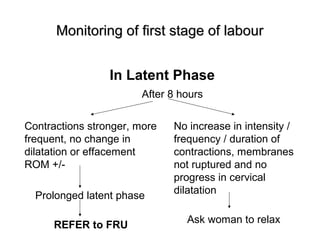
Monitoring of first stage of labourMonitoring of first stage of labour
In Latent Phase
After 8 hours
Contractions stronger, more
frequent, no change in
dilatation or effacement
ROM +/-
REFER to FRU
Prolonged latent phase
No increase in intensity /
frequency / duration of
contractions, membranes
not ruptured and no
progress in cervical
dilatation
Ask woman to relax
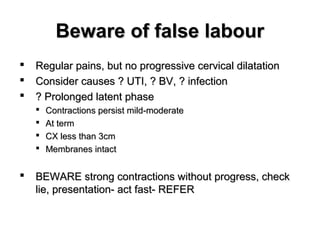
Beware of false labourBeware of false labour
 Regular pains, but no progressive cervical dilatationRegular pains, but no progressive cervical dilatation
 Consider causes ? UTI, ? BV, ? infectionConsider causes ? UTI, ? BV, ? infection
 ? Prolonged latent phase? Prolonged latent phase
 Contractions persist mild-moderateContractions persist mild-moderate
 At termAt term
 CX less than 3cmCX less than 3cm
 Membranes intactMembranes intact
 BEWARE strong contractions without progress, checkBEWARE strong contractions without progress, check
lie, presentation- act fast- REFERlie, presentation- act fast- REFER
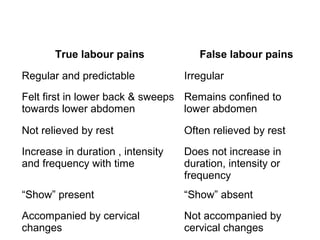
True labour pains False labour pains
Regular and predictable Irregular
Felt first in lower back & sweeps
towards lower abdomen
Remains confined to
lower abdomen
Not relieved by rest Often relieved by rest
Increase in duration , intensity
and frequency with time
Does not increase in
duration, intensity or
frequency
“Show” present “Show” absent
Accompanied by cervical
changes
Not accompanied by
cervical changes
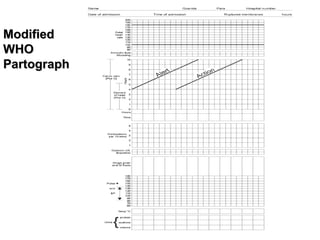
ModifiedModified
WHOWHO
PartographPartograph
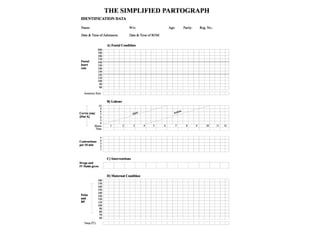
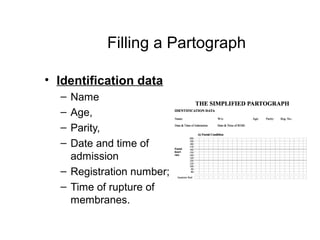
Filling a Partograph
• Identification data
– Name
– Age,
– Parity,
– Date and time of
admission
– Registration number;
– Time of rupture of
membranes.
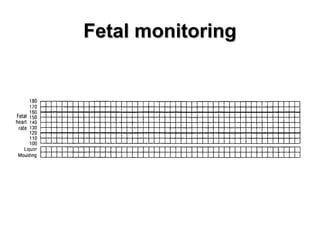
Fetal monitoringFetal monitoring
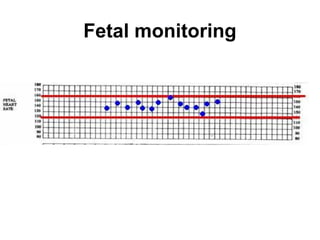
Fetal monitoring
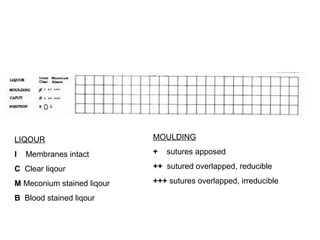
LIQOUR
I Membranes intact
C Clear liqour
M Meconium stained liqour
B Blood stained liqour
MOULDING
+ sutures apposed
++ sutured overlapped, reducible
+++ sutures overlapped, irreducible
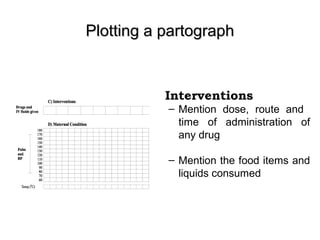
Plotting a partographPlotting a partograph
Interventions
– Mention dose, route and
time of administration of
any drug
– Mention the food items and
liquids consumed
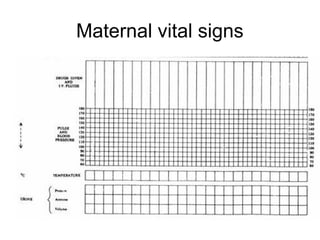
Maternal vital signs
Progress in labourProgress in labour
 Regular contractionsRegular contractions
< 20 sec,< 20 sec, 20-40 sec,20-40 sec, > 40 sec> 40 sec
 Dilatation of cervix –at least 1cm per hourDilatation of cervix –at least 1cm per hour
(follows alert line)(follows alert line)
-- chart aschart as XX
 Descent of presenting part in fifthsDescent of presenting part in fifths
paplablepaplable
-- chart aschart as OO
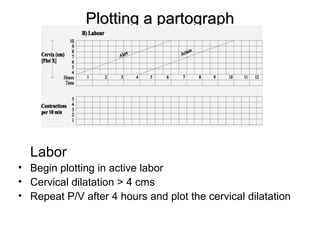
Plotting a partographPlotting a partograph
Labor
• Begin plotting in active labor
• Cervical dilatation > 4 cms
• Repeat P/V after 4 hours and plot the cervical dilatation
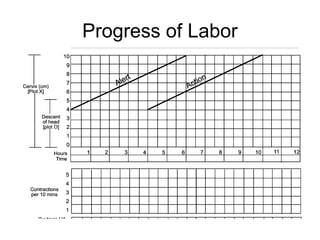
Progress of Labor
ALERT and ACTION linesALERT and ACTION lines
• Alert line: A line starts at 4 cm of cervical dilatation to
the point of expected full dilatation at the rate of 1 cm per
hour.
• Moving to the right or the alert line may require referral to
hospital for extra vigilance
• Action line: Parallel and 4 hours to the right of the alert
line. A lag time of 4 hours between a slowing of labour
and the need for intervention.
• When Action line is reached this is the critical line at
which specific management decisions must be made
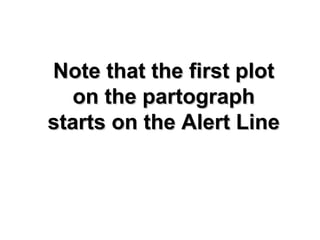
Note that the first plotNote that the first plot
on the partographon the partograph
starts on the Alert Linestarts on the Alert Line
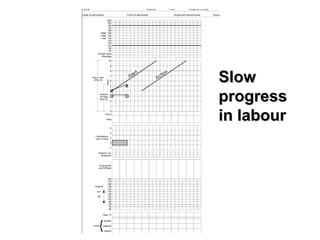
x
x
o o
SlowSlow
progressprogress
in labourin labour
Between alert and action linesBetween alert and action lines
• At lower level facility, the women must be transferred toAt lower level facility, the women must be transferred to
a higher level facility which can do a cesarean section,a higher level facility which can do a cesarean section,
unless the cervix is almost fully dilatedunless the cervix is almost fully dilated
• Continue routine observations but prepare for transfer ifContinue routine observations but prepare for transfer if
neededneeded
• ARM may be performed if membranes are still intactARM may be performed if membranes are still intact
Crossing the Action line
• Crossing of the Action line (the plotting
moves to the right of the Action line) :
indicates the need for intervention
• By the time the action line is crossed the
woman should ideally have reached the FRU
for the appropriate intervention to take place
At or beyond action line:InterventionAt or beyond action line:Intervention
• Repeat full medical assessmentRepeat full medical assessment
• Consider intravenous infusion / bladder catheterization /Consider intravenous infusion / bladder catheterization /
analgesiaanalgesia
• OptionsOptions
 Augment with oxytocin by intravenous infusion only if there areAugment with oxytocin by intravenous infusion only if there are
no contraindicationsno contraindications
 Refer to a higher level facilityRefer to a higher level facility
 Deliver by cesarean section if there is fetal distress orDeliver by cesarean section if there is fetal distress or
diagnosis is obstructed labourdiagnosis is obstructed labour
Slow progress in labour ?Slow progress in labour ?
PowersPowers
 Inadequate contractions (dysfunctional labour)Inadequate contractions (dysfunctional labour)
PassagePassage
 Pelvis too small for baby (cephalopelvic disproportionPelvis too small for baby (cephalopelvic disproportion
– CPD)– CPD)
PassengerPassenger
 Abnormal presentation or position ( e.g. transverse)Abnormal presentation or position ( e.g. transverse)
 Fetal abnormality (e.g. hydrocephalus)Fetal abnormality (e.g. hydrocephalus)
PowersPowers
 Slow progress often due to inadequate uterineSlow progress often due to inadequate uterine
contractionscontractions
 Restore normal progress by:Restore normal progress by:
- rupturing membranesrupturing membranes
- giving syntocinon by IV infusion where allowedgiving syntocinon by IV infusion where allowed
- consider referral to FRUconsider referral to FRU
 Reassess in 2 hoursReassess in 2 hours
 If no further progress REFER for CSIf no further progress REFER for CS
 Cephalopelvic disproportion (CPD)Cephalopelvic disproportion (CPD)
 Malpresentation or MalpositionMalpresentation or Malposition
 Fetal abnormalityFetal abnormality
Passage or Passenger:Passage or Passenger:
Remember!Remember!
 Slow progress may be due to any of theSlow progress may be due to any of the 3Ps3Ps
 Augmentation with syntocinon may beAugmentation with syntocinon may be
dangerous and cause rupture of uterusdangerous and cause rupture of uterus
Slow progress in second stage:Slow progress in second stage:
 Delay in descent of presenting partDelay in descent of presenting part
 Delay in expulsionDelay in expulsion
Slow progress in secondSlow progress in second
stage: Managementstage: Management
 Review maternal positionReview maternal position
 Consider augmentationConsider augmentation
 If fetal head >2/5 palpable deliver by CSIf fetal head >2/5 palpable deliver by CS
(Refer)(Refer)
 If fetal head < 1/5 palpable assist deliveryIf fetal head < 1/5 palpable assist delivery
by vacuum extraction (if avaliable)by vacuum extraction (if avaliable)
IfIf slowslow progress becomesprogress becomes nono
progress and no action isprogress and no action is
taken labour becomestaken labour becomes
obstructedobstructed.
RECAPRECAP
When to start the partographWhen to start the partograph
Correct diagnosis of labourCorrect diagnosis of labour
 Diagnosis and management of slowDiagnosis and management of slow
progress in labour and ensure timelyprogress in labour and ensure timely
referralreferral
Diagnosis of obstructed labourDiagnosis of obstructed labour
Partograph dr sunita

Partograph dr sunita

  • 1.
  • 2.
    AimsAims  To understandthe use of theTo understand the use of the partographpartograph  Practice using the partographPractice using the partograph  To recognise slow progress in labourTo recognise slow progress in labour and manage it appropriatelyand manage it appropriately
  • 3.
    Partograph:Partograph:  a graphicalrecord of progress in laboura graphical record of progress in labour  Should be used for all deliveriesShould be used for all deliveries  Start using once the woman is in labourStart using once the woman is in labour
  • 4.
    LabourLabour  A correctdiagnosis of labour has to beA correct diagnosis of labour has to be made before opening the partographmade before opening the partograph  2-3 uterine contractions in 10mins2-3 uterine contractions in 10mins  Progressive shortening and thinning of theProgressive shortening and thinning of the cervix during labour andcervix during labour and  Cervical dilatationCervical dilatation 4cm4cm or more dilated:or more dilated: openopen partographpartograph
  • 5.
    Monitoring of firststage of labourMonitoring of first stage of labour In Latent Phase After 8 hours Contractions stronger, more frequent, no change in dilatation or effacement ROM +/- REFER to FRU Prolonged latent phase No increase in intensity / frequency / duration of contractions, membranes not ruptured and no progress in cervical dilatation Ask woman to relax
  • 6.
    Beware of falselabourBeware of false labour  Regular pains, but no progressive cervical dilatationRegular pains, but no progressive cervical dilatation  Consider causes ? UTI, ? BV, ? infectionConsider causes ? UTI, ? BV, ? infection  ? Prolonged latent phase? Prolonged latent phase  Contractions persist mild-moderateContractions persist mild-moderate  At termAt term  CX less than 3cmCX less than 3cm  Membranes intactMembranes intact  BEWARE strong contractions without progress, checkBEWARE strong contractions without progress, check lie, presentation- act fast- REFERlie, presentation- act fast- REFER
  • 7.
    True labour painsFalse labour pains Regular and predictable Irregular Felt first in lower back & sweeps towards lower abdomen Remains confined to lower abdomen Not relieved by rest Often relieved by rest Increase in duration , intensity and frequency with time Does not increase in duration, intensity or frequency “Show” present “Show” absent Accompanied by cervical changes Not accompanied by cervical changes
  • 8.
  • 10.
    Filling a Partograph •Identification data – Name – Age, – Parity, – Date and time of admission – Registration number; – Time of rupture of membranes.
  • 11.
  • 12.
  • 13.
    LIQOUR I Membranes intact CClear liqour M Meconium stained liqour B Blood stained liqour MOULDING + sutures apposed ++ sutured overlapped, reducible +++ sutures overlapped, irreducible
  • 14.
    Plotting a partographPlottinga partograph Interventions – Mention dose, route and time of administration of any drug – Mention the food items and liquids consumed
  • 15.
  • 16.
    Progress in labourProgressin labour  Regular contractionsRegular contractions < 20 sec,< 20 sec, 20-40 sec,20-40 sec, > 40 sec> 40 sec  Dilatation of cervix –at least 1cm per hourDilatation of cervix –at least 1cm per hour (follows alert line)(follows alert line) -- chart aschart as XX  Descent of presenting part in fifthsDescent of presenting part in fifths paplablepaplable -- chart aschart as OO
  • 17.
    Plotting a partographPlottinga partograph Labor • Begin plotting in active labor • Cervical dilatation > 4 cms • Repeat P/V after 4 hours and plot the cervical dilatation
  • 18.
  • 19.
    ALERT and ACTIONlinesALERT and ACTION lines • Alert line: A line starts at 4 cm of cervical dilatation to the point of expected full dilatation at the rate of 1 cm per hour. • Moving to the right or the alert line may require referral to hospital for extra vigilance • Action line: Parallel and 4 hours to the right of the alert line. A lag time of 4 hours between a slowing of labour and the need for intervention. • When Action line is reached this is the critical line at which specific management decisions must be made
  • 20.
    Note that thefirst plotNote that the first plot on the partographon the partograph starts on the Alert Linestarts on the Alert Line
  • 21.
  • 22.
    Between alert andaction linesBetween alert and action lines • At lower level facility, the women must be transferred toAt lower level facility, the women must be transferred to a higher level facility which can do a cesarean section,a higher level facility which can do a cesarean section, unless the cervix is almost fully dilatedunless the cervix is almost fully dilated • Continue routine observations but prepare for transfer ifContinue routine observations but prepare for transfer if neededneeded • ARM may be performed if membranes are still intactARM may be performed if membranes are still intact
  • 23.
    Crossing the Actionline • Crossing of the Action line (the plotting moves to the right of the Action line) : indicates the need for intervention • By the time the action line is crossed the woman should ideally have reached the FRU for the appropriate intervention to take place
  • 24.
    At or beyondaction line:InterventionAt or beyond action line:Intervention • Repeat full medical assessmentRepeat full medical assessment • Consider intravenous infusion / bladder catheterization /Consider intravenous infusion / bladder catheterization / analgesiaanalgesia • OptionsOptions  Augment with oxytocin by intravenous infusion only if there areAugment with oxytocin by intravenous infusion only if there are no contraindicationsno contraindications  Refer to a higher level facilityRefer to a higher level facility  Deliver by cesarean section if there is fetal distress orDeliver by cesarean section if there is fetal distress or diagnosis is obstructed labourdiagnosis is obstructed labour
  • 25.
    Slow progress inlabour ?Slow progress in labour ? PowersPowers  Inadequate contractions (dysfunctional labour)Inadequate contractions (dysfunctional labour) PassagePassage  Pelvis too small for baby (cephalopelvic disproportionPelvis too small for baby (cephalopelvic disproportion – CPD)– CPD) PassengerPassenger  Abnormal presentation or position ( e.g. transverse)Abnormal presentation or position ( e.g. transverse)  Fetal abnormality (e.g. hydrocephalus)Fetal abnormality (e.g. hydrocephalus)
  • 26.
    PowersPowers  Slow progressoften due to inadequate uterineSlow progress often due to inadequate uterine contractionscontractions  Restore normal progress by:Restore normal progress by: - rupturing membranesrupturing membranes - giving syntocinon by IV infusion where allowedgiving syntocinon by IV infusion where allowed - consider referral to FRUconsider referral to FRU  Reassess in 2 hoursReassess in 2 hours  If no further progress REFER for CSIf no further progress REFER for CS
  • 27.
     Cephalopelvic disproportion(CPD)Cephalopelvic disproportion (CPD)  Malpresentation or MalpositionMalpresentation or Malposition  Fetal abnormalityFetal abnormality Passage or Passenger:Passage or Passenger:
  • 28.
    Remember!Remember!  Slow progressmay be due to any of theSlow progress may be due to any of the 3Ps3Ps  Augmentation with syntocinon may beAugmentation with syntocinon may be dangerous and cause rupture of uterusdangerous and cause rupture of uterus
  • 29.
    Slow progress insecond stage:Slow progress in second stage:  Delay in descent of presenting partDelay in descent of presenting part  Delay in expulsionDelay in expulsion
  • 30.
    Slow progress insecondSlow progress in second stage: Managementstage: Management  Review maternal positionReview maternal position  Consider augmentationConsider augmentation  If fetal head >2/5 palpable deliver by CSIf fetal head >2/5 palpable deliver by CS (Refer)(Refer)  If fetal head < 1/5 palpable assist deliveryIf fetal head < 1/5 palpable assist delivery by vacuum extraction (if avaliable)by vacuum extraction (if avaliable)
  • 31.
    IfIf slowslow progressbecomesprogress becomes nono progress and no action isprogress and no action is taken labour becomestaken labour becomes obstructedobstructed.
  • 32.
    RECAPRECAP When to startthe partographWhen to start the partograph Correct diagnosis of labourCorrect diagnosis of labour  Diagnosis and management of slowDiagnosis and management of slow progress in labour and ensure timelyprogress in labour and ensure timely referralreferral Diagnosis of obstructed labourDiagnosis of obstructed labour

Editor's Notes

  • #5 Regular, painful and progressive contractions
  • #16 Mention frequency and responsibility, doctors and midwives
  • #31 Ventouse preferred to forceps, and symphysiotomy may not be practised in some countries by law ie Ghana