PRESENTATIONBY,
Ms. KEERTI H
(OBG Nursing)
 The PARTOGRAPH was first introduced in 1954 by
Friedman. Graphically depicting the dilatation of the cervix
during labour.
 Philpott and Castle in 1972 developed Friedman's concept into
a tool for monitoring labour by adding the action and alert
lines.
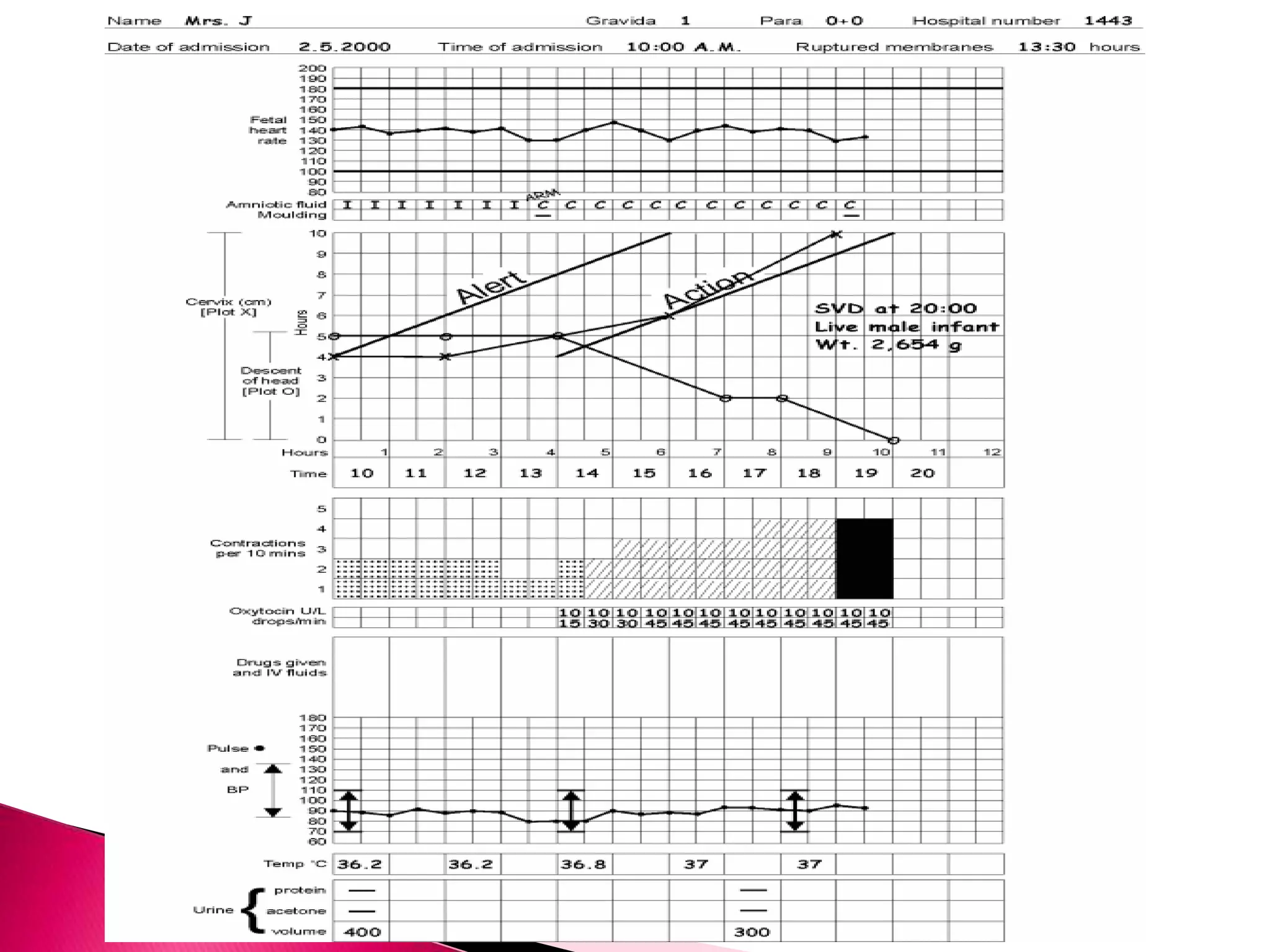
 A partograph is a graphical record of key data
(maternal & fetal) during labour, entered against
time on a single sheet of paper.
 It was developed and extensively tested by the world
health organization WHO
 Early detection of abnormal progress
of a labour .
Prevention of prolonged labour.
 Recognize cephalopelvic disproportion- long before
obstructed labour assist in early decision on transfer ,
augmentation , or termination of labour.
Increase the quality and regularity of all observations of
mother and fetus
 Early recognition of maternal or fetal problems
 The partograph can be highly effective in reducing
complications from prolonged labor for the mother
(postpartum hemorrhage, sepsis, uterine rupture) and
for the newborn (death, anoxia, infections, etc)
 Part I : Fetal Condition ( At Top )
 Part II : Progress Of Labour ( At Middle)
 Part III : Maternal Condition ( At Bottom )
 Outcome : ………………
 Name
 DOA/Time
 Gravida/Parity
 Age
 Gestational week
 IP Number
 ROM
 LMP
 EDD
 Labour duration (Hr)
 Faculty/ Clinic Name
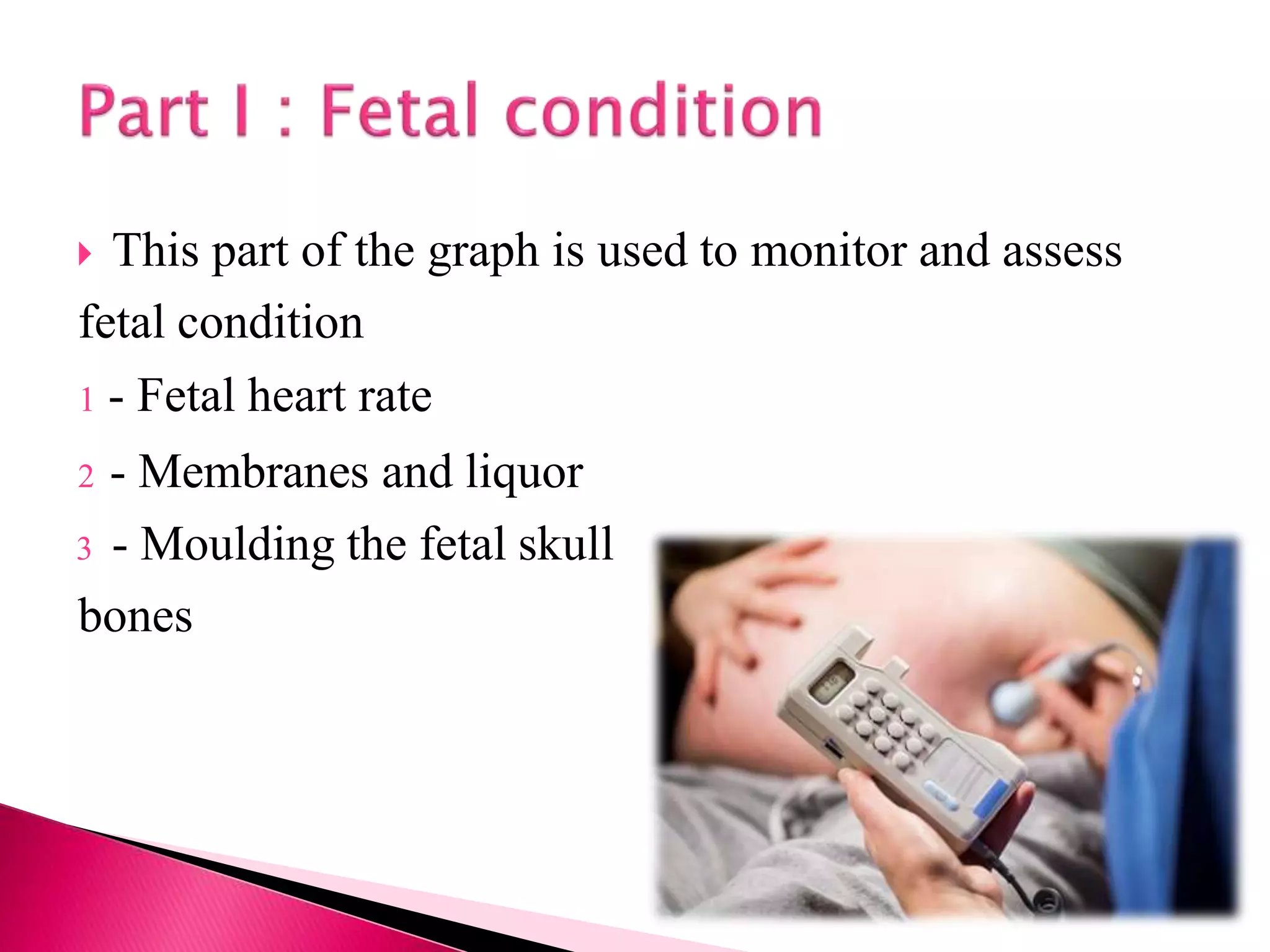
 This part of the graph is used to monitor and assess
fetal condition
1 - Fetal heart rate
2 - Membranes and liquor
3 - Moulding the fetal skull
bones
 Fetal heart rate
> 180 beats/min =Tachycardia
< 160 beats/min = Bradycardia
< 100 beats/min = Severe Bradycardia
 Intact Membranes ……………………………………….I
 Ruptured Membranes + Clear Liquor …………………….C
 Ruptured Membranes + Meconium- Stained Liquor ……..M
 Ruptured Membranes + Blood – Stained Liquor …………B
 Ruptured Membranes + Absent Liquor…………………....A
 Molding is alteration of the shape of the fore-coming head
while passing through the resistant birth passage during labor.
 Increasing Molding with the head, high in the pelvis is an
ominous sign of cephalopelvic disproportion.
 Separated Bones Sutures Felt Easily ……………….….O
 Bones Just Touching Each Other ………………………..+
 Overlapping Bones ( Reducible ) ……………………...++
 Severely Overlapping Bones ( Non – Reducible ) ……..+++
 Cervical dilatation
 Descent ofthe fetal head Fetal position
 Uterine contractions
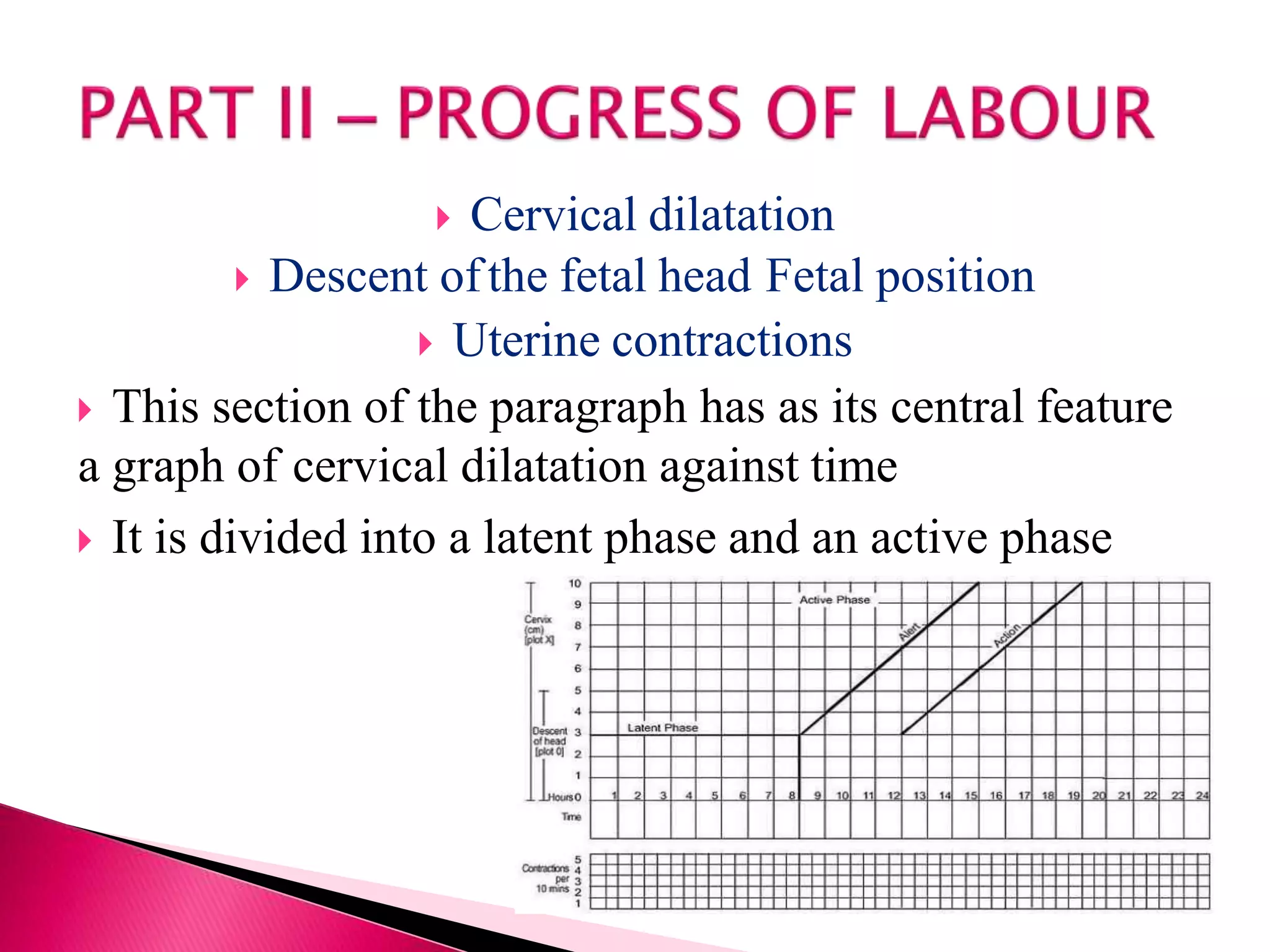
 This section of the paragraph has as its central feature
a graph of cervical dilatation against time
 It is divided into a latent phase and an active phase
 It starts from onset of labour until the cervix reaches 4 cm dilatation
 Once 4 cm dilatation is reached , labour enters the active phase
 Lasts 8 hours or less
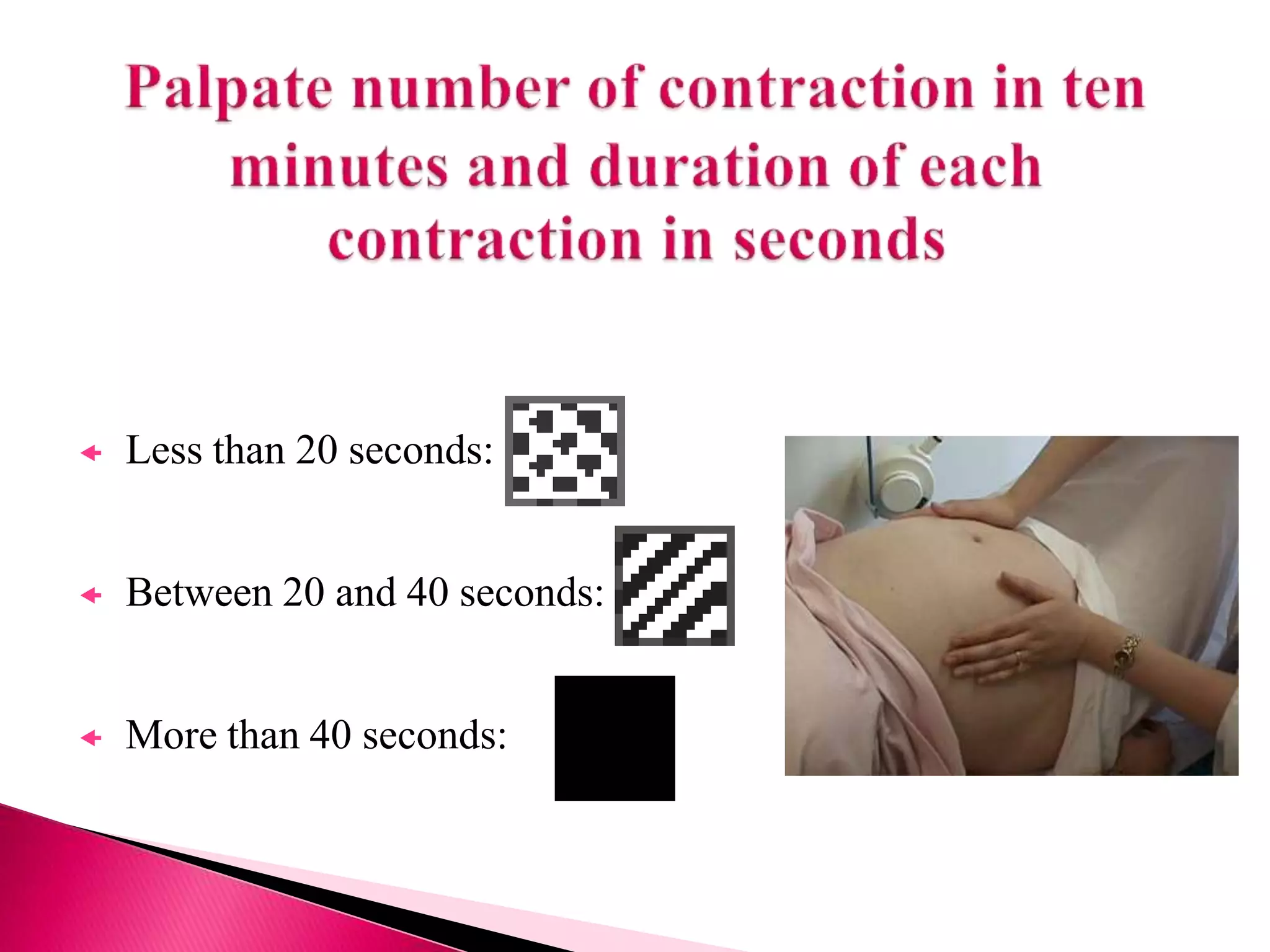
 Each lasting <20 seconds
 At least 2/10 min contractions
ACTIVE PHASE
 Contractions at least 3 / 10 min each lasting< 40
seconds
 The cervix should dilate at a rate of 1 cm / hour or faster
 The alert line drawn from 4cm dilatation represents
the rate of dilatation of 1cm / hour
 Moving to the right or the alert line means referral to
hospital for extra vigilance
ACTION LINE ( HOSPITAL LINE)
 It is drawn 4 hours to the right of the alert line and
parellel to it.
 This is the critical line at which specific management
decisions must be made at the higher level of health
care facility.
 It is the most important information and the surest way toassess
progress of labour.
 When progress of labour is normal and satisfactory, plotting of
cervical dilatation remains on the alert line or to left of it.
 If a woman arrives in the active phase of labour , recording of
cervical dilatation starts on the alert line
 It should be assessed by abdominal examination
immediately before doing a vaginal examination,
using the rule of fifth to assess engagement
 The rule of fifth means the palpable fifth of the fetal
head are felt by abdominal examination to be above
the level of symphysis pubis
 When 2/5 or less of fetal head is felt above the level
of symphysis pubis , this means that the head is
engaged , and by vaginal examination , the lowest
part of vertex has passed or is at the level of ischial
spines
 Observations of the contractions are made every hour in
the latent phase and every half-hour in the active phase
 Frequency- How often are they felt ?
 Assessed by number of contractions in a 10 minutes
period.
 Duration - How long do they last ?
 Measured in seconds from the time the contraction is first
felt abdominally , to the time the contraction phases off
 Each square represents one contraction
 Less than 20 seconds:
 Between 20 and 40 seconds:
 More than 40 seconds:
 Stop oxytocin infusion if there is evidence of uterine
hyperactivity or fetal distress
 Augment with oxytocin only after artificial
rupture of membranes.
Assess maternal condition regularly by monitoring
Drugs , IV Fluids , Oxytocin
 Pulse
 Blood Pressure
 Temperature
 Urine Volume ,
Analysis For Protein
And Acetone
 DariaDaria was admitted in active labour at22:00
 Gravida 1 Para 0
 Fetal heart rate 130 beats per minute
 Fetal head 5/5 palpable
 Cervical dilatation 5 cm Three contractions in 10 minutes
eachlasting 30 seconds Intact membranes
 The bones are separated and the sutures can be felt easily
 Pulse 70 per minute
 Blood pressure 120/80 mm Hg
 Temperature 36.8
 At 2:00Fetal head 2/5 palpable
 Cervical dilatation 9 cm Four contractions in 10 minutes,
eachlasting more than 40 secondsIntact membranes
 The bones are still separated and the sutures can be felt easily
 Nima Bhaskar,textbook of Midwifery and Obstetrical
Nursing.2nd edition,Emmess publications, Newdelhi 2016,205-
209
 D.C Datta, textbook of obstetrics 8th edt,jaypee publication,
Newdelhi,2017,607-608
 Myles textbook for midwives 16th edt,2014,339
 Kamini rao textbook of midwifery and obstetrics for nurses,1st
edt.elsevier publication 2011,449
 Internet souces (Images)
PARTOGRAPH.pptx

PARTOGRAPH.pptx

  • 1.
  • 2.
     The PARTOGRAPHwas first introduced in 1954 by Friedman. Graphically depicting the dilatation of the cervix during labour.  Philpott and Castle in 1972 developed Friedman's concept into a tool for monitoring labour by adding the action and alert lines.
  • 3.
     A partographis a graphical record of key data (maternal & fetal) during labour, entered against time on a single sheet of paper.  It was developed and extensively tested by the world health organization WHO
  • 4.
     Early detectionof abnormal progress of a labour . Prevention of prolonged labour.  Recognize cephalopelvic disproportion- long before obstructed labour assist in early decision on transfer , augmentation , or termination of labour. Increase the quality and regularity of all observations of mother and fetus
  • 5.
     Early recognitionof maternal or fetal problems  The partograph can be highly effective in reducing complications from prolonged labor for the mother (postpartum hemorrhage, sepsis, uterine rupture) and for the newborn (death, anoxia, infections, etc)
  • 6.
     Part I: Fetal Condition ( At Top )  Part II : Progress Of Labour ( At Middle)  Part III : Maternal Condition ( At Bottom )  Outcome : ………………
  • 7.
     Name  DOA/Time Gravida/Parity  Age  Gestational week  IP Number  ROM  LMP  EDD  Labour duration (Hr)  Faculty/ Clinic Name
  • 8.
     This partof the graph is used to monitor and assess fetal condition 1 - Fetal heart rate 2 - Membranes and liquor 3 - Moulding the fetal skull bones
  • 9.
     Fetal heartrate > 180 beats/min =Tachycardia < 160 beats/min = Bradycardia < 100 beats/min = Severe Bradycardia
  • 10.
     Intact Membranes……………………………………….I  Ruptured Membranes + Clear Liquor …………………….C  Ruptured Membranes + Meconium- Stained Liquor ……..M  Ruptured Membranes + Blood – Stained Liquor …………B  Ruptured Membranes + Absent Liquor…………………....A
  • 11.
     Molding isalteration of the shape of the fore-coming head while passing through the resistant birth passage during labor.  Increasing Molding with the head, high in the pelvis is an ominous sign of cephalopelvic disproportion.  Separated Bones Sutures Felt Easily ……………….….O  Bones Just Touching Each Other ………………………..+  Overlapping Bones ( Reducible ) ……………………...++  Severely Overlapping Bones ( Non – Reducible ) ……..+++
  • 12.
     Cervical dilatation Descent ofthe fetal head Fetal position  Uterine contractions  This section of the paragraph has as its central feature a graph of cervical dilatation against time  It is divided into a latent phase and an active phase
  • 13.
     It startsfrom onset of labour until the cervix reaches 4 cm dilatation  Once 4 cm dilatation is reached , labour enters the active phase  Lasts 8 hours or less  Each lasting <20 seconds  At least 2/10 min contractions ACTIVE PHASE  Contractions at least 3 / 10 min each lasting< 40 seconds  The cervix should dilate at a rate of 1 cm / hour or faster
  • 14.
     The alertline drawn from 4cm dilatation represents the rate of dilatation of 1cm / hour  Moving to the right or the alert line means referral to hospital for extra vigilance ACTION LINE ( HOSPITAL LINE)  It is drawn 4 hours to the right of the alert line and parellel to it.  This is the critical line at which specific management decisions must be made at the higher level of health care facility.
  • 15.
     It isthe most important information and the surest way toassess progress of labour.  When progress of labour is normal and satisfactory, plotting of cervical dilatation remains on the alert line or to left of it.  If a woman arrives in the active phase of labour , recording of cervical dilatation starts on the alert line
  • 16.
     It shouldbe assessed by abdominal examination immediately before doing a vaginal examination, using the rule of fifth to assess engagement  The rule of fifth means the palpable fifth of the fetal head are felt by abdominal examination to be above the level of symphysis pubis  When 2/5 or less of fetal head is felt above the level of symphysis pubis , this means that the head is engaged , and by vaginal examination , the lowest part of vertex has passed or is at the level of ischial spines
  • 18.
     Observations ofthe contractions are made every hour in the latent phase and every half-hour in the active phase  Frequency- How often are they felt ?  Assessed by number of contractions in a 10 minutes period.  Duration - How long do they last ?  Measured in seconds from the time the contraction is first felt abdominally , to the time the contraction phases off  Each square represents one contraction
  • 19.
     Less than20 seconds:  Between 20 and 40 seconds:  More than 40 seconds:
  • 20.
     Stop oxytocininfusion if there is evidence of uterine hyperactivity or fetal distress  Augment with oxytocin only after artificial rupture of membranes.
  • 21.
    Assess maternal conditionregularly by monitoring Drugs , IV Fluids , Oxytocin  Pulse  Blood Pressure  Temperature  Urine Volume , Analysis For Protein And Acetone
  • 23.
     DariaDaria wasadmitted in active labour at22:00  Gravida 1 Para 0  Fetal heart rate 130 beats per minute  Fetal head 5/5 palpable  Cervical dilatation 5 cm Three contractions in 10 minutes eachlasting 30 seconds Intact membranes  The bones are separated and the sutures can be felt easily  Pulse 70 per minute  Blood pressure 120/80 mm Hg  Temperature 36.8  At 2:00Fetal head 2/5 palpable  Cervical dilatation 9 cm Four contractions in 10 minutes, eachlasting more than 40 secondsIntact membranes  The bones are still separated and the sutures can be felt easily
  • 24.
     Nima Bhaskar,textbookof Midwifery and Obstetrical Nursing.2nd edition,Emmess publications, Newdelhi 2016,205- 209  D.C Datta, textbook of obstetrics 8th edt,jaypee publication, Newdelhi,2017,607-608  Myles textbook for midwives 16th edt,2014,339  Kamini rao textbook of midwifery and obstetrics for nurses,1st edt.elsevier publication 2011,449  Internet souces (Images)