A Guide To ObGyn Case 
Presentation 
OBSTETRIC 
HISTORY I 
For a patient who presents 
with a complaint 
Associate Professor Dr Hanifullah Khan
The importance of a good history 
Introduction This section details the key 
points of a clinical history
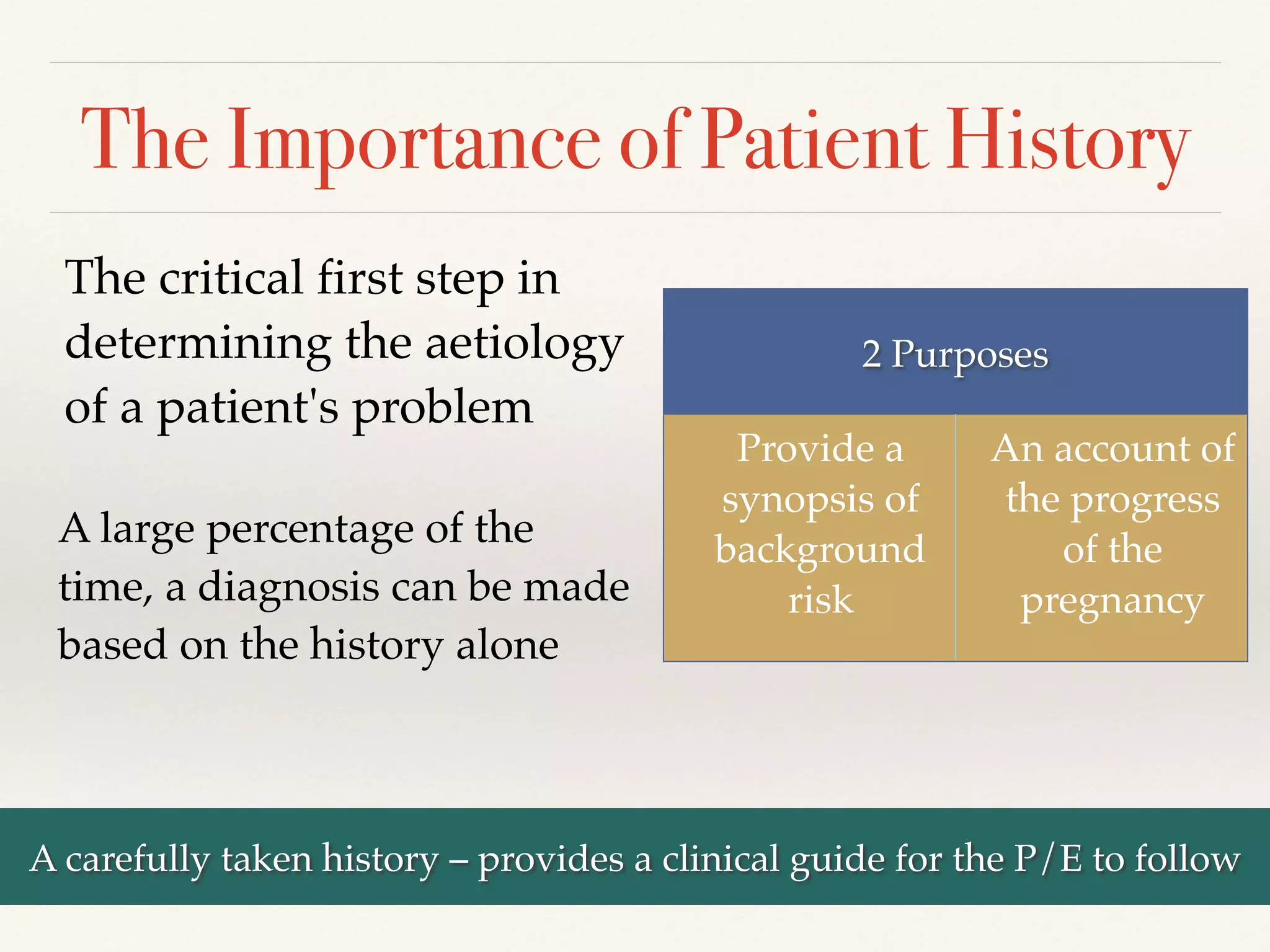
The Importance of Patient History 
The critical first step in 
determining the aetiology 
of a patient's problem 
A large percentage of the 
time, a diagnosis can be made 
based on the history alone 
2 Purposes 
Provide a 
synopsis of 
background 
risk! 
An account of 
the progress 
of the 
pregnancy 
A carefully taken history – provides a clinical guide for the P/E to follow
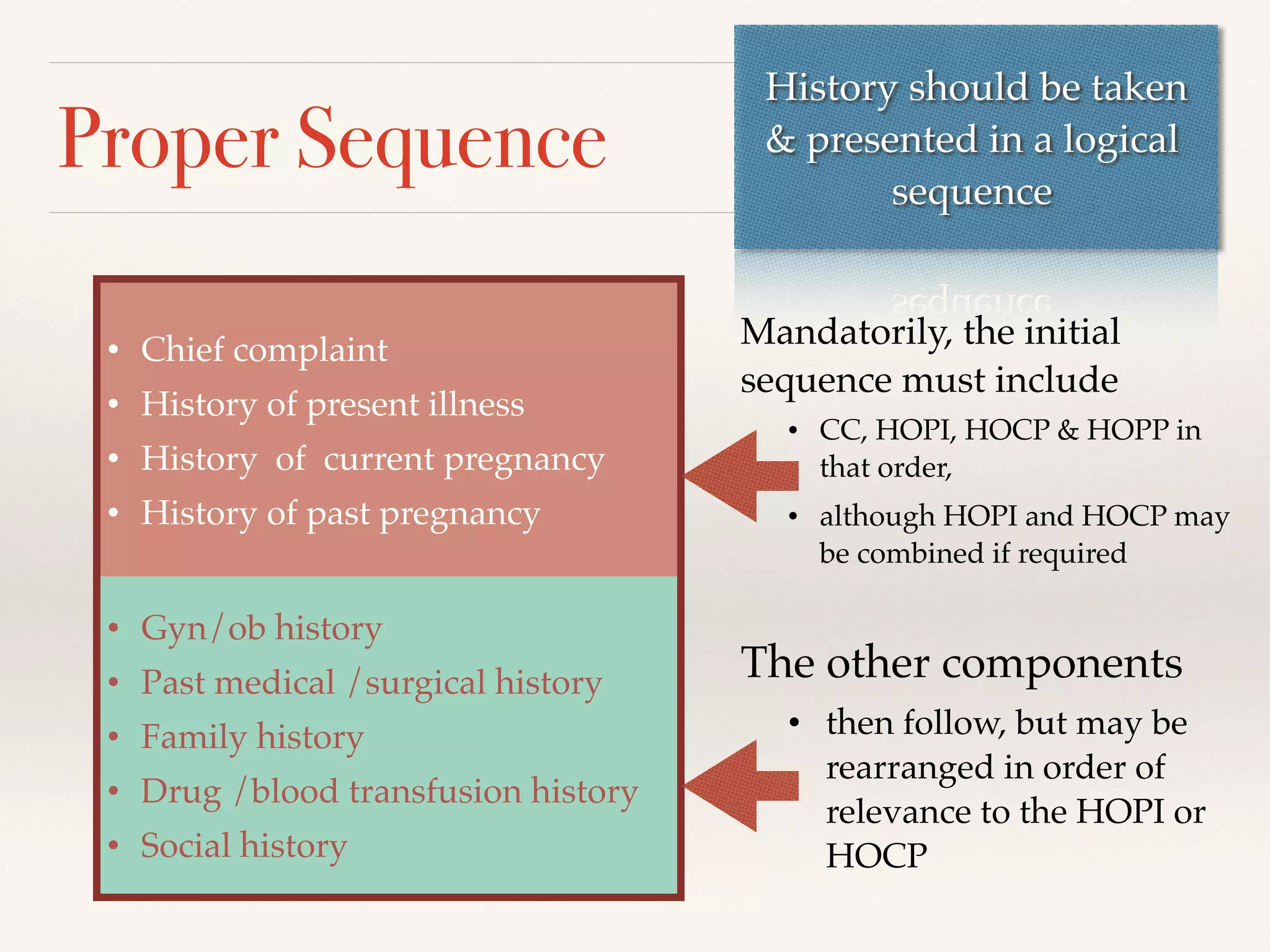
Proper Sequence History should be taken 
& presented in a logical 
sequence 
Mandatorily, the initial 
sequence must include ! 
• CC, HOPI, HOCP & HOPP in 
that order, ! 
• although HOPI and HOCP may 
be combined if required 
• Chief complaint! 
• History of present illness! 
• History of current pregnancy! 
• History of past pregnancy 
• Gyn/ob history! 
• Past medical /surgical history! 
• Family history! 
• Drug /blood transfusion history! 
• Social history 
The other components! 
• then follow, but may be 
rearranged in order of 
relevance to the HOPI or 
HOCP
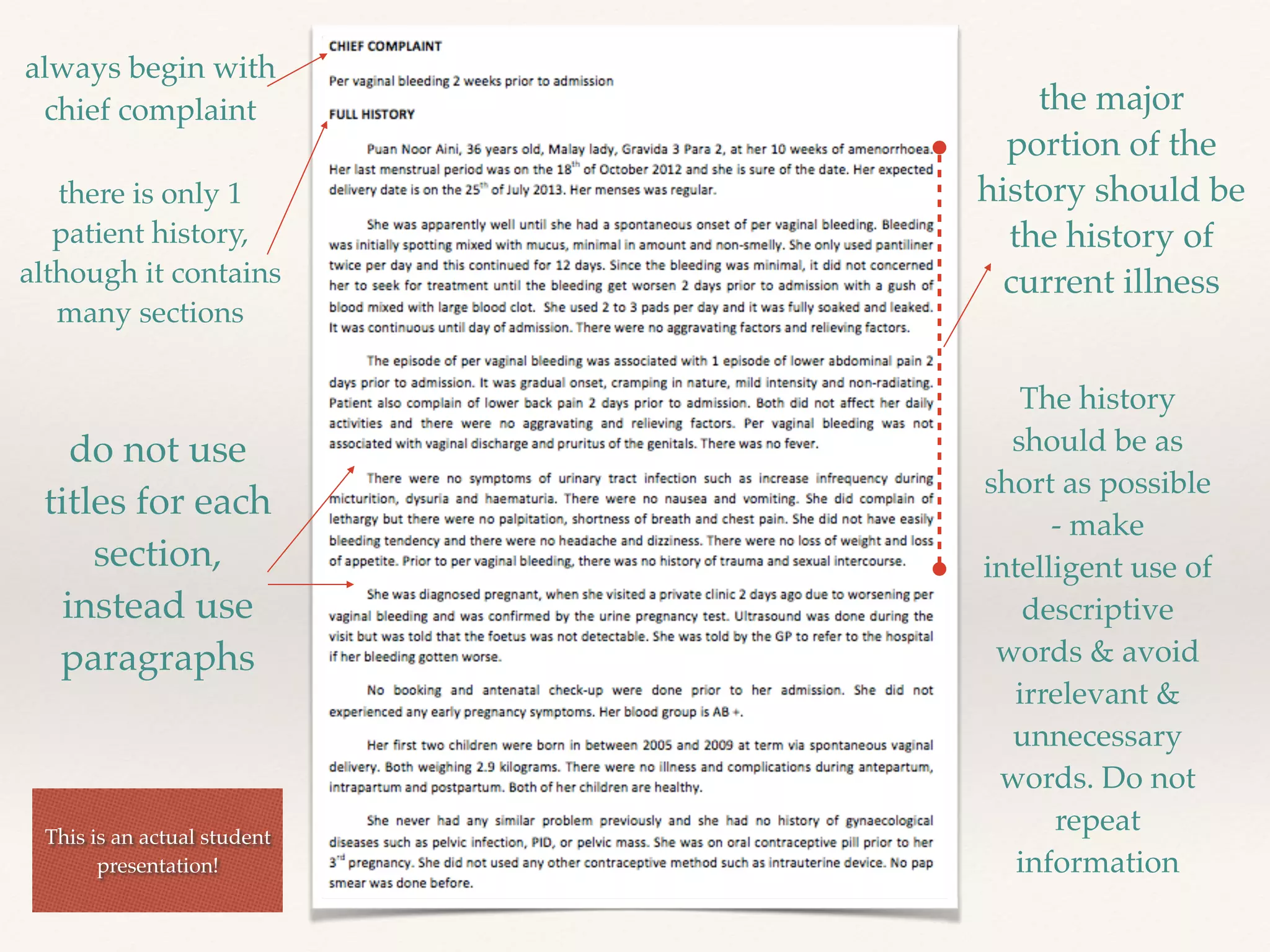
This is an actual student history 
Sample History
always begin with 
chief complaint 
there is only 1 
patient history, 
although it contains 
many sections 
do not use 
titles for each 
section, 
instead use 
paragraphs 
the major 
portion of the 
history should be 
the history of 
current illness 
The history 
should be as 
short as possible 
- make 
intelligent use of 
descriptive 
words & avoid 
irrelevant & 
unnecessary 
words. Do not 
repeat 
information 
! 
This is an actual student 
presentation!!
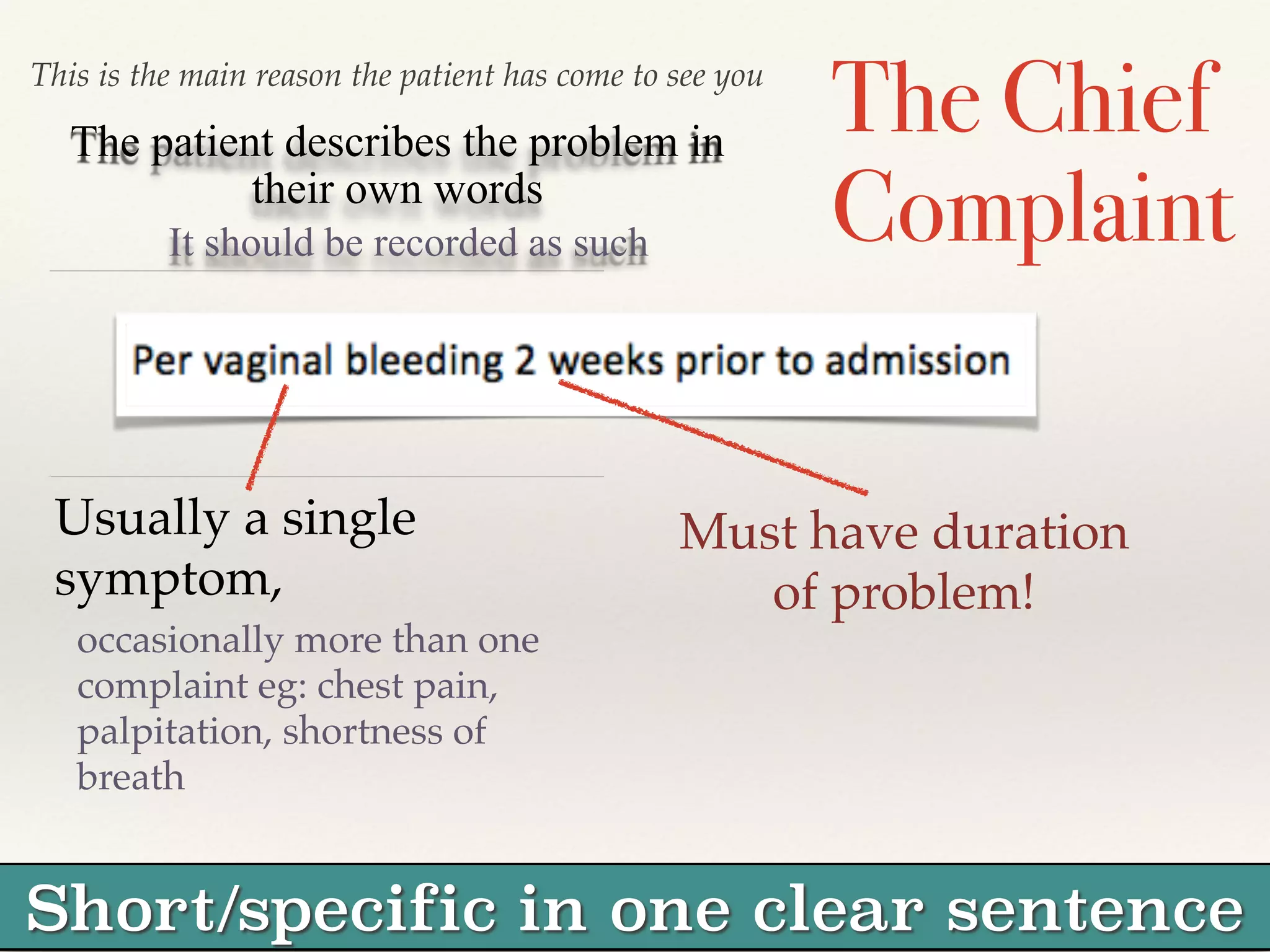
This is the main reason the patient has come to see you The Chief 
Complaint 
The patient describes the problem in 
their own words 
It should be recorded as such 
Usually a single 
symptom, ! 
occasionally more than one 
complaint eg: chest pain, 
palpitation, shortness of 
breath 
Must have duration 
of problem! 
Short/specific in one clear sentence
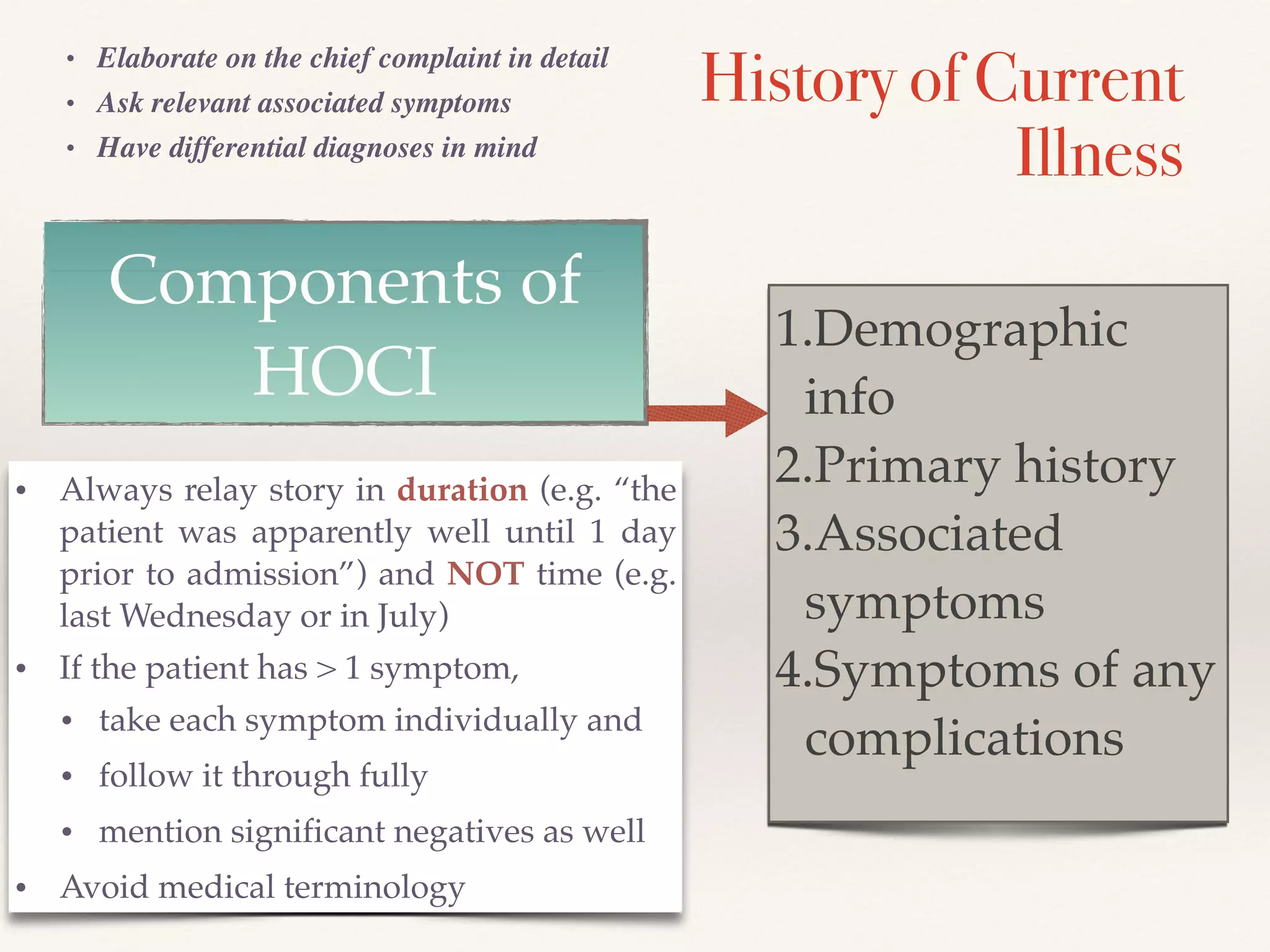
• Elaborate on the chief complaint in detail 
• Ask relevant associated symptoms 
• Have differential diagnoses in mind 
History of Current 
Illness 
1.Demographic 
info! 
2.Primary history ! 
3.Associated 
symptoms! 
4.Symptoms of any 
complications 
Components of 
HOCI 
• Always relay story in duration (e.g. “the 
patient was apparently well until 1 day 
prior to admission”) and NOT time (e.g. 
last Wednesday or in July)! 
• If the patient has > 1 symptom, ! 
• take each symptom individually and ! 
• follow it through fully ! 
• mention significant negatives as well! 
• Avoid medical terminology
Components of 
HOCI! 
1. Demographic 
info! 
2. Primary 
history ! 
3. Associated 
symptoms! 
4. Symptoms of 
any 
complications 
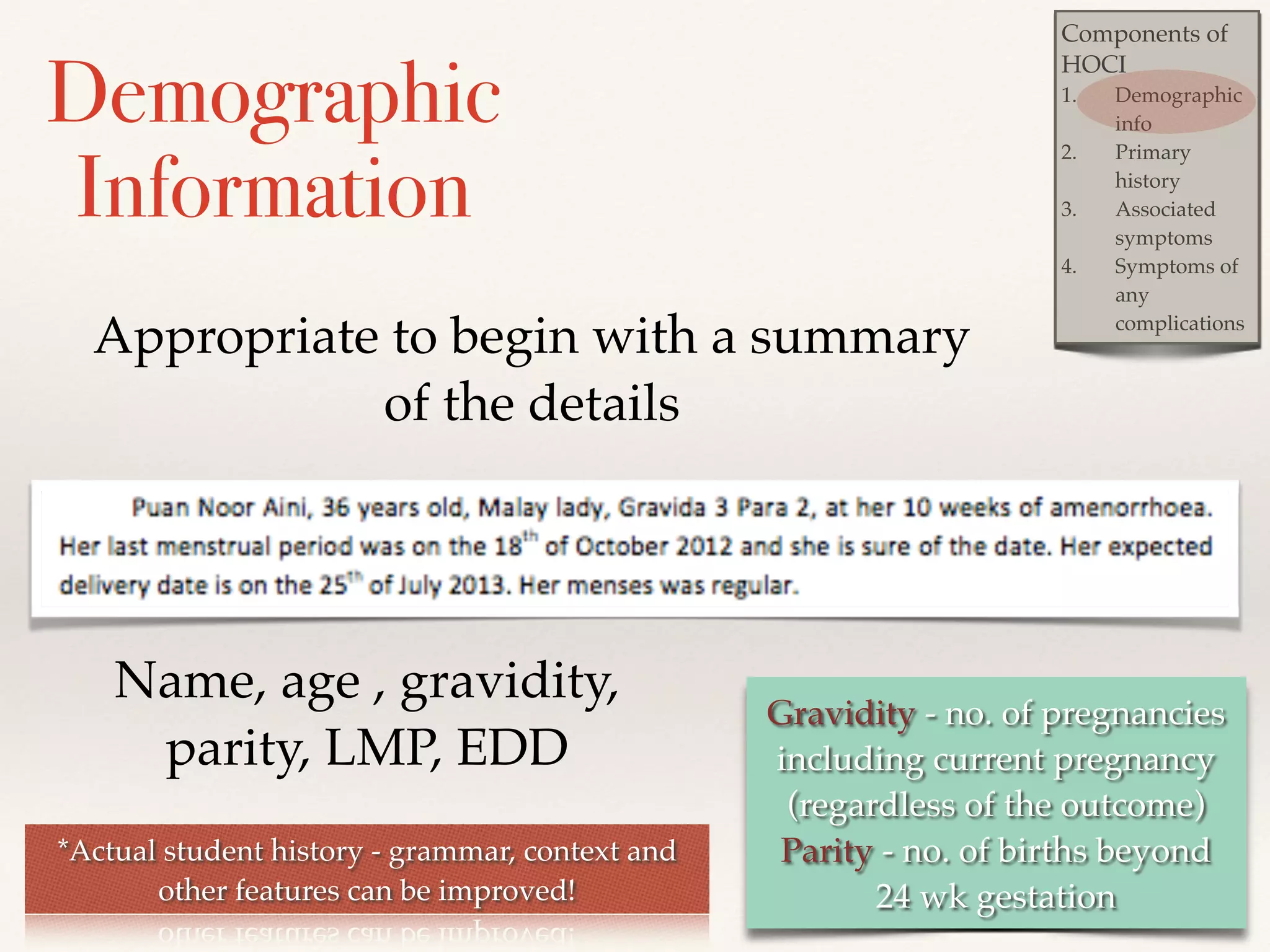
Demographic 
Information 
Appropriate to begin with a summary 
Gravidity - no. of pregnancies! 
including current pregnancy! 
(regardless of the outcome)! 
Parity - no. of births beyond ! 
24 wk gestation 
of the details 
Name, age , gravidity, 
parity, LMP, EDD 
*Actual student history - grammar, context and 
other features can be improved!
Components of 
HOCI! 
1. Demographic 
info! 
2. Primary 
history ! 
3. Associated 
symptoms! 
4. Symptoms of 
any 
complications 
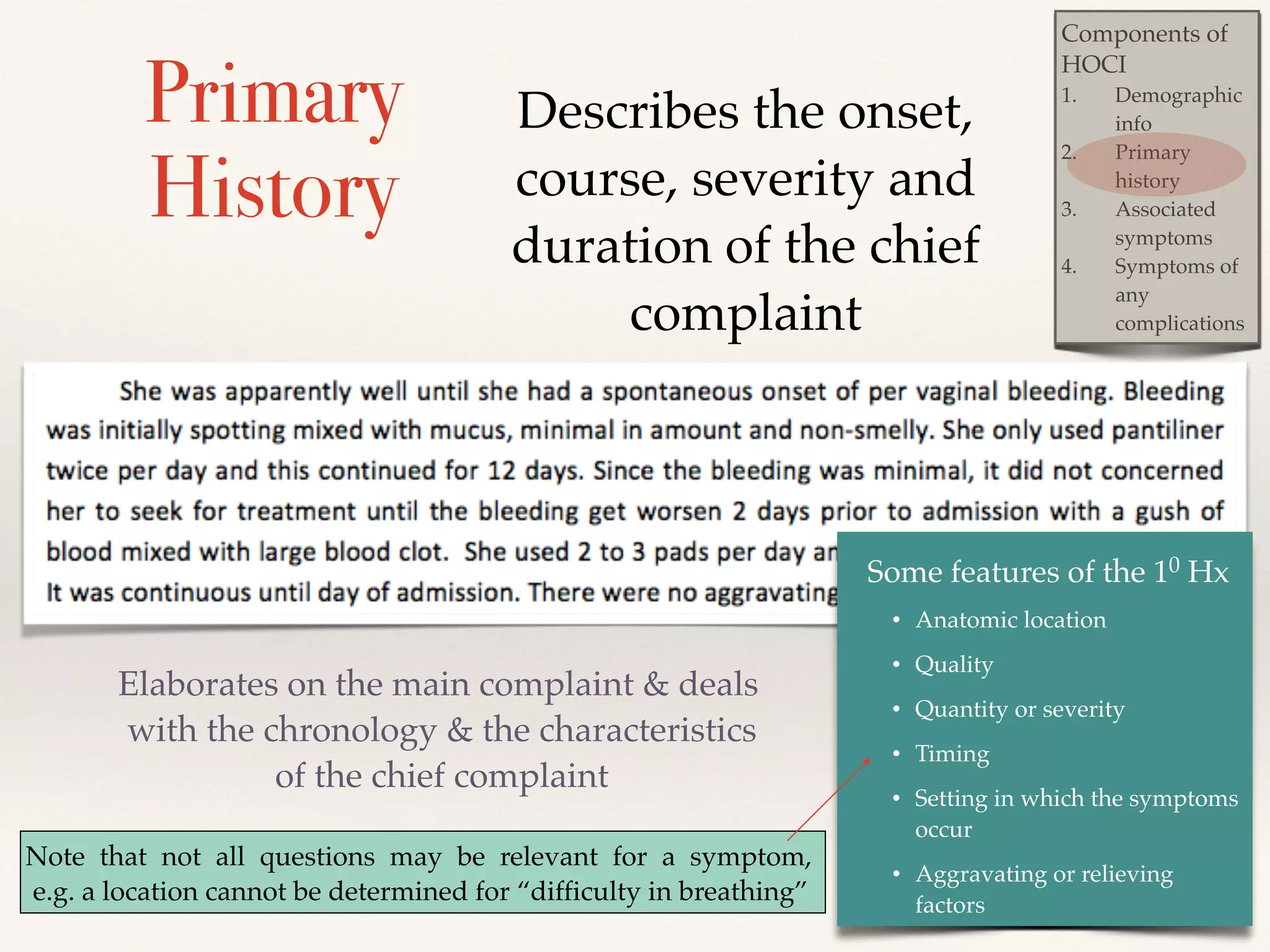
Primary 
History 
Describes the onset, 
course, severity and 
duration of the chief 
Elaborates on the main complaint & deals 
with the chronology & the characteristics 
of the chief complaint 
complaint 
Some features of the 10 Hx! 
• Anatomic location! 
• Quality! 
• Quantity or severity! 
• Timing! 
• Setting in which the symptoms 
occur! 
• Aggravating or relieving 
factors 
Note that not all questions may be relevant for a symptom, 
e.g. a location cannot be determined for “difficulty in breathing”
Components of 
HOCI! 
1. Demographic 
info! 
2. Primary 
history ! 
3. Associated 
symptoms! 
4. Symptoms of 
any 
complications 
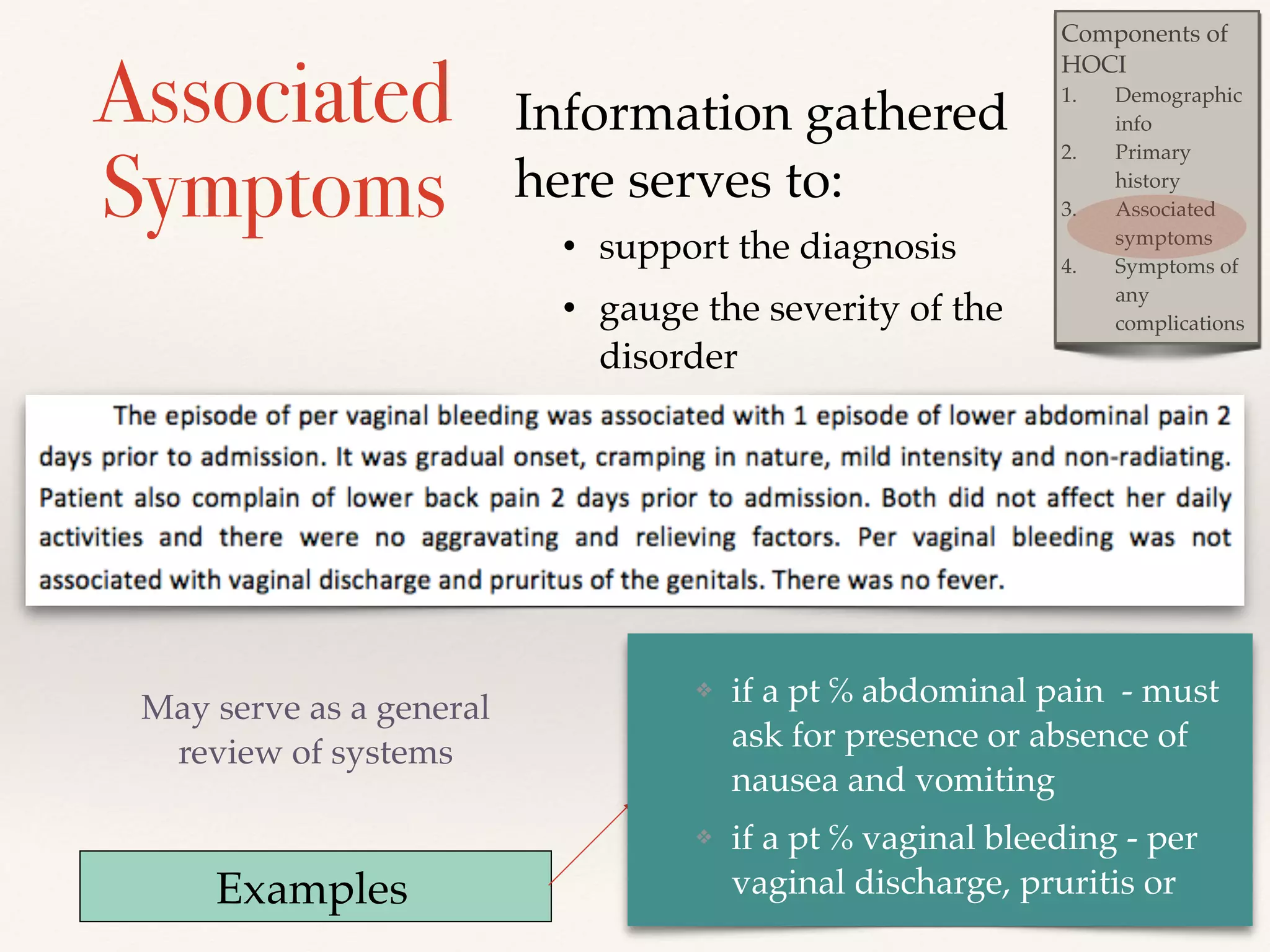
Associated 
Symptoms 
May serve as a general 
review of systems 
Information gathered 
here serves to: ! 
• support the diagnosis ! 
• gauge the severity of the 
disorder 
Examples 
❖ if a pt ℅ abdominal pain - must 
ask for presence or absence of 
nausea and vomiting! 
❖ if a pt ℅ vaginal bleeding - per 
vaginal discharge, pruritis or
Components of 
HOCI! 
1. Demographic 
info! 
2. Primary 
history ! 
3. Associated 
symptoms! 
4. Symptoms of 
any 
complications 
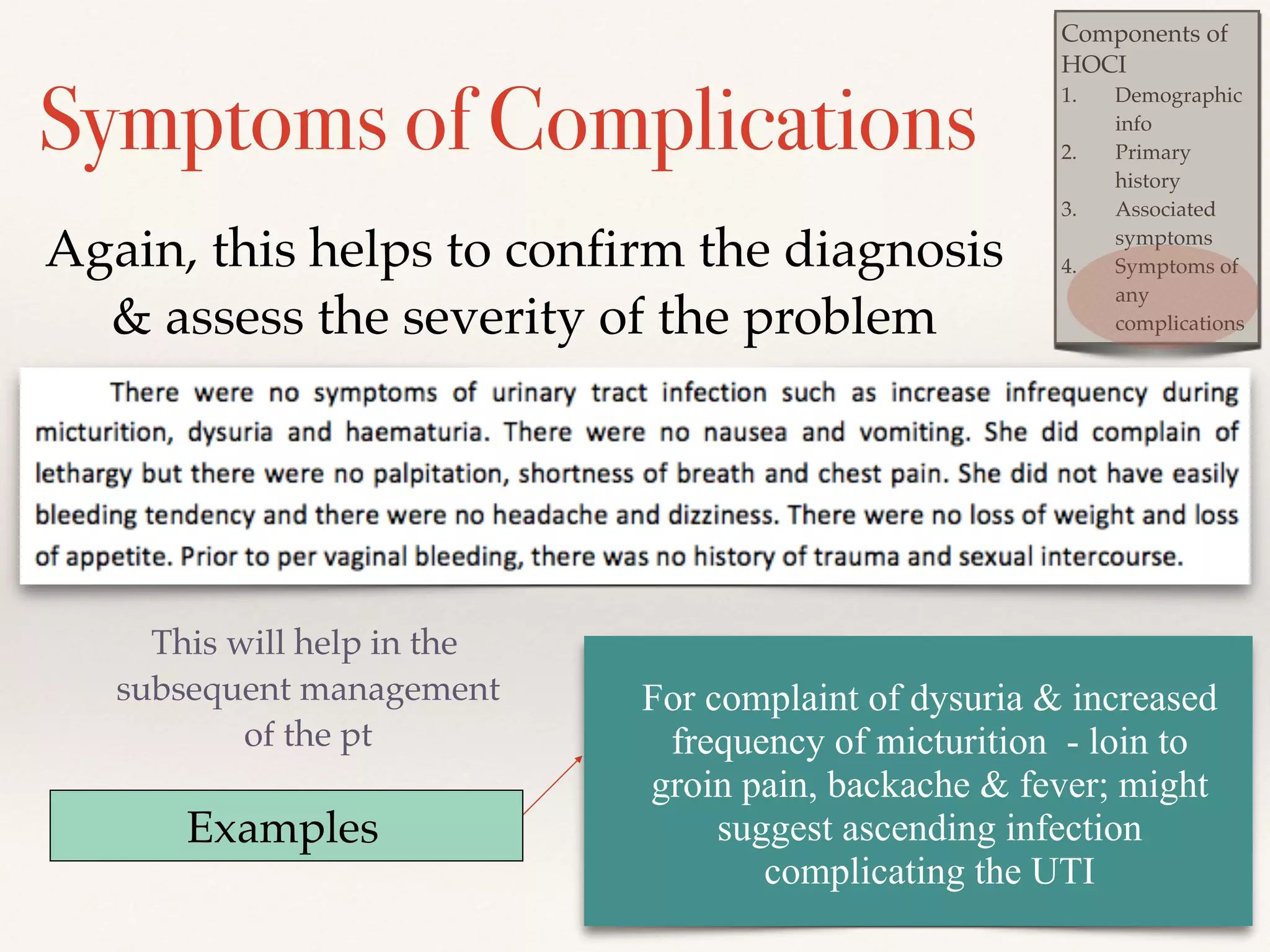
Symptoms of Complications 
Again, this helps to confirm the diagnosis 
& assess the severity of the problem 
This will help in the 
subsequent management 
of the pt 
Examples 
For complaint of dysuria & increased 
frequency of micturition - loin to 
groin pain, backache & fever; might 
suggest ascending infection 
complicating the UTI
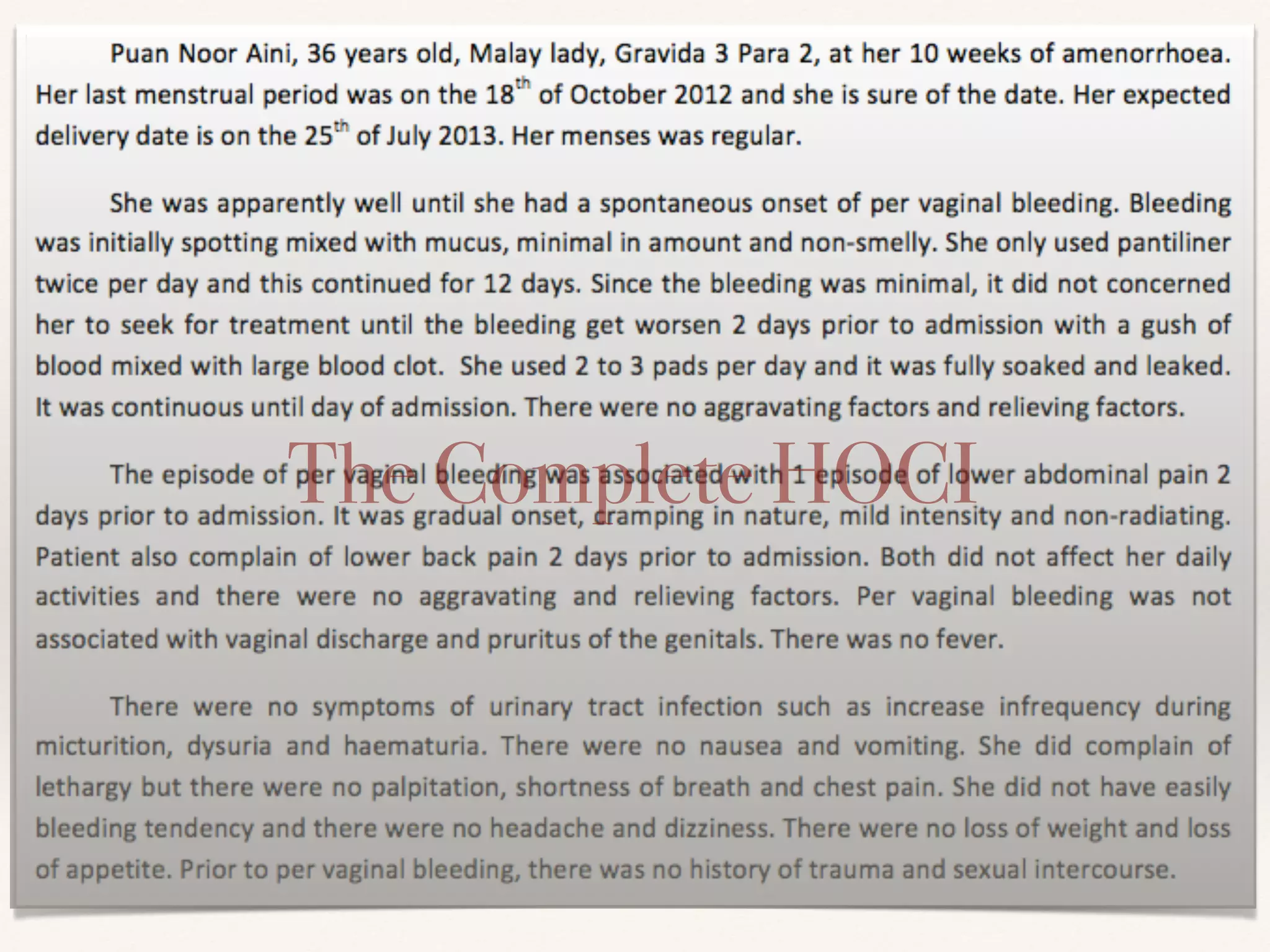
The Complete HOCI
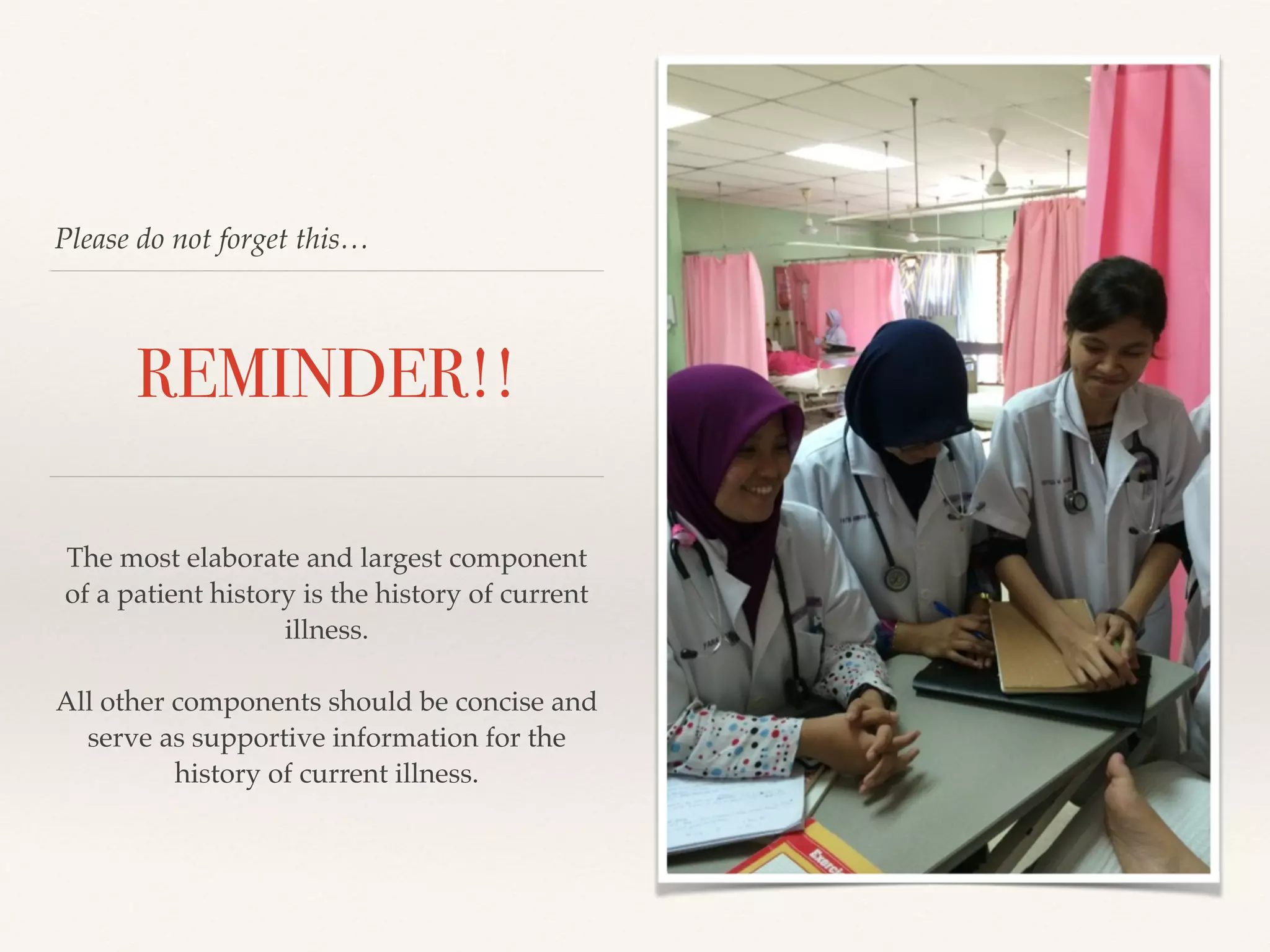
Please do not forget this… 
REMINDER!! 
The most elaborate and largest component 
of a patient history is the history of current 
illness.! 
! 
All other components should be concise and 
serve as supportive information for the 
history of current illness.!
Antenatal history or… 
History of Current 
Pregnancy 
In which you assess the status 
of the current pregnancy and 
its connections to the current 
illness
The HOCP 
Should be a chronological & concise account (1st, 2nd & 3rd trimesters) 
Should have a ! 
few components 
Confirmation of pregnancy 
Antenatal booking & results of 
tests 
Results of ultrasound scans 
Comorbidities
1. Confirmation of pregnancy 
This can be done in 
a number of ways 
❖ assessment of menstrual 
period! 
❖ urine pregnancy test (UPT)! 
❖ assessment of symptoms! 
❖ early ultrasound scan
Calculation from LM 
The gestational date can be calculated 
from the last menstrual period (LMP) 
using Naegele’s rule 
Assessment of 
menstrual period 
Accuracy is reliant on a few points:! 
• must be measured using 1st day of LMP! 
• periods must be regular of 28 day cycle! 
• the pt must be sure of the LMP! 
! 
Calculation of dates is inaccurate if 
any of these conditions are 
unfulfilled
Urine test 
Becomes positive around 5 weeks of 
gestation 
UPT 
Subjective test - it doesn't 
quantify gestation but may 
suggest the duration of 
pregnancy! 
! 
Not very specific nor sensitive - 
false positives are common
The occurrence of pregnancy symptoms… 
Assessment of 
Symptoms 
Quickening - the first sensation of fetal 
movement :! 
primigravida - felt between 22-23 weeks! 
multigravida - felt between 16-18 weeks 
may indicate the gestation & provide a 
rough guide to the accuracy of the 
menstrual dates 
Common early pregnancy 
symptoms are nausea, vomiting, 
gastric symptoms & general 
malaise:! 
noticeable between 5-6 weeks 
gestation! 
usually quite accurate! 
absence of symptoms is not 
predictive of feral well-being 
These symptoms become 
important to confirm gestation 
if an early ultrasound scan 
was not done
Done within the first 12 weeks of gestation… 
provides the most accurate assessment 
of gestational dates. Every mother 
should be encouraged to have one. 
Early Ultrasound 
Scan 
Every early scan must answer at least 3 
questions - the number of fetuses, their 
health (viabilty) & the gestation! 
! 
A simple scan is used to measure the 
Crown-Rump Length (CRL) for accurate 
dating! 
! 
Always ask the patient if she has had one & 
confirm the above 3 questions
2. Antenatal booking & results of tests 
Determine precisely! 
❖ the booking Haemoglobin (Hb) 
- the occurrence of physiological 
anaemia in later trimesters 
masks the actual blood content! 
❖ the booking Blood Pressure (BP) 
- this is to determine if the 
patient has preexisting 
hypertension (H/T)! 
❖ if screening for diabetes mellitus 
(DM) was done & the results 
Early booking - important to determine 
the initial well being of the mother as 
well as for assessment of potential risks! 
The 1st trimester is the time when the 
patient is closest to the non-pregnant 
state! 
Subsequent hormonal & physiological 
alterations tend to mask findings & 
may confuse patient assessment 
Other antenatal tests - Hepatitis 
screen, VDRL, HIV - should just be 
mentioned as normal & need not be 
elaborated
3. Results of ultrasound scans 
❖ The early u/s scan is 
considered the gold 
standard for fetal dating! 
❖ The 2nd trimester u/s 
scan - assessment of feral 
anomaly! 
❖ 3rd trimester scan - 
placental site, confirm lie 
& liquor & size 
It is important to ask the 
pt about any scans done! 
An early scan is one 
done prior to 14 weeks 
gestation 
Ultrasound scanning is part & parcel 
of modern obstetric practice. All 
mothers should have access to this
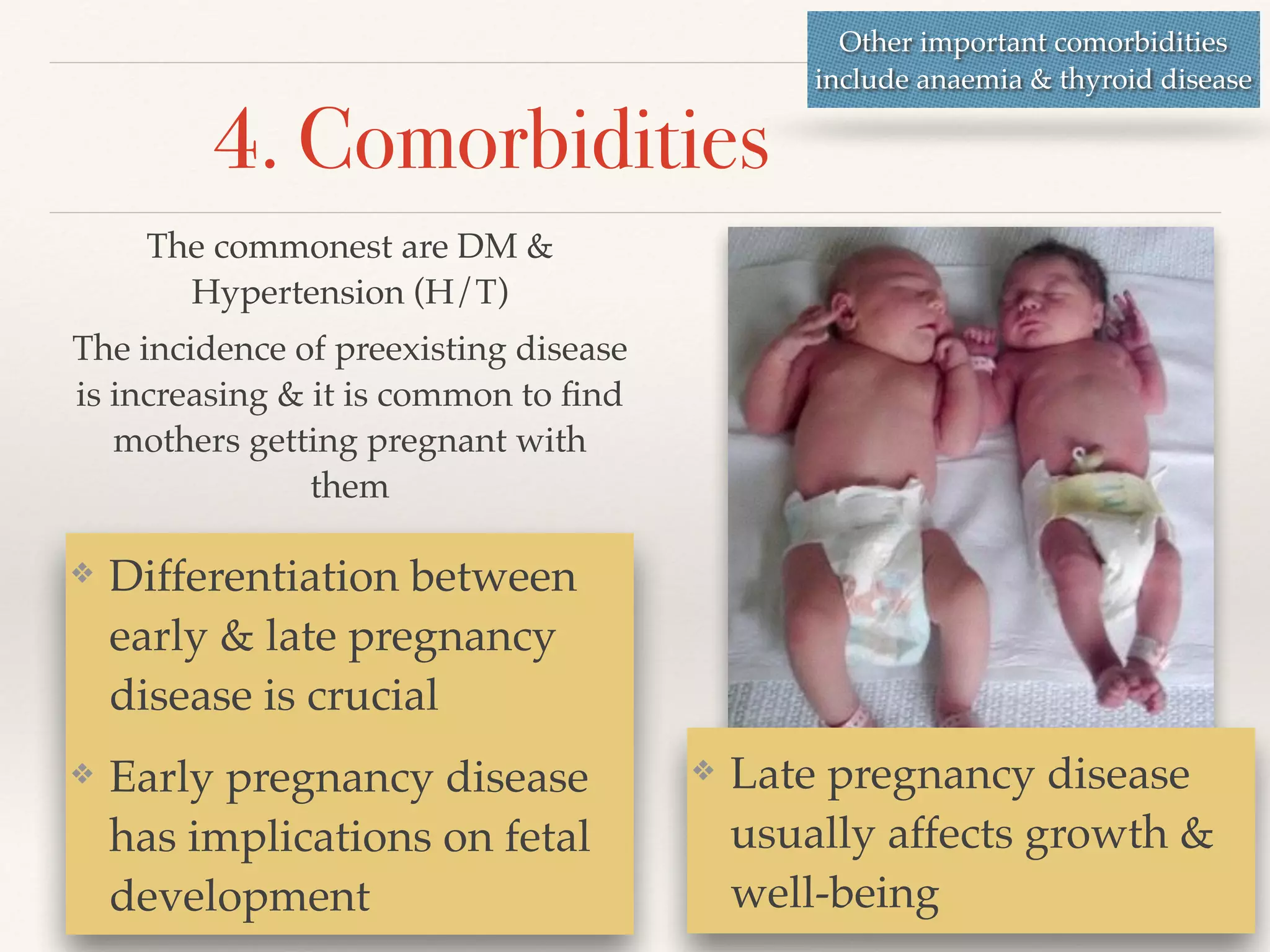
4. Comorbidities 
The commonest are DM & 
Hypertension (H/T)! 
The incidence of preexisting disease 
is increasing & it is common to find 
mothers getting pregnant with 
them 
Other important comorbidities 
include anaemia & thyroid disease 
❖ Late pregnancy disease 
usually affects growth & 
well-being 
❖ Differentiation between 
early & late pregnancy 
disease is crucial! 
❖ Early pregnancy disease 
has implications on fetal 
development
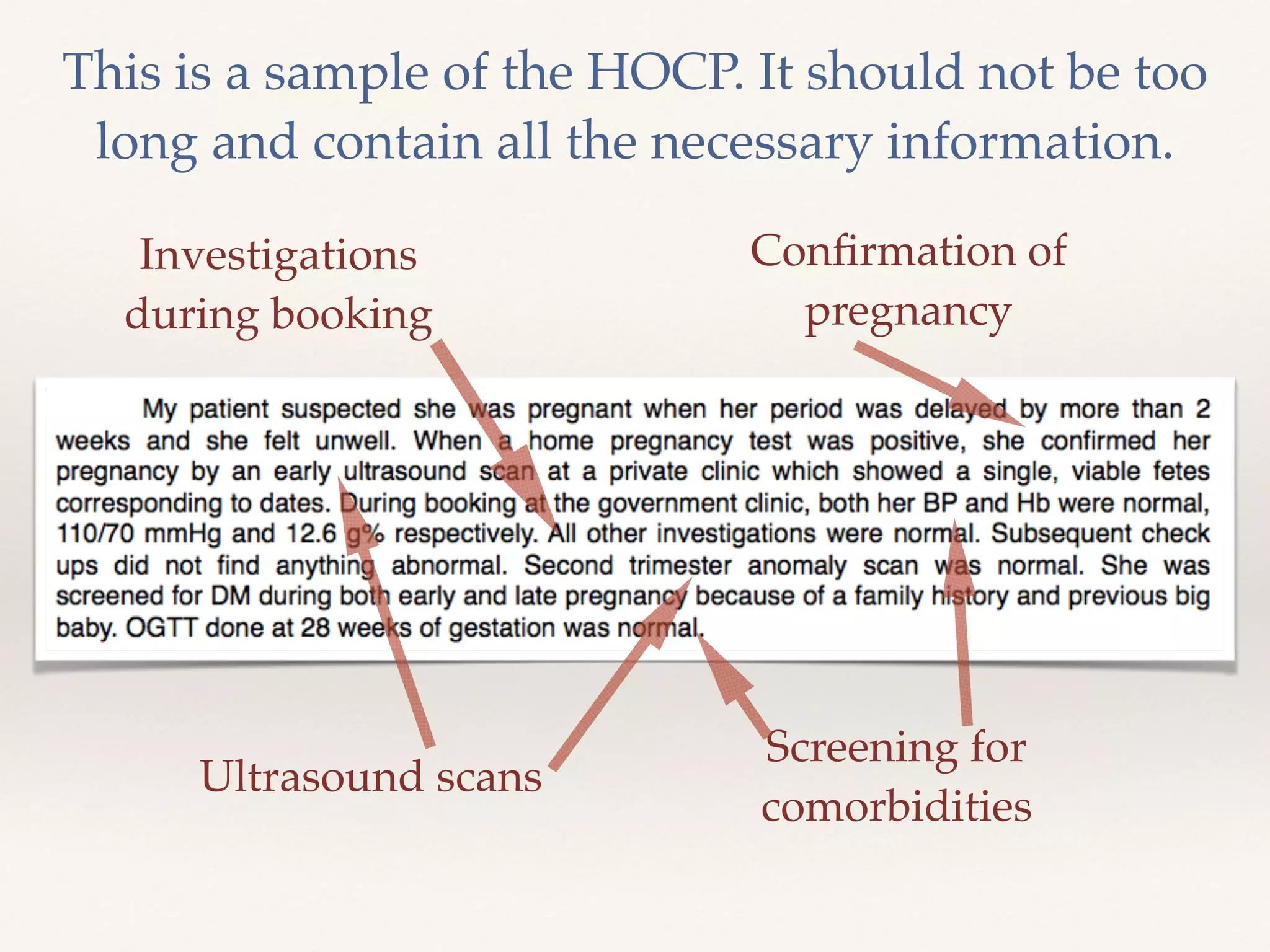
This is a sample of the HOCP. It should not be too 
long and contain all the necessary information. 
Confirmation of 
pregnancy 
Investigations 
during booking 
Ultrasound scans 
Screening for 
comorbidities
Previous pregnancies and deliveries … 
History of Past 
Pregnancy (HOPP) 
What happened in the past 
may indicate the cause of the 
current problem as well as 
impact the current pregnancy
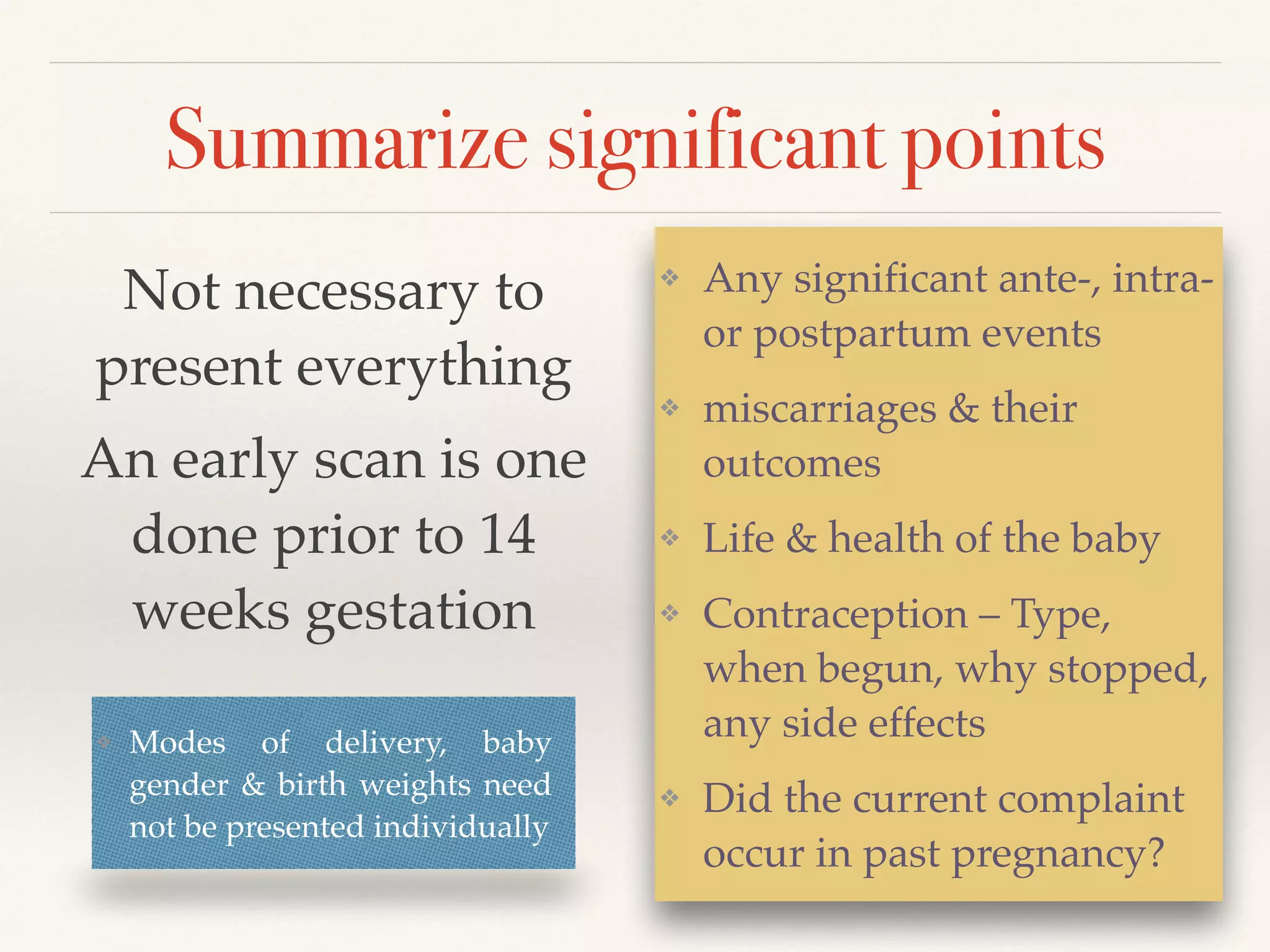
Summarize significant points 
❖ Any significant ante-, intra-or 
postpartum events! 
❖ miscarriages & their 
outcomes! 
❖ Life & health of the baby! 
❖ Contraception – Type, 
when begun, why stopped, 
any side effects! 
❖ Did the current complaint 
occur in past pregnancy? 
Not necessary to 
present everything! 
An early scan is one 
done prior to 14 
weeks gestation 
❖ Modes of delivery, baby 
gender & birth weights need 
not be presented individually
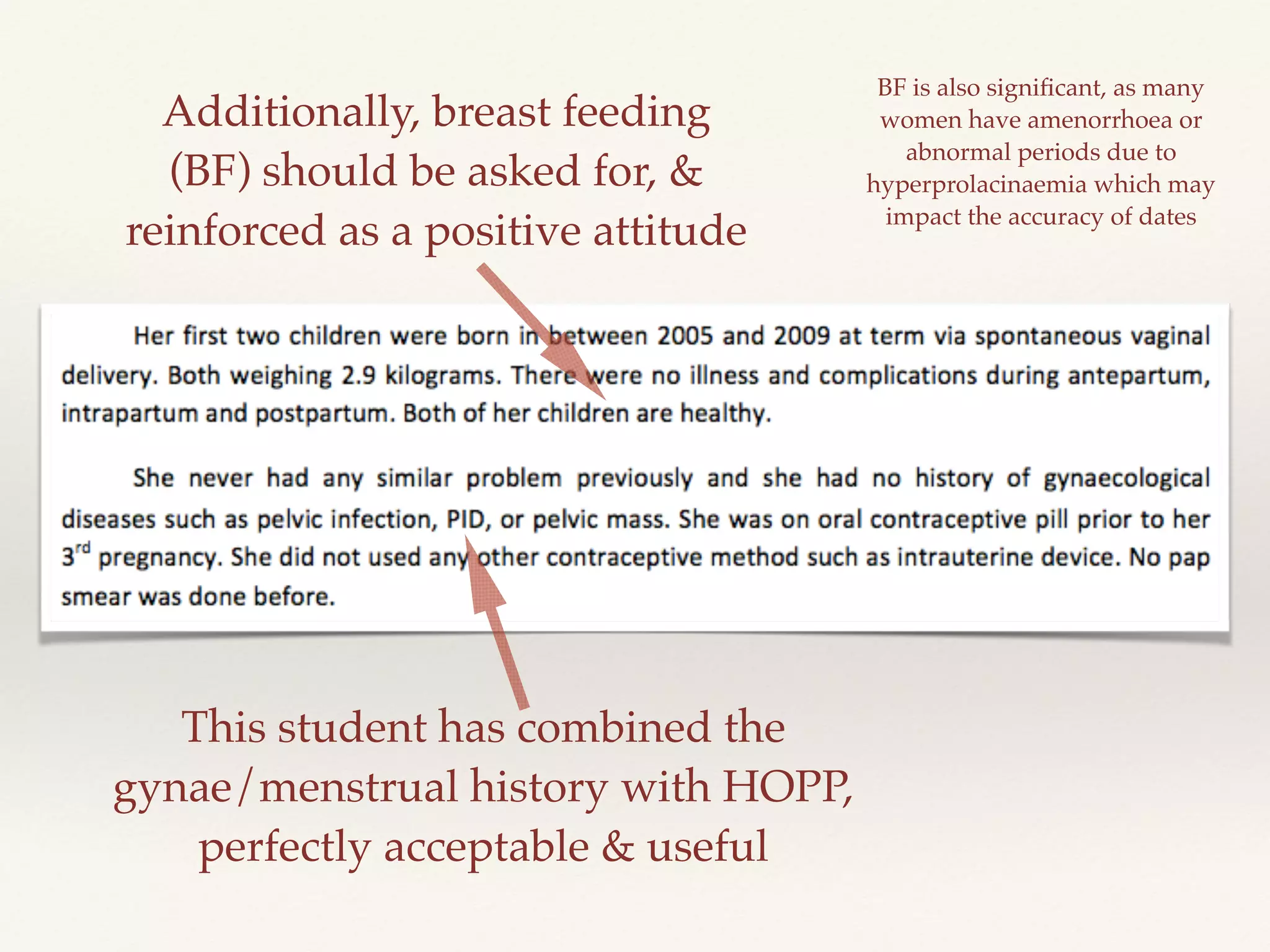
Additionally, breast feeding 
(BF) should be asked for, & 
reinforced as a positive attitude 
This student has combined the 
gynae/menstrual history with HOPP, 
perfectly acceptable & useful 
BF is also significant, as many 
women have amenorrhoea or 
abnormal periods due to 
hyperprolacinaemia which may 
impact the accuracy of dates
All the other stuff 
Other components These components provide 
supportive evidence for the 
possible diagnosis
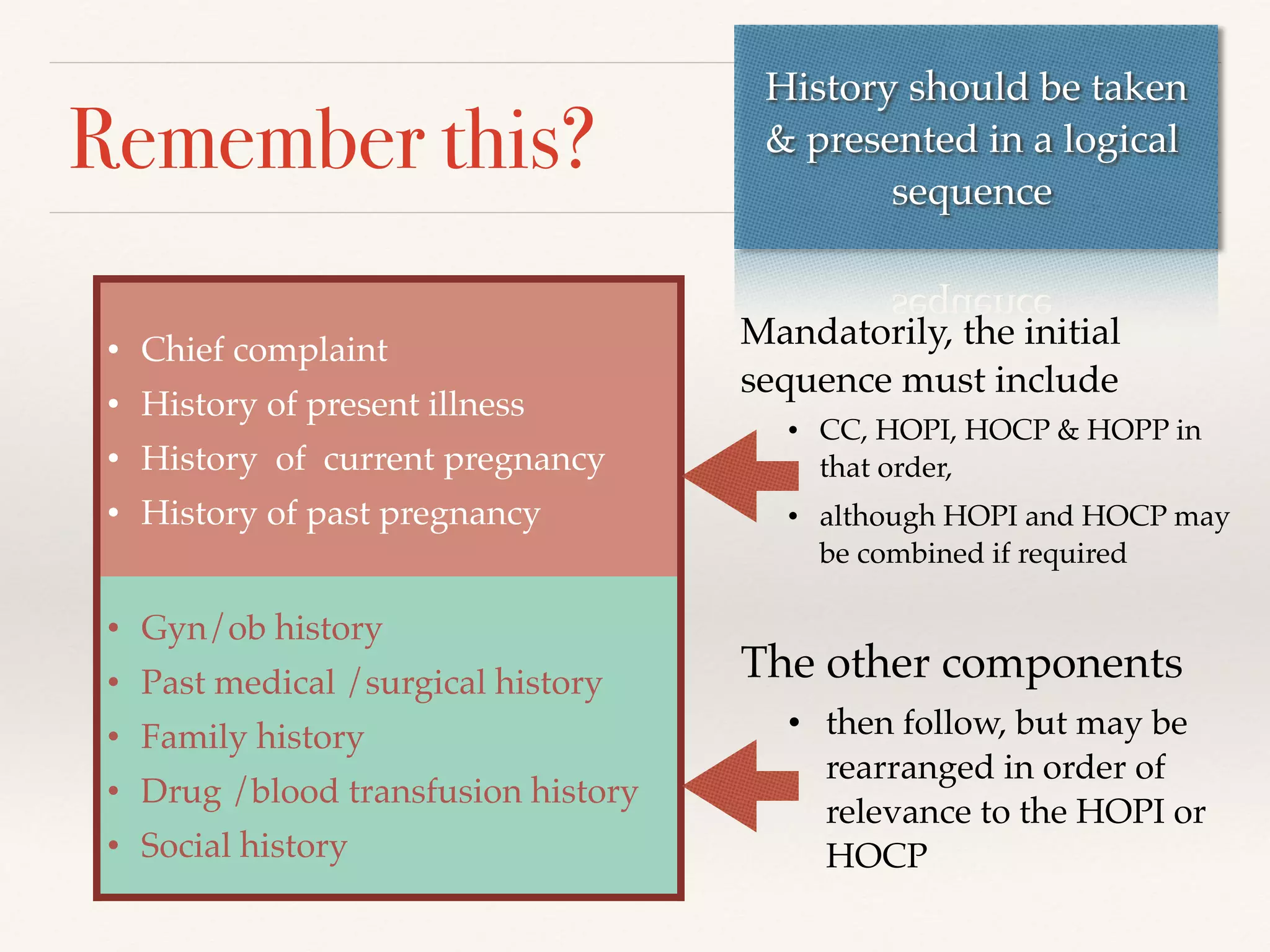
Remember this? History should be taken 
& presented in a logical 
sequence 
Mandatorily, the initial 
sequence must include ! 
• CC, HOPI, HOCP & HOPP in 
that order, ! 
• although HOPI and HOCP may 
be combined if required 
• Chief complaint! 
• History of present illness! 
• History of current pregnancy! 
• History of past pregnancy 
• Gyn/ob history! 
• Past medical /surgical history! 
• Family history! 
• Drug /blood transfusion history! 
• Social history 
The other components! 
• then follow, but may be 
rearranged in order of 
relevance to the HOPI or 
HOCP
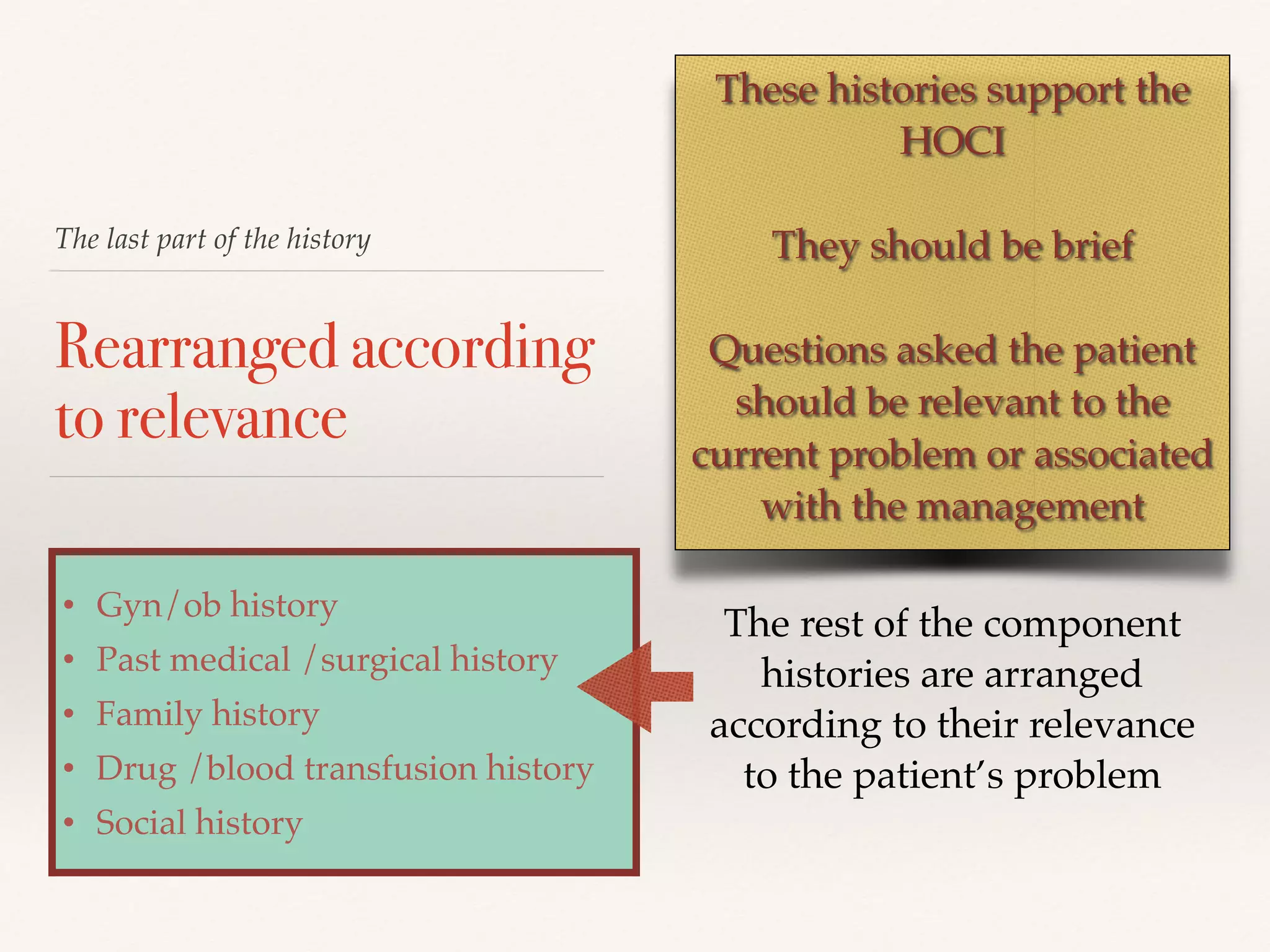
The last part of the history 
Rearranged according 
to relevance 
These histories support the 
HOCI! 
! 
They should be brief! 
! 
Questions asked the patient 
should be relevant to the 
current problem or associated 
with the management 
• Gyn/ob history! 
• Past medical /surgical history! 
• Family history! 
• Drug /blood transfusion history! 
• Social history 
The rest of the component 
histories are arranged 
according to their relevance 
to the patient’s problem
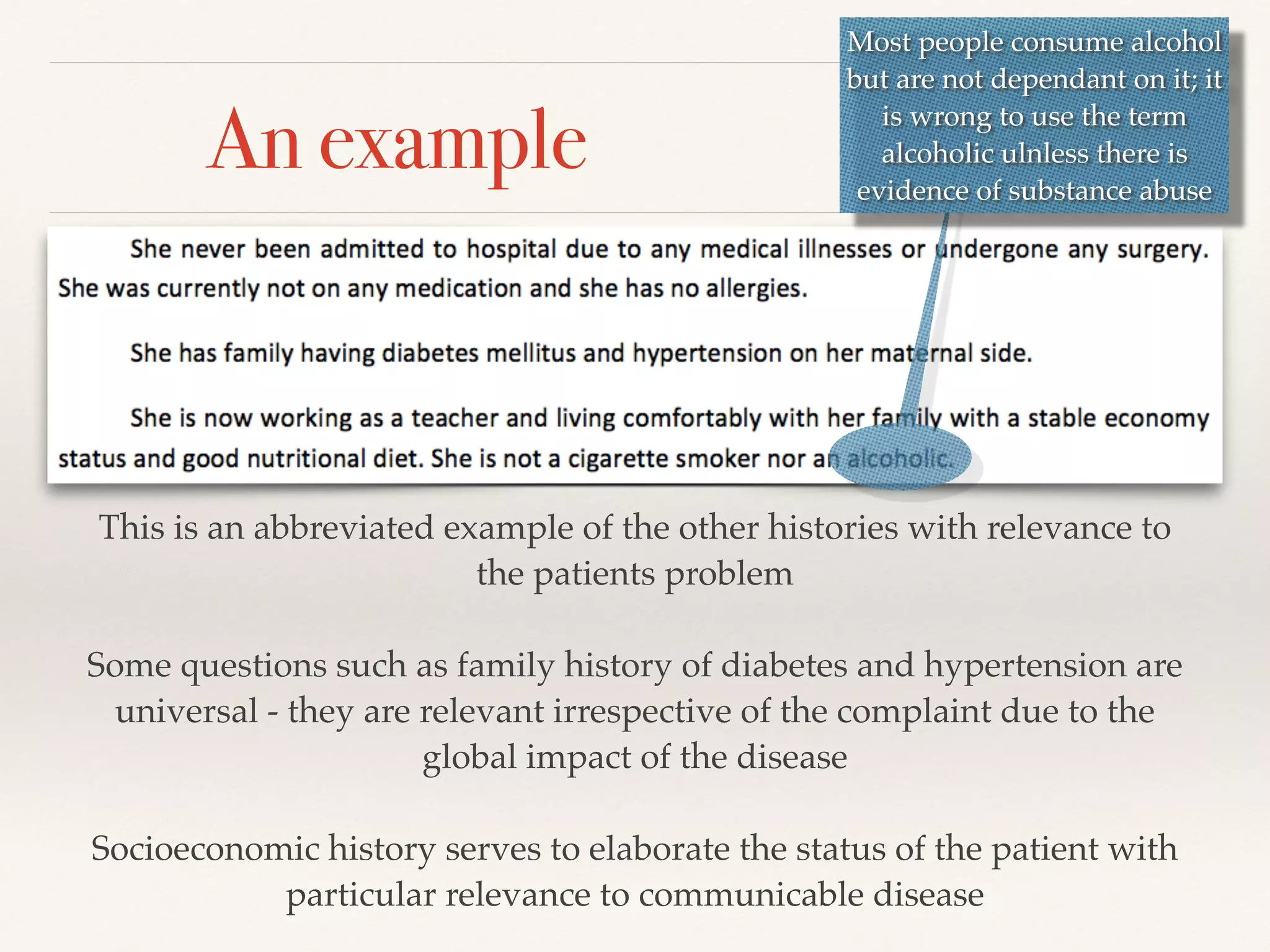
An example 
Most people consume alcohol 
but are not dependant on it; it 
is wrong to use the term 
alcoholic ulnless there is 
evidence of substance abuse 
This is an abbreviated example of the other histories with relevance to 
the patients problem! 
! 
Some questions such as family history of diabetes and hypertension are 
universal - they are relevant irrespective of the complaint due to the 
global impact of the disease! 
! 
Socioeconomic history serves to elaborate the status of the patient with 
particular relevance to communicable disease!
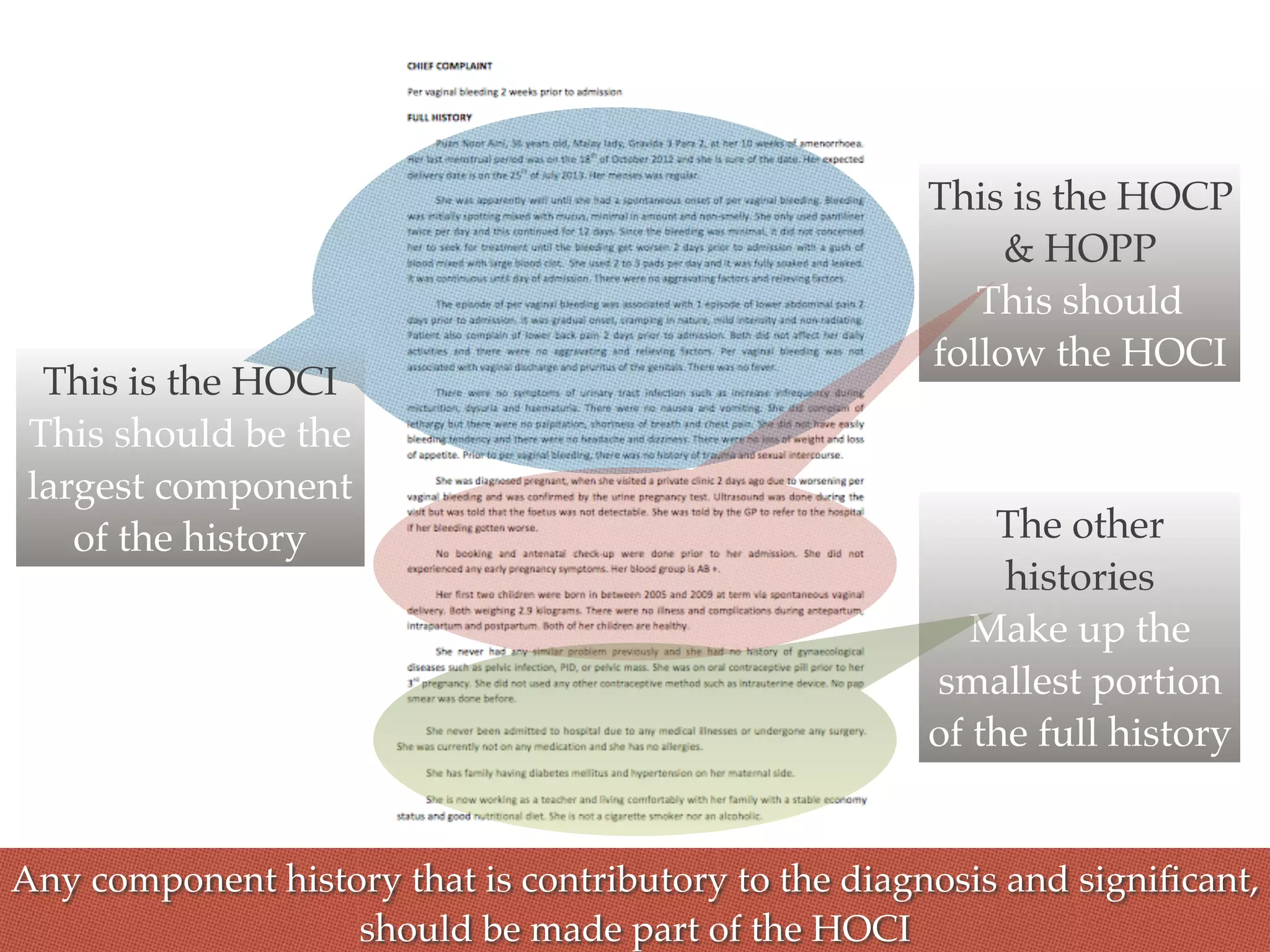
This is the HOCI! 
This should be the 
largest component 
of the history 
This is the HOCP 
& HOPP! 
This should 
follow the HOCI 
The other 
histories! 
Make up the 
smallest portion 
of the full history 
Any component history that is contributory to the diagnosis and significant, 
should be made part of the HOCI
Happy Clerking!

Obstetric History I

  • 1.
    A Guide ToObGyn Case Presentation OBSTETRIC HISTORY I For a patient who presents with a complaint Associate Professor Dr Hanifullah Khan
  • 2.
    The importance ofa good history Introduction This section details the key points of a clinical history
  • 3.
    The Importance ofPatient History The critical first step in determining the aetiology of a patient's problem A large percentage of the time, a diagnosis can be made based on the history alone 2 Purposes Provide a synopsis of background risk! An account of the progress of the pregnancy A carefully taken history – provides a clinical guide for the P/E to follow
  • 4.
    Proper Sequence Historyshould be taken & presented in a logical sequence Mandatorily, the initial sequence must include ! • CC, HOPI, HOCP & HOPP in that order, ! • although HOPI and HOCP may be combined if required • Chief complaint! • History of present illness! • History of current pregnancy! • History of past pregnancy • Gyn/ob history! • Past medical /surgical history! • Family history! • Drug /blood transfusion history! • Social history The other components! • then follow, but may be rearranged in order of relevance to the HOPI or HOCP
  • 5.
    This is anactual student history Sample History
  • 6.
    always begin with chief complaint there is only 1 patient history, although it contains many sections do not use titles for each section, instead use paragraphs the major portion of the history should be the history of current illness The history should be as short as possible - make intelligent use of descriptive words & avoid irrelevant & unnecessary words. Do not repeat information ! This is an actual student presentation!!
  • 7.
    This is themain reason the patient has come to see you The Chief Complaint The patient describes the problem in their own words It should be recorded as such Usually a single symptom, ! occasionally more than one complaint eg: chest pain, palpitation, shortness of breath Must have duration of problem! Short/specific in one clear sentence
  • 8.
    • Elaborate onthe chief complaint in detail • Ask relevant associated symptoms • Have differential diagnoses in mind History of Current Illness 1.Demographic info! 2.Primary history ! 3.Associated symptoms! 4.Symptoms of any complications Components of HOCI • Always relay story in duration (e.g. “the patient was apparently well until 1 day prior to admission”) and NOT time (e.g. last Wednesday or in July)! • If the patient has > 1 symptom, ! • take each symptom individually and ! • follow it through fully ! • mention significant negatives as well! • Avoid medical terminology
  • 9.
    Components of HOCI! 1. Demographic info! 2. Primary history ! 3. Associated symptoms! 4. Symptoms of any complications Demographic Information Appropriate to begin with a summary Gravidity - no. of pregnancies! including current pregnancy! (regardless of the outcome)! Parity - no. of births beyond ! 24 wk gestation of the details Name, age , gravidity, parity, LMP, EDD *Actual student history - grammar, context and other features can be improved!
  • 10.
    Components of HOCI! 1. Demographic info! 2. Primary history ! 3. Associated symptoms! 4. Symptoms of any complications Primary History Describes the onset, course, severity and duration of the chief Elaborates on the main complaint & deals with the chronology & the characteristics of the chief complaint complaint Some features of the 10 Hx! • Anatomic location! • Quality! • Quantity or severity! • Timing! • Setting in which the symptoms occur! • Aggravating or relieving factors Note that not all questions may be relevant for a symptom, e.g. a location cannot be determined for “difficulty in breathing”
  • 11.
    Components of HOCI! 1. Demographic info! 2. Primary history ! 3. Associated symptoms! 4. Symptoms of any complications Associated Symptoms May serve as a general review of systems Information gathered here serves to: ! • support the diagnosis ! • gauge the severity of the disorder Examples ❖ if a pt ℅ abdominal pain - must ask for presence or absence of nausea and vomiting! ❖ if a pt ℅ vaginal bleeding - per vaginal discharge, pruritis or
  • 12.
    Components of HOCI! 1. Demographic info! 2. Primary history ! 3. Associated symptoms! 4. Symptoms of any complications Symptoms of Complications Again, this helps to confirm the diagnosis & assess the severity of the problem This will help in the subsequent management of the pt Examples For complaint of dysuria & increased frequency of micturition - loin to groin pain, backache & fever; might suggest ascending infection complicating the UTI
  • 13.
  • 14.
    Please do notforget this… REMINDER!! The most elaborate and largest component of a patient history is the history of current illness.! ! All other components should be concise and serve as supportive information for the history of current illness.!
  • 15.
    Antenatal history or… History of Current Pregnancy In which you assess the status of the current pregnancy and its connections to the current illness
  • 16.
    The HOCP Shouldbe a chronological & concise account (1st, 2nd & 3rd trimesters) Should have a ! few components Confirmation of pregnancy Antenatal booking & results of tests Results of ultrasound scans Comorbidities
  • 17.
    1. Confirmation ofpregnancy This can be done in a number of ways ❖ assessment of menstrual period! ❖ urine pregnancy test (UPT)! ❖ assessment of symptoms! ❖ early ultrasound scan
  • 18.
    Calculation from LM The gestational date can be calculated from the last menstrual period (LMP) using Naegele’s rule Assessment of menstrual period Accuracy is reliant on a few points:! • must be measured using 1st day of LMP! • periods must be regular of 28 day cycle! • the pt must be sure of the LMP! ! Calculation of dates is inaccurate if any of these conditions are unfulfilled
  • 19.
    Urine test Becomespositive around 5 weeks of gestation UPT Subjective test - it doesn't quantify gestation but may suggest the duration of pregnancy! ! Not very specific nor sensitive - false positives are common
  • 20.
    The occurrence ofpregnancy symptoms… Assessment of Symptoms Quickening - the first sensation of fetal movement :! primigravida - felt between 22-23 weeks! multigravida - felt between 16-18 weeks may indicate the gestation & provide a rough guide to the accuracy of the menstrual dates Common early pregnancy symptoms are nausea, vomiting, gastric symptoms & general malaise:! noticeable between 5-6 weeks gestation! usually quite accurate! absence of symptoms is not predictive of feral well-being These symptoms become important to confirm gestation if an early ultrasound scan was not done
  • 21.
    Done within thefirst 12 weeks of gestation… provides the most accurate assessment of gestational dates. Every mother should be encouraged to have one. Early Ultrasound Scan Every early scan must answer at least 3 questions - the number of fetuses, their health (viabilty) & the gestation! ! A simple scan is used to measure the Crown-Rump Length (CRL) for accurate dating! ! Always ask the patient if she has had one & confirm the above 3 questions
  • 22.
    2. Antenatal booking& results of tests Determine precisely! ❖ the booking Haemoglobin (Hb) - the occurrence of physiological anaemia in later trimesters masks the actual blood content! ❖ the booking Blood Pressure (BP) - this is to determine if the patient has preexisting hypertension (H/T)! ❖ if screening for diabetes mellitus (DM) was done & the results Early booking - important to determine the initial well being of the mother as well as for assessment of potential risks! The 1st trimester is the time when the patient is closest to the non-pregnant state! Subsequent hormonal & physiological alterations tend to mask findings & may confuse patient assessment Other antenatal tests - Hepatitis screen, VDRL, HIV - should just be mentioned as normal & need not be elaborated
  • 23.
    3. Results ofultrasound scans ❖ The early u/s scan is considered the gold standard for fetal dating! ❖ The 2nd trimester u/s scan - assessment of feral anomaly! ❖ 3rd trimester scan - placental site, confirm lie & liquor & size It is important to ask the pt about any scans done! An early scan is one done prior to 14 weeks gestation Ultrasound scanning is part & parcel of modern obstetric practice. All mothers should have access to this
  • 24.
    4. Comorbidities Thecommonest are DM & Hypertension (H/T)! The incidence of preexisting disease is increasing & it is common to find mothers getting pregnant with them Other important comorbidities include anaemia & thyroid disease ❖ Late pregnancy disease usually affects growth & well-being ❖ Differentiation between early & late pregnancy disease is crucial! ❖ Early pregnancy disease has implications on fetal development
  • 25.
    This is asample of the HOCP. It should not be too long and contain all the necessary information. Confirmation of pregnancy Investigations during booking Ultrasound scans Screening for comorbidities
  • 26.
    Previous pregnancies anddeliveries … History of Past Pregnancy (HOPP) What happened in the past may indicate the cause of the current problem as well as impact the current pregnancy
  • 27.
    Summarize significant points ❖ Any significant ante-, intra-or postpartum events! ❖ miscarriages & their outcomes! ❖ Life & health of the baby! ❖ Contraception – Type, when begun, why stopped, any side effects! ❖ Did the current complaint occur in past pregnancy? Not necessary to present everything! An early scan is one done prior to 14 weeks gestation ❖ Modes of delivery, baby gender & birth weights need not be presented individually
  • 28.
    Additionally, breast feeding (BF) should be asked for, & reinforced as a positive attitude This student has combined the gynae/menstrual history with HOPP, perfectly acceptable & useful BF is also significant, as many women have amenorrhoea or abnormal periods due to hyperprolacinaemia which may impact the accuracy of dates
  • 29.
    All the otherstuff Other components These components provide supportive evidence for the possible diagnosis
  • 30.
    Remember this? Historyshould be taken & presented in a logical sequence Mandatorily, the initial sequence must include ! • CC, HOPI, HOCP & HOPP in that order, ! • although HOPI and HOCP may be combined if required • Chief complaint! • History of present illness! • History of current pregnancy! • History of past pregnancy • Gyn/ob history! • Past medical /surgical history! • Family history! • Drug /blood transfusion history! • Social history The other components! • then follow, but may be rearranged in order of relevance to the HOPI or HOCP
  • 31.
    The last partof the history Rearranged according to relevance These histories support the HOCI! ! They should be brief! ! Questions asked the patient should be relevant to the current problem or associated with the management • Gyn/ob history! • Past medical /surgical history! • Family history! • Drug /blood transfusion history! • Social history The rest of the component histories are arranged according to their relevance to the patient’s problem
  • 32.
    An example Mostpeople consume alcohol but are not dependant on it; it is wrong to use the term alcoholic ulnless there is evidence of substance abuse This is an abbreviated example of the other histories with relevance to the patients problem! ! Some questions such as family history of diabetes and hypertension are universal - they are relevant irrespective of the complaint due to the global impact of the disease! ! Socioeconomic history serves to elaborate the status of the patient with particular relevance to communicable disease!
  • 33.
    This is theHOCI! This should be the largest component of the history This is the HOCP & HOPP! This should follow the HOCI The other histories! Make up the smallest portion of the full history Any component history that is contributory to the diagnosis and significant, should be made part of the HOCI
  • 34.