





Practical Ideas to
Transform Your
School Culture and
Create a Vision
NC Association for
Middle Level Education
Bruce Vosburgh -
PAMLE
Bruce Vosburgh – Schools to Watch
Director in Pennsylvania,
- PAMLE State Executive Board
- Retired middle level teacher, team
leader, coach, administrator
- President Elect – National Forum to
Accelerate Middle Grades Reform
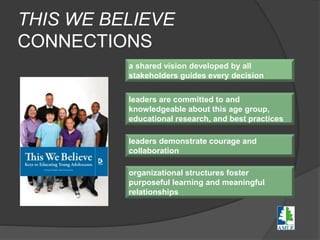
THIS WE BELIEVE
CONNECTIONS
a shared vision developed by all
stakeholders guides every decision
leaders are committed to and
knowledgeable about this age group,
educational research, and best practices
leaders demonstrate courage and
collaboration
organizational structures foster
purposeful learning and meaningful
relationships
Schools to Watch
A shared vision of what a high-
performing, developmentally
appropriate school is and does drives
every facet of school change.
1. The shared vision drives constant
improvement.
2. Shared, distributed, and sustained
leadership propels the school forward
and preserves its institutional memory
and purpose.
3. Everyone knows what the plan is and
the vision is posted and evidenced by
actions.
EXPECTED OUTCOMES
participants will learn how to transform
toxic cultures into collaborative
endeavors
participants will analyze and discuss
their current school culture and begin
the development of a plan to make it
more collaborative
ESSENTIAL QUESTION
What is school culture and
how does it affect the
effectiveness of your school?
HOW BIG IS THE GORILLA IN
YOUR SCHOOL?
In most schools, the
800 pound gorilla
that impairs
performance and
stifles change is
CULTURE.
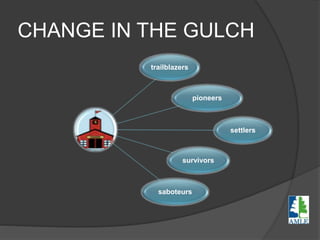
CHANGE IN THE GULCH
trailblazers
pioneers
settlers
survivors
saboteurs
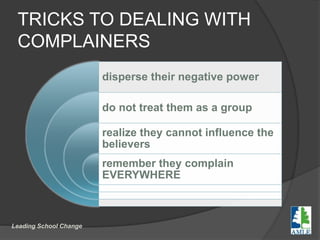
TRICKS TO DEALING WITH
COMPLAINERS
disperse their negative power
do not treat them as a group
realize they cannot influence the
believers
remember they complain
EVERYWHERE
Leading School Change
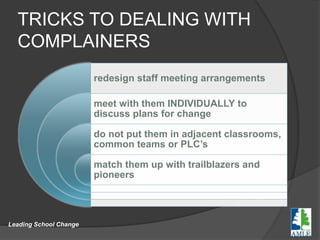
TRICKS TO DEALING WITH
COMPLAINERS
redesign staff meeting arrangements
meet with them INDIVIDUALLY to
discuss plans for change
do not put them in adjacent classrooms,
common teams or PLC’s
match them up with trailblazers and
pioneers
Leading School Change
What are the causes of the
resistance to change we
often find at our schools?
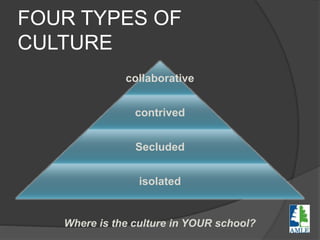
FOUR TYPES OF
CULTURE
collaborative
contrived
Secluded
isolated
Where is the culture in YOUR school?
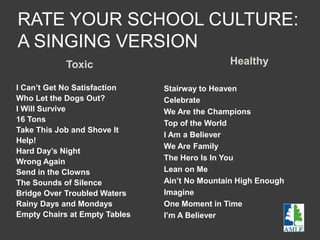
RATE YOUR SCHOOL CULTURE:
A SINGING VERSION
Toxic Healthy
I Can’t Get No Satisfaction
Who Let the Dogs Out?
I Will Survive
16 Tons
Take This Job and Shove It
Help!
Hard Day’s Night
Wrong Again
Send in the Clowns
The Sounds of Silence
Bridge Over Troubled Waters
Rainy Days and Mondays
Empty Chairs at Empty Tables
Stairway to Heaven
Celebrate
We Are the Champions
Top of the World
I Am a Believer
We Are Family
The Hero Is In You
Lean on Me
Ain’t No Mountain High Enough
Imagine
One Moment in Time
I’m A Believer
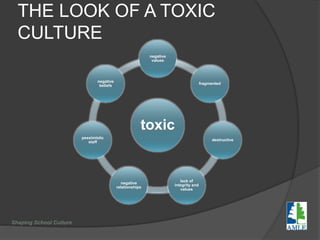
THE LOOK OF A TOXIC
CULTURE
toxic
negative
values
fragmented
destructive
lack of
integrity and
values
negative
relationships
pessimistic
staff
negative
beliefs
Shaping School Culture
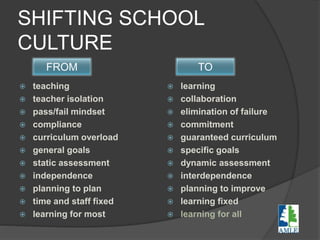
SHIFTING SCHOOL
CULTURE
 teaching
 teacher isolation
 pass/fail mindset
 compliance
 curriculum overload
 general goals
 static assessment
 independence
 planning to plan
 time and staff fixed
 learning for most
 learning
 collaboration
 elimination of failure
 commitment
 guaranteed curriculum
 specific goals
 dynamic assessment
 interdependence
 planning to improve
 learning fixed
 learning for all
FROM TO
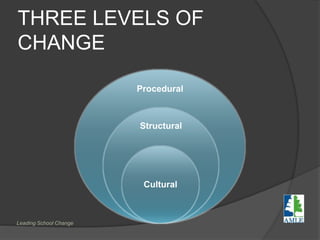
THREE LEVELS OF
CHANGE
Procedural
Structural
Cultural
Leading School Change
WHAT CAN YOU DO TO
DEVELOP A
COLLABORATIVE CULTURE
IN YOUR SCHOOL?
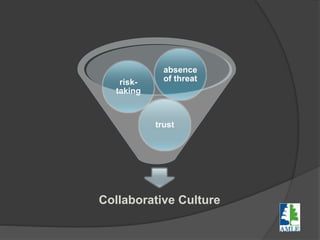
Collaborative Culture
trust
risk-
taking
absence
of threat
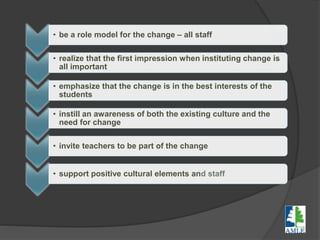
• be a role model for the change – all staff
• realize that the first impression when instituting change is
all important
• emphasize that the change is in the best interests of the
students
• instill an awareness of both the existing culture and the
need for change
• invite teachers to be part of the change
• support positive cultural elements and staff
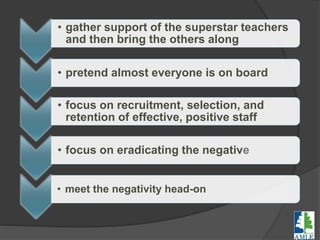
• gather support of the superstar teachers
and then bring the others along
• pretend almost everyone is on board
• focus on recruitment, selection, and
retention of effective, positive staff
• focus on eradicating the negative
• meet the negativity head-on
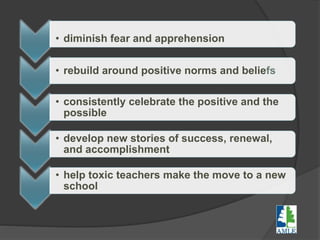
• diminish fear and apprehension
• rebuild around positive norms and beliefs
• consistently celebrate the positive and the
possible
• develop new stories of success, renewal,
and accomplishment
• help toxic teachers make the move to a new
school
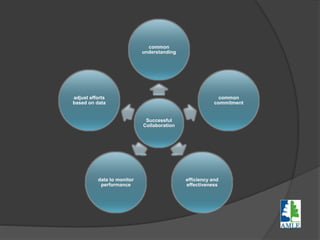
Successful
Collaboration
common
understanding
common
commitment
efficiency and
effectiveness
data to monitor
performance
adjust efforts
based on data
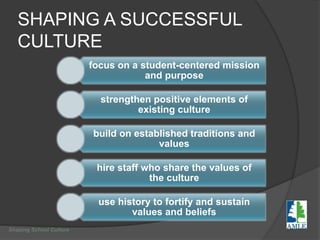
SHAPING A SUCCESSFUL
CULTURE
focus on a student-centered mission
and purpose
strengthen positive elements of
existing culture
build on established traditions and
values
hire staff who share the values of
the culture
use history to fortify and sustain
values and beliefs
Shaping School Culture
Creating A Vision
 Create Small focused groups to
brainstorm and discuss the following
questions
 1. How are we different from other
schools?
 2. What kind of school do we hope to
be?
 3 What can we do differently?
 4. What do you think should be included
in our vision statement?
• Radnor MS
Bringing the Vision to Life
 Branding
 Create a logo
 Develop posters, T-shirts, stickers
 Display in all school communications
 Create Vision Days, Pep Rallies
• Radnor MS
POWERFUL, POSITIVE
CULTURES
collegiality
experimentation
high expectations
trust and confidence
tangible support
reaching out to the knowledge bases
POWERFUL, POSITIVE
CULTURES
appreciation and recognition
caring, celebration, humor
involvement in decision making
protection of what is important
honor traditions
honest, open communication
Butler and Dickson, 1987
TODAY’S PRINCIPAL
provides an atmosphere conducive to shared decision-
making and collaboration at all levels
asks questions rather than providing answers
facilitates the process of school improvement rather
than prescribing how it should be done
collaboratively explores alternatives to ineffective
policies and practices rather than dictate the ones that
will be used
This We Believe in Action
TODAY’S TEACHERS
are active leaders in the school learning
communityparticipate in instructional discussions within learning
communities that are centered on student success
are involved members of their teams
seek ways to make curriculum integrative, relevant, and
challenging for students
This We Believe in Action
TODAY’S TEACHERS
share instructional strategies to help meet individual
student needs
discuss data with their colleagues and use it to inform
instruction
share their expertise to help the school solve
problems, make decisions, and set policy and direction
This We Believe in Action
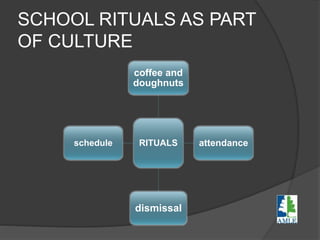
SCHOOL RITUALS AS PART
OF CULTURE
RITUALS
coffee and
doughnuts
attendance
dismissal
schedule
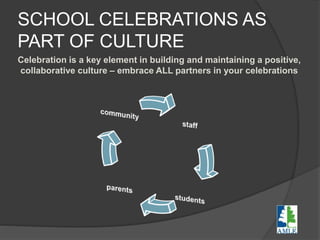
SCHOOL CELEBRATIONS AS
PART OF CULTURE
Celebration is a key element in building and maintaining a positive,
collaborative culture – embrace ALL partners in your celebrations
TICKET OUT THE
DOOR
What do you need to do at your school?
Bruce Vosburgh
 bvosbur@comcast.net
 610-945-4434
 www.pamle.org
 http://middlegradesforum.org

Practical Ideas to Transform Your School Culture and Create a Vision

  • 1.
    Practical Ideas to TransformYour School Culture and Create a Vision NC Association for Middle Level Education Bruce Vosburgh - PAMLE
  • 2.
    Bruce Vosburgh –Schools to Watch Director in Pennsylvania, - PAMLE State Executive Board - Retired middle level teacher, team leader, coach, administrator - President Elect – National Forum to Accelerate Middle Grades Reform
  • 3.
    THIS WE BELIEVE CONNECTIONS ashared vision developed by all stakeholders guides every decision leaders are committed to and knowledgeable about this age group, educational research, and best practices leaders demonstrate courage and collaboration organizational structures foster purposeful learning and meaningful relationships
  • 4.
    Schools to Watch Ashared vision of what a high- performing, developmentally appropriate school is and does drives every facet of school change. 1. The shared vision drives constant improvement. 2. Shared, distributed, and sustained leadership propels the school forward and preserves its institutional memory and purpose. 3. Everyone knows what the plan is and the vision is posted and evidenced by actions.
  • 5.
    EXPECTED OUTCOMES participants willlearn how to transform toxic cultures into collaborative endeavors participants will analyze and discuss their current school culture and begin the development of a plan to make it more collaborative
  • 6.
    ESSENTIAL QUESTION What isschool culture and how does it affect the effectiveness of your school?
  • 7.
    HOW BIG ISTHE GORILLA IN YOUR SCHOOL? In most schools, the 800 pound gorilla that impairs performance and stifles change is CULTURE.
  • 8.
    CHANGE IN THEGULCH trailblazers pioneers settlers survivors saboteurs
  • 9.
    TRICKS TO DEALINGWITH COMPLAINERS disperse their negative power do not treat them as a group realize they cannot influence the believers remember they complain EVERYWHERE Leading School Change
  • 10.
    TRICKS TO DEALINGWITH COMPLAINERS redesign staff meeting arrangements meet with them INDIVIDUALLY to discuss plans for change do not put them in adjacent classrooms, common teams or PLC’s match them up with trailblazers and pioneers Leading School Change
  • 11.
    What are thecauses of the resistance to change we often find at our schools?
  • 12.
  • 13.
    RATE YOUR SCHOOLCULTURE: A SINGING VERSION Toxic Healthy I Can’t Get No Satisfaction Who Let the Dogs Out? I Will Survive 16 Tons Take This Job and Shove It Help! Hard Day’s Night Wrong Again Send in the Clowns The Sounds of Silence Bridge Over Troubled Waters Rainy Days and Mondays Empty Chairs at Empty Tables Stairway to Heaven Celebrate We Are the Champions Top of the World I Am a Believer We Are Family The Hero Is In You Lean on Me Ain’t No Mountain High Enough Imagine One Moment in Time I’m A Believer
  • 14.
    THE LOOK OFA TOXIC CULTURE toxic negative values fragmented destructive lack of integrity and values negative relationships pessimistic staff negative beliefs Shaping School Culture
  • 15.
    SHIFTING SCHOOL CULTURE  teaching teacher isolation  pass/fail mindset  compliance  curriculum overload  general goals  static assessment  independence  planning to plan  time and staff fixed  learning for most  learning  collaboration  elimination of failure  commitment  guaranteed curriculum  specific goals  dynamic assessment  interdependence  planning to improve  learning fixed  learning for all FROM TO
  • 16.
  • 17.
    WHAT CAN YOUDO TO DEVELOP A COLLABORATIVE CULTURE IN YOUR SCHOOL?
  • 18.
  • 19.
    • be arole model for the change – all staff • realize that the first impression when instituting change is all important • emphasize that the change is in the best interests of the students • instill an awareness of both the existing culture and the need for change • invite teachers to be part of the change • support positive cultural elements and staff
  • 20.
    • gather supportof the superstar teachers and then bring the others along • pretend almost everyone is on board • focus on recruitment, selection, and retention of effective, positive staff • focus on eradicating the negative • meet the negativity head-on
  • 21.
    • diminish fearand apprehension • rebuild around positive norms and beliefs • consistently celebrate the positive and the possible • develop new stories of success, renewal, and accomplishment • help toxic teachers make the move to a new school
  • 22.
  • 23.
    SHAPING A SUCCESSFUL CULTURE focuson a student-centered mission and purpose strengthen positive elements of existing culture build on established traditions and values hire staff who share the values of the culture use history to fortify and sustain values and beliefs Shaping School Culture
  • 24.
    Creating A Vision Create Small focused groups to brainstorm and discuss the following questions  1. How are we different from other schools?  2. What kind of school do we hope to be?  3 What can we do differently?  4. What do you think should be included in our vision statement? • Radnor MS
  • 25.
    Bringing the Visionto Life  Branding  Create a logo  Develop posters, T-shirts, stickers  Display in all school communications  Create Vision Days, Pep Rallies • Radnor MS
  • 26.
    POWERFUL, POSITIVE CULTURES collegiality experimentation high expectations trustand confidence tangible support reaching out to the knowledge bases
  • 27.
    POWERFUL, POSITIVE CULTURES appreciation andrecognition caring, celebration, humor involvement in decision making protection of what is important honor traditions honest, open communication Butler and Dickson, 1987
  • 28.
    TODAY’S PRINCIPAL provides anatmosphere conducive to shared decision- making and collaboration at all levels asks questions rather than providing answers facilitates the process of school improvement rather than prescribing how it should be done collaboratively explores alternatives to ineffective policies and practices rather than dictate the ones that will be used This We Believe in Action
  • 29.
    TODAY’S TEACHERS are activeleaders in the school learning communityparticipate in instructional discussions within learning communities that are centered on student success are involved members of their teams seek ways to make curriculum integrative, relevant, and challenging for students This We Believe in Action
  • 30.
    TODAY’S TEACHERS share instructionalstrategies to help meet individual student needs discuss data with their colleagues and use it to inform instruction share their expertise to help the school solve problems, make decisions, and set policy and direction This We Believe in Action
  • 31.
    SCHOOL RITUALS ASPART OF CULTURE RITUALS coffee and doughnuts attendance dismissal schedule
  • 32.
    SCHOOL CELEBRATIONS AS PARTOF CULTURE Celebration is a key element in building and maintaining a positive, collaborative culture – embrace ALL partners in your celebrations
  • 33.
    TICKET OUT THE DOOR Whatdo you need to do at your school?
  • 34.
    Bruce Vosburgh  bvosbur@comcast.net 610-945-4434  www.pamle.org  http://middlegradesforum.org

Editor's Notes

  • #25 Responses were collected and coded for keywords and phrases. Common language was identified and used in developing a vision statement. Vision statement was vetted through your school committee as well as through grade level and department meetings.