School Improvement:
Different Thinking
for Different Results.
mcduffienorman@gmail.com
Contact and Feedback
Who’s In the Room?
• School Level
• District Level
• State Level
• Teachers
• If you are looking for
something positive, you
will find it.
• If you are looking for
something negative, you
will find it.
• So, the question is….
What are you looking for?
100% Guarantee
1. Create a sense of educational awareness
and urgency.
2. Inspire educators to seek their next
step(s) towards improvement.
3. Promote Different Thinking for Different
Results.
CHANGED People, Change People!
Intentional IMPACT
Improve Your
AIM
on
School
Improvement
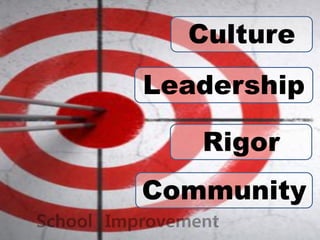
Culture
Leadership
Rigor
Community
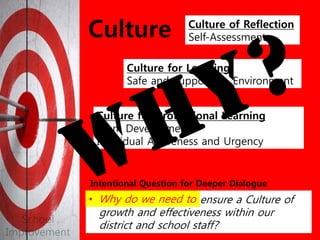
Culture
Culture for Learning
Safe and Supportive Environment
Culture for Professional Learning
Team Development
Individual Awareness and Urgency
Culture of Reflection
Self-Assessment
• How do we ensure a Culture of growth
and effectiveness within our district and
school staff?
Intentional Question for Deeper Dialogue
• Why do we need to ensure a Culture of
growth and effectiveness within our
district and school staff?
• Why do we need to
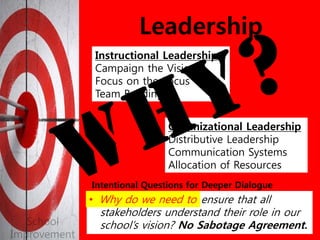
Leadership
Instructional Leadership
Campaign the Vision
Focus on the Focus
Team Building
Organizational Leadership
Distributive Leadership
Communication Systems
Allocation of Resources
Intentional Questions for Deeper Dialogue
• How do we ensure that all stakeholders
understand their role in our school’s
vision? No Sabotage Agreement.
• Why do we need to ensure that all
stakeholders understand their role in our
school’s vision? No Sabotage Agreement.
• Why do we need to
Rigor Curriculum
Power Standards
Goal Summaries
Instruction
District and School Management
Administrative Support
Equality vs. Equity
High Yield Instructional Learning Strategies
Intentional Question for Deeper Dialogue
• How do we define, ensure, and monitor
high quality instruction in all classrooms?
Assessment
Assessment System
Shared Understanding
Data Analysis to Influence Decisions
Student Involved in Assessment Process
• Why do we need to define, ensure, and
monitor high quality instruction in all
classrooms?
• Why do we need to
Community
Intentional Question for Deeper Dialogue
• How do we ensure that families and
community partners are invited and
involved in our learning and improvement
process?
Communication
Community Engagement
Connection Avenues and Tools
• Why do we need to ensure that families
and community partners are invited and
involved in our learning and improvement
process?
• Why do we need to
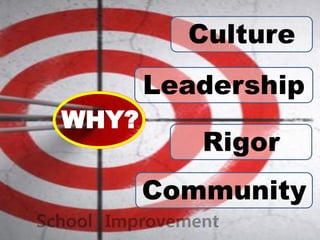
WHY?
Culture
Leadership
Rigor
Community
“The whole school needs to
understand what culture is and why
it matters. You need to become
aware that it is guiding your actions.
This will help you use your culture
versus being used by it.”
Hay Group Education, 2004
CULTURE
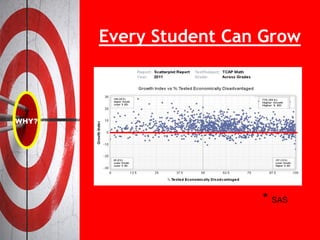
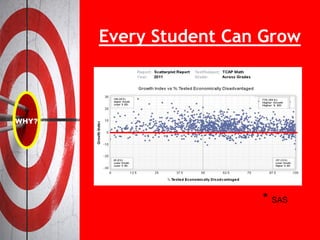
Every Student Can Grow
* SAS
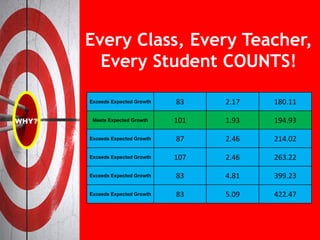
Every Class, Every Teacher,
Every Student COUNTS!
Exceeds Expected Growth 83 2.17 180.11
Meets Expected Growth 101 1.93 194.93
Exceeds Expected Growth 87 2.46 214.02
Exceeds Expected Growth 107 2.46 263.22
Exceeds Expected Growth 83 4.81 399.23
Exceeds Expected Growth 83 5.09 422.47
Meets Expected Growth 108 -1.74 -187.92
Meets Expected Growth 83 -1.94 -161.02
Meets Expected Growth 101 -1.55 -156.55
Meets Expected Growth 83 -1.87 -155.21
Meets Expected Growth 101 -0.5 -50.5
Meets Expected Growth 25 -1.96 -49
Meets Expected Growth 81 -0.18 -14.58
Meets Expected Growth 27 -0.1 -2.7
Meets Expected Growth 29 0.07 2.03
Meets Expected Growth 90 0.09 8.1
Meets Expected Growth 85 0.21 17.85
Meets Expected Growth 61 0.77 46.97
Meets Expected Growth 82 0.79 64.78
Meets Expected Growth 107 0.71 75.97
Meets Expected Growth 108 0.91 98.28
Meets Expected Growth 82 1.24 101.68
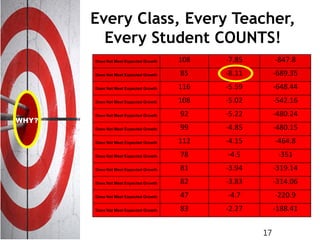
Every Class, Every Teacher,
Every Student COUNTS!
Does Not Meet Expected Growth 108 -7.85 -847.8
Does Not Meet Expected Growth 85 -8.11 -689.35
Does Not Meet Expected Growth 116 -5.59 -648.44
Does Not Meet Expected Growth 108 -5.02 -542.16
Does Not Meet Expected Growth 92 -5.22 -480.24
Does Not Meet Expected Growth 99 -4.85 -480.15
Does Not Meet Expected Growth 112 -4.15 -464.8
Does Not Meet Expected Growth 78 -4.5 -351
Does Not Meet Expected Growth 81 -3.94 -319.14
Does Not Meet Expected Growth 82 -3.83 -314.06
Does Not Meet Expected Growth 47 -4.7 -220.9
Does Not Meet Expected Growth 83 -2.27 -188.41
17
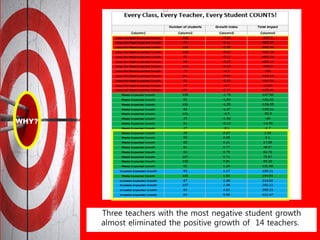
Every Class, Every Teacher,
Every Student COUNTS!
Three teachers with the most negative student growth
almost eliminated the positive growth of 14 teachers.
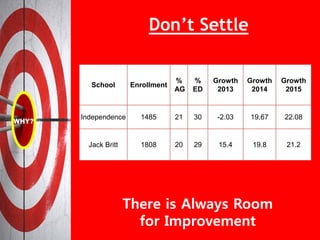
School Enrollment
%
AG
%
ED
Growth
2013
Growth
2014
Growth
2015
Independence 1485 21 30 -2.03 19.67 22.08
Jack Britt 1808 20 29 15.4 19.8 21.2
Don’t Settle
There is Always Room
for Improvement
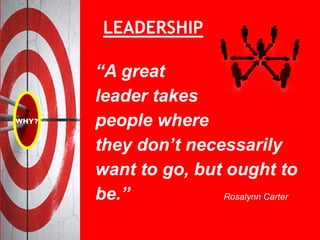
“A great
leader takes
people where
they don’t necessarily
want to go, but ought to
be.” Rosalynn Carter
LEADERSHIP
21
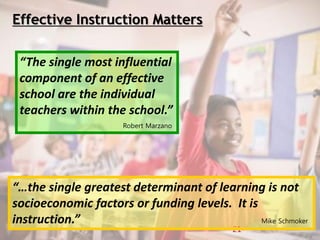
“The single most influential
component of an effective
school are the individual
teachers within the school.”
Robert Marzano
“…the single greatest determinant of learning is not
socioeconomic factors or funding levels. It is
instruction.” Mike Schmoker
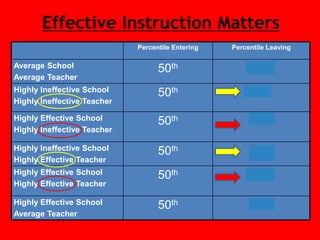
Effective Instruction Matters
Every Student Can Grow
* SAS
Percentile Entering Percentile Leaving
Average School
Average Teacher
50th 50th
Highly Ineffective School
Highly Ineffective Teacher
50th 3rd
Highly Effective School
Highly Ineffective Teacher
50th 37th
Highly Ineffective School
Highly Effective Teacher
50th 63rd
Highly Effective School
Highly Effective Teacher
50th 96th
Highly Effective School
Average Teacher
50th 78th
Effective Instruction Matters
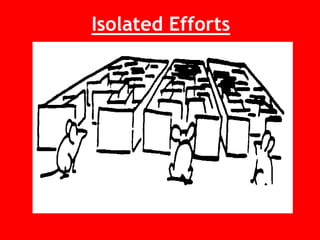
Isolated Efforts
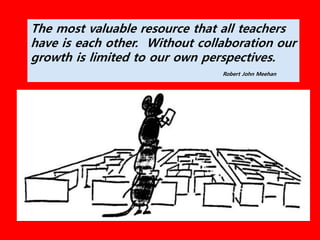
The most valuable resource that all teachers
have is each other. Without collaboration our
growth is limited to our own perspectives.
Robert John Meehan
“All Educators are
charged with the
mission of creating a learning
environment where every child can
thrive. Given the right supports and
strategies, every child can learn high
standards.”
Priority Schools: Reaching for Excellence 2013
RIGOR
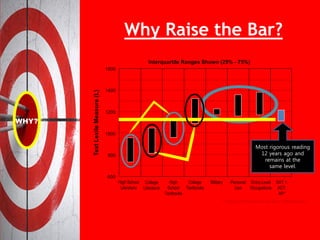
600
800
1000
1400
1600
1200
TextLexileMeasure(L)
High School
Literature
College
Literature
High
School
Textbooks
College
Textbooks
Military Personal
Use
Entry-Level
Occupations
SAT 1,
ACT,
AP*
* Source of National Test Data: MetaMetrics
Interquartile Ranges Shown (25% - 75%)
Most rigorous reading
12 years ago and
remains at the
same level.
Why Raise the Bar?
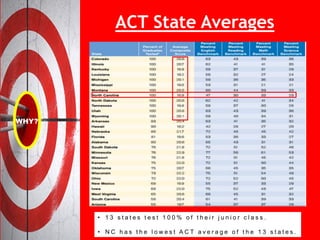
• 1 3 s t a t e s t e s t 1 0 0 % o f t h e i r j u n i o r c l a s s .
• N C h a s t h e l o w e s t A C T a v e r a g e o f t h e 1 3 s t a t e s .
ACT State Averages
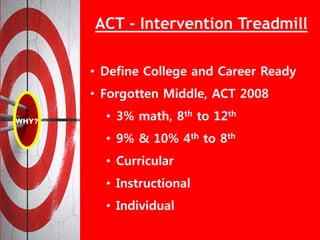
ACT - Intervention Treadmill
• Define College and Career Ready
• Forgotten Middle, ACT 2008
• 3% math, 8th to 12th
• 9% & 10% 4th to 8th
• Curricular
• Instructional
• Individual
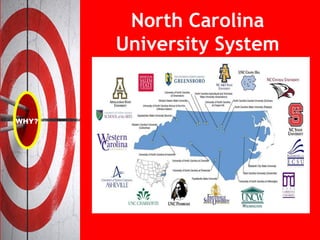
North Carolina
University System
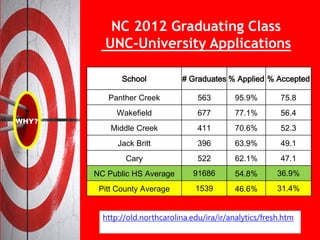
School # Graduates % Applied % Accepted
Panther Creek 563 95.9% 75.8
Wakefield 677 77.1% 56.4
Middle Creek 411 70.6% 52.3
Jack Britt 396 63.9% 49.1
Cary 522 62.1% 47.1
NC Public HS Average 91686 54.8% 36.9%
Pitt County Average 1539 46.6% 31.4%
NC 2012 Graduating Class
UNC-University Applications
http://old.northcarolina.edu/ira/ir/analytics/fresh.htm
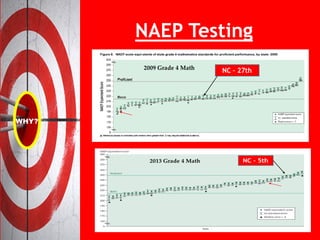
NAEP Testing
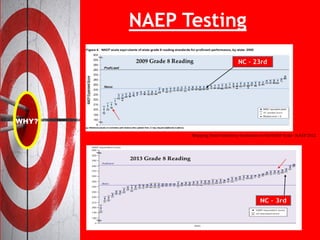
NAEP Testing
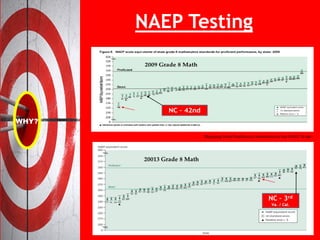
NAEP Testing
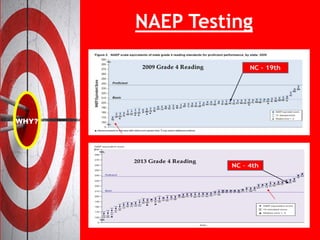
NAEP Testing
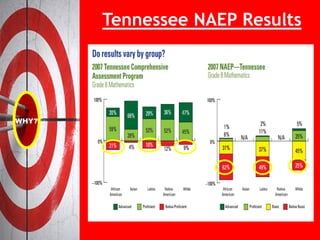
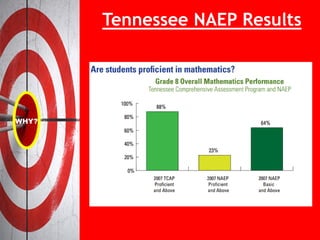
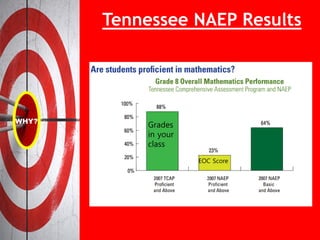
Tennessee NAEP Results
Grades
in your
class
EOC Score
“Schools have a responsibility to
take the lead and help
stakeholders feel invited and
understand their roles in
improving student learning.”
9 Characteristics of High Performing Schools, 2006
COMMUNITY
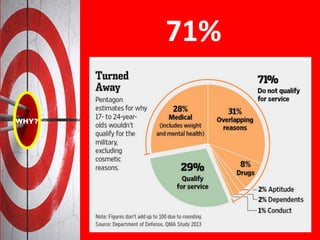
71%
Skills Gap
• Globally Competitive?
• Retirement?
• Crime?
• Government assistance?
• Unemployment?
Can We Afford Your School’s
Improvement Pace?
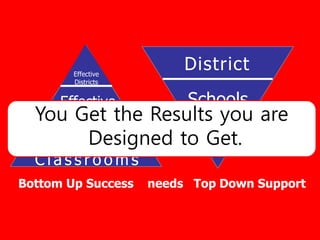
Effective
Districts
Effective
Schools
E f f e c t i v e
C l a s s r o o m s
District
Schools
Classrooms
Bottom Up Success needs Top Down Support
You Get the Results you are
Designed to Get.
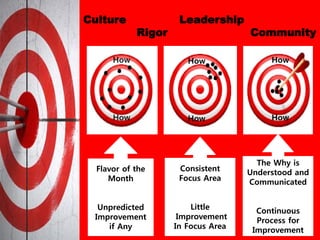
Flavor of the
Month
Unpredicted
Improvement
if Any
The Why is
Understood and
Communicated
Continuous
Process for
Improvement
Culture Leadership
Rigor Community
How
How
How
How
Consistent
Focus Area
Little
Improvement
In Focus Area
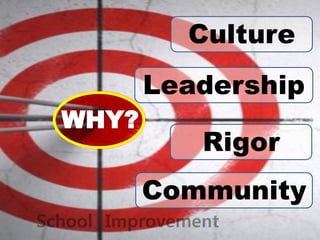
WHY?
Culture
Leadership
Rigor
Community
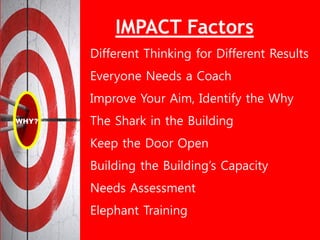
IMPACT Factors
Different Thinking for Different Results
Everyone Needs a Coach
Improve Your Aim, Identify the Why
The Shark in the Building
Keep the Door Open
Building the Building’s Capacity
Needs Assessment
Elephant Training
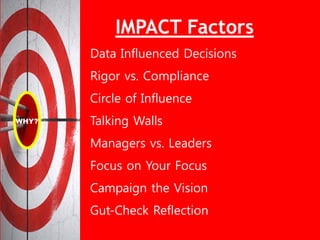
IMPACT Factors
Data Influenced Decisions
Rigor vs. Compliance
Circle of Influence
Talking Walls
Managers vs. Leaders
Focus on Your Focus
Campaign the Vision
Gut-Check Reflection
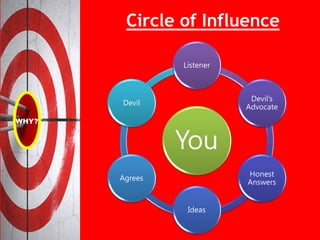
You
Listener
Devil’s
Advocate
Honest
Answers
Ideas
Agrees
Devil
Circle of Influence
IMPACT Factors
Who’s Failing Who?
Grade Your Grades
Not Easy, But Necessary
Theory into Action Plan
Study School Success
Sift the Junk and Multiply the Great
Excuses or Results
Educator’s Toolkit
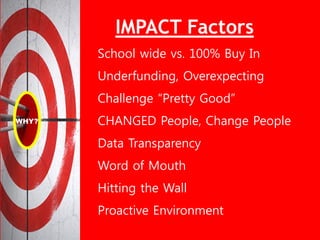
IMPACT Factors
School wide vs. 100% Buy In
Underfunding, Overexpecting
Challenge “Pretty Good”
CHANGED People, Change People
Data Transparency
Word of Mouth
Hitting the Wall
Proactive Environment
IMPACT Factors
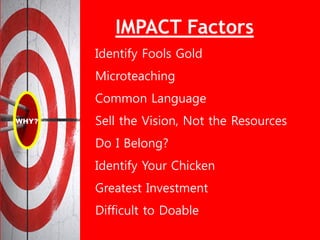
Identify Fools Gold
Microteaching
Common Language
Sell the Vision, Not the Resources
Do I Belong?
Identify Your Chicken
Greatest Investment
Difficult to Doable
IMPACT Factors
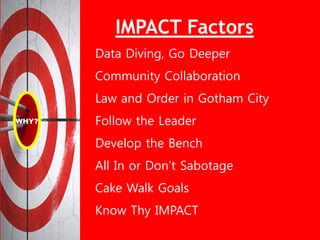
Data Diving, Go Deeper
Community Collaboration
Law and Order in Gotham City
Follow the Leader
Develop the Bench
All In or Don’t Sabotage
Cake Walk Goals
Know Thy IMPACT
IMPACT Factors
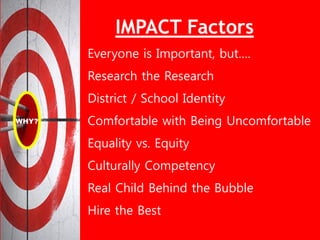
Everyone is Important, but….
Research the Research
District / School Identity
Comfortable with Being Uncomfortable
Equality vs. Equity
Culturally Competency
Real Child Behind the Bubble
Hire the Best
IMPACT Factors
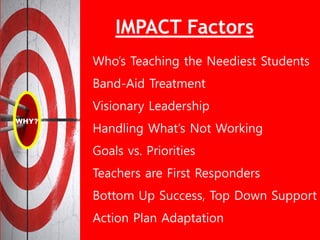
Who’s Teaching the Neediest Students
Band-Aid Treatment
Visionary Leadership
Handling What’s Not Working
Goals vs. Priorities
Teachers are First Responders
Bottom Up Success, Top Down Support
Action Plan Adaptation
IMPACT Factors
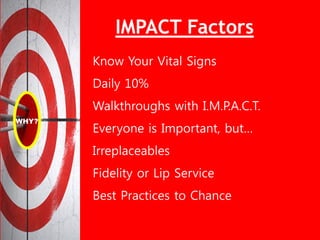
Know Your Vital Signs
Daily 10%
Walkthroughs with I.M.P.A.C.T.
Everyone is Important, but…
Irreplaceables
Fidelity or Lip Service
Best Practices to Chance
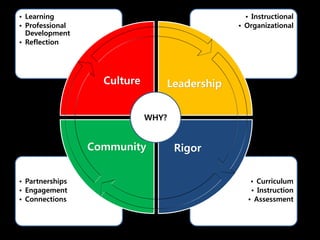
• Curriculum
• Instruction
• Assessment
• Partnerships
• Engagement
• Connections
• Instructional
• Organizational
• Learning
• Professional
Development
• Reflection
Culture Leadership
RigorCommunity
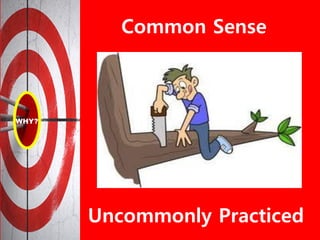
Common Sense
Uncommonly Practiced
Share one with
partner 1.
Reflections
2.
question
3.
concerncomment
Reference
Reference
Reference
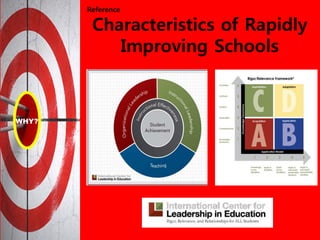
Characteristics of Rapidly
Improving Schools
Reference
References
Reference
Reference
1. Create a sense of educational awareness
and urgency.
2. Inspire educators to seek their next
step(s) towards improvement.
3. Promote Different Thinking for Different
Results.
CHANGED People, Change People!
Intentional IMPACT
True
or
Fales?
Why?
mcduffienorman@gmail.com
Contact and Feedback

Improve Your AIM on School Improvement

  • 1.
  • 2.
  • 3.
    Who’s In theRoom? • School Level • District Level • State Level • Teachers
  • 4.
    • If youare looking for something positive, you will find it. • If you are looking for something negative, you will find it. • So, the question is…. What are you looking for? 100% Guarantee
  • 5.
    1. Create asense of educational awareness and urgency. 2. Inspire educators to seek their next step(s) towards improvement. 3. Promote Different Thinking for Different Results. CHANGED People, Change People! Intentional IMPACT
  • 6.
  • 7.
  • 8.
    Culture Culture for Learning Safeand Supportive Environment Culture for Professional Learning Team Development Individual Awareness and Urgency Culture of Reflection Self-Assessment • How do we ensure a Culture of growth and effectiveness within our district and school staff? Intentional Question for Deeper Dialogue • Why do we need to ensure a Culture of growth and effectiveness within our district and school staff? • Why do we need to
  • 9.
    Leadership Instructional Leadership Campaign theVision Focus on the Focus Team Building Organizational Leadership Distributive Leadership Communication Systems Allocation of Resources Intentional Questions for Deeper Dialogue • How do we ensure that all stakeholders understand their role in our school’s vision? No Sabotage Agreement. • Why do we need to ensure that all stakeholders understand their role in our school’s vision? No Sabotage Agreement. • Why do we need to
  • 10.
    Rigor Curriculum Power Standards GoalSummaries Instruction District and School Management Administrative Support Equality vs. Equity High Yield Instructional Learning Strategies Intentional Question for Deeper Dialogue • How do we define, ensure, and monitor high quality instruction in all classrooms? Assessment Assessment System Shared Understanding Data Analysis to Influence Decisions Student Involved in Assessment Process • Why do we need to define, ensure, and monitor high quality instruction in all classrooms? • Why do we need to
  • 11.
    Community Intentional Question forDeeper Dialogue • How do we ensure that families and community partners are invited and involved in our learning and improvement process? Communication Community Engagement Connection Avenues and Tools • Why do we need to ensure that families and community partners are invited and involved in our learning and improvement process? • Why do we need to
  • 12.
  • 13.
    “The whole schoolneeds to understand what culture is and why it matters. You need to become aware that it is guiding your actions. This will help you use your culture versus being used by it.” Hay Group Education, 2004 CULTURE
  • 14.
  • 15.
    Every Class, EveryTeacher, Every Student COUNTS! Exceeds Expected Growth 83 2.17 180.11 Meets Expected Growth 101 1.93 194.93 Exceeds Expected Growth 87 2.46 214.02 Exceeds Expected Growth 107 2.46 263.22 Exceeds Expected Growth 83 4.81 399.23 Exceeds Expected Growth 83 5.09 422.47
  • 16.
    Meets Expected Growth108 -1.74 -187.92 Meets Expected Growth 83 -1.94 -161.02 Meets Expected Growth 101 -1.55 -156.55 Meets Expected Growth 83 -1.87 -155.21 Meets Expected Growth 101 -0.5 -50.5 Meets Expected Growth 25 -1.96 -49 Meets Expected Growth 81 -0.18 -14.58 Meets Expected Growth 27 -0.1 -2.7 Meets Expected Growth 29 0.07 2.03 Meets Expected Growth 90 0.09 8.1 Meets Expected Growth 85 0.21 17.85 Meets Expected Growth 61 0.77 46.97 Meets Expected Growth 82 0.79 64.78 Meets Expected Growth 107 0.71 75.97 Meets Expected Growth 108 0.91 98.28 Meets Expected Growth 82 1.24 101.68 Every Class, Every Teacher, Every Student COUNTS!
  • 17.
    Does Not MeetExpected Growth 108 -7.85 -847.8 Does Not Meet Expected Growth 85 -8.11 -689.35 Does Not Meet Expected Growth 116 -5.59 -648.44 Does Not Meet Expected Growth 108 -5.02 -542.16 Does Not Meet Expected Growth 92 -5.22 -480.24 Does Not Meet Expected Growth 99 -4.85 -480.15 Does Not Meet Expected Growth 112 -4.15 -464.8 Does Not Meet Expected Growth 78 -4.5 -351 Does Not Meet Expected Growth 81 -3.94 -319.14 Does Not Meet Expected Growth 82 -3.83 -314.06 Does Not Meet Expected Growth 47 -4.7 -220.9 Does Not Meet Expected Growth 83 -2.27 -188.41 17 Every Class, Every Teacher, Every Student COUNTS!
  • 18.
    Three teachers withthe most negative student growth almost eliminated the positive growth of 14 teachers.
  • 19.
    School Enrollment % AG % ED Growth 2013 Growth 2014 Growth 2015 Independence 148521 30 -2.03 19.67 22.08 Jack Britt 1808 20 29 15.4 19.8 21.2 Don’t Settle There is Always Room for Improvement
  • 20.
    “A great leader takes peoplewhere they don’t necessarily want to go, but ought to be.” Rosalynn Carter LEADERSHIP
  • 21.
    21 “The single mostinfluential component of an effective school are the individual teachers within the school.” Robert Marzano “…the single greatest determinant of learning is not socioeconomic factors or funding levels. It is instruction.” Mike Schmoker Effective Instruction Matters
  • 22.
  • 23.
    Percentile Entering PercentileLeaving Average School Average Teacher 50th 50th Highly Ineffective School Highly Ineffective Teacher 50th 3rd Highly Effective School Highly Ineffective Teacher 50th 37th Highly Ineffective School Highly Effective Teacher 50th 63rd Highly Effective School Highly Effective Teacher 50th 96th Highly Effective School Average Teacher 50th 78th Effective Instruction Matters
  • 24.
  • 25.
    The most valuableresource that all teachers have is each other. Without collaboration our growth is limited to our own perspectives. Robert John Meehan
  • 26.
    “All Educators are chargedwith the mission of creating a learning environment where every child can thrive. Given the right supports and strategies, every child can learn high standards.” Priority Schools: Reaching for Excellence 2013 RIGOR
  • 27.
    600 800 1000 1400 1600 1200 TextLexileMeasure(L) High School Literature College Literature High School Textbooks College Textbooks Military Personal Use Entry-Level Occupations SAT1, ACT, AP* * Source of National Test Data: MetaMetrics Interquartile Ranges Shown (25% - 75%) Most rigorous reading 12 years ago and remains at the same level. Why Raise the Bar?
  • 28.
    • 1 3s t a t e s t e s t 1 0 0 % o f t h e i r j u n i o r c l a s s . • N C h a s t h e l o w e s t A C T a v e r a g e o f t h e 1 3 s t a t e s . ACT State Averages
  • 29.
    ACT - InterventionTreadmill • Define College and Career Ready • Forgotten Middle, ACT 2008 • 3% math, 8th to 12th • 9% & 10% 4th to 8th • Curricular • Instructional • Individual
  • 30.
  • 31.
    School # Graduates% Applied % Accepted Panther Creek 563 95.9% 75.8 Wakefield 677 77.1% 56.4 Middle Creek 411 70.6% 52.3 Jack Britt 396 63.9% 49.1 Cary 522 62.1% 47.1 NC Public HS Average 91686 54.8% 36.9% Pitt County Average 1539 46.6% 31.4% NC 2012 Graduating Class UNC-University Applications http://old.northcarolina.edu/ira/ir/analytics/fresh.htm
  • 32.
  • 33.
  • 34.
  • 35.
  • 36.
  • 37.
  • 38.
  • 39.
    “Schools have aresponsibility to take the lead and help stakeholders feel invited and understand their roles in improving student learning.” 9 Characteristics of High Performing Schools, 2006 COMMUNITY
  • 40.
  • 41.
    Skills Gap • GloballyCompetitive? • Retirement? • Crime? • Government assistance? • Unemployment? Can We Afford Your School’s Improvement Pace?
  • 42.
    Effective Districts Effective Schools E f fe c t i v e C l a s s r o o m s District Schools Classrooms Bottom Up Success needs Top Down Support You Get the Results you are Designed to Get.
  • 43.
    Flavor of the Month Unpredicted Improvement ifAny The Why is Understood and Communicated Continuous Process for Improvement Culture Leadership Rigor Community How How How How Consistent Focus Area Little Improvement In Focus Area
  • 44.
  • 45.
    IMPACT Factors Different Thinkingfor Different Results Everyone Needs a Coach Improve Your Aim, Identify the Why The Shark in the Building Keep the Door Open Building the Building’s Capacity Needs Assessment Elephant Training
  • 46.
    IMPACT Factors Data InfluencedDecisions Rigor vs. Compliance Circle of Influence Talking Walls Managers vs. Leaders Focus on Your Focus Campaign the Vision Gut-Check Reflection
  • 47.
  • 48.
    IMPACT Factors Who’s FailingWho? Grade Your Grades Not Easy, But Necessary Theory into Action Plan Study School Success Sift the Junk and Multiply the Great Excuses or Results Educator’s Toolkit
  • 49.
    IMPACT Factors School widevs. 100% Buy In Underfunding, Overexpecting Challenge “Pretty Good” CHANGED People, Change People Data Transparency Word of Mouth Hitting the Wall Proactive Environment
  • 50.
    IMPACT Factors Identify FoolsGold Microteaching Common Language Sell the Vision, Not the Resources Do I Belong? Identify Your Chicken Greatest Investment Difficult to Doable
  • 51.
    IMPACT Factors Data Diving,Go Deeper Community Collaboration Law and Order in Gotham City Follow the Leader Develop the Bench All In or Don’t Sabotage Cake Walk Goals Know Thy IMPACT
  • 52.
    IMPACT Factors Everyone isImportant, but…. Research the Research District / School Identity Comfortable with Being Uncomfortable Equality vs. Equity Culturally Competency Real Child Behind the Bubble Hire the Best
  • 53.
    IMPACT Factors Who’s Teachingthe Neediest Students Band-Aid Treatment Visionary Leadership Handling What’s Not Working Goals vs. Priorities Teachers are First Responders Bottom Up Success, Top Down Support Action Plan Adaptation
  • 54.
    IMPACT Factors Know YourVital Signs Daily 10% Walkthroughs with I.M.P.A.C.T. Everyone is Important, but… Irreplaceables Fidelity or Lip Service Best Practices to Chance
  • 55.
    • Curriculum • Instruction •Assessment • Partnerships • Engagement • Connections • Instructional • Organizational • Learning • Professional Development • Reflection Culture Leadership RigorCommunity
  • 56.
  • 57.
    Share one with partner1. Reflections 2. question 3. concerncomment
  • 58.
  • 59.
  • 60.
  • 61.
  • 62.
  • 63.
  • 64.
  • 65.
    1. Create asense of educational awareness and urgency. 2. Inspire educators to seek their next step(s) towards improvement. 3. Promote Different Thinking for Different Results. CHANGED People, Change People! Intentional IMPACT
  • 66.
  • 67.