



Transforming School
Culture:
www.schoolofeducators.com
Culture is the most powerful
source of leverage for bringing
about change in a school – or any
organization, for that matter.
Thomas J. Sergiovanni
www.schoolofeducators.com
School CultureSchool Culture
School culture is norms developed over
time based on shared attitudes, values,
beliefs, expectations, relationships, and
traditions of a particular school that
cause it to function or react as it does.www.schoolofeducators.com
School Culture is often majority
driven (staff), intangible, hard to
describe, and difficult to positively
impact, or change in a systemic way.
The attitudes, beliefs, and values
may often be “hidden” to those new
to or outside of the school
community.
School Culture Con’t
www.schoolofeducators.com
School ClimateSchool Climate is the communication of its
norms, beliefs, and values through various
behaviors and interactions and their effect
on others, with the primary focus being on
students. School Climate is driven by and
reflected in the daily interactions of staff,
administration, students, support staff, and
the outside community.
www.schoolofeducators.com
Climate is expressed in tangible ways, is
more leadership driven, and responds
more quickly to change. Climate is
demonstrated through collegiality,
communication, decision-making, trust,
expectations, ideology, leadership,
recognition, celebration, support, and
experimentation. Climate should
directly reflect the school’s mission
statement through its focus and actions.
www.schoolofeducators.com
School Culture is over a period of time…
the history
Climate is now, it’s the
perceptions/emotions being evoked
www.schoolofeducators.com
Definition of Culture
In short, Terrence Deal,
author and professor at
Vanderbilt University,
explains, “It is the way
we do business here
and clarifies what is
important and what is
not.” www.schoolofeducators.com
Group Activity
The Hotel Californiawww.schoolofeducators.com
Culture
VALUES
ATTITUDES
BELIEFS
LANGUAGE
COMMUNICATION
BEHAVIOR
INDIVIDUAL
History Religion
Geography
Politics
Government
Social-Peer
Groups
Economics
Neighborhood
Community
Region
Socio-Economic Status (SES)
Society
Clan
Gender
Events
Cultural Practices
Traditions
Customs
Race
Family
Ethnic Group
School Culture
Values-Attitudes-Beliefs
Mission-Vision-Goals
Histories-Norms-Traditions-Stories
Policies-Habits-Expectations-Rituals-Ceremonies
Decision-Making Communication
Collegiality/ Professional Collaboration
(Professional Learning Community)
RELATIONSHIPS and INTERACTIONS
(How people treat each other, feel about each other and work together...)
Administrator to
Staff to Staff Staff to Student Student to
Student
School to
Parents/
CommunityStaff Students
www.schoolofeducators.com
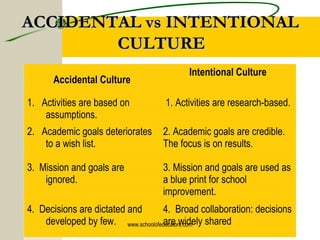
ACCIDENTAL vs INTENTIONALACCIDENTAL vs INTENTIONAL
CULTURECULTURE
Accidental Culture
Intentional Culture
1. Activities are based on
assumptions.
1. Activities are research-based.
2. Academic goals deteriorates
to a wish list.
2. Academic goals are credible.
The focus is on results.
3. Mission and goals are
ignored.
3. Mission and goals are used as
a blue print for school
improvement.
4. Decisions are dictated and
developed by few.
4. Broad collaboration: decisions
are widely sharedwww.schoolofeducators.com
ACCIDENTAL vs INTENTIONALACCIDENTAL vs INTENTIONAL
CULTURECULTURE
Accidental Culture
Intentional Culture
1. Articulated Beliefs 1. Beliefs are tied to actions and
behaviors.
2. Random Values 2. Values tied to vision and
mission
3. Connections are random 3. Connections are constantly
sought
4. Diversity is acknowledge 4. Diversity is valued
www.schoolofeducators.com
Negativity in a school culture or climate is
usually manifested in the attitudes and actions
of school staff through:
No or low
expectations
Little or no
communication
among stakeholders
Resistance to change
No ownership
Little or no sense of
community
Disrespect/hostility
widespread
Low morale and
distrustwww.schoolofeducators.com
Examples of Negativity through
Dysfunctional Norms
Dread coming to
school
Criticize those who
are innovative
Politics drive
decision-making
Do just enough to
get by
Judgmental/Critical of
other’s motivation
Fear reprisal
Distrust colleagues or
administration
“Me First”
Operate in a vacuum
Adapted from Shaping School Culture: The Heart of Leadership (1998)www.schoolofeducators.com
A Toxic School Culture Is full of
Taters
Dictators
Commentators
 Agitators
Spectators
www.schoolofeducators.com
Collaboration, Collegiality
and Efficacy
www.schoolofeducators.com
Positive School Culture/Climate
Mission IS about student and teacher learning
Rich sense of history and purpose
Core values of collegiality, performance, and
improvement centered around quality,
achievement, and learning for ALL students
Positive and Proactive Approaches for staff and
students
www.schoolofeducators.com
Positive School Culture/Climate
Stories that celebrate successes and recognize
heroines and heroes
Physical Environment reflects pride and joy
Widespread sense of respect and nurturing
www.schoolofeducators.com
Why Is School Culture
Important?
What research tells us:
“Positive learning can only take place in a positive
culture. A healthy school culture will affect more
student and teacher success than any other reform
or school improvement effort currently being
employed.”
-Gary Phillips
www.schoolofeducators.com
TRANSFORMING SCHOOL
CULTURE
www.schoolofeducators.com
If you intend to introduce a change that is
incompatible with the organization’s culture,
you have only three choices: modify the
change to be more in line with the existing
culture, alter the culture to be more in line
with the proposed change, or prepare to
fail.
David Salisbury & Daryl Conner, 1994
www.schoolofeducators.com
It’s not so much that we’re afraid of
change, or so in love with the old ways,
but it’s that place in between … it’s like
being in between trapezes. It’s Linus
when his blanket is in the dryer. There’s
nothing to hold on to.
- Marilyn Ferguson
www.schoolofeducators.com
YOU MUST FIRST ASSESS
YOUR CULTURE!
TO IMPROVE YOUR
CULTURE…
www.schoolofeducators.com
GROUP ACTIVITY
SCHOOL CULTURE
SURVEY
www.schoolofeducators.com
Four Steps in Creating a Truthful
Culture
Lead with questions, not with answers.
Engage in dialogue and debate, not
coercion.
Conduct autopsies without blame.
Build red flag mechanisms that turn
information into information that cannot be
ignored. www.schoolofeducators.com
Reculturing
versus
Restructuring
Changing The School Culture
www.schoolofeducators.com
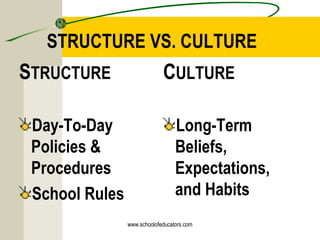
STRUCTURE VS. CULTURE
STRUCTURE
Day-To-Day
Policies &
Procedures
School Rules
CULTURE
Long-Term
Beliefs,
Expectations,
and Habits
www.schoolofeducators.com
TO CHANGE YOUR
SCHOOL’S CULTURE
Promote your mission, vision, values and
goals.
Bring your staff together to find best
practices.
Sustain the culture through
communication.
Persist.
Confront problems.www.schoolofeducators.com
What Do We Know About Effective Culture?
Twelve Norms of School Culture Where People and
Programs Improve
Collegiality Appreciation and recognition
Experimentation Caring, celebration, humor
High expectations Involvement in decision making
Trust and confidence Protection of what’s important
Tangible support Traditions
Reaching out to the knowledge
bases
Honest, open communication
“Good Seeds Grow in Strong Cultures” by Saphier and King
www.schoolofeducators.com
A Final Thought
“Self-renewing school cultures are
collaborative places where adults care
about one another, share common
goals and values, and have the skills
and knowledge to plan together, solve
problems together, and fight
passionately but gracefully for ideas to
improve instruction.”
-Robert Garmston & Bruce Wellman
www.schoolofeducators.com
It’s difficult to change school
culture,
but remain optimisticwww.schoolofeducators.com
www.schoolofeducators.com
WE ARE ALL IN THIS BOAT
TOGETHER
www.schoolofeducators.com
All I Need To Know, I Learned From Noah’s Ark:
•Don’t Miss The Boat
•Remember That We Are All In The Same Boat
•Plan Ahead: It was not Raining When Noah Built The
Ark
•Stay Fit: When you’re 600 years old someone may ask
you to do something really big
www.schoolofeducators.com
All I Need To Know, I Learned From Noah’s Ark:
•Don’t Listen To Critics; Just Get On With The Job That
Needs To Be Done.
•Build Your Future on high Ground.
•For Safety Travel In Pairs.
•Speed isn’t always an advantage. The snails were on
board with the cheetahs.
www.schoolofeducators.com
All I Need To Know, I Learned From Noah’s
Ark:
•When you’re stressed, float a while.
•Remember the Ark was built by amateurs,
and the titanic by professionals
•No matter the storm, when you are with the
right people, there’s always a rainbow
waiting
www.schoolofeducators.com
A MOMENT OF CLARITY
I learned that …
I realized that …
I was pleased that …
I was not aware that…
www.schoolofeducators.com
Presented By:Presented By:
www.schoolofeducators.comwww.schoolofeducators.com
www.schoolofeducators.com

Transformingschoolculture

  • 1.
  • 2.
    Culture is themost powerful source of leverage for bringing about change in a school – or any organization, for that matter. Thomas J. Sergiovanni www.schoolofeducators.com
  • 3.
    School CultureSchool Culture Schoolculture is norms developed over time based on shared attitudes, values, beliefs, expectations, relationships, and traditions of a particular school that cause it to function or react as it does.www.schoolofeducators.com
  • 4.
    School Culture isoften majority driven (staff), intangible, hard to describe, and difficult to positively impact, or change in a systemic way. The attitudes, beliefs, and values may often be “hidden” to those new to or outside of the school community. School Culture Con’t www.schoolofeducators.com
  • 5.
    School ClimateSchool Climateis the communication of its norms, beliefs, and values through various behaviors and interactions and their effect on others, with the primary focus being on students. School Climate is driven by and reflected in the daily interactions of staff, administration, students, support staff, and the outside community. www.schoolofeducators.com
  • 6.
    Climate is expressedin tangible ways, is more leadership driven, and responds more quickly to change. Climate is demonstrated through collegiality, communication, decision-making, trust, expectations, ideology, leadership, recognition, celebration, support, and experimentation. Climate should directly reflect the school’s mission statement through its focus and actions. www.schoolofeducators.com
  • 7.
    School Culture isover a period of time… the history Climate is now, it’s the perceptions/emotions being evoked www.schoolofeducators.com
  • 8.
    Definition of Culture Inshort, Terrence Deal, author and professor at Vanderbilt University, explains, “It is the way we do business here and clarifies what is important and what is not.” www.schoolofeducators.com
  • 9.
    Group Activity The HotelCaliforniawww.schoolofeducators.com
  • 10.
    Culture VALUES ATTITUDES BELIEFS LANGUAGE COMMUNICATION BEHAVIOR INDIVIDUAL History Religion Geography Politics Government Social-Peer Groups Economics Neighborhood Community Region Socio-Economic Status(SES) Society Clan Gender Events Cultural Practices Traditions Customs Race Family Ethnic Group School Culture Values-Attitudes-Beliefs Mission-Vision-Goals Histories-Norms-Traditions-Stories Policies-Habits-Expectations-Rituals-Ceremonies Decision-Making Communication Collegiality/ Professional Collaboration (Professional Learning Community) RELATIONSHIPS and INTERACTIONS (How people treat each other, feel about each other and work together...) Administrator to Staff to Staff Staff to Student Student to Student School to Parents/ CommunityStaff Students www.schoolofeducators.com
  • 11.
    ACCIDENTAL vs INTENTIONALACCIDENTALvs INTENTIONAL CULTURECULTURE Accidental Culture Intentional Culture 1. Activities are based on assumptions. 1. Activities are research-based. 2. Academic goals deteriorates to a wish list. 2. Academic goals are credible. The focus is on results. 3. Mission and goals are ignored. 3. Mission and goals are used as a blue print for school improvement. 4. Decisions are dictated and developed by few. 4. Broad collaboration: decisions are widely sharedwww.schoolofeducators.com
  • 12.
    ACCIDENTAL vs INTENTIONALACCIDENTALvs INTENTIONAL CULTURECULTURE Accidental Culture Intentional Culture 1. Articulated Beliefs 1. Beliefs are tied to actions and behaviors. 2. Random Values 2. Values tied to vision and mission 3. Connections are random 3. Connections are constantly sought 4. Diversity is acknowledge 4. Diversity is valued www.schoolofeducators.com
  • 13.
    Negativity in aschool culture or climate is usually manifested in the attitudes and actions of school staff through: No or low expectations Little or no communication among stakeholders Resistance to change No ownership Little or no sense of community Disrespect/hostility widespread Low morale and distrustwww.schoolofeducators.com
  • 14.
    Examples of Negativitythrough Dysfunctional Norms Dread coming to school Criticize those who are innovative Politics drive decision-making Do just enough to get by Judgmental/Critical of other’s motivation Fear reprisal Distrust colleagues or administration “Me First” Operate in a vacuum Adapted from Shaping School Culture: The Heart of Leadership (1998)www.schoolofeducators.com
  • 15.
    A Toxic SchoolCulture Is full of Taters Dictators Commentators  Agitators Spectators www.schoolofeducators.com
  • 16.
  • 17.
    Positive School Culture/Climate MissionIS about student and teacher learning Rich sense of history and purpose Core values of collegiality, performance, and improvement centered around quality, achievement, and learning for ALL students Positive and Proactive Approaches for staff and students www.schoolofeducators.com
  • 18.
    Positive School Culture/Climate Storiesthat celebrate successes and recognize heroines and heroes Physical Environment reflects pride and joy Widespread sense of respect and nurturing www.schoolofeducators.com
  • 19.
    Why Is SchoolCulture Important? What research tells us: “Positive learning can only take place in a positive culture. A healthy school culture will affect more student and teacher success than any other reform or school improvement effort currently being employed.” -Gary Phillips www.schoolofeducators.com
  • 20.
  • 21.
    If you intendto introduce a change that is incompatible with the organization’s culture, you have only three choices: modify the change to be more in line with the existing culture, alter the culture to be more in line with the proposed change, or prepare to fail. David Salisbury & Daryl Conner, 1994 www.schoolofeducators.com
  • 22.
    It’s not somuch that we’re afraid of change, or so in love with the old ways, but it’s that place in between … it’s like being in between trapezes. It’s Linus when his blanket is in the dryer. There’s nothing to hold on to. - Marilyn Ferguson www.schoolofeducators.com
  • 23.
    YOU MUST FIRSTASSESS YOUR CULTURE! TO IMPROVE YOUR CULTURE… www.schoolofeducators.com
  • 24.
  • 25.
    Four Steps inCreating a Truthful Culture Lead with questions, not with answers. Engage in dialogue and debate, not coercion. Conduct autopsies without blame. Build red flag mechanisms that turn information into information that cannot be ignored. www.schoolofeducators.com
  • 26.
  • 27.
    STRUCTURE VS. CULTURE STRUCTURE Day-To-Day Policies& Procedures School Rules CULTURE Long-Term Beliefs, Expectations, and Habits www.schoolofeducators.com
  • 28.
    TO CHANGE YOUR SCHOOL’SCULTURE Promote your mission, vision, values and goals. Bring your staff together to find best practices. Sustain the culture through communication. Persist. Confront problems.www.schoolofeducators.com
  • 29.
    What Do WeKnow About Effective Culture? Twelve Norms of School Culture Where People and Programs Improve Collegiality Appreciation and recognition Experimentation Caring, celebration, humor High expectations Involvement in decision making Trust and confidence Protection of what’s important Tangible support Traditions Reaching out to the knowledge bases Honest, open communication “Good Seeds Grow in Strong Cultures” by Saphier and King www.schoolofeducators.com
  • 30.
    A Final Thought “Self-renewingschool cultures are collaborative places where adults care about one another, share common goals and values, and have the skills and knowledge to plan together, solve problems together, and fight passionately but gracefully for ideas to improve instruction.” -Robert Garmston & Bruce Wellman www.schoolofeducators.com
  • 31.
    It’s difficult tochange school culture, but remain optimisticwww.schoolofeducators.com
  • 32.
  • 33.
    WE ARE ALLIN THIS BOAT TOGETHER www.schoolofeducators.com
  • 34.
    All I NeedTo Know, I Learned From Noah’s Ark: •Don’t Miss The Boat •Remember That We Are All In The Same Boat •Plan Ahead: It was not Raining When Noah Built The Ark •Stay Fit: When you’re 600 years old someone may ask you to do something really big www.schoolofeducators.com
  • 35.
    All I NeedTo Know, I Learned From Noah’s Ark: •Don’t Listen To Critics; Just Get On With The Job That Needs To Be Done. •Build Your Future on high Ground. •For Safety Travel In Pairs. •Speed isn’t always an advantage. The snails were on board with the cheetahs. www.schoolofeducators.com
  • 36.
    All I NeedTo Know, I Learned From Noah’s Ark: •When you’re stressed, float a while. •Remember the Ark was built by amateurs, and the titanic by professionals •No matter the storm, when you are with the right people, there’s always a rainbow waiting www.schoolofeducators.com
  • 37.
    A MOMENT OFCLARITY I learned that … I realized that … I was pleased that … I was not aware that… www.schoolofeducators.com
  • 38.