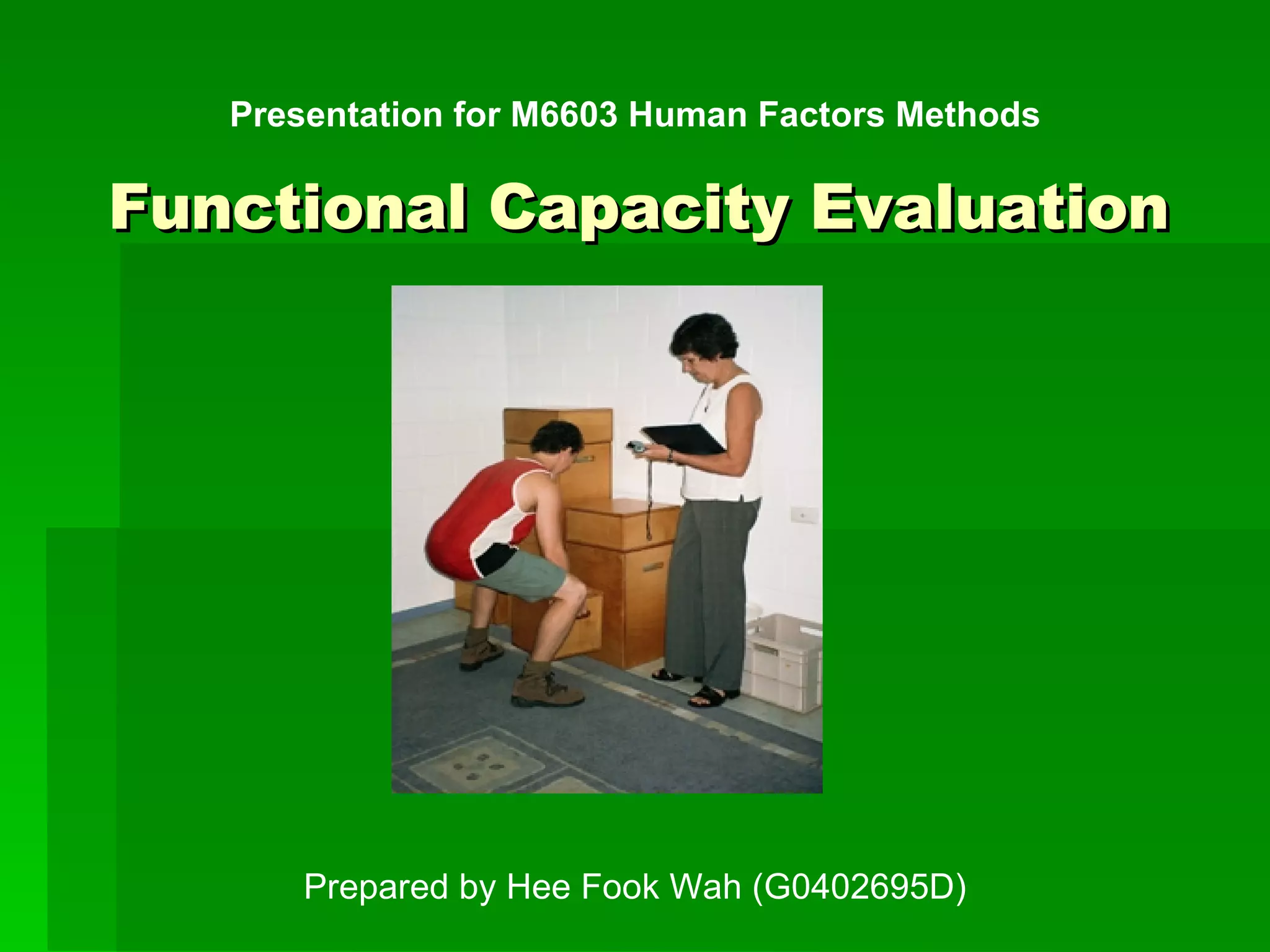
Functional Capacity Evaluation Presentation for M6603 Human Factors Methods Prepared by Hee Fook Wah (G0402695D)
Introduction … traditional physical evaluation procedure such as testing muscle strength, measuring joint range of motion, radiographic findings and recording  medical signs and symptoms are not good predictors of functional abilities .... functional capacity evaluation have developed from a need for a more objective measure of a person’s physical abilities to perform work… Lechner et al. (1994)
What is FCE? …  is a systematic process of assessing an individual's physical capacities and functional abilities.  AOTA (2005)
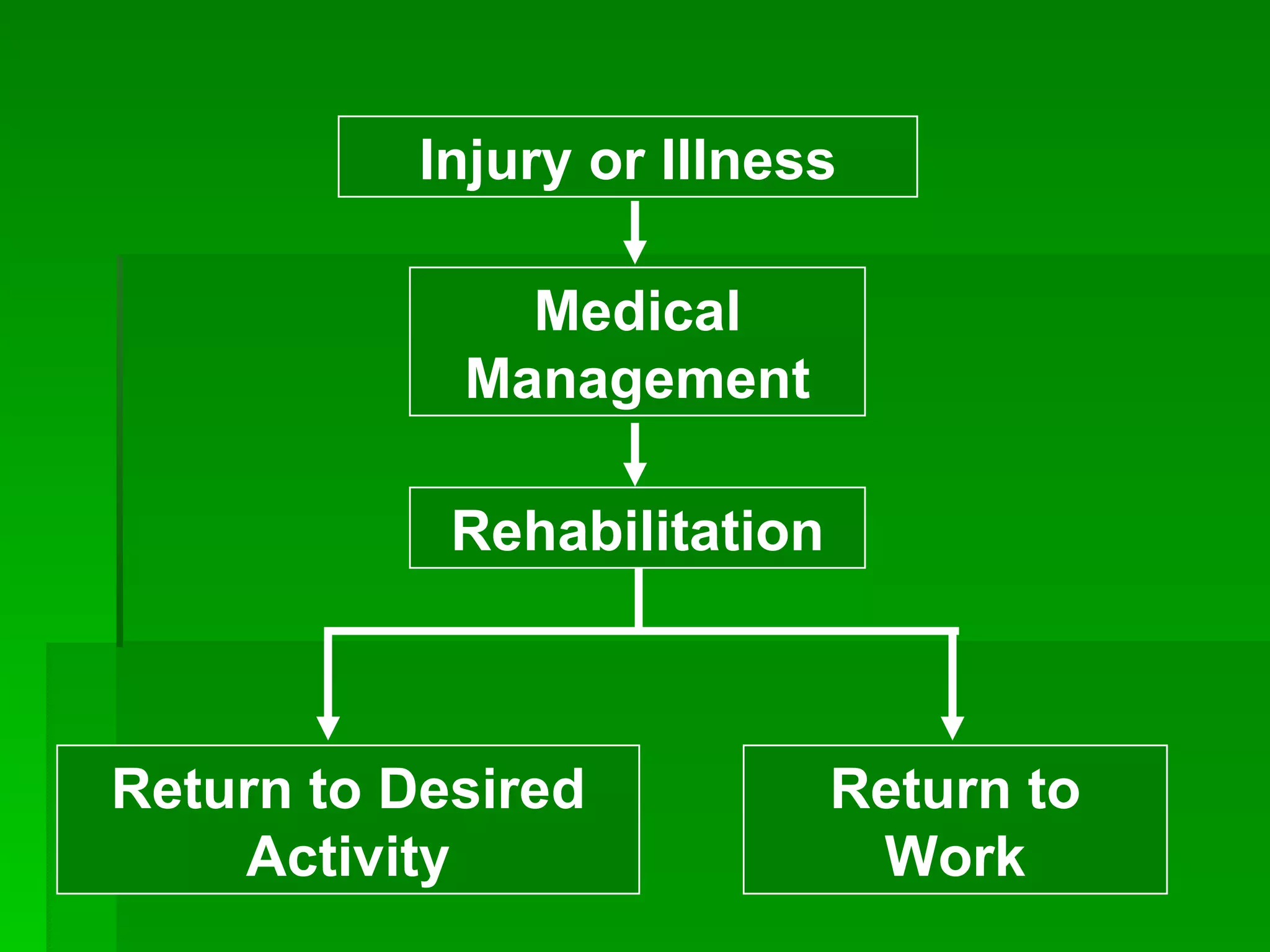
Injury or Illness Medical Management Return to Work Return to Desired Activity Rehabilitation
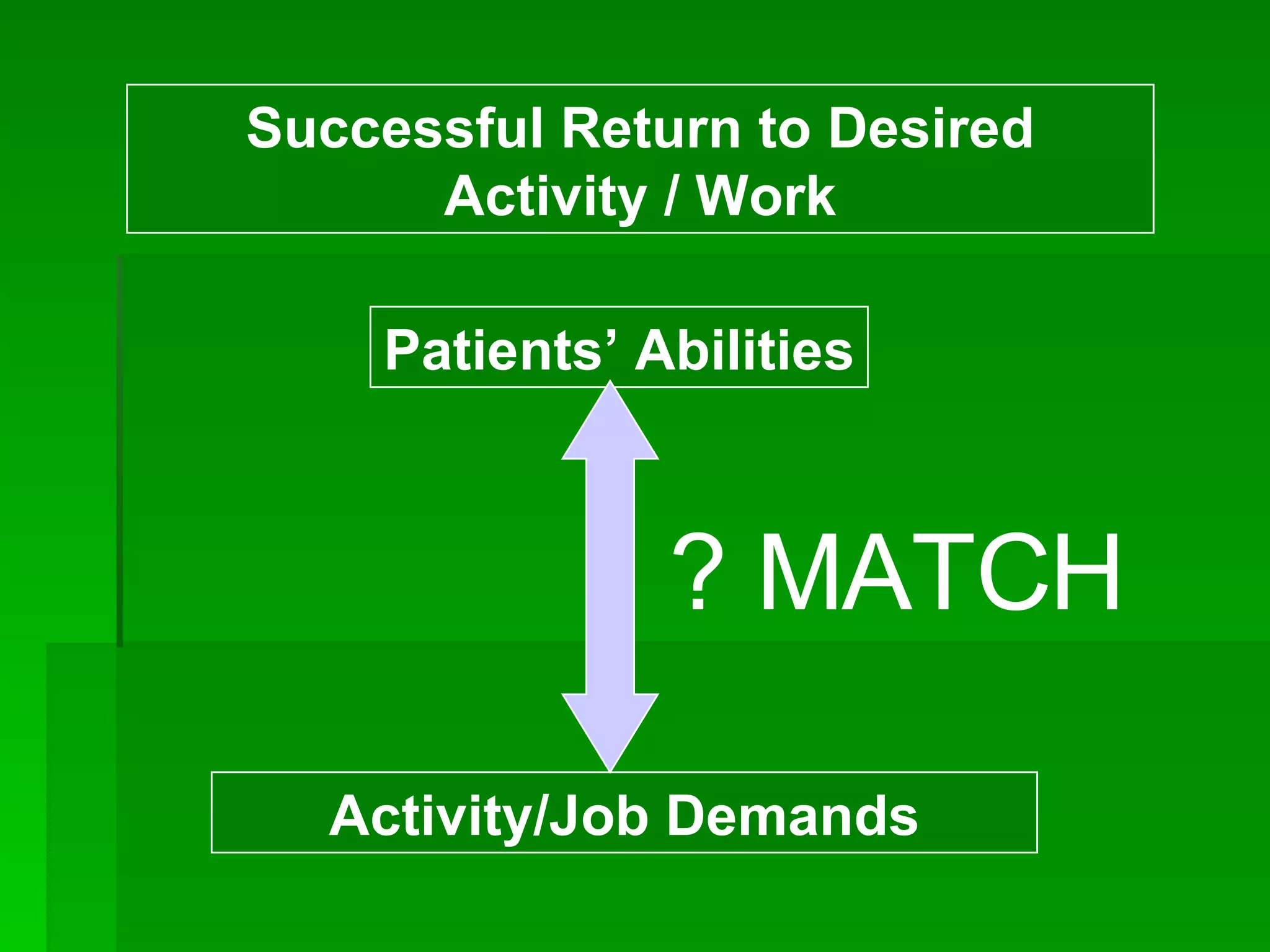
Successful Return to Desired Activity / Work Patients’ Abilities Activity/Job Demands   ? MATCH
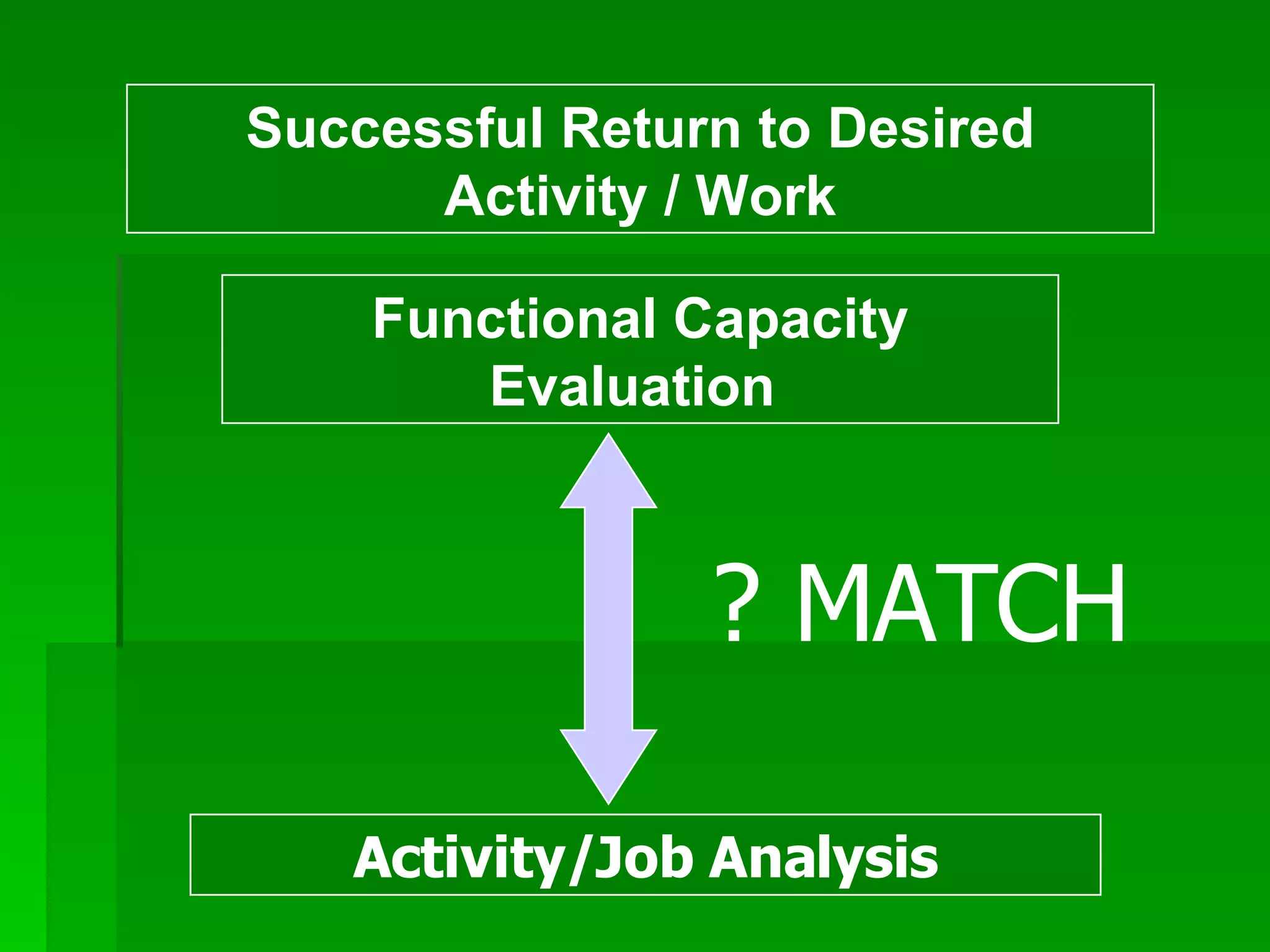
Successful Return to Desired Activity / Work Functional Capacity Evaluation   Activity/Job Analysis  ? MATCH
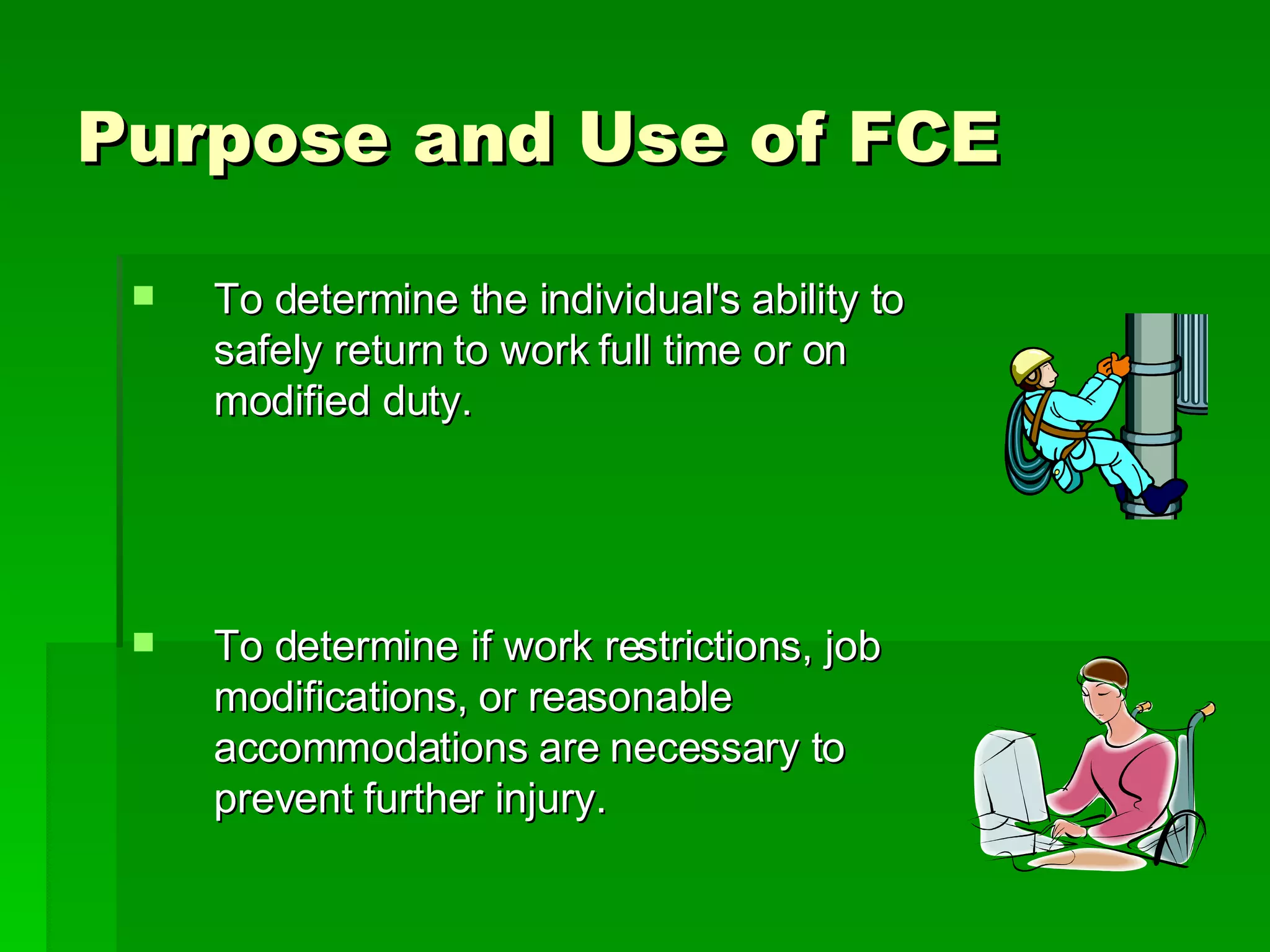
Purpose and Use of FCE To determine the individual's ability to safely return to work full time or on modified duty.  To determine if work restrictions, job modifications, or reasonable accommodations are necessary to prevent further injury.
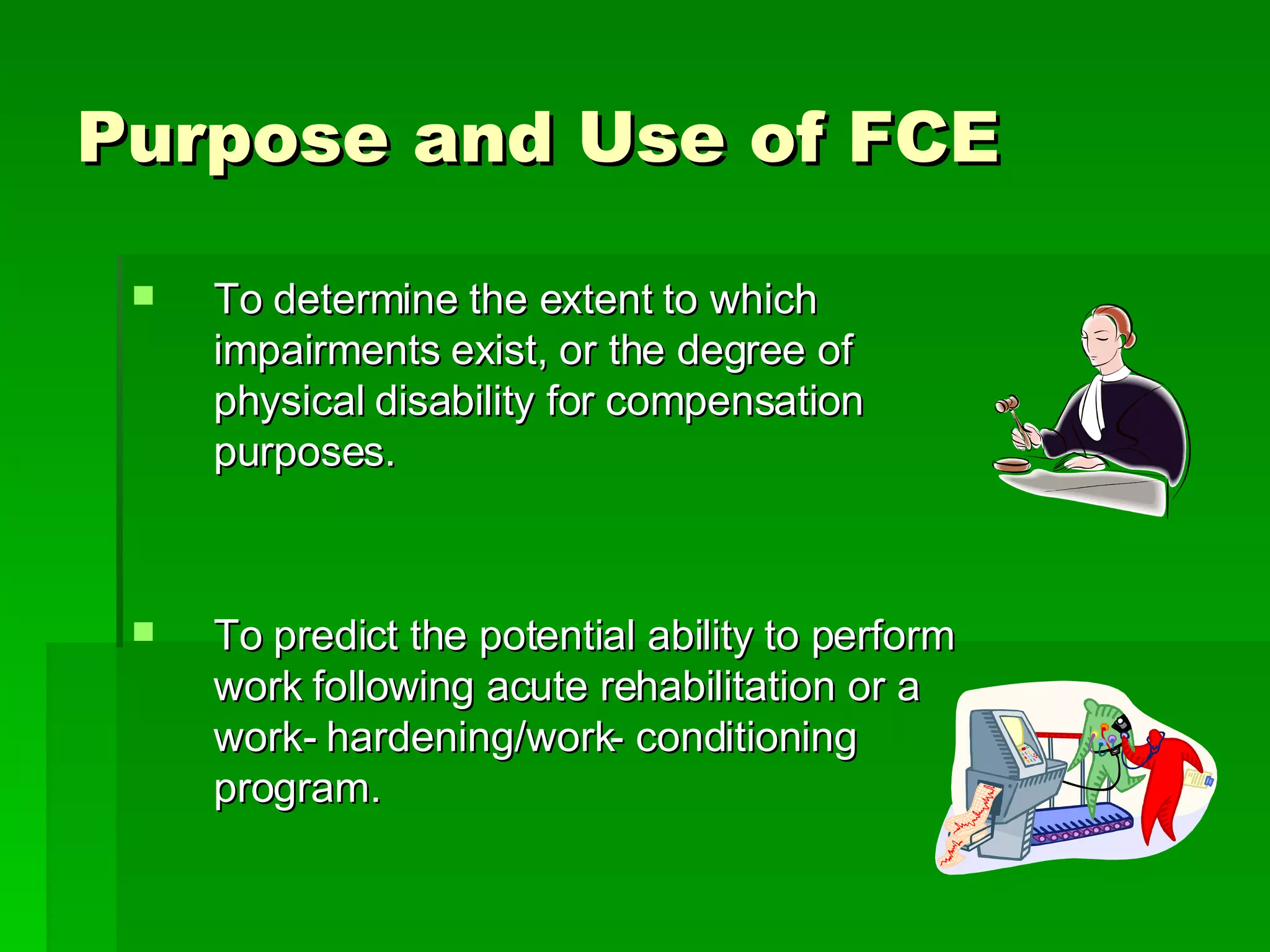
Purpose and Use of FCE To determine the extent to which impairments exist, or the degree of physical disability for compensation purposes.  To predict the potential ability to perform work following acute rehabilitation or a work- hardening/work- conditioning program.
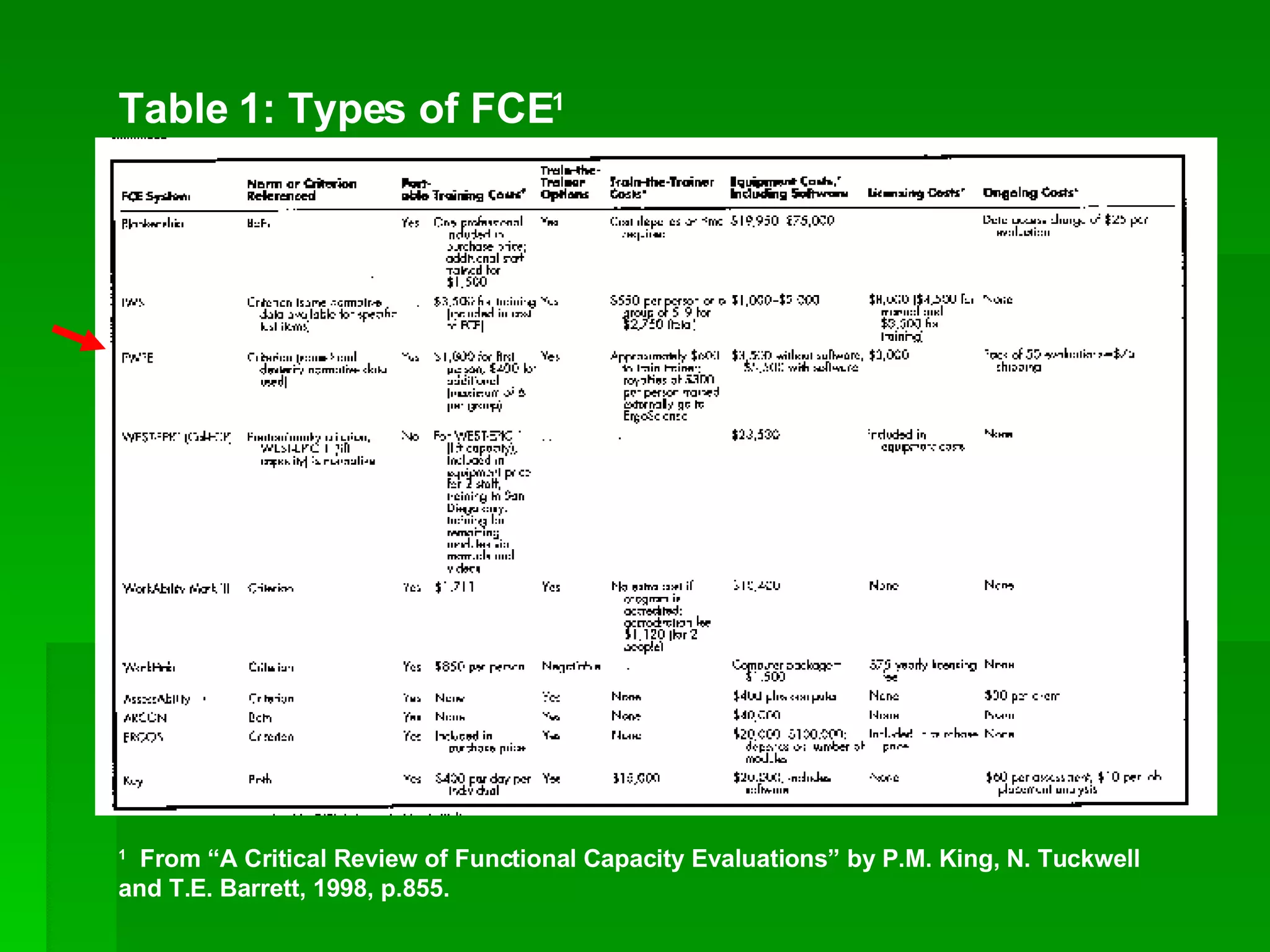
Table 1: Types of FCE 1 1   From “A Critical Review of Functional Capacity Evaluations” by P.M. King, N. Tuckwell and T.E. Barrett, 1998, p.855.
Physical Work Performance Evaluation (PWPE) Developed by ErgoScience The test items include the testing of the  20 physical demands  as defined by the Department of Labour (U.S.A.) in the Dictionary of Occupational Titles.
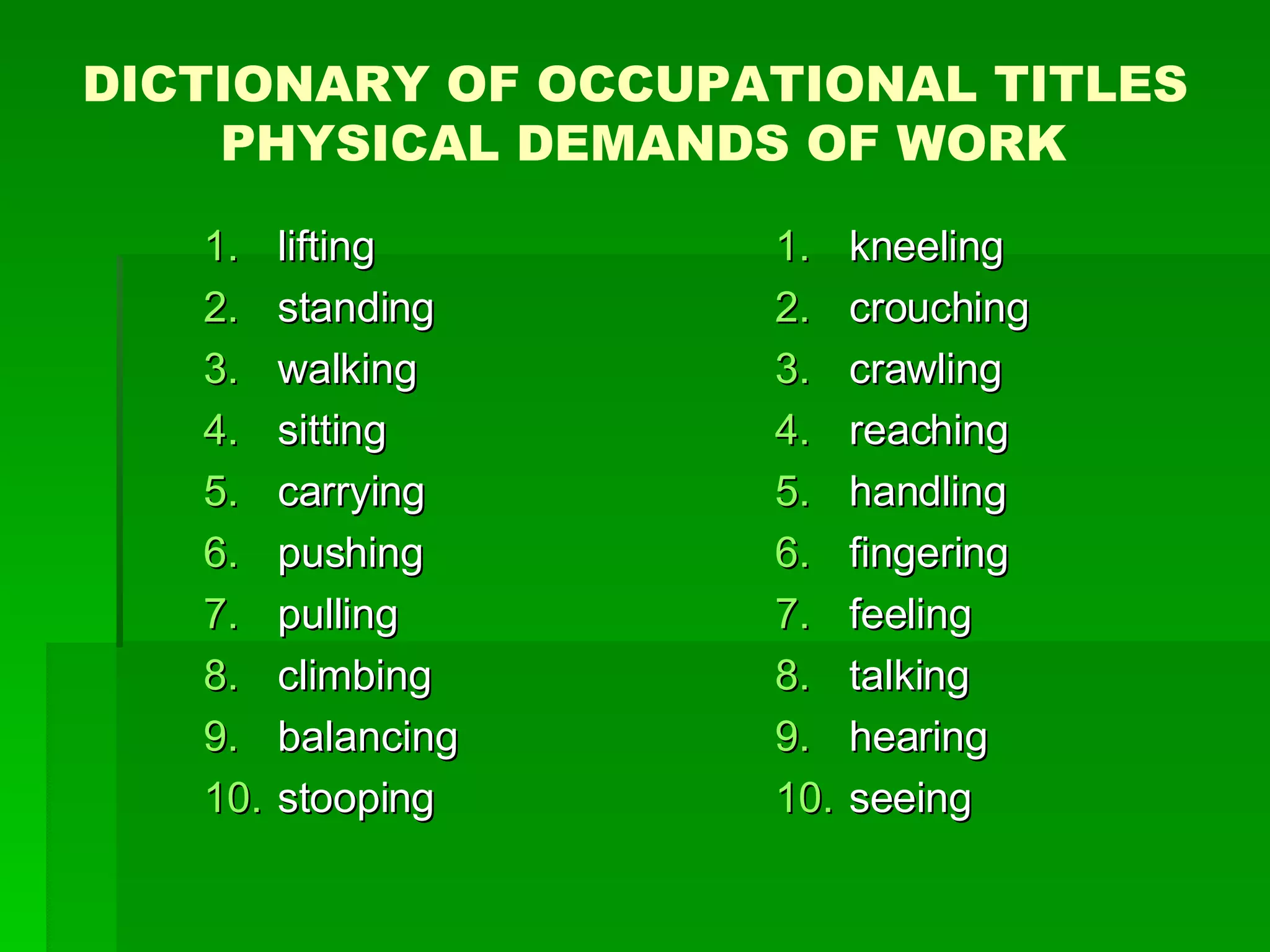
lifting standing walking sitting carrying pushing pulling climbing balancing stooping kneeling crouching crawling reaching handling fingering feeling talking hearing seeing DICTIONARY OF OCCUPATIONAL TITLES  PHYSICAL DEMANDS OF WORK
Dynamic strength Position tolerance Mobility Endurance Fine motor skills Balance Coordination Evaluate 36 Tasks in 7 Sections Physical Work Performance Evaluation (PWPE)
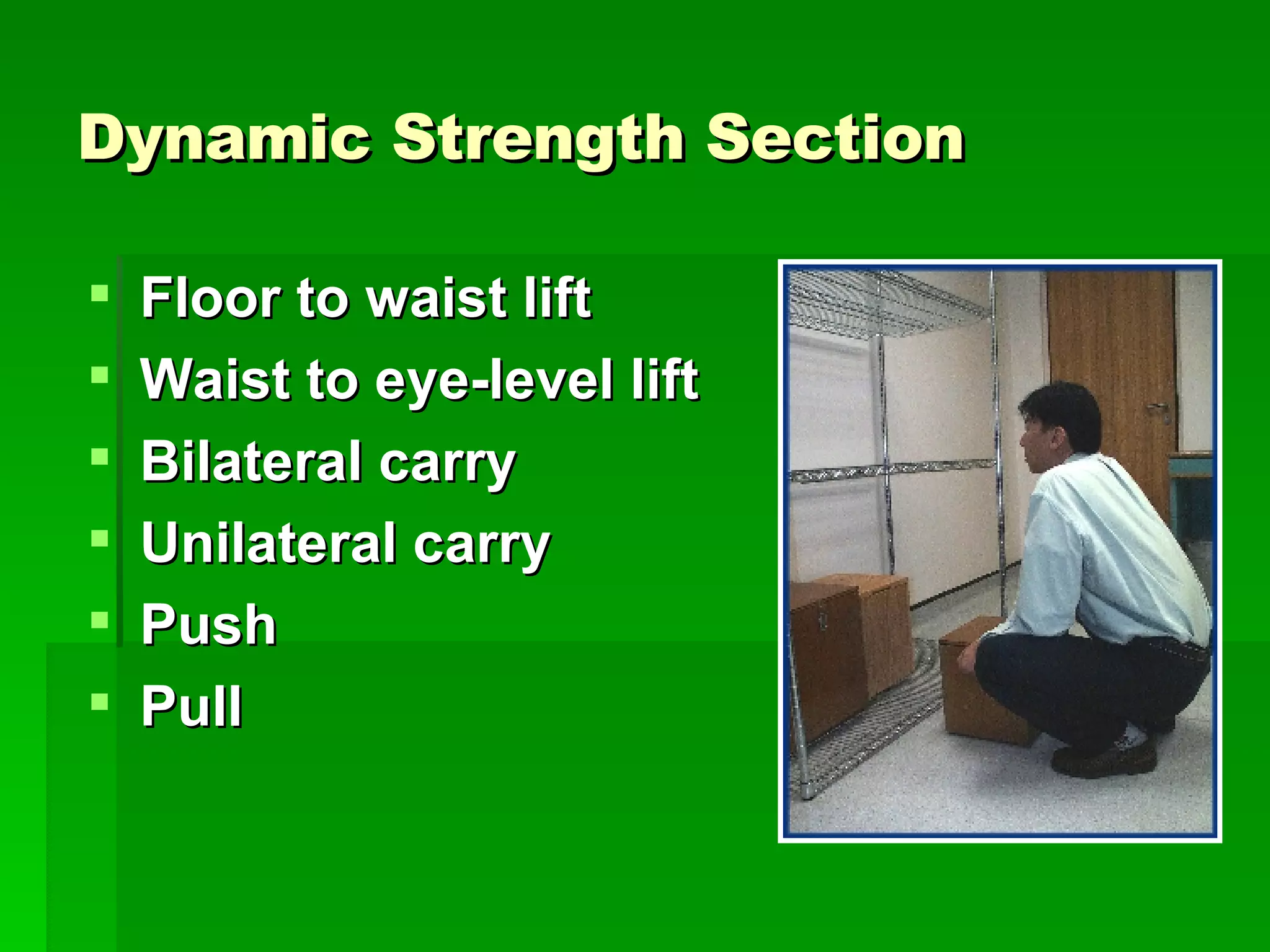
Dynamic Strength Section Floor to waist lift Waist to eye-level lift Bilateral carry Unilateral carry Push Pull
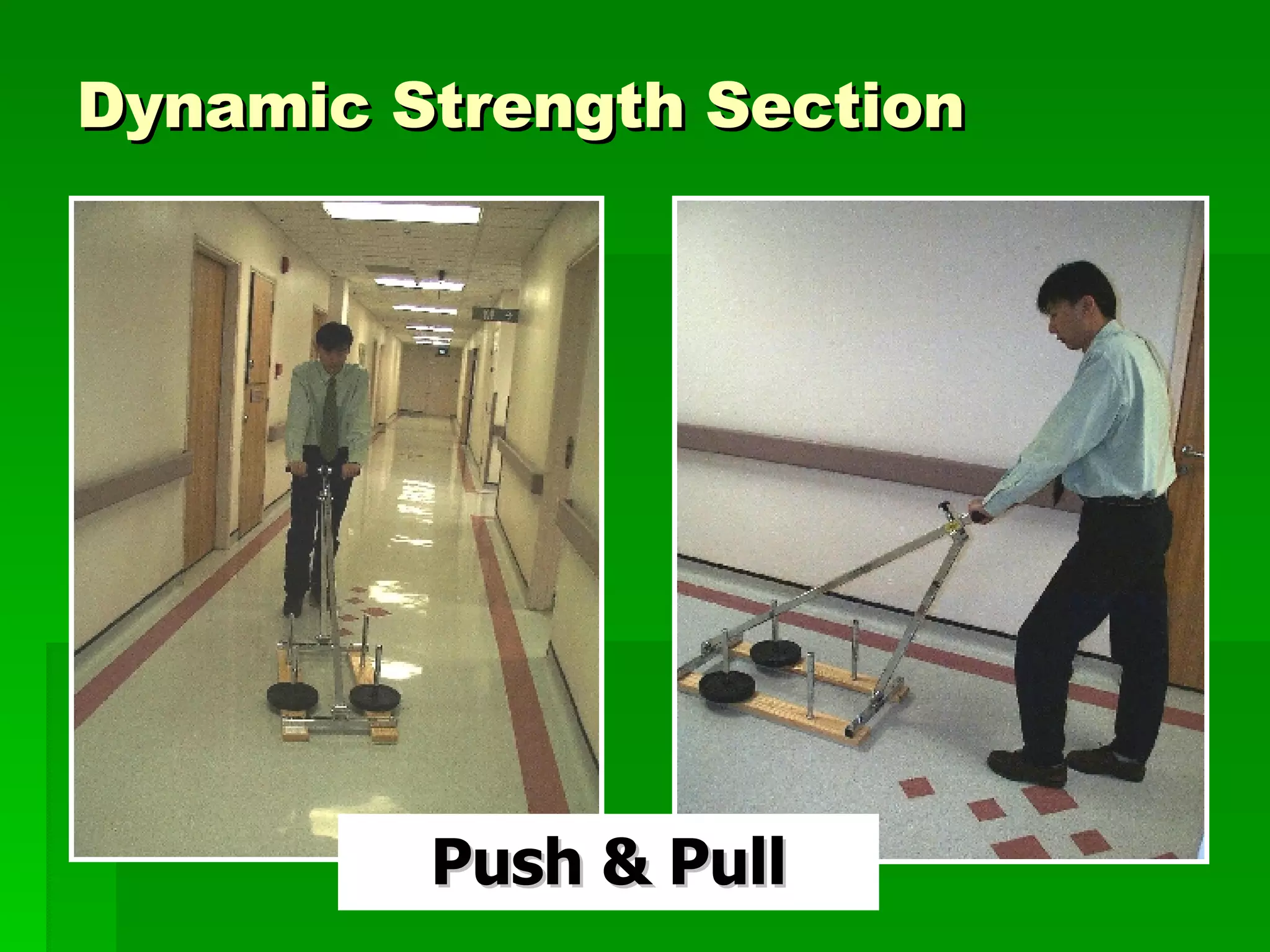
Push & Pull Dynamic Strength Section
Dynamic Strength  Scoring Time Weight handled Heart rate 0-10 pain score Specific signs of maximal performance Changes in heart rate  Changes in time to complete repetition
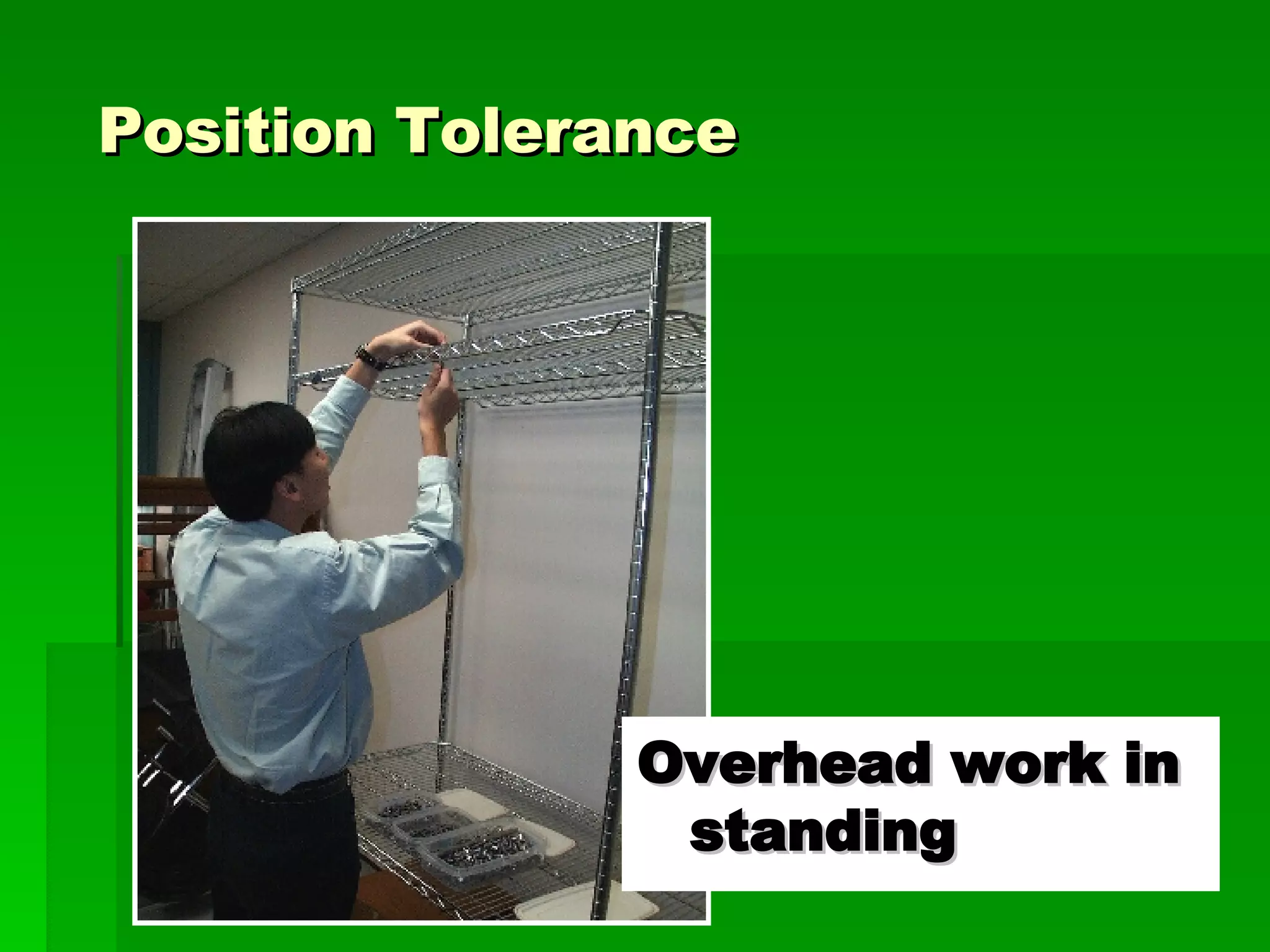
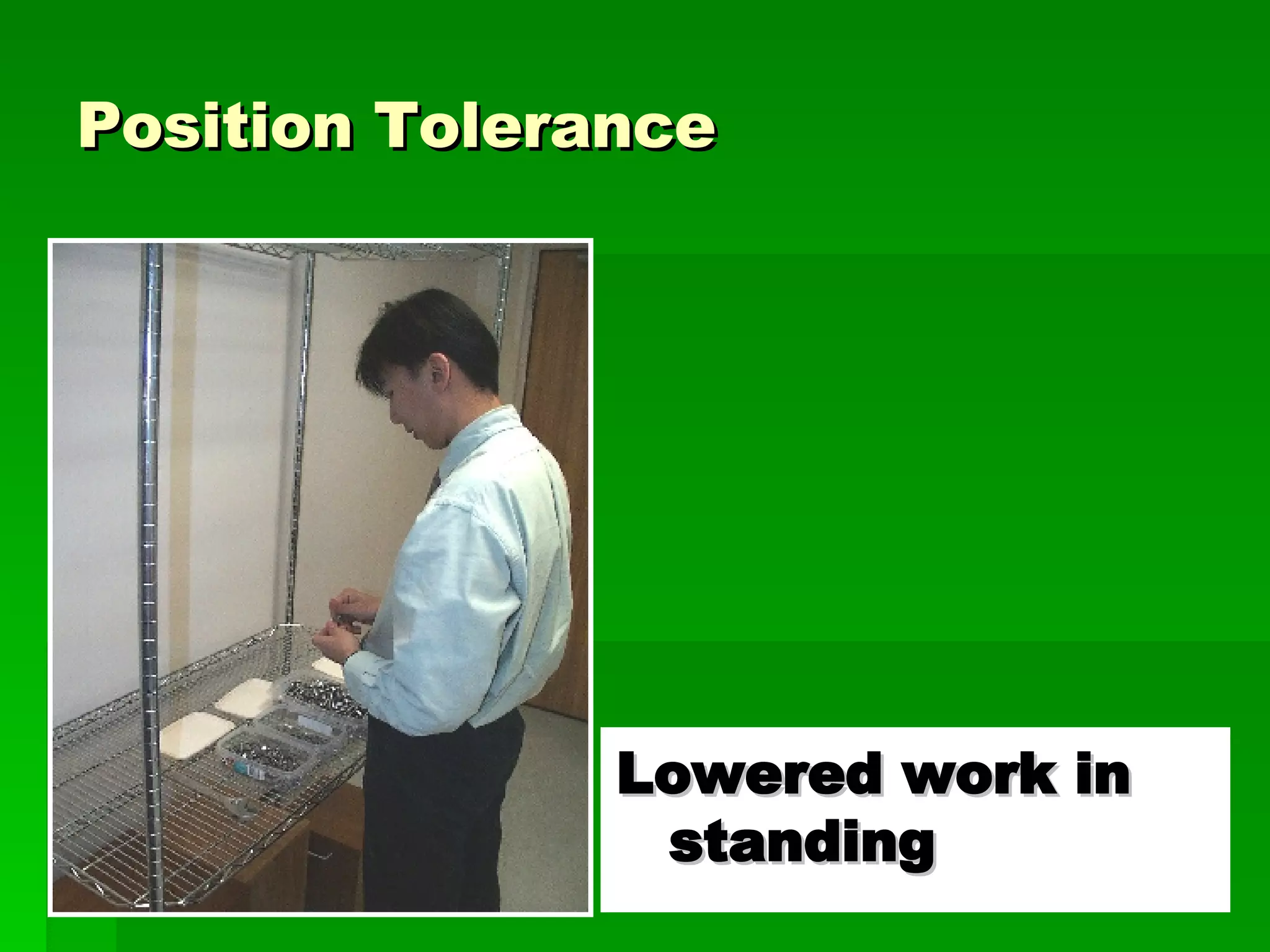
Position Tolerance Sitting Standing Overhead work in standing Lowered work in standing Kneeling  Lowered work in sitting Squatting Overhead work in supine
Position Tolerance Overhead work in standing
Position Tolerance Lowered work in standing
Position Tolerance  Scoring Time position tolerated Number of position adjustments Deviations from normally expected position (WNL, minimal, moderate, or severe deviations) Pain score (0-10)
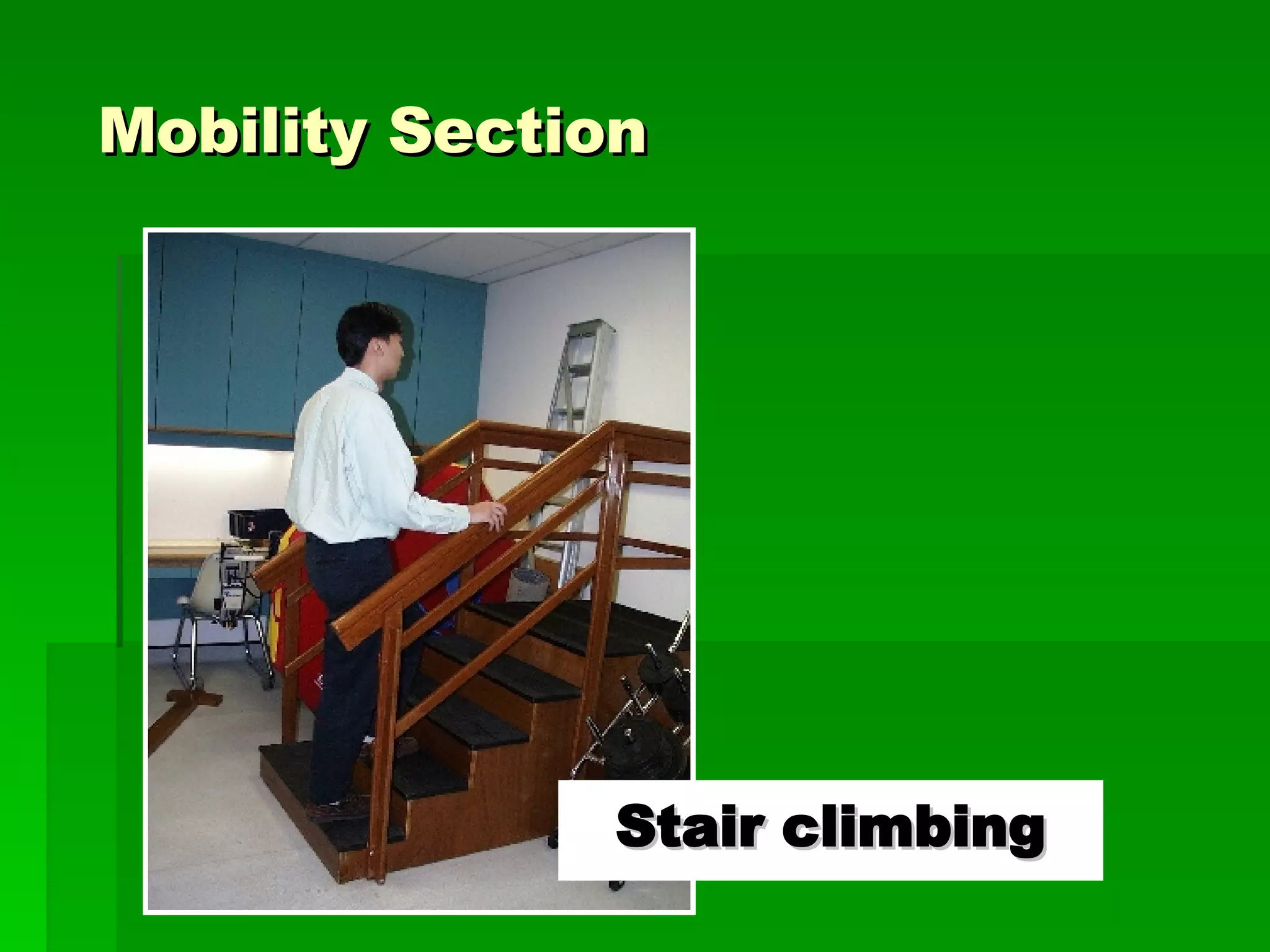
Mobility Section Stair climbing Repetitive squatting Walking Crawling Ladder climbing Repetitive trunk rotation - sitting Repetitive trunk rotation - standing
Mobility Section Stair climbing
Mobility  Scoring Number of repetitions performed or distance ambulated Heart rate Deviations from normally expected movement pattern (WNL, minimal, moderate, or severe deviations) Pain score (0-10)
Fine Motor Section Isometric Grip Strength  Perdue Pegboard O’Conner Tweezer Dexterity Test Minnesota Dexterity Test Hand Tool Dexterity Test
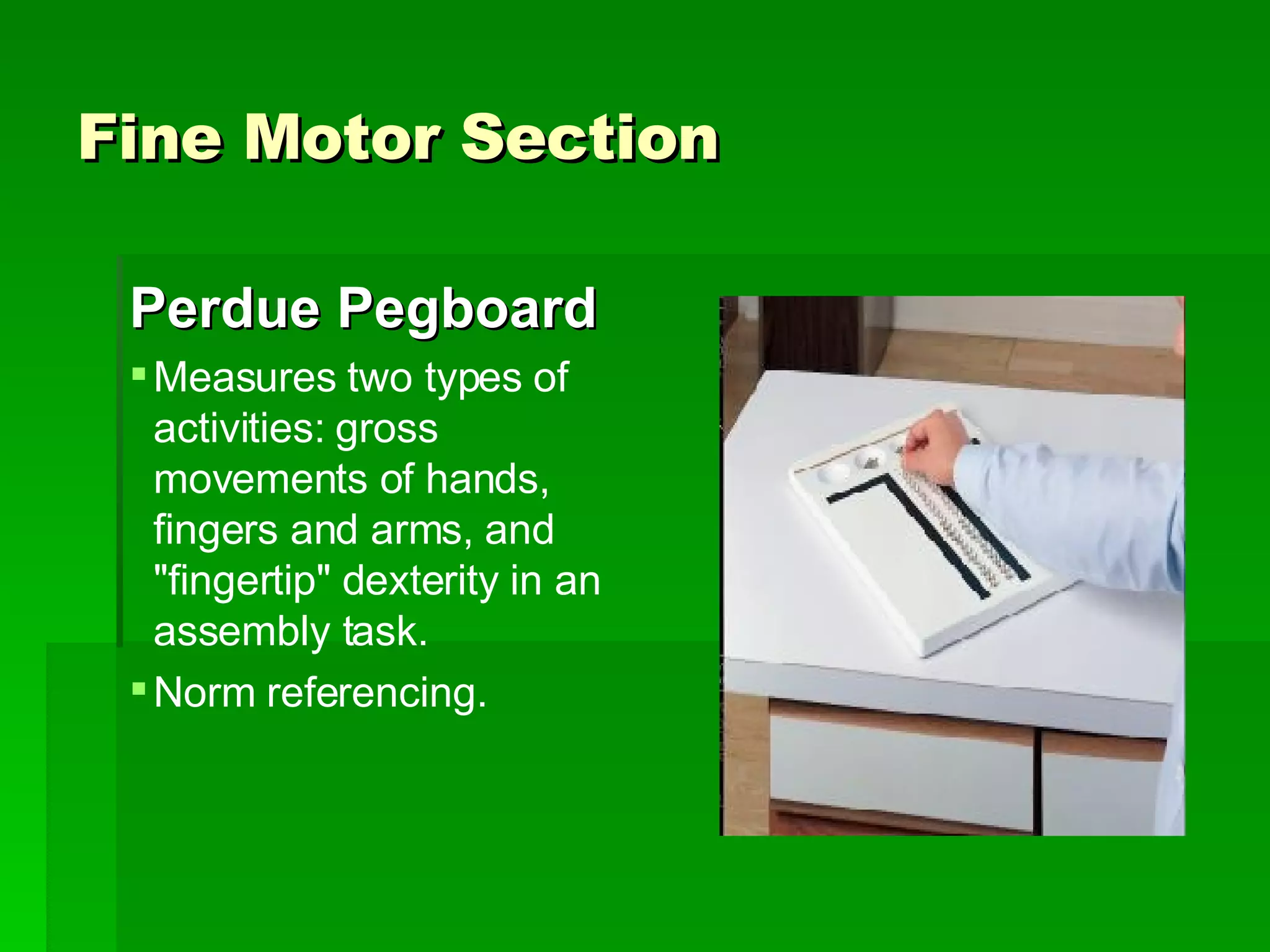
Fine Motor Section Perdue Pegboard Measures two types of activities: gross movements of hands, fingers and arms, and "fingertip" dexterity in an assembly task.  Norm referencing.
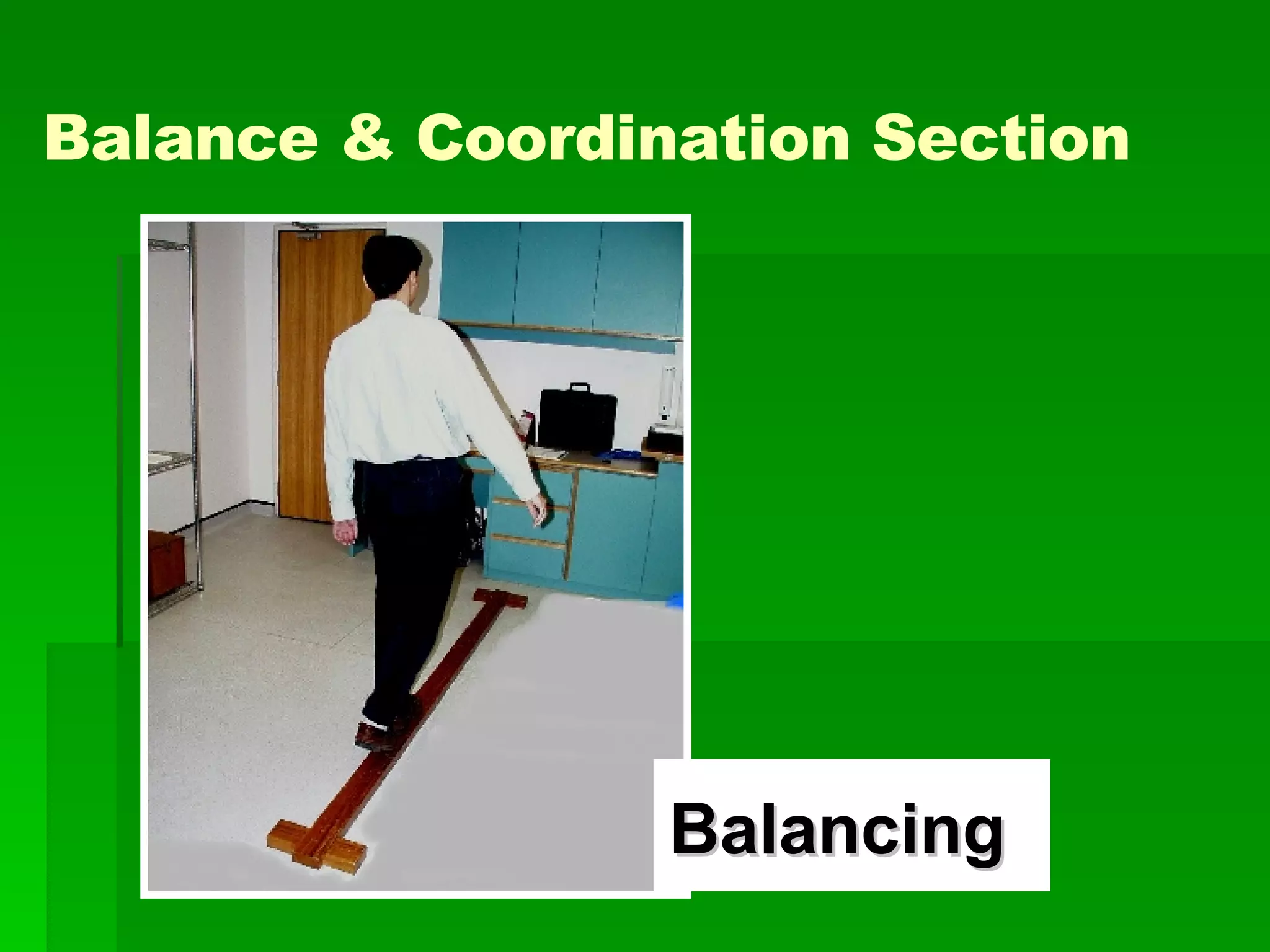
Balance & Coordination Section Screening sections only Used to determine need for further testing Performed only on those that: Have sustained brain trauma Jobs that require beam and scaffold work Jobs that require rapid work with machinery
Balancing Balance & Coordination Section
Endurance Section First three tasks of test are most demanding Repeat the tasks at the end of the test  Measure change in heart rate response Measure change in performance Developed algorithm to determine whether the client can tolerate an 8-hr day at a given level
Results Overall level of work Tolerance for 8 hour day Level of cooperation with testing Specific limitations Whether abilities match job demands Interventions for consideration
The overall level of work ability of the worker with injury can be assessed and classified as: unable to work; able to perform sedentary work;  able to perform light work;  able to perform medium work;  able to perform heavy work or able to perform very heavy work Results
Validity and Reliability Innes, E. & Straker, L. (1999). Reliability of work-related assessments.  Work,13 , 107-124. Innes, E. & Straker, L. (1999). Validity of work-related assessments.  Work,13 , 125-152. King, P. M., Tuckwell, N. & Barrett, T. E. (1998). A critical review of functional capacity evaluations.  Physical Therapy, 78  (8), 852-866.
Validity and Reliability Most FCEs have limited evidence of validity and reliability.  Literature review did not show strong scientific evidence to support or justify the approach and rationale of evaluation.
Validity and Reliability Face and content validity rarely formally establish for the majority of FCE. Most consider if the 20 physical demands of DOT are covered, then there is adequate face and content validity.  No strong support or justification for the acceptance of the criteria.
In USA, the Social Security Administration (SSA) requires the FCE to address 3 areas: Physical abilities: limitations regarding physical activities. Mental limitation: limitations in understanding, remembering, and following through on instructions.  Non-exertional impairment: info on pain, environmental restrictions, need for rest break and any side effect of medication.  Claim for Social Security Disability Benefit
Issues in FCE Development Safety Prevention of further injury during testing To stop or not to stop? Who initiate to stop the assessment?
Issues in FCE Development Length of assessment 2 days vs 1 day assessment. Pressure from external group to shorten the length of assessment. Need min. duration to assess endurance for a normal working hours. No proven formula to project the test performance to actual working hours
Medico-legal Implications FCEs are used in legal proceedings to determine ability vs disability in settlements scrutiny of test standardisation  objectivity of the assessment is therefore vital  Issues in FCE Development
Conclusions More research can be done to improve the validity and reliability of FCE.  HFE can contribute to the development of FCE.  Good FCE may allow HFE practitioner to understand the users better.

Functional Capacity Evaluation

  • 1.
    Functional Capacity EvaluationPresentation for M6603 Human Factors Methods Prepared by Hee Fook Wah (G0402695D)
  • 2.
    Introduction … traditionalphysical evaluation procedure such as testing muscle strength, measuring joint range of motion, radiographic findings and recording medical signs and symptoms are not good predictors of functional abilities .... functional capacity evaluation have developed from a need for a more objective measure of a person’s physical abilities to perform work… Lechner et al. (1994)
  • 3.
    What is FCE?… is a systematic process of assessing an individual's physical capacities and functional abilities. AOTA (2005)
  • 4.
    Injury or IllnessMedical Management Return to Work Return to Desired Activity Rehabilitation
  • 5.
    Successful Return toDesired Activity / Work Patients’ Abilities Activity/Job Demands ? MATCH
  • 6.
    Successful Return toDesired Activity / Work Functional Capacity Evaluation Activity/Job Analysis ? MATCH
  • 7.
    Purpose and Useof FCE To determine the individual's ability to safely return to work full time or on modified duty. To determine if work restrictions, job modifications, or reasonable accommodations are necessary to prevent further injury.
  • 8.
    Purpose and Useof FCE To determine the extent to which impairments exist, or the degree of physical disability for compensation purposes. To predict the potential ability to perform work following acute rehabilitation or a work- hardening/work- conditioning program.
  • 9.
    Table 1: Typesof FCE 1 1 From “A Critical Review of Functional Capacity Evaluations” by P.M. King, N. Tuckwell and T.E. Barrett, 1998, p.855.
  • 10.
    Physical Work PerformanceEvaluation (PWPE) Developed by ErgoScience The test items include the testing of the 20 physical demands as defined by the Department of Labour (U.S.A.) in the Dictionary of Occupational Titles.
  • 11.
    lifting standing walkingsitting carrying pushing pulling climbing balancing stooping kneeling crouching crawling reaching handling fingering feeling talking hearing seeing DICTIONARY OF OCCUPATIONAL TITLES PHYSICAL DEMANDS OF WORK
  • 12.
    Dynamic strength Positiontolerance Mobility Endurance Fine motor skills Balance Coordination Evaluate 36 Tasks in 7 Sections Physical Work Performance Evaluation (PWPE)
  • 13.
    Dynamic Strength SectionFloor to waist lift Waist to eye-level lift Bilateral carry Unilateral carry Push Pull
  • 14.
    Push & PullDynamic Strength Section
  • 15.
    Dynamic Strength Scoring Time Weight handled Heart rate 0-10 pain score Specific signs of maximal performance Changes in heart rate Changes in time to complete repetition
  • 16.
    Position Tolerance SittingStanding Overhead work in standing Lowered work in standing Kneeling Lowered work in sitting Squatting Overhead work in supine
  • 17.
  • 18.
  • 19.
    Position Tolerance Scoring Time position tolerated Number of position adjustments Deviations from normally expected position (WNL, minimal, moderate, or severe deviations) Pain score (0-10)
  • 20.
    Mobility Section Stairclimbing Repetitive squatting Walking Crawling Ladder climbing Repetitive trunk rotation - sitting Repetitive trunk rotation - standing
  • 21.
  • 22.
    Mobility ScoringNumber of repetitions performed or distance ambulated Heart rate Deviations from normally expected movement pattern (WNL, minimal, moderate, or severe deviations) Pain score (0-10)
  • 23.
    Fine Motor SectionIsometric Grip Strength Perdue Pegboard O’Conner Tweezer Dexterity Test Minnesota Dexterity Test Hand Tool Dexterity Test
  • 24.
    Fine Motor SectionPerdue Pegboard Measures two types of activities: gross movements of hands, fingers and arms, and "fingertip" dexterity in an assembly task. Norm referencing.
  • 25.
    Balance & CoordinationSection Screening sections only Used to determine need for further testing Performed only on those that: Have sustained brain trauma Jobs that require beam and scaffold work Jobs that require rapid work with machinery
  • 26.
    Balancing Balance &Coordination Section
  • 27.
    Endurance Section Firstthree tasks of test are most demanding Repeat the tasks at the end of the test Measure change in heart rate response Measure change in performance Developed algorithm to determine whether the client can tolerate an 8-hr day at a given level
  • 28.
    Results Overall levelof work Tolerance for 8 hour day Level of cooperation with testing Specific limitations Whether abilities match job demands Interventions for consideration
  • 29.
    The overall levelof work ability of the worker with injury can be assessed and classified as: unable to work; able to perform sedentary work; able to perform light work; able to perform medium work; able to perform heavy work or able to perform very heavy work Results
  • 30.
    Validity and ReliabilityInnes, E. & Straker, L. (1999). Reliability of work-related assessments. Work,13 , 107-124. Innes, E. & Straker, L. (1999). Validity of work-related assessments. Work,13 , 125-152. King, P. M., Tuckwell, N. & Barrett, T. E. (1998). A critical review of functional capacity evaluations. Physical Therapy, 78 (8), 852-866.
  • 31.
    Validity and ReliabilityMost FCEs have limited evidence of validity and reliability. Literature review did not show strong scientific evidence to support or justify the approach and rationale of evaluation.
  • 32.
    Validity and ReliabilityFace and content validity rarely formally establish for the majority of FCE. Most consider if the 20 physical demands of DOT are covered, then there is adequate face and content validity. No strong support or justification for the acceptance of the criteria.
  • 33.
    In USA, theSocial Security Administration (SSA) requires the FCE to address 3 areas: Physical abilities: limitations regarding physical activities. Mental limitation: limitations in understanding, remembering, and following through on instructions. Non-exertional impairment: info on pain, environmental restrictions, need for rest break and any side effect of medication. Claim for Social Security Disability Benefit
  • 34.
    Issues in FCEDevelopment Safety Prevention of further injury during testing To stop or not to stop? Who initiate to stop the assessment?
  • 35.
    Issues in FCEDevelopment Length of assessment 2 days vs 1 day assessment. Pressure from external group to shorten the length of assessment. Need min. duration to assess endurance for a normal working hours. No proven formula to project the test performance to actual working hours
  • 36.
    Medico-legal Implications FCEsare used in legal proceedings to determine ability vs disability in settlements scrutiny of test standardisation objectivity of the assessment is therefore vital Issues in FCE Development
  • 37.
    Conclusions More researchcan be done to improve the validity and reliability of FCE. HFE can contribute to the development of FCE. Good FCE may allow HFE practitioner to understand the users better.