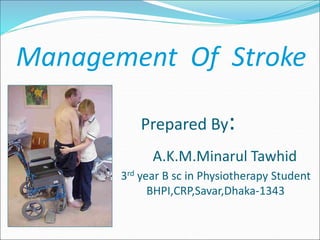
Management Of Stroke
Prepared By:
A.K.M.Minarul Tawhid
3rd year B sc in Physiotherapy Student
BHPI,CRP,Savar,Dhaka-1343
Content:
What is Stroke?
Risk factors of Stroke.
Complication of Stroke.
Management of Stroke.
Stroke:
According to WHO-`A rapidly developed clinical
sign of focal disturbance of cerebral function of
presumed vascular origin of more than 24 hours
duration.”
Types:
 Ischemic- 80% of total stroke.
 Haemorrhagic- 20% of total stroke.
Risk factors:
Potentially Modifiable Factors:
 Transient ischemic attack (TIA)- Early sign of stroke.
 Hypertension.
 Diabetes mellitus.
 Cardiac disease.
 Atrial fibrillation.
 Left ventricular hypertrophy.
 High cholesterol.
 Smoking,Alchohol.
 Congestive heart failure.
 Contraceptive pills.
Non-modifiable factor:
 Age.
 Sex- Male are more affected than female.
 Heredity.
Complication:
Early complication:
 Respiratory complication- Bronchopneumonia.
 Pulmonary embolism- DVT form & then embolism.
 Pressure sore- Due to sensory deficit in bony
prominent area. It can also occur by Bacterial infection
due to improper catheterization.
Late complication:
 Decreased Flexibility-
 Immobility.
 Decreased AROM.
 Decreased soft tissue length.
 Contracture.
 Deformity.
 Shoulder Sublaxation and pain-
 Low tone.
 Malalignment.
 Adhesive capsulitis.
 Repetitive micro trauma.
Urinary incontinence.
Decreased functional activities.
Abnormal gait(Hemiplegic gait).
Communication problem-
Dysarthria (Problems of articulation).
Dysphasia (Difficulty in speech, Receptive/Expressive).
Aphasia (Total inability to speech).
Loss of facial expression & gesture.
Recovery:
Whatever the cause of stroke, a proportion of patients will
recover some degree which depends on the following factors-
 The site & extent of the initial lesion.
 The age of the patient.
 The capacity to achieved a motor goal related to functional
movement.
 The capacity of nervous system to reorganize
(Neuroplasticity).
 The motivation & attitude of patient towards recovery.
 The premorbid status of patient.
N:B>Maximum recovery occurs within first 8-12 weeks.
Management:
Medical Management:
 Aspirin in ischemic stroke to prevent recurrence or extension.
 Patients with hemiplegias should have antiembolic stockings
& anticoagulants, such as Warfarin as prophylaxis against DVT.
 Aspiration Pneumonia occurs about 15-25% patients. Adverse
outcome reduced by appropriate nursing, chest physiotherapy
& medication.
 In TIA,if heart is considered a likely source of emboli then long
term treatment with anticoagulents indicated.Atherosclerosis
leading to tight stenosis of internal carotid artery, can be
confirmed angiographically & treated surgically by carotid
endarterectomy.
 Patients with haematomas are also treated surgically.
 Neurological deficit is maximal in outset & if not severe, the
patient can be managed at home satisfactorily.
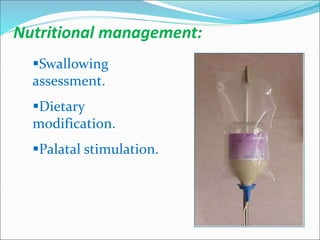
Nutritional management:
Swallowing
assessment.
Dietary
modification.
Palatal stimulation.
Definition of Rehabilitation:
“The active participation of a disabled person
and others to reduce the impact of disease
and disability on daily life”
Principles of rehabilitation
 Assess impact of disease on patient’s life-
 At levels of function, skill and independence.
 Set goals-
 Restoration of independence.
 Relevant to patient’s priorities.
 Realistic.
 Tackle barriers to goals-
 At levels of impairment, disability and handicap.
 Multi-disciplinary approach.
Physiotherapy Management:
Aims of Physiotherapy:
Early stage-
 To maintain airway.
 To maintain normal soft tissue length.
 To normalize muscle tone.
 To maintain healthy skin & prevent pressure sore.
Sub-acute stage-
 To maintain ROM.
 To maintain good respiratory status.
 To start active rehabilitation.
Active rehabilitation stage:
 To normalize muscle tone.
 To maintain normal postural alignment.
 To aid function and independence.
 To provide appropriate sensory stimulation.
 To help in regaining balance.
 To decrease the neglect of one side.
 To re-educate the gait.
Discharge:
 To withdraw the direct treatment.
 To emphasis on patients independence.
Follow-up:
 To review the in outdoor to monitor progress.
 To deterioration in function and treat accordingly.
Physiotherapy Management:
Physiotherapy for unconscious patients:
 Respiratory function:
Regular & frequent turning.
Percussion ,vibration to the chest & springing. Postural
drainage if indicated or if patient unconscious for prolong
period & if necessary some form of intubation or suction.
 Musculoskeletal integrity:
Range of motion exercise.
Positioning to maintain muscle length and prevent muscle
shortening & increased stiffness.
Active exercise and task related training should be
instituted as soon as the patient is conscious.
Bobath approach:
It is the most common & effective treatment procedure for
Stroke patients. Some key points are given below-
Patient should be in comfortable position.
Motor key point must be stable.
Movement will be proximal to distal.
No passive movement but active assisted.
In all trunk is main.
No static balance, all are dynamic balance.
Physiotherapy for medically stable patients:
Upper limb:
Use Bobath sling if patient have sublaxation in shoulder.
Rolling for relaxation.
Slow stretching for normalize muscle tone.
Active assisted movement in shoulder,elbow,wrist.Not
more than 90 degree if shoulder is sublaxed.
Shoulder mobilization for pain& stiffness (Frozen
shoulder).
Movement with mobilization for muscle pain & stiffness.
Hand & finger mobilization.
Strengthening exercise if patient able to perform.
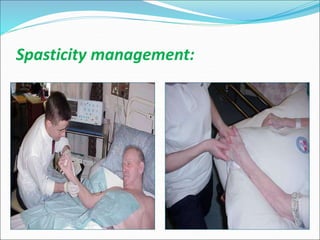
Spasticity management:
Weight bearing exercise through limb for sensory stimulus
& normalize muscle tone.
Afferent cutaneous stimuli.
Trunk & Pelvis:
Trunk control exercise by manually or by using Gym ball.
Pelvic tilting exercise.
Bridging exercise by both leg & one leg.
Different Kneeling exercise.
Dynamic sitting balance practice.
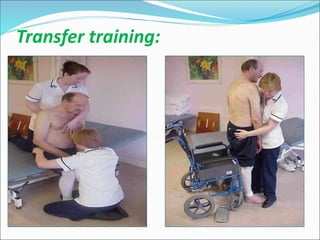
Transfer training:
Lower Limb:
Rolling for relaxation.
Stretching for normalize muscle tone.
Active movement for hip, knee & ankle joint.
Movement with mobilization for muscle pain & stiffness.
Active & passive TA stretching.
Foot mobilization.
Strengthening exercise by Gym ball & sand bag.
Weight bearing exercise through limb for sensory stimulus
& normalize muscle tone.
Afferent cutaneous stimuli.
Gait re-education:
Dynamic standing balance practice.
Stepping practice.
Selective knee flexion practice beside the wall.
Weight shifting practice.
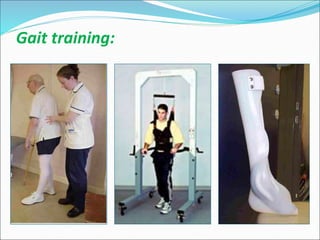
Gait training:
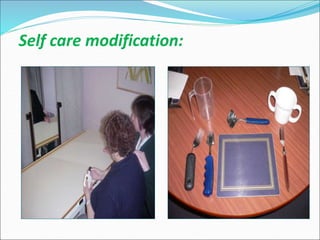
Self care modification:
Promote independence:
 Family role.
 Employment rehabilitation-
 Re-learn previous work skills.
 Modify circumstances of current job.
 Alternative job.
 Recreation.
 Promote relearning for future development-
 adrenergic medication
Reference:
 Neurological Rehabilitation: Optimizing
Performance- Janet H. Carr & Roberta B. Shepherd
 Neurological Physiotherapy-Professor Maria Stokes
 Physical Management in Neurological
Rehabilitation- Maria Stokes
 Right in The Middle- Patricia M. Davies
Question-
THANK YOU
EVERYBODY

Management of Stroke.ppt

  • 2.
    Management Of Stroke PreparedBy: A.K.M.Minarul Tawhid 3rd year B sc in Physiotherapy Student BHPI,CRP,Savar,Dhaka-1343
  • 3.
    Content: What is Stroke? Riskfactors of Stroke. Complication of Stroke. Management of Stroke.
  • 4.
    Stroke: According to WHO-`Arapidly developed clinical sign of focal disturbance of cerebral function of presumed vascular origin of more than 24 hours duration.” Types:  Ischemic- 80% of total stroke.  Haemorrhagic- 20% of total stroke.
  • 5.
    Risk factors: Potentially ModifiableFactors:  Transient ischemic attack (TIA)- Early sign of stroke.  Hypertension.  Diabetes mellitus.  Cardiac disease.  Atrial fibrillation.  Left ventricular hypertrophy.  High cholesterol.  Smoking,Alchohol.  Congestive heart failure.  Contraceptive pills.
  • 6.
    Non-modifiable factor:  Age. Sex- Male are more affected than female.  Heredity.
  • 7.
    Complication: Early complication:  Respiratorycomplication- Bronchopneumonia.  Pulmonary embolism- DVT form & then embolism.  Pressure sore- Due to sensory deficit in bony prominent area. It can also occur by Bacterial infection due to improper catheterization.
  • 8.
    Late complication:  DecreasedFlexibility-  Immobility.  Decreased AROM.  Decreased soft tissue length.  Contracture.  Deformity.  Shoulder Sublaxation and pain-  Low tone.  Malalignment.  Adhesive capsulitis.  Repetitive micro trauma.
  • 9.
    Urinary incontinence. Decreased functionalactivities. Abnormal gait(Hemiplegic gait). Communication problem- Dysarthria (Problems of articulation). Dysphasia (Difficulty in speech, Receptive/Expressive). Aphasia (Total inability to speech). Loss of facial expression & gesture.
  • 10.
    Recovery: Whatever the causeof stroke, a proportion of patients will recover some degree which depends on the following factors-  The site & extent of the initial lesion.  The age of the patient.  The capacity to achieved a motor goal related to functional movement.  The capacity of nervous system to reorganize (Neuroplasticity).  The motivation & attitude of patient towards recovery.  The premorbid status of patient. N:B>Maximum recovery occurs within first 8-12 weeks.
  • 11.
    Management: Medical Management:  Aspirinin ischemic stroke to prevent recurrence or extension.  Patients with hemiplegias should have antiembolic stockings & anticoagulants, such as Warfarin as prophylaxis against DVT.  Aspiration Pneumonia occurs about 15-25% patients. Adverse outcome reduced by appropriate nursing, chest physiotherapy & medication.  In TIA,if heart is considered a likely source of emboli then long term treatment with anticoagulents indicated.Atherosclerosis leading to tight stenosis of internal carotid artery, can be confirmed angiographically & treated surgically by carotid endarterectomy.  Patients with haematomas are also treated surgically.  Neurological deficit is maximal in outset & if not severe, the patient can be managed at home satisfactorily.
  • 12.
  • 13.
    Definition of Rehabilitation: “Theactive participation of a disabled person and others to reduce the impact of disease and disability on daily life”
  • 14.
    Principles of rehabilitation Assess impact of disease on patient’s life-  At levels of function, skill and independence.  Set goals-  Restoration of independence.  Relevant to patient’s priorities.  Realistic.  Tackle barriers to goals-  At levels of impairment, disability and handicap.  Multi-disciplinary approach.
  • 15.
    Physiotherapy Management: Aims ofPhysiotherapy: Early stage-  To maintain airway.  To maintain normal soft tissue length.  To normalize muscle tone.  To maintain healthy skin & prevent pressure sore. Sub-acute stage-  To maintain ROM.  To maintain good respiratory status.  To start active rehabilitation.
  • 16.
    Active rehabilitation stage: To normalize muscle tone.  To maintain normal postural alignment.  To aid function and independence.  To provide appropriate sensory stimulation.  To help in regaining balance.  To decrease the neglect of one side.  To re-educate the gait.
  • 17.
    Discharge:  To withdrawthe direct treatment.  To emphasis on patients independence. Follow-up:  To review the in outdoor to monitor progress.  To deterioration in function and treat accordingly.
  • 18.
    Physiotherapy Management: Physiotherapy forunconscious patients:  Respiratory function: Regular & frequent turning. Percussion ,vibration to the chest & springing. Postural drainage if indicated or if patient unconscious for prolong period & if necessary some form of intubation or suction.  Musculoskeletal integrity: Range of motion exercise. Positioning to maintain muscle length and prevent muscle shortening & increased stiffness. Active exercise and task related training should be instituted as soon as the patient is conscious.
  • 19.
    Bobath approach: It isthe most common & effective treatment procedure for Stroke patients. Some key points are given below- Patient should be in comfortable position. Motor key point must be stable. Movement will be proximal to distal. No passive movement but active assisted. In all trunk is main. No static balance, all are dynamic balance.
  • 20.
    Physiotherapy for medicallystable patients: Upper limb: Use Bobath sling if patient have sublaxation in shoulder. Rolling for relaxation. Slow stretching for normalize muscle tone. Active assisted movement in shoulder,elbow,wrist.Not more than 90 degree if shoulder is sublaxed. Shoulder mobilization for pain& stiffness (Frozen shoulder). Movement with mobilization for muscle pain & stiffness. Hand & finger mobilization. Strengthening exercise if patient able to perform.
  • 21.
  • 22.
    Weight bearing exercisethrough limb for sensory stimulus & normalize muscle tone. Afferent cutaneous stimuli. Trunk & Pelvis: Trunk control exercise by manually or by using Gym ball. Pelvic tilting exercise. Bridging exercise by both leg & one leg. Different Kneeling exercise. Dynamic sitting balance practice.
  • 23.
  • 24.
    Lower Limb: Rolling forrelaxation. Stretching for normalize muscle tone. Active movement for hip, knee & ankle joint. Movement with mobilization for muscle pain & stiffness. Active & passive TA stretching. Foot mobilization. Strengthening exercise by Gym ball & sand bag. Weight bearing exercise through limb for sensory stimulus & normalize muscle tone. Afferent cutaneous stimuli.
  • 25.
    Gait re-education: Dynamic standingbalance practice. Stepping practice. Selective knee flexion practice beside the wall. Weight shifting practice.
  • 26.
  • 27.
  • 28.
    Promote independence:  Familyrole.  Employment rehabilitation-  Re-learn previous work skills.  Modify circumstances of current job.  Alternative job.  Recreation.  Promote relearning for future development-  adrenergic medication
  • 29.
    Reference:  Neurological Rehabilitation:Optimizing Performance- Janet H. Carr & Roberta B. Shepherd  Neurological Physiotherapy-Professor Maria Stokes  Physical Management in Neurological Rehabilitation- Maria Stokes  Right in The Middle- Patricia M. Davies
  • 30.
  • 31.