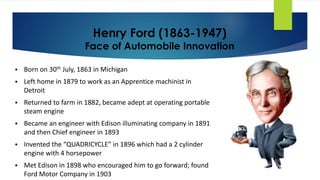



Henry Ford (1863-1947)
Face of Automobile Innovation
 Born on 30th July, 1863 in Michigan
 Left home in 1879 to work as an Apprentice machinist in
Detroit
 Returned to farm in 1882, became adept at operating portable
steam engine
 Became an engineer with Edison illuminating company in 1891
and then Chief engineer in 1893
 Invented the “QUADRICYCLE” in 1896 which had a 2 cylinder
engine with 4 horsepower
 Met Edison in 1898 who encouraged him to go forward; found
Ford Motor Company in 1903
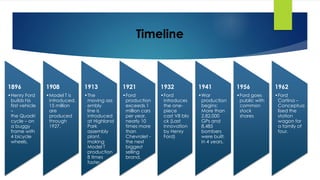
1896
•Henry Ford
builds his
first vehicle
–
the Quadri
cycle – on
a buggy
frame with
4 bicycle
wheels.
1908
•Model T is
introduced.
15 million
are
produced
through
1927.
1913
•The
moving ass
embly
line is
introduced
at Highland
Park
assembly
plant,
making
Model T
production
8 times
faster.
1921
•Ford
production
exceeds 1
million cars
per year,
nearly 10
times more
than
Chevrolet -
the next
biggest
selling
brand.
1932
•Ford
introduces
the one-
piece
cast V8 blo
ck (Last
innovation
by Henry
Ford)
1941
•War
production
begins:
More than
2,82,000
GPs and
8,485
bombers
were built,
in 4 years.
1956
•Ford goes
public with
common
stock
shares
1962
•Ford
Cortina –
Conceptua
lised the
station
wagon for
a family of
four.
Timeline
Important Factors | Henry Ford’s Success
 Curiosity
 Asking Questions
 Mechanical Ability
 Willingness to take
risks
 Perseverance
(Character Traits)
The Most Important Factor
• The ability to articulate a vision and
convince other people to sign on and
help him achieve that vision.
Important Factors | Henry Ford’s Success
(Innovative Result)
Henry Ford convinced a group of businessmen to back him in the biggest risk of his life—a
company to make horseless carriages.
Most of the commercial traffic in cities still moved in horse-drawn vehicles. Rural Americans
simply accepted the limited travel radius of horse- or mule-drawn vehicles. For long distances,
Americans used our extensive, well developed railroad network.
Important Factors | Henry Ford’s Success
When his workforce objected to the relentless, repetitive work that the line entailed, Ford
responded with perhaps his boldest idea ever—he doubled wages to $5 per day. With that one
move, he stabilized his workforce and gave it the ability to buy the very cars it made.
He hired a brilliant accountant named Norval Hawkins as his sales manager, and Hawkins created
a sales organization and advertising campaign that fueled potential customers’ appetites for
Fords. Model T sales rose steadily while the selling price dropped. By 1921, half the cars in
America were Model Ts, and a new one could be had for as little as $415.
(Innovative Result)
93 Minutes
Seriously?
Reference
Article: “Henry Ford and Innovation - From The Curators” (thehenryford.org/education)
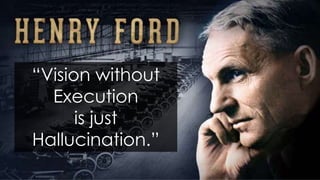
“Vision without
Execution
is just
Hallucination.”
Thank You! 
Prepared By:
Group 1
1.) Arjun Parekh
2.) Dheeraj Dabla
3.) Karan Bakshi
4.) Prashant Mathew
5.) Sayantan Bose
6.) Utkarsh Prasad

Henry Ford and Innovation

  • 2.
    Henry Ford (1863-1947) Faceof Automobile Innovation  Born on 30th July, 1863 in Michigan  Left home in 1879 to work as an Apprentice machinist in Detroit  Returned to farm in 1882, became adept at operating portable steam engine  Became an engineer with Edison illuminating company in 1891 and then Chief engineer in 1893  Invented the “QUADRICYCLE” in 1896 which had a 2 cylinder engine with 4 horsepower  Met Edison in 1898 who encouraged him to go forward; found Ford Motor Company in 1903
  • 3.
    1896 •Henry Ford builds his firstvehicle – the Quadri cycle – on a buggy frame with 4 bicycle wheels. 1908 •Model T is introduced. 15 million are produced through 1927. 1913 •The moving ass embly line is introduced at Highland Park assembly plant, making Model T production 8 times faster. 1921 •Ford production exceeds 1 million cars per year, nearly 10 times more than Chevrolet - the next biggest selling brand. 1932 •Ford introduces the one- piece cast V8 blo ck (Last innovation by Henry Ford) 1941 •War production begins: More than 2,82,000 GPs and 8,485 bombers were built, in 4 years. 1956 •Ford goes public with common stock shares 1962 •Ford Cortina – Conceptua lised the station wagon for a family of four. Timeline
  • 4.
    Important Factors |Henry Ford’s Success  Curiosity  Asking Questions  Mechanical Ability  Willingness to take risks  Perseverance (Character Traits)
  • 5.
    The Most ImportantFactor • The ability to articulate a vision and convince other people to sign on and help him achieve that vision.
  • 6.
    Important Factors |Henry Ford’s Success (Innovative Result) Henry Ford convinced a group of businessmen to back him in the biggest risk of his life—a company to make horseless carriages. Most of the commercial traffic in cities still moved in horse-drawn vehicles. Rural Americans simply accepted the limited travel radius of horse- or mule-drawn vehicles. For long distances, Americans used our extensive, well developed railroad network.
  • 7.
    Important Factors |Henry Ford’s Success When his workforce objected to the relentless, repetitive work that the line entailed, Ford responded with perhaps his boldest idea ever—he doubled wages to $5 per day. With that one move, he stabilized his workforce and gave it the ability to buy the very cars it made. He hired a brilliant accountant named Norval Hawkins as his sales manager, and Hawkins created a sales organization and advertising campaign that fueled potential customers’ appetites for Fords. Model T sales rose steadily while the selling price dropped. By 1921, half the cars in America were Model Ts, and a new one could be had for as little as $415. (Innovative Result)
  • 8.
  • 9.
    Reference Article: “Henry Fordand Innovation - From The Curators” (thehenryford.org/education)
  • 10.
  • 11.
    Thank You!  PreparedBy: Group 1 1.) Arjun Parekh 2.) Dheeraj Dabla 3.) Karan Bakshi 4.) Prashant Mathew 5.) Sayantan Bose 6.) Utkarsh Prasad