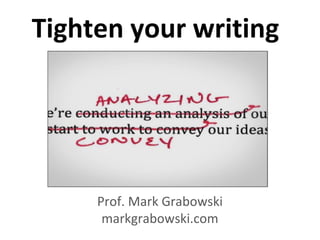
Tighten your writing
Prof. Mark Grabowski
markgrabowski.com
Use active voice
• Reword passive voice where possible. Whether
referring to general passive (“The food was eaten
by him” instead of “He ate the food”) or present
progressive passive (“The food is being served by
the waiters” instead of “the waiters are serving
the food”), most of the time a sentence will be
stronger if the passive voice is avoided. An easy
way to seek and destroy unwanted passive
construction is do a “Find” for ing, was, is, it was,
and there was, to name a few.
Eliminate That Unnecessary Word
• Which word, you ask? “That.” It’s one of the
most superfluous words, helpful for clarity about
10 percent of the time. The other 90 percent, it’s
filler and makes your work seem unpolished.
Read these sentences after removing the
offending word.
– She felt that her heart was breaking.
– The strawberry chiffon was the most delicious cake
that I’ve ever eaten.
(Of course, the word has its uses; just be sure
you’re choosing correctly between that and
which.)
Adverbs/Adjectives Overuse
• Adverbs and adjectives are necessary for
expressive writing, but adverbs are often abused.
Don’t let these overused filler words obscure
your work:
– Very, Really, Actually, Probably, Definitely, Just,
Somewhat, Extremely, Pretty, Kind of, Rather
• According to The Elements of Style: “These are
the leeches that infest the pond of prose, sucking
the blood of words.”
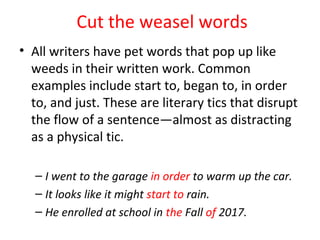
Cut the weasel words
• All writers have pet words that pop up like
weeds in their written work. Common
examples include start to, began to, in order
to, and just. These are literary tics that disrupt
the flow of a sentence—almost as distracting
as a physical tic.
– I went to the garage in order to warm up the car.
– It looks like it might start to rain.
– He enrolled at school in the Fall of 2017.
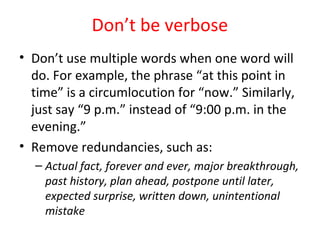
Don’t be verbose
• Don’t use multiple words when one word will
do. For example, the phrase “at this point in
time” is a circumlocution for “now.” Similarly,
just say “9 p.m.” instead of “9:00 p.m. in the
evening.”
• Remove redundancies, such as:
– Actual fact, forever and ever, major breakthrough,
past history, plan ahead, postpone until later,
expected surprise, written down, unintentional
mistake
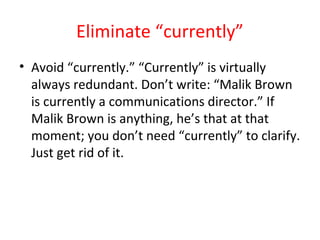
Eliminate “currently”
• Avoid “currently.” “Currently” is virtually
always redundant. Don’t write: “Malik Brown
is currently a communications director.” If
Malik Brown is anything, he’s that at that
moment; you don’t need “currently” to clarify.
Just get rid of it.
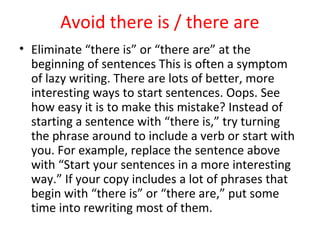
Avoid there is / there are
• Eliminate “there is” or “there are” at the
beginning of sentences This is often a symptom
of lazy writing. There are lots of better, more
interesting ways to start sentences. Oops. See
how easy it is to make this mistake? Instead of
starting a sentence with “there is,” try turning
the phrase around to include a verb or start with
you. For example, replace the sentence above
with “Start your sentences in a more interesting
way.” If your copy includes a lot of phrases that
begin with “there is” or “there are,” put some
time into rewriting most of them.
Use contractions
• Which sounds more personable?
– I am heading to the market that is close to my
house.
– I’m heading to the market that’s close to my
house.
• Contractions make your writing sound
friendlier, like you’re (not you are) a real
person. And that makes it easier to connect
with readers.
• Contractions can also make your story easier
to read and comprehend.
Tightening Exercise
Now, try applying the tips you
just learned. Visit:
http://bit.ly/2dGVne4
Sources
• The Write Life: “25 Editing Tips for Tightening
Your Copy,””http://thewritelife.com/edit-your-
copy/
• Positive Writer: “6 Quick Tricks to Help You
Tighten Up Your Writing,” at
http://positivewriter.com/tighten-your-writing/
• Grammarly: “5 Exercises to Tighten Your Writing
for 2014’s National Day on Writing,” at
http://bit.ly/2eJWd7x
• Udemy: “Redundancy Examples: How to Find
Redundancy in Writing,”
https://blog.udemy.com/redundancy-examples/

Tighten writing

  • 1.
    Tighten your writing Prof.Mark Grabowski markgrabowski.com
  • 2.
    Use active voice •Reword passive voice where possible. Whether referring to general passive (“The food was eaten by him” instead of “He ate the food”) or present progressive passive (“The food is being served by the waiters” instead of “the waiters are serving the food”), most of the time a sentence will be stronger if the passive voice is avoided. An easy way to seek and destroy unwanted passive construction is do a “Find” for ing, was, is, it was, and there was, to name a few.
  • 3.
    Eliminate That UnnecessaryWord • Which word, you ask? “That.” It’s one of the most superfluous words, helpful for clarity about 10 percent of the time. The other 90 percent, it’s filler and makes your work seem unpolished. Read these sentences after removing the offending word. – She felt that her heart was breaking. – The strawberry chiffon was the most delicious cake that I’ve ever eaten. (Of course, the word has its uses; just be sure you’re choosing correctly between that and which.)
  • 4.
    Adverbs/Adjectives Overuse • Adverbsand adjectives are necessary for expressive writing, but adverbs are often abused. Don’t let these overused filler words obscure your work: – Very, Really, Actually, Probably, Definitely, Just, Somewhat, Extremely, Pretty, Kind of, Rather • According to The Elements of Style: “These are the leeches that infest the pond of prose, sucking the blood of words.”
  • 5.
    Cut the weaselwords • All writers have pet words that pop up like weeds in their written work. Common examples include start to, began to, in order to, and just. These are literary tics that disrupt the flow of a sentence—almost as distracting as a physical tic. – I went to the garage in order to warm up the car. – It looks like it might start to rain. – He enrolled at school in the Fall of 2017.
  • 6.
    Don’t be verbose •Don’t use multiple words when one word will do. For example, the phrase “at this point in time” is a circumlocution for “now.” Similarly, just say “9 p.m.” instead of “9:00 p.m. in the evening.” • Remove redundancies, such as: – Actual fact, forever and ever, major breakthrough, past history, plan ahead, postpone until later, expected surprise, written down, unintentional mistake
  • 7.
    Eliminate “currently” • Avoid“currently.” “Currently” is virtually always redundant. Don’t write: “Malik Brown is currently a communications director.” If Malik Brown is anything, he’s that at that moment; you don’t need “currently” to clarify. Just get rid of it.
  • 8.
    Avoid there is/ there are • Eliminate “there is” or “there are” at the beginning of sentences This is often a symptom of lazy writing. There are lots of better, more interesting ways to start sentences. Oops. See how easy it is to make this mistake? Instead of starting a sentence with “there is,” try turning the phrase around to include a verb or start with you. For example, replace the sentence above with “Start your sentences in a more interesting way.” If your copy includes a lot of phrases that begin with “there is” or “there are,” put some time into rewriting most of them.
  • 9.
    Use contractions • Whichsounds more personable? – I am heading to the market that is close to my house. – I’m heading to the market that’s close to my house. • Contractions make your writing sound friendlier, like you’re (not you are) a real person. And that makes it easier to connect with readers. • Contractions can also make your story easier to read and comprehend.
  • 10.
    Tightening Exercise Now, tryapplying the tips you just learned. Visit: http://bit.ly/2dGVne4
  • 11.
    Sources • The WriteLife: “25 Editing Tips for Tightening Your Copy,””http://thewritelife.com/edit-your- copy/ • Positive Writer: “6 Quick Tricks to Help You Tighten Up Your Writing,” at http://positivewriter.com/tighten-your-writing/ • Grammarly: “5 Exercises to Tighten Your Writing for 2014’s National Day on Writing,” at http://bit.ly/2eJWd7x • Udemy: “Redundancy Examples: How to Find Redundancy in Writing,” https://blog.udemy.com/redundancy-examples/