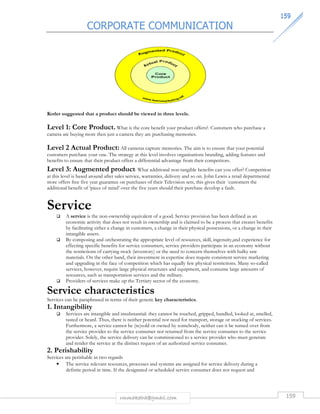
CORPORATE 
COMMUNICATION 
rrrrmmmmmmmmaaaakkkkaaaahhhhaaaa@@@@ggggmmmmaaaaiiiillll....ccccoooommmm 
www.slideshare.com/rmakaha
CORPORATE COMMUNICATION 
rmmakaha@gmail.com 1 
1 
CORPORATE COMMUNICATION 552/02/SO 
1. AIM 
Equipping the management trainee with knowledge and skills to effectively communicate marketing ideas, messages and products. 
2. OBJECTIVES 
The student should be able to: 
1.1. Promote the image of the organization. 
1.2. Effectively promote the organization’s products. 
1.3. Personally present products to clients/customer and potential customers nationally and internationally. 
1.4. Advise on communications and promotional regulations, laws and ethical issues 
1.5. Launch and administer a sales promotion 
1.6. Apply information technology in promotion 
1.7. Advertise products and services in the electronic media 
1.8. Advertise products and services in the print media 
3. CONTENT 
The role of the manager in corporate communications as all embracing 
(a) ADVERTISING 
(b) SALES PROMOTION 
(c) PERSONAL SELLING 
(d) PUBLICITY 
(e) PUBLIC RELATIONS 
(f) DIRECT MARKETING 
(g) INTERNATIONAL MARKETING 
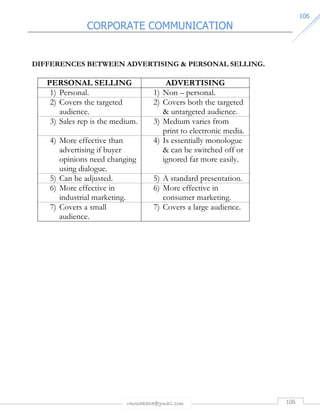
The role of the manager in corporate communication 
4. ADVERTISING 
a) Definition 
b) Role in society 
c) Advertising & the market process. 
d) Behavioral aspects of advertising 
e) Advertising research 
f) Advertising media 
g) Creating advertisements 
5. SALES PROMOTION 
a) Definition 
b) Forms 
c) Links with other elements of promotion mix i.e. advertising 
6. PUBLICITY 
(a) Definition 
(b) Forms 
(c) Links with other promotion mix elements 
(d) Financial implications of publicity 
7. PERSONAL SELLING 
(a) The promotional elements of personal selling 
(b) Types of personal selling 
(c) Linkage with other promotional elements 
8. DIRECT MARKETING 
(a) Definition 
(b) Forms of direct marketing 
(c) Relationship with other elements of the promotion mix. 
9. INFORMATION TECHNOLOGY APPLICATIONS 
(a) Explain the role of IT in promotion. 
(b) Examine the opportunities that IT can provide in promotion. 
(c) Information technology and promotion media 
10. ETHICS & LEGAL ISSUES 
(a) Promotion ethics 
(b) Legislation and implications in advertising, and other forms of communication. 
11. INTERNATIONAL MARKETING 
(a) National & international marketing environment 
(b) International markets 
(c) Methods of entering international markets
CORPORATE COMMUNICATION 
rmmakaha@gmail.com 2 
2 
INTRO TO CORPORATE COMMUNICATION 
• Corporate communication is the communication issued by a corporate / organization / body / institute to 
all its public(s). 
• Publics here can be both internal (employees, stakeholders, i.e. - share and stock holders) and external 
(agencies, channel partners, media, government, industry bodies and institutes, educational institutes and 
general public). 
• An organization needs to talk the same message to all of its stakeholders, in order to transmit coherence, 
credibility and ethic. If one of these points is broken, the whole community can make this organization 
disappears, from one day to the other. 
• The Corporate Communication area will help this organization to build its message, combining its vision, 
mission and values and will also support the organization by communicating its message, activities and 
practices to all of its stakeholders. 
According to the book Essentials of Corporate Communication by Cees van Riel and Charles Fombrun 
o The term Corporate Communication can be defined as the set of activities involved in managing and orchestrating 
all internal and external communications aimed at creating favorable starting points with stakeholders on which 
the company depends. 
o Corporate communication consists of the dissemination of information by a variety of specialists and 
generalists in an organization, with the common goal of enhancing the organization's ability to retain its license 
to operate. 
o As Jackson (1987) remarks: Note that it is corporate communication - without a final "s". Tired of being called 
on to fix the company switchboard, recommend an answering machine or meet a computer salesman, I long 
ago adopted this form as being more accurate and left communications to the telecommunications specialists. 
It's a small point but another attempt to bring clarity out of confusion. 
o Corporate communication serves as the liaison between an organization and its publics. 
o Organizations can strategically communicate to their audiences through public relations and advertising. This 
may involve an employee newsletter or video, crisis management with the news media, special events planning, 
building product value and communicating with stockholders, clients or donors. 
What corporate communication encodes and promotes 
1. Strong corporate culture 
2. Coherent corporate identity 
3. Reasonable corporate philosophy 
4. Genuine sense of corporate citizenship 
5. An appropriate and professional relationship with the press, including quick, responsible ways of 
communicating in a crisis 
6. Understanding of communication tools and technologies 
7. Sophisticated approaches to global communications 
 How an organization communicates with its employees, its extended audiences, the press and its customers brings 
its values to life. 
 Corporate communications is all about managing perceptions and ensuring: 
a) Effective and timely dissemination of information 
b) Positive corporate image 
c) Smooth and affirmative relationship with all stakeholders 
 Be it a corporate body, company, organization, institution, non-governmental organization, governmental 
body, all of them needs to have a respectable image and reputation. In today's day and age of increasing 
competition, easy access to information and the media explosion, reputation management has gained even
CORPORATE COMMUNICATION 
rmmakaha@gmail.com 3 
3 
more importance. Therefore, corporate communications as a role has become significant and professional in 
nature. 
 Gone are the days when corporate communication merely meant 'wining and dining the client' - it has now 
emerged as a science and art of perception management. 
Key tasks of corporate communication 
The responsibilities of corporate communication are therefore: 
1. To flesh out the profile of the company behind the brand (corporate branding); 
2. To develop initiatives that minimize discrepancies between the company's desired identity and brand 
features; 
3. To indicate who should perform which tasks in the field of communication; 
4. To formulate and execute effective procedures in order to facilitate decision making about matters 
concerning communication; 
5. To mobilize internal and external support behind corporate objectives. 
Tools of corporate communication 
Integrated communication can be achieved in various ways. The main four practices are: 
1. Application of visual identity systems (sometimes referred to as house style) 
2. Use of integrated marketing communications; 
3. Reliance on coordinating teams; 
4. Adoption of a centralized planning system. 
The communication agenda: to build reputation 
• Corporate communication helps an organization to create distinctive and appealing images with its stakeholder 
groups, build a strong corporate brand, and develop reputation capital. To achieve those ends, all forms of 
communication must be orchestrated into a coherent whole and success criteria developed that enable 
measuring the effects of the organization's communication on its reputation and value. 
External communication 
Media relations 
 This involves building and maintaining a positive relationship with the media (television, print, web, et cetera). 
This includes, but is not limited to, drafting and dissemination of press releases, organizing press conferences 
and meeting with media professionals and organizing events for the media as a group. 
External events 
 Could involve vendor / supplier / distributor meets, channel partner meetings, events related to product 
launches, important initiatives, et cetera. 
Company/spokesperson profiling 
 Ensuring that the company/organization spokesperson is in the public limelight, is well-known and considered 
as an authority in the respective sector/field. 
• Managing content of corporate websites and/or other external touch points 
• Managing corporate publications - for the external world 
• Managing print media 
Brand management 
 Development and upkeep of the corporate identity to ensure adherence to corporate brand guidelines
CORPORATE COMMUNICATION 
rmmakaha@gmail.com 4 
4 
 To improve overall business communications so as to clearly and effectively communicate the essence of the 
company. 
Corporate identity/organizational identity 
There are two approaches for Identity, respectively Corporate Identity and Organizational Identity. 
• Corporate identity is the reality and uniqueness of an organization, which is integrally related to its external 
and internal image and reputation through corporate communication (Gray and Balmer, 1998) 
• Organizational Identity comprises those characteristics of an organization that its members believe are central, 
distinctive and enduring. That is, organizational identity consists of those attributes that members feel are 
fundamental to (central) and uniquely descriptive of (distinctive) the organization and that persist within the 
organization over time (enduring). (Pratt and Foreman, 2000) 
Corporate reputation 
Reputations are overall assessments of organizations by their stakeholders. They are aggregate perceptions by 
stakeholders of an organization’s ability to fulfil their expectations, whether these stakeholders are interested in buying 
the company's products, working for the company, or investing in the company's shares. 
In 2000, the US based Council of PR Firms identified seven programs that were developed by either media organizations 
or market research firms, and that were being used by companies to assess or benchmark their corporate reputations. Of 
these only three are conducted regularly and have broad visibility: 
• America's Most Admired Companies by Fortune Magazine; 
• The Brand Asset Valuator by Young  Rubicam; 
• RepTrak by Reputation Institute. 
Corporate image 
 A corporate image refers to how a corporation is perceived. It is a generally accepted image of what a 
company stands for. Marketing experts who use public relations and other forms of promotion to suggest a 
mental picture to the public. Typically, a corporate image is designed to be appealing to the public, so that the 
company can spark an interest among consumers, create share of mind, generate brand equity, and thus 
facilitate product sales. 
 A corporation's image is not solely created by the company: Other contributors to a company's image could 
include news media, journalists, labor unions, environmental organizations, and other NGOs. 
 Corporations are not the only form of organization that create these types of images. Governments, charitable 
organizations, criminal organizations, religious organizations, political organizations, and educational 
organizations all tend to have a unique image, an image that is partially deliberate and partially accidental, 
partially self-created and partially exogenous. 
Corporate identity 
 In marketing, a corporate identity is the persona of a corporation which is designed to accord with and 
facilitate the attainment of business objectives. It is usually visibly manifested by way of branding and the use 
of trademarks. 
 Corporate identity comes into being when there is a common ownership of an organisational philosophy that is 
manifest in a distinct corporate culture — the corporate personality. At its most profound, the public feel that 
they have ownership of the philosophy. 
 In general, this amounts to a corporate title, logo (logotype and/or logogram), and supporting devices 
commonly assembled within a set of guidelines. These guidelines govern how the identity is applied and 
confirm approved colour palettes, typefaces, page layouts and other such methods of maintaining visual 
continuity and brand recognition across all physical manifestations of the brand. These guidelines are usually 
formulated into a package of tools called corporate identity manuals. 
 Many companies, such as McDonald's and Electronic Arts, have their own identity that runs through all of 
their products and merchandise. The trademark M logo and the yellow and red appears consistently 
throughout the McDonald's packaging and advertisements. Many companies pay large amounts of money for 
an identity that is extremely distinguishable, so it can appeal more to its targeted audience.
CORPORATE COMMUNICATION 
rmmakaha@gmail.com 5 
5 
Concept 
Corporate identity is often viewed as being composed of three parts: 
• Corporate design (logos, uniforms, corporate colours etc.) 
• Corporate communication (advertising, public relations, information, etc.) 
• Corporate behavior (internal values, norms, etc.) 
Corporate identity has become a universal technique for promoting companies and improving corporate culture. 
Organizational point of view 
In a recent monograph on Chinese corporate identity (Routledge, 2006), Peter Peverelli, proposes a new definition of 
corporate identity, based on the general organization theory proposed in his earlier work, in particular Peverelli (2000). 
This definition regards identity as a result of social interaction: 
• Corporate identity is the way corporate actors (actors who perceive themselves as acting on behalf of the 
company) make sense of their company in ongoing social interaction with other actors in a specific context. It 
includes shared perceptions of reality, ways-to-do-things, etc., and interlocked behaviour. 
• In this process the corporate actors are of equal importance as those others; corporate identity pertains to the 
company (the group of corporate actors) as well as to the relevant others; 
• Corporate actors construct different identities in different contexts. 
Visual identity 
Corporate visual identity plays a significant role in the way an organization presents itself to both internal and external 
stakeholders. In general terms, a corporate visual identity expresses the values and ambitions of an organization, its 
business, and its characteristics. Four functions of corporate visual identity can be distinguished. Three of these are 
aimed at external stakeholders. 
1. First, a corporate visual identity provides an organization with visibility and recognizability. For virtually all 
profit and non-profit organizations, it is of vital importance that people know that the organization exists and 
remember its name and core business at the right time. 
2. Second, a corporate visual identity symbolizes an organization for external stakeholders, and, hence, 
contributes to its image and reputation (Schultz, Hatch and Larsen, 2000). Van den Bosch, De Jong and Elving 
(2005) explored possible relationships between corporate visual identity and reputation, and concluded that 
corporate visual identity plays a supportive role in corporate reputations. 
3. Third, a corporate visual identity expresses the structure of an organization to its external stakeholders, 
visualising its coherence as well as the relationships between divisions or units. Olins (1989) is well-known for 
his corporate identity structure, which consists of three concepts: monolithic brands for companies which 
have a single brand, a branded identity in which different brands are developed for parts of the organization or 
for different product lines, and an endorsed identity with different brands which are (visually) connected to 
each other. Although these concepts introduced by Olins are often presented as the corporate identity 
structure, they merely provide an indication of the visual presentation of (parts of) the organization. It is 
therefore better to describe it as a corporate visual identity structure. 
4. A fourth, internal function of corporate visual identity relates to employees' identification with the organization 
as a whole and/or the specific departments they work for (depending on the corporate visual strategy in this 
respect). Identification appears to be crucial for employees, and corporate visual identity probably plays a 
symbolic role in creating such identification. 
The definition of the corporate visual identity management is: 
 Corporate visual identity management involves the planned maintenance, assessment and development of a 
corporate visual identity as well as associated tools and support, anticipating developments both inside and 
outside the organization, and engaging employees in applying it, with the objective of contributing to 
employees' identification with and appreciation of the organization as well as recognition and appreciation 
among external stakeholders. 
 Special attention is paid to corporate identity in times of organizational change. Once a new corporate identity 
is implemented, attention to corporate identity related issues generally tends to decrease. However, corporate 
identity needs to be managed on a structural basis, to be internalized by the employees and to harmonize with 
future organizational developments.
CORPORATE COMMUNICATION 
rmmakaha@gmail.com 6 
6 
 Efforts to manage the corporate visual identity will result in more consistency and the corporate visual identity 
management mix should include structural, cultural and strategic aspects.[5] Guidelines, procedures and tools 
can be summarized as the structural aspects of managing the corporate visual identity. 
 However, as important as the structural aspects may be, they must be complemented by two other types of 
aspects. Among the cultural aspects of corporate visual identity management, socialization – i.e., formal and 
informal learning processes – turned out to influence the consistency of a corporate visual identity. Managers 
are important as a role model and they can clearly set an example. This implies that they need to be aware of 
the impact of their behavior, which has an effect on how employees behave. If managers pay attention to the 
way they convey the identity of their organization, including the use of a corporate visual identity, this will have 
a positive effect on the attention employees give to the corporate visual identity. 
 Further, it seems to be important that the organization communicates the strategic aspects of the corporate 
visual identity. Employees need to have knowledge of the corporate visual identity of their organization – not 
only the general reasons for using the corporate visual identity, such as its role in enhancing the visibility and 
recognizability of the organization, but also aspects of the story behind the corporate visual identity. The story 
should explain why the design fits the organization and what the design – in all of its elements – is intended to 
express. 
Learning Objectives: Communications and the Promotional Mix 
i. Define the term promotional mix. 
ii. List the five elements of the promotional mix. 
iii. List and explain the nine elements of the communications process. 
iv. Explain the difference between explicit and implicit communications. 
v. List the principal goals of promotion. 
vi. Explain the relationship of the promotional mix and the marketing mix. 
Learning Objectives: 
Communications and the Promotional Mix 
i. Define the terms advertising, personal selling, sales promotion, merchandising, public relations and publicity. 
ii. List the advantages and disadvantages of each of the five promotional mix elements. 
iii. Identify the factors that affect the promotional mix. 
The Basic Model of Communications 
Five Promotional Mix Elements 
i. Advertising 
ii. Personal selling (sales) 
iii. Public relations and publicity 
iv. Sales promotion 
v. Merchandising  Direct Marketing 
The Difference between Explicit and Implicit Communications 
i. Explicit communications: definite messages given to customers through the use of language, either oral or 
written (i.e., through the five promotional mix elements) 
ii. Implicit communications: promotional cues or messages conveyed through body language or by another non-verbal 
means. 
Three Principal Goals of Promotion 
i. To inform. 
ii. To persuade. 
iii. To remind. 
RIP acronym = Remind - Inform - Persuade
CORPORATE COMMUNICATION 
rmmakaha@gmail.com 7 
7 
Definitions of Individual-Promotional Mix Elements 
Advertising: 
 Any paid form of non-personal presentation of ideas, goods, or services by an identified sponsor. 
Personal selling: 
 Oral conversations, either by telephone or face-to-face, between sales persons and prospective customers. 
Sales promotion: 
 Approaches other than advertising, personal selling, and public relations and publicity where customers are 
given a short-term inducement to make an immediate purchase. 
Merchandising: 
 Materials used in-house to stimulate sales. 
Public relations: 
 All the activities that a hospitality and travel organization engages in to maintain or improve its 
relationship with other organizations and individuals. 
Publicity: 
 One public relations technique that involves non-paid communication of information about an 
organization’s services. 
Advantages of Advertising 
i. Low cost per contact. 
ii. Ability to reach potential visitors where sales staff cannot. 
iii. Great scope for creative versatility and dramatization of messages. 
iv. Ability to create images that sales staff cannot. 
v. Non-threatening nature of non-personal presentation. 
vi. Prestige and impressiveness of mass-media advertising. 
Disadvantages of Advertising 
i. Inability to close sales. 
ii. Advertising clutter. 
iii. Ability for visitor to ignore advertising messages. 
iv. Difficulties in getting immediate response and action. 
v. Difficulties in getting quick feedback and in adjusting messages. 
vi. Difficulties in measuring effectiveness. 
vii. Relatively high waste factor. 
Advantages of Personal Selling (Sales) 
i. Ability to close sales. 
ii. Ability to hold the prospect’s attention. 
iii. Immediate feedback and two-way communications. 
iv. Presentations can be tailored to the prospect’s needs. 
v. Ability to precisely target the prospect. 
vi. Ability to get immediate action. 
Disadvantages of Personal Selling (Sales) 
i. High cost per contact. 
ii. Inability to reach some customers as effectively. 
Advantages of Sales Promotions 
i. Sales promotions have some of the advantages of advertising and sales. 
ii. Ability to get quick feedback. 
iii. Ability to add excitement to what is being offered by the destination. 
iv. Flexible timing. 
v. Efficiency. 
Disadvantages of Sales Promotions 
i. Many sales promotions only provide short-term benefits.
CORPORATE COMMUNICATION 
rmmakaha@gmail.com 8 
8 
ii. Ineffective in building long-term loyalty for the destination. 
iii. Inability to be used in the long term without other promotional mix elements. 
iv. Often misused by tourism and hospitality organizations (e.g., coupons). 
Advantages of Merchandising 
i. Merchandising materials can stimulate impulse purchases and higher per capita spending. 
ii. Provides support for advertising campaigns. 
Disadvantages of Merchandising 
i. Not very effective in building long-term loyalty for the destination. 
ii. May contribute to visual clutter. 
iii. May not be noticed by visitors or potential visitors. 
Advantages of Public Relations and Publicity 
i. Relatively low cost. 
ii. Effective because not seen as a commercial message. 
iii. Credibility and implied endorsements (e.g., articles by travel critics). 
iv. Prestige and impressiveness of mass-media coverage (e.g., feature articles). 
v. Added excitement and dramatization. 
vi. Maintenance of a “public” presence. 
Disadvantages of Public Relations and Publicity 
i. Difficulties in arranging consistent coverage of the destination. 
ii. Lack of control over what gets printed or said. 
Factors that Affect the Promotional Mix 
i. Target markets 
ii. Marketing objectives 
iii. Competition and promotional practices 
iv. Promotional budget available 
What are corporate/ marketing communications? 
o Any method by which your company communicates with anyone, either internally or externally. 
o Corporate/ marketing communications is a subset of the overall subject area known as marketing. Marketing 
has a marketing mix that is made of price, place, promotion, product (known as the four P's), that includes 
people, processes and physical evidence, when marketing services (known as the seven P's). 
o How does marketing communications fit in? Marketing communications is 'promotion' from the marketing 
mix. 
 Corporate or Marketing communications (or marcom) are messages and related media used to communicate with a 
market. Those who practice advertising, branding, direct marketing, graphic design, marketing, packaging, promotion, 
publicity, public relations, sales, sales promotion and online marketing are termed marketing communicators, marketing 
communication managers, or more briefly as marcom managers. 
 Traditionally, marketing or corporate communication practitioners focus on the creation and execution of printed 
marketing collateral; however, academic and professional research developed the practice to use strategic elements of 
branding and marketing in order to ensure consistency of message delivery throughout an organization. Many trends in 
business can be attributed to marketing communication; for example: the transition from customer service to customer 
relations, and the transition from human resources to human solutions. In branding, opportunities to contact stakeholders 
are called brand touchpoints (or points of contact.) Marketing communication is concerned with the general behavior of an 
organization and the perceptions of the organization that are promoted to stakeholders through these touch points. 
 Integrated marketing communication presents aspiration for companies to develop and optimal combination of 
communication elements in order to maximize effects and minimize losses (defined as investment which did not result in 
goal achievement).
CORPORATE COMMUNICATION 
rmmakaha@gmail.com 9 
9 
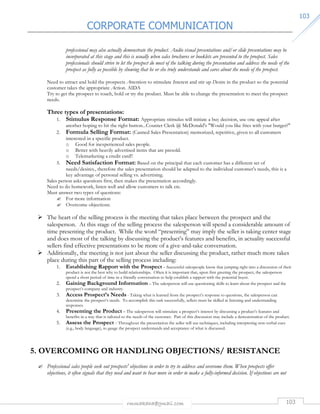
AIDA 
AIDA is an acronym used in marketing that describes a common list of events that are very often undergone when a 
person is selling a product or service: 
A - Attention: attract the attention of the customer. 
I - Interest: raise customer interest by demonstrating features, advantages, and benefits. 
D - Desire: convince customers that they want and desire the product or service and that it will satisfy their 
needs. 
A - Action: lead customers towards taking action and/or purchasing. 
Nowadays some have add another letter to form AIDA(S) : 
S - Satisfaction - satisfy the customer so they become a repeat customer and give referrals to a product 
AIDA is the original sales training acronym, from the late 1950's, when selling was first treated as a professional 
discipline, and sales training began. AIDA is even more relevant today. If you remember just one sales or selling model, 
remember AIDA. Often called the 'Hierarchy of Effects', AIDA describes the basic process by which people become 
motivated to act on external stimulus, including the way that successful selling happens and sales are made. 
A - Attention 
I - Interest 
D - Desire 
A - Action 
The AIDA process also applies to any advertising or communication that aims to generate a response, and it provides a 
reliable template for the design of all sorts of marketing material. 
Simply, when we buy something we buy according to the AIDA process. So when we sell something we must sell go 
through the AIDA stages. Something first gets our attention; if it's relevant to us we are interested to learn or hear 
more about it. If the product or service then appears to closely match our needs and/or aspirations, and resources, 
particularly if it is special, unique, or rare, we begin to desire it. If we are prompted or stimulated to overcome our 
natural caution we may then become motivated or susceptible to taking action to buy. 
Some AIDA pointers: 
Attention 
• Getting the other person's attention sets the tone: first impressions count , so smile - even on the phone 
because people can hear it in your voice - be happy (but not annoyingly so) be natural, honest and professional. 
• If you're not in the mood to smile do some paperwork instead. If you rarely smile then get out of selling. 
• Getting attention is more difficult than it used to be, because people are less accessible, have less free time, and 
lots of competing distractions, so think about when it's best to call. 
• Gimmicks, tricks and crafty techniques don't work, because your prospective customers - like the rest of us - 
are irritated by hundreds of them every day. 
• If you are calling on the phone or meeting face-to-face you have about five seconds to attract attention, by 
which time the other person has formed their first impression of you. 
• Despite the time pressure, relax and enjoy it - expect mostly to be told 'no thanks' - but remember that every 
'no' takes you closer to the next 'okay'. 
Interest 
• You now have maybe 5-15 seconds in which to create some interest. 
• Something begins to look interesting if it is relevant and potentially advantageous. This implies a lot: 
• The person you are approaching should have a potential need for your product or service or proposition 
(which implies that you or somebody else has established a target customer profile).
CORPORATE COMMUNICATION 
10 
• You must approach the other person at a suitable time (ie it's convenient, and that aspects of seasonality and 
other factors affecting timing have been taken into account) 
• You must empathize with and understand the other person's situation and issues, and be able to express 
yourself in their terms (ie talk their language). 
rmmakaha@gmail.com 10 
Desire 
• The sales person needs to be able to identify and agree the prospect's situation, needs, priorities and constraints 
on personal and organizational levels, through empathic questioning and interpretation. 
• You must build rapport and trust, and a preparedness in the prospect's mind to do business with you 
personally (thus dispelling the prospect's feelings of doubt or risk about your own integrity and ability). 
• You must understand your competitors' capabilities and your prospect's other options. 
• You must obviously understand your product (specification, options, features, advantages, and benefits), and 
particularly all relevance and implications for your prospect. 
• You must be able to present, explain and convey solutions with credibility and enthusiasm. 
• The key is being able to demonstrate how you, your own organization and your product will suitably, reliably 
and sustainably 'match' the prospect's needs identified and agreed, within all constraints. 
• Creating desire is part skill and technique, and part behaviour and style. In modern selling and business, trust 
and relationship (the 'you' factor) are increasingly significant, as natural competitive development inexorably 
squeezes and reduces the opportunities for clear product advantage and uniqueness. 
Action 
• Simply the conversion of potential into actuality, to achieve or move closer to whatever is the aim. 
• Natural inertia and caution often dictate that clear opportunities are not acted upon, particularly by purchasers 
of all sorts, so the sales person must suggest, or encourage agreement to move to complete the sale or move to 
the next stage. 
• The better the preceding three stages have been conducted, then the less emphasis is required for the action 
stage; in fact on a few rare occasions in the history of the universe, a sale is so well conducted that the prospect 
decides to take action without any encouragement at all. 
AIDCA 
• Attention 
• Interest 
• Desire 
• Commitment 
• Action
CORPORATE COMMUNICATION 
11 
The Marketing Mix 
(The 4 P's of Marketing) 
The major marketing management decisions can be classified in one of the following four categories: 
rmmakaha@gmail.com 11 
• Product 
• Price 
• Place (distribution) 
• Promotion 
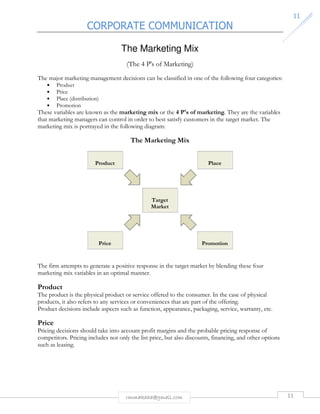
These variables are known as the marketing mix or the 4 P's of marketing. They are the variables 
that marketing managers can control in order to best satisfy customers in the target market. The 
marketing mix is portrayed in the following diagram: 
The Marketing Mix 
Product 
Place 
Target 
Market 
Price 
Promotion 
The firm attempts to generate a positive response in the target market by blending these four 
marketing mix variables in an optimal manner. 
Product 
The product is the physical product or service offered to the consumer. In the case of physical 
products, it also refers to any services or conveniences that are part of the offering. 
Product decisions include aspects such as function, appearance, packaging, service, warranty, etc. 
Price 
Pricing decisions should take into account profit margins and the probable pricing response of 
competitors. Pricing includes not only the list price, but also discounts, financing, and other options 
such as leasing.
CORPORATE COMMUNICATION 
12 
Place 
Place (or placement) decisions are those associated with channels of distribution that serve as the 
means for getting the product to the target customers. The distribution system performs 
transactional, logistical, and facilitating functions. 
Distribution decisions include market coverage, channel member selection, logistics, and levels of 
service. 
Promotion 
Promotion decisions are those related to communicating and selling to potential consumers. Since 
these costs can be large in proportion to the product price, a break-even analysis should be 
performed when making promotion decisions. It is useful to know the value of a customer in order 
to determine whether additional customers are worth the cost of acquiring them. 
Promotion decisions involve advertising, public relations, media types, etc. 
A Summary Table of the Marketing Mix 
The following table summarizes the marketing mix decisions, including a list of some of the aspects 
of each of the 4Ps. 
Summary of Marketing Mix Decisions 
Product Price Place Promotion 
Functionality 
List price 
Channel members 
Appearance 
Discounts 
Channel motivation 
Quality 
Allowances 
Market coverage 
Packaging 
Financing 
Locations 
Brand 
Leasing options 
Logistics 
Warranty 
Service levels 
Service/Support 
Advertising 
Personal selling 
Public relations 
Message 
Media 
Budget 
rmmakaha@gmail.com 12 
What is promotion? 
1. Promotion is a form of corporate communication that uses various methods to reach a targeted audience with 
a certain message in order to achieve specific organizational objectives. Nearly all organizations, whether for-profit 
or not-for-profit, in all types of industries, must engage in some form of promotion. Such efforts may 
range from multinational firms spending large sums on securing high-profile celebrities to serve as corporate 
spokespersons to the owner of a one-person enterprise passing out business cards at a local businessperson’s 
meeting. 
2. In addition to coordinating general promotion decisions with other business areas, individual promotions must 
also work together. Under the concept of Integrated Marketing Communication marketers attempt to develop 
a unified promotional strategy involving the coordination of many different types of promotional techniques. 
The key idea for the marketer who employs several promotional options (we’ll discuss potential options later in 
this tutorial) to reach objectives for the product is to employ a consistent message across all options. For 
instance, salespeople will discuss the same benefits of a product as mentioned in television advertisements. In 
this way no matter how customers are exposed to a marketer’s promotional efforts they all receive the same 
information.
CORPORATE COMMUNICATION 
13 
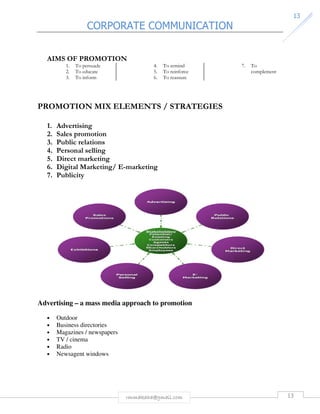
AIMS OF PROMOTION 
rmmakaha@gmail.com 13 
1. To persuade 
2. To educate 
3. To inform 
4. To remind 
5. To reinforce 
6. To reassure 
7. To 
complement 
PROMOTION MIX ELEMENTS / STRATEGIES 
1. Advertising 
2. Sales promotion 
3. Public relations 
4. Personal selling 
5. Direct marketing 
6. Digital Marketing/ E-marketing 
7. Publicity 
Advertising – a mass media approach to promotion 
• Outdoor 
• Business directories 
• Magazines / newspapers 
• TV / cinema 
• Radio 
• Newsagent windows
CORPORATE COMMUNICATION 
14 
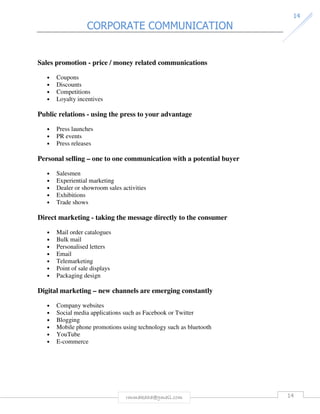
Sales promotion - price / money related communications 
rmmakaha@gmail.com 14 
• Coupons 
• Discounts 
• Competitions 
• Loyalty incentives 
Public relations - using the press to your advantage 
• Press launches 
• PR events 
• Press releases 
Personal selling – one to one communication with a potential buyer 
• Salesmen 
• Experiential marketing 
• Dealer or showroom sales activities 
• Exhibitions 
• Trade shows 
Direct marketing - taking the message directly to the consumer 
• Mail order catalogues 
• Bulk mail 
• Personalised letters 
• Email 
• Telemarketing 
• Point of sale displays 
• Packaging design 
Digital marketing – new channels are emerging constantly 
• Company websites 
• Social media applications such as Facebook or Twitter 
• Blogging 
• Mobile phone promotions using technology such as bluetooth 
• YouTube 
• E-commerce
CORPORATE COMMUNICATION 
15 
rmmakaha@gmail.com 15
CORPORATE COMMUNICATION 
16 
rmmakaha@gmail.com 16
CORPORATE COMMUNICATION 
17 
Targets of Marketing Promotions/ Corporate Communication 
The audience for an organization’s marketing communication efforts is not limited to just the marketer’s target market. 
While the bulk of a marketer’s promotional budget may be directed at the target market, there are many other groups 
that could also serve as useful target of a marketing message. 
Targets of a marketing message generally fall into one of the following categories: 
rmmakaha@gmail.com 17
CORPORATE COMMUNICATION 
18 
• Members of the Organization’s Target Market – This category would include current customers, previous 
customers and potential customers, and as noted, may receive the most promotional attention. 
• Influencers of the Organization’s Target Market – There exists a large group of people and organizations 
that can affect how a company’s target market is exposed to and perceives a company’s products. These 
influencing groups have their own communication mechanisms that reach the target market and the marketer may 
be able utilize these influencers to its benefit. Influencers include the news media (e.g., offer company stories), 
special interest groups, opinion leaders (e.g., doctors directing patients), and industry trade associations. 
• Participants in the Distribution Process – The distribution channel provides services to help gain access to 
final customers and are also target markets since they must recognize a product’s benefits and agree to handle the 
product in the same way as final customers who must agree to purchase products. Aiming promotions at 
distribution partners (e.g., retailers, wholesalers, distributors) and other channel members is extremely important 
and, in some industries, represents a higher portion of a marketer’s promotional budget than promotional 
spending directed at the final customer. 
• Other Companies – The most likely scenario in which a company will communicate with another company 
occurs when the marketer is probing to see if the company would have an interest in a joint venture, such as a co-marketing 
arrangement where two firms share marketing costs. Reaching out to other companies, including 
companies who may be competitors for other products, could help create interest in discussing such a relationship. 
• Other Organizational Stakeholders – Marketers may also be involved with communication activities directed 
at other stakeholders. This group consists of those who provide services, support or, in other ways, impact the 
company. For example, an industry group that sets industry standards can affect company products through the 
issuance of recommended compliance standards for product development or other marketing activities. 
Communicating with this group is important to insure the marketer’s views of any changes in standards are known. 
Objectives of Corporate Communication/ Promotion 
 The most obvious objective for corporate communication activities is to convince customers to make a 
decision that benefits the organization (of course the organization believes the decision will also benefit the 
customer). For most for-profit marketers this means getting customers to buy an organization’s product and, 
in most cases, to remain a loyal long-term customer. For other marketers, such as not-for-profits, it means 
getting customers to increase donations, utilize more services, change attitudes, or change behavior (e.g., stop 
smoking campaigns). 
 However, marketers must understand that getting customers to commit to a decision, such as a purchase 
decision, is only achievable when a customer is ready to make the decision. As we saw in the AIDA above; 
customers often move through several stages before a purchase decision is made. Additionally before turning 
into a repeat customer, purchasers analyze their initial purchase to see whether they received a good value, and 
then often repeat the purchase process again before deciding to make the same choice. 
 The type of customer the marketer is attempting to attract and which stage of the purchase process a customer 
is in will affect the objectives of a particular marketing communication effort. And since a marketer often has 
multiple simultaneous promotional campaigns, the objective of each could be different. 
Types of Corporate Communication/ Promotion Objectives 
The possible objectives for corporate communications may include the following: 
• Build Awareness – New products and new companies are often unknown to a market, which means initial promotional 
efforts must focus on establishing an identity. In this situation the marketer must focus promotion to: 1) effectively reach customers, 
and 2) tell the market who they are and what they have to offer. 
• Create Interest – Moving a customer from awareness of a product to making a purchase can present a significant challenge. 
As we saw with our discussion of consumer and business buying behavior, customers must first recognize they have a need before they 
actively start to consider a purchase. The focus on creating messages that convince customers that a need exists has been the hallmark 
of marketing for a long time with promotional appeals targeted at basic human characteristics such as emotions, fears, sex, and humor. 
• Provide Information – Some promotion is designed to assist customers in the search stage of the purchasing process. In 
some cases, such as when a product is so novel it creates a new category of product and has few competitors, the information is simply 
intended to explain what the product is and may not mention any competitors. In other situations, where the product competes in an 
existing market, informational promotion may be used to help with a product positioning strategy 
rmmakaha@gmail.com 18
CORPORATE COMMUNICATION 
19 
• Stimulate Demand – The right promotion can drive customers to make a purchase. In the case of products that a 
customer has not previously purchased or has not purchased in a long time, the promotional efforts may be directed at getting the 
customer to try the product. This is often seen on the Internet where software companies allow for free demonstrations or even free 
downloadable trials of their products. For products with an established customer-base, promotion can encourage customers to 
increase their purchasing by providing a reason to purchase products sooner or purchase in greater quantities than they normally do. 
For example, a pre-holiday newspaper advertisement may remind customers to stock up for the holiday by purchasing more than they 
typically purchase during non-holiday periods. 
• Reinforce the Brand – Once a purchase is made, a marketer can use promotion to help build a strong relationship that can 
lead to the purchaser becoming a loyal customer. For instance, many retail stores now ask for a customer’s email address so that 
follow-up emails containing additional product information or even an incentive to purchase other products from the retailer can be 
sent in order to strengthen the customer-marketer relationship. 
The Communication Process 
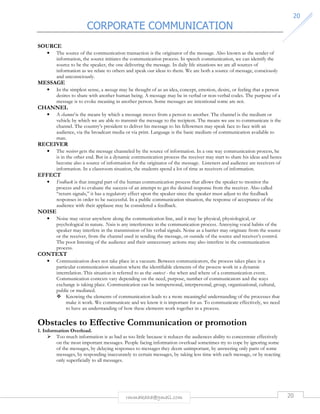
With the aid of a diagram, discuss the communication process. (20 marks) 
rmmakaha@gmail.com 19
CORPORATE COMMUNICATION 
20 
rmmakaha@gmail.com 20 
SOURCE 
• The source of the communication transaction is the originator of the message. Also known as the sender of 
information, the source initiates the communication process. In speech communication, we can identify the 
source to be the speaker, the one delivering the message. In daily life situations we are all sources of 
information as we relate to others and speak our ideas to them. We are both a source of message, consciously 
and unconsciously. 
MESSAGE 
• In the simplest sense, a message may be thought of as an idea, concept, emotion, desire, or feeling that a person 
desires to share with another human being. A message may be in verbal or non-verbal codes. The purpose of a 
message is to evoke meaning in another person. Some messages are intentional some are not. 
CHANNEL 
• A channel is the means by which a message moves from a person to another. The channel is the medium or 
vehicle by which we are able to transmit the message to the recipient. The means we use to communicate is the 
channel. The country’s president to deliver his message to his fellowmen may speak face to face with an 
audience, via the broadcast media or via print. Language is the basic medium of communication available to 
man. 
RECEIVER 
• The receiver gets the message channeled by the source of information. In a one way communication process, he 
is in the other end. But in a dynamic communication process the receiver may start to share his ideas and hence 
become also a source of information for the originator of the message. Listeners and audience are receivers of 
information. In a classroom situation, the students spend a lot of time as receivers of information. 
EFFECT 
• Feedback is that integral part of the human communication process that allows the speaker to monitor the 
process and to evaluate the success of an attempt to get the desired response from the receiver. Also called 
“return signals,” it has a regulatory effect upon the speaker since the speaker must adjust to the feedback 
responses in order to be successful. In a public communication situation, the response of acceptance of the 
audience with their applause may be considered a feedback. 
NOISE 
• Noise may occur anywhere along the communication line, and it may be physical, physiological, or 
psychological in nature. Noise is any interference in the communication process. Annoying vocal habits of the 
speaker may interfere in the transmission of his verbal signals. Noise as a barrier may originate from the source 
or the receiver, from the channel used in sending the message, or outside of the source and receiver’s control. 
The poor listening of the audience and their unnecessary actions may also interfere in the communication 
process. 
CONTEXT 
• Communication does not take place in a vacuum. Between communicators, the process takes place in a 
particular communication situation where the identifiable elements of the process work in a dynamic 
interrelation. This situation is referred to as the context - the when and where of a communication event. 
Communication contexts vary depending on the need, purpose, number of communicators and the ways 
exchange is taking place. Communication can be intrapersonal, interpersonal, group, organizational, cultural, 
public or mediated. 
 Knowing the elements of communication leads to a more meaningful understanding of the processes that 
make it work. We communicate and we know it is important for us. To communicate effectively, we need 
to have an understanding of how these elements work together in a process. 
Obstacles to Effective Communication or promotion 
1. Information Overload. 
 Too much information is as bad as too little because it reduces the audiences ability to concentrate effectively 
on the most important messages. People facing information overload sometimes try to cope by ignoring some 
of the messages, by delaying responses to messages they deem unimportant, by answering only parts of some 
messages, by responding inaccurately to certain messages, by taking less time with each message, or by reacting 
only superficially to all messages.
CORPORATE COMMUNICATION 
21 
 To overcome information overload, realize that some information is not necessary, and make necessary 
information easily available. Give information meaning rather than just passing it on, and set priorities for 
dealing with the information flow. Some information isn't necessary. 
rmmakaha@gmail.com 21 
2. Message Complexity. 
 When formulating business messages, you communicate both as an individual and as representative of an 
organization. Thus you must adjust your own ideas and style so that they are acceptable to your employer. In 
fact, you may be asked occasionally to write or say something that you disagree with personally. Suppose you 
work as a recruiter for your firm. You've interviewed a job candidate you believe would make an excellent 
employee, but others in the firm have rejected this applicant. Now you have to write a letter turning down the 
candidate: You must communicate your firms message, regardless of your personal feelings, a task some 
communicators find difficult. 
 To overcome the barriers of complex messages, keep them clear and easy to understand. Use strong 
organization, guide readers by telling them what to expect, use concrete and specific language, and stick to the 
point. Be sure to ask for feedback so that you can clarify and improve your message. 
3. Message Competition. 
 Communicators are often faced with messages that compete for attention. If you're talking on the phone while 
scanning a report, both messages are apt to get short shrift. Even your own messages may have to compete 
with a variety of interruptions: The phone rings every five minutes, people intrude, meetings are called, and 
crises arise. In short, your messages rarely have the benefit on the receivers undivided attention. 
 To overcome competition barriers, avoid making demands on a receiver who doesn't have the time to pay 
careful attention to your message. Make written messages visually appealing and easy to understand, and try to 
deliver them when your receiver has time to read them. Oral messages are most effective when you can speak 
directly to your receiver (rather than to intermediaries or answering machines). Also, be sure to set aside 
enough time for important messages that you receive. Business messages rarely have the benefit of the 
audiences full and undivided attention. 
4. Differing Status. 
 Employees of low status may be overly cautious when sending messages to managers and may talk only about 
subjects they think the manager is interested in. Similarly, higher-status people may distort messages by refusing 
to discuss anything that would tend to undermine their authority in the organization. Moreover, belonging to a 
particular department or being responsible for a particular task can narrow your point of view so that it differs 
from the attitudes, values, and expectations of people who belong to other departments or who are responsible 
for other tasks. 
 To overcome status barriers, keep managers and colleagues well informed. Encourage lower-status employees 
to keep you informed by being fair-minded and respectful of their opinions. When you have information that 
you're afraid you boss might not like, be brave and convey it anyway. Status barriers can be overcome by a 
willingness to give and receive bad news. 
5. Lack of Trust, Building trust is a difficult problem. 
 Other organization members don't know whether you'll respond in a supportive or responsible way, so trusting 
can be risky. Without trust, however, free and open communication is effectively blocked, threatening the 
organization's stability. Just being clear in your communication is not enough. 
 To overcome trust barriers, be visible and accessible. Don't insulate yourself behind assistants or secretaries. 
Share key information with colleagues and employees, communicate honestly, and include employees in 
decision making. For communication to be successful, organizations must create an atmosphere of fairness and 
trust. 
6. Inadequate Communication Structures. 
 Organizational communication is effected by formal restrictions on who may communicate with whom and 
who is authorized to make decisions. Designing too few formal channels blocks effective communication. 
Strongly centralized organizations, especially those with a high degree of formalization, reduce communication 
capacity, and they decrease the tendency to communicate horizontally thus limiting the ability to coordinate 
activities and decisions. Tall organizations tend to provide too many vertical communication links, so messages 
become distorted as they move through the organization's levels.
CORPORATE COMMUNICATION 
22 
 To overcome structural barriers, offer opportunities for communicating upward, downward, and horizontally 
(using such techniques as employee surveys, open-door policies, newsletters, memo, and task groups). Try to 
reduce hierarchical levels, increase coordination between departments, and encourage two-way communication. 
rmmakaha@gmail.com 22 
7. Incorrect Choice of Medium. 
 If you choose an inappropriate communication medium, your message can be distorted so that the intended 
meaning is blocked. You can select the most appropriate medium by matching your choice with the nature of 
the message and of the group or the individual who will receive it. Face-to-face communication is the richest 
medium because it is personal, it provides immediate feedback, it transmits information from both verbal and 
nonverbal cues, and it conveys the emotion behind the message. Telephones and other interactive electronic 
media aren't as rich; although they allow immediate feedback, they don't provide visual nonverbal cues such as 
facial expressions, eye contact and body movements. Written media can be personalized through addressed 
memos, letters, and reports, but they lack the immediate feedback and the visual and vocal nonverbal cues that 
contribute to the meaning of the message. The leanest media are generally impersonal written messages such as 
bulletins, fliers, and standard reports. Not only do they lack the ability to transmit nonverbal cues and to give 
feedback, they also eliminate any personal focus. 
 To overcome media barriers, choose the richest media for no routine, complex message. Use rich media to 
extend and to humanize your presence throughout the organization, to communicate caring and personal 
interest to employees, and to gain employee commitment to organizational goals. Use leaner media to 
communicate simple, routine messages. You can send information such as statistics, facts, figures and 
conclusions through a note, memo or written report 
8. Closed communication climate. 
 Communication climate is influenced by management style, and a directive, authoritarian style blocks the free 
and open exchange of information that characterizes good communication. 
 To overcome climate barriers, spend more time listening than issuing orders. 
9. Unethical Communication. 
 An organization cannot create illegal or unethical messages and still be credible or successful in the long run. 
Relationships within and outside the organization depend or trust and fairness. 
 To overcome ethics barriers, make sure your messages include all the information that ought to be there. Make 
sure that information is adequate and relevant to the situation. And make sure your message is completely 
truthful, not deceptive in any way. 
10. Inefficient Communication. 
 Producing worthless messages wastes time and resources, and it contributes to the information overload 
already mentioned. 
 Reduce the number of messages by thinking twice before sending one. Then speed up the process, first, by 
preparing messages correctly the first time around and, second, by standardizing format and material when 
appropriate. Be clear about the writing assignments you accept as well as the ones you assign. 
11. Physical distractions. 
 Communication barriers are often physical: bad connections, poor acoustics, illegible copy. Although noise or 
this sort seems trivial, it can completely block an otherwise effective message. Your receiver might also be 
distracted by an uncomfortable chair, poor lighting, or some other irritating condition. In some cases, the 
barrier may be related to the receiver's health. Hearing or visual impairment or even a headache can interfere 
with reception of a message. These annoyances don't generally block communication entirely, but they may 
reduce the receiver's concentration. 
 To overcome physical distractions, try to prepare well written documents which are clear, concise, and 
comprehensive. When preparing oral presentations try to find a setting which permits audience to see and hear 
the speaker clearly. 
12. Potential Barrier in communication (Cultural Differences) 
 Cultural differences can cause many problems in an effective discussion, for example: If two people 
are trying to have a discussion and both speak different languages, it would be extremely difficult to
CORPORATE COMMUNICATION 
23 
communicate, in different cultures hand signs represent gestures that the British take politely. 
Religious issues can accelerate a normal discussion into a debate. 
 Possible ways of overcoming potential barriers that cultural differences create 
 There are some ways of resolving these, some of which are the following: learn their language, hire an 
interpreter, carry a translating dictionary, Instead of trying to communicate with hand signs and 
offend them, research some different signs that mean something polite and respectful, these are all 
ways that can solve the problems of effective communication in cultural differences. 
13. Potential Barrier in communication (Distractions) 
 Distractions are one of the most annoying potential barriers; sometimes they are inescapable or 
unpreventable. However, some of them can be avoided, for example: mobile phones, people arriving 
late, changing the subject, talking about a different topic, some of these are preventable though. 
 Possible ways to overcome potential barriers that distractions create 
 Some distractions are unpreventable, but are some are avoidable, for example: turn mobile phones 
off, arrive on time or come in quietly. Some of the distractions that are inescapable are as follows: 
road works outside, mobile phone, someone arriving late. 
14. Potential Barrier in communication (Incorrect spelling/grammar) 
 Incorrect spelling is a potential barrier in communication because it can be misinterpreted as 
something else and an important message might not be passed on, this can happen in any written 
forms of communication, for example: email, snail- mail, memo, etc. 
 Possible ways to overcome potential barriers that incorrect spelling/grammar creates 
 There are a number of ways to overcome incorrect spelling/grammar; firstly the spellchecker is useful 
for simple spelling and grammar mistakes. Next, proofreading is important as this is more accurate 
than spellchecker because machines do not know what context is suitable; finally, a second opinion is 
the best option to overcome this barrier, getting a friend to check the work over ensures better work. 
15. Potential Barrier in communication (Terminology) 
 Using the wrong terminology is very poor quality communication; it can lead to misunderstanding of 
an important issue, terminology that is too simple, example, thingy and stuff, is far too vaguer 
terminology to understand, if someone is having a technical discussion about something they need to 
use technical terminology. The wrong terminology can also result in loss of interest. 
 Possible ways to overcome potential barriers that incorrect terminology creates 
 There is no easy way to correct terminology; use same level of technical language, provide audience 
with information about the topic to make communication easier, example: handouts. 
16. Potential Barrier in communication (Loss of interest) 
 Loss of interest is the cause of poor communication, meaning a boring issue is being discussed or 
incorrect terminology is being used. The subject might not be relevant to people in the audience, 
talking too quietly, talking in a monotone. 
 Possible ways to overcome potential barriers that loss of interest causes 
 There are numerous ways to overcome loss of interest, for example: talking in different tones relevant 
to the subject, interact with the audience, use interesting slideshows, video clips, and pictures. Loss of 
interest is only caused by: a boring subject, the wrong terminology, talking in monotone, these 
problems can easily be solved. 
rmmakaha@gmail.com 23 
17. Poor Encoding – 
 This occurs when the message source fails to create the right sensory stimuli to meet the objectives of the 
message. For instance, in person-to-person communication, verbally phrasing words poorly so the 
intended communication is not what is actually said, is the result of poor encoding. Poor encoding is also 
seen in advertisements that are difficult for the intended audience to understand, such as words or symbols 
that lack meaning or, worse, have totally different meanings within a certain cultural groups. This often 
occurs when marketers use the same advertising message across many different countries. Differences due 
to translation or cultural understanding can result in the message receiver having a different frame of 
reference for how to interpret words, symbols, sounds, etc. This may lead the message receiver to decode 
the meaning of the message in a different way than was intended by the message sender. 
18. Poor Decoding – 
 This refers to a message receiver’s error in processing the message so that the meaning given to the 
received message is not what the source intended. This differs from poor encoding when it is clear, 
through comparative analysis with other receivers, that a particular receiver perceived a message differently
CORPORATE COMMUNICATION 
24 
from others and from what the message source intended. Clearly, as we noted above, if the receiver’s 
frame of reference is different (e.g., meaning of words are different) then decoding problems can occur. 
More likely, when it comes to marketing promotions, decoding errors occur due to personal or 
psychological factors, such as not paying attention to a full television advertisement, driving too quickly 
past a billboard, or allowing one’s mind to wonder while talking to a salesperson. 
rmmakaha@gmail.com 24 
19. Medium Failure – 
 Sometimes communication channels break down and end up sending out weak or faltering signals. Other 
times the wrong medium is used to communicate the message. For instance, trying to educate doctors 
about a new treatment for heart disease using television commercials that quickly flash highly detailed 
information is not going to be as effective as presenting this information in a print ad where doctors can 
take their time evaluating the information. 
20. Communication Noise – 
 Noise in communication occurs when an outside force in someway affects delivery of the message. The 
most obvious example is when loud sounds block the receiver’s ability to hear a message. Nearly any 
distraction to the sender or the receiver can lead to communication noise. In advertising, many customers 
are overwhelmed (i.e., distracted) by the large number of advertisements they encountered each day. Such 
advertising clutter (i.e., noise) makes it difficult for advertisers to get their message through to desired 
customers. 
Factors that hinder effective communication or promotion- EXPAND 
1. Media cost 
2. Culture 
3. Lacking knowledge of the target audience 
4. Sending the wrong non verbal signals 
5. Illiteracy/ literacy levels 
6. Language limitations 
7. Media limitations 
8. Legal considerations 
Keys to Effective Communication 
For marketers understanding how communication works can improve the delivery of their message. From the 
information just discussed, marketers should focus on the following to improve communication with their targeted 
audience: 
• Carefully Encode – Marketers should make sure the message they send is crafted in a way that will be interpreted by message 
receivers as intended. This means having a good understanding of how their audience interprets words, symbols, sounds and other 
stimuli used by marketers. 
• Allow Feedback – Encouraging the message receiver to provide feedback can greatly improve communication and help determine 
if a marketer’s message was decoded and interpreted properly. Feedback can be improved by providing easy-to-use options for 
responding, such as phone numbers, Internet chat, and email. 
• Reduce Noise – In many promotional situations the marketer has little control over interference with their message. However, 
there are a few instances where the marketer can proactively lower the noise level. For instance, salespeople can be trained to reduce 
noise by employing techniques that limit customer distractions, such as scheduling meetings during non-busy times or by inviting 
potential customers to an environment that offers fewer distractions, such as a conference facility. Additionally, advertising can be 
developed in ways that separates the marketer’s ad from others, including the use of white space in magazine ads. 
• Choose Right Audience – Targeting the right message receiver will go a long way to improving a marketer’s ability to promote 
their products. Messages are much more likely to be received and appropriately decoded by those who have an interest in the content 
of the message. 
Characteristics of Different Promotions 
Before we discuss the different types of promotion options available to a marketer, it is useful to gain an understanding 
of the features that set different options apart. For our discussion we isolate seven characteristics on which each 
promotional option can be judged. While these characteristics are widely understood as being important in evaluating 
the effectiveness of each type of promotion, they are by no means the only criteria used for evaluation. In fact, as new 
promotional methods emerge the criteria for evaluating promotional methods will likely change.
CORPORATE COMMUNICATION 
25 
For our discussion we will look at the following characteristics of a promotional method: 
1. Intended Audience: Mass vs. Targeted 
2. Payment Model: Paid vs. Non-Paid 
3. Interaction Type: Personal vs. Non-Personal 
4. Message Flow: One-Way vs. Two-Way 
5. Demand Creation: Quick vs. Lagging 
6. Message Control 
7. Message Credibility 
8. Effective Cost of Promotion 
1. Intended Audience: Mass Promotion vs. Targeted Promotion 
 Promotions can be categorized based on the intended coverage of a single promotional message. For instance, 
a single television advertisement for a major sporting event, such as the Super Bowl, World Cup or Olympics, 
could be seen by millions of viewers at the same time. Such mass promotion, intended to reach as many 
people as possible, has been a mainstay of marketers’ promotional efforts for a long time. 
 Unfortunately, while mass promotions are delivered to a large number of people, the actual number that fall 
within the marketer’s target market may be small. Because of this, many who use mass promotion techniques 
find it to be an inefficient way to reach desired customers. Instead, today’s marketers are turning to newer 
techniques designed to focus promotional delivery to only those with a high probability of being in the 
marketer’s target market. For example, Google, Yahoo and other Internet search engines employ methods for 
delivering highly targeted ads to customers as they enter search terms. The assumption made by advertisers is 
that customers who enter search terms are interested in the information they have entered, especially if they are 
searching by entering detailed search strings (e.g., phrases rather than a single word). Following this logic, 
advertisers are much more likely to have their ads displayed to customers within their target market and, thus, 
receive a higher return on their promotional investment. The movement to highly targeted promotions has 
gained tremendous traction in recent years and, as new and improved targeting methods are introduced, its 
importance will continue to grow. 
2. Payment Model: Paid Promotion vs. Non-Paid Promotion 
 Most efforts to promote products require marketers to make direct payment to the medium that delivers the 
message. For instance, a company must pay a magazine publisher to advertise in the magazine. However, 
there are several forms of promotion that do not involve direct payment in order to distribute a promotional 
message. While not necessarily “free” since there may be indirect costs involved, the ability to have a product 
promoted without making direct payment to the medium can be a viable alternative to expensive promotion 
options. 
3. Interaction Type: Personal vs. Non-Personal 
 Promotions involving real people communicating with other people is considered personal promotion. While 
salespeople are a common and well understood type of personal promotion, another type of promotion, called 
controlled word-of-mouth promotion (a.k.a., buzz marketing), is emerging as a form of personal promotion. 
Unlike salespeople who attempt to obtain an order from customers, controlled word-of-mouth promotion uses 
real people to help spread information about a product but is not designed to directly elicit orders. 
 One key advantage personal promotions have is the ability for the message sender to adjust the message as they 
gain feedback from message receivers (i.e., two-way communication). So if a customer does not understand 
something in the initial message (e.g., doesn’t fully understand how the product works) the person delivering 
the message can adjust the promotion to address questions or concerns. Many non-personal forms of 
promotion, such as a radio advertisement, are inflexible, at least in the short-term, and cannot be easily adjusted 
to address questions that arise by the audience experiencing the ad. 
4. Message Flow: One-Way vs. Two-Way Communication 
 Promotions can be classified based on whether the message source enables the message receiver to respond 
with immediate feedback. Such feedback can then be followed with further information exchange between 
both parties. Most efforts at mass promotion, such as television advertising, offer only a one-way information 
flow that does not allow for easy response by the message receiver. However, many targeted promotions, such 
as using a sales force to promote products, allow message recipients to respond immediately to information 
from the message sender. 
rmmakaha@gmail.com 25
CORPORATE COMMUNICATION 
26 
5. Demand Creation: Quick vs. Lagging 
 As we discussed earlier, the success of promotional activity may not always be measured by comparing 
spending to an increase in product sales since marketers may use promotion to achieve other objectives. 
However, when a marketer is looking to increase demand, certain promotional activities offer advantages in 
turning exposure to promotion into a quick increase in demand. In general, these activities are most effective 
when customers are offered an incentive to make the purchase either in a monetary way (e.g., save money) or in 
psychological way (e.g., improves customer’s perceived group role or status level). 
rmmakaha@gmail.com 26 
6. Message Control 
 Most promotions are controlled by the marketer who encodes the message (or hires specialists such as 
advertising agencies to create the promotion) and then pays to have the message delivered. However, no 
marketer can totally control how the news media, customers or others talk about a company or its products. 
Reporters for magazines, newspaper and websites, as well as posters to Internet forums may discuss a 
company’s products in ways that can benefit or hinder a company’s marketing efforts. This is particularly true 
with non-paid promotions where a marketer is looking to obtain a free “mention” by an influential message 
medium (e.g., newspaper article). 
7. Message Credibility 
 The perceived control of the message can influence the target market’s perception of message credibility. For 
example, many customers viewing a comparative advertisement in which a product is shown to be superior to a 
competitor’s product may be skeptical about the claims since the company with the superior product is paying 
for the advertisement. Yet, if the same comparison is mentioned in a newspaper article it may be more 
favorably viewed since readers may perceive the author of the story has possessing an unbiased point-of-view. 
8. Cost Effectiveness 
 Promotional cost is measured in several different ways though the most useful are measured in terms of cost-per- 
impression (CPI), cost-per-targeted impression (CPTI), and cost-per-action (CPA). The CPI metric relates 
to how many people are exposed to a promotion in relation to the cost of the promotion. A national or 
international television advertisement, while expensive to create and broadcast, actually produces a very low 
CPI given how many people are exposed to the ad. Yet, a low CPI can be misleading if a large percentage of 
the promotion’s audience is not within the marketer’s target market, in which case the CPTI may be a better 
metric for gauging promotion effectiveness. The CPTI approach looks at what percentage of an audience is 
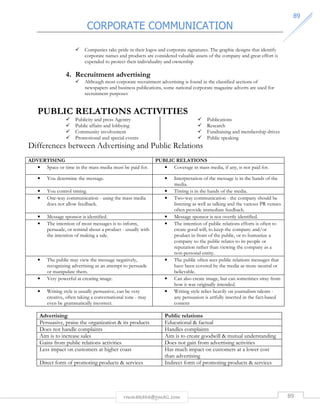
within the marketer’s customer group and, thus, legitimate targets for the promotion. Clearly, CPTI is higher 
than CPI, but it offers a better indication of how much promotion is reaching targeted customers. 
 An even more effective way to evaluate promotional costs is through the cost-per-action metric. With CPA the 
marketer evaluates how many people actually respond to a promotion. Response may be measured by 
examining purchase activity, number of phone inquiries, website traffic, clicks on advertisements, and other 
means within a short time after the promotional message was delivered. Unfortunately, measuring CPA is not 
always easy and tying it directly to a specific promotion can also be difficult. For example, a customer who 
purchases a snack product may have first learned about the snack product several weeks before from a 
television advertisement. The fact that it took the customer several weeks to make the purchase does not mean 
the advertisement was not effective in generating sales, though if the CPA was measured within a day or two 
after the ad was broadcast this person’s action would not have been counted.. 
 With the growing trend to more targeted promotions, especially those delivered through the Internet, 
combined with the development of sophisticated customer tracking techniques, the ability to compare 
promotion to actual customer activity is bound to one day be the dominant method for measuring promotional 
effectiveness.
CORPORATE COMMUNICATION 
27 
Types of Promotion – Promotion Mix 
Marketers have at their disposal four major methods of promotion. Taken together these comprise the promotion mix. 
In this section a basic definition of each method is offered while in the next section a comparison of each method based 
on the characteristics of promotion is presented. 
1. Advertising – Involves non-personal, mostly paid promotions often using mass media outlets to deliver the marketer’s message. 
While historically advertising has involved one-way communication with little feedback opportunity for the customer experiencing 
the advertisement, the advent of computer technology and, in particular, the Internet has increased the options that allow 
customers to provide quick feedback. 
2. Sales Promotion – Involves the use of special short-term techniques, often in the form of incentives, to encourage customers to 
respond or undertake some activity. For instance, the use of retail coupons with expiration dates requires customers to act while 
the incentive is still valid. 
3. Public Relations – Also referred to as publicity, this type of promotion uses third-party sources, and particularly the news media, 
to offer a favorable mention of the marketer’s company or product without direct payment to the publisher of the information. 
4. Personal Selling – As the name implies, this form of promotion involves personal contact between company representatives and 
those who have a role in purchase decisions (e.g., make the decision, such as consumers, or have an influence on a decision, such 
as members of a company buying center). Often this occurs face-to-face or via telephone, though newer technologies allow this to 
occur online via video conferencing or text chat. 
rmmakaha@gmail.com 27 
5. Direct marketing 
6. Publicity 
Promotion Summary Table 
The table below compares each of the promotion mix options on the eight key promotional characteristics. The summary should be viewed only as a 
general guide since promotion techniques are continually evolving and how each technique is compared on a characteristics is subject to change. 
Characteristics Advertising Sales Promotion Public Relations Personal Selling 
Directed Coverage mass  targeted mass  targeted mass targeted 
Message Flow one  two-way one  two-way one-way two-way 
Payment Model paid 
limited non-paid 
paid non-paid paid 
Interaction Type non-personal personal  
non-personal 
non-personal personal 
Demand Stimulation lagging quick lagging quick 
Message Control good good poor very good 
Message Credibility low-medium low-medium high medium-high 
Cost of Promotion CPI - Low 
CPTI - Varies 
CPA - Varies 
CPI - Mediium 
CPTI - Varies 
CPA - Varies 
CPI - None 
CPTI - None 
CPA - None 
CPI - High 
CPTI - High 
CPA - High 
Factors Affecting Promotions Choice 
With four promotional methods to choose from how does the marketer determine which ones to use? The selection 
can be complicated by company and marketing decision issues. 
Company Issues: 
1. Promotional Objective – As we discussed, there are several different objectives a marketer may pursue with their 
promotional strategy. Each type of promotion offers different advantages in terms of helping the marketer reach their objectives. 
For instance, if the objective of a software manufacturer is to get customers to try a product, the use of sales promotion, such as 
offering the software in a free downloadable form, may yield better results than promoting through Internet advertising. 
2. Availability of Resources – The amount of money and other resources that can be directed to promotion affects the 
marketer’s choice of promotional methods. Marketers with large promotional budgets may be able to spread spending among all 
promotion options while marketers with limited funds must be more selective on the promotion techniques they use. 
3. Company Philosophy – Some companies follow a philosophy that dictates where most promotional spending occurs. 
For instance, some companies follow the approach that all promotion should be done through salespeople while other companies 
prefer to focus attention on product development and hope word-of-mouth communication by satisfied customers helps to create 
interest in their product.
CORPORATE COMMUNICATION 
28 
rmmakaha@gmail.com 28 
Marketing Decision Issues: 
1. Target Market – As one might expect, customer characteristics dictate how promotion is determined. Characteristics such 
as size, location and type of target markets affect how the marketer communicates with customers. For instance, for a small 
marketer serving business markets with customers widely dispersed, it may be very expensive to utilize a sales force versus using 
advertising. 
2. Product – Different products require different promotional approaches. For the consumer market, products falling into the 
convenience and shopping goods categories are likely to use mass market promotional approaches while higher-end specialty 
goods are likely to use personalized selling. Thus, products that are complex and take customers extended time to make a purchase 
decision may require personal selling rather than advertising. This is often the case with products targeted to the business market. 
Additionally, Managing Products and will later see when we discuss marketing strategy, products pass through different stages in 
the Product Life Cycle. As a product moves through these stages the product itself may evolve and also promotional objectives 
will change. This leads to different promotional mix decisions from one stage to the next. 
3. Distribution –Marketing organizations selling through channel partners can reach the final customer either directly using a 
pull promotion strategy or indirectly using a push promotional strategy. The pull strategy is so named since it creates demand for a 
product by promoting directly to the final customer in the hopes that their interest in the product will help “pull” more product 
through the distribution channel. This approach can be used when channel partners are hesitant about stocking a product unless 
they are assured of sufficient customer interest. The push strategy uses promotion to encourage channel partners to stock and 
promote the product to their customers. The idea is that by offering incentives to channel members the marketer is encouraging 
their partners (e.g., wholesalers, retailers) to “push” the product down the channel and into customer’s hands. Most large 
consumer products companies will use both approaches while smaller firm may find one approach works better. 
4. Price – The higher the price of a product the more likely a marketer will need to engage in personalized promotion compared to 
lower priced products that can be marketed using mass promotion. 
Other factors- EXPAND 
 Stage reached in the product life cycle [PLC] 
 The nature of the product – type of product or service 
 Demand mechanisms 
 The target market – the nature of the market. 
 The promotion budget – the amount of money available for promotion. 
 Objectives of the promotion campaign 
 Time scale – time available for preparing the promotion and the timescale for carrying out the 
promotion. 
STEPS OR DECISIONS TO FOLLOW IN DEVELOPING AN EFFECIVE PROMOTION 
PROGRAM OR CAMPAIGN 
1) Determine the communication/ promotion objectives 
2) Identify the target audience 
3) Design the message 
4) Select the communication channels/ media or medium 
5) Allocate the total promotional budget. 
6) Decide on the promotion mix. 
7) Manage and coordinate the total marketing communication 
8) Evaluate measure the promotion results
CORPORATE COMMUNICATION 
29 
4. ADVERTISING 
rmmakaha@gmail.com 29 
a) Definition 
b) Role in society 
c) Advertising  the market process. 
d) Behavioral aspects of advertising 
e) Advertising research 
f) Advertising media 
g) Creating advertisements 
 Advertising is a form of communication used to persuade an audience (viewers, 
readers or listeners) to take some action with respect to products, ideas, or services. 
Most commonly, the desired result is to drive consumer behavior with respect to a 
commercial offering. Advertising messages are usually paid for by sponsors and 
viewed via various traditional media; including mass media such as newspaper, 
magazines, television commercial, radio advertisement, outdoor advertising or direct 
mail; or new media such as websites and text messages. 
What is the Difference between Advertising and sales Promotion? 
1. Advertising and promotion are two related marketing tools, both widely used in the modern world. At first glance, it 
may be difficult to understand what exactly the difference between advertising and promotion is, since they both use 
many of the same techniques, and apply them for very similar ends. A few things differentiate advertising and 
promotion from one another, including the scope of time involved, overall cost, impact on sales, the purpose, and 
what kind of companies the technique is suitable for. 
2. Both advertising and promotion are types of marketing, involved in getting information about a product out to the 
buying public. Advertising is usually undertaken by mid- to large-level firms, which come up with cohesive messages 
that help strengthen the brand and aim to build long term sales. Advertising includes things like buying radio or 
television spots, printing up advertisements in regional or national papers, hiring guerrilla marketing teams to spread 
the word about the product, or billboard or poster campaigns. 
3. Advertising has at its goal not only an increase in sales in the short- to mid-term, but also a strengthening of the 
brand and image of the company and products, to build long-term sales and consumer loyalty. Advertising is a costly 
endeavor, and it can be months or even years before results are seen from a successful ad campaign. As a result, 
measuring sales directly from advertising can be difficult, although overall trends will of course be noticeable. 
Advertising is, as a result of its long-term agenda and high cost, best suited for large companies, or larger medium-sized 
companies, which have the budget for comprehensive campaigns, and a higher interest in building long-term 
sales. 
4. Promotion, on the other hand, is a more short-term strategy. Although brand-building may occur as a result of 
promotions, it is not the point. The only real purpose of a promotional campaign is to build sales in the short term, 
either to move a company back into the black, to build capital reserves for expansion, or as a long-term strategy of 
constant promotional pushes to reach sales goals. Promotions include things like two-for-one specials, coupons in 
the local or regional paper, free samples, or special in-store events. 
5. Because promotions are so easy to set up, and tend to be created for short-term gains, they are well-suited to small-or 
medium-sized companies. Although ad agencies may come up with promotional campaigns as part of a larger ad 
campaign, promotions are the sort of thing that even a one-person company can put together to help drive sales. 
This is not to say that larger companies don’t use promotions, of course, and many rely heavily on promotions in 
tandem with larger regional or national ad campaigns. Coupons, heavily discounted products, and value-added 
services like technical support are all examples of promotions that might be used by national chains. 
6. There is, of course, a great deal of overlap between advertising and promotion. The two disciplines feed and support 
one another, and healthy ad campaigns often rely on promotions, and visa versa. For example, a company may offer 
a two-for-one coupon on a product for two weeks before Christmas, with this promotion expected to bring in more 
business. For months before hand, the same company would likely have an ad campaign pushing that same product, 
and the campaign would continue for months after the promotion. The promotion, in this case, serves to bring a 
surge of interest in at a specific time during the ad campaign, helping to make the campaign more
CORPORATE COMMUNICATION 
3300 
rmmakaha@gmail.com 30 
What is advertising? 
 Advertising is a non-personal form of promotion that is delivered through selected media outlets that, under 
most circumstances, require the marketer to pay for message placement. 
 Advertising has long been viewed as a method of mass promotion in that a single message can reach a large 
number of people. 
 But, this mass promotion approach presents problems since many exposed to an advertising message may not 
be within the marketer’s target market, and thus, may be an inefficient use of promotional funds. However, 
this is changing as new advertising technologies and the emergence of new media outlets offer more options 
for targeted advertising. 
 Advertising also has a history of being considered a one-way form of marketing communication where the 
message receiver (i.e., target market) is not in position to immediately respond to the message (e.g., seek more 
information). This too is changing. For example, in the next few years technologies will be readily available to 
enable a television viewer to click a button to request more details on a product seen on their favorite TV 
program. In fact, it is expected that over the next 10-20 years advertising will move away from a one-way 
communication model and become one that is highly interactive. 
 Another characteristic that may change as advertising evolves is the view that advertising does not stimulate 
immediate demand for the product advertised. That is, customers cannot quickly purchase a product they see 
advertised. But as more media outlets allow customers to interact with the messages being delivered the ability 
of advertising to quickly stimulate demand will improve. 
Use of Advertising 
1. Promoting Products or Organizations 
• Institutional Advertising promotes organizations, images, ideas or political issues. IE Beer 
company sponsors responsible drinking to promote the company image. 
PHILIP MORRIS ADVERTISING 
• Product Advertising promotes goods and services. 
2. Stimulating Primary and Selective Demand 
• First to introduce product needs to stimulate primary demand. Pioneer Advertising informs 
people about the product (introduction stage of the product life cycle). Do not emphasize 
the brand name. 
• Can also be used to stimulate the demand for a product group, IE Beef council. 
• For Selective demand, advertisers use Competitive advertising, brand uses, benefits not 
available with other brands. Can use comparative advertising, 1988 Trademark Law Revision 
Act, cannot misinterpret. American Express et al. 
3. Offsetting Competitors Advertising 
• Defensive advertising, offset to lessen the effect of competitors advertising. Used in fastfood 
industry, extremely competitive consumer products markets. 
4. Making salespersons more effective 
• Tries to presell product to buyers by informing them of uses, features and benefits-encourage 
them to contact dealers etc. Cars...bring to retail store. 
5. Increasing use of product 
• Consumer can consume only so much of a product, this limits absolute demand. May need 
to convince the market to use the product in more than one way. 
6. Reminding and reinforcing customers 
• Reminder, need to keep company/product name at the forefront of consumers' minds in the 
competitive marketplace. Reinforcement prevents cognitive dissonance. 
7. Reducing Sales fluctuations
CORPORATE COMMUNICATION 
3311 
• Increase sales during slow periods will help increase production efficiency, IE advertising 
reduced prices of lawn mowers in the winter months (reduce inventory costs). Coupons for 
Pizza only Mon-Thurs. 
rmmakaha@gmail.com 31 
ROLE OF ADVERTISING 
a) TO INFORM 
b) TO PERSUADE 
c) TO REMIND 
d) TO REINFORCE 
e) TO EDUCATE 
f) TO REASSURE 
g) TO COMPLEMENT 
Expand these! 
FUNCTIONS OF ADVERTISING 
a) To identify products and differentiate 
them from others 
b) To communicate information about the 
product, its features and its location of 
sale 
c) To induce consumers to try new 
products and to suggest re-use 
d) To stimulate the distribution of a product 
e) To increase product usage 
f) To build brand preference and loyalty 
g) To invite inquiries 
h) To announce the location of stock 
i) To educate consumers- educational 
advertising 
j) To challenge competition 
k) To build brand recognition 
l) To announce a product or service 
modification 
m) To announce a new product or service 
n) To announce a price change 
o) To announce a new pack or package 
p) To create awareness 
q) To consolidate an existing reputation 
r) To correct misleading claims of others 
s) To increase market share or to expand 
the market 
ADVANTAGES  DISADVANTAGES OF ADVERTISING 
Advantages of Advertising 
o Low cost per contact. 
o Ability to reach potential visitors where sales staff cannot. 
o Great scope for creative versatility and dramatization of messages. 
o Ability to create images that sales staff cannot. 
o Non-threatening nature of non-personal presentation. 
o Prestige and impressiveness of mass-media advertising. 
Disadvantages of Advertising 
o Inability to close sales. 
o Advertising clutter. 
o Ability for visitor to ignore advertising messages. 
o Difficulties in getting immediate response and action. 
o Difficulties in getting quick feedback and in adjusting messages. 
o Difficulties in measuring effectiveness. 
o Relatively high waste factor. 
SOCIAL CRITICISM OF ADVERTISING 
1. Advertising debases our language 
2. Advertising makes us too materialistic 
3. Advertising manipulates us into buying things we don’t need 
4. Advertising is excessive 
5. Advertising is offensive and can be in bad taste 
6. Advertising perpetuates stereotypes 
7. Advertising is deceptive
CORPORATE COMMUNICATION 
3322 
1) Advertising debases our language 
The language of advertising at times is too breezy, too informal, too casual and therefore, improper. 
In some instances, advertising has destroyed the dignity of language. Grammatical rules, especially 
punctuation rules, are commonly broken by advertising copywriters. 
2) Advertising makes us too materialistic 
Advertising encourages people to buy more than they need, all with the promise of greater status, 
greater social acceptance and greater sex appeal. Some people prefer a simpler life without an elegant 
house, fancy cars, and trips abroad, while others enjoy the material pleasures of modern, technological 
society. Critics argue that advertising adversely affects our value system because it suggests that the 
means to a happier life is acquisition of more goods. 
3) Advertising manipulates us into buying things we don’t need 
Advertising forces people to buy things they don’t need by playing on their emotions. Underlying this 
criticism is a belief that the persuasive techniques of advertising are so powerful that consumers are 
helpless to defend themselves. Sometimes adverts carry hypnotic messages. Sometimes advertising 
lacks credibility. 
4) Advertising is excessive 
Advertisements reach us in cars, elevators, parking lots, hotel lobbies, buses, in our homes, on radio 
and television, in newspapers and through the e-mail. An average American is exposed to over 500 
commercial messages a day. 
5) Advertising is offensive and can be in bad taste 
Many find advertising offensive to their religious convictions, morality or political perspective. Others 
find the use of advertising techniques that emphasize sex, violence or body functions to be in bad 
taste. 
6) Advertising perpetuates stereotypes 
Advertising has been accused of portraying members of racial and ethnic groups in stereotypical ways 
and perpetuating stereotypical sex roles. Some adverts still project women as housewives or mothers, 
constantly seeking advice from men whereas men are depicted as leaders, professionals, consultants 
and so on. 
7) Advertising is deceptive 
Advertising has been labeled as grossly deceptive. The courts have held that the following acts constitute unfair or 
deceptive trade practices and therefore illegal. The acts include: false promises, incomplete description, misleading comparisons, bait 
and switch offers, visual distortions, false testimonials, false comparisons, partial disclosures and small print qualifications 
1. False promises – making advertising promise that cannot be kept e.g. “restores youth” or “prevents cancer”. 
2. Incomplete description – stating some , but not all, of the contents of a product, such as advertising a 
“mukwa” desk without mentioning that only the top is solid mukwa and that the rest is made of hard wood 
with a mukwa veneer. 
3. Misleading comparisons – making meaningless comparisons, e.g.” as good as a diamond” when in fact the 
rmmakaha@gmail.com 32 
claim cannot be verified. 
4. Bait and switch offers – advertising an item at an unusually low price to bring people into the store and then 
“switching” them to a higher priced model than the one advertised by stating that the advertised product is 
“out of stock” or “poorly made”.
CORPORATE COMMUNICATION 
3333 
5. Visual distortions – making a product look larger and beautiful than really is 
6. False testimonials – implying that a product has the endorsement of a celebrity or an authority, who is not 
rmmakaha@gmail.com 33 
bona fide user of the product. 
7. False comparisons – demonstrating one product as superior to another without giving the so called “inferior” 
item a chance to prove itself or by comparing it with the least competitive product available. 
8. Partial disclosures – stating what a product can do but not what it cannot do, e.g. stating that High Life [skin 
lightening cream] is good for your skin without telling us that it contains hydroquinone which causes skin 
damage. 
9. Small print qualifications – making a statement in large print only to qualify it in smaller type elsewhere in 
the advert. 
Types of advertising 
Virtually any medium can be used for advertising. Commercial advertising media can include wall paintings, billboards, 
street furniture components, printed flyers and rack cards, radio, cinema and television adverts, web banners, mobile 
telephone screens, shopping carts, web popups, skywriting, bus stop benches, human billboards, magazines, newspapers, 
town criers, sides of buses, banners attached to or sides of airplanes (logojets), in-flight advertisements on seatback 
tray tables or overhead storage bins, taxicab doors, roof mounts and passenger screens, musical stage shows, subway 
platforms and trains, elastic bands on disposable diapers,doors of bathroom stalls,stickers on apples in supermarkets, 
shopping cart handles (grabertising), the opening section of streaming audio and video, posters, and the backs of event 
tickets and supermarket receipts. Any place an identified sponsor pays to deliver their message through a medium is 
advertising. 
Television advertising / Music in advertising 
The TV commercial is generally considered the most effective mass-market advertising format, as is reflected 
by the high prices TV networks charge for commercial airtime during popular TV events. The annual Super 
Bowl football game in the United States is known as the most prominent advertising event on television. The 
average cost of a single thirty-second TV spot during this game has reached US$3 million (as of 2009). The 
majority of television commercials feature a song or jingle that listeners soon relate to the product. Virtual 
advertisements may be inserted into regular television programming through computer graphics. It is typically 
inserted into otherwise blank backdrops or used to replace local billboards that are not relevant to the remote 
broadcast audience.[14] More controversially, virtual billboards may be inserted into the background where none 
exist in real-life. This technique is especially used in televised sporting events.[16][17] Virtual product placement is 
also possible. 
Infomercials 
An infomercial is a long-format television commercial, typically five minutes or longer. The word infomercial 
combining the words information  commercial. The main objective in an infomercial is to create an 
impulse purchase, so that the consumer sees the presentation and then immediately buys the product through 
the advertised toll-free telephone number or website. Infomercials describe, display, and often demonstrate 
products and their features, and commonly have testimonials from consumers and industry professionals. 
Radio advertising 
Radio advertising is a form of advertising via the medium of radio. Radio advertisements are broadcast as 
radio waves to the air from a transmitter to an antenna and a thus to a receiving device. Airtime is purchased 
from a station or network in exchange for airing the commercials. While radio has the limitation of being 
restricted to sound, proponents of radio advertising often cite this as an advantage. Radio is an expanding 
medium that can be found not only on air, but also online. According to Arbitron, radio has approximately 
241.6 million weekly listeners, or more than 93 percent of the U.S. population.
CORPORATE COMMUNICATION 
3344 
rmmakaha@gmail.com 34 
Online advertising 
Online advertising is a form of promotion that uses the Internet and World Wide Web for the expressed 
purpose of delivering marketing messages to attract customers. Online ads are delivered by an ad server. 
Examples of online advertising include contextual ads that appear on search engine results pages, banner ads, in 
text ads, Rich Media Ads, Social network advertising, online classified advertising, advertising networks and e-mail 
marketing, including e-mail spam. 
Product placements 
Covert advertising, also known as guerrilla advertising, is when a product or brand is embedded in 
entertainment and media. For example, in a film, the main character can use an item or other of a definite 
brand, as in the movie Minority Report, where Tom Cruise's character John Anderton owns a phone with the 
Nokia logo clearly written in the top corner, or his watch engraved with the Bulgari logo. Another example of 
advertising in film is in I, Robot, where main character played by Will Smith mentions his Converse shoes several 
times, calling them classics, because the film is set far in the future. I, Robot and Spaceballs also showcase 
futuristic cars with the Audi and Mercedes-Benz logos clearly displayed on the front of the vehicles. Cadillac chose 
to advertise in the movie The Matrix Reloaded, which as a result contained many scenes in which Cadillac cars 
were used. Similarly, product placement for Omega Watches, Ford, VAIO, BMW and Aston Martin cars are 
featured in recent James Bond films, most notably Casino Royale. In Fantastic Four: Rise of the Silver Surfer, 
the main transport vehicle shows a large Dodge logo on the front. Blade Runner includes some of the most 
obvious product placement; the whole film stops to show a Coca-Cola billboard. 
Press advertising 
Press advertising describes advertising in a printed medium such as a newspaper, magazine, or trade journal. 
This encompasses everything from media with a very broad readership base, such as a major national 
newspaper or magazine, to more narrowly targeted media such as local newspapers and trade journals on very 
specialized topics. A form of press advertising is classified advertising, which allows private individuals or 
companies to purchase a small, narrowly targeted ad for a low fee advertising a product or service. Another 
form of press advertising is the Display Ad, which is a larger ad (can include art) that typically run in an article 
section of a newspaper. 
Billboard advertising 
Billboards are large structures located in public places which display advertisements to passing pedestrians and 
motorists. Most often, they are located on main roads with a large amount of passing motor and pedestrian 
traffic; however, they can be placed in any location with large amounts of viewers, such as on mass transit 
vehicles and in stations, in shopping malls or office buildings, and in stadiums. 
Mobile billboard advertising 
Mobile billboards are generally vehicle mounted billboards or digital screens. These can be on dedicated 
vehicles built solely for carrying advertisements along routes preselected by clients, they can also be specially 
equipped cargo trucks or, in some cases, large banners strewn from planes. The billboards are often lighted; 
some being backlit, and others employing spotlights. Some billboard displays are static, while others change; for 
example, continuously or periodically rotating among a set of advertisements. Mobile displays are used for 
various situations in metropolitan areas throughout the world, including: Target advertising, One-day, and long-term 
campaigns, Conventions, Sporting events, Store openings and similar promotional events, and Big 
advertisements from smaller companies. 
In-store advertising 
In-store advertising is any advertisement placed in a retail store. It includes placement of a product in visible 
locations in a store, such as at eye level, at the ends of aisles and near checkout counters (aka POP—Point Of 
Purchase display), eye-catching displays promoting a specific product, and advertisements in such places as 
shopping carts and in-store video displays. 
Coffee cup advertising 
Coffee cup advertising is any advertisement placed upon a coffee cup that is distributed out of an office, café, 
or drive-through coffee shop. This form of advertising was first popularized in Australia, and has begun 
growing in popularity in the United States, India, and parts of the Middle East. 
Street advertising 
This type of advertising first came to prominence in the UK by Street Advertising Services to create outdoor 
advertising on street furniture and pavements. Working with products such as Reverse Graffiti, air dancer's and 
3D pavement advertising, the media became an affordable and effective tool for getting brand messages out 
into public spaces.
CORPORATE COMMUNICATION 
3355 
rmmakaha@gmail.com 35 
Celebrity branding 
This type of advertising focuses upon using celebrity power, fame, money, popularity to gain recognition for 
their products and promote specific stores or products. Advertisers often advertise their products, for example, 
when celebrities share their favorite products or wear clothes by specific brands or designers. Celebrities are 
often involved in advertising campaigns such as television or print adverts to advertise specific or general 
products. The use of celebrities to endorse a brand can have its downsides, however. One mistake by a 
celebrity can be detrimental to the public relations of a brand. For example, following his performance of eight 
gold medals at the 2008 Olympic Games in Beijing, China, swimmer Michael Phelps' contract with Kellogg's 
was terminated, as Kellogg's did not want to associate with him after he was photographed smoking marijuana. 
Online advertising 
Online advertising is a form of promotion that uses the Internet and World Wide Web for the expressed 
purpose of delivering marketing messages to attract customers. Examples of online advertising include 
contextual ads that appear on search engine results pages, banner ads, in text ads, Rich Media Ads, Social 
network advertising, online classified advertising, advertising networks and e-mail marketing, including e-mail 
spam. 
Important - Make notes on the following methods  types of advertising 
a) Trade advertising 
b) Consumer advertising 
c) Generic advertising 
d) Institutional advertising 
e) Corporate identity advertising 
f) Recruitment advertising 
g) Public relations advertising 
h) Brand advertising 
i) Product advertising 
j) Range advertising 
k) Corporate advertising 
l) Retail advertising 
m) Co-operative advertising 
n) Direct response advertising 
Advertising and Society 
Advertising plays a role in society both economically and socially, and its effects on the economy can be felt 
immediately and over time. Before moving to my theory on advertising, we must first delineate its purpose in 
society: 
1. Advertising serves to drive competition in the marketplace by stimulating consumer spending and ultimately 
increasing the amount of money that businesses make. Advertising does not necessitate that business improve 
its products or service due to competition, but I do believe that competition requires that the advertising 
produced must match the product benefit. Example?? 
2. Advertising stabilizes an otherwise dynamic marketplace. As consumers remain cognizant of products 
through various types of advertising, companies are not as susceptible to changes or shifts in the ebb and flow 
of business. Each business is also forced to maintain its prices within a reasonable range compared to its 
competitors. Consumers are not unwilling participants in this system, they consciously and freely participate, 
and are fully aware, and can also distinguish between facts and false claims from the marketplace. 
3. Advertising creates a want where there was no need. It stimulates purchase and consumption. However, in 
contradiction to strong effects theorists, I believe that this stimulation is more fleeting and imaginative than 
harmful. 
4. It creates product images and perceptions for the consumer. Depending upon the advertising message and 
the type of product advertised, consumers hope to satisfy their needs for self-actualization and self-esteem, 
their need to belong, and other symbolic meanings gained through the experience of consumer consumption. 
Advertising’s role is to connect meanings form product to consumer. More on that later... First, how does it 
work?
CORPORATE COMMUNICATION 
3366 
rmmakaha@gmail.com 36 
Advertising brief 
• An advertising brief is the basis upon which the creative advertising agency produces 
their strategy and communication ideas. It should identify your advertising needs, 
objectives, target audiences, budget, and timetable and provide relevant background 
information. As such, the quality of your brief is the key to the success of your 
communication activity. 
A good advertising brief will: 
1) explain why you need an advertising activity; 
2) define as closely as possible the objectives of your advertising activity; and 
3) place your advertising into the overall framework of your communication 
Document confirming understanding between a client and an advertising agency on 
(1) Objectives of an advertising campaign, 
(2) Identification of the targeted audience, 
(3) Strategies to be adopted in reaching the audience, 
(4) The timeframe of the campaign, and 
(5) Its total estimated cost. 
The importance of the creative brief 
The creative brief is essential because it is the main method of interwieving the brand-positioning stage, with the 
creative-concept stage, of the campaign. It is about ensuring that the final creative concept is rooted in branding-positioning 
thinking. 
The account planner is in charge at this point. The creative brief outlines to the creative team the parameters in which 
they must work (from a brand-positioning perspective). But what the creative team do within these parameters is more-a- 
less up to them (the only real obstruction to total freedom being any possible concerns of the client). Although the 
account planner must be strict about laying down the parameters 
within the creative brief, at the same time the creative brief is, also, designed to get the best out of the creative team. 
Firstly, the account planner must provide useful and interesting background information to help the creative team along 
the way. And, secondly, and much harder to do (and more difficult to pin down – depending very much on the 
personality and the creative/intuitive skills of the account planner) the account planner must be able to add some really 
creative-inspiring ingredient that sparks off ideas within the creative team – right from the beginning (ensuring first, 
though, that the creative time understand, perfectly clearly, the brand-positioning goal of the ad). 
So the creative brief should be: 
First and foremost: very clear and succinct in the brand-positioning goal 
Secondly, and importantly: provide useful and interesting background information 
Thirdly (and the thing that can help to make the difference, at times, between a good and a great campaign): contain 
some really creative-inspiring ingredient. 
Advertising Brief Template 
The Creative Brief will be set out (more-a-less the same from one advertising agency to another) like this: 
1) Background (to campaign) 
Here the account planner will give an overview of what is going on in the market; who the competition are; any
CORPORATE COMMUNICATION 
3377 
useful information about the client; and so on. 
Two important words here are Who and What. ‘Who is the audience?’. ‘What is our main message?’ 
2) Goal of Ad (Objectives of an advertising campaign) 
How should the audience respond? What do you want them to do / think / feel? 
3) Who is the audience? (Identification of the targeted audience) 
Target audience 
who are you trying to reach? The target audience is the key group of people that you are trying to communicate 
your campaign message with. Defining clear target audiences enables more targeted communication, so it is 
essential to carefully consider your campaign audience. Include appropriate demographic, geographic and 
qualitative information such as target audience attitudes, awareness, behaviors and compliance levels. 
4) What is our main message? (message creation) 
Define your message 
what is it that you are trying to communicate to your audience? Avoid trying to communicate multiple 
messages in a single campaign. If your budget allows, split these messages into separate campaigns to avoid 
sending mixed, confused messages. 
5) Rational and Emotional Reasons why the audience should act or believe in a certain way in their 
rmmakaha@gmail.com 37 
response to the campaign 
6) Budget 
providing a budget estimate can greatly assist the advertising agency to better scope the requirements of a 
project in a realistic way, and perhaps offer better value. Don't assume that not providing a budget will result in 
getting a better financial deal. 
7) Schedule (The timeframe of the campaign) 
Campaign timing 
This could cover the timeframe to respond to the brief as well as your indicative timetable to implementation. 
In both, plan ahead and allow the agency time to develop great work. Be realistic with the required approval 
times. For major campaigns several weeks should be allowed for a response. 
Steps to launch an advertising campaign 
1. Defining advertising goals 
We must first determine the objectives of our advertising campaign, that is, we should point out what we want to 
achieve through it, and for example, our marketing objectives can be: 
* Publicize a new product. 
* Report on the characteristics of a product. 
* Highlight the key benefits or attributes of a product. 
* Positioning a slogan. 
* Persuade, encourage, stimulate or motivate the purchase or use of a product or service. 
* To remember the existence of a product or service. 
2. Identify target audience or market 
Once established our marketing objectives, we must identify our audience or target market, ie the specific groups will be 
directed to our advertising campaign.
CORPORATE COMMUNICATION 
3388 
And, once determined our target audience, observe and analyze their characteristics, so that, on this basis, we design our 
media messages and advertising strategies. 
The reason for a particular target segment is that not all audiences have access to the same channels as advertising, or 
react the same way to the same type of message. 
Even if we sell the same product type, we may need different media messages and advertising strategies for each 
audience. 
3. Define media or advertising channels 
Once we have determined and analyzed our target, we define the means or channels that will be used to send the 
advertisement to the public, ie, we define the media or advertising channels we use to advertise our products or services 
to our target audience. 
The media and advertising channels may be formed, for example, television, radio, newspapers, magazines, Internet, 
traditional and electronic mail, trade shows, campaigns, events, posters, posters, brochures, flyers, etc.. 
4. Write your marketing message 
After defining the advertising media we use, we turn to write the message sent through the media, to our target audience. 
In the message must identify the main features of our product, we highlight the characteristics they have a greater benefit 
to the public, allowing the product associated with that message and that capture consumers who seek only those 
characteristics, for example, we can create a message that emphasizes the quality or status that would give the possession 
of our product. 
The advertising message must consist of a clear, fluid and easy to understand. Should capture the attention of 
consumers, and a message must be truthful, we must offer something that our products do not have or something we 
cannot meet, as it happened, we would give a very bad image. 
5. Launch advertising campaign 
And finally, once defined our advertising goals, identified and analyzed our target, given the means or channels that use 
it, and will send written advertisement, now is the time to redeem our advertising campaign. 
MAJOR DECISIONS INVOLVED IN DEVELOPING  IMPLEMENTING 
AN ADVERTISING CAMPAIGN 
1. Identify and Analyze the Advertising Target. 
2. Defining Objectives. 
3. Determine the Advertising Appropriation 
4. Creating an Advertising Message 
5. Developing a Media Plan 
6. Executing the Campaign 
7. Evaluating the effectiveness of the campaign 
1. Defining the advertising objectives 
• What is your marketing goal? 
• Your marketing goal is basically what you want. Do you want X amount of people to visit your city this year or 
season? Do you want to increase sales an X amount? Is there a problem you need solved, like filling rooms 
mid-week? Once you determine what it is you’re looking for, you can then determine who you want to speak to 
and what you want to say to them. 
Promotion Decisions, marketing promotion, which includes advertising, can be used to address 
several broad objectives including: building product awareness, creating interest, providing 
information, stimulating demand and reinforcing the brand. To achieve one or more of these 
objectives, advertising is used to send a message containing information about some element of the 
marketer’s offerings. For example: 
rmmakaha@gmail.com 38
CORPORATE COMMUNICATION 
3399 
• Message About Product – Details about the product play a prominent role in advertising for new and existing 
products. In fact, a very large percentage of product-oriented advertising includes some mention of features and benefits offered by 
the marketer’s product. Advertising can be used to inform customers of changes that take place in existing products. For instance, if a 
beverage company has purchased the brands of another company resulting in a brand name change, an advertising message may stress 
“New Name but Same Great Taste”. 
• Message About Price – Companies that regularly engage in price adjustments, such as running short term sales (i.e., 
price markdown), can use advertising to let the market know of price reductions. Alternatively, advertising can be used to encourage 
customers to purchase now before a scheduled price increase takes place. 
• Message About Other Promotions – Advertising often works hand-in-hand with other promotional mix items. 
For instance, special sales promotions, such as contests, may be announced within an advertisement. Also, advertising can help 
salespeople gain access to new accounts if the advertising precedes the salesperson’s attempt to gain an appointment with a prospective 
buyer. This may be especially effective for a company entering a new market where advertising may help reduce the uncertainty a 
buyer has about a new company. 
• Message About Distribution – Within distribution channels, advertising can help expand channel options for a 
marketer by making distributors aware of the marketer’s offerings. Also, advertising can be used to let customers know locations 
where a product can be purchased. 
2. Identifying the target audience 
Who are you trying to reach? 
The audience you want to reach is your target market. In order to determine your target market, you will need to do a 
little research. You will want to know what the consumer thinks about your city, resort, or product and your 
competition. It is extremely important to know who your audience is, so you can create the right message for the right 
person. There are several ways to discover your audience, which is detailed in the research portion of the educational 
series. It may be helpful to categorize your consumer in order to market to the correct group. Some questions to ask 
yourself during the research process are: 
• Location - where does your consumer live? Urban or rural environment? Out of State? In a specific city? Far 
rmmakaha@gmail.com 39 
away or close by? 
• Age - Is your consumer between the ages of 25-54 or 34-54? Are they younger or older? 
• Marital/Family Status - Are they married? Single? Do they have kids? How many? What ages? 
• Income - Does your consumer make $30,000 per year or $100,000? 
• Life stage - At what stage of life are they? Are they newlyweds just beginning their life together, empty nesters 
(children are grown and gone), retired? 
• Travel Patterns - How many times a year do they visit and during what season? 
3. Design the advertising message 
What do you want to say? 
Now that you’ve narrowed your target audience, you can begin the process of deciding what it is you want the consumer 
to know or think about you. This is called the creative process or strategy. While there may be many ways to position 
your product or service, you should always try to appeal to the needs and wants of your target consumer, which again 
you will find from your research. Once you understand their needs, you can then create a message inviting them to visit 
your area or resort. Some questions you may want to ask yourself during this process are: 
• Why would the consumer visit/stay here? Is it a special event? A great deal? A chance to relax? Lots of 
activities? 
• What does the consumer need to know about you? A historical place? A new place? You have something no 
one else has? 
• What does the consumer want to do when they stay here? Research has shown that certain people like to do 
similar activities. Can you put a package together that groups these activities? 
• When might they be more likely to visit? 
• It is important not to focus on too many things, because then your message gets too confusing. Pick a topic 
and focus on that.
CORPORATE COMMUNICATION 
4400 
4. Select the communication channel or medium 
 With an objective and a budget in place, the advertising campaign will next need to focus on developing the 
message. However, before effort is placed in developing a message the marketer must first determine which 
media outlets will be used to deliver their message since the choice of media outlets guides the type of message 
that can be created and how frequently the message will be delivered. 
 An advertising message can be delivered via a large number of media outlets. These range from traditional 
outlets, such as print publications, radio and television, to newly emerging outlets, such as the Internet and 
mobile devices. However, each media outlet possess different characteristics and, thus, offer marketers 
different advantages and disadvantages. 
Factors that should be considered when deciding upon the media or medium 
to use 
The characteristics by which different media outlets can be assessed include the following seven 
factors: 
1. Creative Options – REQUIREMENTS OF THE MESSAGE 
2. Creative Cost – AVAILABLE BUDGET 
3. Media Market Reach - COVERAGE 
4. Message Placement Cost – AVAILABLE BUDGET 
5. Length of Exposure - FREQUENCY 
6. Advertising Clutter 
7. Response Tracking 
8. Types of media available 
9. Target audience 
rmmakaha@gmail.com 40 
1. Creative Options 
 An advertisement has the potential to appeal to four senses – sight, sound, smell and touch. 
(It should be noted that promotion can also appeal to the sense of taste but generally these 
efforts generally fall under the category of sales promotion which we will discuss in a later 
tutorial.) However, not all advertising media have the ability to deliver multi-sensory 
messages. Traditional radio, for example, is limited to delivering audio messages while 
roadside billboards offer only visual appeal. Additionally, some media may place limits on 
when particular options can be used. For instance, some search engines or websites may 
only accept graphical-style ads, such as images, if these conform to certain large dimensions 
and limit small advertising to text-only ads. 
2. Creative Cost 
 The media type chosen to deliver a marketer’s message also impacts the cost of creating the 
message. For media outlets that deliver a multi-sensory experience (e.g., television and 
Internet for sight and sound; print publications for sight, touch and smell) creative cost can 
be significantly higher than for media targeting a single sensory experience. But creative 
costs are also affected by the expectation of quality for the media that delivers the message. 
In fact, media outlets may set minimal production standards for advertisements and reject 
ads that do not meet these standards. Television networks, for example, may set high 
production quality levels for advertisements they deliver. Achieving these standards requires 
expensive equipment and high cost labor, which may not be feasible for small businesses. 
Conversely, creating a simple text only Internet advertisement requires very little cost that 
almost anyone is capable of creating. 
3. Media Market Reach 
 The number of customers exposed to a single promotional effort within a target market is 
considered the reach of a promotion. Some forms of advertising, such as television 
advertising, offer an extensive reach, while a single roadside billboard on a lightly traveled 
road offers very limited reach. 
 Market reach can be measured along two dimensions: 1) channels served and, 2) geographic 
scope of a media outlet.
CORPORATE COMMUNICATION 
4411 
• Channels Served - This dimension relates to whether a media outlet is effective in reaching the members within the marketer’s 
channel of distribution. Channels can be classified as: 
o Consumer Channel – Does the media outlet reach the final consumer market targeted by the marketer? 
o Trade Channel – Does the media outlet reach a marketer’s channel partners who help distribute their product? 
o Business-to-Business – Does the media outlet reach customers in the business market targeted by the marketer? 
• Geographic Scope – This dimension defines the geographic breadth of the channels served and includes: 
o International – Does the media outlet have multi-country distribution? 
o National – Does the media outlet cover an entire country? 
o Regional – Does the media outlet have distribution across multiple geographic regions such as counties, states, 
provinces, territories, etc.? 
o Local – Does the media outlet primarily serve a limited geographic area? 
o Individual – Does the media outlet offer individual customer targeting? 
rmmakaha@gmail.com 41 
4. Message Placement Cost 
 Creative development is one of two major spending considerations for advertising. The other cost is for media 
placement; the purchase of ad time, space or location with media outlets that deliver the message. Advertising 
placement costs vary widely from very small amounts for certain online advertisements to exorbitant fees for 
advertising on major television programs. For example, in the United States the highest cost for advertising 
placement occurs with television ads shown during the National Football League’s Super Bowl championship 
game where ad rates for a single 30-second advertisement exceed (US) $2.5 million. By contrast, ads placed 
through online search engines may cost less than (US) $1 dollar. 
 Media outlets set placement cost using several factors though the most important are determined by audience 
size, audience type and an advertisement’s production characteristics: 
• Audience Size – Refers to the number of people who experience the media outlet during a particular time period. For example, 
for television outlets audience size is measured in terms of number of program viewers, for print publications audience is measured by 
number of readers, and for websites audience is measured by number of visitors. In general, the more people experiencing a media 
outlet, the more the outlet can charge for ads. However, actual measurement of the popularity of media outlets is complicated by 
many factors to the point where the media outlets are rarely trusted to give accurate figures reflecting their audience. Today nearly all 
media outlets rely on third-party audit organizations to measure audiences and most marketers rely on these auditors to determine 
whether the cost of placement is justified given the audited audience size. 
• Audience Type – As we have discussed many times in the Principles of Marketing tutorial, the key to marketing is aligning 
marketing decisions to satisfy the needs of a target market. A well-defined target market is critical to successful marketing and vital to a 
successful advertising campaign. When choosing a media outlet, selection is evaluated based on the outlet’s customer profile (i.e., 
viewers, readers, website visitors) and whether these match the characteristics sought by the marketer’s desired target market. The 
more selectively targeted the audience, the more valuable this audience is to advertisers since with targeted advertising promotional 
funds are being spent on those with the highest potential to respond to the advertiser’s message. The result is that media outlets, 
whose audience shares very similar characteristics (e.g., age, education level, political views, etc.), are in a position to charge higher 
advertising rates than media outlets that do not appeal to such a targeted group. 
• Characteristics of the Advertisement – Media outlet also charge different rates based on creative characteristics of the message. 
Characteristics that create ad rate differences include: 
o Run Time (e.g., length of television or radio ads ) 
o Size (e.g., print ads size, billboard size) 
o Print Style (e.g., black-and-white vs. color) 
o Location in Media (e.g., back magazine cover vs. inside pages) 
5. Length of Exposure 
 Some products require customers be exposed to just a little bit of information in order to build customer 
interest. For example, the features and benefits of a new snack food can be explained in a short period of time 
using television or radio commercials. However, complicated products need to present more information for 
customers to fully understand the product. Consequently, advertisers of these products well seek media 
formats that allot more time to deliver the message. 
 Media outlets vary in how much exposure they offer to their audience. Magazines and other publications 
provide opportunities for longer exposure times since these media types can be retained by the audience (i.e., 
keep old magazines) while exposure on television and radio are generally limited to the time the ad was 
broadcast. 
6. Advertising Clutter 
 In order to increase revenue, media outlets often include a large number of ads within a certain time, space or 
location. For instance, television programs may contain many ads inserted during the scheduled run-time of a 
program. A large number of advertisements create an environment of advertising clutter, which makes it
CORPORATE COMMUNICATION 
4422 
difficult for viewers to recognize and remember particular advertisements. To break through the clutter 
advertisers may be required to increase the frequency of their advertising efforts (i.e., run more ads). Yet 
greater advertising frequency increases advertising expense. Alternatively, advertisers may seek opportunities 
that offer less clutter where an ad has a better chance of standing out from others. This can be seen with 
online downloads (e.g., podcasts) of sports and news programming where a 5-10 minute story will be 
presented with a single 30-60 second ad. 
rmmakaha@gmail.com 42 
7. Response Tracking 
 Advertising, marketers are embracing new technologies that make it easier to track audience response to 
advertisements. Newer media developed using Internet technology offer effective methods for tracking 
audience response compared to traditional media. But Internet-media are not alone in providing response 
tracking. Other advertising outlets, such as advertising by mail and television infomercial programming, also 
provide useful measures of audience reaction. 
How do you reach your audience? 
There are numerous options to choose from when you are deciding how to advertise. What are your tactics? What 
approach do you want to use? This will become your media strategy. 
• Newspaper 
• Direct Mail 
• Brochures 
• Coupons 
• Handouts or Flyers 
• Radio 
• Magazines 
• TV 
• Outdoor, such as billboards 
• Special promotions or packages 
• Partnering with another tourism business or 
tourism area 
• Internet Marketing 
The medium you choose will depend on what your target audience will see and where they turn to for information, as 
well as your budget constraints. The educational series on creating and buying media details more about planing and 
buying media, but here are some of your media choices. 
1. Television 
Television is a powerful medium because it communicates with both sight and sound. Network television, the most 
costly purchase, can reach up to 95 percent of the homes in the United States. Spot television, on the other hand, 
enables the advertiser to hand pick a specific audience in a specific area. By scheduling spots to air during certain times 
of the day or programs, you can reach your target market in a cost efficient means. 
The major disadvantage of both spot and network television is cost. Because of high rates, many advertisers have 
reduced the length of their commercials from 30 seconds to 15 seconds. This practice, referred to as splitting :30s, 
reduces costs but severely restricts the amount of information that can be conveyed. 
Another problem with television is the likelihood of wasted coverage -- having people outside your product's target market 
see the advertisement. Cable TV is another area to consider, since ad rates are often less expensive than the prime time 
on major networks. You may not be reaching as many people, but you likely have less waste since you can pinpoint 
audiences very precisely. 
Television 
Advantages 
• Television permits you to reach large numbers of people on a national or regional level in a short period of 
time 
• Independent stations and cable offer new opportunities to pinpoint local audiences 
• Television being an image-building and visual medium, it offers the ability to convey your message with sight, 
sound and motion 
Disadvantages
CORPORATE COMMUNICATION 
4433 
• Message is temporary, and may require multiple exposure for the ad to rise above the clutter 
• Ads on network affiliates are concentrated in local news broadcasts and station breaks 
• Preferred ad times are often sold out far in advance 
• Limited length of exposure, as most ads are only thirty seconds long or less, which limits the amount of 
information you can communicate 
• Relatively expensive in terms of creative, production and airtime costs 
2. Radio 
Radio, like television, has the ability to quickly reach a large number of consumers. The major advantage of radio lies in 
its ability to efficiently target narrowly defined segments of consumers. The vast array of radio program formats lets an 
advertiser gear ads to almost any target audience. 
Beyond this advantage, radio is commonly used by small businesses because it is relatively inexpensive (both in terms of 
airtime and production costs) and because deadlines for placing radio advertising are relatively short, providing an 
advertiser with increased flexibility. The disadvantages of radio are: an advertiser is limited to an audio message so there 
is no visual product or service identification, ad clutter can be high and exposure to the message is short and fleeting. 
Finally, similar to television, multiple exposures may be required for message retention and consumer reaction. Also, 
listeners may change stations to avoid commercials. 
Radio 
There are seven times as many radio stations as television stations in the United States. The major advantage of radio is 
that it is a segmented medium. There are all-talk stations, rock stations, jazz stations, news stations, etc. A media buy can 
be tailored to the profile of your audience. There is an immediacy to radio (visit this weekend, attend this event) and 
greater flexibility to your buy. 
The disadvantage of radio is that it has limited use for products that must be seen by the audience. Another problem, 
not unlike TV, is the ease with which consumers can tune out a commercial by simply switching the station. Peak radio 
listening time is during the drive times (6 to 10 am and 4 to 7 pm). 
rmmakaha@gmail.com 43 
Radio 
Advantages 
• Radio is a universal medium enjoyed by people at one time or another during the day, at home, at work, and 
even in the car. 
• The vast array of radio program formats offers to efficiently target your advertising dollars to narrowly defined 
segments of consumers most likely to respond to your offer. 
• Gives your business personality through the creation of campaigns using sounds and voices 
• Free creative help is often available 
• Rates can generally be negotiated 
• During the past ten years, radio rates have seen less inflation than those for other media 
Disadvantages 
• Because radio listeners are spread over many stations, you may have to advertise simultaneously on several 
stations to reach your target audience 
• Listeners cannot go back to your ads to go over important points 
• Ads are an interruption in the entertainment. Because of this, a radio ad may require multiple exposure to break 
through the listener's tune-out factor and ensure message retention 
• Radio is a background medium. Most listeners are doing something else while listening, which means that your 
ad has to work hard to get their attention 
3. Magazine
CORPORATE COMMUNICATION 
4444 
The marketing advantage of this medium is the great number of special-interest publications that appeal to defined 
segments. For instance, if your target consists of avid runners, there is Runners World; for the outdoors and hiking 
enthusiasts -- Backpacker; for vacation planners -- Midwest Living and so on. In addition to the distinct audience profiles of 
magazines, good color production is an advantage that allows magazines to create strong advertising images. 
While the cost of national magazines is a disadvantage, many publications publish regional and even metro editions, 
which reduce the cost and wasted coverage. In addition to cost, a limitation to magazines is their infrequency. Some 
magazines are only printed on a bi-monthly basis. 
Magazines 
Magazines provide an advertiser with the means to reach highly targeted audiences. Specific groups can be reached by 
placing as ad in a magazine whose editorial content specializes in topics of interest to that target. This is true both of 
consumer and business publications. Audiences can be reached by placing ads in magazines which have well-defined 
geographic, demographic or lifestyle focus. 
Beyond the ability to reach specific audiences, the advantage of magazines include: 
Relatively long ad life and repeated ad exposure (magazines are typically looked through several times before 
rmmakaha@gmail.com 44 
discard); 
Excellent reproduction quality and pass-along value. 
The disadvantages of magazines include: 
Long lead time; 
Limited flexibility in terms of ad placement and format, and 
The potential for high costs in production and placement. 
Magazines. Magazines are a more focused, albeit more expensive, alternative to newspaper advertising. This medium 
allows you to reach highly targeted audiences. 
Advantages 
• Allows for better targeting of audience, as you can choose magazine publications that cater to your specific 
audience or whose editorial content specializes in topics of interest to your audience. 
• High reader involvement means that more attention will be paid to your advertisement 
• Better quality paper permits better color reproduction and full-color ads 
• The smaller page (generally 8 ½ by 11 inches) permits even small ads to stand out 
Disadvantages 
• Long lead times mean that you have to make plans weeks or months in advance 
• The slower lead time heightens the risk of your ad getting overtaken by events 
• There is limited flexibility in terms of ad placement and format. 
• Space and ad layout costs are higher 
4. Newspaper 
Newspapers are an important local medium with excellent reach potential. Because of the daily publication of most 
papers, you can place an ad that requires immediate action -- this weekend only, special event Saturday, call this 800 
number now. 
The disadvantage of newspapers is that they are rarely saved by the purchaser, so companies are generally limited to ads 
that call for an immediate customer response. Also, companies cannot depend on newspapers for good color 
reproduction. 
Newspapers 
Newspapers permit and advertiser to reach a large number of people within a specified geographic area. Newspaper 
advertising has several advantages for the small business. An advertiser has flexibility in terms of as size and placement 
within the newspaper. Exposure to the ad is not limited, so readers can take their time with your message. Short 
deadlines permit quick response to changing market conditions. Disadvantages of newspaper advertising include: 
• Declining readership and market penetration;
CORPORATE COMMUNICATION 
4455 
• Ad space can be expensive; 
• Clutter of competitive advertising and a relatively short lifespan (newspapers are typically read once, then 
discarded), thus requiring multiple insertions. 
Newspapers, Newspapers are one of the traditional mediums used by businesses, both big and small alike, to 
advertise their businesses. 
rmmakaha@gmail.com 45 
Advantages 
• Allows you to reach a huge number of people in a given geographic area 
• You have the flexibility in deciding the ad size and placement within the newspaper 
• Your ad can be as large as necessary to communicate as much of a story as you care to tell 
• Exposure to your ad is not limited; readers can go back to your message again and again if so desired. 
• Free help in creating and producing ad copy is usually available 
• Quick turn-around helps your ad reflect the changing market conditions. The ad you decide to run today can 
be in your customers' hands in one to two days. 
Disadvantages 
• Ad space can be expensive 
• Your ad has to compete against the clutter of other advertisers, including the giants ads run by supermarkets 
and department stores as well as the ads of your competitors 
• Poor photo reproduction limits creativity 
• Newspapers are a price-oriented medium; most ads are for sales 
• Expect your ad to have a short shelf life, as newspapers are usually read once and then discarded. 
• You may be paying to send your message to a lot of people who will probably never be in the market to buy 
from you. 
• Newspapers are a highly visible medium, so your competitors can quickly react to your prices 
• With the increasing popularity of the Internet, newspapers face declining readership and market penetration. A 
growing number of readers now skip the print version of the newspaper (and hence the print ads) and instead 
read the online version of the publication. 
5. Direct Mail 
Direct mail allows the greatest degree of audience selectivity. By selecting names from your own database of interested 
people and past visitors or buy purchasing a qualified list from a direct mail company, you can reach an audience who is 
already interested in your offering. This is an excellent reason to start your own database if you don’t already have one. 
Later in this booklet, we’ll discuss the benefits, as well as how to develop and work with a database. 
Another advantage of direct mail is that you can provide complete information on your destination or attraction, 
compared with that in a newspaper ad or a 30-second radio spot. 
One disadvantage of direct mail is rising postal costs. Another limitation is that people view direct mail as junk, and 
the challenge is to get them to open a letter. 
Direct Mail 
Direct mail advertisers use targeted mailing lists to reach highly specialized audiences. In addition to low waste in ad 
exposure, direct mail provides an advertiser with great flexibility in the message presentation. The disadvantages of direct 
mail include: 
Relatively high cost per contact, 
Obtaining updated, accurate mailing lists, and 
Difficulty in getting the audience's attention (direct mail is often considered junk mail).
CORPORATE COMMUNICATION 
4466 
Direct Mail. Direct mail, often called direct marketing or direct response marketing, is a marketing technique in 
which the seller sends marketing messages directly to the buyer. Direct mail include catalogs or other product literature 
with ordering opportunities; sales letters; and sales letters with brochures. 
rmmakaha@gmail.com 46 
Advantages 
• Your advertising message is targeted to those most likely to buy your product or service. 
• Marketing message can be personalized, thus helping increase positive response. 
• Your message can be as long as is necessary to fully tell your story. 
• Effectiveness of response to the campaign can be easily measured. 
• You have total control over the presentation of your advertising message. 
• Your ad campaign is hidden from your competitors until it's too late for them to react 
• Active involvement - the act of opening the mail and reading it -- can be elicited from the target market. 
Disadvantages 
• Some people do not like receiving offers in their mail, and throw them immediately without even opening the 
mail. 
• Resources need to be allocated in the maintenance of lists, as the success of this kind of promotional campaign 
depends on the quality of your mailing list. 
• Long lead times are required for creative printing and mailing 
• Producing direct mail materials entail the expense of using various professionals - copywriter, artists, 
photographers, printers, etc. 
• Can be expensive, depending on your target market, quality of your list and size of the campaign. 
6. Outdoor 
The most cost-effective advertising vehicle is outdoor billboards. The visibility of this medium is good reinforcement for 
products, and it is a flexible alternative. An advertiser can buy space in the desired geographical market. It can be as 
specific as a certain expressway location, or proximity to a store, for instance. 
The disadvantage to billboards is that there is not an opportunity for a lengthy message. Also, the message is considered 
fleeting since the drive-by times are so often very fast. The message has to stand out so it won’t be forgotten once the 
billboard is passed. 
Outdoor (Billboards) 
Outdoor advertising is typically used to reinforce or remind the consumer of the advertising messages communicated 
through other media. The advantages of outdoor advertising are: 
The ability to completely cover a market, and 
High levels of viewing frequency. 
The disadvantages of outdoor advertising are related to viewing time. Because target consumers are typically moving, an 
outdoor advertisement must communicate with a minimum of words. Messages must be simple, direct, and easily 
understood. 
Transit 
This medium includes messages on the interior and exterior of buses, subway cars and taxis. There is a great deal of 
selectivity with this medium, allowing you to buy space by neighborhood or bus route. 
One disadvantage of this medium is that the heavy travel times, when the audiences are the largest, are not conducive to 
reading advertising copy. As with billboards, concise break-through messages are critical. 
7. Internet 
Advertising on the Internet is the fastest-growing media vehicle. To date, there are over 56 million U.S. residents who 
are Internet users. This media vehicle has the advantage of active reader involvement and attention -- users have the 
capability of choosing different sites, and for that matter, viewing advertisements. Furthermore, the demographic profile
CORPORATE COMMUNICATION 
4477 
of Internet users is desirable to advertisers -- 68 percent have household incomes of $50,000+ and 83 percent have a 
college education. 
There are some disadvantages to using this medium. With technology constantly changing, it is difficult to completely 
control the user experience over time. Secondly, the return on investment is sometimes difficult to measure. Lastly, not 
everyone is online. 
8. Yellow Pages 
The Yellow Pages are an advertising medium that share many of the strengths of other advertising media while at the 
same time avoiding some of the limitations or disadvantages. As such, the Yellow Pages are best used to complement or 
extend the effects of advertising placed in other media. Like other media, the Yellow Pages permit an advertiser to select 
a well-defined geographic area, ranging from a neighborhood to an entire metropolitan area. 
The advantages of the Yellow Pages are: 
Once the geography is defined, an ad has permanence, i.e., the Yellow Pages are kept as a regular reference. 
 
They support your other advertising by providing a convenient way for consumers to contact sources and 
obtain information on the products or services they desire at the time they are ready to take action. 
The Yellow pages are relatively low in cost in terms of both ad production and placement. 
 
The disadvantages of the Yellow Pages include: 
 
Lack of timeliness (ads can be changed only once per year and, as a result, there is no opportunity for price 
rmmakaha@gmail.com 47 
advertising), 
 
Potential clutter in some classifications, and 
Not as much creative flexibility as other print media. 
Yellow Pages. There are several forms of Yellow Pages that you can use to promote and advertise your business. 
Aside from the traditional Yellow Pages supplied by phone companies, you can also check out specialized directories 
targeted to specific markets (e.g. Hispanic Yellow Pages, Blacks, etc.); interactive or consumer search databases; 
Audiotex or talking yellow pages; Internet directories containing national, local and regional listings; and other services 
classified as Yellow Pages. 
Advantages 
• Wide availability, as mostly everyone uses the Yellow Pages 
• Non-intrusive 
• Action-oriented, as the audience is actually looking for the ads 
• Ads are reasonably inexpensive 
• Responses are easily tracked and measured 
• Frequency 
Disadvantages 
• Pages can look cluttered, and your ad can easily get lost in the clutter 
• Your ad is placed together with all your competitors 
• Limited creativity in the ads, given the need to follow a pre-determined format 
• Ads slow to reflect market changes
CORPORATE COMMUNICATION 
4488 
9. Telemarketing. Telephone sales, or telemarketing, is an effective system for introducing a company to a 
prospect and setting up appointments. 
rmmakaha@gmail.com 48 
Advantages 
• Provides a venue where you can easily interact with the prospect, answering any questions or concerns they 
may have about your product or service. 
• It's easy to prospect and find the right person to talk to. 
• It's cost-effective compared to direct sales. 
• Results are highly measurable. 
• You can get a lot of information across if your script is properly structured. 
• If outsourcing, set-up cost is minimal 
• Increased efficiency since you can reach many more prospects by phone than you can with in-person sales 
calls. 
• Great tool to improve relationship and maintain contact with existing customers, as well as to introduce new 
products to them 
• Makes it easy to expand sales territory as the phone allows you to call local, national and even global prospects. 
Disadvantages 
• An increasing number of people have become averse to telemarketing. 
• More people are using technology to screen out unwanted callers, particularly telemarketers 
• Government is implementing tougher measures to curb unscrupulous telemarketers 
• Lots of businesses use telemarketing. 
• If hiring an outside firm to do telemarketing, there is lesser control in the process given that the people doing 
the calls are not your employees 
• May need to hire a professional to prepare a well-crafted and effective script 
• It can be extremely expensive, particularly if the telemarketing is outsourced to an outside firm 
• It is most appropriate for high-ticket retail items or professional services. 
10. Specialty Advertising. This kind of advertising entails the use of imprinted, useful, or decorative 
products called advertising specialties, such as key chains, computer mouse, mugs, etc. These articles are distributed for 
free; recipients need not purchase or make a contribution to receive these items. 
Advantages 
• Flexibility of use 
• High selectivity factor as these items can be distributed only to the target market. 
• If done well, target audience may decide to keep the items, hence promoting long retention and constant 
exposure 
• Availability of wide range of inexpensive items that can be purchased at a low price. 
• They can create instant awareness. 
• They can generate goodwill in receiver 
• The items can be used to supplement other promotional efforts and media (e.g. distributed during trade 
shows). 
Disadvantages 
• Targeting your market is difficult.
CORPORATE COMMUNICATION 
4499 
• This can be an inappropriate medium for some businesses. 
• It is difficult to find items that are appropriate for certain businesses 
• Longer lead time in developing the message and promotional product 
• Possibility of saturation in some items and audiences 
• Wrong choice of product or poor creative may cheapen the image of advertiser 
5. Allocate the advertising budget 
Before establishing an advertising budget, companies must take into consideration other market factors, such as 
advertising frequency, competition and clutter, market share, product differentiation, and stage in the product life cycle. 
1. Advertising Frequency Advertising frequency refers to the number of times an advertisement is repeated during a given 
time period to promote a product’s name, message, and other important information. A larger advertising budget is required in 
order to achieve a high advertising frequency: Estimates have been put forward that a consumer needs to come in contact with an 
advertising message nine times before it will be remembered. 
2. Competition and Clutter Highly competitive product markets, such as the soft-drink industry, require higher advertising 
budgets just to stay even with competitors. If a company wants to be a leader in an industry, then a substantial advertising budget 
must be earmarked every year. Examples abound of companies that spend millions of dollars on advertising in order to be key 
players in their respective industries (e.g., Coca Cola and General Motors). 
3. Market Share Desired market share is also an important factor in establishing an advertising budget. Increasing market share 
normally requires a large advertising budget because a company’s competitors counterattack with their own advertising blitz. 
Successfully increasing market share depends on advertisement quality, competitor responses, and product demand and quality. 
4. Product Differentiation How customers perceive products is also important to the budget setting process. Product 
differentiation is often necessary in competitive markets where customers have a hard time differentiating between products. For 
example, product differentiation might be necessary when a new laundry detergent is advertised: Since so many brands of detergent 
already exist, an aggressive advertising campaign would be required. Without this aggressive advertising, customers would not be 
aware of the product’s availability and how it differs from other products on the market. The advertising budget is higher in order 
to pay for the additional advertising. 
5. Stage in the Product Life Cycle New product offerings require considerably more advertising to make customers 
aware of their existence. As a product moves through the product life cycle, fewer and fewer advertising resources are needed 
because the product has become known and has developed an established buyer base. Advertising budgets are typically highest for 
a particular product during the introduction stage and gradually decline as the product matures. 
BUDGETING METHODS 
There are several allocation methods used in developing a budget. The most common are listed below: 
rmmakaha@gmail.com 49 
• Percentage of Sales method 
• Objective and Task method 
• Competitive Parity method 
• Market Share method 
• Unit Sales method 
• All Available Funds method 
• Affordable method 
It is important to notice that most of these methods are often combined in any number of ways, depending on the 
situation. Because of this, these methods should not be seen as rigid, but rather as building blocks that can be combined, 
modified, or discarded as necessary. Remember, a business must be flexibleeady to change course, goals, and philosophy 
when the market and the consumer demand such a change. 
1. PERCENTAGE OF SALES METHOD Due to its simplicity, the percentage of sales method is the most 
commonly used by small businesses. When using this method an advertiser takes a percentage of either past or 
anticipated sales and allocates that percentage of the overall budget to advertising. Critics of this method,
CORPORATE COMMUNICATION 
5500 
though, charge that using past sales for figuring the advertising budget is too conservative and that it can stunt 
growth. 
However, it might be safer for a small business to use this method if the ownership feels that future returns 
cannot be safely anticipated. On the other hand, an established business, with well-established profit trends, 
will tend to use anticipated sales when figuring advertising expenditures. This method can be especially 
effective if the business compares its sales with those of the competition (if available) when figuring its budget. 
In markets with a stable, predictable sales pattern, some companies set their advertising spend consistently at a 
fixed percentage of sales. This policy has the advantage of avoiding an “advertising war” which could be bad 
news for profits. 
However, there are some disadvantages with this approach. This approach assumes that sales are directly 
related to advertising. Clearly this will not entirely be the case, since other elements of the promotional mix will 
also affect sales. If the rule is applied when sales are declining, the result will be a reduction in advertising just 
when greater sales promotion is required! 
2. OBJECTIVE AND TASK METHOD Because of the importance of objectives in business, the task and 
objective method is considered by many to make the most sense, and is therefore used by most large 
businesses. The benefit of this method is that it allows the advertiser to correlate advertising expenditures to 
overall marketing objectives. This correlation is important because it keeps spending focused on primary 
business goals. 
With this method, a business needs to first establish concrete marketing objectives, which are often articulated 
in the selling proposal, and then develop complimentary advertising objectives, which are articulated in the 
positioning statement. After these objectives have been established, the advertiser determines how much it 
will cost to meet them. Of course, fiscal realities need to be figured into this methodology as well. Some 
objectives (expansion of area market share by 15 percent within a year, for instance) may only be reachable 
through advertising expenditures that are beyond the capacity of a small business. In such cases, small business 
owners must scale down their objectives so that they reflect the financial situation under which they are 
operating. 
The task approach involves setting marketing objectives based on the “tasks” that the advertising has to 
complete. 
These tasks could be financial in nature (e.g. achieve a certain increase in sales, profits) or related to the 
marketing activity that is generated by the campaigns. For example: 
o Numbers of enquiries received quoting the source code on the advertisement 
o Increase in customer recognition / awareness of the product or brand (which can be 
rmmakaha@gmail.com 50 
measured) 
o Number of viewers, listeners or readers reached by the campaign 
3. COMPETITIVE PARITY METHOD While keeping one's own objectives in mind, it is often useful for a 
business to compare its advertising spending with that of its competitors. The theory here is that if a business is 
aware of how much its competitors are spending to inform, persuade, and remind (the three general aims of 
advertising) the consumer of their products and services, then that business can, in order to remain 
competitive, either spend more, the same, or less on its own advertising.
CORPORATE COMMUNICATION 
5511 
However, as Alexander Hiam and Charles D. Schewe suggested in The Portable MBA in Marketing, a business 
should not assume that its competitors have similar or even comparable objectives. While it is important for 
small businesses to maintain an awareness of the competition's health and guiding philosophies, it is not always 
advisable to follow a competitor's course. 
This approach has widespread use when products are well-established with predictable sales patterns. It is 
based on the assumption that there is an “industry average” spend that works well for all major players in a 
market. 
A major problem with this approach (in addition to the disadvantages set out for the example above) is that it 
encourages businesses to ignore the effectiveness of their advertising spend – it makes them “lazy”. It could 
also prevent a business with competitive advantages from increasing market share by spending more than 
average. 
4. MARKET SHARE METHOD Similar to competitive parity, the market share method bases its budgeting 
strategy on external market trends. With this method a business equates its market share with its advertising 
expenditures. 
Critics of this method contend that companies that use market share numbers to arrive at an advertising budget 
are ultimately predicating their advertising on an arbitrary guideline that does not adequately reflect future 
goals. 
5. UNIT SALES METHOD This method takes the cost of advertising an individual item and multiplies it by 
the number of units the advertiser wishes to sell. 
6. ALL AVAILABLE FUNDS METHOD This aggressive method involves the allocation of all available 
profits to advertising purposes. This can be risky for a business of any size, for it means that no money is being 
used to help the business grow in other ways (purchasing new technologies, expanding the work force, etc.). 
Yet this aggressive approach is sometimes useful when a start-up business is trying to increase consumer 
awareness of its products or services. However, a business using this approach needs to make sure that its 
advertising strategy is an effective one, and that funds which could help the business expand are not being 
wasted. 
7. AFFORDABLE METHOD With this method, advertisers base their budgets on what they can afford. Of 
course, arriving at a conclusion about what a small business can afford in the realm of advertising is often a 
difficult task, one that needs to incorporate overall objectives and goals, competition, presence in the market, 
unit sales, sales trends, operating costs, and other factors. 
rmmakaha@gmail.com 51 
8. Method (4) Residual 
The residual approach, which is perhaps the worst of all, is to base the advertising budget on what the business 
can afford – after all other expenditure. There is no attempt to associate marketing objectives with levels of 
advertising. In a good year large amounts of money could be wasted; in a bad year, the low advertising budget 
could guarantee a further low year for sales.
CORPORATE COMMUNICATION 
5522 
Other Advertising budgeting methods or approaches– EXPAND THESE 
rmmakaha@gmail.com 52 
1) Unit of sales methods 
2) Objective task method 
3) Competitive parity method 
4) Affordable method 
5) Arbitrary method 
6) Return on investment 
7) SALT [Same As Last Time] 
8) Market share method 
9) All funds available method 
6. Decide on the timing and scheduling 
When are you going to reach your audience? 
o Timing is an important aspect when placing advertising. If you place an ad too soon, people may forget about 
your event. If you place an ad too late, people may already have plans or purchased another product. 
o For a seasonal plan, you may want to begin running a campaign early enough to catch the planners and 
continue running your ad in order to catch the last-minute trip takers. By doing this you maximize your 
chances of reaching your entire audience. Remember: advertising can motivate planning and needs to do so 
before the customer has already begun their planning their trip. 
How do you time the advertising? 
o There is no correct schedule to advertise a product, but two factors should be considered. The first is the 
purchase frequency -- the more frequently the product is purchased, the less repetition is required. Second, 
companies need to consider the forgetting rate, the speed at which buyers forget the brand if advertising is not 
seen nor heard. 
There are two basic approaches to setting advertising schedules: 
o Continuous schedule - Advertising of a product runs throughout the year, when demand and seasonal factors 
are unimportant. 
o Flight schedule - Advertising is distributed unevenly throughout the year because of seasonal demand, heavy 
periods of promotion, or introduction of a new product. 
7. Evaluate and measure the advertising results 
Evaluating Your Advertising 
How successful is advertising? How do you know if your campaign worked? There are a few ways to go about evaluating 
your campaign: 
1. Do a random research sample asking people how they heard about you or your product. 
2. Add different extension codes to different pieces of advertising. With each caller, ask for the special extension number, so you can 
track where they got your number. 
3. Note the percentage your sales, visitors, or calls increased from the previous year without advertising and then with advertising. You 
should see a difference. 
Five Common Approaches 
Your advertisements should be post-tested to determine whether they are achieving their intended objectives. There are 
five common approaches to post-testing: 
1. Aided Recall - After being shown an ad, respondents are asked whether their previous exposure to it was 
through reading, viewing or listening. 
2. Unaided Recall - A question such as, What ads do you remember seeing yesterday? is asked of 
respondents without any prompting to determine whether they saw or heard advertising messages. 
3. Attitude Tests - Respondents are asked questions to measure changes in their attitudes before and after an 
advertising campaign. 
4. Inquiry Tests - Ads generating the most inquiries are presumed to be the most effective. 
5. Sales Tests - Charting increases in sales against when the advertising was running. Could also include total 
sales volume at the end of a season or year. This should also include analysis of how it compared to similar
CORPORATE COMMUNICATION 
5533 
time periods in the prior year. You can also conduct a conversion study to determine the percentage of 
inquirers who visited. 
 The final step in an advertising campaign is to measure the results of carrying out the campaign. In most cases 
the results measured relate directly to the objectives the marketer is seeking to achieve with the campaign. 
Consequently, whether a campaign is judged successful is not always tied to whether product sales have 
increased since the beginning of the campaign. In some cases, such as when the objective is to build 
awareness, a successful campaign may be measured in terms of how many people are now aware of the 
product. 
 In order to evaluate an advertising campaign it is necessary for two measures to take place. First, there must be 
a pre-campaign or pre-test measure that evaluates conditions prior to campaign implementation. For instance, 
prior to an advertising campaign for Product X a random survey may be undertaken of customers within a 
target market to see what percentage are aware of Product X. Once the campaign has run, a second, post-campaign 
or post-test measure is undertaken to see if there is an increase in awareness. Such pre and post 
testing can be done no matter what the objective including measuring the campaign’s impact on total 
product sales 
rmmakaha@gmail.com 53 
Advertising agency 
An advertising agency or ad agency is a service business dedicated to creating, planning and handling 
advertising (and sometimes other forms of promotion) for its clients. An ad agency is independent from the 
client and provides an outside point of view to the effort of selling the client's products or services. An 
agency can also handle overall marketing and branding strategies and sales promotions for its clients. 
Advertising Agency Functions 
Professionals at advertising agencies and other advertising organizations offer a number of functions 
including: 
• Account Management – Within an advertising agency the account manager or account executive is tasked with handling all major 
decisions related to a specific client. These responsibilities include locating and negotiating to acquire clients. Once the client has 
agreed to work with the agency, the account manager works closely with the client to develop an advertising strategy. For very large 
clients, such as large consumer products companies, an advertising agency may assign an account manager to work full-time with only 
one client and, possibly, with only one of the client’s product lines. For smaller accounts an account manager may simultaneously 
manage several different, though non-competing, accounts. 
• Creative Team –The principle role of account managers is to manage the overall advertising campaign for a client, which often 
includes delegating selective tasks to specialists. For large accounts one task account managers routinely delegate involves generating 
ideas, designing concepts and creating the final advertisement, which generally becomes the responsibility of the agency’s creative 
team. An agency’s creative team consists of specialists in graphic design, film and audio production, copywriting, computer 
programming, and much more. 
• Researchers – Full-service advertising agencies employ market researchers who assess a client’s market situation, including 
understanding customers and competitors, and also are used to test creative ideas. For instance, in the early stages of an advertising 
campaign researchers may run focus group sessions with selected members of the client’s target market in order to get their reaction to 
several advertising concepts. Researchers are also used following the completion of an advertising campaign to measure whether the 
campaign reached its objectives. 
• Media Planners – Once an advertisement is created, it must be placed through an appropriate advertising media. Each 
advertising media, of which there are thousands, has its own unique methods for accepting advertisements, such as different 
advertising cost structures (i.e., what it costs marketers to place an ad), different requirements for accepting ad designs (e.g., size of ad), 
different ways placements can be purchased (e.g., direct contact with media or through third-party seller), and different time schedules 
(i.e., when ad will be run). Understanding the nuances of different media is the role of a media planner, who looks for the best media 
match for a client and also negotiates the best deals.
CORPORATE COMMUNICATION 
5544 
Reasons why companies may seek the services of advertising agencies. 
o They have creative and artistic resources, 
o They can provide access to these resources more cheaply or for short term requirements, 
o They provide an independent view of your product, 
o They may have better information on demographics across a broader region of the country or 
rmmakaha@gmail.com 54 
internationally, 
o They can normally buy advertising at rates lower than individual companies can, 
o They give you someone to sue if it is screwed up. 
o Objective: Ad agencies focus on their aims and try to achieve them without any delays. The agencies 
know about all the techniques of producing the right ad according to the clients needs. 
o Media availability: Fully developed advertising agencies can even help in arranging media for the 
promotion of the ad. Agencies even help to negotiate with the media because of their business 
networks. 
o Meet dead lines: An advertiser might fail to meet a deadline but an ad agency will never dis satisfy 
the client. All work is done today and nothing is left for tomorrow in an ad agency. 
o Professional: Advertising agencies are really professional in their working and make sure that they 
have well defined target audience to make the message reach the right people at right point of time. 
o Other reason is the media buying power, an agency is capable of having and handing on down to a 
client. Because the advertising agency represents a larger volume of purchases, they tend to be given 
better placement deals. 
o Another reason is the quality and extensiveness of an advertising agency's media buying lists. Media 
buying can be a jungle when trying to find multiple quality placements for your advertisements, 
advertising agency's tend to have a full list and are better able to advise the right media placement 
within your budget. 
o Any good advertising Agency is objective when identifying the proper mediums to utilize in your 
campaign. For example, a typical business owner will be approached by many different sales reps 
from various media outlets. A sales rep from the New York Times will be trying to sell The New 
York Times, a sales rep from Comcast will be trying to sell Comcast, an account exec at an advertising 
agency will be trying to find the best fit for you. They'll be trying to locate your audience. 
o Advertising Agencies know advertising, you don't. When it comes to writing a script or building a 
print ad, your ad rep knows the time tested strategies that work. 
o An Agency will usually provide a full creative recommendation at no additional charge. When you go 
direct to a media source you will usually be paying a 15% commission to your sales rep. Most media 
outlets have deals for agencies that save them that 15%. They then charge you that 15% commission 
that you would pay anyway while giving you a full creative package along with the media 
recommendation. 
Disadvantages 
They take things out of your control such as delivery schedule, they can be more expensive, they can have a 
conflict if they also advertise for your competition, they may not fully understand your product value or your 
customers as well as you.
CORPORATE COMMUNICATION 
5555 
CREATING ADVERTISEMENTS 
rmmakaha@gmail.com 55 
Definitions copy 
• The content and context of a message contained in an advertisement. 
• The written part of an advertisement. Effective copy is critically important, even in visually-oriented 
advertising messages 
Definition copywriting 
• Writing the verbal (written or spoken) elements of an advertisement. 
• Is the art of writing selling messages, it is salesmanship in print. 
• Copywriting is the process of writing the words that promote a person, business, opinion, or idea. It may be 
used as plain text, as a radio or television advertisement, or in a variety of other media. ... 
Definition copy platform 
• An outline of topics to be addressed in an ad, brochure, radio spot or any other advertising medium (directed 
by a client's goals and objectives). 
• A plan for use by copywriters that defines the basic theme of communications and advertising to ensure 
appropriate messages are conveyed. 
Definition copy testing 
• A method of determining the degree of understanding, impact, awareness and believability that an ad may 
generate. ... 
• Tests to determine consumer response to advertising copy and more broadly, to the total content - written and 
visual - of advertisements. 
• A specialized field of marketing research, copy testing is the study of television commercials prior to airing 
them. 
Definition copywriter 
• Someone who writes copy for advertisements or other promotional material 
• A copywriter simply writes compelling and creative text for a website. An example of this is someone who 
writes product descriptions for an e-commerce website. ... 
• a person employed to write advertising or publicity copy 
• Copywriting is the process of writing the words that promote a person, business, opinion, or idea. It may be 
used as plain text, as a radio or television advertisement, or in a variety of other media. ... 
• A person responsible for writing advertising copy and generating creative concepts, often in collaboration with 
an art director or creative director. 
What is Copywriting 
Introduction to Copywriting 
An advertisement is a stimulus. It must break through consumers’ physiological screens to create the kind of attention 
that leads to perception. 
The final form in which advertising appears perhaps conceals as much as it reveals, unless advertising is superficial and 
shallow. The creative team has the critical responsibility of not missing out on the substance and yet making the 
advertising appealing and credible. 
What is Copywriting? 
Definition: 
Copywriting is a specialized form of communicating ideas that are meant to serve the requirements of modern 
marketing. It helps in establishing links between advertisers and their prospects. It may also be used to promote the 
acceptance of an idea, as in the case of non-commercial advertising. It utilizes words to convey messages having 
commercial, informative or persuasive value through various media and its success is indicated by the acceptance by the
CORPORATE COMMUNICATION 
5566 
audience of the idea or claims made for goods or services. The results come from what words convey in terms of 
benefits and satisfaction. 
Meaning (Copywriting): 
Copywriting is essentially selling with words. Copywriting is using words to convince readers they will benefit by using a 
certain product or service and then motivating them to take action (buy). 
Copywriting is the words used in advertisements, TV commercials, and brochures. Whenever a business promotes itself 
(through a press release, a leaflet or a newsletter), it needs a copywriter. That’s why copywriting is everywhere - on big 
posters, local newspaper ads, and every slogan. And when you put a postcard in a newsagent's window, to sell your old 
hi-fi, you're using copywriting again. 
Copywriting is probably the most creative and demanding branch of writing. You start with a blank sheet of paper. You 
may have only a couple of days to meet the client’s deadline. And your work could be read by millions of people. 
rmmakaha@gmail.com 56 
What Copywriting isn't! 
Copywriting is different from copyright. Copyright is about owning the rights to a book, play or picture while 
copywriting is writing of an advertisement for television, radio, posters, billboards, leaflets, pamphlets, etc. 
Who needs copywriters 
The market is vast. Every business, small and large, has to promote itself. Every company needs leaflets or direct mail 
letters. And every new product needs a pack that will entice us to buy it. 
These days all organizations need to communicate. That includes hospitals, local authorities and charities. So the 
opportunities for the copywriter are infinite. 
Because organizations constantly alter, their literature and ads need regularly changing, too. That keeps copywriters busy! 
A copywriter performs a highly responsible role of fully understanding the marketing strategy and integrating it, through 
creative strategy, in the copy. Copywriting skills require command over language and an intellectual and creative 
mentality. 
It may also be necessary, at times, to assume the role of a salesman, for instance to understand the marketing perspective 
from the advertisers angle as well as from the audience point of view. 
A copywriter works in the creative department along with the art director. It is the job of this department to generate 
alternative advertising ideas and ultimately pick one or a few that will go forward into production. A copywriter has the 
responsibility of creating the advertising while as the art director has to introduce illustration and pictoral materials. 
These two people are generally under the supervision of the Creative Director and as team is responsible to make a 
campaign. 
Principles of Copywriting 
• Use Attention Getting Headlines 
BPL - Powerful performance, Incredible looks 
• Keep body copy to the point 
If your headline and illustration has attracted the reader, he may decide to look at the small print – the body 
copy. This is where you explain the headline, confirm the facts and add extra selling points. If one can make 
people read the body copy, you have a better chance of selling your product. Be positive. Some ad starts with 
negative statements, which could be easily converted into positive statements.
CORPORATE COMMUNICATION 
5577 
Indiatimes Astrospeak - A wrong move and your career might not move at all. 
Include the minor details. At the bottom of the ad goes your company name, the address and telephone 
number. If you leave it out you aren’t really trying to get sales. If you are selling packaged goods, you will need 
to include a pack shot – a photo of your product. If you can’t use a pack shot, your logo will provide a visual 
reminder for the reader. A list of stockists is important if your product has limited selective distribution. Other 
options include a money – off coupon, or a coupon to be mailed back to you for more information. 
rmmakaha@gmail.com 57 
Case: Enchanting Tamil Nadu 
An ad. Promoting Tamil Nadu, which includes all the contact details. 
• Expand Headline with Lead Paragraph 
Follow up the headline immediately with the first paragraph. If you ask a question, answer it. If you propose a 
thought, explain it. Don't leave them hanging too long; you may end up hanging yourself. 
BioAsia 
Introduces an industrial area with a saying by a newspaper regarding that land. 
• Draw the Reader In 
Avoid page and advertising layouts that are confusing or hard to read. Reading your message should be a 
pleasure to read. Keep your copy simple, clear and concise. Talk to your reader as you would a friend or family 
member. Be straight and sincere with them. Spell it out and explain points that need explaining. Don't leave 
your reader second-guessing your copy. 
• Focus on the Reader, not the Product 
Of course your copy must contain information and facts about your product or service, but that is not your 
focal point. You must focus the reader. Use their needs, wants, desires, fears, weaknesses, concerns, and even 
fantasies to sell your product or service. 
Case: Lakme 
The ad for Lakme Deep Pore Cleansing begins with the headline “There's a lot that shows on your face”. 
The body copy includes - Now, one-and-a-half minutes is all it takes to uncover the real you. Presenting the 
complete Deep Pore Cleansing Regimen from Lakme. Simply because your face says it all. 
Thus, not only does the ad talk about the product, it also focuses equally on the reader. Using words like “you” 
would make the reader feel good, rather than an ad that boasts about the product but says nothing about how 
to use it, how it could make your life better, etc. 
• Use the That's Right! Principle 
Get your prospect to agree with you. Tell them something they know already. Get them to say to themselves, 
That's Right! 
Case: JW Marriott 
The print ad for JW Marriott starts with the headline -: Your mom knows exactly how you like your bed, your 
toast, and your coffee….
CORPORATE COMMUNICATION 
5588 
This headline will indeed make the target exclaim – that’s right! 
rmmakaha@gmail.com 58 
• Ask Provocative Questions: 
Leading into your copy or headline with thought provoking questions will grab the reader's interest and move 
them to read more for the answer. 
Car ads. Usually ask a question such as “Planning to buy a new car”? 
• Move Quickly from Intro to the Pitch: 
Don't waste your reader's time trying to warm them up. If they got that far, there's blood flowing already. 
People are busy creatures. If you lose their interest, you neither sell nor profit. Get on with it! 
• Be Sincere: 
What's the number one fallback for sales on the web? Fear! Fear of being scammed or ripped-off. The more 
sincere you are the better your chance of building a selling relationship. 
Case: Air Sahara 
The sincerity and genuineness of Air Sahara comes across in its ad where the body copy says – as hard as we 
may try at this time of the year (winter), there are chances of flight delays due to weather conditions. Every step 
is taken to help passengers get to their destinations on time. To make this process easier, we need your help 
too. 
• Don't Contradict Yourself: 
Double-check your copy. You would be surprised to know that many copywriters unknowingly contradict 
themselves leaving the reader suspicious, thus destroying your credibility with them. 
• Keep Your Focus Aligned 
The more focused your target group, the better your chance of meeting their needs. Don't try to sell everyone! 
• Make Your Product Irresistible 
Dress it up. Your product should sound like the cream of the crop. Focus on your selling point (price, quality, 
etc) and make it impossible for the reader to imagine another in comparison. 
The FedEx ad which shows a company employee carrying a baby in his arms. 
• Use Fear as Motivation: 
Fear is both a weakness and strength, but also a powerful selling tool. Fear of injury, death or missed 
opportunity. If you sell a safety product you would use this fear to your advantage. If you're offering an 
opportunity, the fear of missing their chance is a strong seller. 
Saffola oil talks about the heart problems among the high risk Indians 
• Flattery will get you everywhere 
Yes, everyone likes to hear a little flattery. Keyword here is little. Don't overdo it!
CORPORATE COMMUNICATION 
5599 
rmmakaha@gmail.com 59 
• Be Personable 
Let them know that there is a kind, honest and real person behind the page. People would rather deal with 
people, not companies, corporations or conglomerates. Add the Human Touch to your copy. 
Case: Eureka Forbes 
The institutional ad for Eureka Forbes which shows model Aditi Gowatrikar with her child has a human touch 
to it, what with the body copy saying – “…times have changed. Yet your dreams remain the same. So open up. 
Say ‘yes’ to life…” 
• It's Guaranteed 
A guarantee reassures the reader that you are reputable and will live up to your promises. 
Case: Vim Bar 
In the Vim Bar TVC, the anchor promises that if “your” detergent is better than Vim Bar, you will get a year’s 
supply of your detergent free. This guarantee lends credibility to the offering and induces the viewer to act. 
• Share a Secret 
People want to get the inside track. If you can convince your prospect that you have an exclusive message for 
them, you're one step closer to a sale. 
• Use Powerful Words: 
Power words are words that move a buyer by enhancing and reinforcing your presented idea. Certain words 
have proven to be movers and shakers in the advertising world. 
Examples of persuasive and attention-grabbing words 
Easy convenient exclusive Indulge 
genuine advantages comfortable dependable 
immediate instant WANTED WARNING 
more biggest oldest Original 
• Keep It Lively: 
There are many ways to keep your copy lively. Telling a (brief) story is a strong technique for getting your 
message across. Separating and highlighting key information or facts is another. Using personal pronouns like 
you, we and us will add a sense of warmth to your copy. 
• Go with the Flow 
Writing copy requires the ability to make a smooth transition from one point to another. Rather than laying 
them out like a list, learn to use transitional words. Transitional words are used to go from one point to 
another. 
• Check Your Spelling
CORPORATE COMMUNICATION 
6600 
Take the time and spell-check your work. Finding misspelled words in copy leaves the reader wondering how 
competent your product or service could be, if you cannot take the time to be sure you spelled the words in 
your web copy correctly. 
rmmakaha@gmail.com 60 
• Use Photo's to Demonstrate: 
Use photos to demonstrate your product or service. If used correctly a picture really is worth a thousand 
words. 
The VLCC ‘Before’  ‘After’ Ads. 
• Use Graphics to get Attention: 
Using buttons, icons and arrows can help direct the reader's attention to important details. If organized 
correctly they can also help sort facts or messages into categories. 
The Fila ad. shows how similar is a design of a Fila shoe and a F1 car. 
• Offer Testimonials 
Offer short, reputable testimonials. People want to hear what others have to say about your product or service. 
Loreal - Diana Hayden – Miss World 1996 offers testimonial for Loreal Hair color. 
• Create a Memorable Logo 
Create a simple, but memorable logo or custom graphic that your visitor can easily relate to your product or 
service 
Nike swoosh, BMW, Mercedes 
• Create an Unforgettable Slogan 
Use a short, easy to remember slogan that a reader will walk away with on his or her lips. 
Nike – Just Do It. 
Visa – Go get it 
Pepsi – Yeh Dil Maange More 
Asian Paints – Merawalla…. 
• Get a response 
There are many techniques for getting a prospect to respond. Spell it out for them. Tell them to respond. Tell 
them why they should respond. Give them a reason they should respond now. Offer a bonus or freebie if they 
respond. 
This can be done by using words like – order now, order today, for a short time only, last chance, etc. 
Service – ICICI Bank – Two Wheeler Loans 
“Take Home Passion (Hero Honda Passion) by just paying Rs. 3999 only
CORPORATE COMMUNICATION 
6611 
Writing strategy while using copywriting 
Creativity is of paramount importance in initiating the process of writing a copy, especially in evolving the basic 
approach. At the same time, creative ardour has to be combined with purposeful thinking. Such thinking should, in fact, 
help in capitalizing effectively on the full creative potential. 
The following phases of purposeful thinking have been envisaged 
• Abstracting: Relevant data are obtained from the market situation, prospects and relevant media. 
• Synthesizing: Elements are blended and combined, ideas and approaches accepted, rejected, revised. 
• Hypothesizing: Ideas formulated into experimental pattern culminating in a working statement. 
• Gestation: Objections and difficulties resolved. Many involve discussion with others or reference to sources 
rmmakaha@gmail.com 61 
of information. 
• Coalescence: Decisions are made for transference of ideation to physical expression, i.e. writing. 
• Performance: Action is taken in the form of actual writing. 
Major elements of copy for copywriting 
Copy Elements 
The major elements of copy are briefly described below. All of them may not be necessary advertisements. 
The Headline 
The first and possibly the most important copy element is the headline. The headline of an advertisement will normally 
present a selling idea or will otherwise serve to involve the prospect in reading of the advertisement. Most 
advertisements have headlines of one sort or another and their primary function is to catch the eye of the reader. A 
headline may be set in big type or small. Headlines need not always contain special messages. Even a company or brand 
name could be used as a headline. 
The Sub head 
Sometimes important facts may have to be conveyed to the reader and it may require more space than what should be 
ideally used for the headline. In order to give prominence to such formation it can be put in smaller type than the 
headline, known as a subhead. All advertisements do not require subheads. 
Example: Mahindra Scorpio – the NFO Automotive 2003 Total Customer Satisfaction Study. Yet another high for 
Scorpio. 
The Body Copy 
The body copy refers to the text in the advertisement which contains details regarding the functions of the 
product/service and its benefits. Ogilvy recommends plunging in the subject matter straightaway without beating about 
the bush. 
The body copy can be short or long depending on how much information the company is willing to tell the reader. 
Captions 
Captions are the small units of type used with illustrations, coupons and special offers. These are generally less important 
than the main selling points of the advertisement in the body copy and are usually set in type sizes smaller than the text. 
Health Total – exciting new year offer last 6 days 
The Blurb 
A blurb or a balloon is a display arrangement where the words appear to be coming from the mouth of one of the 
characters illustrated in the advertisement. At times the complete body copy can be composed of blurbs, as in the case of 
comic strips. 
DIT – speech bubble having the text “ Sunoji, today is the last date for payment of Advance Tax…… Sunti ho” 
Boxes and Panels
CORPORATE COMMUNICATION 
6622 
Boxes or panels are, in fact, captions placed in special display positions so as to get greater attention. A box is a caption 
that has been lined on all sides and singled out from the rest of the copy. A panel is a solid rectangle in the centre of 
which the caption is placed either in white or centered in the white space. Boxes and panels are generally used in 
advertisements containing features such as coupons, special offers and consumer contests. 
Slogans, Logo Types and Signatures 
A slogan may refer, for instance, to the age of the advertiser’s firm, meant for inclusion in every advertisement. A 
symbol of the company name, seal or trademark is called logotype and is a typical feature of most advertisements. It is 
also referred to as signature, indicating identification of the company or the brand. A logotype is an important aid in 
quick recognition of an advertisement and in creating familiarity for the audience. 
Add a strapline 
A ‘strapline’ or ‘tag line’ usually appears underneath the logo. The strapline summarizes the product’s benefits in a 
memorable way. Put the same strapline at the bottom of the ad, on point-of-sale material and on brochures, and you 
link all the different promotional elements together. 
Writing a strapline is like writing a headline. You sit down and produce fifteen or more short lines (each two to five 
words long). Occasionally, a strapline becomes a national saying, but people usually forget which brand it was attached 
to. 
Straplines often make good headlines because they summarize a major benefit in a pithy way. Similarly, discarded 
headlines often make good straplines, though they may have to be shortened. 
rmmakaha@gmail.com 62 
BPL – Believe in the Best 
ADVERTISING APPEALS 
 Appetite 
 Taste 
 Health 
 Fear 
 Humor 
 Security 
 Cleanliness 
 Sex attraction 
 Romance 
 Social achievement 
 Ambition 
 Personal comfort 
 Protection of others 
 Social approval of 
others 
 Guilt 
 Durability 
 Safety 
 Economy in use 
 Dependability in use 
 Rest/sleep 
Different Types of Advertising Appeals 
o Advertising appeals aim to influence the way consumers view themselves and how buying certain products 
can prove to be beneficial for them. The message conveyed through advertising appeals influences the 
purchasing decisions of consumers. Keep on reading to know the various different types of advertising 
appeals that can be seen in the media today. 
o The most basic of human needs is the need for food, clothing and shelter. Special need for these 
necessities cannot be created with advertising. However there are certain other products that provide 
comfort in life and advertising aims to generate demand for these products. Advertising uses appeals as a 
way of persuading people to buy certain products. Advertising appeals are designed in a way so as to create 
a positive image of the individuals who use certain products. Advertising agencies and companies use 
different types of advertising appeals to influence the purchasing decisions of people. 
o The most important types of advertising appeals include emotional and rational appeals. Emotional 
appeals are often effective for the youth while rational appeals work well for products directed towards the 
older generation. Here are just some of the various different kinds of advertising appeals seen in the media 
today: 
Emotional Appeal
CORPORATE COMMUNICATION 
6633 
An emotional appeal is related to an individual’s psychological and social needs for purchasing certain 
products and services. Many consumers are emotionally motivated or driven to make certain purchases. 
Advertisers aim to cash in on the emotional appeal and this works particularly well where there is not 
much difference between multiple product brands and its offerings. Emotional appeal includes personal 
and social aspects. 
rmmakaha@gmail.com 63 
Personal Appeal 
Some personal emotions that can drive individuals to purchase products include safety, fear, love, humor, 
joy, happiness, sentiment, stimulation, pride, self esteem, pleasure, comfort, ambition, nostalgia etc. 
Social Appeal 
Social factors cause people to make purchases and include such aspects as recognition, respect, 
involvement, affiliation, rejection, acceptance, status and approval. 
Fear Appeal 
Fear is also an important factor that can have incredible influence on individuals. Fear is often used to 
good effect in advertising and marketing campaigns of beauty and health products including insurance. 
Advertising experts indicate that using moderate levels of fear in advertising can prove to be effective. 
Humor Appeal 
Humor is an element that is used in around 30% of the advertisements. Humor can be an excellent tool to 
catch the viewer’s attention and help in achieving instant recall which can work well for the sale of the 
product. Humor can be used effectively when it is related to some benefit that the customer can derive 
without which the joke might overpower the message. 
Sex Appeal 
Sex and nudity have always sold well. Sexuality, sexual suggestiveness, over sexuality or sensuality raises 
curiosity of the audience and can result in strong feelings about the advertisement. It can also result in the 
product appearing interesting. However use of sex in types of advertising appeals can have a boomerang 
effect if it is not used carefully. It can interfere with the actual message of the advertisement and purpose 
of the product and can also cause low brand recall. If this is used then it should be an integral part of the 
product and should not seem vulgar. The shift should be towards sensuality. 
Music Appeal 
Music can be used as types of advertising appeals as it has a certain intrinsic value and can help in 
increasing the persuasiveness of the advertisement. It can also help capture attention and increase 
customer recall. 
Scarcity Appeal 
Scarcity appeals are based on limited supplies or limited time period for purchase of products and are 
often used while employing promotional tools including sweepstakes, contests etc. 
Rational Appeal 
Rational appeals as the name suggests aims to focus on the individual’s functional, utilitarian or practical 
needs for particular products and services. Such appeals emphasize the characteristics and features of the 
product and the service and how it would be beneficial to own or use the particular brand. Print media is 
particularly well suited for rational appeals and is often used with good success. It is also suited for 
business to business advertisers and for products that are complex and that need high degree of attention 
and involvement. 
Masculine Feminine Appeal 
Used in cosmetic or beauty products and also clothing. This type of appeal aims at creating the impression 
of the perfect person. The message is that the product will infuse the perfection or the stated qualities in 
you. 
Brand Appeal 
This appeal is directed towards people who are brand conscious and wish to choose particular products to 
make a brand statement. 
Snob Appeal 
This appeal is directed towards creating feeling of desire or envy for products that are termed top of the 
line or that have considerable qualities of luxury, elegance associated with them. 
Adventure Appeal 
This appeal is directed towards giving the impression that purchasing a product will change the individual’s 
life radically and fill it with fun, adventure and action.
CORPORATE COMMUNICATION 
6644 
rmmakaha@gmail.com 64 
Less than Perfect Appeal 
Advertisements often try to influence people to make certain purchases by pointing out their inadequacies 
or making them feel less perfect and more dissatisfied with their present condition. These types of 
advertising appeals are used in cosmetic and health industries. 
Romance Appeal 
These advertisements display the attraction between the sexes. The appeal is used to signify that buying 
certain products will have a positive impact on the opposite sex and improve your romantic or love life. 
Frangrances, automobiles and other products use these types of advertising appeals. 
Emotional Words/Sensitivity Appeal 
These advertisements are used to drive at and influence the sensitivities of consumers. 
Youth Appeal 
Advertisements that reflect youth giving aspects or ingredients of products use these types of appeals. 
Cosmetic products in particular make use of these appeals. 
Endorsement 
Celebrities and well known personalities often endorse certain products and their pitching can help drive 
the sales. 
Play on Words 
Advertisements also make effective use of catch phrases to convey the message. Such appeals help in 
brand recognition and recall and can be quite popular with the youth in particular. 
Statistics 
Advertisements also use statistics and figures to display aspects of the product and its popularity in 
particular. 
Plain Appeal 
These advertisements use every day aspects of life and appeal to ordinary people regarding the use of a 
product or service. 
Bandwagon Appeal 
This type of advertising appeal is meant to signify that since everybody is doing something you should be a 
part of the crowd as well. It appeals towards the popularity aspect or coolness aspect of a person using a 
particular product or service. 
OBJECTIVES OR CHARACTERISTICS OF A GOOD COPY 
1. ATTENTION 
Gaining attention is the first objective of copywriting. The headline must be enticing. Devices like illustration, layout, color 
and size of the advert in print media as well as visual sounds or visual techniques in electronic media can also be used to 
gain attention. 
2. INTEREST 
Some ads use cartoon, or other interior visuals, subheads, story line copy or charts and tables to stimulate interest. 
3. CREDIBILITY 
If an ad features statistics, there must be a high degree of honesty. Statistical manipulation is a creative failure. Through 
testimonials, credibility is usually achieved mainly by featuring credible personalities. 
4. DESIRE 
To heighten desire, we need to inform the reader or viewer of the benefits of the product or service. 
5. ACTION 
We want to motivate the reader to take some action, to do some action, to do something or at least to agree with us. 
GUIDELINES FOR MAKING AN EFFECTIVE COPY 
i. Make it easy for your reader. Write short sentences. Use easy familiar words. 
ii. Don’t waste words. Say what you have to say – nothing more, nothing less. 
iii. Stick to the present tense, active voice. Avoid the past tense and passive voice; exceptions should be 
deliberate, for special effect. 
iv. Don’t hesitate to use personal pronouns. Use “you” and “your”. 
v. Clichés are crutches. Learn how to get along without them 
vi. Don’t over punctuate. It kills copy flow. 
vii. Don’t brag or boast.
CORPORATE COMMUNICATION 
6655 
viii. Be single minded. Chase one rabbit at a time. 
ix. Write with flair. Drum up excitement. 
COMMON TYPES OF HEADLINES 
1. Benefit headlines 
2. Provocative headlines 
3. News/ information headlines 
4. Question headlines 
5. Command headline i.e. “buy your 
furniture at Pelham’s 
6. Declarative headline i.e. “the 
world’s toughest tyre” 
7. Challenging headline i.e. “why put 
up with other prices” 
8. Testimonial headline i.e. “I always 
use blue surf says Brenda” 
9. Bargaining headline i.e. “two fro 
the price of one”,” now only 99c” 
10. Gimmick headline 
Types of Headlines Which Sell 
rmmakaha@gmail.com 65 
1. The News Headline: 
o If your product or service offers something newsworthy, announce it in your headline. You would normally use 
this to introduce a new product or the improvement of an existing product.Here are some words you can use 
in your News Headlines.New, Announcing, Introducing, Finally, Just released, Now, At last.Examples: “At 
last! A Tooth Paste Kids Will Love” 
o “New Diet Burns Off More Fat Than If You Ran 98 Miles a Week” 
o “Announcing . . . The New Bald Cure Guaranteed To Make Even Trevor Crook Look Like He’s Got A Full 
Crop Of Hair!” 
2. The Guarantee Headline: 
o These state a desirable benefit and guarantee results or other benefits. If you offer a powerful guarantee . . . let 
your prospects know by stating it in the headline. 
o Examples: 
o “Makes Money In 90 days Or It’s FREE Under my 100%, Unconditional Money Back Guarantee” 
o “Hands Which Feel As Smooth As Silk In 24 Hours . . . Or Double Your Money Back!” 
3. The How To Headline: 
o With over 7,000 book titles starting with ‘How To’ you can’t go wrong with this one. If you ever get stuck, try 
adding ‘how to’ in front of your headline as these type of headlines promise your prospect a source of 
information, advice and solutions to their problems. 
o Example: 
o “How To Win Friends And Influence People” 
o “How To Avoid Snake-Oil Selling Scumbags On The Internet” 
4. The Benefit Headline: 
o Benefits sell . . . features DO NOT! To write a successful benefit Headline, you must know your market so 
well, you can offer them a powerful, compelling benefit driven headline which they can’t easily get somewhere 
else. You must do your homework though in order to know what benefit will motivate your prospect/s to take 
action. 
o Examples: 
o “Dries Up Your Hay Fever In 15 Minutes” 
o “Stops Diahorrea in 30 Minutes” 
o “It Cleans Your Breath While It Cleans Your Teeth” 
5. The Question Headline: 
o Be careful when using this one. You must know your market backwards otherwise you can blow your whole 
advertising campaign. The best types of questions to ask are questions which get your prospect involved. 
o Examples: 
o “Do You Make These Mistakes In Marriage?” 
o “Do You Make These Mistakes In English?
CORPORATE COMMUNICATION 
6666 
o “Can You Smash Through 6 Bricks Like Dr. Stan ‘Breakthrough’ 
rmmakaha@gmail.com 66 
Harris? 
6. The Reason Why Headline: 
o These give your prospect specific reasons why they should read your ad, sales letter or website. These are very 
effective because they contain facts and specific numbers. 
o Examples: 
o “27 Reasons Why You Should Attend Trevor Crook’s Persuasive Writing Sells Online Course” 
o “37 Fun And Easy Ways To Earn $500 In Your Sleep” 
7. The Testimonial Headline: 
o This is just what it says. It uses a customer testimonial for a headline. This gets your customers to sell for you 
by talking about the benefits they received. 
o Examples: 
o “How I Make $557.63 Per Week In My Sleep” 
o “I Had Never Purchased A Share In My Life. I Opened A Share Account With $14,000.00 After Attending 
The Trading Edge Workshop . . . In Six Months My Account is OVER $21,000!” 
8. The Command Headline: 
o This tells your customers what to do. Your command should encourage action by offering your prospect a 
benefit which will help them. The most effective command headlines start out with action verbs. 
o Examples: 
o “Stop Baldness Today Before Your Head Looks Like A Bowling Ball” 
o “Stop Wasting Time On Advertising Guesswork” 
o “Stop Being An Advertising Victim” 
FUNCTIONS OF A HEADLINE IN AN ADVERT 
1. It must attract attention to the advert. The entire message is lost if no one reads the headline. 
2. It must select the reader through the generation of interest. 
3. Should lead the reader directly into the body copy. 
4. Must present the complete selling idea. It should tell the whole story. 
5. It should promise the customers a benefit. 
6. It should present product news of interest to the consumer. 
7. It must imply “newness to increase readership, e.g. through the words: Not, Amazing, Suddenly, 
Announcing, Introducing, Improved, Revolutionary, Just arrived, etc 
What is advertising message execution? 
Advertising Execution: — 
Creative execution refers to the manner in which an advertising appeal is carried out or presented. A 
particular advertising appeal can be executed in a variety of ways and a particular means of execution 
can be applied to a variety of advertising appeals. 
Message execution styles or techniques include: 
1. Straight-sell or factual message—this type of execution relies on a straightforward presentation of 
information about the product or service such as specific attributes or benefits. 
2. Scientific/technical evidence—a variation of the straight sell where scientific or technical evidence or 
information is presented in the ad to support a claim. 
3. Demonstration—this type of execution is designed to illustrate the key advantages or benefits of a
CORPORATE COMMUNICATION 
6677 
product or service by showing it in actual use or in some contrived or staged situation. 
4. Comparison—this type of execution involves a direct or indirect comparison of a brand against the 
competition. 
5. Testimonials—many advertisers present their advertising messages in the form of a testimonial whereby a 
person speak on behalf of the product or service based on his or her personal use of and/or experiences with 
it. 
6. Slice of life—this type of execution is often based on a problem/solution type of format. The ad attempts 
to portray a real-life situation involving a problem, conflict or situation consumers may face in their daily 
lives. The ad then focuses on showing how the advertiser's product or service can resolve the problem. Slice-of- 
life executions are also becoming very common in business-to-business advertising as companies use this 
approach to demonstrate how their products and services can be used to solve business problems. 
7. Animation—this technique used animated characters or scenes drawn by artists or on computer. 
Animation is often used as an execution technique for advertising targeted at children. Some advertisers have 
also been Roger Rabbit style ads that mix animation with real people. For example, Exhibit 9-18 shows an 
image from a Star-Kist tuna commercial featuring Charlie the Tuna that mixes animation with real people. 
8. Personality symbol—this type of execution involves the use of a central character or personality symbol 
to deliver the advertising message and with which the product or service can be identified. The personality 
symbol can take the form of a person who is used as a spokesperson, animated characters or even animals. 
The text discusses how AFLAC has made effective use of this execution style by developing commercials that 
have made a duck a popular personality symbol for the company. 
9. Fantasy—this type of appeal is often used for image advertising by showing an imaginary situation or 
illusion involving a consumer and the product or service. Cosmetic companies often use fantasy executions 
although the technique has also been used in advertising for other products such as automobiles and beer. 
10. Dramatization—this execution technique creates a suspenseful situation or scenario in the form of a 
short story. Dramatizations often use the problem/solution approach as they show how the advertised brand 
can help resolve a problem. 
11. Humor—humor can be used as the basis for an advertising appeal. However, humor can also be used as a 
way of executing the message and presenting other types of advertising appeals. 
12. Combinations—many of these execution techniques can be combined in presenting an advertising 
message. For example, slice-of-life ads are often used to demonstrate a product or make brand comparisons. 
THINGS TO AVOID WHEN WRITING A COPY 
1. Obfuscation – be simple, clear and understandable. Use short sentences 
2. Clichés/Triteness – overused terms are boring. They give an out- of – date image. 
3. Abstract/ Vagueness – simplify terms and concepts 
4. Me-Me-Me- the advert must appeal to the readers’ self interest and not the advertisers’. Use the 
‘YOU’ attitude. Articulate the consumer’s wishes and preferences. 
5. Defamation – avoid portraying real people in bad light. 
rmmakaha@gmail.com 67
CORPORATE COMMUNICATION 
6688 
WHAT ARE THE DIFFERENCES  SIMILARITIES BETWEEN find out? 
1. Advertising  Sales promotion [20] 
2. Advertising  Public relations [20] 
3. Advertising  Publicity [20] 
4. Advertising  Direct mail [20] 
5. Advertising  Personal selling [20] 
rmmakaha@gmail.com 68
CORPORATE COMMUNICATION 
6699 
5. SALES PROMOTION 
rmmakaha@gmail.com 69 
What is Sales Promotion? 
 Sales promotion describes promotional methods using special short-term techniques to persuade members of a 
target market to respond or undertake certain activity. As a reward, marketers offer something of value to 
those responding generally in the form of lower cost of ownership for a purchased product (e.g., lower 
purchase price, money back) or the inclusion of additional value-added material (e.g., something more for the 
same price). 
 Sales promotions are often confused with advertising. For instance, a television advertisement mentioning a 
contest awarding winners with a free trip to a Caribbean island may give the contest the appearance of 
advertising. While the delivery of the marketer’s message through television media is certainly labeled as 
advertising, what is contained in the message, namely the contest, is considered a sales promotion. 
 The factors that distinguish between the two promotional approaches are: 
 Whether the promotion involves a short-term value proposition (e.g., the contest is only offered for a limited period 
of time), and 
 The customer must perform some activity in order to be eligible to receive the value proposition (e.g., customer must 
enter contest). 
The inclusion of a timing constraint and an activity requirement are hallmarks of sales promotion. 
 Sales promotions are used by a wide range of organizations in both the consumer and business markets, though 
the frequency and spending levels are much greater for consumer products marketers. One estimate by the 
Promotion Marketing Association suggests that in the US alone spending on sales promotion exceeds that of 
advertising. 
Factors that led to rapid growth of sales promotion. 
1. The growing power of retailers 
2. Declining brand loyalty 
3. Increased promotional sensitivity 
4. Brand proliferation 
5. Fragmentation of the consumer market 
6. Short term focus 
7. Increased accountability 
8. Competition 
9. Clutter 
10. Product managers face greater pressures to increase their current sales, and sales promotion 
is viewed as an effective sales tool. 
Objectives of Sales Promotion 
Sales promotion is a tool used to achieve most of the five major promotional objectives. 
• Building Product Awareness – Several sales promotion techniques are highly effective in exposing customers to products for the 
first time and can serve as key promotional components in the early stages of new product introduction. Additionally, as part of the 
effort to build product awareness, several sales promotion techniques possess the added advantage of capturing customer information 
at the time of exposure to the promotion. In this way sales promotion can act as an effective customer information gathering tool (i.e., 
sales lead generation), which can then be used as part of follow-up marketing efforts. 
• Creating Interest – Marketers find that sales promotions are very effective in creating interest in a product. In fact, creating 
interest is often considered the most important use of sales promotion. In the retail industry an appealing sales promotions can 
significantly increase customer traffic to retail outlets. Internet marketers can use similar approaches to bolster the number of website 
visitors. Another important way to create interest is to move customers to experience a product. Several sales promotion techniques 
offer the opportunity for customers to try products for free or at low cost. 
• Providing Information – Generally sales promotion techniques are designed to move customers to some action and are rarely 
simply informational in nature. However, some sales promotions do offer customers access to product information. For instance, a
CORPORATE COMMUNICATION 
7700 
promotion may allow customers to try a fee-based online service for free for several days. This free access may include receiving 
product information via email. 
• Stimulating Demand – Next to building initial product awareness, the most important use of sales promotion is to build demand 
by convincing customers to make a purchase. Special promotions, especially those that lower the cost of ownership to the customer 
(e.g., price reduction), can be employed to stimulate sales. 
• Reinforcing the Brand – Once customers have made a purchase sales promotion can be used to both encourage additional 
purchasing and also as a reward for purchase loyalty (see loyalty programs below). Many companies, including airlines and retail stores, 
reward good or “preferred” customers with special promotions, such as email “special deals” and surprise price reductions at the cash 
register. 
ROLES OF SALES PROMOTION IN MARKETING 
1. To neutralize competitive promotion 
2. To increase sales volumes 
3. To encourage repurchase 
4. To increase traffic in the shop 
5. To stimulate trial of new products 
6. To improve product availability 
7. To stimulate impulse purchase 
ADVANTAGES  DISADVATAGES OF SALES PROMOTION 
1. Good short term tactical tool 
2. Can stimulate quick increases in sales by targeting 
promotional incentives on particular products. 
3. Increase in sales by providing extra incentives to 
rmmakaha@gmail.com 70 
purchase 
4. Maintain brand and company loyalty 
5. Act as a reminder function e.g. calendars, t-shirts 
6. Impulse purchases increased by displays 
7. Contests generate excitement especially with high 
pay off 
8. Consumers may just wait for the incentives 
9. Too much sales promotion may damage brand image 
10. May diminish the image of the firm  may be viewed as 
decline in product quality 
11. Reduces profit margins, customers may stock up during the 
promotion 
12. If used over the long term, customers may get used to the 
effect 
SALES PROMOTION STRATEGIES 
There are three types of sales promotions strategies: Push, Pull, or a combination of the two. 
A push strategy involves convincing trade intermediary channel members to push the product 
through the distribution channels to the ultimate consumer via promotions and personal selling efforts. The 
company promotes the product through a reseller who in turn promotes it to yet another reseller or the final 
consumer. Trade-promotion objectives are to persuade retailers or wholesalers to carry a brand, give a brand 
shelf space, promote a brand in advertising, and/or push a brand to final consumers. Typical tactics employed 
in push strategy are: allowances, buy-back guarantees, free trials, contests, specialty advertising items, discounts, 
displays, and premiums. 
A pull strategy attempts to get consumers to pull the product from the manufacturer through the 
marketing channel. The company focuses its marketing communications efforts on consumers in the hope that 
it stimulates interest and demand for the product at the end-user level. This strategy is often employed if 
distributors are reluctant to carry a product because it gets as many consumers as possible to go to retail outlets 
and request the product, thus pulling it through the channel. Consumer-promotion objectives are to entice 
consumers to try a new product, lure customers away from competitors’ products, get consumers to load up 
on a mature product, hold  reward loyal customers, and build consumer relationships. Typical tactics 
employed in pull strategy are: samples, coupons, cash refunds and rebates, premiums, advertising specialties, 
loyalty programs/patronage rewards, contests, sweepstakes, games, and point-of-purchase (POP) displays.
CORPORATE COMMUNICATION 
7711 
FORMS/ METHODS OF SALES PROMOTIONS 
/TYPES OF SALES PROMOTION 
Explain the following forms or types of sales 
promotions. 
a) Consumer oriented sales promotion (Consumer 
Market-Directed). 
• Consumer sales promotions encompass a variety of short-term promotional techniques 
designed to induce customers to respond in some way. The most popular consumer sales 
promotions are directly associated with product purchasing. These promotions are intended 
to enhance the value of a product purchase by either reducing the overall cost of the product 
(i.e., get same product but for less money) or by adding more benefit to the regular purchase 
price (i.e., get more for the money). 
• While tying a promotion to an immediate purchase is a major use of consumer sales 
promotion, it is not the only one. As we noted above, promotion techniques can be used to 
achieve other objectives such as building brand loyalty or creating product awareness. 
Consequently, a marketer’s promotional toolbox contains a large variety of consumer 
promotions. 
• Broad objectives of any sales promotion program are to induce trial and purchase of the 
product. As we consider several promotions programs of different organizations, we can 
conclude that their objectives are any of all of the following: 
Objectives for consumer sales promotions 
1. Generate consumer interest, which should lead to trial. 
2. Generate inquiries from the target customer group. 
3. Build traffic for a brand at the retail outlet; which should help generate additional sales of 
product; 
4. Motivate customers to repeat their choice. 
5. Increase the rate of purchase. 
Next we list the 11 types of consumer sales promotions: 
1. Coupons 
2. Rebates 
3. Promotional Pricing 
4. Trade-In 
5. Loyalty Programs 
6. Sampling and Free Trials 
7. Free Product 
8. Premiums 
9. Contests and Sweepstakes 
10. Demonstrations 
11. Personal Appearances 
rmmakaha@gmail.com 71
CORPORATE COMMUNICATION 
7722 
b) Trade oriented sales promotion (Trade Market- 
Directed). 
• Certain promotions can help push a product through the channel by encouraging channel 
members to purchase and also promote the product to their customers. For instance, a trade 
promotion aimed at retailers may encourage retailers to instruct their employees to promote a 
marketer’s brand over competitors’ offerings. With thousands of products competing for limited 
shelf space, spending on trade promotion is nearly equal that spent on consumer promotions. 
• Sales promotions can also be directed at members of the trade – wholesalers, distributors, and 
retailers. It is intended to stimulate demand in the short run and help push the product through 
the distribution channel more immediately. Effective trade promotions can generate enthusiasm 
for a product and contribute to the loyalty distributors show for the brand. With the massive 
proliferation of new brands and brand extensions, manufacturers need to stimulate enthusiasm 
and loyalty among members of the trade and also need a way to get the attention of the buyers 
suffering from information overload. 
Objectives for promotions in the trade market 
When marketers devise incentives for the trade market, they are executing a push strategy – i.e. 
sales promotions directed at the trade help push a product into the distribution channel until it 
ultimately reaches the consumer. 
1. Obtain initial distribution 
Because of the proliferation of brands in the consumer market, there is fierce competition 
for shelf space. Sales promotion incentives can help a firm gain initial distribution and shelf 
placement. Like consumers, members of the trade need a “ reason to choose” one brand 
over the other when it comes to allocating shelf space. A well conceived promotion 
incentive might sway them. 
2. Increase order size 
Sales promotions techniques encourage wholesalers and retailers to order in large quantities, 
thus shifting the inventory burden to the channel and giving them benefits of economies of 
scale. 
3. Increased store traffic 
Retailers can increase store traffic through sales promotions or events. A promotion that 
generates a lot of interest within a target audience can drive consumers to retail outlets. 
• Many sales promotions aimed at building relationships with channel partners follow similar 
designs as those directed to consumers including promotional pricing, contests and free product. 
In addition to these, several other promotional approaches are specifically designed to appeal to 
trade partners. These approaches include: 
1. Point-of-Purchase Displays 
2. Advertising Support Programs 
3. Short Term Allowances 
4. Sales Incentives or Push Money 
5. Promotional Products 
6. Trade Shows 
c) Sales force sales promotions 
• Sales promotion directed towards the sales people is referred to as sales force promotions. 
• These schemes are intended to motivate sales people to put in more efforts to increase sales, 
increase distribution, promote new or seasonal products, sell more deals to resellers, book more 
orders develop prospects lists and build up morale and enthusiasm. 
rmmakaha@gmail.com 72
CORPORATE COMMUNICATION 
7733 
Some of these activities are meant to prepare the sales people to do their jobs well and include 
sales meetings and manuals, training programmes, sales presentations, film and slide shows etc. 
Prize distribution to winners is the more tangible aspect of any such programme. 
Objectives of sales force promotion schemes are: 
• Increase sales volume 
• Introduce a new product 
• Reducing selling costs 
• Offset competitive promotions 
• Improve working habits 
• Develop new prospect lists etc. 
d) Business sales promotions (Business-to-Business Market- 
Directed). 
The use of sales promotion is not limited to consumer products marketing. In business-to-business 
markets sales promotions are also used as a means of moving customers to action. However, the 
promotional choices available to the B-to-B marketer are not as extensive as those found in the 
consumer or trade markets. For example, most B-to-B marketers do not use coupons as a vehicle for 
sales promotion with the exception of companies that sell to both consumer and business customers 
(e.g., products sold through office supply retailers). Rather, the techniques more likely to be utilized 
include: 
1. Price-reductions 
2. Free product 
3. Trade-in 
4. Promotional products 
5. Trade shows 
A. CONSUMER SALES PROMOTION TECHNIQUES 
Detail: 
Consumer sales promotions encompass a variety of short-term promotional techniques designed to 
induce customers to respond in some way. The most popular consumer sales promotions are directly associated with 
product purchasing. These promotions are intended to enhance the value of a product purchase by either reducing the 
overall cost of the product (i.e., get same product but for less money) or by adding more benefit to the regular purchase 
price (i.e., get more for the money). 
While tying a promotion to an immediate purchase is a major use of consumer sales promotion, it is not the only one. 
As we noted above, promotion techniques can be used to achieve other objectives such as building brand loyalty or 
creating product awareness. Consequently, a marketer’s promotional toolbox contains a large variety of consumer 
promotions. 
11 types of consumer sales promotions: 
rmmakaha@gmail.com 73 
1. Coupons 
2. Rebates 
3. Promotional Pricing 
4. Trade-In 
5. Loyalty Programs 
6. Sampling and Free Trials 
7. Free Product
CORPORATE COMMUNICATION 
7744 
rmmakaha@gmail.com 74 
8. Premiums 
9. Contests and Sweepstakes 
10. Demonstrations 
11. Personal Appearances 
1. Coupons 
 Coupons are another, very versatile, way of offering a discount. Consider the following examples of 
the use of coupons: 
 On a pack to encourage repeat purchase 
- In coupon books sent out in newspapers allowing customers to redeem the coupon at a retailer 
- A cut-out coupon as part of an advert 
- On the back of till receipts 
 The key objective with a coupon promotion is to maximize the redemption rate – this is the 
proportion of customers actually using the coupon. 
 One problem with coupons is that they may simply encourage customers to buy what they would 
have bought anyway. Another problem occurs when retailers do not hold sufficient stocks of the 
promoted product – causing customer disappointment. 
 Use of coupon promotions is, therefore, often best for new products or perhaps to encourage sales of 
existing products that are slowing down. 
2. Rebates 
 Rebates, like coupons, offer value to purchasers typically by lowering the customer’s final cost for acquiring the 
product. While rebates share some similarities with coupons, they differ in several keys aspects. First, rebates 
are generally handed or offered (e.g., accessible on the Internet) to customers after a purchase is made and 
cannot be used to obtain immediate savings in the way coupons are used. (So called “instant rebates”, where 
customers receive price reductions at the time of purchase, have elements of both coupons and rebates, but for 
our purposes we will classify these as coupons due to the timing of the reward to the customer.) 
 Second, rebates often request the purchaser to submit personal data in order to obtain the rebate. For instance, 
customer identification, including name, address and contact information, is generally required to obtain a 
rebate. Also, the marketer may ask those seeking a rebate to provide additional data such as indicating the 
reason for making the purchase. 
 Third, unlike coupons that always offer value when used in a purchase (assuming it is accepted by the retailer), 
receiving a rebate only guarantees value if the customer takes actions. Marketers know that not all customers 
will respond to a rebate. Some will misplace or forget to submit the rebate while others may submit after a 
required deadline. Marketers factor in the non-redemption rate as they attempt to calculate the cost of the 
rebate promotion. 
 Finally, rebates tend to be used as a value enhancement in higher priced products compared to coupons. For 
instance, rebates are a popular promotion for automobiles and computer software where large amounts of 
money may be returned to the customer. 
3. Promotional Pricing 
 One of the most powerful sales promotion techniques is the short-term price reduction or, as known in some 
areas, “on sale” pricing. Lowering a product’s selling price can have an immediate impact on demand, though 
marketers must exercise caution since the frequent use of this technique can lead customers to anticipate the 
reduction and, consequently, withhold purchase until the price reduction occurs again. 
 As we will see in a later tutorial, promotional pricing is also considered within the framework of the Price 
marketing mix component. More on of this technique will be provided in that discussion. 
4. Trade-In 
 Trade-in promotions allow consumers to obtain lower prices by exchanging something the customer possess, 
such as an older product that the new purchase will replace. While the idea of gaining price breaks for trading 
in another product is most frequently seen with automobile sales, such promotions are used in other industries, 
such as computers and golf equipment, where the customer’s exchanged product can be resold by the marketer 
in order to extract value. 
5. Loyalty Programs 
 Promotions that offer customers a reward, such as price discounts and free products, for frequent purchasing 
or other activity are called loyalty programs. These promotions have been around for many years but grew 
rapidly in popularity when introduced in the airline industry as part of frequent-filer programs. Loyalty
CORPORATE COMMUNICATION 
7755 
programs are also found in numerous other industries, including grocery, pizza purchasing and online book 
purchases, where they may also be known as club card programs since members often must use a verification 
card as evidence of enrollment in the program. 
 Many loyalty programs have become ingrained as part of the value offered by a marketer. That is, a retailer or 
marketing organization may offer loyalty programs as general business practice. Under this condition loyalty 
program does not qualify as a sales promotion since it does not fit the requirement of offering a short-term 
value (i.e., it is always offered). However, within a general business practice loyalty program a sales promotion 
can be offered, such as special short-term offer that lowers the number of points needed to acquire a free 
product. 
rmmakaha@gmail.com 75 
6. Sampling and Free Trials 
 Enticing members of a target market to try a product is often easy when the trial comes at little or no cost to 
the customer. The use of samples and free trials may be the oldest of all sales promotion techniques dating 
back to when society advanced from a culture of self-subsistence to a culture of trade. 
 Sampling and free trials give customers the opportunity to experience products, often in small quantities or for 
a short duration, without purchasing the product. Today, these methods are used in almost all industries and 
are especially useful for getting customers to try a product for the first time. 
7. Free Product 
 Some promotional methods offer free products but with the condition that a purchase be made. The free 
product may be in the form of additional quantities of the same purchased product (e.g., buy one, get one free) 
or specialty packages (e.g., value pack) that offer more quantity for the same price as regular packaging. 
8. Premiums 
 Another form of sales promotion involving free merchandise is premium or “give-away” items. Premiums 
differ from samples and free product in that these often do not consist of the actual product, though there is 
often some connection. For example, a cellphone manufacturer may offer access to free downloadable 
ringtones for those purchasing a cellphone. 
9. Contests and Sweepstakes 
 Consumers are often attracted to promotions where the potential value obtained is very high. In these 
promotions only a few lucky consumers receive the value offered in the promotion. Two types of promotions 
that offer high value are contests and sweepstakes. 
 Contests are special promotions awarding value to winners based on skills they demonstrate compared to 
others. For instance, a baking company may offer free vacations to winners of a baking contest. Contest 
award winners are often determined by a panel of judges. 
 Sweepstakes or drawings are not skill based but rather based on luck. Winners are determined by random 
selection. In some cases the chances of winning may be higher for those who make a purchase if entry into the 
sweepstake occurs automatically when a purchase is made. But in most cases, anyone is free to enter without 
the requirement to make a purchase. 
 A sub-set of both contests and sweepstakes are games, which come in a variety of formats such as scratch-off 
cards and collection of game pieces. Unlike contests and sweepstakes, which may not require purchase, to 
participate in a game customers may be required to make a purchase. In the United States and other countries, 
where eligibility is based on purchase, games may be subjected to rigid legal controls and may actually fall under 
that category of lotteries, which are tightly controlled. 
11. Demonstrations 
 Many products benefit from customers being shown how products are used through a demonstration. 
Whether the demonstration is experienced in-person or via video form, such as over the Internet, this 
promotional technique can produce highly effective results. Unfortunately, demonstrations are very expensive 
to produce. Costs involved in demonstrations include paying for the expense of the demonstrator, which can 
be high if the demonstrator is well-known (e.g., nationally known chef), and also paying for the space where the 
demonstration is given. 
12. Personal Appearances 
 An in-person appearance by someone of interest to the target market, such as an author, sports figure or 
celebrity, is another form of sales promotion capable of generating customer traffic to a physical location. 
However, as with demonstrations, personal appearance promotion can be expensive since the marketer 
normally must pay a fee for the person to appear.
CORPORATE COMMUNICATION 
7766 
B. TRADE SALES PROMOTION TECHNIQUES 
 Certain promotions can help “push” a product through the channel by encouraging channel members to 
purchase and also promote the product to their customers. For instance, a trade promotion aimed at retailers 
may encourage retailers to instruct their employees to promote a marketer’s brand over competitors’ offerings. 
With thousands of products competing for limited shelf space, spending on trade promotion is nearly equal 
that spent on consumer promotions. 
 Many sales promotions aimed at building relationships with channel partners follow similar designs as those 
directed to consumers including promotional pricing, contests and free product. In addition to these, several 
other promotional approaches are specifically designed to appeal to trade partners. These approaches 
include: 
1. Point-of-Purchase Displays 
2. Advertising Support Programs 
3. Short Term Allowances 
4. Sales Incentives or Push Money 
5. Promotional Products 
6. Trade Shows 
Below is a discussion of each approach. 
• Trade allowances: short term incentive offered to induce a retailer to stock up on a product. 
• Dealer loader: An incentive given to induce a retailer to purchase and display a product. 
• Trade contest: A contest to reward retailers that sell the most product. 
• Point-of-purchase displays: Extra sales tools given to retailers to boost sales. 
• Training programs: dealer employees are trained in selling the product. 
• Push money: also known as spiffs. An extra commission paid to retail employees to push products. 
1. Point-of-Purchase Displays 
 Point of purchase (POP) displays are specially designed materials intended for placement in retail stores. These 
displays allow products to be prominently presented, often in high traffic areas, and thereby increase the 
probability the product will standout. POP displays come in many styles, though the most popular are ones 
allowing a product to stand alone, such as in the middle of a store aisle or sit at the end of an aisle (i.e., end-cap) 
where it will be exposed to heavy customer traffic. 
 For channel partners, POP displays can result in significant sales increases compared to sales levels in a normal 
shelf position. Also, many marketers will lower the per-unit cost of products in the POP display as an 
incentive for retailers to agree to include the display in their stores. 
2. Advertising Support Programs 
 In addition to offering promotional support in the form of physical displays, marketers can attract channel 
members’ interest by offering financial assistance in the form of advertising money. These funds are often 
directed to retailers who then include the company’s products in their advertising. In certain cases the marketer 
will offer to pay the entire cost of advertising, but more often, the marketer offers partial support known as co-op 
rmmakaha@gmail.com 76 
advertising funds. 
3. Short Term Trade Allowances 
 This promotion offers channel partners price breaks for agreeing to stock the product. In most cases the 
allowance is not only given as encouragement to purchase the product but also as an inducement to promote 
the product in other ways such as by offering attractive shelf space or store location, highlighting the product in 
company-produced advertising or website display, or by agreeing to have the retailer’s sales personnel “talk-up” 
the product to customers. 
 Allowances can be in the form price reductions (a.k.a. off-invoice promotion) and buy-back guarantees if the 
product does not sell in certain period of time. 
4. Sales Incentives or Push Money 
 Since sales promotions are intended to stimulate activity that leads to meeting promotional objectives, it makes 
sense that these can also apply to those in the organization who also affect sales. Thus, sales promotions are 
commonplace among an organization’s sales force and customer service staff where they are used as incentives
CORPORATE COMMUNICATION 
7777 
to help sell more of the marketer’s product. Sometimes called push money, these promotions typically offer 
employees cash or prizes, such as trips, for those that meet sales requirements. 
rmmakaha@gmail.com 77 
5. Promotional Products 
 Among the most widely used methods of sales promotions is the promotional product; products labeled with 
the brand or company name that serve as reminders of the actual product. For instance, companies often hand 
out free calendars, coffee cups and pens that contain the product logo. 
6. Trade Shows 
 One final type of trade promotion is the industry trade show (a.k.a. exhibitions, conventions). Trade shows are 
organized events that bring both industry buyers and sellers together in one central location. Spending on trade 
shows is one of the highest of all sales promotions. In fact, the Promotion Marketing Association estimates 
that over (US) $20 billion is spent annually by marketers to participate in trade shows. 
 Marketers are attracted to trade shows since these offer the opportunity to reach a large number of potential 
buyers in one convenient setting. At these events most sellers attempt to capture the attention of buyers by 
setting up a display area to present their product offerings and meet with potential customers. These displays 
can range from a single table covering a small area to erecting specially built display booths that dominate the 
trade show floor. 
 offer employees cash or prizes, such as trips, for those that meet sales requirements. 
MAJOR DECISIONS IN SALES PROMOTION 
How sales promotion campaigns are developed  implemented. 
(a) DETERMINE OR SET THE SALES PROMOTION OBJECTIVES. 
Some of the objectives include: 
Consumer oriented 
• Obtaining trial  repurchase 
• To increase short term sales 
• To help build long-term market share 
• To entice consumers to try a new product 
• To lure consumers away from 
competitor’s products 
• To get consumers to “load up” on a 
mature product or hold  reward loyal 
customers. 
• Increasing consumption of an established 
brand 
• Defending current customers 
• Enhancing advertising  marketing 
efforts. 
Trade oriented 
• Obtain distribution  support for new 
products 
• Getting retailers to carry new items and 
more inventory. 
• Getting them to advertise the product 
and give it more shelf space. 
• Maintain trade support for established 
brands 
• Encourage retailers to display and 
promote established brands 
• Build retail inventories 
(b) IDENTIFY THE TARGET MARKET/AUDIENCE. 
• The marketer also must set conditions for participation,  the group he wishes to receive his 
messages. 
• Incentives might be offered to everyone or to select groups. 
(c) SELECTING THE SALES PROMOTION TOOLS OR TECHNIQUES 
• The marketer must decide on how to promote  distribute the promotion program itself. 
• Coupons, Samples, Premium, price off deals, rebates/ refund, bonus packs, contests 
 sweepstakes, discount, games, allowances ETC. 
• A $500 off coupon could be given out in a package, at the store, by mail, or in an 
advertisement. 
• Each distribution method involves a different level of reach  cost. 
• Increasingly marketers are blending several media into a total campaign concept.
CORPORATE COMMUNICATION 
7788 
(d) ALLOCATE THE SALES PROMOTION BUDGET. 
o This affects the size of the incentive. A certain minimum incentive is necessary if the promotion is to 
succeed; a larger incentive will produce more sales response but also expensive hence requires a bigger 
budget. 
(e) DECIDE ON THE ROLL OUT TIMETABLE OF THE PROGRAM. 
 The length of the promotion is also important. If the sales promotion period is too short, 
many prospects (who may not be buying during that time) will miss it. 
 If the promotion runs too long, the deal will lose some of its “act now” force. 
(f) EVALUATE / MEASURE THE SALES PROMOTION RESULTS. 
 The most common method is to compare sales before, during and after a promotion. 
 Suppose a company has a 6% market share before the promotion, which jumps to 10% 
during the promotion, falls to 5% right after, and rises to 7% later on. The promotion seems 
to attracted new triers and more buying from current customers. 
 After the promotion sales fell as consumers used up their inventories. 
 The long run rise to 7% means that the promotion gained some new users.Surveys can 
provide information on how many consumers recall the promotion, what they thought of it, 
how many took advantage of it, and how it affected their buying. 
************READ; PRINCIPLES OF MARKETING BY PHILIP KOTLER 3RD EDITION Page 527-535 
OR ANY OTHER EDITION, TOPIC: ADVERTISING, SALES PROMOTION  PUBLICITY 
rmmakaha@gmail.com 78
CORPORATE COMMUNICATION 
7799 
6. PUBLICITY/ Public relations 
(a) Definition 
(b) Forms 
(c) Links with other promotion mix elements 
(d) Financial implications of publicity 
Publicity involves” securing editorial space” as divorced from paid space, in all media read, viewed, or heard 
by a company’s customers or prospects, for the specific purpose of assisting in the meeting of sales goals. 
rmmakaha@gmail.com 79 
Advantages of publicity 
1. Lower cost than advertising or personal selling 
No media space or time costs  no sales people to support 
2. Increased readership 
Presented as editorial material or news, so it gets greater readership, many consumers are conditioned to ignore advertising or at least 
pay a scant attention 
3. More information 
Because it is presented as editorial material, publicity can contain greater material or detail than the usual advert. 
4. Timeliness 
A company can put out a news release very quickly when some unexpected event occurs 
5. High credibility 
News stories and features seem more authentic and credible than adverts do 
6. Dramatization 
Publicity, like advertising, has a potential for dramatizing a company or product. 
7. Cost: Publicity is usually free. 
i. If it isn't totally free, it is cost effective. 
8. Perception of your business by the customer. We tend to remember stories about a business long after we've 
forgotten their ads. 
9. Credibility: Anyone can buy an ad in the paper. Publicity must be earned. There is the perception that the media doing the 
story has verified that you are as advertised before they do the story. 
DISADVANTAGES OF PUBLICITY include: 
o Marketers HAVE NO CONTROL over how, when, or if the media will use the story. 
o Media DOES NOT HAVE TO PUBLISH IT. 
o The story can be ALTERED so it’s not positive. 
o There IS such a thing as BAD publicity. 
o Stories are NOT LIKELY TO BE REPEATED; advertising can be repeated as often as needed 
Publicity is the deliberate attempt to manage the public's perception of a subject. The subjects of publicity include 
people (for example, politicians and performing artists), goods and services, organizations of all kinds, and works of art 
or entertainment. 
 From a marketing perspective, publicity is one component of promotion. The other elements of the promotional 
mix are advertising, sales promotion, and personal selling. Promotion is one component of marketing. 
 Between the client and selected target audiences, publicity is the management of product- or brand-related 
communications between the firm and the general public. It is primarily an informative activity (as opposed to 
a persuasive one), but its ultimate goal is to promote the client's products, services, or brands. A publicity plan 
is a planned program aimed at obtaining favorable media coverage for an organization's products - or for the 
organization itself, to enhance its reputation and relationships with stakeholders. 
 A basic tool of the publicist is the press release, but other techniques include telephone press conferences, in-studio 
media tours, multi-component video news releases (VNR’s), newswire stories, and internet releases. For 
these releases to be used by the media, they must be of interest to the public ( or at least to the market segment 
that the media outlet is targeted to). The releases are often customized to match the media vehicle that they are 
being sent to. Getting noticed by the press is all about saying the right thing at the right time. A publicist is 
continuously asking what about you or your company will pique the reader's curiosity and make a good story? 
The most successful publicity releases are related to topics of current interest. These are referred to as news
CORPORATE COMMUNICATION 
8800 
pegs. An example is if three people die of water poisoning, an alert publicist would release stories about the 
technology embodied in a water purification product. 
MAJOR DICISIONS IN PUBLICITY 
How PUBLICITY campaigns are developed  implemented? 
1. Establish the publicity objectives 
2. Choosing the publicity message  vehicles 
3. Implementing the publicity plan 
4. Evaluating the publicity results 
For detail: visit PRINCIPLES OF MARKETING BY PHILIP KOTLER 3RD EDITION Page 538-539 OR 
ANY OTHER EDITION, TOPIC: ADVERTISING, SALES PROMOTION  PUBLICITY 
But the publicist cannot wait around for the news to present opportunities. They must also try to create their own news. 
Examples of this include: 
1) Contests 
2) Art exhibitions 
3) Event sponsorship 
4) Arrange a speech or talk 
5) Make an analysis or prediction 
6) Conduct a poll or survey 
7) Issue a report 
8) Take a stand on a controversial subject 
9) Arrange for a testimonial 
10) Announce an appointment 
11) Celebrate an anniversary 
12) Invent then present an award 
13) Stage a debate 
14) Organize a tour of your business or projects 
15) Issue a commendation 
 The advantages of publicity are low cost, and credibility (particularly if the publicity is aired in 
between news stories like on evening TV news casts). New technologies such as weblogs, web 
cameras, web affiliates, and convergence (phone-camera posting of pictures and videos to 
websites) are changing the cost-structure. The disadvantages are lack of control over how your 
releases will be used, and frustration over the low percentage of releases that are taken up by the 
media. 
 Publicity draws on several key themes including birth, love, and death. These are of particular 
interest because they are themes in human lives which feature heavily throughout life. In 
television serials several couples have emerged during crucial ratings and important publicity 
times, as a way to make constant headlines. Also known as a publicity stunt, the pairings may or 
may not be truthful. 
Public Relations 
• Public Relations is a planned and sustained activity to help an institution create a social climate 
favorable for its growth. It is based on the fundamental belief that the survival of any enterprise, 
public or private depends today on the sensitive response to changes in public opinion. 
rmmakaha@gmail.com 80 
DEFINITION 
The International Public Relations Association defines Public Relations as “Public Relations is the art and 
social science of analyzing trends, predicting their consequences, counseling organisation leaders and
CORPORATE COMMUNICATION 
8811 
implementing planned programmes of action which will serve both the organization’s and the public 
interest.” 
Public relation is a two way process. On the one hand it seeks to interpret an organization to society while on 
the other it keeps the organization informed about the expectation of the society. Fundamentally public 
relation is a means by which an organization improves its operating environment. 
Who needs public relations 
The diverse institutions and individuals requiring professional Public Relations go beyond the more traditionally defined 
corporate world. Who are they? And Who are they. 
College or University 
A public relations expert needs to defuse those crisis situations where student bodies could be in revolt over demands, 
where there is a change in educational policy, where something could be wrong with the examination papers or simply 
when, in interaction with State and Central Governments, grants have to be sought or when a college organizes 
intercollegiate festivals. 
rmmakaha@gmail.com 81 
Newspaper 
Some of the better newspapers have Public Relations Staff quite separate from the advertising department or the 
marketing people.Times Of India is having lots of articles on the National Readership Survey, because they topped the 
list. 
Non-Profit Body 
From the point of view of the organisation, whether it is Rotary, UNICEF, the Red Cross, or any number of charitable 
and cultural and social service organizations, a Public Relations cell is an integral part of the institution. It has to interact 
with a number of bodies for its very existence, for the support of its causes, for mis-understandings that can crop-up as; 
at every stage it is public money at stake. 
Individual 
An aspirant to a political post needs it, so does a person standing for president-ship of a chamber of commerce. So does 
an actor, a producer or a gallery owner, or a non-resident who is seeking to make a mark in the Indian business 
circle.Shripad Nadkarni of Coke needed PR as his image was shattered when Sushmita Sen lay allegations on him of 
sexual harassment. He got the support from his company  Miss sen was shown thumbs down. 
Corporate Bodies 
Corporate organizations constitute bulk of recognized Public relations activity involving numerous publics. 
Employee Interaction 
The most important “public” of Public Relations activity in a corporation is the employee. He is vital in a more crucial 
way than people imagine. The employee could be viewed as a decision-maker, someone who cannot merely be a target 
for communication but who would also be dictating the direction in which the company moves. 
Which means that the Public Relations Practitioners cannot be mere purveyors of information, but have to ensure an 
involvement and participation of and direction from employees. Employee aspirations have soared as a result of which a 
PR expert has to remember some basic tenets. He has to ensure the least amount of secrecy and holding back of 
information. He has to cater to many strata of employees, he has to convey the company’s plans, ideas, projects and 
vision, and also ensuring better communications during a crisis. Effective Public Relations begins at home! 
Like notice saying that there would be no Christmas holiday this year due to increased work load, so the employees can
CORPORATE COMMUNICATION 
8822 
rmmakaha@gmail.com 82 
plan their schedules in advance. 
Shareholder Interface 
A shareholder relation is a key aspect of corporate Public Relations. Shareholders, particularly those who have stayed 
with a company for many years because they value their investment in it, deserve more than just the statutory annual 
report, interim report or ‘not well’ shareholders visits to the company which turn out to be a mere picnic. A well-treated 
shareholder can do a lot for the company’s image in terms of his feedback to his peer group. For, armed with his 
detailed knowledge of the company’s financial status, twinned with the kind of “treatment” the company the metes out 
to him in terms of goodies like shareholders meets and gifts and information, he can be a better ambassador of the 
company than the organisation could ever imagine. Also now there are new investor associations, which are 
championing the rights of shareholders. This is an issue companies need to be aware of so that their interaction can 
extend beyond shareholders to these associations. 
Dhirubhai Ambani considered that corporate duty towards society is not to donate money but to maximize share 
holder’s wealth. 
Media Monitoring 
The area, which occupies considerable amounts of time for any Public Relations department is the relationship with the 
media. To many people, this is probably the only function of a public relations person. To the Chief executive, this is the 
area, which is likely to create the greatest problems. To the public relations expert, this is what brings in the best 
opportunities to communicate the product-policy-plan conundrum of the company through well-mustered plans. To the 
journalist or the television producer, it is sometimes a reactive situation of reviving unsolicited plugs, but also one, which 
could provide material for analysis, projection of industrial progress and background for potentially explosive stories.The 
Cola –Pesticide and the Cadbury - worms controversy. 
Government Goodwill 
When public relations was in its infancy, the strongest focus, and perhaps the need of the day, was lobbying with the 
powers that be. Today, the needs of the company to interact with the policy makers, not just through their government 
liaison departments, but also through their public relations managers who are expected to be able to study the complete 
picture and present not just a case for license but a total image package. 
Suppliers 
They need to be informed of the strategies being pursued by the focus organization, if they are to be able to provide 
continuity  a quality service. 
Financial Groups 
In addition to the shareholders, there are those individuals or organizations who are either potential investors or those 
who advice investors. These represent the wider financial community. Financial analysts need to be supplied with 
information in order that they be up to date with the activities  performance outcomes of organizations, but also need 
to be adviced of developments within the various markets that the organization operates.If a company has a bagged a big 
contract overseas, then it can be boasted of. 
Community 
The local community is often the target of PR activities because of its proximity  the influence that the locals may have 
on an organization. By attempting to keep it informed  by trying to develop a goodwill  mutual understanding, the 
local community can be encouraged to identify more strongly with the focus organization. 
When Colgate started their business they were not well received. Due to the general attitude of the people, it was 
considered as non-indian  an outsider. So it came up with a community service programme. It was a programme for 
the youth  involved dental health  sports at metro  mini-metro cities. It named it as Colgate Palmolive young India 
programme It was highly successful.
CORPORATE COMMUNICATION 
8833 
rmmakaha@gmail.com 83 
Local Authorities 
The power  influence held by local authorities cannot be underestimated. Eg: their willingness to grant licenses to a 
project reflect the attitudes  relationship between the 2 parties. 
Customers 
This group is often the target for PR activities, because although members of the public may not be current customers, 
the potential they represent is important. The attit udes  preferences towards the organization  its products may be 
unfavourable. By creating awareness  trust, it is possible to create goodwill interest, which may transform into purchase 
activity or favourable word-of-mouth communication. 
During the dengue fever and malaria scare, Odomos, the mosquito repellent cream company, distributed free tubes of 
Odomos, in an effort to show that they care about their consumers. 
International Public Relations 
International PR counseling  services essentially involve assistance to the top management in matters involving people-to- 
people activities in more than 1 country. Basically, the discipline  techniques used are the same as in domestic PR, 
but the job is quite different  complex due to social, cultural  language difficulties that exist. 
PR in crisis management 
Crisis can strike any organization any time. They can be bad,  they are usually visible  a focus of everyone’s attention. 
In all crises generally a lot is at stake. Image, reputation  money- at the individual , organizational  individual level. 
Public Relations in Crisis 
They are mostly inexplicable  because of external factors- like rumors  negative competitive propaganda. The way to 
handle this kind of crisis is to establish direct contact with your publics  explain the facts. Silence or the “no comment” 
response is in a way confessing of ignorance, acceptance or guilt. 
Wrong public perceptions 
Cadbury’s large press campaigns, informing the consumer that the worms found, were actually in very few samples. They 
also started “project Vishvas” where they distributed coolers and mini refrigerators to retailers to enable better 
preservation of the product. 
Product failure 
Here one is referring to damage caused by the failure of products in use- such as injuries, pollution, loss of reputation  
esteem  so on. Here honesty is the best policy. You need to be open  transparent. You need to act fast to rectify the 
situation  communicate fast. Your company  its reputation is more important than its product. 
Cash crunch 
For daily operations a company needs cash flow. A problem of cash flow can affect one’s performance. This is a 
problem which PR cannot solve directly. It is a top management problem to be handled by the CEO  the team. PR 
can play a supportive role in communicating the management policies of cost cutting  austerity. 
Industrial relations 
Labour problems, agitations  strikes are common. Dealing with it is an ongoing  continuous process.
CORPORATE COMMUNICATION 
8844 
rmmakaha@gmail.com 84 
Mergers  Acquisitions 
This can lead to a crisis when there is a resistance to the takeover or acuistion from the present management or 
employees. Usually takeovers are accompanied by change of policies  ways of functioning  this results in conflicts. 
Good overall performance, good financial practices  communication at all levels are the important wayts to avoid 
such crisis. 
Press relations in emergencies/crisis 
Some of the big questions that an on the spot spokesman should be ready to handle: 
•What happened? 
•What caused it? 
•When did it happen? 
•Where did it happen? 
•How much damage has occurred? 
•Were anybody killed or hurt? 
Managing crisis situations 
To handle a crisis we need to adopt a focused  concerted effort comprising: 
•Planning 
•Strategy 
•An action plan 
Planning 
In planning, the key lies in defining the problem clearly. Once the problem  its cause has been understood the next 
step should be to fix clear-cut objectives that need to be met  can be achieved by communications with the target 
publics. 1 must arrive at the final message, or theme, (what to say)  define the primary audience (to whom). A company 
must be able to communicate effectively to every sector of the community in the event of a crisis. 
Strategy 
Whatever strategy be adopted there are some proven guidelines which need to be followed. One looks at all aspects of 
your operations to identify those that might become targets of opponents or snowball into bigger issues. Have the 
information organized  ready at all likely places where it might be needed- in writing if possible. 
Be open  honest in your response to the employees, media,  all your target groups. Giving out the information when 
it is most required is most essential. 
Have experts identified  readily available to impart information whenever  wherever needed. If possible have 
communication kits prepared  made available to be sent to people at the crisis scene as quickly as possible. 
Train your people for the toughest conditions they might encounter in a crisis- like facing hostile media, being 
interviewed, tackling baited questions in a television interview  so on. 
Action 
Whatever strategy prepared should be implemented by keeping two things in mind, in viz: choosing the right media  
getting proper coverage
CORPORATE COMMUNICATION 
8855 
Advantages of Public Relations - PR 
There are many advantages of Public Relations which help business in many ways. They are. 
Credibility 
Because PR communications are not perceived in the same light as advertising – that is, the public does not realize the 
organization either directly or indirectly paid for them – they tend to have more credibility. The fact that the media are 
not being compensated for providing the information may lead receivers to consider the news more truthful and 
credible. For example, an article in newspapers or magazines discussing the virtues of aspirin may be perceived very 
much as more credible than an ad for a particular brand of aspirin. 
rmmakaha@gmail.com 85 
Cost 
In both absolute and relative terms, the cost of PR is very low, especially when the possible effects are considered. 
While a firm can employ AD agencies and spend millions of dollars on AD, for smaller companies, this form of 
communication may be the most affordable alternative available. 
Avoidance of Clutter 
Because they are typically perceived, as news items, PR messages are not subject to the clutter of ads. A story regarding a 
new product, introduction of break through is treated as a news item and is likely to receive attention. 
Talks about the Aamir Khan movie, The Rising 
Lead Generation 
Information about the technological innovations, medical break-throughs and the like results almost immediately in a 
multitude of inquiries. These inquiries may give the firm some quality sales lead. 
Ability to reach specific groups 
Because some products appeal to only small market segments, it is not feasible to engage in advertising and / or 
promotions to reach them. If the firm does not have the financial capabilities, to engage in promotional expenditures, 
the best way to communicate to these groups is through PR. 
Language barriers in different parts of india 
Image Building 
Effective PR helps to develop positive image for the organization. A strong image is insurance against later mis-fortunes. 
Disadvantages of Public Relations 
Perhaps, the major disadvantage of PR is the potential for not completing communication process 
While PR ( public Relations ) messages can break through the clutter of commercials, the receiver may not make the 
connection to the source. 
Public Relations may also mis-fire through mis management and a lack of co-ordination with the marketing department. 
When the marketing and PR department operate independently, there is a danger of inconsistency in communication, 
redundancies in efforts and so on. 
The key to effective PR is to establish a good program, worthy of public interest and manage it properly. To determine if 
this program is working, the firm must measure the effectiveness of the Public Relations effort.
CORPORATE COMMUNICATION 
8866 
PR Process - Public Relations 
Establishing an public relations program on behalf of a business or industry, or a professional group, involves a series of 
steps that, although subject to some variation in differing situations, generally will include. 
Public relations activity has seven steps: 
rmmakaha@gmail.com 86 
1. Analysis of the situation 
2. Definition of problem areas 
3. Identification of pertinent publics 
4. Establishment of specific objectives 
5. Planning of program 
6. Implementation of program 
7. Periodic evaluations of progress 
ANALYSIS OF THE SITUATION 
Analysis of the situation calls for broad study of all aspects of the business that affect the publics. The starting point will 
be the people in the business or industry (particularly those who are active in the company, such as board members, 
appropriate committee chairman and members, and so on) who appear to have awareness of the public relations 
situation. The public relations person will begin by interviewing such people; from them he or she will go to people 
outside the business but in a position to observe it more closely than the average layman (these may include editors of 
trade publications, officials of chambers of commerce and better business bureaus, government officials concerned with 
the regulations of the business or profession. 
Public Relations Tools - PR 
PRINT MEDIA 
Most of the efforts chapters make in public relations are through forms of print media, primarily newspapers. These are 
usually the most visible outlets on college campuses, especially school newspapers, and in the local community. 
PRESS RELEASE 
The press release is the most common material provided to media outlets. These documents provide a brief, yet 
thorough, description of an upcoming activity, whether it is rush or a service project. 
PHOTOGRAPHS 
There are usually two types of photographs in publicity portrait shots, where people pose for the camera and smile, and 
candids, where the subjects are doing something. 
CASES HISTORIES/ STUDIES 
Case studies which show a good image of the company are shared with the media/ investors, community etc. Books on 
Making of Asoka, Making of Lagaan, Amitabh Bacchan- A book by Jaya Bachchan EDITORIALS No money, high 
credibility, however no control over message. 
ADVERTORIALS Advertisement + Editorial. 
Control over message, pay lesser than an advertisement. It is a strategic tool, but should not be used too often. 
INTERVIEWS/FEATURES Meeting journalists. 
Here there is lot of room for different interpretations. More often than not, press releases will not be printed verbatim. 
Even though your media contact will likely rewrite them, possibly including additional quotes or information they 
research on their own your press releases should be written well enough. However, there are also times that a press 
release will encourage a reporter to do more, such as conduct a full interview with chapter members or write a feature 
article on an upcoming project. While doing sponsorships one should try to brand it with the event simultaneously. 
BROCHURE 
A booklet published by the organization which contains the organisations background, its ethics, vision, mission, its past, 
present and future projects, its USP, etc.Eg: brochure given to new employees to give them a gist of the organisation.
CORPORATE COMMUNICATION 
8877 
POSTER AND CALENDAR 
Any poster or calendar used to achieve a public relations objective. 
WRITTEN SPEECH 
The typewritten or printed text of a speech given to achieve a public relations objective. 
INTERNAL NEWSLETTERS AND PUBLICATIONS 
ICICI has their internal Newsletters, in which information about the company, its profits, employees etc. is given. 
EVENT AND PRESS SUPPOR 
Special events are acts of news development. The ingredients are time, place, people, activities, drama, showmanship; 
one special event may have many subsidiary events, such as luncheons, banquets, contests, speeches, and many others as 
part of the build up. 
LETTERS TO THE EDITOR 
Submitting these articles does not require a media contact. This also gives an opportunity for any member to submit a 
letter on their chapter for printing in a local or campus newspaper. 
ANALYSTS BRIEF 
One tells about the company, what the company is doing. It is done to influence the stock buyers, analysts, employees 
and media. 
CORPORATE ADVERTISING 
If you believe the image of the company is good i.e. that trustworthy, reliable one, then you can use that as a PR tool. 
E.X.Aditya Birla Group, Om Kotak Mahindra ad. 
CONFERENCES AND SEMINARS 
Om Kotak doing many seminars. It contacts associations and tells them to give numbers of their members so that they 
can talk to them. The members are contacted through telephones and asked to attend seminar on General Insurance. In 
the seminar they talk on General Insurance for 20 minutes and then the next 10 minutes they talk about the company 
products.Pharma Companies when they do any research say for example, diabetic research, they would launch the 
product and before or after the launch they would call doctors for a conference to discuss about the research 
INTERNET: 
This one medium has helped transform the whole business of marketing and public relations. In a way, it gives any 
organization the ability to promote themselves without having to rely solely on other media outlets. Websites and e-mail 
are the two most common methods to use the Internet for PR purposes. 
WEBSITE 
A chapter website should not only be designed to serve as a resource for members, but it should also present a positive 
message to nonmembers just browsing through. Brief descriptions of chapter history, past projects and activities, and 
long-standing relationships with other organizations may give an outsider a positive impression of the fraternity. Like the 
newsletter, information for members shouldn't just inform, it should also encourage involvement and develop 
enthusiasm. 
E-MAIL 
Today, this has become the most common method used for communication between fraternity members. It can also be 
used to promote a chapter to fellow students and others, but it should be used carefully. 
AUDIO AND VISUAL: 
This division includes any audio or audio/visual presentation or program which serves a :Public Relations objective. 
Audio presentation. Any sound-only program, including telephone hot lines and other recorded messages, radio 
programs, public service announcements and audio news releases.Audio/Visual Presentation. Any internal or external 
audio-visual presentation using still illustrations, with or without sound, using one or more projectors. Film Or Video. 
Any film or video which presents information to an organization's internal audiences. 
rmmakaha@gmail.com 87
CORPORATE COMMUNICATION 
8888 
NEWS AND PUBLICITY: 
News is something that interests many people today. From the point of view of THE TIMES OF INDIA, that means 
the national readers of THE TIMES OF INDIA and the metropolis readers of THE BOMBAY TIMES, etc. From the 
point of view of THE INDIAN EXPRESS, it means all the people interested in hardcore content and no masala.Every 
medium has a news standard of its own, and that is the criterion the publicist goes by in attempting to address publicity 
to the public through that medium; 
SPECIAL EVENTS: 
Special events are acts or news development. The ingredients are time, place, people, activities, drama, and 
showmanship. One special event may have many subsidiary events, such as luncheons, banquets, contests, speeches, and 
many others, as part of the build-up. The special event is the coup de maitre of publicity, propaganda, and public 
relations. 
COPRORATE ADVERTISING 
• Advertising designed to promote the company first and the products or services second. 
• This is the sort of advertising meant to build reputation in the market place 
• Promotes the company not individual products. This is so because the company name is not always the brand or product 
name e.g. UNILEVER has products like surf. 
• Corporate advertising is employed for improving customer relation, launch a company on the stock exchange or to attract 
rmmakaha@gmail.com 88 
investors 
• Also used when research shows that people are unaware of the company’s name and what it does. 
WHAT GOOD CORPORATE ADVERTISING CAN ACHIEVE 
1. It can build awareness of the company. The invisibility and remoteness of most companies is the main 
handicap. 
2. Corporate advertising can make a good impression on the financial community, thus enabling you to raise 
capital at lower cost and make more acquisitions. 
3. It can motivate your present employees and attract better recruits. Good public relations begin at home. If your 
employees understand your policies and feel proud of your company, they will be your best ambassadors. 
4. Corporate advertising can influence public opinions on specific issues. 
FOUR TYPES OF CORPORATE ADVERTISING 
1. Public relations advertising 
 Often used when a company wishes to communicate directly with one of its important 
publics to express its feelings or enhance its point of view to that particular audience. Other 
public relations adverts might be used for improving the company’s relations with labor, 
government, customers or suppliers. Similarly when companies sponsor programmes on 
public television, arts events or charitable activities, they frequently place public relations 
adverts in other media to promote the programmes and their sponsorship. These ads are 
designed to enhance the company’s general community citizenship and to create public 
goodwill. 
2. Institutional advertising 
 This is used specifically to enhance a company’s image and awareness. It reports a company’s 
accomplishments, positions the company competitiveness in the market, to reflect a change in 
corporate personality, to show up stock prices, to improve employee morale or to avoid a 
communications problem with agents, dealers or customers. 
3. Corporate identity advertising
CORPORATE COMMUNICATION 
8899 
 Companies take pride in their logos and corporate signatures. The graphic designs that identify 
corporate names and products are considered valuable assets of the company and great effort is 
expended to protect their individuality and ownership 
4. Recruitment advertising 
 Although most corporate recruitment advertising is found in the classified sections of 
newspapers and business publications, some national corporate magazine adverts are used for 
recruitment purposes 
PUBLIC RELATIONS ACTIVITIES 
 Publicity and press Agentry 
 Public affairs and lobbying 
 Community involvement 
 Promotional and special events 
 Publications 
 Research 
 Fundraising and membership drives 
 Public speaking 
Differences between Advertising and Public Relations 
ADVERTISING PUBLIC RELATIONS 
• Space or time in the mass media must be paid for. • Coverage in mass media, if any, is not paid for. 
• You determine the message. • Interpretation of the message is in the hands of the 
media. 
• You control timing. • Timing is in the hands of the media. 
• One-way communication - using the mass media 
rmmakaha@gmail.com 89 
does not allow feedback. 
• Two-way communication - the company should be 
listening as well as talking and the various PR venues 
often provide immediate feedback. 
• Message sponsor is identified. • Message sponsor is not overtly identified. 
• The intention of most messages is to inform, 
persuade, or remind about a product - usually with 
the intention of making a sale. 
• The intention of public relations efforts is often to 
create good will, to keep the company and/or 
product in front of the public, or to humanize a 
company so the public relates to its people or 
reputation rather than viewing the company as a 
non-personal entity. 
• The public may view the message negatively, 
recognizing advertising as an attempt to persuade 
or manipulate them. 
• The public often sees public relations messages that 
have been covered by the media as more neutral or 
believable. 
• Very powerful at creating image. • Can also create image, but can sometimes stray from 
how it was originally intended. 
• Writing style is usually persuasive, can be very 
creative, often taking a conversational tone - may 
even be grammatically incorrect. 
• Writing style relies heavily on journalism talents - 
any persuasion is artfully inserted in the fact-based 
content 
Advertising Public relations 
Persuasive, praise the organization  its products Educational  factual 
Does not handle complaints Handles complaints 
Aim is to increase sales Aim is to create goodwill  mutual understanding 
Gains from public relations activities Does not gain from advertising activities 
Less impact on customers at higher coast Has much impact on customers at a lower cost 
than advertising 
Direct form of promoting products  services Indirect form of promoting products  services
CORPORATE COMMUNICATION 
rmmakaha@gmail.com 90 
9900 
7. PERSONAL SELLING 
Advertising vs. Personal selling 
What is Personal Selling? 
• Personal selling occurs where an individual salesperson sells a product, service or solution to a client. Salespeople match 
the benefits of their offering to the specific needs of a client. Today, personal selling involves the development of 
longstanding client relationships. 
• Personal selling is a promotional method in which one party (e.g., salesperson) uses skills and techniques for building 
personal relationships with another party (e.g., those involved in a purchase decision) that results in both parties 
obtaining value. In most cases the value for the salesperson is realized through the financial rewards of the sale while 
the customer’s value is realized from the benefits obtained by consuming the product. However, getting a customer to 
purchase a product is not always the objective of personal selling. For instance, selling may be used for the purpose of 
simply delivering information. 
• Because selling involves personal contact, this promotional method often occurs through face-to-face meetings or via a 
telephone conversation, though newer technologies allow contact to take place over the Internet including using video 
conferencing or text messaging (e.g., online chat).
CORPORATE COMMUNICATION 
rmmakaha@gmail.com 91 
9911 
Difference between salesmanship and advertisement
CORPORATE COMMUNICATION 
rmmakaha@gmail.com 92 
9922 
Advantages of Personal Selling 
• One key advantage personal selling has over other promotional methods is that it is a two-way form of communication. 
In selling situations the message sender (e.g., salesperson) can adjust the message as they gain feedback from message 
receivers (e.g., customer). So if a customer does not understand the initial message (e.g., doesn’t fully understand how 
the product works) the salesperson can make adjustments to address questions or concerns. Many non-personal forms 
of promotion, such as a radio advertisement, are inflexible, at least in the short-term, and cannot be easily adjusted to 
address audience questions. 
• The interactive nature of personal selling also makes it the most effective promotional method for building relationships 
with customers, particularly in the business-to-business market. This is especially important for companies that either sell 
expensive products or sell lower cost but high volume products (i.e., buyer must purchase in large quantities) that rely 
heavily on customers making repeat purchases. Because such purchases may take a considerable amount of time to 
complete and may involve the input of many people at the purchasing company (i.e., buying center), sales success often 
requires the marketer develop and maintain strong relationships with members of the purchasing company. 
• Finally, personal selling is the most practical promotional option for reaching customers who are not easily reached 
through other methods. The best example is in selling to the business market where, compared to the consumer market, 
advertising, public relations and sales promotions are often not well received. 
Disadvantages of Personal Selling 
Possibly the biggest disadvantage of selling is the degree to which this promotional method is misunderstood. Most people have 
had some bad experiences with salespeople who they perceived were overly aggressive or even downright annoying. While there 
are certainly many salespeople who fall into this category, the truth is salespeople are most successful when they focus their 
efforts on satisfying customers over the long term and not focusing own their own selfish interests. 
A second disadvantage of personal selling is the high cost in maintaining this type of promotional effort. Costs incurred in 
personal selling include: 
• High cost-per-action (CPA) – As noted in the Promotion Decisions tutorial, CPA can be an important measure of the 
success of promotion spending. Since personal selling involves person-to-person contact, the money spent to support a 
sales staff (i.e., sales force) can be steep. For instance, in some industries it costs well over (US) $300 each time a 
salesperson contacts a potential customer. This cost is incurred whether a sale is made or not! These costs include 
compensation (e.g., salary, commission, bonus), providing sales support materials, allowances for entertainment 
spending, office supplies, telecommunication and much more. With such high cost for maintaining a sales force, selling 
is often not a practical option for selling products that do not generate a large amount of revenue. 
• Training Costs – Most forms of personal selling require the sales staff be extensively trained on product knowledge, 
industry information and selling skills. For companies that require their salespeople attend formal training programs, the 
cost of training can be quite high and include such expenses as travel, hotel, meals, and training equipment while also 
paying the trainees’ salaries while they attend. 
A third disadvantage is that personal selling is not for everyone. Job turnover in sales is often much higher than other marketing 
positions. For companies that assign salespeople to handle certain customer groups (e.g., geographic territory), turnover may leave 
a company without representation in a customer group for an extended period of time while the company recruits and trains a 
replacement. 
Objectives of Personal Selling 
Personal selling is used to meet the five objectives of promotion in the following ways: 
• Building Product Awareness – A common task of salespeople, especially when selling in business markets, is to educate 
customers on new product offerings. In fact, salespeople serve a major role at industry trades shows (see the Sales
CORPORATE COMMUNICATION 
rmmakaha@gmail.com 93 
9933 
Promotion tutorial) where they discuss products with show attendees. But building awareness using personal selling is 
also important in consumer markets. As we will discuss, the advent of controlled word-of-mouth marketing is leading to 
personal selling becoming a useful mechanism for introducing consumers to new products. 
• Creating Interest – The fact that personal selling involves person-to-person communication makes it a natural method 
for getting customers to experience a product for the first time. In fact, creating interest goes hand-in-hand with building 
product awareness as sales professionals can often accomplish both objectives during the first encounter with a potential 
customer. 
• Providing Information – When salespeople engage customers a large part of the conversation focuses on product 
information. Marketing organizations provide their sales staff with large amounts of sales support including brochures, 
research reports, computer programs and many other forms of informational material. 
• Stimulating Demand – By far, the most important objective of personal selling is to convince customers to make a 
purchase. In The Selling Process tutorial we will see how salespeople accomplish this when we offer detailed coverage of 
the selling process used to gain customer orders. 
• Reinforcing the Brand – Most personal selling is intended to build long-term relationships with customers. A strong 
relationship can only be built over time and requires regular communication with a customer. Meeting with customers 
on a regular basis allows salespeople to repeatedly discuss their company’s products and by doing so helps strengthen 
customers’ knowledge of what the company has to offer. 
IMPORTANCE OF PERSONAL SELLING 
 Serve as communication link with the public 
 Seek out and acquire new customers 
 Build good long-term relationship with customers 
 Liaise with buyers to provide after sales support 
 Resolve problems and complaints that may arise 
Essential elements of personal selling
CORPORATE COMMUNICATION 
rmmakaha@gmail.com 94 
9944 
THE ROLE OF PERSONAL SELLING IN THE MARKETING SYSTEM 
Personal selling forms an integral part of the marketing process and cannot be separated from the following important 
elements of marketing 
1. Market research 
o Salespeople as a result of their regular face to face contact with customers, they make an important 
contribution towards market research. They are often aware of the needs and problems of customers than most 
other people in the company. When salespeople feed useful information back to management, management 
can take better marketing decisions with less risk. 
2. Product planning 
o During product planning management often relies on salespeople to advise them on the reaction of customers 
to existing and new products. Often salespeople are able to spot the success or failure of new, innovative 
product ideas. 
3. Price fixing 
o Before management determines the price of a product, they need to know what maximum price is customers are 
prepared to pay, and what competitors charge for the same product. Here the salesperson can also be a valuable 
source of information. 
4. Grading and industry standards 
o Products are often graded or classified according to industry standards or government regulations. It is part of the 
salesperson’s job to inform customers about this, and especially to tell customers to what extent they are protected 
by such specifications. 
5. Advertising 
o Because salespeople understand the needs of customers, they know which of the product benefits the business 
should advertise. Their knowledge of the target market enables them to make suggestions regarding where and how 
advertising should be done. 
6. Transport and distribution 
o The salesperson should make sure that goods are delivered on time and in perfect condition, and should promptly 
attend to any complaints customers may have. Transport and distribution bridges the gap between producer and the 
consumer. 
VARIOUS SITUATIONS IN WHICH PERSONAL SELLING CAN DOMINATE THE PROMOTION 
MIX - expand 
1. Industrial marketing. 
2. Target market concentrated. 
3. Fewer buyers or customers. 
4. Product demonstration 
required, e.g. how to operate a 
TV set 
5. Prospecting 
6. Specific target market 
7. Product explanation required. 
8. Relationship marketing  
follow up services required. 
9. Highly technical  complex 
products, e.g. a computer 
10. Personal attention needed. 
11. 2 way communications 
needed. 
12. Potential customers decrease. 
13. Complexity of product 
increases. 
14. Value of product grows. 
15. The market is concentrated 
geographically 
16. Product value is not readily 
apparent 
17. The product has high unit 
value. 
18. Is technically, or requires 
much explanation 
19. The product must be tailored 
to a customer 
20. The sale involves a trade-in 
21. The product is at the 
introductory stage of its life 
cycle 
22. The firm has a small budget 
for advertising 
QUALITIES OR CHARACTERISTICS OF A SUCCESSFUL SALESPERSON - expand 
1) Knowledgeableness 
2) Analytical skills 
3) Self discipline 
4) Creative / initiative 
5) Communication skills 
6) Judgment 
7) Empathy 
8) Personal drive, ego drive, self 
esteem 
9) Persuasiveness 
10) Adaptability 
11) Ambitious 
12) Business sense 
13) Confidence 
14) Dependable 
15) Trustworthy 
16) Hardworking 
17) Industrious
CORPORATE COMMUNICATION 
9955 
Skills  attributes required by salespeople to be successful in 
corporate communications. 
rmmakaha@gmail.com 95
CORPORATE COMMUNICATION 
rmmakaha@gmail.com 96 
9966 
What are the main roles of the sales force? 
Kotler describes six main activities of a sales force: 
(1) Prospecting - trying to find new customers 
(2) Communicating - with existing and potential customers about the product range 
(3) Selling- contact with the customer, answering questions and trying to close the sale 
(4) Servicing - providing support and service to the customer in the period up to delivery and also post-sale 
(5) Information gathering - obtaining information about the market to feedback into the marketing planning process 
(6) Allocating - in times of product shortage, the sales force may have the power to decide how available stocks are allocated 
DUTIES OF A SALES PERSON 
1) Prospecting – looking for customers 
2) Presentation  demonstration of products 
3) Qualifying prospects 
4) Handling objections 
5) Handling customer complaints 
6) Providing after sales services 
7) Providing marketing intelligence 
8) Determining customer needs
CORPORATE COMMUNICATION 
rmmakaha@gmail.com 97 
9977 
9) Selling the company’s product lines 
10) Delivering orders 
11) Monitoring competitor actions 
12) Maintaining customer records in a database 
13) Planning  controlling sale activities 
14) Manning exhibitions at trade shows 
15) Writing orders 
16) Maintenance of adequate stocks of his company’s 
goods by distributors and users 
TYPES OR FORMS OF PERSONAL SELLING – expand (important) 
1) Commercial selling 
2) Technical selling 
3) Direct selling 
4) Consultative selling 
5) Trade selling 
6) Missionary selling 
7) New business selling 
ROLE OF PERSONAL SELLING 
1) To introduce new products to consumers 
2) To persuade or convince the customer 
3) To find out the customer needs and wants 
4) A communication channel between the business and its 
customers 
5) Creating relationship between buyer and seller 
6) To promote products and services 
7) The creation of demand for new products and services. 
8) To increase sales 
9) Creating a positive image for the organization. 
The 7 stages of the personal selling process are: 
1. Prospecting and qualifying 
2. Planning the sales call (preapproach) 
3. Approaching the prospect 
4. Making the sales presentation and demonstration 
5. Negotiating sales resistance or buyer objections 
6. Confirming and closing the sale 
7. Following up and servicing the account 
Steps in personal Selling process 
Personal Selling consists of the following steps. 
1. Prospecting : It refers to locating or searching out prospective buyers who have the need for the product 
and the ability to buy it. Potential customers may be spotted through observation, enquiry and analysis of records 
of existing customers. Social contacts, business associations and dealers can be helpful in the identification of 
potential buyers. 
2. Pre-sale preparation: The 2nd step in personal selling is the selection, training and motivation of 
salespersons. The salespersons must be fully familiar with the product, the firm, the market and the selling 
techniques. They should be well-informed about the competitor's products and the degree of competition. They 
should also be acquainted with the motives and behavior of prospective buyers. 
3. Approaching : Before calling on the prospects, the salesperson should fully learn their number, needs, 
habits, spending capacity, motives, etc. Such knowledge helps in selecting the right sales appeal. After such 
learning, the salesperson should approach the customer in a polite and dignified way. He should introduce himself
CORPORATE COMMUNICATION 
rmmakaha@gmail.com 98 
9988 
and his product to the customer. He should greet the customer with a smile and make him feel at home. He 
should introduce himself and his product to the customer. In case he is busy with some other customer, he should 
assure the new customer that he would be attended very soon. The salesperson has to be very careful in his 
approach as the first impression is the last impression. 
4. Presentation and Demonstration: For this purpose, the salesperson has to present the product and 
describe its features in brief. The presentation should be matched with the attitude of the prospect so that the 
salesman can continuously hold his attention and create interest in the product. In order to maintain customer's 
interest and to arouse his desire, the sales-person must display and demonstrate the product. He has to explain 
the utility and distinctive qualities of the product so that the prospect realizes the need for the product to satisfy his 
wants. He should not be in a hurry to impress the customer and should avoid controversy. He may suggest uses 
of the product and may create an impulsive urge to possess the article by appealing to human instincts. 
5. Handling objections: A sale cannot be achieved simply by creating interest and desire. Every customer 
wants to make the best bargain for the money he is spending. Presentation and demonstration of the product are 
likely to create doubts and questions in his mind. The salesman should clear all doubts and objections without 
entering into a controversy and without losing his temper. Testimonials, money-back guarantee, tact and patience 
are popular means of winning over s hesitant buyers. The salesman should convince the customer that he is 
making the best use of his money by purchasing the product. For this purpose, the salesman should prove the 
superiority of his product over the competitive products. He should not lose patience if the customer puts too 
many queries and takes time in arriving at any decision. If the customer does not buy even after meeting 
rejections, the salesman should let him go without showing temper. He must believe in the universal rule that the 
customer is always right. 
6. Closing the sale: This is the climax or critical point in the personal selling process. Completing the sale 
seems to be an easy task but inappropriate handling of the customer can result in loss of sale. The salesman 
should not force the deal but let the customer feel that he has made the final decision. He should guide the 
customer in making the choice without imposing his own view. Some adjustment in price or other concession may 
sometimes be necessary for a successful closing. The salesman should show the same interest in the customer 
which he exhibited during approach stage. Sales should be closed in a cordial manner so that the customer feels 
inclined to visit the shop again. In closing the sale, the article should be packed properly and handed over to the 
customer with speed and accuracy. Once the customer has purchased the article, the salesman should show and 
suggest an allied product. For instance, he may suggest socks, ties, handkerchiefs, vests, etc., to a customer 
purchasing a shirt. This is known as additional sales and requires great skill and tact. 
7. Post-sale follow-up : It refers to the activities undertaken to ensure that the customer is satisfied with the 
article and the firm. These activities include installation of the products, checking and ensuring its smooth 
performance, maintenance and after-sale service. It helps to secure repeat sales identify additional prospects and 
to evaluate salesman's effectiveness. 
SOURCES OF PROSPECTS OR METHODS OF PROSPECTING - EXPAND 
1. Existing customers 
2. Inquiries 
3. Company sources 
4. The press, newspaper 
leads 
5. Telephone prospecting 
6. Friends, social contacts 
7. Trade directories 
8. Cold canvassing or cold 
calling 
9. Internet 
10. personal acquaintances 
11. referrals 
12. Competitors 
13. Trade shows 
14. Sellers of unrelated 
products 
Source: SALES MANAGEMENT IN ACTION A PRACTICAL GUIDE FOR LEARNERS AND PRACTITIONERS 
By Gerhard Visser page 113-115
CORPORATE COMMUNICATION 
rmmakaha@gmail.com 99 
9999 
TYPES OF BUYERS - EXPAND 
1. FRIENDLY BUYER 
2. TIMID BUYER 
3. STUBBORN BUYER 
4. BUSY BUYER 
5. TALKERTIVE BUYER 
6. POMPUS BUYER 
7. OLD AND EXPERIENCED 
BUYER 
APPROACH TECHNIQUES – WAYS TO APPROACH A CUSTOMER - expand 
1. Introductory approach 
2. Referral approach 
3. Product/ sample approach 
4. Customer benefit approach 
5. Question approach 
6. Shock approach 
7. Major benefit approach 
8. Curious approach 
9. Complimentary approach 
10. Dramatic approach 
Source: SALES MANAGEMENT IN ACTION A PRACTICAL GUIDE FOR LEARNERS AND PRACTITIONERS 
By Gerhard Visser page 119-121 
OBJECTION 
 A statement that indicates unwillingness to buy a product. 
 A word used to refer to a reason given by a prospect who does not want to buy your product. 
 The salesman interprets an objection as the prospect’s way of saying “I need to know more before I buy” 
 Need for more information is often accompanied by fear 
 The prospect is afraid of making the wrong decision 
TYPES OF OBJECTIONS 
1. Money objection 
2. Price objection 
3. No need objection 
4. The salesman objection 
5. The company objection 
6. Product objection 
7. Hidden or smoke screen objection 
METHODS OF HANDLING OBJECTIONS - expand 
 Ignoring the objection (pass up method) 
 Rephrasing the objection into a question 
 Boomerang 
 Compensation method 
 Third party principle 
 Ask questions ask about use 
 Contradict it 
Source: SALES MANAGEMENT IN ACTION A PRACTICAL GUIDE FOR LEARNERS AND PRACTITIONERS 
By Gerhard Visser page 126-128 
METHODS OF CLOSING THE SALE OR CLOSING TECHNIQUES - expand 
 Assumptive close 
 Summary close 
 Ask for the order 
 Trial close 
 Special offer/ inducement close 
 Getting the prospect to say “yes” 
 Close after an objection 
Source: SALES MANAGEMENT IN ACTION A PRACTICAL GUIDE FOR LEARNERS AND PRACTITIONERS 
By Gerhard Visser page 128 - 132
CORPORATE COMMUNICATION 
rmmakaha@gmail.com 100 
110000 
The Personal Selling Process 
Source: SALES MANAGEMENT IN ACTION A PRACTICAL GUIDE FOR LEARNERS AND PRACTITIONERS 
By Gerhard Visser page 112 – 136 
***PRINCIPLES OF MARKETING BY PHILIP KOTLER 3RD EDITION Page 557-560 OR ANY OTHER EDITION, TOPIC: 
promoting products: PERSONAL SELLING  SALES MANAGEMENT. 
1. Pre-Approach. Looking for customers and getting ready for the sale. 
2. Approaching the Customer. Greeting the customer face-to-face, or in the case of electronic sales, 
through a Live Discussion Thread or Live Chat. 
3. Determining needs. Learning what the customer is looking for in a good or service in order to decide 
which products to show and which product features to present first which occurs in the next step of the sale. 
4. Presenting the product. Educating the customer about the product or the service features and benefits. 
5. Handling questions and objections. Learning why the customer is reluctant to buy, providing 
information to remove the uncertainty and helping the customer make a satisfying buying decision. 
6. Closing the Sale. Getting the customer’s positive agreement to buy. 
7. Suggestion selling. Suggesting that the customer buy additional merchandise or services to save money or 
to enhance the enjoyment of the original purchase. 
8. Reassuring and follow-up. Helping a customer feel that he or she has made a wise purchase. 
1. PROSPECTING  (QUALIFYING OR EVAUATING) 
 Selling begins by locating potential customers. A potential customer or “prospect” is first identified 
as a sales lead, which simply means the salesperson has obtained information to suggest that 
someone exhibits key characteristics that lend them to being a prospect. For instance, salespeople 
may receive a list of sales leads based on inquiries through the company’s website. 
 Prospecting refers to identifying and developing a list of potential clients. Sales people can seek the names of prospects from a 
variety of sources including trade shows, commercially-available databases or mail lists, company sales records and in-house 
databases, website registrations, public records, referrals, directories and a wide variety of other sources. Prospecting activities 
should be structured so that they identify only potential clients who fit the profile and are able, willing and authorized to buy the 
product or service. 
 This activity is greatly enhanced today using websites with specially-coded pages optimized with key words so that prospects may 
easily find you when they search the web for certain key words related to your offering. Once prospecting is underway, it then is up 
to the sales professional to qualify those prospects to further identify likely customers and screen out poor leads. Modern websites 
can go a long way in not only identifying potential prospects but also starting this qualification process. 
 However, for a large percentage of salespeople lead generation consumes a significant portion of their 
everyday work. For salespeople actively involved in generating leads, they are continually on the look out for 
potential new business. In fact, for salespeople whose chief role is that of order getter, there is virtually no 
chance of being successful unless they can consistently generate sales leads. 
 Sales leads can come from many sources including: 
1. Prospect Initiated – Includes leads obtained when prospects initiate contact such as when they fill out a website form enter a 
trade show booth or respond to an advertisement.
CORPORATE COMMUNICATION 
rmmakaha@gmail.com 101 
110011 
2. Profile Fitting – Uses market research tools, such as company profiles, to locate leads based on customers that fit a particular 
profile likely to be a match for the company’s products. The profile is often based on the profile of previous customers. 
3. Market Monitoring – Through this approach leads are obtained by monitoring media outlets, such as news articles, Internet 
forums and corporate press releases. 
4. Canvassing – Here leads are gathered by cold-calling (i.e., contacting someone without pre-notification) including in-person, by 
telephone or by email. 
5. Data Mining – This technique uses sophisticated software to evaluate information (e.g., in a corporate database) previously 
gathered by a company in hopes of locating prospects. 
6. Personal and Professional Contacts – A very common method for locating sales leads uses referrals. Such referrals may come 
at no cost to the salesperson or, to encourage referrals, salespeople may offer payment for referrals. Non-paying methods 
including asking acquaintances (e.g., friends, business associates) and networking (e.g., joining local or professional groups and 
associations). Paid methods may include payment to others who direct leads that eventually turn into customers including using 
Internet affiliate programs (i.e., paid for website referrals). 
7. Promotions – The method uses free gifts to encourage prospect to provide contact information or attend a sales meeting. For 
example, offering free software for signing up for a demonstration of another product. 
Not all sales leads hold the potential for becoming sales prospects. There are many reasons for this 
including: 
1. Cannot be Contacted – Some prospects may fit the criteria for being a prospect but gaining time to meet with them may be 
very difficult (e.g., high-level executives). 
2. Need Already Satisfied - Prospects may have already purchased a similar product offered by a competitor and, thus, may not 
have the need for additional products. 
3. Lack Financial Capacity - Just because someone has a need for a product does not mean they can afford it. Lack of financial 
capacity is major reason why sales leads do not become prospects. 
4. May Not Be Key Decision Maker - Prospects may lack the authority to approve the purchase. 
5. May Not Meet Requirements to Purchase - Prospects may not meet the requirements for purchasing the product (e.g., lack 
other products needed for seller’s product to work properly). 
 The process of determining whether a sales lead has the potential to become a prospect is known as 
“qualifying” the lead. In some cases, a sales lead can be qualified by the seller prior to making first contact. 
For instance, this can be done through the use of research reports, such as an evaluation of a company’s 
financial position using publicly available financial reporting services. More likely, sellers will not be in a 
position to qualify leads until they establish contact with a lead, which may occur in activities associated with 
either Preparation for the Sales Call or The Sales Meeting. 
2. PREAPPROACH (Preparing) 
 Before engaging in the actual personal selling process, sales professionals first analyze all the information they have available 
to them about a prospect to understand as much about the prospect as possible. During the Pre-approach phase of the 
personal selling process, sales professionals try to understand the prospect's current needs, current use of brands and feelings 
about all available brands, as well as identify key decision makers, review account histories (if any), assess product needs, 
plan/create a sales presentation to address the identified and likely concerns of the prospect, and set call objectives. The sales 
professional also develops a preliminary overall strategy for the sales process during this phase, keeping in mind that the 
strategy may have to be refined as he or she learns more about the prospect. 
Review key decision makers esp. for business to business, but also family 
o Assess credit histories 
o Prepare sales presentations 
o Identify product needs. 
 If a prospect has been qualified or if qualifying cannot take place until additional information is 
obtained (e.g., when first talking to the prospect), a salesperson’s next task is to prepare for an 
eventual sales call. 
 This activity in the selling process has two main objectives:
CORPORATE COMMUNICATION 
rmmakaha@gmail.com 102 
110022 
Learn More about the Customer 
 While during the lead generation and qualifying portion of the selling process a seller may have gained a great deal of 
knowledge about a customer, invariably there is much more to be known that will be helpful once an actual sales call is 
made. The salesperson will use their research skills to learn about such issues as: 
 who is the key decision maker 
 what is the customer’s organizational structure 
 what products are currently being purchased 
 how are purchase decisions made 
 Salespeople can attempt to gather this information through several sources including: corporate research 
reports, information on the prospect’s website, conversations with non-competitive salespeople who have 
dealt with the prospect, website forums where industry information is discussed, and by asking questions 
when setting up sales meetings (see Arranging Prospect Contact). Gaining this information can help prepare the 
salesperson for the sales presentation. For example, if the salesperson learns which competitor currently 
supplies the prospect then the salesperson can tailor promotional material in a way that compares the seller’s 
products against products being purchased by the prospect. Additionally, having more information about a 
prospect allows the salesperson to be more confident in his/her presentation and, consequently, come across 
as more knowledgeable when meeting with the prospect. 
Helps present the presentation to meet the prospects needs. 
3. APPROACHING THE CUSTOMER 
 The approach is the actual contact the sales professional has with the prospect. This is the point of the selling process where the 
sales professional meets and greets the prospect, provides an introduction, establishes rapport that sets the foundation of the 
relationship, and asks open-ended questions to learn more about the prospect and his or her needs. 
Manner in which the sales person contacts the potential customer. First impression of the sales person is Lasting and 
therefore important. 
Strive to develop a relationship rather than just push the product. 
Can be based on referrals, cold calling or repeat contact. 
Arranging Prospect Contact 
 With some information about the prospect in-hand, the salesperson must then move to make initial contact. 
In a few cases a salesperson may be fortunate to have the prospect contact her/him but in most cases 
salespeople will need to initiate contact. In many ways arranging for contact is as much as selling effort as 
selling a product. 
There are two main approaches to arranging contact: 
1. Cold Calling for Presentation – A challenging way to contact a prospect is to attempt to conduct a sales meeting through a straight 
cold call. In this approach the intention is to not only contact the prospect but to also give a sales presentation during this first contact 
period. This approach can be difficult since the prospect may be irritated by having unannounced salespeople interrupt them and take time 
out of their busy work schedule to sit for a sales meeting. 
2. Cold Calling for Appointment – A better approach for most salespeople is to contact a prospect to set up an appointment in advance 
of the sales meeting. The main advantages of making appointments is that it gives the salesperson additional time to prepare for the meeting 
and also, in the course of discussing an appointment, the salesperson may have the opportunity to gain more information from the prospect. 
Of course, this way also has the added advantage of having the prospect agree to the sit for the meeting, which may make them more 
receptive to the product than if the salesperson had followed the Cold Calling for Presentation approach. 
4. SALES PRESENTATION AND DEMONSTRATION 
 During the presentation portion of the selling process, the sales professional tells that product story in a way that 
speaks directly to the identified needs and wants of the prospect. A highly customized presentation is the key component 
of this step. At this point in the process, prospects are often allowed to hold and/or inspect the product and the sales
CORPORATE COMMUNICATION 
rmmakaha@gmail.com 103 
110033 
professional may also actually demonstrate the product. Audio visual presentations and/or slide presentations may be 
incorporated at this stage and this is usually when sales brochures or booklets are presented to the prospect. Sales 
professionals should strive to let the prospect do most of the talking during the presentation and address the needs of the 
prospect as fully as possible by showing that he or she truly understands and cares about the needs of the prospect. 
Need to attract and hold the prospects Attention to stimulate Interest and stir up Desire in the product so the potential 
customer takes the appropriate Action. AIDA 
Try to get the prospect to touch, hold or try the product. Must be able to change the presentation to meet the prospect 
needs. 
Three types of presentations: 
1. Stimulus Response Format: Appropriate stimulus will initiate a buy decision, use one appeal after 
another hoping to hit the right button...Counter Clerk @ McDonald's Would you like fries with your burger? 
2. Formula Selling Format: (Canned Sales Presentation) memorized, repetitive, given to all customers 
interested in a specific product. 
o Good for inexperienced sales people. 
o Better with heavily advertised items that are presold. 
o Telemarketing a credit card!! 
3. Need Satisfaction Format: Based on the principal that each customer has a different set of 
needs/desires., therefore the sales presentation should be adapted to the individual customer's needs, this is a 
key advantage of personal selling vs. advertising. 
Sales person asks questions first, then makes the presentation accordingly. 
Need to do homework, listen well and allow customers to talk etc. 
Must answer two types of questions: 
 For more information 
 Overcome objections. 
 The heart of the selling process is the meeting that takes place between the prospect and the 
salesperson. At this stage of the selling process the salesperson will spend a considerable amount of 
time presenting the product. While the word “presenting” may imply the seller is taking center stage 
and does most of the talking by discussing the product’s features and benefits, in actuality successful 
sellers find effective presentations to be more of a give-and-take conversation. 
 Additionally, the meeting is not just about the seller discussing the product, rather much more takes 
place during this part of the selling process including: 
1. Establishing Rapport with the Prospect – Successful salespeople know that jumping right into a discussion of their 
product is not the best why to build relationships. Often it is important that, upon first greeting the prospect, the salesperson 
spend a short period of time in a friendly conversation to help establish a rapport with the potential buyer. 
2. Gaining Background Information – The salesperson will use questioning skills to learn about the prospect and the 
prospect’s company and industry. 
3. Access Prospect’s Needs - Taking what is learned from the prospect’s response to questions, the salesperson can 
determine the prospect’s needs. To accomplish this task successfully, sellers must be skilled at listening and understanding 
responses. 
4. Presenting the Product – The salesperson will stimulate a prospect’s interest by discussing a product’s features and 
benefits in a way that is tailored to the needs of the customer. Part of this discussion may include a demonstration of the product. 
5. Assess the Prospect - Throughout the presentation the seller will use techniques, including interpreting non-verbal cues 
(e.g., body language), to gauge the prospect understands and acceptance of what is discussed. 
5. OVERCOMING OR HANDLING OBJECTIONS/ RESISTANCE 
 Professional sales people seek out prospects' objections in order to try to address and overcome them. When prospects offer 
objections, it often signals that they need and want to hear more in order to make a fully-informed decision. If objections are not
CORPORATE COMMUNICATION 
rmmakaha@gmail.com 104 
110044 
uncovered and identified, then sales professionals cannot effectively manage them. Uncovering objections, asking clarifying 
questions, and overcoming objections is a critical part of training for professional sellers and is a skill area that must be 
continually developed because there will always be objections. Trust me when I tell you that as soon as a sales professional finds a 
way to successfully handle all his or her prospects' objections, some prospect will find a new, unanticipated objection-- if for no 
other reason than to test the mettle of the sales person. 
• Seek out objections and address them. 
• Anticipate and counter them before the prospect can raise them. 
• Try to avoid bringing up objections that the prospect would not have raised. 
• Price objection is the most common. 
• Need to provide customers with reasons for the $s, build up the value before price is mentioned. 
• Must be convinced of price in own mind before you can sell to customer. 
• Get budget info. on buyer before you try to sell, and must know what they want, must sell service on 
top of product augmented product--to create value!! 
• Must know value of product, provide warranties etc.!! 
 It is a rare instance when a salesperson does not receive resistance from a prospect. By resistance we are referring 
to a concern a prospect has regarding the product (or company) and how it will work for their situation. In most 
cases the resistance is expressed verbally (e.g., “I don’t see how this can help us.”) but other times the resistance 
presents itself in a non-verbal fashion (e.g., prospect facial expression shows puzzlement). 
 While handling sales resistance may sound like a difficult part of selling, most successful salespeople actually 
welcome and even encourage it as part of the selling process. Why? Because it is an indication the prospect is 
paying attention to the presentation and may even have an interest in the product if the resistance can be effectively 
addressed. 
 To overcome resistance, salespeople are trained to make sure they clearly understand the prospect’s concern. 
Sometimes prospects say one thing that appears to be an objection to the product but, in fact, they have another 
issue that is preventing them from agreeing to a purchase. Salespeople are rarely able to make the sale unless 
resistance is overcome. 
6. CLOSING THE SALE 
 Although technically closing a sale happens when products or services are delivered to the customer's satisfaction and payment is 
received, for the purposes of our discussion I will define closing as asking for the order and adequately addressing any final 
objections or obstacles. There are many closing techniques as well as many ways to ask trial closing questions. A trail question 
might take the form of, Now that I've addressed your concerns, what other questions do you have that might impact your 
decision to purchase? Closing does not always mean that the sales professional literally asks for the order, it could be asking the 
prospect how many they would like, what color they would prefer, when they would like to take delivery, etc. Too many sales 
professions are either weak or too aggressive when it comes to closing. If you are closing a sale, be sure to ask for the order. If the 
prospect gives an answer other than yes, it may be a good opportunity to identify new objections and continue selling. 
Ask prospect to buy product/products. Use trial closes, IE ask about financial terms, preferred method of delivery. 
20% sales people generally close 80% sales., Avon, over 1/2 US $1.4 bn business from 17% of 415,000 SRs. 
Need to be prepared to close at any time. The following are popular closing techniques: 
a. Trial Close (Minor decision close) 
b. Assumptive close (Implied consent close) 
c. Urgency close 
d. Ask for the sale close 
If prospect says no, they may just need more reasons to buy!! 
 Most people involved in selling acknowledge that this part of the selling process is the most difficult. Closing the 
sale is the point when the seller asks the prospect to agree to make the purchase. It is also the point at which many
CORPORATE COMMUNICATION 
rmmakaha@gmail.com 105 
110055 
customers are unwilling to make a commitment and, consequently, respond to the seller’s request by saying no. For 
anyone involved in sales such rejection can be very difficult to overcome, especially if it occurs on a consistent 
basis. 
 Yet the most successful salespeople will say that closing the sale is actually fairly easy if the salesperson has worked 
hard in developing a relationship with the customer. Unfortunately some buyers, no matter how satisfied they are 
with the seller and their product, may be insecure or lack confidence in making buying decisions. For these buyers, 
salespeople must rely on persuasive communication skills that help assist and even persuade a buyer to place an 
order. 
 The use of persuasive communication techniques is by far the most controversial and most misunderstood concept 
related to the selling process. Why? Because to many people the act of persuasion is viewed as an attempt to 
manipulate someone into doing something they really do not want to do. However, for sales professionals this is 
not what persuasive communication is about. Instead, persuasion is a skill for assisting someone in making a 
decision; it is not a technique for making someone make a decision. The difference is important. Where one is 
manipulative, the other is helpful and designed to benefit the buyer. And as we noted, persuasion does not always 
occur. Many times buyers take the lead in closing a sale since they are convinced the product is right for them. 
 For salespeople, understanding when it is time to close a sale and what techniques should be used takes experience. 
In any event, the close is not the end of the selling process but is the beginning of building a relationship. 
7. FOLLOW UP OR AFTER SALES SERVICES 
 Follow-up is an often overlooked but important part of the selling process. After an order is received, it is in the best interest 
of everyone involved for the sales person to follow-up with the prospect to make sure the product was received in the proper 
condition, at the right time, installed properly, proper training delivered, and that the entire process was acceptable to the 
customer. This is a critical step in creating customer satisfaction and building long-term relationships with customers. If the 
customer experienced any problems whatsoever, the sales professional can intervene and become a customer advocate to ensure 
100% satisfaction. Diligent follow-up can also lead to uncovering new needs, additional purchases, and also referrals and 
testimonials which can be used as sales tools. 
Must follow up sale; determine if the order was delivered on time, installation OK etc. Also helps determine the 
prospects future needs. Accomplishes four objectives: 
1. customer gain short term satisfaction 
2. referrals are stimulated 
3. in the long run, repurchase 
4. prevent cognitive dissonance 
Old school, sell and leave!!--Quickly before customer changes her mind!! 
Now: 
• Stay a few minutes after sale--reinforce, make them feel good, made wise choice, leave small gift (with co. name 
on it!!), call office at any time etc!! 
• Follow up, reinforce, know birthdays, new year etc, friendly correspondence...relationship building!! 
 While FOLLOW UP or after sales services or account maintenance is listed as the final activity in the selling process, it 
really amounts to the beginning of the next sale and, thus, the beginning of a buyer-seller relationship. In selling 
situations where repeat purchasing is a goal (compared to a one-time sale), following up with a customer is critical to 
establishing a long-term relationship. 
 After a sale, salespeople should work hard to insure the customer is satisfied with the purchase and determine what 
other ways the salesperson can help the customer be even more satisfied with the purchase. The level and nature of 
after-sale follow-up will often depend on the product sold. Expensive, complex purchases that require installation and 
training may result in the salesperson spending considerable time with the customer after the sale while smaller 
purchases may have the seller follow-up with simple email correspondence. 
 By maintaining contact after the sale the seller is in a position to become more accepted by the customer which 
invariably leads to the salesperson learning more about the customer and the customer’s business. With this knowledge 
the salesperson will almost always be presented with more selling opportunities.
CORPORATE COMMUNICATION 
rmmakaha@gmail.com 106 
110066 
DIFFERENCES BETWEEN ADVERTISING  PERSONAL SELLING. 
PERSONAL SELLING ADVERTISING 
1) Personal. 1) Non – personal. 
2) Covers the targeted 
audience. 
2) Covers both the targeted 
 untargeted audience. 
3) Sales rep is the medium. 3) Medium varies from 
print to electronic media. 
4) More effective than 
advertising if buyer 
opinions need changing 
using dialogue. 
4) Is essentially monologue 
 can be switched off or 
ignored far more easily. 
5) Can be adjusted. 5) A standard presentation. 
6) More effective in 
industrial marketing. 
6) More effective in 
consumer marketing. 
7) Covers a small 
audience. 
7) Covers a large audience.
CORPORATE COMMUNICATION 
rmmakaha@gmail.com 107 
110077 
8. DIRECT MARKETING 
According to Roberts  Berger (1999:2) 
 Direct Marketing is an interactive system of marketing which uses one or more advertising media to effect a 
measurable response and/or transaction at any location. 
1. Interactive system means that direct marketing uses two way flow of communication. This dyadic relationship 
results in immediacy of feedback. The prospect or customer becomes an active recipient of information. The 
dyadic relationship includes the direct marketer who usually initiates the message and the prospect who is the 
recipient of the message. In some cases, the prospect can initiate contact through information request. 
2. Response means specific action is always elicited by either inquiry or purchase. Failure to respond is also an 
important form of response. 
3. Measurability. Means direct marketing can be measured. Measurability fosters accountability. This has been the 
principal reason for the growing popularity of direct marketing. It links cause and effect between marketing 
programs and financial results. We can measure the effectiveness of the copy, headline or offer incentives. 
4. At any location means contact with the targeted individual can take place whenever and wherever there is 
access to medium of communication. E.g. , a transaction can be consummated through the phone.
CORPORATE COMMUNICATION 
rmmakaha@gmail.com 108 
110088 
DIFFERENCES BETWEEN DIRECT MARKETING  ADVERTISING 
Advertising Direct marketing 
1. Reaches a mass audience 
through mass media 
Reaches/ Communicates directly with the 
customer or prospect 
2. Communications are 
impersonal 
Can personalize communication by name, 
title, buying behavior and /or with 
variable messages. 
3. Communication is one way i.e. 
from advertiser to prospect 
Communication can be interactive usually 
through the use of telephone, cell phone, 
e-mail  direct response radio  TV 
4. Amount of promotion 
controlled by size of budget. 
Size of budget can be determined by 
success of test/ promotion 
5. Desired action is either delayed 
or unclear 
Specific action always requested by inquiry 
or purchase 
6. Analysis is conducted at 
segment level. 
Analysis is conducted at individual or firm 
level. 
7. Retail outlet is the market place The medium is the market place 
8. Marketer may lose control as 
the product enters the 
distribution channel 
Marketer controls product until delivery. 
9. Consumers feel less risk 
because they have direct 
contact with the product. 
Direct recourse 
Consumers feel high perceived risk 
because product is bought unseen 
Recourse distant 
10. Mass selling. Buyers are 
identified as broad groups 
sharing common demographic 
and psychographic 
characteristics. 
Selling to individuals. Customers are 
identified by name, address and purchase 
behavior 
11. Product benefits do not always 
include convenient distribution 
channels. 
Products have added value or services. 
Distribution is an important product 
benefit.
CORPORATE COMMUNICATION 
rmmakaha@gmail.com 109 
110099 
THE 4 BROAD OBJECTIVES OF DIRECT MARKETING 
1. Sale of a product or service 
2. Lead generation 
3. Lead qualification 
4. Establishment and maintenance of customer relationships. 
1. Sale of a product or service 
 Selling product or services. Most direct marketing programs are intended to effect a sale of a product 
or service. Customers may be requested to order by completing an order form or dialing the toll- free 
number. For example, a college offering tuition can place an enrolment form to be completed by 
students wanting to enroll for a specific course like Purchasing Management. 
2. Lead generation 
 Leads are generated through inbound telemarketing (call from the customer). Customer can initiate 
communication when they seek clarification or request for more product information. Leads can also 
be generated through snowball technique (every prospect, regardless of whether he/she has made a 
purchase is asked to recommend one or two additional prospects). Leads may also be elicited 
through searching for names in newspapers or directories. 
3. Lead qualification 
 Leads generated need to be qualified through screening out by considering important variables 
like; financial ability , volume of business, special needs and possibilities for growth. 
4. Establishment and maintenance of customer relationships 
 Continues communication with customer consolidates the business relationship. The goal of 
every direct marketer is to ensure long term relationship with the customer through cross selling 
(selling other complementary products) and up selling of merchandise.
CORPORATE COMMUNICATION 
rmmakaha@gmail.com 110 
111100 
SPECIAL COMPETENCIES OF DIRECT MARKETING/ ADVANTAGES OF 
DIRECT MARKETING 
1. Precision targeting 
o Communication is directed at an individual consumer or prospect, unlike in general 
marketing where communication is directed to a group of heterogeneous customers 
resulting in resource wastage. 
2. Personalization 
o Information from the database is collated so that the customer is addressed by name 
and title. Personalization extends beyond use of names. Messages directed to different 
customers can also be varied because of differences in appeal. For example, a 
departmental store trying to sell perfume to females would emphasize on 
attractiveness and acceptance while the message for male users would centre on 
confidence. 
3. Call for immediate action 
o Direct marketing activities request for specific actions for immediate results e.g. 
“Click here to get this”, “Reply Now”. In direct marketing, it is now or never and 
consumers or prospects should not be accorded the opportunity to defer action. 
4. “Invisible” strategies 
o Since communication is direct to the customer, the offer and message will be less 
visible to competitors, unlike in general advertising where communication is 
impersonal. 
5. Measurability 
o The direct marketer can measure the effectiveness of the copy, headline and any other 
direct marketing variable which helps in determining the success of the campaign 
prior to its rollout. 
o Cause and effect between marketing programs and financial results are scientifically 
determined. 
o For example, if one hundred direct mail soliciting for orders are sent to one hundred 
prospects, after a given period, responses received can be compared to the total 
business generated. 
6. Ability to test 
o Different ideas e.g. suitability of the offer can be determined before rolling it out. 
Other ideas which can be tested include, the copy, the letter, headline or urgency 
factors included in the copy. 
(a) Can reach audience not reached by other media 
(b) Can actively capture reader’s attention 
(c) Conducive to marketing research, because in many cases its 
effectiveness can be measured directly 
(d) Can be modified to suit desired target audience - flexibility 
(e) Can personalize the message through use of information 
from customer database. 
(f) Segmentation capabilities 
(g) Selective reach 
(h) Allows personalization of messages 
(i) High information content
CORPORATE COMMUNICATION 
rmmakaha@gmail.com 111 
111111 
(j) Timing (k) Frequency 
DISADVANTAGES OF DIRECT MARKETING 
1. Often perceived as junk mail 
2. High cost per prospect reached 
3. New media opportunities in competition with direct mail 
4. Effectiveness is dependent on quality of mailing lists 
BENEFITS OF DIRECT MARKETING to customers 
1. Provides greater shopping convenience and service 
2. Supports the trade to centre activities on the home and family 
3. Eliminates shopping in overcrowded stores and shopping malls 
4. Allows consumers to pay by credit card 
BENEFITS OF DIRECT MARKETING to marketers 
1. Provides on-going relationships between marketer and customer 
2. Makes use of a customer database 
3. Allows for interaction between marketer and customer 
4. Results can be measured with precision 
5. Aimed directly at identified person or household.
CORPORATE COMMUNICATION 
rmmakaha@gmail.com 112 
111122 
THE DECISION VARIABLES OF DIRECT MARKETING 
Unlike general marketing which focuses on 4Ps as controllable decision making variables to manage the uncontrollable variable - 
the customer, Direct Marketing focuses on the following variables: 
1. Offer 
o Offer is what the marketer proposes to the customer. It includes both the emotional benefits and physical benefits of the 
products. The offer fosters the product’s positioning relative to competing products. 
2. Creative aspects 
o The creative components include the copy platform, graphical designs, convenience, urgency and involvement 
techniques. 
3. Media 
o The media available to the direct marketer includes all mass media (adapted to suit direct marketers) as well as direct 
mail, telephone, e-mail and the Internet. For example when marketing an emotional product like perfume, attaching a 
sachet would be more appropriate than just describing its benefits. Direct mail would be more appropriate than 
telephone. 
4. Timing/ Sequencing 
o Direct marketers have more control over media than general marketers. They can decide when to mail in order to 
coincide with seasonal effects. For example flower vendors and gift shops target Christmas  valentine days. 
5. Customer service 
o The various types of service include; toll free telephone number, free limited –trial time, acceptance of several 
credit cards. Such techniques help in overcoming customer resistance to buying via direct response media. 
Even more important it the level of customer service provided in the form of speed and accuracy of order 
fulfillment, customer complaint handling and guaranteed returns policy.
CORPORATE COMMUNICATION 
rmmakaha@gmail.com 113 
111133 
CONDITIONS FAVOURING DIRECT MARKETING – the growth of direct 
marketing: 
FACTORS THAT LED TO THE PHENOMENAL GROWTH OF DIRECT MARKETING 
1. The fragmentation of markets and media and the ever increasing number of media vehicles catering for special interests 
and needs. 
2. The rise of single –person, single parent and dual –income households all of which crave for convenience 
3. The escalation of cost of reaching customers through traditional mass media. 
4. The development of information technology as a paradigm shift in marketing approaches. 
5. Suitable middlemen are not available to handle the product 
6. The attitude of competitors and buyers are such that direct marketing is required. 
7. The manufacturer has adequate managerial ability and financial resources to market directly 
8. The manufacturer is in a position to perform the marketing functions at a reasonable cost 
9. Use 
10. of consumer credit cards 
11. Technological advances 
12. Direct marketing syndicates 
13. Changing values 
14. Customers’ time constraints—appeal of investing less time and money. 
15. Increase in niche marketing—close buyer-seller relationships. 
16. Availability of specialized media—highly targeted to narrowly defined audiences. 
17. Computerized databases—availability of detailed personal or company information. 
18. Advances in technology and electronic media—increased use of computers, Internet, telecommunications 
capability, etc. 
19. Global business expansion—worldwide growth of catalogs and mail-order businesses, and use of 
promotional tools to reach a global marketplace.
CORPORATE COMMUNICATION 2013 
Why use direct marketing? 
Direct marketing allows you to generate a specific response from targeted groups of customers. It's a particularly useful tool for 
small businesses because it allows you to: 
• focus limited resources where they are most likely to produce results 
• measure the success of campaigns accurately by analyzing responses 
• test your marketing - you can target a representative sample of your target audience and see what delivers the best response 
114 
rates before developing a full campaign 
A direct marketing campaign can help you to achieve the following key objectives: 
• increasing sales to existing customers 
• building customer loyalty 
• re-establishing lapsed customer relationships 
• generating new business 
You can use direct marketing in both business-to-business and consumer markets. Of course, your strategy will need to be 
modified depending on which you're targeting. While business contacts are used to receiving marketing emails, consumers may be 
less receptive to mailshots or telemarketing calls - so you need to plan your approach carefully. 
DEFINITION OF TERMS 
i. Database marketing. 
• A segmentation process carried out on a computerized database of customers and prospects using 
statistical analyses and models in order to target individual instead of entire segment of customers 
or prospects. 
• Database is dynamic. New data is constantly added as a result of interaction with customers and 
the ever changes in the psychographic and geo-demographic profiles of customers 
• Many companies confuse a customer mailing list with a customer database. A customer database 
contains much more information. 
• Database marketing is a form of direct marketing using databases of customers or 
potential customers to generate personalized communications in order to promote 
a product or service for marketing purposes. The method of communication can 
be any addressable medium, as in direct marketing. 
ii. Customer database 
• Is an organized collection of comprehensive data about individual customers or prospects, 
including geographic, demographic, psychographic and behavioral data 
Uses of Customer Database 
o Identifying prospects
CORPORATE COMMUNICATION 2013 
115 
o Personalization of the offer 
o Maintaining customer loyalty 
o Reactivating customer purchases 
iii. Direct selling. 
• A form of selling which by passes traditional retail outlets by dealing with consumers through telemarketing, direct mail or other 
such measures 
• Includes both personal contact with consumers in their homes (and other non-store locations such as offices) and phone 
solicitations initiated by a retailer. 
• Selling directly from producer to consumer without any intermediary. 
iv. Direct mail 
• It is one of the several types of media used in direct marketing 
• Mail is sent to prospects/ customers directly
CORPORATE COMMUNICATION 2013 
• The direct mail can be used for product introductions, special monthly offers or updates or drive prospects to the company’s website. The latest type 
116 
of direct mail is the e-mail. Fro example a departmental store may send a sachet of a new brand of perfume to selected up-market professional 
ladies 
v. Mail order 
• One of the commonly used distribution channel in direct marketing. 
• The order is effected through mail. The customer receives the order usually through the postal system as a registered article. The courier service 
complements the traditional postal system. For example, receiving a parcel of video cassettes ordered through completing an order form inserted in a 
magazine. 
vi. Direct response 
• Any action oriented type of advertising. 
• It requires the customer to respond immediately. For example, the customer can be requested to dial the toll free number flashing on the television 
screen. 
vii. Automatic vending. 
• A self-service device that, upon insertion of a coin, paper currency, token, card, or key, dispenses unit servings of food in bulk or 
in packages ... 
• A retailing format that involves the coin- or card-operated dispensing of goods and services. It eliminates the use of sales 
personnel and allows around-the-clock sales. 
viii. Branding. 
• the creation of a three-dimensional character for a product, defined in terms of name, packaging, colors, symbols, etc., that helps to 
differentiate it from its competitors, and helps the customer to develop a relationship with the product. 
• The identification of a product or a service with the parent company; it usually means the inclusion of the corporate signature in the 
ad or on the product. 
• Selecting and blending tangible and intangible attributes to differentiate the product, service or corporation in an attractive, 
meaningful and compelling way 
• The process of creating a brand, the visual, emotional, rational, and cultural image associated with a company or a product.
CORPORATE COMMUNICATION 2013 
117 
DIRECT MARKETING MEDIA, TOOLS OR TECHNIQUES
CORPORATE COMMUNICATION 2013 
118 
1. DIRECT MAIL 
o Probably the most commonly used medium for direct marketing is direct mail, in which marketing communications are 
sent to customers using the postal service. In many developed countries, direct mail represents such a significant amount 
of the total volume of mail that special rate classes have been established. In the United States and United Kingdom, for 
example, there are bulk mail rates that enable marketers to send mail at rates that are substantially lower than regular 
first-class rates. In order to qualify for these rates, marketers must format and sort the mail in particular ways - which 
reduces the handling (and therefore costs) required by the postal service. 
o Direct mail allows you to get information about your products and services directly into the hands of people who may 
be interested in it. Though it's often dismissed as junk mail, it can be highly effective in both business and consumer 
markets if it's properly planned and researched. 
o As well as a mailing letter, you typically include a range of enclosures such as a product brochure, order-form and pre-paid 
reply envelope. Don't cut corners in preparing your materials - the success of your mail shot depends on it. 
o The other key ingredient for a successful direct-mail campaign is a high-quality mailing list. The most effective lists are 
those sourced in-house from a well-managed database - you will know the preferences of the recipients of your mails hot 
and can tailor your offer accordingly. 
o If you don't have lists, however, there's a range of commercial list providers you can use. Lists of both businesses and 
consumers are available. You can find details of list providers on the Direct Marketing Association (DMA) website. 
o Direct mail permits the marketer to design marketing pieces in many different formats. Indeed, there is an entire 
subsector of the industry that produces specialized papers, printing, envelopes, and other materials for direct mail 
marketing. 
Some of the common formats include: 
o Catalogs: Multi-page, bound promotions, usually featuring a selection of products for sale. 
o Self-mailers: Pieces usually created from a single sheet that has been printed and folded. For instance, a common 
practice is to print a page-length advertisement or promotion on one side of a sheet of paper. This is then folded in half 
or in thirds, with the promotional message to the inside. The two outside surfaces are then used for the address of the 
recipient and some teaser message designed to persuade the customer to open the piece. 
o Poly-bag packages: Large (often 9x12 or bigger) full-color packages sealed in a clear plastic outer wrap. The contents 
show through the poly-bag, giving the potential for maximum initial impact. Poly-bag packages can be extremely 
effective, but also quite expensive. 
o Postcards: Simple, two-sided pieces, with a promotional message on one side and the customer's address on the other. 
o Envelope mailers: Mailings in which the marketing material is placed inside an envelope. This permits the marketer to 
include more than one insert. When more than one advertiser is included, this is often called marriage mail. Valpak is 
one of the largest examples of a marriage mail service. 
o Snap Mailers: Mailers that fold and seal with pressure. The sides detach and the mailer is opened to reveal the message. 
o Dimensional Mailers: Mailers that have some dimension to them, like a small box. 
o Intelligent Documents: Programmable mail pieces built dynamically from database information, and printed digitally 
for faster production. 
Advantages and Disadvantages of Direct Mail 
Advantages include the following: 
1. Targeting - Historically, the most important aspect of direct mail was its ability to precisely target previous customers. 
If a suitable list was available, it also did a good job of targeting prospects. It permits high target-market selectivity. 
2. Personalization - Direct mail can address the customer personally and be tailored to their needs based on previous 
transactions and gathered data. Highly personalized. 
3. Optimization - Because of its direct accountability, direct mail can be tested to find the best list; the best offer; the best 
timing (and many other factors). Then the winning tests can be rolled out to a wider audience for optimal results. 
4. Accumulation - Responses (and non-responses) can be added to the database, allowing future mailings to be better 
targeted. 
5. flexible 
6. Allows easy measurement of results.
CORPORATE COMMUNICATION 2013 
119 
Disadvantages include: 
1. Cost - The cost per thousand will be higher than almost any other form of mass promotion (although the wastage rate 
may be much lower). 
2. Waste - Large quantities of paper are thrown away (see below). 
3. Alienation - Some recipients resent direct marketing being forced upon them, and boycott companies that do so. 
Moreover, they may obtain Prohibitory Orders against companies whose direct marketing mail they find offensive. 
Tips for a successful direct-mail campaign 
1) Draw up a budget which sees your business profiting at a realistic level of response. 
2) Consider incentives such as prizes or discounts to maximize response - and make sure you've included these in your 
budget. 
3) Source a mailing list that's appropriate to your objectives. 
4) Make sure you have the resources to run the campaign, follow it up and cope with the response. 
5) When your campaign is over, quantify the costs, returns and rates of response. If you started with clear objectives, you 
should be able to learn a lot about what you achieved and how. 
2. LEAFLET DROPS AND HANDOUTS 
Leafleting is probably the simplest and cheapest form of direct marketing. It may be worth considering unaddressed leaflet drops 
and street handouts if you want to promote your business in your local area, particularly to consumers. For example, if you: 
• offer services locally - such as food delivery, taxi services, gardening or double-glazing installation 
• want to attract people to your shop's sale or say the opening of your new restaurant 
 However, leafleting brings significantly lower response rates than direct mail. It's less targeted - you don't know the 
characteristics of the recipients of your leaflet and you can't personalise your message. As a result it's often best to use 
leaflets for products or services of universal appeal, or when you need a large number of leads. 
 Decide whether you need to get your leaflet into every building in the area - called blanketing - or if it's more 
appropriate to hand information to people in the street near your business. 
 If you're blanketing, using the postal service is a possible alternative to organising your own door-to-door distribution 
and may make it more likely that recipients will read your leaflet. You can find out about Royal Mail's door-to-door 
service on the Royal Mail website. 
 If you want a return on your investment, you need to prepare your materials carefully. Ensure materials look 
professional and contain clear, useful information. 
 To find out how effective your campaign has been, it's a good idea to include some kind of incentive for feedback. For 
instance, you could provide a small discount or special offer for the first 100 customers who bring in your leaflet. As 
with any such offers, make sure they're priced into your overall budget for the campaign. 
3. CATALOGUE 
 Is a direct marketing medium which takes the shop to the customer? In simpler terms, a catalogue is a “paper-shop”. 
The customer or prospect does not necessarily have to visit the shop, but can place an order from the comfort of his 
office or home. In other words, the shop “visits” the customer. 
 It is a complete list of products on offer. 
 It can be in both print and electronic format. 
 Meant to give a general illustration of products a company produces or a shop sells or has in stock. 
 There are mainly four types of catalogues which are; retail catalogues, full range of merchandise catalogues, 
business catalogues and specialized consumer catalogues. 
4. MAIL ORDER 
 A form of non store retailing usually involving a catalogue from which customers select goods, the mail or telephone 
their orders to the supplier. 
 Goods are then delivered to the customer’s home. 
 The product is typically delivered directly to an address supplied by the customer i.e. home address. 
 Occasionally the orders are delivered to a nearby retail location for the customer to pick the consignment (product).
CORPORATE COMMUNICATION 2013 
120 
5. EMAIL 
• Email is an extremely cheap form of direct marketing - a message can be sent to thousands of recipients for next to 
nothing. 
• Email allows users to send messages or files directly from one computer to another. 
• Messages arrive almost instantly and are stored until the receiving part retrieves them. 
• Many direct marketers now send sales announcements, offers, product information and other messages to e-mail 
addresses. 
KEY BENEFITS OR ADVANTAGES 
• Interactivity. Email encourages direct and immediate interactivity. 
• It's also the easiest way to target the exact person you need to reach. 
• Lower costs. A message can be sent to thousands of recipients for next to nothing. Can be faster , cheaper and more 
effective. 
• E-mail allows a direct marketer to target an audience. 
• Measuring response rates is simple and recent figures show that they are higher than those for mail shots - probably 
because replying to emails is so straightforward. 
• New technologies have made it possible to produce eye-catching electronic newsletters with built-in response 
mechanisms. If you don't have in-house expertise, there are specialists firms which can help develop newsletters and 
customize them to particular audiences. 
However, there are DISADVANTAGES, too. 
• Email contacts go out of date faster than either addresses or telephone numbers, so you need to be particularly active in 
cleaning your database. 
• And the increasing amount of spam - unsolicited email - means your marketing emails will need to stand out if they 
aren't to be deleted before being read. 
• Increasingly sophisticated anti-spam software also means that many marketing emails are deleted before they arrive at 
their destination. 
4. TELEMARKETING 
 Is a method of direct marketing in which a salesperson uses the telephone to solicit prospective customers to buy 
products or services? Telemarketing can also include recorded sales pitches programmed to be played over the phone via 
automatic dialing. 
 Telemarketing refers to the use of telephone to sell directly to consumers. 
 It is a carefully thought out and controlled marketing activity in which the persons or companies called have been 
identified as actual potential members of the target market. 
 Outbound, proactive marketing in which prospective and preexisting customers are contacted directly 
 Inbound, reactive reception of incoming orders and requests for information. Demand is generally created by 
advertising, publicity, or the efforts of outside salespeople. 
 Telemarketing may be done from a company office, from a call centre, or from home. It may involve either a live 
operator or a recorded message, in which case it is known as automated telemarketing using voice broadcasting. 
Robocalling is a form of voice broadcasting which is most frequently associated with political messages. 
 An effective telemarketing process often involves two or more calls. The first call (or series of calls) determines the 
customer’s needs. The final call (or series of calls) motivates the customer to make a purchase. 
 Prospective customers are identified by various means, including past purchase history, previous requests for 
information, credit limit, competition entry forms, and application forms. Names may also be purchased from another 
company's consumer database or obtained from a telephone directory or another public list. The qualification process is 
intended to determine which customers are most likely to purchase the product or service. 
 Charitable organizations, alumni associations, and political parties often use telemarketing to solicit donations. Marketing 
research companies use telemarketing techniques to survey the prospective or past customers of a client’s business in 
order to assess market acceptance of or satisfaction with a particular product, service, brand, or company. Public opinion 
polls are conducted in a similar manner. 
 Telemarketing techniques are also applied to other forms of electronic marketing using e-mail or fax messages, in which 
case they are frequently considered spam.
CORPORATE COMMUNICATION 2013 
121 
KEY ADVANTAGES OR BENEFITS 
1. Immediate feedback 
 Telephone dialogue allows feedback to be accessed immediately which facilitates the evaluation of the success rate of the 
various aspects of the direct marketing program 
2. Flexibility 
 Some aspects of the program that are not working as expected can be altered overnight. It also provides the opportunity 
to change aspects of the program that do not work and to test program variations. 
3. Incremental effectiveness 
 Telemarketing has a synergistic effect when used in conjunction with other media. The combined result is greater than 
the sum of two media working in an uncoordinated way. For example, a pharmaceutical company selling winter-related 
products, can have its TV winter advertising campaign augmented by its telesales personnel 
4. Building and maintaining customer relationships 
 Telemarketing is effective in checking on customer needs and satisfaction thereby building the relationship with new 
customers and maintaining a strong business relationship with existing customers. 
5. Increased levels of customer services 
 Most of customer queries are handled through telephone. Such queries range from order verification, tracking and 
complaint handling. All concerns are handled timeously 
6. Increased productivity and cost effectiveness 
 A well managed and well structured telemarketing program results in the cost per contact being relatively low. Each 
response is easily quantified and measured against the total cost of cost of the telemarketing program. 
DISADVANTAGES 
1. Telemarketing lacks prestige - 
2. Quality of lists – the availability of good reliable lists is highly questionable. Some mailing lists are not 
available either because they do not have telephone numbers or owners are not willing to have their names 
used for telemarketing. 
3. Hiring and retention of good telephone representatives with good skills can be difficult. 
5. INTERNET 
• Is the use of the Internet to advertise and sell goods and services. Internet Marketing includes pay per click advertising, 
banner ads, e-mail marketing, affiliate marketing, interactive advertising, search engine marketing (including search 
engine optimization), blog marketing, article marketing, and blogging. 
• Benefits 
• Some of the benefits associated with Internet marketing include the availability of information. Consumers can log onto 
the Internet and learn about products, as well as purchase them, at any hour. Companies that use Internet marketing can 
also save money because of a reduced need for a sales force. Overall, Internet marketing can help expand from a local 
market to both national and international marketplaces. And, in a way, it levels the playing field for big and small players. 
Unlike traditional marketing media (like print, radio and TV), entry into the realm of Internet marketing can be a lot less 
expensive. 
• Furthermore, since exposure, response and overall efficiency of digital media is much easier to track than that of 
traditional offline media, Internet marketing offers a greater sense of accountability for advertisers. 
• Compared to the other media marketing(like print, radio and TV), Internet marketing is growing very fast. It's also 
gaining popularity among small businesses and even consumers when trying to monetize their blog or website. The 
measurability of the internet as a media makes it easier to experience innovative e-marketing tactics that will prove a 
better Cost of Acquisition than other media. However, in most developed countries, internet marketing and advertising 
spending is around 5% only, while TV, radio, and the print are more. 
• Limitations 
• Limitations of Internet marketing create problems for both companies and consumers. Slow Internet connections can 
cause difficulties. If companies build overly large or complicated web pages, Internet users may struggle to download the 
information. Internet marketing does not allow shoppers to touch, smell, taste or try-on tangible goods before making 
an online purchase. Some e-commerce vendors have implemented liberal return policies to reassure customers. Germany
CORPORATE COMMUNICATION 2013 
for example introduced a law in 2000 (Fernabsatzgesetz - later incorporated into the BGB), that allows any buyer of a 
new product over the internet to return the product on a no-questions-asked basis and get a full return. This is one of 
the main reasons why in Germany internet shopping became so popular. Another limiting factor, particularly with 
respect to actual buying and selling, is the adequate development (or lack thereof) of electronic payment methods like e-checks, 
122 
credit cards, etc. 
• Security concerns 
• For both companies and consumers that participate in online business, security concerns are very important. Many 
consumers are hesitant to buy items over the Internet because they do not trust that their personal information will 
remain private. Recently, some companies that do business online have been caught giving away or selling information 
about their customers. Several of these companies have guarantees on their websites, claiming customer information will 
be private. By selling customer information, these companies are breaking their own, publicized policy. Some companies 
that buy customer information offer the option for individuals to have their information removed from the database 
(known as opting out). However, many customers are unaware that their information is being shared and are unable to 
stop the transfer of their information between companies. 
• Security concerns are of great importance and online companies have been working hard to create solutions. Encryption 
is one of the main methods for dealing with privacy and security concerns on the Internet. Encryption is defined as the 
conversion of data into a form called a cipher. This cipher cannot be easily intercepted unless an individual is authorized 
by the program or company that completed the encryption. In general, the stronger the cipher, the better protected the 
data is. However, the stronger the cipher, the more expensive encryption becomes 
8. DIRECT RESPONSE TELEVISION 
• Direct Response Television, or DRTV for short, includes any TV programs that market goods and services 
directly from the manufacturer or wholesaler to the consumer, bypassing retail. 
• Most general marketers in Zimbabwe use a 30 second television spot. For direct marketers, the time allocated 
to advertising is much longer, often ranging from 60 to 120 seconds. 
• Longer advertising spots persuasively describe a product and give customers a toll-free number for ordering. 
• The toll-free number usually flashes on the screen 
DIRECT RESPONSE MAGAZINES 
DIRECT RESPONSE NEWSPAPER 
9. DIRECT RESPONSE RADIO 
o Radio has proved to be an ideal direct response medium because of its ability to reach highly segmented 
audience who may share a strong regional cohesiveness with distinctive personality 
o Some direct marketers argue direct response radio is not an appropriate medium because people listen to it 
while doing something else; therefore it is not convenient for listeners to write down the address or telephone 
number. 
o Some of the main reasons why the direct response radio, is effective in producing sales and leads as well as 
attracting traffic to retail locations are listed below 
 Cost efficiency 
 Availability 
 Flexibility 
 Involvement 
 Excellent targeting
CORPORATE COMMUNICATION 2013 
rmmakaha@gmail.com 123
CORPORATE COMMUNICATION 2013 
9. INFORMATION TECHNOLOGY 
APPLICATIONS 
1. Electronic Delivery 
 Promotions are delivered to customers in many ways such as by mail, in-person or within print media. However, 
the Internet and mobile technologies, such as cell phones, present marketers with a number of new delivery 
options. For examples, the combination of mobile devices and geographic positioning technology will soon 
permit marketers to target promotions to a customer’s physical location. This will allow retailers and other 
businesses to issue sales promotions, such as electronic coupons, to a customer’s mobile device when they are 
near the location where the coupon can be used. 
2. Mobile Technology and Web-Based Computing 
 The move to an information sharing approach is most effective when salespeople have access to information 
sharing features when they need it most. Mobile technologies, such as wireless internet (WiFi) and cellular 
Internet access, allow salespeople to retrieve needed information at any time. For example, if a salesperson takes 
a customer to lunch, the salesperson can quickly access company material to respond to questions such as how 
long it may take to receive product if an order is placed. 
 Additionally, there is a growing trend to make key business applications available through a browser rather than 
having programs loaded on a salesperson’s computer. This allows for the application to be accessed from 
anywhere at anytime. For example, many companies have moved to web-based CRM systems where simply 
having Internet access allows salespeople to enter and retrieve information. Also, many new office productivity 
applications, such as word processing and spreadsheets, are now becoming web-accessible. 
 New generation cellphones or smartphones along with other handheld devices, such as personal digital assistants 
(PDA), lighten the burden of carrying laptop computers. But because these handheld devices are web-enabled 
they provide access to much of the same information as a standard computer. While the computing power of 
handheld devices is still underpowered compared to conventional computers, the move to web-based computing 
may some day make the handheld the main instrument for inputting and outputting information? 
rmmakaha@gmail.com 124 
 
3. Electronic Sales Presentations 
• Technology is also playing a major role in how sales professionals reach prospects and existing 
customers. While audio/video conferencing has been available for many years using high-end 
telecommunication hookups, it has only been within the last few years that improvements in Internet 
access speeds, computing power and meeting software have made this method for reaching customers 
a practical alternative to face-to-face sales meetings. 
4. Online Video Conferencing 
• Online conferencing essentially acts in the same way as telecommunications videoconferencing, 
with one big exception; it is delivered over the Internet. Anyone who has an Internet 
connection knows that trying to deliver video over the Internet can be a trying experience as 
video often appears to be slow, jittery and sometimes not even recognizable. But these problems 
are quickly disappearing and while real time Internet video conferencing (i.e., television quality 
video and audio) is still not routinely accessible to most salespeople, this is expected to change. 
5. Web/Phone Conferencing 
• To offset the problems associated with Internet delivery of real time audio and video, many 
companies deliver sales presentations using a combination of web and telecommunications. The most 
widely used services use the Internet, to deliver visual material (typically a slide presentation) and 
telecommunications, to allow for voice conversation. The process has a salesperson arrange for a 
conferencing time with a prospect who enters the conference by: 1) using their web browser to gain 
access to the visual presentation and 2) using their telephone to call into an audio conference. 
Splitting the visual and audio feeds allows for smoother presentations since the conference 
participants’ computers need only process the visual material. It should be noted, that while audio 
access is now being carried out over telephone connections, the emergence of telephone over the
CORPORATE COMMUNICATION 2013 
Internet (i.e., VOIP - voice over Internet Protocol) may soon help resolve some of the problems that 
have been encountered when delivering both. 
6. Online Text Chat 
• Online chat allows for real time communication between multiple participants using text messaging. 
While this form of buyer-seller communication may not be very effective at getting customers to agree 
to make a purchase, it has proven very effective in building initial product interest. For example, 
potential customers visiting a website may use the chat feature to ask a few questions about the 
company’s products. Engaging a customer this way can then lead to the customer agreeing to receive 
a phone call from a salesperson to further discuss the product. 
7. Electronic Sales Training 
• Developing the skills and techniques needed to be successful at selling requires an extensive 
commitment by the individual seller and the seller's company to sales training. Sales training is 
the hallmark of professional selling. If there is one thing that separates the truly successful 
salesperson from those who are not, it is the amount of training and preparation they engage in. 
• Most organizations that employ a sales force offer new salespeople an extensive formal training 
program often held at dedicated training facilities. These training programs can range from a few 
days to many months depending on the industry. But once a salesperson has made the move to 
the field, training does not stop. Those involved in selling must continue to stay abreast of their 
products, customers, markets and competitors. While many companies may continue to employ 
the same methods used when they first trained their salespeople, a large number of firms are 
finding that ongoing training can be just as effective using electronic options such as delivering 
training over the Internet, through downloadable computer programs or through interactive CDs 
or DVDs. 
• While feedback using electronic means is not as personal as it might be with in-person training, 
sophisticated electronic training programs are effective in educating and testing trainee’s 
knowledge. Also, a live trainer can be contacted very quickly via e-mail, online chat or by a 
phone call if a question does arise. 
• Using electronic delivery, the cost to the company for adding or updating training material is 
inexpensive and quick compared to the cost and time needed to produce and ship paper-based 
materials. Additionally, the use of RSS feeds or email enables salespeople to be quickly notified 
when new training material is available. This is useful when the sales force must be made aware 
of a recent change that will impact how products are promoted such as a price change, new 
information to be used as comparison to competitor’s products, a potential problem that has 
arisen when installing or using a product or some other adjustment. 
8. Internet Advertising 
• The fastest growing media outlet for advertising is the Internet. Compared to spending in other 
media, the rate of spending for Internet advertising is experiencing tremendous growth. 
However, total spending for Internet advertising remains relatively small compared to other 
media. Yet, while Internet advertising is still a small player, its influence continues to expand and 
each year more major marketers shift a larger portion of their promotional budget to this 
medium. Two key reasons for this shift rest with the Internet’s ability to: 1) narrowly target an 
advertising message and, 2) track user response to the advertiser’s message. 
The Internet offers many advertising options with messages delivered through websites or 
by email. 
9. Website Advertising 
• Advertising tied to a user’s visit to a website accounts for the largest spending on Internet 
advertising. For marketers, website advertising offers many options in terms of: 
o Creative Types – Internet advertising allows for a large variety of creative types including 
text-only, image-only, multimedia (e.g., video) and advanced interactive (e.g., advertisement in the 
form of online games). 
rmmakaha@gmail.com 125
CORPORATE COMMUNICATION 2013 
o Size – In addition to a large number of creative types, Internet advertisements can be 
delivered in a number of different sizes (measured in screen pixels) ranging from full screen to 
small square ads that are only a few pixels in size. The most popular Internet ad sizes include 
banner ads (468 x 60 pixels), leaderboard (728 x 90 pixels) and skyscraper (160 x 600 pixels). 
o Placement – The delivery of an Internet advertisement can occur in many ways including 
fixed placement in a certain website location (e.g., top of page), processed placement where the ad 
is delivered based on user characteristics (e.g., entry of words in a search box, recognition of user 
via Internet tracking cookies), or on a separate webpage where the user may not see the ad until 
they leave a site or close their browser (e.g., pop-under). 
o Delivery – When it comes to placing advertisements on websites marketers can, in some 
cases, negotiate with websites directly to place an ad on the site or marketers can place ads via a 
third-party advertising network, which has agreements to place ads on a large number of partner 
websites. 
10. Email Advertising 
• Using email to deliver an advertisement affords marketers the advantage of low distribution 
cost and potentially high reach. In situations where the marketer possesses a highly targeted 
list, response rates to email advertisements may be quite high. This is especially true if those 
on the list have agreed to receive email, a process known as “opt-in” marketing. Email 
advertisement can take the form of a regular email message or be presented within the 
context of more detailed content, such as an electronic newsletter. Delivery to a user’s email 
address can be viewed as either plain text or can look more like a website using web coding 
(i.e., HTML). However, as most people are aware, there is significant downside to email 
advertising due to highly publicized issues related to abuse (i.e., spam). 
11. Mobile Device Advertising 
• Handheld devices, such as cellphones, personal digital assistants (PDAs) and other wireless 
devices, make up the growing mobile device market. Such devices allow customers to stay 
informed, gather information and communicate with others without being tied to a physical 
location. While the mobile device market is only beginning to become a viable advertising 
medium, it may soon offer significant opportunity for marketers to reach customers at 
anytime and anyplace. 
• Also, with geographic positioning features included in newer mobile devices, the medium 
has the potential to provide marketers with the ability to target customers based on their 
geographic location. Currently, the most popular advertising delivery method to mobile 
devices is through plain text messaging, however, over the next few years multimedia 
advertisements are expected to become the dominant message format 
12. COMPUTERS 
 Used to manage lists of customer names and other relevant information through databases 
 Consumers use their personal computers at home to reach marketers through online 
shopping services 
13. DATABASE MARKETING. 
• A computer based repository of information organized in such a way as to allow for efficient retrieval, 
manipulation and analysis in order to produce a product to be marketed decision support system An 
interactive, flexible information system that enables people to obtain and manipulate ... 
• The process of systematically collecting, in electronic or optical form, data about past, current and / or 
potential customers, maintaining the integrity of the data by continually monitoring customer 
purchases, by enquiring about changing status, and by using the data to formulate marketing ... 
• Database marketing is a form of direct marketing using databases of customers or potential customers 
to generate personalized communications in order to promote a product or service for marketing 
purposes. The method of communication can be any addressable medium, as in direct marketing. 
rmmakaha@gmail.com 126
CORPORATE COMMUNICATION 2013 
14. INTERNET MARKETING 
VISIT DIRECT MARKETING CHAPTER ABOVE FOR MORE DETAIL 
15. DIRECT RESPONSE TELEVISION 
VISIT DIRECT MARKETING CHAPTER ABOVE FOR MORE DETAIL 
16. INTERACTIVE TECHNOLOGY 
• Examples include telephone, e-mail, fax, cell phones, SMS or text messages 
• VISIT DIRECT MARKETING CHAPTER ABOVE FOR MORE DETAIL i.e. telemarketing, 
e-mail  fax marketing 
• E-txt message manager. A simple PC-based application which resembles popular email programs, 
e-txt is designed for bulk sending and receiving of SMS text messages. 
17. ELECTRONIC CATALOGUES 
• Catalogues are becoming available in video cassette and computer disk formats. 
• Video catalogues offer dynamic live presentation of the product, its benefits and uses 
18. ELECTRONIC BILLBOARDS 
19. COMPUTERIZED VENDING MACHINES 
rmmakaha@gmail.com 127 
20. TELEVISION 
• Television provides a means for reaching a great number of people in a short period of time. 
Small businesses will typically use either spot television or cable television. A spot television ad is 
placed on one station in one market. The number of target audience who see your ad depends 
upon how many viewers are tuned into the television station at a specific time. Cable advertising 
is placed either on a local cable television channel or on a cable network. The number of people 
reached by cable advertising depends upon the cable penetration and cable/channel program 
viewer ship in a given market. 
• Beyond television's reach, an additional advantage is its ability to convey your message with sight, 
sound, and motion. The disadvantages of television advertising are: relatively higher cost — both 
the terms of airtime and production, limited length of exposure, short airtime (making it difficult 
to present a complex or detailed message) and the clutter of many other ads. 
• Television ads may require multiple exposures to achieve message retention and consumer action. 
Also, many commercials are considered intrusive, prompting viewers to switch channels to avoid 
them. 
21. RADIO 
• Radio, like television, has the ability to quickly reach a large number of consumers. The major 
advantage of radio lies in its ability to efficiently target narrowly defined segments of consumers. 
The vast array of radio program formats lets an advertiser gear ads to almost any target audience. 
• Beyond this advantage, radio is commonly used by small businesses because it is relatively 
inexpensive (both in terms of airtime and production costs) and because deadlines for placing 
radio advertising are relatively short, providing an advertiser with increased flexibility. The 
disadvantages of radio are: an advertiser is limited to an audio message so there is no visual 
product or service identification, ad clutter can be high and exposure to the message is short and 
fleeting. Finally, similar to television, multiple exposures may be required for message retention 
and consumer reaction. Also, listeners may change stations to avoid commercials. 
11. USE OF POWER POINT, MS PUBLISHER, MS WORD IN PRODUCING QUALITY PROMOTION 
MATERIAL
CORPORATE COMMUNICATION 2013 
10. ETHICS  LEGAL ISSUES 
rmmakaha@gmail.com 128 
Defining Ethics 
 The definition of ethics is somewhat consistent from scholar to scholar. According to the Josephson 
Institute, ethics is defined as: 
 Standards of conduct that indicate how one should behave based on moral duties and virtues. 
 However, the debate comes into play when determining what these standards of conduct consist of. 
Are ethics a personal decision? Do universal ethics really exist? Are ethical obligations determined by 
yourself, your employer, the public relations profession, society? Each of these issues is debated among 
scholars. 
Traditionally, ethical systems have been categorized into one of three main categories: 
• Teleological 
Teleological ethics systems take on a results-oriented approach and are often referred to as utilitarian. This 
approach asks the question, which decision will provide the greatest good to the greatest number of people. 
Examples of teleological ethics: 
• The suggestion that public relations should serve the public interest. 
• Making choices not based solely on financial considerations. 
• Deontological 
Deontological approaches to ethical decision making are also called duty ethics or the humanitarian 
approach. Deontological systems are based on the idea that human beings must treat other human beings with 
respect and dignity. In this case, ethical behavior is judged on whether the action violates human rights. The 
actions themselves are treated as right or wrong. 
Examples of Deontological Ethics: 
• Declaration of Independence 
• Choosing not to disseminate false information because that would constitute an act of lying which is 
wrong. 
• Situational 
Situational ethics suggests that decision-making should be seen as independent of specific circumstances. 
Instead of following the same set of rules in each decision, practitioners engaging in Situational ethics decide on 
a case by case basis. 
Examples of Situational Ethics in Action: 
• Choosing not to comment to the press when releasing the information could result in considerable 
harm to one's client or the public. The conflicting ethical responsibilities in this instance include 
honest and prevention of harm. 
Promotion: Code of Ethics; members 
1. To comply with all, state and local laws. 
2. To accurately represent product, training and promotional experience. 
3. To make appropriate disclosures about promotional products or services. 
4. To provide clear and frank promotion communications whereby the buyer is enabled to make an informed purchase judgment. 
5. To refuse to participate in any proposals which involve the use of coercive promotion tactics? 
6. To avoid participation in any promotion matters which involve a conflict of interest unless proper disclosure is made to the 
appropriate parties and their consent is obtained. 
7. To meet all obligations based on promotion contracts or agreements in a timely manner, in good faith, and in accordance with 
the agreed terms. 
8. To respect any proprietary intellectual property represented by the promotion work of others and not appropriate its value 
without authorization and fair compensation. 
9. To hold in confidence private information received in the course of a professional promotion relationship.
CORPORATE COMMUNICATION 2013 
The ethics codes are based on three different yet interrelated principles of 
professional communication that apply throughout the world. 
These principles assume that just societies are governed by a profound respect for human rights and the rule of 
law; that ethics, the criteria for determining what is right and wrong, can be agreed upon by members of an 
organization; and, that understanding matters of taste requires sensitivity to cultural norms. 
rmmakaha@gmail.com 129 
These principles are essential: 
Professional communication is legal. 
Professional communication is ethical. 
Professional communication is in good taste. 
Recognizing these principles, 
 engage in communication that is not only legal but also ethical and sensitive to cultural values and 
beliefs; 
 engage in truthful, accurate and fair communication that facilitates respect and mutual understanding; 
and, 
 Adhere to the following articles of Code of Ethics for Professional Communicators. 
CODES 
1. Professional communicators uphold the credibility and dignity of their profession by practicing honest, 
candid and timely communication and by fostering the free flow of essential information in accord with the 
public interest. 
2. Professional communicators disseminate accurate information and promptly correct any erroneous 
communication for which they may be responsible. 
3. Professional communicators understand and support the principles of free speech, freedom of assembly, and 
access to an open marketplace of ideas; and, act accordingly. 
4. Professional communicators are sensitive to cultural values and beliefs and engage in fair and balanced 
communication activities that foster and encourage mutual understanding. 
5. Professional communicators refrain from taking part in any undertaking which the communicator considers 
to be unethical. 
6. Professional communicators obey laws and public policies governing their professional activities and are 
sensitive to the spirit of all laws and regulations and, should any law or public policy be violated, for whatever 
reason, act promptly to correct the situation. 
7. Professional communicators give credit for unique expressions borrowed from others and identify the 
sources and purposes of all information disseminated to the public. 
8. Professional communicators protect confidential information and, at the same time, comply with all legal 
requirements for the disclosure of information affecting the welfare of others. 
9. Professional communicators do not use confidential information gained as a result of professional activities 
for personal benefit and do not represent conflicting or competing interests without written consent of those 
involved. 
10. Professional communicators do not accept undisclosed gifts or payments for professional services from 
anyone other than a client or employer. 
11. Professional communicators do not guarantee results that are beyond the power of the practitioner to 
deliver. 
12. Professional communicators are honest not only with others but also, and most importantly, with 
themselves as individuals; for a professional communicator seeks the truth and speaks that truth first to the 
self. 
. 
THE DIRECT MARKETING CODE OF ETHICS 
This Code of Ethics exists to help the direct marketing industry gain consumer trust. The 
continued growth of the industry is dependent on all members maintaining these standards: 
1. Member companies will, through the organization of the Direct Marketing 
Association and with the aim of enhancing consumer lifestyles, recognize that this
CORPORATE COMMUNICATION 2013 
Code of Ethics is voluntary and will undertake their business in accordance with the 
principle of upholding consumer rights. 
2. Member companies will systematically and as a matter of course consider this} Code 
as the minimum moral and ethical standard, and conduct their business in a manner 
of right and proper custom and practice. 
3. Member companies will offer good quality products and services at fair prices and in 
a reliable business manner in order to enhance the lives of consumers. 
4. Member companies will supply truthful, simple and clear information within their 
direct marketing advertising so that misunderstandings by consumers do not occur. 
5. Member companies, within the special characteristics of direct marketing 
transactions, will endeavour to provide consumers with accurate and precise 
information concerning the quality, functions and prices of their products and 
services so as to allow consumers to make correct and fair purchase decisions. 
6. Member companies, within the special characteristics of direct marketing 
transactions, will endeavour to provide sales conditions that ensure consumer 
security and satisfaction. 
7. Member companies will respect the privacy of the consumer, be extremely careful in 
handling information concerning customers, and respond sincerely to demands 
concerning the right of privacy. 
8. Member companies. When selling to minors, will be sure to act in such a way as to 
enhance the correct and healthy development of children. 
9. Member companies will make every effort to avoid consumer complaints, systemize 
complaint handling, and deal with complaints swiftly and appropriately. 
ADVERTISING ETHICS AND PRINCIPLES* 
ADVERTISING CODE OF ETHICS 
BASIC PRINCIPLES 
1. All advertisements must comply with the laws of Zimbabwe. 
2. No advertisement should impair public confidence in advertising. 
3. No advertisement should be misleading or deceptive or likely to mislead or deceive the consumer. 
4. All advertisements should be prepared with a due sense of social responsibility to consumers and to society. 
5. All advertisements should respect the principles of free and fair competition generally accepted in business. 
rmmakaha@gmail.com 130 
RULES 
1. Identification - Advertisements should be clearly distinguishable as such, whatever their form and 
whatever the medium used; when an advertisement appears in a medium which contains news or 
editorial matter, it must be presented so that it is readily recognized as an advertisement. 
2. Truthful Presentation - Advertisements should not contain any statement or visual presentation or 
create an overall impression which directly or by implication, omission, ambiguity or exaggerated 
claim is misleading or deceptive, is likely to deceive or mislead the consumer, makes false and 
misleading representation, abuses the trust of the consumer or exploits his/her lack of experience or 
knowledge. (Obvious hyperbole, identifiable as such, is not considered to be misleading). 
3. Research, Tests and Surveys - Advertisements should not use tests and surveys, research results or 
quotations from technical and scientific literature, in a manner which is misleading or deceptive. 
4. Decency - Advertisements should not contain anything which clearly offends against generally 
prevailing community standards taking into account the context, medium, audience and product 
(including services). 
5. Offensiveness - Advertisements should not contain anything which in the light of generally 
prevailing community standards is likely to cause serious or widespread offence taking into account 
the context, medium, audience and product (including services).
CORPORATE COMMUNICATION 2013 
6. Fear - Advertisements should not exploit the superstitious, nor without justifiable reason, play on 
rmmakaha@gmail.com 131 
fear. 
7. Violence - Advertisements should not contain anything which lends support to unacceptable violent 
behavior. 
8. Denigration - Advertisements should not denigrate identifiable products or competitors. 
9. Testimonials - Advertisements should not contain or refer to any personal testimonial unless it is 
genuine, current, related to the experience of the person giving it and representative of typical and not 
exceptional cases. The claims in the testimonial should be verifiable. 
10. Privacy - Unless prior permission has been obtained an advertisement should not portray or refer to 
any persons, whether in a private or public capacity, or refer to any person's property, in a 
way likely to convey the impression of a genuine endorsement. 
11. Advocacy Advertising - Expression of opinion in advocacy advertising is an essential and 
desirable part of the functioning of a democratic society. Therefore such opinions may be 
robust. However, opinion should be clearly distinguishable from factual information. The 
identity of an advertiser in matters of public interest or political issue should be clear. 
12. Safety - Advertisements should not, unless justifiable on educational or social grounds, 
contain any visual presentation or any description of dangerous or illegal practices or 
situations which encourage a disregard for safety. 
13. Truth-Advertising shall tell the truth, and shall reveal significant facts, the omission of 
which would mislead the public. 
14. Substantiation-Advertising claims shall be substantiated by evidence in possession of the 
advertiser and advertising agency, prior to making such claims. 
15. Comparisons-Advertising shall refrain from making false, misleading, or unsubstantiated 
statements or claims about a competitor or his/her products or services. 
16. Bait Advertising-Advertising shall not offer products or services for sale unless such offer 
constitutes a bona fide effort to sell the advertising products or services and is not a device 
to switch consumers to other goods or services, usually higher priced. 
17. Guarantees and Warranties-Advertising of guarantees and warranties shall be explicit, with 
sufficient information to apprise consumers of their principal terms and limitations or, when 
space or time restrictions preclude such disclosures, the advertisement should clearly reveal 
where the full text of the guarantee or warranty can be examined before purchase. 
18. Price Claims-advertising shall avoid price claims which are false or misleading, or saving 
claims which do not offer provable savings. 
19. Testimonials-Advertising containing testimonials shall be limited to those of competent 
witnesses who are reflecting a real and honest opinion or experience. 
20. Taste and Decency. Advertising shall be free of statements, illustrations or implications 
which are offensive to good taste or public decency. 
21. Misleading advertising-Advertisements are not allowed to mislead consumers. 
This means that advertisers must hold evidence to prove the claims they make about their 
products or services before an ad appears. 
22. Offensive advertising 
Ads are not allowed to cause serious or widespread offence. Special care needs to be taken 
on the grounds of sex, race, religion, sexuality and disability. We consider many factors 
before deciding whether or not the ad is offensive – including where the ad appears, the 
audience, the product and what is generally acceptable conduct at the time. It’s not simply 
about the number of complaints made.
CORPORATE COMMUNICATION 2013 
11. INTERNATIONAL MARKETING 
International marketing definitions 
There is much uncertainty between the terms: multinational marketing, international marketing and exporting. 
rmmakaha@gmail.com 132 
Multinational marketing 
 Refers to a number of very large companies whose business interests, manufacturing plant and 
offices are spread throughout the world. Although their strategic headquarters might be based in 
the original parent country, they tend to operate autonomously in individual countries. 
Multinational companies can also be exporters and importers, but the main point is that they 
actually produce and market goods within the countries they have chosen to develop. 
Global marketing 
 Treats the whole world as one market and offers the same standardized product throughout the 
world. It is based on the assumption that although the world is not necessarily one homogenous 
market, segments of consumers with similar needs and wants can be identified and be served 
profitably as one market. 
International marketing 
 Is the marketing of goods, services or ideas across national boundaries? 
o Exchanges across national boundaries for the satisfaction of human needs and wants. 
o Is the performance of business of business activities that direct the flow of a company’s 
goods and services to consumers and users in more than one country for a profit? 
Exporting 
 Is the term commonly used to describe the commercial activity involved when international 
transactions take place? However, in an international marketing sense it refers to those 
companies who consider overseas business as being marginal to their main activities. In such 
circumstances they simply accept export orders, rather than engage in active manipulation of 
their marketing mixes to suit the needs of customers in specifically targeted countries. 
Global marketing versus International Marketing 
 Global marketing looks at the world as one market. The focus in global marketing is to 
identify and target cross- cultural similarities. On the other hand, international 
marketing takes cognizance of cross cultural, political, economic and social differences. 
Each foreign market requires its own different marketing strategy. 
THE MAJOR INTERNATIONAL MARKETING DECISIONS 
When a company contemplated marketing abroad, it faces five major decisions: 
1. The international marketing decision 
2. The market selection decision 
3. The market entry decision 
4. The marketing mix decision 
5. The organization decision 
1. The international marketing decision 
 Fundamentally whether or not to market or expand abroad
CORPORATE COMMUNICATION 2013 
 Deciding Whether to Go Abroad: 
 Business would be easier and safer while going global. 
 Yet several factors are drawing more and more companies into the international arena: 
o Higher profit opportunities 
o Larger customer base 
o Reduce dependence on any one market 
o Counterattacking on competitors in their home markets 
o Customers are requiring international services 
 Before making a decision to go abroad, the company must weigh several risks: 
o Co. might not understand foreign customer 
o Co. might not understand foreign country’s business culture 
o Co. might underestimate foreign regulations 
o Lack of managers with international experience 
o Problems with commercial laws, currency, politics and foreign property 
2. The market selection decision 
 Determination of which market(s) to enter 
 Deciding Which Market to Enter: 
 In deciding to go abroad, the company needs to define its marketing objectives and 
rmmakaha@gmail.com 133 
policies. 
 How Many Markets to Enter 
 The company must decide how many countries to enter and how fast to expand. 
o Developed v/s. Developing Markets: 
o Regional Free Trade Zones: “group of nations organized to work toward 
common goals in the regulation of international trade.” 
o One such community is the European Union (EU), COMESA  SADC 
o SAFTA and India’s Trade Partnership: The ultimate objective of SAFTA is 
to form a South Asian Union with a common currency, similar to EU. Under 
this agreement, tariffs will be reduced significantly. 
 Evaluating Potential Markets: 
o Suppose, a company has assembled a list of potential market to enter. How 
does it choose among them? Many countries prefer to sell to neighboring 
countries because they understand these countries better and can control 
their costs more effectively. 
3. The market entry decision 
 Determination of the most appropriate method of entry i.e. exporting, licensing or 
manufacturing abroad. 
 Deciding How to Enter the Market: 
 Once a company decides to target a particular country, it has to determine the best 
mode of entry. 
 Its broad choices are indirect exporting, direct exporting, licensing, joint ventures and direct 
investment. 
1. Indirect and Direct Export: The normal way to get involved in an 
international market is through export.
CORPORATE COMMUNICATION 2013 
2. Using a Global Web Strategy: With the web, it is not necessary to attend 
trade shows to show one’s wares: Electronic communication via the internet 
is extending the reach of companies large and small to worldwide markets. 
3. Licensing: Licensing is the simple way to become involved in international 
marketing. The licensor issues a license to a foreign company to use a 
manufacturing process, patent, trade secrets, or other item of value for a fee 
or royalty. 
4. Joint Ventures: Foreign investors may join with local investors to create a 
Joint Venture company in which they share ownership and control. 
For instance: Tata AIG, Birla Sun Life, ICICI Prudential, HDFC Standard 
etc. 
5. Foreign Direct Investment: The ultimate form of foreign involvement is 
direct ownership of foreign based assembly or manufacturing facilities. The 
foreign company can buy part or full interest in a local company or build its 
own facilities. 
4. The marketing mix decision 
 Planning a marketing mix appropriate to the market environment. 
 Deciding on the Marketing Program: 
 International companies must decide how much to adapt their marketing strategy to 
local conditions. At one extreme are companies that use a globally standardized 
marketing mix worldwide. 
 Standardization of the product, communication, and distribution channels promises 
the lowest costs. At the other extreme is an adapted marketing mix, where the 
producer adjusts the marketing program to each target market. 
rmmakaha@gmail.com 134 
 Product: 
• Some type of products travel better across borders than others – food and 
beverages marketers have to contend with widely varying tastes. 
1. Straight Extension means introducing the product in the foreign market 
without any change. 
2. Product Adaptation involves altering the product to meet local conditions 
or preferences. 
3. Product Invention consists of creating something new. It can take two 
forms; 
4. Backward Invention is reintroducing earlier product forms that are well 
adapted to a foreign country’s need. 
5. Forward Invention is creating a new product to meet a need in another 
country. 
 Communications: 
o Companies can run the same marketing communications programs as used in 
the home market or change them for each local market, a process called 
communication adaptation. 
o If it adapts both the product and the communications, the company engages 
in dual adaptation.
CORPORATE COMMUNICATION 2013 
rmmakaha@gmail.com 135 
 Price: 
• Multinationals face several pricing problems when selling abroad. 
• They must deal with price escalation, transfer prices, dumping charges, and gray 
markets. 
• When companies sell their goods abroad, they face price escalation problem. 
Because the cost escalation varies from country to country, the question is how 
to set the prices in different countries. 
• Companies have three choices: 
 Set a uniform price everywhere 
 Set a market-based price in each country 
 Set a cost-based price in each country 
 Distribution Channels: 
o Companies should pay attention to how the product is distributed within a 
foreign country. They should take a whole channel view of the problem of 
distributing products to final users. 
o SELLERS - HEAD QUARTERS - CHANNEL BETWEEN NATIONS - 
CHANNEL WITHIN FOREIGN NATIONS - FINAL BUYERS 
5. The organization decision 
 Preparation of an overall marketing plan and determination of the organization 
structure most appropriate to its implementation. 
 Deciding on the Marketing Organization: 
 Companies manage their international marketing activities in three ways: through 
export departments, international divisions, or a global organization. 
o Export Department: A firm normally goes into international marketing by simply 
shipping out its goods. If its international sales expand, the company organizes an export 
department consisting of a sales manager and a few assistants. 
o International Division: Many companies become involved in several international 
markets and ventures. Sooner or later they will create international divisions to handle all 
their international activity. The international division is headed by a division president, 
who sets goals and budgets and is responsible for the company’s international growth. 
o Global Organization: Several firms have become truly global organizations. The 
global operating units report directly to the chief executive or executive committee, not the 
head of international division. 
 Bartlett and Ghosal have proposed circumstances under which different approaches 
work best. They distinguish three organizational strategies: 
o A global strategy treats the world as a single market 
o A multinational strategy treats the world as a portfolio of national opportunities 
o A “global” strategy standardizes certain core elements and localizes other elements 
INTERNATIONAL MARKETING CONCEPTS/ ATTITUDES TO 
DOING BUSINESS ABROAD
CORPORATE COMMUNICATION 2013 
Ethnocentrism (Domestic market extension concept) 
 Assumes that home countries nationals are superior to foreign nationals are trustworthy and 
rmmakaha@gmail.com 136 
reliable. 
 Home country management practices are seen as having universal validity 
 When a company has products that are in excess of the requirements of the domestic market, it 
may dispose of such excess on the external market, thus overseas subsidiaries are seen as a 
means of disposing off surplus domestic production. 
 With this approach the domestic market gets priority, with the external market being viewed as 
secondary. 
 Firms pursuing a domestic market extension orientation usually do not vary their marketing mix 
to suit the external market. 
 The external market is treated in the same way as the domestic market 
 No systematic marketing research is conducted abroad 
 The company is highly centralized - power and decision making are done in the home country. 
 A good example is GMB exporting surplus grain to other countries in need. 
Polycentrism (Multi-domestic marketing concept) 
o Host country cultures are viewed as different hence the need to employ host country nationals who 
know what is best for their country. 
o Highly decentralized 
o Basically the firm adapts to the requirements of each country. 
o Products are developed to suit the particular tastes of each country, pricing structures will be different 
and so will be advertising campaigns. 
o A separate marketing strategy and marketing mix is developed for each country. 
Geocentrism (Global marketing concept) 
o A firm pursuing this philosophy treats the whole world as one market and offers the same 
standardized product throughout the world. 
o Assumes that there are both similarities and unique differences in terms of home country and foreign 
country nationals. Thus although the world is not necessarily one homogenous market, segments of 
consumers with similar needs and wants can be identified and served profitably as one market. 
o Superiority is not equated to nationality. 
o The main aim is the development of a world wide approach. 
Regiocentrism (Regional marketing concept) 
o Assumes that countries can be geographically grouped since they have a common culture, 
management practices and regional experiences. 
The significance of international marketing 
 The economic theory of comparative advantage states that each country should specialize in the 
production of those goods it can most efficiently provide which should encourage unrestricted trade, 
international specialization and increased global efficiency. 
 This is perhaps a commonsense, yet idealistic view for individual countries, for a variety of political 
and economic reasons, erect barriers to the free movement of goods and services between countries. 
Agreements are formed which encourage free trade within defined geographical regions, but which 
tend to erect barriers against those who are not in this ‘club’. 
World trading blocks 
 The biggest of these ‘clubs’ is the Common Market or the European Union (EU) which was formerly 
known as the European Community (EC) and before that the European Economic Community 
(EEC). Its latest title of EU perhaps reflects the change that taken place since the initial phases when
CORPORATE COMMUNICATION 2013 
it was termed the EEC. In the early days it was seen as a trading block - hence its title - whereas the 
current title reflects its trading and political role as a kind of United States of Europe. Indeed this is 
an issue which currently rages among member nations of the EU in terms of those wishing for more 
federal control from Brussels (the headquarters) and those wishing to keep their autonomy. Currently 
the membership of the EU is as follows: 
 Belgium, France, Germany, Netherlands, Luxembourg, Italy, Ireland, United Kingdom, Denmark, 
Greece, Spain, Portugal, Finland, Sweden and Austria. A number of former Communist countries are 
now queueing up to join (and indeed the former East Germany has already been incorporated as part 
of what is now simply Germany) and amongst the most likely front runners are: Hungary, Czech 
Republic, Slovakia and Poland plus the two ex-Soviet Republics of Estonia and Latvia. 
 Other organisations exist throughout the world, but such organisations are not as politically integrated 
as the EU. These organisations are: 
 North American Free Trade Association (NAFTA) comprising the USA, Canada and Mexico. 
 Organisation for Petroleum Exporting Countries (OPEC) comprising Saudi Arabia, Kuwait, United 
Arab Emirates, Qatar, Iran, Iraq, Libya, Algeria, Nigeria, Venezuela and Indonesia. 
 Association of South-East Asian Nations (ASEAN) comprising Singapore, Thailand, Malaysia, the 
Philippines, Indonesia and Brunei. 
 European Free Trade Association (EFTA) has lost most of its membership to the EU, but those 
remaining in this trading block are Norway, Switzerland and Iceland. 
 However, international business continues to rise on a worldwide basis as barriers to trade slowly 
come down. This has been principally due to the incremental agreements being sought by the 
General Agreement on Tariffs and Trade (GATT) organisation which was formed in 1948 to develop 
fair trading practices amongst its members who now total over 100 individual countries. 
What are the reasons for engaging in international 
marketing? [20 marks] 
Reasons for international trading between companies 
• Amongst individual companies there is an increasing need for them to expand their markets into the 
international arena for a number of reasons, namely: 
1. To achieve growth and expansion 
2. The company might want to reduce its dependence on any one market so as to reduce 
rmmakaha@gmail.com 137 
its risk. 
3. To achieve economies of scale 
4. The company might need an enlarged customer base in order to achieve economies of 
scale 
5. To fight competition in order to avoid elimination. 
 Global competitors might attack the company’s domestic market by offering 
better products or lower prices. 
 The company might want to counter attack these competitors in their home 
markets to tie up their resources. 
6. National necessity. In order to earn foreign currency to pay for the imports needed. 
7. Provides a safety net during business downturns in the home country. 
8. The company’s domestic market might be stagnant, shrinking, or saturated. 
9. Companies are attracted by tax incentives offered by a foreign country. To attract 
foreign business to their countries some governments due to employment creation in 
their economies offer tax holidays to foreign companies. 
10. Attracted by cheap labor in other countries.
CORPORATE COMMUNICATION 2013 
11. To test new products or develop new products outside the home country, this avoids 
exposure to competition  keeps new product development secret until the product is 
ready for full introduction. 
12. To increase the overall level of total profits 
13. Because the home market might be saturated 
14. To take advantage of an innovative to the world product or service 
15. To satisfy the goals of corporate management who might wish as a general matter of 
policy that the company should be committed to international operations 
16. To enjoy the corporate tax advantages offered in overseas countries 
17. To enjoy the funding benefits from setting up manufacturing and assembly bases in 
certain overseas countries which might also offer access to the trading block to which 
that country belongs 
18. To obtain economies of larger scale operations 
19. Freer trade in general as a result of General Agreement on Tariffs and Trade GATT accords 
What are the negative factors for engaging in international 
marketing? [20 marks] 
1. The reason why a company might wish to enter the international arena is to escape 
competition in the home market. One of the principal reasons that has spurred a number of UK 
companies to unwillingly enter EU markets is because UK markets have now been legitimately 
opened up to other EU countries and the only way for them to keep market share is to enter EU 
markets 
2. To dispose of surplus production or to utilize surplus manufacturing capacity. This is a 
negative factor, but a number of companies’ dispose of their surplus production overseas at cost or 
even below cost rather than cut their prices on the domestic market. In the case of selling below cost 
there is international law under ‘Anti-dumping and countervailing measures’ which prohibits dumping 
as it constitutes unfair competition against domestic manufacturers. The USA in particular is very 
sensitive to products being ‘dumped’ in the USA and will enact this legislation whenever it is 
appropriate to do so 
3. To avoid Import tariffs which impose a percentage duty on the cost of landed products pose a 
negative factor to exporting as do import quotas which impose a numerical value on the numbers of 
products that can be imported. Sometimes import licences are required which demand a licence to 
import certain goods or services and in most cases the foreign government has to be paid for such 
licences 
4. Political unrest is a factor which negates against companies wishing to trade in a foreign 
country. Quite often it stems from political unrest, but in certain cases an overseas government 
might stop payment for goods or services that have been provided on the basis that it seeks to 
preserve its foreign exchanges. In the UK an organisation exists called the Export Credits Guarantee 
Department (ECGD) which is set up to insure companies against such risks, and indeed insurance is 
available to insure against non-payment by individual overseas companies. However, the negative side 
is that such services cost money and this all adds to the costs of trading competitively on an 
international basis. 
A macro overview of international trade 
 Foreign exchange is important to a country in order to pay for the goods and services it imports. As a 
country it is vital that we export to pay for essential imports, because we are not self sufficient in food 
or raw materials and a lot of manufactured goods. However, we are also a free trading nation and 
traditionally we have put up few barriers to those countries who have wished to market their goods 
and services here. 
 The gap between a country’s total exports and its total imports is known as the balance of trade and in 
payment terms it is known as the balance of payments. If a country imports more than it exports in 
rmmakaha@gmail.com 138
CORPORATE COMMUNICATION 2013 
value terms then the balance of payments will be in deficit, but if exports are higher than imports then 
the balance of payments will be in surplus. 
 Two types of trade are considered. Visible trade means the trading of physical commodities ranging 
from raw materials to finished goods and this is accounted for separately in Government statistics and 
quoted as the visible trade balance which, in the case of the UK, is usually in defecit. The other 
account is for what is called invisible trade and this is for the trading of less tangible services that are 
traded between countries. In the case of the UK, trade in invisibles is usually in surplus. The total 
account of both visibles and invisibles is the balance of payments. 
International Marketing Environment 
Entering global markets. 
 There are a number of steps that need to be taken before you decide to enter international markets. 
 Analyze the international marketing environment. A PEST/STEP analysis needs to be conducted on 
the market you enter, to assess whether it is worthwhile or not. 
 Lets briefly look at some factors that may influence an international decision 
What are the 5 major forces in the international marketing 
environment? Describe them in detail. [20 marks] 
rmmakaha@gmail.com 139 
1. Political Environment 
Consider: 
• The political stability of the nation. Is it a democracy, communist, or dictatorial regime? 
• Monetary regulations. Will the seller be paid in a currency that they value or will payments 
only be accepted in the host nation currency? 
• Political stability, political sovereignty, political conflict, political intervention, import 
restrictions, market control, tax control, expropriation, nationalization, domestication, 
exchange controls, price controls, labor restrictions, government policies, attitude towards 
multinational companies 
2. Economical Environment 
Consider: 
• Consumer wealth and expenditure within the country. 
• National interests and inflation rate. 
• Are quotas imposed on your product. 
• Are there import tariffs imposed. 
• Does the government offer subsidies to national players that make it difficult for you to 
compete? 
o Stage of economic development, economic infrastructure, currency stability, standard of 
living, exchange rates, per capita income, distribution of wealth, population  income. 
o Internal organization of the country is important in terms of its commercial infrastructure 
which can range from the way business is conducted to the state of the road and general 
transport systems. 
3. Social Environment  Cultural and environment 
Consider 
• Language. Will language be a barrier to communication for you? Does your host nation 
speak your national language? What is the meaning of your brand name in your host 
country’s language? 
• Customs: what customs do you have to be aware of within the country? This is important. 
You need to make sure you do not offend while communicating your message. 
• Social factors: What are the role of women and family within society? 
• Religion: How does religion affect behaviour?
CORPORATE COMMUNICATION 2013 
• Values: what are the values and attitudes of individuals within the market? 
 Language should be considered from the point of view of both the written and spoken language 
in terms of sales literature and sales presentation. There might also be a language hierarchy in the 
country and in some countries it is not expected that translations will be made from English - the 
major international language - into the local language. 
 Attitudes and values may be different in some countries in relation to matters such as 
timekeeping in respect of appointments. In some societies it would be deemed exceptionally 
discourteous to be late for an appointment, yet in other cultures lateness is the norm. In 
some societies there is a strong feeling of kinship between members of the population and 
particularly towards the individual’s family, where in some cases it would be extremely 
disrespectful to question the word of the head of the family. 
 Religion is a very important consideration in terms of the observance of such matters as prayer 
times, religious rituals, sacred objects, sacred taboos and religious holidays. 
 Aesthetic considerations cover matters like what is regarded as beautiful or good taste, 
which then includes design criteria like colors and shapes and even brand name considerations. Many 
international brand names have been coined which sometimes have unfortunate connotations in 
certain languages. 
 Education in a country is important, for if goods are to be marketed there, levels of understanding 
and literacy must be considered when compiling instructions for use in respect of more complicated 
products. 
4. Technological Environment 
Consider: 
• The technological infrastructure of the market. 
• Do all homes have access to energy (electricity) 
• Is there an Internet infrastructure. Does this infrastructure support broadband or dial up? 
• Will your systems easily integrate with your host country’s? 
rmmakaha@gmail.com 140 
5. Legal Environment 
 Law and politics should be considered particularly in the case of there being a potential 
dispute in relation to the products being supplied. Does the home country law take 
precedence over the supplier’s country’s law, or does international law apply? Here, 
consideration must be given to drawing up a sound contract of sale. 
 Establishment, patents  trademarks, taxes, tariffs, anti-dumping laws, export  import 
licensing, foreign investment regulations, restrictive trading laws. 
6. Demographic Environment 
 DEMOGRAPHIC ENVIRONMENT. Size of population, number of households, household size, 
age distribution, occupation distribution, educational levels, employment rate, and income levels. 
STAGES OF ECONOMIC DEVELOPMENT 
In relation to individual countries an international classification exists to denote the stage in terms of 
development status in which such countries are placed. This classification is as follows: 
 Undeveloped countries (sometimes termed ‘subsistence economies) which have 
subsistence living and engage in barter trade for the exchange of goods largely in central 
markets. There is no specialisation and no modern marketing activity. 
 Less developed countries have more of a self-sufficiency philosophy with a predominance 
of small scale cottage industry. Agriculture and manufacturing is labour intensive. 
Producers tend to be marketers (production orientation). 
 Developing countries are sometimes referred to as ‘newly industrialising countries’ (NIC) 
and they have specialisation of labour and manufacturing. There is a separation of 
production from the marketing function.
CORPORATE COMMUNICATION 2013 
 Developed countries (sometimes termed industrialised countries) engage in regional, 
national and international marketing. There is specialisation of manufacture and mass 
distribution. 
 Affluent countries is a further category that is sometime used and this relates to countries 
who have reached developed country status, but additionally its population demands high 
quality, sophisticated consumer goods. 
INTERNATIONAL MARKETING MIX 
 It makes sense to institute a marketing policy for international markets developed on the basis of an 
integrated marketing mix rather than simply selling products designed for the domestic market on an 
international scale. Marketing mix elements for international operations are no different to those used 
for domestic marketing, the principal difference being in the range of options. It is up to the 
marketing manager, or the manager designated to look after international operations (perhaps the 
international marketing or sales manager) to decide. This is done on the basis of what marketing 
research indicates, how the marketing mix should be adapted for each target area in which the 
company markets or is considering entering. 
 Each of the marketing mix elements, which includes the important aspect of selling that is considered 
separately from promotion, are now considered from the viewpoint of examining the issues that are at 
stake when considering them in the context of international marketing. 
rmmakaha@gmail.com 141 
A Product 
 Due regard must be given to whether to market the entire product range or part of the range and 
whether to modify these products to suit local demand, standards and regulations that might pertain 
in the overseas market. This might mean high modification costs, packaging, labelling and product or 
brand name considerations. 
 A policy of standardisation (we sell what we make) is typical for a passive company who has found 
itself in international trade by accident. This is akin, perhaps, to simple exporting in terms of fulfilling 
unsolicited export orders. Such orders might come from an advertisement in a domestic journal that 
has some circulation overseas, but the company’s philosophy tends to be that it will export if it has 
surplus stocks or production capacity. When selling to countries with a similar culture (eg. Ireland, 
UK, Canada, Australia, New Zealand and the USA) there will be few problems because of the 
similarities in terms of culture and language. 
 Some companies adapt their products to as to promote sales in particular countries (we make what 
we can sell) and engage in market segmentation. Instead of simply attempting to sell domestic 
product overseas, attempts are made to adapt product in terms of their design, their function and their 
size. 
 Where a company is committed to continuous, rather than ad hoc, overseas sales and takes on the 
notion of international marketing activity as being central to its very existence then it can be regarded 
more truly as an international marketing company (ecological approach). 
 The notion of the three strategies just mentioned was first put forward by H.B.Thorelli in 1980. 
From what has been described it is clear that international marketing decision-making must consider 
the organisation’s resources and its corporate objectives. If the company is to seriously consider the 
international marketing route (the ecological approach) then it should have the backing of the board 
of directors and the active support of top strategic level management. 
B Price 
Price considerations 
 Depending upon whether the company pursues a strategy of differentiated, undifferentiated or 
concentrated marketing in relation to its chosen market segments, will depend upon the price levels to 
be charged overseas. Considerations relating to chosen market segments will affect the decision as to 
whether to adopt a skimming or penetration approach to pricing. In the end analysis, the method of 
pricing international sales will very largely depend upon how important the overseas price will be in 
the overall marketing mix. 
 An extra factor in terms of costs which has to be considered in pricing decision are such factors as 
tariffs and logistics costs. In addition to this, there is the added uncertainty of extending credit for 
goods supplied to an overseas customer whom the company does not know as well as an equivalent 
domestic customer. However, this latter need not be such a problem, as part of the sales agreement
CORPORATE COMMUNICATION 2013 
can include payment through a letter of credit or an irrevocable letter of credit, which means that the 
buyer’s and the seller’s banks exchange agreed funds at a certain point in the export delivery cycle. 
 Consideration should also be given as to the currency in which payment is to be made. Most export 
order arrangements stipulate ‘hard’ currency payments in US dollars or other stable currencies. 
However, there are circumstances in which the order can only be received if payment is made in the 
local currency. Here, consideration should be given to the strength of the currency and the fact that it 
might devalue by the time the contract is paid. In such a case, what might have originally looked like 
a reasonably lucrative contract might end up as a loss-making venture. For some export contracts to 
less developed countries, the government of that country might insist on some kind of barter deal, 
whereby in return for a company’s products, some other products of that country must be taken as 
payment, thus saving the country valuable foreign exchange. Added to this, is the probability is that in 
order to be competitive, margins on products destined for overseas markets will carry less profit that 
those manufactured for home consumption. With such added costs, and potential uncertainties, this 
is precisely the reason why a number of manufacturers prefer to remain with the domestic market 
rather than becoming involved internationally. 
 In meeting pricing objectives, both cost and market considerations are important together with the 
very practical issue of ‘Is it worth it?’ Clearly, if the company is simply breaking even to achieve 
volume in its international activities, then serious consideration should be give to only engaging in 
domestic sales. 
o Identify and explain at least 5 documentation for exporting and 
importing or the principal pricing quotations used in international 
marketing. [20 marks] 
o Explain the following terms: 
a) F.O.B. 
b) F.A.S. 
c) C.I.F. 
d) Ex-works 
e) DPP 
f) Ex-FP [4 Each] 
International Price Quotations 
 At a more practical level, price will have to consider the extra costs for packing and freight charges. As a result, 
quotations in export markets sometime include freight charges and sometime it is the ex-factory cost. The principal 
quotations used include: 
1. Ex-works which means that the purchaser has to bear all of the costs of packing and freightage and 
insurance, plus other liabilities like import duties after they have left the supplier’s factory. 
2. Free alongside ship (FAS) means that the exporter is responsible for transporting the goods to the point 
where they are being loaded onto the ship. 
3. Free on board (FOB) extends the responsibility to the exporter until the goods have been loaded on the 
ship. The ship’s master will then give the goods a ‘clean bill of lading’ which means that they have been 
accepted as being in good condition for the sea journey. If goods are not received in good condition by 
the ship’s master, a ‘foul bill of lading’ will be issued. This is not to say that the goods are damaged, but 
that the way they are packed might be not sturdy enough to stand the sea journey, in which case any 
insurance claims will be problematical. Assuming a clean bill of lading, from there the importer pays the 
costs of carriage insurance and freight. 
4. Cost insurance and freight (CIF) means that as well as placing the goods on board the ship the exporter 
is also responsible for the freight to the end port destination plus any freight insurance charges. A 
variation of this quotation is ‘Cost and freight’ (CF) which is similar, but the importer pays the insurance 
premium. 
rmmakaha@gmail.com 142
CORPORATE COMMUNICATION 2013 
5. Free delivered or ‘franco rendu’ as it is sometimes called means that the exporter has responsibility for all 
the costs of freightage right to the customer’s premises which will include payment of any import duties, 
obtaining import licences where appropriate plus all other administrative details right up to organising 
foreign exchange where necessary. Clearly, this option is the most complicated one for the seller and the 
least complicated one for the buyer. However, companies that engage in regular international marketing 
have departments specifically established to deal with these kinds of transactions so the problem becomes 
a one of routine. 
rmmakaha@gmail.com 143 
C Promotion 
 The company has a number of courses open to it in terms of promoting itself internationally which includes media 
advertising, point-of-sale promotion, trade exhibitions, trade fairs, brochures and direct mail. The availability and the 
relative quality of such media is, of course, an important consideration as are factors like costs and foreign language 
considerations for translations of promotional literature. Of course promotion as an element of the marketing mix 
involves selling, and in the international marketing context the principal concern here is the type of representation that 
will be adopted. In these circumstances selling takes on a wider remit than it does in a domestic marketing situation. It 
also includes the type of distribution to be employed, because in most instances of international selling, the seller also 
plays a critical part in the distribution and often the stocking of the goods. This aspect is considered in the next section 
under ‘place’. 
 The most important aspect of international promotion is the policy that will be adopted in relation to standardisation. 
Warren J Keegan has put forward five strategies for international marketing in terms of both Promotion and Products. 
 His idea has been adapted and is shown in Figure 1 below 
Figure 1 Keegan’s five strategies for international marketing 
• Examples cited by Keegan as relating to each of the strategies above are: 
1 = Famous brands of cola (this is termed straight extension) 
2 = Famous brands of petrol using an international logo and advertising theme, but adapting the product to suit different climatic 
conditions (this is termed product adaptation) 
3 = Bicycles - leisure promotion in Western countries and means of transportation promotion in less developed countries (this is 
termed communications adaptation) 
4 = Clothing - different clothing to suit different tastes and different promotion to reflect fashion in certain countries 
and functionality in others (this is termed dual adaptation) 
5 = in some countries product invention might be necessary in order to meet customer needs at affordable prices. The 
example Keegan cites is a hand-cranked manual washing machine for subsistence level countries. 
D Place (or distribution) 
 This is probably the most critical decision for the international marketer and the principal choice is between direct 
representation from the company or through some kind of commission agent or distributor. If the decision is to use 
direct representation from the company, then this can be very expensive in terms of costs and expenses, especially if the 
representative is required to live permanently in the overseas country. There is also the problem of culture and indeed in 
some countries it would not be possible for a ‘foreigner’ to conclude negotiations single-handedly and some kind of local 
intermediary would be required. Many local companies offer their services as commission agents working simply on 
commission for the goods they sell and leaving the commercial transactions to the supplying company and the
CORPORATE COMMUNICATION 2013 
customers they sell to. At the other extreme there are distributors who purchase and stock the products and then resell 
them in the overseas market in addition to providing service facilities. 
 This aspect of international marketing is a very important part of the organisations representational and selling 
arrangements, and it is considered separately in the next section under ‘sales channels’. 
 Place, of course, has a logistics implication and here the process is far more complicated than for domestic marketing. 
Goods must be packed in appropriate packaging for seafreight if they are bulky and cannot be transported in containers. 
Containerisation has, in recent years, made the task of international trade much easier and cheaper, because an individual 
company’s goods can often go in a container that is shared with other companies exporting to the same destination. The 
shipping company or a shipping agent organises logistics, so it is not a matter of the company having to locate another 
company to share a container load. Air freight is a possibility and here packing costs are much cheaper as packing does 
not have to be at a standard to withstand a lengthy sea journey. Freight insurance charges by air are also much cheaper 
as there is less likelihood of damage than with sea transport. Air freight is more expensive than sea transport, but it is a 
rapidly growing international transport medium that is particularly suited to perishable goods and good that have a high 
value in relation to their weight. This means that they can be in the hands of the customer in a matter of days rather than 
weeks by seafreight. 
Market entry methods 
 After assessing the environment in your selected country, how do you decide which are the best countries to enter? 
Paliwood (1993) suggests that before you enter an overseas market there are six factors that need to be considered: 
 Speed – How quickly do you wish to enter your selected market? 
Costs- What is the cost of entering that market? 
Flexibility – How easy is it to enter/leave your chosen market? 
Risk Factor – What is the political risk of entering the market? What are the competitive risks? How competitive is the 
market? 
Payback period – When do you wish to obtain a return from entering the market? Are there pressures to break even and 
return a profit within a certain period? 
Long- term objectives- What does the organization wish to achieve in the long term by operating in the foreign market? Will 
they establish a presence in that market and then move onto others? 
Give  explain any 5 methods of entering international 
markets, highlighting 2 advantages of each. [20 marks] 
Give 2 advantages  2 disadvantages of any 5 methods of entering international 
markets. [20 marks] 
1. Exporting 
 Exporting is a relatively low risk strategy in which few investments are made in the new country. A drawback is that, because 
the firm makes few if any marketing investments in the new country, market share may be below potential. Further, the firm, 
by not operating in the country, learns less about the market (What do consumers really want? Which kinds of advertising 
campaigns are most successful? What are the most effective methods of distribution?) If an importer is willing to do a good 
job of marketing, this arrangement may represent a win-win situation, but it may be more difficult for the firm to enter on 
its own later if it decides that larger profits can be made within the country. 
rmmakaha@gmail.com 144 
Direct export 
• The organization produces their product in their home market and then sells them to customers overseas. 
• The company that chooses this route rather than marketing through an independent distributor, has a number of 
choices open to it in this respect:
CORPORATE COMMUNICATION 2013 
• Set up an overseas branch or a subsidiary company has the advantage of offering the fewest organizational 
changes, allows management to think in more global terms of its responsibilities and commitments and gives it 
more control over its selling and marketing efforts. 
• However, the downside is the high cost and greater risk, plus the fact that in such circumstances the physical 
distance between the overseas branch and head office is greater. This might lead to possibilities for 
misunderstanding and misinterpretation of policies put forward by the head office and a general feeling of ‘isolation’ 
which can lead to motivational problems. 
• Exporting is a relatively low risk strategy in which few investments are made in the new country. A drawback is that, 
because the firm makes few if any marketing investments in the new country, market share may be below potential. 
Further, the firm, by not operating in the country, learns less about the market (What do consumers really want? 
Which kinds of advertising campaigns are most successful? What are the most effective methods of distribution?) If 
an importer is willing to do a good job of marketing, this arrangement may represent a win-win situation, but it 
may be more difficult for the firm to enter on its own later if it decides that larger profits can be made within the 
country. 
rmmakaha@gmail.com 145 
Indirect export 
• The organizations sell their product to a third party who then sells it on within the foreign market. 
BENEFITS OF EXPORTING 
• Increased sales. 
When domestic sales are good, the time is ripe for you to start exporting. 
• Higher profits. 
Your profits can rise faster, if your company's fixed costs are covered by domestic operations. 
• Reduction of dependence on traditional markets. 
You can strengthen your company by diversifying into international markets. 
• Diversified markets. 
Companies that market internationally can take advantage of booming export markets. 
• New knowledge, experience and enhanced domestic competitiveness. 
Expand your horizons! Often, new ideas, new approaches, new marketing techniques learned from exposure the 
global marketplace can be successfully applied domestically. 
• Global competitiveness. 
Today, many companies outside your country are entering your local market, as they are exporting worldwide. 
Exporting paves the way to global competitiveness. 
• Selling globally opens up the way to lucrative large-business customers. If you do not cover all geographical 
areas, you cannot talk to large-business customers, who, themselves, are all established globally. And unless your 
company can address these large customers, you will not be able to negotiate better prices from your suppliers 
(prices that your competition has obtained from volume). 
Advantages 
 Exporting allows manufacturing to be concentrated in a single location since concentrated manufacturing 
operations have cost and quality advantages over decentralized manufacturing. 
 It involves less risk; it is a low risk investment. 
 It is relatively cheap, it involves less investment 
 Middlemen bring know-how and services to the relationship. 
Disadvantages 
 If the company use direct exporting, the investment and risk are somewhat greater. 
 Products may not be modified to suit the market i.e. not tailor made. 
 Product may not be able to meet expected standards in the country it is exported to. 
 A product may not make profits because of political or economic instability in the host country. 
 Products may be subjected to trade restrictions e.g. duty. 
2. Licensing 
 Licensing and franchising are also low exposure methods of entry you allow someone else to use your trademarks and 
accumulated expertise. Your partner puts up the money and assumes the risk. Problems here involve the fact that you 
are training a potential competitor and that you have little control over how the business is operated. For example,
CORPORATE COMMUNICATION 2013 
American fast food restaurants have found that foreign franchisers often fail to maintain American standards of 
cleanliness. Similarly, a foreign manufacturer may use lower quality ingredients in manufacturing a brand based on 
premium contents in the home country. 
 Another less risky market entry method is licensing. Here the Licensor will grant an organization in the foreign market a 
license to produce the product, use the brand name etc in return that they will receive a royalty payment. 
 These arrangements can take a number of forms. A company may negotiate a license for a foreign company to produce 
and market its products overseas or simply to market the goods. Alternatively, the company might grant a franchise to 
an overseas company that will involve the granting of rights to sell certain goods or services in defined markets using 
methods agreed by the supplier. The advantages offered by licensing are that it is a low risk option with low investment 
costs and speedy entry to the overseas market. 
 Disadvantages lie in the fact that it will be less profitable in the long term than direct exporting and the company’s 
international reputation may suffer if the licensee produces products that do not meet expectations. Legal arrangements 
for such arrangements are often complex, lengthy and costly. 
• Licensing and franchising are also low exposure methods of entry—you allow someone else to use your trademarks and 
accumulated expertise. Your partner puts up the money and assumes the risk. Problems here involve the fact that you 
are training a potential competitor and that you have little control over how the business is operated. For example, 
American fast food restaurants have found that foreign franchisers often fail to maintain American standards of 
cleanliness. Similarly, a foreign manufacturer may use lower quality ingredients in manufacturing a brand based on 
premium contents in the home country. 
rmmakaha@gmail.com 146 
Advantages 
 Requires little capital and serves as a quick and easy entry into foreign markets. 
 Licensing overcomes high transport costs, which make some exports more competitive in target markets. 
 Licensing is immune to expropriation. 
 Risk of losing property is minimized. 
 Offers companies flexibility with minimal investments. 
 A company enters a large number of which enables its growth in business. 
 It provides life extension to products in the maturity stage of the PLC. 
Disadvantages 
 To attract licensees, a company must have distinctiveness in technology, trademark and company or brand name 
that is attractive to potential foreign users. 
 The licensee takes most of the risk. 
 Company might find that it has created a competitor, when the contract ends. 
 If the licensee does not perform in a stipulated period, the licensor can cancel the agreement. 
 The licenser has little or no control over production and marketing by the licensee. 
3. Joint ventures 
 To share the risk of market entry into a foreign market, two organizations may come together to form a company to 
operate in the host country. The two companies may share knowledge and expertise to assist them in the development 
of company; of course profits will have to be shared out also. 
 A joint venture can take the form of forming an overseas arrangement with an indigenous firm. In some markets this 
is the only way in which the exporting company can legitimately do business. In other instances the joint venture might 
be between two or more companies with complementary products or services forming a joint venture to collectively 
enter an overseas market. 
 The advantage here is particularly for small manufacturers who can defray some of the costs of performing such a 
venture on their own. In the case of a joint venture with a local company, entry to the overseas market is often made a 
lot easier because of a knowledge of trading and ways of doing business in that market place. This can be particularly 
attractive when the manufacturer sees such a partner as becoming a potential assembler or stockholder, who will tend to 
be more firmly committed to the success of the venture than say a distributor, who will distribute other manufacturers’ 
products as well as those of the exporting company, so the degree of commitment might not be as strong. 
 Against these advantages there is the possibility that the partner to the joint venture might eventually become a 
competitor and, indeed, there might then be the possibility of friction between the parties in relation to matters of 
financing, profit sharing and control.
CORPORATE COMMUNICATION 2013 
Advantages or circumstances favoring joint ventures. 
 Risks of expropriation of assets are reduced as foreign partners are often protected. 
 Local capacity is developed, as the foreigner is usually required to develop the local partner. 
 Suitable when 100% foreign equity ownership is not allowed by local laws. 
 Suitable when local government attitudes toward foreign investment are such that an independent operation though 
legally possible is not an attractive option. 
 Suitable when it is important to acquire quickly local marketing expertise or an established distribution network. 
 Suitable where there is inadequate capital to exploit fully all markets with potential. 
 Suitable when managerial and other personnel resources are limited. 
 Suitable when political and other uncertainties call for some limitation of investment risks. 
 Suitable when a manufacturing company wishes to safeguard its supply sources of raw materials e.g. a steel works 
company may enter into joint venture with a foreign company to exploit iron ore deposits. 
Disadvantages 
Conflict of interest may arise as a result of the following: 
 Natural differences in culture, business practices  management styles. 
 Inadequate communication arising from both distance and language problems. 
 One partner might want to reinvest earnings for growth ant the other partner want to withdraw these earnings. 
 The partners might disagree over investments, marketing or other policies. 
 The local partner might participate in a greater share of overall earnings than their contributions warrant. 
 The foreign partner maybe tempted to penalize the joint venture by diverting business to wholly owned subsidiaries 
or by over-pricing inward or under pricing outward transfer of goods and services. 
rmmakaha@gmail.com 147 
4. Franchising 
 Franchising is another form of licensing. Here the organization puts together a package of the ‘successful’ ingredients 
that made them a success in their home market and then franchise this package to oversea investors. The Franchise 
holder may help out by providing training and marketing the services or product. McDonalds is a popular example of a 
Franchising option for expanding in international markets. 
Advantages 
 With its greater degree of control, resulting from the supplies of ingredients or components, franchising offers the 
possibility of more revenue from a product that is not patentable. 
 Requires little capital and serves as a quick and easy entry into foreign markets. 
 Overcomes high transport costs, which make some exports more competitive in target markets. 
 Immune to expropriation. 
 It provides life extension to products in the maturity stage of the PLC. 
Disadvantages 
 Franchising tends to be a smaller operation. 
 Many franchisees are required as a rule and the search for them can be expensive and time consuming. 
 To attract franchisees, a company must have distinctiveness in technology, trademark and company or brand name 
that is attractive to potential foreign users. 
 The franchiser has little or no control over production and marketing by the Franchisee. 
5. Foreign Direct Investment 100% Ownership 
 Direct entry strategies, where the firm either acquires a firm or builds operations from scratch involve the highest 
exposure, but also the greatest opportunities for profits. The firm gains more knowledge about the local market and 
maintains greater control, but now has a huge investment. In some countries, the government may expropriate assets 
without compensation, so direct investment entails an additional risk. A variation involves a joint venture, where a local 
firm puts up some of the money and knowledge about the local market. 
 The ultimate decision to sell abroad is the decision to establish a manufacturing plant in the host country. The 
government of the host country may give the organization some form of tax advantage because they wish to attract 
inward investment to help create employment for their economy.
CORPORATE COMMUNICATION 2013 
rmmakaha@gmail.com 148 
Advantages 
 Lower costs in the form of cheaper labor or raw materials. 
 Incentives from the foreign government. 
 Saving on freight 
 The firm may improve its image in the host country because it creates jobs. 
Disadvantages 
 The host government can expropriate the firm. 
 The firm will find it expensive to reduce or close down its operations since the host country laws might require 
substantial severance pay to the employees. 
 Government takeover 
 Falling markets risk 
 Risk of restricted, devalued or undervalued currency. 
 Requires the greatest commitment of capital  managerial effort. 
6. Management Contracting 
 Management Contracts. A firm agrees to manage a facility e.g., a factory, port, or airport in a foreign country, using 
knowledge gained in other markets. Again, one thing is to be able to transfer technology another is to be able to work in a 
new country with a different infrastructure, culture, and political/legal environment. 
Advantages 
 A low risk method 
 It permits low risk market entry, with no capital investment and no expropriation risk. 
 The company capitalizes on management skills 
 Yields income from the beginning. 
 There is an opportunity to buy some shares 
Disadvantages 
 The method prevents the company from setting up its own operations for a period of time. 
 The firm has no control of projects that can flow the venture. 
 The domestic investor may interfere with the way his or her investments are being managed. 
 Training and initial staffing requirements may be a serious drain on the activities of the managing company. 
 Scarce management talent can be better used where the firm undertakes the whole venture. 
7. Contract Manufacturing 
 Contract manufacturing involves having someone else manufacture products while you take on some of the marketing 
efforts yourself. This saves investment, but again you may be training a competitor. 
 Another of form on market entry in an overseas market which involves the exchange of ideas is contracting. The 
manufacturer of the product will contract out the production of the product to another organization to produce the 
product on their behalf. Clearly contracting out saves the organization exporting to the foreign market. 
• Contract manufacturing involves having someone else manufacture products while you take on some of the marketing 
efforts yourself. This saves investment, but again you may be training a competitor. 
Advantages 
 It’s less risk 
 The firm enjoys the use of qualified local manufacturers to produce many of its products. 
 There is a chance to start faster 
 There is an opportunity to form a partnership with or buy out the local manufacturer 
Disadvantages 
 Decreased control over the manufacturing process. 
 Loss of potential profits on manufacturing. 
8. Turnkey Projects.
CORPORATE COMMUNICATION 2013 
 A firm uses knowledge and expertise it has gained in one or more markets to provide a working project e.g. a factory, 
building, bridge, or other structure to a buyer in a new country. 
 The firm can take advantage of investments already made in technology and/or development and may be able to 
receive greater profits since these investments do not have to be started from scratch again. 
 However, getting the technology to work in a new country may be challenging for a firm that does not have experience 
with the infrastructure, culture, and legal environment. 
Protectionism: 
Although trade generally benefits a country as a whole, powerful interests within countries frequently put obstacles—i.e., they 
seek to inhibit free trade. There are several ways this can be done: 
rmmakaha@gmail.com 149 
Protectionism 
 Protectionism is the economic policy of restraining trade between states through methods such as tariffs on 
imported goods, restrictive quotas, and a variety of other government regulations designed to discourage 
imports and prevent foreign take-over of domestic markets and companies. 
 This policy contrasts with free trade, where government barriers to trade and movement of capital are kept to 
a minimum. In recent years, it has become closely aligned with anti-globalization. The term is mostly used in 
the context of economics, where protectionism refers to policies or doctrines which protect businesses and 
workers within a country by restricting or regulating trade with foreign nations. 
Forms of Protectionism (Protectionist policies) 
1. Discuss the challenges, which companies marketing their products and services to 
international markets are likely to face. [20 marks] 
2. Discuss the unique problems  challenges, which companies marketing their products 
 services to foreign markets are likely to encounter. [20 marks] 
3. State and explain at least 5 barriers to international trade or marketing [20 marks] 
1. Tariffs: 
 Typically, tariffs (or taxes) are imposed on imported goods. Tariff rates usually vary according to the type of 
goods imported. Import tariffs will increase the cost to importers, and increase the price of imported goods in 
the local markets, thus lowering the quantity of goods imported. Tariffs may also be imposed on exports, and 
in an economy with floating exchange rates, export tariffs have similar effects as import tariffs. However, since 
export tariffs are often perceived as 'hurting' local industries, while import tariffs are perceived as 'helping' 
local industries, export tariffs are seldom implemented. 
2. Import quotas: 
 To reduce the quantity and therefore increase the market price of imported goods. The economic effects of an 
import quota is similar to that of a tariff, except that the tax revenue gain from a tariff will instead be 
distributed to those who receive import licenses. Economists often suggest that import licenses be auctioned 
to the highest bidder, or that import quotas be replaced by an equivalent tariff.
CORPORATE COMMUNICATION 2013 
3. Administrative barriers: 
 Countries are sometimes accused of using their various administrative rules (e.g. regarding food safety, 
environmental standards, electrical safety, etc.) as a way to introduce barriers to imports. 
4. Anti-dumping legislation 
 Supporters of anti-dumping laws argue that they prevent dumping of cheaper foreign goods that would 
cause local firms to close down. However, in practice, anti-dumping laws are usually used to impose trade 
tariffs on foreign exporters. 
5. Direct subsidies: 
 Government subsidies (in the form of lump-sum payments or cheap loans) are sometimes given to local firms 
that cannot compete well against foreign imports. These subsidies are purported to protect local jobs, and to 
help local firms adjust to the world markets. 
6. Export subsidies: 
 Export subsidies are often used by governments to increase exports. Export subsidies are the opposite of 
export tariffs, exporters are paid a percentage of the value of their exports. Export subsidies increase the 
amount of trade, and in a country with floating exchange rates, have effects similar to import subsidies. 
7. Exchange rate manipulation: 
 A government may intervene in the foreign exchange market to lower the value of its currency by selling its 
currency in the foreign exchange market. Doing so will raise the cost of imports and lower the cost of exports, 
leading to an improvement in its trade balance. However, such a policy is only effective in the short run, as it 
will most likely lead to inflation in the country, which will in turn raise the cost of exports, and reduce the 
relative price of imports. 
8. International patent systems: 
 There is an argument for viewing national patent systems as a cloak for protectionist trade policies at a national 
level. Two strands of this argument exist: one when patents held by one country form part of a system of 
exploitable relative advantage in trade negotiations against another, and a second where adhering to a 
worldwide system of patents confers good citizenship status despite 'de facto protectionism'. Peter Drahos 
explains that States realized that patent systems could be used to cloak protectionist strategies. There were 
also reputational advantages for states to be seen to be sticking to intellectual property systems. One could 
attend the various revisions of the Paris and Berne conventions, participate in the cosmopolitan moral dialogue 
about the need to protect the fruits of authorial labor and inventive genius...knowing all the while that one's 
domestic intellectual property system was a handy protectionist weapon. 
9. Tariff barriers: 
 A duty, or tax or fee, is put on products imported. This is usually a percentage of the cost of the good. 
rmmakaha@gmail.com 150 
10. Quotas: 
 A country can export only a certain number of goods to the importing country. For example, Mexico can 
export only a certain quantity of tomatoes to the United States, and Asian countries can send only a certain 
quota of textiles here.
CORPORATE COMMUNICATION 2013 
11. Voluntary export restraints: 
 These are not official quotas, but involve agreements made by countries to limit the amount of goods they 
export to an importing country. Such restraints are typically motivated by the desire to avoid more stringent 
restrictions if the exporters do not agree to limit themselves. For example, Japanese car manufacturers have 
agreed to limit the number of automobiles they export to the United States. 
12. Subsidies to domestic products: 
 If the government supports domestic producers of a product, these may end up with a cost advantage relative 
to foreign producers who do not get this subsidy. U.S. honey manufacturers receive such subsidies. 
13. Non-tariff barriers 
 Such as differential standards in testing foreign and domestic products for safety, disclosure of less information 
to foreign manufacturers needed to get products approved, slow processing of imports at ports of entry, or 
arbitrary laws which favor domestic manufacturers. 
Other challenges faced by companies or firms in international marketing 
1. Distance 
2. Language differences 
3. Cultural differences and local requirements 
4. Technical differences 
5. Tariff barriers 
6. Customs regulations 
7. Documentation 
8. Payment 
9. Insurance 
The Scope of International Market Research 
rmmakaha@gmail.com 151 
1. Political information 
2. Economic data 
3. Sociological factors 
4. Cultural factors 
5. Beliefs and attitudes 
Questions 
Justify protectionism (20 marks) 
Identify and explain any 5 justifications of 
protectionism. (20 marks) 
Justifications or Reasons for Protectionism 
As a matter of fact, no countries in the world that truly practise free trade although the arguments put 
up are very persuasive. All governments to some extent do restrict the movement of goods  services 
in  out of borders 
what are some of the reasons given for trade restrictions? 
(1) Protecting the infant industry. 
This is the most traditional excuse  is often used by developing countries. They claim that they have 
many sunrise industries with great potential to be transformed into international business. However, 
at the meantime they yet to realise the cost advantages from economies of scale. They need time to 
enlarge their market share, trained their labours  learn to produce via the most cost-efficient 
method. As such they need ‘temporary’ protection from low-cost foreign producers until they are able
CORPORATE COMMUNICATION 
115522 
to compete on equal footing. So tariffs are put up, making the once-cheap foreign goods to be 
artificially expensive. Local producers can now raise the price of their goods  thus enable them to 
enjoy some profits 
Evaluation: However, there problems appear to be bigger than the solution. Firstly, once 
protectionist measures are erected it is so politically unpopular to remove it. People with special 
interests will always convince policymakers that further protection is justified. Secondly, it is very 
difficult for a government to decide which industries that really have the potential comparative 
advantage  therefore merit protection. If the industry turns out to be not having a good chance, then 
this is an enormous waste of financial resources. Lastly, this argument is not that relevant to 
developed nations like US, Germany  Japan where most of its industries have reached maturity 
stage. 
(2) Protecting jobs. 
At any given time in an economy, there will also be some industries which are declining (sunset 
industries). Normally firms in this industry have reached maturity stage but yet inefficient. Let’s 
consider US. In 2002, President Bush imposed the controversial 8-30% steel tariffs after mounting 
pressure from industry leaders  increasing number of steel mills that went under administration. If 
there was no further action taken, probably structural unemployment would have increased even 
more. Let’s not forget that there are many industries that are steel related. So bankruptcy of mills have 
negative spill over onto others 
Evaluation: However , we can also argue that jobs protection in steel mills is at the expense of other 
businesses. First, think of the US producers of cars, bikes  other goods which are forced to use 
more expensive US steel. They’ll see an increase in the production costs which will force them to raise 
prices, thus losing customers. This will cause reduction of jobs in those industries. Or, to mitigate 
sudden increase in costs firms often resort to downsize its workforce. So whose job is more 
important, the steelworker’s or auto producer’s? 
rmmakaha@gmail.com 152 
(3) Revenue. 
In many developing countries, it is quite difficult to earn sufficient revenue from income tax  
corporation tax. This is because, the level of unemployment is usually high  there are very few large 
firms around. Therefore the governments impose tariffs onto foreign goods in order to raise the 
desired revenue. From the diagram below, revenue from tariff is given by the area of KLMN 
Evaluation: However it is worth to take that not all developing nations have the freedom to impose 
tariffs. Consider those Sub Saharan African economies. Many of them have considerable comparative 
advantage in agriculture sector  production of minerals like diamonds, gold, copper etc. Their 
economic  political will are somehow tied due to the high level of debts to IMF. They are forced to 
undergo strict Structural Adjustment Policies (SAP) which among require them to liberalise their 
economy 
(4) National security. 
Some governments admit that although they may not have comparative advantage in the production 
of a good, protectionist measures must be maintained to ensure their survival. Agriculture  steel 
industries can become strategically important especially in time of crisis or war where they are easily 
cut off. In Japan, very high restrictive quotas  tariffs are placed on rice. The farmers need to be 
protected so that they can grow enough food to feed the Japanese in crisis. The same reason for US 
which wants protection for its steel industry so that they can produce sufficient tanks  munitions 
during an international conflict
CORPORATE COMMUNICATION 
115533 
Evaluation: However, this argument is often overstated. In many cases, it is unlikely that a country 
which goes on war or in crisis be cut off from all supplies. It is merely an excuse to erect 
protectionism 
(5) Protect consumers from unsafe products. 
Very often consumers are unaware of the quality  safety of the products they consume. Therefore 
we have the government stepping in to act as an agent guaranteeing consumers product safety. Cars 
must pass safety inspection, rules are made regarding types of chemicals that can be used onto food 
etc. Having said so, different countries have different standards that might not conform to other 
beliefs about product safety. For instance, the famous EU ban on US beef  dairy products claiming 
that the cattle have been injected with hormones to increase its size  milk production. The US 
government defends itself by saying that this does not pose a risk to consumers  EU medical 
authorities have no hard evidence for this 
Evaluation: However , it is believed that there is no safety issues involved here. What EU did was 
actually to protect its inefficient beef  dairy producers like France  Spain. Also this form of 
‘obvious’ protectionist measure often invite retaliation. This was the case as later in 1999, US 
retaliated by imposing trade sanctions against dairy goods from EU worth more than $117 million. In 
return, it harmed those EU farmers as much as it hurt those in US 
(6) Discourage unethical practices. 
Sometimes a country might wish to impose trade restrictions to force a change in other countries. For 
instance, tariffs are placed onto shoes  textile from East Asia to exhibit dissatisfaction  a form of 
‘boycott’ against the working practices there. In China employees have to endure long working hours 
 yet ill-paid. Also in many instances, these employers fail to comply with compulsory health  safety 
legislations thus giving them artificial cost competitiveness. Also trade restrictions are a method to 
show dissatisfactions with some like African nations as the money is used to finance civil war  
terrorism within Africa 
(7) Protection from dumping. 
Dumping is an act of selling large quantities of a good in another country at price below its 
production costs. For example, EU has large surpluses of butter  milk. Therefore it decided to sell 
these at a very low price in another developing economy. If that particular country does not have any 
form of protection onto its local dairy industry, very soon all those dairy farmers will be driven out of 
job 
Evaluation: However, it is very difficult to distinguish whether the case of dumping is purely done 
with intention to drive out local industries or the exporting countries really enjoy significant EOS 
(8) Narrowing BOP deficit. 
One of the arguments for protectionist measures is also to fix the deficit in balance of payments 
particularly current account. It is hoped that with more expensive foreign goods, its demand will fall 
in relation to exports. As such over the time current account deficit will be narrowed. The IMF 
actually allows member countries to impose temporary trade restrictions to get their BOP fixed 
Evaluation: However , this is more like a short run solution. To seek for long run remedy, it is best if 
the particular country identifies the root cause for deficit. Is it due to lack of commitment onto 
education  healthcare sector? Could it be accrued to low level of investment onto capital 
equipments? Chances to narrow the deficit will increase if solutions to boost exports  cut imports 
rmmakaha@gmail.com 153
CORPORATE COMMUNICATION 
115544 
are both taken simultaneously. Also a government will have to be careful not to impose excessive 
import tariffs onto intermediate goods. Or else, production costs will increase  exports fall at a faster 
rate than imports. BOP deficit worsens 
(9) Cultural preservation. 
This is a non-economic reason. In some countries like Canada, various forms of restrictions such as 
80% tax are put onto US sales of publications, magazines  textbooks. In 1990s this cultural 
protectionism was expanding to kill off US ‘intruders’. Critics argued that without media protection, 
US magazines like Time  Business Week could soon deprive Canadians of the ability to read about 
themselves. In short, to filter the cultural imperialism 
(10). Protection of an infant industry 
Costs are often higher, and quality lower, when an industry first gets started in a country, and it thus 
be very difficult for that country to compete. However, as the industry in the country matures, it may 
be better able to compute. Thus, for example, some countries have attempted to protect their 
domestic computer markets while they gained strength. The U.S. attempted to protect its market for 
small autos American manufacturers were caught unprepared for the switch in demand away from the 
larger cars caught U.S. auto makers unprepared. This is generally an accepted reason in trade 
agreements, but the duration of this protection must be limited (e.g., a maximum of five to ten years). 
(11). Resistance to unfair foreign competition. 
The U.S. sugar industry contends that most foreign manufacturers subsidize their sugar production, 
so the U.S. must follow to remain competitive. This argument will hold little merit with the dispute 
resolution mechanism available through the World Trade Organization. 
(12). Preservation of a vital domestic industry. 
The U.S. wants to be able to produce its own defense products, even if foreign imports would be 
cheaper, since the U.S. does not want to be dependent on foreign manufacturers with whose 
countries conflicts may arise. Similarly, Japan would prefer to be able to produce its own food supply 
despite its exorbitant costs. For an industry essential to national security, this may be a compelling 
argument, but it is often used for less compelling ones (e.g., manufactures of funeral caskets or 
honey). 
(13). Intervention into a temporary trade balance. 
A country may want to try to reverse a temporary decline in trade balances by limiting imports. In 
practice, this does not work since such moves are typically met by retaliation. 
(14). Maintenance of domestic living standards and preservation of 
jobs. 
Import restrictions can temporarily protect domestic jobs, and can in the long run protect specific 
jobs (e.g., those of auto makers, farmers, or steel workers). This is less of an accepted argument— 
these workers should instead be retrained to work in jobs where their country has a relative advantage. 
rmmakaha@gmail.com 154 
(15). Retaliation.
CORPORATE COMMUNICATION 
115555 
The proper way to address trade disputes is now through the World Trade Organization. In the past, 
where enforcement was less available, this might have been a reasonable argument. 
 Note that while protectionism generally hurts a country overall, it may be beneficial to specific 
industries or other interest groups. Thus, while sugar price supports are bad for consumers in general, 
producers are an organized group that can exert a great deal of influence. In contrast, the individual 
consumer does not have much of an incentive to take action to save about $5.00 a year. 
RESEARCH ON: 
THE EFFECTS ON Effects of protectionism: 
 Protectionism tends to lead to additional tariffs or other protectionist measures by other countries in 
retaliation, reduced competition (which results in inflation and less choice for consumers), a 
weakening of the trade balance (due in part to diminished export abilities resulting from foreign 
retaliations and in part because of the domestic currency loses power as there is less demand for it). 
An overall effect may be a vicious cycle of trade wars as each country responds to the other with a tit 
for tat. 
End of syllabus 
Branding is a strategy that is used by marketers. Pickton and Broderick (2001) describe 
branding as Strategy to differentiate products and companies, and to build economic value for both the 
consumer and the brand owner. Brand occupies space in the perception of the consumer, and is what results 
from the totality of what the consumer takes into consideration before making a purchase decision (Pickton 
and Broderick 2001). 
So branding is a strategy, and brand is what has meaning to the consumer. 
There are some other terms used in branding. Brand Equity is the addition of the brand's attributes including 
reputation, symbols, associations and names. Then the financial expression of the elements of brand equity is 
called Brand Value. 
There are a number of interpretations of the term brand (De Chernatony 2003). They are summarized as 
follows: 
 A brand is simply a logo e.g. McDonald's Golden Arches. 
 A brand is a legal instrument, existing in a similar way to a patent or copyright. 
 A brand is a company e.g. Coca-Cola. 
 A brand is shorthand - not as straightforward. Here a brand that is perceived as having benefits in the 
mind of the consumer is recognised and acts as a shortcut to circumvent large chunks of information. 
So when searching for a product or service in less familiar surroundings you will conduct an 
information search. A recognised brand will help you reach a decision more conveniently. 
 A brand is a risk reducer. The brand reassures you when in unfamiliar territory. 
 A brand is positioning. It is situated in relation to other brands in the mind of the consumer as better, 
worse, quicker, slower, etc. 
 A brand is a personality, beyond function e.g. Apple's iPod versus just any MP3 player. 
 A brand is a cluster of values e.g. Google is reliable, ethical, invaluable, innovative and so on. 
 A brand is a vision. Here managers aspire to see a brand with a cluster of values. In this context vision 
is similar to goal or mission. 
rmmakaha@gmail.com 155
CORPORATE COMMUNICATION 
115566 
 A brand is added value, where the consumer sees value in a brand over and above its competition e.g. 
Audi over Volkswagen, and Volkswagen over Skoda - despite similarities. 
 A brand is an identity that includes all sorts of components; depending on the brand e.g. Body Shop 
International encapsulates ethics, environmentalism and political beliefs. 
 A brand is an image where the consumer perceives a brand as representing a particular reality e.g. 
Stella Artois Reassuring Expensive. 
 A brand is a relationship where the consumer reflects upon him or herself through the experience of 
consuming a product or service. 
Marketing mix 
 The marketing mix is generally accepted as the use and specification of the 'four Ps' describing the 
strategy position of a product or service in the marketplace. The 'marketing mix' is a set of 
controllable, tactical marketing tools that work together to achieve company's objectives. One version 
of the marketing mix originated in 1912 when James Culliton said that a marketing decision should be 
a result of something similar to a recipe. This version was used in 1953 when Neil Borden, in his 
American Marketing Association presidential address, took the recipe idea one step further and coined 
the term marketing-mix. A prominent marketer, E. Jerome McCarthy, proposed a 4 P classification 
in 1960, which has seen wide use. The four Ps concept is explained in most marketing textbooks and 
classes. 
Four Ps 
Elements of the marketing mix are often referred to as 'the four Ps': 
• Product - A tangible object or an intangible service that is mass produced or manufactured on a large 
scale with a specific volume of units. Intangible products are often service based like the tourism 
industry  the hotel industry or codes-based products like cellphone load and credits. Typical 
examples of a mass produced tangible object are the motor car and the disposable razor. A less 
obvious but ubiquitous mass produced service is a computer operating system. 
• Price – The price is the amount a customer pays for the product. It is determined by a number of 
factors including market share, competition, material costs, product identity and the customer's 
perceived value of the product. The business may increase or decrease the price of product if other 
stores have the same product. 
• Place – Place represents the location where a product can be purchased. It is often referred to as the 
distribution channel. It can include any physical store as well as virtual stores on the Internet. 
• Promotion represents all of the communications that a marketer may use in the marketplace. 
Promotion has four distinct elements - advertising, public relations, word of mouth and point of sale. 
A certain amount of crossover occurs when promotion uses the four principal elements together, 
which is common in film promotion. Advertising covers any communication that is paid for, from 
cinema commercials, radio and Internet adverts through print media and billboards. Public relations 
are where the communication is not directly paid for and includes press releases, sponsorship deals, 
exhibitions, conferences, seminars or trade fairs and events. Word of mouth is any apparently 
informal communication about the product by ordinary individuals, satisfied customers or people 
specifically engaged to create word of mouth momentum. Sales staff often plays an important role in 
word of mouth and Public Relations (see Product above). 
Extended marketing mix 
rmmakaha@gmail.com 156
CORPORATE COMMUNICATION 
115577 
There have been attempts to develop an 'extended marketing mix' to better accommodate specific aspects of 
marketing. 
For example, in the 1970s, Nickels and Jolson suggested the inclusion of packaging. 
In the 1980s Kotler proposed public opinion and political power and Booms and Bitner included three 
additional 'Ps' to accommodate trends towards a service or knowledge based economy: 
• People – all people who directly or indirectly influence the perceived value of the product or service, 
including knowledge workers, employees, management and consumers. 
• Process – procedures, mechanisms and flow of activities which lead to an exchange of value. 
• Physical evidence – the direct sensory experience of a product or service that allows a customer to 
measure whether he or she has received value. Examples might include the way a customer is treated 
by a staff member, or the length of time a customer has to wait, or a cover letter from an insurance 
company, or the environment in which a product or service is delivered.[1][2][3] 
rmmakaha@gmail.com 157 
Four Cs 
 The Four Ps is also being replaced by the Four Cs model, consisting of consumer, cost, convenience, 
and communication. 
 The Four Cs model is more consumer-oriented and fits better in the movement from mass marketing 
to niche marketing. 
 The product part of the Four Ps model is replaced by consumer or consumer models, shifting the 
focus to satisfying the consumer. Another C replacement for Product is Capability. By defining 
offerings as individual capabilities that when combined and focused to a specific industry, creates a 
custom solution rather than pigeon-holing a customer into a product. Pricing is replaced by cost, 
reflecting the reality of the total cost of ownership. 
 Many factors affect cost, including but not limited to the customers cost to change or implement the 
new product or service and the customers cost for not selecting a competitors capability. Placement is 
replaced by the convenience function. With the rise of internet and hybrid models of purchasing, 
place is no longer relevant. 
 Convenience takes into account the ease to buy a product, find a product, find information about a 
product, and several other considerations. Finally, the promotions feature is replaced by 
communication. Communications represents a broader focus than simply promotions. 
Communications can include advertising, public relations, personal selling, viral advertising, and any 
form of communication between the firm and the consumer. 
Four Cs in 7Cs compass model 
A formal approach to this customer-focused marketing mix is known as 4C(Commodity, Cost, Channel, 
Communication) in 7Cs compass model. This system is basically the four Ps renamed and reworded to provide 
a customer focus. The four Cs Model provides a demand/customer centric version alternative to the well-known 
four Ps supply side model (product, price, place, promotion) of marketing management. 
• 
o Producta Commodity 
o Price a Cost 
o Place a Channel 
o Promotiona Communication 
The four elements of the 7Cs compass model are: 
• 1.Commodity: the product for the consumers or citizens. 
• 2.Cost: total marketing cost. 
• 3.Channel: marketing channels. 
• 4.Communication: not promotion, marketing communication. 
7Cs Compass Model is in a customer oriented marketing mix. 
Framework of 7Cs compass model 
• 7Cs:(C1)Corporation (and Competitor), (C2)Commodity, (C3)Cost, (C4)Communication, 
(C5)Channel, (C6)Consumer, (C7)Circumstances 
• Compass:
CORPORATE COMMUNICATION 
115588 
o to Consumer: N = Needs, W = Wants, S = Security, E = Education 
o Circumstances: N = National and International, W=Weather, S = Social and Cultural, E = 
rmmakaha@gmail.com 158 
Economic 
(C1) Corporation( and competitor) is the core of 4Cs. 1) It is necessary to place more emphases on the 
organization of the companies; 2) It is necessary to execute marketing plans in conjunction with the company's 
objectives; 3) It is necessary to tackle the internal communication related problems like corporate 
communication or corporate identity system(CIS), etc. In the market, there are the companies of the same 
business, the competitors. 
But at the time of economics downturn, companies or corporations produce the convenient 
(C2)“commodities” for the consumers or citizens with the consideration of the total marketing(C3) “cost”, and 
first of all gain their consents through the sufficient (C5)“communications” and then their confidences by 
selecting the effective(C4) “channels” in conjunction with the uncontrollable external circumstances. This is the 
way to survive in the period of low growth economics. 
(C6) Consumer Consumers are those people encircling the companies. Instead of just the customers of 4P 
marketing model, they are the ordinary citizens nurtured by the motto of the consumerism. However of course 
they are also including the customers and the potential customers. 
• four directions marked on the compass: the factors related to the consumer can be explained by the 
first characters of four directions marked on the Compass.(N,W,S,E) 
• N = Needs: companies can offer more alternatives to meet the various needs of the consumers. 
• W = Wants: the substantiated needs to expect the accordingly commodities. 
• S = Security: the safety of the commodities, the safety of the production process and the adequate 
after-sell warranty. 
• E = Education: consumer right to know the information of the commodities. 
(C7)Circumstances Besides the customers, there are also various uncontrollable external environmental factors 
encircling the companies. 
The same as the factors of the consumers, they can also be explained the first character of the four directions 
marked on the compass. (N,W,S,E) 
• N= National and International Circumstances 
The National Circumstances are related to politic and law. International environment now also becomes 
important. 
• W=Weather 
For most of the natural disasters, the companies can do little but try to predict when they will happen and 
adjust the marketing plans. 
• S=Social and Cultural Circumstances 
When exploring a new oversea market, it is essential to study the social circumstances of that nation. 
• E=Economic Circumstances: economics climate is changing due to many other uncontrollable factors 
like energy, resources, international income and expense, financial circumstances and economic 
growth etc. 
Product 
In marketing, a product is anything that can be offered to a market that might satisfy a want or need [5]. In 
retailing, products are called merchandise.. 
For a more detailed analysis please refer to Principles of Marketing by P.Kotler.
CORPORATE COMMUNICATION 
115599 
Kotler suggested that a product should be viewed in three levels. 
Level 1: Core Product. What is the core benefit your product offers?. Customers who purchase a 
camera are buying more then just a camera they are purchasing memories. 
Level 2 Actual Product: All cameras capture memories. The aim is to ensure that your potential 
customers purchase your one. The strategy at this level involves organisations branding, adding features and 
benefits to ensure that their product offers a differential advantage from their competitors. 
Level 3: Augmented product: What additional non-tangible benefits can you offer? Competition 
at this level is based around after sales service, warranties, delivery and so on. John Lewis a retail departmental 
store offers free five year guarantee on purchases of their Television sets, this gives their `customers the 
additional benefit of ‘piece of mind’ over the five years should their purchase develop a fault. 
Service 
 A service is the non-ownership equivalent of a good. Service provision has been defined as an 
economic activity that does not result in ownership and is claimed to be a process that creates benefits 
by facilitating either a change in customers, a change in their physical possessions, or a change in their 
intangible assets. 
 By composing and orchestrating the appropriate level of resources, skill, ingenuity,and experience for 
effecting specific benefits for service consumers, service providers participate in an economy without 
the restrictions of carrying stock (inventory) or the need to concern themselves with bulky raw 
materials. On the other hand, their investment in expertise does require consistent service marketing 
and upgrading in the face of competition which has equally few physical restrictions. Many so-called 
services, however, require large physical structures and equipment, and consume large amounts of 
resources, such as transportation services and the military. 
 Providers of services make up the Tertiary sector of the economy. 
Service characteristics 
Services can be paraphrased in terms of their generic key characteristics. 
1. Intangibility 
 Services are intangible and insubstantial: they cannot be touched, gripped, handled, looked at, smelled, 
tasted or heard. Thus, there is neither potential nor need for transport, storage or stocking of services. 
Furthermore, a service cannot be (re)sold or owned by somebody, neither can it be turned over from 
the service provider to the service consumer nor returned from the service consumer to the service 
provider. Solely, the service delivery can be commissioned to a service provider who must generate 
and render the service at the distinct request of an authorized service consumer. 
2. Perishability 
Services are perishable in two regards 
• The service relevant resources, processes and systems are assigned for service delivery during a 
definite period in time. If the designated or scheduled service consumer does not request and 
rmmakaha@gmail.com 159
CORPORATE COMMUNICATION 
116600 
consume the service during this period, the service cannot be performed for him. From the 
perspective of the service provider, this is a lost business opportunity as he cannot charge any service 
delivery; potentially, he can assign the resources, processes and systems to another service consumer 
who requests a service. Examples: The hair dresser serves another client when the scheduled starting 
time or time slot is over. An empty seat on a plane never can be utilized and charged after departure. 
• When the service has been completely rendered to the requesting service consumer, this particular 
service irreversibly vanishes as it has been consumed by the service consumer. Example: the passenger 
has been transported to the destination and cannot be transported again to this location at this point 
in time. 
rmmakaha@gmail.com 160 
3. Inseparability 
 The service provider is indispensable for service delivery as he must promptly generate and render the 
service to the requesting service consumer. In many cases the service delivery is executed 
automatically but the service provider must preparatorily assign resources and systems and actively 
keep up appropriate service delivery readiness and capabilities. Additionally, the service consumer is 
inseparable from service delivery because he is involved in it from requesting it up to consuming the 
rendered benefits. Examples: The service consumer must sit in the hair dresser's shop  chair or in 
the plane  seat; correspondingly, the hair dresser or the pilot must be in the same shop or plane, 
respectively, for delivering the service. 
4. Simultaneity 
 Services are rendered and consumed during the same period of time. As soon as the service consumer 
has requested the service (delivery), the particular service must be generated from scratch without any 
delay and friction and the service consumer instantaneously consumes the rendered benefits for 
executing his upcoming activity or task. 
5. Variability 
 Each service is unique. It is one-time generated, rendered and consumed and can never be exactly 
repeated as the point in time, location, circumstances, conditions, current configurations and/or 
assigned resources are different for the next delivery, even if the same service consumer requests the 
same service. Many services are regarded as heterogeneous or lacking homogeneity and are typically 
modified for each service consumer or each new situation (consumerised). Example: The taxi service 
which transports the service consumer from his home to the opera is different from the taxi service 
which transports the same service consumer from the opera to his home - another point in time, the 
other direction, maybe another route, probably another taxi driver and cab. 
 
Each of these characteristics is retractable per se and their inevitable coincidence complicates the 
consistent service conception and make service delivery a challenge in each and every case. Proper 
service marketing requires creative visualization to effectively evoke a concrete image in the service 
consumer's mind. From the service consumer's point of view, these characteristics make it difficult, or 
even impossible, to evaluate or compare services prior to experiencing the service delivery. 
 Mass generation and delivery of services is very difficult. This can be seen as a problem of 
inconsistent service quality. Both inputs and outputs to the processes involved providing services are 
highly variable, as are the relationships between these processes, making it difficult to maintain 
consistent service quality. For many services there is labor intensity as services usually involve 
considerable human activity, rather than a precisely determined process; exceptions include utilities. 
Human resource management is important. The human factor is often the key success factor in 
service economies. It is difficult to achieve economies of scale or gain dominant market share. There 
are demand fluctuations and it can be difficult to forecast demand. Demand can vary by season, time 
of day, business cycle, etc. There is consumer involvement as most service provision requires a high 
degree of interaction between service consumer and service provider. There is a customer-based 
relationship based on creating long-term business relationships. Accountants, attorneys, and financial 
advisers maintain long-term relationships with their clientes for decades. These repeat consumers 
refer friends and family, helping to create a client-based relationship.
CORPORATE COMMUNICATION 
116611 
Service definition 
The generic clear-cut, complete and concise definition of the service term reads as follows: 
A service is a set of singular and perishable benefits 
• delivered from the accountable service provider, mostly in close coaction with his service suppliers, 
• generated by functions of technical systems and/or by distinct activities of individuals, respectively, 
• commissioned according to the needs of his service consumers by the service customer from the 
accountable service provider, 
• rendered individually to an authorized service consumer at his/her dedicated request, 
• and, finally, consumed and utilized by the requesting service consumer for executing and/or 
supporting his/her day-to-day business tasks or private activities. 
Service specification 
Any service can be clearly, completely, consistently and concisely specified by means of the following 12 
standard attributes which conform to the MECE principle (Mutually Exclusive, Collectively Exhaustive) 
1. Service Consumer Benefits 
2. Service-specific Functional Parameter(s) 
3. Service Delivery Point 
4. Service Consumer Count 
5. Service Readiness Times 
6. Service Support Times 
7. Service Support Language(s) 
8. Service Fulfillment Target 
9. Maximum Impairment Duration per Incident 
10. Service Delivering Duration 
11. Service Delivery Unit 
12. Service Delivering Price 
The meaning and content of these attributes are: 
1. Service Consumer Benefits describe the (set of) benefits which are callable, receivable and effectively 
utilizable for any authorized service consumer and which are provided to him as soon as he requests the 
offered service. The description of these benefits must be phrased in the terms and wording of the intended 
service consumers. 
2. Service-specific Functional Parameters specify the functional parameters which are essential and 
unique to the respective service and which describe the most important dimension of the servicescape, the 
service output or outcome, e.g. maximum e-mailbox capacity per registered and authorized e-mail service 
consumer. 
3. Service Delivery Point describes the physical location and/or logical interface where the benefits of 
the service are made accessible, callable, receivable and utilzable to the authorized service consumers. At this 
point and/or interface, the preparedness for service delivery can be assessed as well as the effective delivery of 
the service itself can be monitored and controlled. 
4. Service Consumer Count specifies the number of intended, identified, named, registered and 
authorized service consumers which shall be and/or are allowed and enabled to call and utilize the defined 
service for executing and/or supporting their business tasks or private activities. 
5. Service Readiness Times specify the distinct agreed times of day when 
• the described service consumer benefits are 
o accessible and callable for the authorized service consumers at the defined service delivery 
rmmakaha@gmail.com 161 
point
CORPORATE COMMUNICATION 
116622 
o receivable and utilizable for the authorized service consumers at the respective agreed service 
rmmakaha@gmail.com 162 
level 
• all service-relevant processes and resources are operative and effective 
• all service-relevant technical systems are up and running and attended by the operating team 
• the specified service benefits are comprehensively delivered to any authorized requesting service 
consumer without any delay or friction. 
The time data are specified in 24 h format per local working day and local time, referring to the location of the 
intended service consumers. 
6. Service Support Times specify the determined and agreed times of day when the usage and 
consumption of commissioned services is supported by the service desk team for all identified, registered and 
authorized service consumers within the service customer's organizational unit or area. The service desk 
is/shall be the so called the Single Point of Contact (SPoC) for any service consumer inquiry regarding the 
commissioned, requested and/or delivered services, particularly in the event of service denial, i.e. an incident. 
During the defined service support times, the service desk can be reached by phone, e-mail, web-based entries 
and/or fax, respectively. The time data are specified in 24 h format per local working day and local time, 
referring to the location of the intended service consumers. 
7. Service Support Languages specifies the national languages which are spoken by the service desk 
team(s) to the service consumers calling them. 
8. Service Fulfillment Target specifies the service provider's promise of effective and seamless delivery 
of the defined benefits to any authorized service consumer requesting the service within the defined service 
times. It is expressed as the promised minimum ratio of the counts of successful individual service deliveries 
related to the counts of requested service deliveries. The effective service fulfillment ratio can be measured and 
calculated per single service consumer or per consumer group and may be referred to different time periods 
(workday, calenderweek, workmonth, etc.) 
9. Maximum Impairment Duration per Incident specifies the allowable maximum elapsing time 
[hh:mm] between 
• the first occurrence of a service impairment, i.e. service quality degradation or service delivery 
disruption, whilst the service consumer consumes and utilizes the requested service, 
• the full resumption and complete execution of the service delivery to the content of the affected 
service consumer. 
10. Service Delivering Duration specifies the promised and agreed maximum period of time for 
effectively delivering all specified service consumer benefits to the requesting service consumer at the currently 
chosen service delivery point. 
11. Service Delivery Unit specifies the basic portion for delivering the defined service consumer benefits. 
The service delivery unit is the reference and mapping object for all cost for service generation and delivery as 
well as for charging and billing the consumed service volume to the service customer who has commissioned 
the service delivery. 
12. Service Delivering Price specifies the amount of money the service customer has to pay for the 
distinct service volumes his authorized service consumers have consumed. Normally, the service delivering 
price comprises two portions 
• a fixed basic price portion for basic efforts and resources which provide accessibility and usability of 
the service delivery functions, i.e. service access price 
• a price portion covering the service consumption based on 
o fixed flat rate price per authorized service consumer and delivery period without regard on 
the consumed service volumes, 
o staged prices depending on consumed service volumes,
CORPORATE COMMUNICATION 
116633 
o fixed price per particularly consumed service delivering unit. 
Service delivery 
The delivery of a service typically involves six factors: 
• The accountable service provider and his service suppliers (e.g. the people) 
• Equipment used to provide the service (e.g. vehicles, cash registers, technical systems, computer 
rmmakaha@gmail.com 163 
systems) 
• The physical facilities (e.g. buildings, parking, waiting rooms) 
• The requesting service consumer 
• Other customers at the service delivery location 
• Customer contact 
The service encounter is defined as all activities involved in the service delivery process. Some service managers 
use the term moment of truth to indicate that defining point in a specific service encounter where 
interactions are most intense. 
Many business theorists view service provision as a performance or act (sometimes humorously referred to as 
dramalurgy, perhaps in reference to dramaturgy). The location of the service delivery is referred to as the stage 
and the objects that facilitate the service process are called props. A script is a sequence of behaviors followed 
by all those involved, including the client(s). Some service dramas are tightly scripted, others are more ad lib. 
Role congruence occurs when each actor follows a script that harmonizes with the roles played by the other 
actors. 
In some service industries, especially health care, dispute resolution, and social services, a popular concept is 
the idea of the caseload, which refers to the total number of patients, clients, litigants, or claimants that a given 
employee is presently responsible for. On a daily basis, in all those fields, employees must balance the needs of 
any individual case against the needs of all other current cases as well as their own personal needs. 
Under English law, if a service provider is induced to deliver services to a dishonest client by a deception, this 
is an offence under the Theft Act 1978. 
The service-goods continuum 
The dichotomy between physical goods and intangible services should not be given too much credence. These 
are not discrete categories. Most business theorists see a continuum with pure service on one terminal point 
and pure commodity good on the other terminal point.[citation needed] Most products fall between these two 
extremes. For example, a restaurant provides a physical good (the food), but also provides services in the form 
of ambience, the setting and clearing of the table, etc. And although some utilities actually deliver physical 
goods — like water utilities which actually deliver water — utilities are usually treated as services. 
In a narrower sense, service refers to quality of customer service: the measured appropriateness of assistance 
and support provided to a customer. This particular usage occurs frequently in retailing 
Market Segmentation 
 A market segment is a group of people or organizations sharing one or more characteristics that 
cause them to have similar product and/or service needs. A true market segment meets all of the 
following criteria: it is distinct from other segments (different segments have different needs), it is 
homogeneous within the segment (exhibits common needs); it responds similarly to a market 
stimulus, and it can be reached by a market intervention. The term is also used when consumers with 
identical product and/or service needs are divided up into groups so they can be charged different 
amounts. These can broadly be viewed as 'positive' and 'negative' applications of the same idea, 
splitting up the market into smaller groups. 
 An organization cannot satisfy the needs and wants of all consumers. To do so may result in a 
massive drain in company resources. Segmentation is simply the process of dividing a particular 
market into sections, which display similar characteristics or behaviour. There are a number of 
segmentation variables that allow an organization to divide their market into homogenous groups. 
These variables will be discussed briefly below
CORPORATE COMMUNICATION 
116644 
BENEFITS OF MARKET SEGMENTATION FROM A COMPANY’S POINT OF VIEW 
Ma r k e t s e g m e n t a t i o n - w h y s e g me n t m a r k e t s ? 
There are several important reasons why businesses should attempt to segment their markets carefully. These 
are summarized below 
1. Better matching of customer needs 
 Customer needs differ. Creating separate offers for each segment makes sense and provides 
customers with a better solution 
rmmakaha@gmail.com 164 
2. Enhanced profits for business 
 Customers have different disposable income. They are, therefore, different in how sensitive they are 
to price. By segmenting markets, businesses can raise average prices and subsequently enhance profits 
3. Better opportunities for growth 
 Market segmentation can build sales. For example, customers can be encouraged to trade-up after 
being introduced to a particular product with an introductory, lower-priced product 
4. Retain more customers 
 Customer circumstances change, for example they grow older, form families, change jobs or get 
promoted, change their buying patterns. By marketing products that appeal to customers at different 
stages of their life (life-cycle), a business can retain customers who might otherwise switch to 
competing products and brands 
5. Target marketing communications 
 Businesses need to deliver their marketing message to a relevant customer audience. If the target 
market is too broad, there is a strong risk that (1) the key customers are missed and (2) the cost of 
communicating to customers becomes too high / unprofitable. By segmenting markets, the target 
customer can be reached more often and at lower cost 
6. Gain share of the market segment 
 Unless a business has a strong or leading share of a market, it is unlikely to be maximising its 
profitability. Minor brands suffer from lack of scale economies in production and marketing, 
pressures from distributors and limited space on the shelves. Through careful segmentation and 
targeting, businesses can often achieve competitive production and marketing costs and become the 
preferred choice of customers and distributors. In other words, segmentation offers the opportunity 
for smaller firms to compete with bigger ones. 
FACTORS THAT CAN BE USED TO SEGMENT MARKETS 
Variables Used for Segmentation 
It is widely thought in marketing that than segmentation is an art, not a science. 
The key task is to find the variable, or variables that split the market into actionable segments 
There are two types of segmentation variables: 
(1) Needs 
(2) Profilers 
The basic criteria for segmenting a market are customer needs. To find the needs of customers in a market, it 
is necessary to undertake market research. 
Profilers are the descriptive, measurable customer characteristics (such as location, age, nationality, gender, 
income) that can be used to inform a segmentation exercise. 
The most common profilers used in customer segmentation include the following: 
Profiler Examples 
• Geographic variables 
o Region of the world or country, East, West, South, North, Central, coastal, hilly, etc. 
o County size: Metropolitan Cities, small cities, towns. 
o Density of Area Urban, Semi-urban, Rural.
CORPORATE COMMUNICATION 
116655 
o Climate Hot, Cold, Humid, Rainy. 
rmmakaha@gmail.com 165 
• Demographic variables 
o age 
o gender Male and Female 
o family size 
o family life cycle: young children, empty nest, etc 
o Education Primary, High School, Secondary, College, Universities. 
o income 
o occupation 
o socioeconomic status 
o religion 
o nationality/race (ethnic marketing) 
o language 
• Psychographic variables 
o personality 
o lifestyle 
o value 
o attitude 
• Behavioral variables 
o benefit sought 
o product usage rate 
o brand loyalty 
o product end use 
o readiness-to-buy stage 
o buying center 
o profitability 
o income status 
• Technological segmentation variables 
o motivations 
o usage patterns 
o attitudes about technology 
o fundamental values 
o lifestyle perspective 
o standard of living 
o profit is there in business from the existing clients 
1.Demographic Segmentation 
 Demographics originates from the word ‘demography’ which means a ‘study of population’. The population 
can be divided into age, gender, income, and family lifecycle amongst other variables. 
 As people age their needs and wants change, some organisations develop specific products aimed at particular 
age groups for example nappies for babies, toys for children, clothes for teenagers and so on. Gender 
segmentation is commonly used within the cosmetics, clothing and magazine industry. All Bar One within the 
UK have developed their bars to attract the female audience, taking opportunity of the rise in the number of 
women who now enjoy ‘social drinking’. In the UK we have also seen the introduction of Maxim, 
(www.maxim-magazine.co.uk) a male lifestyle magazine covering male fashion, films, cars, sports and 
technology. We have also seen the introduction of unisex cosmetic products like CK1 which works on the 
similarities between the two genders.
CORPORATE COMMUNICATION 
116666 
Age  lifecycle segmentation: As people age their needs and lifestyles change. 
2.Income segmentation 
 Is another strategy used by many organisations. Stores like Harrods, Harvey Nicohals are predominantly aimed 
at the affluent market. Daewoo aim their vehicles at price sensitive buyers who require a bundle of benefits for 
the price. In today's globally competitive environment brands are specifically developed and positioned within 
particular income segments inorder to maximise turnover. 
 Products and services are also aimed at different lifecycle segments. Holidays are developed for families, the 
18-30's singles, and for those in their 50's. 
3.Geographic Segmentation 
 Geographical segmentation divides markets into different geographical areas. Marketers use geographic 
segmentation because consumers in different areas may display certain characteristics and behaviours in that 
particular region, for example, in London UK certain parts of the West End of London are more affluent then 
the East End and you will find particular products sold in these regions based on their affluence. An area can 
be divided by the town, the region or the country. If you are an organisation working on a global scale you may 
divide by global regions such as Europe, North America, South America, Asia and Africa. Mcdonalds globally, 
sell burgers aimed at local markets, for example, burgers are made from lamb in India rather then beef because 
of religious issues. In Mexico more chilli sauce is added and so on. 
4.Pyschographics Segmentation 
 Although demographic segmentation is useful, marketers can use alternative segmentation variables which aim 
to develop more accurate profiles of their target segments. Pyschrographics segmentation can be broken down 
into lifestyle, social class, and personality characteristics. 
a. Lifestyles segmentation 
rmmakaha@gmail.com 166
CORPORATE COMMUNICATION 
116677 
 The Oxford English dictionary defines a lifestyle 'as a way of life' and lifestyle segmentation aims to examine 
rmmakaha@gmail.com 167 
the way people live. 
 Our lifestyle, our every days activities, our interest, opinions and beliefs on certain issues dictates who we are. 
Marketers refer to these as AIO’s (Activities, Interest and Opinions), and our AIO’s dictate our everyday 
behaviour from where we shop to what we buy. Marketers develop and aim products/services at particular 
lifestyle groups and develop lifestyle profiles on their target market. If we understand the lifestyle of a 
particular group we can sell them a product/services on the basis that it will enhance their lifestyle. A lifestyle 
group is a particular segment defined by the organisation that is marketing a product or service. This lifestyle 
segment is labeled because individual within it display similar characteristics. For example in the early 1980s 
within the UK as the economy was booming the City of London were increasingly employing young 
independent staff on very high salaries. The media termed this group as YUPPIES, they were young upwardly 
mobile professionals, associated with mobile phones, money, expensive cars, and prestigious city jobs. 
 Third agers are another group termed and identified by the marketing industry. They are people in their 50’s 
retired from a profession, and have a high disposable income with time on the hand. 
 Many of these third-agers are adventurous and experimenters, as they have spent their past lives working hard 
and they seek enjoyment from their remaining years and have the income to spend on luxury items. In the 
United States there are 70 million third-agers who are the fastest growing users of the internet, spending more 
time on the internet then their younger counterpart. www.thirdage.com has a hit rate of 500,000 per month. 
Lifestyle groups 
Yuppie Associations 
• Mobile 
• High valued house/flat 
• Good Salary 
• Young branded car. 
Third Agers Associations. 
• 50's 
• Retired early from profession. 
• Time to spare 
• Adventure Seekers 
b. Personality Characteristics 
Products and brands can also be aimed at particular personalities. Pigaio motorcycles are aimed at young 18-25 outgoing, 
independent persons. Often marketers try to develop personalities for their brands and products that mimic that of their 
target market. Ask yourself if Nike or Levi’s was a person, what type of person would they be? 
Social Class Segmentation 
Divides society into 6 distinct groups based solely on occupation. 
A Professional staff 
B Middle management 
C1 Junior management 
C2 Skilled manual 
D Semi-skilled and unskilled workers. 
E Those dependent on the state. 
Social class segmentation works on the assumption that the higher your profession the more you will earn. Thus the 
more affluent lifestyle you will lead. Marketers use this type of information to sell products and services based on 
lifestyle behaviour, and your profession does have an impact on the way you behave.
CORPORATE COMMUNICATION 
116688 
5.Behavioural Segmentation 
Refers to why people purchase a product or service. Behavioural segmentation can be broken down into the benefit a 
consumer seeks from purchasing a product. How will the product enhance their overall lifestyle. When purchasing a 
computer the benefit sought maybe of ‘ease of use’ to the ‘need for speed’. Occasion is another variable. When should 
a product be purchased? The demand for turkeys increases during Christmas, flowers and chocolates on mothers day 
and so on. Occasion segmentation aims to increase the ‘reason to buy factor’ and thus increase sales. Usage rate 
divides customers into light, medium and heavy users. Heavy users obviously contribute more to turnover then light or 
medium users, the objective of an organisation should be to attract heavy users who will make a greater contribution to 
company sales. 
Requirements of segmentation. 
Before an organization can target a specific segment accurately it must ask itself a number of questions. It is important to 
evaluate the effectiveness of a targeting strategy and the viability of the segment, if this is not done then money will be 
wasted. 
The market which is segmented must meet the following criteria: 
1. Measurability of segment: Can you measure the size and growth of the segment. Is the segment 
growing? In the UK the DVD market is growing at an extremely fast pace. From January 2002 – June 2002 900,000 
DVD’s were sold. The fast growth rate is attracting many players within the market. 
2. Accessibility of segment: Is it easy for you to target and reach your segment? Can they be reached with 
basic communication tools such as radio and TV advertising? If you cannot target your segment effectively with 
marketing communication then it is not viable. 
3. Suitability of segment: Is there enough spending power within the segment for the company to sustain 
itself.? Will spending within the DVD marketing continue? 
4. Action ability of segment: Does the organization have enough resources to reach their segments?. It is 
rmmakaha@gmail.com 168
CORPORATE COMMUNICATION 
116699 
no point in targeting segments you do not have the resources to cater for. If you were a car manufacturer the 
organization would not concentrate on the affluent and price sensitive market if they did not have the resources to do 
so. 
EXTERNAL BUS INESS ENVIRONMENT 
Environmental scanning 
Environmental scanning is a process of gathering, analyzing, and dispensing information for tactical or strategic 
purposes. The environmental scanning process entails obtaining both factual and subjective information on the business 
environments in which a company is operating or considering entering. 
Methods 
There are three ways of scanning the business environment: 
• Ad-hoc scanning - Short term, infrequent examinations usually initiated by a crisis 
• Regular scanning - Studies done on a regular schedule (say, once a year) 
• Continuous scanning - (also called continuous learning) - continuous structured data collection and 
processing on a broad range of environmental factors 
-Most commentators feel that in today's turbulent business environment the best scanning method available is 
continuous scanning. This allows the firm to act quickly, take advantage of opportunities before competitors do, and 
respond to environmental threats before significant damage is done. 
The Macro Environment 
Environmental scanning usually refers just to the macro environment, but it can also include industry and competitor 
analysis, consumer analysis, product innovations, and the company's internal environment. Macro environmental 
scanning involves analyzing: 
1.Economic environment – how the economy affects a business in terms of taxation, 
government spending, general demand, interest rates, exchange rates and European and global economic factors. 
(Involving circumstances such as cash flow, goods, 
Services, information, energies) 
The analysis deals with, for instance 
– GDP development trends 
–Business entity life cycle 
– Funds availability, interest rate 
– Inflation 
– Unemployment 
– Energy availability and costs 
rmmakaha@gmail.com 169 
• The Economy 
o GDP per capita 
o economic growth 
o unemployment rate 
o inflation rate 
o consumer and investor confidence 
o inventory levels 
o currency exchange rates 
o merchandise trade balance 
o financial and political health of trading partners 
o balance of payments 
2.Political environment – how changes in government policy might affect the business e.g. a 
decision to subsidise building new houses in an area could be good for a local brick works. 
(Involving circumstances connected with political
CORPORATE COMMUNICATION 
117700 
Power distribution, including local and foreign governments) 
The analysis takes into account 
– Government stability 
– Tax policy 
– Environment protection 
rmmakaha@gmail.com 170 
• Government 
o political climate - amount of government activity 
o political stability and risk 
o government debt 
o budget deficit or surplus 
o corporate and personal tax rates 
o payroll taxes 
o import tariffs and quotas 
o export restrictions 
o restrictions on international financial flows 
3. Legal environment– the way in which legislation in society affects the business. E.g. changes in 
employment laws on working hours. 
– Foreign trade regulation 
– Competition legislation 
• Legal 
o minimum wage laws 
o environmental protection laws 
o worker safety laws 
o union laws 
o copyright and patent laws 
o anti- monopoly laws 
o Sunday closing laws 
o municipal licences 
o laws that favour business investment 
4. Technological Environment – how the rapid pace of change in production processes and 
product innovation affect a business. 
(Involving circumstances related to the development 
Of the means of production, materials, processes, Know-how) 
The analysis is concerned, for instance, with 
– Government expenditures for research and science 
– New discoveries, inventions, patents, 
– Technology transfers 
• Technology 
o efficiency of infrastructure, including: roads, ports, airports, rolling stock, hospitals, education, 
healthcare, communication, etc. 
o industrial productivity 
o new manufacturing processes 
o new products and services of competitors 
o new products and services of supply chain partners 
o any new technology that could impact the company 
o cost and accessibility of electrical power 
• Ecology 
o ecological concerns that affect the firms production processes 
o ecological concerns that affect customers' buying habits 
o ecological concerns that affect customers' perception of the company or product
CORPORATE COMMUNICATION 
117711 
5. Socio- cultural environment – how consumers, households and communities behave and 
their beliefs. For instance, changes in attitude towards health, or a greater number of pensioners in a population. 
(Involving circumstances of the way of life, including 
Life values) 
The object of an analysis can be, for instance 
– Demography 
– Income distribution 
– Population mobility 
– Lifestyle 
– Education level 
– Approach to work and leisure time 
rmmakaha@gmail.com 171 
• Socio-Cultural 
o demographic factors such as: 
 population size and distribution 
 age distribution 
 education levels 
 income levels 
 ethnic origins 
 religious affiliations 
o attitudes towards: 
 materialism, capitalism, free enterprise 
 individualism, role of family, role of government, collectivism 
 role of church and religion 
 consumerism 
 environmentalism 
 importance of work, pride of accomplishment 
o cultural structures including: 
 diet and nutrition 
 housing conditions 
6. Potential Suppliers 
o Labor supply 
 quantity of labour available 
 quality of labour available 
 stability of labour supply 
 wage expectations 
 employee turn-over rate 
 strikes and labour relations 
 educational facilities 
o Material suppliers 
 quality, quantity, price, and stability of material inputs 
 delivery delays 
 proximity of bulky or heavy material inputs 
 level of competition among suppliers 
o Service Providers 
 quantity, quality, price, and stability of service facilitators 
 special requirements 
7. Stakeholders 
o Lobbyists 
o Shareholders 
o Employees
CORPORATE COMMUNICATION 
117722 
rmmakaha@gmail.com 172 
o Partners 
Scanning these macro environmental variables for threats and opportunities requires that each issue be rated on two 
dimensions. It must be rated on its potential impact on the company, and rated on its likeliness of occurrence. 
Multiplying the potential impact parameter by the likeliness of occurrence parameter gives us a good indication of its 
importance to the firm. 
Responses 
When an issue is detected, there are generally six ways of responding to them: 
• opposition strategy - try to influence the environmental forces so as to negate their impact - this is only 
successful where you have some control over the environmental variable in question 
• adaptation strategy - adapt your marketing plan to the new environmental conditions 
• offensive strategy - try to turn the new influence into an advantage - quick response can give you a competitive 
advantage 
• redeployment strategy - redeploy your assets into another industry 
• contingency strategies - determine a broad range of possible reactions - find substitutes 
• passive strategy - no response - study the situation further
CORPORATE COMMUNICATION 
117733 
rmmakaha@gmail.com 173 
Glossary 
(Words which are set in italics have their own entries in the glossary, where they are further defined.) 
A | B | C | D | E | F | G | H | I | J | K | L | M | N | O | P | Q | R | S | T | U | V | W | X | Y | Z 
1. 4Ps: otherwise known as the marketing mix, these are the basic tools of marketing: product, place, price and promotion. 
2. 7Ps: an extended marketing mix that takes account of the particular characteristics of services markets: product, price, place, promotion, physical evidence, 
people and processes. 
3. A 
4. Adaptation: (a) tailoring a product or other aspects of the marketing mix to suit the different needs and demands of other markets, usually international; (b) 
changing production methods or product specifications in a B2B market in order to better meet an individual customer's requirements. 
5. Advertising: a paid form of non-personal communication transmitted through a mass medium. 
6. Advertising media: the means through which advertisements are delivered to the target audience. Media include broadcast media, print media, cinema, 
hoardings and outdoor media. 
7. Advertorial: a form of print advertising that is designed to mimic the editorial content, style and layout of the publication in which it appears. 
8. Agents and brokers: intermediaries who have legal authority to act on behalf of a seller in negotiating sales, but who do not take title to goods themselves. 
9. Alternative currencies: trading stamps, tokens or loyalty scheme points awarded on the basis of the amount spent by the customer that can be accumulated 
and then exchanged for gifts or discounts. 
10. Ansoff matrix: a framework for considering the relationship between general strategic direction and marketing strategies. The four-cell matrix looks at 
permutations of new/existing products and new/existing markets. 
11. Atmosphere: (a) the elements that come together to make an impact on retail customers' senses as they enter and browse in a store; (b) creating a feeling 
appropriate to the character of the store and the desired mood of the customers. 
12. Attitude: the stance that individuals take on a subject that predisposes them to act and react in certain ways. 
13. Augmented product: add-on extras that do not form an integral part of the product but which might be used, particularly by retailers, to increase the 
product's benefits or attractiveness. Includes guarantees, installation, after-sales service, etc. 
14. Awareness: the consciousness that a product or organisation exists. 
15. 
16. B 
17. B2B goods: goods that are sold to organisations for: (a) incorporation into producing other products; or (b) supporting the production of other products 
directly or indirectly; or (c) resale. 
18. B2B marketing: (also known as industrial marketing or organisational marketing) activities directed towards the marketing of goods and services by one 
organisation to another. 
19. Banner advertising: advertising that appears on a website, usually as a banner across the top of a page that clicks the user through to the advertiser's website. 
20. Behaviour segmentation: grouping consumers in terms of their relationship with the product, for instance their usage rate, the purpose of use, their 
willingness and readiness to buy, etc. 
21. BIGIF: a form of product based sales promotion – buy one get one free also known as BOGOFF. 
22. Boston Box: (also known as the BCG matrix) a tool for analysing a product portfolio, plotting relative market share against market growth rate for each product. 
The resultant matrix classifies products as cash cows, dogs, question marks and stars. 
23. Brand loyalty: occurs when a consumer consistently buys the same brand over a long period. 
24. Branding: the creation of a three-dimensional character for a product, defined in terms of name, packaging, colours, symbols, etc., that helps to differentiate it 
from its competitors, and helps the customer to develop a relationship with the product. 
25. Breadth of range: the variety of different product lines either (a) produced by a manufacturer; or (b) stocked by a retailer. 
26. Breakeven analysis: shows the relationship between total costs and total revenue in order to assess the profitability of different levels of sales volume. 
27. Bulk breaking: buying large quantities of goods and then reselling them in smaller lots, reflecting some of the cost savings made through bulk buying in the 
resale price. A prime function of intermediaries. 
28. Business format franchise: allows a franchisee access not only to a product concept, but also to a comprehensive package that allows the product or service to 
be delivered in a standardised way regardless of the location. 
29. Business to business marketing: see B2B marketing. 
30. Buyer readiness stages: categorise consumers in terms of how close they are to making a purchase or a decision. Stages range from initial awareness, through 
to interest, desire and, finally, action. 
31. Buyer–seller relationship: the nature and quality of the social and economic interaction between two parties. 
32. Buying centre: a group of individuals, potentially from any level within an organisation or from any functional area, either contributing towards or taking 
direct responsibility for organisational purchasing decisions. The buying centre might be formally constituted, or be a loose informal grouping. 
33. C 
34. CAPI: computer aided personal interviewing. 
35. Cash rebate: a form of sales promotion usually involving the collection of a specified number of proofs of purchase in order to qualify for a cash sum or for a 
coupon. 
36. Catalogue showrooms: a High Street store selling goods through catalogues displayed in the outlet, with the customer collecting goods immediately from a 
pick-up point on the premises. 
37. CATI: computer aided telephone interviewing. 
38. Cause related marketing: linkages between commercial organisations and charities that can be used by both parties to enhance their profiles and to help 
achieve their marketing objectives. 
39. Channel of distribution: the structure linking a group of organisations or individuals through which a product or service is made available to potential buyers. 
40. Channel strategy: decision taken about the allocation of roles within a channel of distribution, and the way in which the channel is formally or informally 
managed and administered. 
41. Closed questions: market research questions which offer the respondent a limited list of alternative answers to choose from. 
42. Closing the sale: the stage of the personal selling process in which the customer agrees to purchase. 
43. Cognitive dissonance: a state of psychological discomfort arising when a consumer tries to reconcile two conflicting states of mind, for example, the positive 
feeling of having chosen to buy a product and the negative feeling of being disappointed with it afterwards. 
44. Cold calling: unsolicited visits or calls made by sales representatives to potential customers. 
45. Collaborative RD: pooling resources and expertise with one or more other organisations to undertake a research and development project jointly. 
46. Commission: a percentage of the value of goods sold paid as total or partial remuneration to a sales representative or agent. 
47. Comparative advertising: a type of advertising that seeks to make direct comparison between a product and one or more of its competitors on features or 
benefits that are important to the target market.
CORPORATE COMMUNICATION 
117744 
48. Competitive advertising: a commonly used type of advertising that communicates the unique benefits of a product, differentiating it from the competition. 
49. Competitive edge: having a clear advantage over the competition in terms of one or more elements of the marketing mix that is valued by potential customers. 
50. Competitive position: the organisation's strategic position in a market compared with its competitors: leader, challenger, follower or nicher. 
51. Competitive posture: an organisation's means of dealing with competitors' actions in a market, proactively or reactively. Postures can be aggressive, defensive, 
rmmakaha@gmail.com 174 
cooperative or independent. 
52. Competitive strategy: how an organisation chooses to compete within a market, with particular regard to the relative positioning and strategies of 
competitors. 
53. Concept testing: the presentation of a new product concept, in terms of its function, benefits, design, branding, etc., to a sample of potential customers to 
assess their reactions, attitudes and purchasing intentions towards it. 
54. Concessions: (also known as stores within stores) trading areas usually within department stores, sold, licensed or rented out to manufacturers or other retail 
names so that they can create their own distinctive trading image. 
55. Consumer decision-making: the process that consumers go through in deciding what to purchase, including problem recognition, information searching, 
evaluation of alternatives, making the decision, and post-purchase evaluation. 
56. Consumer goods: goods that are sold to individuals for their own or their families' use. 
57. Contracting: a type of market entry method whereby a manufacturer contracts with a company in a foreign market to produce or assemble goods on its behalf. 
58. Contests and sweepstakes: a form of sales promotion in which customers are invited to compete for a specified number of prizes. Contests must involve a 
degree of skill or knowledge, whereas sweepstakes are effectively open lotteries. 
59. Continuous innovation: products are upgraded and updated regularly in relatively small ways that make no great changes to the customer's buying behaviour. 
60. Continuous research: research undertaken, usually by commercial market research organisations, on a long-term, ongoing basis, to track changing patterns in 
markets. 
61. Control and evaluation: mechanisms for ensuring that marketing plans are properly implemented, that their progress is regularly measured and assessed and 
that any deviations are picked up early enough to allow corrective action to be taken. 
62. Convenience goods: relatively inexpensive frequently purchased consumer goods; related to routine problem solving buying behaviour. 
63. Convenience stores: usually small neighbourhood grocery stores that differentiate themselves from the supermarkets through longer opening hours and easy 
accessibility. 
64. Conversion rate: the number of enquiries from potential customers or sales visits made by sales representatives that actually turn into orders or sales. 
65. Co-operative advertising: a form of sales promotion targeted at intermediaries through which manufacturers agree to fund a percentage of the intermediary's local 
advertising costs as long as the manufacturer's product appears in the advertising material. 
66. Copywriting: writing the verbal (written or spoken) elements of an advertisement. 
67. Core product: the prime purpose of a product's existence which might be expressed in terms of functional or psychological benefits. 
68. Corporate chain: multiple retail outlets under common ownership, usually with national coverage. 
69. Corporate identity: the character and image of an organisation, reflecting its culture, that is presented to its various publics, including the organisation's name 
and logo. 
70. Corporate objectives: the overall objectives of the organisation that influence the direction of marketing strategy. 
71. Corporate PR: public relations activities focused on enhancing or protecting the overall corporate image of an organisation. 
72. Corporate social responsibility (CSR): the need for organisations to consider the good of the wider communities, local and global, within which they exist in 
terms of the economic, legal, ethical and philanthropic impact of their way of conducting business and the activities they undertake. ‘The CSR firm should 
strive to make a profit, obey the law, be ethical, and be a good corporate citizen' (Carroll, 1991 see Chapter 1 references). 
73. Count and recount: a form of sales promotion targeted at intermediaries through which rebates are given for all stock sold during a specified promotional period. 
74. Coupons: a form of sales promotion consisting of printed vouchers, distributed in a variety of ways, that allow a customer to claim a price reduction on a 
particular product or at a particular retailer's stores. 
75. Creative appeal: the way in which an advertising message is formulated in order to provoke the desired response from the target audience. Types of appeal 
include rational, emotional, product-orientated or consumer-orientated appeal. 
76. CSR: see corporate social responsibility. 
77. Culture: the personality of the society in whichan individual lives, manifest in terms of the built environment, literature, the arts, beliefs andvalue systems. 
78. Cybermediary: an e-tailer that sells direct to the customer; also any online intermediary that helps the individual to locate a specific website or guides them 
towards sites of interest. Search engines, online shopping malls and online directories are all cybermediaries. 
79. D 
80. Data-based budget setting: setting advertising or marketing budgets using methods that do not involve guesswork or arbitrary figures. The two main methods 
are competitive parity, and objective and task. 
81. Database marketing: compiling, analysing and using data held about customers in order to create better tailored, better timed offers that will maximise 
customer value and loyalty. 
82. Decision-making unit (DMU): see buying centre. 
83. Demographic segmentation: grouping consumers on the basis of one or more demographic factors. 
84. Demographics: the measurable aspects of population structure, such as birth rates, age profiles, family structures, education levels, occupation, income and 
expenditure patterns. 
85. Department stores: large stores, usually located in town centres, which are divided into discrete departments selling a very wide range of diverse goods, from 
clothing to travel, from cosmetics to washing machines. 
86. Depth of range: the amount of choice or assortment within a product line. 
87. Derived demand: where demand for products or components in B2B markets depends on consumer demand further down the chain; for example demand 
for washing machine motors is derived from consumer demand for washing machines. 
88. Differential advantage: see competitive edge. 
89. Diffusion of innovation: a concept suggesting that customers first enter a market at different times, depending on their attitude to innovation and new 
products, and their willingness to take risks. Customers can thus be classified as innovators, early adopters, early majority, late majority and laggards. 
90. Direct export: selling goods to foreign buyers without the intervention of an intermediary. 
91. Direct mail: a direct marketing technique involving the delivery of promotional material to named individuals at their homes or organisational premises. 
92. Direct marketing: an interactive system of marketing that uses one or more advertising media to effect a measurable response at any location, forming a basis 
for further developing an ongoing relationship between an organisation and its customers. 
93. Direct response advertising: advertising through mainstream advertising media that encourages direct action from the audience, for example, requests for more 
information, requests for a sales visit, or orders for goods. 
94. Direct supply: a distribution channel in which the producer deals directly with the end customer without the involvement of intermediaries. 
95. Discontinuous innovation: represents a completely new product concept unlike anything the customer has yet experienced, and thus involves a major 
learning experience for the customer with much information searching and evaluation. 
96. Discount clubs: similar to wholesalers, but re-selling in bulk to consumers who are members of the club rather than small retailers. 
97. Disintermediation: cutting one or more intermediaries out of the distribution channel. 
98. Distributors and dealers: intermediaries who add value through the provision of special services associated with the selling of a product and the after- sales care 
of the customer. 
99. Diversification: developing new products for new markets. 
100. Dotcom: a company set up specifically to sell or deliver goods and/or services via the internet.
CORPORATE COMMUNICATION 
117755 
101. DSS: decision support system; an extension of the MIS that allows the marketing decision maker to manipulate data to explore scenarios and ‘what if …' 
questions as an aid to decision-making. 
102. Durable products: products that last for many years and are thus likely to be infrequently purchased, such as electrical goods and capital equipment. 
103. Dynamically continuous innovation: the introduction of new products with an element of significant innovation that could require major reassessment of 
the product within customers' buying behaviour. 
104. E 
105. E-mail marketing: the use of e-mail as a direct marketing channel. 
106. E-marketing: the use of electronic media such as the internet, wireless marketing and iTV for any marketing purpose. 
107. E-tailer: an online retailer, including dotcom companies that sell goods/services, online ‘branches' of High Street stores, and manufacturers' online direct selling 
rmmakaha@gmail.com 175 
sites. 
108. Economic and competitive environment: trends and developments in terms of the economic well-being and condition of individuals, nations or trading 
blocs, including taxation and interest rates, etc.; the structure of markets in terms of the number of competitors and their ability to influence the market. 
109. Environmental scanning: the collection and evaluation of data and information from the marketing environment that can influence the organisation's 
marketing strategies. 
110. EPOS: electronic point of sale systems which streamline stock control and ordering systems through barcode scanning and allow the automatic processing of 
credit card payments for goods. 
111. Eurobrand: (also known as a pan-European brand) a brand which is marketed and sold with a standardised offering across a number of different European 
countries. 
112. Evoked set: the shortlist of potential products that the consumer has to choose from within the purchasing decision-making process. 
113. Exchange process: the interaction between buyer and seller in which each party gives the other something of value. Usually, the seller offers goods and 
services, and the buyer offers money. 
114. Extended problem solving: a purchasing situation usually involving a great deal of time and conscious information searching and analysis, as it involves high-priced 
goods which are purchased very infrequently; the consequences of making a ‘wrong' decision are severe and thus the customer is prepared to invest time 
and effort in the process. 
115. Extending the product line: adding further product items into a product line to extend coverage of the market, for instance introducing a bottom of the range 
cut-price version of a product, or developing a premium quality product to extend the top end of the range. 
116. F 
117. Family lifecycle: a model representing the way in which a family's structure changes naturally over time. 
118. Field marketing agencies: agencies which undertake in-store sales promotions, sampling, and/or the setting up and maintenance of POS material. 
119. Filling the product range: adding further product items into a product line to fill gaps within the range, for instance introducing additional flavours, pack sizes or 
packaging formats. 
120. Fmcg products: fast moving consumer goods; relatively low-priced, frequently purchased items, such as groceries and toiletries. 
121. Focus group: a small group of people, considered to be representative of the target segment, invited to discuss openly products or issues at their leisure in a 
relaxed environment. 
122. Forecasts: estimates of future demand, sales or other trends, calculated using quantitative and/or qualitative techniques. 
123. Franchise: a contractual vertical marketing system in which a franchisor licenses a franchisee to produce and market goods or services to criteria laid down by the 
franchisor in return for fees and/or royalties. 
124. Franchisee: an intermediary who holds a contract to supply and market a product or service to operating standards and criteria set by the franchisor. 
125. Franchisor: the individual or organisation offering franchise opportunities. 
126. Frequency: the average number of times that a member of the target audience will have been exposed to an advertisement during a specified period. 
127. Full service agencies: advertising agencies that provide a full range of services, including research, planning, creative work, advertising production, media 
buying, etc. Such agencies might also offer other marketing communications services such as direct mail, sales promotion, and PR. 
128. G 
129. GE matrix: a tool for analysing a product portfolio, plotting industry attractiveness against business position for each product, resulting in a nine-cell matrix. 
130. Generic strategies: three broad strategic options that set the direction for more detailed strategic planning: cost leadership, differentiation and focus. 
131. Geodemographics: a combination of geographic and demographic segmentation that can either give the demographic characteristics of particular regions, 
neighbourhoods and even streets, or show the geographic spread of any demographic characteristics. 
132. Geographic segmentation: grouping customers in either B2B or consumer markets in terms of their geographic location. 
133. H 
134. Heterogeneity: a characteristic of services, describing how difficult it is to ensure consistency in a service product because of its ‘live' production and the 
interaction between different customers and service providers. 
135. House journal: an internal publication produced by an organisation in order to inform and entertain its employees and to generate better internal 
communication and relationships. 
136. Hypermarkets: very large self-service out-of-town outlets, 5,000 m2 or more, stocking not only a wide range of grocery and fmcg products, but also other consumer 
goods such as clothing, electrical goods, home maintenance products, etc. 
137. Independent retail outlet: a single retail outlet, or a chain of two or three stores, managed by either a sole trader or a family firm. 
138. Indirect export: selling goods to foreign buyers through intermediaries such as export agents, export merchants or buying houses. 
139. Industrial marketing: see B2B marketing. 
140. Infomediaries: information brokers that gather information about online consumers, their preferences and shopping habits and then sell it on to other 
organisations and/or use it to act as a cybermediary on behalf of consumers to help them locate appropriate sites. 
141. Information overload: having so much information available that the consumer either cannot assimilate it all or feels too overwhelmed to take any of it in. 
142. Inseparability: a characteristic of services, describing how service products tend to be produced at the same time as they are consumed. 
143. Institutional advertising: a type of advertising that does not focus on a specific product, but on the corporate image of the advertiser. 
144. Intangibility: a characteristic of services, describing their non-physical nature. 
145. Interactive marketing: (a) in services markets, the encounter and interaction between the service provider and the customer. (b) see Internet marketing. 
146. Interactive television: (iTV) a means of providing two-way communication between the consumer and the service provider using a television set-top box 
sending and receiving signals via satellite, cable or aerial. 
147. Intermediary: an organisation or individual through whom products pass on their way from the manufacturer to the end buyer. 
148. Internal marketing: the development and training of staff to ensure high levels of quality and consistency in service delivery and support. Internal marketing 
includes recruitment, training, motivation and productivity. 
149. International marketing: a particular application of marketing concerned with developing and managing trade across international boundaries. 
150. Internet marketing: (also known as online marketing) the use of the internet to disseminate information, communicate with the marketplace, advertise, 
promote, sell and/or distribute products or services. 
151. Inventory management: controlling stock levels within the physical distribution function to balance the need for product availability against the need for 
minimising stock holding and handling costs. 
152. iTV: see Interactive television. 
153. J 
154. Joint demand: where demand for one product or component in a B2B market is dependent on the supply or availability of another, for example a computer 
assembler's demand for casings might depend on the supply or availability of disk drives.
CORPORATE COMMUNICATION 
117766 
155. Joint promotion: sales promotion activity undertaken by two or more brands or manufacturers jointly, for example collecting tokens from Virgin Cola in order to 
get two Eurostar tickets for the price of one. 
156. Joint ventures: a jointly owned company set up by two or more other organisations: (a) as a means of market entry method; or (b) as a means of pooling 
complementary resources and exploiting synergy. 
157. Judgemental budget setting: setting advertising or marketing budgets using methods that involve some degree of guesswork or arbitrary figures. Methods 
include: arbitrary, affordable, percentage of past sales, and percentage of future sales. 
rmmakaha@gmail.com 176 
158. K 
159. L 
160. Layout: (a) in retailing, the arrangement of fixtures, fittings and goods in the store; (b) in advertising, the arrangement of the various elements of a print or 
poster advertisement. 
161. Leads: names, addresses and/or other details of individuals or organisations which could be potential customers. 
162. Learning: the change in behaviour that results from experience and practice. 
163. Licensing: an arrangement under which an organisation (the licensor) grants another organisation (the licensee) the right to manufacture goods, use patents, 
use processes, or exploit trade marks within a defined market. Often used as an international market entry method. 
164. Lifestyle segmentation: grouping consumers on the basis of psychographic characteristics. 
165. Limited problem solving: a purchasing situation usually involving some degree of conscious information searching and analysis, as it involves moderately high 
priced goods which are not purchased too frequently, and thus the customer might be prepared to shop around to a limited extent. 
166. Limited service agencies: advertising agencies that specialise in one or just a few parts of the whole advertising process; for example they might specialise in 
creative work, or media buying or advertising research. 
167. Loading up: an objective of sales promotion, encouraging customers to advance their buying cycles, i.e. to buy greater quantities of a product in the short term 
than normal. 
168. Logistics: the handling and movement of inbound raw materials and other supplies as well as outbound physical distribution. 
169. 
170. M 
171. M-marketing: (also known as mobile marketing) see wireless marketing. 
172. Macro segments: segments in B2B markets defined in terms of broad organisational characteristics such as size, location and usage rates, or in terms of 
product applications. 
173. Mail order: a form of non-store retailing usually involving a catalogue from which customers select goods, then mail or telephone their orders to the supplier. 
Goods are delivered to the customer's home. 
174. Mailing list: a list of names and addresses, which can be compiled from organisational records or purchased, used as the basis for direct marketing activities. 
175. Manufacturer brands: branding applied to goods that are produced and sold by a manufacturer who owns the rights to the brand. 
176. Manufacturing subsidiary: a subsidiary company set up in a foreign market to manufacture or assemble a product. 
177. Mark-up: the sum added to the trade price paid for a product to cover the intermediary's costs and profit. Mark-up can be measured as a percentage of the trade 
price or as a percentage of the resale price. 
178. Market coverage: ensuring that the product is made available through appropriate intermediaries so that: (a) the potential customer can access it as easily as 
possible; and (b) the product is properly displayed, sold and supported within the channel of distribution. Market coverage might involve intensive distribution, 
selective distribution or exclusive distribution. 
179. Market development: selling existing products into new segments or geographic markets. 
180. Market entry methods: ways of getting into international markets, including direct exporting, indirect exporting, licensing, franchising, sales or manufacturing 
subsidiaries, joint ventures, or strategic alliances. 
181. Market penetration: increasing sales volume in current markets. 
182. Market potential: the total level of sales achievable in a market assuming that every potential customer in that market is buying, that they are using the 
product on every possible occasion, and that they are using the full amount of product on each occasion. 
183. Market segmentation: breaking a total market down into groups of customers and/or potential customers who have something significant in common in 
terms of their needs and wants or characteristics. 
184. Marketing: creating and holding customers by producing goods or services that they need and want, communicating product benefits to customers, ensuring 
that goods and services are accessible, and that they are available at a price that customers are prepared to pay. 
185. Marketing audit: the systematic collection, analysis and evaluation of information relating to the internal and external environments that answers the question 
‘Where are we now?' for the organisation. 
186. Marketing concept: a philosophy of business, permeating the whole organisation, that holds that the key to organisational success is meeting customers' 
needs and wants more effectively and more closely than competitors. 
187. Marketing environment: the external world in which the organisation and its potential customers have to exist, and within the context of which marketing 
decisions have to be made. 
188. Marketing mix: the combination of the 4Ps that creates an integrated and consistent offering to potential customers that satisfies their needs and wants. 
189. Marketing objectives: what the organisation is trying to achieve through its marketing activities during a specified period. Closely linked with corporate objectives. 
190. Marketing orientation: an approach to business that centres its activities on satisfying the needs and wants of its customers. 
191. Marketing plan: a detailed written statement specifying target markets, marketing programmes, responsibilities, time-scales, controls and resources. Plans may be 
short term or long term, strategic or operational in focus. 
192. Marketing PR: public relations activities focused on particular products or aspects of their marketing campaigns. 
193. Marketing programmes: specific marketing actions, specified within the marketing plan, involving the use of the marketing mix elements in order to achieve 
marketing objectives. 
194. Marketing research: the process of collecting and analysing information in order to solve marketing problems. 
195. Marketing strategy: the broad marketing thinking that will enable an organisation to develop its products and marketing mixes in the right direction, consistent 
with overall corporate objectives. 
196. Master franchising: a franchisor grants an individual or organisation in a particular country or other trading region the exclusive right to develop a franchise 
network by sub-franchising within that territory. 
197. Micro segments: segments in B2B markets defined in terms of detailed organisational characteristics such as management philosophy, decision-making 
structures, purchasing policies, etc. 
198. MIS: marketing information system; the formalised collection, sorting, analysis, evaluation, storage and distribution of marketing data. 
199. Mobile marketing: (also known as m-marketing) see wireless marketing. 
200. Modified re-buy: goods and services purchased relatively infrequently by organisations which might want to update their information on available products 
and suppliers before making a repeat purchase decision. 
201. Money-based sales promotions: sales promotions that centre around some kind of financial incentive: money-off packs, cash rebate offers, or coupons. 
202. Motivation: the driving forces that make people act as they do. 
203. Multiple sourcing: the sourcing of a particular B2B good or service from more than one supplier simultaneously. 
204. Multivariable segmentation: using a number of different variables to develop a rich profile of a target group of customers. 
205. N 
206. Negotiation: a give and take process between a buyer and a seller in which precise terms of supply, specification, delivery, price, and after-sales service, etc. are 
agreed.
CORPORATE COMMUNICATION 
117777 
207. New product development (NPD): the process of seeking and screening new product ideas, analysing their commercial feasibility, developing and test 
marketing the product and its associated marketing mix, launching the product fully, then monitoring and evaluating its initial progress. 
208. New task purchasing: goods and services that are purchased extremely infrequently by organisations, and involve a high level of formalised information 
collection and analysis before a purchasing decision is made. 
209. Non-durable products: products that can only be used once or a few times before replacement, such as groceries or office stationery. 
210. Non-profit marketing: marketing activities undertaken by organisations which do not have profit generation as a prime corporate objective, such as charities, 
public sector health care, and educational establishments. 
211. O 
212. Online marketing: see Internet marketing. 
213. Open-ended questions: market research questions which do not offer a respondent a list of alternative answers. The respondents are encouraged to answer 
spontaneously and to enter into explanation of their answers. 
214. Opt-in: a mechanism by which an individual can signify agreement or specifically request to be included on a telemarketing, direct mail or e-mail marketing list. 
215. Opt-out: a mechanism by which an individual can specifically request to be excluded from or deleted from a telemarketing, direct mail or e-mail marketing list. 
216. Order maker: a sales representatives with responsibility for: (a) finding new customers and making sales to them; and (b) actively increasing the volume or 
rmmakaha@gmail.com 177 
variety of sales to existing customers. 
217. Order taker: a sales representative who either has a set pattern of customer contact or waits for customers to contact him/her when they want to buy. 
218. Organisational marketing: (also known as industrial marketing or business-to-business (B2B) marketing) activities directed towards the marketing of goods 
and services by one organisation to another. 
219. Out of town: describes large retail sites located away from the town centres so that they are easily accessible to large numbers of car-borne shoppers. 
220. Outsourcing RD: commissioning other organisations or research bodies to undertake specific research and development projects, rather than handling 
them in-house. 
221. Own-label brands: branding applied to goods that are produced by a manufacturer on behalf of a retailer or wholesaler who owns the rights to the brand. 
222. P 
223. Penetration pricing: setting prices low in order to gain as much market share as possible as quickly as possible. 
224. Perception: the way in which individuals analyse and interpret incoming information and make sense of it. 
225. Perishability: a characteristic of services, describing how service products cannot be stored because they are produced and offered at particular moments in 
time. 
226. Permission marketing: developing a marketing campaign on the basis that an individual or organisation has explicitly consented to being targeted, for 
example through the use of opt-in and opt-out mechanisms. 
227. Personal selling: interpersonal communication, often face to face, between a sales representative and an individual or group, usually with the objective of 
making a sale. 
228. Personality: features, traits, behaviours and experiences that make each person a unique individual. 
229. Physical distribution: the handling and movement of outbound goods from an organisation to its customers. 
230. Pioneer advertising: advertising used in the early stages of a product lifecycle to explain what a product is, what it can do and what benefits it offers. 
231. Political and legal environment: the governmental influences, at local, national and European levels, that inhibit or encourage business; the legal and 
regulatory frameworks within which organisations have to operate, including national and European law, local by-laws, regulations imposed by statutory bodies 
and voluntary codes of practice. 
232. POS: point of sale; marketing communication activity, for example sales promotions, displays, videos, leaflets, posters, etc., which appears in retail outlets at the 
place where the product is displayed and sold. 
233. Post-purchase evaluation: the stage after a product or service has been purchased and used in which the consumer reflects on whether the product met 
expectations, exceeded them or was disappointing. 
234. Post-testing: evaluation undertaken during or after an advertising campaign to assess its impact and effects. 
235. Potential product: what the product could and should be in the future to maintain its differentiation. 
236. PR: see Public relations. 
237. Premium price: a price which is distinctly higher than average to reflect better product quality, exclusivity or status. 
238. Pre-testing: showing an advertisement to a sample of the target audience during its development to check whether it is conveying the desired message in the 
desired way with the desired effect. 
239. Press relations: cultivating good relationships between an organisation and the media as an aid to public relations activities. 
240. Price: a medium of exchange; what is offered in return for something else; usually measured in terms of money. 
241. Price comparison: using price as a means of comparing two or more products in order tojudge: (a) their likely quality in the absence ofother information; (b) 
which offers the best valuefor money. 
242. Price differential: any difference in the prices charged for the same product to different market segments or in different geographic regions. 
243. Price elasticity of demand: the responsiveness of demand to changes in prices. Elastic products are very responsive, so that a price increase leads to a fall in 
demand, while inelastic products are very unresponsive and thus a rise in price leads to little or no change in demand. 
244. Price negotiation: bargaining between a buyer and a seller to agree a mutually acceptable price. 
245. Price objectives: what the organisation is trying to achieve through its pricing, measured in financial or market share terms, and closely linked with overall 
corporate and marketing objectives. 
246. Price perception: a customer's judgement of a price in terms of whether it is thought to be too high, about right or extremely good value for money; this 
judgement might vary with different circumstances and is often formed in the light of what other alternative products are available. 
247. Price sensitivity: the extent to which price is an important criterion in the customer's decision- making process; thus a price sensitive customer is likely to 
notice a price rise and switch to a cheaper brand or supplier. 
248. Pricing method: the means by which prices are calculated. Methods can be cost-orientated, demand orientated, or competition-orientated. 
249. Pricing policies and strategies: the overall strategic guidelines for the pricing decision, specifying pricing's role within an integrated marketing mix. 
250. Pricing tactics: short-term manipulation of price to achieve specific goals, as for example in money-based sales promotions. 
251. Primary research: marketing research specially commissioned and undertaken for a specific purpose. 
252. Problem recognition: the realisation, triggered by either internal or external factors, that the consumer or the organisation has a problem that can be solved 
through purchasing goods or services. 
253. Product-based sales promotions: sales promotions that centre around some kind incentive connected with the product: extra product free, BIGIF, or samples. 
254. Product development: selling new or improved products into existing markets. 
255. Product items: the individual products or brands that make up a product line. 
256. Product lifecycle (PLC): a concept suggesting that a product goes through various stages in the course of its life: introduction, growth, maturity and decline. 
At each stage, a product's marketing mix might change, as will its revenue and profit profile. 
257. Product lines: a group of products, closely related by production or marketing considerations, that exists within the overall product mix. 
258. Product manager: the individual within an organisation responsible for the day-to-day management and welfare of a product or family of products at all 
stages of their product lifecycle, including their initial development. 
259. Product mix: the total sum of all the product items and their variants offered by an organisation. 
260. Product orientation: an approach to business that centres its activities on continually improving and refining its products, assuming that customers simply 
want the best possible quality for their money. 
261. Product portfolio: the set of different products that an organisation produces, ideally balanced so that some products are mature, some are still in their growth 
stage while others are waiting to be introduced.
CORPORATE COMMUNICATION 
117788 
262. Product positioning: developing a product and associated marketing mix that: (a) is ‘placed' as close as possible in the minds of target customers to their ideal 
in terms of important features and attributes; and (b) clearly differentiates it from the competition. 
263. Product repositioning: refining the product and/or its associated marketing mix in order to change its positioning either: (a) to bring it closer to the customer's 
ideal; or (b) to move it further away from the competition. 
264. Product specification: the criteria to which an organisational purchase must conform in terms of quality, design, compatibility, performance, price, etc. 
265. Production orientation: an approach to business that centres its activities on producing goods more efficiently and cost effectively, assuming that price is the 
rmmakaha@gmail.com 178 
only factor important to customers. 
266. Promotional mix: the elements that combine to make an organisation's marketing communications strategy: advertising, sales promotion, personal selling, direct 
marketing and public relations. 
267. Prospecting: in personal selling, finding new potential customers who have the ability, authority and willingness to purchase. 
268. Psychographics: (also known as lifestyle segmentation) defining consumers in terms of their attitudes, interests and opinions. 
269. Psychological pricing: using price as a means of influencing a consumer's behaviour or perceptions, for example using high prices to reinforce a quality 
image, or selling at £2.99 instead of £3.00 to make the product appear much cheaper. 
270. Pull strategy: a communications strategy that focuses on the end consumer rather than other members of the channel of distribution. Thus a manufacturer might 
focus on communication to consumers, rather than to wholesalers or retailers, thus helping to pull the product down the channel. 
271. Public relations (PR): a deliberate, planned and sustained effort to institute and maintain mutual understanding between an organisation and its publics 
(Institute of Public Relations definition). 
272. Publicity: a tool of public relations focused on generating editorial media coverage for an organisation and/or its products. 
273. Publics: any group, with some common characteristic with which an organisation needs to communicate, including the media, government bodies, financial 
institutions, pressure groups, etc. as well as customers and suppliers. 
274. Purchasing policy: an organisation's preferences, systems and procedures for purchasing including,for example, attitude towards favoured or approved 
suppliers, single or multiple sourcing, and rulesand guidelines. 
275. Purchasing situation: the context in which a consumer purchasing decision is made, defined by the frequency of purchase, the risks involved, and the level of 
information searching undertaken: routine problem solving, limited problem solving, and extended problem solving. 
276. Push strategy: a communications strategy that focuses on the next member of the channel of distribution rather than on the end consumer. Thus a manufacturer 
might focus on communication to wholesalers or retailers rather than to consumers, thus helping to push the product down the channel. 
277. Q 
278. Qualified prospects: potential customers who have been screened to check that they meet relevant criteria as potential purchasers, for example checking their 
financial status or that they do actually needthe product. 
279. Qualitative research: the collection of data that are open to interpretation, for instance on attitudes and opinions, and that might not be validated statistically. 
280. Quantitative research: the collection of quantified data, for example sales figures, demographic data, purchase frequency, etc., that can be subjected to statistical 
analysis. 
281. R 
282. Rating scales: a form of multiple choice market research questionnaire question in which respondents are asked to indicate their answer on a scale, for 
example ranging from 1 to 5 where 5 = ‘strongly agree' and 1 = ‘strongly disagree' with a given statement. 
283. Reach: the percentage of the target market exposed to an advertisement at least once during a specified period. 
284. Reference groups: groups to which an individual belongs or to which the individual aspires to belong, and which influence the individual's motivation, attitudes 
and behaviour. 
285. Relationship lifecycle: the evolution of buyer–seller relationships in B2B markets, through stages including awareness, exploration, expansion, commitment and 
dissolution. 
286. Relationship marketing: a form of marketing that puts particular emphasis on building a longer-term, more intimate bond between an organisation and its 
individual customers. 
287. Reminder and reinforcement advertising: a type of advertising, targeted at consumers who have already tried and used the product before, that reminds 
consumers of a product's continued existence and of its unique benefits. 
288. Repeat purchase: the purchase and use of a product on more than one occasion by a particular customer. 
289. Retailer: an intermediary which buys products either from manufacturers or from wholesalers and resells them to consumers. 
290. Rolling launch: the gradual launch of a new product, region by region. 
291. Routine problem solving: a purchasing situation usually involving low-risk, low-priced, regularly purchased goods, which does not involve much, if any, 
information searching or analysis on the part of the buyer. 
292. Routine re-buy: goods and services purchased frequently by organisations from established suppliers, with little, if any, formal decision-making involved in 
the repeat purchase. 
293. S 
294. Sales orientation: an approach to business that centres its activities on selling whatever it can produce, assuming that customers are inherently reluctant to 
purchase. 
295. Sales potential: the share of a total market that the organisation can reasonably expect to capture. 
296. Sales presentation: the stage of the personal selling process in which the sales representative outlines the product's features and benefits. 
297. Sales promotion: usually short-term tactical incentives offering something over and above the normal product offering to encourage customers to act in 
particular ways. 
298. Sales quotas: the sales targets that a sales representative has to achieve, broken down into individual product areas and specified as sales value or volume. 
299. Sales subsidiaries: a subsidiary company set up in a foreign market to handle marketing, sales, distribution and customer care in that market. 
300. Sampling: (a) a form of product-based sales promotion involving the distribution of samples of products in a variety of ways, so that consumers can try them and 
judge them for themselves; and (b) in market research, the process of setting criteria and then selecting the required number of respondents for a research 
study. 
301. Sampling process: defining the target population for a market research study; finding a means of access to that population, and selecting the individuals to be 
surveyed within that population. 
302. Secondary research: data which already exist in some form, having been collected for a different purpose, perhaps even by a different organisation, and which 
might be useful in solving a current problem. 
303. Self-liquidating offers: a form of merchandise-based sales promotion that invites the consumer to send cash, and often proofs of purchase, in return for 
merchandise. The price charged covers the cost of the merchandise and a contribution to handling and postage. 
304. SEM: single European market; since 1992, completely free trade has been possible between member states of the EU, although the process of harmonising 
marketing regulations, product standards, tax rates, etc. is an ongoing process that has not yet been fully achieved. 
305. Semi-structured interview: a form of market research that involves some closed questions for collecting straightforward data and some open-ended questions to 
allow the respondent to explain more complex feelings and attitudes, for example. 
306. Services: goods that are largely or mainly non-physical in character, such as personal services, travel and tourism, medical care or management consultancy. 
307. Shell directional policy matrix: a tool for analysing a product portfolio, plotting competitive capability against prospects for sector profitability for each product, 
resulting in a nine-cell matrix. 
308. Shopping goods: consumer goods purchased less frequently than convenience goods, and thus requiring some information search and evaluation; related to limited 
problem solving buying behaviour. 
309. SIC code: standard industrial classification; a means of categorising organisations in terms of the nature of their business. 
310. Single sourcing: the sourcing of a particular B2B good or service from only one supplier.
CORPORATE COMMUNICATION 
117799 
311. Skimming: setting prices high in order to attract the least price-sensitive customers and to generate profit quickly before competitors enter the market and start 
rmmakaha@gmail.com 179 
to force prices down. 
312. Slice of life: a style of advertising that shows how the product fits into a lifestyle that is similar to that of the target audience, or represents a lifestyle that they 
can identify with or aspire to. 
313. Small business: small businesses are usually defined as those with fewer than 100 employees. 
314. Social class: a form of stratification that structures and divides a society, often on the basis of income and occupation, for marketing purposes. 
315. Sociocultural environment: trends and developments within society as a whole, affecting the demographic structure of the population, lifestyles, attitudes, culture, 
issues of public and private concern, tastes and demands. 
316. Source credibility: the trustworthiness, likeability, respect or expertise of the perceived source of a marketing message in the minds of the target audience. 
Source credibility might be transferable to the actual subject of the message, or might at least ensure that the message is listened to. 
317. Speciality goods: expensive, infrequently purchased consumer goods; related to extended problem solving buying behaviour. 
318. Speciality stores: stores which tend to concentrate on one clearly defined product area, focusing on depth of range. 
319. Sponsorship: the provision of financial or material support to individuals, teams, events or organisations, outside the sponsor's normal sphere of operations. 
This might involve sport, the arts, community or charity work. 
320. Standardisation: a deliberate strategy to maintainthe same product and marketing mix across all international markets without adapting it for local conditions. 
321. STEP factors: the four broad categories of influences that create the marketing environment: sociocultural, technological, economic and competitive, and political 
and legal. 
322. Store image: the positioning of a store in terms of its branding, product selection, interior and exterior design, fixtures and fittings, lighting, etc. 
323. Storyboard: part of the process of developing a television or cinema advertisement, a storyboard shows sketches of the main scenes in the advertisement, 
describes what is happening at that point, and what sound effects should be used. 
324. Strategic alliance: a collaborative agreemententered into by two or more organisations with a specific purpose in mind. It might include joint ventures or looser 
arrangements that do not involve any equity stakes. 
325. Strategic business unit (SBU): a group of products, markets or operating divisions with common strategic characteristics, that is a profit centre in its own 
right. An individual product, market or operating division could also be defined as an SBU if appropriate. 
326. Strong theory of communication: a theory that assumes that marketing communication takes the potential buyer through the buyer readiness stages in sequence, 
thus forming attitudes and opinions before a purchase has taken place. 
327. Supermarkets: self-service stores carrying a wide range of grocery and fmcg products, with smaller branches located in town centres and larger stores located on 
out-of-town sites. 
328. Sustainable marketing: the establishment, maintenance and enhancement of customer relationships so that the objectives of the parties involved are met 
without compromising the ability of future generations to achieve their own objectives. 
329. Switchers: consumers who are not loyal to any one brand of a particular product and switch between two or more brands within the category. 
330. SWOT analysis: a technique that takes the findings of the marketing audit and categorizes key points as strengths, weaknesses, opportunities or threats. 
331. T 
332. Tangible product: the way in which the concept of the core product is turned into something ‘real' that the customer can interact with, including design, quality, 
branding, and product features. 
333. Targeting: deciding how many market segments to aim for and how to do it. There are three broad targeting strategies: concentrated, differentiated and 
undifferentiated. 
334. Technological environment: trends and developments in the technological field that might: (a) improve production; (b) create new product opportunities;(c) 
render existing products obsolete; (d) change the ways in which goods and services are marketed; or (e) change the profile of customers' needs and wants. 
335. Telemarketing: using the telephone: (a) to make sales directly; or (b) to develop customer relationships and customer care programmes further. Calls might 
be: (a) outbound, instigated by the organisation; or (b) inbound, instigated by the customer. 
336. Teleshopping: a form of non-store retailing including shopping by telephone and shopping via computer networks. 
337. Tendering: where potential suppliers bid competitively for a contract, quoting a price to the buyer. 
338. Test marketing: the stage within the new product development process in which a product and its associated marketing mix are launched within a confined geographic 
area to get as realistic a picture as possible of how that product is likely to perform when fully commercialised. 
339. Trade shows and exhibitions: centralised events, large or small, local or international, focused on an industry or a product area, that bring together a wide 
range of relevant suppliers and interested customers under one roof. 
340. Trading up: an objective of sales promotion, encouraging customers either to buy bigger sized packs of products, or to buy the more expensive products in a 
range. 
341. Transfer pricing: prices charged for the exchange of goods and services between different departments or operating divisions within the same organization. 
342. Trial: the purchase and use of a product for the first time by a particular customer. 
343. Trial price: a very low or minimal temporary price often used for new products to encourage consumers to try them. 
344. Trial sizes: a form of product-based sales promotion involving the sale of products in smaller than normal packs, so that consumers can buy and try them with 
minimal risk. 
345. U 
346. Unsought goods: goods that consumers did not even know they needed until either (a) an emergency arose that needed an immediate purchasing decision to 
help resolve it; or (b) an aggressive sales representative pressurized them into a purchase. 
347. V 
348. Value: a customer's assessment of the worth of what they are getting in terms of a product's functional or psychological benefits. 
349. Value management: the analysis of products and processes to see where the greatest costs are being incurred and where the greatest value is added. This can 
lead to cost savings and better value for money to the customer. 
350. Variety stores: smaller than department stores, variety stores stock a relatively limited number of different product categories, but in greater depth. 
351. Vertical marketing systems: a channel of distribution which is viewed as a coordinated whole and is effectively managed or led by one channel member. The 
leadership might be contractual, or derived from the power or dominance of one member, or arise from the ownership of other channel members by one 
organization. 
352. Viral marketing: the marketer uses electronic media to stimulate and encourage word-of-mouth or electronic message dissemination between individuals. 
353. W 
354. Weak theory of communication: a theory that assumes that marketing communication creates awareness of products, but that attitudes and opinions are only 
created after purchase and trial. 
355. Wholesaler: an intermediary which buys products in bulk, usually from manufacturers, and resells them to trade customers, usually small retailers. 
356. Wireless marketing: (also known as m-marketing or mobile marketing) the use of text messaging via a mobile telephone as a means of marketing 
communication. 
END OF PART 3

CORPORATE COMMUNICATION

  • 1.
  • 2.
    CORPORATE COMMUNICATION rmmakaha@gmail.com1 1 CORPORATE COMMUNICATION 552/02/SO 1. AIM Equipping the management trainee with knowledge and skills to effectively communicate marketing ideas, messages and products. 2. OBJECTIVES The student should be able to: 1.1. Promote the image of the organization. 1.2. Effectively promote the organization’s products. 1.3. Personally present products to clients/customer and potential customers nationally and internationally. 1.4. Advise on communications and promotional regulations, laws and ethical issues 1.5. Launch and administer a sales promotion 1.6. Apply information technology in promotion 1.7. Advertise products and services in the electronic media 1.8. Advertise products and services in the print media 3. CONTENT The role of the manager in corporate communications as all embracing (a) ADVERTISING (b) SALES PROMOTION (c) PERSONAL SELLING (d) PUBLICITY (e) PUBLIC RELATIONS (f) DIRECT MARKETING (g) INTERNATIONAL MARKETING The role of the manager in corporate communication 4. ADVERTISING a) Definition b) Role in society c) Advertising & the market process. d) Behavioral aspects of advertising e) Advertising research f) Advertising media g) Creating advertisements 5. SALES PROMOTION a) Definition b) Forms c) Links with other elements of promotion mix i.e. advertising 6. PUBLICITY (a) Definition (b) Forms (c) Links with other promotion mix elements (d) Financial implications of publicity 7. PERSONAL SELLING (a) The promotional elements of personal selling (b) Types of personal selling (c) Linkage with other promotional elements 8. DIRECT MARKETING (a) Definition (b) Forms of direct marketing (c) Relationship with other elements of the promotion mix. 9. INFORMATION TECHNOLOGY APPLICATIONS (a) Explain the role of IT in promotion. (b) Examine the opportunities that IT can provide in promotion. (c) Information technology and promotion media 10. ETHICS & LEGAL ISSUES (a) Promotion ethics (b) Legislation and implications in advertising, and other forms of communication. 11. INTERNATIONAL MARKETING (a) National & international marketing environment (b) International markets (c) Methods of entering international markets
  • 3.
    CORPORATE COMMUNICATION rmmakaha@gmail.com2 2 INTRO TO CORPORATE COMMUNICATION • Corporate communication is the communication issued by a corporate / organization / body / institute to all its public(s). • Publics here can be both internal (employees, stakeholders, i.e. - share and stock holders) and external (agencies, channel partners, media, government, industry bodies and institutes, educational institutes and general public). • An organization needs to talk the same message to all of its stakeholders, in order to transmit coherence, credibility and ethic. If one of these points is broken, the whole community can make this organization disappears, from one day to the other. • The Corporate Communication area will help this organization to build its message, combining its vision, mission and values and will also support the organization by communicating its message, activities and practices to all of its stakeholders. According to the book Essentials of Corporate Communication by Cees van Riel and Charles Fombrun o The term Corporate Communication can be defined as the set of activities involved in managing and orchestrating all internal and external communications aimed at creating favorable starting points with stakeholders on which the company depends. o Corporate communication consists of the dissemination of information by a variety of specialists and generalists in an organization, with the common goal of enhancing the organization's ability to retain its license to operate. o As Jackson (1987) remarks: Note that it is corporate communication - without a final "s". Tired of being called on to fix the company switchboard, recommend an answering machine or meet a computer salesman, I long ago adopted this form as being more accurate and left communications to the telecommunications specialists. It's a small point but another attempt to bring clarity out of confusion. o Corporate communication serves as the liaison between an organization and its publics. o Organizations can strategically communicate to their audiences through public relations and advertising. This may involve an employee newsletter or video, crisis management with the news media, special events planning, building product value and communicating with stockholders, clients or donors. What corporate communication encodes and promotes 1. Strong corporate culture 2. Coherent corporate identity 3. Reasonable corporate philosophy 4. Genuine sense of corporate citizenship 5. An appropriate and professional relationship with the press, including quick, responsible ways of communicating in a crisis 6. Understanding of communication tools and technologies 7. Sophisticated approaches to global communications How an organization communicates with its employees, its extended audiences, the press and its customers brings its values to life. Corporate communications is all about managing perceptions and ensuring: a) Effective and timely dissemination of information b) Positive corporate image c) Smooth and affirmative relationship with all stakeholders Be it a corporate body, company, organization, institution, non-governmental organization, governmental body, all of them needs to have a respectable image and reputation. In today's day and age of increasing competition, easy access to information and the media explosion, reputation management has gained even
  • 4.
    CORPORATE COMMUNICATION rmmakaha@gmail.com3 3 more importance. Therefore, corporate communications as a role has become significant and professional in nature. Gone are the days when corporate communication merely meant 'wining and dining the client' - it has now emerged as a science and art of perception management. Key tasks of corporate communication The responsibilities of corporate communication are therefore: 1. To flesh out the profile of the company behind the brand (corporate branding); 2. To develop initiatives that minimize discrepancies between the company's desired identity and brand features; 3. To indicate who should perform which tasks in the field of communication; 4. To formulate and execute effective procedures in order to facilitate decision making about matters concerning communication; 5. To mobilize internal and external support behind corporate objectives. Tools of corporate communication Integrated communication can be achieved in various ways. The main four practices are: 1. Application of visual identity systems (sometimes referred to as house style) 2. Use of integrated marketing communications; 3. Reliance on coordinating teams; 4. Adoption of a centralized planning system. The communication agenda: to build reputation • Corporate communication helps an organization to create distinctive and appealing images with its stakeholder groups, build a strong corporate brand, and develop reputation capital. To achieve those ends, all forms of communication must be orchestrated into a coherent whole and success criteria developed that enable measuring the effects of the organization's communication on its reputation and value. External communication Media relations This involves building and maintaining a positive relationship with the media (television, print, web, et cetera). This includes, but is not limited to, drafting and dissemination of press releases, organizing press conferences and meeting with media professionals and organizing events for the media as a group. External events Could involve vendor / supplier / distributor meets, channel partner meetings, events related to product launches, important initiatives, et cetera. Company/spokesperson profiling Ensuring that the company/organization spokesperson is in the public limelight, is well-known and considered as an authority in the respective sector/field. • Managing content of corporate websites and/or other external touch points • Managing corporate publications - for the external world • Managing print media Brand management Development and upkeep of the corporate identity to ensure adherence to corporate brand guidelines
  • 5.
    CORPORATE COMMUNICATION rmmakaha@gmail.com4 4 To improve overall business communications so as to clearly and effectively communicate the essence of the company. Corporate identity/organizational identity There are two approaches for Identity, respectively Corporate Identity and Organizational Identity. • Corporate identity is the reality and uniqueness of an organization, which is integrally related to its external and internal image and reputation through corporate communication (Gray and Balmer, 1998) • Organizational Identity comprises those characteristics of an organization that its members believe are central, distinctive and enduring. That is, organizational identity consists of those attributes that members feel are fundamental to (central) and uniquely descriptive of (distinctive) the organization and that persist within the organization over time (enduring). (Pratt and Foreman, 2000) Corporate reputation Reputations are overall assessments of organizations by their stakeholders. They are aggregate perceptions by stakeholders of an organization’s ability to fulfil their expectations, whether these stakeholders are interested in buying the company's products, working for the company, or investing in the company's shares. In 2000, the US based Council of PR Firms identified seven programs that were developed by either media organizations or market research firms, and that were being used by companies to assess or benchmark their corporate reputations. Of these only three are conducted regularly and have broad visibility: • America's Most Admired Companies by Fortune Magazine; • The Brand Asset Valuator by Young Rubicam; • RepTrak by Reputation Institute. Corporate image A corporate image refers to how a corporation is perceived. It is a generally accepted image of what a company stands for. Marketing experts who use public relations and other forms of promotion to suggest a mental picture to the public. Typically, a corporate image is designed to be appealing to the public, so that the company can spark an interest among consumers, create share of mind, generate brand equity, and thus facilitate product sales. A corporation's image is not solely created by the company: Other contributors to a company's image could include news media, journalists, labor unions, environmental organizations, and other NGOs. Corporations are not the only form of organization that create these types of images. Governments, charitable organizations, criminal organizations, religious organizations, political organizations, and educational organizations all tend to have a unique image, an image that is partially deliberate and partially accidental, partially self-created and partially exogenous. Corporate identity In marketing, a corporate identity is the persona of a corporation which is designed to accord with and facilitate the attainment of business objectives. It is usually visibly manifested by way of branding and the use of trademarks. Corporate identity comes into being when there is a common ownership of an organisational philosophy that is manifest in a distinct corporate culture — the corporate personality. At its most profound, the public feel that they have ownership of the philosophy. In general, this amounts to a corporate title, logo (logotype and/or logogram), and supporting devices commonly assembled within a set of guidelines. These guidelines govern how the identity is applied and confirm approved colour palettes, typefaces, page layouts and other such methods of maintaining visual continuity and brand recognition across all physical manifestations of the brand. These guidelines are usually formulated into a package of tools called corporate identity manuals. Many companies, such as McDonald's and Electronic Arts, have their own identity that runs through all of their products and merchandise. The trademark M logo and the yellow and red appears consistently throughout the McDonald's packaging and advertisements. Many companies pay large amounts of money for an identity that is extremely distinguishable, so it can appeal more to its targeted audience.
  • 6.
    CORPORATE COMMUNICATION rmmakaha@gmail.com5 5 Concept Corporate identity is often viewed as being composed of three parts: • Corporate design (logos, uniforms, corporate colours etc.) • Corporate communication (advertising, public relations, information, etc.) • Corporate behavior (internal values, norms, etc.) Corporate identity has become a universal technique for promoting companies and improving corporate culture. Organizational point of view In a recent monograph on Chinese corporate identity (Routledge, 2006), Peter Peverelli, proposes a new definition of corporate identity, based on the general organization theory proposed in his earlier work, in particular Peverelli (2000). This definition regards identity as a result of social interaction: • Corporate identity is the way corporate actors (actors who perceive themselves as acting on behalf of the company) make sense of their company in ongoing social interaction with other actors in a specific context. It includes shared perceptions of reality, ways-to-do-things, etc., and interlocked behaviour. • In this process the corporate actors are of equal importance as those others; corporate identity pertains to the company (the group of corporate actors) as well as to the relevant others; • Corporate actors construct different identities in different contexts. Visual identity Corporate visual identity plays a significant role in the way an organization presents itself to both internal and external stakeholders. In general terms, a corporate visual identity expresses the values and ambitions of an organization, its business, and its characteristics. Four functions of corporate visual identity can be distinguished. Three of these are aimed at external stakeholders. 1. First, a corporate visual identity provides an organization with visibility and recognizability. For virtually all profit and non-profit organizations, it is of vital importance that people know that the organization exists and remember its name and core business at the right time. 2. Second, a corporate visual identity symbolizes an organization for external stakeholders, and, hence, contributes to its image and reputation (Schultz, Hatch and Larsen, 2000). Van den Bosch, De Jong and Elving (2005) explored possible relationships between corporate visual identity and reputation, and concluded that corporate visual identity plays a supportive role in corporate reputations. 3. Third, a corporate visual identity expresses the structure of an organization to its external stakeholders, visualising its coherence as well as the relationships between divisions or units. Olins (1989) is well-known for his corporate identity structure, which consists of three concepts: monolithic brands for companies which have a single brand, a branded identity in which different brands are developed for parts of the organization or for different product lines, and an endorsed identity with different brands which are (visually) connected to each other. Although these concepts introduced by Olins are often presented as the corporate identity structure, they merely provide an indication of the visual presentation of (parts of) the organization. It is therefore better to describe it as a corporate visual identity structure. 4. A fourth, internal function of corporate visual identity relates to employees' identification with the organization as a whole and/or the specific departments they work for (depending on the corporate visual strategy in this respect). Identification appears to be crucial for employees, and corporate visual identity probably plays a symbolic role in creating such identification. The definition of the corporate visual identity management is: Corporate visual identity management involves the planned maintenance, assessment and development of a corporate visual identity as well as associated tools and support, anticipating developments both inside and outside the organization, and engaging employees in applying it, with the objective of contributing to employees' identification with and appreciation of the organization as well as recognition and appreciation among external stakeholders. Special attention is paid to corporate identity in times of organizational change. Once a new corporate identity is implemented, attention to corporate identity related issues generally tends to decrease. However, corporate identity needs to be managed on a structural basis, to be internalized by the employees and to harmonize with future organizational developments.
  • 7.
    CORPORATE COMMUNICATION rmmakaha@gmail.com6 6 Efforts to manage the corporate visual identity will result in more consistency and the corporate visual identity management mix should include structural, cultural and strategic aspects.[5] Guidelines, procedures and tools can be summarized as the structural aspects of managing the corporate visual identity. However, as important as the structural aspects may be, they must be complemented by two other types of aspects. Among the cultural aspects of corporate visual identity management, socialization – i.e., formal and informal learning processes – turned out to influence the consistency of a corporate visual identity. Managers are important as a role model and they can clearly set an example. This implies that they need to be aware of the impact of their behavior, which has an effect on how employees behave. If managers pay attention to the way they convey the identity of their organization, including the use of a corporate visual identity, this will have a positive effect on the attention employees give to the corporate visual identity. Further, it seems to be important that the organization communicates the strategic aspects of the corporate visual identity. Employees need to have knowledge of the corporate visual identity of their organization – not only the general reasons for using the corporate visual identity, such as its role in enhancing the visibility and recognizability of the organization, but also aspects of the story behind the corporate visual identity. The story should explain why the design fits the organization and what the design – in all of its elements – is intended to express. Learning Objectives: Communications and the Promotional Mix i. Define the term promotional mix. ii. List the five elements of the promotional mix. iii. List and explain the nine elements of the communications process. iv. Explain the difference between explicit and implicit communications. v. List the principal goals of promotion. vi. Explain the relationship of the promotional mix and the marketing mix. Learning Objectives: Communications and the Promotional Mix i. Define the terms advertising, personal selling, sales promotion, merchandising, public relations and publicity. ii. List the advantages and disadvantages of each of the five promotional mix elements. iii. Identify the factors that affect the promotional mix. The Basic Model of Communications Five Promotional Mix Elements i. Advertising ii. Personal selling (sales) iii. Public relations and publicity iv. Sales promotion v. Merchandising Direct Marketing The Difference between Explicit and Implicit Communications i. Explicit communications: definite messages given to customers through the use of language, either oral or written (i.e., through the five promotional mix elements) ii. Implicit communications: promotional cues or messages conveyed through body language or by another non-verbal means. Three Principal Goals of Promotion i. To inform. ii. To persuade. iii. To remind. RIP acronym = Remind - Inform - Persuade
  • 8.
    CORPORATE COMMUNICATION rmmakaha@gmail.com7 7 Definitions of Individual-Promotional Mix Elements Advertising: Any paid form of non-personal presentation of ideas, goods, or services by an identified sponsor. Personal selling: Oral conversations, either by telephone or face-to-face, between sales persons and prospective customers. Sales promotion: Approaches other than advertising, personal selling, and public relations and publicity where customers are given a short-term inducement to make an immediate purchase. Merchandising: Materials used in-house to stimulate sales. Public relations: All the activities that a hospitality and travel organization engages in to maintain or improve its relationship with other organizations and individuals. Publicity: One public relations technique that involves non-paid communication of information about an organization’s services. Advantages of Advertising i. Low cost per contact. ii. Ability to reach potential visitors where sales staff cannot. iii. Great scope for creative versatility and dramatization of messages. iv. Ability to create images that sales staff cannot. v. Non-threatening nature of non-personal presentation. vi. Prestige and impressiveness of mass-media advertising. Disadvantages of Advertising i. Inability to close sales. ii. Advertising clutter. iii. Ability for visitor to ignore advertising messages. iv. Difficulties in getting immediate response and action. v. Difficulties in getting quick feedback and in adjusting messages. vi. Difficulties in measuring effectiveness. vii. Relatively high waste factor. Advantages of Personal Selling (Sales) i. Ability to close sales. ii. Ability to hold the prospect’s attention. iii. Immediate feedback and two-way communications. iv. Presentations can be tailored to the prospect’s needs. v. Ability to precisely target the prospect. vi. Ability to get immediate action. Disadvantages of Personal Selling (Sales) i. High cost per contact. ii. Inability to reach some customers as effectively. Advantages of Sales Promotions i. Sales promotions have some of the advantages of advertising and sales. ii. Ability to get quick feedback. iii. Ability to add excitement to what is being offered by the destination. iv. Flexible timing. v. Efficiency. Disadvantages of Sales Promotions i. Many sales promotions only provide short-term benefits.
  • 9.
    CORPORATE COMMUNICATION rmmakaha@gmail.com8 8 ii. Ineffective in building long-term loyalty for the destination. iii. Inability to be used in the long term without other promotional mix elements. iv. Often misused by tourism and hospitality organizations (e.g., coupons). Advantages of Merchandising i. Merchandising materials can stimulate impulse purchases and higher per capita spending. ii. Provides support for advertising campaigns. Disadvantages of Merchandising i. Not very effective in building long-term loyalty for the destination. ii. May contribute to visual clutter. iii. May not be noticed by visitors or potential visitors. Advantages of Public Relations and Publicity i. Relatively low cost. ii. Effective because not seen as a commercial message. iii. Credibility and implied endorsements (e.g., articles by travel critics). iv. Prestige and impressiveness of mass-media coverage (e.g., feature articles). v. Added excitement and dramatization. vi. Maintenance of a “public” presence. Disadvantages of Public Relations and Publicity i. Difficulties in arranging consistent coverage of the destination. ii. Lack of control over what gets printed or said. Factors that Affect the Promotional Mix i. Target markets ii. Marketing objectives iii. Competition and promotional practices iv. Promotional budget available What are corporate/ marketing communications? o Any method by which your company communicates with anyone, either internally or externally. o Corporate/ marketing communications is a subset of the overall subject area known as marketing. Marketing has a marketing mix that is made of price, place, promotion, product (known as the four P's), that includes people, processes and physical evidence, when marketing services (known as the seven P's). o How does marketing communications fit in? Marketing communications is 'promotion' from the marketing mix. Corporate or Marketing communications (or marcom) are messages and related media used to communicate with a market. Those who practice advertising, branding, direct marketing, graphic design, marketing, packaging, promotion, publicity, public relations, sales, sales promotion and online marketing are termed marketing communicators, marketing communication managers, or more briefly as marcom managers. Traditionally, marketing or corporate communication practitioners focus on the creation and execution of printed marketing collateral; however, academic and professional research developed the practice to use strategic elements of branding and marketing in order to ensure consistency of message delivery throughout an organization. Many trends in business can be attributed to marketing communication; for example: the transition from customer service to customer relations, and the transition from human resources to human solutions. In branding, opportunities to contact stakeholders are called brand touchpoints (or points of contact.) Marketing communication is concerned with the general behavior of an organization and the perceptions of the organization that are promoted to stakeholders through these touch points. Integrated marketing communication presents aspiration for companies to develop and optimal combination of communication elements in order to maximize effects and minimize losses (defined as investment which did not result in goal achievement).
  • 10.
    CORPORATE COMMUNICATION rmmakaha@gmail.com9 9 AIDA AIDA is an acronym used in marketing that describes a common list of events that are very often undergone when a person is selling a product or service: A - Attention: attract the attention of the customer. I - Interest: raise customer interest by demonstrating features, advantages, and benefits. D - Desire: convince customers that they want and desire the product or service and that it will satisfy their needs. A - Action: lead customers towards taking action and/or purchasing. Nowadays some have add another letter to form AIDA(S) : S - Satisfaction - satisfy the customer so they become a repeat customer and give referrals to a product AIDA is the original sales training acronym, from the late 1950's, when selling was first treated as a professional discipline, and sales training began. AIDA is even more relevant today. If you remember just one sales or selling model, remember AIDA. Often called the 'Hierarchy of Effects', AIDA describes the basic process by which people become motivated to act on external stimulus, including the way that successful selling happens and sales are made. A - Attention I - Interest D - Desire A - Action The AIDA process also applies to any advertising or communication that aims to generate a response, and it provides a reliable template for the design of all sorts of marketing material. Simply, when we buy something we buy according to the AIDA process. So when we sell something we must sell go through the AIDA stages. Something first gets our attention; if it's relevant to us we are interested to learn or hear more about it. If the product or service then appears to closely match our needs and/or aspirations, and resources, particularly if it is special, unique, or rare, we begin to desire it. If we are prompted or stimulated to overcome our natural caution we may then become motivated or susceptible to taking action to buy. Some AIDA pointers: Attention • Getting the other person's attention sets the tone: first impressions count , so smile - even on the phone because people can hear it in your voice - be happy (but not annoyingly so) be natural, honest and professional. • If you're not in the mood to smile do some paperwork instead. If you rarely smile then get out of selling. • Getting attention is more difficult than it used to be, because people are less accessible, have less free time, and lots of competing distractions, so think about when it's best to call. • Gimmicks, tricks and crafty techniques don't work, because your prospective customers - like the rest of us - are irritated by hundreds of them every day. • If you are calling on the phone or meeting face-to-face you have about five seconds to attract attention, by which time the other person has formed their first impression of you. • Despite the time pressure, relax and enjoy it - expect mostly to be told 'no thanks' - but remember that every 'no' takes you closer to the next 'okay'. Interest • You now have maybe 5-15 seconds in which to create some interest. • Something begins to look interesting if it is relevant and potentially advantageous. This implies a lot: • The person you are approaching should have a potential need for your product or service or proposition (which implies that you or somebody else has established a target customer profile).
  • 11.
    CORPORATE COMMUNICATION 10 • You must approach the other person at a suitable time (ie it's convenient, and that aspects of seasonality and other factors affecting timing have been taken into account) • You must empathize with and understand the other person's situation and issues, and be able to express yourself in their terms (ie talk their language). rmmakaha@gmail.com 10 Desire • The sales person needs to be able to identify and agree the prospect's situation, needs, priorities and constraints on personal and organizational levels, through empathic questioning and interpretation. • You must build rapport and trust, and a preparedness in the prospect's mind to do business with you personally (thus dispelling the prospect's feelings of doubt or risk about your own integrity and ability). • You must understand your competitors' capabilities and your prospect's other options. • You must obviously understand your product (specification, options, features, advantages, and benefits), and particularly all relevance and implications for your prospect. • You must be able to present, explain and convey solutions with credibility and enthusiasm. • The key is being able to demonstrate how you, your own organization and your product will suitably, reliably and sustainably 'match' the prospect's needs identified and agreed, within all constraints. • Creating desire is part skill and technique, and part behaviour and style. In modern selling and business, trust and relationship (the 'you' factor) are increasingly significant, as natural competitive development inexorably squeezes and reduces the opportunities for clear product advantage and uniqueness. Action • Simply the conversion of potential into actuality, to achieve or move closer to whatever is the aim. • Natural inertia and caution often dictate that clear opportunities are not acted upon, particularly by purchasers of all sorts, so the sales person must suggest, or encourage agreement to move to complete the sale or move to the next stage. • The better the preceding three stages have been conducted, then the less emphasis is required for the action stage; in fact on a few rare occasions in the history of the universe, a sale is so well conducted that the prospect decides to take action without any encouragement at all. AIDCA • Attention • Interest • Desire • Commitment • Action
  • 12.
    CORPORATE COMMUNICATION 11 The Marketing Mix (The 4 P's of Marketing) The major marketing management decisions can be classified in one of the following four categories: rmmakaha@gmail.com 11 • Product • Price • Place (distribution) • Promotion These variables are known as the marketing mix or the 4 P's of marketing. They are the variables that marketing managers can control in order to best satisfy customers in the target market. The marketing mix is portrayed in the following diagram: The Marketing Mix Product Place Target Market Price Promotion The firm attempts to generate a positive response in the target market by blending these four marketing mix variables in an optimal manner. Product The product is the physical product or service offered to the consumer. In the case of physical products, it also refers to any services or conveniences that are part of the offering. Product decisions include aspects such as function, appearance, packaging, service, warranty, etc. Price Pricing decisions should take into account profit margins and the probable pricing response of competitors. Pricing includes not only the list price, but also discounts, financing, and other options such as leasing.
  • 13.
    CORPORATE COMMUNICATION 12 Place Place (or placement) decisions are those associated with channels of distribution that serve as the means for getting the product to the target customers. The distribution system performs transactional, logistical, and facilitating functions. Distribution decisions include market coverage, channel member selection, logistics, and levels of service. Promotion Promotion decisions are those related to communicating and selling to potential consumers. Since these costs can be large in proportion to the product price, a break-even analysis should be performed when making promotion decisions. It is useful to know the value of a customer in order to determine whether additional customers are worth the cost of acquiring them. Promotion decisions involve advertising, public relations, media types, etc. A Summary Table of the Marketing Mix The following table summarizes the marketing mix decisions, including a list of some of the aspects of each of the 4Ps. Summary of Marketing Mix Decisions Product Price Place Promotion Functionality List price Channel members Appearance Discounts Channel motivation Quality Allowances Market coverage Packaging Financing Locations Brand Leasing options Logistics Warranty Service levels Service/Support Advertising Personal selling Public relations Message Media Budget rmmakaha@gmail.com 12 What is promotion? 1. Promotion is a form of corporate communication that uses various methods to reach a targeted audience with a certain message in order to achieve specific organizational objectives. Nearly all organizations, whether for-profit or not-for-profit, in all types of industries, must engage in some form of promotion. Such efforts may range from multinational firms spending large sums on securing high-profile celebrities to serve as corporate spokespersons to the owner of a one-person enterprise passing out business cards at a local businessperson’s meeting. 2. In addition to coordinating general promotion decisions with other business areas, individual promotions must also work together. Under the concept of Integrated Marketing Communication marketers attempt to develop a unified promotional strategy involving the coordination of many different types of promotional techniques. The key idea for the marketer who employs several promotional options (we’ll discuss potential options later in this tutorial) to reach objectives for the product is to employ a consistent message across all options. For instance, salespeople will discuss the same benefits of a product as mentioned in television advertisements. In this way no matter how customers are exposed to a marketer’s promotional efforts they all receive the same information.
  • 14.
    CORPORATE COMMUNICATION 13 AIMS OF PROMOTION rmmakaha@gmail.com 13 1. To persuade 2. To educate 3. To inform 4. To remind 5. To reinforce 6. To reassure 7. To complement PROMOTION MIX ELEMENTS / STRATEGIES 1. Advertising 2. Sales promotion 3. Public relations 4. Personal selling 5. Direct marketing 6. Digital Marketing/ E-marketing 7. Publicity Advertising – a mass media approach to promotion • Outdoor • Business directories • Magazines / newspapers • TV / cinema • Radio • Newsagent windows
  • 15.
    CORPORATE COMMUNICATION 14 Sales promotion - price / money related communications rmmakaha@gmail.com 14 • Coupons • Discounts • Competitions • Loyalty incentives Public relations - using the press to your advantage • Press launches • PR events • Press releases Personal selling – one to one communication with a potential buyer • Salesmen • Experiential marketing • Dealer or showroom sales activities • Exhibitions • Trade shows Direct marketing - taking the message directly to the consumer • Mail order catalogues • Bulk mail • Personalised letters • Email • Telemarketing • Point of sale displays • Packaging design Digital marketing – new channels are emerging constantly • Company websites • Social media applications such as Facebook or Twitter • Blogging • Mobile phone promotions using technology such as bluetooth • YouTube • E-commerce
  • 16.
    CORPORATE COMMUNICATION 15 rmmakaha@gmail.com 15
  • 17.
    CORPORATE COMMUNICATION 16 rmmakaha@gmail.com 16
  • 18.
    CORPORATE COMMUNICATION 17 Targets of Marketing Promotions/ Corporate Communication The audience for an organization’s marketing communication efforts is not limited to just the marketer’s target market. While the bulk of a marketer’s promotional budget may be directed at the target market, there are many other groups that could also serve as useful target of a marketing message. Targets of a marketing message generally fall into one of the following categories: rmmakaha@gmail.com 17
  • 19.
    CORPORATE COMMUNICATION 18 • Members of the Organization’s Target Market – This category would include current customers, previous customers and potential customers, and as noted, may receive the most promotional attention. • Influencers of the Organization’s Target Market – There exists a large group of people and organizations that can affect how a company’s target market is exposed to and perceives a company’s products. These influencing groups have their own communication mechanisms that reach the target market and the marketer may be able utilize these influencers to its benefit. Influencers include the news media (e.g., offer company stories), special interest groups, opinion leaders (e.g., doctors directing patients), and industry trade associations. • Participants in the Distribution Process – The distribution channel provides services to help gain access to final customers and are also target markets since they must recognize a product’s benefits and agree to handle the product in the same way as final customers who must agree to purchase products. Aiming promotions at distribution partners (e.g., retailers, wholesalers, distributors) and other channel members is extremely important and, in some industries, represents a higher portion of a marketer’s promotional budget than promotional spending directed at the final customer. • Other Companies – The most likely scenario in which a company will communicate with another company occurs when the marketer is probing to see if the company would have an interest in a joint venture, such as a co-marketing arrangement where two firms share marketing costs. Reaching out to other companies, including companies who may be competitors for other products, could help create interest in discussing such a relationship. • Other Organizational Stakeholders – Marketers may also be involved with communication activities directed at other stakeholders. This group consists of those who provide services, support or, in other ways, impact the company. For example, an industry group that sets industry standards can affect company products through the issuance of recommended compliance standards for product development or other marketing activities. Communicating with this group is important to insure the marketer’s views of any changes in standards are known. Objectives of Corporate Communication/ Promotion The most obvious objective for corporate communication activities is to convince customers to make a decision that benefits the organization (of course the organization believes the decision will also benefit the customer). For most for-profit marketers this means getting customers to buy an organization’s product and, in most cases, to remain a loyal long-term customer. For other marketers, such as not-for-profits, it means getting customers to increase donations, utilize more services, change attitudes, or change behavior (e.g., stop smoking campaigns). However, marketers must understand that getting customers to commit to a decision, such as a purchase decision, is only achievable when a customer is ready to make the decision. As we saw in the AIDA above; customers often move through several stages before a purchase decision is made. Additionally before turning into a repeat customer, purchasers analyze their initial purchase to see whether they received a good value, and then often repeat the purchase process again before deciding to make the same choice. The type of customer the marketer is attempting to attract and which stage of the purchase process a customer is in will affect the objectives of a particular marketing communication effort. And since a marketer often has multiple simultaneous promotional campaigns, the objective of each could be different. Types of Corporate Communication/ Promotion Objectives The possible objectives for corporate communications may include the following: • Build Awareness – New products and new companies are often unknown to a market, which means initial promotional efforts must focus on establishing an identity. In this situation the marketer must focus promotion to: 1) effectively reach customers, and 2) tell the market who they are and what they have to offer. • Create Interest – Moving a customer from awareness of a product to making a purchase can present a significant challenge. As we saw with our discussion of consumer and business buying behavior, customers must first recognize they have a need before they actively start to consider a purchase. The focus on creating messages that convince customers that a need exists has been the hallmark of marketing for a long time with promotional appeals targeted at basic human characteristics such as emotions, fears, sex, and humor. • Provide Information – Some promotion is designed to assist customers in the search stage of the purchasing process. In some cases, such as when a product is so novel it creates a new category of product and has few competitors, the information is simply intended to explain what the product is and may not mention any competitors. In other situations, where the product competes in an existing market, informational promotion may be used to help with a product positioning strategy rmmakaha@gmail.com 18
  • 20.
    CORPORATE COMMUNICATION 19 • Stimulate Demand – The right promotion can drive customers to make a purchase. In the case of products that a customer has not previously purchased or has not purchased in a long time, the promotional efforts may be directed at getting the customer to try the product. This is often seen on the Internet where software companies allow for free demonstrations or even free downloadable trials of their products. For products with an established customer-base, promotion can encourage customers to increase their purchasing by providing a reason to purchase products sooner or purchase in greater quantities than they normally do. For example, a pre-holiday newspaper advertisement may remind customers to stock up for the holiday by purchasing more than they typically purchase during non-holiday periods. • Reinforce the Brand – Once a purchase is made, a marketer can use promotion to help build a strong relationship that can lead to the purchaser becoming a loyal customer. For instance, many retail stores now ask for a customer’s email address so that follow-up emails containing additional product information or even an incentive to purchase other products from the retailer can be sent in order to strengthen the customer-marketer relationship. The Communication Process With the aid of a diagram, discuss the communication process. (20 marks) rmmakaha@gmail.com 19
  • 21.
    CORPORATE COMMUNICATION 20 rmmakaha@gmail.com 20 SOURCE • The source of the communication transaction is the originator of the message. Also known as the sender of information, the source initiates the communication process. In speech communication, we can identify the source to be the speaker, the one delivering the message. In daily life situations we are all sources of information as we relate to others and speak our ideas to them. We are both a source of message, consciously and unconsciously. MESSAGE • In the simplest sense, a message may be thought of as an idea, concept, emotion, desire, or feeling that a person desires to share with another human being. A message may be in verbal or non-verbal codes. The purpose of a message is to evoke meaning in another person. Some messages are intentional some are not. CHANNEL • A channel is the means by which a message moves from a person to another. The channel is the medium or vehicle by which we are able to transmit the message to the recipient. The means we use to communicate is the channel. The country’s president to deliver his message to his fellowmen may speak face to face with an audience, via the broadcast media or via print. Language is the basic medium of communication available to man. RECEIVER • The receiver gets the message channeled by the source of information. In a one way communication process, he is in the other end. But in a dynamic communication process the receiver may start to share his ideas and hence become also a source of information for the originator of the message. Listeners and audience are receivers of information. In a classroom situation, the students spend a lot of time as receivers of information. EFFECT • Feedback is that integral part of the human communication process that allows the speaker to monitor the process and to evaluate the success of an attempt to get the desired response from the receiver. Also called “return signals,” it has a regulatory effect upon the speaker since the speaker must adjust to the feedback responses in order to be successful. In a public communication situation, the response of acceptance of the audience with their applause may be considered a feedback. NOISE • Noise may occur anywhere along the communication line, and it may be physical, physiological, or psychological in nature. Noise is any interference in the communication process. Annoying vocal habits of the speaker may interfere in the transmission of his verbal signals. Noise as a barrier may originate from the source or the receiver, from the channel used in sending the message, or outside of the source and receiver’s control. The poor listening of the audience and their unnecessary actions may also interfere in the communication process. CONTEXT • Communication does not take place in a vacuum. Between communicators, the process takes place in a particular communication situation where the identifiable elements of the process work in a dynamic interrelation. This situation is referred to as the context - the when and where of a communication event. Communication contexts vary depending on the need, purpose, number of communicators and the ways exchange is taking place. Communication can be intrapersonal, interpersonal, group, organizational, cultural, public or mediated. Knowing the elements of communication leads to a more meaningful understanding of the processes that make it work. We communicate and we know it is important for us. To communicate effectively, we need to have an understanding of how these elements work together in a process. Obstacles to Effective Communication or promotion 1. Information Overload. Too much information is as bad as too little because it reduces the audiences ability to concentrate effectively on the most important messages. People facing information overload sometimes try to cope by ignoring some of the messages, by delaying responses to messages they deem unimportant, by answering only parts of some messages, by responding inaccurately to certain messages, by taking less time with each message, or by reacting only superficially to all messages.
  • 22.
    CORPORATE COMMUNICATION 21 To overcome information overload, realize that some information is not necessary, and make necessary information easily available. Give information meaning rather than just passing it on, and set priorities for dealing with the information flow. Some information isn't necessary. rmmakaha@gmail.com 21 2. Message Complexity. When formulating business messages, you communicate both as an individual and as representative of an organization. Thus you must adjust your own ideas and style so that they are acceptable to your employer. In fact, you may be asked occasionally to write or say something that you disagree with personally. Suppose you work as a recruiter for your firm. You've interviewed a job candidate you believe would make an excellent employee, but others in the firm have rejected this applicant. Now you have to write a letter turning down the candidate: You must communicate your firms message, regardless of your personal feelings, a task some communicators find difficult. To overcome the barriers of complex messages, keep them clear and easy to understand. Use strong organization, guide readers by telling them what to expect, use concrete and specific language, and stick to the point. Be sure to ask for feedback so that you can clarify and improve your message. 3. Message Competition. Communicators are often faced with messages that compete for attention. If you're talking on the phone while scanning a report, both messages are apt to get short shrift. Even your own messages may have to compete with a variety of interruptions: The phone rings every five minutes, people intrude, meetings are called, and crises arise. In short, your messages rarely have the benefit on the receivers undivided attention. To overcome competition barriers, avoid making demands on a receiver who doesn't have the time to pay careful attention to your message. Make written messages visually appealing and easy to understand, and try to deliver them when your receiver has time to read them. Oral messages are most effective when you can speak directly to your receiver (rather than to intermediaries or answering machines). Also, be sure to set aside enough time for important messages that you receive. Business messages rarely have the benefit of the audiences full and undivided attention. 4. Differing Status. Employees of low status may be overly cautious when sending messages to managers and may talk only about subjects they think the manager is interested in. Similarly, higher-status people may distort messages by refusing to discuss anything that would tend to undermine their authority in the organization. Moreover, belonging to a particular department or being responsible for a particular task can narrow your point of view so that it differs from the attitudes, values, and expectations of people who belong to other departments or who are responsible for other tasks. To overcome status barriers, keep managers and colleagues well informed. Encourage lower-status employees to keep you informed by being fair-minded and respectful of their opinions. When you have information that you're afraid you boss might not like, be brave and convey it anyway. Status barriers can be overcome by a willingness to give and receive bad news. 5. Lack of Trust, Building trust is a difficult problem. Other organization members don't know whether you'll respond in a supportive or responsible way, so trusting can be risky. Without trust, however, free and open communication is effectively blocked, threatening the organization's stability. Just being clear in your communication is not enough. To overcome trust barriers, be visible and accessible. Don't insulate yourself behind assistants or secretaries. Share key information with colleagues and employees, communicate honestly, and include employees in decision making. For communication to be successful, organizations must create an atmosphere of fairness and trust. 6. Inadequate Communication Structures. Organizational communication is effected by formal restrictions on who may communicate with whom and who is authorized to make decisions. Designing too few formal channels blocks effective communication. Strongly centralized organizations, especially those with a high degree of formalization, reduce communication capacity, and they decrease the tendency to communicate horizontally thus limiting the ability to coordinate activities and decisions. Tall organizations tend to provide too many vertical communication links, so messages become distorted as they move through the organization's levels.
  • 23.
    CORPORATE COMMUNICATION 22 To overcome structural barriers, offer opportunities for communicating upward, downward, and horizontally (using such techniques as employee surveys, open-door policies, newsletters, memo, and task groups). Try to reduce hierarchical levels, increase coordination between departments, and encourage two-way communication. rmmakaha@gmail.com 22 7. Incorrect Choice of Medium. If you choose an inappropriate communication medium, your message can be distorted so that the intended meaning is blocked. You can select the most appropriate medium by matching your choice with the nature of the message and of the group or the individual who will receive it. Face-to-face communication is the richest medium because it is personal, it provides immediate feedback, it transmits information from both verbal and nonverbal cues, and it conveys the emotion behind the message. Telephones and other interactive electronic media aren't as rich; although they allow immediate feedback, they don't provide visual nonverbal cues such as facial expressions, eye contact and body movements. Written media can be personalized through addressed memos, letters, and reports, but they lack the immediate feedback and the visual and vocal nonverbal cues that contribute to the meaning of the message. The leanest media are generally impersonal written messages such as bulletins, fliers, and standard reports. Not only do they lack the ability to transmit nonverbal cues and to give feedback, they also eliminate any personal focus. To overcome media barriers, choose the richest media for no routine, complex message. Use rich media to extend and to humanize your presence throughout the organization, to communicate caring and personal interest to employees, and to gain employee commitment to organizational goals. Use leaner media to communicate simple, routine messages. You can send information such as statistics, facts, figures and conclusions through a note, memo or written report 8. Closed communication climate. Communication climate is influenced by management style, and a directive, authoritarian style blocks the free and open exchange of information that characterizes good communication. To overcome climate barriers, spend more time listening than issuing orders. 9. Unethical Communication. An organization cannot create illegal or unethical messages and still be credible or successful in the long run. Relationships within and outside the organization depend or trust and fairness. To overcome ethics barriers, make sure your messages include all the information that ought to be there. Make sure that information is adequate and relevant to the situation. And make sure your message is completely truthful, not deceptive in any way. 10. Inefficient Communication. Producing worthless messages wastes time and resources, and it contributes to the information overload already mentioned. Reduce the number of messages by thinking twice before sending one. Then speed up the process, first, by preparing messages correctly the first time around and, second, by standardizing format and material when appropriate. Be clear about the writing assignments you accept as well as the ones you assign. 11. Physical distractions. Communication barriers are often physical: bad connections, poor acoustics, illegible copy. Although noise or this sort seems trivial, it can completely block an otherwise effective message. Your receiver might also be distracted by an uncomfortable chair, poor lighting, or some other irritating condition. In some cases, the barrier may be related to the receiver's health. Hearing or visual impairment or even a headache can interfere with reception of a message. These annoyances don't generally block communication entirely, but they may reduce the receiver's concentration. To overcome physical distractions, try to prepare well written documents which are clear, concise, and comprehensive. When preparing oral presentations try to find a setting which permits audience to see and hear the speaker clearly. 12. Potential Barrier in communication (Cultural Differences) Cultural differences can cause many problems in an effective discussion, for example: If two people are trying to have a discussion and both speak different languages, it would be extremely difficult to
  • 24.
    CORPORATE COMMUNICATION 23 communicate, in different cultures hand signs represent gestures that the British take politely. Religious issues can accelerate a normal discussion into a debate. Possible ways of overcoming potential barriers that cultural differences create There are some ways of resolving these, some of which are the following: learn their language, hire an interpreter, carry a translating dictionary, Instead of trying to communicate with hand signs and offend them, research some different signs that mean something polite and respectful, these are all ways that can solve the problems of effective communication in cultural differences. 13. Potential Barrier in communication (Distractions) Distractions are one of the most annoying potential barriers; sometimes they are inescapable or unpreventable. However, some of them can be avoided, for example: mobile phones, people arriving late, changing the subject, talking about a different topic, some of these are preventable though. Possible ways to overcome potential barriers that distractions create Some distractions are unpreventable, but are some are avoidable, for example: turn mobile phones off, arrive on time or come in quietly. Some of the distractions that are inescapable are as follows: road works outside, mobile phone, someone arriving late. 14. Potential Barrier in communication (Incorrect spelling/grammar) Incorrect spelling is a potential barrier in communication because it can be misinterpreted as something else and an important message might not be passed on, this can happen in any written forms of communication, for example: email, snail- mail, memo, etc. Possible ways to overcome potential barriers that incorrect spelling/grammar creates There are a number of ways to overcome incorrect spelling/grammar; firstly the spellchecker is useful for simple spelling and grammar mistakes. Next, proofreading is important as this is more accurate than spellchecker because machines do not know what context is suitable; finally, a second opinion is the best option to overcome this barrier, getting a friend to check the work over ensures better work. 15. Potential Barrier in communication (Terminology) Using the wrong terminology is very poor quality communication; it can lead to misunderstanding of an important issue, terminology that is too simple, example, thingy and stuff, is far too vaguer terminology to understand, if someone is having a technical discussion about something they need to use technical terminology. The wrong terminology can also result in loss of interest. Possible ways to overcome potential barriers that incorrect terminology creates There is no easy way to correct terminology; use same level of technical language, provide audience with information about the topic to make communication easier, example: handouts. 16. Potential Barrier in communication (Loss of interest) Loss of interest is the cause of poor communication, meaning a boring issue is being discussed or incorrect terminology is being used. The subject might not be relevant to people in the audience, talking too quietly, talking in a monotone. Possible ways to overcome potential barriers that loss of interest causes There are numerous ways to overcome loss of interest, for example: talking in different tones relevant to the subject, interact with the audience, use interesting slideshows, video clips, and pictures. Loss of interest is only caused by: a boring subject, the wrong terminology, talking in monotone, these problems can easily be solved. rmmakaha@gmail.com 23 17. Poor Encoding – This occurs when the message source fails to create the right sensory stimuli to meet the objectives of the message. For instance, in person-to-person communication, verbally phrasing words poorly so the intended communication is not what is actually said, is the result of poor encoding. Poor encoding is also seen in advertisements that are difficult for the intended audience to understand, such as words or symbols that lack meaning or, worse, have totally different meanings within a certain cultural groups. This often occurs when marketers use the same advertising message across many different countries. Differences due to translation or cultural understanding can result in the message receiver having a different frame of reference for how to interpret words, symbols, sounds, etc. This may lead the message receiver to decode the meaning of the message in a different way than was intended by the message sender. 18. Poor Decoding – This refers to a message receiver’s error in processing the message so that the meaning given to the received message is not what the source intended. This differs from poor encoding when it is clear, through comparative analysis with other receivers, that a particular receiver perceived a message differently
  • 25.
    CORPORATE COMMUNICATION 24 from others and from what the message source intended. Clearly, as we noted above, if the receiver’s frame of reference is different (e.g., meaning of words are different) then decoding problems can occur. More likely, when it comes to marketing promotions, decoding errors occur due to personal or psychological factors, such as not paying attention to a full television advertisement, driving too quickly past a billboard, or allowing one’s mind to wonder while talking to a salesperson. rmmakaha@gmail.com 24 19. Medium Failure – Sometimes communication channels break down and end up sending out weak or faltering signals. Other times the wrong medium is used to communicate the message. For instance, trying to educate doctors about a new treatment for heart disease using television commercials that quickly flash highly detailed information is not going to be as effective as presenting this information in a print ad where doctors can take their time evaluating the information. 20. Communication Noise – Noise in communication occurs when an outside force in someway affects delivery of the message. The most obvious example is when loud sounds block the receiver’s ability to hear a message. Nearly any distraction to the sender or the receiver can lead to communication noise. In advertising, many customers are overwhelmed (i.e., distracted) by the large number of advertisements they encountered each day. Such advertising clutter (i.e., noise) makes it difficult for advertisers to get their message through to desired customers. Factors that hinder effective communication or promotion- EXPAND 1. Media cost 2. Culture 3. Lacking knowledge of the target audience 4. Sending the wrong non verbal signals 5. Illiteracy/ literacy levels 6. Language limitations 7. Media limitations 8. Legal considerations Keys to Effective Communication For marketers understanding how communication works can improve the delivery of their message. From the information just discussed, marketers should focus on the following to improve communication with their targeted audience: • Carefully Encode – Marketers should make sure the message they send is crafted in a way that will be interpreted by message receivers as intended. This means having a good understanding of how their audience interprets words, symbols, sounds and other stimuli used by marketers. • Allow Feedback – Encouraging the message receiver to provide feedback can greatly improve communication and help determine if a marketer’s message was decoded and interpreted properly. Feedback can be improved by providing easy-to-use options for responding, such as phone numbers, Internet chat, and email. • Reduce Noise – In many promotional situations the marketer has little control over interference with their message. However, there are a few instances where the marketer can proactively lower the noise level. For instance, salespeople can be trained to reduce noise by employing techniques that limit customer distractions, such as scheduling meetings during non-busy times or by inviting potential customers to an environment that offers fewer distractions, such as a conference facility. Additionally, advertising can be developed in ways that separates the marketer’s ad from others, including the use of white space in magazine ads. • Choose Right Audience – Targeting the right message receiver will go a long way to improving a marketer’s ability to promote their products. Messages are much more likely to be received and appropriately decoded by those who have an interest in the content of the message. Characteristics of Different Promotions Before we discuss the different types of promotion options available to a marketer, it is useful to gain an understanding of the features that set different options apart. For our discussion we isolate seven characteristics on which each promotional option can be judged. While these characteristics are widely understood as being important in evaluating the effectiveness of each type of promotion, they are by no means the only criteria used for evaluation. In fact, as new promotional methods emerge the criteria for evaluating promotional methods will likely change.
  • 26.
    CORPORATE COMMUNICATION 25 For our discussion we will look at the following characteristics of a promotional method: 1. Intended Audience: Mass vs. Targeted 2. Payment Model: Paid vs. Non-Paid 3. Interaction Type: Personal vs. Non-Personal 4. Message Flow: One-Way vs. Two-Way 5. Demand Creation: Quick vs. Lagging 6. Message Control 7. Message Credibility 8. Effective Cost of Promotion 1. Intended Audience: Mass Promotion vs. Targeted Promotion Promotions can be categorized based on the intended coverage of a single promotional message. For instance, a single television advertisement for a major sporting event, such as the Super Bowl, World Cup or Olympics, could be seen by millions of viewers at the same time. Such mass promotion, intended to reach as many people as possible, has been a mainstay of marketers’ promotional efforts for a long time. Unfortunately, while mass promotions are delivered to a large number of people, the actual number that fall within the marketer’s target market may be small. Because of this, many who use mass promotion techniques find it to be an inefficient way to reach desired customers. Instead, today’s marketers are turning to newer techniques designed to focus promotional delivery to only those with a high probability of being in the marketer’s target market. For example, Google, Yahoo and other Internet search engines employ methods for delivering highly targeted ads to customers as they enter search terms. The assumption made by advertisers is that customers who enter search terms are interested in the information they have entered, especially if they are searching by entering detailed search strings (e.g., phrases rather than a single word). Following this logic, advertisers are much more likely to have their ads displayed to customers within their target market and, thus, receive a higher return on their promotional investment. The movement to highly targeted promotions has gained tremendous traction in recent years and, as new and improved targeting methods are introduced, its importance will continue to grow. 2. Payment Model: Paid Promotion vs. Non-Paid Promotion Most efforts to promote products require marketers to make direct payment to the medium that delivers the message. For instance, a company must pay a magazine publisher to advertise in the magazine. However, there are several forms of promotion that do not involve direct payment in order to distribute a promotional message. While not necessarily “free” since there may be indirect costs involved, the ability to have a product promoted without making direct payment to the medium can be a viable alternative to expensive promotion options. 3. Interaction Type: Personal vs. Non-Personal Promotions involving real people communicating with other people is considered personal promotion. While salespeople are a common and well understood type of personal promotion, another type of promotion, called controlled word-of-mouth promotion (a.k.a., buzz marketing), is emerging as a form of personal promotion. Unlike salespeople who attempt to obtain an order from customers, controlled word-of-mouth promotion uses real people to help spread information about a product but is not designed to directly elicit orders. One key advantage personal promotions have is the ability for the message sender to adjust the message as they gain feedback from message receivers (i.e., two-way communication). So if a customer does not understand something in the initial message (e.g., doesn’t fully understand how the product works) the person delivering the message can adjust the promotion to address questions or concerns. Many non-personal forms of promotion, such as a radio advertisement, are inflexible, at least in the short-term, and cannot be easily adjusted to address questions that arise by the audience experiencing the ad. 4. Message Flow: One-Way vs. Two-Way Communication Promotions can be classified based on whether the message source enables the message receiver to respond with immediate feedback. Such feedback can then be followed with further information exchange between both parties. Most efforts at mass promotion, such as television advertising, offer only a one-way information flow that does not allow for easy response by the message receiver. However, many targeted promotions, such as using a sales force to promote products, allow message recipients to respond immediately to information from the message sender. rmmakaha@gmail.com 25
  • 27.
    CORPORATE COMMUNICATION 26 5. Demand Creation: Quick vs. Lagging As we discussed earlier, the success of promotional activity may not always be measured by comparing spending to an increase in product sales since marketers may use promotion to achieve other objectives. However, when a marketer is looking to increase demand, certain promotional activities offer advantages in turning exposure to promotion into a quick increase in demand. In general, these activities are most effective when customers are offered an incentive to make the purchase either in a monetary way (e.g., save money) or in psychological way (e.g., improves customer’s perceived group role or status level). rmmakaha@gmail.com 26 6. Message Control Most promotions are controlled by the marketer who encodes the message (or hires specialists such as advertising agencies to create the promotion) and then pays to have the message delivered. However, no marketer can totally control how the news media, customers or others talk about a company or its products. Reporters for magazines, newspaper and websites, as well as posters to Internet forums may discuss a company’s products in ways that can benefit or hinder a company’s marketing efforts. This is particularly true with non-paid promotions where a marketer is looking to obtain a free “mention” by an influential message medium (e.g., newspaper article). 7. Message Credibility The perceived control of the message can influence the target market’s perception of message credibility. For example, many customers viewing a comparative advertisement in which a product is shown to be superior to a competitor’s product may be skeptical about the claims since the company with the superior product is paying for the advertisement. Yet, if the same comparison is mentioned in a newspaper article it may be more favorably viewed since readers may perceive the author of the story has possessing an unbiased point-of-view. 8. Cost Effectiveness Promotional cost is measured in several different ways though the most useful are measured in terms of cost-per- impression (CPI), cost-per-targeted impression (CPTI), and cost-per-action (CPA). The CPI metric relates to how many people are exposed to a promotion in relation to the cost of the promotion. A national or international television advertisement, while expensive to create and broadcast, actually produces a very low CPI given how many people are exposed to the ad. Yet, a low CPI can be misleading if a large percentage of the promotion’s audience is not within the marketer’s target market, in which case the CPTI may be a better metric for gauging promotion effectiveness. The CPTI approach looks at what percentage of an audience is within the marketer’s customer group and, thus, legitimate targets for the promotion. Clearly, CPTI is higher than CPI, but it offers a better indication of how much promotion is reaching targeted customers. An even more effective way to evaluate promotional costs is through the cost-per-action metric. With CPA the marketer evaluates how many people actually respond to a promotion. Response may be measured by examining purchase activity, number of phone inquiries, website traffic, clicks on advertisements, and other means within a short time after the promotional message was delivered. Unfortunately, measuring CPA is not always easy and tying it directly to a specific promotion can also be difficult. For example, a customer who purchases a snack product may have first learned about the snack product several weeks before from a television advertisement. The fact that it took the customer several weeks to make the purchase does not mean the advertisement was not effective in generating sales, though if the CPA was measured within a day or two after the ad was broadcast this person’s action would not have been counted.. With the growing trend to more targeted promotions, especially those delivered through the Internet, combined with the development of sophisticated customer tracking techniques, the ability to compare promotion to actual customer activity is bound to one day be the dominant method for measuring promotional effectiveness.
  • 28.
    CORPORATE COMMUNICATION 27 Types of Promotion – Promotion Mix Marketers have at their disposal four major methods of promotion. Taken together these comprise the promotion mix. In this section a basic definition of each method is offered while in the next section a comparison of each method based on the characteristics of promotion is presented. 1. Advertising – Involves non-personal, mostly paid promotions often using mass media outlets to deliver the marketer’s message. While historically advertising has involved one-way communication with little feedback opportunity for the customer experiencing the advertisement, the advent of computer technology and, in particular, the Internet has increased the options that allow customers to provide quick feedback. 2. Sales Promotion – Involves the use of special short-term techniques, often in the form of incentives, to encourage customers to respond or undertake some activity. For instance, the use of retail coupons with expiration dates requires customers to act while the incentive is still valid. 3. Public Relations – Also referred to as publicity, this type of promotion uses third-party sources, and particularly the news media, to offer a favorable mention of the marketer’s company or product without direct payment to the publisher of the information. 4. Personal Selling – As the name implies, this form of promotion involves personal contact between company representatives and those who have a role in purchase decisions (e.g., make the decision, such as consumers, or have an influence on a decision, such as members of a company buying center). Often this occurs face-to-face or via telephone, though newer technologies allow this to occur online via video conferencing or text chat. rmmakaha@gmail.com 27 5. Direct marketing 6. Publicity Promotion Summary Table The table below compares each of the promotion mix options on the eight key promotional characteristics. The summary should be viewed only as a general guide since promotion techniques are continually evolving and how each technique is compared on a characteristics is subject to change. Characteristics Advertising Sales Promotion Public Relations Personal Selling Directed Coverage mass targeted mass targeted mass targeted Message Flow one two-way one two-way one-way two-way Payment Model paid limited non-paid paid non-paid paid Interaction Type non-personal personal non-personal non-personal personal Demand Stimulation lagging quick lagging quick Message Control good good poor very good Message Credibility low-medium low-medium high medium-high Cost of Promotion CPI - Low CPTI - Varies CPA - Varies CPI - Mediium CPTI - Varies CPA - Varies CPI - None CPTI - None CPA - None CPI - High CPTI - High CPA - High Factors Affecting Promotions Choice With four promotional methods to choose from how does the marketer determine which ones to use? The selection can be complicated by company and marketing decision issues. Company Issues: 1. Promotional Objective – As we discussed, there are several different objectives a marketer may pursue with their promotional strategy. Each type of promotion offers different advantages in terms of helping the marketer reach their objectives. For instance, if the objective of a software manufacturer is to get customers to try a product, the use of sales promotion, such as offering the software in a free downloadable form, may yield better results than promoting through Internet advertising. 2. Availability of Resources – The amount of money and other resources that can be directed to promotion affects the marketer’s choice of promotional methods. Marketers with large promotional budgets may be able to spread spending among all promotion options while marketers with limited funds must be more selective on the promotion techniques they use. 3. Company Philosophy – Some companies follow a philosophy that dictates where most promotional spending occurs. For instance, some companies follow the approach that all promotion should be done through salespeople while other companies prefer to focus attention on product development and hope word-of-mouth communication by satisfied customers helps to create interest in their product.
  • 29.
    CORPORATE COMMUNICATION 28 rmmakaha@gmail.com 28 Marketing Decision Issues: 1. Target Market – As one might expect, customer characteristics dictate how promotion is determined. Characteristics such as size, location and type of target markets affect how the marketer communicates with customers. For instance, for a small marketer serving business markets with customers widely dispersed, it may be very expensive to utilize a sales force versus using advertising. 2. Product – Different products require different promotional approaches. For the consumer market, products falling into the convenience and shopping goods categories are likely to use mass market promotional approaches while higher-end specialty goods are likely to use personalized selling. Thus, products that are complex and take customers extended time to make a purchase decision may require personal selling rather than advertising. This is often the case with products targeted to the business market. Additionally, Managing Products and will later see when we discuss marketing strategy, products pass through different stages in the Product Life Cycle. As a product moves through these stages the product itself may evolve and also promotional objectives will change. This leads to different promotional mix decisions from one stage to the next. 3. Distribution –Marketing organizations selling through channel partners can reach the final customer either directly using a pull promotion strategy or indirectly using a push promotional strategy. The pull strategy is so named since it creates demand for a product by promoting directly to the final customer in the hopes that their interest in the product will help “pull” more product through the distribution channel. This approach can be used when channel partners are hesitant about stocking a product unless they are assured of sufficient customer interest. The push strategy uses promotion to encourage channel partners to stock and promote the product to their customers. The idea is that by offering incentives to channel members the marketer is encouraging their partners (e.g., wholesalers, retailers) to “push” the product down the channel and into customer’s hands. Most large consumer products companies will use both approaches while smaller firm may find one approach works better. 4. Price – The higher the price of a product the more likely a marketer will need to engage in personalized promotion compared to lower priced products that can be marketed using mass promotion. Other factors- EXPAND Stage reached in the product life cycle [PLC] The nature of the product – type of product or service Demand mechanisms The target market – the nature of the market. The promotion budget – the amount of money available for promotion. Objectives of the promotion campaign Time scale – time available for preparing the promotion and the timescale for carrying out the promotion. STEPS OR DECISIONS TO FOLLOW IN DEVELOPING AN EFFECIVE PROMOTION PROGRAM OR CAMPAIGN 1) Determine the communication/ promotion objectives 2) Identify the target audience 3) Design the message 4) Select the communication channels/ media or medium 5) Allocate the total promotional budget. 6) Decide on the promotion mix. 7) Manage and coordinate the total marketing communication 8) Evaluate measure the promotion results
  • 30.
    CORPORATE COMMUNICATION 29 4. ADVERTISING rmmakaha@gmail.com 29 a) Definition b) Role in society c) Advertising the market process. d) Behavioral aspects of advertising e) Advertising research f) Advertising media g) Creating advertisements Advertising is a form of communication used to persuade an audience (viewers, readers or listeners) to take some action with respect to products, ideas, or services. Most commonly, the desired result is to drive consumer behavior with respect to a commercial offering. Advertising messages are usually paid for by sponsors and viewed via various traditional media; including mass media such as newspaper, magazines, television commercial, radio advertisement, outdoor advertising or direct mail; or new media such as websites and text messages. What is the Difference between Advertising and sales Promotion? 1. Advertising and promotion are two related marketing tools, both widely used in the modern world. At first glance, it may be difficult to understand what exactly the difference between advertising and promotion is, since they both use many of the same techniques, and apply them for very similar ends. A few things differentiate advertising and promotion from one another, including the scope of time involved, overall cost, impact on sales, the purpose, and what kind of companies the technique is suitable for. 2. Both advertising and promotion are types of marketing, involved in getting information about a product out to the buying public. Advertising is usually undertaken by mid- to large-level firms, which come up with cohesive messages that help strengthen the brand and aim to build long term sales. Advertising includes things like buying radio or television spots, printing up advertisements in regional or national papers, hiring guerrilla marketing teams to spread the word about the product, or billboard or poster campaigns. 3. Advertising has at its goal not only an increase in sales in the short- to mid-term, but also a strengthening of the brand and image of the company and products, to build long-term sales and consumer loyalty. Advertising is a costly endeavor, and it can be months or even years before results are seen from a successful ad campaign. As a result, measuring sales directly from advertising can be difficult, although overall trends will of course be noticeable. Advertising is, as a result of its long-term agenda and high cost, best suited for large companies, or larger medium-sized companies, which have the budget for comprehensive campaigns, and a higher interest in building long-term sales. 4. Promotion, on the other hand, is a more short-term strategy. Although brand-building may occur as a result of promotions, it is not the point. The only real purpose of a promotional campaign is to build sales in the short term, either to move a company back into the black, to build capital reserves for expansion, or as a long-term strategy of constant promotional pushes to reach sales goals. Promotions include things like two-for-one specials, coupons in the local or regional paper, free samples, or special in-store events. 5. Because promotions are so easy to set up, and tend to be created for short-term gains, they are well-suited to small-or medium-sized companies. Although ad agencies may come up with promotional campaigns as part of a larger ad campaign, promotions are the sort of thing that even a one-person company can put together to help drive sales. This is not to say that larger companies don’t use promotions, of course, and many rely heavily on promotions in tandem with larger regional or national ad campaigns. Coupons, heavily discounted products, and value-added services like technical support are all examples of promotions that might be used by national chains. 6. There is, of course, a great deal of overlap between advertising and promotion. The two disciplines feed and support one another, and healthy ad campaigns often rely on promotions, and visa versa. For example, a company may offer a two-for-one coupon on a product for two weeks before Christmas, with this promotion expected to bring in more business. For months before hand, the same company would likely have an ad campaign pushing that same product, and the campaign would continue for months after the promotion. The promotion, in this case, serves to bring a surge of interest in at a specific time during the ad campaign, helping to make the campaign more
  • 31.
    CORPORATE COMMUNICATION 3300 rmmakaha@gmail.com 30 What is advertising? Advertising is a non-personal form of promotion that is delivered through selected media outlets that, under most circumstances, require the marketer to pay for message placement. Advertising has long been viewed as a method of mass promotion in that a single message can reach a large number of people. But, this mass promotion approach presents problems since many exposed to an advertising message may not be within the marketer’s target market, and thus, may be an inefficient use of promotional funds. However, this is changing as new advertising technologies and the emergence of new media outlets offer more options for targeted advertising. Advertising also has a history of being considered a one-way form of marketing communication where the message receiver (i.e., target market) is not in position to immediately respond to the message (e.g., seek more information). This too is changing. For example, in the next few years technologies will be readily available to enable a television viewer to click a button to request more details on a product seen on their favorite TV program. In fact, it is expected that over the next 10-20 years advertising will move away from a one-way communication model and become one that is highly interactive. Another characteristic that may change as advertising evolves is the view that advertising does not stimulate immediate demand for the product advertised. That is, customers cannot quickly purchase a product they see advertised. But as more media outlets allow customers to interact with the messages being delivered the ability of advertising to quickly stimulate demand will improve. Use of Advertising 1. Promoting Products or Organizations • Institutional Advertising promotes organizations, images, ideas or political issues. IE Beer company sponsors responsible drinking to promote the company image. PHILIP MORRIS ADVERTISING • Product Advertising promotes goods and services. 2. Stimulating Primary and Selective Demand • First to introduce product needs to stimulate primary demand. Pioneer Advertising informs people about the product (introduction stage of the product life cycle). Do not emphasize the brand name. • Can also be used to stimulate the demand for a product group, IE Beef council. • For Selective demand, advertisers use Competitive advertising, brand uses, benefits not available with other brands. Can use comparative advertising, 1988 Trademark Law Revision Act, cannot misinterpret. American Express et al. 3. Offsetting Competitors Advertising • Defensive advertising, offset to lessen the effect of competitors advertising. Used in fastfood industry, extremely competitive consumer products markets. 4. Making salespersons more effective • Tries to presell product to buyers by informing them of uses, features and benefits-encourage them to contact dealers etc. Cars...bring to retail store. 5. Increasing use of product • Consumer can consume only so much of a product, this limits absolute demand. May need to convince the market to use the product in more than one way. 6. Reminding and reinforcing customers • Reminder, need to keep company/product name at the forefront of consumers' minds in the competitive marketplace. Reinforcement prevents cognitive dissonance. 7. Reducing Sales fluctuations
  • 32.
    CORPORATE COMMUNICATION 3311 • Increase sales during slow periods will help increase production efficiency, IE advertising reduced prices of lawn mowers in the winter months (reduce inventory costs). Coupons for Pizza only Mon-Thurs. rmmakaha@gmail.com 31 ROLE OF ADVERTISING a) TO INFORM b) TO PERSUADE c) TO REMIND d) TO REINFORCE e) TO EDUCATE f) TO REASSURE g) TO COMPLEMENT Expand these! FUNCTIONS OF ADVERTISING a) To identify products and differentiate them from others b) To communicate information about the product, its features and its location of sale c) To induce consumers to try new products and to suggest re-use d) To stimulate the distribution of a product e) To increase product usage f) To build brand preference and loyalty g) To invite inquiries h) To announce the location of stock i) To educate consumers- educational advertising j) To challenge competition k) To build brand recognition l) To announce a product or service modification m) To announce a new product or service n) To announce a price change o) To announce a new pack or package p) To create awareness q) To consolidate an existing reputation r) To correct misleading claims of others s) To increase market share or to expand the market ADVANTAGES DISADVANTAGES OF ADVERTISING Advantages of Advertising o Low cost per contact. o Ability to reach potential visitors where sales staff cannot. o Great scope for creative versatility and dramatization of messages. o Ability to create images that sales staff cannot. o Non-threatening nature of non-personal presentation. o Prestige and impressiveness of mass-media advertising. Disadvantages of Advertising o Inability to close sales. o Advertising clutter. o Ability for visitor to ignore advertising messages. o Difficulties in getting immediate response and action. o Difficulties in getting quick feedback and in adjusting messages. o Difficulties in measuring effectiveness. o Relatively high waste factor. SOCIAL CRITICISM OF ADVERTISING 1. Advertising debases our language 2. Advertising makes us too materialistic 3. Advertising manipulates us into buying things we don’t need 4. Advertising is excessive 5. Advertising is offensive and can be in bad taste 6. Advertising perpetuates stereotypes 7. Advertising is deceptive
  • 33.
    CORPORATE COMMUNICATION 3322 1) Advertising debases our language The language of advertising at times is too breezy, too informal, too casual and therefore, improper. In some instances, advertising has destroyed the dignity of language. Grammatical rules, especially punctuation rules, are commonly broken by advertising copywriters. 2) Advertising makes us too materialistic Advertising encourages people to buy more than they need, all with the promise of greater status, greater social acceptance and greater sex appeal. Some people prefer a simpler life without an elegant house, fancy cars, and trips abroad, while others enjoy the material pleasures of modern, technological society. Critics argue that advertising adversely affects our value system because it suggests that the means to a happier life is acquisition of more goods. 3) Advertising manipulates us into buying things we don’t need Advertising forces people to buy things they don’t need by playing on their emotions. Underlying this criticism is a belief that the persuasive techniques of advertising are so powerful that consumers are helpless to defend themselves. Sometimes adverts carry hypnotic messages. Sometimes advertising lacks credibility. 4) Advertising is excessive Advertisements reach us in cars, elevators, parking lots, hotel lobbies, buses, in our homes, on radio and television, in newspapers and through the e-mail. An average American is exposed to over 500 commercial messages a day. 5) Advertising is offensive and can be in bad taste Many find advertising offensive to their religious convictions, morality or political perspective. Others find the use of advertising techniques that emphasize sex, violence or body functions to be in bad taste. 6) Advertising perpetuates stereotypes Advertising has been accused of portraying members of racial and ethnic groups in stereotypical ways and perpetuating stereotypical sex roles. Some adverts still project women as housewives or mothers, constantly seeking advice from men whereas men are depicted as leaders, professionals, consultants and so on. 7) Advertising is deceptive Advertising has been labeled as grossly deceptive. The courts have held that the following acts constitute unfair or deceptive trade practices and therefore illegal. The acts include: false promises, incomplete description, misleading comparisons, bait and switch offers, visual distortions, false testimonials, false comparisons, partial disclosures and small print qualifications 1. False promises – making advertising promise that cannot be kept e.g. “restores youth” or “prevents cancer”. 2. Incomplete description – stating some , but not all, of the contents of a product, such as advertising a “mukwa” desk without mentioning that only the top is solid mukwa and that the rest is made of hard wood with a mukwa veneer. 3. Misleading comparisons – making meaningless comparisons, e.g.” as good as a diamond” when in fact the rmmakaha@gmail.com 32 claim cannot be verified. 4. Bait and switch offers – advertising an item at an unusually low price to bring people into the store and then “switching” them to a higher priced model than the one advertised by stating that the advertised product is “out of stock” or “poorly made”.
  • 34.
    CORPORATE COMMUNICATION 3333 5. Visual distortions – making a product look larger and beautiful than really is 6. False testimonials – implying that a product has the endorsement of a celebrity or an authority, who is not rmmakaha@gmail.com 33 bona fide user of the product. 7. False comparisons – demonstrating one product as superior to another without giving the so called “inferior” item a chance to prove itself or by comparing it with the least competitive product available. 8. Partial disclosures – stating what a product can do but not what it cannot do, e.g. stating that High Life [skin lightening cream] is good for your skin without telling us that it contains hydroquinone which causes skin damage. 9. Small print qualifications – making a statement in large print only to qualify it in smaller type elsewhere in the advert. Types of advertising Virtually any medium can be used for advertising. Commercial advertising media can include wall paintings, billboards, street furniture components, printed flyers and rack cards, radio, cinema and television adverts, web banners, mobile telephone screens, shopping carts, web popups, skywriting, bus stop benches, human billboards, magazines, newspapers, town criers, sides of buses, banners attached to or sides of airplanes (logojets), in-flight advertisements on seatback tray tables or overhead storage bins, taxicab doors, roof mounts and passenger screens, musical stage shows, subway platforms and trains, elastic bands on disposable diapers,doors of bathroom stalls,stickers on apples in supermarkets, shopping cart handles (grabertising), the opening section of streaming audio and video, posters, and the backs of event tickets and supermarket receipts. Any place an identified sponsor pays to deliver their message through a medium is advertising. Television advertising / Music in advertising The TV commercial is generally considered the most effective mass-market advertising format, as is reflected by the high prices TV networks charge for commercial airtime during popular TV events. The annual Super Bowl football game in the United States is known as the most prominent advertising event on television. The average cost of a single thirty-second TV spot during this game has reached US$3 million (as of 2009). The majority of television commercials feature a song or jingle that listeners soon relate to the product. Virtual advertisements may be inserted into regular television programming through computer graphics. It is typically inserted into otherwise blank backdrops or used to replace local billboards that are not relevant to the remote broadcast audience.[14] More controversially, virtual billboards may be inserted into the background where none exist in real-life. This technique is especially used in televised sporting events.[16][17] Virtual product placement is also possible. Infomercials An infomercial is a long-format television commercial, typically five minutes or longer. The word infomercial combining the words information commercial. The main objective in an infomercial is to create an impulse purchase, so that the consumer sees the presentation and then immediately buys the product through the advertised toll-free telephone number or website. Infomercials describe, display, and often demonstrate products and their features, and commonly have testimonials from consumers and industry professionals. Radio advertising Radio advertising is a form of advertising via the medium of radio. Radio advertisements are broadcast as radio waves to the air from a transmitter to an antenna and a thus to a receiving device. Airtime is purchased from a station or network in exchange for airing the commercials. While radio has the limitation of being restricted to sound, proponents of radio advertising often cite this as an advantage. Radio is an expanding medium that can be found not only on air, but also online. According to Arbitron, radio has approximately 241.6 million weekly listeners, or more than 93 percent of the U.S. population.
  • 35.
    CORPORATE COMMUNICATION 3344 rmmakaha@gmail.com 34 Online advertising Online advertising is a form of promotion that uses the Internet and World Wide Web for the expressed purpose of delivering marketing messages to attract customers. Online ads are delivered by an ad server. Examples of online advertising include contextual ads that appear on search engine results pages, banner ads, in text ads, Rich Media Ads, Social network advertising, online classified advertising, advertising networks and e-mail marketing, including e-mail spam. Product placements Covert advertising, also known as guerrilla advertising, is when a product or brand is embedded in entertainment and media. For example, in a film, the main character can use an item or other of a definite brand, as in the movie Minority Report, where Tom Cruise's character John Anderton owns a phone with the Nokia logo clearly written in the top corner, or his watch engraved with the Bulgari logo. Another example of advertising in film is in I, Robot, where main character played by Will Smith mentions his Converse shoes several times, calling them classics, because the film is set far in the future. I, Robot and Spaceballs also showcase futuristic cars with the Audi and Mercedes-Benz logos clearly displayed on the front of the vehicles. Cadillac chose to advertise in the movie The Matrix Reloaded, which as a result contained many scenes in which Cadillac cars were used. Similarly, product placement for Omega Watches, Ford, VAIO, BMW and Aston Martin cars are featured in recent James Bond films, most notably Casino Royale. In Fantastic Four: Rise of the Silver Surfer, the main transport vehicle shows a large Dodge logo on the front. Blade Runner includes some of the most obvious product placement; the whole film stops to show a Coca-Cola billboard. Press advertising Press advertising describes advertising in a printed medium such as a newspaper, magazine, or trade journal. This encompasses everything from media with a very broad readership base, such as a major national newspaper or magazine, to more narrowly targeted media such as local newspapers and trade journals on very specialized topics. A form of press advertising is classified advertising, which allows private individuals or companies to purchase a small, narrowly targeted ad for a low fee advertising a product or service. Another form of press advertising is the Display Ad, which is a larger ad (can include art) that typically run in an article section of a newspaper. Billboard advertising Billboards are large structures located in public places which display advertisements to passing pedestrians and motorists. Most often, they are located on main roads with a large amount of passing motor and pedestrian traffic; however, they can be placed in any location with large amounts of viewers, such as on mass transit vehicles and in stations, in shopping malls or office buildings, and in stadiums. Mobile billboard advertising Mobile billboards are generally vehicle mounted billboards or digital screens. These can be on dedicated vehicles built solely for carrying advertisements along routes preselected by clients, they can also be specially equipped cargo trucks or, in some cases, large banners strewn from planes. The billboards are often lighted; some being backlit, and others employing spotlights. Some billboard displays are static, while others change; for example, continuously or periodically rotating among a set of advertisements. Mobile displays are used for various situations in metropolitan areas throughout the world, including: Target advertising, One-day, and long-term campaigns, Conventions, Sporting events, Store openings and similar promotional events, and Big advertisements from smaller companies. In-store advertising In-store advertising is any advertisement placed in a retail store. It includes placement of a product in visible locations in a store, such as at eye level, at the ends of aisles and near checkout counters (aka POP—Point Of Purchase display), eye-catching displays promoting a specific product, and advertisements in such places as shopping carts and in-store video displays. Coffee cup advertising Coffee cup advertising is any advertisement placed upon a coffee cup that is distributed out of an office, café, or drive-through coffee shop. This form of advertising was first popularized in Australia, and has begun growing in popularity in the United States, India, and parts of the Middle East. Street advertising This type of advertising first came to prominence in the UK by Street Advertising Services to create outdoor advertising on street furniture and pavements. Working with products such as Reverse Graffiti, air dancer's and 3D pavement advertising, the media became an affordable and effective tool for getting brand messages out into public spaces.
  • 36.
    CORPORATE COMMUNICATION 3355 rmmakaha@gmail.com 35 Celebrity branding This type of advertising focuses upon using celebrity power, fame, money, popularity to gain recognition for their products and promote specific stores or products. Advertisers often advertise their products, for example, when celebrities share their favorite products or wear clothes by specific brands or designers. Celebrities are often involved in advertising campaigns such as television or print adverts to advertise specific or general products. The use of celebrities to endorse a brand can have its downsides, however. One mistake by a celebrity can be detrimental to the public relations of a brand. For example, following his performance of eight gold medals at the 2008 Olympic Games in Beijing, China, swimmer Michael Phelps' contract with Kellogg's was terminated, as Kellogg's did not want to associate with him after he was photographed smoking marijuana. Online advertising Online advertising is a form of promotion that uses the Internet and World Wide Web for the expressed purpose of delivering marketing messages to attract customers. Examples of online advertising include contextual ads that appear on search engine results pages, banner ads, in text ads, Rich Media Ads, Social network advertising, online classified advertising, advertising networks and e-mail marketing, including e-mail spam. Important - Make notes on the following methods types of advertising a) Trade advertising b) Consumer advertising c) Generic advertising d) Institutional advertising e) Corporate identity advertising f) Recruitment advertising g) Public relations advertising h) Brand advertising i) Product advertising j) Range advertising k) Corporate advertising l) Retail advertising m) Co-operative advertising n) Direct response advertising Advertising and Society Advertising plays a role in society both economically and socially, and its effects on the economy can be felt immediately and over time. Before moving to my theory on advertising, we must first delineate its purpose in society: 1. Advertising serves to drive competition in the marketplace by stimulating consumer spending and ultimately increasing the amount of money that businesses make. Advertising does not necessitate that business improve its products or service due to competition, but I do believe that competition requires that the advertising produced must match the product benefit. Example?? 2. Advertising stabilizes an otherwise dynamic marketplace. As consumers remain cognizant of products through various types of advertising, companies are not as susceptible to changes or shifts in the ebb and flow of business. Each business is also forced to maintain its prices within a reasonable range compared to its competitors. Consumers are not unwilling participants in this system, they consciously and freely participate, and are fully aware, and can also distinguish between facts and false claims from the marketplace. 3. Advertising creates a want where there was no need. It stimulates purchase and consumption. However, in contradiction to strong effects theorists, I believe that this stimulation is more fleeting and imaginative than harmful. 4. It creates product images and perceptions for the consumer. Depending upon the advertising message and the type of product advertised, consumers hope to satisfy their needs for self-actualization and self-esteem, their need to belong, and other symbolic meanings gained through the experience of consumer consumption. Advertising’s role is to connect meanings form product to consumer. More on that later... First, how does it work?
  • 37.
    CORPORATE COMMUNICATION 3366 rmmakaha@gmail.com 36 Advertising brief • An advertising brief is the basis upon which the creative advertising agency produces their strategy and communication ideas. It should identify your advertising needs, objectives, target audiences, budget, and timetable and provide relevant background information. As such, the quality of your brief is the key to the success of your communication activity. A good advertising brief will: 1) explain why you need an advertising activity; 2) define as closely as possible the objectives of your advertising activity; and 3) place your advertising into the overall framework of your communication Document confirming understanding between a client and an advertising agency on (1) Objectives of an advertising campaign, (2) Identification of the targeted audience, (3) Strategies to be adopted in reaching the audience, (4) The timeframe of the campaign, and (5) Its total estimated cost. The importance of the creative brief The creative brief is essential because it is the main method of interwieving the brand-positioning stage, with the creative-concept stage, of the campaign. It is about ensuring that the final creative concept is rooted in branding-positioning thinking. The account planner is in charge at this point. The creative brief outlines to the creative team the parameters in which they must work (from a brand-positioning perspective). But what the creative team do within these parameters is more-a- less up to them (the only real obstruction to total freedom being any possible concerns of the client). Although the account planner must be strict about laying down the parameters within the creative brief, at the same time the creative brief is, also, designed to get the best out of the creative team. Firstly, the account planner must provide useful and interesting background information to help the creative team along the way. And, secondly, and much harder to do (and more difficult to pin down – depending very much on the personality and the creative/intuitive skills of the account planner) the account planner must be able to add some really creative-inspiring ingredient that sparks off ideas within the creative team – right from the beginning (ensuring first, though, that the creative time understand, perfectly clearly, the brand-positioning goal of the ad). So the creative brief should be: First and foremost: very clear and succinct in the brand-positioning goal Secondly, and importantly: provide useful and interesting background information Thirdly (and the thing that can help to make the difference, at times, between a good and a great campaign): contain some really creative-inspiring ingredient. Advertising Brief Template The Creative Brief will be set out (more-a-less the same from one advertising agency to another) like this: 1) Background (to campaign) Here the account planner will give an overview of what is going on in the market; who the competition are; any
  • 38.
    CORPORATE COMMUNICATION 3377 useful information about the client; and so on. Two important words here are Who and What. ‘Who is the audience?’. ‘What is our main message?’ 2) Goal of Ad (Objectives of an advertising campaign) How should the audience respond? What do you want them to do / think / feel? 3) Who is the audience? (Identification of the targeted audience) Target audience who are you trying to reach? The target audience is the key group of people that you are trying to communicate your campaign message with. Defining clear target audiences enables more targeted communication, so it is essential to carefully consider your campaign audience. Include appropriate demographic, geographic and qualitative information such as target audience attitudes, awareness, behaviors and compliance levels. 4) What is our main message? (message creation) Define your message what is it that you are trying to communicate to your audience? Avoid trying to communicate multiple messages in a single campaign. If your budget allows, split these messages into separate campaigns to avoid sending mixed, confused messages. 5) Rational and Emotional Reasons why the audience should act or believe in a certain way in their rmmakaha@gmail.com 37 response to the campaign 6) Budget providing a budget estimate can greatly assist the advertising agency to better scope the requirements of a project in a realistic way, and perhaps offer better value. Don't assume that not providing a budget will result in getting a better financial deal. 7) Schedule (The timeframe of the campaign) Campaign timing This could cover the timeframe to respond to the brief as well as your indicative timetable to implementation. In both, plan ahead and allow the agency time to develop great work. Be realistic with the required approval times. For major campaigns several weeks should be allowed for a response. Steps to launch an advertising campaign 1. Defining advertising goals We must first determine the objectives of our advertising campaign, that is, we should point out what we want to achieve through it, and for example, our marketing objectives can be: * Publicize a new product. * Report on the characteristics of a product. * Highlight the key benefits or attributes of a product. * Positioning a slogan. * Persuade, encourage, stimulate or motivate the purchase or use of a product or service. * To remember the existence of a product or service. 2. Identify target audience or market Once established our marketing objectives, we must identify our audience or target market, ie the specific groups will be directed to our advertising campaign.
  • 39.
    CORPORATE COMMUNICATION 3388 And, once determined our target audience, observe and analyze their characteristics, so that, on this basis, we design our media messages and advertising strategies. The reason for a particular target segment is that not all audiences have access to the same channels as advertising, or react the same way to the same type of message. Even if we sell the same product type, we may need different media messages and advertising strategies for each audience. 3. Define media or advertising channels Once we have determined and analyzed our target, we define the means or channels that will be used to send the advertisement to the public, ie, we define the media or advertising channels we use to advertise our products or services to our target audience. The media and advertising channels may be formed, for example, television, radio, newspapers, magazines, Internet, traditional and electronic mail, trade shows, campaigns, events, posters, posters, brochures, flyers, etc.. 4. Write your marketing message After defining the advertising media we use, we turn to write the message sent through the media, to our target audience. In the message must identify the main features of our product, we highlight the characteristics they have a greater benefit to the public, allowing the product associated with that message and that capture consumers who seek only those characteristics, for example, we can create a message that emphasizes the quality or status that would give the possession of our product. The advertising message must consist of a clear, fluid and easy to understand. Should capture the attention of consumers, and a message must be truthful, we must offer something that our products do not have or something we cannot meet, as it happened, we would give a very bad image. 5. Launch advertising campaign And finally, once defined our advertising goals, identified and analyzed our target, given the means or channels that use it, and will send written advertisement, now is the time to redeem our advertising campaign. MAJOR DECISIONS INVOLVED IN DEVELOPING IMPLEMENTING AN ADVERTISING CAMPAIGN 1. Identify and Analyze the Advertising Target. 2. Defining Objectives. 3. Determine the Advertising Appropriation 4. Creating an Advertising Message 5. Developing a Media Plan 6. Executing the Campaign 7. Evaluating the effectiveness of the campaign 1. Defining the advertising objectives • What is your marketing goal? • Your marketing goal is basically what you want. Do you want X amount of people to visit your city this year or season? Do you want to increase sales an X amount? Is there a problem you need solved, like filling rooms mid-week? Once you determine what it is you’re looking for, you can then determine who you want to speak to and what you want to say to them. Promotion Decisions, marketing promotion, which includes advertising, can be used to address several broad objectives including: building product awareness, creating interest, providing information, stimulating demand and reinforcing the brand. To achieve one or more of these objectives, advertising is used to send a message containing information about some element of the marketer’s offerings. For example: rmmakaha@gmail.com 38
  • 40.
    CORPORATE COMMUNICATION 3399 • Message About Product – Details about the product play a prominent role in advertising for new and existing products. In fact, a very large percentage of product-oriented advertising includes some mention of features and benefits offered by the marketer’s product. Advertising can be used to inform customers of changes that take place in existing products. For instance, if a beverage company has purchased the brands of another company resulting in a brand name change, an advertising message may stress “New Name but Same Great Taste”. • Message About Price – Companies that regularly engage in price adjustments, such as running short term sales (i.e., price markdown), can use advertising to let the market know of price reductions. Alternatively, advertising can be used to encourage customers to purchase now before a scheduled price increase takes place. • Message About Other Promotions – Advertising often works hand-in-hand with other promotional mix items. For instance, special sales promotions, such as contests, may be announced within an advertisement. Also, advertising can help salespeople gain access to new accounts if the advertising precedes the salesperson’s attempt to gain an appointment with a prospective buyer. This may be especially effective for a company entering a new market where advertising may help reduce the uncertainty a buyer has about a new company. • Message About Distribution – Within distribution channels, advertising can help expand channel options for a marketer by making distributors aware of the marketer’s offerings. Also, advertising can be used to let customers know locations where a product can be purchased. 2. Identifying the target audience Who are you trying to reach? The audience you want to reach is your target market. In order to determine your target market, you will need to do a little research. You will want to know what the consumer thinks about your city, resort, or product and your competition. It is extremely important to know who your audience is, so you can create the right message for the right person. There are several ways to discover your audience, which is detailed in the research portion of the educational series. It may be helpful to categorize your consumer in order to market to the correct group. Some questions to ask yourself during the research process are: • Location - where does your consumer live? Urban or rural environment? Out of State? In a specific city? Far rmmakaha@gmail.com 39 away or close by? • Age - Is your consumer between the ages of 25-54 or 34-54? Are they younger or older? • Marital/Family Status - Are they married? Single? Do they have kids? How many? What ages? • Income - Does your consumer make $30,000 per year or $100,000? • Life stage - At what stage of life are they? Are they newlyweds just beginning their life together, empty nesters (children are grown and gone), retired? • Travel Patterns - How many times a year do they visit and during what season? 3. Design the advertising message What do you want to say? Now that you’ve narrowed your target audience, you can begin the process of deciding what it is you want the consumer to know or think about you. This is called the creative process or strategy. While there may be many ways to position your product or service, you should always try to appeal to the needs and wants of your target consumer, which again you will find from your research. Once you understand their needs, you can then create a message inviting them to visit your area or resort. Some questions you may want to ask yourself during this process are: • Why would the consumer visit/stay here? Is it a special event? A great deal? A chance to relax? Lots of activities? • What does the consumer need to know about you? A historical place? A new place? You have something no one else has? • What does the consumer want to do when they stay here? Research has shown that certain people like to do similar activities. Can you put a package together that groups these activities? • When might they be more likely to visit? • It is important not to focus on too many things, because then your message gets too confusing. Pick a topic and focus on that.
  • 41.
    CORPORATE COMMUNICATION 4400 4. Select the communication channel or medium With an objective and a budget in place, the advertising campaign will next need to focus on developing the message. However, before effort is placed in developing a message the marketer must first determine which media outlets will be used to deliver their message since the choice of media outlets guides the type of message that can be created and how frequently the message will be delivered. An advertising message can be delivered via a large number of media outlets. These range from traditional outlets, such as print publications, radio and television, to newly emerging outlets, such as the Internet and mobile devices. However, each media outlet possess different characteristics and, thus, offer marketers different advantages and disadvantages. Factors that should be considered when deciding upon the media or medium to use The characteristics by which different media outlets can be assessed include the following seven factors: 1. Creative Options – REQUIREMENTS OF THE MESSAGE 2. Creative Cost – AVAILABLE BUDGET 3. Media Market Reach - COVERAGE 4. Message Placement Cost – AVAILABLE BUDGET 5. Length of Exposure - FREQUENCY 6. Advertising Clutter 7. Response Tracking 8. Types of media available 9. Target audience rmmakaha@gmail.com 40 1. Creative Options An advertisement has the potential to appeal to four senses – sight, sound, smell and touch. (It should be noted that promotion can also appeal to the sense of taste but generally these efforts generally fall under the category of sales promotion which we will discuss in a later tutorial.) However, not all advertising media have the ability to deliver multi-sensory messages. Traditional radio, for example, is limited to delivering audio messages while roadside billboards offer only visual appeal. Additionally, some media may place limits on when particular options can be used. For instance, some search engines or websites may only accept graphical-style ads, such as images, if these conform to certain large dimensions and limit small advertising to text-only ads. 2. Creative Cost The media type chosen to deliver a marketer’s message also impacts the cost of creating the message. For media outlets that deliver a multi-sensory experience (e.g., television and Internet for sight and sound; print publications for sight, touch and smell) creative cost can be significantly higher than for media targeting a single sensory experience. But creative costs are also affected by the expectation of quality for the media that delivers the message. In fact, media outlets may set minimal production standards for advertisements and reject ads that do not meet these standards. Television networks, for example, may set high production quality levels for advertisements they deliver. Achieving these standards requires expensive equipment and high cost labor, which may not be feasible for small businesses. Conversely, creating a simple text only Internet advertisement requires very little cost that almost anyone is capable of creating. 3. Media Market Reach The number of customers exposed to a single promotional effort within a target market is considered the reach of a promotion. Some forms of advertising, such as television advertising, offer an extensive reach, while a single roadside billboard on a lightly traveled road offers very limited reach. Market reach can be measured along two dimensions: 1) channels served and, 2) geographic scope of a media outlet.
  • 42.
    CORPORATE COMMUNICATION 4411 • Channels Served - This dimension relates to whether a media outlet is effective in reaching the members within the marketer’s channel of distribution. Channels can be classified as: o Consumer Channel – Does the media outlet reach the final consumer market targeted by the marketer? o Trade Channel – Does the media outlet reach a marketer’s channel partners who help distribute their product? o Business-to-Business – Does the media outlet reach customers in the business market targeted by the marketer? • Geographic Scope – This dimension defines the geographic breadth of the channels served and includes: o International – Does the media outlet have multi-country distribution? o National – Does the media outlet cover an entire country? o Regional – Does the media outlet have distribution across multiple geographic regions such as counties, states, provinces, territories, etc.? o Local – Does the media outlet primarily serve a limited geographic area? o Individual – Does the media outlet offer individual customer targeting? rmmakaha@gmail.com 41 4. Message Placement Cost Creative development is one of two major spending considerations for advertising. The other cost is for media placement; the purchase of ad time, space or location with media outlets that deliver the message. Advertising placement costs vary widely from very small amounts for certain online advertisements to exorbitant fees for advertising on major television programs. For example, in the United States the highest cost for advertising placement occurs with television ads shown during the National Football League’s Super Bowl championship game where ad rates for a single 30-second advertisement exceed (US) $2.5 million. By contrast, ads placed through online search engines may cost less than (US) $1 dollar. Media outlets set placement cost using several factors though the most important are determined by audience size, audience type and an advertisement’s production characteristics: • Audience Size – Refers to the number of people who experience the media outlet during a particular time period. For example, for television outlets audience size is measured in terms of number of program viewers, for print publications audience is measured by number of readers, and for websites audience is measured by number of visitors. In general, the more people experiencing a media outlet, the more the outlet can charge for ads. However, actual measurement of the popularity of media outlets is complicated by many factors to the point where the media outlets are rarely trusted to give accurate figures reflecting their audience. Today nearly all media outlets rely on third-party audit organizations to measure audiences and most marketers rely on these auditors to determine whether the cost of placement is justified given the audited audience size. • Audience Type – As we have discussed many times in the Principles of Marketing tutorial, the key to marketing is aligning marketing decisions to satisfy the needs of a target market. A well-defined target market is critical to successful marketing and vital to a successful advertising campaign. When choosing a media outlet, selection is evaluated based on the outlet’s customer profile (i.e., viewers, readers, website visitors) and whether these match the characteristics sought by the marketer’s desired target market. The more selectively targeted the audience, the more valuable this audience is to advertisers since with targeted advertising promotional funds are being spent on those with the highest potential to respond to the advertiser’s message. The result is that media outlets, whose audience shares very similar characteristics (e.g., age, education level, political views, etc.), are in a position to charge higher advertising rates than media outlets that do not appeal to such a targeted group. • Characteristics of the Advertisement – Media outlet also charge different rates based on creative characteristics of the message. Characteristics that create ad rate differences include: o Run Time (e.g., length of television or radio ads ) o Size (e.g., print ads size, billboard size) o Print Style (e.g., black-and-white vs. color) o Location in Media (e.g., back magazine cover vs. inside pages) 5. Length of Exposure Some products require customers be exposed to just a little bit of information in order to build customer interest. For example, the features and benefits of a new snack food can be explained in a short period of time using television or radio commercials. However, complicated products need to present more information for customers to fully understand the product. Consequently, advertisers of these products well seek media formats that allot more time to deliver the message. Media outlets vary in how much exposure they offer to their audience. Magazines and other publications provide opportunities for longer exposure times since these media types can be retained by the audience (i.e., keep old magazines) while exposure on television and radio are generally limited to the time the ad was broadcast. 6. Advertising Clutter In order to increase revenue, media outlets often include a large number of ads within a certain time, space or location. For instance, television programs may contain many ads inserted during the scheduled run-time of a program. A large number of advertisements create an environment of advertising clutter, which makes it
  • 43.
    CORPORATE COMMUNICATION 4422 difficult for viewers to recognize and remember particular advertisements. To break through the clutter advertisers may be required to increase the frequency of their advertising efforts (i.e., run more ads). Yet greater advertising frequency increases advertising expense. Alternatively, advertisers may seek opportunities that offer less clutter where an ad has a better chance of standing out from others. This can be seen with online downloads (e.g., podcasts) of sports and news programming where a 5-10 minute story will be presented with a single 30-60 second ad. rmmakaha@gmail.com 42 7. Response Tracking Advertising, marketers are embracing new technologies that make it easier to track audience response to advertisements. Newer media developed using Internet technology offer effective methods for tracking audience response compared to traditional media. But Internet-media are not alone in providing response tracking. Other advertising outlets, such as advertising by mail and television infomercial programming, also provide useful measures of audience reaction. How do you reach your audience? There are numerous options to choose from when you are deciding how to advertise. What are your tactics? What approach do you want to use? This will become your media strategy. • Newspaper • Direct Mail • Brochures • Coupons • Handouts or Flyers • Radio • Magazines • TV • Outdoor, such as billboards • Special promotions or packages • Partnering with another tourism business or tourism area • Internet Marketing The medium you choose will depend on what your target audience will see and where they turn to for information, as well as your budget constraints. The educational series on creating and buying media details more about planing and buying media, but here are some of your media choices. 1. Television Television is a powerful medium because it communicates with both sight and sound. Network television, the most costly purchase, can reach up to 95 percent of the homes in the United States. Spot television, on the other hand, enables the advertiser to hand pick a specific audience in a specific area. By scheduling spots to air during certain times of the day or programs, you can reach your target market in a cost efficient means. The major disadvantage of both spot and network television is cost. Because of high rates, many advertisers have reduced the length of their commercials from 30 seconds to 15 seconds. This practice, referred to as splitting :30s, reduces costs but severely restricts the amount of information that can be conveyed. Another problem with television is the likelihood of wasted coverage -- having people outside your product's target market see the advertisement. Cable TV is another area to consider, since ad rates are often less expensive than the prime time on major networks. You may not be reaching as many people, but you likely have less waste since you can pinpoint audiences very precisely. Television Advantages • Television permits you to reach large numbers of people on a national or regional level in a short period of time • Independent stations and cable offer new opportunities to pinpoint local audiences • Television being an image-building and visual medium, it offers the ability to convey your message with sight, sound and motion Disadvantages
  • 44.
    CORPORATE COMMUNICATION 4433 • Message is temporary, and may require multiple exposure for the ad to rise above the clutter • Ads on network affiliates are concentrated in local news broadcasts and station breaks • Preferred ad times are often sold out far in advance • Limited length of exposure, as most ads are only thirty seconds long or less, which limits the amount of information you can communicate • Relatively expensive in terms of creative, production and airtime costs 2. Radio Radio, like television, has the ability to quickly reach a large number of consumers. The major advantage of radio lies in its ability to efficiently target narrowly defined segments of consumers. The vast array of radio program formats lets an advertiser gear ads to almost any target audience. Beyond this advantage, radio is commonly used by small businesses because it is relatively inexpensive (both in terms of airtime and production costs) and because deadlines for placing radio advertising are relatively short, providing an advertiser with increased flexibility. The disadvantages of radio are: an advertiser is limited to an audio message so there is no visual product or service identification, ad clutter can be high and exposure to the message is short and fleeting. Finally, similar to television, multiple exposures may be required for message retention and consumer reaction. Also, listeners may change stations to avoid commercials. Radio There are seven times as many radio stations as television stations in the United States. The major advantage of radio is that it is a segmented medium. There are all-talk stations, rock stations, jazz stations, news stations, etc. A media buy can be tailored to the profile of your audience. There is an immediacy to radio (visit this weekend, attend this event) and greater flexibility to your buy. The disadvantage of radio is that it has limited use for products that must be seen by the audience. Another problem, not unlike TV, is the ease with which consumers can tune out a commercial by simply switching the station. Peak radio listening time is during the drive times (6 to 10 am and 4 to 7 pm). rmmakaha@gmail.com 43 Radio Advantages • Radio is a universal medium enjoyed by people at one time or another during the day, at home, at work, and even in the car. • The vast array of radio program formats offers to efficiently target your advertising dollars to narrowly defined segments of consumers most likely to respond to your offer. • Gives your business personality through the creation of campaigns using sounds and voices • Free creative help is often available • Rates can generally be negotiated • During the past ten years, radio rates have seen less inflation than those for other media Disadvantages • Because radio listeners are spread over many stations, you may have to advertise simultaneously on several stations to reach your target audience • Listeners cannot go back to your ads to go over important points • Ads are an interruption in the entertainment. Because of this, a radio ad may require multiple exposure to break through the listener's tune-out factor and ensure message retention • Radio is a background medium. Most listeners are doing something else while listening, which means that your ad has to work hard to get their attention 3. Magazine
  • 45.
    CORPORATE COMMUNICATION 4444 The marketing advantage of this medium is the great number of special-interest publications that appeal to defined segments. For instance, if your target consists of avid runners, there is Runners World; for the outdoors and hiking enthusiasts -- Backpacker; for vacation planners -- Midwest Living and so on. In addition to the distinct audience profiles of magazines, good color production is an advantage that allows magazines to create strong advertising images. While the cost of national magazines is a disadvantage, many publications publish regional and even metro editions, which reduce the cost and wasted coverage. In addition to cost, a limitation to magazines is their infrequency. Some magazines are only printed on a bi-monthly basis. Magazines Magazines provide an advertiser with the means to reach highly targeted audiences. Specific groups can be reached by placing as ad in a magazine whose editorial content specializes in topics of interest to that target. This is true both of consumer and business publications. Audiences can be reached by placing ads in magazines which have well-defined geographic, demographic or lifestyle focus. Beyond the ability to reach specific audiences, the advantage of magazines include: Relatively long ad life and repeated ad exposure (magazines are typically looked through several times before rmmakaha@gmail.com 44 discard); Excellent reproduction quality and pass-along value. The disadvantages of magazines include: Long lead time; Limited flexibility in terms of ad placement and format, and The potential for high costs in production and placement. Magazines. Magazines are a more focused, albeit more expensive, alternative to newspaper advertising. This medium allows you to reach highly targeted audiences. Advantages • Allows for better targeting of audience, as you can choose magazine publications that cater to your specific audience or whose editorial content specializes in topics of interest to your audience. • High reader involvement means that more attention will be paid to your advertisement • Better quality paper permits better color reproduction and full-color ads • The smaller page (generally 8 ½ by 11 inches) permits even small ads to stand out Disadvantages • Long lead times mean that you have to make plans weeks or months in advance • The slower lead time heightens the risk of your ad getting overtaken by events • There is limited flexibility in terms of ad placement and format. • Space and ad layout costs are higher 4. Newspaper Newspapers are an important local medium with excellent reach potential. Because of the daily publication of most papers, you can place an ad that requires immediate action -- this weekend only, special event Saturday, call this 800 number now. The disadvantage of newspapers is that they are rarely saved by the purchaser, so companies are generally limited to ads that call for an immediate customer response. Also, companies cannot depend on newspapers for good color reproduction. Newspapers Newspapers permit and advertiser to reach a large number of people within a specified geographic area. Newspaper advertising has several advantages for the small business. An advertiser has flexibility in terms of as size and placement within the newspaper. Exposure to the ad is not limited, so readers can take their time with your message. Short deadlines permit quick response to changing market conditions. Disadvantages of newspaper advertising include: • Declining readership and market penetration;
  • 46.
    CORPORATE COMMUNICATION 4455 • Ad space can be expensive; • Clutter of competitive advertising and a relatively short lifespan (newspapers are typically read once, then discarded), thus requiring multiple insertions. Newspapers, Newspapers are one of the traditional mediums used by businesses, both big and small alike, to advertise their businesses. rmmakaha@gmail.com 45 Advantages • Allows you to reach a huge number of people in a given geographic area • You have the flexibility in deciding the ad size and placement within the newspaper • Your ad can be as large as necessary to communicate as much of a story as you care to tell • Exposure to your ad is not limited; readers can go back to your message again and again if so desired. • Free help in creating and producing ad copy is usually available • Quick turn-around helps your ad reflect the changing market conditions. The ad you decide to run today can be in your customers' hands in one to two days. Disadvantages • Ad space can be expensive • Your ad has to compete against the clutter of other advertisers, including the giants ads run by supermarkets and department stores as well as the ads of your competitors • Poor photo reproduction limits creativity • Newspapers are a price-oriented medium; most ads are for sales • Expect your ad to have a short shelf life, as newspapers are usually read once and then discarded. • You may be paying to send your message to a lot of people who will probably never be in the market to buy from you. • Newspapers are a highly visible medium, so your competitors can quickly react to your prices • With the increasing popularity of the Internet, newspapers face declining readership and market penetration. A growing number of readers now skip the print version of the newspaper (and hence the print ads) and instead read the online version of the publication. 5. Direct Mail Direct mail allows the greatest degree of audience selectivity. By selecting names from your own database of interested people and past visitors or buy purchasing a qualified list from a direct mail company, you can reach an audience who is already interested in your offering. This is an excellent reason to start your own database if you don’t already have one. Later in this booklet, we’ll discuss the benefits, as well as how to develop and work with a database. Another advantage of direct mail is that you can provide complete information on your destination or attraction, compared with that in a newspaper ad or a 30-second radio spot. One disadvantage of direct mail is rising postal costs. Another limitation is that people view direct mail as junk, and the challenge is to get them to open a letter. Direct Mail Direct mail advertisers use targeted mailing lists to reach highly specialized audiences. In addition to low waste in ad exposure, direct mail provides an advertiser with great flexibility in the message presentation. The disadvantages of direct mail include: Relatively high cost per contact, Obtaining updated, accurate mailing lists, and Difficulty in getting the audience's attention (direct mail is often considered junk mail).
  • 47.
    CORPORATE COMMUNICATION 4466 Direct Mail. Direct mail, often called direct marketing or direct response marketing, is a marketing technique in which the seller sends marketing messages directly to the buyer. Direct mail include catalogs or other product literature with ordering opportunities; sales letters; and sales letters with brochures. rmmakaha@gmail.com 46 Advantages • Your advertising message is targeted to those most likely to buy your product or service. • Marketing message can be personalized, thus helping increase positive response. • Your message can be as long as is necessary to fully tell your story. • Effectiveness of response to the campaign can be easily measured. • You have total control over the presentation of your advertising message. • Your ad campaign is hidden from your competitors until it's too late for them to react • Active involvement - the act of opening the mail and reading it -- can be elicited from the target market. Disadvantages • Some people do not like receiving offers in their mail, and throw them immediately without even opening the mail. • Resources need to be allocated in the maintenance of lists, as the success of this kind of promotional campaign depends on the quality of your mailing list. • Long lead times are required for creative printing and mailing • Producing direct mail materials entail the expense of using various professionals - copywriter, artists, photographers, printers, etc. • Can be expensive, depending on your target market, quality of your list and size of the campaign. 6. Outdoor The most cost-effective advertising vehicle is outdoor billboards. The visibility of this medium is good reinforcement for products, and it is a flexible alternative. An advertiser can buy space in the desired geographical market. It can be as specific as a certain expressway location, or proximity to a store, for instance. The disadvantage to billboards is that there is not an opportunity for a lengthy message. Also, the message is considered fleeting since the drive-by times are so often very fast. The message has to stand out so it won’t be forgotten once the billboard is passed. Outdoor (Billboards) Outdoor advertising is typically used to reinforce or remind the consumer of the advertising messages communicated through other media. The advantages of outdoor advertising are: The ability to completely cover a market, and High levels of viewing frequency. The disadvantages of outdoor advertising are related to viewing time. Because target consumers are typically moving, an outdoor advertisement must communicate with a minimum of words. Messages must be simple, direct, and easily understood. Transit This medium includes messages on the interior and exterior of buses, subway cars and taxis. There is a great deal of selectivity with this medium, allowing you to buy space by neighborhood or bus route. One disadvantage of this medium is that the heavy travel times, when the audiences are the largest, are not conducive to reading advertising copy. As with billboards, concise break-through messages are critical. 7. Internet Advertising on the Internet is the fastest-growing media vehicle. To date, there are over 56 million U.S. residents who are Internet users. This media vehicle has the advantage of active reader involvement and attention -- users have the capability of choosing different sites, and for that matter, viewing advertisements. Furthermore, the demographic profile
  • 48.
    CORPORATE COMMUNICATION 4477 of Internet users is desirable to advertisers -- 68 percent have household incomes of $50,000+ and 83 percent have a college education. There are some disadvantages to using this medium. With technology constantly changing, it is difficult to completely control the user experience over time. Secondly, the return on investment is sometimes difficult to measure. Lastly, not everyone is online. 8. Yellow Pages The Yellow Pages are an advertising medium that share many of the strengths of other advertising media while at the same time avoiding some of the limitations or disadvantages. As such, the Yellow Pages are best used to complement or extend the effects of advertising placed in other media. Like other media, the Yellow Pages permit an advertiser to select a well-defined geographic area, ranging from a neighborhood to an entire metropolitan area. The advantages of the Yellow Pages are: Once the geography is defined, an ad has permanence, i.e., the Yellow Pages are kept as a regular reference.  They support your other advertising by providing a convenient way for consumers to contact sources and obtain information on the products or services they desire at the time they are ready to take action. The Yellow pages are relatively low in cost in terms of both ad production and placement.  The disadvantages of the Yellow Pages include:  Lack of timeliness (ads can be changed only once per year and, as a result, there is no opportunity for price rmmakaha@gmail.com 47 advertising),  Potential clutter in some classifications, and Not as much creative flexibility as other print media. Yellow Pages. There are several forms of Yellow Pages that you can use to promote and advertise your business. Aside from the traditional Yellow Pages supplied by phone companies, you can also check out specialized directories targeted to specific markets (e.g. Hispanic Yellow Pages, Blacks, etc.); interactive or consumer search databases; Audiotex or talking yellow pages; Internet directories containing national, local and regional listings; and other services classified as Yellow Pages. Advantages • Wide availability, as mostly everyone uses the Yellow Pages • Non-intrusive • Action-oriented, as the audience is actually looking for the ads • Ads are reasonably inexpensive • Responses are easily tracked and measured • Frequency Disadvantages • Pages can look cluttered, and your ad can easily get lost in the clutter • Your ad is placed together with all your competitors • Limited creativity in the ads, given the need to follow a pre-determined format • Ads slow to reflect market changes
  • 49.
    CORPORATE COMMUNICATION 4488 9. Telemarketing. Telephone sales, or telemarketing, is an effective system for introducing a company to a prospect and setting up appointments. rmmakaha@gmail.com 48 Advantages • Provides a venue where you can easily interact with the prospect, answering any questions or concerns they may have about your product or service. • It's easy to prospect and find the right person to talk to. • It's cost-effective compared to direct sales. • Results are highly measurable. • You can get a lot of information across if your script is properly structured. • If outsourcing, set-up cost is minimal • Increased efficiency since you can reach many more prospects by phone than you can with in-person sales calls. • Great tool to improve relationship and maintain contact with existing customers, as well as to introduce new products to them • Makes it easy to expand sales territory as the phone allows you to call local, national and even global prospects. Disadvantages • An increasing number of people have become averse to telemarketing. • More people are using technology to screen out unwanted callers, particularly telemarketers • Government is implementing tougher measures to curb unscrupulous telemarketers • Lots of businesses use telemarketing. • If hiring an outside firm to do telemarketing, there is lesser control in the process given that the people doing the calls are not your employees • May need to hire a professional to prepare a well-crafted and effective script • It can be extremely expensive, particularly if the telemarketing is outsourced to an outside firm • It is most appropriate for high-ticket retail items or professional services. 10. Specialty Advertising. This kind of advertising entails the use of imprinted, useful, or decorative products called advertising specialties, such as key chains, computer mouse, mugs, etc. These articles are distributed for free; recipients need not purchase or make a contribution to receive these items. Advantages • Flexibility of use • High selectivity factor as these items can be distributed only to the target market. • If done well, target audience may decide to keep the items, hence promoting long retention and constant exposure • Availability of wide range of inexpensive items that can be purchased at a low price. • They can create instant awareness. • They can generate goodwill in receiver • The items can be used to supplement other promotional efforts and media (e.g. distributed during trade shows). Disadvantages • Targeting your market is difficult.
  • 50.
    CORPORATE COMMUNICATION 4499 • This can be an inappropriate medium for some businesses. • It is difficult to find items that are appropriate for certain businesses • Longer lead time in developing the message and promotional product • Possibility of saturation in some items and audiences • Wrong choice of product or poor creative may cheapen the image of advertiser 5. Allocate the advertising budget Before establishing an advertising budget, companies must take into consideration other market factors, such as advertising frequency, competition and clutter, market share, product differentiation, and stage in the product life cycle. 1. Advertising Frequency Advertising frequency refers to the number of times an advertisement is repeated during a given time period to promote a product’s name, message, and other important information. A larger advertising budget is required in order to achieve a high advertising frequency: Estimates have been put forward that a consumer needs to come in contact with an advertising message nine times before it will be remembered. 2. Competition and Clutter Highly competitive product markets, such as the soft-drink industry, require higher advertising budgets just to stay even with competitors. If a company wants to be a leader in an industry, then a substantial advertising budget must be earmarked every year. Examples abound of companies that spend millions of dollars on advertising in order to be key players in their respective industries (e.g., Coca Cola and General Motors). 3. Market Share Desired market share is also an important factor in establishing an advertising budget. Increasing market share normally requires a large advertising budget because a company’s competitors counterattack with their own advertising blitz. Successfully increasing market share depends on advertisement quality, competitor responses, and product demand and quality. 4. Product Differentiation How customers perceive products is also important to the budget setting process. Product differentiation is often necessary in competitive markets where customers have a hard time differentiating between products. For example, product differentiation might be necessary when a new laundry detergent is advertised: Since so many brands of detergent already exist, an aggressive advertising campaign would be required. Without this aggressive advertising, customers would not be aware of the product’s availability and how it differs from other products on the market. The advertising budget is higher in order to pay for the additional advertising. 5. Stage in the Product Life Cycle New product offerings require considerably more advertising to make customers aware of their existence. As a product moves through the product life cycle, fewer and fewer advertising resources are needed because the product has become known and has developed an established buyer base. Advertising budgets are typically highest for a particular product during the introduction stage and gradually decline as the product matures. BUDGETING METHODS There are several allocation methods used in developing a budget. The most common are listed below: rmmakaha@gmail.com 49 • Percentage of Sales method • Objective and Task method • Competitive Parity method • Market Share method • Unit Sales method • All Available Funds method • Affordable method It is important to notice that most of these methods are often combined in any number of ways, depending on the situation. Because of this, these methods should not be seen as rigid, but rather as building blocks that can be combined, modified, or discarded as necessary. Remember, a business must be flexibleeady to change course, goals, and philosophy when the market and the consumer demand such a change. 1. PERCENTAGE OF SALES METHOD Due to its simplicity, the percentage of sales method is the most commonly used by small businesses. When using this method an advertiser takes a percentage of either past or anticipated sales and allocates that percentage of the overall budget to advertising. Critics of this method,
  • 51.
    CORPORATE COMMUNICATION 5500 though, charge that using past sales for figuring the advertising budget is too conservative and that it can stunt growth. However, it might be safer for a small business to use this method if the ownership feels that future returns cannot be safely anticipated. On the other hand, an established business, with well-established profit trends, will tend to use anticipated sales when figuring advertising expenditures. This method can be especially effective if the business compares its sales with those of the competition (if available) when figuring its budget. In markets with a stable, predictable sales pattern, some companies set their advertising spend consistently at a fixed percentage of sales. This policy has the advantage of avoiding an “advertising war” which could be bad news for profits. However, there are some disadvantages with this approach. This approach assumes that sales are directly related to advertising. Clearly this will not entirely be the case, since other elements of the promotional mix will also affect sales. If the rule is applied when sales are declining, the result will be a reduction in advertising just when greater sales promotion is required! 2. OBJECTIVE AND TASK METHOD Because of the importance of objectives in business, the task and objective method is considered by many to make the most sense, and is therefore used by most large businesses. The benefit of this method is that it allows the advertiser to correlate advertising expenditures to overall marketing objectives. This correlation is important because it keeps spending focused on primary business goals. With this method, a business needs to first establish concrete marketing objectives, which are often articulated in the selling proposal, and then develop complimentary advertising objectives, which are articulated in the positioning statement. After these objectives have been established, the advertiser determines how much it will cost to meet them. Of course, fiscal realities need to be figured into this methodology as well. Some objectives (expansion of area market share by 15 percent within a year, for instance) may only be reachable through advertising expenditures that are beyond the capacity of a small business. In such cases, small business owners must scale down their objectives so that they reflect the financial situation under which they are operating. The task approach involves setting marketing objectives based on the “tasks” that the advertising has to complete. These tasks could be financial in nature (e.g. achieve a certain increase in sales, profits) or related to the marketing activity that is generated by the campaigns. For example: o Numbers of enquiries received quoting the source code on the advertisement o Increase in customer recognition / awareness of the product or brand (which can be rmmakaha@gmail.com 50 measured) o Number of viewers, listeners or readers reached by the campaign 3. COMPETITIVE PARITY METHOD While keeping one's own objectives in mind, it is often useful for a business to compare its advertising spending with that of its competitors. The theory here is that if a business is aware of how much its competitors are spending to inform, persuade, and remind (the three general aims of advertising) the consumer of their products and services, then that business can, in order to remain competitive, either spend more, the same, or less on its own advertising.
  • 52.
    CORPORATE COMMUNICATION 5511 However, as Alexander Hiam and Charles D. Schewe suggested in The Portable MBA in Marketing, a business should not assume that its competitors have similar or even comparable objectives. While it is important for small businesses to maintain an awareness of the competition's health and guiding philosophies, it is not always advisable to follow a competitor's course. This approach has widespread use when products are well-established with predictable sales patterns. It is based on the assumption that there is an “industry average” spend that works well for all major players in a market. A major problem with this approach (in addition to the disadvantages set out for the example above) is that it encourages businesses to ignore the effectiveness of their advertising spend – it makes them “lazy”. It could also prevent a business with competitive advantages from increasing market share by spending more than average. 4. MARKET SHARE METHOD Similar to competitive parity, the market share method bases its budgeting strategy on external market trends. With this method a business equates its market share with its advertising expenditures. Critics of this method contend that companies that use market share numbers to arrive at an advertising budget are ultimately predicating their advertising on an arbitrary guideline that does not adequately reflect future goals. 5. UNIT SALES METHOD This method takes the cost of advertising an individual item and multiplies it by the number of units the advertiser wishes to sell. 6. ALL AVAILABLE FUNDS METHOD This aggressive method involves the allocation of all available profits to advertising purposes. This can be risky for a business of any size, for it means that no money is being used to help the business grow in other ways (purchasing new technologies, expanding the work force, etc.). Yet this aggressive approach is sometimes useful when a start-up business is trying to increase consumer awareness of its products or services. However, a business using this approach needs to make sure that its advertising strategy is an effective one, and that funds which could help the business expand are not being wasted. 7. AFFORDABLE METHOD With this method, advertisers base their budgets on what they can afford. Of course, arriving at a conclusion about what a small business can afford in the realm of advertising is often a difficult task, one that needs to incorporate overall objectives and goals, competition, presence in the market, unit sales, sales trends, operating costs, and other factors. rmmakaha@gmail.com 51 8. Method (4) Residual The residual approach, which is perhaps the worst of all, is to base the advertising budget on what the business can afford – after all other expenditure. There is no attempt to associate marketing objectives with levels of advertising. In a good year large amounts of money could be wasted; in a bad year, the low advertising budget could guarantee a further low year for sales.
  • 53.
    CORPORATE COMMUNICATION 5522 Other Advertising budgeting methods or approaches– EXPAND THESE rmmakaha@gmail.com 52 1) Unit of sales methods 2) Objective task method 3) Competitive parity method 4) Affordable method 5) Arbitrary method 6) Return on investment 7) SALT [Same As Last Time] 8) Market share method 9) All funds available method 6. Decide on the timing and scheduling When are you going to reach your audience? o Timing is an important aspect when placing advertising. If you place an ad too soon, people may forget about your event. If you place an ad too late, people may already have plans or purchased another product. o For a seasonal plan, you may want to begin running a campaign early enough to catch the planners and continue running your ad in order to catch the last-minute trip takers. By doing this you maximize your chances of reaching your entire audience. Remember: advertising can motivate planning and needs to do so before the customer has already begun their planning their trip. How do you time the advertising? o There is no correct schedule to advertise a product, but two factors should be considered. The first is the purchase frequency -- the more frequently the product is purchased, the less repetition is required. Second, companies need to consider the forgetting rate, the speed at which buyers forget the brand if advertising is not seen nor heard. There are two basic approaches to setting advertising schedules: o Continuous schedule - Advertising of a product runs throughout the year, when demand and seasonal factors are unimportant. o Flight schedule - Advertising is distributed unevenly throughout the year because of seasonal demand, heavy periods of promotion, or introduction of a new product. 7. Evaluate and measure the advertising results Evaluating Your Advertising How successful is advertising? How do you know if your campaign worked? There are a few ways to go about evaluating your campaign: 1. Do a random research sample asking people how they heard about you or your product. 2. Add different extension codes to different pieces of advertising. With each caller, ask for the special extension number, so you can track where they got your number. 3. Note the percentage your sales, visitors, or calls increased from the previous year without advertising and then with advertising. You should see a difference. Five Common Approaches Your advertisements should be post-tested to determine whether they are achieving their intended objectives. There are five common approaches to post-testing: 1. Aided Recall - After being shown an ad, respondents are asked whether their previous exposure to it was through reading, viewing or listening. 2. Unaided Recall - A question such as, What ads do you remember seeing yesterday? is asked of respondents without any prompting to determine whether they saw or heard advertising messages. 3. Attitude Tests - Respondents are asked questions to measure changes in their attitudes before and after an advertising campaign. 4. Inquiry Tests - Ads generating the most inquiries are presumed to be the most effective. 5. Sales Tests - Charting increases in sales against when the advertising was running. Could also include total sales volume at the end of a season or year. This should also include analysis of how it compared to similar
  • 54.
    CORPORATE COMMUNICATION 5533 time periods in the prior year. You can also conduct a conversion study to determine the percentage of inquirers who visited. The final step in an advertising campaign is to measure the results of carrying out the campaign. In most cases the results measured relate directly to the objectives the marketer is seeking to achieve with the campaign. Consequently, whether a campaign is judged successful is not always tied to whether product sales have increased since the beginning of the campaign. In some cases, such as when the objective is to build awareness, a successful campaign may be measured in terms of how many people are now aware of the product. In order to evaluate an advertising campaign it is necessary for two measures to take place. First, there must be a pre-campaign or pre-test measure that evaluates conditions prior to campaign implementation. For instance, prior to an advertising campaign for Product X a random survey may be undertaken of customers within a target market to see what percentage are aware of Product X. Once the campaign has run, a second, post-campaign or post-test measure is undertaken to see if there is an increase in awareness. Such pre and post testing can be done no matter what the objective including measuring the campaign’s impact on total product sales rmmakaha@gmail.com 53 Advertising agency An advertising agency or ad agency is a service business dedicated to creating, planning and handling advertising (and sometimes other forms of promotion) for its clients. An ad agency is independent from the client and provides an outside point of view to the effort of selling the client's products or services. An agency can also handle overall marketing and branding strategies and sales promotions for its clients. Advertising Agency Functions Professionals at advertising agencies and other advertising organizations offer a number of functions including: • Account Management – Within an advertising agency the account manager or account executive is tasked with handling all major decisions related to a specific client. These responsibilities include locating and negotiating to acquire clients. Once the client has agreed to work with the agency, the account manager works closely with the client to develop an advertising strategy. For very large clients, such as large consumer products companies, an advertising agency may assign an account manager to work full-time with only one client and, possibly, with only one of the client’s product lines. For smaller accounts an account manager may simultaneously manage several different, though non-competing, accounts. • Creative Team –The principle role of account managers is to manage the overall advertising campaign for a client, which often includes delegating selective tasks to specialists. For large accounts one task account managers routinely delegate involves generating ideas, designing concepts and creating the final advertisement, which generally becomes the responsibility of the agency’s creative team. An agency’s creative team consists of specialists in graphic design, film and audio production, copywriting, computer programming, and much more. • Researchers – Full-service advertising agencies employ market researchers who assess a client’s market situation, including understanding customers and competitors, and also are used to test creative ideas. For instance, in the early stages of an advertising campaign researchers may run focus group sessions with selected members of the client’s target market in order to get their reaction to several advertising concepts. Researchers are also used following the completion of an advertising campaign to measure whether the campaign reached its objectives. • Media Planners – Once an advertisement is created, it must be placed through an appropriate advertising media. Each advertising media, of which there are thousands, has its own unique methods for accepting advertisements, such as different advertising cost structures (i.e., what it costs marketers to place an ad), different requirements for accepting ad designs (e.g., size of ad), different ways placements can be purchased (e.g., direct contact with media or through third-party seller), and different time schedules (i.e., when ad will be run). Understanding the nuances of different media is the role of a media planner, who looks for the best media match for a client and also negotiates the best deals.
  • 55.
    CORPORATE COMMUNICATION 5544 Reasons why companies may seek the services of advertising agencies. o They have creative and artistic resources, o They can provide access to these resources more cheaply or for short term requirements, o They provide an independent view of your product, o They may have better information on demographics across a broader region of the country or rmmakaha@gmail.com 54 internationally, o They can normally buy advertising at rates lower than individual companies can, o They give you someone to sue if it is screwed up. o Objective: Ad agencies focus on their aims and try to achieve them without any delays. The agencies know about all the techniques of producing the right ad according to the clients needs. o Media availability: Fully developed advertising agencies can even help in arranging media for the promotion of the ad. Agencies even help to negotiate with the media because of their business networks. o Meet dead lines: An advertiser might fail to meet a deadline but an ad agency will never dis satisfy the client. All work is done today and nothing is left for tomorrow in an ad agency. o Professional: Advertising agencies are really professional in their working and make sure that they have well defined target audience to make the message reach the right people at right point of time. o Other reason is the media buying power, an agency is capable of having and handing on down to a client. Because the advertising agency represents a larger volume of purchases, they tend to be given better placement deals. o Another reason is the quality and extensiveness of an advertising agency's media buying lists. Media buying can be a jungle when trying to find multiple quality placements for your advertisements, advertising agency's tend to have a full list and are better able to advise the right media placement within your budget. o Any good advertising Agency is objective when identifying the proper mediums to utilize in your campaign. For example, a typical business owner will be approached by many different sales reps from various media outlets. A sales rep from the New York Times will be trying to sell The New York Times, a sales rep from Comcast will be trying to sell Comcast, an account exec at an advertising agency will be trying to find the best fit for you. They'll be trying to locate your audience. o Advertising Agencies know advertising, you don't. When it comes to writing a script or building a print ad, your ad rep knows the time tested strategies that work. o An Agency will usually provide a full creative recommendation at no additional charge. When you go direct to a media source you will usually be paying a 15% commission to your sales rep. Most media outlets have deals for agencies that save them that 15%. They then charge you that 15% commission that you would pay anyway while giving you a full creative package along with the media recommendation. Disadvantages They take things out of your control such as delivery schedule, they can be more expensive, they can have a conflict if they also advertise for your competition, they may not fully understand your product value or your customers as well as you.
  • 56.
    CORPORATE COMMUNICATION 5555 CREATING ADVERTISEMENTS rmmakaha@gmail.com 55 Definitions copy • The content and context of a message contained in an advertisement. • The written part of an advertisement. Effective copy is critically important, even in visually-oriented advertising messages Definition copywriting • Writing the verbal (written or spoken) elements of an advertisement. • Is the art of writing selling messages, it is salesmanship in print. • Copywriting is the process of writing the words that promote a person, business, opinion, or idea. It may be used as plain text, as a radio or television advertisement, or in a variety of other media. ... Definition copy platform • An outline of topics to be addressed in an ad, brochure, radio spot or any other advertising medium (directed by a client's goals and objectives). • A plan for use by copywriters that defines the basic theme of communications and advertising to ensure appropriate messages are conveyed. Definition copy testing • A method of determining the degree of understanding, impact, awareness and believability that an ad may generate. ... • Tests to determine consumer response to advertising copy and more broadly, to the total content - written and visual - of advertisements. • A specialized field of marketing research, copy testing is the study of television commercials prior to airing them. Definition copywriter • Someone who writes copy for advertisements or other promotional material • A copywriter simply writes compelling and creative text for a website. An example of this is someone who writes product descriptions for an e-commerce website. ... • a person employed to write advertising or publicity copy • Copywriting is the process of writing the words that promote a person, business, opinion, or idea. It may be used as plain text, as a radio or television advertisement, or in a variety of other media. ... • A person responsible for writing advertising copy and generating creative concepts, often in collaboration with an art director or creative director. What is Copywriting Introduction to Copywriting An advertisement is a stimulus. It must break through consumers’ physiological screens to create the kind of attention that leads to perception. The final form in which advertising appears perhaps conceals as much as it reveals, unless advertising is superficial and shallow. The creative team has the critical responsibility of not missing out on the substance and yet making the advertising appealing and credible. What is Copywriting? Definition: Copywriting is a specialized form of communicating ideas that are meant to serve the requirements of modern marketing. It helps in establishing links between advertisers and their prospects. It may also be used to promote the acceptance of an idea, as in the case of non-commercial advertising. It utilizes words to convey messages having commercial, informative or persuasive value through various media and its success is indicated by the acceptance by the
  • 57.
    CORPORATE COMMUNICATION 5566 audience of the idea or claims made for goods or services. The results come from what words convey in terms of benefits and satisfaction. Meaning (Copywriting): Copywriting is essentially selling with words. Copywriting is using words to convince readers they will benefit by using a certain product or service and then motivating them to take action (buy). Copywriting is the words used in advertisements, TV commercials, and brochures. Whenever a business promotes itself (through a press release, a leaflet or a newsletter), it needs a copywriter. That’s why copywriting is everywhere - on big posters, local newspaper ads, and every slogan. And when you put a postcard in a newsagent's window, to sell your old hi-fi, you're using copywriting again. Copywriting is probably the most creative and demanding branch of writing. You start with a blank sheet of paper. You may have only a couple of days to meet the client’s deadline. And your work could be read by millions of people. rmmakaha@gmail.com 56 What Copywriting isn't! Copywriting is different from copyright. Copyright is about owning the rights to a book, play or picture while copywriting is writing of an advertisement for television, radio, posters, billboards, leaflets, pamphlets, etc. Who needs copywriters The market is vast. Every business, small and large, has to promote itself. Every company needs leaflets or direct mail letters. And every new product needs a pack that will entice us to buy it. These days all organizations need to communicate. That includes hospitals, local authorities and charities. So the opportunities for the copywriter are infinite. Because organizations constantly alter, their literature and ads need regularly changing, too. That keeps copywriters busy! A copywriter performs a highly responsible role of fully understanding the marketing strategy and integrating it, through creative strategy, in the copy. Copywriting skills require command over language and an intellectual and creative mentality. It may also be necessary, at times, to assume the role of a salesman, for instance to understand the marketing perspective from the advertisers angle as well as from the audience point of view. A copywriter works in the creative department along with the art director. It is the job of this department to generate alternative advertising ideas and ultimately pick one or a few that will go forward into production. A copywriter has the responsibility of creating the advertising while as the art director has to introduce illustration and pictoral materials. These two people are generally under the supervision of the Creative Director and as team is responsible to make a campaign. Principles of Copywriting • Use Attention Getting Headlines BPL - Powerful performance, Incredible looks • Keep body copy to the point If your headline and illustration has attracted the reader, he may decide to look at the small print – the body copy. This is where you explain the headline, confirm the facts and add extra selling points. If one can make people read the body copy, you have a better chance of selling your product. Be positive. Some ad starts with negative statements, which could be easily converted into positive statements.
  • 58.
    CORPORATE COMMUNICATION 5577 Indiatimes Astrospeak - A wrong move and your career might not move at all. Include the minor details. At the bottom of the ad goes your company name, the address and telephone number. If you leave it out you aren’t really trying to get sales. If you are selling packaged goods, you will need to include a pack shot – a photo of your product. If you can’t use a pack shot, your logo will provide a visual reminder for the reader. A list of stockists is important if your product has limited selective distribution. Other options include a money – off coupon, or a coupon to be mailed back to you for more information. rmmakaha@gmail.com 57 Case: Enchanting Tamil Nadu An ad. Promoting Tamil Nadu, which includes all the contact details. • Expand Headline with Lead Paragraph Follow up the headline immediately with the first paragraph. If you ask a question, answer it. If you propose a thought, explain it. Don't leave them hanging too long; you may end up hanging yourself. BioAsia Introduces an industrial area with a saying by a newspaper regarding that land. • Draw the Reader In Avoid page and advertising layouts that are confusing or hard to read. Reading your message should be a pleasure to read. Keep your copy simple, clear and concise. Talk to your reader as you would a friend or family member. Be straight and sincere with them. Spell it out and explain points that need explaining. Don't leave your reader second-guessing your copy. • Focus on the Reader, not the Product Of course your copy must contain information and facts about your product or service, but that is not your focal point. You must focus the reader. Use their needs, wants, desires, fears, weaknesses, concerns, and even fantasies to sell your product or service. Case: Lakme The ad for Lakme Deep Pore Cleansing begins with the headline “There's a lot that shows on your face”. The body copy includes - Now, one-and-a-half minutes is all it takes to uncover the real you. Presenting the complete Deep Pore Cleansing Regimen from Lakme. Simply because your face says it all. Thus, not only does the ad talk about the product, it also focuses equally on the reader. Using words like “you” would make the reader feel good, rather than an ad that boasts about the product but says nothing about how to use it, how it could make your life better, etc. • Use the That's Right! Principle Get your prospect to agree with you. Tell them something they know already. Get them to say to themselves, That's Right! Case: JW Marriott The print ad for JW Marriott starts with the headline -: Your mom knows exactly how you like your bed, your toast, and your coffee….
  • 59.
    CORPORATE COMMUNICATION 5588 This headline will indeed make the target exclaim – that’s right! rmmakaha@gmail.com 58 • Ask Provocative Questions: Leading into your copy or headline with thought provoking questions will grab the reader's interest and move them to read more for the answer. Car ads. Usually ask a question such as “Planning to buy a new car”? • Move Quickly from Intro to the Pitch: Don't waste your reader's time trying to warm them up. If they got that far, there's blood flowing already. People are busy creatures. If you lose their interest, you neither sell nor profit. Get on with it! • Be Sincere: What's the number one fallback for sales on the web? Fear! Fear of being scammed or ripped-off. The more sincere you are the better your chance of building a selling relationship. Case: Air Sahara The sincerity and genuineness of Air Sahara comes across in its ad where the body copy says – as hard as we may try at this time of the year (winter), there are chances of flight delays due to weather conditions. Every step is taken to help passengers get to their destinations on time. To make this process easier, we need your help too. • Don't Contradict Yourself: Double-check your copy. You would be surprised to know that many copywriters unknowingly contradict themselves leaving the reader suspicious, thus destroying your credibility with them. • Keep Your Focus Aligned The more focused your target group, the better your chance of meeting their needs. Don't try to sell everyone! • Make Your Product Irresistible Dress it up. Your product should sound like the cream of the crop. Focus on your selling point (price, quality, etc) and make it impossible for the reader to imagine another in comparison. The FedEx ad which shows a company employee carrying a baby in his arms. • Use Fear as Motivation: Fear is both a weakness and strength, but also a powerful selling tool. Fear of injury, death or missed opportunity. If you sell a safety product you would use this fear to your advantage. If you're offering an opportunity, the fear of missing their chance is a strong seller. Saffola oil talks about the heart problems among the high risk Indians • Flattery will get you everywhere Yes, everyone likes to hear a little flattery. Keyword here is little. Don't overdo it!
  • 60.
    CORPORATE COMMUNICATION 5599 rmmakaha@gmail.com 59 • Be Personable Let them know that there is a kind, honest and real person behind the page. People would rather deal with people, not companies, corporations or conglomerates. Add the Human Touch to your copy. Case: Eureka Forbes The institutional ad for Eureka Forbes which shows model Aditi Gowatrikar with her child has a human touch to it, what with the body copy saying – “…times have changed. Yet your dreams remain the same. So open up. Say ‘yes’ to life…” • It's Guaranteed A guarantee reassures the reader that you are reputable and will live up to your promises. Case: Vim Bar In the Vim Bar TVC, the anchor promises that if “your” detergent is better than Vim Bar, you will get a year’s supply of your detergent free. This guarantee lends credibility to the offering and induces the viewer to act. • Share a Secret People want to get the inside track. If you can convince your prospect that you have an exclusive message for them, you're one step closer to a sale. • Use Powerful Words: Power words are words that move a buyer by enhancing and reinforcing your presented idea. Certain words have proven to be movers and shakers in the advertising world. Examples of persuasive and attention-grabbing words Easy convenient exclusive Indulge genuine advantages comfortable dependable immediate instant WANTED WARNING more biggest oldest Original • Keep It Lively: There are many ways to keep your copy lively. Telling a (brief) story is a strong technique for getting your message across. Separating and highlighting key information or facts is another. Using personal pronouns like you, we and us will add a sense of warmth to your copy. • Go with the Flow Writing copy requires the ability to make a smooth transition from one point to another. Rather than laying them out like a list, learn to use transitional words. Transitional words are used to go from one point to another. • Check Your Spelling
  • 61.
    CORPORATE COMMUNICATION 6600 Take the time and spell-check your work. Finding misspelled words in copy leaves the reader wondering how competent your product or service could be, if you cannot take the time to be sure you spelled the words in your web copy correctly. rmmakaha@gmail.com 60 • Use Photo's to Demonstrate: Use photos to demonstrate your product or service. If used correctly a picture really is worth a thousand words. The VLCC ‘Before’ ‘After’ Ads. • Use Graphics to get Attention: Using buttons, icons and arrows can help direct the reader's attention to important details. If organized correctly they can also help sort facts or messages into categories. The Fila ad. shows how similar is a design of a Fila shoe and a F1 car. • Offer Testimonials Offer short, reputable testimonials. People want to hear what others have to say about your product or service. Loreal - Diana Hayden – Miss World 1996 offers testimonial for Loreal Hair color. • Create a Memorable Logo Create a simple, but memorable logo or custom graphic that your visitor can easily relate to your product or service Nike swoosh, BMW, Mercedes • Create an Unforgettable Slogan Use a short, easy to remember slogan that a reader will walk away with on his or her lips. Nike – Just Do It. Visa – Go get it Pepsi – Yeh Dil Maange More Asian Paints – Merawalla…. • Get a response There are many techniques for getting a prospect to respond. Spell it out for them. Tell them to respond. Tell them why they should respond. Give them a reason they should respond now. Offer a bonus or freebie if they respond. This can be done by using words like – order now, order today, for a short time only, last chance, etc. Service – ICICI Bank – Two Wheeler Loans “Take Home Passion (Hero Honda Passion) by just paying Rs. 3999 only
  • 62.
    CORPORATE COMMUNICATION 6611 Writing strategy while using copywriting Creativity is of paramount importance in initiating the process of writing a copy, especially in evolving the basic approach. At the same time, creative ardour has to be combined with purposeful thinking. Such thinking should, in fact, help in capitalizing effectively on the full creative potential. The following phases of purposeful thinking have been envisaged • Abstracting: Relevant data are obtained from the market situation, prospects and relevant media. • Synthesizing: Elements are blended and combined, ideas and approaches accepted, rejected, revised. • Hypothesizing: Ideas formulated into experimental pattern culminating in a working statement. • Gestation: Objections and difficulties resolved. Many involve discussion with others or reference to sources rmmakaha@gmail.com 61 of information. • Coalescence: Decisions are made for transference of ideation to physical expression, i.e. writing. • Performance: Action is taken in the form of actual writing. Major elements of copy for copywriting Copy Elements The major elements of copy are briefly described below. All of them may not be necessary advertisements. The Headline The first and possibly the most important copy element is the headline. The headline of an advertisement will normally present a selling idea or will otherwise serve to involve the prospect in reading of the advertisement. Most advertisements have headlines of one sort or another and their primary function is to catch the eye of the reader. A headline may be set in big type or small. Headlines need not always contain special messages. Even a company or brand name could be used as a headline. The Sub head Sometimes important facts may have to be conveyed to the reader and it may require more space than what should be ideally used for the headline. In order to give prominence to such formation it can be put in smaller type than the headline, known as a subhead. All advertisements do not require subheads. Example: Mahindra Scorpio – the NFO Automotive 2003 Total Customer Satisfaction Study. Yet another high for Scorpio. The Body Copy The body copy refers to the text in the advertisement which contains details regarding the functions of the product/service and its benefits. Ogilvy recommends plunging in the subject matter straightaway without beating about the bush. The body copy can be short or long depending on how much information the company is willing to tell the reader. Captions Captions are the small units of type used with illustrations, coupons and special offers. These are generally less important than the main selling points of the advertisement in the body copy and are usually set in type sizes smaller than the text. Health Total – exciting new year offer last 6 days The Blurb A blurb or a balloon is a display arrangement where the words appear to be coming from the mouth of one of the characters illustrated in the advertisement. At times the complete body copy can be composed of blurbs, as in the case of comic strips. DIT – speech bubble having the text “ Sunoji, today is the last date for payment of Advance Tax…… Sunti ho” Boxes and Panels
  • 63.
    CORPORATE COMMUNICATION 6622 Boxes or panels are, in fact, captions placed in special display positions so as to get greater attention. A box is a caption that has been lined on all sides and singled out from the rest of the copy. A panel is a solid rectangle in the centre of which the caption is placed either in white or centered in the white space. Boxes and panels are generally used in advertisements containing features such as coupons, special offers and consumer contests. Slogans, Logo Types and Signatures A slogan may refer, for instance, to the age of the advertiser’s firm, meant for inclusion in every advertisement. A symbol of the company name, seal or trademark is called logotype and is a typical feature of most advertisements. It is also referred to as signature, indicating identification of the company or the brand. A logotype is an important aid in quick recognition of an advertisement and in creating familiarity for the audience. Add a strapline A ‘strapline’ or ‘tag line’ usually appears underneath the logo. The strapline summarizes the product’s benefits in a memorable way. Put the same strapline at the bottom of the ad, on point-of-sale material and on brochures, and you link all the different promotional elements together. Writing a strapline is like writing a headline. You sit down and produce fifteen or more short lines (each two to five words long). Occasionally, a strapline becomes a national saying, but people usually forget which brand it was attached to. Straplines often make good headlines because they summarize a major benefit in a pithy way. Similarly, discarded headlines often make good straplines, though they may have to be shortened. rmmakaha@gmail.com 62 BPL – Believe in the Best ADVERTISING APPEALS Appetite Taste Health Fear Humor Security Cleanliness Sex attraction Romance Social achievement Ambition Personal comfort Protection of others Social approval of others Guilt Durability Safety Economy in use Dependability in use Rest/sleep Different Types of Advertising Appeals o Advertising appeals aim to influence the way consumers view themselves and how buying certain products can prove to be beneficial for them. The message conveyed through advertising appeals influences the purchasing decisions of consumers. Keep on reading to know the various different types of advertising appeals that can be seen in the media today. o The most basic of human needs is the need for food, clothing and shelter. Special need for these necessities cannot be created with advertising. However there are certain other products that provide comfort in life and advertising aims to generate demand for these products. Advertising uses appeals as a way of persuading people to buy certain products. Advertising appeals are designed in a way so as to create a positive image of the individuals who use certain products. Advertising agencies and companies use different types of advertising appeals to influence the purchasing decisions of people. o The most important types of advertising appeals include emotional and rational appeals. Emotional appeals are often effective for the youth while rational appeals work well for products directed towards the older generation. Here are just some of the various different kinds of advertising appeals seen in the media today: Emotional Appeal
  • 64.
    CORPORATE COMMUNICATION 6633 An emotional appeal is related to an individual’s psychological and social needs for purchasing certain products and services. Many consumers are emotionally motivated or driven to make certain purchases. Advertisers aim to cash in on the emotional appeal and this works particularly well where there is not much difference between multiple product brands and its offerings. Emotional appeal includes personal and social aspects. rmmakaha@gmail.com 63 Personal Appeal Some personal emotions that can drive individuals to purchase products include safety, fear, love, humor, joy, happiness, sentiment, stimulation, pride, self esteem, pleasure, comfort, ambition, nostalgia etc. Social Appeal Social factors cause people to make purchases and include such aspects as recognition, respect, involvement, affiliation, rejection, acceptance, status and approval. Fear Appeal Fear is also an important factor that can have incredible influence on individuals. Fear is often used to good effect in advertising and marketing campaigns of beauty and health products including insurance. Advertising experts indicate that using moderate levels of fear in advertising can prove to be effective. Humor Appeal Humor is an element that is used in around 30% of the advertisements. Humor can be an excellent tool to catch the viewer’s attention and help in achieving instant recall which can work well for the sale of the product. Humor can be used effectively when it is related to some benefit that the customer can derive without which the joke might overpower the message. Sex Appeal Sex and nudity have always sold well. Sexuality, sexual suggestiveness, over sexuality or sensuality raises curiosity of the audience and can result in strong feelings about the advertisement. It can also result in the product appearing interesting. However use of sex in types of advertising appeals can have a boomerang effect if it is not used carefully. It can interfere with the actual message of the advertisement and purpose of the product and can also cause low brand recall. If this is used then it should be an integral part of the product and should not seem vulgar. The shift should be towards sensuality. Music Appeal Music can be used as types of advertising appeals as it has a certain intrinsic value and can help in increasing the persuasiveness of the advertisement. It can also help capture attention and increase customer recall. Scarcity Appeal Scarcity appeals are based on limited supplies or limited time period for purchase of products and are often used while employing promotional tools including sweepstakes, contests etc. Rational Appeal Rational appeals as the name suggests aims to focus on the individual’s functional, utilitarian or practical needs for particular products and services. Such appeals emphasize the characteristics and features of the product and the service and how it would be beneficial to own or use the particular brand. Print media is particularly well suited for rational appeals and is often used with good success. It is also suited for business to business advertisers and for products that are complex and that need high degree of attention and involvement. Masculine Feminine Appeal Used in cosmetic or beauty products and also clothing. This type of appeal aims at creating the impression of the perfect person. The message is that the product will infuse the perfection or the stated qualities in you. Brand Appeal This appeal is directed towards people who are brand conscious and wish to choose particular products to make a brand statement. Snob Appeal This appeal is directed towards creating feeling of desire or envy for products that are termed top of the line or that have considerable qualities of luxury, elegance associated with them. Adventure Appeal This appeal is directed towards giving the impression that purchasing a product will change the individual’s life radically and fill it with fun, adventure and action.
  • 65.
    CORPORATE COMMUNICATION 6644 rmmakaha@gmail.com 64 Less than Perfect Appeal Advertisements often try to influence people to make certain purchases by pointing out their inadequacies or making them feel less perfect and more dissatisfied with their present condition. These types of advertising appeals are used in cosmetic and health industries. Romance Appeal These advertisements display the attraction between the sexes. The appeal is used to signify that buying certain products will have a positive impact on the opposite sex and improve your romantic or love life. Frangrances, automobiles and other products use these types of advertising appeals. Emotional Words/Sensitivity Appeal These advertisements are used to drive at and influence the sensitivities of consumers. Youth Appeal Advertisements that reflect youth giving aspects or ingredients of products use these types of appeals. Cosmetic products in particular make use of these appeals. Endorsement Celebrities and well known personalities often endorse certain products and their pitching can help drive the sales. Play on Words Advertisements also make effective use of catch phrases to convey the message. Such appeals help in brand recognition and recall and can be quite popular with the youth in particular. Statistics Advertisements also use statistics and figures to display aspects of the product and its popularity in particular. Plain Appeal These advertisements use every day aspects of life and appeal to ordinary people regarding the use of a product or service. Bandwagon Appeal This type of advertising appeal is meant to signify that since everybody is doing something you should be a part of the crowd as well. It appeals towards the popularity aspect or coolness aspect of a person using a particular product or service. OBJECTIVES OR CHARACTERISTICS OF A GOOD COPY 1. ATTENTION Gaining attention is the first objective of copywriting. The headline must be enticing. Devices like illustration, layout, color and size of the advert in print media as well as visual sounds or visual techniques in electronic media can also be used to gain attention. 2. INTEREST Some ads use cartoon, or other interior visuals, subheads, story line copy or charts and tables to stimulate interest. 3. CREDIBILITY If an ad features statistics, there must be a high degree of honesty. Statistical manipulation is a creative failure. Through testimonials, credibility is usually achieved mainly by featuring credible personalities. 4. DESIRE To heighten desire, we need to inform the reader or viewer of the benefits of the product or service. 5. ACTION We want to motivate the reader to take some action, to do some action, to do something or at least to agree with us. GUIDELINES FOR MAKING AN EFFECTIVE COPY i. Make it easy for your reader. Write short sentences. Use easy familiar words. ii. Don’t waste words. Say what you have to say – nothing more, nothing less. iii. Stick to the present tense, active voice. Avoid the past tense and passive voice; exceptions should be deliberate, for special effect. iv. Don’t hesitate to use personal pronouns. Use “you” and “your”. v. Clichés are crutches. Learn how to get along without them vi. Don’t over punctuate. It kills copy flow. vii. Don’t brag or boast.
  • 66.
    CORPORATE COMMUNICATION 6655 viii. Be single minded. Chase one rabbit at a time. ix. Write with flair. Drum up excitement. COMMON TYPES OF HEADLINES 1. Benefit headlines 2. Provocative headlines 3. News/ information headlines 4. Question headlines 5. Command headline i.e. “buy your furniture at Pelham’s 6. Declarative headline i.e. “the world’s toughest tyre” 7. Challenging headline i.e. “why put up with other prices” 8. Testimonial headline i.e. “I always use blue surf says Brenda” 9. Bargaining headline i.e. “two fro the price of one”,” now only 99c” 10. Gimmick headline Types of Headlines Which Sell rmmakaha@gmail.com 65 1. The News Headline: o If your product or service offers something newsworthy, announce it in your headline. You would normally use this to introduce a new product or the improvement of an existing product.Here are some words you can use in your News Headlines.New, Announcing, Introducing, Finally, Just released, Now, At last.Examples: “At last! A Tooth Paste Kids Will Love” o “New Diet Burns Off More Fat Than If You Ran 98 Miles a Week” o “Announcing . . . The New Bald Cure Guaranteed To Make Even Trevor Crook Look Like He’s Got A Full Crop Of Hair!” 2. The Guarantee Headline: o These state a desirable benefit and guarantee results or other benefits. If you offer a powerful guarantee . . . let your prospects know by stating it in the headline. o Examples: o “Makes Money In 90 days Or It’s FREE Under my 100%, Unconditional Money Back Guarantee” o “Hands Which Feel As Smooth As Silk In 24 Hours . . . Or Double Your Money Back!” 3. The How To Headline: o With over 7,000 book titles starting with ‘How To’ you can’t go wrong with this one. If you ever get stuck, try adding ‘how to’ in front of your headline as these type of headlines promise your prospect a source of information, advice and solutions to their problems. o Example: o “How To Win Friends And Influence People” o “How To Avoid Snake-Oil Selling Scumbags On The Internet” 4. The Benefit Headline: o Benefits sell . . . features DO NOT! To write a successful benefit Headline, you must know your market so well, you can offer them a powerful, compelling benefit driven headline which they can’t easily get somewhere else. You must do your homework though in order to know what benefit will motivate your prospect/s to take action. o Examples: o “Dries Up Your Hay Fever In 15 Minutes” o “Stops Diahorrea in 30 Minutes” o “It Cleans Your Breath While It Cleans Your Teeth” 5. The Question Headline: o Be careful when using this one. You must know your market backwards otherwise you can blow your whole advertising campaign. The best types of questions to ask are questions which get your prospect involved. o Examples: o “Do You Make These Mistakes In Marriage?” o “Do You Make These Mistakes In English?
  • 67.
    CORPORATE COMMUNICATION 6666 o “Can You Smash Through 6 Bricks Like Dr. Stan ‘Breakthrough’ rmmakaha@gmail.com 66 Harris? 6. The Reason Why Headline: o These give your prospect specific reasons why they should read your ad, sales letter or website. These are very effective because they contain facts and specific numbers. o Examples: o “27 Reasons Why You Should Attend Trevor Crook’s Persuasive Writing Sells Online Course” o “37 Fun And Easy Ways To Earn $500 In Your Sleep” 7. The Testimonial Headline: o This is just what it says. It uses a customer testimonial for a headline. This gets your customers to sell for you by talking about the benefits they received. o Examples: o “How I Make $557.63 Per Week In My Sleep” o “I Had Never Purchased A Share In My Life. I Opened A Share Account With $14,000.00 After Attending The Trading Edge Workshop . . . In Six Months My Account is OVER $21,000!” 8. The Command Headline: o This tells your customers what to do. Your command should encourage action by offering your prospect a benefit which will help them. The most effective command headlines start out with action verbs. o Examples: o “Stop Baldness Today Before Your Head Looks Like A Bowling Ball” o “Stop Wasting Time On Advertising Guesswork” o “Stop Being An Advertising Victim” FUNCTIONS OF A HEADLINE IN AN ADVERT 1. It must attract attention to the advert. The entire message is lost if no one reads the headline. 2. It must select the reader through the generation of interest. 3. Should lead the reader directly into the body copy. 4. Must present the complete selling idea. It should tell the whole story. 5. It should promise the customers a benefit. 6. It should present product news of interest to the consumer. 7. It must imply “newness to increase readership, e.g. through the words: Not, Amazing, Suddenly, Announcing, Introducing, Improved, Revolutionary, Just arrived, etc What is advertising message execution? Advertising Execution: — Creative execution refers to the manner in which an advertising appeal is carried out or presented. A particular advertising appeal can be executed in a variety of ways and a particular means of execution can be applied to a variety of advertising appeals. Message execution styles or techniques include: 1. Straight-sell or factual message—this type of execution relies on a straightforward presentation of information about the product or service such as specific attributes or benefits. 2. Scientific/technical evidence—a variation of the straight sell where scientific or technical evidence or information is presented in the ad to support a claim. 3. Demonstration—this type of execution is designed to illustrate the key advantages or benefits of a
  • 68.
    CORPORATE COMMUNICATION 6677 product or service by showing it in actual use or in some contrived or staged situation. 4. Comparison—this type of execution involves a direct or indirect comparison of a brand against the competition. 5. Testimonials—many advertisers present their advertising messages in the form of a testimonial whereby a person speak on behalf of the product or service based on his or her personal use of and/or experiences with it. 6. Slice of life—this type of execution is often based on a problem/solution type of format. The ad attempts to portray a real-life situation involving a problem, conflict or situation consumers may face in their daily lives. The ad then focuses on showing how the advertiser's product or service can resolve the problem. Slice-of- life executions are also becoming very common in business-to-business advertising as companies use this approach to demonstrate how their products and services can be used to solve business problems. 7. Animation—this technique used animated characters or scenes drawn by artists or on computer. Animation is often used as an execution technique for advertising targeted at children. Some advertisers have also been Roger Rabbit style ads that mix animation with real people. For example, Exhibit 9-18 shows an image from a Star-Kist tuna commercial featuring Charlie the Tuna that mixes animation with real people. 8. Personality symbol—this type of execution involves the use of a central character or personality symbol to deliver the advertising message and with which the product or service can be identified. The personality symbol can take the form of a person who is used as a spokesperson, animated characters or even animals. The text discusses how AFLAC has made effective use of this execution style by developing commercials that have made a duck a popular personality symbol for the company. 9. Fantasy—this type of appeal is often used for image advertising by showing an imaginary situation or illusion involving a consumer and the product or service. Cosmetic companies often use fantasy executions although the technique has also been used in advertising for other products such as automobiles and beer. 10. Dramatization—this execution technique creates a suspenseful situation or scenario in the form of a short story. Dramatizations often use the problem/solution approach as they show how the advertised brand can help resolve a problem. 11. Humor—humor can be used as the basis for an advertising appeal. However, humor can also be used as a way of executing the message and presenting other types of advertising appeals. 12. Combinations—many of these execution techniques can be combined in presenting an advertising message. For example, slice-of-life ads are often used to demonstrate a product or make brand comparisons. THINGS TO AVOID WHEN WRITING A COPY 1. Obfuscation – be simple, clear and understandable. Use short sentences 2. Clichés/Triteness – overused terms are boring. They give an out- of – date image. 3. Abstract/ Vagueness – simplify terms and concepts 4. Me-Me-Me- the advert must appeal to the readers’ self interest and not the advertisers’. Use the ‘YOU’ attitude. Articulate the consumer’s wishes and preferences. 5. Defamation – avoid portraying real people in bad light. rmmakaha@gmail.com 67
  • 69.
    CORPORATE COMMUNICATION 6688 WHAT ARE THE DIFFERENCES SIMILARITIES BETWEEN find out? 1. Advertising Sales promotion [20] 2. Advertising Public relations [20] 3. Advertising Publicity [20] 4. Advertising Direct mail [20] 5. Advertising Personal selling [20] rmmakaha@gmail.com 68
  • 70.
    CORPORATE COMMUNICATION 6699 5. SALES PROMOTION rmmakaha@gmail.com 69 What is Sales Promotion? Sales promotion describes promotional methods using special short-term techniques to persuade members of a target market to respond or undertake certain activity. As a reward, marketers offer something of value to those responding generally in the form of lower cost of ownership for a purchased product (e.g., lower purchase price, money back) or the inclusion of additional value-added material (e.g., something more for the same price). Sales promotions are often confused with advertising. For instance, a television advertisement mentioning a contest awarding winners with a free trip to a Caribbean island may give the contest the appearance of advertising. While the delivery of the marketer’s message through television media is certainly labeled as advertising, what is contained in the message, namely the contest, is considered a sales promotion. The factors that distinguish between the two promotional approaches are: Whether the promotion involves a short-term value proposition (e.g., the contest is only offered for a limited period of time), and The customer must perform some activity in order to be eligible to receive the value proposition (e.g., customer must enter contest). The inclusion of a timing constraint and an activity requirement are hallmarks of sales promotion. Sales promotions are used by a wide range of organizations in both the consumer and business markets, though the frequency and spending levels are much greater for consumer products marketers. One estimate by the Promotion Marketing Association suggests that in the US alone spending on sales promotion exceeds that of advertising. Factors that led to rapid growth of sales promotion. 1. The growing power of retailers 2. Declining brand loyalty 3. Increased promotional sensitivity 4. Brand proliferation 5. Fragmentation of the consumer market 6. Short term focus 7. Increased accountability 8. Competition 9. Clutter 10. Product managers face greater pressures to increase their current sales, and sales promotion is viewed as an effective sales tool. Objectives of Sales Promotion Sales promotion is a tool used to achieve most of the five major promotional objectives. • Building Product Awareness – Several sales promotion techniques are highly effective in exposing customers to products for the first time and can serve as key promotional components in the early stages of new product introduction. Additionally, as part of the effort to build product awareness, several sales promotion techniques possess the added advantage of capturing customer information at the time of exposure to the promotion. In this way sales promotion can act as an effective customer information gathering tool (i.e., sales lead generation), which can then be used as part of follow-up marketing efforts. • Creating Interest – Marketers find that sales promotions are very effective in creating interest in a product. In fact, creating interest is often considered the most important use of sales promotion. In the retail industry an appealing sales promotions can significantly increase customer traffic to retail outlets. Internet marketers can use similar approaches to bolster the number of website visitors. Another important way to create interest is to move customers to experience a product. Several sales promotion techniques offer the opportunity for customers to try products for free or at low cost. • Providing Information – Generally sales promotion techniques are designed to move customers to some action and are rarely simply informational in nature. However, some sales promotions do offer customers access to product information. For instance, a
  • 71.
    CORPORATE COMMUNICATION 7700 promotion may allow customers to try a fee-based online service for free for several days. This free access may include receiving product information via email. • Stimulating Demand – Next to building initial product awareness, the most important use of sales promotion is to build demand by convincing customers to make a purchase. Special promotions, especially those that lower the cost of ownership to the customer (e.g., price reduction), can be employed to stimulate sales. • Reinforcing the Brand – Once customers have made a purchase sales promotion can be used to both encourage additional purchasing and also as a reward for purchase loyalty (see loyalty programs below). Many companies, including airlines and retail stores, reward good or “preferred” customers with special promotions, such as email “special deals” and surprise price reductions at the cash register. ROLES OF SALES PROMOTION IN MARKETING 1. To neutralize competitive promotion 2. To increase sales volumes 3. To encourage repurchase 4. To increase traffic in the shop 5. To stimulate trial of new products 6. To improve product availability 7. To stimulate impulse purchase ADVANTAGES DISADVATAGES OF SALES PROMOTION 1. Good short term tactical tool 2. Can stimulate quick increases in sales by targeting promotional incentives on particular products. 3. Increase in sales by providing extra incentives to rmmakaha@gmail.com 70 purchase 4. Maintain brand and company loyalty 5. Act as a reminder function e.g. calendars, t-shirts 6. Impulse purchases increased by displays 7. Contests generate excitement especially with high pay off 8. Consumers may just wait for the incentives 9. Too much sales promotion may damage brand image 10. May diminish the image of the firm may be viewed as decline in product quality 11. Reduces profit margins, customers may stock up during the promotion 12. If used over the long term, customers may get used to the effect SALES PROMOTION STRATEGIES There are three types of sales promotions strategies: Push, Pull, or a combination of the two. A push strategy involves convincing trade intermediary channel members to push the product through the distribution channels to the ultimate consumer via promotions and personal selling efforts. The company promotes the product through a reseller who in turn promotes it to yet another reseller or the final consumer. Trade-promotion objectives are to persuade retailers or wholesalers to carry a brand, give a brand shelf space, promote a brand in advertising, and/or push a brand to final consumers. Typical tactics employed in push strategy are: allowances, buy-back guarantees, free trials, contests, specialty advertising items, discounts, displays, and premiums. A pull strategy attempts to get consumers to pull the product from the manufacturer through the marketing channel. The company focuses its marketing communications efforts on consumers in the hope that it stimulates interest and demand for the product at the end-user level. This strategy is often employed if distributors are reluctant to carry a product because it gets as many consumers as possible to go to retail outlets and request the product, thus pulling it through the channel. Consumer-promotion objectives are to entice consumers to try a new product, lure customers away from competitors’ products, get consumers to load up on a mature product, hold reward loyal customers, and build consumer relationships. Typical tactics employed in pull strategy are: samples, coupons, cash refunds and rebates, premiums, advertising specialties, loyalty programs/patronage rewards, contests, sweepstakes, games, and point-of-purchase (POP) displays.
  • 72.
    CORPORATE COMMUNICATION 7711 FORMS/ METHODS OF SALES PROMOTIONS /TYPES OF SALES PROMOTION Explain the following forms or types of sales promotions. a) Consumer oriented sales promotion (Consumer Market-Directed). • Consumer sales promotions encompass a variety of short-term promotional techniques designed to induce customers to respond in some way. The most popular consumer sales promotions are directly associated with product purchasing. These promotions are intended to enhance the value of a product purchase by either reducing the overall cost of the product (i.e., get same product but for less money) or by adding more benefit to the regular purchase price (i.e., get more for the money). • While tying a promotion to an immediate purchase is a major use of consumer sales promotion, it is not the only one. As we noted above, promotion techniques can be used to achieve other objectives such as building brand loyalty or creating product awareness. Consequently, a marketer’s promotional toolbox contains a large variety of consumer promotions. • Broad objectives of any sales promotion program are to induce trial and purchase of the product. As we consider several promotions programs of different organizations, we can conclude that their objectives are any of all of the following: Objectives for consumer sales promotions 1. Generate consumer interest, which should lead to trial. 2. Generate inquiries from the target customer group. 3. Build traffic for a brand at the retail outlet; which should help generate additional sales of product; 4. Motivate customers to repeat their choice. 5. Increase the rate of purchase. Next we list the 11 types of consumer sales promotions: 1. Coupons 2. Rebates 3. Promotional Pricing 4. Trade-In 5. Loyalty Programs 6. Sampling and Free Trials 7. Free Product 8. Premiums 9. Contests and Sweepstakes 10. Demonstrations 11. Personal Appearances rmmakaha@gmail.com 71
  • 73.
    CORPORATE COMMUNICATION 7722 b) Trade oriented sales promotion (Trade Market- Directed). • Certain promotions can help push a product through the channel by encouraging channel members to purchase and also promote the product to their customers. For instance, a trade promotion aimed at retailers may encourage retailers to instruct their employees to promote a marketer’s brand over competitors’ offerings. With thousands of products competing for limited shelf space, spending on trade promotion is nearly equal that spent on consumer promotions. • Sales promotions can also be directed at members of the trade – wholesalers, distributors, and retailers. It is intended to stimulate demand in the short run and help push the product through the distribution channel more immediately. Effective trade promotions can generate enthusiasm for a product and contribute to the loyalty distributors show for the brand. With the massive proliferation of new brands and brand extensions, manufacturers need to stimulate enthusiasm and loyalty among members of the trade and also need a way to get the attention of the buyers suffering from information overload. Objectives for promotions in the trade market When marketers devise incentives for the trade market, they are executing a push strategy – i.e. sales promotions directed at the trade help push a product into the distribution channel until it ultimately reaches the consumer. 1. Obtain initial distribution Because of the proliferation of brands in the consumer market, there is fierce competition for shelf space. Sales promotion incentives can help a firm gain initial distribution and shelf placement. Like consumers, members of the trade need a “ reason to choose” one brand over the other when it comes to allocating shelf space. A well conceived promotion incentive might sway them. 2. Increase order size Sales promotions techniques encourage wholesalers and retailers to order in large quantities, thus shifting the inventory burden to the channel and giving them benefits of economies of scale. 3. Increased store traffic Retailers can increase store traffic through sales promotions or events. A promotion that generates a lot of interest within a target audience can drive consumers to retail outlets. • Many sales promotions aimed at building relationships with channel partners follow similar designs as those directed to consumers including promotional pricing, contests and free product. In addition to these, several other promotional approaches are specifically designed to appeal to trade partners. These approaches include: 1. Point-of-Purchase Displays 2. Advertising Support Programs 3. Short Term Allowances 4. Sales Incentives or Push Money 5. Promotional Products 6. Trade Shows c) Sales force sales promotions • Sales promotion directed towards the sales people is referred to as sales force promotions. • These schemes are intended to motivate sales people to put in more efforts to increase sales, increase distribution, promote new or seasonal products, sell more deals to resellers, book more orders develop prospects lists and build up morale and enthusiasm. rmmakaha@gmail.com 72
  • 74.
    CORPORATE COMMUNICATION 7733 Some of these activities are meant to prepare the sales people to do their jobs well and include sales meetings and manuals, training programmes, sales presentations, film and slide shows etc. Prize distribution to winners is the more tangible aspect of any such programme. Objectives of sales force promotion schemes are: • Increase sales volume • Introduce a new product • Reducing selling costs • Offset competitive promotions • Improve working habits • Develop new prospect lists etc. d) Business sales promotions (Business-to-Business Market- Directed). The use of sales promotion is not limited to consumer products marketing. In business-to-business markets sales promotions are also used as a means of moving customers to action. However, the promotional choices available to the B-to-B marketer are not as extensive as those found in the consumer or trade markets. For example, most B-to-B marketers do not use coupons as a vehicle for sales promotion with the exception of companies that sell to both consumer and business customers (e.g., products sold through office supply retailers). Rather, the techniques more likely to be utilized include: 1. Price-reductions 2. Free product 3. Trade-in 4. Promotional products 5. Trade shows A. CONSUMER SALES PROMOTION TECHNIQUES Detail: Consumer sales promotions encompass a variety of short-term promotional techniques designed to induce customers to respond in some way. The most popular consumer sales promotions are directly associated with product purchasing. These promotions are intended to enhance the value of a product purchase by either reducing the overall cost of the product (i.e., get same product but for less money) or by adding more benefit to the regular purchase price (i.e., get more for the money). While tying a promotion to an immediate purchase is a major use of consumer sales promotion, it is not the only one. As we noted above, promotion techniques can be used to achieve other objectives such as building brand loyalty or creating product awareness. Consequently, a marketer’s promotional toolbox contains a large variety of consumer promotions. 11 types of consumer sales promotions: rmmakaha@gmail.com 73 1. Coupons 2. Rebates 3. Promotional Pricing 4. Trade-In 5. Loyalty Programs 6. Sampling and Free Trials 7. Free Product
  • 75.
    CORPORATE COMMUNICATION 7744 rmmakaha@gmail.com 74 8. Premiums 9. Contests and Sweepstakes 10. Demonstrations 11. Personal Appearances 1. Coupons Coupons are another, very versatile, way of offering a discount. Consider the following examples of the use of coupons: On a pack to encourage repeat purchase - In coupon books sent out in newspapers allowing customers to redeem the coupon at a retailer - A cut-out coupon as part of an advert - On the back of till receipts The key objective with a coupon promotion is to maximize the redemption rate – this is the proportion of customers actually using the coupon. One problem with coupons is that they may simply encourage customers to buy what they would have bought anyway. Another problem occurs when retailers do not hold sufficient stocks of the promoted product – causing customer disappointment. Use of coupon promotions is, therefore, often best for new products or perhaps to encourage sales of existing products that are slowing down. 2. Rebates Rebates, like coupons, offer value to purchasers typically by lowering the customer’s final cost for acquiring the product. While rebates share some similarities with coupons, they differ in several keys aspects. First, rebates are generally handed or offered (e.g., accessible on the Internet) to customers after a purchase is made and cannot be used to obtain immediate savings in the way coupons are used. (So called “instant rebates”, where customers receive price reductions at the time of purchase, have elements of both coupons and rebates, but for our purposes we will classify these as coupons due to the timing of the reward to the customer.) Second, rebates often request the purchaser to submit personal data in order to obtain the rebate. For instance, customer identification, including name, address and contact information, is generally required to obtain a rebate. Also, the marketer may ask those seeking a rebate to provide additional data such as indicating the reason for making the purchase. Third, unlike coupons that always offer value when used in a purchase (assuming it is accepted by the retailer), receiving a rebate only guarantees value if the customer takes actions. Marketers know that not all customers will respond to a rebate. Some will misplace or forget to submit the rebate while others may submit after a required deadline. Marketers factor in the non-redemption rate as they attempt to calculate the cost of the rebate promotion. Finally, rebates tend to be used as a value enhancement in higher priced products compared to coupons. For instance, rebates are a popular promotion for automobiles and computer software where large amounts of money may be returned to the customer. 3. Promotional Pricing One of the most powerful sales promotion techniques is the short-term price reduction or, as known in some areas, “on sale” pricing. Lowering a product’s selling price can have an immediate impact on demand, though marketers must exercise caution since the frequent use of this technique can lead customers to anticipate the reduction and, consequently, withhold purchase until the price reduction occurs again. As we will see in a later tutorial, promotional pricing is also considered within the framework of the Price marketing mix component. More on of this technique will be provided in that discussion. 4. Trade-In Trade-in promotions allow consumers to obtain lower prices by exchanging something the customer possess, such as an older product that the new purchase will replace. While the idea of gaining price breaks for trading in another product is most frequently seen with automobile sales, such promotions are used in other industries, such as computers and golf equipment, where the customer’s exchanged product can be resold by the marketer in order to extract value. 5. Loyalty Programs Promotions that offer customers a reward, such as price discounts and free products, for frequent purchasing or other activity are called loyalty programs. These promotions have been around for many years but grew rapidly in popularity when introduced in the airline industry as part of frequent-filer programs. Loyalty
  • 76.
    CORPORATE COMMUNICATION 7755 programs are also found in numerous other industries, including grocery, pizza purchasing and online book purchases, where they may also be known as club card programs since members often must use a verification card as evidence of enrollment in the program. Many loyalty programs have become ingrained as part of the value offered by a marketer. That is, a retailer or marketing organization may offer loyalty programs as general business practice. Under this condition loyalty program does not qualify as a sales promotion since it does not fit the requirement of offering a short-term value (i.e., it is always offered). However, within a general business practice loyalty program a sales promotion can be offered, such as special short-term offer that lowers the number of points needed to acquire a free product. rmmakaha@gmail.com 75 6. Sampling and Free Trials Enticing members of a target market to try a product is often easy when the trial comes at little or no cost to the customer. The use of samples and free trials may be the oldest of all sales promotion techniques dating back to when society advanced from a culture of self-subsistence to a culture of trade. Sampling and free trials give customers the opportunity to experience products, often in small quantities or for a short duration, without purchasing the product. Today, these methods are used in almost all industries and are especially useful for getting customers to try a product for the first time. 7. Free Product Some promotional methods offer free products but with the condition that a purchase be made. The free product may be in the form of additional quantities of the same purchased product (e.g., buy one, get one free) or specialty packages (e.g., value pack) that offer more quantity for the same price as regular packaging. 8. Premiums Another form of sales promotion involving free merchandise is premium or “give-away” items. Premiums differ from samples and free product in that these often do not consist of the actual product, though there is often some connection. For example, a cellphone manufacturer may offer access to free downloadable ringtones for those purchasing a cellphone. 9. Contests and Sweepstakes Consumers are often attracted to promotions where the potential value obtained is very high. In these promotions only a few lucky consumers receive the value offered in the promotion. Two types of promotions that offer high value are contests and sweepstakes. Contests are special promotions awarding value to winners based on skills they demonstrate compared to others. For instance, a baking company may offer free vacations to winners of a baking contest. Contest award winners are often determined by a panel of judges. Sweepstakes or drawings are not skill based but rather based on luck. Winners are determined by random selection. In some cases the chances of winning may be higher for those who make a purchase if entry into the sweepstake occurs automatically when a purchase is made. But in most cases, anyone is free to enter without the requirement to make a purchase. A sub-set of both contests and sweepstakes are games, which come in a variety of formats such as scratch-off cards and collection of game pieces. Unlike contests and sweepstakes, which may not require purchase, to participate in a game customers may be required to make a purchase. In the United States and other countries, where eligibility is based on purchase, games may be subjected to rigid legal controls and may actually fall under that category of lotteries, which are tightly controlled. 11. Demonstrations Many products benefit from customers being shown how products are used through a demonstration. Whether the demonstration is experienced in-person or via video form, such as over the Internet, this promotional technique can produce highly effective results. Unfortunately, demonstrations are very expensive to produce. Costs involved in demonstrations include paying for the expense of the demonstrator, which can be high if the demonstrator is well-known (e.g., nationally known chef), and also paying for the space where the demonstration is given. 12. Personal Appearances An in-person appearance by someone of interest to the target market, such as an author, sports figure or celebrity, is another form of sales promotion capable of generating customer traffic to a physical location. However, as with demonstrations, personal appearance promotion can be expensive since the marketer normally must pay a fee for the person to appear.
  • 77.
    CORPORATE COMMUNICATION 7766 B. TRADE SALES PROMOTION TECHNIQUES Certain promotions can help “push” a product through the channel by encouraging channel members to purchase and also promote the product to their customers. For instance, a trade promotion aimed at retailers may encourage retailers to instruct their employees to promote a marketer’s brand over competitors’ offerings. With thousands of products competing for limited shelf space, spending on trade promotion is nearly equal that spent on consumer promotions. Many sales promotions aimed at building relationships with channel partners follow similar designs as those directed to consumers including promotional pricing, contests and free product. In addition to these, several other promotional approaches are specifically designed to appeal to trade partners. These approaches include: 1. Point-of-Purchase Displays 2. Advertising Support Programs 3. Short Term Allowances 4. Sales Incentives or Push Money 5. Promotional Products 6. Trade Shows Below is a discussion of each approach. • Trade allowances: short term incentive offered to induce a retailer to stock up on a product. • Dealer loader: An incentive given to induce a retailer to purchase and display a product. • Trade contest: A contest to reward retailers that sell the most product. • Point-of-purchase displays: Extra sales tools given to retailers to boost sales. • Training programs: dealer employees are trained in selling the product. • Push money: also known as spiffs. An extra commission paid to retail employees to push products. 1. Point-of-Purchase Displays Point of purchase (POP) displays are specially designed materials intended for placement in retail stores. These displays allow products to be prominently presented, often in high traffic areas, and thereby increase the probability the product will standout. POP displays come in many styles, though the most popular are ones allowing a product to stand alone, such as in the middle of a store aisle or sit at the end of an aisle (i.e., end-cap) where it will be exposed to heavy customer traffic. For channel partners, POP displays can result in significant sales increases compared to sales levels in a normal shelf position. Also, many marketers will lower the per-unit cost of products in the POP display as an incentive for retailers to agree to include the display in their stores. 2. Advertising Support Programs In addition to offering promotional support in the form of physical displays, marketers can attract channel members’ interest by offering financial assistance in the form of advertising money. These funds are often directed to retailers who then include the company’s products in their advertising. In certain cases the marketer will offer to pay the entire cost of advertising, but more often, the marketer offers partial support known as co-op rmmakaha@gmail.com 76 advertising funds. 3. Short Term Trade Allowances This promotion offers channel partners price breaks for agreeing to stock the product. In most cases the allowance is not only given as encouragement to purchase the product but also as an inducement to promote the product in other ways such as by offering attractive shelf space or store location, highlighting the product in company-produced advertising or website display, or by agreeing to have the retailer’s sales personnel “talk-up” the product to customers. Allowances can be in the form price reductions (a.k.a. off-invoice promotion) and buy-back guarantees if the product does not sell in certain period of time. 4. Sales Incentives or Push Money Since sales promotions are intended to stimulate activity that leads to meeting promotional objectives, it makes sense that these can also apply to those in the organization who also affect sales. Thus, sales promotions are commonplace among an organization’s sales force and customer service staff where they are used as incentives
  • 78.
    CORPORATE COMMUNICATION 7777 to help sell more of the marketer’s product. Sometimes called push money, these promotions typically offer employees cash or prizes, such as trips, for those that meet sales requirements. rmmakaha@gmail.com 77 5. Promotional Products Among the most widely used methods of sales promotions is the promotional product; products labeled with the brand or company name that serve as reminders of the actual product. For instance, companies often hand out free calendars, coffee cups and pens that contain the product logo. 6. Trade Shows One final type of trade promotion is the industry trade show (a.k.a. exhibitions, conventions). Trade shows are organized events that bring both industry buyers and sellers together in one central location. Spending on trade shows is one of the highest of all sales promotions. In fact, the Promotion Marketing Association estimates that over (US) $20 billion is spent annually by marketers to participate in trade shows. Marketers are attracted to trade shows since these offer the opportunity to reach a large number of potential buyers in one convenient setting. At these events most sellers attempt to capture the attention of buyers by setting up a display area to present their product offerings and meet with potential customers. These displays can range from a single table covering a small area to erecting specially built display booths that dominate the trade show floor. offer employees cash or prizes, such as trips, for those that meet sales requirements. MAJOR DECISIONS IN SALES PROMOTION How sales promotion campaigns are developed implemented. (a) DETERMINE OR SET THE SALES PROMOTION OBJECTIVES. Some of the objectives include: Consumer oriented • Obtaining trial repurchase • To increase short term sales • To help build long-term market share • To entice consumers to try a new product • To lure consumers away from competitor’s products • To get consumers to “load up” on a mature product or hold reward loyal customers. • Increasing consumption of an established brand • Defending current customers • Enhancing advertising marketing efforts. Trade oriented • Obtain distribution support for new products • Getting retailers to carry new items and more inventory. • Getting them to advertise the product and give it more shelf space. • Maintain trade support for established brands • Encourage retailers to display and promote established brands • Build retail inventories (b) IDENTIFY THE TARGET MARKET/AUDIENCE. • The marketer also must set conditions for participation, the group he wishes to receive his messages. • Incentives might be offered to everyone or to select groups. (c) SELECTING THE SALES PROMOTION TOOLS OR TECHNIQUES • The marketer must decide on how to promote distribute the promotion program itself. • Coupons, Samples, Premium, price off deals, rebates/ refund, bonus packs, contests sweepstakes, discount, games, allowances ETC. • A $500 off coupon could be given out in a package, at the store, by mail, or in an advertisement. • Each distribution method involves a different level of reach cost. • Increasingly marketers are blending several media into a total campaign concept.
  • 79.
    CORPORATE COMMUNICATION 7788 (d) ALLOCATE THE SALES PROMOTION BUDGET. o This affects the size of the incentive. A certain minimum incentive is necessary if the promotion is to succeed; a larger incentive will produce more sales response but also expensive hence requires a bigger budget. (e) DECIDE ON THE ROLL OUT TIMETABLE OF THE PROGRAM. The length of the promotion is also important. If the sales promotion period is too short, many prospects (who may not be buying during that time) will miss it. If the promotion runs too long, the deal will lose some of its “act now” force. (f) EVALUATE / MEASURE THE SALES PROMOTION RESULTS. The most common method is to compare sales before, during and after a promotion. Suppose a company has a 6% market share before the promotion, which jumps to 10% during the promotion, falls to 5% right after, and rises to 7% later on. The promotion seems to attracted new triers and more buying from current customers. After the promotion sales fell as consumers used up their inventories. The long run rise to 7% means that the promotion gained some new users.Surveys can provide information on how many consumers recall the promotion, what they thought of it, how many took advantage of it, and how it affected their buying. ************READ; PRINCIPLES OF MARKETING BY PHILIP KOTLER 3RD EDITION Page 527-535 OR ANY OTHER EDITION, TOPIC: ADVERTISING, SALES PROMOTION PUBLICITY rmmakaha@gmail.com 78
  • 80.
    CORPORATE COMMUNICATION 7799 6. PUBLICITY/ Public relations (a) Definition (b) Forms (c) Links with other promotion mix elements (d) Financial implications of publicity Publicity involves” securing editorial space” as divorced from paid space, in all media read, viewed, or heard by a company’s customers or prospects, for the specific purpose of assisting in the meeting of sales goals. rmmakaha@gmail.com 79 Advantages of publicity 1. Lower cost than advertising or personal selling No media space or time costs no sales people to support 2. Increased readership Presented as editorial material or news, so it gets greater readership, many consumers are conditioned to ignore advertising or at least pay a scant attention 3. More information Because it is presented as editorial material, publicity can contain greater material or detail than the usual advert. 4. Timeliness A company can put out a news release very quickly when some unexpected event occurs 5. High credibility News stories and features seem more authentic and credible than adverts do 6. Dramatization Publicity, like advertising, has a potential for dramatizing a company or product. 7. Cost: Publicity is usually free. i. If it isn't totally free, it is cost effective. 8. Perception of your business by the customer. We tend to remember stories about a business long after we've forgotten their ads. 9. Credibility: Anyone can buy an ad in the paper. Publicity must be earned. There is the perception that the media doing the story has verified that you are as advertised before they do the story. DISADVANTAGES OF PUBLICITY include: o Marketers HAVE NO CONTROL over how, when, or if the media will use the story. o Media DOES NOT HAVE TO PUBLISH IT. o The story can be ALTERED so it’s not positive. o There IS such a thing as BAD publicity. o Stories are NOT LIKELY TO BE REPEATED; advertising can be repeated as often as needed Publicity is the deliberate attempt to manage the public's perception of a subject. The subjects of publicity include people (for example, politicians and performing artists), goods and services, organizations of all kinds, and works of art or entertainment. From a marketing perspective, publicity is one component of promotion. The other elements of the promotional mix are advertising, sales promotion, and personal selling. Promotion is one component of marketing. Between the client and selected target audiences, publicity is the management of product- or brand-related communications between the firm and the general public. It is primarily an informative activity (as opposed to a persuasive one), but its ultimate goal is to promote the client's products, services, or brands. A publicity plan is a planned program aimed at obtaining favorable media coverage for an organization's products - or for the organization itself, to enhance its reputation and relationships with stakeholders. A basic tool of the publicist is the press release, but other techniques include telephone press conferences, in-studio media tours, multi-component video news releases (VNR’s), newswire stories, and internet releases. For these releases to be used by the media, they must be of interest to the public ( or at least to the market segment that the media outlet is targeted to). The releases are often customized to match the media vehicle that they are being sent to. Getting noticed by the press is all about saying the right thing at the right time. A publicist is continuously asking what about you or your company will pique the reader's curiosity and make a good story? The most successful publicity releases are related to topics of current interest. These are referred to as news
  • 81.
    CORPORATE COMMUNICATION 8800 pegs. An example is if three people die of water poisoning, an alert publicist would release stories about the technology embodied in a water purification product. MAJOR DICISIONS IN PUBLICITY How PUBLICITY campaigns are developed implemented? 1. Establish the publicity objectives 2. Choosing the publicity message vehicles 3. Implementing the publicity plan 4. Evaluating the publicity results For detail: visit PRINCIPLES OF MARKETING BY PHILIP KOTLER 3RD EDITION Page 538-539 OR ANY OTHER EDITION, TOPIC: ADVERTISING, SALES PROMOTION PUBLICITY But the publicist cannot wait around for the news to present opportunities. They must also try to create their own news. Examples of this include: 1) Contests 2) Art exhibitions 3) Event sponsorship 4) Arrange a speech or talk 5) Make an analysis or prediction 6) Conduct a poll or survey 7) Issue a report 8) Take a stand on a controversial subject 9) Arrange for a testimonial 10) Announce an appointment 11) Celebrate an anniversary 12) Invent then present an award 13) Stage a debate 14) Organize a tour of your business or projects 15) Issue a commendation The advantages of publicity are low cost, and credibility (particularly if the publicity is aired in between news stories like on evening TV news casts). New technologies such as weblogs, web cameras, web affiliates, and convergence (phone-camera posting of pictures and videos to websites) are changing the cost-structure. The disadvantages are lack of control over how your releases will be used, and frustration over the low percentage of releases that are taken up by the media. Publicity draws on several key themes including birth, love, and death. These are of particular interest because they are themes in human lives which feature heavily throughout life. In television serials several couples have emerged during crucial ratings and important publicity times, as a way to make constant headlines. Also known as a publicity stunt, the pairings may or may not be truthful. Public Relations • Public Relations is a planned and sustained activity to help an institution create a social climate favorable for its growth. It is based on the fundamental belief that the survival of any enterprise, public or private depends today on the sensitive response to changes in public opinion. rmmakaha@gmail.com 80 DEFINITION The International Public Relations Association defines Public Relations as “Public Relations is the art and social science of analyzing trends, predicting their consequences, counseling organisation leaders and
  • 82.
    CORPORATE COMMUNICATION 8811 implementing planned programmes of action which will serve both the organization’s and the public interest.” Public relation is a two way process. On the one hand it seeks to interpret an organization to society while on the other it keeps the organization informed about the expectation of the society. Fundamentally public relation is a means by which an organization improves its operating environment. Who needs public relations The diverse institutions and individuals requiring professional Public Relations go beyond the more traditionally defined corporate world. Who are they? And Who are they. College or University A public relations expert needs to defuse those crisis situations where student bodies could be in revolt over demands, where there is a change in educational policy, where something could be wrong with the examination papers or simply when, in interaction with State and Central Governments, grants have to be sought or when a college organizes intercollegiate festivals. rmmakaha@gmail.com 81 Newspaper Some of the better newspapers have Public Relations Staff quite separate from the advertising department or the marketing people.Times Of India is having lots of articles on the National Readership Survey, because they topped the list. Non-Profit Body From the point of view of the organisation, whether it is Rotary, UNICEF, the Red Cross, or any number of charitable and cultural and social service organizations, a Public Relations cell is an integral part of the institution. It has to interact with a number of bodies for its very existence, for the support of its causes, for mis-understandings that can crop-up as; at every stage it is public money at stake. Individual An aspirant to a political post needs it, so does a person standing for president-ship of a chamber of commerce. So does an actor, a producer or a gallery owner, or a non-resident who is seeking to make a mark in the Indian business circle.Shripad Nadkarni of Coke needed PR as his image was shattered when Sushmita Sen lay allegations on him of sexual harassment. He got the support from his company Miss sen was shown thumbs down. Corporate Bodies Corporate organizations constitute bulk of recognized Public relations activity involving numerous publics. Employee Interaction The most important “public” of Public Relations activity in a corporation is the employee. He is vital in a more crucial way than people imagine. The employee could be viewed as a decision-maker, someone who cannot merely be a target for communication but who would also be dictating the direction in which the company moves. Which means that the Public Relations Practitioners cannot be mere purveyors of information, but have to ensure an involvement and participation of and direction from employees. Employee aspirations have soared as a result of which a PR expert has to remember some basic tenets. He has to ensure the least amount of secrecy and holding back of information. He has to cater to many strata of employees, he has to convey the company’s plans, ideas, projects and vision, and also ensuring better communications during a crisis. Effective Public Relations begins at home! Like notice saying that there would be no Christmas holiday this year due to increased work load, so the employees can
  • 83.
    CORPORATE COMMUNICATION 8822 rmmakaha@gmail.com 82 plan their schedules in advance. Shareholder Interface A shareholder relation is a key aspect of corporate Public Relations. Shareholders, particularly those who have stayed with a company for many years because they value their investment in it, deserve more than just the statutory annual report, interim report or ‘not well’ shareholders visits to the company which turn out to be a mere picnic. A well-treated shareholder can do a lot for the company’s image in terms of his feedback to his peer group. For, armed with his detailed knowledge of the company’s financial status, twinned with the kind of “treatment” the company the metes out to him in terms of goodies like shareholders meets and gifts and information, he can be a better ambassador of the company than the organisation could ever imagine. Also now there are new investor associations, which are championing the rights of shareholders. This is an issue companies need to be aware of so that their interaction can extend beyond shareholders to these associations. Dhirubhai Ambani considered that corporate duty towards society is not to donate money but to maximize share holder’s wealth. Media Monitoring The area, which occupies considerable amounts of time for any Public Relations department is the relationship with the media. To many people, this is probably the only function of a public relations person. To the Chief executive, this is the area, which is likely to create the greatest problems. To the public relations expert, this is what brings in the best opportunities to communicate the product-policy-plan conundrum of the company through well-mustered plans. To the journalist or the television producer, it is sometimes a reactive situation of reviving unsolicited plugs, but also one, which could provide material for analysis, projection of industrial progress and background for potentially explosive stories.The Cola –Pesticide and the Cadbury - worms controversy. Government Goodwill When public relations was in its infancy, the strongest focus, and perhaps the need of the day, was lobbying with the powers that be. Today, the needs of the company to interact with the policy makers, not just through their government liaison departments, but also through their public relations managers who are expected to be able to study the complete picture and present not just a case for license but a total image package. Suppliers They need to be informed of the strategies being pursued by the focus organization, if they are to be able to provide continuity a quality service. Financial Groups In addition to the shareholders, there are those individuals or organizations who are either potential investors or those who advice investors. These represent the wider financial community. Financial analysts need to be supplied with information in order that they be up to date with the activities performance outcomes of organizations, but also need to be adviced of developments within the various markets that the organization operates.If a company has a bagged a big contract overseas, then it can be boasted of. Community The local community is often the target of PR activities because of its proximity the influence that the locals may have on an organization. By attempting to keep it informed by trying to develop a goodwill mutual understanding, the local community can be encouraged to identify more strongly with the focus organization. When Colgate started their business they were not well received. Due to the general attitude of the people, it was considered as non-indian an outsider. So it came up with a community service programme. It was a programme for the youth involved dental health sports at metro mini-metro cities. It named it as Colgate Palmolive young India programme It was highly successful.
  • 84.
    CORPORATE COMMUNICATION 8833 rmmakaha@gmail.com 83 Local Authorities The power influence held by local authorities cannot be underestimated. Eg: their willingness to grant licenses to a project reflect the attitudes relationship between the 2 parties. Customers This group is often the target for PR activities, because although members of the public may not be current customers, the potential they represent is important. The attit udes preferences towards the organization its products may be unfavourable. By creating awareness trust, it is possible to create goodwill interest, which may transform into purchase activity or favourable word-of-mouth communication. During the dengue fever and malaria scare, Odomos, the mosquito repellent cream company, distributed free tubes of Odomos, in an effort to show that they care about their consumers. International Public Relations International PR counseling services essentially involve assistance to the top management in matters involving people-to- people activities in more than 1 country. Basically, the discipline techniques used are the same as in domestic PR, but the job is quite different complex due to social, cultural language difficulties that exist. PR in crisis management Crisis can strike any organization any time. They can be bad, they are usually visible a focus of everyone’s attention. In all crises generally a lot is at stake. Image, reputation money- at the individual , organizational individual level. Public Relations in Crisis They are mostly inexplicable because of external factors- like rumors negative competitive propaganda. The way to handle this kind of crisis is to establish direct contact with your publics explain the facts. Silence or the “no comment” response is in a way confessing of ignorance, acceptance or guilt. Wrong public perceptions Cadbury’s large press campaigns, informing the consumer that the worms found, were actually in very few samples. They also started “project Vishvas” where they distributed coolers and mini refrigerators to retailers to enable better preservation of the product. Product failure Here one is referring to damage caused by the failure of products in use- such as injuries, pollution, loss of reputation esteem so on. Here honesty is the best policy. You need to be open transparent. You need to act fast to rectify the situation communicate fast. Your company its reputation is more important than its product. Cash crunch For daily operations a company needs cash flow. A problem of cash flow can affect one’s performance. This is a problem which PR cannot solve directly. It is a top management problem to be handled by the CEO the team. PR can play a supportive role in communicating the management policies of cost cutting austerity. Industrial relations Labour problems, agitations strikes are common. Dealing with it is an ongoing continuous process.
  • 85.
    CORPORATE COMMUNICATION 8844 rmmakaha@gmail.com 84 Mergers Acquisitions This can lead to a crisis when there is a resistance to the takeover or acuistion from the present management or employees. Usually takeovers are accompanied by change of policies ways of functioning this results in conflicts. Good overall performance, good financial practices communication at all levels are the important wayts to avoid such crisis. Press relations in emergencies/crisis Some of the big questions that an on the spot spokesman should be ready to handle: •What happened? •What caused it? •When did it happen? •Where did it happen? •How much damage has occurred? •Were anybody killed or hurt? Managing crisis situations To handle a crisis we need to adopt a focused concerted effort comprising: •Planning •Strategy •An action plan Planning In planning, the key lies in defining the problem clearly. Once the problem its cause has been understood the next step should be to fix clear-cut objectives that need to be met can be achieved by communications with the target publics. 1 must arrive at the final message, or theme, (what to say) define the primary audience (to whom). A company must be able to communicate effectively to every sector of the community in the event of a crisis. Strategy Whatever strategy be adopted there are some proven guidelines which need to be followed. One looks at all aspects of your operations to identify those that might become targets of opponents or snowball into bigger issues. Have the information organized ready at all likely places where it might be needed- in writing if possible. Be open honest in your response to the employees, media, all your target groups. Giving out the information when it is most required is most essential. Have experts identified readily available to impart information whenever wherever needed. If possible have communication kits prepared made available to be sent to people at the crisis scene as quickly as possible. Train your people for the toughest conditions they might encounter in a crisis- like facing hostile media, being interviewed, tackling baited questions in a television interview so on. Action Whatever strategy prepared should be implemented by keeping two things in mind, in viz: choosing the right media getting proper coverage
  • 86.
    CORPORATE COMMUNICATION 8855 Advantages of Public Relations - PR There are many advantages of Public Relations which help business in many ways. They are. Credibility Because PR communications are not perceived in the same light as advertising – that is, the public does not realize the organization either directly or indirectly paid for them – they tend to have more credibility. The fact that the media are not being compensated for providing the information may lead receivers to consider the news more truthful and credible. For example, an article in newspapers or magazines discussing the virtues of aspirin may be perceived very much as more credible than an ad for a particular brand of aspirin. rmmakaha@gmail.com 85 Cost In both absolute and relative terms, the cost of PR is very low, especially when the possible effects are considered. While a firm can employ AD agencies and spend millions of dollars on AD, for smaller companies, this form of communication may be the most affordable alternative available. Avoidance of Clutter Because they are typically perceived, as news items, PR messages are not subject to the clutter of ads. A story regarding a new product, introduction of break through is treated as a news item and is likely to receive attention. Talks about the Aamir Khan movie, The Rising Lead Generation Information about the technological innovations, medical break-throughs and the like results almost immediately in a multitude of inquiries. These inquiries may give the firm some quality sales lead. Ability to reach specific groups Because some products appeal to only small market segments, it is not feasible to engage in advertising and / or promotions to reach them. If the firm does not have the financial capabilities, to engage in promotional expenditures, the best way to communicate to these groups is through PR. Language barriers in different parts of india Image Building Effective PR helps to develop positive image for the organization. A strong image is insurance against later mis-fortunes. Disadvantages of Public Relations Perhaps, the major disadvantage of PR is the potential for not completing communication process While PR ( public Relations ) messages can break through the clutter of commercials, the receiver may not make the connection to the source. Public Relations may also mis-fire through mis management and a lack of co-ordination with the marketing department. When the marketing and PR department operate independently, there is a danger of inconsistency in communication, redundancies in efforts and so on. The key to effective PR is to establish a good program, worthy of public interest and manage it properly. To determine if this program is working, the firm must measure the effectiveness of the Public Relations effort.
  • 87.
    CORPORATE COMMUNICATION 8866 PR Process - Public Relations Establishing an public relations program on behalf of a business or industry, or a professional group, involves a series of steps that, although subject to some variation in differing situations, generally will include. Public relations activity has seven steps: rmmakaha@gmail.com 86 1. Analysis of the situation 2. Definition of problem areas 3. Identification of pertinent publics 4. Establishment of specific objectives 5. Planning of program 6. Implementation of program 7. Periodic evaluations of progress ANALYSIS OF THE SITUATION Analysis of the situation calls for broad study of all aspects of the business that affect the publics. The starting point will be the people in the business or industry (particularly those who are active in the company, such as board members, appropriate committee chairman and members, and so on) who appear to have awareness of the public relations situation. The public relations person will begin by interviewing such people; from them he or she will go to people outside the business but in a position to observe it more closely than the average layman (these may include editors of trade publications, officials of chambers of commerce and better business bureaus, government officials concerned with the regulations of the business or profession. Public Relations Tools - PR PRINT MEDIA Most of the efforts chapters make in public relations are through forms of print media, primarily newspapers. These are usually the most visible outlets on college campuses, especially school newspapers, and in the local community. PRESS RELEASE The press release is the most common material provided to media outlets. These documents provide a brief, yet thorough, description of an upcoming activity, whether it is rush or a service project. PHOTOGRAPHS There are usually two types of photographs in publicity portrait shots, where people pose for the camera and smile, and candids, where the subjects are doing something. CASES HISTORIES/ STUDIES Case studies which show a good image of the company are shared with the media/ investors, community etc. Books on Making of Asoka, Making of Lagaan, Amitabh Bacchan- A book by Jaya Bachchan EDITORIALS No money, high credibility, however no control over message. ADVERTORIALS Advertisement + Editorial. Control over message, pay lesser than an advertisement. It is a strategic tool, but should not be used too often. INTERVIEWS/FEATURES Meeting journalists. Here there is lot of room for different interpretations. More often than not, press releases will not be printed verbatim. Even though your media contact will likely rewrite them, possibly including additional quotes or information they research on their own your press releases should be written well enough. However, there are also times that a press release will encourage a reporter to do more, such as conduct a full interview with chapter members or write a feature article on an upcoming project. While doing sponsorships one should try to brand it with the event simultaneously. BROCHURE A booklet published by the organization which contains the organisations background, its ethics, vision, mission, its past, present and future projects, its USP, etc.Eg: brochure given to new employees to give them a gist of the organisation.
  • 88.
    CORPORATE COMMUNICATION 8877 POSTER AND CALENDAR Any poster or calendar used to achieve a public relations objective. WRITTEN SPEECH The typewritten or printed text of a speech given to achieve a public relations objective. INTERNAL NEWSLETTERS AND PUBLICATIONS ICICI has their internal Newsletters, in which information about the company, its profits, employees etc. is given. EVENT AND PRESS SUPPOR Special events are acts of news development. The ingredients are time, place, people, activities, drama, showmanship; one special event may have many subsidiary events, such as luncheons, banquets, contests, speeches, and many others as part of the build up. LETTERS TO THE EDITOR Submitting these articles does not require a media contact. This also gives an opportunity for any member to submit a letter on their chapter for printing in a local or campus newspaper. ANALYSTS BRIEF One tells about the company, what the company is doing. It is done to influence the stock buyers, analysts, employees and media. CORPORATE ADVERTISING If you believe the image of the company is good i.e. that trustworthy, reliable one, then you can use that as a PR tool. E.X.Aditya Birla Group, Om Kotak Mahindra ad. CONFERENCES AND SEMINARS Om Kotak doing many seminars. It contacts associations and tells them to give numbers of their members so that they can talk to them. The members are contacted through telephones and asked to attend seminar on General Insurance. In the seminar they talk on General Insurance for 20 minutes and then the next 10 minutes they talk about the company products.Pharma Companies when they do any research say for example, diabetic research, they would launch the product and before or after the launch they would call doctors for a conference to discuss about the research INTERNET: This one medium has helped transform the whole business of marketing and public relations. In a way, it gives any organization the ability to promote themselves without having to rely solely on other media outlets. Websites and e-mail are the two most common methods to use the Internet for PR purposes. WEBSITE A chapter website should not only be designed to serve as a resource for members, but it should also present a positive message to nonmembers just browsing through. Brief descriptions of chapter history, past projects and activities, and long-standing relationships with other organizations may give an outsider a positive impression of the fraternity. Like the newsletter, information for members shouldn't just inform, it should also encourage involvement and develop enthusiasm. E-MAIL Today, this has become the most common method used for communication between fraternity members. It can also be used to promote a chapter to fellow students and others, but it should be used carefully. AUDIO AND VISUAL: This division includes any audio or audio/visual presentation or program which serves a :Public Relations objective. Audio presentation. Any sound-only program, including telephone hot lines and other recorded messages, radio programs, public service announcements and audio news releases.Audio/Visual Presentation. Any internal or external audio-visual presentation using still illustrations, with or without sound, using one or more projectors. Film Or Video. Any film or video which presents information to an organization's internal audiences. rmmakaha@gmail.com 87
  • 89.
    CORPORATE COMMUNICATION 8888 NEWS AND PUBLICITY: News is something that interests many people today. From the point of view of THE TIMES OF INDIA, that means the national readers of THE TIMES OF INDIA and the metropolis readers of THE BOMBAY TIMES, etc. From the point of view of THE INDIAN EXPRESS, it means all the people interested in hardcore content and no masala.Every medium has a news standard of its own, and that is the criterion the publicist goes by in attempting to address publicity to the public through that medium; SPECIAL EVENTS: Special events are acts or news development. The ingredients are time, place, people, activities, drama, and showmanship. One special event may have many subsidiary events, such as luncheons, banquets, contests, speeches, and many others, as part of the build-up. The special event is the coup de maitre of publicity, propaganda, and public relations. COPRORATE ADVERTISING • Advertising designed to promote the company first and the products or services second. • This is the sort of advertising meant to build reputation in the market place • Promotes the company not individual products. This is so because the company name is not always the brand or product name e.g. UNILEVER has products like surf. • Corporate advertising is employed for improving customer relation, launch a company on the stock exchange or to attract rmmakaha@gmail.com 88 investors • Also used when research shows that people are unaware of the company’s name and what it does. WHAT GOOD CORPORATE ADVERTISING CAN ACHIEVE 1. It can build awareness of the company. The invisibility and remoteness of most companies is the main handicap. 2. Corporate advertising can make a good impression on the financial community, thus enabling you to raise capital at lower cost and make more acquisitions. 3. It can motivate your present employees and attract better recruits. Good public relations begin at home. If your employees understand your policies and feel proud of your company, they will be your best ambassadors. 4. Corporate advertising can influence public opinions on specific issues. FOUR TYPES OF CORPORATE ADVERTISING 1. Public relations advertising Often used when a company wishes to communicate directly with one of its important publics to express its feelings or enhance its point of view to that particular audience. Other public relations adverts might be used for improving the company’s relations with labor, government, customers or suppliers. Similarly when companies sponsor programmes on public television, arts events or charitable activities, they frequently place public relations adverts in other media to promote the programmes and their sponsorship. These ads are designed to enhance the company’s general community citizenship and to create public goodwill. 2. Institutional advertising This is used specifically to enhance a company’s image and awareness. It reports a company’s accomplishments, positions the company competitiveness in the market, to reflect a change in corporate personality, to show up stock prices, to improve employee morale or to avoid a communications problem with agents, dealers or customers. 3. Corporate identity advertising
  • 90.
    CORPORATE COMMUNICATION 8899 Companies take pride in their logos and corporate signatures. The graphic designs that identify corporate names and products are considered valuable assets of the company and great effort is expended to protect their individuality and ownership 4. Recruitment advertising Although most corporate recruitment advertising is found in the classified sections of newspapers and business publications, some national corporate magazine adverts are used for recruitment purposes PUBLIC RELATIONS ACTIVITIES Publicity and press Agentry Public affairs and lobbying Community involvement Promotional and special events Publications Research Fundraising and membership drives Public speaking Differences between Advertising and Public Relations ADVERTISING PUBLIC RELATIONS • Space or time in the mass media must be paid for. • Coverage in mass media, if any, is not paid for. • You determine the message. • Interpretation of the message is in the hands of the media. • You control timing. • Timing is in the hands of the media. • One-way communication - using the mass media rmmakaha@gmail.com 89 does not allow feedback. • Two-way communication - the company should be listening as well as talking and the various PR venues often provide immediate feedback. • Message sponsor is identified. • Message sponsor is not overtly identified. • The intention of most messages is to inform, persuade, or remind about a product - usually with the intention of making a sale. • The intention of public relations efforts is often to create good will, to keep the company and/or product in front of the public, or to humanize a company so the public relates to its people or reputation rather than viewing the company as a non-personal entity. • The public may view the message negatively, recognizing advertising as an attempt to persuade or manipulate them. • The public often sees public relations messages that have been covered by the media as more neutral or believable. • Very powerful at creating image. • Can also create image, but can sometimes stray from how it was originally intended. • Writing style is usually persuasive, can be very creative, often taking a conversational tone - may even be grammatically incorrect. • Writing style relies heavily on journalism talents - any persuasion is artfully inserted in the fact-based content Advertising Public relations Persuasive, praise the organization its products Educational factual Does not handle complaints Handles complaints Aim is to increase sales Aim is to create goodwill mutual understanding Gains from public relations activities Does not gain from advertising activities Less impact on customers at higher coast Has much impact on customers at a lower cost than advertising Direct form of promoting products services Indirect form of promoting products services
  • 91.
    CORPORATE COMMUNICATION rmmakaha@gmail.com90 9900 7. PERSONAL SELLING Advertising vs. Personal selling What is Personal Selling? • Personal selling occurs where an individual salesperson sells a product, service or solution to a client. Salespeople match the benefits of their offering to the specific needs of a client. Today, personal selling involves the development of longstanding client relationships. • Personal selling is a promotional method in which one party (e.g., salesperson) uses skills and techniques for building personal relationships with another party (e.g., those involved in a purchase decision) that results in both parties obtaining value. In most cases the value for the salesperson is realized through the financial rewards of the sale while the customer’s value is realized from the benefits obtained by consuming the product. However, getting a customer to purchase a product is not always the objective of personal selling. For instance, selling may be used for the purpose of simply delivering information. • Because selling involves personal contact, this promotional method often occurs through face-to-face meetings or via a telephone conversation, though newer technologies allow contact to take place over the Internet including using video conferencing or text messaging (e.g., online chat).
  • 92.
    CORPORATE COMMUNICATION rmmakaha@gmail.com91 9911 Difference between salesmanship and advertisement
  • 93.
    CORPORATE COMMUNICATION rmmakaha@gmail.com92 9922 Advantages of Personal Selling • One key advantage personal selling has over other promotional methods is that it is a two-way form of communication. In selling situations the message sender (e.g., salesperson) can adjust the message as they gain feedback from message receivers (e.g., customer). So if a customer does not understand the initial message (e.g., doesn’t fully understand how the product works) the salesperson can make adjustments to address questions or concerns. Many non-personal forms of promotion, such as a radio advertisement, are inflexible, at least in the short-term, and cannot be easily adjusted to address audience questions. • The interactive nature of personal selling also makes it the most effective promotional method for building relationships with customers, particularly in the business-to-business market. This is especially important for companies that either sell expensive products or sell lower cost but high volume products (i.e., buyer must purchase in large quantities) that rely heavily on customers making repeat purchases. Because such purchases may take a considerable amount of time to complete and may involve the input of many people at the purchasing company (i.e., buying center), sales success often requires the marketer develop and maintain strong relationships with members of the purchasing company. • Finally, personal selling is the most practical promotional option for reaching customers who are not easily reached through other methods. The best example is in selling to the business market where, compared to the consumer market, advertising, public relations and sales promotions are often not well received. Disadvantages of Personal Selling Possibly the biggest disadvantage of selling is the degree to which this promotional method is misunderstood. Most people have had some bad experiences with salespeople who they perceived were overly aggressive or even downright annoying. While there are certainly many salespeople who fall into this category, the truth is salespeople are most successful when they focus their efforts on satisfying customers over the long term and not focusing own their own selfish interests. A second disadvantage of personal selling is the high cost in maintaining this type of promotional effort. Costs incurred in personal selling include: • High cost-per-action (CPA) – As noted in the Promotion Decisions tutorial, CPA can be an important measure of the success of promotion spending. Since personal selling involves person-to-person contact, the money spent to support a sales staff (i.e., sales force) can be steep. For instance, in some industries it costs well over (US) $300 each time a salesperson contacts a potential customer. This cost is incurred whether a sale is made or not! These costs include compensation (e.g., salary, commission, bonus), providing sales support materials, allowances for entertainment spending, office supplies, telecommunication and much more. With such high cost for maintaining a sales force, selling is often not a practical option for selling products that do not generate a large amount of revenue. • Training Costs – Most forms of personal selling require the sales staff be extensively trained on product knowledge, industry information and selling skills. For companies that require their salespeople attend formal training programs, the cost of training can be quite high and include such expenses as travel, hotel, meals, and training equipment while also paying the trainees’ salaries while they attend. A third disadvantage is that personal selling is not for everyone. Job turnover in sales is often much higher than other marketing positions. For companies that assign salespeople to handle certain customer groups (e.g., geographic territory), turnover may leave a company without representation in a customer group for an extended period of time while the company recruits and trains a replacement. Objectives of Personal Selling Personal selling is used to meet the five objectives of promotion in the following ways: • Building Product Awareness – A common task of salespeople, especially when selling in business markets, is to educate customers on new product offerings. In fact, salespeople serve a major role at industry trades shows (see the Sales
  • 94.
    CORPORATE COMMUNICATION rmmakaha@gmail.com93 9933 Promotion tutorial) where they discuss products with show attendees. But building awareness using personal selling is also important in consumer markets. As we will discuss, the advent of controlled word-of-mouth marketing is leading to personal selling becoming a useful mechanism for introducing consumers to new products. • Creating Interest – The fact that personal selling involves person-to-person communication makes it a natural method for getting customers to experience a product for the first time. In fact, creating interest goes hand-in-hand with building product awareness as sales professionals can often accomplish both objectives during the first encounter with a potential customer. • Providing Information – When salespeople engage customers a large part of the conversation focuses on product information. Marketing organizations provide their sales staff with large amounts of sales support including brochures, research reports, computer programs and many other forms of informational material. • Stimulating Demand – By far, the most important objective of personal selling is to convince customers to make a purchase. In The Selling Process tutorial we will see how salespeople accomplish this when we offer detailed coverage of the selling process used to gain customer orders. • Reinforcing the Brand – Most personal selling is intended to build long-term relationships with customers. A strong relationship can only be built over time and requires regular communication with a customer. Meeting with customers on a regular basis allows salespeople to repeatedly discuss their company’s products and by doing so helps strengthen customers’ knowledge of what the company has to offer. IMPORTANCE OF PERSONAL SELLING Serve as communication link with the public Seek out and acquire new customers Build good long-term relationship with customers Liaise with buyers to provide after sales support Resolve problems and complaints that may arise Essential elements of personal selling
  • 95.
    CORPORATE COMMUNICATION rmmakaha@gmail.com94 9944 THE ROLE OF PERSONAL SELLING IN THE MARKETING SYSTEM Personal selling forms an integral part of the marketing process and cannot be separated from the following important elements of marketing 1. Market research o Salespeople as a result of their regular face to face contact with customers, they make an important contribution towards market research. They are often aware of the needs and problems of customers than most other people in the company. When salespeople feed useful information back to management, management can take better marketing decisions with less risk. 2. Product planning o During product planning management often relies on salespeople to advise them on the reaction of customers to existing and new products. Often salespeople are able to spot the success or failure of new, innovative product ideas. 3. Price fixing o Before management determines the price of a product, they need to know what maximum price is customers are prepared to pay, and what competitors charge for the same product. Here the salesperson can also be a valuable source of information. 4. Grading and industry standards o Products are often graded or classified according to industry standards or government regulations. It is part of the salesperson’s job to inform customers about this, and especially to tell customers to what extent they are protected by such specifications. 5. Advertising o Because salespeople understand the needs of customers, they know which of the product benefits the business should advertise. Their knowledge of the target market enables them to make suggestions regarding where and how advertising should be done. 6. Transport and distribution o The salesperson should make sure that goods are delivered on time and in perfect condition, and should promptly attend to any complaints customers may have. Transport and distribution bridges the gap between producer and the consumer. VARIOUS SITUATIONS IN WHICH PERSONAL SELLING CAN DOMINATE THE PROMOTION MIX - expand 1. Industrial marketing. 2. Target market concentrated. 3. Fewer buyers or customers. 4. Product demonstration required, e.g. how to operate a TV set 5. Prospecting 6. Specific target market 7. Product explanation required. 8. Relationship marketing follow up services required. 9. Highly technical complex products, e.g. a computer 10. Personal attention needed. 11. 2 way communications needed. 12. Potential customers decrease. 13. Complexity of product increases. 14. Value of product grows. 15. The market is concentrated geographically 16. Product value is not readily apparent 17. The product has high unit value. 18. Is technically, or requires much explanation 19. The product must be tailored to a customer 20. The sale involves a trade-in 21. The product is at the introductory stage of its life cycle 22. The firm has a small budget for advertising QUALITIES OR CHARACTERISTICS OF A SUCCESSFUL SALESPERSON - expand 1) Knowledgeableness 2) Analytical skills 3) Self discipline 4) Creative / initiative 5) Communication skills 6) Judgment 7) Empathy 8) Personal drive, ego drive, self esteem 9) Persuasiveness 10) Adaptability 11) Ambitious 12) Business sense 13) Confidence 14) Dependable 15) Trustworthy 16) Hardworking 17) Industrious
  • 96.
    CORPORATE COMMUNICATION 9955 Skills attributes required by salespeople to be successful in corporate communications. rmmakaha@gmail.com 95
  • 97.
    CORPORATE COMMUNICATION rmmakaha@gmail.com96 9966 What are the main roles of the sales force? Kotler describes six main activities of a sales force: (1) Prospecting - trying to find new customers (2) Communicating - with existing and potential customers about the product range (3) Selling- contact with the customer, answering questions and trying to close the sale (4) Servicing - providing support and service to the customer in the period up to delivery and also post-sale (5) Information gathering - obtaining information about the market to feedback into the marketing planning process (6) Allocating - in times of product shortage, the sales force may have the power to decide how available stocks are allocated DUTIES OF A SALES PERSON 1) Prospecting – looking for customers 2) Presentation demonstration of products 3) Qualifying prospects 4) Handling objections 5) Handling customer complaints 6) Providing after sales services 7) Providing marketing intelligence 8) Determining customer needs
  • 98.
    CORPORATE COMMUNICATION rmmakaha@gmail.com97 9977 9) Selling the company’s product lines 10) Delivering orders 11) Monitoring competitor actions 12) Maintaining customer records in a database 13) Planning controlling sale activities 14) Manning exhibitions at trade shows 15) Writing orders 16) Maintenance of adequate stocks of his company’s goods by distributors and users TYPES OR FORMS OF PERSONAL SELLING – expand (important) 1) Commercial selling 2) Technical selling 3) Direct selling 4) Consultative selling 5) Trade selling 6) Missionary selling 7) New business selling ROLE OF PERSONAL SELLING 1) To introduce new products to consumers 2) To persuade or convince the customer 3) To find out the customer needs and wants 4) A communication channel between the business and its customers 5) Creating relationship between buyer and seller 6) To promote products and services 7) The creation of demand for new products and services. 8) To increase sales 9) Creating a positive image for the organization. The 7 stages of the personal selling process are: 1. Prospecting and qualifying 2. Planning the sales call (preapproach) 3. Approaching the prospect 4. Making the sales presentation and demonstration 5. Negotiating sales resistance or buyer objections 6. Confirming and closing the sale 7. Following up and servicing the account Steps in personal Selling process Personal Selling consists of the following steps. 1. Prospecting : It refers to locating or searching out prospective buyers who have the need for the product and the ability to buy it. Potential customers may be spotted through observation, enquiry and analysis of records of existing customers. Social contacts, business associations and dealers can be helpful in the identification of potential buyers. 2. Pre-sale preparation: The 2nd step in personal selling is the selection, training and motivation of salespersons. The salespersons must be fully familiar with the product, the firm, the market and the selling techniques. They should be well-informed about the competitor's products and the degree of competition. They should also be acquainted with the motives and behavior of prospective buyers. 3. Approaching : Before calling on the prospects, the salesperson should fully learn their number, needs, habits, spending capacity, motives, etc. Such knowledge helps in selecting the right sales appeal. After such learning, the salesperson should approach the customer in a polite and dignified way. He should introduce himself
  • 99.
    CORPORATE COMMUNICATION rmmakaha@gmail.com98 9988 and his product to the customer. He should greet the customer with a smile and make him feel at home. He should introduce himself and his product to the customer. In case he is busy with some other customer, he should assure the new customer that he would be attended very soon. The salesperson has to be very careful in his approach as the first impression is the last impression. 4. Presentation and Demonstration: For this purpose, the salesperson has to present the product and describe its features in brief. The presentation should be matched with the attitude of the prospect so that the salesman can continuously hold his attention and create interest in the product. In order to maintain customer's interest and to arouse his desire, the sales-person must display and demonstrate the product. He has to explain the utility and distinctive qualities of the product so that the prospect realizes the need for the product to satisfy his wants. He should not be in a hurry to impress the customer and should avoid controversy. He may suggest uses of the product and may create an impulsive urge to possess the article by appealing to human instincts. 5. Handling objections: A sale cannot be achieved simply by creating interest and desire. Every customer wants to make the best bargain for the money he is spending. Presentation and demonstration of the product are likely to create doubts and questions in his mind. The salesman should clear all doubts and objections without entering into a controversy and without losing his temper. Testimonials, money-back guarantee, tact and patience are popular means of winning over s hesitant buyers. The salesman should convince the customer that he is making the best use of his money by purchasing the product. For this purpose, the salesman should prove the superiority of his product over the competitive products. He should not lose patience if the customer puts too many queries and takes time in arriving at any decision. If the customer does not buy even after meeting rejections, the salesman should let him go without showing temper. He must believe in the universal rule that the customer is always right. 6. Closing the sale: This is the climax or critical point in the personal selling process. Completing the sale seems to be an easy task but inappropriate handling of the customer can result in loss of sale. The salesman should not force the deal but let the customer feel that he has made the final decision. He should guide the customer in making the choice without imposing his own view. Some adjustment in price or other concession may sometimes be necessary for a successful closing. The salesman should show the same interest in the customer which he exhibited during approach stage. Sales should be closed in a cordial manner so that the customer feels inclined to visit the shop again. In closing the sale, the article should be packed properly and handed over to the customer with speed and accuracy. Once the customer has purchased the article, the salesman should show and suggest an allied product. For instance, he may suggest socks, ties, handkerchiefs, vests, etc., to a customer purchasing a shirt. This is known as additional sales and requires great skill and tact. 7. Post-sale follow-up : It refers to the activities undertaken to ensure that the customer is satisfied with the article and the firm. These activities include installation of the products, checking and ensuring its smooth performance, maintenance and after-sale service. It helps to secure repeat sales identify additional prospects and to evaluate salesman's effectiveness. SOURCES OF PROSPECTS OR METHODS OF PROSPECTING - EXPAND 1. Existing customers 2. Inquiries 3. Company sources 4. The press, newspaper leads 5. Telephone prospecting 6. Friends, social contacts 7. Trade directories 8. Cold canvassing or cold calling 9. Internet 10. personal acquaintances 11. referrals 12. Competitors 13. Trade shows 14. Sellers of unrelated products Source: SALES MANAGEMENT IN ACTION A PRACTICAL GUIDE FOR LEARNERS AND PRACTITIONERS By Gerhard Visser page 113-115
  • 100.
    CORPORATE COMMUNICATION rmmakaha@gmail.com99 9999 TYPES OF BUYERS - EXPAND 1. FRIENDLY BUYER 2. TIMID BUYER 3. STUBBORN BUYER 4. BUSY BUYER 5. TALKERTIVE BUYER 6. POMPUS BUYER 7. OLD AND EXPERIENCED BUYER APPROACH TECHNIQUES – WAYS TO APPROACH A CUSTOMER - expand 1. Introductory approach 2. Referral approach 3. Product/ sample approach 4. Customer benefit approach 5. Question approach 6. Shock approach 7. Major benefit approach 8. Curious approach 9. Complimentary approach 10. Dramatic approach Source: SALES MANAGEMENT IN ACTION A PRACTICAL GUIDE FOR LEARNERS AND PRACTITIONERS By Gerhard Visser page 119-121 OBJECTION A statement that indicates unwillingness to buy a product. A word used to refer to a reason given by a prospect who does not want to buy your product. The salesman interprets an objection as the prospect’s way of saying “I need to know more before I buy” Need for more information is often accompanied by fear The prospect is afraid of making the wrong decision TYPES OF OBJECTIONS 1. Money objection 2. Price objection 3. No need objection 4. The salesman objection 5. The company objection 6. Product objection 7. Hidden or smoke screen objection METHODS OF HANDLING OBJECTIONS - expand Ignoring the objection (pass up method) Rephrasing the objection into a question Boomerang Compensation method Third party principle Ask questions ask about use Contradict it Source: SALES MANAGEMENT IN ACTION A PRACTICAL GUIDE FOR LEARNERS AND PRACTITIONERS By Gerhard Visser page 126-128 METHODS OF CLOSING THE SALE OR CLOSING TECHNIQUES - expand Assumptive close Summary close Ask for the order Trial close Special offer/ inducement close Getting the prospect to say “yes” Close after an objection Source: SALES MANAGEMENT IN ACTION A PRACTICAL GUIDE FOR LEARNERS AND PRACTITIONERS By Gerhard Visser page 128 - 132
  • 101.
    CORPORATE COMMUNICATION rmmakaha@gmail.com100 110000 The Personal Selling Process Source: SALES MANAGEMENT IN ACTION A PRACTICAL GUIDE FOR LEARNERS AND PRACTITIONERS By Gerhard Visser page 112 – 136 ***PRINCIPLES OF MARKETING BY PHILIP KOTLER 3RD EDITION Page 557-560 OR ANY OTHER EDITION, TOPIC: promoting products: PERSONAL SELLING SALES MANAGEMENT. 1. Pre-Approach. Looking for customers and getting ready for the sale. 2. Approaching the Customer. Greeting the customer face-to-face, or in the case of electronic sales, through a Live Discussion Thread or Live Chat. 3. Determining needs. Learning what the customer is looking for in a good or service in order to decide which products to show and which product features to present first which occurs in the next step of the sale. 4. Presenting the product. Educating the customer about the product or the service features and benefits. 5. Handling questions and objections. Learning why the customer is reluctant to buy, providing information to remove the uncertainty and helping the customer make a satisfying buying decision. 6. Closing the Sale. Getting the customer’s positive agreement to buy. 7. Suggestion selling. Suggesting that the customer buy additional merchandise or services to save money or to enhance the enjoyment of the original purchase. 8. Reassuring and follow-up. Helping a customer feel that he or she has made a wise purchase. 1. PROSPECTING (QUALIFYING OR EVAUATING) Selling begins by locating potential customers. A potential customer or “prospect” is first identified as a sales lead, which simply means the salesperson has obtained information to suggest that someone exhibits key characteristics that lend them to being a prospect. For instance, salespeople may receive a list of sales leads based on inquiries through the company’s website. Prospecting refers to identifying and developing a list of potential clients. Sales people can seek the names of prospects from a variety of sources including trade shows, commercially-available databases or mail lists, company sales records and in-house databases, website registrations, public records, referrals, directories and a wide variety of other sources. Prospecting activities should be structured so that they identify only potential clients who fit the profile and are able, willing and authorized to buy the product or service. This activity is greatly enhanced today using websites with specially-coded pages optimized with key words so that prospects may easily find you when they search the web for certain key words related to your offering. Once prospecting is underway, it then is up to the sales professional to qualify those prospects to further identify likely customers and screen out poor leads. Modern websites can go a long way in not only identifying potential prospects but also starting this qualification process. However, for a large percentage of salespeople lead generation consumes a significant portion of their everyday work. For salespeople actively involved in generating leads, they are continually on the look out for potential new business. In fact, for salespeople whose chief role is that of order getter, there is virtually no chance of being successful unless they can consistently generate sales leads. Sales leads can come from many sources including: 1. Prospect Initiated – Includes leads obtained when prospects initiate contact such as when they fill out a website form enter a trade show booth or respond to an advertisement.
  • 102.
    CORPORATE COMMUNICATION rmmakaha@gmail.com101 110011 2. Profile Fitting – Uses market research tools, such as company profiles, to locate leads based on customers that fit a particular profile likely to be a match for the company’s products. The profile is often based on the profile of previous customers. 3. Market Monitoring – Through this approach leads are obtained by monitoring media outlets, such as news articles, Internet forums and corporate press releases. 4. Canvassing – Here leads are gathered by cold-calling (i.e., contacting someone without pre-notification) including in-person, by telephone or by email. 5. Data Mining – This technique uses sophisticated software to evaluate information (e.g., in a corporate database) previously gathered by a company in hopes of locating prospects. 6. Personal and Professional Contacts – A very common method for locating sales leads uses referrals. Such referrals may come at no cost to the salesperson or, to encourage referrals, salespeople may offer payment for referrals. Non-paying methods including asking acquaintances (e.g., friends, business associates) and networking (e.g., joining local or professional groups and associations). Paid methods may include payment to others who direct leads that eventually turn into customers including using Internet affiliate programs (i.e., paid for website referrals). 7. Promotions – The method uses free gifts to encourage prospect to provide contact information or attend a sales meeting. For example, offering free software for signing up for a demonstration of another product. Not all sales leads hold the potential for becoming sales prospects. There are many reasons for this including: 1. Cannot be Contacted – Some prospects may fit the criteria for being a prospect but gaining time to meet with them may be very difficult (e.g., high-level executives). 2. Need Already Satisfied - Prospects may have already purchased a similar product offered by a competitor and, thus, may not have the need for additional products. 3. Lack Financial Capacity - Just because someone has a need for a product does not mean they can afford it. Lack of financial capacity is major reason why sales leads do not become prospects. 4. May Not Be Key Decision Maker - Prospects may lack the authority to approve the purchase. 5. May Not Meet Requirements to Purchase - Prospects may not meet the requirements for purchasing the product (e.g., lack other products needed for seller’s product to work properly). The process of determining whether a sales lead has the potential to become a prospect is known as “qualifying” the lead. In some cases, a sales lead can be qualified by the seller prior to making first contact. For instance, this can be done through the use of research reports, such as an evaluation of a company’s financial position using publicly available financial reporting services. More likely, sellers will not be in a position to qualify leads until they establish contact with a lead, which may occur in activities associated with either Preparation for the Sales Call or The Sales Meeting. 2. PREAPPROACH (Preparing) Before engaging in the actual personal selling process, sales professionals first analyze all the information they have available to them about a prospect to understand as much about the prospect as possible. During the Pre-approach phase of the personal selling process, sales professionals try to understand the prospect's current needs, current use of brands and feelings about all available brands, as well as identify key decision makers, review account histories (if any), assess product needs, plan/create a sales presentation to address the identified and likely concerns of the prospect, and set call objectives. The sales professional also develops a preliminary overall strategy for the sales process during this phase, keeping in mind that the strategy may have to be refined as he or she learns more about the prospect. Review key decision makers esp. for business to business, but also family o Assess credit histories o Prepare sales presentations o Identify product needs. If a prospect has been qualified or if qualifying cannot take place until additional information is obtained (e.g., when first talking to the prospect), a salesperson’s next task is to prepare for an eventual sales call. This activity in the selling process has two main objectives:
  • 103.
    CORPORATE COMMUNICATION rmmakaha@gmail.com102 110022 Learn More about the Customer While during the lead generation and qualifying portion of the selling process a seller may have gained a great deal of knowledge about a customer, invariably there is much more to be known that will be helpful once an actual sales call is made. The salesperson will use their research skills to learn about such issues as: who is the key decision maker what is the customer’s organizational structure what products are currently being purchased how are purchase decisions made Salespeople can attempt to gather this information through several sources including: corporate research reports, information on the prospect’s website, conversations with non-competitive salespeople who have dealt with the prospect, website forums where industry information is discussed, and by asking questions when setting up sales meetings (see Arranging Prospect Contact). Gaining this information can help prepare the salesperson for the sales presentation. For example, if the salesperson learns which competitor currently supplies the prospect then the salesperson can tailor promotional material in a way that compares the seller’s products against products being purchased by the prospect. Additionally, having more information about a prospect allows the salesperson to be more confident in his/her presentation and, consequently, come across as more knowledgeable when meeting with the prospect. Helps present the presentation to meet the prospects needs. 3. APPROACHING THE CUSTOMER The approach is the actual contact the sales professional has with the prospect. This is the point of the selling process where the sales professional meets and greets the prospect, provides an introduction, establishes rapport that sets the foundation of the relationship, and asks open-ended questions to learn more about the prospect and his or her needs. Manner in which the sales person contacts the potential customer. First impression of the sales person is Lasting and therefore important. Strive to develop a relationship rather than just push the product. Can be based on referrals, cold calling or repeat contact. Arranging Prospect Contact With some information about the prospect in-hand, the salesperson must then move to make initial contact. In a few cases a salesperson may be fortunate to have the prospect contact her/him but in most cases salespeople will need to initiate contact. In many ways arranging for contact is as much as selling effort as selling a product. There are two main approaches to arranging contact: 1. Cold Calling for Presentation – A challenging way to contact a prospect is to attempt to conduct a sales meeting through a straight cold call. In this approach the intention is to not only contact the prospect but to also give a sales presentation during this first contact period. This approach can be difficult since the prospect may be irritated by having unannounced salespeople interrupt them and take time out of their busy work schedule to sit for a sales meeting. 2. Cold Calling for Appointment – A better approach for most salespeople is to contact a prospect to set up an appointment in advance of the sales meeting. The main advantages of making appointments is that it gives the salesperson additional time to prepare for the meeting and also, in the course of discussing an appointment, the salesperson may have the opportunity to gain more information from the prospect. Of course, this way also has the added advantage of having the prospect agree to the sit for the meeting, which may make them more receptive to the product than if the salesperson had followed the Cold Calling for Presentation approach. 4. SALES PRESENTATION AND DEMONSTRATION During the presentation portion of the selling process, the sales professional tells that product story in a way that speaks directly to the identified needs and wants of the prospect. A highly customized presentation is the key component of this step. At this point in the process, prospects are often allowed to hold and/or inspect the product and the sales
  • 104.
    CORPORATE COMMUNICATION rmmakaha@gmail.com103 110033 professional may also actually demonstrate the product. Audio visual presentations and/or slide presentations may be incorporated at this stage and this is usually when sales brochures or booklets are presented to the prospect. Sales professionals should strive to let the prospect do most of the talking during the presentation and address the needs of the prospect as fully as possible by showing that he or she truly understands and cares about the needs of the prospect. Need to attract and hold the prospects Attention to stimulate Interest and stir up Desire in the product so the potential customer takes the appropriate Action. AIDA Try to get the prospect to touch, hold or try the product. Must be able to change the presentation to meet the prospect needs. Three types of presentations: 1. Stimulus Response Format: Appropriate stimulus will initiate a buy decision, use one appeal after another hoping to hit the right button...Counter Clerk @ McDonald's Would you like fries with your burger? 2. Formula Selling Format: (Canned Sales Presentation) memorized, repetitive, given to all customers interested in a specific product. o Good for inexperienced sales people. o Better with heavily advertised items that are presold. o Telemarketing a credit card!! 3. Need Satisfaction Format: Based on the principal that each customer has a different set of needs/desires., therefore the sales presentation should be adapted to the individual customer's needs, this is a key advantage of personal selling vs. advertising. Sales person asks questions first, then makes the presentation accordingly. Need to do homework, listen well and allow customers to talk etc. Must answer two types of questions: For more information Overcome objections. The heart of the selling process is the meeting that takes place between the prospect and the salesperson. At this stage of the selling process the salesperson will spend a considerable amount of time presenting the product. While the word “presenting” may imply the seller is taking center stage and does most of the talking by discussing the product’s features and benefits, in actuality successful sellers find effective presentations to be more of a give-and-take conversation. Additionally, the meeting is not just about the seller discussing the product, rather much more takes place during this part of the selling process including: 1. Establishing Rapport with the Prospect – Successful salespeople know that jumping right into a discussion of their product is not the best why to build relationships. Often it is important that, upon first greeting the prospect, the salesperson spend a short period of time in a friendly conversation to help establish a rapport with the potential buyer. 2. Gaining Background Information – The salesperson will use questioning skills to learn about the prospect and the prospect’s company and industry. 3. Access Prospect’s Needs - Taking what is learned from the prospect’s response to questions, the salesperson can determine the prospect’s needs. To accomplish this task successfully, sellers must be skilled at listening and understanding responses. 4. Presenting the Product – The salesperson will stimulate a prospect’s interest by discussing a product’s features and benefits in a way that is tailored to the needs of the customer. Part of this discussion may include a demonstration of the product. 5. Assess the Prospect - Throughout the presentation the seller will use techniques, including interpreting non-verbal cues (e.g., body language), to gauge the prospect understands and acceptance of what is discussed. 5. OVERCOMING OR HANDLING OBJECTIONS/ RESISTANCE Professional sales people seek out prospects' objections in order to try to address and overcome them. When prospects offer objections, it often signals that they need and want to hear more in order to make a fully-informed decision. If objections are not
  • 105.
    CORPORATE COMMUNICATION rmmakaha@gmail.com104 110044 uncovered and identified, then sales professionals cannot effectively manage them. Uncovering objections, asking clarifying questions, and overcoming objections is a critical part of training for professional sellers and is a skill area that must be continually developed because there will always be objections. Trust me when I tell you that as soon as a sales professional finds a way to successfully handle all his or her prospects' objections, some prospect will find a new, unanticipated objection-- if for no other reason than to test the mettle of the sales person. • Seek out objections and address them. • Anticipate and counter them before the prospect can raise them. • Try to avoid bringing up objections that the prospect would not have raised. • Price objection is the most common. • Need to provide customers with reasons for the $s, build up the value before price is mentioned. • Must be convinced of price in own mind before you can sell to customer. • Get budget info. on buyer before you try to sell, and must know what they want, must sell service on top of product augmented product--to create value!! • Must know value of product, provide warranties etc.!! It is a rare instance when a salesperson does not receive resistance from a prospect. By resistance we are referring to a concern a prospect has regarding the product (or company) and how it will work for their situation. In most cases the resistance is expressed verbally (e.g., “I don’t see how this can help us.”) but other times the resistance presents itself in a non-verbal fashion (e.g., prospect facial expression shows puzzlement). While handling sales resistance may sound like a difficult part of selling, most successful salespeople actually welcome and even encourage it as part of the selling process. Why? Because it is an indication the prospect is paying attention to the presentation and may even have an interest in the product if the resistance can be effectively addressed. To overcome resistance, salespeople are trained to make sure they clearly understand the prospect’s concern. Sometimes prospects say one thing that appears to be an objection to the product but, in fact, they have another issue that is preventing them from agreeing to a purchase. Salespeople are rarely able to make the sale unless resistance is overcome. 6. CLOSING THE SALE Although technically closing a sale happens when products or services are delivered to the customer's satisfaction and payment is received, for the purposes of our discussion I will define closing as asking for the order and adequately addressing any final objections or obstacles. There are many closing techniques as well as many ways to ask trial closing questions. A trail question might take the form of, Now that I've addressed your concerns, what other questions do you have that might impact your decision to purchase? Closing does not always mean that the sales professional literally asks for the order, it could be asking the prospect how many they would like, what color they would prefer, when they would like to take delivery, etc. Too many sales professions are either weak or too aggressive when it comes to closing. If you are closing a sale, be sure to ask for the order. If the prospect gives an answer other than yes, it may be a good opportunity to identify new objections and continue selling. Ask prospect to buy product/products. Use trial closes, IE ask about financial terms, preferred method of delivery. 20% sales people generally close 80% sales., Avon, over 1/2 US $1.4 bn business from 17% of 415,000 SRs. Need to be prepared to close at any time. The following are popular closing techniques: a. Trial Close (Minor decision close) b. Assumptive close (Implied consent close) c. Urgency close d. Ask for the sale close If prospect says no, they may just need more reasons to buy!! Most people involved in selling acknowledge that this part of the selling process is the most difficult. Closing the sale is the point when the seller asks the prospect to agree to make the purchase. It is also the point at which many
  • 106.
    CORPORATE COMMUNICATION rmmakaha@gmail.com105 110055 customers are unwilling to make a commitment and, consequently, respond to the seller’s request by saying no. For anyone involved in sales such rejection can be very difficult to overcome, especially if it occurs on a consistent basis. Yet the most successful salespeople will say that closing the sale is actually fairly easy if the salesperson has worked hard in developing a relationship with the customer. Unfortunately some buyers, no matter how satisfied they are with the seller and their product, may be insecure or lack confidence in making buying decisions. For these buyers, salespeople must rely on persuasive communication skills that help assist and even persuade a buyer to place an order. The use of persuasive communication techniques is by far the most controversial and most misunderstood concept related to the selling process. Why? Because to many people the act of persuasion is viewed as an attempt to manipulate someone into doing something they really do not want to do. However, for sales professionals this is not what persuasive communication is about. Instead, persuasion is a skill for assisting someone in making a decision; it is not a technique for making someone make a decision. The difference is important. Where one is manipulative, the other is helpful and designed to benefit the buyer. And as we noted, persuasion does not always occur. Many times buyers take the lead in closing a sale since they are convinced the product is right for them. For salespeople, understanding when it is time to close a sale and what techniques should be used takes experience. In any event, the close is not the end of the selling process but is the beginning of building a relationship. 7. FOLLOW UP OR AFTER SALES SERVICES Follow-up is an often overlooked but important part of the selling process. After an order is received, it is in the best interest of everyone involved for the sales person to follow-up with the prospect to make sure the product was received in the proper condition, at the right time, installed properly, proper training delivered, and that the entire process was acceptable to the customer. This is a critical step in creating customer satisfaction and building long-term relationships with customers. If the customer experienced any problems whatsoever, the sales professional can intervene and become a customer advocate to ensure 100% satisfaction. Diligent follow-up can also lead to uncovering new needs, additional purchases, and also referrals and testimonials which can be used as sales tools. Must follow up sale; determine if the order was delivered on time, installation OK etc. Also helps determine the prospects future needs. Accomplishes four objectives: 1. customer gain short term satisfaction 2. referrals are stimulated 3. in the long run, repurchase 4. prevent cognitive dissonance Old school, sell and leave!!--Quickly before customer changes her mind!! Now: • Stay a few minutes after sale--reinforce, make them feel good, made wise choice, leave small gift (with co. name on it!!), call office at any time etc!! • Follow up, reinforce, know birthdays, new year etc, friendly correspondence...relationship building!! While FOLLOW UP or after sales services or account maintenance is listed as the final activity in the selling process, it really amounts to the beginning of the next sale and, thus, the beginning of a buyer-seller relationship. In selling situations where repeat purchasing is a goal (compared to a one-time sale), following up with a customer is critical to establishing a long-term relationship. After a sale, salespeople should work hard to insure the customer is satisfied with the purchase and determine what other ways the salesperson can help the customer be even more satisfied with the purchase. The level and nature of after-sale follow-up will often depend on the product sold. Expensive, complex purchases that require installation and training may result in the salesperson spending considerable time with the customer after the sale while smaller purchases may have the seller follow-up with simple email correspondence. By maintaining contact after the sale the seller is in a position to become more accepted by the customer which invariably leads to the salesperson learning more about the customer and the customer’s business. With this knowledge the salesperson will almost always be presented with more selling opportunities.
  • 107.
    CORPORATE COMMUNICATION rmmakaha@gmail.com106 110066 DIFFERENCES BETWEEN ADVERTISING PERSONAL SELLING. PERSONAL SELLING ADVERTISING 1) Personal. 1) Non – personal. 2) Covers the targeted audience. 2) Covers both the targeted untargeted audience. 3) Sales rep is the medium. 3) Medium varies from print to electronic media. 4) More effective than advertising if buyer opinions need changing using dialogue. 4) Is essentially monologue can be switched off or ignored far more easily. 5) Can be adjusted. 5) A standard presentation. 6) More effective in industrial marketing. 6) More effective in consumer marketing. 7) Covers a small audience. 7) Covers a large audience.
  • 108.
    CORPORATE COMMUNICATION rmmakaha@gmail.com107 110077 8. DIRECT MARKETING According to Roberts Berger (1999:2) Direct Marketing is an interactive system of marketing which uses one or more advertising media to effect a measurable response and/or transaction at any location. 1. Interactive system means that direct marketing uses two way flow of communication. This dyadic relationship results in immediacy of feedback. The prospect or customer becomes an active recipient of information. The dyadic relationship includes the direct marketer who usually initiates the message and the prospect who is the recipient of the message. In some cases, the prospect can initiate contact through information request. 2. Response means specific action is always elicited by either inquiry or purchase. Failure to respond is also an important form of response. 3. Measurability. Means direct marketing can be measured. Measurability fosters accountability. This has been the principal reason for the growing popularity of direct marketing. It links cause and effect between marketing programs and financial results. We can measure the effectiveness of the copy, headline or offer incentives. 4. At any location means contact with the targeted individual can take place whenever and wherever there is access to medium of communication. E.g. , a transaction can be consummated through the phone.
  • 109.
    CORPORATE COMMUNICATION rmmakaha@gmail.com108 110088 DIFFERENCES BETWEEN DIRECT MARKETING ADVERTISING Advertising Direct marketing 1. Reaches a mass audience through mass media Reaches/ Communicates directly with the customer or prospect 2. Communications are impersonal Can personalize communication by name, title, buying behavior and /or with variable messages. 3. Communication is one way i.e. from advertiser to prospect Communication can be interactive usually through the use of telephone, cell phone, e-mail direct response radio TV 4. Amount of promotion controlled by size of budget. Size of budget can be determined by success of test/ promotion 5. Desired action is either delayed or unclear Specific action always requested by inquiry or purchase 6. Analysis is conducted at segment level. Analysis is conducted at individual or firm level. 7. Retail outlet is the market place The medium is the market place 8. Marketer may lose control as the product enters the distribution channel Marketer controls product until delivery. 9. Consumers feel less risk because they have direct contact with the product. Direct recourse Consumers feel high perceived risk because product is bought unseen Recourse distant 10. Mass selling. Buyers are identified as broad groups sharing common demographic and psychographic characteristics. Selling to individuals. Customers are identified by name, address and purchase behavior 11. Product benefits do not always include convenient distribution channels. Products have added value or services. Distribution is an important product benefit.
  • 110.
    CORPORATE COMMUNICATION rmmakaha@gmail.com109 110099 THE 4 BROAD OBJECTIVES OF DIRECT MARKETING 1. Sale of a product or service 2. Lead generation 3. Lead qualification 4. Establishment and maintenance of customer relationships. 1. Sale of a product or service Selling product or services. Most direct marketing programs are intended to effect a sale of a product or service. Customers may be requested to order by completing an order form or dialing the toll- free number. For example, a college offering tuition can place an enrolment form to be completed by students wanting to enroll for a specific course like Purchasing Management. 2. Lead generation Leads are generated through inbound telemarketing (call from the customer). Customer can initiate communication when they seek clarification or request for more product information. Leads can also be generated through snowball technique (every prospect, regardless of whether he/she has made a purchase is asked to recommend one or two additional prospects). Leads may also be elicited through searching for names in newspapers or directories. 3. Lead qualification Leads generated need to be qualified through screening out by considering important variables like; financial ability , volume of business, special needs and possibilities for growth. 4. Establishment and maintenance of customer relationships Continues communication with customer consolidates the business relationship. The goal of every direct marketer is to ensure long term relationship with the customer through cross selling (selling other complementary products) and up selling of merchandise.
  • 111.
    CORPORATE COMMUNICATION rmmakaha@gmail.com110 111100 SPECIAL COMPETENCIES OF DIRECT MARKETING/ ADVANTAGES OF DIRECT MARKETING 1. Precision targeting o Communication is directed at an individual consumer or prospect, unlike in general marketing where communication is directed to a group of heterogeneous customers resulting in resource wastage. 2. Personalization o Information from the database is collated so that the customer is addressed by name and title. Personalization extends beyond use of names. Messages directed to different customers can also be varied because of differences in appeal. For example, a departmental store trying to sell perfume to females would emphasize on attractiveness and acceptance while the message for male users would centre on confidence. 3. Call for immediate action o Direct marketing activities request for specific actions for immediate results e.g. “Click here to get this”, “Reply Now”. In direct marketing, it is now or never and consumers or prospects should not be accorded the opportunity to defer action. 4. “Invisible” strategies o Since communication is direct to the customer, the offer and message will be less visible to competitors, unlike in general advertising where communication is impersonal. 5. Measurability o The direct marketer can measure the effectiveness of the copy, headline and any other direct marketing variable which helps in determining the success of the campaign prior to its rollout. o Cause and effect between marketing programs and financial results are scientifically determined. o For example, if one hundred direct mail soliciting for orders are sent to one hundred prospects, after a given period, responses received can be compared to the total business generated. 6. Ability to test o Different ideas e.g. suitability of the offer can be determined before rolling it out. Other ideas which can be tested include, the copy, the letter, headline or urgency factors included in the copy. (a) Can reach audience not reached by other media (b) Can actively capture reader’s attention (c) Conducive to marketing research, because in many cases its effectiveness can be measured directly (d) Can be modified to suit desired target audience - flexibility (e) Can personalize the message through use of information from customer database. (f) Segmentation capabilities (g) Selective reach (h) Allows personalization of messages (i) High information content
  • 112.
    CORPORATE COMMUNICATION rmmakaha@gmail.com111 111111 (j) Timing (k) Frequency DISADVANTAGES OF DIRECT MARKETING 1. Often perceived as junk mail 2. High cost per prospect reached 3. New media opportunities in competition with direct mail 4. Effectiveness is dependent on quality of mailing lists BENEFITS OF DIRECT MARKETING to customers 1. Provides greater shopping convenience and service 2. Supports the trade to centre activities on the home and family 3. Eliminates shopping in overcrowded stores and shopping malls 4. Allows consumers to pay by credit card BENEFITS OF DIRECT MARKETING to marketers 1. Provides on-going relationships between marketer and customer 2. Makes use of a customer database 3. Allows for interaction between marketer and customer 4. Results can be measured with precision 5. Aimed directly at identified person or household.
  • 113.
    CORPORATE COMMUNICATION rmmakaha@gmail.com112 111122 THE DECISION VARIABLES OF DIRECT MARKETING Unlike general marketing which focuses on 4Ps as controllable decision making variables to manage the uncontrollable variable - the customer, Direct Marketing focuses on the following variables: 1. Offer o Offer is what the marketer proposes to the customer. It includes both the emotional benefits and physical benefits of the products. The offer fosters the product’s positioning relative to competing products. 2. Creative aspects o The creative components include the copy platform, graphical designs, convenience, urgency and involvement techniques. 3. Media o The media available to the direct marketer includes all mass media (adapted to suit direct marketers) as well as direct mail, telephone, e-mail and the Internet. For example when marketing an emotional product like perfume, attaching a sachet would be more appropriate than just describing its benefits. Direct mail would be more appropriate than telephone. 4. Timing/ Sequencing o Direct marketers have more control over media than general marketers. They can decide when to mail in order to coincide with seasonal effects. For example flower vendors and gift shops target Christmas valentine days. 5. Customer service o The various types of service include; toll free telephone number, free limited –trial time, acceptance of several credit cards. Such techniques help in overcoming customer resistance to buying via direct response media. Even more important it the level of customer service provided in the form of speed and accuracy of order fulfillment, customer complaint handling and guaranteed returns policy.
  • 114.
    CORPORATE COMMUNICATION rmmakaha@gmail.com113 111133 CONDITIONS FAVOURING DIRECT MARKETING – the growth of direct marketing: FACTORS THAT LED TO THE PHENOMENAL GROWTH OF DIRECT MARKETING 1. The fragmentation of markets and media and the ever increasing number of media vehicles catering for special interests and needs. 2. The rise of single –person, single parent and dual –income households all of which crave for convenience 3. The escalation of cost of reaching customers through traditional mass media. 4. The development of information technology as a paradigm shift in marketing approaches. 5. Suitable middlemen are not available to handle the product 6. The attitude of competitors and buyers are such that direct marketing is required. 7. The manufacturer has adequate managerial ability and financial resources to market directly 8. The manufacturer is in a position to perform the marketing functions at a reasonable cost 9. Use 10. of consumer credit cards 11. Technological advances 12. Direct marketing syndicates 13. Changing values 14. Customers’ time constraints—appeal of investing less time and money. 15. Increase in niche marketing—close buyer-seller relationships. 16. Availability of specialized media—highly targeted to narrowly defined audiences. 17. Computerized databases—availability of detailed personal or company information. 18. Advances in technology and electronic media—increased use of computers, Internet, telecommunications capability, etc. 19. Global business expansion—worldwide growth of catalogs and mail-order businesses, and use of promotional tools to reach a global marketplace.
  • 115.
    CORPORATE COMMUNICATION 2013 Why use direct marketing? Direct marketing allows you to generate a specific response from targeted groups of customers. It's a particularly useful tool for small businesses because it allows you to: • focus limited resources where they are most likely to produce results • measure the success of campaigns accurately by analyzing responses • test your marketing - you can target a representative sample of your target audience and see what delivers the best response 114 rates before developing a full campaign A direct marketing campaign can help you to achieve the following key objectives: • increasing sales to existing customers • building customer loyalty • re-establishing lapsed customer relationships • generating new business You can use direct marketing in both business-to-business and consumer markets. Of course, your strategy will need to be modified depending on which you're targeting. While business contacts are used to receiving marketing emails, consumers may be less receptive to mailshots or telemarketing calls - so you need to plan your approach carefully. DEFINITION OF TERMS i. Database marketing. • A segmentation process carried out on a computerized database of customers and prospects using statistical analyses and models in order to target individual instead of entire segment of customers or prospects. • Database is dynamic. New data is constantly added as a result of interaction with customers and the ever changes in the psychographic and geo-demographic profiles of customers • Many companies confuse a customer mailing list with a customer database. A customer database contains much more information. • Database marketing is a form of direct marketing using databases of customers or potential customers to generate personalized communications in order to promote a product or service for marketing purposes. The method of communication can be any addressable medium, as in direct marketing. ii. Customer database • Is an organized collection of comprehensive data about individual customers or prospects, including geographic, demographic, psychographic and behavioral data Uses of Customer Database o Identifying prospects
  • 116.
    CORPORATE COMMUNICATION 2013 115 o Personalization of the offer o Maintaining customer loyalty o Reactivating customer purchases iii. Direct selling. • A form of selling which by passes traditional retail outlets by dealing with consumers through telemarketing, direct mail or other such measures • Includes both personal contact with consumers in their homes (and other non-store locations such as offices) and phone solicitations initiated by a retailer. • Selling directly from producer to consumer without any intermediary. iv. Direct mail • It is one of the several types of media used in direct marketing • Mail is sent to prospects/ customers directly
  • 117.
    CORPORATE COMMUNICATION 2013 • The direct mail can be used for product introductions, special monthly offers or updates or drive prospects to the company’s website. The latest type 116 of direct mail is the e-mail. Fro example a departmental store may send a sachet of a new brand of perfume to selected up-market professional ladies v. Mail order • One of the commonly used distribution channel in direct marketing. • The order is effected through mail. The customer receives the order usually through the postal system as a registered article. The courier service complements the traditional postal system. For example, receiving a parcel of video cassettes ordered through completing an order form inserted in a magazine. vi. Direct response • Any action oriented type of advertising. • It requires the customer to respond immediately. For example, the customer can be requested to dial the toll free number flashing on the television screen. vii. Automatic vending. • A self-service device that, upon insertion of a coin, paper currency, token, card, or key, dispenses unit servings of food in bulk or in packages ... • A retailing format that involves the coin- or card-operated dispensing of goods and services. It eliminates the use of sales personnel and allows around-the-clock sales. viii. Branding. • the creation of a three-dimensional character for a product, defined in terms of name, packaging, colors, symbols, etc., that helps to differentiate it from its competitors, and helps the customer to develop a relationship with the product. • The identification of a product or a service with the parent company; it usually means the inclusion of the corporate signature in the ad or on the product. • Selecting and blending tangible and intangible attributes to differentiate the product, service or corporation in an attractive, meaningful and compelling way • The process of creating a brand, the visual, emotional, rational, and cultural image associated with a company or a product.
  • 118.
    CORPORATE COMMUNICATION 2013 117 DIRECT MARKETING MEDIA, TOOLS OR TECHNIQUES
  • 119.
    CORPORATE COMMUNICATION 2013 118 1. DIRECT MAIL o Probably the most commonly used medium for direct marketing is direct mail, in which marketing communications are sent to customers using the postal service. In many developed countries, direct mail represents such a significant amount of the total volume of mail that special rate classes have been established. In the United States and United Kingdom, for example, there are bulk mail rates that enable marketers to send mail at rates that are substantially lower than regular first-class rates. In order to qualify for these rates, marketers must format and sort the mail in particular ways - which reduces the handling (and therefore costs) required by the postal service. o Direct mail allows you to get information about your products and services directly into the hands of people who may be interested in it. Though it's often dismissed as junk mail, it can be highly effective in both business and consumer markets if it's properly planned and researched. o As well as a mailing letter, you typically include a range of enclosures such as a product brochure, order-form and pre-paid reply envelope. Don't cut corners in preparing your materials - the success of your mail shot depends on it. o The other key ingredient for a successful direct-mail campaign is a high-quality mailing list. The most effective lists are those sourced in-house from a well-managed database - you will know the preferences of the recipients of your mails hot and can tailor your offer accordingly. o If you don't have lists, however, there's a range of commercial list providers you can use. Lists of both businesses and consumers are available. You can find details of list providers on the Direct Marketing Association (DMA) website. o Direct mail permits the marketer to design marketing pieces in many different formats. Indeed, there is an entire subsector of the industry that produces specialized papers, printing, envelopes, and other materials for direct mail marketing. Some of the common formats include: o Catalogs: Multi-page, bound promotions, usually featuring a selection of products for sale. o Self-mailers: Pieces usually created from a single sheet that has been printed and folded. For instance, a common practice is to print a page-length advertisement or promotion on one side of a sheet of paper. This is then folded in half or in thirds, with the promotional message to the inside. The two outside surfaces are then used for the address of the recipient and some teaser message designed to persuade the customer to open the piece. o Poly-bag packages: Large (often 9x12 or bigger) full-color packages sealed in a clear plastic outer wrap. The contents show through the poly-bag, giving the potential for maximum initial impact. Poly-bag packages can be extremely effective, but also quite expensive. o Postcards: Simple, two-sided pieces, with a promotional message on one side and the customer's address on the other. o Envelope mailers: Mailings in which the marketing material is placed inside an envelope. This permits the marketer to include more than one insert. When more than one advertiser is included, this is often called marriage mail. Valpak is one of the largest examples of a marriage mail service. o Snap Mailers: Mailers that fold and seal with pressure. The sides detach and the mailer is opened to reveal the message. o Dimensional Mailers: Mailers that have some dimension to them, like a small box. o Intelligent Documents: Programmable mail pieces built dynamically from database information, and printed digitally for faster production. Advantages and Disadvantages of Direct Mail Advantages include the following: 1. Targeting - Historically, the most important aspect of direct mail was its ability to precisely target previous customers. If a suitable list was available, it also did a good job of targeting prospects. It permits high target-market selectivity. 2. Personalization - Direct mail can address the customer personally and be tailored to their needs based on previous transactions and gathered data. Highly personalized. 3. Optimization - Because of its direct accountability, direct mail can be tested to find the best list; the best offer; the best timing (and many other factors). Then the winning tests can be rolled out to a wider audience for optimal results. 4. Accumulation - Responses (and non-responses) can be added to the database, allowing future mailings to be better targeted. 5. flexible 6. Allows easy measurement of results.
  • 120.
    CORPORATE COMMUNICATION 2013 119 Disadvantages include: 1. Cost - The cost per thousand will be higher than almost any other form of mass promotion (although the wastage rate may be much lower). 2. Waste - Large quantities of paper are thrown away (see below). 3. Alienation - Some recipients resent direct marketing being forced upon them, and boycott companies that do so. Moreover, they may obtain Prohibitory Orders against companies whose direct marketing mail they find offensive. Tips for a successful direct-mail campaign 1) Draw up a budget which sees your business profiting at a realistic level of response. 2) Consider incentives such as prizes or discounts to maximize response - and make sure you've included these in your budget. 3) Source a mailing list that's appropriate to your objectives. 4) Make sure you have the resources to run the campaign, follow it up and cope with the response. 5) When your campaign is over, quantify the costs, returns and rates of response. If you started with clear objectives, you should be able to learn a lot about what you achieved and how. 2. LEAFLET DROPS AND HANDOUTS Leafleting is probably the simplest and cheapest form of direct marketing. It may be worth considering unaddressed leaflet drops and street handouts if you want to promote your business in your local area, particularly to consumers. For example, if you: • offer services locally - such as food delivery, taxi services, gardening or double-glazing installation • want to attract people to your shop's sale or say the opening of your new restaurant However, leafleting brings significantly lower response rates than direct mail. It's less targeted - you don't know the characteristics of the recipients of your leaflet and you can't personalise your message. As a result it's often best to use leaflets for products or services of universal appeal, or when you need a large number of leads. Decide whether you need to get your leaflet into every building in the area - called blanketing - or if it's more appropriate to hand information to people in the street near your business. If you're blanketing, using the postal service is a possible alternative to organising your own door-to-door distribution and may make it more likely that recipients will read your leaflet. You can find out about Royal Mail's door-to-door service on the Royal Mail website. If you want a return on your investment, you need to prepare your materials carefully. Ensure materials look professional and contain clear, useful information. To find out how effective your campaign has been, it's a good idea to include some kind of incentive for feedback. For instance, you could provide a small discount or special offer for the first 100 customers who bring in your leaflet. As with any such offers, make sure they're priced into your overall budget for the campaign. 3. CATALOGUE Is a direct marketing medium which takes the shop to the customer? In simpler terms, a catalogue is a “paper-shop”. The customer or prospect does not necessarily have to visit the shop, but can place an order from the comfort of his office or home. In other words, the shop “visits” the customer. It is a complete list of products on offer. It can be in both print and electronic format. Meant to give a general illustration of products a company produces or a shop sells or has in stock. There are mainly four types of catalogues which are; retail catalogues, full range of merchandise catalogues, business catalogues and specialized consumer catalogues. 4. MAIL ORDER A form of non store retailing usually involving a catalogue from which customers select goods, the mail or telephone their orders to the supplier. Goods are then delivered to the customer’s home. The product is typically delivered directly to an address supplied by the customer i.e. home address. Occasionally the orders are delivered to a nearby retail location for the customer to pick the consignment (product).
  • 121.
    CORPORATE COMMUNICATION 2013 120 5. EMAIL • Email is an extremely cheap form of direct marketing - a message can be sent to thousands of recipients for next to nothing. • Email allows users to send messages or files directly from one computer to another. • Messages arrive almost instantly and are stored until the receiving part retrieves them. • Many direct marketers now send sales announcements, offers, product information and other messages to e-mail addresses. KEY BENEFITS OR ADVANTAGES • Interactivity. Email encourages direct and immediate interactivity. • It's also the easiest way to target the exact person you need to reach. • Lower costs. A message can be sent to thousands of recipients for next to nothing. Can be faster , cheaper and more effective. • E-mail allows a direct marketer to target an audience. • Measuring response rates is simple and recent figures show that they are higher than those for mail shots - probably because replying to emails is so straightforward. • New technologies have made it possible to produce eye-catching electronic newsletters with built-in response mechanisms. If you don't have in-house expertise, there are specialists firms which can help develop newsletters and customize them to particular audiences. However, there are DISADVANTAGES, too. • Email contacts go out of date faster than either addresses or telephone numbers, so you need to be particularly active in cleaning your database. • And the increasing amount of spam - unsolicited email - means your marketing emails will need to stand out if they aren't to be deleted before being read. • Increasingly sophisticated anti-spam software also means that many marketing emails are deleted before they arrive at their destination. 4. TELEMARKETING Is a method of direct marketing in which a salesperson uses the telephone to solicit prospective customers to buy products or services? Telemarketing can also include recorded sales pitches programmed to be played over the phone via automatic dialing. Telemarketing refers to the use of telephone to sell directly to consumers. It is a carefully thought out and controlled marketing activity in which the persons or companies called have been identified as actual potential members of the target market. Outbound, proactive marketing in which prospective and preexisting customers are contacted directly Inbound, reactive reception of incoming orders and requests for information. Demand is generally created by advertising, publicity, or the efforts of outside salespeople. Telemarketing may be done from a company office, from a call centre, or from home. It may involve either a live operator or a recorded message, in which case it is known as automated telemarketing using voice broadcasting. Robocalling is a form of voice broadcasting which is most frequently associated with political messages. An effective telemarketing process often involves two or more calls. The first call (or series of calls) determines the customer’s needs. The final call (or series of calls) motivates the customer to make a purchase. Prospective customers are identified by various means, including past purchase history, previous requests for information, credit limit, competition entry forms, and application forms. Names may also be purchased from another company's consumer database or obtained from a telephone directory or another public list. The qualification process is intended to determine which customers are most likely to purchase the product or service. Charitable organizations, alumni associations, and political parties often use telemarketing to solicit donations. Marketing research companies use telemarketing techniques to survey the prospective or past customers of a client’s business in order to assess market acceptance of or satisfaction with a particular product, service, brand, or company. Public opinion polls are conducted in a similar manner. Telemarketing techniques are also applied to other forms of electronic marketing using e-mail or fax messages, in which case they are frequently considered spam.
  • 122.
    CORPORATE COMMUNICATION 2013 121 KEY ADVANTAGES OR BENEFITS 1. Immediate feedback Telephone dialogue allows feedback to be accessed immediately which facilitates the evaluation of the success rate of the various aspects of the direct marketing program 2. Flexibility Some aspects of the program that are not working as expected can be altered overnight. It also provides the opportunity to change aspects of the program that do not work and to test program variations. 3. Incremental effectiveness Telemarketing has a synergistic effect when used in conjunction with other media. The combined result is greater than the sum of two media working in an uncoordinated way. For example, a pharmaceutical company selling winter-related products, can have its TV winter advertising campaign augmented by its telesales personnel 4. Building and maintaining customer relationships Telemarketing is effective in checking on customer needs and satisfaction thereby building the relationship with new customers and maintaining a strong business relationship with existing customers. 5. Increased levels of customer services Most of customer queries are handled through telephone. Such queries range from order verification, tracking and complaint handling. All concerns are handled timeously 6. Increased productivity and cost effectiveness A well managed and well structured telemarketing program results in the cost per contact being relatively low. Each response is easily quantified and measured against the total cost of cost of the telemarketing program. DISADVANTAGES 1. Telemarketing lacks prestige - 2. Quality of lists – the availability of good reliable lists is highly questionable. Some mailing lists are not available either because they do not have telephone numbers or owners are not willing to have their names used for telemarketing. 3. Hiring and retention of good telephone representatives with good skills can be difficult. 5. INTERNET • Is the use of the Internet to advertise and sell goods and services. Internet Marketing includes pay per click advertising, banner ads, e-mail marketing, affiliate marketing, interactive advertising, search engine marketing (including search engine optimization), blog marketing, article marketing, and blogging. • Benefits • Some of the benefits associated with Internet marketing include the availability of information. Consumers can log onto the Internet and learn about products, as well as purchase them, at any hour. Companies that use Internet marketing can also save money because of a reduced need for a sales force. Overall, Internet marketing can help expand from a local market to both national and international marketplaces. And, in a way, it levels the playing field for big and small players. Unlike traditional marketing media (like print, radio and TV), entry into the realm of Internet marketing can be a lot less expensive. • Furthermore, since exposure, response and overall efficiency of digital media is much easier to track than that of traditional offline media, Internet marketing offers a greater sense of accountability for advertisers. • Compared to the other media marketing(like print, radio and TV), Internet marketing is growing very fast. It's also gaining popularity among small businesses and even consumers when trying to monetize their blog or website. The measurability of the internet as a media makes it easier to experience innovative e-marketing tactics that will prove a better Cost of Acquisition than other media. However, in most developed countries, internet marketing and advertising spending is around 5% only, while TV, radio, and the print are more. • Limitations • Limitations of Internet marketing create problems for both companies and consumers. Slow Internet connections can cause difficulties. If companies build overly large or complicated web pages, Internet users may struggle to download the information. Internet marketing does not allow shoppers to touch, smell, taste or try-on tangible goods before making an online purchase. Some e-commerce vendors have implemented liberal return policies to reassure customers. Germany
  • 123.
    CORPORATE COMMUNICATION 2013 for example introduced a law in 2000 (Fernabsatzgesetz - later incorporated into the BGB), that allows any buyer of a new product over the internet to return the product on a no-questions-asked basis and get a full return. This is one of the main reasons why in Germany internet shopping became so popular. Another limiting factor, particularly with respect to actual buying and selling, is the adequate development (or lack thereof) of electronic payment methods like e-checks, 122 credit cards, etc. • Security concerns • For both companies and consumers that participate in online business, security concerns are very important. Many consumers are hesitant to buy items over the Internet because they do not trust that their personal information will remain private. Recently, some companies that do business online have been caught giving away or selling information about their customers. Several of these companies have guarantees on their websites, claiming customer information will be private. By selling customer information, these companies are breaking their own, publicized policy. Some companies that buy customer information offer the option for individuals to have their information removed from the database (known as opting out). However, many customers are unaware that their information is being shared and are unable to stop the transfer of their information between companies. • Security concerns are of great importance and online companies have been working hard to create solutions. Encryption is one of the main methods for dealing with privacy and security concerns on the Internet. Encryption is defined as the conversion of data into a form called a cipher. This cipher cannot be easily intercepted unless an individual is authorized by the program or company that completed the encryption. In general, the stronger the cipher, the better protected the data is. However, the stronger the cipher, the more expensive encryption becomes 8. DIRECT RESPONSE TELEVISION • Direct Response Television, or DRTV for short, includes any TV programs that market goods and services directly from the manufacturer or wholesaler to the consumer, bypassing retail. • Most general marketers in Zimbabwe use a 30 second television spot. For direct marketers, the time allocated to advertising is much longer, often ranging from 60 to 120 seconds. • Longer advertising spots persuasively describe a product and give customers a toll-free number for ordering. • The toll-free number usually flashes on the screen DIRECT RESPONSE MAGAZINES DIRECT RESPONSE NEWSPAPER 9. DIRECT RESPONSE RADIO o Radio has proved to be an ideal direct response medium because of its ability to reach highly segmented audience who may share a strong regional cohesiveness with distinctive personality o Some direct marketers argue direct response radio is not an appropriate medium because people listen to it while doing something else; therefore it is not convenient for listeners to write down the address or telephone number. o Some of the main reasons why the direct response radio, is effective in producing sales and leads as well as attracting traffic to retail locations are listed below Cost efficiency Availability Flexibility Involvement Excellent targeting
  • 124.
    CORPORATE COMMUNICATION 2013 rmmakaha@gmail.com 123
  • 125.
    CORPORATE COMMUNICATION 2013 9. INFORMATION TECHNOLOGY APPLICATIONS 1. Electronic Delivery Promotions are delivered to customers in many ways such as by mail, in-person or within print media. However, the Internet and mobile technologies, such as cell phones, present marketers with a number of new delivery options. For examples, the combination of mobile devices and geographic positioning technology will soon permit marketers to target promotions to a customer’s physical location. This will allow retailers and other businesses to issue sales promotions, such as electronic coupons, to a customer’s mobile device when they are near the location where the coupon can be used. 2. Mobile Technology and Web-Based Computing The move to an information sharing approach is most effective when salespeople have access to information sharing features when they need it most. Mobile technologies, such as wireless internet (WiFi) and cellular Internet access, allow salespeople to retrieve needed information at any time. For example, if a salesperson takes a customer to lunch, the salesperson can quickly access company material to respond to questions such as how long it may take to receive product if an order is placed. Additionally, there is a growing trend to make key business applications available through a browser rather than having programs loaded on a salesperson’s computer. This allows for the application to be accessed from anywhere at anytime. For example, many companies have moved to web-based CRM systems where simply having Internet access allows salespeople to enter and retrieve information. Also, many new office productivity applications, such as word processing and spreadsheets, are now becoming web-accessible. New generation cellphones or smartphones along with other handheld devices, such as personal digital assistants (PDA), lighten the burden of carrying laptop computers. But because these handheld devices are web-enabled they provide access to much of the same information as a standard computer. While the computing power of handheld devices is still underpowered compared to conventional computers, the move to web-based computing may some day make the handheld the main instrument for inputting and outputting information? rmmakaha@gmail.com 124 3. Electronic Sales Presentations • Technology is also playing a major role in how sales professionals reach prospects and existing customers. While audio/video conferencing has been available for many years using high-end telecommunication hookups, it has only been within the last few years that improvements in Internet access speeds, computing power and meeting software have made this method for reaching customers a practical alternative to face-to-face sales meetings. 4. Online Video Conferencing • Online conferencing essentially acts in the same way as telecommunications videoconferencing, with one big exception; it is delivered over the Internet. Anyone who has an Internet connection knows that trying to deliver video over the Internet can be a trying experience as video often appears to be slow, jittery and sometimes not even recognizable. But these problems are quickly disappearing and while real time Internet video conferencing (i.e., television quality video and audio) is still not routinely accessible to most salespeople, this is expected to change. 5. Web/Phone Conferencing • To offset the problems associated with Internet delivery of real time audio and video, many companies deliver sales presentations using a combination of web and telecommunications. The most widely used services use the Internet, to deliver visual material (typically a slide presentation) and telecommunications, to allow for voice conversation. The process has a salesperson arrange for a conferencing time with a prospect who enters the conference by: 1) using their web browser to gain access to the visual presentation and 2) using their telephone to call into an audio conference. Splitting the visual and audio feeds allows for smoother presentations since the conference participants’ computers need only process the visual material. It should be noted, that while audio access is now being carried out over telephone connections, the emergence of telephone over the
  • 126.
    CORPORATE COMMUNICATION 2013 Internet (i.e., VOIP - voice over Internet Protocol) may soon help resolve some of the problems that have been encountered when delivering both. 6. Online Text Chat • Online chat allows for real time communication between multiple participants using text messaging. While this form of buyer-seller communication may not be very effective at getting customers to agree to make a purchase, it has proven very effective in building initial product interest. For example, potential customers visiting a website may use the chat feature to ask a few questions about the company’s products. Engaging a customer this way can then lead to the customer agreeing to receive a phone call from a salesperson to further discuss the product. 7. Electronic Sales Training • Developing the skills and techniques needed to be successful at selling requires an extensive commitment by the individual seller and the seller's company to sales training. Sales training is the hallmark of professional selling. If there is one thing that separates the truly successful salesperson from those who are not, it is the amount of training and preparation they engage in. • Most organizations that employ a sales force offer new salespeople an extensive formal training program often held at dedicated training facilities. These training programs can range from a few days to many months depending on the industry. But once a salesperson has made the move to the field, training does not stop. Those involved in selling must continue to stay abreast of their products, customers, markets and competitors. While many companies may continue to employ the same methods used when they first trained their salespeople, a large number of firms are finding that ongoing training can be just as effective using electronic options such as delivering training over the Internet, through downloadable computer programs or through interactive CDs or DVDs. • While feedback using electronic means is not as personal as it might be with in-person training, sophisticated electronic training programs are effective in educating and testing trainee’s knowledge. Also, a live trainer can be contacted very quickly via e-mail, online chat or by a phone call if a question does arise. • Using electronic delivery, the cost to the company for adding or updating training material is inexpensive and quick compared to the cost and time needed to produce and ship paper-based materials. Additionally, the use of RSS feeds or email enables salespeople to be quickly notified when new training material is available. This is useful when the sales force must be made aware of a recent change that will impact how products are promoted such as a price change, new information to be used as comparison to competitor’s products, a potential problem that has arisen when installing or using a product or some other adjustment. 8. Internet Advertising • The fastest growing media outlet for advertising is the Internet. Compared to spending in other media, the rate of spending for Internet advertising is experiencing tremendous growth. However, total spending for Internet advertising remains relatively small compared to other media. Yet, while Internet advertising is still a small player, its influence continues to expand and each year more major marketers shift a larger portion of their promotional budget to this medium. Two key reasons for this shift rest with the Internet’s ability to: 1) narrowly target an advertising message and, 2) track user response to the advertiser’s message. The Internet offers many advertising options with messages delivered through websites or by email. 9. Website Advertising • Advertising tied to a user’s visit to a website accounts for the largest spending on Internet advertising. For marketers, website advertising offers many options in terms of: o Creative Types – Internet advertising allows for a large variety of creative types including text-only, image-only, multimedia (e.g., video) and advanced interactive (e.g., advertisement in the form of online games). rmmakaha@gmail.com 125
  • 127.
    CORPORATE COMMUNICATION 2013 o Size – In addition to a large number of creative types, Internet advertisements can be delivered in a number of different sizes (measured in screen pixels) ranging from full screen to small square ads that are only a few pixels in size. The most popular Internet ad sizes include banner ads (468 x 60 pixels), leaderboard (728 x 90 pixels) and skyscraper (160 x 600 pixels). o Placement – The delivery of an Internet advertisement can occur in many ways including fixed placement in a certain website location (e.g., top of page), processed placement where the ad is delivered based on user characteristics (e.g., entry of words in a search box, recognition of user via Internet tracking cookies), or on a separate webpage where the user may not see the ad until they leave a site or close their browser (e.g., pop-under). o Delivery – When it comes to placing advertisements on websites marketers can, in some cases, negotiate with websites directly to place an ad on the site or marketers can place ads via a third-party advertising network, which has agreements to place ads on a large number of partner websites. 10. Email Advertising • Using email to deliver an advertisement affords marketers the advantage of low distribution cost and potentially high reach. In situations where the marketer possesses a highly targeted list, response rates to email advertisements may be quite high. This is especially true if those on the list have agreed to receive email, a process known as “opt-in” marketing. Email advertisement can take the form of a regular email message or be presented within the context of more detailed content, such as an electronic newsletter. Delivery to a user’s email address can be viewed as either plain text or can look more like a website using web coding (i.e., HTML). However, as most people are aware, there is significant downside to email advertising due to highly publicized issues related to abuse (i.e., spam). 11. Mobile Device Advertising • Handheld devices, such as cellphones, personal digital assistants (PDAs) and other wireless devices, make up the growing mobile device market. Such devices allow customers to stay informed, gather information and communicate with others without being tied to a physical location. While the mobile device market is only beginning to become a viable advertising medium, it may soon offer significant opportunity for marketers to reach customers at anytime and anyplace. • Also, with geographic positioning features included in newer mobile devices, the medium has the potential to provide marketers with the ability to target customers based on their geographic location. Currently, the most popular advertising delivery method to mobile devices is through plain text messaging, however, over the next few years multimedia advertisements are expected to become the dominant message format 12. COMPUTERS Used to manage lists of customer names and other relevant information through databases Consumers use their personal computers at home to reach marketers through online shopping services 13. DATABASE MARKETING. • A computer based repository of information organized in such a way as to allow for efficient retrieval, manipulation and analysis in order to produce a product to be marketed decision support system An interactive, flexible information system that enables people to obtain and manipulate ... • The process of systematically collecting, in electronic or optical form, data about past, current and / or potential customers, maintaining the integrity of the data by continually monitoring customer purchases, by enquiring about changing status, and by using the data to formulate marketing ... • Database marketing is a form of direct marketing using databases of customers or potential customers to generate personalized communications in order to promote a product or service for marketing purposes. The method of communication can be any addressable medium, as in direct marketing. rmmakaha@gmail.com 126
  • 128.
    CORPORATE COMMUNICATION 2013 14. INTERNET MARKETING VISIT DIRECT MARKETING CHAPTER ABOVE FOR MORE DETAIL 15. DIRECT RESPONSE TELEVISION VISIT DIRECT MARKETING CHAPTER ABOVE FOR MORE DETAIL 16. INTERACTIVE TECHNOLOGY • Examples include telephone, e-mail, fax, cell phones, SMS or text messages • VISIT DIRECT MARKETING CHAPTER ABOVE FOR MORE DETAIL i.e. telemarketing, e-mail fax marketing • E-txt message manager. A simple PC-based application which resembles popular email programs, e-txt is designed for bulk sending and receiving of SMS text messages. 17. ELECTRONIC CATALOGUES • Catalogues are becoming available in video cassette and computer disk formats. • Video catalogues offer dynamic live presentation of the product, its benefits and uses 18. ELECTRONIC BILLBOARDS 19. COMPUTERIZED VENDING MACHINES rmmakaha@gmail.com 127 20. TELEVISION • Television provides a means for reaching a great number of people in a short period of time. Small businesses will typically use either spot television or cable television. A spot television ad is placed on one station in one market. The number of target audience who see your ad depends upon how many viewers are tuned into the television station at a specific time. Cable advertising is placed either on a local cable television channel or on a cable network. The number of people reached by cable advertising depends upon the cable penetration and cable/channel program viewer ship in a given market. • Beyond television's reach, an additional advantage is its ability to convey your message with sight, sound, and motion. The disadvantages of television advertising are: relatively higher cost — both the terms of airtime and production, limited length of exposure, short airtime (making it difficult to present a complex or detailed message) and the clutter of many other ads. • Television ads may require multiple exposures to achieve message retention and consumer action. Also, many commercials are considered intrusive, prompting viewers to switch channels to avoid them. 21. RADIO • Radio, like television, has the ability to quickly reach a large number of consumers. The major advantage of radio lies in its ability to efficiently target narrowly defined segments of consumers. The vast array of radio program formats lets an advertiser gear ads to almost any target audience. • Beyond this advantage, radio is commonly used by small businesses because it is relatively inexpensive (both in terms of airtime and production costs) and because deadlines for placing radio advertising are relatively short, providing an advertiser with increased flexibility. The disadvantages of radio are: an advertiser is limited to an audio message so there is no visual product or service identification, ad clutter can be high and exposure to the message is short and fleeting. Finally, similar to television, multiple exposures may be required for message retention and consumer reaction. Also, listeners may change stations to avoid commercials. 11. USE OF POWER POINT, MS PUBLISHER, MS WORD IN PRODUCING QUALITY PROMOTION MATERIAL
  • 129.
    CORPORATE COMMUNICATION 2013 10. ETHICS LEGAL ISSUES rmmakaha@gmail.com 128 Defining Ethics The definition of ethics is somewhat consistent from scholar to scholar. According to the Josephson Institute, ethics is defined as: Standards of conduct that indicate how one should behave based on moral duties and virtues. However, the debate comes into play when determining what these standards of conduct consist of. Are ethics a personal decision? Do universal ethics really exist? Are ethical obligations determined by yourself, your employer, the public relations profession, society? Each of these issues is debated among scholars. Traditionally, ethical systems have been categorized into one of three main categories: • Teleological Teleological ethics systems take on a results-oriented approach and are often referred to as utilitarian. This approach asks the question, which decision will provide the greatest good to the greatest number of people. Examples of teleological ethics: • The suggestion that public relations should serve the public interest. • Making choices not based solely on financial considerations. • Deontological Deontological approaches to ethical decision making are also called duty ethics or the humanitarian approach. Deontological systems are based on the idea that human beings must treat other human beings with respect and dignity. In this case, ethical behavior is judged on whether the action violates human rights. The actions themselves are treated as right or wrong. Examples of Deontological Ethics: • Declaration of Independence • Choosing not to disseminate false information because that would constitute an act of lying which is wrong. • Situational Situational ethics suggests that decision-making should be seen as independent of specific circumstances. Instead of following the same set of rules in each decision, practitioners engaging in Situational ethics decide on a case by case basis. Examples of Situational Ethics in Action: • Choosing not to comment to the press when releasing the information could result in considerable harm to one's client or the public. The conflicting ethical responsibilities in this instance include honest and prevention of harm. Promotion: Code of Ethics; members 1. To comply with all, state and local laws. 2. To accurately represent product, training and promotional experience. 3. To make appropriate disclosures about promotional products or services. 4. To provide clear and frank promotion communications whereby the buyer is enabled to make an informed purchase judgment. 5. To refuse to participate in any proposals which involve the use of coercive promotion tactics? 6. To avoid participation in any promotion matters which involve a conflict of interest unless proper disclosure is made to the appropriate parties and their consent is obtained. 7. To meet all obligations based on promotion contracts or agreements in a timely manner, in good faith, and in accordance with the agreed terms. 8. To respect any proprietary intellectual property represented by the promotion work of others and not appropriate its value without authorization and fair compensation. 9. To hold in confidence private information received in the course of a professional promotion relationship.
  • 130.
    CORPORATE COMMUNICATION 2013 The ethics codes are based on three different yet interrelated principles of professional communication that apply throughout the world. These principles assume that just societies are governed by a profound respect for human rights and the rule of law; that ethics, the criteria for determining what is right and wrong, can be agreed upon by members of an organization; and, that understanding matters of taste requires sensitivity to cultural norms. rmmakaha@gmail.com 129 These principles are essential: Professional communication is legal. Professional communication is ethical. Professional communication is in good taste. Recognizing these principles, engage in communication that is not only legal but also ethical and sensitive to cultural values and beliefs; engage in truthful, accurate and fair communication that facilitates respect and mutual understanding; and, Adhere to the following articles of Code of Ethics for Professional Communicators. CODES 1. Professional communicators uphold the credibility and dignity of their profession by practicing honest, candid and timely communication and by fostering the free flow of essential information in accord with the public interest. 2. Professional communicators disseminate accurate information and promptly correct any erroneous communication for which they may be responsible. 3. Professional communicators understand and support the principles of free speech, freedom of assembly, and access to an open marketplace of ideas; and, act accordingly. 4. Professional communicators are sensitive to cultural values and beliefs and engage in fair and balanced communication activities that foster and encourage mutual understanding. 5. Professional communicators refrain from taking part in any undertaking which the communicator considers to be unethical. 6. Professional communicators obey laws and public policies governing their professional activities and are sensitive to the spirit of all laws and regulations and, should any law or public policy be violated, for whatever reason, act promptly to correct the situation. 7. Professional communicators give credit for unique expressions borrowed from others and identify the sources and purposes of all information disseminated to the public. 8. Professional communicators protect confidential information and, at the same time, comply with all legal requirements for the disclosure of information affecting the welfare of others. 9. Professional communicators do not use confidential information gained as a result of professional activities for personal benefit and do not represent conflicting or competing interests without written consent of those involved. 10. Professional communicators do not accept undisclosed gifts or payments for professional services from anyone other than a client or employer. 11. Professional communicators do not guarantee results that are beyond the power of the practitioner to deliver. 12. Professional communicators are honest not only with others but also, and most importantly, with themselves as individuals; for a professional communicator seeks the truth and speaks that truth first to the self. . THE DIRECT MARKETING CODE OF ETHICS This Code of Ethics exists to help the direct marketing industry gain consumer trust. The continued growth of the industry is dependent on all members maintaining these standards: 1. Member companies will, through the organization of the Direct Marketing Association and with the aim of enhancing consumer lifestyles, recognize that this
  • 131.
    CORPORATE COMMUNICATION 2013 Code of Ethics is voluntary and will undertake their business in accordance with the principle of upholding consumer rights. 2. Member companies will systematically and as a matter of course consider this} Code as the minimum moral and ethical standard, and conduct their business in a manner of right and proper custom and practice. 3. Member companies will offer good quality products and services at fair prices and in a reliable business manner in order to enhance the lives of consumers. 4. Member companies will supply truthful, simple and clear information within their direct marketing advertising so that misunderstandings by consumers do not occur. 5. Member companies, within the special characteristics of direct marketing transactions, will endeavour to provide consumers with accurate and precise information concerning the quality, functions and prices of their products and services so as to allow consumers to make correct and fair purchase decisions. 6. Member companies, within the special characteristics of direct marketing transactions, will endeavour to provide sales conditions that ensure consumer security and satisfaction. 7. Member companies will respect the privacy of the consumer, be extremely careful in handling information concerning customers, and respond sincerely to demands concerning the right of privacy. 8. Member companies. When selling to minors, will be sure to act in such a way as to enhance the correct and healthy development of children. 9. Member companies will make every effort to avoid consumer complaints, systemize complaint handling, and deal with complaints swiftly and appropriately. ADVERTISING ETHICS AND PRINCIPLES* ADVERTISING CODE OF ETHICS BASIC PRINCIPLES 1. All advertisements must comply with the laws of Zimbabwe. 2. No advertisement should impair public confidence in advertising. 3. No advertisement should be misleading or deceptive or likely to mislead or deceive the consumer. 4. All advertisements should be prepared with a due sense of social responsibility to consumers and to society. 5. All advertisements should respect the principles of free and fair competition generally accepted in business. rmmakaha@gmail.com 130 RULES 1. Identification - Advertisements should be clearly distinguishable as such, whatever their form and whatever the medium used; when an advertisement appears in a medium which contains news or editorial matter, it must be presented so that it is readily recognized as an advertisement. 2. Truthful Presentation - Advertisements should not contain any statement or visual presentation or create an overall impression which directly or by implication, omission, ambiguity or exaggerated claim is misleading or deceptive, is likely to deceive or mislead the consumer, makes false and misleading representation, abuses the trust of the consumer or exploits his/her lack of experience or knowledge. (Obvious hyperbole, identifiable as such, is not considered to be misleading). 3. Research, Tests and Surveys - Advertisements should not use tests and surveys, research results or quotations from technical and scientific literature, in a manner which is misleading or deceptive. 4. Decency - Advertisements should not contain anything which clearly offends against generally prevailing community standards taking into account the context, medium, audience and product (including services). 5. Offensiveness - Advertisements should not contain anything which in the light of generally prevailing community standards is likely to cause serious or widespread offence taking into account the context, medium, audience and product (including services).
  • 132.
    CORPORATE COMMUNICATION 2013 6. Fear - Advertisements should not exploit the superstitious, nor without justifiable reason, play on rmmakaha@gmail.com 131 fear. 7. Violence - Advertisements should not contain anything which lends support to unacceptable violent behavior. 8. Denigration - Advertisements should not denigrate identifiable products or competitors. 9. Testimonials - Advertisements should not contain or refer to any personal testimonial unless it is genuine, current, related to the experience of the person giving it and representative of typical and not exceptional cases. The claims in the testimonial should be verifiable. 10. Privacy - Unless prior permission has been obtained an advertisement should not portray or refer to any persons, whether in a private or public capacity, or refer to any person's property, in a way likely to convey the impression of a genuine endorsement. 11. Advocacy Advertising - Expression of opinion in advocacy advertising is an essential and desirable part of the functioning of a democratic society. Therefore such opinions may be robust. However, opinion should be clearly distinguishable from factual information. The identity of an advertiser in matters of public interest or political issue should be clear. 12. Safety - Advertisements should not, unless justifiable on educational or social grounds, contain any visual presentation or any description of dangerous or illegal practices or situations which encourage a disregard for safety. 13. Truth-Advertising shall tell the truth, and shall reveal significant facts, the omission of which would mislead the public. 14. Substantiation-Advertising claims shall be substantiated by evidence in possession of the advertiser and advertising agency, prior to making such claims. 15. Comparisons-Advertising shall refrain from making false, misleading, or unsubstantiated statements or claims about a competitor or his/her products or services. 16. Bait Advertising-Advertising shall not offer products or services for sale unless such offer constitutes a bona fide effort to sell the advertising products or services and is not a device to switch consumers to other goods or services, usually higher priced. 17. Guarantees and Warranties-Advertising of guarantees and warranties shall be explicit, with sufficient information to apprise consumers of their principal terms and limitations or, when space or time restrictions preclude such disclosures, the advertisement should clearly reveal where the full text of the guarantee or warranty can be examined before purchase. 18. Price Claims-advertising shall avoid price claims which are false or misleading, or saving claims which do not offer provable savings. 19. Testimonials-Advertising containing testimonials shall be limited to those of competent witnesses who are reflecting a real and honest opinion or experience. 20. Taste and Decency. Advertising shall be free of statements, illustrations or implications which are offensive to good taste or public decency. 21. Misleading advertising-Advertisements are not allowed to mislead consumers. This means that advertisers must hold evidence to prove the claims they make about their products or services before an ad appears. 22. Offensive advertising Ads are not allowed to cause serious or widespread offence. Special care needs to be taken on the grounds of sex, race, religion, sexuality and disability. We consider many factors before deciding whether or not the ad is offensive – including where the ad appears, the audience, the product and what is generally acceptable conduct at the time. It’s not simply about the number of complaints made.
  • 133.
    CORPORATE COMMUNICATION 2013 11. INTERNATIONAL MARKETING International marketing definitions There is much uncertainty between the terms: multinational marketing, international marketing and exporting. rmmakaha@gmail.com 132 Multinational marketing Refers to a number of very large companies whose business interests, manufacturing plant and offices are spread throughout the world. Although their strategic headquarters might be based in the original parent country, they tend to operate autonomously in individual countries. Multinational companies can also be exporters and importers, but the main point is that they actually produce and market goods within the countries they have chosen to develop. Global marketing Treats the whole world as one market and offers the same standardized product throughout the world. It is based on the assumption that although the world is not necessarily one homogenous market, segments of consumers with similar needs and wants can be identified and be served profitably as one market. International marketing Is the marketing of goods, services or ideas across national boundaries? o Exchanges across national boundaries for the satisfaction of human needs and wants. o Is the performance of business of business activities that direct the flow of a company’s goods and services to consumers and users in more than one country for a profit? Exporting Is the term commonly used to describe the commercial activity involved when international transactions take place? However, in an international marketing sense it refers to those companies who consider overseas business as being marginal to their main activities. In such circumstances they simply accept export orders, rather than engage in active manipulation of their marketing mixes to suit the needs of customers in specifically targeted countries. Global marketing versus International Marketing Global marketing looks at the world as one market. The focus in global marketing is to identify and target cross- cultural similarities. On the other hand, international marketing takes cognizance of cross cultural, political, economic and social differences. Each foreign market requires its own different marketing strategy. THE MAJOR INTERNATIONAL MARKETING DECISIONS When a company contemplated marketing abroad, it faces five major decisions: 1. The international marketing decision 2. The market selection decision 3. The market entry decision 4. The marketing mix decision 5. The organization decision 1. The international marketing decision Fundamentally whether or not to market or expand abroad
  • 134.
    CORPORATE COMMUNICATION 2013 Deciding Whether to Go Abroad: Business would be easier and safer while going global. Yet several factors are drawing more and more companies into the international arena: o Higher profit opportunities o Larger customer base o Reduce dependence on any one market o Counterattacking on competitors in their home markets o Customers are requiring international services Before making a decision to go abroad, the company must weigh several risks: o Co. might not understand foreign customer o Co. might not understand foreign country’s business culture o Co. might underestimate foreign regulations o Lack of managers with international experience o Problems with commercial laws, currency, politics and foreign property 2. The market selection decision Determination of which market(s) to enter Deciding Which Market to Enter: In deciding to go abroad, the company needs to define its marketing objectives and rmmakaha@gmail.com 133 policies. How Many Markets to Enter The company must decide how many countries to enter and how fast to expand. o Developed v/s. Developing Markets: o Regional Free Trade Zones: “group of nations organized to work toward common goals in the regulation of international trade.” o One such community is the European Union (EU), COMESA SADC o SAFTA and India’s Trade Partnership: The ultimate objective of SAFTA is to form a South Asian Union with a common currency, similar to EU. Under this agreement, tariffs will be reduced significantly. Evaluating Potential Markets: o Suppose, a company has assembled a list of potential market to enter. How does it choose among them? Many countries prefer to sell to neighboring countries because they understand these countries better and can control their costs more effectively. 3. The market entry decision Determination of the most appropriate method of entry i.e. exporting, licensing or manufacturing abroad. Deciding How to Enter the Market: Once a company decides to target a particular country, it has to determine the best mode of entry. Its broad choices are indirect exporting, direct exporting, licensing, joint ventures and direct investment. 1. Indirect and Direct Export: The normal way to get involved in an international market is through export.
  • 135.
    CORPORATE COMMUNICATION 2013 2. Using a Global Web Strategy: With the web, it is not necessary to attend trade shows to show one’s wares: Electronic communication via the internet is extending the reach of companies large and small to worldwide markets. 3. Licensing: Licensing is the simple way to become involved in international marketing. The licensor issues a license to a foreign company to use a manufacturing process, patent, trade secrets, or other item of value for a fee or royalty. 4. Joint Ventures: Foreign investors may join with local investors to create a Joint Venture company in which they share ownership and control. For instance: Tata AIG, Birla Sun Life, ICICI Prudential, HDFC Standard etc. 5. Foreign Direct Investment: The ultimate form of foreign involvement is direct ownership of foreign based assembly or manufacturing facilities. The foreign company can buy part or full interest in a local company or build its own facilities. 4. The marketing mix decision Planning a marketing mix appropriate to the market environment. Deciding on the Marketing Program: International companies must decide how much to adapt their marketing strategy to local conditions. At one extreme are companies that use a globally standardized marketing mix worldwide. Standardization of the product, communication, and distribution channels promises the lowest costs. At the other extreme is an adapted marketing mix, where the producer adjusts the marketing program to each target market. rmmakaha@gmail.com 134 Product: • Some type of products travel better across borders than others – food and beverages marketers have to contend with widely varying tastes. 1. Straight Extension means introducing the product in the foreign market without any change. 2. Product Adaptation involves altering the product to meet local conditions or preferences. 3. Product Invention consists of creating something new. It can take two forms; 4. Backward Invention is reintroducing earlier product forms that are well adapted to a foreign country’s need. 5. Forward Invention is creating a new product to meet a need in another country. Communications: o Companies can run the same marketing communications programs as used in the home market or change them for each local market, a process called communication adaptation. o If it adapts both the product and the communications, the company engages in dual adaptation.
  • 136.
    CORPORATE COMMUNICATION 2013 rmmakaha@gmail.com 135 Price: • Multinationals face several pricing problems when selling abroad. • They must deal with price escalation, transfer prices, dumping charges, and gray markets. • When companies sell their goods abroad, they face price escalation problem. Because the cost escalation varies from country to country, the question is how to set the prices in different countries. • Companies have three choices: Set a uniform price everywhere Set a market-based price in each country Set a cost-based price in each country Distribution Channels: o Companies should pay attention to how the product is distributed within a foreign country. They should take a whole channel view of the problem of distributing products to final users. o SELLERS - HEAD QUARTERS - CHANNEL BETWEEN NATIONS - CHANNEL WITHIN FOREIGN NATIONS - FINAL BUYERS 5. The organization decision Preparation of an overall marketing plan and determination of the organization structure most appropriate to its implementation. Deciding on the Marketing Organization: Companies manage their international marketing activities in three ways: through export departments, international divisions, or a global organization. o Export Department: A firm normally goes into international marketing by simply shipping out its goods. If its international sales expand, the company organizes an export department consisting of a sales manager and a few assistants. o International Division: Many companies become involved in several international markets and ventures. Sooner or later they will create international divisions to handle all their international activity. The international division is headed by a division president, who sets goals and budgets and is responsible for the company’s international growth. o Global Organization: Several firms have become truly global organizations. The global operating units report directly to the chief executive or executive committee, not the head of international division. Bartlett and Ghosal have proposed circumstances under which different approaches work best. They distinguish three organizational strategies: o A global strategy treats the world as a single market o A multinational strategy treats the world as a portfolio of national opportunities o A “global” strategy standardizes certain core elements and localizes other elements INTERNATIONAL MARKETING CONCEPTS/ ATTITUDES TO DOING BUSINESS ABROAD
  • 137.
    CORPORATE COMMUNICATION 2013 Ethnocentrism (Domestic market extension concept) Assumes that home countries nationals are superior to foreign nationals are trustworthy and rmmakaha@gmail.com 136 reliable. Home country management practices are seen as having universal validity When a company has products that are in excess of the requirements of the domestic market, it may dispose of such excess on the external market, thus overseas subsidiaries are seen as a means of disposing off surplus domestic production. With this approach the domestic market gets priority, with the external market being viewed as secondary. Firms pursuing a domestic market extension orientation usually do not vary their marketing mix to suit the external market. The external market is treated in the same way as the domestic market No systematic marketing research is conducted abroad The company is highly centralized - power and decision making are done in the home country. A good example is GMB exporting surplus grain to other countries in need. Polycentrism (Multi-domestic marketing concept) o Host country cultures are viewed as different hence the need to employ host country nationals who know what is best for their country. o Highly decentralized o Basically the firm adapts to the requirements of each country. o Products are developed to suit the particular tastes of each country, pricing structures will be different and so will be advertising campaigns. o A separate marketing strategy and marketing mix is developed for each country. Geocentrism (Global marketing concept) o A firm pursuing this philosophy treats the whole world as one market and offers the same standardized product throughout the world. o Assumes that there are both similarities and unique differences in terms of home country and foreign country nationals. Thus although the world is not necessarily one homogenous market, segments of consumers with similar needs and wants can be identified and served profitably as one market. o Superiority is not equated to nationality. o The main aim is the development of a world wide approach. Regiocentrism (Regional marketing concept) o Assumes that countries can be geographically grouped since they have a common culture, management practices and regional experiences. The significance of international marketing The economic theory of comparative advantage states that each country should specialize in the production of those goods it can most efficiently provide which should encourage unrestricted trade, international specialization and increased global efficiency. This is perhaps a commonsense, yet idealistic view for individual countries, for a variety of political and economic reasons, erect barriers to the free movement of goods and services between countries. Agreements are formed which encourage free trade within defined geographical regions, but which tend to erect barriers against those who are not in this ‘club’. World trading blocks The biggest of these ‘clubs’ is the Common Market or the European Union (EU) which was formerly known as the European Community (EC) and before that the European Economic Community (EEC). Its latest title of EU perhaps reflects the change that taken place since the initial phases when
  • 138.
    CORPORATE COMMUNICATION 2013 it was termed the EEC. In the early days it was seen as a trading block - hence its title - whereas the current title reflects its trading and political role as a kind of United States of Europe. Indeed this is an issue which currently rages among member nations of the EU in terms of those wishing for more federal control from Brussels (the headquarters) and those wishing to keep their autonomy. Currently the membership of the EU is as follows: Belgium, France, Germany, Netherlands, Luxembourg, Italy, Ireland, United Kingdom, Denmark, Greece, Spain, Portugal, Finland, Sweden and Austria. A number of former Communist countries are now queueing up to join (and indeed the former East Germany has already been incorporated as part of what is now simply Germany) and amongst the most likely front runners are: Hungary, Czech Republic, Slovakia and Poland plus the two ex-Soviet Republics of Estonia and Latvia. Other organisations exist throughout the world, but such organisations are not as politically integrated as the EU. These organisations are: North American Free Trade Association (NAFTA) comprising the USA, Canada and Mexico. Organisation for Petroleum Exporting Countries (OPEC) comprising Saudi Arabia, Kuwait, United Arab Emirates, Qatar, Iran, Iraq, Libya, Algeria, Nigeria, Venezuela and Indonesia. Association of South-East Asian Nations (ASEAN) comprising Singapore, Thailand, Malaysia, the Philippines, Indonesia and Brunei. European Free Trade Association (EFTA) has lost most of its membership to the EU, but those remaining in this trading block are Norway, Switzerland and Iceland. However, international business continues to rise on a worldwide basis as barriers to trade slowly come down. This has been principally due to the incremental agreements being sought by the General Agreement on Tariffs and Trade (GATT) organisation which was formed in 1948 to develop fair trading practices amongst its members who now total over 100 individual countries. What are the reasons for engaging in international marketing? [20 marks] Reasons for international trading between companies • Amongst individual companies there is an increasing need for them to expand their markets into the international arena for a number of reasons, namely: 1. To achieve growth and expansion 2. The company might want to reduce its dependence on any one market so as to reduce rmmakaha@gmail.com 137 its risk. 3. To achieve economies of scale 4. The company might need an enlarged customer base in order to achieve economies of scale 5. To fight competition in order to avoid elimination. Global competitors might attack the company’s domestic market by offering better products or lower prices. The company might want to counter attack these competitors in their home markets to tie up their resources. 6. National necessity. In order to earn foreign currency to pay for the imports needed. 7. Provides a safety net during business downturns in the home country. 8. The company’s domestic market might be stagnant, shrinking, or saturated. 9. Companies are attracted by tax incentives offered by a foreign country. To attract foreign business to their countries some governments due to employment creation in their economies offer tax holidays to foreign companies. 10. Attracted by cheap labor in other countries.
  • 139.
    CORPORATE COMMUNICATION 2013 11. To test new products or develop new products outside the home country, this avoids exposure to competition keeps new product development secret until the product is ready for full introduction. 12. To increase the overall level of total profits 13. Because the home market might be saturated 14. To take advantage of an innovative to the world product or service 15. To satisfy the goals of corporate management who might wish as a general matter of policy that the company should be committed to international operations 16. To enjoy the corporate tax advantages offered in overseas countries 17. To enjoy the funding benefits from setting up manufacturing and assembly bases in certain overseas countries which might also offer access to the trading block to which that country belongs 18. To obtain economies of larger scale operations 19. Freer trade in general as a result of General Agreement on Tariffs and Trade GATT accords What are the negative factors for engaging in international marketing? [20 marks] 1. The reason why a company might wish to enter the international arena is to escape competition in the home market. One of the principal reasons that has spurred a number of UK companies to unwillingly enter EU markets is because UK markets have now been legitimately opened up to other EU countries and the only way for them to keep market share is to enter EU markets 2. To dispose of surplus production or to utilize surplus manufacturing capacity. This is a negative factor, but a number of companies’ dispose of their surplus production overseas at cost or even below cost rather than cut their prices on the domestic market. In the case of selling below cost there is international law under ‘Anti-dumping and countervailing measures’ which prohibits dumping as it constitutes unfair competition against domestic manufacturers. The USA in particular is very sensitive to products being ‘dumped’ in the USA and will enact this legislation whenever it is appropriate to do so 3. To avoid Import tariffs which impose a percentage duty on the cost of landed products pose a negative factor to exporting as do import quotas which impose a numerical value on the numbers of products that can be imported. Sometimes import licences are required which demand a licence to import certain goods or services and in most cases the foreign government has to be paid for such licences 4. Political unrest is a factor which negates against companies wishing to trade in a foreign country. Quite often it stems from political unrest, but in certain cases an overseas government might stop payment for goods or services that have been provided on the basis that it seeks to preserve its foreign exchanges. In the UK an organisation exists called the Export Credits Guarantee Department (ECGD) which is set up to insure companies against such risks, and indeed insurance is available to insure against non-payment by individual overseas companies. However, the negative side is that such services cost money and this all adds to the costs of trading competitively on an international basis. A macro overview of international trade Foreign exchange is important to a country in order to pay for the goods and services it imports. As a country it is vital that we export to pay for essential imports, because we are not self sufficient in food or raw materials and a lot of manufactured goods. However, we are also a free trading nation and traditionally we have put up few barriers to those countries who have wished to market their goods and services here. The gap between a country’s total exports and its total imports is known as the balance of trade and in payment terms it is known as the balance of payments. If a country imports more than it exports in rmmakaha@gmail.com 138
  • 140.
    CORPORATE COMMUNICATION 2013 value terms then the balance of payments will be in deficit, but if exports are higher than imports then the balance of payments will be in surplus. Two types of trade are considered. Visible trade means the trading of physical commodities ranging from raw materials to finished goods and this is accounted for separately in Government statistics and quoted as the visible trade balance which, in the case of the UK, is usually in defecit. The other account is for what is called invisible trade and this is for the trading of less tangible services that are traded between countries. In the case of the UK, trade in invisibles is usually in surplus. The total account of both visibles and invisibles is the balance of payments. International Marketing Environment Entering global markets. There are a number of steps that need to be taken before you decide to enter international markets. Analyze the international marketing environment. A PEST/STEP analysis needs to be conducted on the market you enter, to assess whether it is worthwhile or not. Lets briefly look at some factors that may influence an international decision What are the 5 major forces in the international marketing environment? Describe them in detail. [20 marks] rmmakaha@gmail.com 139 1. Political Environment Consider: • The political stability of the nation. Is it a democracy, communist, or dictatorial regime? • Monetary regulations. Will the seller be paid in a currency that they value or will payments only be accepted in the host nation currency? • Political stability, political sovereignty, political conflict, political intervention, import restrictions, market control, tax control, expropriation, nationalization, domestication, exchange controls, price controls, labor restrictions, government policies, attitude towards multinational companies 2. Economical Environment Consider: • Consumer wealth and expenditure within the country. • National interests and inflation rate. • Are quotas imposed on your product. • Are there import tariffs imposed. • Does the government offer subsidies to national players that make it difficult for you to compete? o Stage of economic development, economic infrastructure, currency stability, standard of living, exchange rates, per capita income, distribution of wealth, population income. o Internal organization of the country is important in terms of its commercial infrastructure which can range from the way business is conducted to the state of the road and general transport systems. 3. Social Environment Cultural and environment Consider • Language. Will language be a barrier to communication for you? Does your host nation speak your national language? What is the meaning of your brand name in your host country’s language? • Customs: what customs do you have to be aware of within the country? This is important. You need to make sure you do not offend while communicating your message. • Social factors: What are the role of women and family within society? • Religion: How does religion affect behaviour?
  • 141.
    CORPORATE COMMUNICATION 2013 • Values: what are the values and attitudes of individuals within the market? Language should be considered from the point of view of both the written and spoken language in terms of sales literature and sales presentation. There might also be a language hierarchy in the country and in some countries it is not expected that translations will be made from English - the major international language - into the local language. Attitudes and values may be different in some countries in relation to matters such as timekeeping in respect of appointments. In some societies it would be deemed exceptionally discourteous to be late for an appointment, yet in other cultures lateness is the norm. In some societies there is a strong feeling of kinship between members of the population and particularly towards the individual’s family, where in some cases it would be extremely disrespectful to question the word of the head of the family. Religion is a very important consideration in terms of the observance of such matters as prayer times, religious rituals, sacred objects, sacred taboos and religious holidays. Aesthetic considerations cover matters like what is regarded as beautiful or good taste, which then includes design criteria like colors and shapes and even brand name considerations. Many international brand names have been coined which sometimes have unfortunate connotations in certain languages. Education in a country is important, for if goods are to be marketed there, levels of understanding and literacy must be considered when compiling instructions for use in respect of more complicated products. 4. Technological Environment Consider: • The technological infrastructure of the market. • Do all homes have access to energy (electricity) • Is there an Internet infrastructure. Does this infrastructure support broadband or dial up? • Will your systems easily integrate with your host country’s? rmmakaha@gmail.com 140 5. Legal Environment Law and politics should be considered particularly in the case of there being a potential dispute in relation to the products being supplied. Does the home country law take precedence over the supplier’s country’s law, or does international law apply? Here, consideration must be given to drawing up a sound contract of sale. Establishment, patents trademarks, taxes, tariffs, anti-dumping laws, export import licensing, foreign investment regulations, restrictive trading laws. 6. Demographic Environment DEMOGRAPHIC ENVIRONMENT. Size of population, number of households, household size, age distribution, occupation distribution, educational levels, employment rate, and income levels. STAGES OF ECONOMIC DEVELOPMENT In relation to individual countries an international classification exists to denote the stage in terms of development status in which such countries are placed. This classification is as follows: Undeveloped countries (sometimes termed ‘subsistence economies) which have subsistence living and engage in barter trade for the exchange of goods largely in central markets. There is no specialisation and no modern marketing activity. Less developed countries have more of a self-sufficiency philosophy with a predominance of small scale cottage industry. Agriculture and manufacturing is labour intensive. Producers tend to be marketers (production orientation). Developing countries are sometimes referred to as ‘newly industrialising countries’ (NIC) and they have specialisation of labour and manufacturing. There is a separation of production from the marketing function.
  • 142.
    CORPORATE COMMUNICATION 2013 Developed countries (sometimes termed industrialised countries) engage in regional, national and international marketing. There is specialisation of manufacture and mass distribution. Affluent countries is a further category that is sometime used and this relates to countries who have reached developed country status, but additionally its population demands high quality, sophisticated consumer goods. INTERNATIONAL MARKETING MIX It makes sense to institute a marketing policy for international markets developed on the basis of an integrated marketing mix rather than simply selling products designed for the domestic market on an international scale. Marketing mix elements for international operations are no different to those used for domestic marketing, the principal difference being in the range of options. It is up to the marketing manager, or the manager designated to look after international operations (perhaps the international marketing or sales manager) to decide. This is done on the basis of what marketing research indicates, how the marketing mix should be adapted for each target area in which the company markets or is considering entering. Each of the marketing mix elements, which includes the important aspect of selling that is considered separately from promotion, are now considered from the viewpoint of examining the issues that are at stake when considering them in the context of international marketing. rmmakaha@gmail.com 141 A Product Due regard must be given to whether to market the entire product range or part of the range and whether to modify these products to suit local demand, standards and regulations that might pertain in the overseas market. This might mean high modification costs, packaging, labelling and product or brand name considerations. A policy of standardisation (we sell what we make) is typical for a passive company who has found itself in international trade by accident. This is akin, perhaps, to simple exporting in terms of fulfilling unsolicited export orders. Such orders might come from an advertisement in a domestic journal that has some circulation overseas, but the company’s philosophy tends to be that it will export if it has surplus stocks or production capacity. When selling to countries with a similar culture (eg. Ireland, UK, Canada, Australia, New Zealand and the USA) there will be few problems because of the similarities in terms of culture and language. Some companies adapt their products to as to promote sales in particular countries (we make what we can sell) and engage in market segmentation. Instead of simply attempting to sell domestic product overseas, attempts are made to adapt product in terms of their design, their function and their size. Where a company is committed to continuous, rather than ad hoc, overseas sales and takes on the notion of international marketing activity as being central to its very existence then it can be regarded more truly as an international marketing company (ecological approach). The notion of the three strategies just mentioned was first put forward by H.B.Thorelli in 1980. From what has been described it is clear that international marketing decision-making must consider the organisation’s resources and its corporate objectives. If the company is to seriously consider the international marketing route (the ecological approach) then it should have the backing of the board of directors and the active support of top strategic level management. B Price Price considerations Depending upon whether the company pursues a strategy of differentiated, undifferentiated or concentrated marketing in relation to its chosen market segments, will depend upon the price levels to be charged overseas. Considerations relating to chosen market segments will affect the decision as to whether to adopt a skimming or penetration approach to pricing. In the end analysis, the method of pricing international sales will very largely depend upon how important the overseas price will be in the overall marketing mix. An extra factor in terms of costs which has to be considered in pricing decision are such factors as tariffs and logistics costs. In addition to this, there is the added uncertainty of extending credit for goods supplied to an overseas customer whom the company does not know as well as an equivalent domestic customer. However, this latter need not be such a problem, as part of the sales agreement
  • 143.
    CORPORATE COMMUNICATION 2013 can include payment through a letter of credit or an irrevocable letter of credit, which means that the buyer’s and the seller’s banks exchange agreed funds at a certain point in the export delivery cycle. Consideration should also be given as to the currency in which payment is to be made. Most export order arrangements stipulate ‘hard’ currency payments in US dollars or other stable currencies. However, there are circumstances in which the order can only be received if payment is made in the local currency. Here, consideration should be given to the strength of the currency and the fact that it might devalue by the time the contract is paid. In such a case, what might have originally looked like a reasonably lucrative contract might end up as a loss-making venture. For some export contracts to less developed countries, the government of that country might insist on some kind of barter deal, whereby in return for a company’s products, some other products of that country must be taken as payment, thus saving the country valuable foreign exchange. Added to this, is the probability is that in order to be competitive, margins on products destined for overseas markets will carry less profit that those manufactured for home consumption. With such added costs, and potential uncertainties, this is precisely the reason why a number of manufacturers prefer to remain with the domestic market rather than becoming involved internationally. In meeting pricing objectives, both cost and market considerations are important together with the very practical issue of ‘Is it worth it?’ Clearly, if the company is simply breaking even to achieve volume in its international activities, then serious consideration should be give to only engaging in domestic sales. o Identify and explain at least 5 documentation for exporting and importing or the principal pricing quotations used in international marketing. [20 marks] o Explain the following terms: a) F.O.B. b) F.A.S. c) C.I.F. d) Ex-works e) DPP f) Ex-FP [4 Each] International Price Quotations At a more practical level, price will have to consider the extra costs for packing and freight charges. As a result, quotations in export markets sometime include freight charges and sometime it is the ex-factory cost. The principal quotations used include: 1. Ex-works which means that the purchaser has to bear all of the costs of packing and freightage and insurance, plus other liabilities like import duties after they have left the supplier’s factory. 2. Free alongside ship (FAS) means that the exporter is responsible for transporting the goods to the point where they are being loaded onto the ship. 3. Free on board (FOB) extends the responsibility to the exporter until the goods have been loaded on the ship. The ship’s master will then give the goods a ‘clean bill of lading’ which means that they have been accepted as being in good condition for the sea journey. If goods are not received in good condition by the ship’s master, a ‘foul bill of lading’ will be issued. This is not to say that the goods are damaged, but that the way they are packed might be not sturdy enough to stand the sea journey, in which case any insurance claims will be problematical. Assuming a clean bill of lading, from there the importer pays the costs of carriage insurance and freight. 4. Cost insurance and freight (CIF) means that as well as placing the goods on board the ship the exporter is also responsible for the freight to the end port destination plus any freight insurance charges. A variation of this quotation is ‘Cost and freight’ (CF) which is similar, but the importer pays the insurance premium. rmmakaha@gmail.com 142
  • 144.
    CORPORATE COMMUNICATION 2013 5. Free delivered or ‘franco rendu’ as it is sometimes called means that the exporter has responsibility for all the costs of freightage right to the customer’s premises which will include payment of any import duties, obtaining import licences where appropriate plus all other administrative details right up to organising foreign exchange where necessary. Clearly, this option is the most complicated one for the seller and the least complicated one for the buyer. However, companies that engage in regular international marketing have departments specifically established to deal with these kinds of transactions so the problem becomes a one of routine. rmmakaha@gmail.com 143 C Promotion The company has a number of courses open to it in terms of promoting itself internationally which includes media advertising, point-of-sale promotion, trade exhibitions, trade fairs, brochures and direct mail. The availability and the relative quality of such media is, of course, an important consideration as are factors like costs and foreign language considerations for translations of promotional literature. Of course promotion as an element of the marketing mix involves selling, and in the international marketing context the principal concern here is the type of representation that will be adopted. In these circumstances selling takes on a wider remit than it does in a domestic marketing situation. It also includes the type of distribution to be employed, because in most instances of international selling, the seller also plays a critical part in the distribution and often the stocking of the goods. This aspect is considered in the next section under ‘place’. The most important aspect of international promotion is the policy that will be adopted in relation to standardisation. Warren J Keegan has put forward five strategies for international marketing in terms of both Promotion and Products. His idea has been adapted and is shown in Figure 1 below Figure 1 Keegan’s five strategies for international marketing • Examples cited by Keegan as relating to each of the strategies above are: 1 = Famous brands of cola (this is termed straight extension) 2 = Famous brands of petrol using an international logo and advertising theme, but adapting the product to suit different climatic conditions (this is termed product adaptation) 3 = Bicycles - leisure promotion in Western countries and means of transportation promotion in less developed countries (this is termed communications adaptation) 4 = Clothing - different clothing to suit different tastes and different promotion to reflect fashion in certain countries and functionality in others (this is termed dual adaptation) 5 = in some countries product invention might be necessary in order to meet customer needs at affordable prices. The example Keegan cites is a hand-cranked manual washing machine for subsistence level countries. D Place (or distribution) This is probably the most critical decision for the international marketer and the principal choice is between direct representation from the company or through some kind of commission agent or distributor. If the decision is to use direct representation from the company, then this can be very expensive in terms of costs and expenses, especially if the representative is required to live permanently in the overseas country. There is also the problem of culture and indeed in some countries it would not be possible for a ‘foreigner’ to conclude negotiations single-handedly and some kind of local intermediary would be required. Many local companies offer their services as commission agents working simply on commission for the goods they sell and leaving the commercial transactions to the supplying company and the
  • 145.
    CORPORATE COMMUNICATION 2013 customers they sell to. At the other extreme there are distributors who purchase and stock the products and then resell them in the overseas market in addition to providing service facilities. This aspect of international marketing is a very important part of the organisations representational and selling arrangements, and it is considered separately in the next section under ‘sales channels’. Place, of course, has a logistics implication and here the process is far more complicated than for domestic marketing. Goods must be packed in appropriate packaging for seafreight if they are bulky and cannot be transported in containers. Containerisation has, in recent years, made the task of international trade much easier and cheaper, because an individual company’s goods can often go in a container that is shared with other companies exporting to the same destination. The shipping company or a shipping agent organises logistics, so it is not a matter of the company having to locate another company to share a container load. Air freight is a possibility and here packing costs are much cheaper as packing does not have to be at a standard to withstand a lengthy sea journey. Freight insurance charges by air are also much cheaper as there is less likelihood of damage than with sea transport. Air freight is more expensive than sea transport, but it is a rapidly growing international transport medium that is particularly suited to perishable goods and good that have a high value in relation to their weight. This means that they can be in the hands of the customer in a matter of days rather than weeks by seafreight. Market entry methods After assessing the environment in your selected country, how do you decide which are the best countries to enter? Paliwood (1993) suggests that before you enter an overseas market there are six factors that need to be considered: Speed – How quickly do you wish to enter your selected market? Costs- What is the cost of entering that market? Flexibility – How easy is it to enter/leave your chosen market? Risk Factor – What is the political risk of entering the market? What are the competitive risks? How competitive is the market? Payback period – When do you wish to obtain a return from entering the market? Are there pressures to break even and return a profit within a certain period? Long- term objectives- What does the organization wish to achieve in the long term by operating in the foreign market? Will they establish a presence in that market and then move onto others? Give explain any 5 methods of entering international markets, highlighting 2 advantages of each. [20 marks] Give 2 advantages 2 disadvantages of any 5 methods of entering international markets. [20 marks] 1. Exporting Exporting is a relatively low risk strategy in which few investments are made in the new country. A drawback is that, because the firm makes few if any marketing investments in the new country, market share may be below potential. Further, the firm, by not operating in the country, learns less about the market (What do consumers really want? Which kinds of advertising campaigns are most successful? What are the most effective methods of distribution?) If an importer is willing to do a good job of marketing, this arrangement may represent a win-win situation, but it may be more difficult for the firm to enter on its own later if it decides that larger profits can be made within the country. rmmakaha@gmail.com 144 Direct export • The organization produces their product in their home market and then sells them to customers overseas. • The company that chooses this route rather than marketing through an independent distributor, has a number of choices open to it in this respect:
  • 146.
    CORPORATE COMMUNICATION 2013 • Set up an overseas branch or a subsidiary company has the advantage of offering the fewest organizational changes, allows management to think in more global terms of its responsibilities and commitments and gives it more control over its selling and marketing efforts. • However, the downside is the high cost and greater risk, plus the fact that in such circumstances the physical distance between the overseas branch and head office is greater. This might lead to possibilities for misunderstanding and misinterpretation of policies put forward by the head office and a general feeling of ‘isolation’ which can lead to motivational problems. • Exporting is a relatively low risk strategy in which few investments are made in the new country. A drawback is that, because the firm makes few if any marketing investments in the new country, market share may be below potential. Further, the firm, by not operating in the country, learns less about the market (What do consumers really want? Which kinds of advertising campaigns are most successful? What are the most effective methods of distribution?) If an importer is willing to do a good job of marketing, this arrangement may represent a win-win situation, but it may be more difficult for the firm to enter on its own later if it decides that larger profits can be made within the country. rmmakaha@gmail.com 145 Indirect export • The organizations sell their product to a third party who then sells it on within the foreign market. BENEFITS OF EXPORTING • Increased sales. When domestic sales are good, the time is ripe for you to start exporting. • Higher profits. Your profits can rise faster, if your company's fixed costs are covered by domestic operations. • Reduction of dependence on traditional markets. You can strengthen your company by diversifying into international markets. • Diversified markets. Companies that market internationally can take advantage of booming export markets. • New knowledge, experience and enhanced domestic competitiveness. Expand your horizons! Often, new ideas, new approaches, new marketing techniques learned from exposure the global marketplace can be successfully applied domestically. • Global competitiveness. Today, many companies outside your country are entering your local market, as they are exporting worldwide. Exporting paves the way to global competitiveness. • Selling globally opens up the way to lucrative large-business customers. If you do not cover all geographical areas, you cannot talk to large-business customers, who, themselves, are all established globally. And unless your company can address these large customers, you will not be able to negotiate better prices from your suppliers (prices that your competition has obtained from volume). Advantages Exporting allows manufacturing to be concentrated in a single location since concentrated manufacturing operations have cost and quality advantages over decentralized manufacturing. It involves less risk; it is a low risk investment. It is relatively cheap, it involves less investment Middlemen bring know-how and services to the relationship. Disadvantages If the company use direct exporting, the investment and risk are somewhat greater. Products may not be modified to suit the market i.e. not tailor made. Product may not be able to meet expected standards in the country it is exported to. A product may not make profits because of political or economic instability in the host country. Products may be subjected to trade restrictions e.g. duty. 2. Licensing Licensing and franchising are also low exposure methods of entry you allow someone else to use your trademarks and accumulated expertise. Your partner puts up the money and assumes the risk. Problems here involve the fact that you are training a potential competitor and that you have little control over how the business is operated. For example,
  • 147.
    CORPORATE COMMUNICATION 2013 American fast food restaurants have found that foreign franchisers often fail to maintain American standards of cleanliness. Similarly, a foreign manufacturer may use lower quality ingredients in manufacturing a brand based on premium contents in the home country. Another less risky market entry method is licensing. Here the Licensor will grant an organization in the foreign market a license to produce the product, use the brand name etc in return that they will receive a royalty payment. These arrangements can take a number of forms. A company may negotiate a license for a foreign company to produce and market its products overseas or simply to market the goods. Alternatively, the company might grant a franchise to an overseas company that will involve the granting of rights to sell certain goods or services in defined markets using methods agreed by the supplier. The advantages offered by licensing are that it is a low risk option with low investment costs and speedy entry to the overseas market. Disadvantages lie in the fact that it will be less profitable in the long term than direct exporting and the company’s international reputation may suffer if the licensee produces products that do not meet expectations. Legal arrangements for such arrangements are often complex, lengthy and costly. • Licensing and franchising are also low exposure methods of entry—you allow someone else to use your trademarks and accumulated expertise. Your partner puts up the money and assumes the risk. Problems here involve the fact that you are training a potential competitor and that you have little control over how the business is operated. For example, American fast food restaurants have found that foreign franchisers often fail to maintain American standards of cleanliness. Similarly, a foreign manufacturer may use lower quality ingredients in manufacturing a brand based on premium contents in the home country. rmmakaha@gmail.com 146 Advantages Requires little capital and serves as a quick and easy entry into foreign markets. Licensing overcomes high transport costs, which make some exports more competitive in target markets. Licensing is immune to expropriation. Risk of losing property is minimized. Offers companies flexibility with minimal investments. A company enters a large number of which enables its growth in business. It provides life extension to products in the maturity stage of the PLC. Disadvantages To attract licensees, a company must have distinctiveness in technology, trademark and company or brand name that is attractive to potential foreign users. The licensee takes most of the risk. Company might find that it has created a competitor, when the contract ends. If the licensee does not perform in a stipulated period, the licensor can cancel the agreement. The licenser has little or no control over production and marketing by the licensee. 3. Joint ventures To share the risk of market entry into a foreign market, two organizations may come together to form a company to operate in the host country. The two companies may share knowledge and expertise to assist them in the development of company; of course profits will have to be shared out also. A joint venture can take the form of forming an overseas arrangement with an indigenous firm. In some markets this is the only way in which the exporting company can legitimately do business. In other instances the joint venture might be between two or more companies with complementary products or services forming a joint venture to collectively enter an overseas market. The advantage here is particularly for small manufacturers who can defray some of the costs of performing such a venture on their own. In the case of a joint venture with a local company, entry to the overseas market is often made a lot easier because of a knowledge of trading and ways of doing business in that market place. This can be particularly attractive when the manufacturer sees such a partner as becoming a potential assembler or stockholder, who will tend to be more firmly committed to the success of the venture than say a distributor, who will distribute other manufacturers’ products as well as those of the exporting company, so the degree of commitment might not be as strong. Against these advantages there is the possibility that the partner to the joint venture might eventually become a competitor and, indeed, there might then be the possibility of friction between the parties in relation to matters of financing, profit sharing and control.
  • 148.
    CORPORATE COMMUNICATION 2013 Advantages or circumstances favoring joint ventures. Risks of expropriation of assets are reduced as foreign partners are often protected. Local capacity is developed, as the foreigner is usually required to develop the local partner. Suitable when 100% foreign equity ownership is not allowed by local laws. Suitable when local government attitudes toward foreign investment are such that an independent operation though legally possible is not an attractive option. Suitable when it is important to acquire quickly local marketing expertise or an established distribution network. Suitable where there is inadequate capital to exploit fully all markets with potential. Suitable when managerial and other personnel resources are limited. Suitable when political and other uncertainties call for some limitation of investment risks. Suitable when a manufacturing company wishes to safeguard its supply sources of raw materials e.g. a steel works company may enter into joint venture with a foreign company to exploit iron ore deposits. Disadvantages Conflict of interest may arise as a result of the following: Natural differences in culture, business practices management styles. Inadequate communication arising from both distance and language problems. One partner might want to reinvest earnings for growth ant the other partner want to withdraw these earnings. The partners might disagree over investments, marketing or other policies. The local partner might participate in a greater share of overall earnings than their contributions warrant. The foreign partner maybe tempted to penalize the joint venture by diverting business to wholly owned subsidiaries or by over-pricing inward or under pricing outward transfer of goods and services. rmmakaha@gmail.com 147 4. Franchising Franchising is another form of licensing. Here the organization puts together a package of the ‘successful’ ingredients that made them a success in their home market and then franchise this package to oversea investors. The Franchise holder may help out by providing training and marketing the services or product. McDonalds is a popular example of a Franchising option for expanding in international markets. Advantages With its greater degree of control, resulting from the supplies of ingredients or components, franchising offers the possibility of more revenue from a product that is not patentable. Requires little capital and serves as a quick and easy entry into foreign markets. Overcomes high transport costs, which make some exports more competitive in target markets. Immune to expropriation. It provides life extension to products in the maturity stage of the PLC. Disadvantages Franchising tends to be a smaller operation. Many franchisees are required as a rule and the search for them can be expensive and time consuming. To attract franchisees, a company must have distinctiveness in technology, trademark and company or brand name that is attractive to potential foreign users. The franchiser has little or no control over production and marketing by the Franchisee. 5. Foreign Direct Investment 100% Ownership Direct entry strategies, where the firm either acquires a firm or builds operations from scratch involve the highest exposure, but also the greatest opportunities for profits. The firm gains more knowledge about the local market and maintains greater control, but now has a huge investment. In some countries, the government may expropriate assets without compensation, so direct investment entails an additional risk. A variation involves a joint venture, where a local firm puts up some of the money and knowledge about the local market. The ultimate decision to sell abroad is the decision to establish a manufacturing plant in the host country. The government of the host country may give the organization some form of tax advantage because they wish to attract inward investment to help create employment for their economy.
  • 149.
    CORPORATE COMMUNICATION 2013 rmmakaha@gmail.com 148 Advantages Lower costs in the form of cheaper labor or raw materials. Incentives from the foreign government. Saving on freight The firm may improve its image in the host country because it creates jobs. Disadvantages The host government can expropriate the firm. The firm will find it expensive to reduce or close down its operations since the host country laws might require substantial severance pay to the employees. Government takeover Falling markets risk Risk of restricted, devalued or undervalued currency. Requires the greatest commitment of capital managerial effort. 6. Management Contracting Management Contracts. A firm agrees to manage a facility e.g., a factory, port, or airport in a foreign country, using knowledge gained in other markets. Again, one thing is to be able to transfer technology another is to be able to work in a new country with a different infrastructure, culture, and political/legal environment. Advantages A low risk method It permits low risk market entry, with no capital investment and no expropriation risk. The company capitalizes on management skills Yields income from the beginning. There is an opportunity to buy some shares Disadvantages The method prevents the company from setting up its own operations for a period of time. The firm has no control of projects that can flow the venture. The domestic investor may interfere with the way his or her investments are being managed. Training and initial staffing requirements may be a serious drain on the activities of the managing company. Scarce management talent can be better used where the firm undertakes the whole venture. 7. Contract Manufacturing Contract manufacturing involves having someone else manufacture products while you take on some of the marketing efforts yourself. This saves investment, but again you may be training a competitor. Another of form on market entry in an overseas market which involves the exchange of ideas is contracting. The manufacturer of the product will contract out the production of the product to another organization to produce the product on their behalf. Clearly contracting out saves the organization exporting to the foreign market. • Contract manufacturing involves having someone else manufacture products while you take on some of the marketing efforts yourself. This saves investment, but again you may be training a competitor. Advantages It’s less risk The firm enjoys the use of qualified local manufacturers to produce many of its products. There is a chance to start faster There is an opportunity to form a partnership with or buy out the local manufacturer Disadvantages Decreased control over the manufacturing process. Loss of potential profits on manufacturing. 8. Turnkey Projects.
  • 150.
    CORPORATE COMMUNICATION 2013 A firm uses knowledge and expertise it has gained in one or more markets to provide a working project e.g. a factory, building, bridge, or other structure to a buyer in a new country. The firm can take advantage of investments already made in technology and/or development and may be able to receive greater profits since these investments do not have to be started from scratch again. However, getting the technology to work in a new country may be challenging for a firm that does not have experience with the infrastructure, culture, and legal environment. Protectionism: Although trade generally benefits a country as a whole, powerful interests within countries frequently put obstacles—i.e., they seek to inhibit free trade. There are several ways this can be done: rmmakaha@gmail.com 149 Protectionism Protectionism is the economic policy of restraining trade between states through methods such as tariffs on imported goods, restrictive quotas, and a variety of other government regulations designed to discourage imports and prevent foreign take-over of domestic markets and companies. This policy contrasts with free trade, where government barriers to trade and movement of capital are kept to a minimum. In recent years, it has become closely aligned with anti-globalization. The term is mostly used in the context of economics, where protectionism refers to policies or doctrines which protect businesses and workers within a country by restricting or regulating trade with foreign nations. Forms of Protectionism (Protectionist policies) 1. Discuss the challenges, which companies marketing their products and services to international markets are likely to face. [20 marks] 2. Discuss the unique problems challenges, which companies marketing their products services to foreign markets are likely to encounter. [20 marks] 3. State and explain at least 5 barriers to international trade or marketing [20 marks] 1. Tariffs: Typically, tariffs (or taxes) are imposed on imported goods. Tariff rates usually vary according to the type of goods imported. Import tariffs will increase the cost to importers, and increase the price of imported goods in the local markets, thus lowering the quantity of goods imported. Tariffs may also be imposed on exports, and in an economy with floating exchange rates, export tariffs have similar effects as import tariffs. However, since export tariffs are often perceived as 'hurting' local industries, while import tariffs are perceived as 'helping' local industries, export tariffs are seldom implemented. 2. Import quotas: To reduce the quantity and therefore increase the market price of imported goods. The economic effects of an import quota is similar to that of a tariff, except that the tax revenue gain from a tariff will instead be distributed to those who receive import licenses. Economists often suggest that import licenses be auctioned to the highest bidder, or that import quotas be replaced by an equivalent tariff.
  • 151.
    CORPORATE COMMUNICATION 2013 3. Administrative barriers: Countries are sometimes accused of using their various administrative rules (e.g. regarding food safety, environmental standards, electrical safety, etc.) as a way to introduce barriers to imports. 4. Anti-dumping legislation Supporters of anti-dumping laws argue that they prevent dumping of cheaper foreign goods that would cause local firms to close down. However, in practice, anti-dumping laws are usually used to impose trade tariffs on foreign exporters. 5. Direct subsidies: Government subsidies (in the form of lump-sum payments or cheap loans) are sometimes given to local firms that cannot compete well against foreign imports. These subsidies are purported to protect local jobs, and to help local firms adjust to the world markets. 6. Export subsidies: Export subsidies are often used by governments to increase exports. Export subsidies are the opposite of export tariffs, exporters are paid a percentage of the value of their exports. Export subsidies increase the amount of trade, and in a country with floating exchange rates, have effects similar to import subsidies. 7. Exchange rate manipulation: A government may intervene in the foreign exchange market to lower the value of its currency by selling its currency in the foreign exchange market. Doing so will raise the cost of imports and lower the cost of exports, leading to an improvement in its trade balance. However, such a policy is only effective in the short run, as it will most likely lead to inflation in the country, which will in turn raise the cost of exports, and reduce the relative price of imports. 8. International patent systems: There is an argument for viewing national patent systems as a cloak for protectionist trade policies at a national level. Two strands of this argument exist: one when patents held by one country form part of a system of exploitable relative advantage in trade negotiations against another, and a second where adhering to a worldwide system of patents confers good citizenship status despite 'de facto protectionism'. Peter Drahos explains that States realized that patent systems could be used to cloak protectionist strategies. There were also reputational advantages for states to be seen to be sticking to intellectual property systems. One could attend the various revisions of the Paris and Berne conventions, participate in the cosmopolitan moral dialogue about the need to protect the fruits of authorial labor and inventive genius...knowing all the while that one's domestic intellectual property system was a handy protectionist weapon. 9. Tariff barriers: A duty, or tax or fee, is put on products imported. This is usually a percentage of the cost of the good. rmmakaha@gmail.com 150 10. Quotas: A country can export only a certain number of goods to the importing country. For example, Mexico can export only a certain quantity of tomatoes to the United States, and Asian countries can send only a certain quota of textiles here.
  • 152.
    CORPORATE COMMUNICATION 2013 11. Voluntary export restraints: These are not official quotas, but involve agreements made by countries to limit the amount of goods they export to an importing country. Such restraints are typically motivated by the desire to avoid more stringent restrictions if the exporters do not agree to limit themselves. For example, Japanese car manufacturers have agreed to limit the number of automobiles they export to the United States. 12. Subsidies to domestic products: If the government supports domestic producers of a product, these may end up with a cost advantage relative to foreign producers who do not get this subsidy. U.S. honey manufacturers receive such subsidies. 13. Non-tariff barriers Such as differential standards in testing foreign and domestic products for safety, disclosure of less information to foreign manufacturers needed to get products approved, slow processing of imports at ports of entry, or arbitrary laws which favor domestic manufacturers. Other challenges faced by companies or firms in international marketing 1. Distance 2. Language differences 3. Cultural differences and local requirements 4. Technical differences 5. Tariff barriers 6. Customs regulations 7. Documentation 8. Payment 9. Insurance The Scope of International Market Research rmmakaha@gmail.com 151 1. Political information 2. Economic data 3. Sociological factors 4. Cultural factors 5. Beliefs and attitudes Questions Justify protectionism (20 marks) Identify and explain any 5 justifications of protectionism. (20 marks) Justifications or Reasons for Protectionism As a matter of fact, no countries in the world that truly practise free trade although the arguments put up are very persuasive. All governments to some extent do restrict the movement of goods services in out of borders what are some of the reasons given for trade restrictions? (1) Protecting the infant industry. This is the most traditional excuse is often used by developing countries. They claim that they have many sunrise industries with great potential to be transformed into international business. However, at the meantime they yet to realise the cost advantages from economies of scale. They need time to enlarge their market share, trained their labours learn to produce via the most cost-efficient method. As such they need ‘temporary’ protection from low-cost foreign producers until they are able
  • 153.
    CORPORATE COMMUNICATION 115522 to compete on equal footing. So tariffs are put up, making the once-cheap foreign goods to be artificially expensive. Local producers can now raise the price of their goods thus enable them to enjoy some profits Evaluation: However, there problems appear to be bigger than the solution. Firstly, once protectionist measures are erected it is so politically unpopular to remove it. People with special interests will always convince policymakers that further protection is justified. Secondly, it is very difficult for a government to decide which industries that really have the potential comparative advantage therefore merit protection. If the industry turns out to be not having a good chance, then this is an enormous waste of financial resources. Lastly, this argument is not that relevant to developed nations like US, Germany Japan where most of its industries have reached maturity stage. (2) Protecting jobs. At any given time in an economy, there will also be some industries which are declining (sunset industries). Normally firms in this industry have reached maturity stage but yet inefficient. Let’s consider US. In 2002, President Bush imposed the controversial 8-30% steel tariffs after mounting pressure from industry leaders increasing number of steel mills that went under administration. If there was no further action taken, probably structural unemployment would have increased even more. Let’s not forget that there are many industries that are steel related. So bankruptcy of mills have negative spill over onto others Evaluation: However , we can also argue that jobs protection in steel mills is at the expense of other businesses. First, think of the US producers of cars, bikes other goods which are forced to use more expensive US steel. They’ll see an increase in the production costs which will force them to raise prices, thus losing customers. This will cause reduction of jobs in those industries. Or, to mitigate sudden increase in costs firms often resort to downsize its workforce. So whose job is more important, the steelworker’s or auto producer’s? rmmakaha@gmail.com 152 (3) Revenue. In many developing countries, it is quite difficult to earn sufficient revenue from income tax corporation tax. This is because, the level of unemployment is usually high there are very few large firms around. Therefore the governments impose tariffs onto foreign goods in order to raise the desired revenue. From the diagram below, revenue from tariff is given by the area of KLMN Evaluation: However it is worth to take that not all developing nations have the freedom to impose tariffs. Consider those Sub Saharan African economies. Many of them have considerable comparative advantage in agriculture sector production of minerals like diamonds, gold, copper etc. Their economic political will are somehow tied due to the high level of debts to IMF. They are forced to undergo strict Structural Adjustment Policies (SAP) which among require them to liberalise their economy (4) National security. Some governments admit that although they may not have comparative advantage in the production of a good, protectionist measures must be maintained to ensure their survival. Agriculture steel industries can become strategically important especially in time of crisis or war where they are easily cut off. In Japan, very high restrictive quotas tariffs are placed on rice. The farmers need to be protected so that they can grow enough food to feed the Japanese in crisis. The same reason for US which wants protection for its steel industry so that they can produce sufficient tanks munitions during an international conflict
  • 154.
    CORPORATE COMMUNICATION 115533 Evaluation: However, this argument is often overstated. In many cases, it is unlikely that a country which goes on war or in crisis be cut off from all supplies. It is merely an excuse to erect protectionism (5) Protect consumers from unsafe products. Very often consumers are unaware of the quality safety of the products they consume. Therefore we have the government stepping in to act as an agent guaranteeing consumers product safety. Cars must pass safety inspection, rules are made regarding types of chemicals that can be used onto food etc. Having said so, different countries have different standards that might not conform to other beliefs about product safety. For instance, the famous EU ban on US beef dairy products claiming that the cattle have been injected with hormones to increase its size milk production. The US government defends itself by saying that this does not pose a risk to consumers EU medical authorities have no hard evidence for this Evaluation: However , it is believed that there is no safety issues involved here. What EU did was actually to protect its inefficient beef dairy producers like France Spain. Also this form of ‘obvious’ protectionist measure often invite retaliation. This was the case as later in 1999, US retaliated by imposing trade sanctions against dairy goods from EU worth more than $117 million. In return, it harmed those EU farmers as much as it hurt those in US (6) Discourage unethical practices. Sometimes a country might wish to impose trade restrictions to force a change in other countries. For instance, tariffs are placed onto shoes textile from East Asia to exhibit dissatisfaction a form of ‘boycott’ against the working practices there. In China employees have to endure long working hours yet ill-paid. Also in many instances, these employers fail to comply with compulsory health safety legislations thus giving them artificial cost competitiveness. Also trade restrictions are a method to show dissatisfactions with some like African nations as the money is used to finance civil war terrorism within Africa (7) Protection from dumping. Dumping is an act of selling large quantities of a good in another country at price below its production costs. For example, EU has large surpluses of butter milk. Therefore it decided to sell these at a very low price in another developing economy. If that particular country does not have any form of protection onto its local dairy industry, very soon all those dairy farmers will be driven out of job Evaluation: However, it is very difficult to distinguish whether the case of dumping is purely done with intention to drive out local industries or the exporting countries really enjoy significant EOS (8) Narrowing BOP deficit. One of the arguments for protectionist measures is also to fix the deficit in balance of payments particularly current account. It is hoped that with more expensive foreign goods, its demand will fall in relation to exports. As such over the time current account deficit will be narrowed. The IMF actually allows member countries to impose temporary trade restrictions to get their BOP fixed Evaluation: However , this is more like a short run solution. To seek for long run remedy, it is best if the particular country identifies the root cause for deficit. Is it due to lack of commitment onto education healthcare sector? Could it be accrued to low level of investment onto capital equipments? Chances to narrow the deficit will increase if solutions to boost exports cut imports rmmakaha@gmail.com 153
  • 155.
    CORPORATE COMMUNICATION 115544 are both taken simultaneously. Also a government will have to be careful not to impose excessive import tariffs onto intermediate goods. Or else, production costs will increase exports fall at a faster rate than imports. BOP deficit worsens (9) Cultural preservation. This is a non-economic reason. In some countries like Canada, various forms of restrictions such as 80% tax are put onto US sales of publications, magazines textbooks. In 1990s this cultural protectionism was expanding to kill off US ‘intruders’. Critics argued that without media protection, US magazines like Time Business Week could soon deprive Canadians of the ability to read about themselves. In short, to filter the cultural imperialism (10). Protection of an infant industry Costs are often higher, and quality lower, when an industry first gets started in a country, and it thus be very difficult for that country to compete. However, as the industry in the country matures, it may be better able to compute. Thus, for example, some countries have attempted to protect their domestic computer markets while they gained strength. The U.S. attempted to protect its market for small autos American manufacturers were caught unprepared for the switch in demand away from the larger cars caught U.S. auto makers unprepared. This is generally an accepted reason in trade agreements, but the duration of this protection must be limited (e.g., a maximum of five to ten years). (11). Resistance to unfair foreign competition. The U.S. sugar industry contends that most foreign manufacturers subsidize their sugar production, so the U.S. must follow to remain competitive. This argument will hold little merit with the dispute resolution mechanism available through the World Trade Organization. (12). Preservation of a vital domestic industry. The U.S. wants to be able to produce its own defense products, even if foreign imports would be cheaper, since the U.S. does not want to be dependent on foreign manufacturers with whose countries conflicts may arise. Similarly, Japan would prefer to be able to produce its own food supply despite its exorbitant costs. For an industry essential to national security, this may be a compelling argument, but it is often used for less compelling ones (e.g., manufactures of funeral caskets or honey). (13). Intervention into a temporary trade balance. A country may want to try to reverse a temporary decline in trade balances by limiting imports. In practice, this does not work since such moves are typically met by retaliation. (14). Maintenance of domestic living standards and preservation of jobs. Import restrictions can temporarily protect domestic jobs, and can in the long run protect specific jobs (e.g., those of auto makers, farmers, or steel workers). This is less of an accepted argument— these workers should instead be retrained to work in jobs where their country has a relative advantage. rmmakaha@gmail.com 154 (15). Retaliation.
  • 156.
    CORPORATE COMMUNICATION 115555 The proper way to address trade disputes is now through the World Trade Organization. In the past, where enforcement was less available, this might have been a reasonable argument. Note that while protectionism generally hurts a country overall, it may be beneficial to specific industries or other interest groups. Thus, while sugar price supports are bad for consumers in general, producers are an organized group that can exert a great deal of influence. In contrast, the individual consumer does not have much of an incentive to take action to save about $5.00 a year. RESEARCH ON: THE EFFECTS ON Effects of protectionism: Protectionism tends to lead to additional tariffs or other protectionist measures by other countries in retaliation, reduced competition (which results in inflation and less choice for consumers), a weakening of the trade balance (due in part to diminished export abilities resulting from foreign retaliations and in part because of the domestic currency loses power as there is less demand for it). An overall effect may be a vicious cycle of trade wars as each country responds to the other with a tit for tat. End of syllabus Branding is a strategy that is used by marketers. Pickton and Broderick (2001) describe branding as Strategy to differentiate products and companies, and to build economic value for both the consumer and the brand owner. Brand occupies space in the perception of the consumer, and is what results from the totality of what the consumer takes into consideration before making a purchase decision (Pickton and Broderick 2001). So branding is a strategy, and brand is what has meaning to the consumer. There are some other terms used in branding. Brand Equity is the addition of the brand's attributes including reputation, symbols, associations and names. Then the financial expression of the elements of brand equity is called Brand Value. There are a number of interpretations of the term brand (De Chernatony 2003). They are summarized as follows: A brand is simply a logo e.g. McDonald's Golden Arches. A brand is a legal instrument, existing in a similar way to a patent or copyright. A brand is a company e.g. Coca-Cola. A brand is shorthand - not as straightforward. Here a brand that is perceived as having benefits in the mind of the consumer is recognised and acts as a shortcut to circumvent large chunks of information. So when searching for a product or service in less familiar surroundings you will conduct an information search. A recognised brand will help you reach a decision more conveniently. A brand is a risk reducer. The brand reassures you when in unfamiliar territory. A brand is positioning. It is situated in relation to other brands in the mind of the consumer as better, worse, quicker, slower, etc. A brand is a personality, beyond function e.g. Apple's iPod versus just any MP3 player. A brand is a cluster of values e.g. Google is reliable, ethical, invaluable, innovative and so on. A brand is a vision. Here managers aspire to see a brand with a cluster of values. In this context vision is similar to goal or mission. rmmakaha@gmail.com 155
  • 157.
    CORPORATE COMMUNICATION 115566 A brand is added value, where the consumer sees value in a brand over and above its competition e.g. Audi over Volkswagen, and Volkswagen over Skoda - despite similarities. A brand is an identity that includes all sorts of components; depending on the brand e.g. Body Shop International encapsulates ethics, environmentalism and political beliefs. A brand is an image where the consumer perceives a brand as representing a particular reality e.g. Stella Artois Reassuring Expensive. A brand is a relationship where the consumer reflects upon him or herself through the experience of consuming a product or service. Marketing mix The marketing mix is generally accepted as the use and specification of the 'four Ps' describing the strategy position of a product or service in the marketplace. The 'marketing mix' is a set of controllable, tactical marketing tools that work together to achieve company's objectives. One version of the marketing mix originated in 1912 when James Culliton said that a marketing decision should be a result of something similar to a recipe. This version was used in 1953 when Neil Borden, in his American Marketing Association presidential address, took the recipe idea one step further and coined the term marketing-mix. A prominent marketer, E. Jerome McCarthy, proposed a 4 P classification in 1960, which has seen wide use. The four Ps concept is explained in most marketing textbooks and classes. Four Ps Elements of the marketing mix are often referred to as 'the four Ps': • Product - A tangible object or an intangible service that is mass produced or manufactured on a large scale with a specific volume of units. Intangible products are often service based like the tourism industry the hotel industry or codes-based products like cellphone load and credits. Typical examples of a mass produced tangible object are the motor car and the disposable razor. A less obvious but ubiquitous mass produced service is a computer operating system. • Price – The price is the amount a customer pays for the product. It is determined by a number of factors including market share, competition, material costs, product identity and the customer's perceived value of the product. The business may increase or decrease the price of product if other stores have the same product. • Place – Place represents the location where a product can be purchased. It is often referred to as the distribution channel. It can include any physical store as well as virtual stores on the Internet. • Promotion represents all of the communications that a marketer may use in the marketplace. Promotion has four distinct elements - advertising, public relations, word of mouth and point of sale. A certain amount of crossover occurs when promotion uses the four principal elements together, which is common in film promotion. Advertising covers any communication that is paid for, from cinema commercials, radio and Internet adverts through print media and billboards. Public relations are where the communication is not directly paid for and includes press releases, sponsorship deals, exhibitions, conferences, seminars or trade fairs and events. Word of mouth is any apparently informal communication about the product by ordinary individuals, satisfied customers or people specifically engaged to create word of mouth momentum. Sales staff often plays an important role in word of mouth and Public Relations (see Product above). Extended marketing mix rmmakaha@gmail.com 156
  • 158.
    CORPORATE COMMUNICATION 115577 There have been attempts to develop an 'extended marketing mix' to better accommodate specific aspects of marketing. For example, in the 1970s, Nickels and Jolson suggested the inclusion of packaging. In the 1980s Kotler proposed public opinion and political power and Booms and Bitner included three additional 'Ps' to accommodate trends towards a service or knowledge based economy: • People – all people who directly or indirectly influence the perceived value of the product or service, including knowledge workers, employees, management and consumers. • Process – procedures, mechanisms and flow of activities which lead to an exchange of value. • Physical evidence – the direct sensory experience of a product or service that allows a customer to measure whether he or she has received value. Examples might include the way a customer is treated by a staff member, or the length of time a customer has to wait, or a cover letter from an insurance company, or the environment in which a product or service is delivered.[1][2][3] rmmakaha@gmail.com 157 Four Cs The Four Ps is also being replaced by the Four Cs model, consisting of consumer, cost, convenience, and communication. The Four Cs model is more consumer-oriented and fits better in the movement from mass marketing to niche marketing. The product part of the Four Ps model is replaced by consumer or consumer models, shifting the focus to satisfying the consumer. Another C replacement for Product is Capability. By defining offerings as individual capabilities that when combined and focused to a specific industry, creates a custom solution rather than pigeon-holing a customer into a product. Pricing is replaced by cost, reflecting the reality of the total cost of ownership. Many factors affect cost, including but not limited to the customers cost to change or implement the new product or service and the customers cost for not selecting a competitors capability. Placement is replaced by the convenience function. With the rise of internet and hybrid models of purchasing, place is no longer relevant. Convenience takes into account the ease to buy a product, find a product, find information about a product, and several other considerations. Finally, the promotions feature is replaced by communication. Communications represents a broader focus than simply promotions. Communications can include advertising, public relations, personal selling, viral advertising, and any form of communication between the firm and the consumer. Four Cs in 7Cs compass model A formal approach to this customer-focused marketing mix is known as 4C(Commodity, Cost, Channel, Communication) in 7Cs compass model. This system is basically the four Ps renamed and reworded to provide a customer focus. The four Cs Model provides a demand/customer centric version alternative to the well-known four Ps supply side model (product, price, place, promotion) of marketing management. • o Producta Commodity o Price a Cost o Place a Channel o Promotiona Communication The four elements of the 7Cs compass model are: • 1.Commodity: the product for the consumers or citizens. • 2.Cost: total marketing cost. • 3.Channel: marketing channels. • 4.Communication: not promotion, marketing communication. 7Cs Compass Model is in a customer oriented marketing mix. Framework of 7Cs compass model • 7Cs:(C1)Corporation (and Competitor), (C2)Commodity, (C3)Cost, (C4)Communication, (C5)Channel, (C6)Consumer, (C7)Circumstances • Compass:
  • 159.
    CORPORATE COMMUNICATION 115588 o to Consumer: N = Needs, W = Wants, S = Security, E = Education o Circumstances: N = National and International, W=Weather, S = Social and Cultural, E = rmmakaha@gmail.com 158 Economic (C1) Corporation( and competitor) is the core of 4Cs. 1) It is necessary to place more emphases on the organization of the companies; 2) It is necessary to execute marketing plans in conjunction with the company's objectives; 3) It is necessary to tackle the internal communication related problems like corporate communication or corporate identity system(CIS), etc. In the market, there are the companies of the same business, the competitors. But at the time of economics downturn, companies or corporations produce the convenient (C2)“commodities” for the consumers or citizens with the consideration of the total marketing(C3) “cost”, and first of all gain their consents through the sufficient (C5)“communications” and then their confidences by selecting the effective(C4) “channels” in conjunction with the uncontrollable external circumstances. This is the way to survive in the period of low growth economics. (C6) Consumer Consumers are those people encircling the companies. Instead of just the customers of 4P marketing model, they are the ordinary citizens nurtured by the motto of the consumerism. However of course they are also including the customers and the potential customers. • four directions marked on the compass: the factors related to the consumer can be explained by the first characters of four directions marked on the Compass.(N,W,S,E) • N = Needs: companies can offer more alternatives to meet the various needs of the consumers. • W = Wants: the substantiated needs to expect the accordingly commodities. • S = Security: the safety of the commodities, the safety of the production process and the adequate after-sell warranty. • E = Education: consumer right to know the information of the commodities. (C7)Circumstances Besides the customers, there are also various uncontrollable external environmental factors encircling the companies. The same as the factors of the consumers, they can also be explained the first character of the four directions marked on the compass. (N,W,S,E) • N= National and International Circumstances The National Circumstances are related to politic and law. International environment now also becomes important. • W=Weather For most of the natural disasters, the companies can do little but try to predict when they will happen and adjust the marketing plans. • S=Social and Cultural Circumstances When exploring a new oversea market, it is essential to study the social circumstances of that nation. • E=Economic Circumstances: economics climate is changing due to many other uncontrollable factors like energy, resources, international income and expense, financial circumstances and economic growth etc. Product In marketing, a product is anything that can be offered to a market that might satisfy a want or need [5]. In retailing, products are called merchandise.. For a more detailed analysis please refer to Principles of Marketing by P.Kotler.
  • 160.
    CORPORATE COMMUNICATION 115599 Kotler suggested that a product should be viewed in three levels. Level 1: Core Product. What is the core benefit your product offers?. Customers who purchase a camera are buying more then just a camera they are purchasing memories. Level 2 Actual Product: All cameras capture memories. The aim is to ensure that your potential customers purchase your one. The strategy at this level involves organisations branding, adding features and benefits to ensure that their product offers a differential advantage from their competitors. Level 3: Augmented product: What additional non-tangible benefits can you offer? Competition at this level is based around after sales service, warranties, delivery and so on. John Lewis a retail departmental store offers free five year guarantee on purchases of their Television sets, this gives their `customers the additional benefit of ‘piece of mind’ over the five years should their purchase develop a fault. Service A service is the non-ownership equivalent of a good. Service provision has been defined as an economic activity that does not result in ownership and is claimed to be a process that creates benefits by facilitating either a change in customers, a change in their physical possessions, or a change in their intangible assets. By composing and orchestrating the appropriate level of resources, skill, ingenuity,and experience for effecting specific benefits for service consumers, service providers participate in an economy without the restrictions of carrying stock (inventory) or the need to concern themselves with bulky raw materials. On the other hand, their investment in expertise does require consistent service marketing and upgrading in the face of competition which has equally few physical restrictions. Many so-called services, however, require large physical structures and equipment, and consume large amounts of resources, such as transportation services and the military. Providers of services make up the Tertiary sector of the economy. Service characteristics Services can be paraphrased in terms of their generic key characteristics. 1. Intangibility Services are intangible and insubstantial: they cannot be touched, gripped, handled, looked at, smelled, tasted or heard. Thus, there is neither potential nor need for transport, storage or stocking of services. Furthermore, a service cannot be (re)sold or owned by somebody, neither can it be turned over from the service provider to the service consumer nor returned from the service consumer to the service provider. Solely, the service delivery can be commissioned to a service provider who must generate and render the service at the distinct request of an authorized service consumer. 2. Perishability Services are perishable in two regards • The service relevant resources, processes and systems are assigned for service delivery during a definite period in time. If the designated or scheduled service consumer does not request and rmmakaha@gmail.com 159
  • 161.
    CORPORATE COMMUNICATION 116600 consume the service during this period, the service cannot be performed for him. From the perspective of the service provider, this is a lost business opportunity as he cannot charge any service delivery; potentially, he can assign the resources, processes and systems to another service consumer who requests a service. Examples: The hair dresser serves another client when the scheduled starting time or time slot is over. An empty seat on a plane never can be utilized and charged after departure. • When the service has been completely rendered to the requesting service consumer, this particular service irreversibly vanishes as it has been consumed by the service consumer. Example: the passenger has been transported to the destination and cannot be transported again to this location at this point in time. rmmakaha@gmail.com 160 3. Inseparability The service provider is indispensable for service delivery as he must promptly generate and render the service to the requesting service consumer. In many cases the service delivery is executed automatically but the service provider must preparatorily assign resources and systems and actively keep up appropriate service delivery readiness and capabilities. Additionally, the service consumer is inseparable from service delivery because he is involved in it from requesting it up to consuming the rendered benefits. Examples: The service consumer must sit in the hair dresser's shop chair or in the plane seat; correspondingly, the hair dresser or the pilot must be in the same shop or plane, respectively, for delivering the service. 4. Simultaneity Services are rendered and consumed during the same period of time. As soon as the service consumer has requested the service (delivery), the particular service must be generated from scratch without any delay and friction and the service consumer instantaneously consumes the rendered benefits for executing his upcoming activity or task. 5. Variability Each service is unique. It is one-time generated, rendered and consumed and can never be exactly repeated as the point in time, location, circumstances, conditions, current configurations and/or assigned resources are different for the next delivery, even if the same service consumer requests the same service. Many services are regarded as heterogeneous or lacking homogeneity and are typically modified for each service consumer or each new situation (consumerised). Example: The taxi service which transports the service consumer from his home to the opera is different from the taxi service which transports the same service consumer from the opera to his home - another point in time, the other direction, maybe another route, probably another taxi driver and cab. Each of these characteristics is retractable per se and their inevitable coincidence complicates the consistent service conception and make service delivery a challenge in each and every case. Proper service marketing requires creative visualization to effectively evoke a concrete image in the service consumer's mind. From the service consumer's point of view, these characteristics make it difficult, or even impossible, to evaluate or compare services prior to experiencing the service delivery. Mass generation and delivery of services is very difficult. This can be seen as a problem of inconsistent service quality. Both inputs and outputs to the processes involved providing services are highly variable, as are the relationships between these processes, making it difficult to maintain consistent service quality. For many services there is labor intensity as services usually involve considerable human activity, rather than a precisely determined process; exceptions include utilities. Human resource management is important. The human factor is often the key success factor in service economies. It is difficult to achieve economies of scale or gain dominant market share. There are demand fluctuations and it can be difficult to forecast demand. Demand can vary by season, time of day, business cycle, etc. There is consumer involvement as most service provision requires a high degree of interaction between service consumer and service provider. There is a customer-based relationship based on creating long-term business relationships. Accountants, attorneys, and financial advisers maintain long-term relationships with their clientes for decades. These repeat consumers refer friends and family, helping to create a client-based relationship.
  • 162.
    CORPORATE COMMUNICATION 116611 Service definition The generic clear-cut, complete and concise definition of the service term reads as follows: A service is a set of singular and perishable benefits • delivered from the accountable service provider, mostly in close coaction with his service suppliers, • generated by functions of technical systems and/or by distinct activities of individuals, respectively, • commissioned according to the needs of his service consumers by the service customer from the accountable service provider, • rendered individually to an authorized service consumer at his/her dedicated request, • and, finally, consumed and utilized by the requesting service consumer for executing and/or supporting his/her day-to-day business tasks or private activities. Service specification Any service can be clearly, completely, consistently and concisely specified by means of the following 12 standard attributes which conform to the MECE principle (Mutually Exclusive, Collectively Exhaustive) 1. Service Consumer Benefits 2. Service-specific Functional Parameter(s) 3. Service Delivery Point 4. Service Consumer Count 5. Service Readiness Times 6. Service Support Times 7. Service Support Language(s) 8. Service Fulfillment Target 9. Maximum Impairment Duration per Incident 10. Service Delivering Duration 11. Service Delivery Unit 12. Service Delivering Price The meaning and content of these attributes are: 1. Service Consumer Benefits describe the (set of) benefits which are callable, receivable and effectively utilizable for any authorized service consumer and which are provided to him as soon as he requests the offered service. The description of these benefits must be phrased in the terms and wording of the intended service consumers. 2. Service-specific Functional Parameters specify the functional parameters which are essential and unique to the respective service and which describe the most important dimension of the servicescape, the service output or outcome, e.g. maximum e-mailbox capacity per registered and authorized e-mail service consumer. 3. Service Delivery Point describes the physical location and/or logical interface where the benefits of the service are made accessible, callable, receivable and utilzable to the authorized service consumers. At this point and/or interface, the preparedness for service delivery can be assessed as well as the effective delivery of the service itself can be monitored and controlled. 4. Service Consumer Count specifies the number of intended, identified, named, registered and authorized service consumers which shall be and/or are allowed and enabled to call and utilize the defined service for executing and/or supporting their business tasks or private activities. 5. Service Readiness Times specify the distinct agreed times of day when • the described service consumer benefits are o accessible and callable for the authorized service consumers at the defined service delivery rmmakaha@gmail.com 161 point
  • 163.
    CORPORATE COMMUNICATION 116622 o receivable and utilizable for the authorized service consumers at the respective agreed service rmmakaha@gmail.com 162 level • all service-relevant processes and resources are operative and effective • all service-relevant technical systems are up and running and attended by the operating team • the specified service benefits are comprehensively delivered to any authorized requesting service consumer without any delay or friction. The time data are specified in 24 h format per local working day and local time, referring to the location of the intended service consumers. 6. Service Support Times specify the determined and agreed times of day when the usage and consumption of commissioned services is supported by the service desk team for all identified, registered and authorized service consumers within the service customer's organizational unit or area. The service desk is/shall be the so called the Single Point of Contact (SPoC) for any service consumer inquiry regarding the commissioned, requested and/or delivered services, particularly in the event of service denial, i.e. an incident. During the defined service support times, the service desk can be reached by phone, e-mail, web-based entries and/or fax, respectively. The time data are specified in 24 h format per local working day and local time, referring to the location of the intended service consumers. 7. Service Support Languages specifies the national languages which are spoken by the service desk team(s) to the service consumers calling them. 8. Service Fulfillment Target specifies the service provider's promise of effective and seamless delivery of the defined benefits to any authorized service consumer requesting the service within the defined service times. It is expressed as the promised minimum ratio of the counts of successful individual service deliveries related to the counts of requested service deliveries. The effective service fulfillment ratio can be measured and calculated per single service consumer or per consumer group and may be referred to different time periods (workday, calenderweek, workmonth, etc.) 9. Maximum Impairment Duration per Incident specifies the allowable maximum elapsing time [hh:mm] between • the first occurrence of a service impairment, i.e. service quality degradation or service delivery disruption, whilst the service consumer consumes and utilizes the requested service, • the full resumption and complete execution of the service delivery to the content of the affected service consumer. 10. Service Delivering Duration specifies the promised and agreed maximum period of time for effectively delivering all specified service consumer benefits to the requesting service consumer at the currently chosen service delivery point. 11. Service Delivery Unit specifies the basic portion for delivering the defined service consumer benefits. The service delivery unit is the reference and mapping object for all cost for service generation and delivery as well as for charging and billing the consumed service volume to the service customer who has commissioned the service delivery. 12. Service Delivering Price specifies the amount of money the service customer has to pay for the distinct service volumes his authorized service consumers have consumed. Normally, the service delivering price comprises two portions • a fixed basic price portion for basic efforts and resources which provide accessibility and usability of the service delivery functions, i.e. service access price • a price portion covering the service consumption based on o fixed flat rate price per authorized service consumer and delivery period without regard on the consumed service volumes, o staged prices depending on consumed service volumes,
  • 164.
    CORPORATE COMMUNICATION 116633 o fixed price per particularly consumed service delivering unit. Service delivery The delivery of a service typically involves six factors: • The accountable service provider and his service suppliers (e.g. the people) • Equipment used to provide the service (e.g. vehicles, cash registers, technical systems, computer rmmakaha@gmail.com 163 systems) • The physical facilities (e.g. buildings, parking, waiting rooms) • The requesting service consumer • Other customers at the service delivery location • Customer contact The service encounter is defined as all activities involved in the service delivery process. Some service managers use the term moment of truth to indicate that defining point in a specific service encounter where interactions are most intense. Many business theorists view service provision as a performance or act (sometimes humorously referred to as dramalurgy, perhaps in reference to dramaturgy). The location of the service delivery is referred to as the stage and the objects that facilitate the service process are called props. A script is a sequence of behaviors followed by all those involved, including the client(s). Some service dramas are tightly scripted, others are more ad lib. Role congruence occurs when each actor follows a script that harmonizes with the roles played by the other actors. In some service industries, especially health care, dispute resolution, and social services, a popular concept is the idea of the caseload, which refers to the total number of patients, clients, litigants, or claimants that a given employee is presently responsible for. On a daily basis, in all those fields, employees must balance the needs of any individual case against the needs of all other current cases as well as their own personal needs. Under English law, if a service provider is induced to deliver services to a dishonest client by a deception, this is an offence under the Theft Act 1978. The service-goods continuum The dichotomy between physical goods and intangible services should not be given too much credence. These are not discrete categories. Most business theorists see a continuum with pure service on one terminal point and pure commodity good on the other terminal point.[citation needed] Most products fall between these two extremes. For example, a restaurant provides a physical good (the food), but also provides services in the form of ambience, the setting and clearing of the table, etc. And although some utilities actually deliver physical goods — like water utilities which actually deliver water — utilities are usually treated as services. In a narrower sense, service refers to quality of customer service: the measured appropriateness of assistance and support provided to a customer. This particular usage occurs frequently in retailing Market Segmentation A market segment is a group of people or organizations sharing one or more characteristics that cause them to have similar product and/or service needs. A true market segment meets all of the following criteria: it is distinct from other segments (different segments have different needs), it is homogeneous within the segment (exhibits common needs); it responds similarly to a market stimulus, and it can be reached by a market intervention. The term is also used when consumers with identical product and/or service needs are divided up into groups so they can be charged different amounts. These can broadly be viewed as 'positive' and 'negative' applications of the same idea, splitting up the market into smaller groups. An organization cannot satisfy the needs and wants of all consumers. To do so may result in a massive drain in company resources. Segmentation is simply the process of dividing a particular market into sections, which display similar characteristics or behaviour. There are a number of segmentation variables that allow an organization to divide their market into homogenous groups. These variables will be discussed briefly below
  • 165.
    CORPORATE COMMUNICATION 116644 BENEFITS OF MARKET SEGMENTATION FROM A COMPANY’S POINT OF VIEW Ma r k e t s e g m e n t a t i o n - w h y s e g me n t m a r k e t s ? There are several important reasons why businesses should attempt to segment their markets carefully. These are summarized below 1. Better matching of customer needs Customer needs differ. Creating separate offers for each segment makes sense and provides customers with a better solution rmmakaha@gmail.com 164 2. Enhanced profits for business Customers have different disposable income. They are, therefore, different in how sensitive they are to price. By segmenting markets, businesses can raise average prices and subsequently enhance profits 3. Better opportunities for growth Market segmentation can build sales. For example, customers can be encouraged to trade-up after being introduced to a particular product with an introductory, lower-priced product 4. Retain more customers Customer circumstances change, for example they grow older, form families, change jobs or get promoted, change their buying patterns. By marketing products that appeal to customers at different stages of their life (life-cycle), a business can retain customers who might otherwise switch to competing products and brands 5. Target marketing communications Businesses need to deliver their marketing message to a relevant customer audience. If the target market is too broad, there is a strong risk that (1) the key customers are missed and (2) the cost of communicating to customers becomes too high / unprofitable. By segmenting markets, the target customer can be reached more often and at lower cost 6. Gain share of the market segment Unless a business has a strong or leading share of a market, it is unlikely to be maximising its profitability. Minor brands suffer from lack of scale economies in production and marketing, pressures from distributors and limited space on the shelves. Through careful segmentation and targeting, businesses can often achieve competitive production and marketing costs and become the preferred choice of customers and distributors. In other words, segmentation offers the opportunity for smaller firms to compete with bigger ones. FACTORS THAT CAN BE USED TO SEGMENT MARKETS Variables Used for Segmentation It is widely thought in marketing that than segmentation is an art, not a science. The key task is to find the variable, or variables that split the market into actionable segments There are two types of segmentation variables: (1) Needs (2) Profilers The basic criteria for segmenting a market are customer needs. To find the needs of customers in a market, it is necessary to undertake market research. Profilers are the descriptive, measurable customer characteristics (such as location, age, nationality, gender, income) that can be used to inform a segmentation exercise. The most common profilers used in customer segmentation include the following: Profiler Examples • Geographic variables o Region of the world or country, East, West, South, North, Central, coastal, hilly, etc. o County size: Metropolitan Cities, small cities, towns. o Density of Area Urban, Semi-urban, Rural.
  • 166.
    CORPORATE COMMUNICATION 116655 o Climate Hot, Cold, Humid, Rainy. rmmakaha@gmail.com 165 • Demographic variables o age o gender Male and Female o family size o family life cycle: young children, empty nest, etc o Education Primary, High School, Secondary, College, Universities. o income o occupation o socioeconomic status o religion o nationality/race (ethnic marketing) o language • Psychographic variables o personality o lifestyle o value o attitude • Behavioral variables o benefit sought o product usage rate o brand loyalty o product end use o readiness-to-buy stage o buying center o profitability o income status • Technological segmentation variables o motivations o usage patterns o attitudes about technology o fundamental values o lifestyle perspective o standard of living o profit is there in business from the existing clients 1.Demographic Segmentation Demographics originates from the word ‘demography’ which means a ‘study of population’. The population can be divided into age, gender, income, and family lifecycle amongst other variables. As people age their needs and wants change, some organisations develop specific products aimed at particular age groups for example nappies for babies, toys for children, clothes for teenagers and so on. Gender segmentation is commonly used within the cosmetics, clothing and magazine industry. All Bar One within the UK have developed their bars to attract the female audience, taking opportunity of the rise in the number of women who now enjoy ‘social drinking’. In the UK we have also seen the introduction of Maxim, (www.maxim-magazine.co.uk) a male lifestyle magazine covering male fashion, films, cars, sports and technology. We have also seen the introduction of unisex cosmetic products like CK1 which works on the similarities between the two genders.
  • 167.
    CORPORATE COMMUNICATION 116666 Age lifecycle segmentation: As people age their needs and lifestyles change. 2.Income segmentation Is another strategy used by many organisations. Stores like Harrods, Harvey Nicohals are predominantly aimed at the affluent market. Daewoo aim their vehicles at price sensitive buyers who require a bundle of benefits for the price. In today's globally competitive environment brands are specifically developed and positioned within particular income segments inorder to maximise turnover. Products and services are also aimed at different lifecycle segments. Holidays are developed for families, the 18-30's singles, and for those in their 50's. 3.Geographic Segmentation Geographical segmentation divides markets into different geographical areas. Marketers use geographic segmentation because consumers in different areas may display certain characteristics and behaviours in that particular region, for example, in London UK certain parts of the West End of London are more affluent then the East End and you will find particular products sold in these regions based on their affluence. An area can be divided by the town, the region or the country. If you are an organisation working on a global scale you may divide by global regions such as Europe, North America, South America, Asia and Africa. Mcdonalds globally, sell burgers aimed at local markets, for example, burgers are made from lamb in India rather then beef because of religious issues. In Mexico more chilli sauce is added and so on. 4.Pyschographics Segmentation Although demographic segmentation is useful, marketers can use alternative segmentation variables which aim to develop more accurate profiles of their target segments. Pyschrographics segmentation can be broken down into lifestyle, social class, and personality characteristics. a. Lifestyles segmentation rmmakaha@gmail.com 166
  • 168.
    CORPORATE COMMUNICATION 116677 The Oxford English dictionary defines a lifestyle 'as a way of life' and lifestyle segmentation aims to examine rmmakaha@gmail.com 167 the way people live. Our lifestyle, our every days activities, our interest, opinions and beliefs on certain issues dictates who we are. Marketers refer to these as AIO’s (Activities, Interest and Opinions), and our AIO’s dictate our everyday behaviour from where we shop to what we buy. Marketers develop and aim products/services at particular lifestyle groups and develop lifestyle profiles on their target market. If we understand the lifestyle of a particular group we can sell them a product/services on the basis that it will enhance their lifestyle. A lifestyle group is a particular segment defined by the organisation that is marketing a product or service. This lifestyle segment is labeled because individual within it display similar characteristics. For example in the early 1980s within the UK as the economy was booming the City of London were increasingly employing young independent staff on very high salaries. The media termed this group as YUPPIES, they were young upwardly mobile professionals, associated with mobile phones, money, expensive cars, and prestigious city jobs. Third agers are another group termed and identified by the marketing industry. They are people in their 50’s retired from a profession, and have a high disposable income with time on the hand. Many of these third-agers are adventurous and experimenters, as they have spent their past lives working hard and they seek enjoyment from their remaining years and have the income to spend on luxury items. In the United States there are 70 million third-agers who are the fastest growing users of the internet, spending more time on the internet then their younger counterpart. www.thirdage.com has a hit rate of 500,000 per month. Lifestyle groups Yuppie Associations • Mobile • High valued house/flat • Good Salary • Young branded car. Third Agers Associations. • 50's • Retired early from profession. • Time to spare • Adventure Seekers b. Personality Characteristics Products and brands can also be aimed at particular personalities. Pigaio motorcycles are aimed at young 18-25 outgoing, independent persons. Often marketers try to develop personalities for their brands and products that mimic that of their target market. Ask yourself if Nike or Levi’s was a person, what type of person would they be? Social Class Segmentation Divides society into 6 distinct groups based solely on occupation. A Professional staff B Middle management C1 Junior management C2 Skilled manual D Semi-skilled and unskilled workers. E Those dependent on the state. Social class segmentation works on the assumption that the higher your profession the more you will earn. Thus the more affluent lifestyle you will lead. Marketers use this type of information to sell products and services based on lifestyle behaviour, and your profession does have an impact on the way you behave.
  • 169.
    CORPORATE COMMUNICATION 116688 5.Behavioural Segmentation Refers to why people purchase a product or service. Behavioural segmentation can be broken down into the benefit a consumer seeks from purchasing a product. How will the product enhance their overall lifestyle. When purchasing a computer the benefit sought maybe of ‘ease of use’ to the ‘need for speed’. Occasion is another variable. When should a product be purchased? The demand for turkeys increases during Christmas, flowers and chocolates on mothers day and so on. Occasion segmentation aims to increase the ‘reason to buy factor’ and thus increase sales. Usage rate divides customers into light, medium and heavy users. Heavy users obviously contribute more to turnover then light or medium users, the objective of an organisation should be to attract heavy users who will make a greater contribution to company sales. Requirements of segmentation. Before an organization can target a specific segment accurately it must ask itself a number of questions. It is important to evaluate the effectiveness of a targeting strategy and the viability of the segment, if this is not done then money will be wasted. The market which is segmented must meet the following criteria: 1. Measurability of segment: Can you measure the size and growth of the segment. Is the segment growing? In the UK the DVD market is growing at an extremely fast pace. From January 2002 – June 2002 900,000 DVD’s were sold. The fast growth rate is attracting many players within the market. 2. Accessibility of segment: Is it easy for you to target and reach your segment? Can they be reached with basic communication tools such as radio and TV advertising? If you cannot target your segment effectively with marketing communication then it is not viable. 3. Suitability of segment: Is there enough spending power within the segment for the company to sustain itself.? Will spending within the DVD marketing continue? 4. Action ability of segment: Does the organization have enough resources to reach their segments?. It is rmmakaha@gmail.com 168
  • 170.
    CORPORATE COMMUNICATION 116699 no point in targeting segments you do not have the resources to cater for. If you were a car manufacturer the organization would not concentrate on the affluent and price sensitive market if they did not have the resources to do so. EXTERNAL BUS INESS ENVIRONMENT Environmental scanning Environmental scanning is a process of gathering, analyzing, and dispensing information for tactical or strategic purposes. The environmental scanning process entails obtaining both factual and subjective information on the business environments in which a company is operating or considering entering. Methods There are three ways of scanning the business environment: • Ad-hoc scanning - Short term, infrequent examinations usually initiated by a crisis • Regular scanning - Studies done on a regular schedule (say, once a year) • Continuous scanning - (also called continuous learning) - continuous structured data collection and processing on a broad range of environmental factors -Most commentators feel that in today's turbulent business environment the best scanning method available is continuous scanning. This allows the firm to act quickly, take advantage of opportunities before competitors do, and respond to environmental threats before significant damage is done. The Macro Environment Environmental scanning usually refers just to the macro environment, but it can also include industry and competitor analysis, consumer analysis, product innovations, and the company's internal environment. Macro environmental scanning involves analyzing: 1.Economic environment – how the economy affects a business in terms of taxation, government spending, general demand, interest rates, exchange rates and European and global economic factors. (Involving circumstances such as cash flow, goods, Services, information, energies) The analysis deals with, for instance – GDP development trends –Business entity life cycle – Funds availability, interest rate – Inflation – Unemployment – Energy availability and costs rmmakaha@gmail.com 169 • The Economy o GDP per capita o economic growth o unemployment rate o inflation rate o consumer and investor confidence o inventory levels o currency exchange rates o merchandise trade balance o financial and political health of trading partners o balance of payments 2.Political environment – how changes in government policy might affect the business e.g. a decision to subsidise building new houses in an area could be good for a local brick works. (Involving circumstances connected with political
  • 171.
    CORPORATE COMMUNICATION 117700 Power distribution, including local and foreign governments) The analysis takes into account – Government stability – Tax policy – Environment protection rmmakaha@gmail.com 170 • Government o political climate - amount of government activity o political stability and risk o government debt o budget deficit or surplus o corporate and personal tax rates o payroll taxes o import tariffs and quotas o export restrictions o restrictions on international financial flows 3. Legal environment– the way in which legislation in society affects the business. E.g. changes in employment laws on working hours. – Foreign trade regulation – Competition legislation • Legal o minimum wage laws o environmental protection laws o worker safety laws o union laws o copyright and patent laws o anti- monopoly laws o Sunday closing laws o municipal licences o laws that favour business investment 4. Technological Environment – how the rapid pace of change in production processes and product innovation affect a business. (Involving circumstances related to the development Of the means of production, materials, processes, Know-how) The analysis is concerned, for instance, with – Government expenditures for research and science – New discoveries, inventions, patents, – Technology transfers • Technology o efficiency of infrastructure, including: roads, ports, airports, rolling stock, hospitals, education, healthcare, communication, etc. o industrial productivity o new manufacturing processes o new products and services of competitors o new products and services of supply chain partners o any new technology that could impact the company o cost and accessibility of electrical power • Ecology o ecological concerns that affect the firms production processes o ecological concerns that affect customers' buying habits o ecological concerns that affect customers' perception of the company or product
  • 172.
    CORPORATE COMMUNICATION 117711 5. Socio- cultural environment – how consumers, households and communities behave and their beliefs. For instance, changes in attitude towards health, or a greater number of pensioners in a population. (Involving circumstances of the way of life, including Life values) The object of an analysis can be, for instance – Demography – Income distribution – Population mobility – Lifestyle – Education level – Approach to work and leisure time rmmakaha@gmail.com 171 • Socio-Cultural o demographic factors such as: population size and distribution age distribution education levels income levels ethnic origins religious affiliations o attitudes towards: materialism, capitalism, free enterprise individualism, role of family, role of government, collectivism role of church and religion consumerism environmentalism importance of work, pride of accomplishment o cultural structures including: diet and nutrition housing conditions 6. Potential Suppliers o Labor supply quantity of labour available quality of labour available stability of labour supply wage expectations employee turn-over rate strikes and labour relations educational facilities o Material suppliers quality, quantity, price, and stability of material inputs delivery delays proximity of bulky or heavy material inputs level of competition among suppliers o Service Providers quantity, quality, price, and stability of service facilitators special requirements 7. Stakeholders o Lobbyists o Shareholders o Employees
  • 173.
    CORPORATE COMMUNICATION 117722 rmmakaha@gmail.com 172 o Partners Scanning these macro environmental variables for threats and opportunities requires that each issue be rated on two dimensions. It must be rated on its potential impact on the company, and rated on its likeliness of occurrence. Multiplying the potential impact parameter by the likeliness of occurrence parameter gives us a good indication of its importance to the firm. Responses When an issue is detected, there are generally six ways of responding to them: • opposition strategy - try to influence the environmental forces so as to negate their impact - this is only successful where you have some control over the environmental variable in question • adaptation strategy - adapt your marketing plan to the new environmental conditions • offensive strategy - try to turn the new influence into an advantage - quick response can give you a competitive advantage • redeployment strategy - redeploy your assets into another industry • contingency strategies - determine a broad range of possible reactions - find substitutes • passive strategy - no response - study the situation further
  • 174.
    CORPORATE COMMUNICATION 117733 rmmakaha@gmail.com 173 Glossary (Words which are set in italics have their own entries in the glossary, where they are further defined.) A | B | C | D | E | F | G | H | I | J | K | L | M | N | O | P | Q | R | S | T | U | V | W | X | Y | Z 1. 4Ps: otherwise known as the marketing mix, these are the basic tools of marketing: product, place, price and promotion. 2. 7Ps: an extended marketing mix that takes account of the particular characteristics of services markets: product, price, place, promotion, physical evidence, people and processes. 3. A 4. Adaptation: (a) tailoring a product or other aspects of the marketing mix to suit the different needs and demands of other markets, usually international; (b) changing production methods or product specifications in a B2B market in order to better meet an individual customer's requirements. 5. Advertising: a paid form of non-personal communication transmitted through a mass medium. 6. Advertising media: the means through which advertisements are delivered to the target audience. Media include broadcast media, print media, cinema, hoardings and outdoor media. 7. Advertorial: a form of print advertising that is designed to mimic the editorial content, style and layout of the publication in which it appears. 8. Agents and brokers: intermediaries who have legal authority to act on behalf of a seller in negotiating sales, but who do not take title to goods themselves. 9. Alternative currencies: trading stamps, tokens or loyalty scheme points awarded on the basis of the amount spent by the customer that can be accumulated and then exchanged for gifts or discounts. 10. Ansoff matrix: a framework for considering the relationship between general strategic direction and marketing strategies. The four-cell matrix looks at permutations of new/existing products and new/existing markets. 11. Atmosphere: (a) the elements that come together to make an impact on retail customers' senses as they enter and browse in a store; (b) creating a feeling appropriate to the character of the store and the desired mood of the customers. 12. Attitude: the stance that individuals take on a subject that predisposes them to act and react in certain ways. 13. Augmented product: add-on extras that do not form an integral part of the product but which might be used, particularly by retailers, to increase the product's benefits or attractiveness. Includes guarantees, installation, after-sales service, etc. 14. Awareness: the consciousness that a product or organisation exists. 15. 16. B 17. B2B goods: goods that are sold to organisations for: (a) incorporation into producing other products; or (b) supporting the production of other products directly or indirectly; or (c) resale. 18. B2B marketing: (also known as industrial marketing or organisational marketing) activities directed towards the marketing of goods and services by one organisation to another. 19. Banner advertising: advertising that appears on a website, usually as a banner across the top of a page that clicks the user through to the advertiser's website. 20. Behaviour segmentation: grouping consumers in terms of their relationship with the product, for instance their usage rate, the purpose of use, their willingness and readiness to buy, etc. 21. BIGIF: a form of product based sales promotion – buy one get one free also known as BOGOFF. 22. Boston Box: (also known as the BCG matrix) a tool for analysing a product portfolio, plotting relative market share against market growth rate for each product. The resultant matrix classifies products as cash cows, dogs, question marks and stars. 23. Brand loyalty: occurs when a consumer consistently buys the same brand over a long period. 24. Branding: the creation of a three-dimensional character for a product, defined in terms of name, packaging, colours, symbols, etc., that helps to differentiate it from its competitors, and helps the customer to develop a relationship with the product. 25. Breadth of range: the variety of different product lines either (a) produced by a manufacturer; or (b) stocked by a retailer. 26. Breakeven analysis: shows the relationship between total costs and total revenue in order to assess the profitability of different levels of sales volume. 27. Bulk breaking: buying large quantities of goods and then reselling them in smaller lots, reflecting some of the cost savings made through bulk buying in the resale price. A prime function of intermediaries. 28. Business format franchise: allows a franchisee access not only to a product concept, but also to a comprehensive package that allows the product or service to be delivered in a standardised way regardless of the location. 29. Business to business marketing: see B2B marketing. 30. Buyer readiness stages: categorise consumers in terms of how close they are to making a purchase or a decision. Stages range from initial awareness, through to interest, desire and, finally, action. 31. Buyer–seller relationship: the nature and quality of the social and economic interaction between two parties. 32. Buying centre: a group of individuals, potentially from any level within an organisation or from any functional area, either contributing towards or taking direct responsibility for organisational purchasing decisions. The buying centre might be formally constituted, or be a loose informal grouping. 33. C 34. CAPI: computer aided personal interviewing. 35. Cash rebate: a form of sales promotion usually involving the collection of a specified number of proofs of purchase in order to qualify for a cash sum or for a coupon. 36. Catalogue showrooms: a High Street store selling goods through catalogues displayed in the outlet, with the customer collecting goods immediately from a pick-up point on the premises. 37. CATI: computer aided telephone interviewing. 38. Cause related marketing: linkages between commercial organisations and charities that can be used by both parties to enhance their profiles and to help achieve their marketing objectives. 39. Channel of distribution: the structure linking a group of organisations or individuals through which a product or service is made available to potential buyers. 40. Channel strategy: decision taken about the allocation of roles within a channel of distribution, and the way in which the channel is formally or informally managed and administered. 41. Closed questions: market research questions which offer the respondent a limited list of alternative answers to choose from. 42. Closing the sale: the stage of the personal selling process in which the customer agrees to purchase. 43. Cognitive dissonance: a state of psychological discomfort arising when a consumer tries to reconcile two conflicting states of mind, for example, the positive feeling of having chosen to buy a product and the negative feeling of being disappointed with it afterwards. 44. Cold calling: unsolicited visits or calls made by sales representatives to potential customers. 45. Collaborative RD: pooling resources and expertise with one or more other organisations to undertake a research and development project jointly. 46. Commission: a percentage of the value of goods sold paid as total or partial remuneration to a sales representative or agent. 47. Comparative advertising: a type of advertising that seeks to make direct comparison between a product and one or more of its competitors on features or benefits that are important to the target market.
  • 175.
    CORPORATE COMMUNICATION 117744 48. Competitive advertising: a commonly used type of advertising that communicates the unique benefits of a product, differentiating it from the competition. 49. Competitive edge: having a clear advantage over the competition in terms of one or more elements of the marketing mix that is valued by potential customers. 50. Competitive position: the organisation's strategic position in a market compared with its competitors: leader, challenger, follower or nicher. 51. Competitive posture: an organisation's means of dealing with competitors' actions in a market, proactively or reactively. Postures can be aggressive, defensive, rmmakaha@gmail.com 174 cooperative or independent. 52. Competitive strategy: how an organisation chooses to compete within a market, with particular regard to the relative positioning and strategies of competitors. 53. Concept testing: the presentation of a new product concept, in terms of its function, benefits, design, branding, etc., to a sample of potential customers to assess their reactions, attitudes and purchasing intentions towards it. 54. Concessions: (also known as stores within stores) trading areas usually within department stores, sold, licensed or rented out to manufacturers or other retail names so that they can create their own distinctive trading image. 55. Consumer decision-making: the process that consumers go through in deciding what to purchase, including problem recognition, information searching, evaluation of alternatives, making the decision, and post-purchase evaluation. 56. Consumer goods: goods that are sold to individuals for their own or their families' use. 57. Contracting: a type of market entry method whereby a manufacturer contracts with a company in a foreign market to produce or assemble goods on its behalf. 58. Contests and sweepstakes: a form of sales promotion in which customers are invited to compete for a specified number of prizes. Contests must involve a degree of skill or knowledge, whereas sweepstakes are effectively open lotteries. 59. Continuous innovation: products are upgraded and updated regularly in relatively small ways that make no great changes to the customer's buying behaviour. 60. Continuous research: research undertaken, usually by commercial market research organisations, on a long-term, ongoing basis, to track changing patterns in markets. 61. Control and evaluation: mechanisms for ensuring that marketing plans are properly implemented, that their progress is regularly measured and assessed and that any deviations are picked up early enough to allow corrective action to be taken. 62. Convenience goods: relatively inexpensive frequently purchased consumer goods; related to routine problem solving buying behaviour. 63. Convenience stores: usually small neighbourhood grocery stores that differentiate themselves from the supermarkets through longer opening hours and easy accessibility. 64. Conversion rate: the number of enquiries from potential customers or sales visits made by sales representatives that actually turn into orders or sales. 65. Co-operative advertising: a form of sales promotion targeted at intermediaries through which manufacturers agree to fund a percentage of the intermediary's local advertising costs as long as the manufacturer's product appears in the advertising material. 66. Copywriting: writing the verbal (written or spoken) elements of an advertisement. 67. Core product: the prime purpose of a product's existence which might be expressed in terms of functional or psychological benefits. 68. Corporate chain: multiple retail outlets under common ownership, usually with national coverage. 69. Corporate identity: the character and image of an organisation, reflecting its culture, that is presented to its various publics, including the organisation's name and logo. 70. Corporate objectives: the overall objectives of the organisation that influence the direction of marketing strategy. 71. Corporate PR: public relations activities focused on enhancing or protecting the overall corporate image of an organisation. 72. Corporate social responsibility (CSR): the need for organisations to consider the good of the wider communities, local and global, within which they exist in terms of the economic, legal, ethical and philanthropic impact of their way of conducting business and the activities they undertake. ‘The CSR firm should strive to make a profit, obey the law, be ethical, and be a good corporate citizen' (Carroll, 1991 see Chapter 1 references). 73. Count and recount: a form of sales promotion targeted at intermediaries through which rebates are given for all stock sold during a specified promotional period. 74. Coupons: a form of sales promotion consisting of printed vouchers, distributed in a variety of ways, that allow a customer to claim a price reduction on a particular product or at a particular retailer's stores. 75. Creative appeal: the way in which an advertising message is formulated in order to provoke the desired response from the target audience. Types of appeal include rational, emotional, product-orientated or consumer-orientated appeal. 76. CSR: see corporate social responsibility. 77. Culture: the personality of the society in whichan individual lives, manifest in terms of the built environment, literature, the arts, beliefs andvalue systems. 78. Cybermediary: an e-tailer that sells direct to the customer; also any online intermediary that helps the individual to locate a specific website or guides them towards sites of interest. Search engines, online shopping malls and online directories are all cybermediaries. 79. D 80. Data-based budget setting: setting advertising or marketing budgets using methods that do not involve guesswork or arbitrary figures. The two main methods are competitive parity, and objective and task. 81. Database marketing: compiling, analysing and using data held about customers in order to create better tailored, better timed offers that will maximise customer value and loyalty. 82. Decision-making unit (DMU): see buying centre. 83. Demographic segmentation: grouping consumers on the basis of one or more demographic factors. 84. Demographics: the measurable aspects of population structure, such as birth rates, age profiles, family structures, education levels, occupation, income and expenditure patterns. 85. Department stores: large stores, usually located in town centres, which are divided into discrete departments selling a very wide range of diverse goods, from clothing to travel, from cosmetics to washing machines. 86. Depth of range: the amount of choice or assortment within a product line. 87. Derived demand: where demand for products or components in B2B markets depends on consumer demand further down the chain; for example demand for washing machine motors is derived from consumer demand for washing machines. 88. Differential advantage: see competitive edge. 89. Diffusion of innovation: a concept suggesting that customers first enter a market at different times, depending on their attitude to innovation and new products, and their willingness to take risks. Customers can thus be classified as innovators, early adopters, early majority, late majority and laggards. 90. Direct export: selling goods to foreign buyers without the intervention of an intermediary. 91. Direct mail: a direct marketing technique involving the delivery of promotional material to named individuals at their homes or organisational premises. 92. Direct marketing: an interactive system of marketing that uses one or more advertising media to effect a measurable response at any location, forming a basis for further developing an ongoing relationship between an organisation and its customers. 93. Direct response advertising: advertising through mainstream advertising media that encourages direct action from the audience, for example, requests for more information, requests for a sales visit, or orders for goods. 94. Direct supply: a distribution channel in which the producer deals directly with the end customer without the involvement of intermediaries. 95. Discontinuous innovation: represents a completely new product concept unlike anything the customer has yet experienced, and thus involves a major learning experience for the customer with much information searching and evaluation. 96. Discount clubs: similar to wholesalers, but re-selling in bulk to consumers who are members of the club rather than small retailers. 97. Disintermediation: cutting one or more intermediaries out of the distribution channel. 98. Distributors and dealers: intermediaries who add value through the provision of special services associated with the selling of a product and the after- sales care of the customer. 99. Diversification: developing new products for new markets. 100. Dotcom: a company set up specifically to sell or deliver goods and/or services via the internet.
  • 176.
    CORPORATE COMMUNICATION 117755 101. DSS: decision support system; an extension of the MIS that allows the marketing decision maker to manipulate data to explore scenarios and ‘what if …' questions as an aid to decision-making. 102. Durable products: products that last for many years and are thus likely to be infrequently purchased, such as electrical goods and capital equipment. 103. Dynamically continuous innovation: the introduction of new products with an element of significant innovation that could require major reassessment of the product within customers' buying behaviour. 104. E 105. E-mail marketing: the use of e-mail as a direct marketing channel. 106. E-marketing: the use of electronic media such as the internet, wireless marketing and iTV for any marketing purpose. 107. E-tailer: an online retailer, including dotcom companies that sell goods/services, online ‘branches' of High Street stores, and manufacturers' online direct selling rmmakaha@gmail.com 175 sites. 108. Economic and competitive environment: trends and developments in terms of the economic well-being and condition of individuals, nations or trading blocs, including taxation and interest rates, etc.; the structure of markets in terms of the number of competitors and their ability to influence the market. 109. Environmental scanning: the collection and evaluation of data and information from the marketing environment that can influence the organisation's marketing strategies. 110. EPOS: electronic point of sale systems which streamline stock control and ordering systems through barcode scanning and allow the automatic processing of credit card payments for goods. 111. Eurobrand: (also known as a pan-European brand) a brand which is marketed and sold with a standardised offering across a number of different European countries. 112. Evoked set: the shortlist of potential products that the consumer has to choose from within the purchasing decision-making process. 113. Exchange process: the interaction between buyer and seller in which each party gives the other something of value. Usually, the seller offers goods and services, and the buyer offers money. 114. Extended problem solving: a purchasing situation usually involving a great deal of time and conscious information searching and analysis, as it involves high-priced goods which are purchased very infrequently; the consequences of making a ‘wrong' decision are severe and thus the customer is prepared to invest time and effort in the process. 115. Extending the product line: adding further product items into a product line to extend coverage of the market, for instance introducing a bottom of the range cut-price version of a product, or developing a premium quality product to extend the top end of the range. 116. F 117. Family lifecycle: a model representing the way in which a family's structure changes naturally over time. 118. Field marketing agencies: agencies which undertake in-store sales promotions, sampling, and/or the setting up and maintenance of POS material. 119. Filling the product range: adding further product items into a product line to fill gaps within the range, for instance introducing additional flavours, pack sizes or packaging formats. 120. Fmcg products: fast moving consumer goods; relatively low-priced, frequently purchased items, such as groceries and toiletries. 121. Focus group: a small group of people, considered to be representative of the target segment, invited to discuss openly products or issues at their leisure in a relaxed environment. 122. Forecasts: estimates of future demand, sales or other trends, calculated using quantitative and/or qualitative techniques. 123. Franchise: a contractual vertical marketing system in which a franchisor licenses a franchisee to produce and market goods or services to criteria laid down by the franchisor in return for fees and/or royalties. 124. Franchisee: an intermediary who holds a contract to supply and market a product or service to operating standards and criteria set by the franchisor. 125. Franchisor: the individual or organisation offering franchise opportunities. 126. Frequency: the average number of times that a member of the target audience will have been exposed to an advertisement during a specified period. 127. Full service agencies: advertising agencies that provide a full range of services, including research, planning, creative work, advertising production, media buying, etc. Such agencies might also offer other marketing communications services such as direct mail, sales promotion, and PR. 128. G 129. GE matrix: a tool for analysing a product portfolio, plotting industry attractiveness against business position for each product, resulting in a nine-cell matrix. 130. Generic strategies: three broad strategic options that set the direction for more detailed strategic planning: cost leadership, differentiation and focus. 131. Geodemographics: a combination of geographic and demographic segmentation that can either give the demographic characteristics of particular regions, neighbourhoods and even streets, or show the geographic spread of any demographic characteristics. 132. Geographic segmentation: grouping customers in either B2B or consumer markets in terms of their geographic location. 133. H 134. Heterogeneity: a characteristic of services, describing how difficult it is to ensure consistency in a service product because of its ‘live' production and the interaction between different customers and service providers. 135. House journal: an internal publication produced by an organisation in order to inform and entertain its employees and to generate better internal communication and relationships. 136. Hypermarkets: very large self-service out-of-town outlets, 5,000 m2 or more, stocking not only a wide range of grocery and fmcg products, but also other consumer goods such as clothing, electrical goods, home maintenance products, etc. 137. Independent retail outlet: a single retail outlet, or a chain of two or three stores, managed by either a sole trader or a family firm. 138. Indirect export: selling goods to foreign buyers through intermediaries such as export agents, export merchants or buying houses. 139. Industrial marketing: see B2B marketing. 140. Infomediaries: information brokers that gather information about online consumers, their preferences and shopping habits and then sell it on to other organisations and/or use it to act as a cybermediary on behalf of consumers to help them locate appropriate sites. 141. Information overload: having so much information available that the consumer either cannot assimilate it all or feels too overwhelmed to take any of it in. 142. Inseparability: a characteristic of services, describing how service products tend to be produced at the same time as they are consumed. 143. Institutional advertising: a type of advertising that does not focus on a specific product, but on the corporate image of the advertiser. 144. Intangibility: a characteristic of services, describing their non-physical nature. 145. Interactive marketing: (a) in services markets, the encounter and interaction between the service provider and the customer. (b) see Internet marketing. 146. Interactive television: (iTV) a means of providing two-way communication between the consumer and the service provider using a television set-top box sending and receiving signals via satellite, cable or aerial. 147. Intermediary: an organisation or individual through whom products pass on their way from the manufacturer to the end buyer. 148. Internal marketing: the development and training of staff to ensure high levels of quality and consistency in service delivery and support. Internal marketing includes recruitment, training, motivation and productivity. 149. International marketing: a particular application of marketing concerned with developing and managing trade across international boundaries. 150. Internet marketing: (also known as online marketing) the use of the internet to disseminate information, communicate with the marketplace, advertise, promote, sell and/or distribute products or services. 151. Inventory management: controlling stock levels within the physical distribution function to balance the need for product availability against the need for minimising stock holding and handling costs. 152. iTV: see Interactive television. 153. J 154. Joint demand: where demand for one product or component in a B2B market is dependent on the supply or availability of another, for example a computer assembler's demand for casings might depend on the supply or availability of disk drives.
  • 177.
    CORPORATE COMMUNICATION 117766 155. Joint promotion: sales promotion activity undertaken by two or more brands or manufacturers jointly, for example collecting tokens from Virgin Cola in order to get two Eurostar tickets for the price of one. 156. Joint ventures: a jointly owned company set up by two or more other organisations: (a) as a means of market entry method; or (b) as a means of pooling complementary resources and exploiting synergy. 157. Judgemental budget setting: setting advertising or marketing budgets using methods that involve some degree of guesswork or arbitrary figures. Methods include: arbitrary, affordable, percentage of past sales, and percentage of future sales. rmmakaha@gmail.com 176 158. K 159. L 160. Layout: (a) in retailing, the arrangement of fixtures, fittings and goods in the store; (b) in advertising, the arrangement of the various elements of a print or poster advertisement. 161. Leads: names, addresses and/or other details of individuals or organisations which could be potential customers. 162. Learning: the change in behaviour that results from experience and practice. 163. Licensing: an arrangement under which an organisation (the licensor) grants another organisation (the licensee) the right to manufacture goods, use patents, use processes, or exploit trade marks within a defined market. Often used as an international market entry method. 164. Lifestyle segmentation: grouping consumers on the basis of psychographic characteristics. 165. Limited problem solving: a purchasing situation usually involving some degree of conscious information searching and analysis, as it involves moderately high priced goods which are not purchased too frequently, and thus the customer might be prepared to shop around to a limited extent. 166. Limited service agencies: advertising agencies that specialise in one or just a few parts of the whole advertising process; for example they might specialise in creative work, or media buying or advertising research. 167. Loading up: an objective of sales promotion, encouraging customers to advance their buying cycles, i.e. to buy greater quantities of a product in the short term than normal. 168. Logistics: the handling and movement of inbound raw materials and other supplies as well as outbound physical distribution. 169. 170. M 171. M-marketing: (also known as mobile marketing) see wireless marketing. 172. Macro segments: segments in B2B markets defined in terms of broad organisational characteristics such as size, location and usage rates, or in terms of product applications. 173. Mail order: a form of non-store retailing usually involving a catalogue from which customers select goods, then mail or telephone their orders to the supplier. Goods are delivered to the customer's home. 174. Mailing list: a list of names and addresses, which can be compiled from organisational records or purchased, used as the basis for direct marketing activities. 175. Manufacturer brands: branding applied to goods that are produced and sold by a manufacturer who owns the rights to the brand. 176. Manufacturing subsidiary: a subsidiary company set up in a foreign market to manufacture or assemble a product. 177. Mark-up: the sum added to the trade price paid for a product to cover the intermediary's costs and profit. Mark-up can be measured as a percentage of the trade price or as a percentage of the resale price. 178. Market coverage: ensuring that the product is made available through appropriate intermediaries so that: (a) the potential customer can access it as easily as possible; and (b) the product is properly displayed, sold and supported within the channel of distribution. Market coverage might involve intensive distribution, selective distribution or exclusive distribution. 179. Market development: selling existing products into new segments or geographic markets. 180. Market entry methods: ways of getting into international markets, including direct exporting, indirect exporting, licensing, franchising, sales or manufacturing subsidiaries, joint ventures, or strategic alliances. 181. Market penetration: increasing sales volume in current markets. 182. Market potential: the total level of sales achievable in a market assuming that every potential customer in that market is buying, that they are using the product on every possible occasion, and that they are using the full amount of product on each occasion. 183. Market segmentation: breaking a total market down into groups of customers and/or potential customers who have something significant in common in terms of their needs and wants or characteristics. 184. Marketing: creating and holding customers by producing goods or services that they need and want, communicating product benefits to customers, ensuring that goods and services are accessible, and that they are available at a price that customers are prepared to pay. 185. Marketing audit: the systematic collection, analysis and evaluation of information relating to the internal and external environments that answers the question ‘Where are we now?' for the organisation. 186. Marketing concept: a philosophy of business, permeating the whole organisation, that holds that the key to organisational success is meeting customers' needs and wants more effectively and more closely than competitors. 187. Marketing environment: the external world in which the organisation and its potential customers have to exist, and within the context of which marketing decisions have to be made. 188. Marketing mix: the combination of the 4Ps that creates an integrated and consistent offering to potential customers that satisfies their needs and wants. 189. Marketing objectives: what the organisation is trying to achieve through its marketing activities during a specified period. Closely linked with corporate objectives. 190. Marketing orientation: an approach to business that centres its activities on satisfying the needs and wants of its customers. 191. Marketing plan: a detailed written statement specifying target markets, marketing programmes, responsibilities, time-scales, controls and resources. Plans may be short term or long term, strategic or operational in focus. 192. Marketing PR: public relations activities focused on particular products or aspects of their marketing campaigns. 193. Marketing programmes: specific marketing actions, specified within the marketing plan, involving the use of the marketing mix elements in order to achieve marketing objectives. 194. Marketing research: the process of collecting and analysing information in order to solve marketing problems. 195. Marketing strategy: the broad marketing thinking that will enable an organisation to develop its products and marketing mixes in the right direction, consistent with overall corporate objectives. 196. Master franchising: a franchisor grants an individual or organisation in a particular country or other trading region the exclusive right to develop a franchise network by sub-franchising within that territory. 197. Micro segments: segments in B2B markets defined in terms of detailed organisational characteristics such as management philosophy, decision-making structures, purchasing policies, etc. 198. MIS: marketing information system; the formalised collection, sorting, analysis, evaluation, storage and distribution of marketing data. 199. Mobile marketing: (also known as m-marketing) see wireless marketing. 200. Modified re-buy: goods and services purchased relatively infrequently by organisations which might want to update their information on available products and suppliers before making a repeat purchase decision. 201. Money-based sales promotions: sales promotions that centre around some kind of financial incentive: money-off packs, cash rebate offers, or coupons. 202. Motivation: the driving forces that make people act as they do. 203. Multiple sourcing: the sourcing of a particular B2B good or service from more than one supplier simultaneously. 204. Multivariable segmentation: using a number of different variables to develop a rich profile of a target group of customers. 205. N 206. Negotiation: a give and take process between a buyer and a seller in which precise terms of supply, specification, delivery, price, and after-sales service, etc. are agreed.
  • 178.
    CORPORATE COMMUNICATION 117777 207. New product development (NPD): the process of seeking and screening new product ideas, analysing their commercial feasibility, developing and test marketing the product and its associated marketing mix, launching the product fully, then monitoring and evaluating its initial progress. 208. New task purchasing: goods and services that are purchased extremely infrequently by organisations, and involve a high level of formalised information collection and analysis before a purchasing decision is made. 209. Non-durable products: products that can only be used once or a few times before replacement, such as groceries or office stationery. 210. Non-profit marketing: marketing activities undertaken by organisations which do not have profit generation as a prime corporate objective, such as charities, public sector health care, and educational establishments. 211. O 212. Online marketing: see Internet marketing. 213. Open-ended questions: market research questions which do not offer a respondent a list of alternative answers. The respondents are encouraged to answer spontaneously and to enter into explanation of their answers. 214. Opt-in: a mechanism by which an individual can signify agreement or specifically request to be included on a telemarketing, direct mail or e-mail marketing list. 215. Opt-out: a mechanism by which an individual can specifically request to be excluded from or deleted from a telemarketing, direct mail or e-mail marketing list. 216. Order maker: a sales representatives with responsibility for: (a) finding new customers and making sales to them; and (b) actively increasing the volume or rmmakaha@gmail.com 177 variety of sales to existing customers. 217. Order taker: a sales representative who either has a set pattern of customer contact or waits for customers to contact him/her when they want to buy. 218. Organisational marketing: (also known as industrial marketing or business-to-business (B2B) marketing) activities directed towards the marketing of goods and services by one organisation to another. 219. Out of town: describes large retail sites located away from the town centres so that they are easily accessible to large numbers of car-borne shoppers. 220. Outsourcing RD: commissioning other organisations or research bodies to undertake specific research and development projects, rather than handling them in-house. 221. Own-label brands: branding applied to goods that are produced by a manufacturer on behalf of a retailer or wholesaler who owns the rights to the brand. 222. P 223. Penetration pricing: setting prices low in order to gain as much market share as possible as quickly as possible. 224. Perception: the way in which individuals analyse and interpret incoming information and make sense of it. 225. Perishability: a characteristic of services, describing how service products cannot be stored because they are produced and offered at particular moments in time. 226. Permission marketing: developing a marketing campaign on the basis that an individual or organisation has explicitly consented to being targeted, for example through the use of opt-in and opt-out mechanisms. 227. Personal selling: interpersonal communication, often face to face, between a sales representative and an individual or group, usually with the objective of making a sale. 228. Personality: features, traits, behaviours and experiences that make each person a unique individual. 229. Physical distribution: the handling and movement of outbound goods from an organisation to its customers. 230. Pioneer advertising: advertising used in the early stages of a product lifecycle to explain what a product is, what it can do and what benefits it offers. 231. Political and legal environment: the governmental influences, at local, national and European levels, that inhibit or encourage business; the legal and regulatory frameworks within which organisations have to operate, including national and European law, local by-laws, regulations imposed by statutory bodies and voluntary codes of practice. 232. POS: point of sale; marketing communication activity, for example sales promotions, displays, videos, leaflets, posters, etc., which appears in retail outlets at the place where the product is displayed and sold. 233. Post-purchase evaluation: the stage after a product or service has been purchased and used in which the consumer reflects on whether the product met expectations, exceeded them or was disappointing. 234. Post-testing: evaluation undertaken during or after an advertising campaign to assess its impact and effects. 235. Potential product: what the product could and should be in the future to maintain its differentiation. 236. PR: see Public relations. 237. Premium price: a price which is distinctly higher than average to reflect better product quality, exclusivity or status. 238. Pre-testing: showing an advertisement to a sample of the target audience during its development to check whether it is conveying the desired message in the desired way with the desired effect. 239. Press relations: cultivating good relationships between an organisation and the media as an aid to public relations activities. 240. Price: a medium of exchange; what is offered in return for something else; usually measured in terms of money. 241. Price comparison: using price as a means of comparing two or more products in order tojudge: (a) their likely quality in the absence ofother information; (b) which offers the best valuefor money. 242. Price differential: any difference in the prices charged for the same product to different market segments or in different geographic regions. 243. Price elasticity of demand: the responsiveness of demand to changes in prices. Elastic products are very responsive, so that a price increase leads to a fall in demand, while inelastic products are very unresponsive and thus a rise in price leads to little or no change in demand. 244. Price negotiation: bargaining between a buyer and a seller to agree a mutually acceptable price. 245. Price objectives: what the organisation is trying to achieve through its pricing, measured in financial or market share terms, and closely linked with overall corporate and marketing objectives. 246. Price perception: a customer's judgement of a price in terms of whether it is thought to be too high, about right or extremely good value for money; this judgement might vary with different circumstances and is often formed in the light of what other alternative products are available. 247. Price sensitivity: the extent to which price is an important criterion in the customer's decision- making process; thus a price sensitive customer is likely to notice a price rise and switch to a cheaper brand or supplier. 248. Pricing method: the means by which prices are calculated. Methods can be cost-orientated, demand orientated, or competition-orientated. 249. Pricing policies and strategies: the overall strategic guidelines for the pricing decision, specifying pricing's role within an integrated marketing mix. 250. Pricing tactics: short-term manipulation of price to achieve specific goals, as for example in money-based sales promotions. 251. Primary research: marketing research specially commissioned and undertaken for a specific purpose. 252. Problem recognition: the realisation, triggered by either internal or external factors, that the consumer or the organisation has a problem that can be solved through purchasing goods or services. 253. Product-based sales promotions: sales promotions that centre around some kind incentive connected with the product: extra product free, BIGIF, or samples. 254. Product development: selling new or improved products into existing markets. 255. Product items: the individual products or brands that make up a product line. 256. Product lifecycle (PLC): a concept suggesting that a product goes through various stages in the course of its life: introduction, growth, maturity and decline. At each stage, a product's marketing mix might change, as will its revenue and profit profile. 257. Product lines: a group of products, closely related by production or marketing considerations, that exists within the overall product mix. 258. Product manager: the individual within an organisation responsible for the day-to-day management and welfare of a product or family of products at all stages of their product lifecycle, including their initial development. 259. Product mix: the total sum of all the product items and their variants offered by an organisation. 260. Product orientation: an approach to business that centres its activities on continually improving and refining its products, assuming that customers simply want the best possible quality for their money. 261. Product portfolio: the set of different products that an organisation produces, ideally balanced so that some products are mature, some are still in their growth stage while others are waiting to be introduced.
  • 179.
    CORPORATE COMMUNICATION 117788 262. Product positioning: developing a product and associated marketing mix that: (a) is ‘placed' as close as possible in the minds of target customers to their ideal in terms of important features and attributes; and (b) clearly differentiates it from the competition. 263. Product repositioning: refining the product and/or its associated marketing mix in order to change its positioning either: (a) to bring it closer to the customer's ideal; or (b) to move it further away from the competition. 264. Product specification: the criteria to which an organisational purchase must conform in terms of quality, design, compatibility, performance, price, etc. 265. Production orientation: an approach to business that centres its activities on producing goods more efficiently and cost effectively, assuming that price is the rmmakaha@gmail.com 178 only factor important to customers. 266. Promotional mix: the elements that combine to make an organisation's marketing communications strategy: advertising, sales promotion, personal selling, direct marketing and public relations. 267. Prospecting: in personal selling, finding new potential customers who have the ability, authority and willingness to purchase. 268. Psychographics: (also known as lifestyle segmentation) defining consumers in terms of their attitudes, interests and opinions. 269. Psychological pricing: using price as a means of influencing a consumer's behaviour or perceptions, for example using high prices to reinforce a quality image, or selling at £2.99 instead of £3.00 to make the product appear much cheaper. 270. Pull strategy: a communications strategy that focuses on the end consumer rather than other members of the channel of distribution. Thus a manufacturer might focus on communication to consumers, rather than to wholesalers or retailers, thus helping to pull the product down the channel. 271. Public relations (PR): a deliberate, planned and sustained effort to institute and maintain mutual understanding between an organisation and its publics (Institute of Public Relations definition). 272. Publicity: a tool of public relations focused on generating editorial media coverage for an organisation and/or its products. 273. Publics: any group, with some common characteristic with which an organisation needs to communicate, including the media, government bodies, financial institutions, pressure groups, etc. as well as customers and suppliers. 274. Purchasing policy: an organisation's preferences, systems and procedures for purchasing including,for example, attitude towards favoured or approved suppliers, single or multiple sourcing, and rulesand guidelines. 275. Purchasing situation: the context in which a consumer purchasing decision is made, defined by the frequency of purchase, the risks involved, and the level of information searching undertaken: routine problem solving, limited problem solving, and extended problem solving. 276. Push strategy: a communications strategy that focuses on the next member of the channel of distribution rather than on the end consumer. Thus a manufacturer might focus on communication to wholesalers or retailers rather than to consumers, thus helping to push the product down the channel. 277. Q 278. Qualified prospects: potential customers who have been screened to check that they meet relevant criteria as potential purchasers, for example checking their financial status or that they do actually needthe product. 279. Qualitative research: the collection of data that are open to interpretation, for instance on attitudes and opinions, and that might not be validated statistically. 280. Quantitative research: the collection of quantified data, for example sales figures, demographic data, purchase frequency, etc., that can be subjected to statistical analysis. 281. R 282. Rating scales: a form of multiple choice market research questionnaire question in which respondents are asked to indicate their answer on a scale, for example ranging from 1 to 5 where 5 = ‘strongly agree' and 1 = ‘strongly disagree' with a given statement. 283. Reach: the percentage of the target market exposed to an advertisement at least once during a specified period. 284. Reference groups: groups to which an individual belongs or to which the individual aspires to belong, and which influence the individual's motivation, attitudes and behaviour. 285. Relationship lifecycle: the evolution of buyer–seller relationships in B2B markets, through stages including awareness, exploration, expansion, commitment and dissolution. 286. Relationship marketing: a form of marketing that puts particular emphasis on building a longer-term, more intimate bond between an organisation and its individual customers. 287. Reminder and reinforcement advertising: a type of advertising, targeted at consumers who have already tried and used the product before, that reminds consumers of a product's continued existence and of its unique benefits. 288. Repeat purchase: the purchase and use of a product on more than one occasion by a particular customer. 289. Retailer: an intermediary which buys products either from manufacturers or from wholesalers and resells them to consumers. 290. Rolling launch: the gradual launch of a new product, region by region. 291. Routine problem solving: a purchasing situation usually involving low-risk, low-priced, regularly purchased goods, which does not involve much, if any, information searching or analysis on the part of the buyer. 292. Routine re-buy: goods and services purchased frequently by organisations from established suppliers, with little, if any, formal decision-making involved in the repeat purchase. 293. S 294. Sales orientation: an approach to business that centres its activities on selling whatever it can produce, assuming that customers are inherently reluctant to purchase. 295. Sales potential: the share of a total market that the organisation can reasonably expect to capture. 296. Sales presentation: the stage of the personal selling process in which the sales representative outlines the product's features and benefits. 297. Sales promotion: usually short-term tactical incentives offering something over and above the normal product offering to encourage customers to act in particular ways. 298. Sales quotas: the sales targets that a sales representative has to achieve, broken down into individual product areas and specified as sales value or volume. 299. Sales subsidiaries: a subsidiary company set up in a foreign market to handle marketing, sales, distribution and customer care in that market. 300. Sampling: (a) a form of product-based sales promotion involving the distribution of samples of products in a variety of ways, so that consumers can try them and judge them for themselves; and (b) in market research, the process of setting criteria and then selecting the required number of respondents for a research study. 301. Sampling process: defining the target population for a market research study; finding a means of access to that population, and selecting the individuals to be surveyed within that population. 302. Secondary research: data which already exist in some form, having been collected for a different purpose, perhaps even by a different organisation, and which might be useful in solving a current problem. 303. Self-liquidating offers: a form of merchandise-based sales promotion that invites the consumer to send cash, and often proofs of purchase, in return for merchandise. The price charged covers the cost of the merchandise and a contribution to handling and postage. 304. SEM: single European market; since 1992, completely free trade has been possible between member states of the EU, although the process of harmonising marketing regulations, product standards, tax rates, etc. is an ongoing process that has not yet been fully achieved. 305. Semi-structured interview: a form of market research that involves some closed questions for collecting straightforward data and some open-ended questions to allow the respondent to explain more complex feelings and attitudes, for example. 306. Services: goods that are largely or mainly non-physical in character, such as personal services, travel and tourism, medical care or management consultancy. 307. Shell directional policy matrix: a tool for analysing a product portfolio, plotting competitive capability against prospects for sector profitability for each product, resulting in a nine-cell matrix. 308. Shopping goods: consumer goods purchased less frequently than convenience goods, and thus requiring some information search and evaluation; related to limited problem solving buying behaviour. 309. SIC code: standard industrial classification; a means of categorising organisations in terms of the nature of their business. 310. Single sourcing: the sourcing of a particular B2B good or service from only one supplier.
  • 180.
    CORPORATE COMMUNICATION 117799 311. Skimming: setting prices high in order to attract the least price-sensitive customers and to generate profit quickly before competitors enter the market and start rmmakaha@gmail.com 179 to force prices down. 312. Slice of life: a style of advertising that shows how the product fits into a lifestyle that is similar to that of the target audience, or represents a lifestyle that they can identify with or aspire to. 313. Small business: small businesses are usually defined as those with fewer than 100 employees. 314. Social class: a form of stratification that structures and divides a society, often on the basis of income and occupation, for marketing purposes. 315. Sociocultural environment: trends and developments within society as a whole, affecting the demographic structure of the population, lifestyles, attitudes, culture, issues of public and private concern, tastes and demands. 316. Source credibility: the trustworthiness, likeability, respect or expertise of the perceived source of a marketing message in the minds of the target audience. Source credibility might be transferable to the actual subject of the message, or might at least ensure that the message is listened to. 317. Speciality goods: expensive, infrequently purchased consumer goods; related to extended problem solving buying behaviour. 318. Speciality stores: stores which tend to concentrate on one clearly defined product area, focusing on depth of range. 319. Sponsorship: the provision of financial or material support to individuals, teams, events or organisations, outside the sponsor's normal sphere of operations. This might involve sport, the arts, community or charity work. 320. Standardisation: a deliberate strategy to maintainthe same product and marketing mix across all international markets without adapting it for local conditions. 321. STEP factors: the four broad categories of influences that create the marketing environment: sociocultural, technological, economic and competitive, and political and legal. 322. Store image: the positioning of a store in terms of its branding, product selection, interior and exterior design, fixtures and fittings, lighting, etc. 323. Storyboard: part of the process of developing a television or cinema advertisement, a storyboard shows sketches of the main scenes in the advertisement, describes what is happening at that point, and what sound effects should be used. 324. Strategic alliance: a collaborative agreemententered into by two or more organisations with a specific purpose in mind. It might include joint ventures or looser arrangements that do not involve any equity stakes. 325. Strategic business unit (SBU): a group of products, markets or operating divisions with common strategic characteristics, that is a profit centre in its own right. An individual product, market or operating division could also be defined as an SBU if appropriate. 326. Strong theory of communication: a theory that assumes that marketing communication takes the potential buyer through the buyer readiness stages in sequence, thus forming attitudes and opinions before a purchase has taken place. 327. Supermarkets: self-service stores carrying a wide range of grocery and fmcg products, with smaller branches located in town centres and larger stores located on out-of-town sites. 328. Sustainable marketing: the establishment, maintenance and enhancement of customer relationships so that the objectives of the parties involved are met without compromising the ability of future generations to achieve their own objectives. 329. Switchers: consumers who are not loyal to any one brand of a particular product and switch between two or more brands within the category. 330. SWOT analysis: a technique that takes the findings of the marketing audit and categorizes key points as strengths, weaknesses, opportunities or threats. 331. T 332. Tangible product: the way in which the concept of the core product is turned into something ‘real' that the customer can interact with, including design, quality, branding, and product features. 333. Targeting: deciding how many market segments to aim for and how to do it. There are three broad targeting strategies: concentrated, differentiated and undifferentiated. 334. Technological environment: trends and developments in the technological field that might: (a) improve production; (b) create new product opportunities;(c) render existing products obsolete; (d) change the ways in which goods and services are marketed; or (e) change the profile of customers' needs and wants. 335. Telemarketing: using the telephone: (a) to make sales directly; or (b) to develop customer relationships and customer care programmes further. Calls might be: (a) outbound, instigated by the organisation; or (b) inbound, instigated by the customer. 336. Teleshopping: a form of non-store retailing including shopping by telephone and shopping via computer networks. 337. Tendering: where potential suppliers bid competitively for a contract, quoting a price to the buyer. 338. Test marketing: the stage within the new product development process in which a product and its associated marketing mix are launched within a confined geographic area to get as realistic a picture as possible of how that product is likely to perform when fully commercialised. 339. Trade shows and exhibitions: centralised events, large or small, local or international, focused on an industry or a product area, that bring together a wide range of relevant suppliers and interested customers under one roof. 340. Trading up: an objective of sales promotion, encouraging customers either to buy bigger sized packs of products, or to buy the more expensive products in a range. 341. Transfer pricing: prices charged for the exchange of goods and services between different departments or operating divisions within the same organization. 342. Trial: the purchase and use of a product for the first time by a particular customer. 343. Trial price: a very low or minimal temporary price often used for new products to encourage consumers to try them. 344. Trial sizes: a form of product-based sales promotion involving the sale of products in smaller than normal packs, so that consumers can buy and try them with minimal risk. 345. U 346. Unsought goods: goods that consumers did not even know they needed until either (a) an emergency arose that needed an immediate purchasing decision to help resolve it; or (b) an aggressive sales representative pressurized them into a purchase. 347. V 348. Value: a customer's assessment of the worth of what they are getting in terms of a product's functional or psychological benefits. 349. Value management: the analysis of products and processes to see where the greatest costs are being incurred and where the greatest value is added. This can lead to cost savings and better value for money to the customer. 350. Variety stores: smaller than department stores, variety stores stock a relatively limited number of different product categories, but in greater depth. 351. Vertical marketing systems: a channel of distribution which is viewed as a coordinated whole and is effectively managed or led by one channel member. The leadership might be contractual, or derived from the power or dominance of one member, or arise from the ownership of other channel members by one organization. 352. Viral marketing: the marketer uses electronic media to stimulate and encourage word-of-mouth or electronic message dissemination between individuals. 353. W 354. Weak theory of communication: a theory that assumes that marketing communication creates awareness of products, but that attitudes and opinions are only created after purchase and trial. 355. Wholesaler: an intermediary which buys products in bulk, usually from manufacturers, and resells them to trade customers, usually small retailers. 356. Wireless marketing: (also known as m-marketing or mobile marketing) the use of text messaging via a mobile telephone as a means of marketing communication. END OF PART 3