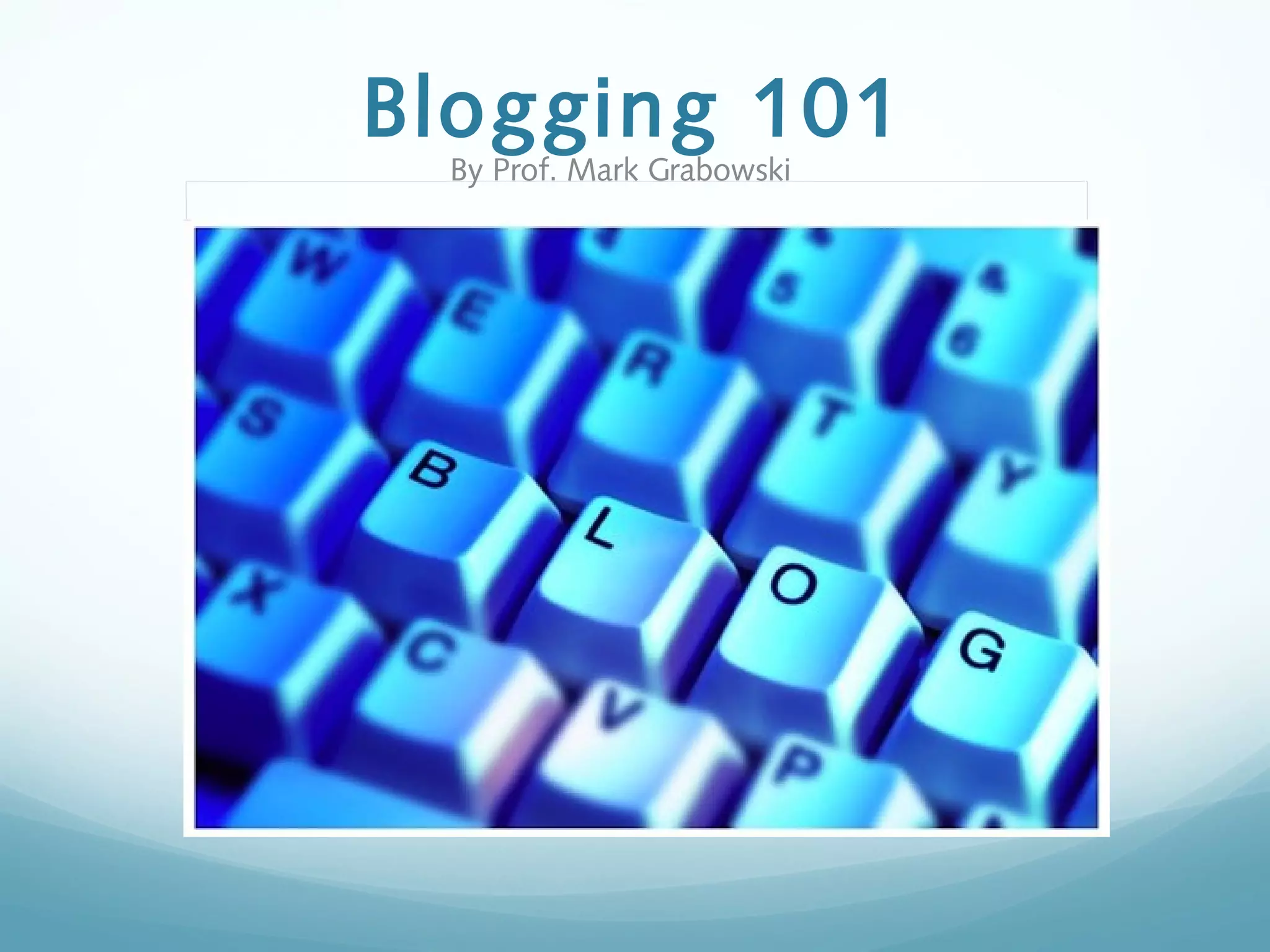
Blogging 101
By Prof. Mark Grabowski
Why blog?
1. Blogs are more common and more
credible. HuffPost won 2012 Pulitzer.
2. It will make you a better journalist
3. If you want to get a job in journalism
after college, you need to be able to write
for the Web.
4. 44% of all journalists work digitally
What is a blog?
There’s really no set definition for a
blog. Blogs are whatever people want
them to be. A blog is just a medium.
Generally, though…
Most blogs feature posts in reverse chronological
order, hyperlinks, a section for readers to
comment and a writing style that is a bit more
casual than writing seen in newspapers and
academic papers.
Personal diaries
Defective Yeti http://defectiveyeti.com/
Moms’ blogs
New York Mom’s Blog
http://www.nytrendymoms.com/
Gossip Blogs
Perez Hilton makes millions covering celebrity gossip at:
http://perezhilton.com
Gossip Blogs
Gawker provides NYC gossip,
such as this:
http://gawker.com/5812604/educated-snob-berates-train-condu
reason
St. John’s Gossip Blog
Fortunately, this appears to be defunct…
http://stjohnsgossip.blogspot.com/
Pets Blog
Owned By Pugs
http://www.ownedbypugs.com
I Can Has Cheezburger?
http://icanhascheezburger.com
Newspaper blogs
New York Times real estate blog
http://realestateqa.blogs.nytimes.com
Providence Journal 7 to 7 News Blog
http://newsblog.projo.com/
Philadelphia Inquirer Phillies Blog
http://www.philly.com/philly/blogs/phillies_zone/
More Phillies Blogs
Philadelphia Daily News High Cheese
http://www.philly.com/philly/blogs/phillies/Oswalt-or-
Worley-An-alternate-viewpoint.html
• MLB Phillies Blog
http://zozone.mlblogs.com
Law Blog
http://abovethelaw.com
Tech Blogs
 Mashable
 Gizmodo
 Tech Crunch
 Ars Technica
 Engadget
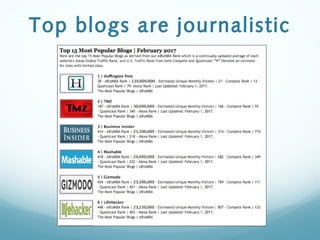
Top blogs are journalistic
Blogging as journalism
Remember: blogs don’t always equal
online journalism. And this is an online

journalism class. So, while you will be writing
for a blog, remember, you’re also a
journalist. As such, your blog posts shouldn’t
be mere rants or photos of your cat.
Fundamentals still apply
Even though this is “new media” and some things
are different, don’t forget the basics of journalism:
tight, succinct writing
a strong lead, sources
facts, newsworthy info
does it pass the, “why should I care test?”
Provide value for readers
Most importantly, your blog should provide
value for readers. Don’t just regurgitate
information easily available elsewhere in the
Web. Be enterprising. Provide insights and
analysis.
Don’t get stuck in the
past
At the same time, don’t just think of a blog post as a
newspaper-type story that you’re posting online.
There’s a reason the Internet has become the #1 source
of news – ahead of traditional media, like newspapers,
TV and radio.
Because it allows journalists to tell stories in ways they
can’t in other mediums. So, your posts should combine
text with multimedia elements, such as photos, video,
audio and hyperlinks.
Consider partnering
with a classmate
3 musts for a good blog
1. Have something valuable to say
If you’re just posting pictures of your cat, no one’s going
to care, except you and your mom. If your merely opining
on the New York Jets game, why would strangers care
more about your opinion than an ESPN analyst like Ron
Jaworski? You’re not providing value. So, either cover a
topic better than anyone else does or choose a niche topic
that’s not being adequately covered.
3 musts for a good blog
2. Publish regularly
If you have lengthy time gaps between posts,
readers will forget about your blog and stop coming back.
You need to feed their appetites. In this 24-7 media cycle, if
you don’t, someone else will and they’ll go elsewhere for
their news. The best blogs are updated multiple times a day.
At a minimum, you should post at least one substantive
post per week – and that’s just if you want to get a ‘B+’
grade.
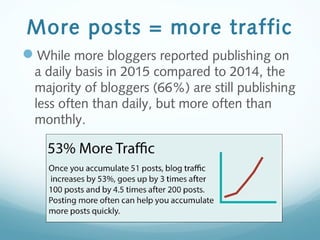
More posts = more traffic
While more bloggers reported publishing on
a daily basis in 2015 compared to 2014, the
majority of bloggers (66%) are still publishing
less often than daily, but more often than
monthly.
3 musts for a good blog
3. Build an audience. If you have something valuable to
say and regularly publish, the audience will usually follow.
We’ll discuss ways you can expedite the process and
generate publicity for your blog. Keep in mind that making
a name for yourself in the blogosphere can take several
months or much more time. It won’t happen overnight.
15 Blogging Tips
Choose good topic
The topic should be something that’s practical
for you to cover. You need to talk to sources and
take photos.
The topic should be interesting to people other
than just you. It should provide value.
The topic should be something that can be
discussed every week for an extended period of
time and has different aspects for you to address.
Choose URL carefully
When you start a new blog, you will be asked by
Word Press to give it a URL (e.g.,
myblog.wordpress.com). This may be difficult to
change later, so what you pick for “myblog”
matters a lot. Choose a blog name that relates to
your blog topic.
Explain your blog
Only returning visitors will know what
your blog is about.
80% of blog visitors are new.
Create an “About Me” section. Include an
e-mail address people can reach you at if
they have news tips or feedback.
Write clear headlines
Titles should be literal and dead-clear.
Think about a person typing search terms
into Google. Use keywords they’d use.
Five or six words is an ideal length.
Use short paragraphs
A 200-word paragraph looks pretty long
on a Web page. Keep all paragraphs to 3-
4 sentences or 75 words at most.
Write tightly
• 43% of people admit to skimming blog posts.
You can’t afford to bury the lead online. Tell readers
quickly what the story is about and why they should
keep reading – or else they won’t.
Also, use active verbs. Passive verbs bore readers.
Bored readers leave. Avoid redundancy.
One thing to remember is that the absence of space
limitations online should not be viewed as an
invitation to ramble on about things.
Use inverted pyramid
According to research, only 16 percent of online users
read a webpage word-by-word. The vast majority scan
read. There is no harm “giving the story away” in the
first paragraph.
Most content management systems are also set up so
that your first paragraph appears as the snippet of text
underneath your headline on a Google search result.
So, use the “inverted pyramid” writing style.
Provide up-to-date info
There are time constraints with traditional media.
In Online News, publication is immediate. This is
a big reason why the Internet is a superior
medium for journalism and why carbon copies of
things you may write for the newspaper won't
work well.
So, if you’re covering a event, blog about it
ASAP. Don’t wait to publish your blog post until
a week later, when it’s old news.
Cite credible sources
A source provides reliable, truthful information
on a topic. Each blog post should contain at least
two sources – at least one of which should be a
primary source (an expert source).
A secondary source offers reliable second-hand
information on a topic.
Note: always avoid using anonymous sources.
Use hyperlinks
Hyperlinks allow the writer to provide a wealth
of related information to the reader.
Linked phrases such as "click here" or "Web
page" do not provide helpful information, so
avoid them. Integrate the text of your blog posts
with relevant links.
Link to useful websites.
Use non-textual elements
Blog posts with images get 94% more
views.
Bring your story to life. Engage with your
readers and give them something they
can't get in print. With images, charts,
graphs, video, etc. Even different font sizes
and colors.
Write regularly
All your posts need not be substantive. For
example, you may post an interesting photo that
relates to your topic.
But you should have at least one good,
substantive post per week (this means a post
where you reported on something newsworthy,
interviewed sources, had links and/or photos or
videos, etc.).
Offer variety
Don’t just cover meetings or write
profiles for each post. Mix it up.
Have a wide variety of posts covering
different aspects of your topic. Good
blogs are fun to read because they
don’t feel repetitive.
Provide value for readers
Don’t repeat obvious info. Don’t rehash old
news.
Tell readers something they don’t know, and
can’t get elsewhere.
94% of people who share posts do so because
they think it might be helpful to others.
Remember, the most popular blogs are news
blogs.
Respect copyright law
U.S. copyright law does apply to ALL IMAGES you see on the
Web, on any Web page. So it is absolutely NOT okay to copy
an image (photo or otherwise) from somewhere online and
use it in your blog.
It is still NOT okay if you add a link to the original and/or a
photo credit line.
The image does NOT need to have a copyright symbol or a
copyright notice to enjoy this protection. All published works
are automatically protected by this law — and that includes
ALL images online.
What to do for visuals?
First, you could just take your own photos or make your
own artwork. This would impress me and count as a
non-textual element in your post.
Second, some people have chosen to allow limited use of
their Web-published work — that is, they have given you
permission in advance. For more info, visit
http://www.newslab.org/2011/03/03/free-multimedia-
resources/
Questions?
E-mail me at:
grabowsm@stjohns.edu

Blogging Assignment

  • 1.
    Blogging 101 By Prof.Mark Grabowski
  • 2.
    Why blog? 1. Blogsare more common and more credible. HuffPost won 2012 Pulitzer. 2. It will make you a better journalist 3. If you want to get a job in journalism after college, you need to be able to write for the Web. 4. 44% of all journalists work digitally
  • 3.
    What is ablog? There’s really no set definition for a blog. Blogs are whatever people want them to be. A blog is just a medium.
  • 4.
    Generally, though… Most blogsfeature posts in reverse chronological order, hyperlinks, a section for readers to comment and a writing style that is a bit more casual than writing seen in newspapers and academic papers.
  • 5.
    Personal diaries Defective Yetihttp://defectiveyeti.com/
  • 6.
    Moms’ blogs New YorkMom’s Blog http://www.nytrendymoms.com/
  • 7.
    Gossip Blogs Perez Hiltonmakes millions covering celebrity gossip at: http://perezhilton.com
  • 8.
    Gossip Blogs Gawker providesNYC gossip, such as this: http://gawker.com/5812604/educated-snob-berates-train-condu reason
  • 9.
    St. John’s GossipBlog Fortunately, this appears to be defunct… http://stjohnsgossip.blogspot.com/
  • 10.
    Pets Blog Owned ByPugs http://www.ownedbypugs.com I Can Has Cheezburger? http://icanhascheezburger.com
  • 11.
    Newspaper blogs New YorkTimes real estate blog http://realestateqa.blogs.nytimes.com Providence Journal 7 to 7 News Blog http://newsblog.projo.com/ Philadelphia Inquirer Phillies Blog http://www.philly.com/philly/blogs/phillies_zone/
  • 12.
    More Phillies Blogs PhiladelphiaDaily News High Cheese http://www.philly.com/philly/blogs/phillies/Oswalt-or- Worley-An-alternate-viewpoint.html • MLB Phillies Blog http://zozone.mlblogs.com
  • 13.
  • 14.
    Tech Blogs  Mashable Gizmodo  Tech Crunch  Ars Technica  Engadget
  • 15.
    Top blogs arejournalistic
  • 16.
    Blogging as journalism Remember:blogs don’t always equal online journalism. And this is an online journalism class. So, while you will be writing for a blog, remember, you’re also a journalist. As such, your blog posts shouldn’t be mere rants or photos of your cat.
  • 17.
    Fundamentals still apply Eventhough this is “new media” and some things are different, don’t forget the basics of journalism: tight, succinct writing a strong lead, sources facts, newsworthy info does it pass the, “why should I care test?”
  • 18.
    Provide value forreaders Most importantly, your blog should provide value for readers. Don’t just regurgitate information easily available elsewhere in the Web. Be enterprising. Provide insights and analysis.
  • 19.
    Don’t get stuckin the past At the same time, don’t just think of a blog post as a newspaper-type story that you’re posting online. There’s a reason the Internet has become the #1 source of news – ahead of traditional media, like newspapers, TV and radio. Because it allows journalists to tell stories in ways they can’t in other mediums. So, your posts should combine text with multimedia elements, such as photos, video, audio and hyperlinks.
  • 20.
  • 21.
    3 musts fora good blog 1. Have something valuable to say If you’re just posting pictures of your cat, no one’s going to care, except you and your mom. If your merely opining on the New York Jets game, why would strangers care more about your opinion than an ESPN analyst like Ron Jaworski? You’re not providing value. So, either cover a topic better than anyone else does or choose a niche topic that’s not being adequately covered.
  • 22.
    3 musts fora good blog 2. Publish regularly If you have lengthy time gaps between posts, readers will forget about your blog and stop coming back. You need to feed their appetites. In this 24-7 media cycle, if you don’t, someone else will and they’ll go elsewhere for their news. The best blogs are updated multiple times a day. At a minimum, you should post at least one substantive post per week – and that’s just if you want to get a ‘B+’ grade.
  • 23.
    More posts =more traffic While more bloggers reported publishing on a daily basis in 2015 compared to 2014, the majority of bloggers (66%) are still publishing less often than daily, but more often than monthly.
  • 24.
    3 musts fora good blog 3. Build an audience. If you have something valuable to say and regularly publish, the audience will usually follow. We’ll discuss ways you can expedite the process and generate publicity for your blog. Keep in mind that making a name for yourself in the blogosphere can take several months or much more time. It won’t happen overnight.
  • 25.
  • 26.
    Choose good topic Thetopic should be something that’s practical for you to cover. You need to talk to sources and take photos. The topic should be interesting to people other than just you. It should provide value. The topic should be something that can be discussed every week for an extended period of time and has different aspects for you to address.
  • 27.
    Choose URL carefully Whenyou start a new blog, you will be asked by Word Press to give it a URL (e.g., myblog.wordpress.com). This may be difficult to change later, so what you pick for “myblog” matters a lot. Choose a blog name that relates to your blog topic.
  • 28.
    Explain your blog Onlyreturning visitors will know what your blog is about. 80% of blog visitors are new. Create an “About Me” section. Include an e-mail address people can reach you at if they have news tips or feedback.
  • 29.
    Write clear headlines Titlesshould be literal and dead-clear. Think about a person typing search terms into Google. Use keywords they’d use. Five or six words is an ideal length.
  • 30.
    Use short paragraphs A200-word paragraph looks pretty long on a Web page. Keep all paragraphs to 3- 4 sentences or 75 words at most.
  • 31.
    Write tightly • 43%of people admit to skimming blog posts. You can’t afford to bury the lead online. Tell readers quickly what the story is about and why they should keep reading – or else they won’t. Also, use active verbs. Passive verbs bore readers. Bored readers leave. Avoid redundancy. One thing to remember is that the absence of space limitations online should not be viewed as an invitation to ramble on about things.
  • 32.
    Use inverted pyramid Accordingto research, only 16 percent of online users read a webpage word-by-word. The vast majority scan read. There is no harm “giving the story away” in the first paragraph. Most content management systems are also set up so that your first paragraph appears as the snippet of text underneath your headline on a Google search result. So, use the “inverted pyramid” writing style.
  • 33.
    Provide up-to-date info Thereare time constraints with traditional media. In Online News, publication is immediate. This is a big reason why the Internet is a superior medium for journalism and why carbon copies of things you may write for the newspaper won't work well. So, if you’re covering a event, blog about it ASAP. Don’t wait to publish your blog post until a week later, when it’s old news.
  • 34.
    Cite credible sources Asource provides reliable, truthful information on a topic. Each blog post should contain at least two sources – at least one of which should be a primary source (an expert source). A secondary source offers reliable second-hand information on a topic. Note: always avoid using anonymous sources.
  • 35.
    Use hyperlinks Hyperlinks allowthe writer to provide a wealth of related information to the reader. Linked phrases such as "click here" or "Web page" do not provide helpful information, so avoid them. Integrate the text of your blog posts with relevant links. Link to useful websites.
  • 36.
    Use non-textual elements Blogposts with images get 94% more views. Bring your story to life. Engage with your readers and give them something they can't get in print. With images, charts, graphs, video, etc. Even different font sizes and colors.
  • 37.
    Write regularly All yourposts need not be substantive. For example, you may post an interesting photo that relates to your topic. But you should have at least one good, substantive post per week (this means a post where you reported on something newsworthy, interviewed sources, had links and/or photos or videos, etc.).
  • 38.
    Offer variety Don’t justcover meetings or write profiles for each post. Mix it up. Have a wide variety of posts covering different aspects of your topic. Good blogs are fun to read because they don’t feel repetitive.
  • 39.
    Provide value forreaders Don’t repeat obvious info. Don’t rehash old news. Tell readers something they don’t know, and can’t get elsewhere. 94% of people who share posts do so because they think it might be helpful to others. Remember, the most popular blogs are news blogs.
  • 40.
    Respect copyright law U.S.copyright law does apply to ALL IMAGES you see on the Web, on any Web page. So it is absolutely NOT okay to copy an image (photo or otherwise) from somewhere online and use it in your blog. It is still NOT okay if you add a link to the original and/or a photo credit line. The image does NOT need to have a copyright symbol or a copyright notice to enjoy this protection. All published works are automatically protected by this law — and that includes ALL images online.
  • 41.
    What to dofor visuals? First, you could just take your own photos or make your own artwork. This would impress me and count as a non-textual element in your post. Second, some people have chosen to allow limited use of their Web-published work — that is, they have given you permission in advance. For more info, visit http://www.newslab.org/2011/03/03/free-multimedia- resources/
  • 42.