Semantic Web
Application
Tariq Ahmed 20-Arid-4421
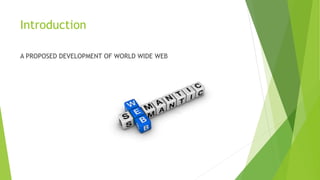
Introduction
A PROPOSED DEVELOPMENT OF WORLD WIDE WEB
Web
 The Web is a system of interlinked documents accessed
via the internet.
 Computers use network protocols to communicate in
networks.
 Web browsers use HTTP to communicate with Web
servers.
Semantics
Semantics is related to the word “syntax”.
BUT
Syntax is how to say something and semantics is the
meaning behind what you say.
Web 2.0
Web 2.0 :-
Web 2.0 describes World Wide Web websites that
emphasize user-generated content and usability (ease of
use , even by non-experts) for end users.
Example:- You Tube , social networking sites such as
facebook etc.
Today's scenario of web.......
 Most of the Web content is suitable for human use.
 Information seeking, publishing, and using, searching for people and
products, shopping, reviewing catalogues, etc.
 Dynamic pages generated based on information from databases but
without original information structure found in databases.
The Semantic Web
 “The Semantic Web is an extension of the current web in which
information is given well-defined meaning, better enabling computers
and people to work in co-operation.“
 Today’s web is about documents but semantic web is about things .
 It can recognize people , places , events , companies , products ,
movies, etc. It can understand the relationships between things.
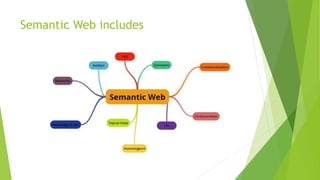
Semantic Web includes
Working
 The Semantic web proposes to help computers “read” and use the
web. The big idea is pretty simple –Metadata added to web pages can
make the existing World Wide Web machine readable . This won’t
make computers selfaware , but it will give machines tools to find ,
exchange and , to a limited extent , interpret information .
AN EXAMPLE TO UNDERSTAND THE
SEMANTIC WEB
 Suppose, you want to watch a movie and grab something to eat.
 You like an Action movie and Italian food.
 Now , you perform a search for movie theaters , and restaurants .
 In this phenomenon , you spend half an hour doing the planning .
 THIS IS HOW THINGS WORK TODAY.
 The next generation of the web will change How things work
AN EXAMPLE TO UNDERSTAND THE
SEMANTIC WEB
Semantic web will make search task faster and easier by making searches more
personalized.
AS:
You could enter ” I want to watch an action movie and then want to have a
dinner at an Italian Restaurant . ”
And , the semantic web will display the results for you.
The Semantic web will act as a Personal Assistant.
Advantages
 Semantic web will make search tasks faster and easier .
 Semantic web will make searches , more personalized .
 Semantic web browser will act as a personal assistant .
RDF semantics
Objectives
• Define a notion of interpretation
– to evaluate the truth of a triple/graph
• Define entailment
– what can be deduced from the triples of an RDF graph
RDF
DF – Resource Description Framework
 What is RDF?
– A language to describe Resources.
 What is a Resource?
– Anything/concept in the world: a book, a movie, a person etc.
– must be identified by a universally unique name (URI)
 What can we do with it?
– Unambiguously describe a concept/resource/thing
– Specify how these resources are related
– Do basic inferencing
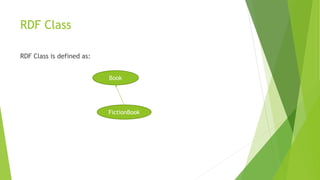
RDF Class
RDF Class is defined as:
Book
FictionBook
RDF – in detail
Knowledge is represented in RDF as a set of Triples.
• What is a Triple?
– Triple in RDF is analogous a sentence in natural language.
– Every NL sentence contains 3 parts: subject, predicate & object.
Similar is of the form <subject, predicate, object> and the purpose in
RDF.
– Example:
NL Sentence: Obama is the president of USA
RDF Triple: <URI1#Obama> <URI2#presidentOf> <URI3#USA>
– Here subject & predicate must be resources (i.e they are things/concepts
and must have a URI) and the object can be a resource or a literal (simple
value. Eg: ‘10’
Where is RDF currently used?
 RSS 1.0 (RDF Site Summary)
 RDFa (to add rdf metadata to html/xhtml pages – annotate the Web)
 OWL (Successor of RDFS)
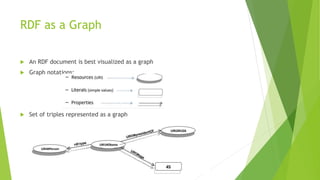
RDF as a Graph
 An RDF document is best visualized as a graph
 Graph notations:
 Set of triples represented as a graph
RDFS
 RDFS: RDF Schema
 RDF Schema defines the basic vocabulary that can be used in
 RDF document to describe resources.
What exactly can we define:
– Classes
– Properties
– Hierarchies
– Collections
– Reification
– Documentation
– Basic Entailments( subclass, subproperty) needed for reasoning
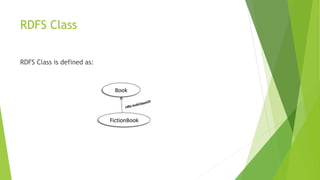
RDFS Class
RDFS Class is defined as:
semantic web.pptx

semantic web.pptx

  • 2.
  • 3.
  • 4.
    Web  The Webis a system of interlinked documents accessed via the internet.  Computers use network protocols to communicate in networks.  Web browsers use HTTP to communicate with Web servers.
  • 5.
    Semantics Semantics is relatedto the word “syntax”. BUT Syntax is how to say something and semantics is the meaning behind what you say.
  • 6.
    Web 2.0 Web 2.0:- Web 2.0 describes World Wide Web websites that emphasize user-generated content and usability (ease of use , even by non-experts) for end users. Example:- You Tube , social networking sites such as facebook etc.
  • 7.
    Today's scenario ofweb.......  Most of the Web content is suitable for human use.  Information seeking, publishing, and using, searching for people and products, shopping, reviewing catalogues, etc.  Dynamic pages generated based on information from databases but without original information structure found in databases.
  • 8.
    The Semantic Web “The Semantic Web is an extension of the current web in which information is given well-defined meaning, better enabling computers and people to work in co-operation.“  Today’s web is about documents but semantic web is about things .  It can recognize people , places , events , companies , products , movies, etc. It can understand the relationships between things.
  • 9.
  • 10.
    Working  The Semanticweb proposes to help computers “read” and use the web. The big idea is pretty simple –Metadata added to web pages can make the existing World Wide Web machine readable . This won’t make computers selfaware , but it will give machines tools to find , exchange and , to a limited extent , interpret information .
  • 11.
    AN EXAMPLE TOUNDERSTAND THE SEMANTIC WEB  Suppose, you want to watch a movie and grab something to eat.  You like an Action movie and Italian food.  Now , you perform a search for movie theaters , and restaurants .  In this phenomenon , you spend half an hour doing the planning .  THIS IS HOW THINGS WORK TODAY.  The next generation of the web will change How things work
  • 12.
    AN EXAMPLE TOUNDERSTAND THE SEMANTIC WEB Semantic web will make search task faster and easier by making searches more personalized. AS: You could enter ” I want to watch an action movie and then want to have a dinner at an Italian Restaurant . ” And , the semantic web will display the results for you. The Semantic web will act as a Personal Assistant.
  • 13.
    Advantages  Semantic webwill make search tasks faster and easier .  Semantic web will make searches , more personalized .  Semantic web browser will act as a personal assistant .
  • 14.
    RDF semantics Objectives • Definea notion of interpretation – to evaluate the truth of a triple/graph • Define entailment – what can be deduced from the triples of an RDF graph
  • 15.
    RDF DF – ResourceDescription Framework  What is RDF? – A language to describe Resources.  What is a Resource? – Anything/concept in the world: a book, a movie, a person etc. – must be identified by a universally unique name (URI)  What can we do with it? – Unambiguously describe a concept/resource/thing – Specify how these resources are related – Do basic inferencing
  • 16.
    RDF Class RDF Classis defined as: Book FictionBook
  • 17.
    RDF – indetail Knowledge is represented in RDF as a set of Triples. • What is a Triple? – Triple in RDF is analogous a sentence in natural language. – Every NL sentence contains 3 parts: subject, predicate & object. Similar is of the form <subject, predicate, object> and the purpose in RDF. – Example: NL Sentence: Obama is the president of USA RDF Triple: <URI1#Obama> <URI2#presidentOf> <URI3#USA> – Here subject & predicate must be resources (i.e they are things/concepts and must have a URI) and the object can be a resource or a literal (simple value. Eg: ‘10’
  • 18.
    Where is RDFcurrently used?  RSS 1.0 (RDF Site Summary)  RDFa (to add rdf metadata to html/xhtml pages – annotate the Web)  OWL (Successor of RDFS)
  • 19.
    RDF as aGraph  An RDF document is best visualized as a graph  Graph notations:  Set of triples represented as a graph
  • 20.
    RDFS  RDFS: RDFSchema  RDF Schema defines the basic vocabulary that can be used in  RDF document to describe resources. What exactly can we define: – Classes – Properties – Hierarchies – Collections – Reification – Documentation – Basic Entailments( subclass, subproperty) needed for reasoning
  • 21.
    RDFS Class RDFS Classis defined as: