
POLITICS OF
PLANNED
DEVELOPMENT
TRACING A JOURNEY
WHY LEARN ABOUT
DEVELOPMENT IN POLITICAL
SCIENCE
• WHAT IS POLITICS?
• A SET OF ACTIVITIES THAT ARE ASSOCIATED WITH THE
GOVERNANCE OF A COUNTRY ,STATE OR AREA. IT
INVOLVES MAKING DECISIONS THAT APPLY TO
GROUPS OF MEMBERS AND ACHIEVING AND
EXERCISING POSITIONS OF GOVERNANCE –
ORGANISED CONTROL OVER HUMAN COMMUNITY.
• Thedecisionsfordevelopmentaretakenby politicalleaders
Development
 Brainstorming- what does development mean to you?
??????
INDIA AFTER INDEPENDENCE
Less than a sixth of Indians were literate.
The abject poverty and sharp social differences had
cast doubts on India’s survival as one nation.
 Cambridge historian Angus Maddison’s work
shows that India’s share of world income shrank from
22.6% in 1700—almost equal to Europe’s share of
23.3%—to 3.8% in 1952.
As former prime minister Manmohan Singh put it:
“The brightest jewel in the British Crown" was the
poorest country in the world in terms of per capita
income at the beginning of the 20th century.
What should India have
done to develop?
?????
The two alternatives of development
• Liberal -Capitalist
• Free market
• EXAMPLE: USA
• VERY FEW SUPPORTERS In
INDIA
• Socialist MODEL
• State controlled
• EXAMPLE: USSR
• SUPPORTED BY cpi,
SOCIALIST PARTY
AND NEHRU
Nehru’s ideas of
development
• State was an all-pervasive entrepreneur and financier of private
businesses.
• For Nehru industry, not agriculture, was the lever of economic
development. He thought that industry-led growth transformed
the economy far more quickly and effectively than agriculture-
led growth.
• Nehru remained a socialist all his adult life and entertained the
same broad view of it.
• Nehru advocated economic planning on the ground that it was
the only scientific way of running the economy.
• The Planning Commission of India is the brainchild of
Jawaharlal Nehru.
• He preferred “Mixed economy” model. His concept of planning
envisaged that people’s participation should be ensured at every
stage.
Planning Commission
The Planning Commission of India
was a non-constitutional and non-
statutory body, which was responsible
to formulate India’s five years plans for
social and economic development in
India.
Prime minister of India is the Ex-
officio chairman of the planning
commission. It was established on 15
March, 1950 in accordance with article
39 of the constitution which is a part of
directive principles of state policy.
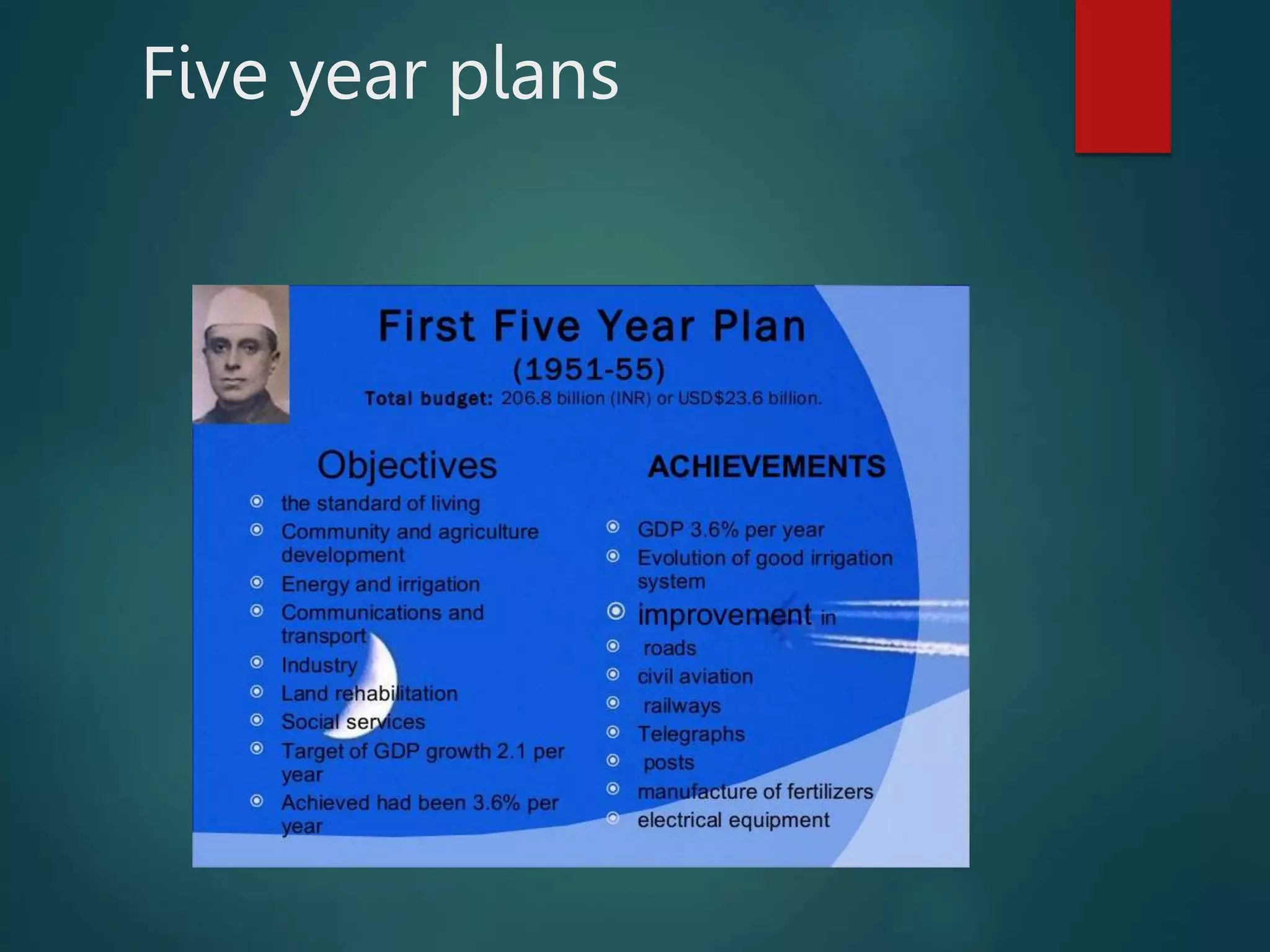
Five year plans
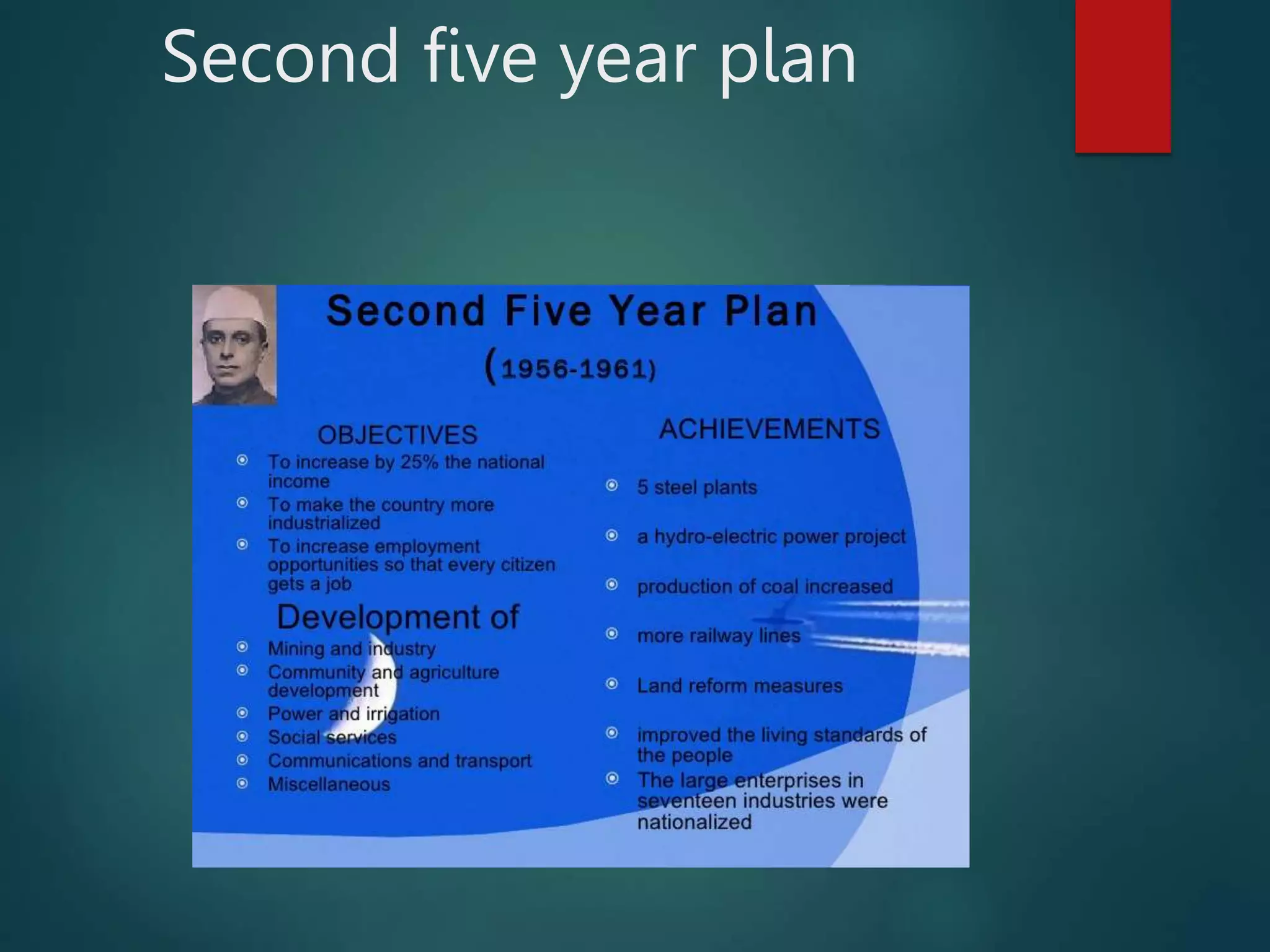
Second five year plan
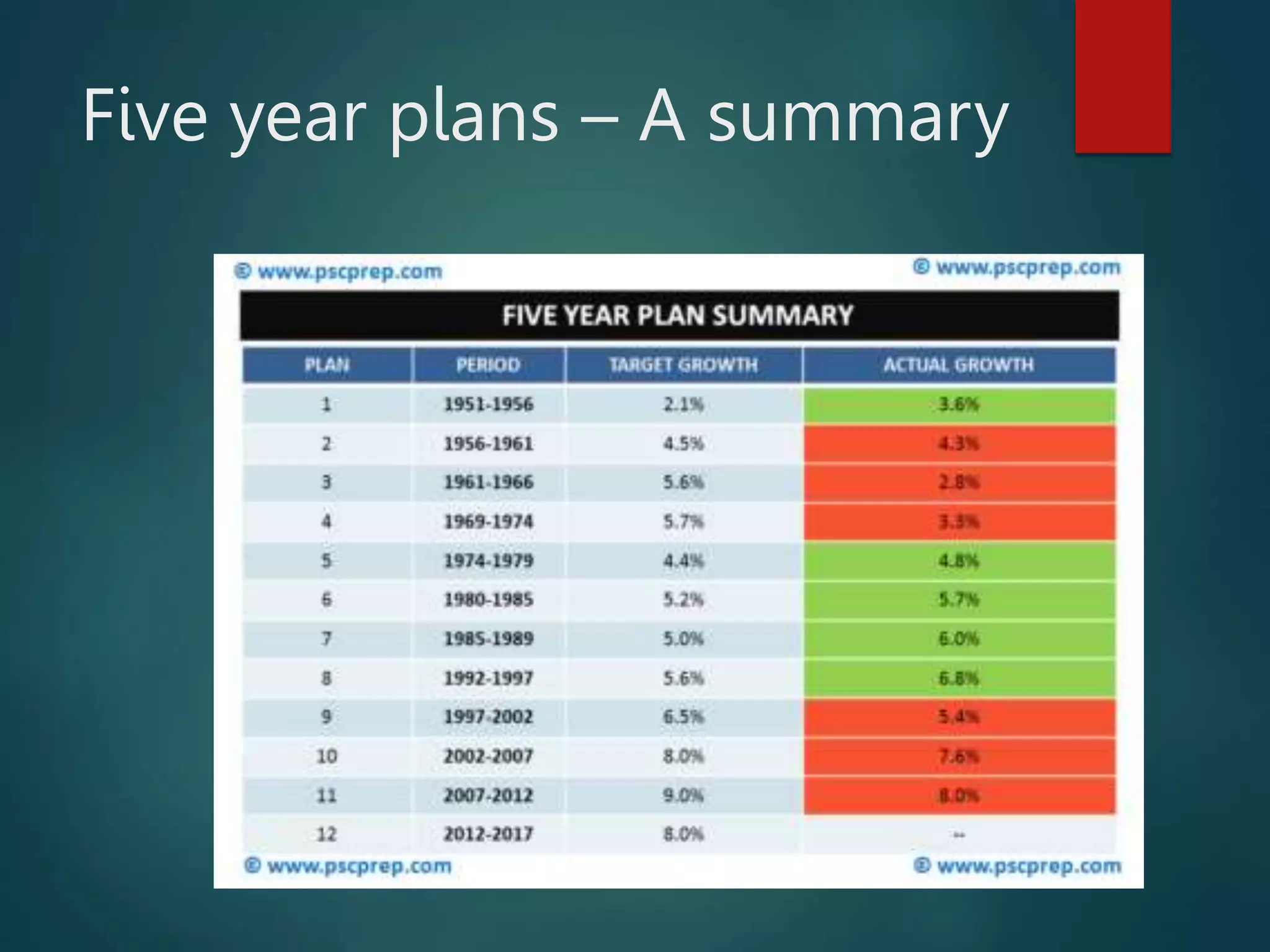
Five year plans – A summary
National Development Council
National Development Council (NDC) is an executive body established by
the Government of India in August 1952, which is neither a constitutional
nor a statutory body. It is the apex body to take decisions on matters related
to approval of five year plans of the country. Prime minister is the ex-officio
chairman of the NDC.
Composition
National Development Council is composed of the members mentioned
below:
(1) Prime Minister of India (Chairman of NDC)
(2) Chief Ministers of all states
(3) Administrators of all Union Territories
(4) All cabinet ministers
(5) Members of the Planning Commission
The secretary of the Planning Commission is also the secretary of the NDC.
The administrative assistance is also provided by the Planning Commission.
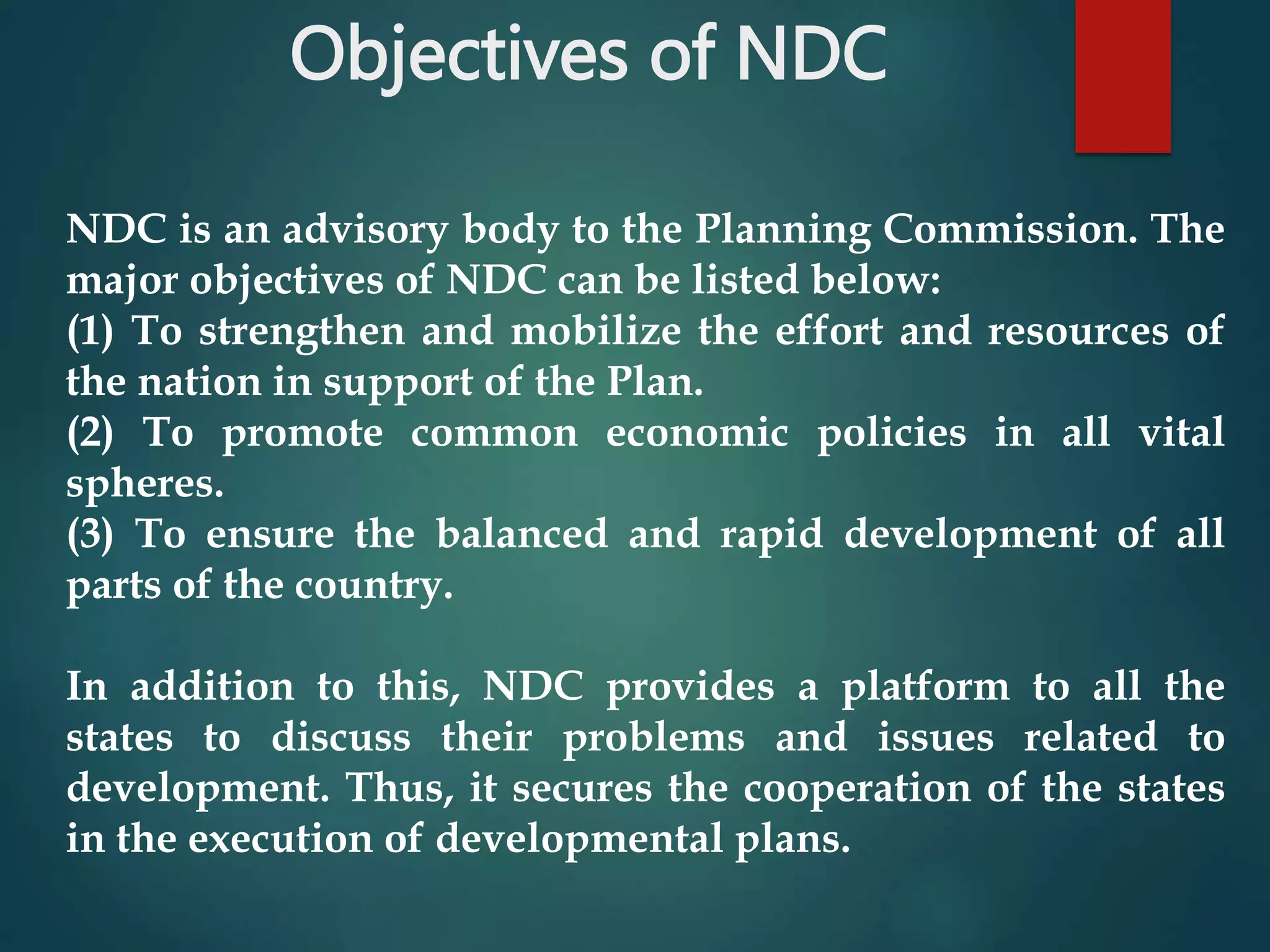
Objectives of NDC
NDC is an advisory body to the Planning Commission. The
major objectives of NDC can be listed below:
(1) To strengthen and mobilize the effort and resources of
the nation in support of the Plan.
(2) To promote common economic policies in all vital
spheres.
(3) To ensure the balanced and rapid development of all
parts of the country.
In addition to this, NDC provides a platform to all the
states to discuss their problems and issues related to
development. Thus, it secures the cooperation of the states
in the execution of developmental plans.
Functions of NDC
To meet its objectives, the NDC has been assigned below functions:
(1) To prescribe guidelines for the formulation of the National Plan,
including the assessment of resources for the Plan
(2) To consider the National Plan as formulated by the Planning Commission
(3) To make an assessment of the resources required to implement the plan
and the way to augment the resources.
(4) To consider important questions of social and economic policy affecting
national development
(5) To review the working of the Plan from time to time
(6) To recommend such measures that are necessary for achieving the aims
and targets set out in the National Plan.
NITI AAYOG
The National Institution for Transforming India, also called
NITI Aayog, was formed via a resolution of the Union
Cabinet on January 1, 2015. NITI Aayog is the premier
policy 'Think Tank' of the Government of India, providing
both directional and policy inputs.
Planning Commission NITI Aayog
Enjoyed the powers to allocate funds to ministries and state
governments.
To be an advisory body, or a think-tank. The powers to allocate funds
might be vested in the finance ministry.
The last Commission had eight full-time members The number of full-time members could be fewer than Planning
Commission
States' role was limited to the National Development Council
and annual interaction during Plan meetings.
State governments are expected to play a more significant role than
they did in the Planning Commission.
Secretaries or member secretaries were appointment through
the usual process
Secretaries to be known as the CEO and to be appointed by the prime
minister.
Full Planning Commission had no provision for part-time
members.
To have a number of part-time members, depending on the need from
time to time.
The commission reported to National Development Council
that had state chief ministers and lieutenant governors.
Governing Council has state chief ministers and lieutenant governors.
Had deputy chairperson, a member secretary and full-time
members
New posts of CEO, of secretary rank, and Vice-Chairperson. Will also
have five full-time members and two part-time members. Four cabinet
ministers will serve as ex-officio members.
Policy was formed by the commission and states were then
consulted about allocation of funds.
Consulting states while making policy and deciding on funds
allocation. Final policy would be a result of that.
Had power to decide allocation of government funds for
various programmes at national and state levels.
No power to allocate funds
Imposed policies on states and tied allocation of funds with
projects it approved.
NITI is a think-tank and does not have the power to impose policies.
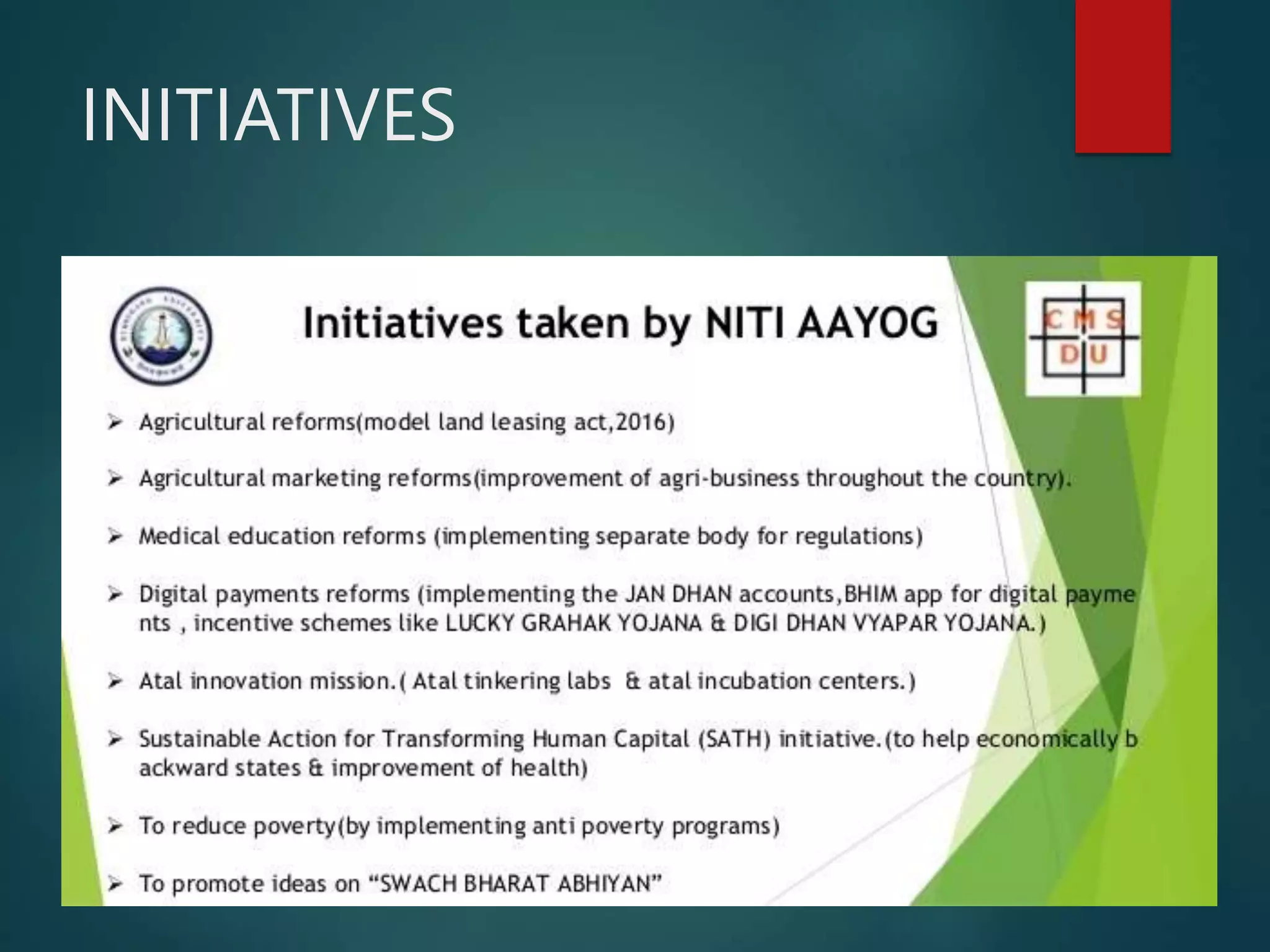
INITIATIVES
Atal Innovation Mission to promote innovation and entrepreneurship
Focuses on Education and health and to build three ‘Role Model States
Sushant Singh Rajput to support NITI Aayog’s initiative for women
entrepreneurs, fund women-led startups
DIGITAL INDIA: NITI AAYOG TO RANK STATES ON INITIATIVES TAKEN TO
PROMOTE CASHLESS ECONOMY
ShopClues Co-Founder among top
CEOs to lend support NITI Aayog
in the Mentor India Initiative
“A journey from the centralised planning to the cooperative federalism”
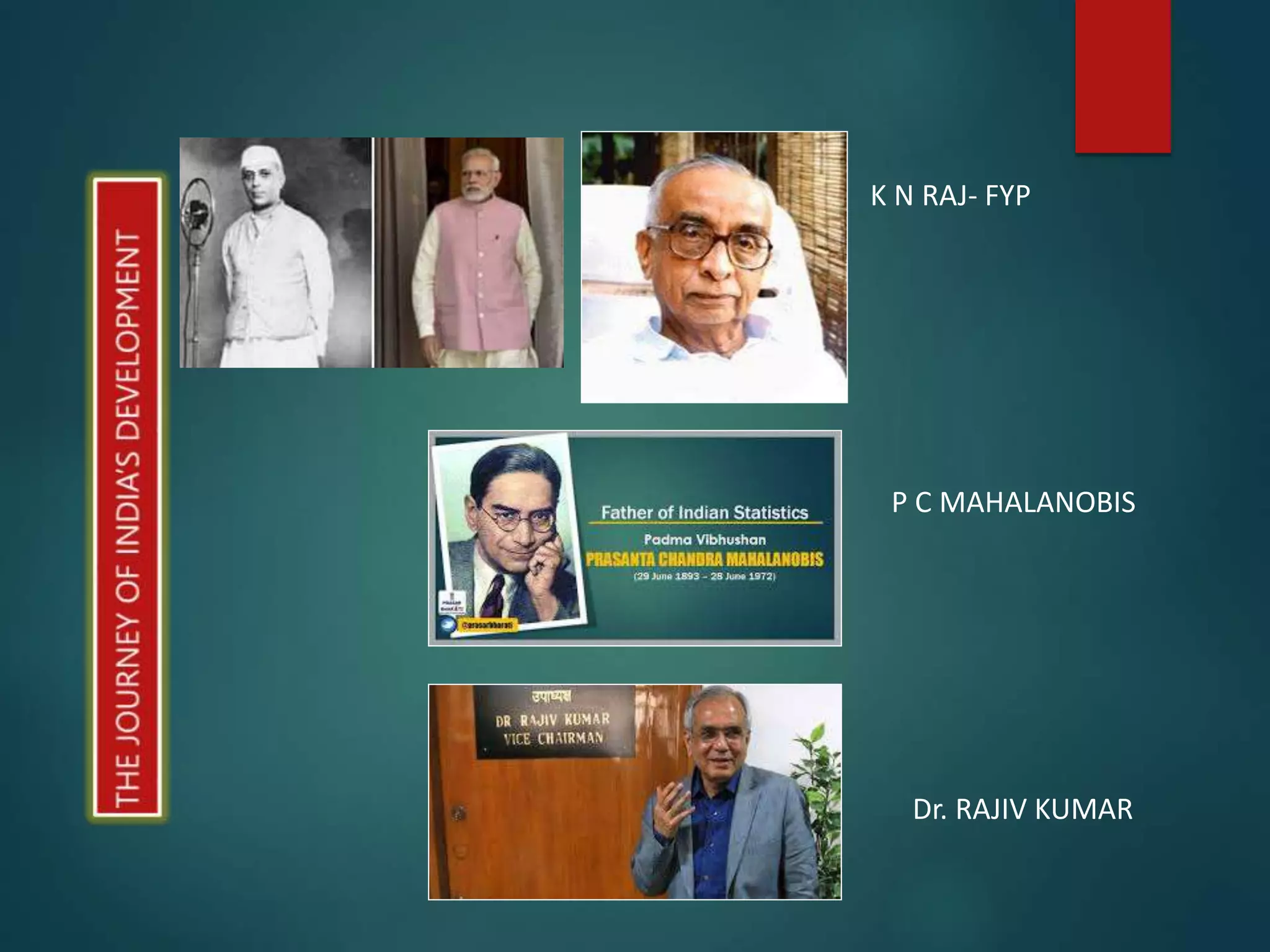
K N RAJ- FYP
P C MAHALANOBIS
Dr. RAJIV KUMAR

PPT_POLITICS OF PLANNED DEVELOPMENT.ppt

  • 1.
  • 2.
    WHY LEARN ABOUT DEVELOPMENTIN POLITICAL SCIENCE • WHAT IS POLITICS? • A SET OF ACTIVITIES THAT ARE ASSOCIATED WITH THE GOVERNANCE OF A COUNTRY ,STATE OR AREA. IT INVOLVES MAKING DECISIONS THAT APPLY TO GROUPS OF MEMBERS AND ACHIEVING AND EXERCISING POSITIONS OF GOVERNANCE – ORGANISED CONTROL OVER HUMAN COMMUNITY. • Thedecisionsfordevelopmentaretakenby politicalleaders
  • 3.
    Development  Brainstorming- whatdoes development mean to you? ??????
  • 4.
    INDIA AFTER INDEPENDENCE Lessthan a sixth of Indians were literate. The abject poverty and sharp social differences had cast doubts on India’s survival as one nation.  Cambridge historian Angus Maddison’s work shows that India’s share of world income shrank from 22.6% in 1700—almost equal to Europe’s share of 23.3%—to 3.8% in 1952. As former prime minister Manmohan Singh put it: “The brightest jewel in the British Crown" was the poorest country in the world in terms of per capita income at the beginning of the 20th century.
  • 5.
    What should Indiahave done to develop? ?????
  • 6.
    The two alternativesof development • Liberal -Capitalist • Free market • EXAMPLE: USA • VERY FEW SUPPORTERS In INDIA • Socialist MODEL • State controlled • EXAMPLE: USSR • SUPPORTED BY cpi, SOCIALIST PARTY AND NEHRU
  • 7.
    Nehru’s ideas of development •State was an all-pervasive entrepreneur and financier of private businesses. • For Nehru industry, not agriculture, was the lever of economic development. He thought that industry-led growth transformed the economy far more quickly and effectively than agriculture- led growth. • Nehru remained a socialist all his adult life and entertained the same broad view of it. • Nehru advocated economic planning on the ground that it was the only scientific way of running the economy. • The Planning Commission of India is the brainchild of Jawaharlal Nehru. • He preferred “Mixed economy” model. His concept of planning envisaged that people’s participation should be ensured at every stage.
  • 8.
    Planning Commission The PlanningCommission of India was a non-constitutional and non- statutory body, which was responsible to formulate India’s five years plans for social and economic development in India. Prime minister of India is the Ex- officio chairman of the planning commission. It was established on 15 March, 1950 in accordance with article 39 of the constitution which is a part of directive principles of state policy.
  • 9.
  • 10.
  • 11.
    Five year plans– A summary
  • 12.
    National Development Council NationalDevelopment Council (NDC) is an executive body established by the Government of India in August 1952, which is neither a constitutional nor a statutory body. It is the apex body to take decisions on matters related to approval of five year plans of the country. Prime minister is the ex-officio chairman of the NDC. Composition National Development Council is composed of the members mentioned below: (1) Prime Minister of India (Chairman of NDC) (2) Chief Ministers of all states (3) Administrators of all Union Territories (4) All cabinet ministers (5) Members of the Planning Commission The secretary of the Planning Commission is also the secretary of the NDC. The administrative assistance is also provided by the Planning Commission.
  • 13.
    Objectives of NDC NDCis an advisory body to the Planning Commission. The major objectives of NDC can be listed below: (1) To strengthen and mobilize the effort and resources of the nation in support of the Plan. (2) To promote common economic policies in all vital spheres. (3) To ensure the balanced and rapid development of all parts of the country. In addition to this, NDC provides a platform to all the states to discuss their problems and issues related to development. Thus, it secures the cooperation of the states in the execution of developmental plans.
  • 14.
    Functions of NDC Tomeet its objectives, the NDC has been assigned below functions: (1) To prescribe guidelines for the formulation of the National Plan, including the assessment of resources for the Plan (2) To consider the National Plan as formulated by the Planning Commission (3) To make an assessment of the resources required to implement the plan and the way to augment the resources. (4) To consider important questions of social and economic policy affecting national development (5) To review the working of the Plan from time to time (6) To recommend such measures that are necessary for achieving the aims and targets set out in the National Plan.
  • 15.
    NITI AAYOG The NationalInstitution for Transforming India, also called NITI Aayog, was formed via a resolution of the Union Cabinet on January 1, 2015. NITI Aayog is the premier policy 'Think Tank' of the Government of India, providing both directional and policy inputs.
  • 16.
    Planning Commission NITIAayog Enjoyed the powers to allocate funds to ministries and state governments. To be an advisory body, or a think-tank. The powers to allocate funds might be vested in the finance ministry. The last Commission had eight full-time members The number of full-time members could be fewer than Planning Commission States' role was limited to the National Development Council and annual interaction during Plan meetings. State governments are expected to play a more significant role than they did in the Planning Commission. Secretaries or member secretaries were appointment through the usual process Secretaries to be known as the CEO and to be appointed by the prime minister. Full Planning Commission had no provision for part-time members. To have a number of part-time members, depending on the need from time to time. The commission reported to National Development Council that had state chief ministers and lieutenant governors. Governing Council has state chief ministers and lieutenant governors. Had deputy chairperson, a member secretary and full-time members New posts of CEO, of secretary rank, and Vice-Chairperson. Will also have five full-time members and two part-time members. Four cabinet ministers will serve as ex-officio members. Policy was formed by the commission and states were then consulted about allocation of funds. Consulting states while making policy and deciding on funds allocation. Final policy would be a result of that. Had power to decide allocation of government funds for various programmes at national and state levels. No power to allocate funds Imposed policies on states and tied allocation of funds with projects it approved. NITI is a think-tank and does not have the power to impose policies.
  • 19.
  • 22.
    Atal Innovation Missionto promote innovation and entrepreneurship
  • 23.
    Focuses on Educationand health and to build three ‘Role Model States
  • 24.
    Sushant Singh Rajputto support NITI Aayog’s initiative for women entrepreneurs, fund women-led startups DIGITAL INDIA: NITI AAYOG TO RANK STATES ON INITIATIVES TAKEN TO PROMOTE CASHLESS ECONOMY ShopClues Co-Founder among top CEOs to lend support NITI Aayog in the Mentor India Initiative “A journey from the centralised planning to the cooperative federalism”
  • 25.
    K N RAJ-FYP P C MAHALANOBIS Dr. RAJIV KUMAR