DEMOCRATIC
RESURGENCE
MEANING OF THE TERM ‘DEMOCRATIC
RESURGENCE’ IN THE CONTEXT OF CHAPTER:
• ‘’Resurgence’ means the act or fact of rising again or revival.
• In the context of chapter the period on national emergency was
seen as a fall of democracy. A period of crisis to democratic
order. But eventually emergency was uplifted and “democracy
rose again”
2
PROVISION OF EMERGENCY IN INDIAN CONSTITUTION
Article 352
NATIONAL
EMERGENCY
National emergency
can be declared on
the basis of war,
external aggression
or armed rebellion.
Article 356
PRESIDENT’S RULE
It is this duty in the
performance of which
the centre takes over the
government of a state
under Article 356 in case
of failure of
constitutional machinery
in a state.
Article360
FINANCIAL
EMERGENCY
Grounds of declaration:
Article 360empowers the
president to proclaim a
Financial Emergency if he is
satisfied that a situation
has arisen due to which the
financial stability or credit
of India or any part of its
territory is threatened.
3
National emergency
• The President can declare a national emergency even before the
actual occurrence of war or armed rebellion or external aggression
• When a national emergency is declared on the grounds of‘war’ or
‘external aggression’,it is known as‘External Emergency’.On the
other hand, when it is declared on the grounds of‘armed rebellion’,it
is known as‘Internal Emergency’.
• This term ‘armed rebellion’ is inserted from the44th
amendment
.Before this term it was known as internal disturbance.
4
NATIONAL EMERGENCY OF 1975 (CRISIS TO DEMOCRATIC ORDER)
5
BACKGROUND OF EMERGENCY (CAUSES)
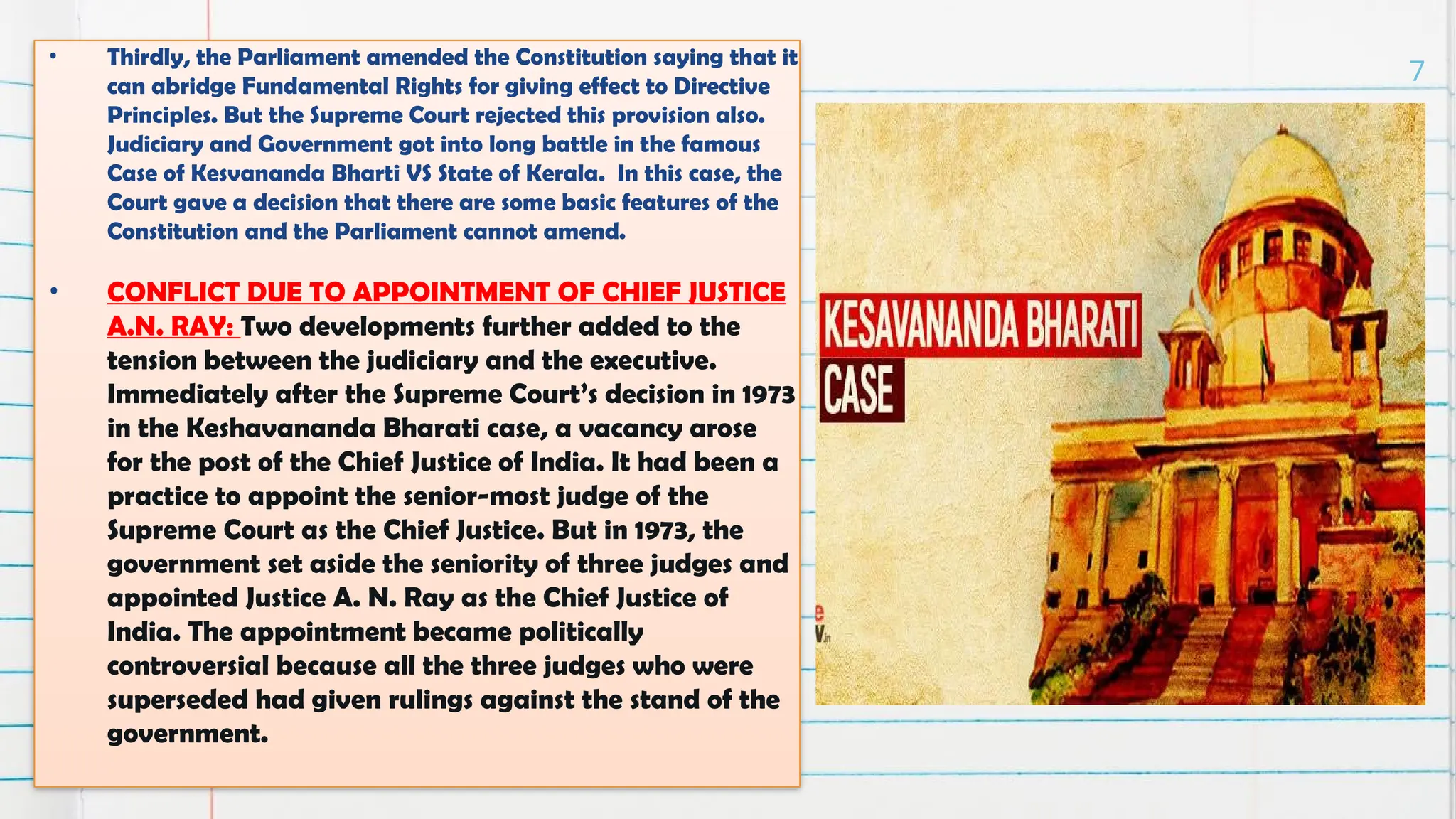
• Conflict due to Kesavananda Bharti Case: This period witnessed tensions in the
relationship between the government and the judiciary. The Supreme Court found
many initiatives of the government to be violative of the Constitution. The Congress
party took the position that this stand of the Court was against principles of democracy
and parliamentary supremacy. The Congress also alleged that the Court was a
conservative institution and it was becoming an obstacle in the way of implementing
pro-poor welfare programmes.
THREE CONSTITUTIONAL ISSUES HAD EMERGED.
• Firstly, the Parliament’s power to abridge Fundamental Rights. Supreme Court was not
in agreement to this.
• Secondly, Parliament’s power to curtail Right to Property by making an amendment.
Again, Supreme Court said that Parliament cannot amend the Constitution in such a
manner that rights are curtailed.
6
CONFLICT WITH
JUDICIARY
• Thirdly, the Parliament amended the Constitution saying that it
can abridge Fundamental Rights for giving effect to Directive
Principles. But the Supreme Court rejected this provision also.
Judiciary and Government got into long battle in the famous
Case of Kesvananda Bharti VS State of Kerala. In this case, the
Court gave a decision that there are some basic features of the
Constitution and the Parliament cannot amend.
• CONFLICT DUE TO APPOINTMENT OF CHIEF JUSTICE
A.N. RAY: Two developments further added to the
tension between the judiciary and the executive.
Immediately after the Supreme Court’s decision in 1973
in the Keshavananda Bharati case, a vacancy arose
for the post of the Chief Justice of India. It had been a
practice to appoint the senior-most judge of the
Supreme Court as the Chief Justice. But in 1973, the
government set aside the seniority of three judges and
appointed Justice A. N. Ray as the Chief Justice of
India. The appointment became politically
controversial because all the three judges who were
superseded had given rulings against the stand of the
government.
7
ECONOMIC BACKGROUND:
• The Bangladesh crisis had put a heavy strain on India’s economy. About eight
million people crossed over the East Pakistan border into India. This was
followed by war with Pakistan.
• After the war the U.S government stopped all aid to India.
• In the international market, oil prices increased manifold during this period.
This led to an all-round increase in prices of commodities. Such a high level of
inflation caused much hardship to the people.
• Industrial growth was low and unemployment was very high, particularly in
the rural areas.
• In order to reduce expenditure the government froze the salaries of its
employees. This caused further dissatisfaction among government employees.
• Monsoons failed in 1972-1973. This resulted in a sharp decline in agricultural
productivity. Food grain output declined.
8
POLITICAL BACKGROUND
• GUJARAT MOVEMENT: In January 1974 students in
Gujarat started an agitation against rising prices of food
grains, cooking oil and other essential commodities, and
against corruption in high places.
• The students’ protest was joined by major opposition parties
and became widespread leading to the imposition of
President’s rule in the state. The opposition parties
demanded fresh elections to the state legislature.
• Morarji Desai, a prominent leader of Congress (O), who was
the main rival of Indira Gandhi when he was in the Congress,
announced that he would go on an indefinite fast if fresh
elections were not held in the State. Under intense pressure
from students, supported by the opposition political parties,
assembly elections were held in Gujarat in June 1975. The
Congress was defeated in this election.
9
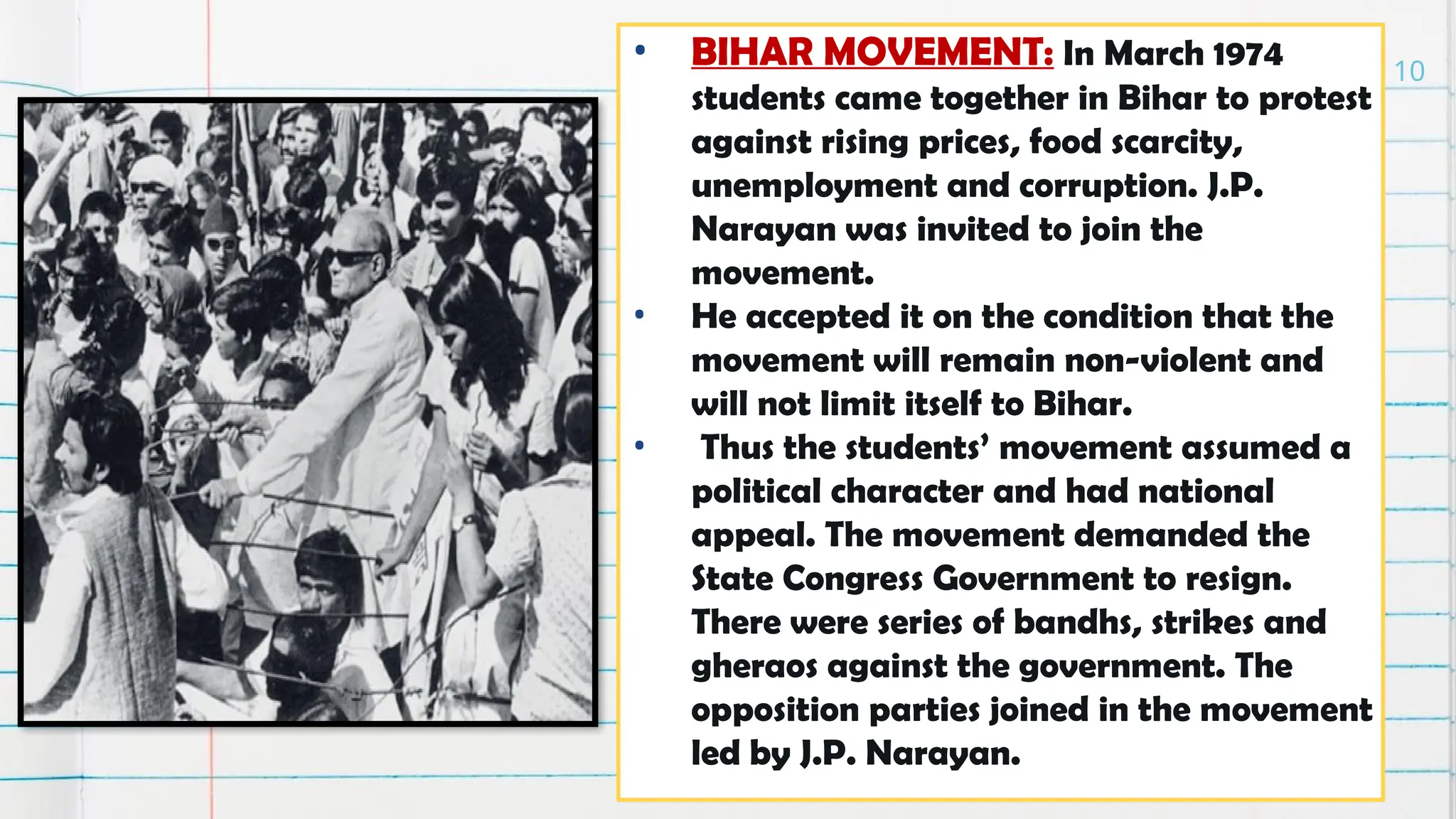
• BIHAR MOVEMENT: In March 1974
students came together in Bihar to protest
against rising prices, food scarcity,
unemployment and corruption. J.P.
Narayan was invited to join the
movement.
• He accepted it on the condition that the
movement will remain non-violent and
will not limit itself to Bihar.
• Thus the students’ movement assumed a
political character and had national
appeal. The movement demanded the
State Congress Government to resign.
There were series of bandhs, strikes and
gheraos against the government. The
opposition parties joined in the movement
led by J.P. Narayan.
10
• RAILWAY STRIKE 1974: The employees
of the Railways gave a call for a
nationwide strike. This threatened to
paralyse the country.
• NAXALITE MOVEMENTS: There an
increase in the activities of Marxist groups
who did not believe in parliamentary
politics. These groups had taken to arms
and insurgent techniques for the
overthrow of the capitalist order and the
established political system. Known as the
Marxist-Leninist (now Maoist) groups or
Naxalites, they were particularly strong in
West Bengal, where the State government
took stringent measures to suppress them.
11
12
IMMEDIATE CAUSE:
• On 12 June 1975, Justice Jagmohan Lal Sinha of the
Allahabad High Court passed a judgment declaring
Indira Gandhi’s election to the Lok Sabha invalid.
• This order came on an election petition filed by Raj
Narain, a socialist leader and a candidate who had
contested against her in 1971. The petition,
challenged the election of Indira Gandhi on the
ground that she had used the services of
government servants in her election campaign.
• The judgment of the High Court meant that legally
she was no more an MP and therefore, could not
remain the Prime Minister unless she was once
again elected as an MP within six months. On June
24, the Supreme Court granted her a partial stay
on the High Court order.
13
CRISIS & RESPONSE
• CRISIS:
The opposition political parties led by Jayaprakash Narayan pressed for Indira
Gandhi’s resignation and organised a massive demonstration in Delhi’s Ramlila
grounds on 25 June 1975. Jayaprakash announced a nationwide satyagraha for her
resignation and asked the army, the police and government employees not to obey
“illegal and immoral orders”. The political mood of the country had turned against the
Congress, more than ever before.
• RESPONSE:
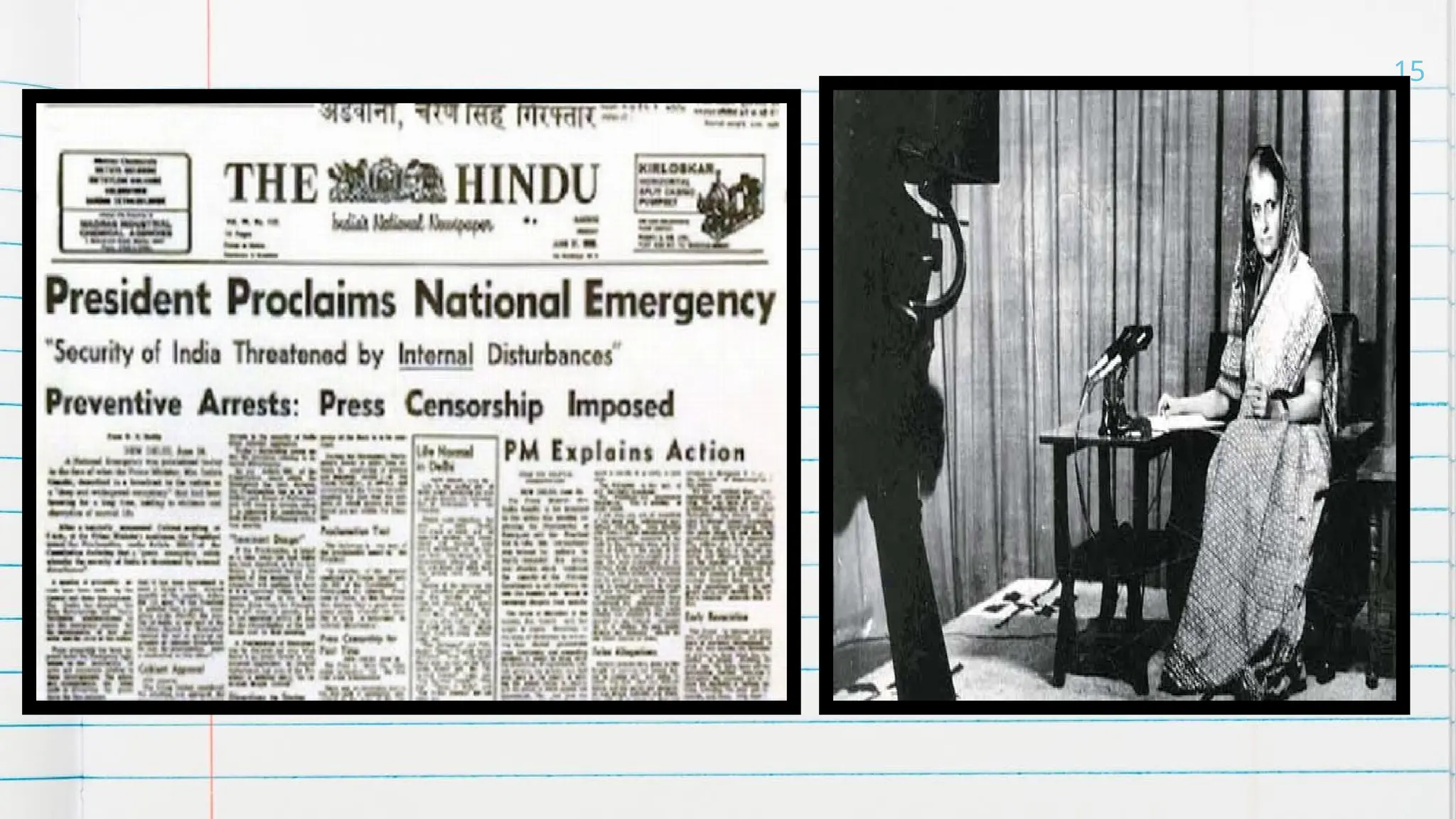
The government was to declare a state of emergency. On 25
June 1975, the government declared that there was a threat of
internal disturbances and therefore, it invoked Article 352 of
the Constitution.
14
15
DECLARATION OF EMERGENCY:
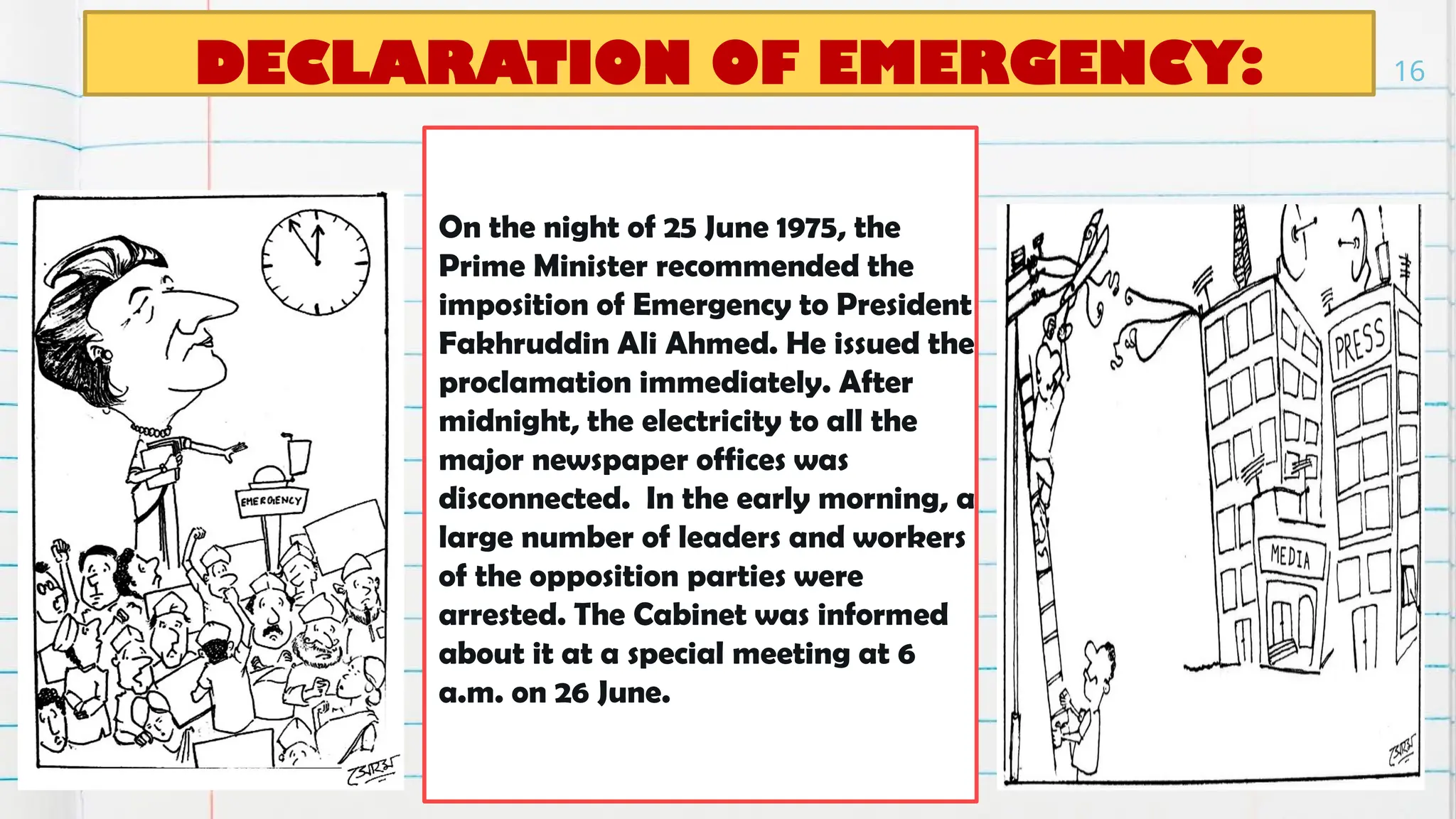
On the night of 25 June 1975, the
Prime Minister recommended the
imposition of Emergency to President
Fakhruddin Ali Ahmed. He issued the
proclamation immediately. After
midnight, the electricity to all the
major newspaper offices was
disconnected. In the early morning, a
large number of leaders and workers
of the opposition parties were
arrested. The Cabinet was informed
about it at a special meeting at 6
a.m. on 26 June.
16
IMPLICATION OF ARTICLE 352:
On 25 June 1975, the government declared that
there was a threat of internal disturbances and
therefore, it invoked Article 352 of the
Constitution. Under the provision of this article
the government could declare a state of
emergency on grounds of external threat or a
threat of internal disturbances.
• Once an emergency is proclaimed, the
federal distribution of powers remains
practically suspended and all the powers are
concentrated in the hands of the union
government.
• Secondly, the government also gets the
power to curtail or restrict all or any of the
fundamental rights during the emergency.
17
18
CONSEQUENCES OF EMERGENCY:
• POLITICAL PROTEST AGAINST GOVERNMENT GOT SUSPENDED: This brought the agitation led by JP
Narayan to an abrupt stop. Protests and strikes and public agitations were also disallowed.
• On Opposition Parties and leaders: Many opposition leaders were put in jail. The government banned
Rashtriya Swayamsevak Sangh (RSS) and Jamait-e-Islami.
• EXCESSIVE ARREST AND USE OF PREVENTIVE DETENTION AND CUSTODIAL DEATHS: Many prominent
political leaders were arrested. In all, 676 opposition leaders were arrested. The Shah Commission
estimated that nearly one lakh eleven thousand people were arrested under preventive detention laws.
There were many cases register of custodial deaths.
• Suspension of Fundamental Rights especially Habeas Corpus: Using preventive detention acts, the
government made large scale arrests during the emergency. Arrested political workers could not
challenge their arrest through habeas corpus petitions.
• IMPACT ON JUDICIARY: Many cases were filed in the High Courts and the Supreme Court by and on
behalf of arrested persons, but the government claimed that it was not even necessary to inform the
arrested persons of the reasons and grounds of their arrest. Though in April 1976, the constitution bench of
the Supreme Court over-ruled the High Courts and accepted the government’s plea. It meant that during
emergency the government could take away the citizen’s right to life and liberty. This judgment closed
the doors of judiciary for the citizens and is regarded as one of the most controversial judgments of the
Supreme Court.
19
• ON MEDIA AND PRESS: The government suspended the freedom of the Press. Newspapers were
asked to get prior approval for all material to be published. This is known as press censorship
Newspapers like the Indian Express and the Statesman protested against censorship by leaving
blank spaces where news items had been censored. Magazines like the Seminar and the
Mainstream chose to close down rather than submit to censorship. Many journalists were arrested
for writing against the Emergency. Many underground newsletters and leaflets were published to
bypass censorship. Shivarama Karanth, awarded with Padma Bhushan, and Hindi writer
Fanishwarnath Renu, awarded with Padma Shri, returned their awards in protest.
• CONSTITUTIONAL CHANGES: The Parliament also brought in many new changes to the
Constitution. An amendment was made declaring that elections of Prime Minister, President and
Vice-President could not be challenged in the Court. The forty-second amendment was also passed
during the emergency. The various changes made by this amendment, one was that the duration
of the legislatures in the country was extended from five to six years. during an emergency,
elections can be postponed by one year. Thus, effectively, after 1971, elections needed to be held
only in 1978; instead of 1976.
• USE OF POWER BY THOSE WHO WERE NON- OFFICE BEARERS: There were other and more
serious allegations regarding the exercise of governmental power by people who held no
official position. Sanjay Gandhi, the Prime Minister’s younger son, did not hold any official position
at the time. Yet, he gained control over the administration and allegedly interfered in the
functioning of the government. His role in the demolitions and forced sterilisation in Delhi became
controversial.
20
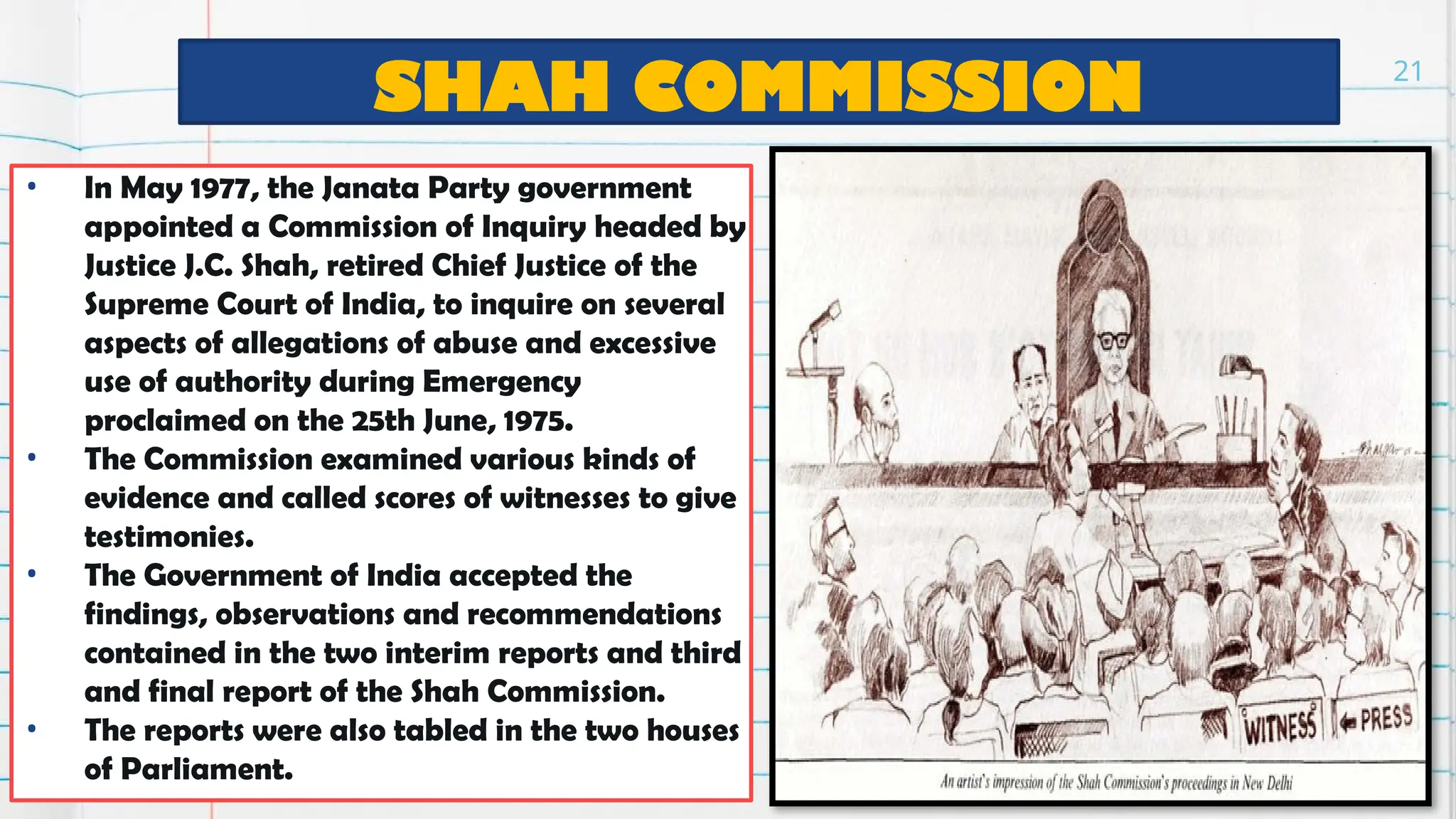
SHAH COMMISSION
• In May 1977, the Janata Party government
appointed a Commission of Inquiry headed by
Justice J.C. Shah, retired Chief Justice of the
Supreme Court of India, to inquire on several
aspects of allegations of abuse and excessive
use of authority during Emergency
proclaimed on the 25th June, 1975.
• The Commission examined various kinds of
evidence and called scores of witnesses to give
testimonies.
• The Government of India accepted the
findings, observations and recommendations
contained in the two interim reports and third
and final report of the Shah Commission.
• The reports were also tabled in the two houses
of Parliament.
21
DIFFERING VIEWPOINTS ON EMERGENCY
INDIRA GANDHI’S GOVERNMENT VIEWPOINT:
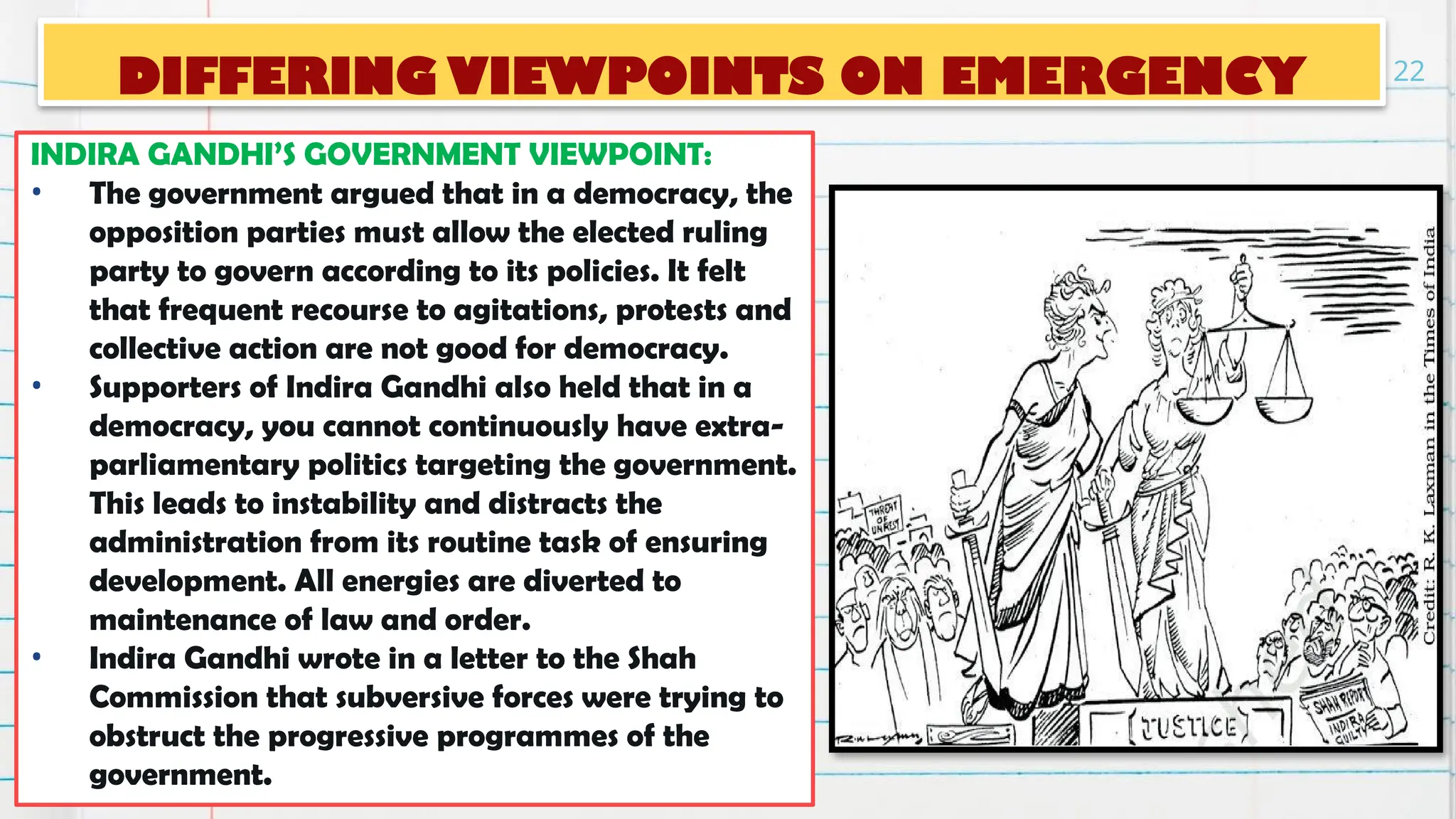
• The government argued that in a democracy, the
opposition parties must allow the elected ruling
party to govern according to its policies. It felt
that frequent recourse to agitations, protests and
collective action are not good for democracy.
• Supporters of Indira Gandhi also held that in a
democracy, you cannot continuously have extra-
parliamentary politics targeting the government.
This leads to instability and distracts the
administration from its routine task of ensuring
development. All energies are diverted to
maintenance of law and order.
• Indira Gandhi wrote in a letter to the Shah
Commission that subversive forces were trying to
obstruct the progressive programmes of the
government.
22
COMMUNIST PARTY’S VIEWPOINT:
• The CPI that continued to back the Congress during the Emergency, also believed
that there was an international conspiracy against the unity of India. It believed
that in such circumstances some restrictions on agitations were justified.
• The CPI felt that the agitations led by JP were mainly by the middle classes who
were opposed to the radical policies of the Congress party.
• After the emergency, the CPI felt that its assessment was mistaken and that it was
an error to have supported the Emergency.
CRITICS OF EMERGENCY:
• The critics of the Emergency argued that ever since the freedom movement, Indian
politics had a history of popular struggles. JP and many other opposition leaders felt
that in a democracy, people had the right to publicly protest against the
government.
• The Bihar and Gujarat agitations were mostly peaceful and non-violent. Those who
were arrested were never tried for any anti-national activity. No cases were
registered against most of the detainees.
• If some agitations had over-stepped their limits, the government had enough
routine powers to deal with it. There was no need to suspend democratic functioning
or imposing Emergency.
23
LESSONS LEARNT FROM EMERGENCY
POSITIVE LESSONS
• First lesson learnt from Emergency is that it is
extremely difficult to do away with democracy in
India. As normal democratic functioning resumed
within a short span of time post Emergency.
• Secondly, it brought out some ambiguities regarding
the Emergency provision in the Constitution that
have been rectified ‘internal’ emergency can be
proclaimed only on the grounds of ‘armed rebellion’
and it is necessary that the advice to the President to
proclaim emergency must be given in writing by the
Council of Ministers.
• Thirdly, the Emergency made everyone more aware
of the value of civil liberties. The Courts too, have
taken an active role after the emergency in
protecting the civil liberties of the individuals.
CRITICAL ANALYSIS
• The tension between routine
functioning of a democratic
government and the continuous
political protests by parties and
groups has tendency to create
volatile situation.
• Secondly, the actual
implementation of the
emergency rule took place
through the police and the
administration. These institutions
could not function
independently. They were turned
into political instruments of the
ruling party.
24
REVOKE OF EMERGENCY
• India has proclaimed 3 National Emergency from 1962 – 1977.
• The first Emergency was declared during the Indo-China war in
(26th October 1962 -10th January 1968) by President Sarvepalli
Radhakrishnan.The second Emergency was declared during the
Indo-Pakistan war in (3rd December 1971 – 21st March 1977) by
PresidentVV Giri.
• These 2 emergencies were imposed because of external aggression
and war but in (25 Jun 1975 – 21 Mar 1977) by
PresidentFakhruddin Ali Ahmeddue to the clash among the
Judiciary system and Legislative assembly of India. This phase of
national emergency is often known as the darkest phase of Indian
political history which changed the political system of Country.
25
ELECTIONS AFTER EMERGENCY
• In January 1977, after eighteen months of emergency,
the government decided to hold elections.
• The major opposition parties had already been
coming closer in the pre-Emergency period. Now they
came together and formed a new party, known as
the Janata Party. The new party accepted the
leadership of Jayaprakash Narayan.
• Some other Congress leaders also came out and
formed a separate party under the leadership of
Jagjivan Ram. This party named as Congress for
Democracy, later merged with the Janata Party.
• The Janata Party made this election into a
referendum on the Emergency.
• Its campaign was focused on the non- democratic
character of the rule and on the various excesses that
took place during this period. In the backdrop of
arrests of thousands of persons and the censorship of
the Press, the public opinion was against the
Congress.
26
• Jayaprakash Narayan became the popular
symbol of restoration of democracy.
• The formation of the Janata Party also ensured
that non-Congress votes would not be divided. It
was evident that the going was tough for the
Congress.
• For the first time since independence, the
Congress party was defeated in the Lok Sabha
elections. The Congress could win only 154 seats in
the Lok Sabha. Its share of popular votes fell to
less than 35 per cent.
• The Congress lost in every constituency in Bihar,
Uttar Pradesh, Delhi, Haryana and the Punjab
and could win only one seat each in Rajasthan
and Madhya Pradesh. Indira Gandhi was
defeated from Rae Bareli, as was her son Sanjay
Gandhi from Amethi.
• The Janata Party and its allies won 330 out of the
542 seats in the Lok Sabha; Janata Party itself
won 295 seats and thus enjoyed a clear majority
27
Why in 1977 elections Congress did not lose all over
the country?
Or
‘Impact of emergency was not felt equally in all
States which got reflected in 1977 elections’. Justify.
• It retained many seats in Maharashtra, Gujarat and Orissa and virtually
swept through the southern States.
• The forced relocation and displacements, the forced sterilisations, were
mostly concentrated in the northern States.
• But more importantly, north India had experienced some long term
changes in the nature of political competition. The middle castes from
north India were beginning to move away from the Congress and the
Janata party became a platform for many of these sections to come
together.
28
29
JANATA GOVERNMENT & ITS FAILURE
• The Janata Party government that came to
power after the 1977 elections. There was stiff
competition among three leaders for the post of
Prime Minister – Morarji Desai from Janta
Party, Charan Singh, leader of the Bharatiya
Lok Dal and a farmers’ leader from UP; and
Jagjivan Ram from Congress for Democracy.
FAILURE:
 Janata Party lacked direction, leadership, and a
common programme.
 The Janata Party government could not bring
about a fundamental change in policies from
those pursued by the Congress.
30
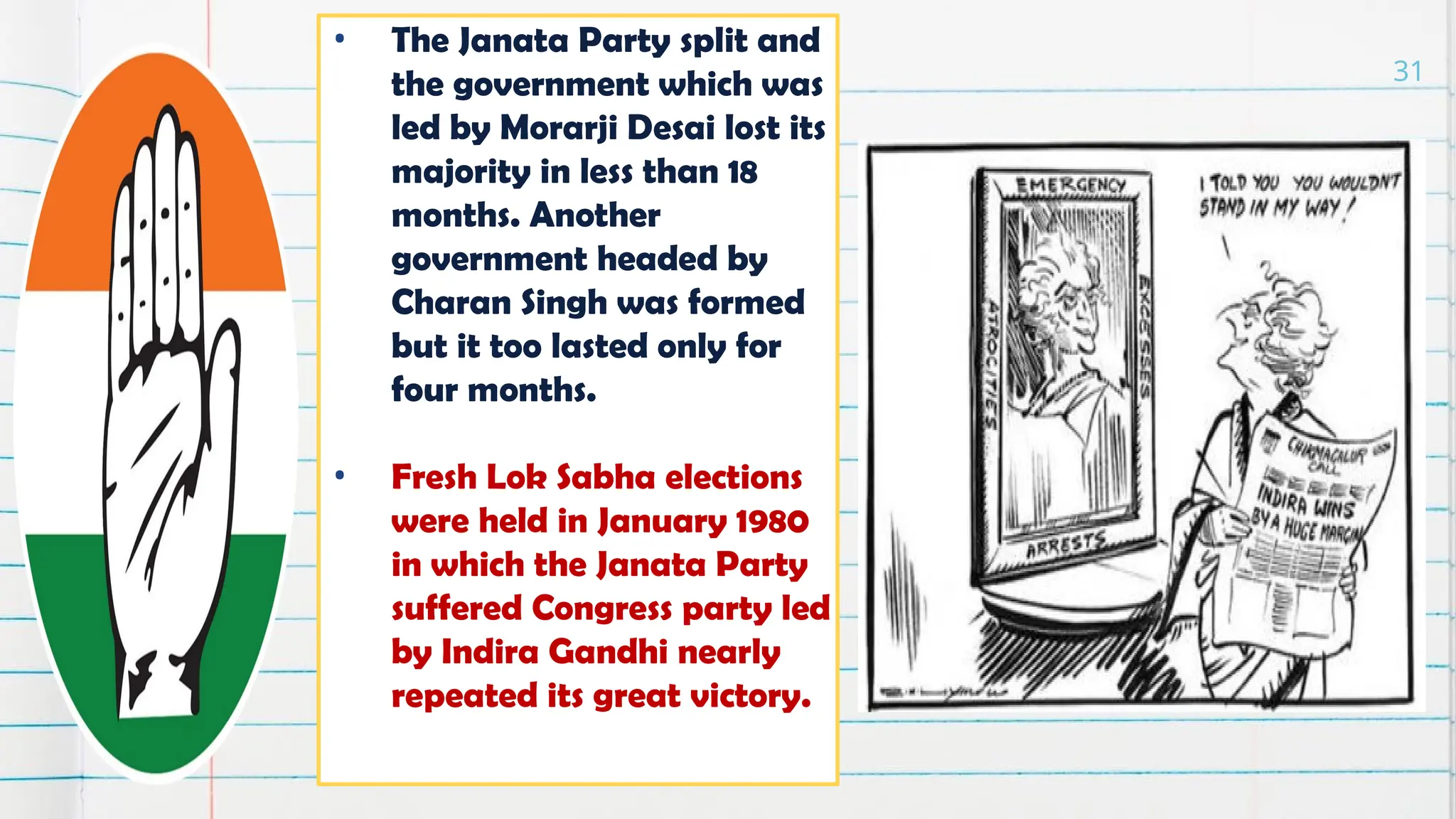
• The Janata Party split and
the government which was
led by Morarji Desai lost its
majority in less than 18
months. Another
government headed by
Charan Singh was formed
but it too lasted only for
four months.
• Fresh Lok Sabha elections
were held in January 1980
in which the Janata Party
suffered Congress party led
by Indira Gandhi nearly
repeated its great victory.
31
LEGACY OF POLITICS AFTER 1977
• CHANGE IN ORIENTATION OF CONGRESS PARTY:
• Since 1969, the Congress party had starting shedding its character as an umbrella party
which accommodated leaders and workers of different ideological dispensations and view
points. The Congress party now identified itself with a particular ideology, claiming to be
the only socialist and pro-poor party. Thus with the early nineteen seventies, the Congress’s
political success depended on attracting people on the basis of sharp social and ideological
divisions and the appeal of one leader, Indira Gandhi.
• BEGINNING OF OBC POLITICS:
• In an indirect manner the issue of welfare of the backward castes also began to dominate
politics since 1977. the northern States elected non-Congress governments in which the
leaders of the backward castes played an important role. The issue of reservations for
‘other backward classes’ became very controversial in Bihar and following this, the Mandal
Commission was appointed by the Janata party government at the centre.
32
• PERIOD OF CONSTITUTIONAL AND POLITICAL CRISIS:
• The Emergency and the period around it can be described as a period of
constitutional crisis because it had its origins in the constitutional battle over
the jurisdiction of the Parliament and the judiciary. On the other hand, it
was also a period of political crisis. The party in power had absolute majority
and yet, its leadership decided to suspend the democratic process.
• PERIOD OF MASS PROTESTS IN PARLIAMENTARY
DEMOCRACY:
• There was clearly a tension between institution- based democracy
and democracy based on spontaneous popular participation. This
tension stated the inability of party system to incorporate the
aspirations of people.
33
DEMOCRATIC UPSURGES
Increasing participation of the people in the democratic politics of the
country is broadly characterised as democratic upsurge. Based on this
principle, social scientists have characterized three democratic upsurges in
post- independence history of India.
• The ‘First Democratic Upsurge’ could be attributed from the 1950s till
1970s which was based on the participation of Indian adult voters to
the democratic politics both at the centre and in states. Falsifying the
western myth that the success of democracy requires modernization,
urbanization, education and access to media, the successful holding of
elections to both Lok Sabha and legislative assemblies all across states
on the principle of parliamentary democracy were the testimony of
India’s first democratic upsurge.
34
• During the 1980’s, the increasing political participation of the lower classes of the society
such as SCs, STs and OBCs has been interpreted as ‘Second Democratic Upsurge’. This
participation has made Indian politics more accommodative and accessible for these
classes. Although this upsurge has not made any major change in the standard of living of
these classes, especially Dalits, the participation of these classes into the organizational and
political platforms gave them the opportunity to strengthen their self-respect and ensure
empowerment in the democratic politics of the country.
• The era of Liberalization, Privatization and Globalization from the early 1990s is
attributed to the emergence of a competitive market society encompassing all important
sectors of economy, society and polity thus paving way for the ‘Third Democratic Upsurge’.
The Third Democratic Upsurge represents a competitive electoral market which is based not
on the principle of survival of the fittest but rather the survival of the ablest. It underlines
three shifts in India’s electoral market: from State to Market, from Government to
Governance, from State as Controller to State as Facilitator. Moreover, the Third
Democratic Upsurge seeks to promote the participation of the youth who constitute a
significant chunk of Indian society and have emerged as the real game changers in view of
their increasing electoral preference for both development and governance in India’s
contemporary democratic politics.
35

DEMOCRATIC RESURGENCE, PPT FOR, CLASS 12

  • 1.
  • 2.
    MEANING OF THETERM ‘DEMOCRATIC RESURGENCE’ IN THE CONTEXT OF CHAPTER: • ‘’Resurgence’ means the act or fact of rising again or revival. • In the context of chapter the period on national emergency was seen as a fall of democracy. A period of crisis to democratic order. But eventually emergency was uplifted and “democracy rose again” 2
  • 3.
    PROVISION OF EMERGENCYIN INDIAN CONSTITUTION Article 352 NATIONAL EMERGENCY National emergency can be declared on the basis of war, external aggression or armed rebellion. Article 356 PRESIDENT’S RULE It is this duty in the performance of which the centre takes over the government of a state under Article 356 in case of failure of constitutional machinery in a state. Article360 FINANCIAL EMERGENCY Grounds of declaration: Article 360empowers the president to proclaim a Financial Emergency if he is satisfied that a situation has arisen due to which the financial stability or credit of India or any part of its territory is threatened. 3
  • 4.
    National emergency • ThePresident can declare a national emergency even before the actual occurrence of war or armed rebellion or external aggression • When a national emergency is declared on the grounds of‘war’ or ‘external aggression’,it is known as‘External Emergency’.On the other hand, when it is declared on the grounds of‘armed rebellion’,it is known as‘Internal Emergency’. • This term ‘armed rebellion’ is inserted from the44th amendment .Before this term it was known as internal disturbance. 4
  • 5.
    NATIONAL EMERGENCY OF1975 (CRISIS TO DEMOCRATIC ORDER) 5
  • 6.
    BACKGROUND OF EMERGENCY(CAUSES) • Conflict due to Kesavananda Bharti Case: This period witnessed tensions in the relationship between the government and the judiciary. The Supreme Court found many initiatives of the government to be violative of the Constitution. The Congress party took the position that this stand of the Court was against principles of democracy and parliamentary supremacy. The Congress also alleged that the Court was a conservative institution and it was becoming an obstacle in the way of implementing pro-poor welfare programmes. THREE CONSTITUTIONAL ISSUES HAD EMERGED. • Firstly, the Parliament’s power to abridge Fundamental Rights. Supreme Court was not in agreement to this. • Secondly, Parliament’s power to curtail Right to Property by making an amendment. Again, Supreme Court said that Parliament cannot amend the Constitution in such a manner that rights are curtailed. 6 CONFLICT WITH JUDICIARY
  • 7.
    • Thirdly, theParliament amended the Constitution saying that it can abridge Fundamental Rights for giving effect to Directive Principles. But the Supreme Court rejected this provision also. Judiciary and Government got into long battle in the famous Case of Kesvananda Bharti VS State of Kerala. In this case, the Court gave a decision that there are some basic features of the Constitution and the Parliament cannot amend. • CONFLICT DUE TO APPOINTMENT OF CHIEF JUSTICE A.N. RAY: Two developments further added to the tension between the judiciary and the executive. Immediately after the Supreme Court’s decision in 1973 in the Keshavananda Bharati case, a vacancy arose for the post of the Chief Justice of India. It had been a practice to appoint the senior-most judge of the Supreme Court as the Chief Justice. But in 1973, the government set aside the seniority of three judges and appointed Justice A. N. Ray as the Chief Justice of India. The appointment became politically controversial because all the three judges who were superseded had given rulings against the stand of the government. 7
  • 8.
    ECONOMIC BACKGROUND: • TheBangladesh crisis had put a heavy strain on India’s economy. About eight million people crossed over the East Pakistan border into India. This was followed by war with Pakistan. • After the war the U.S government stopped all aid to India. • In the international market, oil prices increased manifold during this period. This led to an all-round increase in prices of commodities. Such a high level of inflation caused much hardship to the people. • Industrial growth was low and unemployment was very high, particularly in the rural areas. • In order to reduce expenditure the government froze the salaries of its employees. This caused further dissatisfaction among government employees. • Monsoons failed in 1972-1973. This resulted in a sharp decline in agricultural productivity. Food grain output declined. 8
  • 9.
    POLITICAL BACKGROUND • GUJARATMOVEMENT: In January 1974 students in Gujarat started an agitation against rising prices of food grains, cooking oil and other essential commodities, and against corruption in high places. • The students’ protest was joined by major opposition parties and became widespread leading to the imposition of President’s rule in the state. The opposition parties demanded fresh elections to the state legislature. • Morarji Desai, a prominent leader of Congress (O), who was the main rival of Indira Gandhi when he was in the Congress, announced that he would go on an indefinite fast if fresh elections were not held in the State. Under intense pressure from students, supported by the opposition political parties, assembly elections were held in Gujarat in June 1975. The Congress was defeated in this election. 9
  • 10.
    • BIHAR MOVEMENT:In March 1974 students came together in Bihar to protest against rising prices, food scarcity, unemployment and corruption. J.P. Narayan was invited to join the movement. • He accepted it on the condition that the movement will remain non-violent and will not limit itself to Bihar. • Thus the students’ movement assumed a political character and had national appeal. The movement demanded the State Congress Government to resign. There were series of bandhs, strikes and gheraos against the government. The opposition parties joined in the movement led by J.P. Narayan. 10
  • 11.
    • RAILWAY STRIKE1974: The employees of the Railways gave a call for a nationwide strike. This threatened to paralyse the country. • NAXALITE MOVEMENTS: There an increase in the activities of Marxist groups who did not believe in parliamentary politics. These groups had taken to arms and insurgent techniques for the overthrow of the capitalist order and the established political system. Known as the Marxist-Leninist (now Maoist) groups or Naxalites, they were particularly strong in West Bengal, where the State government took stringent measures to suppress them. 11
  • 12.
  • 13.
    IMMEDIATE CAUSE: • On12 June 1975, Justice Jagmohan Lal Sinha of the Allahabad High Court passed a judgment declaring Indira Gandhi’s election to the Lok Sabha invalid. • This order came on an election petition filed by Raj Narain, a socialist leader and a candidate who had contested against her in 1971. The petition, challenged the election of Indira Gandhi on the ground that she had used the services of government servants in her election campaign. • The judgment of the High Court meant that legally she was no more an MP and therefore, could not remain the Prime Minister unless she was once again elected as an MP within six months. On June 24, the Supreme Court granted her a partial stay on the High Court order. 13
  • 14.
    CRISIS & RESPONSE •CRISIS: The opposition political parties led by Jayaprakash Narayan pressed for Indira Gandhi’s resignation and organised a massive demonstration in Delhi’s Ramlila grounds on 25 June 1975. Jayaprakash announced a nationwide satyagraha for her resignation and asked the army, the police and government employees not to obey “illegal and immoral orders”. The political mood of the country had turned against the Congress, more than ever before. • RESPONSE: The government was to declare a state of emergency. On 25 June 1975, the government declared that there was a threat of internal disturbances and therefore, it invoked Article 352 of the Constitution. 14
  • 15.
  • 16.
    DECLARATION OF EMERGENCY: Onthe night of 25 June 1975, the Prime Minister recommended the imposition of Emergency to President Fakhruddin Ali Ahmed. He issued the proclamation immediately. After midnight, the electricity to all the major newspaper offices was disconnected. In the early morning, a large number of leaders and workers of the opposition parties were arrested. The Cabinet was informed about it at a special meeting at 6 a.m. on 26 June. 16
  • 17.
    IMPLICATION OF ARTICLE352: On 25 June 1975, the government declared that there was a threat of internal disturbances and therefore, it invoked Article 352 of the Constitution. Under the provision of this article the government could declare a state of emergency on grounds of external threat or a threat of internal disturbances. • Once an emergency is proclaimed, the federal distribution of powers remains practically suspended and all the powers are concentrated in the hands of the union government. • Secondly, the government also gets the power to curtail or restrict all or any of the fundamental rights during the emergency. 17
  • 18.
  • 19.
    CONSEQUENCES OF EMERGENCY: •POLITICAL PROTEST AGAINST GOVERNMENT GOT SUSPENDED: This brought the agitation led by JP Narayan to an abrupt stop. Protests and strikes and public agitations were also disallowed. • On Opposition Parties and leaders: Many opposition leaders were put in jail. The government banned Rashtriya Swayamsevak Sangh (RSS) and Jamait-e-Islami. • EXCESSIVE ARREST AND USE OF PREVENTIVE DETENTION AND CUSTODIAL DEATHS: Many prominent political leaders were arrested. In all, 676 opposition leaders were arrested. The Shah Commission estimated that nearly one lakh eleven thousand people were arrested under preventive detention laws. There were many cases register of custodial deaths. • Suspension of Fundamental Rights especially Habeas Corpus: Using preventive detention acts, the government made large scale arrests during the emergency. Arrested political workers could not challenge their arrest through habeas corpus petitions. • IMPACT ON JUDICIARY: Many cases were filed in the High Courts and the Supreme Court by and on behalf of arrested persons, but the government claimed that it was not even necessary to inform the arrested persons of the reasons and grounds of their arrest. Though in April 1976, the constitution bench of the Supreme Court over-ruled the High Courts and accepted the government’s plea. It meant that during emergency the government could take away the citizen’s right to life and liberty. This judgment closed the doors of judiciary for the citizens and is regarded as one of the most controversial judgments of the Supreme Court. 19
  • 20.
    • ON MEDIAAND PRESS: The government suspended the freedom of the Press. Newspapers were asked to get prior approval for all material to be published. This is known as press censorship Newspapers like the Indian Express and the Statesman protested against censorship by leaving blank spaces where news items had been censored. Magazines like the Seminar and the Mainstream chose to close down rather than submit to censorship. Many journalists were arrested for writing against the Emergency. Many underground newsletters and leaflets were published to bypass censorship. Shivarama Karanth, awarded with Padma Bhushan, and Hindi writer Fanishwarnath Renu, awarded with Padma Shri, returned their awards in protest. • CONSTITUTIONAL CHANGES: The Parliament also brought in many new changes to the Constitution. An amendment was made declaring that elections of Prime Minister, President and Vice-President could not be challenged in the Court. The forty-second amendment was also passed during the emergency. The various changes made by this amendment, one was that the duration of the legislatures in the country was extended from five to six years. during an emergency, elections can be postponed by one year. Thus, effectively, after 1971, elections needed to be held only in 1978; instead of 1976. • USE OF POWER BY THOSE WHO WERE NON- OFFICE BEARERS: There were other and more serious allegations regarding the exercise of governmental power by people who held no official position. Sanjay Gandhi, the Prime Minister’s younger son, did not hold any official position at the time. Yet, he gained control over the administration and allegedly interfered in the functioning of the government. His role in the demolitions and forced sterilisation in Delhi became controversial. 20
  • 21.
    SHAH COMMISSION • InMay 1977, the Janata Party government appointed a Commission of Inquiry headed by Justice J.C. Shah, retired Chief Justice of the Supreme Court of India, to inquire on several aspects of allegations of abuse and excessive use of authority during Emergency proclaimed on the 25th June, 1975. • The Commission examined various kinds of evidence and called scores of witnesses to give testimonies. • The Government of India accepted the findings, observations and recommendations contained in the two interim reports and third and final report of the Shah Commission. • The reports were also tabled in the two houses of Parliament. 21
  • 22.
    DIFFERING VIEWPOINTS ONEMERGENCY INDIRA GANDHI’S GOVERNMENT VIEWPOINT: • The government argued that in a democracy, the opposition parties must allow the elected ruling party to govern according to its policies. It felt that frequent recourse to agitations, protests and collective action are not good for democracy. • Supporters of Indira Gandhi also held that in a democracy, you cannot continuously have extra- parliamentary politics targeting the government. This leads to instability and distracts the administration from its routine task of ensuring development. All energies are diverted to maintenance of law and order. • Indira Gandhi wrote in a letter to the Shah Commission that subversive forces were trying to obstruct the progressive programmes of the government. 22
  • 23.
    COMMUNIST PARTY’S VIEWPOINT: •The CPI that continued to back the Congress during the Emergency, also believed that there was an international conspiracy against the unity of India. It believed that in such circumstances some restrictions on agitations were justified. • The CPI felt that the agitations led by JP were mainly by the middle classes who were opposed to the radical policies of the Congress party. • After the emergency, the CPI felt that its assessment was mistaken and that it was an error to have supported the Emergency. CRITICS OF EMERGENCY: • The critics of the Emergency argued that ever since the freedom movement, Indian politics had a history of popular struggles. JP and many other opposition leaders felt that in a democracy, people had the right to publicly protest against the government. • The Bihar and Gujarat agitations were mostly peaceful and non-violent. Those who were arrested were never tried for any anti-national activity. No cases were registered against most of the detainees. • If some agitations had over-stepped their limits, the government had enough routine powers to deal with it. There was no need to suspend democratic functioning or imposing Emergency. 23
  • 24.
    LESSONS LEARNT FROMEMERGENCY POSITIVE LESSONS • First lesson learnt from Emergency is that it is extremely difficult to do away with democracy in India. As normal democratic functioning resumed within a short span of time post Emergency. • Secondly, it brought out some ambiguities regarding the Emergency provision in the Constitution that have been rectified ‘internal’ emergency can be proclaimed only on the grounds of ‘armed rebellion’ and it is necessary that the advice to the President to proclaim emergency must be given in writing by the Council of Ministers. • Thirdly, the Emergency made everyone more aware of the value of civil liberties. The Courts too, have taken an active role after the emergency in protecting the civil liberties of the individuals. CRITICAL ANALYSIS • The tension between routine functioning of a democratic government and the continuous political protests by parties and groups has tendency to create volatile situation. • Secondly, the actual implementation of the emergency rule took place through the police and the administration. These institutions could not function independently. They were turned into political instruments of the ruling party. 24
  • 25.
    REVOKE OF EMERGENCY •India has proclaimed 3 National Emergency from 1962 – 1977. • The first Emergency was declared during the Indo-China war in (26th October 1962 -10th January 1968) by President Sarvepalli Radhakrishnan.The second Emergency was declared during the Indo-Pakistan war in (3rd December 1971 – 21st March 1977) by PresidentVV Giri. • These 2 emergencies were imposed because of external aggression and war but in (25 Jun 1975 – 21 Mar 1977) by PresidentFakhruddin Ali Ahmeddue to the clash among the Judiciary system and Legislative assembly of India. This phase of national emergency is often known as the darkest phase of Indian political history which changed the political system of Country. 25
  • 26.
    ELECTIONS AFTER EMERGENCY •In January 1977, after eighteen months of emergency, the government decided to hold elections. • The major opposition parties had already been coming closer in the pre-Emergency period. Now they came together and formed a new party, known as the Janata Party. The new party accepted the leadership of Jayaprakash Narayan. • Some other Congress leaders also came out and formed a separate party under the leadership of Jagjivan Ram. This party named as Congress for Democracy, later merged with the Janata Party. • The Janata Party made this election into a referendum on the Emergency. • Its campaign was focused on the non- democratic character of the rule and on the various excesses that took place during this period. In the backdrop of arrests of thousands of persons and the censorship of the Press, the public opinion was against the Congress. 26
  • 27.
    • Jayaprakash Narayanbecame the popular symbol of restoration of democracy. • The formation of the Janata Party also ensured that non-Congress votes would not be divided. It was evident that the going was tough for the Congress. • For the first time since independence, the Congress party was defeated in the Lok Sabha elections. The Congress could win only 154 seats in the Lok Sabha. Its share of popular votes fell to less than 35 per cent. • The Congress lost in every constituency in Bihar, Uttar Pradesh, Delhi, Haryana and the Punjab and could win only one seat each in Rajasthan and Madhya Pradesh. Indira Gandhi was defeated from Rae Bareli, as was her son Sanjay Gandhi from Amethi. • The Janata Party and its allies won 330 out of the 542 seats in the Lok Sabha; Janata Party itself won 295 seats and thus enjoyed a clear majority 27
  • 28.
    Why in 1977elections Congress did not lose all over the country? Or ‘Impact of emergency was not felt equally in all States which got reflected in 1977 elections’. Justify. • It retained many seats in Maharashtra, Gujarat and Orissa and virtually swept through the southern States. • The forced relocation and displacements, the forced sterilisations, were mostly concentrated in the northern States. • But more importantly, north India had experienced some long term changes in the nature of political competition. The middle castes from north India were beginning to move away from the Congress and the Janata party became a platform for many of these sections to come together. 28
  • 29.
  • 30.
    JANATA GOVERNMENT &ITS FAILURE • The Janata Party government that came to power after the 1977 elections. There was stiff competition among three leaders for the post of Prime Minister – Morarji Desai from Janta Party, Charan Singh, leader of the Bharatiya Lok Dal and a farmers’ leader from UP; and Jagjivan Ram from Congress for Democracy. FAILURE:  Janata Party lacked direction, leadership, and a common programme.  The Janata Party government could not bring about a fundamental change in policies from those pursued by the Congress. 30
  • 31.
    • The JanataParty split and the government which was led by Morarji Desai lost its majority in less than 18 months. Another government headed by Charan Singh was formed but it too lasted only for four months. • Fresh Lok Sabha elections were held in January 1980 in which the Janata Party suffered Congress party led by Indira Gandhi nearly repeated its great victory. 31
  • 32.
    LEGACY OF POLITICSAFTER 1977 • CHANGE IN ORIENTATION OF CONGRESS PARTY: • Since 1969, the Congress party had starting shedding its character as an umbrella party which accommodated leaders and workers of different ideological dispensations and view points. The Congress party now identified itself with a particular ideology, claiming to be the only socialist and pro-poor party. Thus with the early nineteen seventies, the Congress’s political success depended on attracting people on the basis of sharp social and ideological divisions and the appeal of one leader, Indira Gandhi. • BEGINNING OF OBC POLITICS: • In an indirect manner the issue of welfare of the backward castes also began to dominate politics since 1977. the northern States elected non-Congress governments in which the leaders of the backward castes played an important role. The issue of reservations for ‘other backward classes’ became very controversial in Bihar and following this, the Mandal Commission was appointed by the Janata party government at the centre. 32
  • 33.
    • PERIOD OFCONSTITUTIONAL AND POLITICAL CRISIS: • The Emergency and the period around it can be described as a period of constitutional crisis because it had its origins in the constitutional battle over the jurisdiction of the Parliament and the judiciary. On the other hand, it was also a period of political crisis. The party in power had absolute majority and yet, its leadership decided to suspend the democratic process. • PERIOD OF MASS PROTESTS IN PARLIAMENTARY DEMOCRACY: • There was clearly a tension between institution- based democracy and democracy based on spontaneous popular participation. This tension stated the inability of party system to incorporate the aspirations of people. 33
  • 34.
    DEMOCRATIC UPSURGES Increasing participationof the people in the democratic politics of the country is broadly characterised as democratic upsurge. Based on this principle, social scientists have characterized three democratic upsurges in post- independence history of India. • The ‘First Democratic Upsurge’ could be attributed from the 1950s till 1970s which was based on the participation of Indian adult voters to the democratic politics both at the centre and in states. Falsifying the western myth that the success of democracy requires modernization, urbanization, education and access to media, the successful holding of elections to both Lok Sabha and legislative assemblies all across states on the principle of parliamentary democracy were the testimony of India’s first democratic upsurge. 34
  • 35.
    • During the1980’s, the increasing political participation of the lower classes of the society such as SCs, STs and OBCs has been interpreted as ‘Second Democratic Upsurge’. This participation has made Indian politics more accommodative and accessible for these classes. Although this upsurge has not made any major change in the standard of living of these classes, especially Dalits, the participation of these classes into the organizational and political platforms gave them the opportunity to strengthen their self-respect and ensure empowerment in the democratic politics of the country. • The era of Liberalization, Privatization and Globalization from the early 1990s is attributed to the emergence of a competitive market society encompassing all important sectors of economy, society and polity thus paving way for the ‘Third Democratic Upsurge’. The Third Democratic Upsurge represents a competitive electoral market which is based not on the principle of survival of the fittest but rather the survival of the ablest. It underlines three shifts in India’s electoral market: from State to Market, from Government to Governance, from State as Controller to State as Facilitator. Moreover, the Third Democratic Upsurge seeks to promote the participation of the youth who constitute a significant chunk of Indian society and have emerged as the real game changers in view of their increasing electoral preference for both development and governance in India’s contemporary democratic politics. 35