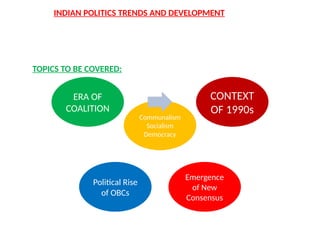
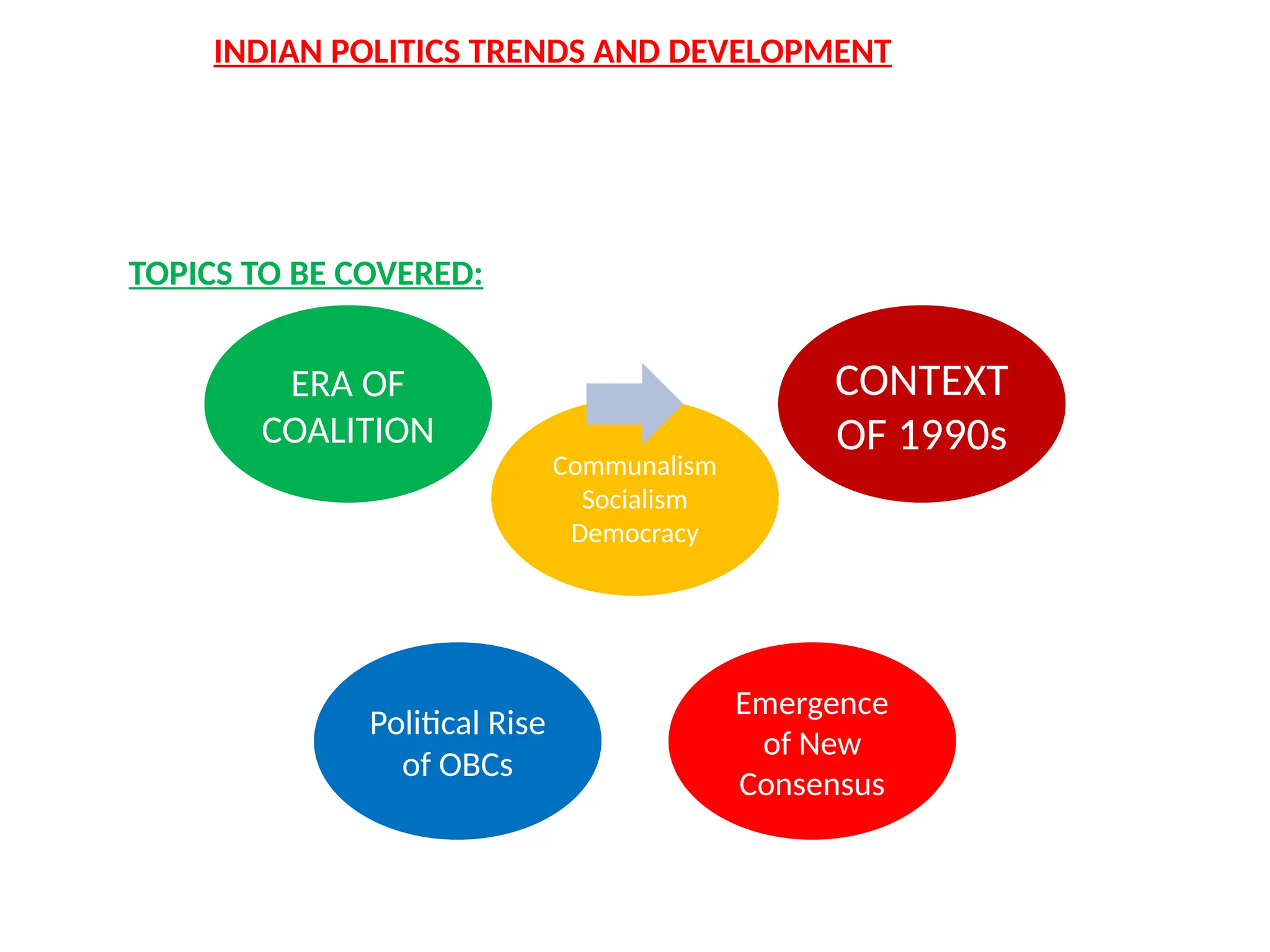

INDIAN POLITICS TRENDS AND DEVELOPMENT
Communalism
Socialism
Democracy
CONTEXT
OF 1990s
Emergence
of New
Consensus
Political Rise
of OBCs
ERA OF
COALITION
TOPICS TO BE COVERED:
CONTEXT OF 1990s:
Indira Gandhi was assassinated-31st
October 1984. and
Rajiv Gandhi was elected as a Prime Minister of India in
the same year.
END OF CONGRESS SYSTEM-
In 1984 congress won total 415 seats and Rajiv Gandhi was elected PM.
 in 1989 congress was defeated badly won only 197 seats .
National front alliance with Janta party again , got the majority in 1989.
MANDAL COMMISSION :
In 1990 Mandal commission was formed under National Front
Government.which gave its recommendations for the OBCs reservations in
Government jobs.
Conflicts and unrest in peace due to this issue.
NEW ECONOMIC POLICY
In 1991 NEP was launched by the government to reduce its
intervention in the market and government brought many changes by
liberalizing the policies.(Globalization) LPG.
It was structural adjustment programs started by Rajiv Gandhi which
was visible by 1991.
POLITICS OF HINDUTVA:
Ayodhya demolition (Babri Masjid)
Ramjanambhumi movement
Rise of BJP
Indian Secularism
ASSASSINATION OF RAJIV GANDHI
May 21, 1991 Rajiv Gandhi was assassinated by LTTE.
During Tamil Nadu campaign
PV Narsimha Rav was elected next pm from congress in 1991.
ERA OF COALITION OR MULTIPARTY SYSTEM-
1989-2014
DECLINE OF CONGRESS-
Congress party was a largest party
Crucial role of regional political parties in forming the government.
No single party had clear majority since 1989 till 2014.
UNSTABLE POLITICAL EQUATION-
1989- Congress could not form the majority government.
1996 BJP could not form the majority government.
This era was coalition v/s minority government.
POLITICAL RISE OF OBC:
SC & ST It was seen that people those who are in these categories socially and
educationally backward need to be empowered.
OBCs There are people who also are backward educationally and socially.
OBC s (Administrative categories) supported by Janta Party (BKD + SSP) in the
election 1977
Party had powerful rural base.
MANDAL COMMISSION (SECOND BACKWARD CLASS
COMMISSION-1978:
Bindehwari Prasad Mandal (BP Mandal) was the chairman of this
commission
There was reservation in South India since 1960 but there was no quotas in
North therefore there was a demand by the people .
Janta Party (1977-79) fulfill the demand by forming commission.
The CM of Bihar Karpuri Thakur initiated reservation for OBCs in Bihar.
OBJECTIVE OF MANDAL COMMISSION :
To investigate the extent of social and educational backwardness
of OBCs.
Ways of identifying these backward classes.
Ways to end backwardness.
Commission gave its recommendation in 1880.
RECOMMENDATIONS:
There are very less presence in education and jobs, backward class are
actually backward castes in India
These can be empowered by giving 27% of Reservation in Gov. jobs.
Land reforms .
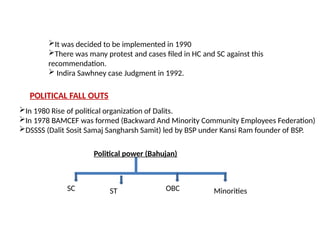
It was decided to be implemented in 1990
There was many protest and cases filed in HC and SC against this
recommendation.
 Indira Sawhney case Judgment in 1992.
POLITICAL FALL OUTS
In 1980 Rise of political organization of Dalits.
In 1978 BAMCEF was formed (Backward And Minority Community Employees Federation)
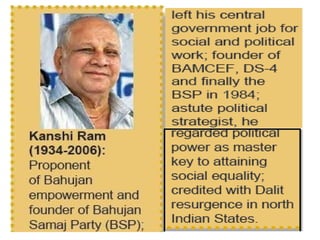
DSSSS (Dalit Sosit Samaj Sangharsh Samit) led by BSP under Kansi Ram founder of BSP.
Political power (Bahujan)
SC ST OBC Minorities
• It was out of this that the subsequent
Dalit Shoshit Samaj Sangharsh Samiti D-S 4 and later the Bahujan Samaj Party
(BSP) |
emerged under the leadership of Kanshi Ram.
• The BSP began as a small party supported largely by Dalit voters in Punjab,
Haryana and Uttar Pradesh.
• But in 1989 and the 1991 elections, it achieved a breakthrough in Uttar Pradesh.
• This was the first time in independent India that a political party supported
mainly by Dalit voters had achieved this kind of political success
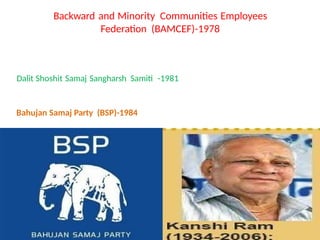
Backward and Minority Communities Employees
Federation (BAMCEF)-1978
Dalit Shoshit Samaj Sangharsh Samiti -1981
Bahujan Samaj Party (BSP)-1984
RISE OF
POLITICS BASED ON RELIGIOUS IDENTITY
• leading to a debate about secularism and democracy.
• BJS ----JP----BJP (1980)
• It embraced ‘Gandhian Socialism’ as its ideology.
• it did not get much success in the elections held in 1980 and 1984.
• After 1986, the party began to emphasise the Hindu nationalist element in
its ideology.
• The BJP :politics of ‘Hindutva’
• adopted the strategy of mobilizing the Hindus.
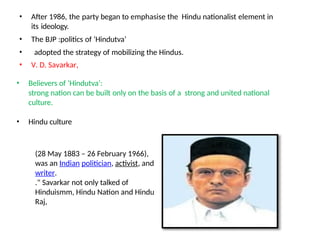
• V. D. Savarkar,
• Believers of ‘Hindutva’:
strong nation can be built only on the basis of a strong and united national
culture.
• Hindu culture
(28 May 1883 – 26 February 1966),
was an Indian politician, activist, and
writer.
." Savarkar not only talked of
Hinduismm, Hindu Nation and Hindu
Raj,
Two developments around 1986 became central to the politics of BJP as a ‘Hindutva’
party.
• Shah Bano case in 1985.
• Ayodhya dispute
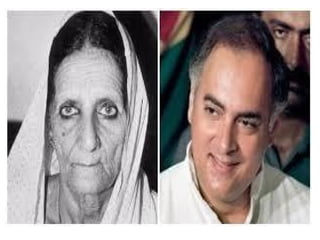
Mohd. Ahmed Khan v. Shah Bano Begum-1985
• 62 year old
• had filed a case for maintenance from her former husband.
• The SC ruled in her favour.
• The orthodox Muslims saw the SC order as an interference in Muslim
Personal Law.
• Muslim Women (Protection of Rights on Divorce) Act, 1986
• nullified the SC judgment
Criticisms of Government
• women’s organisations,
• many Muslim groups ,
• most of the intellectuals.
• The BJP criticised this action of the Congress govt as an unnecessary
concession and ‘appeasement’ of the minority community.
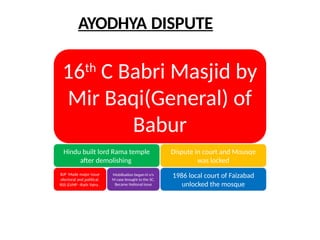
16th
C Babri Masjid by
Mir Baqi(General) of
Babur
Hindu built lord Rama temple
after demolishing
BJP Made major issue
electoral and political.
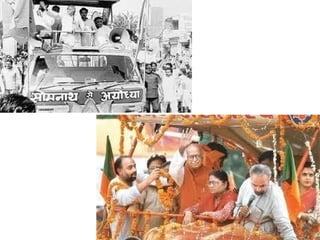
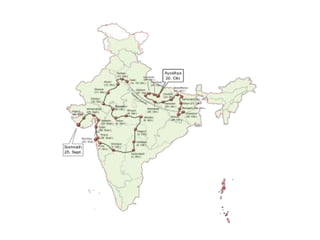
RSS &VHP –Rath Yatra .
Mobilisation began-H v/s
M case brought to the SC.
Became National issue
Dispute in court and Mousqe
was locked
1986 local court of Faizabad
unlocked the mosque
AYODHYA DISPUTE
• In 6 December 1992
• organisations supporting the construction of the temple had organised a
Karseva (voluntary service by the devotees) for building the Ram temple.
• Tense situation
• SC -- ordered the State govt to take care that the disputed site will not be
endangered.
Demolition and after
• The violence in Mumbai erupted again in Jan 1993.
• thousands of people gathered at Ayodhya on 6 December 1992 .
• demolished the mosque.
• clashes b/w H-M started.
• Centre dismissed UP-Kalyan singh government.
• President’s rule in BJP govt states.
• A case against the CM of UP was registered in the SC for contempt of court .
• Commission to investigate. (Liberhan)
• Debate over Secularism.
• Debate over using religious sentiments for electoral purpose.
Series of other developments
Threat to democracy
• Anti-Sikh riots 1984
• Demolition of Babri Masjid 1992
• Gujarat riot 2002
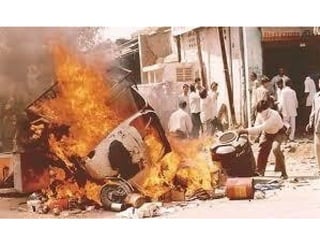
• Feb-Mar2002, large-scale violence
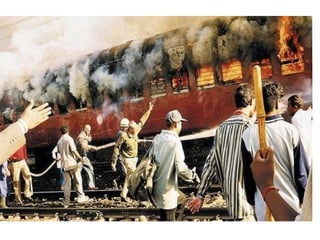
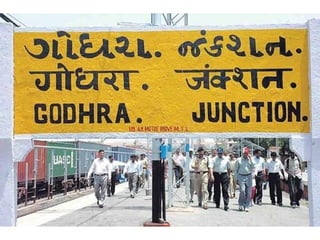
• incident at Godhra railway station
• A bogey of a train that was returning from Ayodhya and was full of Karsevaks
was set on fire.
• 57 died
• Violence against Muslims .
• 1100 killed
GUJARAT RIOT 2002
• NHRC criticised the Gujarat government
• failing to :
 control violence,
 provide relief to the victims,
 prosecute the perpetrators of this violence.
• ECI ordered the assembly elections to be postponed.
THANK YOU

Recent Development in Indian Politice.pptx

  • 1.
    INDIAN POLITICS TRENDSAND DEVELOPMENT Communalism Socialism Democracy CONTEXT OF 1990s Emergence of New Consensus Political Rise of OBCs ERA OF COALITION TOPICS TO BE COVERED:
  • 2.
    CONTEXT OF 1990s: IndiraGandhi was assassinated-31st October 1984. and Rajiv Gandhi was elected as a Prime Minister of India in the same year. END OF CONGRESS SYSTEM- In 1984 congress won total 415 seats and Rajiv Gandhi was elected PM.  in 1989 congress was defeated badly won only 197 seats . National front alliance with Janta party again , got the majority in 1989. MANDAL COMMISSION : In 1990 Mandal commission was formed under National Front Government.which gave its recommendations for the OBCs reservations in Government jobs. Conflicts and unrest in peace due to this issue.
  • 3.
    NEW ECONOMIC POLICY In1991 NEP was launched by the government to reduce its intervention in the market and government brought many changes by liberalizing the policies.(Globalization) LPG. It was structural adjustment programs started by Rajiv Gandhi which was visible by 1991. POLITICS OF HINDUTVA: Ayodhya demolition (Babri Masjid) Ramjanambhumi movement Rise of BJP Indian Secularism ASSASSINATION OF RAJIV GANDHI May 21, 1991 Rajiv Gandhi was assassinated by LTTE. During Tamil Nadu campaign PV Narsimha Rav was elected next pm from congress in 1991.
  • 4.
    ERA OF COALITIONOR MULTIPARTY SYSTEM- 1989-2014 DECLINE OF CONGRESS- Congress party was a largest party Crucial role of regional political parties in forming the government. No single party had clear majority since 1989 till 2014. UNSTABLE POLITICAL EQUATION- 1989- Congress could not form the majority government. 1996 BJP could not form the majority government. This era was coalition v/s minority government.
  • 5.
    POLITICAL RISE OFOBC: SC & ST It was seen that people those who are in these categories socially and educationally backward need to be empowered. OBCs There are people who also are backward educationally and socially. OBC s (Administrative categories) supported by Janta Party (BKD + SSP) in the election 1977 Party had powerful rural base. MANDAL COMMISSION (SECOND BACKWARD CLASS COMMISSION-1978: Bindehwari Prasad Mandal (BP Mandal) was the chairman of this commission There was reservation in South India since 1960 but there was no quotas in North therefore there was a demand by the people . Janta Party (1977-79) fulfill the demand by forming commission. The CM of Bihar Karpuri Thakur initiated reservation for OBCs in Bihar.
  • 6.
    OBJECTIVE OF MANDALCOMMISSION : To investigate the extent of social and educational backwardness of OBCs. Ways of identifying these backward classes. Ways to end backwardness. Commission gave its recommendation in 1880. RECOMMENDATIONS: There are very less presence in education and jobs, backward class are actually backward castes in India These can be empowered by giving 27% of Reservation in Gov. jobs. Land reforms .
  • 7.
    It was decidedto be implemented in 1990 There was many protest and cases filed in HC and SC against this recommendation.  Indira Sawhney case Judgment in 1992. POLITICAL FALL OUTS In 1980 Rise of political organization of Dalits. In 1978 BAMCEF was formed (Backward And Minority Community Employees Federation) DSSSS (Dalit Sosit Samaj Sangharsh Samit) led by BSP under Kansi Ram founder of BSP. Political power (Bahujan) SC ST OBC Minorities
  • 8.
    • It wasout of this that the subsequent Dalit Shoshit Samaj Sangharsh Samiti D-S 4 and later the Bahujan Samaj Party (BSP) | emerged under the leadership of Kanshi Ram. • The BSP began as a small party supported largely by Dalit voters in Punjab, Haryana and Uttar Pradesh. • But in 1989 and the 1991 elections, it achieved a breakthrough in Uttar Pradesh. • This was the first time in independent India that a political party supported mainly by Dalit voters had achieved this kind of political success
  • 9.
    Backward and MinorityCommunities Employees Federation (BAMCEF)-1978 Dalit Shoshit Samaj Sangharsh Samiti -1981 Bahujan Samaj Party (BSP)-1984
  • 11.
    RISE OF POLITICS BASEDON RELIGIOUS IDENTITY • leading to a debate about secularism and democracy. • BJS ----JP----BJP (1980) • It embraced ‘Gandhian Socialism’ as its ideology. • it did not get much success in the elections held in 1980 and 1984.
  • 12.
    • After 1986,the party began to emphasise the Hindu nationalist element in its ideology. • The BJP :politics of ‘Hindutva’ • adopted the strategy of mobilizing the Hindus. • V. D. Savarkar, • Believers of ‘Hindutva’: strong nation can be built only on the basis of a strong and united national culture. • Hindu culture (28 May 1883 – 26 February 1966), was an Indian politician, activist, and writer. ." Savarkar not only talked of Hinduismm, Hindu Nation and Hindu Raj,
  • 13.
    Two developments around1986 became central to the politics of BJP as a ‘Hindutva’ party. • Shah Bano case in 1985. • Ayodhya dispute
  • 15.
    Mohd. Ahmed Khanv. Shah Bano Begum-1985 • 62 year old • had filed a case for maintenance from her former husband. • The SC ruled in her favour. • The orthodox Muslims saw the SC order as an interference in Muslim Personal Law. • Muslim Women (Protection of Rights on Divorce) Act, 1986 • nullified the SC judgment
  • 16.
    Criticisms of Government •women’s organisations, • many Muslim groups , • most of the intellectuals. • The BJP criticised this action of the Congress govt as an unnecessary concession and ‘appeasement’ of the minority community.
  • 17.
    16th C Babri Masjidby Mir Baqi(General) of Babur Hindu built lord Rama temple after demolishing BJP Made major issue electoral and political. RSS &VHP –Rath Yatra . Mobilisation began-H v/s M case brought to the SC. Became National issue Dispute in court and Mousqe was locked 1986 local court of Faizabad unlocked the mosque AYODHYA DISPUTE
  • 20.
    • In 6December 1992 • organisations supporting the construction of the temple had organised a Karseva (voluntary service by the devotees) for building the Ram temple. • Tense situation • SC -- ordered the State govt to take care that the disputed site will not be endangered. Demolition and after • The violence in Mumbai erupted again in Jan 1993. • thousands of people gathered at Ayodhya on 6 December 1992 . • demolished the mosque. • clashes b/w H-M started.
  • 21.
    • Centre dismissedUP-Kalyan singh government. • President’s rule in BJP govt states. • A case against the CM of UP was registered in the SC for contempt of court . • Commission to investigate. (Liberhan) • Debate over Secularism. • Debate over using religious sentiments for electoral purpose. Series of other developments Threat to democracy • Anti-Sikh riots 1984 • Demolition of Babri Masjid 1992 • Gujarat riot 2002
  • 22.
    • Feb-Mar2002, large-scaleviolence • incident at Godhra railway station • A bogey of a train that was returning from Ayodhya and was full of Karsevaks was set on fire. • 57 died • Violence against Muslims . • 1100 killed GUJARAT RIOT 2002
  • 26.
    • NHRC criticisedthe Gujarat government • failing to :  control violence,  provide relief to the victims,  prosecute the perpetrators of this violence. • ECI ordered the assembly elections to be postponed.
  • 27.