Plus Two History
ATHIRA ASOKAN
2. KINGS, FARMERS AND TOWNS:
Early State and Economies
( C 600 BCE – 600 CE)
After the decline of
Harappa culture ancient
India witnessed
remarkable development
in many fields
 ‘Rigveda‘ was composed
 Emergence of agricultural settlement
 New method of disposal of the dead
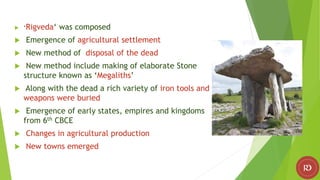
 New method include making of elaborate Stone
structure known as ‘Megaliths’
 Along with the dead a rich variety of iron tools and
weapons were buried
 Emergence of early states, empires and kingdoms
from 6th CBCE
 Changes in agricultural production
 New towns emerged
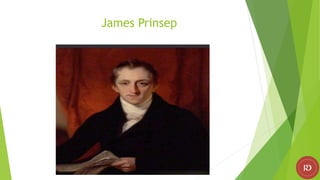
Prinsep and Piyadassi
 In 1830 significant developments the took place in
Indian epigraphy
 James Prinsep was Officer in the Mint of the English
East India Company
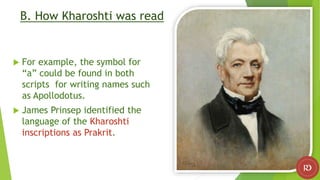
 He deciphered “Brahmi” and “Kharoshti” scripts
 Piyadassi- Pleasant to behold
 comparing these with Buddhist text, he found that
“piyadassi” was Asoka
Epigraphy means study
of inscriptions
James Prinsep
The Earlier States
 Use of iron and the development of coinage
 Rise of cities and towns
 Growth of Buddhism and Jainism
 Iron was liberally used
 Development of coinage led to the growth
of trade
Janapada
Janapada means the land were a
‘jana’(people, clan or tribe )settles.
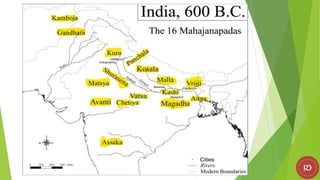
 Buddhist and Jainist text mentioned 16 states.
 These states known as ‘ Mahajanapada’
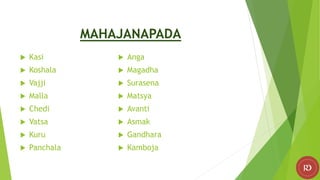
MAHAJANAPADA
 Kasi
 Koshala
 Vajji
 Malla
 Chedi
 Vatsa
 Kuru
 Panchala
 Anga
 Magadha
 Surasena
 Matsya
 Avanti
 Asmak
 Gandhara
 Kamboja
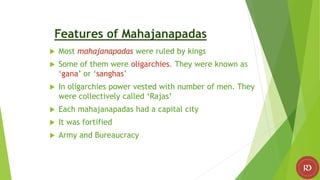
Features of Mahajanapadas
 Most mahajanapadas were ruled by kings
 Some of them were oligarchies. They were known as
‘gana’ or ‘sanghas’
 In oligarchies power vested with number of men. They
were collectively called ‘Rajas’
 Each mahajanapadas had a capital city
 It was fortified
 Army and Bureaucracy
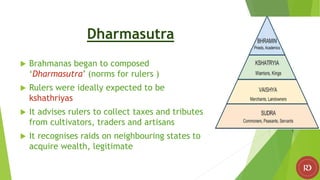
Dharmasutra
 Brahmanas began to composed
‘Dharmasutra’ (norms for rulers )
 Rulers were ideally expected to be
kshathriyas
 It advises rulers to collect taxes and tributes
from cultivators, traders and artisans
 It recognises raids on neighbouring states to
acquire wealth, legitimate
First Among the Sixteen :Magadha
 Magadha was a fertile region
 Use of Iron
 Magadha control over the trade roots of Ganga
and its tributaries provide substantial revenue
 Elephants were important component of the army.
It were found in large numbers in forest
 Marriage alliances
First Among the Sixteen :Magadha
 Earliest capital –Rajagriha (house of king)
 It was an impregnable city protected by
five hills
 In the 4 th century BCE capital was shifted
to Pataliputhra
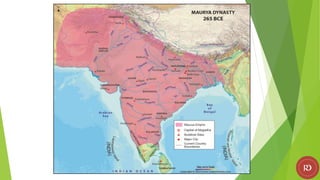
An Early Empire
 Kingdom of Magadha emerged to be the most powerful
and founding an empire
 Chandragupta Maurya -founder-321BCE
 He extended his control as far as Afghanistan and
Baluchistan
 Bindusara extended the empire further
 His son Asoka conquered Kalinga too
Finding out about the Mauryas
Important Sources
 Indica – Megasthanes
 Arthasastra – Kautilya(Chanakya), (minister of
Chandragupta )
 Mudra Rakshasa – Vishakhadatta.
 Buddhist, Jaina, Puranic literature
 Inscriptions of Asoka on rocks and pillars
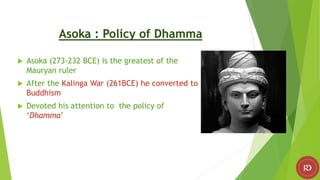
Asoka : Policy of Dhamma
 Asoka (273-232 BCE) is the greatest of the
Mauryan ruler
 After the Kalinga War (261BCE) he converted to
Buddhism
 Devoted his attention to the policy of
‘Dhamma’
Principles of Dhamma
 Respect to teachers, elders and parents
 Generosity towards brahmins
 Treating slaves and servents kindly
 Respect for other religion and tradition
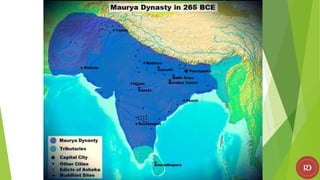
Administrating the Empire
Five major capitals
A. Pataliputhra
B. Taxila
C. Ujjain
D. Tosali
E. Suvarnagiri
 Administrative control was strongest in
areas around the capital and provincial
centers
 Taxila and Ujjain were situated on
important long distance trade routes
 Suvarnagiri was important for tapping the
gold mine
Features of Mauryan Government
 Highly centralised
 King was supreme head
 The king calls himself “Dharma Pravarthaka” or
promulgator of social order.
 Vast bureaucracy
 System of espionage
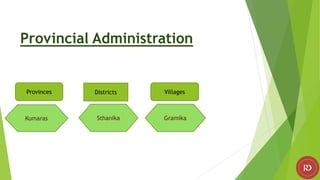
Provincial Administration
Provinces Districts Villages
Kumaras Sthanika Gramika
City Administration
 City was under a council of 30 member
 Council was divided into six committee of 5 members each
1. First committee looked after industry and craft
2. Second committee looked after the foreigners
3. Third committee was in charge of registration of birth and death
4. Fourth committee looked after trade and commerce
5. Fifth committee looked after the manufactured goods
6. Sixth committee collected taxes on the goods sold
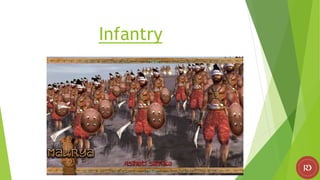
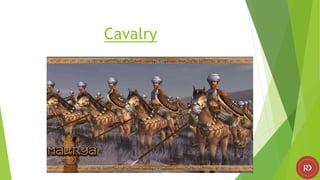
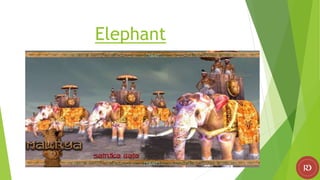
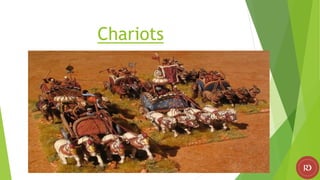
Army
Infantry
Cavalry
Elephant
Chariots
How important was the Mauryan
Empire
 19 th C historians began to reconstruct early Indian history
 Mauryan empire as a major land mark
 Stone sculptures considered to be example of spectacular art,
typical of empire
 Messages on Asokas inscription were different from other rulers
 This suggested that Asoka was most powerful and industrious
How important was the Mauryan
Empire
 Nationalist leaders of 20 th c regarded Asoka as an
inspiring figure
 Some historians says Mauryan empire lasted for 150 years,
which is not a very long time span and it did not
encompass the entire India and controle was not uniform.
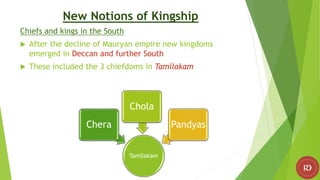
New Notions of Kingship
Chiefs and kings in the South
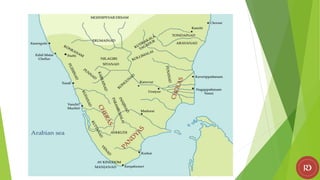
 After the decline of Mauryan empire new kingdoms
emerged in Deccan and further South
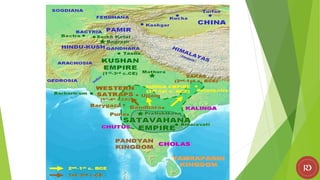
 These included the 3 chiefdoms in Tamilakam
Tamilakam
Chera
Chola
Pandyas
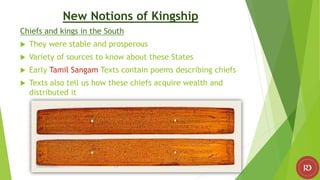
New Notions of Kingship
Chiefs and kings in the South
 They were stable and prosperous
 Variety of sources to know about these States
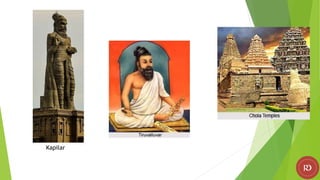
 Early Tamil Sangam Texts contain poems describing chiefs
 Texts also tell us how these chiefs acquire wealth and
distributed it
Kapilar
Chiefs and kings in the South
 during 2nd C BCE and 2nd C CE
Sathavahanas
• ruled over parts of western and Central India
Sakas
• people of Central Asian origin who
established kingdoms in the North-western
and western parts
Chiefs and kings in the South
The chiefs and king derived revenue from long
distance trade
Their social origins were often insecure
But once they acquired power they attempted
to claim social status from verity of ways.
Chiefs and Chiefdoms
 A chief is a powerful man
 Position may or may not be hereditary
 Derives support from his kinfolk
 Functions may include
 performing special rituals
 leadership in warfare
 arbitrating disputes
 Receives gift from his subordinates
 Distributes it amongst his supporters
 No regular armies and officials in chiefdoms
Divine Kings
 Kings claimed high status by adopting Several strategies.
 One strategy was to identify themselves with several deities.
 This is best exemplified by the Kushanas (1st C BCE to 1st C CE)
 Their Kingdom was extended from Central Asia to north – west
India
 Kushana rulers considered themselves god like
 Rulers adopted the title “Devaputhra” or “son of god”
 Rulers performed Aswamedha to exhibit their power and status
Divine Kings
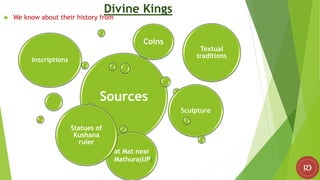
 We know about their history from
Sources
Inscriptions
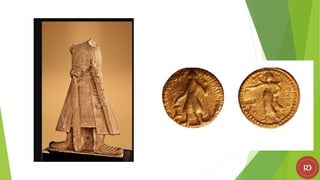
Coins
Sculpture
Statues of
Kushana
ruler
Textual
traditions
at Mat near
Mathura(UP)
Divine kings
 By the 4th century CE, there is evidence of rise of large empire
 Among them most important is the Gupta Empire
 Most of the empire depend on Samantha.
 They had control over land.
 They provide military support to the rulers.
 Later powerful Samantha’s became Kings.
 Historians reconstruct the history of Gupta with the help of a
variety of sources
(A) literature
(B) coins
(C)Inscriptions including ‘Prasastis'
Divine kings
 ‘Prasati’ is a particular type of inscription composed in
praise of Kings and patrons by poets.
 From these compositions historians tried to draw factual
information.
 But those who composed them often treasured them as
works of poetry rather than real accounts.
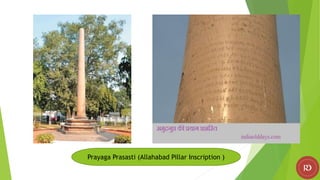
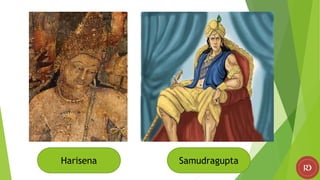
 The ‘Prayaga Prasasti’ ( also known as the Allahabad pillar
inscription ) was composed by Harisena, the court poet of
Samudragupta,in Sanskrit.
 we came to know about all campaigns of Samudragupta
only from one record, the ‘Prayaga Prasasti’.
Prayaga Prasasti (Allahabad Pillar Inscription )
Harisena Samudragupta
A changing countryside
A. Popular perceptions of kings
B. Strategies for increasing production
C. Difference in rural society
D. Land grants and new rural elites
A Changing Countryside
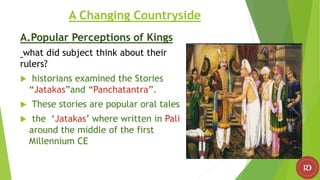
A.Popular Perceptions of Kings
what did subject think about their
rulers?
 historians examined the Stories
“Jatakas”and “Panchatantra”.
 These stories are popular oral tales
 the ‘Jatakas’ where written in Pali
around the middle of the first
Millennium CE
A. Popular perceptions of Kings
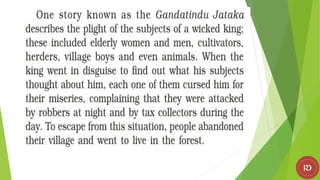
 This story indicate the strained relationship between a
king and his subjects
 King often try to collect high taxes . People found
such collections oppressive
 People found two strategies to escape the situation
1. Escaping into the forest
2. Increase production to meet high demand of tax
B. Strategies for increasing production
 One strategy was plough agriculture
 Paddy Transplantation
B. Strategy for Increasing production
 Use of irrigation through wells , tanks and canals
C. Differences in rural society
 Use of various Technologies led to Increase in
production
 But all people could not get its benefit
 There was a growing differentiation among people
 Buddhist stories mentioned about the landless
agricultural labourers, small peasants and large
landholders
C. Differences in rural society
 The term ‘gahapati’ Used in Pali texts to
designate small peasant and large land holders
 Large landholders and village headman emerged
as powerful figures . Position of village headman
was often hereditary.
 They exercise control over other cultivators
C. Differences in rural society
 In early Tamil literatures also there is mention of different
categories of people living in villages. They were :
1. Vellalar (large landowners)
2. Uzhavar (ploughmen)
3. Adimai (slaves)
 It is assumed that these differences are based on
differential access to land labour and new technologies
D. Land grants and new rural elite
 Early centuries of common era witnessed land grant,
many of which were recorded in inscription
 Some inscriptions on stone, but most were on copper
plates
 It is given as a record of the transaction to those who
received the land
 The record generally about grants to religious Institutions
or brahmanas
 Most inscription in Sanskrit, from the seventh century
part of the instruction was in Sanskrit rest was in a local
language such as Tamil ,Telugu
D. Land grand and new rural elites
• Prabhavati Gupta was the daughter of Chandragupta –II
the most important Gupta ruler. She was married into the
ruling family of Vakatakas who were very powerful in the
Deccan.
• Sanskrit legal texts deny women independent access to
the resources such as Land. But one inscription indicates
that Prabhavati Gupta had access to land which she then
granted.
• Prabhavathi was able to grand her land because she was a
queen. So it was an exceptional situation
• but there is another possibility too. Prabhavathi‘s ‘ land
grant‘ shows that the provisions of legal texts not always
uniformly followed
D. Land grant and new rural elites
 Inscription give as an idea about rural population
 According to the inscription they would have to
obey new Lords of the village
 Land grants were found in several parts of the
country. There were regional variations in size
and rights of land donated
 According to some historians land grant were part
of a strategy adopted by rulers to extend
agriculture to new areas
D. Land Grant and new rural elites
 Another view is that land grant led to the
weakening of Kings political power. As king were
losing control over their Samantas they tried to
win allies by making grants of land.
 They also feel the king tried to project
themselves as Supermen because they losing
control . In such situation they want to present at
least a facade power.
Towns and Trade
A. New cities
B. Urban populations: Elites and craftpersons
C. Trade in the subcontinent and beyond
D. Coins and kings
Towns and Trade
A.New cities
 From sixth century BCE many urban centres
emerged in several parts of the country
 Most of these centres were Capitals of
Mahajanapadas
 Almost all major towns Where are located
along routes of communication
New cities
 Pataliputra – Riverine routes
 Ujjain – Land routes
 Puhar – Near the coast
 Mathura – Know for the commercial, cultural and
political activity
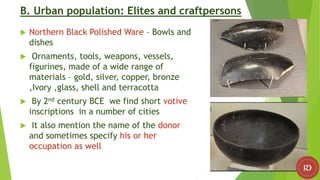
B. Urban population: Elites and craftpersons
 Northern Black Polished Ware – Bowls and
dishes
 Ornaments, tools, weapons, vessels,
figurines, made of a wide range of
materials – gold, silver, copper, bronze
,Ivory ,glass, shell and terracotta
 By 2nd century BCE we find short votive
inscriptions in a number of cities
 It also mention the name of the donor
and sometimes specify his or her
occupation as well
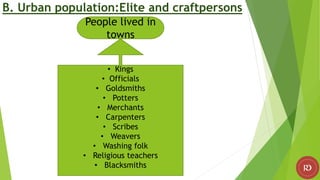
B. Urban population:Elite and craftpersons
• Kings
• Officials
• Goldsmiths
• Potters
• Merchants
• Carpenters
• Scribes
• Weavers
• Washing folk
• Religious teachers
• Blacksmiths
People lived in
towns
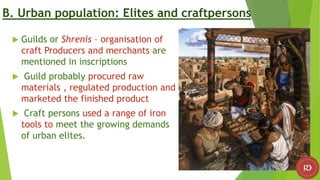
B. Urban population: Elites and craftpersons
 Guilds or Shrenis – organisation of
craft Producers and merchants are
mentioned in inscriptions
 Guild probably procured raw
materials , regulated production and
marketed the finished product
 Craft persons used a range of iron
tools to meet the growing demands
of urban elites.
C. Trade in the subcontinent and beyond
 Land and river routes criss-crossed the subcontinent and
extended in all directions
 Overland trade was extended into Central Asia and beyond
 Over sea trade was extended across Arabian Sea to East
and North Africa and West Asia
 Trade was extended through the Bay of Bengal to South-
East Asia and China
 Rulers often tried to control these trade routes by offering
protection for a price
C. Trade in the subcontinent and beyond
 Peddlers, merchants and seafarers travelled
through these trade routes. Peddlers might have
travelled on foot while merchants travelled with
caravans of bullock cart and pack animals
 There were also seafarers whose ventures were
risky but highly profitable
 merchants who succeeded in their trade became
enormously rich
C. Trade in the subcontinent and beyond
 They were designated as “masattuvan”, in Tamil and
“setthis” and “sattavahas” in Prakrit.
 A wide range of goods were carried from one place to
another
 It included salt, grain, cloth, metal ores and finished
products, stone, timber, medicinal plants, etc
 Textiles, medicinal plants and spices especially paper
were in high demand in Roman empire
 All these items were transported across Arabian Sea to
the Mediterranean
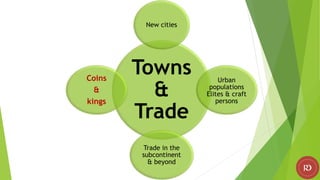
Towns
&
Trade
New cities
Urban
populations
Elites & craft
persons
Trade in the
subcontinent
& beyond
Coins
&
kings
D. Coins and Kings
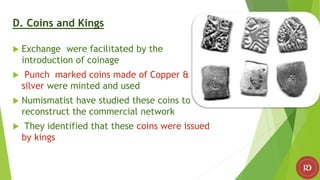
 Exchange were facilitated by the
introduction of coinage
 Punch marked coins made of Copper &
silver were minted and used
 Numismatist have studied these coins to
reconstruct the commercial network
 They identified that these coins were issued
by kings
D. Coins and Kings
 It also likely that merchants, bankers and
townsmen issued such coins .
 The first coin bearing the names and images of
rulers were issued by Indigo- Greeks
 They had established control over the North
Western part of the subcontinent in 2nd century
BCE
D. Coins and Kings
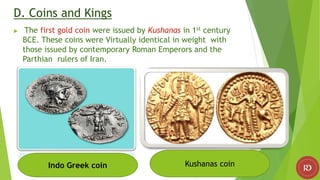
 The first gold coin were issued by Kushanas in 1st century
BCE. These coins were Virtually identical in weight with
those issued by contemporary Roman Emperors and the
Parthian rulers of Iran.
Indo Greek coin Kushanas coin
D. Coins and Kings
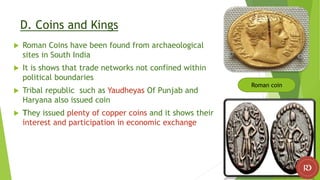
 Roman Coins have been found from archaeological
sites in South India
 It is shows that trade networks not confined within
political boundaries
 Tribal republic such as Yaudheyas Of Punjab and
Haryana also issued coin
 They issued plenty of copper coins and it shows their
interest and participation in economic exchange
Roman coin
D. Coins and Kings
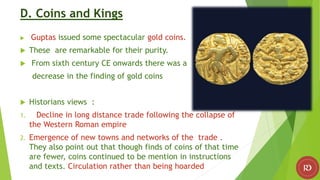
 Guptas issued some spectacular gold coins.
 These are remarkable for their purity.
 From sixth century CE onwards there was a
decrease in the finding of gold coins
 Historians views :
1. Decline in long distance trade following the collapse of
the Western Roman empire
2. Emergence of new towns and networks of the trade .
They also point out that though finds of coins of that time
are fewer, coins continued to be mention in instructions
and texts. Circulation rather than being hoarded
Back to Basics : How are Inscriptions
Deciphered ?
A. Deciphering Brahmi
 Most scripts used to write modern Indian languages
are derived from Brahmi
 It is ‘Brahmi’, that is used in most of the Asoka
inscriptions
 Many attempts have been made by European
Scholars with the help of Indian Scholars to decipher
Brahmi script
A. Deciphering Brahmi
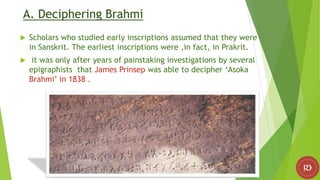
 Scholars who studied early inscriptions assumed that they were
in Sanskrit. The earliest inscriptions were ,in fact, in Prakrit.
 it was only after years of painstaking investigations by several
epigraphists that James Prinsep was able to decipher ‘Asoka
Brahmi’ in 1838 .
B. How was Kharoshti read?
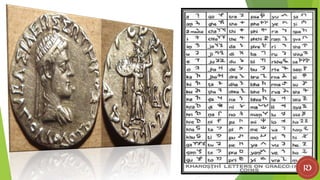
 The inscriptions in the North-West where in ‘Kharoshti’
 Coins of Indo - Greek kings who ruled over the area were
found. It was much helpful to decipher the script.
 These coins contain the names of Kings. The names were
written in Greek and Kharoshti script.
 The European Scholars able to read the Greek script. So
they composed the letters on the coin
B. How Kharoshti was read
 For example, the symbol for
“a” could be found in both
scripts for writing names such
as Apollodotus.
 James Prinsep identified the
language of the Kharoshti
inscriptions as Prakrit.
C. Historical evidence from Inscriptions
 Epigraphists and historians resort to several methods to
understand inscriptions.
 Analysis of an Asoka inscription:-
 The name of the ruler Asoka is not mentioned in the
inscription. Instead the title, “Devanampiya” is used. It
can be translated as “ beloved of the Gods” and
“Piyadassi” or “pleasant to behold”.
 The name Asoka is mentioned in some other
inscriptions, which also contain these titles .
C. Historical evidence from inscriptions
 Epigraphists found that these inscriptions match in
terms of content, style, language and palaeography.
They could concluded that they were issued by the
same ruler.
 In one of his inscription Asoka claims that earlier
rulers had no arrangements to receive reports .
 The historians have to constantly assess statements in
inscriptions before they jump into conclusions.
C. Historical evidence from inscriptions
 Historians face some other problems. King’s orders were
inscribed on natural rocks near cities or routes of
Communications. Is it meant that the passers-by have to
stop and read this?
 Perhaps, the people may be literate. Again, did everybody
in the country understand the Prakrit? There are such
questions which cannot be easily answered.
 An Asoka inscription is interpreted as reflecting the
anguish of the ruler and his change in attitude towards
war.
C. Historical evidence from inscription
 The problem becomes more complicated when we
move beyond reading the inscription at the face
value.
 Among the Asoka inscriptions in present day Orissa,
the one depicting his anguish is missing.
 What are we to understand? Is it that the anguish of
the conquest of Kalinga was too painful in the region
and so the rulers was unable to address the issue ?
The limitation of inscriptional evidence
 Some limitations are technical in character.
 Sometimes letters are not clearly engraved.
 Inscriptions may be sometimes damaged.
 Some letters may be missing.
 Sometimes the historian or epigraphists may not be
able to understand the exact meaning of the words
used in inscriptions.
The limitations of inscriptional evidence
 There may be many more inscriptions, which cannot be
survived the ravages of time.
 So what is available at present is probably only a fraction
of what was inscribed.
 There are many things which we consider Important
politically or economically.
 But they need not be necessarily recorded in inscription.
 Day-to-day agricultural practices or joys and sorrows of
people in daily life do not find mention in inscriptions.
 Inscriptions focus on grand, unique events.
 The content of inscriptions invariably project the
viewpoints of the person who commissioned it
The limitations of inscriptional evidence
 Day-to-day agricultural practices or joys and sorrows
of people in daily life do not find mention in
inscriptions.
 Inscriptions focus on grand, unique events.
 The content of inscriptions invariably project the
viewpoints of the person who commissioned it.
Thank You

Plus 2 Chapter 2 History Athira.pptx

  • 1.
    Plus Two History ATHIRAASOKAN 2. KINGS, FARMERS AND TOWNS: Early State and Economies ( C 600 BCE – 600 CE)
  • 2.
    After the declineof Harappa culture ancient India witnessed remarkable development in many fields
  • 3.
     ‘Rigveda‘ wascomposed  Emergence of agricultural settlement  New method of disposal of the dead  New method include making of elaborate Stone structure known as ‘Megaliths’  Along with the dead a rich variety of iron tools and weapons were buried  Emergence of early states, empires and kingdoms from 6th CBCE  Changes in agricultural production  New towns emerged
  • 4.
    Prinsep and Piyadassi In 1830 significant developments the took place in Indian epigraphy  James Prinsep was Officer in the Mint of the English East India Company  He deciphered “Brahmi” and “Kharoshti” scripts  Piyadassi- Pleasant to behold  comparing these with Buddhist text, he found that “piyadassi” was Asoka Epigraphy means study of inscriptions
  • 5.
  • 6.
    The Earlier States Use of iron and the development of coinage  Rise of cities and towns  Growth of Buddhism and Jainism  Iron was liberally used  Development of coinage led to the growth of trade
  • 7.
    Janapada Janapada means theland were a ‘jana’(people, clan or tribe )settles.  Buddhist and Jainist text mentioned 16 states.  These states known as ‘ Mahajanapada’
  • 8.
    MAHAJANAPADA  Kasi  Koshala Vajji  Malla  Chedi  Vatsa  Kuru  Panchala  Anga  Magadha  Surasena  Matsya  Avanti  Asmak  Gandhara  Kamboja
  • 10.
    Features of Mahajanapadas Most mahajanapadas were ruled by kings  Some of them were oligarchies. They were known as ‘gana’ or ‘sanghas’  In oligarchies power vested with number of men. They were collectively called ‘Rajas’  Each mahajanapadas had a capital city  It was fortified  Army and Bureaucracy
  • 11.
    Dharmasutra  Brahmanas beganto composed ‘Dharmasutra’ (norms for rulers )  Rulers were ideally expected to be kshathriyas  It advises rulers to collect taxes and tributes from cultivators, traders and artisans  It recognises raids on neighbouring states to acquire wealth, legitimate
  • 12.
    First Among theSixteen :Magadha  Magadha was a fertile region  Use of Iron  Magadha control over the trade roots of Ganga and its tributaries provide substantial revenue  Elephants were important component of the army. It were found in large numbers in forest  Marriage alliances
  • 13.
    First Among theSixteen :Magadha  Earliest capital –Rajagriha (house of king)  It was an impregnable city protected by five hills  In the 4 th century BCE capital was shifted to Pataliputhra
  • 14.
    An Early Empire Kingdom of Magadha emerged to be the most powerful and founding an empire  Chandragupta Maurya -founder-321BCE  He extended his control as far as Afghanistan and Baluchistan  Bindusara extended the empire further  His son Asoka conquered Kalinga too
  • 16.
    Finding out aboutthe Mauryas Important Sources  Indica – Megasthanes  Arthasastra – Kautilya(Chanakya), (minister of Chandragupta )  Mudra Rakshasa – Vishakhadatta.  Buddhist, Jaina, Puranic literature  Inscriptions of Asoka on rocks and pillars
  • 17.
    Asoka : Policyof Dhamma  Asoka (273-232 BCE) is the greatest of the Mauryan ruler  After the Kalinga War (261BCE) he converted to Buddhism  Devoted his attention to the policy of ‘Dhamma’
  • 18.
    Principles of Dhamma Respect to teachers, elders and parents  Generosity towards brahmins  Treating slaves and servents kindly  Respect for other religion and tradition
  • 19.
    Administrating the Empire Fivemajor capitals A. Pataliputhra B. Taxila C. Ujjain D. Tosali E. Suvarnagiri
  • 21.
     Administrative controlwas strongest in areas around the capital and provincial centers  Taxila and Ujjain were situated on important long distance trade routes  Suvarnagiri was important for tapping the gold mine
  • 22.
    Features of MauryanGovernment  Highly centralised  King was supreme head  The king calls himself “Dharma Pravarthaka” or promulgator of social order.  Vast bureaucracy  System of espionage
  • 23.
    Provincial Administration Provinces DistrictsVillages Kumaras Sthanika Gramika
  • 24.
    City Administration  Citywas under a council of 30 member  Council was divided into six committee of 5 members each 1. First committee looked after industry and craft 2. Second committee looked after the foreigners 3. Third committee was in charge of registration of birth and death 4. Fourth committee looked after trade and commerce 5. Fifth committee looked after the manufactured goods 6. Sixth committee collected taxes on the goods sold
  • 25.
  • 26.
  • 27.
  • 28.
  • 29.
  • 30.
    How important wasthe Mauryan Empire  19 th C historians began to reconstruct early Indian history  Mauryan empire as a major land mark  Stone sculptures considered to be example of spectacular art, typical of empire  Messages on Asokas inscription were different from other rulers  This suggested that Asoka was most powerful and industrious
  • 31.
    How important wasthe Mauryan Empire  Nationalist leaders of 20 th c regarded Asoka as an inspiring figure  Some historians says Mauryan empire lasted for 150 years, which is not a very long time span and it did not encompass the entire India and controle was not uniform.
  • 32.
    New Notions ofKingship Chiefs and kings in the South  After the decline of Mauryan empire new kingdoms emerged in Deccan and further South  These included the 3 chiefdoms in Tamilakam Tamilakam Chera Chola Pandyas
  • 33.
    New Notions ofKingship Chiefs and kings in the South  They were stable and prosperous  Variety of sources to know about these States  Early Tamil Sangam Texts contain poems describing chiefs  Texts also tell us how these chiefs acquire wealth and distributed it
  • 34.
  • 36.
    Chiefs and kingsin the South  during 2nd C BCE and 2nd C CE Sathavahanas • ruled over parts of western and Central India Sakas • people of Central Asian origin who established kingdoms in the North-western and western parts
  • 37.
    Chiefs and kingsin the South The chiefs and king derived revenue from long distance trade Their social origins were often insecure But once they acquired power they attempted to claim social status from verity of ways.
  • 39.
    Chiefs and Chiefdoms A chief is a powerful man  Position may or may not be hereditary  Derives support from his kinfolk  Functions may include  performing special rituals  leadership in warfare  arbitrating disputes  Receives gift from his subordinates  Distributes it amongst his supporters  No regular armies and officials in chiefdoms
  • 40.
    Divine Kings  Kingsclaimed high status by adopting Several strategies.  One strategy was to identify themselves with several deities.  This is best exemplified by the Kushanas (1st C BCE to 1st C CE)  Their Kingdom was extended from Central Asia to north – west India  Kushana rulers considered themselves god like  Rulers adopted the title “Devaputhra” or “son of god”  Rulers performed Aswamedha to exhibit their power and status
  • 41.
    Divine Kings  Weknow about their history from Sources Inscriptions Coins Sculpture Statues of Kushana ruler Textual traditions at Mat near Mathura(UP)
  • 43.
    Divine kings  Bythe 4th century CE, there is evidence of rise of large empire  Among them most important is the Gupta Empire  Most of the empire depend on Samantha.  They had control over land.  They provide military support to the rulers.  Later powerful Samantha’s became Kings.  Historians reconstruct the history of Gupta with the help of a variety of sources (A) literature (B) coins (C)Inscriptions including ‘Prasastis'
  • 44.
    Divine kings  ‘Prasati’is a particular type of inscription composed in praise of Kings and patrons by poets.  From these compositions historians tried to draw factual information.  But those who composed them often treasured them as works of poetry rather than real accounts.  The ‘Prayaga Prasasti’ ( also known as the Allahabad pillar inscription ) was composed by Harisena, the court poet of Samudragupta,in Sanskrit.  we came to know about all campaigns of Samudragupta only from one record, the ‘Prayaga Prasasti’.
  • 45.
    Prayaga Prasasti (AllahabadPillar Inscription )
  • 46.
  • 48.
    A changing countryside A.Popular perceptions of kings B. Strategies for increasing production C. Difference in rural society D. Land grants and new rural elites
  • 49.
    A Changing Countryside A.PopularPerceptions of Kings what did subject think about their rulers?  historians examined the Stories “Jatakas”and “Panchatantra”.  These stories are popular oral tales  the ‘Jatakas’ where written in Pali around the middle of the first Millennium CE
  • 51.
    A. Popular perceptionsof Kings  This story indicate the strained relationship between a king and his subjects  King often try to collect high taxes . People found such collections oppressive  People found two strategies to escape the situation 1. Escaping into the forest 2. Increase production to meet high demand of tax
  • 52.
    B. Strategies forincreasing production  One strategy was plough agriculture  Paddy Transplantation
  • 53.
    B. Strategy forIncreasing production  Use of irrigation through wells , tanks and canals
  • 54.
    C. Differences inrural society  Use of various Technologies led to Increase in production  But all people could not get its benefit  There was a growing differentiation among people  Buddhist stories mentioned about the landless agricultural labourers, small peasants and large landholders
  • 55.
    C. Differences inrural society  The term ‘gahapati’ Used in Pali texts to designate small peasant and large land holders  Large landholders and village headman emerged as powerful figures . Position of village headman was often hereditary.  They exercise control over other cultivators
  • 56.
    C. Differences inrural society  In early Tamil literatures also there is mention of different categories of people living in villages. They were : 1. Vellalar (large landowners) 2. Uzhavar (ploughmen) 3. Adimai (slaves)  It is assumed that these differences are based on differential access to land labour and new technologies
  • 57.
    D. Land grantsand new rural elite  Early centuries of common era witnessed land grant, many of which were recorded in inscription  Some inscriptions on stone, but most were on copper plates  It is given as a record of the transaction to those who received the land  The record generally about grants to religious Institutions or brahmanas  Most inscription in Sanskrit, from the seventh century part of the instruction was in Sanskrit rest was in a local language such as Tamil ,Telugu
  • 58.
    D. Land grandand new rural elites • Prabhavati Gupta was the daughter of Chandragupta –II the most important Gupta ruler. She was married into the ruling family of Vakatakas who were very powerful in the Deccan. • Sanskrit legal texts deny women independent access to the resources such as Land. But one inscription indicates that Prabhavati Gupta had access to land which she then granted. • Prabhavathi was able to grand her land because she was a queen. So it was an exceptional situation • but there is another possibility too. Prabhavathi‘s ‘ land grant‘ shows that the provisions of legal texts not always uniformly followed
  • 59.
    D. Land grantand new rural elites  Inscription give as an idea about rural population  According to the inscription they would have to obey new Lords of the village  Land grants were found in several parts of the country. There were regional variations in size and rights of land donated  According to some historians land grant were part of a strategy adopted by rulers to extend agriculture to new areas
  • 60.
    D. Land Grantand new rural elites  Another view is that land grant led to the weakening of Kings political power. As king were losing control over their Samantas they tried to win allies by making grants of land.  They also feel the king tried to project themselves as Supermen because they losing control . In such situation they want to present at least a facade power.
  • 61.
    Towns and Trade A.New cities B. Urban populations: Elites and craftpersons C. Trade in the subcontinent and beyond D. Coins and kings
  • 62.
    Towns and Trade A.Newcities  From sixth century BCE many urban centres emerged in several parts of the country  Most of these centres were Capitals of Mahajanapadas  Almost all major towns Where are located along routes of communication
  • 63.
    New cities  Pataliputra– Riverine routes  Ujjain – Land routes  Puhar – Near the coast  Mathura – Know for the commercial, cultural and political activity
  • 64.
    B. Urban population:Elites and craftpersons  Northern Black Polished Ware – Bowls and dishes  Ornaments, tools, weapons, vessels, figurines, made of a wide range of materials – gold, silver, copper, bronze ,Ivory ,glass, shell and terracotta  By 2nd century BCE we find short votive inscriptions in a number of cities  It also mention the name of the donor and sometimes specify his or her occupation as well
  • 65.
    B. Urban population:Eliteand craftpersons • Kings • Officials • Goldsmiths • Potters • Merchants • Carpenters • Scribes • Weavers • Washing folk • Religious teachers • Blacksmiths People lived in towns
  • 66.
    B. Urban population:Elites and craftpersons  Guilds or Shrenis – organisation of craft Producers and merchants are mentioned in inscriptions  Guild probably procured raw materials , regulated production and marketed the finished product  Craft persons used a range of iron tools to meet the growing demands of urban elites.
  • 67.
    C. Trade inthe subcontinent and beyond  Land and river routes criss-crossed the subcontinent and extended in all directions  Overland trade was extended into Central Asia and beyond  Over sea trade was extended across Arabian Sea to East and North Africa and West Asia  Trade was extended through the Bay of Bengal to South- East Asia and China  Rulers often tried to control these trade routes by offering protection for a price
  • 68.
    C. Trade inthe subcontinent and beyond  Peddlers, merchants and seafarers travelled through these trade routes. Peddlers might have travelled on foot while merchants travelled with caravans of bullock cart and pack animals  There were also seafarers whose ventures were risky but highly profitable  merchants who succeeded in their trade became enormously rich
  • 69.
    C. Trade inthe subcontinent and beyond  They were designated as “masattuvan”, in Tamil and “setthis” and “sattavahas” in Prakrit.  A wide range of goods were carried from one place to another  It included salt, grain, cloth, metal ores and finished products, stone, timber, medicinal plants, etc  Textiles, medicinal plants and spices especially paper were in high demand in Roman empire  All these items were transported across Arabian Sea to the Mediterranean
  • 70.
    Towns & Trade New cities Urban populations Elites &craft persons Trade in the subcontinent & beyond Coins & kings
  • 71.
    D. Coins andKings  Exchange were facilitated by the introduction of coinage  Punch marked coins made of Copper & silver were minted and used  Numismatist have studied these coins to reconstruct the commercial network  They identified that these coins were issued by kings
  • 72.
    D. Coins andKings  It also likely that merchants, bankers and townsmen issued such coins .  The first coin bearing the names and images of rulers were issued by Indigo- Greeks  They had established control over the North Western part of the subcontinent in 2nd century BCE
  • 73.
    D. Coins andKings  The first gold coin were issued by Kushanas in 1st century BCE. These coins were Virtually identical in weight with those issued by contemporary Roman Emperors and the Parthian rulers of Iran. Indo Greek coin Kushanas coin
  • 74.
    D. Coins andKings  Roman Coins have been found from archaeological sites in South India  It is shows that trade networks not confined within political boundaries  Tribal republic such as Yaudheyas Of Punjab and Haryana also issued coin  They issued plenty of copper coins and it shows their interest and participation in economic exchange Roman coin
  • 75.
    D. Coins andKings  Guptas issued some spectacular gold coins.  These are remarkable for their purity.  From sixth century CE onwards there was a decrease in the finding of gold coins  Historians views : 1. Decline in long distance trade following the collapse of the Western Roman empire 2. Emergence of new towns and networks of the trade . They also point out that though finds of coins of that time are fewer, coins continued to be mention in instructions and texts. Circulation rather than being hoarded
  • 76.
    Back to Basics: How are Inscriptions Deciphered ? A. Deciphering Brahmi  Most scripts used to write modern Indian languages are derived from Brahmi  It is ‘Brahmi’, that is used in most of the Asoka inscriptions  Many attempts have been made by European Scholars with the help of Indian Scholars to decipher Brahmi script
  • 77.
    A. Deciphering Brahmi Scholars who studied early inscriptions assumed that they were in Sanskrit. The earliest inscriptions were ,in fact, in Prakrit.  it was only after years of painstaking investigations by several epigraphists that James Prinsep was able to decipher ‘Asoka Brahmi’ in 1838 .
  • 78.
    B. How wasKharoshti read?  The inscriptions in the North-West where in ‘Kharoshti’  Coins of Indo - Greek kings who ruled over the area were found. It was much helpful to decipher the script.  These coins contain the names of Kings. The names were written in Greek and Kharoshti script.  The European Scholars able to read the Greek script. So they composed the letters on the coin
  • 80.
    B. How Kharoshtiwas read  For example, the symbol for “a” could be found in both scripts for writing names such as Apollodotus.  James Prinsep identified the language of the Kharoshti inscriptions as Prakrit.
  • 81.
    C. Historical evidencefrom Inscriptions  Epigraphists and historians resort to several methods to understand inscriptions.  Analysis of an Asoka inscription:-  The name of the ruler Asoka is not mentioned in the inscription. Instead the title, “Devanampiya” is used. It can be translated as “ beloved of the Gods” and “Piyadassi” or “pleasant to behold”.  The name Asoka is mentioned in some other inscriptions, which also contain these titles .
  • 82.
    C. Historical evidencefrom inscriptions  Epigraphists found that these inscriptions match in terms of content, style, language and palaeography. They could concluded that they were issued by the same ruler.  In one of his inscription Asoka claims that earlier rulers had no arrangements to receive reports .  The historians have to constantly assess statements in inscriptions before they jump into conclusions.
  • 83.
    C. Historical evidencefrom inscriptions  Historians face some other problems. King’s orders were inscribed on natural rocks near cities or routes of Communications. Is it meant that the passers-by have to stop and read this?  Perhaps, the people may be literate. Again, did everybody in the country understand the Prakrit? There are such questions which cannot be easily answered.  An Asoka inscription is interpreted as reflecting the anguish of the ruler and his change in attitude towards war.
  • 84.
    C. Historical evidencefrom inscription  The problem becomes more complicated when we move beyond reading the inscription at the face value.  Among the Asoka inscriptions in present day Orissa, the one depicting his anguish is missing.  What are we to understand? Is it that the anguish of the conquest of Kalinga was too painful in the region and so the rulers was unable to address the issue ?
  • 85.
    The limitation ofinscriptional evidence  Some limitations are technical in character.  Sometimes letters are not clearly engraved.  Inscriptions may be sometimes damaged.  Some letters may be missing.  Sometimes the historian or epigraphists may not be able to understand the exact meaning of the words used in inscriptions.
  • 86.
    The limitations ofinscriptional evidence  There may be many more inscriptions, which cannot be survived the ravages of time.  So what is available at present is probably only a fraction of what was inscribed.  There are many things which we consider Important politically or economically.  But they need not be necessarily recorded in inscription.  Day-to-day agricultural practices or joys and sorrows of people in daily life do not find mention in inscriptions.  Inscriptions focus on grand, unique events.  The content of inscriptions invariably project the viewpoints of the person who commissioned it
  • 87.
    The limitations ofinscriptional evidence  Day-to-day agricultural practices or joys and sorrows of people in daily life do not find mention in inscriptions.  Inscriptions focus on grand, unique events.  The content of inscriptions invariably project the viewpoints of the person who commissioned it.
  • 88.