The Planning Commission was an institution formed
in March 15 1950 by Government of India, which
formulated India's Five-Year Plans, among other
functions. It was established in accordance with
article 39 of the constitution which is a part of
directive principles of state policy.
An Overview
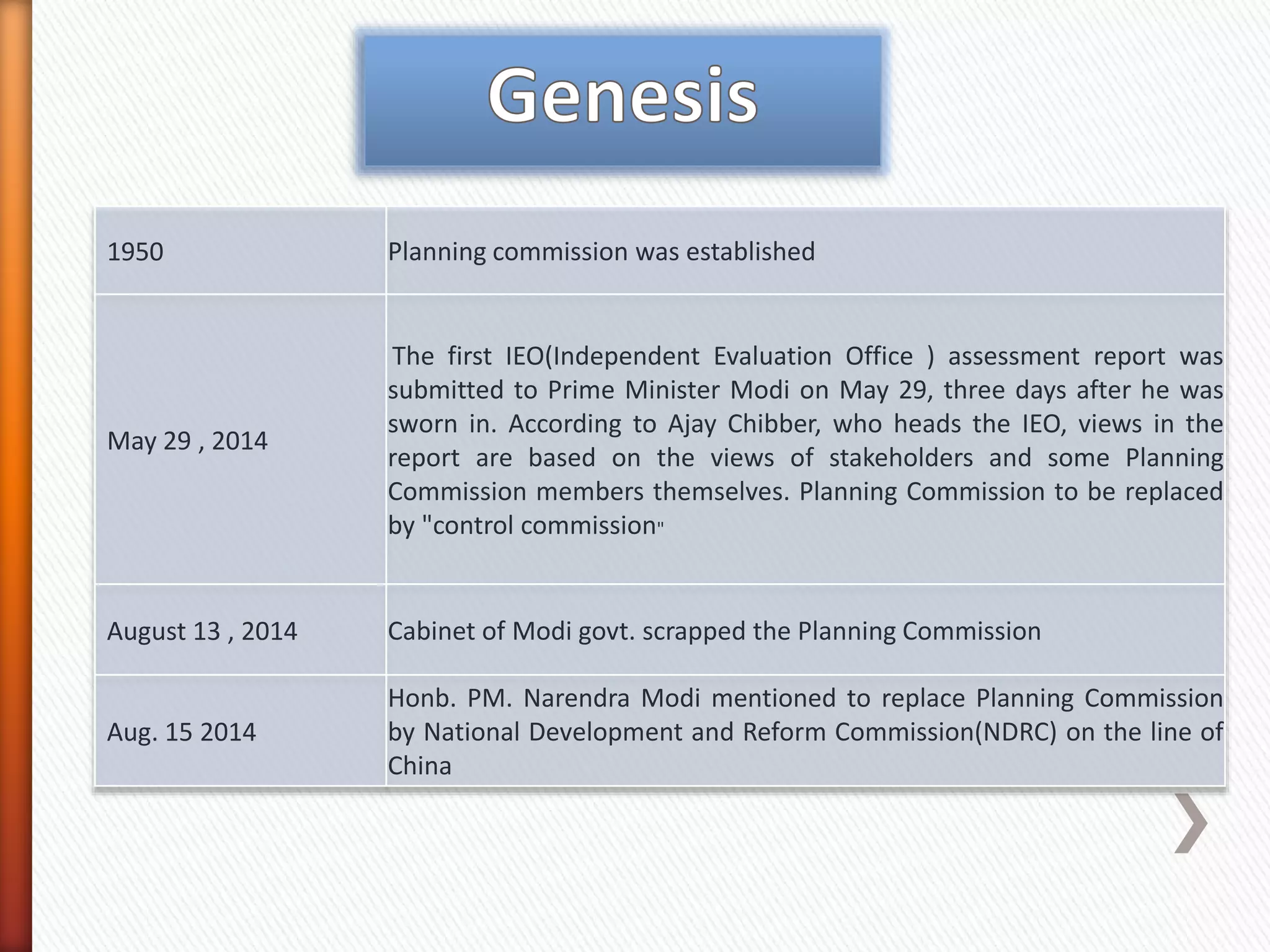
1950 Planning commission was established
May 29 , 2014
The first IEO(Independent Evaluation Office ) assessment report was
submitted to Prime Minister Modi on May 29, three days after he was
sworn in. According to Ajay Chibber, who heads the IEO, views in the
report are based on the views of stakeholders and some Planning
Commission members themselves. Planning Commission to be replaced
by "control commission"
August 13 , 2014 Cabinet of Modi govt. scrapped the Planning Commission
Aug. 15 2014
Honb. PM. Narendra Modi mentioned to replace Planning Commission
by National Development and Reform Commission(NDRC) on the line of
China
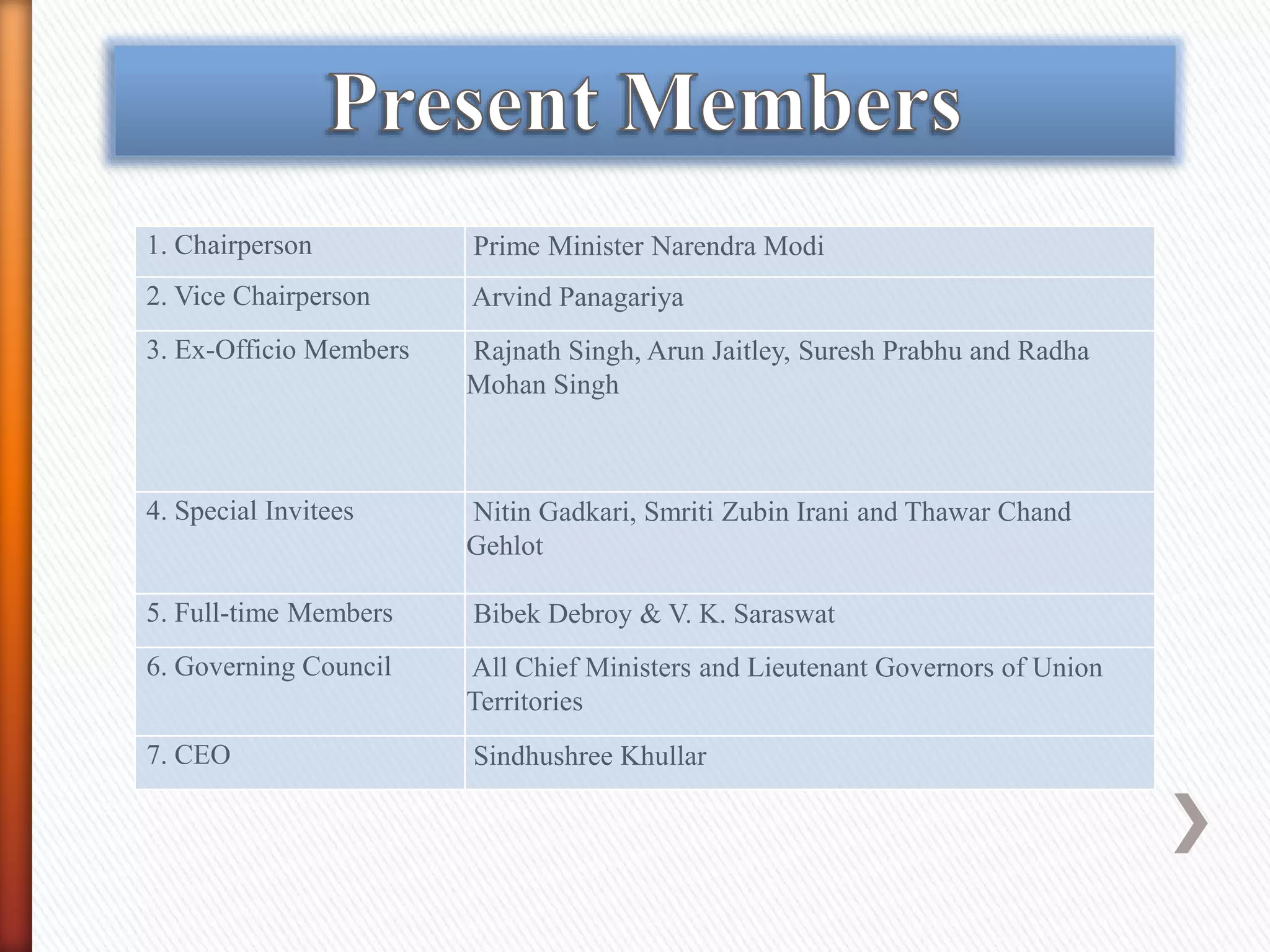
1. Chairperson Prime Minister Narendra Modi
2. Vice Chairperson Arvind Panagariya
3. Ex-Officio Members Rajnath Singh, Arun Jaitley, Suresh Prabhu and Radha
Mohan Singh
4. Special Invitees Nitin Gadkari, Smriti Zubin Irani and Thawar Chand
Gehlot
5. Full-time Members Bibek Debroy & V. K. Saraswat
6. Governing Council All Chief Ministers and Lieutenant Governors of Union
Territories
7. CEO Sindhushree Khullar
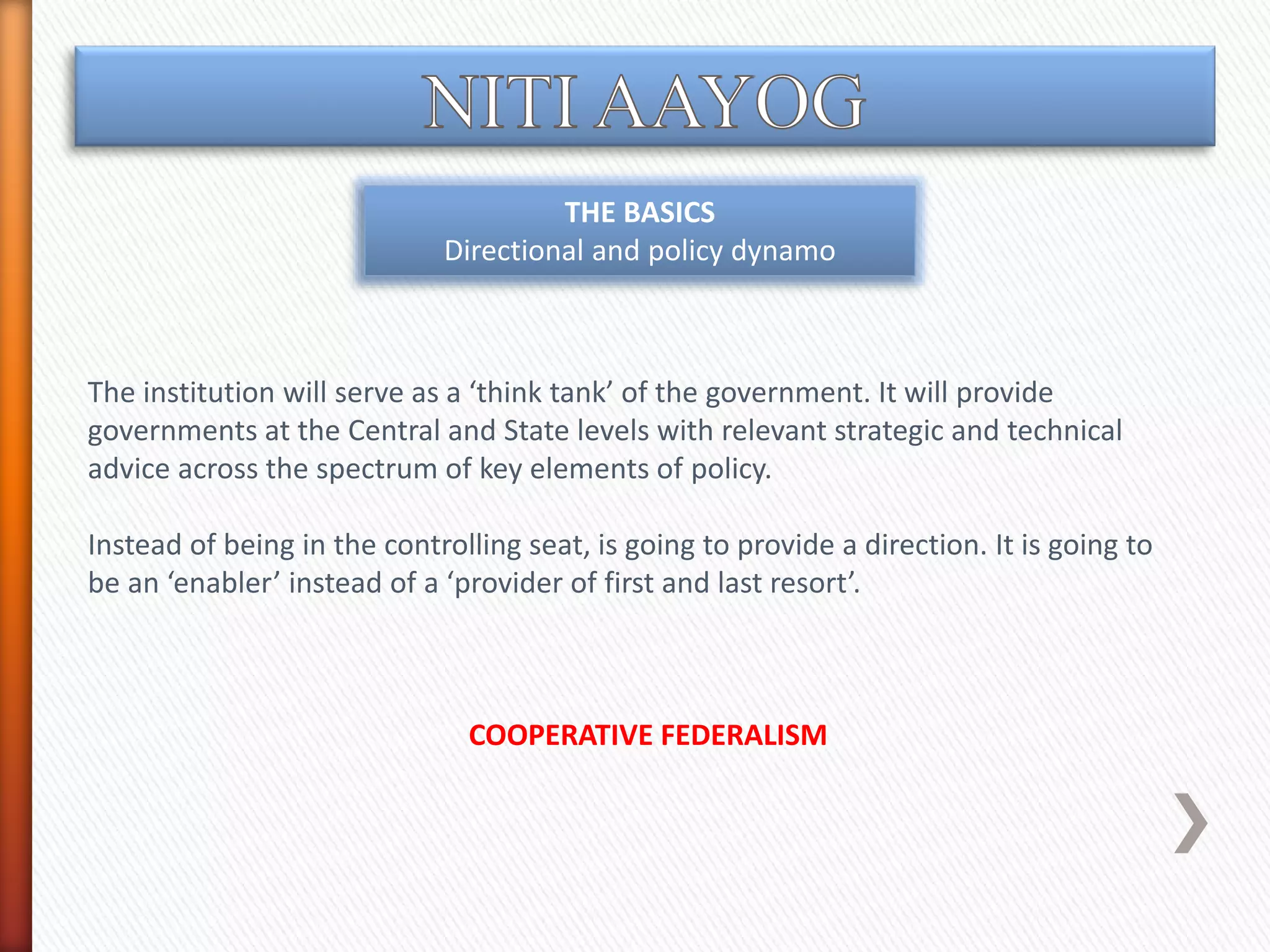
THE BASICS
Directional and policy dynamo
The institution will serve as a ‘think tank’ of the government. It will provide
governments at the Central and State levels with relevant strategic and technical
advice across the spectrum of key elements of policy.
Instead of being in the controlling seat, is going to provide a direction. It is going to
be an ‘enabler’ instead of a ‘provider of first and last resort’.
COOPERATIVE FEDERALISM
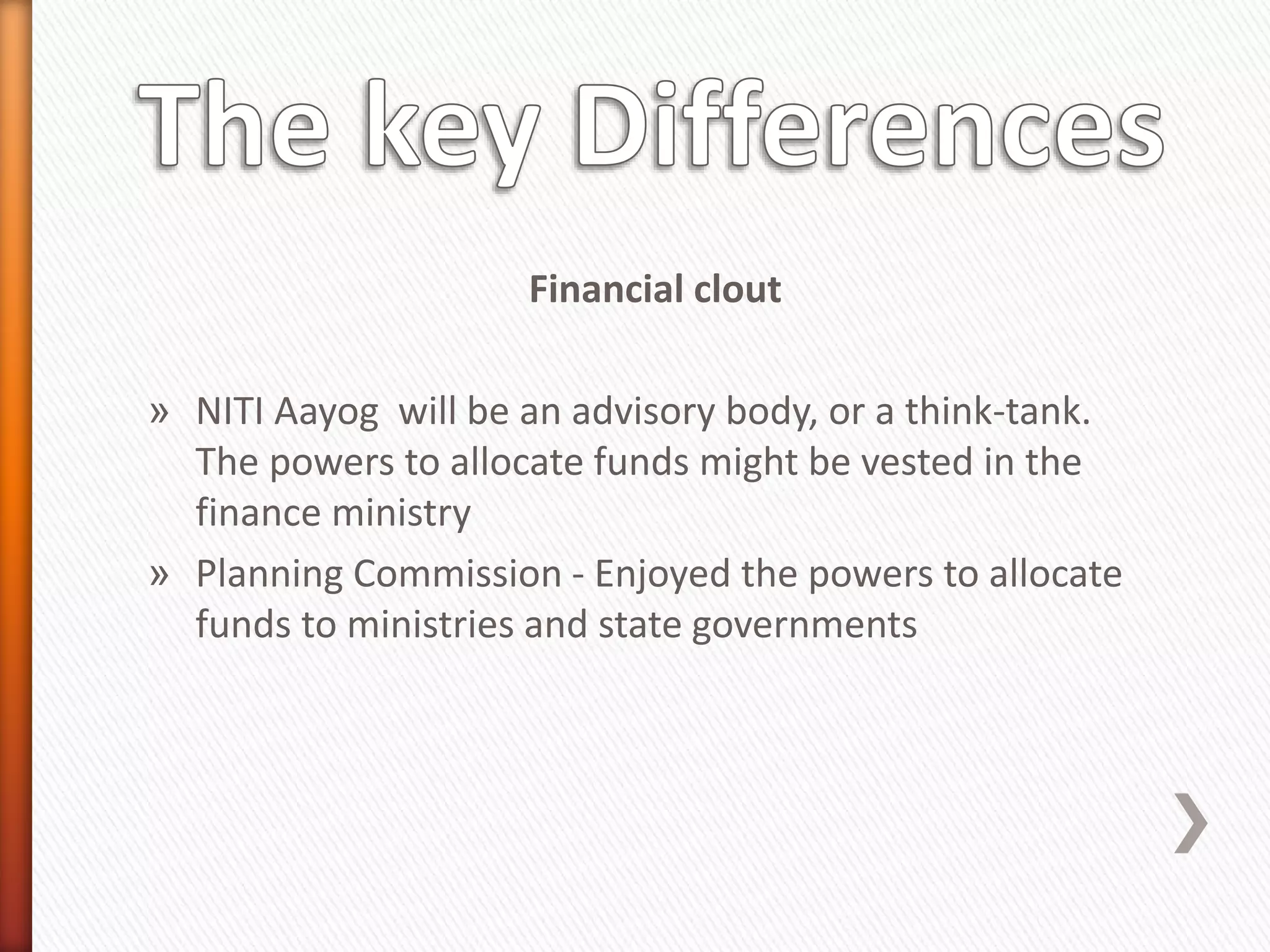
Financial clout
» NITI Aayog will be an advisory body, or a think-tank.
The powers to allocate funds might be vested in the
finance ministry
» Planning Commission - Enjoyed the powers to allocate
funds to ministries and state governments
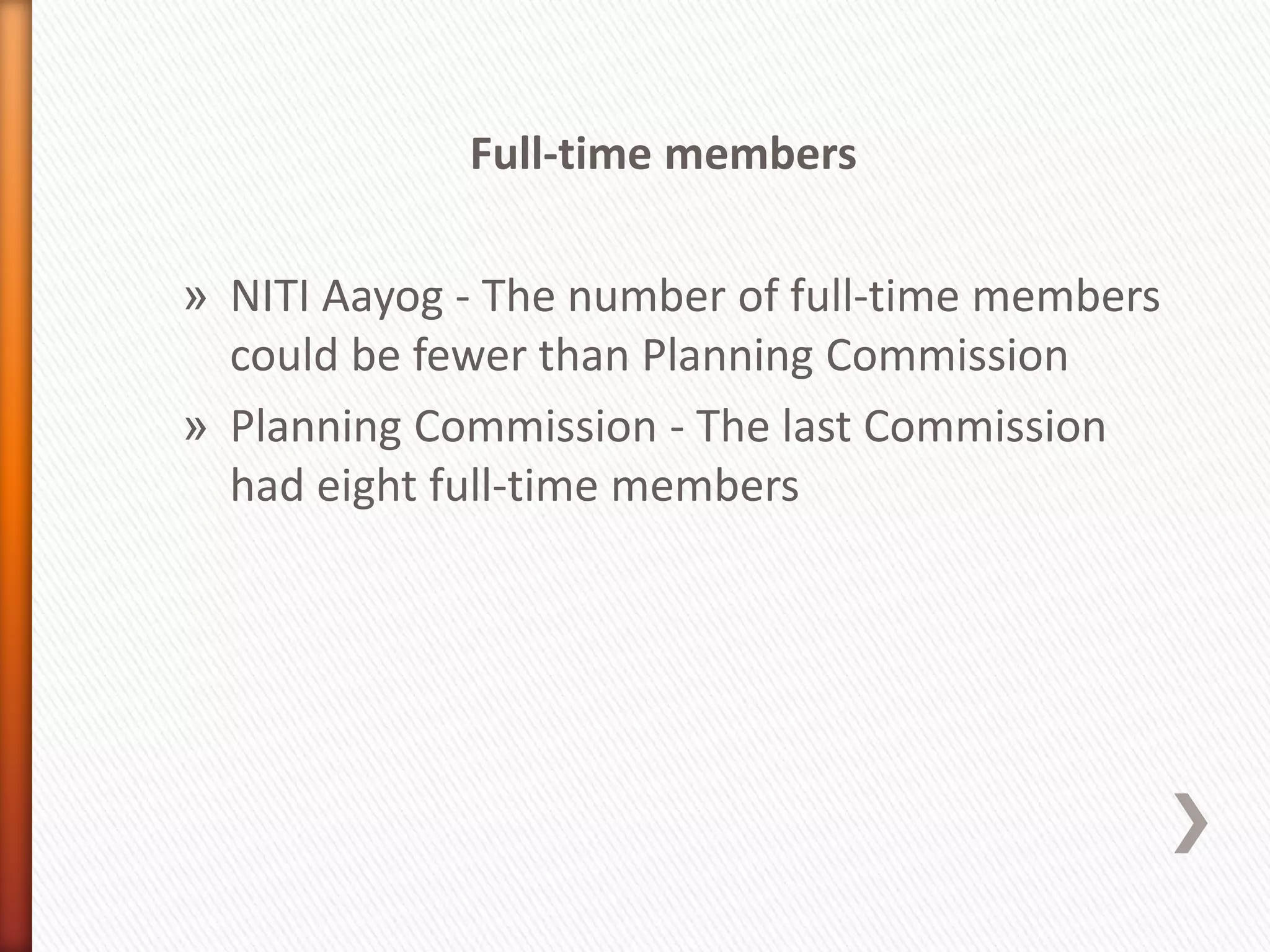
Full-time members
» NITI Aayog - The number of full-time members
could be fewer than Planning Commission
» Planning Commission - The last Commission
had eight full-time members
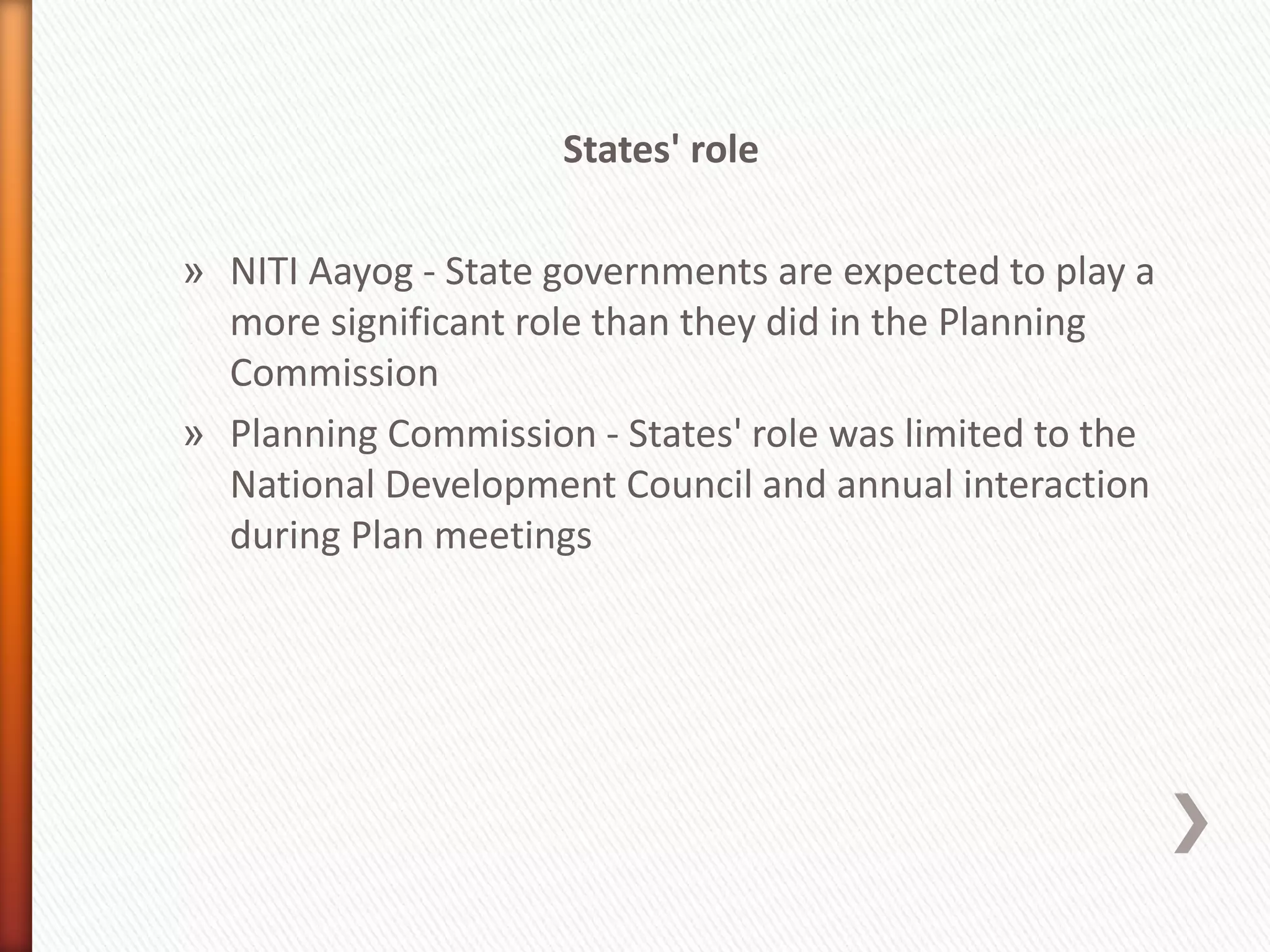
States' role
» NITI Aayog - State governments are expected to play a
more significant role than they did in the Planning
Commission
» Planning Commission - States' role was limited to the
National Development Council and annual interaction
during Plan meetings
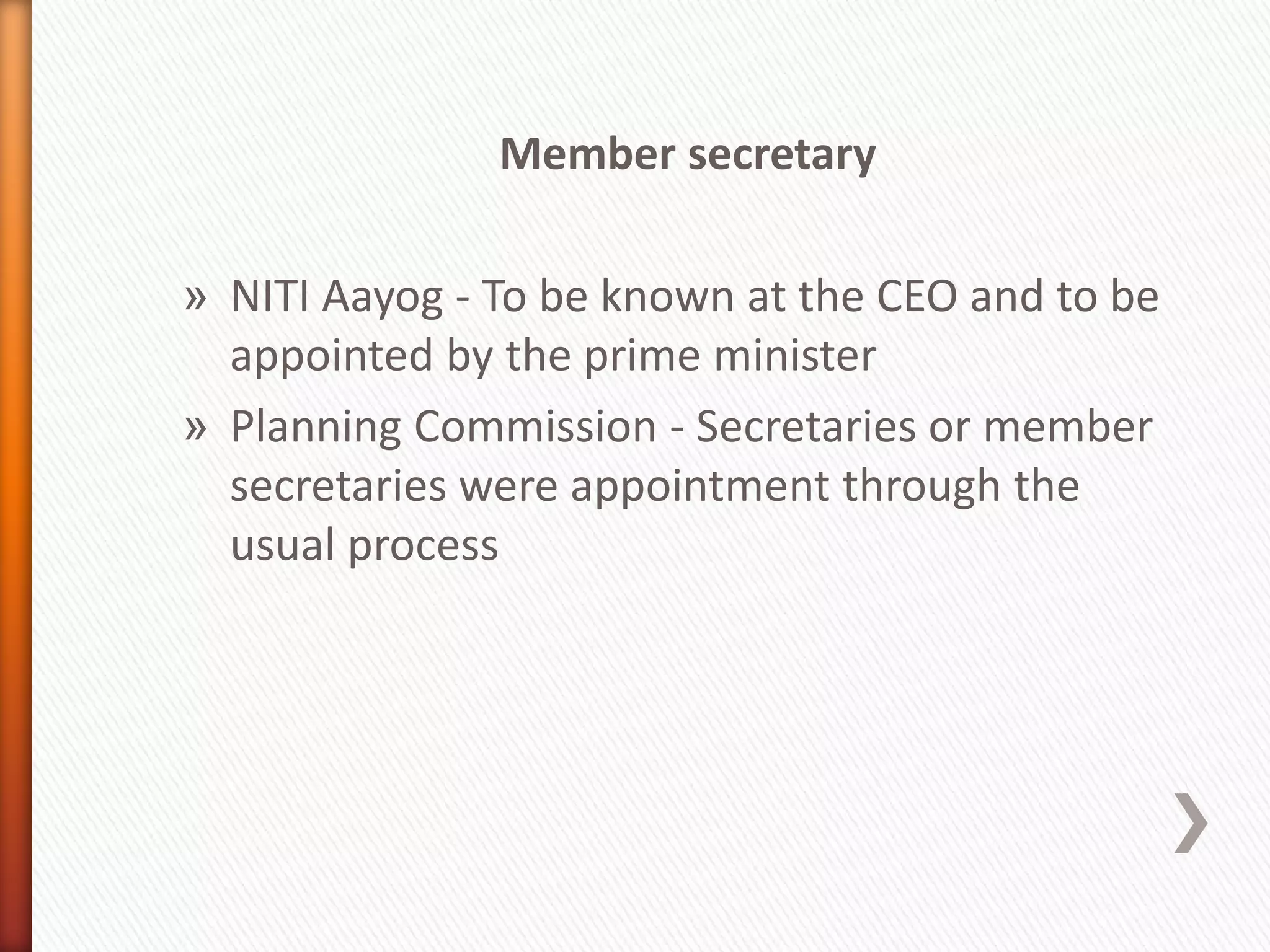
Member secretary
» NITI Aayog - To be known at the CEO and to be
appointed by the prime minister
» Planning Commission - Secretaries or member
secretaries were appointment through the
usual process
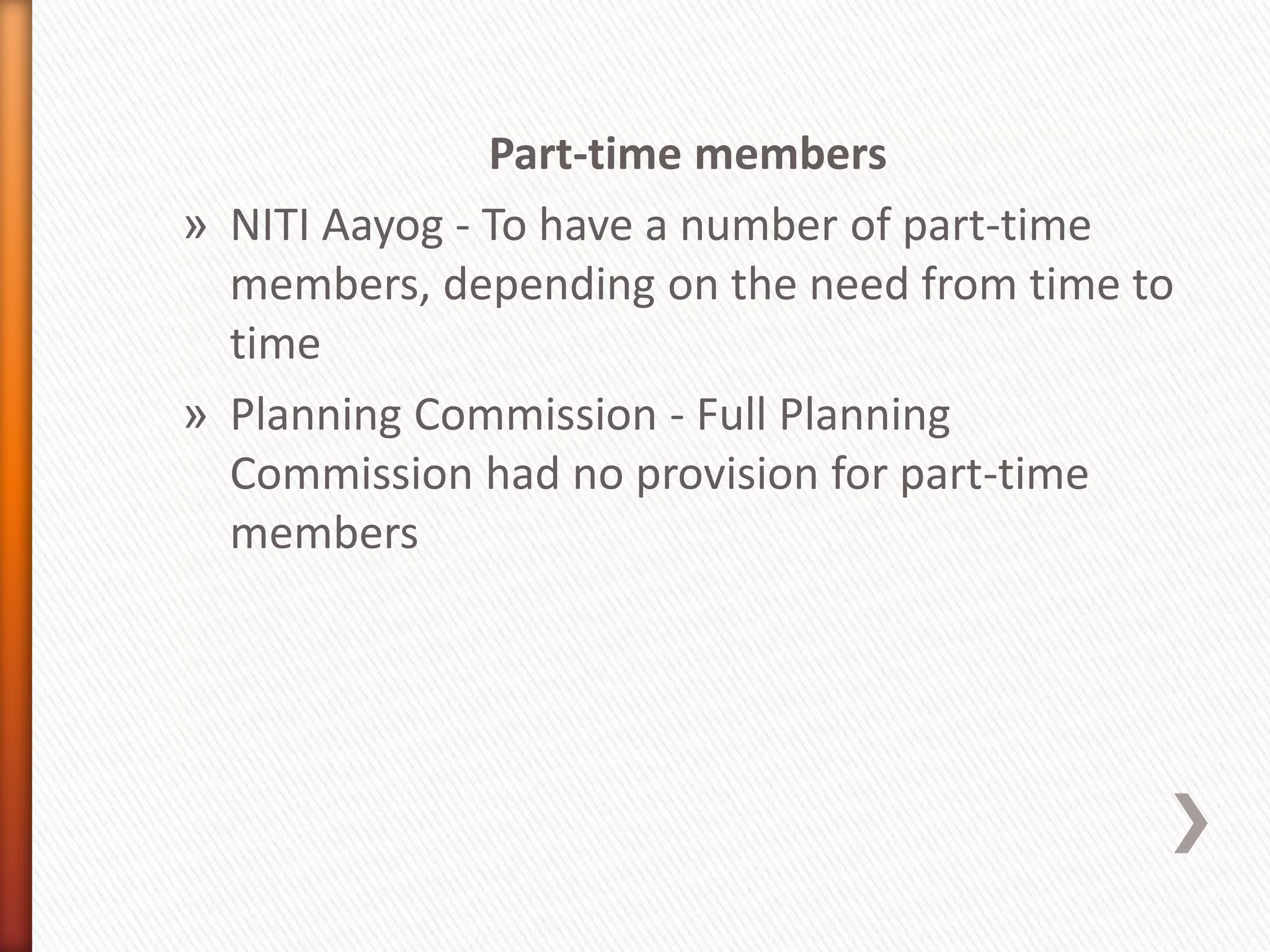
Part-time members
» NITI Aayog - To have a number of part-time
members, depending on the need from time to
time
» Planning Commission - Full Planning
Commission had no provision for part-time
members
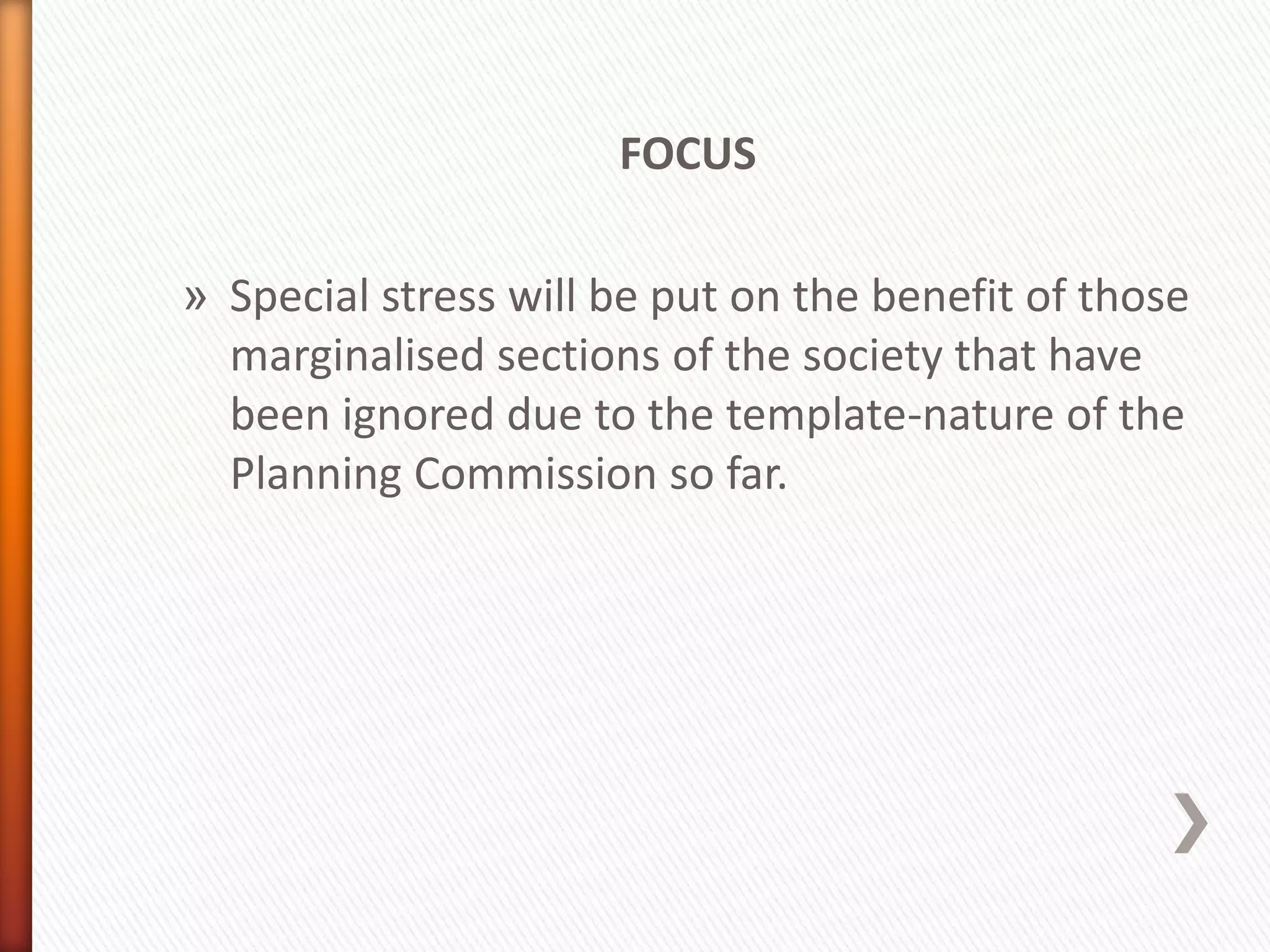
FOCUS
» Special stress will be put on the benefit of those
marginalised sections of the society that have
been ignored due to the template-nature of the
Planning Commission so far.
Constitution
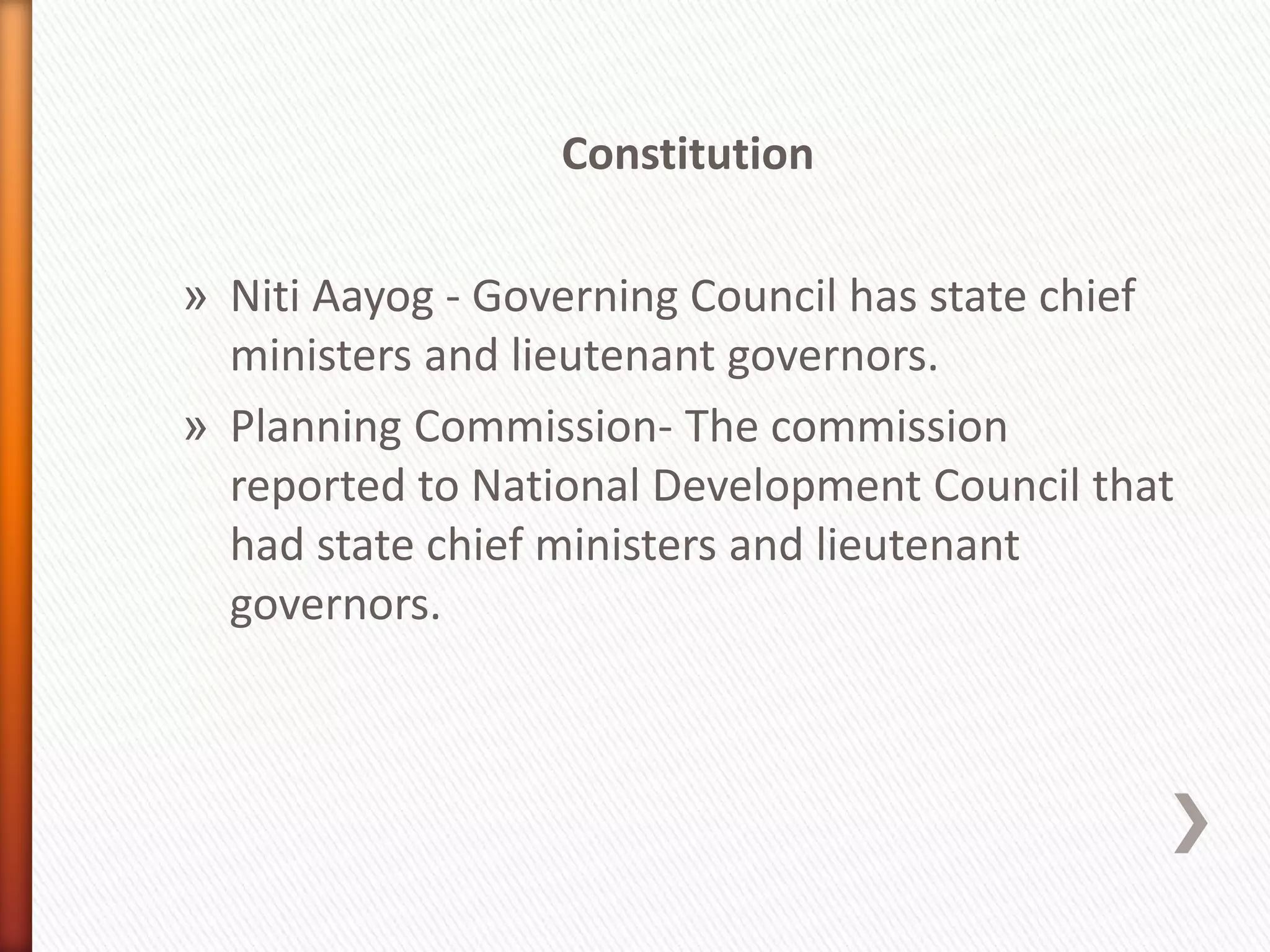
» Niti Aayog - Governing Council has state chief
ministers and lieutenant governors.
» Planning Commission- The commission
reported to National Development Council that
had state chief ministers and lieutenant
governors.
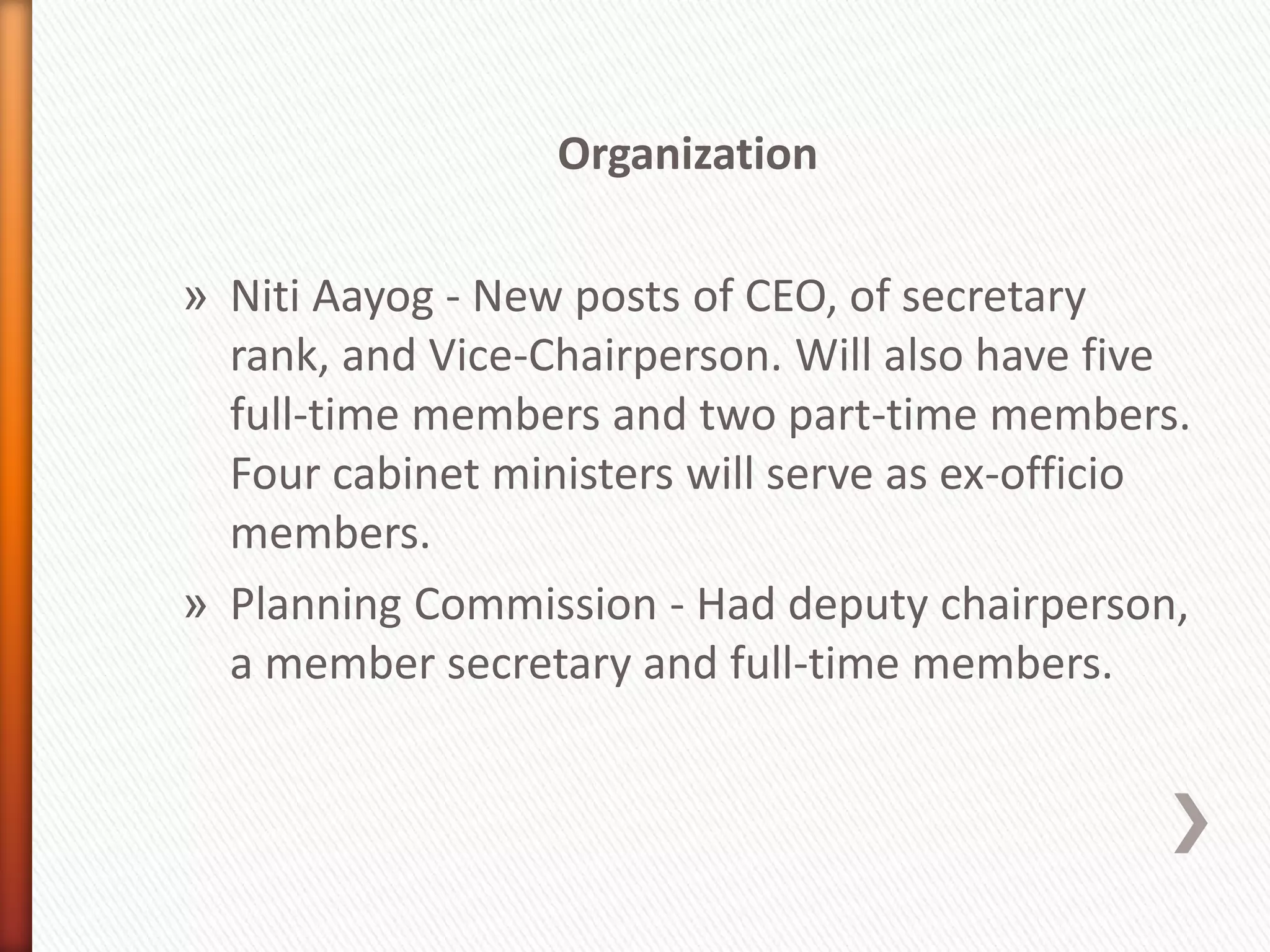
Organization
» Niti Aayog - New posts of CEO, of secretary
rank, and Vice-Chairperson. Will also have five
full-time members and two part-time members.
Four cabinet ministers will serve as ex-officio
members.
» Planning Commission - Had deputy chairperson,
a member secretary and full-time members.
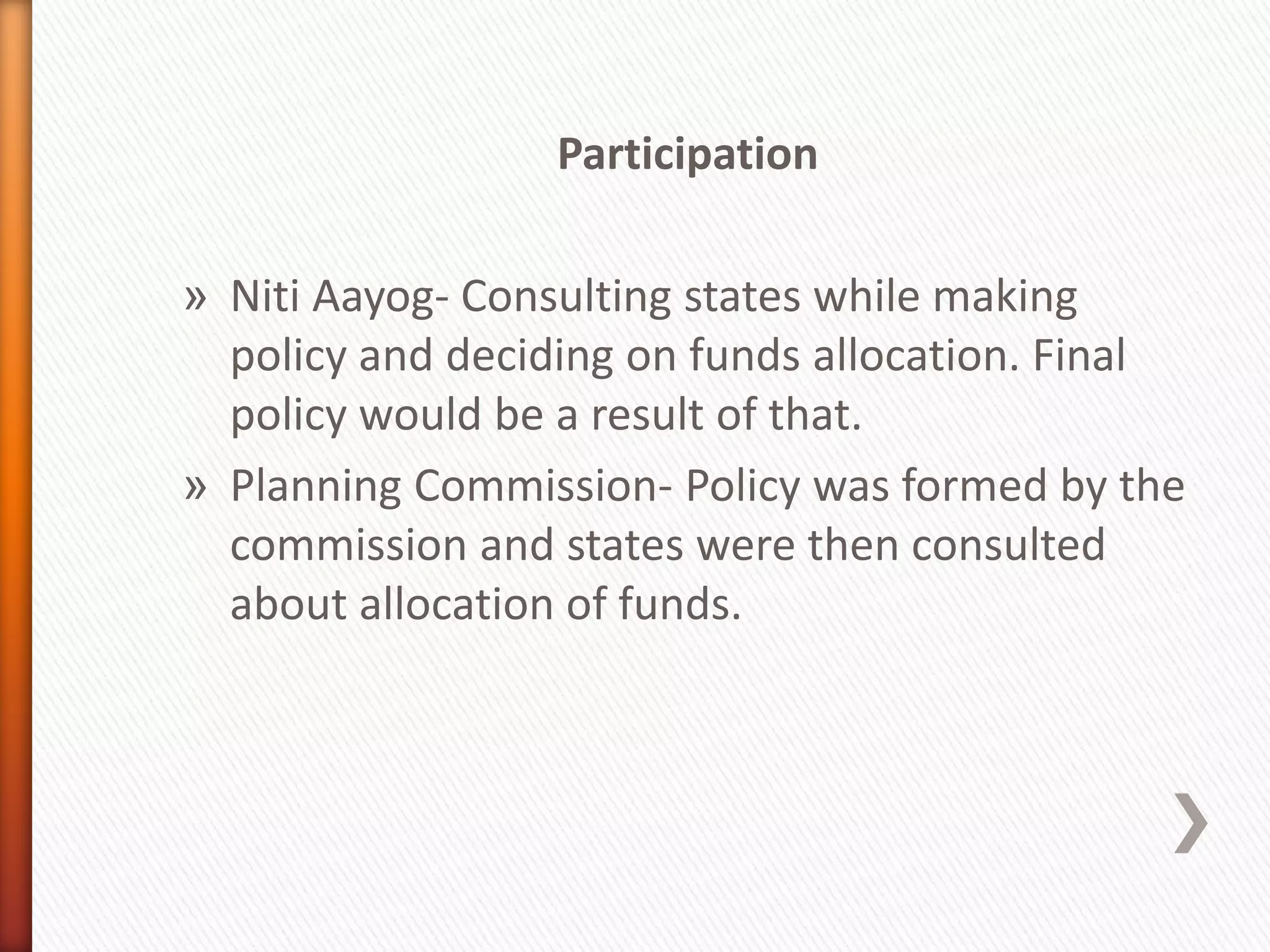
Participation
» Niti Aayog- Consulting states while making
policy and deciding on funds allocation. Final
policy would be a result of that.
» Planning Commission- Policy was formed by the
commission and states were then consulted
about allocation of funds.
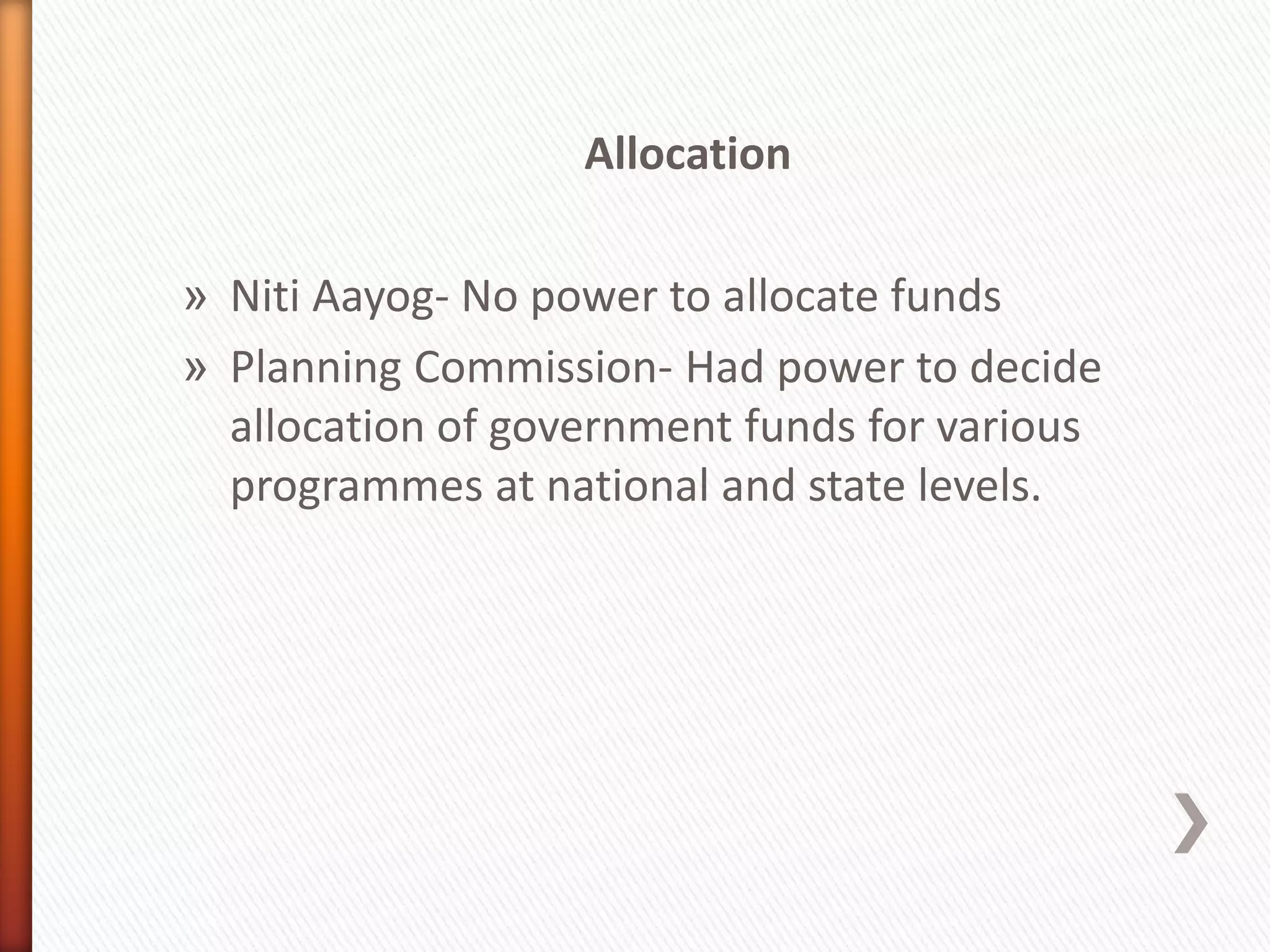
Allocation
» Niti Aayog- No power to allocate funds
» Planning Commission- Had power to decide
allocation of government funds for various
programmes at national and state levels.
Nature
» Niti Aayog- NITI is a think-tank and does not
have the power to impose policies.
» Planning Commission- Imposed policies on
states and tied allocation of funds with projects
it approved.
There is a paradigm shift in the way the policy
formulation and implementation are being
worked out. Instead of being the last resort, the
government will act as an enabler.
( bottoms up approach)
» 1. The new National Institution for Transforming India (NITI) will act more like a think tank or forum, say its
supporters, in contrast with the Commission which imposed five-year-plans and allocated resources to hit set
economic targets.
» 2. NITI will include leaders of India's 29 states and seven union territories. But its full-time staff - a deputy chairman,
Chief Executive Officer and experts - will answer directly to the 64-year-old Prime Minister, who will be chairman.
» 3. The opposition Congress mocked the launch as a cosmetic relabelling exercise - the new body's acronym-based
name means 'Policy Commission' in Hindi, suggesting a less bold departure than the English version does.
» 4. Despite being blamed by critics for the slow growth that long plagued India, the Commission survived the market
reforms of the early 1990s, riling Mr Modi with its interventions when he was Chief minister of industry and investor
friendly Gujarat.
» 5. Mr Modi, elected by a landslide last year on a promise to revive flagging growth and create jobs, had vowed to do
away with the Planning Commission that was set up in 1950 by Congressman and Prime Minister Jawaharlal Nehru.
» 6. But his plans have been derided by the Congress party, which wants to defend the Nehru legacy and describes Mr
Modi's vision of "cooperative federalism" as cover for a veiled power grab.
» 7. India's first Prime Minister Jawaharlal Nehru, a socialist who admired Joseph Stalin's drive to industrialize the
Soviet Union, set up and chaired the Commission to map out a development path for India's agrarian economy.
» 8. In 2012, the Planning Commission was pilloried for spending some Rs. 35 lakh to renovate two office toilets, and
then it was lampooned for suggesting that citizens who spent Rs. 27 or more a day were not poor.
» 9. The commission had remained powerful over the decades because it had emerged as a sort of parallel cabinet
with the Prime Minister as its head.
» 10. The Commission's power in allocating central funds to states and sanctioning capital spending of the central
government was deeply resented by states and various government departments.

Niti aayog and planning commission

  • 2.
    The Planning Commissionwas an institution formed in March 15 1950 by Government of India, which formulated India's Five-Year Plans, among other functions. It was established in accordance with article 39 of the constitution which is a part of directive principles of state policy. An Overview
  • 3.
    1950 Planning commissionwas established May 29 , 2014 The first IEO(Independent Evaluation Office ) assessment report was submitted to Prime Minister Modi on May 29, three days after he was sworn in. According to Ajay Chibber, who heads the IEO, views in the report are based on the views of stakeholders and some Planning Commission members themselves. Planning Commission to be replaced by "control commission" August 13 , 2014 Cabinet of Modi govt. scrapped the Planning Commission Aug. 15 2014 Honb. PM. Narendra Modi mentioned to replace Planning Commission by National Development and Reform Commission(NDRC) on the line of China
  • 4.
    1. Chairperson PrimeMinister Narendra Modi 2. Vice Chairperson Arvind Panagariya 3. Ex-Officio Members Rajnath Singh, Arun Jaitley, Suresh Prabhu and Radha Mohan Singh 4. Special Invitees Nitin Gadkari, Smriti Zubin Irani and Thawar Chand Gehlot 5. Full-time Members Bibek Debroy & V. K. Saraswat 6. Governing Council All Chief Ministers and Lieutenant Governors of Union Territories 7. CEO Sindhushree Khullar
  • 5.
    THE BASICS Directional andpolicy dynamo The institution will serve as a ‘think tank’ of the government. It will provide governments at the Central and State levels with relevant strategic and technical advice across the spectrum of key elements of policy. Instead of being in the controlling seat, is going to provide a direction. It is going to be an ‘enabler’ instead of a ‘provider of first and last resort’. COOPERATIVE FEDERALISM
  • 6.
    Financial clout » NITIAayog will be an advisory body, or a think-tank. The powers to allocate funds might be vested in the finance ministry » Planning Commission - Enjoyed the powers to allocate funds to ministries and state governments
  • 8.
    Full-time members » NITIAayog - The number of full-time members could be fewer than Planning Commission » Planning Commission - The last Commission had eight full-time members
  • 9.
    States' role » NITIAayog - State governments are expected to play a more significant role than they did in the Planning Commission » Planning Commission - States' role was limited to the National Development Council and annual interaction during Plan meetings
  • 10.
    Member secretary » NITIAayog - To be known at the CEO and to be appointed by the prime minister » Planning Commission - Secretaries or member secretaries were appointment through the usual process
  • 11.
    Part-time members » NITIAayog - To have a number of part-time members, depending on the need from time to time » Planning Commission - Full Planning Commission had no provision for part-time members
  • 12.
    FOCUS » Special stresswill be put on the benefit of those marginalised sections of the society that have been ignored due to the template-nature of the Planning Commission so far.
  • 13.
    Constitution » Niti Aayog- Governing Council has state chief ministers and lieutenant governors. » Planning Commission- The commission reported to National Development Council that had state chief ministers and lieutenant governors.
  • 14.
    Organization » Niti Aayog- New posts of CEO, of secretary rank, and Vice-Chairperson. Will also have five full-time members and two part-time members. Four cabinet ministers will serve as ex-officio members. » Planning Commission - Had deputy chairperson, a member secretary and full-time members.
  • 15.
    Participation » Niti Aayog-Consulting states while making policy and deciding on funds allocation. Final policy would be a result of that. » Planning Commission- Policy was formed by the commission and states were then consulted about allocation of funds.
  • 16.
    Allocation » Niti Aayog-No power to allocate funds » Planning Commission- Had power to decide allocation of government funds for various programmes at national and state levels.
  • 17.
    Nature » Niti Aayog-NITI is a think-tank and does not have the power to impose policies. » Planning Commission- Imposed policies on states and tied allocation of funds with projects it approved.
  • 18.
    There is aparadigm shift in the way the policy formulation and implementation are being worked out. Instead of being the last resort, the government will act as an enabler. ( bottoms up approach)
  • 19.
    » 1. Thenew National Institution for Transforming India (NITI) will act more like a think tank or forum, say its supporters, in contrast with the Commission which imposed five-year-plans and allocated resources to hit set economic targets. » 2. NITI will include leaders of India's 29 states and seven union territories. But its full-time staff - a deputy chairman, Chief Executive Officer and experts - will answer directly to the 64-year-old Prime Minister, who will be chairman. » 3. The opposition Congress mocked the launch as a cosmetic relabelling exercise - the new body's acronym-based name means 'Policy Commission' in Hindi, suggesting a less bold departure than the English version does. » 4. Despite being blamed by critics for the slow growth that long plagued India, the Commission survived the market reforms of the early 1990s, riling Mr Modi with its interventions when he was Chief minister of industry and investor friendly Gujarat. » 5. Mr Modi, elected by a landslide last year on a promise to revive flagging growth and create jobs, had vowed to do away with the Planning Commission that was set up in 1950 by Congressman and Prime Minister Jawaharlal Nehru. » 6. But his plans have been derided by the Congress party, which wants to defend the Nehru legacy and describes Mr Modi's vision of "cooperative federalism" as cover for a veiled power grab. » 7. India's first Prime Minister Jawaharlal Nehru, a socialist who admired Joseph Stalin's drive to industrialize the Soviet Union, set up and chaired the Commission to map out a development path for India's agrarian economy. » 8. In 2012, the Planning Commission was pilloried for spending some Rs. 35 lakh to renovate two office toilets, and then it was lampooned for suggesting that citizens who spent Rs. 27 or more a day were not poor. » 9. The commission had remained powerful over the decades because it had emerged as a sort of parallel cabinet with the Prime Minister as its head. » 10. The Commission's power in allocating central funds to states and sanctioning capital spending of the central government was deeply resented by states and various government departments.