
Contemporary South Asia.pptx
•Download as PPTX, PDF•
5 likes•7,534 views

South Asia faces many political and social issues that challenge stable democracy and regional cooperation. Major points of conflict include territorial disputes like Kashmir, water sharing tensions, and ethnic conflicts. While countries like India, Sri Lanka, and Bangladesh have established democratic systems, others like Pakistan have faced repeated military coups. Regional cooperation through SAARC has been limited by political differences. Both China and the US now exert growing influence in South Asia.

More Related Content
What's hot
What's hot (20)
Similar to Contemporary South Asia.pptx
Similar to Contemporary South Asia.pptx (20)
More from AnilMishra180
Recently uploaded
Recently uploaded (20)
Contemporary South Asia.pptx
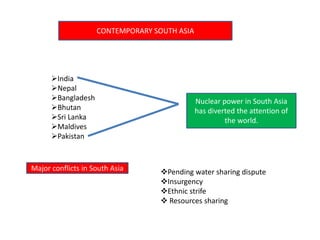
- 1. CONTEMPORARY SOUTH ASIA India Nepal Bangladesh Bhutan Sri Lanka Maldives Pakistan Nuclear power in South Asia has diverted the attention of the world. Major conflicts in South Asia Pending water sharing dispute Insurgency Ethnic strife Resources sharing
- 2. SOUTH ASIA
- 3. “Ours is a region where rivalry and goodwill, hope and despair, mutual suspicion and trust coexist.” What is South Asia? Natural insularity (South Asian Nations are naturally protected by mother Nature) Boundaries are not much clear as between India and China, Myanmar and Afghanistan. Diversity Aspirations for democracy
- 4. India &Sri Lanka Democracies throughout since Independence . Bangladesh Post cold war – Civilian Govt. Pakistan Civilian (Government elected by people)& Military rule as Benazir Bhutto , Nawaz Sarif. 1999-Military coup by Parvez Musarraf and now from 2008 Civilian Govt. Nepal Till-2006 Constitutional Monarchy 2008- Monarchy was abolished and Nepal became democratic republic. Bhutan 2008 Constitutional monarchy with multiparty system. Maldives Saltanate rule till 1968. after 1968 It became republic and presidential system. And 2005 followed multiparty system. MDP (Maldivepian Democratic Party) Countries Features
- 5. THE MILITARY DEMOCRACY IN PAKISTAN General Ayub Khan – He became the ruler after naming in fraud election and there was a great disapproval and dissatisfaction by the people and he was removed. General Yahya Khan- He became ruler in 1971 during the Bangladesh crisis and India –Pakistan war. Julfikarali Bhutto- Elected in 1971-1977 General Ziaul Haq- He removed elected government and became ruler He faced pro-democratic movement in 1982 and removed. Benazir Bhutto- Elected in 1988 where there was competition in two major party Pakistan’s people party and Muslim League.She belonged to Pakistan people’s party. Nawaz Sarif – Democratic ruler from Muslim League elected to rule. General Parwage Mussarraf- He set up military coup in 1999 to 2008.(Military rule)( Changed the constitution and became president through referendum) There is now elected civilian government since 2008 in Pakistan.
- 6. REASONS FOR FAILURE OF STABLE DEMOCRACY Social dominance of military/ clergy and landowning aristocrats War between India and Pakistan had made pro military powerful groups Political parties are failure in Pakistan Pakistan security flawed by selfish chaotic parties Lack of gaining international support for democratic rule in Pakistan. People have strong democracy sentiments. Courageous and relatively free press. Strong human rights movements.
- 7. DEMOCRACY IN BANGLADESH 1947-71 Pakistan West Pakistan East Pakistan It was separated from Punjab Sindh provinces and North west frontier. Major language spoken was urdu Ruled by General Yahya Khan (Military Rule) It was separated from Assam and Bengal. Bangla was the major language She Ikh Muzib -ur Rahman from Awami League.
- 8. REASONS FOR THE DEMAND OF EAST PAKISTAN Fair representation Autonomy Right to practice Bengali culture and language Protest against unfair treatment Resented imposition of Urdu language ROLE OF MUZIB-UR-REHMAN He led popular struggle against west Pakistan domination. Demand of autonomy During 1970 elections all seats won by him in East Pakistan Secured majority in proposed constituent assembly (In complete Pakistan) Dominating west Pakistan leadership Refused to convince the assembly Muzib-Ur-Rehman was arrested Suppressing the movement
- 9. CONFRONTATIONS Government of Pakistan sent its army to suppress the movement demanding East Pakistan . More than 1000 people were killed by Pakistan army in 1971 and mostly were Hindus More than 80 lakhs refugees migrated from East Pakistan to India. India had burdened of refugees and helped east Pakistan financially and militarily to get it independent. In December-1971 there was war between India and Pakistan where the Pakistan army surrendered before the Indian army and East Pakistan was declared an independent country (Bangladesh)
- 10. CONSTITUTION FOR BANGLADESH-1972 Features Secularism Socialism Democracy She-Ikh –Muzib-Ur-Rehman amended the constitution in 1975 and changed it from Parliamentary to Presidential form of Government in Bangladesh . He also abolished all political parties except his own party Awami league which raised tensions and conflicts in the country. She-Ikh-Muzib-Ur-Rehman was assassinated in August 1975 in military upspring.
- 11. NEW LEADER IN THE COUNTRY ZIAUR REHMAN New military ruler Won election in 1979 Formed his own party Bangladesh National Party (BNP) He was also assassinated
- 12. Lt. General HM Irshad Military ruler who take over the country People demanded for democracy specially students union protested against military rule. He allowed political activities on limited scale. Later he was elected as a president for five years by using unfair means. There was a mass public movement against the Government ans in 1990 he resigned . 1991 Bangladesh adopted multiparty system since then there is democracy.
- 13. MONARCHY AND DEMCRACY IN NEPAL MONARCHY HINDU KINGDOM CONSTITUTIONAL MONARCHY PEOPLE DEMANDED TO HAVE OPEN AND RESPONSIBLE SYSTEM KING RESTRICTED DEMOCRACY AND SUPPRESS THE MOVEMENT BY NEPALI ARMY THERE WAS A STRONG PRO- DEMOCRATIC MOVEMENT
- 14. SPREAD OF MAOIST IDEOLOGY -1990s IN NEPAL Maoist had the ideology of resurrection of arms against the monarchy and in the favour of poor people . They wanted to restructure the political and economic system in Nepal. There were three groups people who were demanding monarchy , people those who support Maoist ideology ant third people who wanted to setup democracy. In 2002 King of Nepal abolished parliament and dismissed the government. After four years in 2006 there was a massive protest for democracy in Nepal in that movement different leaders and three important groups participated actively. Maoist, Social activist and SPA. Because of this mass movement the king had to restore the parliament in Nepal. In 2007 the constituent assembly was formed and in 2008 Nepal became democratic country. Nepal introduced its new constitution in 2015.
- 15. ETHNIC CONFLICTS AND DEMOCRACY IN SRILANKA Sri Lanka became Independent-1948 Since independence there was a serious challenges of ethnic conflicts and demand for equal rights. There was no concessions for Tamils Sinhala dominated in Sri Lanka Neglected of concerns Militant Tamil Nationalism- 1983-2009 LITTE- Liberation Tiger of Tamil Eelam V/S Srilankan Army Demand Tamil Eelam (North East parts of Sri Lanka)
- 16. ROLE OF INDIA TO SAVE INDIAN TAMILS IN SRI LANKA Tamils were origin of India and migrated to SriLanka and fighting for rights. Indian Government tried to negotiate with SriLankan Government on this issues. Tamils in Sri Lanka were pressurizing Indian government to get their problems solved. 1987 – Direct involvement of India in SriLankan internal affaires. LITTE V/S INDIAN ARMY. 1987-1989- IPKF (INDIAN PEACE KEEPING FORCE ) Deployed to SriLanka.
- 17. In 1989 IPKF was pulled out to India without achieving the goals. There were several obligations were made on IPKF. To suppress the violence Norway and Scandinavian countries also played important role. SriLanka after-2009 There was economic growth and human development Fast developing country and successfully controlled the population growth. Highest PCI and HDI ranking Better GDP First country in the region to liberalise economy Democratic political system
- 18. INDIA –PAKISTAN CONFLICTS (KASHMIR ISSUE)
- 19. INDIA –PAKISTAN WAR 1947 1965 UNSETTLED 1971 1999 SIACHEN GLACIER AND ARM RACE 1990-1998 Both The Countries Pakistan and India became nuclear power.
- 20. INDIA BLAMES PAKISTAN Pakistan helps kashmiri militants and provides weapons and trainings money protection to carry out terrorist activities against India. Aided pro khalistani militants with arms and manumission during 1985-1995 Anti India campaign in NE through Bangladesh and Nepal by ISI (Inter Services Intelligence) PAKISTAN BLAIMS INDIA India creates all troubles in Sindh and Baluchistan provinces of Pakistan.
- 21. INDUS RIVER WATER DISPUTE
- 22. Dispute over Demarcation line in sir creek , run of kutch. There is disputes between India and Sri Lanka for sea resources.
- 23. INDIA AND OTHER NEIGHBOURS INDIA AND BANGLADESH RELATION Rivers water disputes (Ganga and Brahmaputra) Bengladesh denial of illegal immigrants to India Bangladesh supports for ani-Indian Islamic fundamentalist groups. Bangladesh refused travelling rute for the Indian troops . Refused to export natural gas from Myanmar via Bangladesh to India. BANGLADESH TO INDIA Regional bully , interfere into internal affairs of Bangladesh Get the supply of NG illegally Unfair in trade
- 24. COOPERATIONS India look east policy where Bangladesh helped India to maintain relation with eastern neighbor Myanmar. To solve the problems related disaster (Natural hazards) in management. Identify common treats INDIA AND NEPAL RELATION INDIA TO NEPAL Trade related disputes in ports Inaction against anti-Indian campaign Maoist movement Rise of naxalist group in adjoining states
- 25. NEPAL TO INDIA Interference in internal affairs. Nepal wants ports facilities as it is land locked. COOPERATION No visa and passport Scientific cooperation We share common natural resources Both are democratic countries INDIA AND SRILANKS RELATION India signed on FTA (Free Trade Agreement) with SriLanka 1987 treaty was signed not to interfere into the internal affairs of Srilanka Reconstruction after Tsunami in SriLanka
- 26. INDIA AND BHUTAN RELATION Himalayan kingdom No more conflicts with India Trying to suppress naxalist movement and Gurilla militants in North East and helping India. India give aid for the development like hydroelectric projects. INDIA AND OTHE PROBLEMS WITH NEIGHBOURS Migrants from Nepal and Bhutan Rohingyas from Myanmar River water disputes from Nepal and Bangladesh
- 27. SAARC NATIONS (SOUTH ASIA ASSOCIATION AND REGIONAL COOPERATION -1985 Major regional initiatives through multilateral means Not much success due to political differences SAFTA agreement was signed in 2004 (South Asian Free Trade Agreement) Some bilateral and multilateral agreement related trade were signed CHINA AND USA INFLUENCE After 1991 there is a great influence in South Asia