➢What colonial rule meant to those who lived
in the countryside.
➢Colonialism how affected-
1. zamindars of Bengal,
2. Rajmahal hills where the Paharias and the
Santhals lived, and then
3. Deccan
1. English East India Company (E.I.C.)
established its raj in the countryside,
2. implemented its revenue policies,
3. what these policies meant to different
sections of people,
4. and how they changed everyday lives.
• Colonialism is the establishment of a colony in one
territory by a political power from another territory,
and the subsequent maintenance, expansion, and
exploitation of that colony.
• The European colonial period was the era from
the 16th century to the mid-20th century when
several European powers established colonies
in Asia, Africa, and the Americas.
• *Countryside – Rural areas, far away areas.
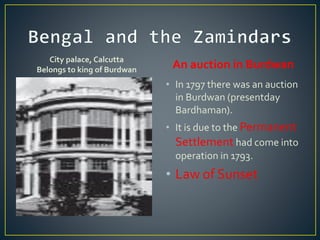
City palace, Calcutta
Belongs to king of Burdwan An auction in Burdwan
• In 1797 there was an auction
in Burdwan (presentday
Bardhaman).
• It is due to the Permanent
Settlement had come into
operation in 1793.
• Law of Sunset
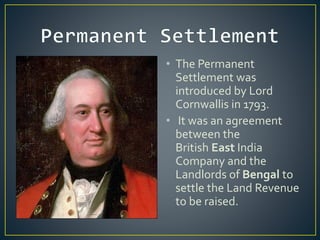
• The Permanent
Settlement was
introduced by Lord
Cornwallis in 1793.
• It was an agreement
between the
British East India
Company and the
Landlords of Bengal to
settle the Land Revenue
to be raised.
• it recognized the landlords as the proprietors of the land.
• They should collect land revenue from the people and
deposit it at the government treasury regularly for all
times.
• All their rights ended if they failed to pay.
• It was agreed that the tax rate would not increase in
future.
• By the 1770s, the rural economy in Bengal was in crisis.
• Officials felt that agriculture, trade and the revenue
resources of the state could all be developed by
encouraging investment in agriculture.
1. The initial demands were very high.
2. This high demand was imposed in the 1790s, a time
when the prices of agricultural produce were
depressed, making it difficult for the ryots to pay
their dues to the zamindar.
3. The revenue was invariable, regardless of the
harvest, and had to be paid punctually.
4. The Permanent Settlement initially limited the
power of the zamindar to collect rent from the ryot
and manage his zamindari.
• The Company had recognised the zamindars as important,
but it wanted to control and regulate them subdue their
authority and restrict their autonomy.
• The zamindars’ troops were disbanded.
• customs duties abolished,
• their “cutcheries” (courts) brought under the supervision of a
Collector appointed by the Company.
• Zamindars lost their power to organise local justice and the
local police.
• Over time the collectorate emerged as an alternative centre
of authority.
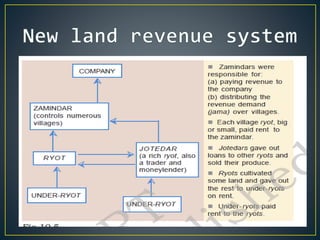
• A group of rich peasants were consolidating their position in
the villages.
• By the early nineteenth century, jotedars had acquired vast
areas of land.
• They controlled local trade as well as moneylending,
exercising immense power over the poorer cultivators of the
region.
• A large part of their land was cultivated through
sharecroppers (adhiyars or bargadars) who brought their own
ploughs, laboured in the field, and handed over half the
produce to the jotedars.
• 1.They lived in villages. So, they had a lot of
influence on many villages.
• 2.They opposed the efforts of the Zamindars to
increase the jama of the village.
• 3. prevented zamindari officials from executing their
duties.
• 4. mobilised ryots who were dependent on them, and
deliberately delayed payments of revenue to the
zamindar.
• 5.They even purchased land when the estates of the
Zamindars were being auctioned for failure to make
payment of the revenue.
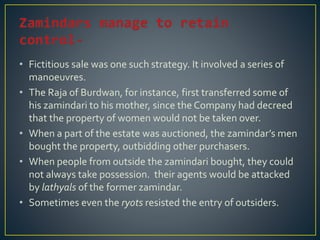
• Fictitious sale was one such strategy. It involved a series of
manoeuvres.
• The Raja of Burdwan, for instance, first transferred some of
his zamindari to his mother, since the Company had decreed
that the property of women would not be taken over.
• When a part of the estate was auctioned, the zamindar’s men
bought the property, outbidding other purchasers.
• When people from outside the zamindari bought, they could
not always take possession. their agents would be attacked
by lathyals of the former zamindar.
• Sometimes even the ryots resisted the entry of outsiders.
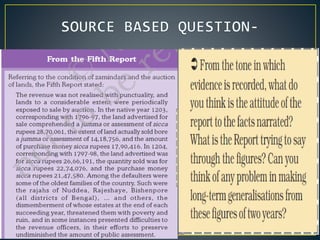
• A report that was submitted to the British Parliament in 1813.
• It was the fifth of a series of reports on the administration and
activities of the East India Company in India.
• The Report’s 800 pages were the appendices that reproduced the
petitions of zamindars and ryots,reports of collectors from various
districts, statistical tables on revenue returns and notes on
revenue and judicial administration of Bengal and Madras.
• Many political groups argued that the conquest of Bengal was
benefiting only the East India Company but not the British nation
as a whole.
• They indicate that, intent on criticizing the maladministration of
the company, the Fifth Report exaggerated the collapse of
traditional zamindari power.
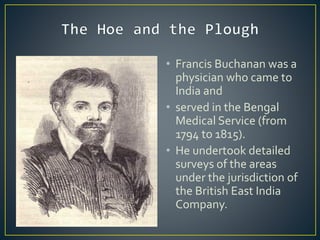
• Francis Buchanan was a
physician who came to
India and
• served in the Bengal
Medical Service (from
1794 to 1815).
• He undertook detailed
surveys of the areas
under the jurisdiction of
the British East India
Company.
• The life of the Paharias – as hunters, shifting cultivators, food
gatherers, charcoal producers, silkworm rearers – was thus
intimately connected to the forest.
• They considered the entire region as their land, the basis of
their identity as well as survival;
• and they resisted the intrusion of outsiders.
• Their chiefs maintained the unity of the group, settled
disputes, and led the tribe in battles with other tribes and
plainspeople.
• The Pahariyas regularly raided the plains where settled
agriculturists lived.
• These raids were necessary for survival, particularlyin years of
scarcity.
• As settled agriculture expanded, the area under
forests and pastures contracted, sharpened the
conflict between hill folk and settled cultivators.
• 1770s the British embarked on a brutal policy of
extermination, hunting the Paharias down and killing
them.
• 1780s, Augustus Cleveland, the Collector of
Bhagalpur, proposed a policy of pacification.
• The experience of pacification campaigns and
memories of brutal repression shaped their
perception of British infiltration into the area.
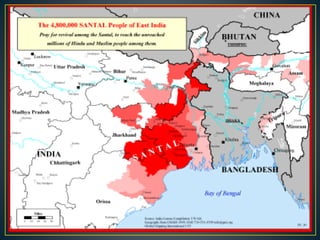
• The Santhals had begun to come into Bengal around the
1780s.
• Zamindars hired them to reclaim land and expand
cultivation,
• British officials invited them to settle in the Jangal
Mahals.
• The Santhals, by contrast, appeared to be ideal settlers,
clearing forests and ploughing the land with vigour.
• The Santhals were given land and persuaded to settle in
the foothills of Rajmahal.
• By 1832 a large area of land was demarcated as Damin-i-
Koh.
• After the demarcation of Damin-i-Koh, Santhal
settlements expanded rapidly.
• From 40 Santhal villages in the area in 1838, as many
as 1,473 villages had come up by 1851.
• Over the same period, the Santhal population
increased from a mere 3,000 to over 82,000.
• When the Santhals settled on the peripheries of the
Rajmahal hills, the Paharias resisted but were
ultimately forced to withdraw deeper into the hills.
The Santhals, by contrast, gave up
their earlier life of mobility and settled
down, cultivating a range of
commercial crops for the market, and
dealing with traders and
moneylenders.
• The peasant movement began at Supa in Poona district on 12
May 1875, ryots from surrounding rural areas gathered and
attacked the shopkeepers, demanding the account books and
bonds used for lending money by money lenders.
• The revolt spread from Poona to Ahmednagar.Within next
two months it spread further and covered 6,500 square km.
• Morethan thirty villages were affected.The pattern of the
revolt was same everywhere.
• Sahukars were attacked and burnt their account books.
• To prevent the revolt, the British established many police
posts in villages.
• Troops were rushed to the areas of the revolt.951 people were
arrested .It took several months to bring it under control.
• The Permanent revenue system was not extended beyond
Bengal.
• One reason was that since the revenue was fixed, the state
could not claim any share of the increased revenue. So in
territories annexed in the 19th century, temporary revenue
settlements were made.
• David Ricardo was an eminent economist in England in 1820s.
• His economic theories influenced the revenue policies of the
British in India.
• His idea of land ownership was introduced in the Bombay
Deccan.
• Land owner should claim only the average rent When the
land yielded more than this “average rent”, the landowner
had a surplus that the state needed to tax.
• If tax was not levied, cultivators were likely to turn into
rentiers, and their surplus income was unlikely to be
productively invested in the improvement of the land.
• The revenue system introduced in the Bombay Deccan was
known as the ryotwari settlement.
• Under this system,The revenue was directly settled with the
ryot.
• The average income from different types of soil was
calculated.The revenue paying capacity of the ryot was
assessed.
• A proportion of it fixed as the share of the state.
• The lands were resurveyed every 30 years and the revenue
rates increasedThe revenue demand was no longer
permanent.
• The revenue demanded in the Bombay Deccan was very high.
• When rains failed and harvests were poor, peasants found it unable
to pay the revenue.The revenue collectors extracted revenue with
utmost severity. If the peasant failed to pay, his crops were seized
and a fine was imposed.
• By 1830s prices of agricultural products fell sharply.T here was a
decline in peasant’s income.The countryside was devastated by a
famine in the years 1832-34.
• The cultivators borrowed money from the moneylender to pay the
revenue. But ryot found it difficult to pay it back and debt mounted.
• Ryot needed more loans to buy their everyday needs. By 1840s
officials found the alarming state of peasant indebtedness.
• Before 1860s, three-fourth of raw cotton imports into Britain
came fromAmerica.
• British manufacturers were about their dependence on
American supply.
• In 1857The Cotton Supply Association was founded in Britain
and in 1859 the Manchester Cotton Company was established
to encourage cotton production all over the world.
• These organizations found India that could supply cotton to
Lancashire.
• India had suitable soil for cultivation, a favourable cultivation,
and cheap labour.
• American civil war broke out in 1861.The raw cotton supply from
America to Britain felt.
• In Bombay the cotton merchants visited the cotton districts to
encourage farmers to cultivate it.
• These developments affected the peasants in the Deccan areas.
The ryots in the Deccan villages suddenly found access to limitless
credit.
• They were given Rs.100 as advance for every acre with the
cultivation of cotton. Cotton production in Bombay expanded .
• 90 percent of the cotton imports into Britain came from India. It
resulted in a period of cotton boom.While the cotton boom lasted,
cotton merchants in India had visions of capturing the world market
replacing America.
• By 1865, civil war ended in America. Cotton supply from America to
Britain revived.There was a fall in the export of Indian cotton to
Britain.
• Shaukers and export merchants in Maharashtra stopped long term credit
and started demanding repayment of debts.While credit dried, the
state’s revenue demand increased.
• The government made new settlement and increased revenue demand
from 50 to 100 per cent.
• The ryots were unable to pay the inflated demand at a time when prices
were falling and cotton fields disappeared.
• The ryot had to turn to the moneylender .Money lender refused to give
loans to ryots.
• There was a customary norm that the interest charged could not be
more than the principal. It put limit on the moneylender’s exactions. It
could be counted as “fair interest”.
• Under British rule this norm broke down.
• Deccan Riots Commission cited that the moneylender had charged cover
Rs.2000 as interest on a loan of Rs.100.
• The ryots came to see the money lender as devious and deceitful.
• Limitation Law was passed in 1859 that stated that the loan bonds
would be valid for only three years. It aimed to check the
accumulation of interest over time.
• The money lender forced the ryots to sign a new bond every three
years.When the new bond was signed, the unpaid balance
i.e.original loan and accumulated interest was entered as the
principal.
• A new set of interest charged was calculated.
• In the petitions that the Deccan Riots Commission collected, the
ryots wrote how the processes worked and what unjust methods
were used by the moneylenders to short change the ryot.
• For example,they refused to give receipts when loans were repaid,
entered fictitious figures in bonds, bought the peasant’s harvest at
low prices and ultimately took over the peasant’s property.
• The Deccan Riots Commission was set up the Government of
Bombay to inquire into the causes of the Deccan riots.
• The commission presented a report in the British Parliament in
1878.
• It provides historians with a range of sources for the study of the
riot.
• The Commission held enquiries in the districts where the riots
spread recorded statements of ryots, shahukars and eyewitnesses
etc.
• Collected statistical data on revenue rates, prices and interest rates
in different regions. Collated reports sent by district collectors.
• However it is important to remember that these sources were
official ones and reflect official concerns and interpretations.
• The commission was asked to find out if the revenue demand
was the cause of the revolt.
• The commission reported that the government demand was
not the cause of peasant anger.
• The commission blamed the moneylender.The government’s
persistent reluctant to admit a mistake frequently seen in
colonial records.
• Official reports like Deccan Riot report have to be studied
along with other sources-newspapers, unofficial accounts,
legal records and oral sources

Colonialism and the Countryside.pdf

  • 1.
    ➢What colonial rulemeant to those who lived in the countryside. ➢Colonialism how affected- 1. zamindars of Bengal, 2. Rajmahal hills where the Paharias and the Santhals lived, and then 3. Deccan
  • 2.
    1. English EastIndia Company (E.I.C.) established its raj in the countryside, 2. implemented its revenue policies, 3. what these policies meant to different sections of people, 4. and how they changed everyday lives.
  • 3.
    • Colonialism isthe establishment of a colony in one territory by a political power from another territory, and the subsequent maintenance, expansion, and exploitation of that colony. • The European colonial period was the era from the 16th century to the mid-20th century when several European powers established colonies in Asia, Africa, and the Americas. • *Countryside – Rural areas, far away areas.
  • 4.
    City palace, Calcutta Belongsto king of Burdwan An auction in Burdwan • In 1797 there was an auction in Burdwan (presentday Bardhaman). • It is due to the Permanent Settlement had come into operation in 1793. • Law of Sunset
  • 5.
    • The Permanent Settlementwas introduced by Lord Cornwallis in 1793. • It was an agreement between the British East India Company and the Landlords of Bengal to settle the Land Revenue to be raised.
  • 6.
    • it recognizedthe landlords as the proprietors of the land. • They should collect land revenue from the people and deposit it at the government treasury regularly for all times. • All their rights ended if they failed to pay. • It was agreed that the tax rate would not increase in future. • By the 1770s, the rural economy in Bengal was in crisis. • Officials felt that agriculture, trade and the revenue resources of the state could all be developed by encouraging investment in agriculture.
  • 7.
    1. The initialdemands were very high. 2. This high demand was imposed in the 1790s, a time when the prices of agricultural produce were depressed, making it difficult for the ryots to pay their dues to the zamindar. 3. The revenue was invariable, regardless of the harvest, and had to be paid punctually. 4. The Permanent Settlement initially limited the power of the zamindar to collect rent from the ryot and manage his zamindari.
  • 8.
    • The Companyhad recognised the zamindars as important, but it wanted to control and regulate them subdue their authority and restrict their autonomy. • The zamindars’ troops were disbanded. • customs duties abolished, • their “cutcheries” (courts) brought under the supervision of a Collector appointed by the Company. • Zamindars lost their power to organise local justice and the local police. • Over time the collectorate emerged as an alternative centre of authority.
  • 9.
    • A groupof rich peasants were consolidating their position in the villages. • By the early nineteenth century, jotedars had acquired vast areas of land. • They controlled local trade as well as moneylending, exercising immense power over the poorer cultivators of the region. • A large part of their land was cultivated through sharecroppers (adhiyars or bargadars) who brought their own ploughs, laboured in the field, and handed over half the produce to the jotedars.
  • 11.
    • 1.They livedin villages. So, they had a lot of influence on many villages. • 2.They opposed the efforts of the Zamindars to increase the jama of the village. • 3. prevented zamindari officials from executing their duties. • 4. mobilised ryots who were dependent on them, and deliberately delayed payments of revenue to the zamindar. • 5.They even purchased land when the estates of the Zamindars were being auctioned for failure to make payment of the revenue.
  • 12.
    • Fictitious salewas one such strategy. It involved a series of manoeuvres. • The Raja of Burdwan, for instance, first transferred some of his zamindari to his mother, since the Company had decreed that the property of women would not be taken over. • When a part of the estate was auctioned, the zamindar’s men bought the property, outbidding other purchasers. • When people from outside the zamindari bought, they could not always take possession. their agents would be attacked by lathyals of the former zamindar. • Sometimes even the ryots resisted the entry of outsiders.
  • 13.
    • A reportthat was submitted to the British Parliament in 1813. • It was the fifth of a series of reports on the administration and activities of the East India Company in India. • The Report’s 800 pages were the appendices that reproduced the petitions of zamindars and ryots,reports of collectors from various districts, statistical tables on revenue returns and notes on revenue and judicial administration of Bengal and Madras. • Many political groups argued that the conquest of Bengal was benefiting only the East India Company but not the British nation as a whole. • They indicate that, intent on criticizing the maladministration of the company, the Fifth Report exaggerated the collapse of traditional zamindari power.
  • 15.
    • Francis Buchananwas a physician who came to India and • served in the Bengal Medical Service (from 1794 to 1815). • He undertook detailed surveys of the areas under the jurisdiction of the British East India Company.
  • 16.
    • The lifeof the Paharias – as hunters, shifting cultivators, food gatherers, charcoal producers, silkworm rearers – was thus intimately connected to the forest. • They considered the entire region as their land, the basis of their identity as well as survival; • and they resisted the intrusion of outsiders. • Their chiefs maintained the unity of the group, settled disputes, and led the tribe in battles with other tribes and plainspeople. • The Pahariyas regularly raided the plains where settled agriculturists lived. • These raids were necessary for survival, particularlyin years of scarcity.
  • 17.
    • As settledagriculture expanded, the area under forests and pastures contracted, sharpened the conflict between hill folk and settled cultivators. • 1770s the British embarked on a brutal policy of extermination, hunting the Paharias down and killing them. • 1780s, Augustus Cleveland, the Collector of Bhagalpur, proposed a policy of pacification. • The experience of pacification campaigns and memories of brutal repression shaped their perception of British infiltration into the area.
  • 18.
    • The Santhalshad begun to come into Bengal around the 1780s. • Zamindars hired them to reclaim land and expand cultivation, • British officials invited them to settle in the Jangal Mahals. • The Santhals, by contrast, appeared to be ideal settlers, clearing forests and ploughing the land with vigour. • The Santhals were given land and persuaded to settle in the foothills of Rajmahal. • By 1832 a large area of land was demarcated as Damin-i- Koh.
  • 21.
    • After thedemarcation of Damin-i-Koh, Santhal settlements expanded rapidly. • From 40 Santhal villages in the area in 1838, as many as 1,473 villages had come up by 1851. • Over the same period, the Santhal population increased from a mere 3,000 to over 82,000. • When the Santhals settled on the peripheries of the Rajmahal hills, the Paharias resisted but were ultimately forced to withdraw deeper into the hills.
  • 22.
    The Santhals, bycontrast, gave up their earlier life of mobility and settled down, cultivating a range of commercial crops for the market, and dealing with traders and moneylenders.
  • 24.
    • The peasantmovement began at Supa in Poona district on 12 May 1875, ryots from surrounding rural areas gathered and attacked the shopkeepers, demanding the account books and bonds used for lending money by money lenders. • The revolt spread from Poona to Ahmednagar.Within next two months it spread further and covered 6,500 square km. • Morethan thirty villages were affected.The pattern of the revolt was same everywhere. • Sahukars were attacked and burnt their account books. • To prevent the revolt, the British established many police posts in villages. • Troops were rushed to the areas of the revolt.951 people were arrested .It took several months to bring it under control.
  • 25.
    • The Permanentrevenue system was not extended beyond Bengal. • One reason was that since the revenue was fixed, the state could not claim any share of the increased revenue. So in territories annexed in the 19th century, temporary revenue settlements were made.
  • 26.
    • David Ricardowas an eminent economist in England in 1820s. • His economic theories influenced the revenue policies of the British in India. • His idea of land ownership was introduced in the Bombay Deccan. • Land owner should claim only the average rent When the land yielded more than this “average rent”, the landowner had a surplus that the state needed to tax. • If tax was not levied, cultivators were likely to turn into rentiers, and their surplus income was unlikely to be productively invested in the improvement of the land.
  • 27.
    • The revenuesystem introduced in the Bombay Deccan was known as the ryotwari settlement. • Under this system,The revenue was directly settled with the ryot. • The average income from different types of soil was calculated.The revenue paying capacity of the ryot was assessed. • A proportion of it fixed as the share of the state. • The lands were resurveyed every 30 years and the revenue rates increasedThe revenue demand was no longer permanent.
  • 28.
    • The revenuedemanded in the Bombay Deccan was very high. • When rains failed and harvests were poor, peasants found it unable to pay the revenue.The revenue collectors extracted revenue with utmost severity. If the peasant failed to pay, his crops were seized and a fine was imposed. • By 1830s prices of agricultural products fell sharply.T here was a decline in peasant’s income.The countryside was devastated by a famine in the years 1832-34. • The cultivators borrowed money from the moneylender to pay the revenue. But ryot found it difficult to pay it back and debt mounted. • Ryot needed more loans to buy their everyday needs. By 1840s officials found the alarming state of peasant indebtedness.
  • 29.
    • Before 1860s,three-fourth of raw cotton imports into Britain came fromAmerica. • British manufacturers were about their dependence on American supply. • In 1857The Cotton Supply Association was founded in Britain and in 1859 the Manchester Cotton Company was established to encourage cotton production all over the world. • These organizations found India that could supply cotton to Lancashire. • India had suitable soil for cultivation, a favourable cultivation, and cheap labour.
  • 30.
    • American civilwar broke out in 1861.The raw cotton supply from America to Britain felt. • In Bombay the cotton merchants visited the cotton districts to encourage farmers to cultivate it. • These developments affected the peasants in the Deccan areas. The ryots in the Deccan villages suddenly found access to limitless credit. • They were given Rs.100 as advance for every acre with the cultivation of cotton. Cotton production in Bombay expanded . • 90 percent of the cotton imports into Britain came from India. It resulted in a period of cotton boom.While the cotton boom lasted, cotton merchants in India had visions of capturing the world market replacing America. • By 1865, civil war ended in America. Cotton supply from America to Britain revived.There was a fall in the export of Indian cotton to Britain.
  • 31.
    • Shaukers andexport merchants in Maharashtra stopped long term credit and started demanding repayment of debts.While credit dried, the state’s revenue demand increased. • The government made new settlement and increased revenue demand from 50 to 100 per cent. • The ryots were unable to pay the inflated demand at a time when prices were falling and cotton fields disappeared. • The ryot had to turn to the moneylender .Money lender refused to give loans to ryots. • There was a customary norm that the interest charged could not be more than the principal. It put limit on the moneylender’s exactions. It could be counted as “fair interest”. • Under British rule this norm broke down. • Deccan Riots Commission cited that the moneylender had charged cover Rs.2000 as interest on a loan of Rs.100. • The ryots came to see the money lender as devious and deceitful.
  • 32.
    • Limitation Lawwas passed in 1859 that stated that the loan bonds would be valid for only three years. It aimed to check the accumulation of interest over time. • The money lender forced the ryots to sign a new bond every three years.When the new bond was signed, the unpaid balance i.e.original loan and accumulated interest was entered as the principal. • A new set of interest charged was calculated. • In the petitions that the Deccan Riots Commission collected, the ryots wrote how the processes worked and what unjust methods were used by the moneylenders to short change the ryot. • For example,they refused to give receipts when loans were repaid, entered fictitious figures in bonds, bought the peasant’s harvest at low prices and ultimately took over the peasant’s property.
  • 33.
    • The DeccanRiots Commission was set up the Government of Bombay to inquire into the causes of the Deccan riots. • The commission presented a report in the British Parliament in 1878. • It provides historians with a range of sources for the study of the riot. • The Commission held enquiries in the districts where the riots spread recorded statements of ryots, shahukars and eyewitnesses etc. • Collected statistical data on revenue rates, prices and interest rates in different regions. Collated reports sent by district collectors. • However it is important to remember that these sources were official ones and reflect official concerns and interpretations.
  • 34.
    • The commissionwas asked to find out if the revenue demand was the cause of the revolt. • The commission reported that the government demand was not the cause of peasant anger. • The commission blamed the moneylender.The government’s persistent reluctant to admit a mistake frequently seen in colonial records. • Official reports like Deccan Riot report have to be studied along with other sources-newspapers, unofficial accounts, legal records and oral sources