NITI Aayog
PRESENTED BY
SIRAJU RAHMAN K
• The NITI Aayog (National Institution for Transforming
India) was set up in the year 2015 Jan 1st in the place of
planning commission.
• The original planning commission was set up in March
1950 through a cabinet resolution.
• The Prime Minister will head the new institution as the
Chairperson.
• The Prime Minister will appoint the vice chairperson and
CEO.
Introduction:-
• It is a government of India Think-Tank policy .
• It is a non-statutory body.
• The stated aim for NITI Aayog’s creation is to foster
involvement and participation in the economic policy-
making process by the state government of India.
• One of the important mandates of NITI Aayog is to bring
co-operative competitive federalism and to improve centre-
state relation.
History:-
• On May 29, 2014, the Independent Evaluation Office submitted an
assessment report to Prime Minister Modi with the recommendation to
replace the Planning Commission with a "control commission".
• On August 13, 2014, the Union Cabinet scrapped the Planning
Commission, to be replaced with a diluted version of the National
Development and Reform Commission (NDRC) of India.
• On January 1, 2015 a Cabinet resolution was passed to
replace the Planning Commission with the newly formed
NITI Aayog (National Institution for Transforming India).
• The first meeting of NITI Aayog was chaired by Narendra
Modi on February 8, 2015.
Basic features of NITI Aayog
 NITI Aayog basically represent the economic interest of state
governments and union territories of India, which the previous planning
structure commission structure lacked.
 Instead of being in a controlling seat ;it is going to be a provider of both
directional and policy inputs.
 ‘NITI blogs’ provides public access to articles , field reports as well as
published opinions of the officials.
Objectives of NITI Aayog
 NITI Aayog is essentially an advisory body that seeks to provide critical directional and
strategic inputs across spectrum of key elements of policy to the centre as well as
states.
 It also seeks to put an end to the slow and tardy implementation of the policy by
fostering inter-ministry, inter-state and centre-state coordination
 Strong states make a strong nation, is the core idea; and the Aayog will foster cooperative
federalism by evolving a shared vision of national development priorities.
 It has been envisaged to follow the bottom-top development approach whereby, it
would develop mechanisms to formulate credible plans to the village level and
aggregate these progressively at higher levels of government.
 It would also pay attention to the weaker sections of the society that may
not have benefitted from economic progress.
 It would create a knowledge, innovation and entrepreneurial support
system via a community of national and international experts, practitioners
and partners.
 It would serve as a platform for resolution of inter- sectoral and inter-
departmental issues in order to accelerate the implementation of the
development agenda.
 It will also monitor and evaluate the implementation of programmes, and
focus on technology upgradation and capacity building
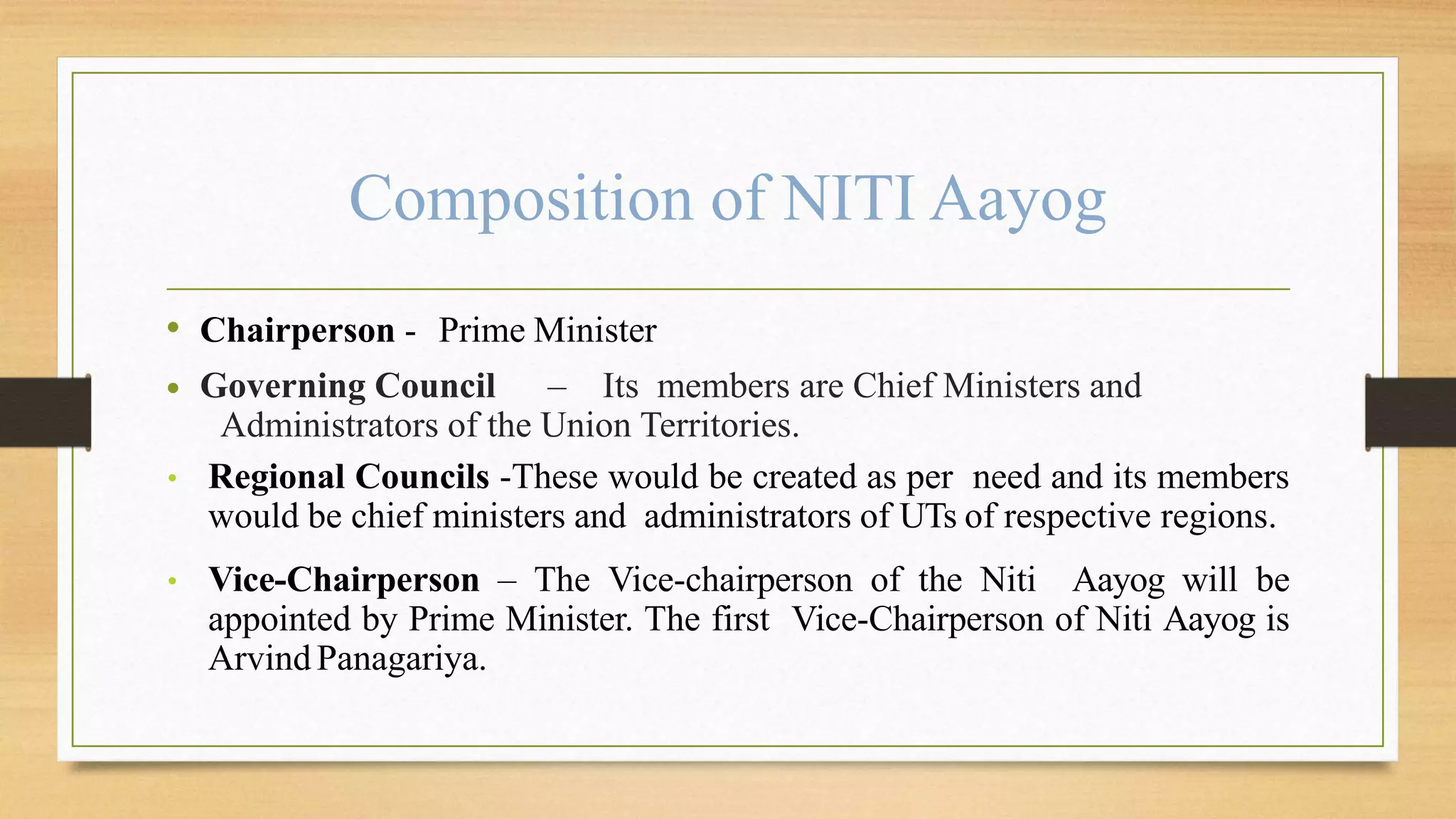
Composition of NITI Aayog
• Chairperson - Prime Minister
• Governing Council – Its members are Chief Ministers and
Administrators of the Union Territories.
• Regional Councils -These would be created as per need and its members
would be chief ministers and administrators of UTs of respective regions.
• Vice-Chairperson – The Vice-chairperson of the Niti Aayog will be
appointed by Prime Minister. The first Vice-Chairperson of Niti Aayog is
Arvind Panagariya.
• Niti Aayog has full time members (number unspecified), part time
members (maximum 2), Ex-officio members (maximum 4, these are
ministers from Union Council of Ministers), Special Invitees
(appointed by PM for fixed tenure).
• Finally, there is a Chief Executive Officer (CEO) of the Niti Aayog,
who is appointed by Prime Minister and has a rank similar to
Secretary to the Government of India.
PRESENT MEMBERS
 Chairperson: PMO India: Shri Narendra Modi.
 Vice-Chairman: Rajiv Kumar.
 CEO: Amitabh Kant.
 Members: (1) Bibek Debroy (Economist),(2) V.K. Saraswat (Former DRDO
Chief),(3)Ramesh Chand (Agriculture Expert)
 Special Invitees: Nitin Gadkari, Smriti Zubin Irani and
• Thawar Chand Gehlot.
 Governing Council: All Chief Ministers and Lieutenant Governors of Union Territories.
PARAMETER NITI AAYOG PLANNING
COMMISSION
Financial clout To be an advisory
body or a think tank.
Enjoyed the powers to
allocate funds to ministers
and state government.
States role State government are
expected to play a
significant role than
they did in the planning
commission.
States role was limited to the
National Development
Council and annual
interaction during plan
meetings.
NITI AAYOG V/S PLANNING
COMMISSION
Full time members The number of full time The last commission
members could be less
than planning
commission.
has 8 full time members.
Member secretary Tobe known at the CEO and
to be appointed by the PM
Secretaries or member
secretaries were appointed
through usual process.
Part time members Tohave a number of part
time members depending on
the need from time to time.
Full planning commission
had no provision for part
time members.
NITI AAYOG
PLANNING
COMMISSION
NITI Aayog will-
• Seek to provide a critical directional and strategic input into the
governance process
• Develop mechanisms to formulate credible plans at the village level and
aggregate these progressively at higher levels of government.
• Ensure, on areas that are specifically referred to it, that the interests of
national security are incorporated in economic strategy and policy.
• Pay special attention to the sections of the society that may be at risk
of not benefiting adequately from economic progress.
• Through commitment to a cooperative federalism
- promotion of citizen engagement, egalitarian access to opportunity,
participative and adaptive governance, increasing use of the
technology.
• It will leverage India's pool of entrepreneurial, scientific and
intellectual human capital
• Compared to Planning Commission, which was 64 years old when replaced by
NITI Aayog which is in infancy. But the expectations from a high profile
institution, irrespective of its age(tenure) are always high. Some of its achievements
in this two years of working are stated below.
 On Innovation and entrepreneurship.
 On Infrastructure and Energy Sector.
 On co–operative federalism.
 On agricultural development.
 Digitalization Movement.
 Increase in FDI.
ACHIEVEMENTS & ACCOMPLISHMENT OF NITI
AAYOG
Sustaining a growth of 7.5 per cent when there is global slow down, shows that
implementation of NITI Aayog is on the right track. However,critics of this new
set up criticized it and some termed it as an old wine in a new bottle,though
some critics have also argued positively in its favour.Some of the criticism and
challenges faced by NITI Aayog are:-
 An extra-constitutional body
 Contradictory Vision
 Not Obligatory
 Biased nature
 Practical implementation till date,limited only to some states
CRITICISM AND CHALLENGES
Finance Minister Arun Jaitley made the following observation on the necessity
of creating NITI Aayog.
 "The 65-year-old Planning Commission had become a redundant
organisation. It was relevant in a command economy structure, but not any
longer. India is a diversified country and its states are in various phases of
economic development along with their own strengths and weaknesses. In
this context, a ‘one size fits all’ approach to economic planning is obsolete. It
cannot make India competitive in today’s global economy."
CONCLUSION
 However, it is too early to comment on the efficacy of the new institution
related to planned development, something is possible when it shifts
gears and moves into operation seriously. However, the present move to
decentralize planning and allowing inputs from states to guide it, appears
to be a positive and effective steps.
 But NITI Aayog will always remain a hotbed political topic with
ambiguous opinions.
Niti aayog

Niti aayog

  • 1.
  • 2.
    • The NITIAayog (National Institution for Transforming India) was set up in the year 2015 Jan 1st in the place of planning commission. • The original planning commission was set up in March 1950 through a cabinet resolution. • The Prime Minister will head the new institution as the Chairperson. • The Prime Minister will appoint the vice chairperson and CEO. Introduction:-
  • 3.
    • It isa government of India Think-Tank policy . • It is a non-statutory body. • The stated aim for NITI Aayog’s creation is to foster involvement and participation in the economic policy- making process by the state government of India. • One of the important mandates of NITI Aayog is to bring co-operative competitive federalism and to improve centre- state relation.
  • 4.
    History:- • On May29, 2014, the Independent Evaluation Office submitted an assessment report to Prime Minister Modi with the recommendation to replace the Planning Commission with a "control commission". • On August 13, 2014, the Union Cabinet scrapped the Planning Commission, to be replaced with a diluted version of the National Development and Reform Commission (NDRC) of India.
  • 5.
    • On January1, 2015 a Cabinet resolution was passed to replace the Planning Commission with the newly formed NITI Aayog (National Institution for Transforming India). • The first meeting of NITI Aayog was chaired by Narendra Modi on February 8, 2015.
  • 6.
    Basic features ofNITI Aayog  NITI Aayog basically represent the economic interest of state governments and union territories of India, which the previous planning structure commission structure lacked.  Instead of being in a controlling seat ;it is going to be a provider of both directional and policy inputs.  ‘NITI blogs’ provides public access to articles , field reports as well as published opinions of the officials.
  • 7.
    Objectives of NITIAayog  NITI Aayog is essentially an advisory body that seeks to provide critical directional and strategic inputs across spectrum of key elements of policy to the centre as well as states.  It also seeks to put an end to the slow and tardy implementation of the policy by fostering inter-ministry, inter-state and centre-state coordination  Strong states make a strong nation, is the core idea; and the Aayog will foster cooperative federalism by evolving a shared vision of national development priorities.  It has been envisaged to follow the bottom-top development approach whereby, it would develop mechanisms to formulate credible plans to the village level and aggregate these progressively at higher levels of government.
  • 8.
     It wouldalso pay attention to the weaker sections of the society that may not have benefitted from economic progress.  It would create a knowledge, innovation and entrepreneurial support system via a community of national and international experts, practitioners and partners.  It would serve as a platform for resolution of inter- sectoral and inter- departmental issues in order to accelerate the implementation of the development agenda.  It will also monitor and evaluate the implementation of programmes, and focus on technology upgradation and capacity building
  • 10.
    Composition of NITIAayog • Chairperson - Prime Minister • Governing Council – Its members are Chief Ministers and Administrators of the Union Territories. • Regional Councils -These would be created as per need and its members would be chief ministers and administrators of UTs of respective regions. • Vice-Chairperson – The Vice-chairperson of the Niti Aayog will be appointed by Prime Minister. The first Vice-Chairperson of Niti Aayog is Arvind Panagariya.
  • 11.
    • Niti Aayoghas full time members (number unspecified), part time members (maximum 2), Ex-officio members (maximum 4, these are ministers from Union Council of Ministers), Special Invitees (appointed by PM for fixed tenure). • Finally, there is a Chief Executive Officer (CEO) of the Niti Aayog, who is appointed by Prime Minister and has a rank similar to Secretary to the Government of India.
  • 12.
    PRESENT MEMBERS  Chairperson:PMO India: Shri Narendra Modi.  Vice-Chairman: Rajiv Kumar.  CEO: Amitabh Kant.  Members: (1) Bibek Debroy (Economist),(2) V.K. Saraswat (Former DRDO Chief),(3)Ramesh Chand (Agriculture Expert)  Special Invitees: Nitin Gadkari, Smriti Zubin Irani and • Thawar Chand Gehlot.  Governing Council: All Chief Ministers and Lieutenant Governors of Union Territories.
  • 13.
    PARAMETER NITI AAYOGPLANNING COMMISSION Financial clout To be an advisory body or a think tank. Enjoyed the powers to allocate funds to ministers and state government. States role State government are expected to play a significant role than they did in the planning commission. States role was limited to the National Development Council and annual interaction during plan meetings. NITI AAYOG V/S PLANNING COMMISSION
  • 14.
    Full time membersThe number of full time The last commission members could be less than planning commission. has 8 full time members. Member secretary Tobe known at the CEO and to be appointed by the PM Secretaries or member secretaries were appointed through usual process. Part time members Tohave a number of part time members depending on the need from time to time. Full planning commission had no provision for part time members. NITI AAYOG PLANNING COMMISSION
  • 15.
    NITI Aayog will- •Seek to provide a critical directional and strategic input into the governance process • Develop mechanisms to formulate credible plans at the village level and aggregate these progressively at higher levels of government. • Ensure, on areas that are specifically referred to it, that the interests of national security are incorporated in economic strategy and policy.
  • 16.
    • Pay specialattention to the sections of the society that may be at risk of not benefiting adequately from economic progress. • Through commitment to a cooperative federalism - promotion of citizen engagement, egalitarian access to opportunity, participative and adaptive governance, increasing use of the technology. • It will leverage India's pool of entrepreneurial, scientific and intellectual human capital
  • 17.
    • Compared toPlanning Commission, which was 64 years old when replaced by NITI Aayog which is in infancy. But the expectations from a high profile institution, irrespective of its age(tenure) are always high. Some of its achievements in this two years of working are stated below.  On Innovation and entrepreneurship.  On Infrastructure and Energy Sector.  On co–operative federalism.  On agricultural development.  Digitalization Movement.  Increase in FDI. ACHIEVEMENTS & ACCOMPLISHMENT OF NITI AAYOG
  • 18.
    Sustaining a growthof 7.5 per cent when there is global slow down, shows that implementation of NITI Aayog is on the right track. However,critics of this new set up criticized it and some termed it as an old wine in a new bottle,though some critics have also argued positively in its favour.Some of the criticism and challenges faced by NITI Aayog are:-  An extra-constitutional body  Contradictory Vision  Not Obligatory  Biased nature  Practical implementation till date,limited only to some states CRITICISM AND CHALLENGES
  • 19.
    Finance Minister ArunJaitley made the following observation on the necessity of creating NITI Aayog.  "The 65-year-old Planning Commission had become a redundant organisation. It was relevant in a command economy structure, but not any longer. India is a diversified country and its states are in various phases of economic development along with their own strengths and weaknesses. In this context, a ‘one size fits all’ approach to economic planning is obsolete. It cannot make India competitive in today’s global economy."
  • 20.
    CONCLUSION  However, itis too early to comment on the efficacy of the new institution related to planned development, something is possible when it shifts gears and moves into operation seriously. However, the present move to decentralize planning and allowing inputs from states to guide it, appears to be a positive and effective steps.  But NITI Aayog will always remain a hotbed political topic with ambiguous opinions.