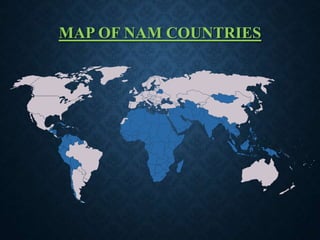
MAP OF NAM COUNTRIES
THE NON-ALIGNMENT MOVEMENT
SUBMITTED BY- TANYA TIWARI
REGISTRATION NUMBER-12103996
SUBMITTED TO- DR.GURJEET KAUR
HISTORY
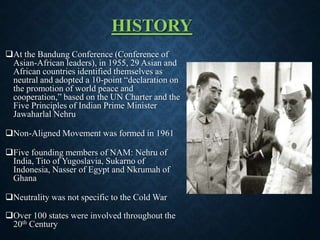
At the Bandung Conference (Conference of
Asian-African leaders), in 1955, 29 Asian and
African countries identified themselves as
neutral and adopted a 10-point “declaration on
the promotion of world peace and
cooperation,” based on the UN Charter and the
Five Principles of Indian Prime Minister
Jawaharlal Nehru
Non-Aligned Movement was formed in 1961
Five founding members of NAM: Nehru of
India, Tito of Yugoslavia, Sukarno of
Indonesia, Nasser of Egypt and Nkrumah of
Ghana
Neutrality was not specific to the Cold War
Over 100 states were involved throughout the
20th Century
FACTORS RESPONSIBLE FOR
THE NON ALIGNMENT
MOVEMENT
• Global tension caused by Cold War
• Struggle against Imperialism and Colonalisation
• Right of Independent Judgement
• Friendly relations with all nations
• Restructuring International Economic Order
• Formation of Collective Force
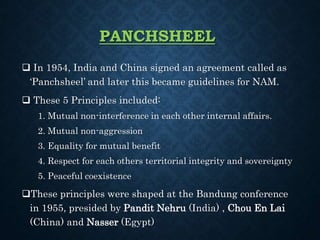
PANCHSHEEL
 In 1954, India and China signed an agreement called as
‘Panchsheel’ and later this became guidelines for NAM.
 These 5 Principles included:
1. Mutual non-interference in each other internal affairs.
2. Mutual non-aggression
3. Equality for mutual benefit
4. Respect for each others territorial integrity and sovereignty
5. Peaceful coexistence
These principles were shaped at the Bandung conference
in 1955, presided by Pandit Nehru (India) , Chou En Lai
(China) and Nasser (Egypt)
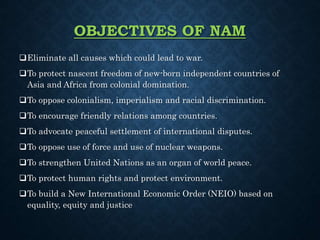
OBJECTIVES OF NAM
Eliminate all causes which could lead to war.
To protect nascent freedom of new-born independent countries of
Asia and Africa from colonial domination.
To oppose colonialism, imperialism and racial discrimination.
To encourage friendly relations among countries.
To advocate peaceful settlement of international disputes.
To oppose use of force and use of nuclear weapons.
To strengthen United Nations as an organ of world peace.
To protect human rights and protect environment.
To build a New International Economic Order (NEIO) based on
equality, equity and justice
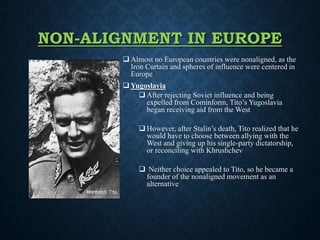
NON-ALIGNMENT IN EUROPE
 Almost no European countries were nonaligned, as the
Iron Curtain and spheres of influence were centered in
Europe
 Yugoslavia
 After rejecting Soviet influence and being
expelled from Cominform, Tito’s Yugoslavia
began receiving aid from the West
 However, after Stalin’s death, Tito realized that he
would have to choose between allying with the
West and giving up his single-party dictatorship,
or reconciling with Khrushchev
 Neither choice appealed to Tito, so he became a
founder of the nonaligned movement as an
alternative
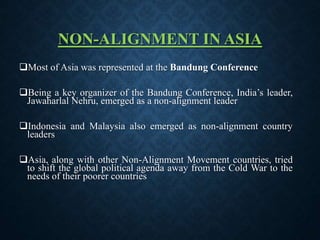
NON-ALIGNMENT IN ASIA
Most of Asia was represented at the Bandung Conference
Being a key organizer of the Bandung Conference, India’s leader,
Jawaharlal Nehru, emerged as a non-alignment leader
Indonesia and Malaysia also emerged as non-alignment country
leaders
Asia, along with other Non-Alignment Movement countries, tried
to shift the global political agenda away from the Cold War to the
needs of their poorer countries
NON-ALIGNMENT IN INDIA
After independence, India’s relations with the United States diminished
substantially
India rejected U.S. capitalism, and created a series of five year plans,
with a very small private sector
As a result of the economic disputes between India and the U.S., India
refused to join the U.S. alliance in the Cold War
Because India did not fully support the Soviet Union either, India became
an organizer of the Bangung Conference
Indian leader, Jawaharlal Nehru went to the Bandung Conference with
five objectives:
 Peace and Disarmament
 Self-Determination
 Economic Equality
 Cultural Equality
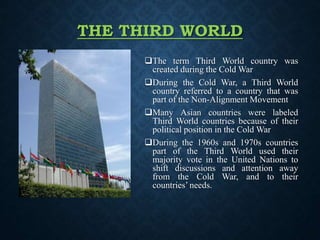
THE THIRD WORLD
The term Third World country was
created during the Cold War
During the Cold War, a Third World
country referred to a country that was
part of the Non-Alignment Movement
Many Asian countries were labeled
Third World countries because of their
political position in the Cold War
During the 1960s and 1970s countries
part of the Third World used their
majority vote in the United Nations to
shift discussions and attention away
from the Cold War, and to their
countries’ needs.
AFRICA AND THE
NON-ALIGNMENT MOVEMENT
• The majority of the present-day members of the Non-Aligned Movement
are small African states that desire independence from the world’s
superpowers
• Many of these nations joined soon after gaining self-determination from
Western powers as a means of maintaining their autonomy and freedom
• Eleven of the original twenty-five members of the Non-Alignment
Movement were African states. Fears of further colonialism or future
dependence on either the Western or communist blocs encouraged these
nations to join the movement which encourages equality, non-aggression,
and peaceful coexistence.
• Although the threat of war was the dominant theme at the original summit
meeting in 1961, the movement gained respect and influence as nations
were given the right of “independent judgment” so that they could
restructure the world economic order as well as prevent imperialism from
permeating their independent societies.
• The main African nations involved in the Non-Alignment Movement were
Egypt, South Africa, and Ghana.
EGYPTIAN INVOLVEMENT IN
THE NON-ALIGNMENT
MOVEMENY
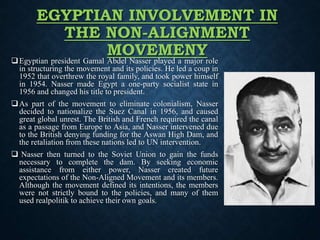
Egyptian president Gamal Abdel Nasser played a major role
in structuring the movement and its policies. He led a coup in
1952 that overthrew the royal family, and took power himself
in 1954. Nasser made Egypt a one-party socialist state in
1956 and changed his title to president.
As part of the movement to eliminate colonialism, Nasser
decided to nationalize the Suez Canal in 1956, and caused
great global unrest. The British and French required the canal
as a passage from Europe to Asia, and Nasser intervened due
to the British denying funding for the Aswan High Dam, and
the retaliation from these nations led to UN intervention.
 Nasser then turned to the Soviet Union to gain the funds
necessary to complete the dam. By seeking economic
assistance from either power, Nasser created future
expectations of the Non-Aligned Movement and its members.
Although the movement defined its intentions, the members
were not strictly bound to the policies, and many of them
used realpolitik to achieve their own goals.
OTHER NATIONS AND THE NON-
ALIGNMENT MOVEMENT
South Africa became a member of the Non-Alignment
Movement when it severed ties to the British
Commonwealth in 1961 and consolidated the apartheid
system. The Commonwealth opposed the apartheid system
in South Africa, making the Non-Aligned Movement a
justified means to end the relationship between the two
nations.
Iran had been under the economic control of Britain and
Russia throughout the nineteenth century. The Non-
Alignment Movement reduced ties with these superpowers,
but Iran continued to receive some economic aid from the
United States because of the American’s deep interest in
the Iranian oil industry.
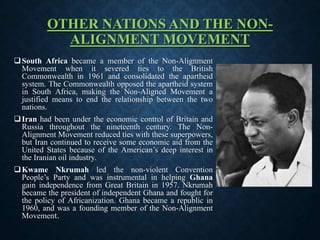
Kwame Nkrumah led the non-violent Convention
People’s Party and was instrumental in helping Ghana
gain independence from Great Britain in 1957. Nkrumah
became the president of independent Ghana and fought for
the policy of Africanization. Ghana became a republic in
1960, and was a founding member of the Non-Alignment
Movement.
Nkrumah
THE IMPACT OF NON-
ALIGNMENT
The Nonalignment Movement
encountered several difficulties that
made it less effective:
All members agreed to the ten-point
declaration and were against bloc
politics, but they were by no means
unified in their foreign policies or
goals
Many member-nations were from the
Third World, and had little sway in
international affairs compared to the
powerful blocs
The nonalignment movement
succeeded in being an alternative to
the bloc system and a means of
avoiding the influence of the blocs
Nasser, Tito, and Nehru
CHALLENGES AND FAILURE
Lacked economic and military apparatus to carry out
resolutions
Many member states WERE aligned with one of the two
superpowers (e.g. Cuba w/ U.S.S.R.), usually the East
 There were many divisions within the NAM that stymied
their progress
 In 1962, Sino-Indian border war breaks out
In 1963, PM Nehru dies
In 1970, Nasser dies
In 1979, Soviets invade Afghanistan
THANK YOU