XI-Political Science:
Chapter - 08
NCERT Book-01:
Indian Constitution at Work
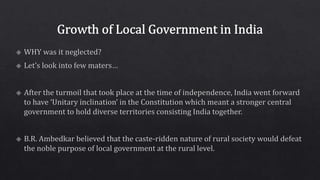
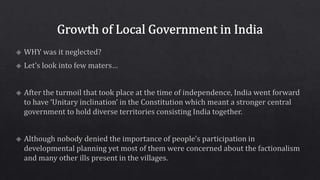
Growth of Local Government in India
Self-Governing village communities from the earliest times in India
as ‘Sabhas’
(Village Assemblies)
Then they became…
‘Panchayats’
(An assembly of five persons)
They resolved issues at village level
The system then kept on changing with times..
Growth of Local Government in India
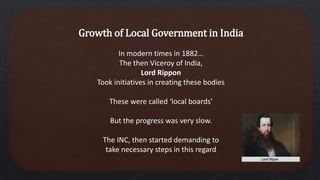
In modern times in 1882…
The then Viceroy of India,
Lord Rippon
Took initiatives in creating these bodies
These were called ‘local boards’
But the progress was very slow.
The INC, then started demanding to
take necessary steps in this regard
Growth of Local Government in India
The Government of India Act 1919 and then 1935…
The trend of establishing village Panchayats continued in British India Provinces.
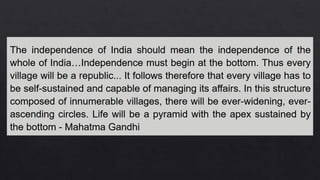
During the Freedom Struggle Mahatma Gandhi had strongly demanded for…
Decentralisation
Of Economic and Political Power
The intention was that…
The village institutions must have greater involvement in the formation of all
developmental policies to strengthen the participatory democracy.
The basic reason behind such demands was the experience of the freedom fighters who
knew the harmful effects of much of the centralization of power as it was centralised in the
hands of Governor-General or Viceroys.
Community Development Programme in 1952
To promote people’s participation in local development
A Three-tier system was recommended for the rural areas.
• Some states like Maharashtra and Gujarat adopted such a system of elected bodies of local
governments
• Other states adopted to a limited scale and didn’t give local governments enough powers and
functions to look after local development. They were very much dependent upn the state and
central government for the financial assistance.
• Many States did not think it necessary to establish elected local bodies. In many instances, local
bodies were dissolved and the local government was handed over to government officers.
• Many States had indirect elections to most local bodies. In many States, elections to the local
bodies were postponed from time to time.
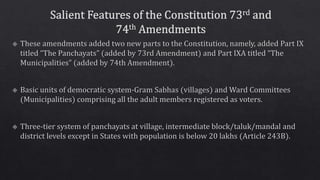
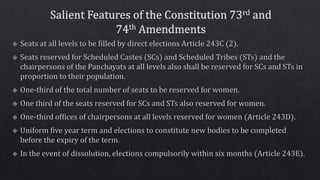
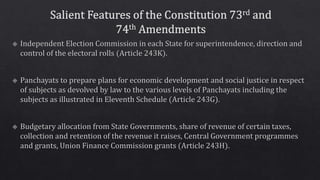
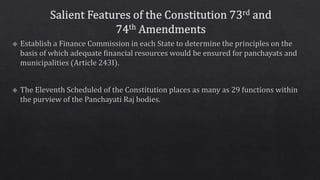
• 1989: Central Government introduced these two constitutional amendments
• 1992: These amendments were passed by the Parliament
• 73rd Amendment: Rural Local Governments (Panchayati Raj Institutions)
• 74th Amendment: Urban Local Government (Nagarpalikas)
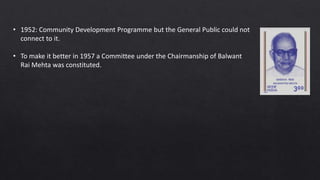
• 1952: Community Development Programme but the General Public could not
connect to it.
• To make it better in 1957 a Committee under the Chairmanship of Balwant
Rai Mehta was constituted.
• 1952: Community Development Programme but the General Public could not
connect to it.
• To make it better in 1957 a Committee under the Chairmanship of Balwant
Rai Mehta was constituted.
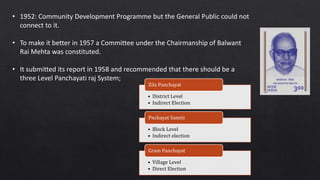
• It submitted its report in 1958 and recommended that there should be a
three Level Panchayati raj System;
• District Level
• Indirect Election
Zila Panchayat
• Block Level
• Indirect election
Pnchayat Samiti
• Village Level
• Direct Election
Gram Panchayat
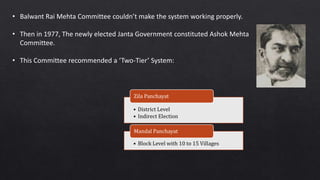
• Balwant Rai Mehta Committee couldn’t make the system working properly.
• Then in 1977, The newly elected Janta Government constituted Ashok Mehta
Committee.
• This Committee recommended a ‘Two-Tier’ System:
• District Level
• Indirect Election
Zila Panchayat
• Block Level with 10 to 15 Villages
Mandal Panchayat
• Then in 1985, GVK Rao Committee.
• The G.V.K. Rao Committee (1985) recommended making the “district” as the
basic unit of planning and also holding regular elections
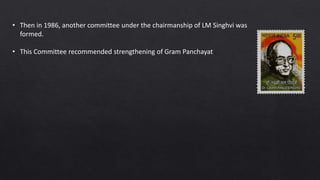
• Then in 1986, another committee under the chairmanship of LM Singhvi was
formed.
• This Committee recommended strengthening of Gram Panchayat
Now, go to the textbook…

XI-PolSc-Bk01-Ch08-Local Governments.pptx

  • 1.
    XI-Political Science: Chapter -08 NCERT Book-01: Indian Constitution at Work
  • 2.
    Growth of LocalGovernment in India Self-Governing village communities from the earliest times in India as ‘Sabhas’ (Village Assemblies) Then they became… ‘Panchayats’ (An assembly of five persons) They resolved issues at village level The system then kept on changing with times..
  • 3.
    Growth of LocalGovernment in India In modern times in 1882… The then Viceroy of India, Lord Rippon Took initiatives in creating these bodies These were called ‘local boards’ But the progress was very slow. The INC, then started demanding to take necessary steps in this regard
  • 4.
    Growth of LocalGovernment in India The Government of India Act 1919 and then 1935… The trend of establishing village Panchayats continued in British India Provinces.
  • 5.
    During the FreedomStruggle Mahatma Gandhi had strongly demanded for… Decentralisation Of Economic and Political Power The intention was that… The village institutions must have greater involvement in the formation of all developmental policies to strengthen the participatory democracy. The basic reason behind such demands was the experience of the freedom fighters who knew the harmful effects of much of the centralization of power as it was centralised in the hands of Governor-General or Viceroys.
  • 13.
    Community Development Programmein 1952 To promote people’s participation in local development A Three-tier system was recommended for the rural areas. • Some states like Maharashtra and Gujarat adopted such a system of elected bodies of local governments • Other states adopted to a limited scale and didn’t give local governments enough powers and functions to look after local development. They were very much dependent upn the state and central government for the financial assistance. • Many States did not think it necessary to establish elected local bodies. In many instances, local bodies were dissolved and the local government was handed over to government officers. • Many States had indirect elections to most local bodies. In many States, elections to the local bodies were postponed from time to time.
  • 15.
    • 1989: CentralGovernment introduced these two constitutional amendments • 1992: These amendments were passed by the Parliament • 73rd Amendment: Rural Local Governments (Panchayati Raj Institutions) • 74th Amendment: Urban Local Government (Nagarpalikas)
  • 17.
    • 1952: CommunityDevelopment Programme but the General Public could not connect to it. • To make it better in 1957 a Committee under the Chairmanship of Balwant Rai Mehta was constituted.
  • 18.
    • 1952: CommunityDevelopment Programme but the General Public could not connect to it. • To make it better in 1957 a Committee under the Chairmanship of Balwant Rai Mehta was constituted. • It submitted its report in 1958 and recommended that there should be a three Level Panchayati raj System; • District Level • Indirect Election Zila Panchayat • Block Level • Indirect election Pnchayat Samiti • Village Level • Direct Election Gram Panchayat
  • 19.
    • Balwant RaiMehta Committee couldn’t make the system working properly. • Then in 1977, The newly elected Janta Government constituted Ashok Mehta Committee. • This Committee recommended a ‘Two-Tier’ System: • District Level • Indirect Election Zila Panchayat • Block Level with 10 to 15 Villages Mandal Panchayat
  • 20.
    • Then in1985, GVK Rao Committee. • The G.V.K. Rao Committee (1985) recommended making the “district” as the basic unit of planning and also holding regular elections
  • 21.
    • Then in1986, another committee under the chairmanship of LM Singhvi was formed. • This Committee recommended strengthening of Gram Panchayat
  • 27.
    Now, go tothe textbook…