Family planning: importance and various methods
Anindita Choudhury.
Adolescent Health Consultant (UNICEF Support)
National Health Mission, Assam.
Date :24th May’2022
Objective of the session
❑ Understand importance of family planning and various methods.
❑ Disseminate messages on family planning methods.
India’s Contribution to World Population
Status of Family Planning in Assam (NFHS-5)
Sl. Indicators Assam TFR – 1.9%
1. Women age 20-24 years married before age 18 years (%) 31.8
2.
Women15-19 years who were already mothers or pregnant at the time of the
survey (%)
11.7
Current Use of Family Planning Methods (currently married women age 15–49 years)
3.i Any method 60.8%
3.ii Any modern method 45.3%
3.iii Female sterilization 9.0%
3.iv Male sterilization 0.1%
3.v IUD/PPIUD 2.9%
3.vi Pill 27.5%
3.vii Condom 4.9%
3.viii Injectables 0.5%
4. Total Unmet Needs 11%
5. Unmet Need for spacing 4.1%
Quality of Family Planning Services
6 Health worker ever talked to female non-users about family planning 21.4%
7 Current users ever informed about side effects of current method 70.0%
Why Family Planning -
• Improving maternal health and child survival – (Helping women avoid becoming pregnant too early, too late or too often benefits them and
their children.)
• Prevents unintended pregnancies and unsafe abortions - Closing the gap in the unmet need for contraceptives would further reduce the
number of abortions worldwide by 64% each year. More than half of all abortions occurring in developing countries are unsafe, and fewer
unsafe abortions would lead to fewer maternal deaths and injuries.
• Preventing sexually transmitted infections (STIs), including HIV/AIDS-Improved access to condoms, both male and female, reduces the
rate at which STIs, including HIV, are spread. Moreover, to the extent that HIV-positive women are better able to prevent unplanned
pregnancies and births, they are also helping to reduce the rate of new HIV infections.
• Empowering women. Women who can control the number and timing of their children can take better advantage of educational and
economic opportunities, improving their own future and that of their families.
• Promoting social and economic development and security. High population growth hampers poor countries’ economic development as
their expanding populations compete for limited resources such as food, housing, schools and jobs.
• Protecting the environment. Since so many women worldwide want fewer children than their mothers did, increasing their access to
voluntary family planning services will further slow population growth rates.
• Prevents high-risk pregnancies
• The treatment of involuntary infertility.
Ovulation may occur as soon as two weeks after an
abortion, irrespective of the method of evacuation
In India, abortions account for around 8 -13% of
MMR
Post abortion contraception can prevent 90% of maternal mortality associated with unsafe
abortions
Out of 10 women, 1 to 3 women will have a repeat
abortion
Post Abortion Family Planning
LONG-TERM
Population stabilisation by 2045
MID-TERM
TFR to replacement level of 2.1 by 2010
IMMEDIATE
Address unmet need
National Population Policy - 2000 Objectives
Contraceptive Basket of Choice under National Family Planning Program
Temporary Methods
• Condoms (Nirodh)
• Oral Contraceptive Pills-
• Combined Oral Contraceptives (Mala N)
• Centchroman (Chhaya)
• Emergency Contraceptive Pills (Ezy Pill)
• IUCD-380A, 375
• Injectable MPA
Permanent Methods
• Male Sterilization (Conventional Vasectomy/NSV)
• Female Sterilization (Minilap/Laparoscopic)
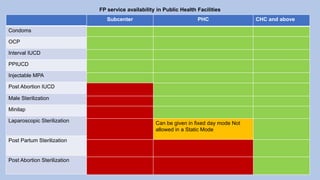
FP service availability in Public Health Facilities
Condoms
OCP
Interval IUCD
PPIUCD
Injectable MPA
Post Abortion IUCD
Male Sterilization
Minilap
Laparoscopic Sterilization
Post Partum Sterilization
Post Abortion Sterilization
Subcenter PHC CHC and above
Can be given in fixed day mode Not
allowed in a Static Mode
Community Based Schemes (ASHA)
Scheme of Home Delivery of Contraceptives by ASHAs at Doorstep of Beneficiaries-
(HDC)
Scheme for Ensuring Spacing of Births-(ESB)
Scheme for Utilization of Pregnancy Test Kit(PTK)
Commodities in Family Planning Program
Commodities for free distribution at facility level: Commodities for administering at
facility level free of cost:
Commodities for distribution through ASHA at village level:
Additional commodity under
PTK Scheme:
Condom COC ECP Weekly Pill
Injectable IUCD Tubal Ring
Pregnancy Testing Kit
11
How does the pill work?
• Stops ovulation
• Thins uterine lining
• Thickens cervical mucus
Positive Benefits of Birth Control Pills
✓ Prevents pregnancy
✓ Eases menstrual cramps
✓ Shortens period
✓ Regulates period
✓ Decreases incidence of ovarian
cysts
✓ Prevents ovarian and uterine
cancer
✓ Decreases acne
Side-effects
• Breast tenderness
• Nausea
• Increase in headaches
• Moodiness
• Weight change
Taking the Pill
Once a day at the same time everyday
Use condoms for first month
Use condoms when on antibiotics
Use condoms for 1 week if you miss a pill or take one late
The pill offers no protection from STD’s
IUCD- Intra Uterine Contraceptive Device (Long Active Reversible Contraceptive)
,
IUCD-380A IUCD- 375
• Effective for 10 years.
• T shaped device
• Effective for 5 years.
• Inverted U shaped device
Failure Rate- 6 to 8 pregnancies per 1000 women over 1st year of use.
Who can use – All women Reproductive Age Group after due pelvic examination and medical screening.
How to use - Inserted by trained service provider at Medical Facility
Promoting quality IUCD services
• Interval IUCD:
• Can be provided in all public health facilities by a trained provider in OPD
• PPIUCD (Post partum IUCD):
• Inserted within 48 hours after delivery in facilities conducting deliveries
• PAIUCD (Post abortion IUCD):
• Inserted within 12 days of abortion in PHC and above facilities
PPIUCD and PAIUCD incentive scheme :
• Trained/Skilled empaneled provider inserting PPIUCD/PAIUCD- Rs 150 per insertion.
• ASHA accompanying Client- Rs 150/insertion
• Beneficiary- Rs. 300
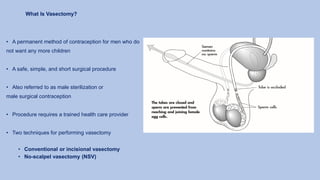
What Is Vasectomy?
• A permanent method of contraception for men who do
not want any more children
• A safe, simple, and short surgical procedure
• Also referred to as male sterilization or
male surgical contraception
• Procedure requires a trained health care provider
• Two techniques for performing vasectomy
• Conventional or incisional vasectomy
• No-scalpel vasectomy (NSV)
Health benefits, non-health benefits and risks of vasectomy
• Is a cost-effective, one-off event, with no need for resupply
• Does not interfere with sex
• May enhance enjoyment and frequency of sex
• Allows man to play significant role in FP
• Is a safe procedure
• Carries a small risk of failure
• Carries risk associated with pain management drugs and surgical procedure
Possible side effects and complications of vasectomy
• Headaches and mild dizziness
• Nausea
• Fever
• Pain
• Injury to other structures
• Hemorrhage
• Hematoma
• Surgical site/wound infection
• Abscess formation
• Sperm granuloma
• Anti-sperm antibodies
• Regret
• Failure
Vasectomy use by men with HIV
• Men with asymptomatic or mild HIV clinical disease or severe, advanced HIV disease on antiretroviral
drugs can SAFELY have vasectomy. (Special arrangements are needed for advanced clinical disease.)
• Patients need to be aware that vasectomy does not protect against HIV infections or STIs.
• Promote consistent condom use to prevent transmission of infections.
• No one should be coerced or pressured to accept vasectomy, whether or not they are seropositive.
Timing of the vasectomy procedure
When can a client have a vasectomy?
The procedure can be performed at any time if:
The client has made the request and is prepared.
No medical conditions warrant delay of the vasectomy.
The client has made an informed and voluntary decision (provided written informed consent).
The provider is prepared and ready, with the right equipment and supplies to perform the procedure.
If any of the above conditions are not met, there can be a delay.
The client may need to be referred if he has a condition that needs special attention.
Comparing Effectiveness of Family Planning Methods
How to make your
method more effective
Implants, IUD, female sterilization:
After procedure, little or nothing to do or
remember
Vasectomy: Use another method for first
3 months
Injectables: Get repeat injections on time
Lactational Amenorrhea Method (for 6 months):
Breastfeed often, day and night
Pills: Take a pill each day
Patch, ring: Keep in place, change on time
Male condoms, diaphragm: Use correctly every
time you have sex
Fertility awareness methods: Abstain or use
condoms on fertile days. Standard Days Method
and Two-Day Method may be easier to use.
More effective
Less than 1 pregnancy per
100 women in one year
Less effective
About 30 pregnancies per
100 women in one year
Female condoms, withdrawal, spermicides:
Use correctly every time you have sex
Family Planning: A Global Handbook for Providers (3rd Edition, 2018)
What is female sterilization?
• Female sterilization is a family planning method that provides permanent contraception to women and couples who want to
limit births or do not want any more children.
• The two surgical approaches most often used are minilaparotomy and laparoscopy.
• Female sterilization is also referred to as “tubal occlusion,” “tubal sterilization,” “tubal ligation,” “surgical
contraception,” “voluntary surgical contraception,” “tubectomy,” “bi-tubal occlusion,” “minilap,” or simply “the
operation.”
How does female sterilization work?
A segment of the fallopian tube is removed, and then the tube is
tied or blocked.
Sperm are blocked from fertilizing the ovum
Female sterilization: Health benefits
• Protects against risks of pregnancy and childbirth
• Lower risks of ectopic pregnancy
• May lower risks of developing ovarian cancers
Female sterilization: Timing of procedure and surgical approaches
Timing of the procedure
Interval
Procedure is performed at any time
unrelated to a pregnancy or six
weeks or more after the last
delivery or abortion.
Postabortion
Procedure is performed within the
first week following a nonseptic
spontaneous or induced abortion.
Postpartum
Procedure is performed within the
first week after a vaginal delivery or
while a cesarean section is being
performed.
Approaches
Surgical Nonsurgical
Laparotomy
• Minilaparotomy
procedure
• After delivery of baby
and Placenta during C/S
Transcervical
Laparoscopic procedure
Female sterilization: Side effects and complications
• Complications of female sterilization are rare.
• Immediate side effects of minilaparotomy are transient and include nausea, vomiting, and minor abdominal
discomfort.
• Complications may be:
• Surgical
o Injuries to other viscera
o Bleeding or hemorrhage/
hematoma formation
o Infection
o Small risk of failure leading to
pregnancy (ectopic or intrauterine)
• Anesthesia-related
o Respiratory depression
o Drug overdose
Long-term effects are rare:
o Risk of ectopic pregnancy
o Potential for regret
Who can have female sterilization?
With proper counseling and informed consent, any woman can safely
have a female sterilization procedure, including women who:
• Are not married
• Have no children or few children
• Do not have spousal permission
• Are young
• Just gave birth (within the last seven days)
• Are breastfeeding
• Are infected with HIV, whether or not they are receiving
antiretroviral therapy
But they may need to wait if they:
• Gave birth 1–6 weeks ago
• May be pregnant
• Have an infection or other problem
• Have some other serious health condition
Female sterilization is safe for all women.
Female sterilization: Use by interval clients
Sterilization can be performed:
At any time, if the provider is certain that the client is not pregnant and that no other medical condition is present.Preferably
in the first half, or proliferative phase, of the menstrual cycle.
However, providers should exercise caution if the client is young, to avoid regret in the future.
Emergency contraception
Copper T 380A
What is emergency contraception?
Contraceptive methods that are used to prevent pregnancy after sexual intercourse.
Recommended for use within 5 days but their effectiveness increases when used as early as possible after
the act of intercourse.
Can prevent up to over 95% of pregnancies when taken within 5 days after intercourse.
Methods of emergency contraception
• Emergency contraceptive pills (ECPs)
• Dedicated ECP Products
• ECPs containing ulipristal acetate (UPA)
• ECPs containing levonorgestrel (LNG)
• Progestin-only pills with levonorgestrel or norgestrel
• Combined oral contraceptive pills (COCs) with estrogen and a progestin- levonorgestrel, norgestrel, or norethindrone
(also called norethisterone)
• Copper-bearing intrauterine devices
Indications for emergency contraception - 1
Emergency contraception can be used in the following situations following sexual
intercourse:
• When no contraceptive has been used.
• Sexual assault when the woman was not protected by an effective contraceptive
method.
• When there is concern of possible contraceptive failure, from improper or incorrect use.
A woman may be given advance supplies of ECPs to ensure their availability when needed and they can be
used as soon as possible after unprotected intercourse.
• Condom breakage, slippage, or incorrect use
• 3 or more consecutively missed combined oral contraceptive pills
• More than 3 hours late from the usual time of intake of the progestogen-only pill (minipill), or more than 27
hours after the previous pill
• More than 12 hours late from the usual time of intake of the desogestrel-containing pill (0.75 mg) or more than
36 hours after the previous pill
• More than 2 weeks late for the norethisterone enanthate (NET-EN) progestogen-only injection
• More than 4 weeks late for the depot-medroxyprogesterone acetate (DMPA) progestogen-only injection
• More than 7 days late for the combined injectable contraceptive (CIC)
• Dislodgment, breakage, tearing, or early removal of a diaphragm or cervical cap
• Failed withdrawal (e.g. ejaculation in the vagina or on external genitalia)
• Failure of a spermicide tablet or film to melt before intercourse
• Miscalculation of the abstinence period, or failure to abstain or use a barrier method on the fertile days of the
cycle when using fertility awareness based methods
• Expulsion of an intrauterine contraceptive device (IUD) or hormonal contraceptive implant
Improper or incorrect use of contraceptives include:
Indications for emergency contraception - 2
Emergency contraceptive pills (ECPs)
• Also called “morning after” pills or postcoital contraceptives.
Types of ECPs
• Dedicated ECP Products
• ECPs containing ulipristal acetate (UPA)
• ECPs containing levonorgestrel (LNG)
• Progestin-only pills with levonorgestrel or norgestrel
• Combined oral contraceptive pills (COCs) with estrogen and a progestin- levonorgestrel, norgestrel, or
norethindrone (norethisterone). They are taken as a split dose. This regimen is known as the Yuzpe
method.
28
Day
1
First Day of
Cycle
Last Day of
Menstruation Ovulation
Starts
Fertilization
Implantation
Positive
Pregnancy Test
EC pills work
before fertilization
EC pills have no effect
after fertilization,
do not cause abortion
ECPs: Mechanism of action
29
Expansion of the basket of FP Choices
Introduction of new contraceptive choices-
▪ Injectable Contraceptive (Antara Program)
▪ Centchroman (Chhaya)
▪ Progesterone only Pills- under pilot
Introduction of new device-
▪ Cu IUCD 375 (effective for five years) was introduced in program in 2012-13.
Introduction of new method-
▪ Post partum IUCD was introduced in the program in 2010-11 and has provided post partum women an
effective spacing option.
National Family Planning Program
Key highlights of FP programmes
India was the first country to launch National Family Planning Program
• Target free approach
• Voluntary adoption of Family Planning Methods
• Based on felt need of the community
• Children by choice and not chance
Policy level
• More emphasis on spacing methods
• Assuring Quality of services
• Expanding Contraceptive choices
Service level
Expansion of the
basket of FP Choices
Augmenting the
demand through ASHA
Schemes for Family
Planning
Promoting quality
sterilization services
Promoting quality
IUCD services
Generating demand
and awareness for FP
services
Addressing global
Commitments (Family
Planning 2020)
KEY FP INITIATIVES/SCHEMES
Augmenting the demand through ASHA Schemes for Family Planning
• Home Delivery of Contraceptives
• Ensuring Spacing at Birth
• Pregnancy Testing Kits-
• Pregnancy Testing Kits are now a part of ASHA kits so as to ensure early management of pregnancy
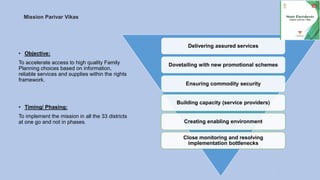
Mission Parivar Vikas
• Objective:
To accelerate access to high quality Family
Planning choices based on information,
reliable services and supplies within the rights
framework.
• Timing/ Phasing:
To implement the mission in all the 33 districts
at one go and not in phases.
Delivering assured services
Dovetailing with new promotional schemes
Ensuring commodity security
Building capacity (service providers)
Creating enabling environment
Close monitoring and resolving
implementation bottlenecks
Generating demand and awareness for FP services
• Improved counseling through RMNCH Counselors
• Celebration of World Population Day & fortnight (July 11 – July 24)
• Population stabilisation fortnight has helped to break the seasonal trend of sterilization services in the northern
states of India.
• It is being held in all blocks, districts and states of India since 2009 and the event is observed over a month long
period, split into:
• June 27 to July 10: “Dampati Sampark Pakhwada” or “Mobilisation Fortnight”
• July 11 to July 24: or “Jansankhya Sthirtha Pakhwada” or “Population Stabilisation Fortnight”
• Celebration of Vasectomy fortnight (21st November to 4th December)
• The objective is to improve male participation in Family Planning
Medical eligibility criteria (MEC) for ECPs
• No medical precautions or contraindications; all women are medically eligible to use ECPs including women who
cannot use hormonal contraceptives as regular methods because they are used for a short term.
• When taken frequently and repeatedly, ECPs may be harmful for women who have MEC category 2, 3 or 4
conditions for combined hormonal contraception or Progestin-only contraceptives.
ECP screening flow chart
1. Did you have unprotected sex in
the last 120 hours (5 days)?
Yes
2. Are you pregnant?
4. Do you want to
prevent pregnancy?
Recommend ECPs. If your
next period does not come
within 7 days of when you
would normally expect it, see
a health care provider to
determine pregnancy status.
ECPs are not right for you. If
your last menses was over 4
weeks ago, see a health care
provider to determine next
steps.
No
Yes
Don’t know
No
Yes
No
3. Was your last
menses was over 4
weeks ago?
Yes
Don’t know No
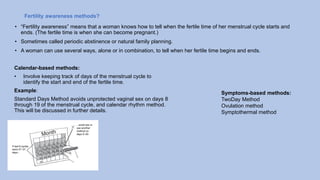
Fertility awareness methods?
• “Fertility awareness” means that a woman knows how to tell when the fertile time of her menstrual cycle starts and
ends. (The fertile time is when she can become pregnant.)
• Sometimes called periodic abstinence or natural family planning.
• A woman can use several ways, alone or in combination, to tell when her fertile time begins and ends.
Symptoms-based methods:
TwoDay Method
Ovulation method
Symptothermal method
Calendar-based methods:
• Involve keeping track of days of the menstrual cycle to
identify the start and end of the fertile time.
Example:
Standard Days Method avoids unprotected vaginal sex on days 8
through 19 of the menstrual cycle, and calendar rhythm method.
This will be discussed in further details.
Early marriage and Family Planning
Child Marriage Is One Of The Main Drivers Of Adolescent Pregnancies:
• 90% of births to adolescent girls in the developing world occur within a marriage or union (UNFPA, Motherhood in Childhood:
Facing the challenge of adolescent pregnancy, State of World Population, 2013 )
CHILD BRIDES RARELY HAVE ACCESS TO FAMILY PLANNING:
• Married adolescents have the lowest use of contraception and the highest levels of unmet need
• Married girls do not always realise they have a right to contraception, and the right to choose if, when and how many
children to have. They are often isolated, hard to reach and unaware that such services are available.
• Child brides who are married to older men may lack the negotiation skills and the confidence to assert their needs to
their husbands.
EARLY PREGNANCY NOT ONLY AFFECTS MOTHERS, IT AFFECTS THEIR CHILDREN TOO
• In developing countries, babies born to mothers who are under the age of 20 are 50% more likely to be stillborn and to
die in the first weeks of their life.
• Adolescent mothers are also more likely to have babies with low birth weight.
40
EARLY PREGNANCY AND FAMILY PLANNING
• Pregnancy and childbirth complications are the second leading cause of death among 15 to 19 year olds globally,
after suicide (WHO, Preventing Suicide: A Global Imperative, 2014 )
• Girls who give birth between 15-19 years are much more likely to die in childbirth than girls 20-24 years and those
under 15 are at even greater risk.
(UNFPA, Motherhood in Childhood – Facing the Challenge of Adolescent Pregnancy, 2013. Nove A, Matthews Z, Neal S, Camacho
AV. Maternal mortality in adolescents compared with women of other ages: evidence from 144 countries. Lancet Global Health
2014)
41
How Can We Improve Girls’ – Both Married And Unmarried – Access To Family Planning?
• Ensuring family planning programmes take married and unmarried
adolescent girls into account and offer quality services that are
adolescent-friendly.
• Address the factors that drive early pregnancies and early marriage,
including poverty, insecurity, the lack of opportunities for girls,
traditional roles of wives and mothers, and gender inequality.
• Provide safe spaces for adolescent girls to interact, exchange
information and learn about their rights and the family planning
options available to them.
42
Reference :
1. Family Planning Division , MOHFW.
2. Adapted from Training Resource Package for Family Planning: https://www.fptraining.org/

Family Planning Methods.pdf

  • 1.
    Family planning: importanceand various methods Anindita Choudhury. Adolescent Health Consultant (UNICEF Support) National Health Mission, Assam. Date :24th May’2022
  • 2.
    Objective of thesession ❑ Understand importance of family planning and various methods. ❑ Disseminate messages on family planning methods.
  • 3.
    India’s Contribution toWorld Population
  • 4.
    Status of FamilyPlanning in Assam (NFHS-5) Sl. Indicators Assam TFR – 1.9% 1. Women age 20-24 years married before age 18 years (%) 31.8 2. Women15-19 years who were already mothers or pregnant at the time of the survey (%) 11.7 Current Use of Family Planning Methods (currently married women age 15–49 years) 3.i Any method 60.8% 3.ii Any modern method 45.3% 3.iii Female sterilization 9.0% 3.iv Male sterilization 0.1% 3.v IUD/PPIUD 2.9% 3.vi Pill 27.5% 3.vii Condom 4.9% 3.viii Injectables 0.5% 4. Total Unmet Needs 11% 5. Unmet Need for spacing 4.1% Quality of Family Planning Services 6 Health worker ever talked to female non-users about family planning 21.4% 7 Current users ever informed about side effects of current method 70.0%
  • 5.
    Why Family Planning- • Improving maternal health and child survival – (Helping women avoid becoming pregnant too early, too late or too often benefits them and their children.) • Prevents unintended pregnancies and unsafe abortions - Closing the gap in the unmet need for contraceptives would further reduce the number of abortions worldwide by 64% each year. More than half of all abortions occurring in developing countries are unsafe, and fewer unsafe abortions would lead to fewer maternal deaths and injuries. • Preventing sexually transmitted infections (STIs), including HIV/AIDS-Improved access to condoms, both male and female, reduces the rate at which STIs, including HIV, are spread. Moreover, to the extent that HIV-positive women are better able to prevent unplanned pregnancies and births, they are also helping to reduce the rate of new HIV infections. • Empowering women. Women who can control the number and timing of their children can take better advantage of educational and economic opportunities, improving their own future and that of their families. • Promoting social and economic development and security. High population growth hampers poor countries’ economic development as their expanding populations compete for limited resources such as food, housing, schools and jobs. • Protecting the environment. Since so many women worldwide want fewer children than their mothers did, increasing their access to voluntary family planning services will further slow population growth rates. • Prevents high-risk pregnancies • The treatment of involuntary infertility.
  • 6.
    Ovulation may occuras soon as two weeks after an abortion, irrespective of the method of evacuation In India, abortions account for around 8 -13% of MMR Post abortion contraception can prevent 90% of maternal mortality associated with unsafe abortions Out of 10 women, 1 to 3 women will have a repeat abortion Post Abortion Family Planning
  • 7.
    LONG-TERM Population stabilisation by2045 MID-TERM TFR to replacement level of 2.1 by 2010 IMMEDIATE Address unmet need National Population Policy - 2000 Objectives
  • 8.
    Contraceptive Basket ofChoice under National Family Planning Program Temporary Methods • Condoms (Nirodh) • Oral Contraceptive Pills- • Combined Oral Contraceptives (Mala N) • Centchroman (Chhaya) • Emergency Contraceptive Pills (Ezy Pill) • IUCD-380A, 375 • Injectable MPA Permanent Methods • Male Sterilization (Conventional Vasectomy/NSV) • Female Sterilization (Minilap/Laparoscopic)
  • 9.
    FP service availabilityin Public Health Facilities Condoms OCP Interval IUCD PPIUCD Injectable MPA Post Abortion IUCD Male Sterilization Minilap Laparoscopic Sterilization Post Partum Sterilization Post Abortion Sterilization Subcenter PHC CHC and above Can be given in fixed day mode Not allowed in a Static Mode
  • 10.
    Community Based Schemes(ASHA) Scheme of Home Delivery of Contraceptives by ASHAs at Doorstep of Beneficiaries- (HDC) Scheme for Ensuring Spacing of Births-(ESB) Scheme for Utilization of Pregnancy Test Kit(PTK)
  • 11.
    Commodities in FamilyPlanning Program Commodities for free distribution at facility level: Commodities for administering at facility level free of cost: Commodities for distribution through ASHA at village level: Additional commodity under PTK Scheme: Condom COC ECP Weekly Pill Injectable IUCD Tubal Ring Pregnancy Testing Kit 11
  • 12.
    How does thepill work? • Stops ovulation • Thins uterine lining • Thickens cervical mucus
  • 13.
    Positive Benefits ofBirth Control Pills ✓ Prevents pregnancy ✓ Eases menstrual cramps ✓ Shortens period ✓ Regulates period ✓ Decreases incidence of ovarian cysts ✓ Prevents ovarian and uterine cancer ✓ Decreases acne Side-effects • Breast tenderness • Nausea • Increase in headaches • Moodiness • Weight change Taking the Pill Once a day at the same time everyday Use condoms for first month Use condoms when on antibiotics Use condoms for 1 week if you miss a pill or take one late The pill offers no protection from STD’s
  • 14.
    IUCD- Intra UterineContraceptive Device (Long Active Reversible Contraceptive) , IUCD-380A IUCD- 375 • Effective for 10 years. • T shaped device • Effective for 5 years. • Inverted U shaped device Failure Rate- 6 to 8 pregnancies per 1000 women over 1st year of use. Who can use – All women Reproductive Age Group after due pelvic examination and medical screening. How to use - Inserted by trained service provider at Medical Facility
  • 15.
    Promoting quality IUCDservices • Interval IUCD: • Can be provided in all public health facilities by a trained provider in OPD • PPIUCD (Post partum IUCD): • Inserted within 48 hours after delivery in facilities conducting deliveries • PAIUCD (Post abortion IUCD): • Inserted within 12 days of abortion in PHC and above facilities PPIUCD and PAIUCD incentive scheme : • Trained/Skilled empaneled provider inserting PPIUCD/PAIUCD- Rs 150 per insertion. • ASHA accompanying Client- Rs 150/insertion • Beneficiary- Rs. 300
  • 16.
    What Is Vasectomy? •A permanent method of contraception for men who do not want any more children • A safe, simple, and short surgical procedure • Also referred to as male sterilization or male surgical contraception • Procedure requires a trained health care provider • Two techniques for performing vasectomy • Conventional or incisional vasectomy • No-scalpel vasectomy (NSV)
  • 17.
    Health benefits, non-healthbenefits and risks of vasectomy • Is a cost-effective, one-off event, with no need for resupply • Does not interfere with sex • May enhance enjoyment and frequency of sex • Allows man to play significant role in FP • Is a safe procedure • Carries a small risk of failure • Carries risk associated with pain management drugs and surgical procedure Possible side effects and complications of vasectomy • Headaches and mild dizziness • Nausea • Fever • Pain • Injury to other structures • Hemorrhage • Hematoma • Surgical site/wound infection • Abscess formation • Sperm granuloma • Anti-sperm antibodies • Regret • Failure
  • 18.
    Vasectomy use bymen with HIV • Men with asymptomatic or mild HIV clinical disease or severe, advanced HIV disease on antiretroviral drugs can SAFELY have vasectomy. (Special arrangements are needed for advanced clinical disease.) • Patients need to be aware that vasectomy does not protect against HIV infections or STIs. • Promote consistent condom use to prevent transmission of infections. • No one should be coerced or pressured to accept vasectomy, whether or not they are seropositive. Timing of the vasectomy procedure When can a client have a vasectomy? The procedure can be performed at any time if: The client has made the request and is prepared. No medical conditions warrant delay of the vasectomy. The client has made an informed and voluntary decision (provided written informed consent). The provider is prepared and ready, with the right equipment and supplies to perform the procedure. If any of the above conditions are not met, there can be a delay. The client may need to be referred if he has a condition that needs special attention.
  • 19.
    Comparing Effectiveness ofFamily Planning Methods How to make your method more effective Implants, IUD, female sterilization: After procedure, little or nothing to do or remember Vasectomy: Use another method for first 3 months Injectables: Get repeat injections on time Lactational Amenorrhea Method (for 6 months): Breastfeed often, day and night Pills: Take a pill each day Patch, ring: Keep in place, change on time Male condoms, diaphragm: Use correctly every time you have sex Fertility awareness methods: Abstain or use condoms on fertile days. Standard Days Method and Two-Day Method may be easier to use. More effective Less than 1 pregnancy per 100 women in one year Less effective About 30 pregnancies per 100 women in one year Female condoms, withdrawal, spermicides: Use correctly every time you have sex Family Planning: A Global Handbook for Providers (3rd Edition, 2018)
  • 20.
    What is femalesterilization? • Female sterilization is a family planning method that provides permanent contraception to women and couples who want to limit births or do not want any more children. • The two surgical approaches most often used are minilaparotomy and laparoscopy. • Female sterilization is also referred to as “tubal occlusion,” “tubal sterilization,” “tubal ligation,” “surgical contraception,” “voluntary surgical contraception,” “tubectomy,” “bi-tubal occlusion,” “minilap,” or simply “the operation.” How does female sterilization work? A segment of the fallopian tube is removed, and then the tube is tied or blocked. Sperm are blocked from fertilizing the ovum
  • 21.
    Female sterilization: Healthbenefits • Protects against risks of pregnancy and childbirth • Lower risks of ectopic pregnancy • May lower risks of developing ovarian cancers Female sterilization: Timing of procedure and surgical approaches Timing of the procedure Interval Procedure is performed at any time unrelated to a pregnancy or six weeks or more after the last delivery or abortion. Postabortion Procedure is performed within the first week following a nonseptic spontaneous or induced abortion. Postpartum Procedure is performed within the first week after a vaginal delivery or while a cesarean section is being performed. Approaches Surgical Nonsurgical Laparotomy • Minilaparotomy procedure • After delivery of baby and Placenta during C/S Transcervical Laparoscopic procedure
  • 22.
    Female sterilization: Sideeffects and complications • Complications of female sterilization are rare. • Immediate side effects of minilaparotomy are transient and include nausea, vomiting, and minor abdominal discomfort. • Complications may be: • Surgical o Injuries to other viscera o Bleeding or hemorrhage/ hematoma formation o Infection o Small risk of failure leading to pregnancy (ectopic or intrauterine) • Anesthesia-related o Respiratory depression o Drug overdose Long-term effects are rare: o Risk of ectopic pregnancy o Potential for regret
  • 23.
    Who can havefemale sterilization? With proper counseling and informed consent, any woman can safely have a female sterilization procedure, including women who: • Are not married • Have no children or few children • Do not have spousal permission • Are young • Just gave birth (within the last seven days) • Are breastfeeding • Are infected with HIV, whether or not they are receiving antiretroviral therapy But they may need to wait if they: • Gave birth 1–6 weeks ago • May be pregnant • Have an infection or other problem • Have some other serious health condition Female sterilization is safe for all women. Female sterilization: Use by interval clients Sterilization can be performed: At any time, if the provider is certain that the client is not pregnant and that no other medical condition is present.Preferably in the first half, or proliferative phase, of the menstrual cycle. However, providers should exercise caution if the client is young, to avoid regret in the future.
  • 24.
    Emergency contraception Copper T380A What is emergency contraception? Contraceptive methods that are used to prevent pregnancy after sexual intercourse. Recommended for use within 5 days but their effectiveness increases when used as early as possible after the act of intercourse. Can prevent up to over 95% of pregnancies when taken within 5 days after intercourse.
  • 25.
    Methods of emergencycontraception • Emergency contraceptive pills (ECPs) • Dedicated ECP Products • ECPs containing ulipristal acetate (UPA) • ECPs containing levonorgestrel (LNG) • Progestin-only pills with levonorgestrel or norgestrel • Combined oral contraceptive pills (COCs) with estrogen and a progestin- levonorgestrel, norgestrel, or norethindrone (also called norethisterone) • Copper-bearing intrauterine devices
  • 26.
    Indications for emergencycontraception - 1 Emergency contraception can be used in the following situations following sexual intercourse: • When no contraceptive has been used. • Sexual assault when the woman was not protected by an effective contraceptive method. • When there is concern of possible contraceptive failure, from improper or incorrect use. A woman may be given advance supplies of ECPs to ensure their availability when needed and they can be used as soon as possible after unprotected intercourse.
  • 27.
    • Condom breakage,slippage, or incorrect use • 3 or more consecutively missed combined oral contraceptive pills • More than 3 hours late from the usual time of intake of the progestogen-only pill (minipill), or more than 27 hours after the previous pill • More than 12 hours late from the usual time of intake of the desogestrel-containing pill (0.75 mg) or more than 36 hours after the previous pill • More than 2 weeks late for the norethisterone enanthate (NET-EN) progestogen-only injection • More than 4 weeks late for the depot-medroxyprogesterone acetate (DMPA) progestogen-only injection • More than 7 days late for the combined injectable contraceptive (CIC) • Dislodgment, breakage, tearing, or early removal of a diaphragm or cervical cap • Failed withdrawal (e.g. ejaculation in the vagina or on external genitalia) • Failure of a spermicide tablet or film to melt before intercourse • Miscalculation of the abstinence period, or failure to abstain or use a barrier method on the fertile days of the cycle when using fertility awareness based methods • Expulsion of an intrauterine contraceptive device (IUD) or hormonal contraceptive implant Improper or incorrect use of contraceptives include: Indications for emergency contraception - 2
  • 28.
    Emergency contraceptive pills(ECPs) • Also called “morning after” pills or postcoital contraceptives. Types of ECPs • Dedicated ECP Products • ECPs containing ulipristal acetate (UPA) • ECPs containing levonorgestrel (LNG) • Progestin-only pills with levonorgestrel or norgestrel • Combined oral contraceptive pills (COCs) with estrogen and a progestin- levonorgestrel, norgestrel, or norethindrone (norethisterone). They are taken as a split dose. This regimen is known as the Yuzpe method. 28
  • 29.
    Day 1 First Day of Cycle LastDay of Menstruation Ovulation Starts Fertilization Implantation Positive Pregnancy Test EC pills work before fertilization EC pills have no effect after fertilization, do not cause abortion ECPs: Mechanism of action 29
  • 30.
    Expansion of thebasket of FP Choices Introduction of new contraceptive choices- ▪ Injectable Contraceptive (Antara Program) ▪ Centchroman (Chhaya) ▪ Progesterone only Pills- under pilot Introduction of new device- ▪ Cu IUCD 375 (effective for five years) was introduced in program in 2012-13. Introduction of new method- ▪ Post partum IUCD was introduced in the program in 2010-11 and has provided post partum women an effective spacing option.
  • 31.
  • 32.
    Key highlights ofFP programmes India was the first country to launch National Family Planning Program • Target free approach • Voluntary adoption of Family Planning Methods • Based on felt need of the community • Children by choice and not chance Policy level • More emphasis on spacing methods • Assuring Quality of services • Expanding Contraceptive choices Service level
  • 33.
    Expansion of the basketof FP Choices Augmenting the demand through ASHA Schemes for Family Planning Promoting quality sterilization services Promoting quality IUCD services Generating demand and awareness for FP services Addressing global Commitments (Family Planning 2020) KEY FP INITIATIVES/SCHEMES
  • 34.
    Augmenting the demandthrough ASHA Schemes for Family Planning • Home Delivery of Contraceptives • Ensuring Spacing at Birth • Pregnancy Testing Kits- • Pregnancy Testing Kits are now a part of ASHA kits so as to ensure early management of pregnancy
  • 35.
    Mission Parivar Vikas •Objective: To accelerate access to high quality Family Planning choices based on information, reliable services and supplies within the rights framework. • Timing/ Phasing: To implement the mission in all the 33 districts at one go and not in phases. Delivering assured services Dovetailing with new promotional schemes Ensuring commodity security Building capacity (service providers) Creating enabling environment Close monitoring and resolving implementation bottlenecks
  • 36.
    Generating demand andawareness for FP services • Improved counseling through RMNCH Counselors • Celebration of World Population Day & fortnight (July 11 – July 24) • Population stabilisation fortnight has helped to break the seasonal trend of sterilization services in the northern states of India. • It is being held in all blocks, districts and states of India since 2009 and the event is observed over a month long period, split into: • June 27 to July 10: “Dampati Sampark Pakhwada” or “Mobilisation Fortnight” • July 11 to July 24: or “Jansankhya Sthirtha Pakhwada” or “Population Stabilisation Fortnight” • Celebration of Vasectomy fortnight (21st November to 4th December) • The objective is to improve male participation in Family Planning
  • 37.
    Medical eligibility criteria(MEC) for ECPs • No medical precautions or contraindications; all women are medically eligible to use ECPs including women who cannot use hormonal contraceptives as regular methods because they are used for a short term. • When taken frequently and repeatedly, ECPs may be harmful for women who have MEC category 2, 3 or 4 conditions for combined hormonal contraception or Progestin-only contraceptives.
  • 38.
    ECP screening flowchart 1. Did you have unprotected sex in the last 120 hours (5 days)? Yes 2. Are you pregnant? 4. Do you want to prevent pregnancy? Recommend ECPs. If your next period does not come within 7 days of when you would normally expect it, see a health care provider to determine pregnancy status. ECPs are not right for you. If your last menses was over 4 weeks ago, see a health care provider to determine next steps. No Yes Don’t know No Yes No 3. Was your last menses was over 4 weeks ago? Yes Don’t know No
  • 39.
    Fertility awareness methods? •“Fertility awareness” means that a woman knows how to tell when the fertile time of her menstrual cycle starts and ends. (The fertile time is when she can become pregnant.) • Sometimes called periodic abstinence or natural family planning. • A woman can use several ways, alone or in combination, to tell when her fertile time begins and ends. Symptoms-based methods: TwoDay Method Ovulation method Symptothermal method Calendar-based methods: • Involve keeping track of days of the menstrual cycle to identify the start and end of the fertile time. Example: Standard Days Method avoids unprotected vaginal sex on days 8 through 19 of the menstrual cycle, and calendar rhythm method. This will be discussed in further details.
  • 40.
    Early marriage andFamily Planning Child Marriage Is One Of The Main Drivers Of Adolescent Pregnancies: • 90% of births to adolescent girls in the developing world occur within a marriage or union (UNFPA, Motherhood in Childhood: Facing the challenge of adolescent pregnancy, State of World Population, 2013 ) CHILD BRIDES RARELY HAVE ACCESS TO FAMILY PLANNING: • Married adolescents have the lowest use of contraception and the highest levels of unmet need • Married girls do not always realise they have a right to contraception, and the right to choose if, when and how many children to have. They are often isolated, hard to reach and unaware that such services are available. • Child brides who are married to older men may lack the negotiation skills and the confidence to assert their needs to their husbands. EARLY PREGNANCY NOT ONLY AFFECTS MOTHERS, IT AFFECTS THEIR CHILDREN TOO • In developing countries, babies born to mothers who are under the age of 20 are 50% more likely to be stillborn and to die in the first weeks of their life. • Adolescent mothers are also more likely to have babies with low birth weight. 40
  • 41.
    EARLY PREGNANCY ANDFAMILY PLANNING • Pregnancy and childbirth complications are the second leading cause of death among 15 to 19 year olds globally, after suicide (WHO, Preventing Suicide: A Global Imperative, 2014 ) • Girls who give birth between 15-19 years are much more likely to die in childbirth than girls 20-24 years and those under 15 are at even greater risk. (UNFPA, Motherhood in Childhood – Facing the Challenge of Adolescent Pregnancy, 2013. Nove A, Matthews Z, Neal S, Camacho AV. Maternal mortality in adolescents compared with women of other ages: evidence from 144 countries. Lancet Global Health 2014) 41
  • 42.
    How Can WeImprove Girls’ – Both Married And Unmarried – Access To Family Planning? • Ensuring family planning programmes take married and unmarried adolescent girls into account and offer quality services that are adolescent-friendly. • Address the factors that drive early pregnancies and early marriage, including poverty, insecurity, the lack of opportunities for girls, traditional roles of wives and mothers, and gender inequality. • Provide safe spaces for adolescent girls to interact, exchange information and learn about their rights and the family planning options available to them. 42
  • 43.
    Reference : 1. FamilyPlanning Division , MOHFW. 2. Adapted from Training Resource Package for Family Planning: https://www.fptraining.org/