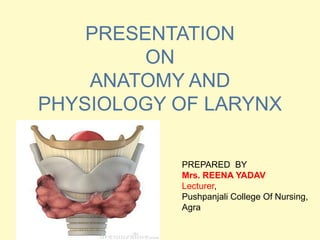
PRESENTATION
ON
ANATOMY AND
PHYSIOLOGY OF LARYNX
PREPARED BY
Mrs. REENA YADAV
Lecturer,
Pushpanjali College Of Nursing,
Agra
OBJECTIVES
•To discuss the basic anatomy of the larynx
•To enumerate the main functions of the
larynx
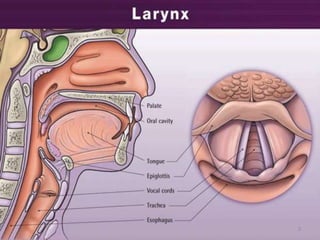
LARYNX
3
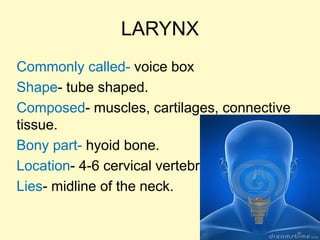
LARYNX
Commonly called- voice box
Shape- tube shaped.
Composed- muscles, cartilages, connective
tissue.
Bony part- hyoid bone.
Location- 4-6 cervical vertebra.
Lies- midline of the neck.
5
SHAPE AND SIZE
•the shape of the larynx in lower side is circular and
from the upper it is tringular in shape.
•Its length is 4.3 cm,
• transverse diameter is 4.2 cm and anterior
posterior diameter 3.6 cm.
LARYNX
The larynx is composed of nine pieces of
cartilage.
PAIRED
Arytenoid cartilage
Corniculate cartilage
Cuneiform cartilage
, UNPAIRED:
Thyroid cartilage
Cricoid cartilage
Epiglottis
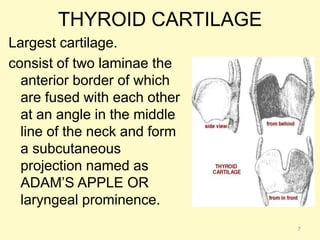
THYROID CARTILAGE
Largest cartilage.
consist of two laminae the
anterior border of which
are fused with each other
at an angle in the middle
line of the neck and form
a subcutaneous
projection named as
ADAM’S APPLE OR
laryngeal prominence.
7
LINNING OF THE LARYNX
superior of the vocal fold is
non karatinized stratified squamous epithelium,
inferior to the vocal fold is pseudo stratified
columnar epithelium.
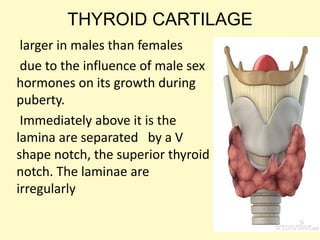
THYROID CARTILAGE
larger in males than females
due to the influence of male sex
hormones on its growth during
puberty.
Immediately above it is the
lamina are separated by a V
shape notch, the superior thyroid
notch. The laminae are
irregularly
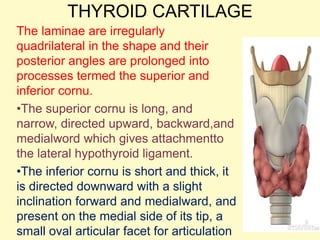
THYROID CARTILAGE
The laminae are irregularly
quadrilateral in the shape and their
posterior angles are prolonged into
processes termed the superior and
inferior cornu.
•The superior cornu is long, and
narrow, directed upward, backward,and
medialword which gives attachmentto
the lateral hypothyroid ligament.
•The inferior cornu is short and thick, it
is directed downward with a slight
inclination forward and medialward, and
present on the medial side of its tip, a
small oval articular facet for articulation
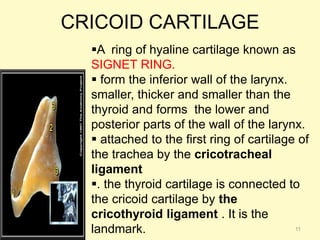
CRICOID CARTILAGE
A ring of hyaline cartilage known as
SIGNET RING.
 form the inferior wall of the larynx.
smaller, thicker and smaller than the
thyroid and forms the lower and
posterior parts of the wall of the larynx.
 attached to the first ring of cartilage of
the trachea by the cricotracheal
ligament
. the thyroid cartilage is connected to
the cricoid cartilage by the
cricothyroid ligament . It is the
landmark. 11
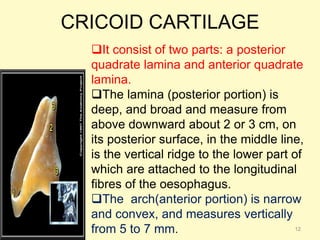
CRICOID CARTILAGE
It consist of two parts: a posterior
quadrate lamina and anterior quadrate
lamina.
The lamina (posterior portion) is
deep, and broad and measure from
above downward about 2 or 3 cm, on
its posterior surface, in the middle line,
is the vertical ridge to the lower part of
which are attached to the longitudinal
fibres of the oesophagus.
The arch(anterior portion) is narrow
and convex, and measures vertically
from 5 to 7 mm. 12
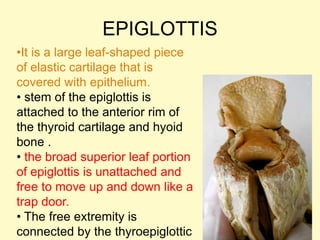
EPIGLOTTIS
•It is a large leaf-shaped piece
of elastic cartilage that is
covered with epithelium.
• stem of the epiglottis is
attached to the anterior rim of
the thyroid cartilage and hyoid
bone .
• the broad superior leaf portion
of epiglottis is unattached and
free to move up and down like a
trap door.
• The free extremity is
connected by the thyroepiglottic
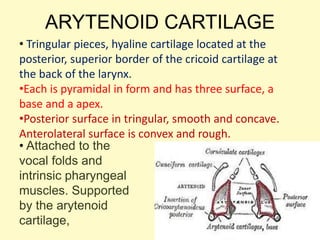
ARYTENOID CARTILAGE
• Tringular pieces, hyaline cartilage located at the
posterior, superior border of the cricoid cartilage at
the back of the larynx.
•Each is pyramidal in form and has three surface, a
base and a apex.
•Posterior surface in tringular, smooth and concave.
Anterolateral surface is convex and rough.
• Attached to the
vocal folds and
intrinsic pharyngeal
muscles. Supported
by the arytenoid
cartilage,
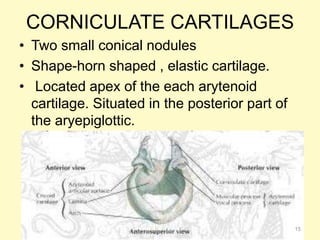
CORNICULATE CARTILAGES
• Two small conical nodules
• Shape-horn shaped , elastic cartilage.
• Located apex of the each arytenoid
cartilage. Situated in the posterior part of
the aryepiglottic.
15
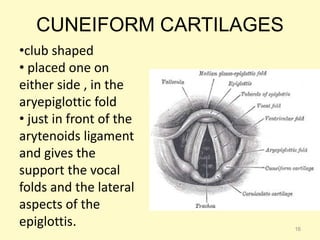
CUNEIFORM CARTILAGES
•club shaped
• placed one on
either side , in the
aryepiglottic fold
• just in front of the
arytenoids ligament
and gives the
support the vocal
folds and the lateral
aspects of the
epiglottis. 16
LARYNGEAL LIGAMENTS
• EXTRINSIC
– Thyrohyoid
membrane and
ligaments
– Cricothyroid
membrane and
ligaments
– Cricotracheal
ligament
– Epiglottis
• INTRINSIC
– Elastic membrane
– Quadrangular
membrane
– Conus elasticus
(cricovocal
membrane)
– Median cricothyroid
ligament
– Vocal Ligament
– Thyroepiglottic
ligament
17
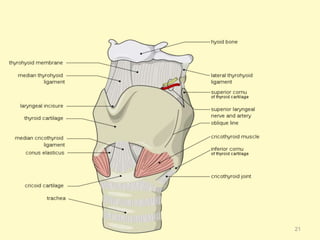
The thyroid membrane---
a broad, fibroelastic layer, attached below to
the upper border of the thyroid cartilage and to
the front of its superior cornu.
EXTRINSIC LIGAMENTS
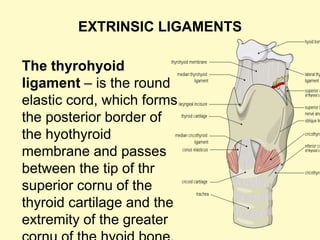
The thyrohyoid
ligament – is the round
elastic cord, which forms
the posterior border of
the hyothyroid
membrane and passes
between the tip of thr
superior cornu of the
thyroid cartilage and the
extremity of the greater
EXTRINSIC LIGAMENTS
EXTRINSIC LIGAMENTS
Epiglottis -- is connected with the hyoid bone
by an elastic hand the hyoepiglotic ligament.
Cricotracheal ligament –
Connects the cricoid cartilage with the first ring
of the trachea. It resembles the fibrous
membrane which connects the cartilaginous
rings of the trachea to the each other.
21
22
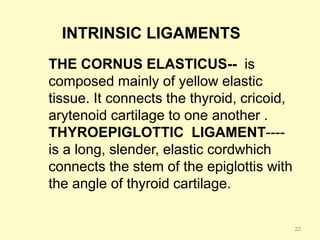
INTRINSIC LIGAMENTS
THE CORNUS ELASTICUS-- is
composed mainly of yellow elastic
tissue. It connects the thyroid, cricoid,
arytenoid cartilage to one another .
THYROEPIGLOTTIC LIGAMENT----
is a long, slender, elastic cordwhich
connects the stem of the epiglottis with
the angle of thyroid cartilage.
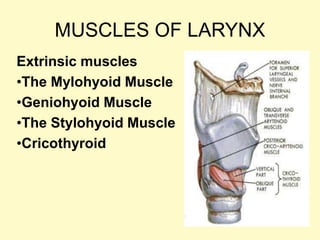
MUSCLES OF LARYNX
Extrinsic muscles
•The Mylohyoid Muscle
•Geniohyoid Muscle
•The Stylohyoid Muscle
•Cricothyroid
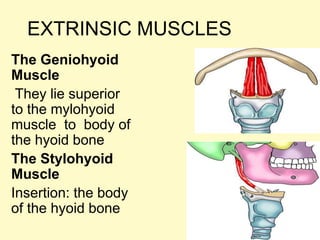
EXTRINSIC MUSCLES
The Geniohyoid
Muscle
They lie superior
to the mylohyoid
muscle to body of
the hyoid bone
The Stylohyoid
Muscle
Insertion: the body
of the hyoid bone
Cont…..
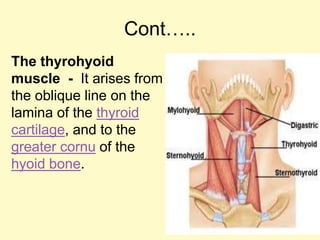
The thyrohyoid
muscle - It arises from
the oblique line on the
lamina of the thyroid
cartilage, and to the
greater cornu of the
hyoid bone.
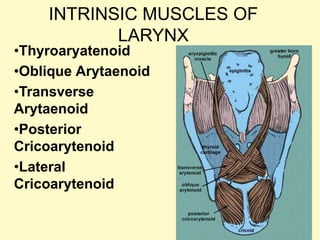
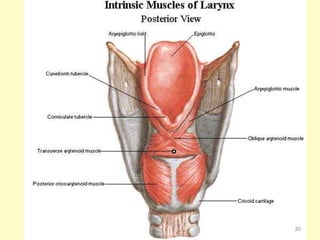
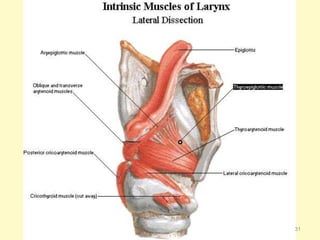
INTRINSIC MUSCLES OF
LARYNX
•Thyroaryatenoid
•Oblique Arytaenoid
•Transverse
Arytaenoid
•Posterior
Cricoarytenoid
•Lateral
Cricoarytenoid
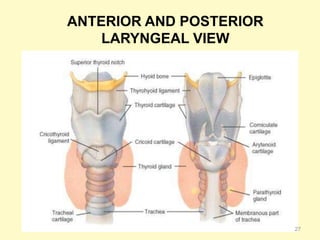
ANTERIOR AND POSTERIOR
LARYNGEAL VIEW
27
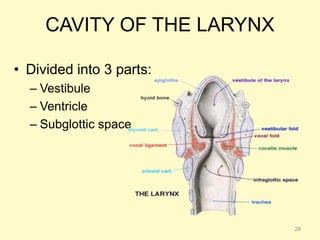
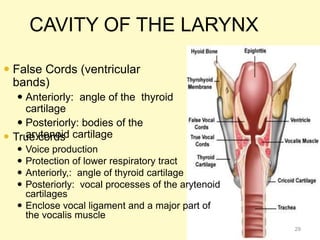
CAVITY OF THE LARYNX
• Divided into 3 parts:
– Vestibule
– Ventricle
– Subglottic space
28
CAVITY OF THE LARYNX
 False Cords (ventricular
bands)
 Anteriorly: angle of the thyroid
cartilage
 Posteriorly: bodies of the
arytenoid cartilage True cords
 Voice production
 Protection of lower respiratory tract
 Anteriorly,: angle of thyroid cartilage
 Posteriorly: vocal processes of the arytenoid
cartilages
 Enclose vocal ligament and a major part of
the vocalis muscle
29
30
31
32
BLOOD SUPPLY
• Upper Larynx
– External carotid artery
– Superior thyroid artery
– Superior laryngeal
artery
• Lower Larynx
– Subclavian artery
– Thyrocervical artery
– Inferior thyroid artery
– Inferior laryngeal
artery
33
34
PHYSIOLOGY
35
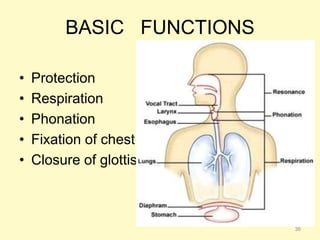
BASIC FUNCTIONS
• Protection
• Respiration
• Phonation
• Fixation of chest
• Closure of glottis
36

Ppt larynx.

  • 1.
    PRESENTATION ON ANATOMY AND PHYSIOLOGY OFLARYNX PREPARED BY Mrs. REENA YADAV Lecturer, Pushpanjali College Of Nursing, Agra
  • 2.
    OBJECTIVES •To discuss thebasic anatomy of the larynx •To enumerate the main functions of the larynx
  • 3.
  • 4.
    LARYNX Commonly called- voicebox Shape- tube shaped. Composed- muscles, cartilages, connective tissue. Bony part- hyoid bone. Location- 4-6 cervical vertebra. Lies- midline of the neck.
  • 5.
    5 SHAPE AND SIZE •theshape of the larynx in lower side is circular and from the upper it is tringular in shape. •Its length is 4.3 cm, • transverse diameter is 4.2 cm and anterior posterior diameter 3.6 cm.
  • 6.
    LARYNX The larynx iscomposed of nine pieces of cartilage. PAIRED Arytenoid cartilage Corniculate cartilage Cuneiform cartilage , UNPAIRED: Thyroid cartilage Cricoid cartilage Epiglottis
  • 7.
    THYROID CARTILAGE Largest cartilage. consistof two laminae the anterior border of which are fused with each other at an angle in the middle line of the neck and form a subcutaneous projection named as ADAM’S APPLE OR laryngeal prominence. 7
  • 8.
    LINNING OF THELARYNX superior of the vocal fold is non karatinized stratified squamous epithelium, inferior to the vocal fold is pseudo stratified columnar epithelium.
  • 9.
    THYROID CARTILAGE larger inmales than females due to the influence of male sex hormones on its growth during puberty. Immediately above it is the lamina are separated by a V shape notch, the superior thyroid notch. The laminae are irregularly
  • 10.
    THYROID CARTILAGE The laminaeare irregularly quadrilateral in the shape and their posterior angles are prolonged into processes termed the superior and inferior cornu. •The superior cornu is long, and narrow, directed upward, backward,and medialword which gives attachmentto the lateral hypothyroid ligament. •The inferior cornu is short and thick, it is directed downward with a slight inclination forward and medialward, and present on the medial side of its tip, a small oval articular facet for articulation
  • 11.
    CRICOID CARTILAGE A ringof hyaline cartilage known as SIGNET RING.  form the inferior wall of the larynx. smaller, thicker and smaller than the thyroid and forms the lower and posterior parts of the wall of the larynx.  attached to the first ring of cartilage of the trachea by the cricotracheal ligament . the thyroid cartilage is connected to the cricoid cartilage by the cricothyroid ligament . It is the landmark. 11
  • 12.
    CRICOID CARTILAGE It consistof two parts: a posterior quadrate lamina and anterior quadrate lamina. The lamina (posterior portion) is deep, and broad and measure from above downward about 2 or 3 cm, on its posterior surface, in the middle line, is the vertical ridge to the lower part of which are attached to the longitudinal fibres of the oesophagus. The arch(anterior portion) is narrow and convex, and measures vertically from 5 to 7 mm. 12
  • 13.
    EPIGLOTTIS •It is alarge leaf-shaped piece of elastic cartilage that is covered with epithelium. • stem of the epiglottis is attached to the anterior rim of the thyroid cartilage and hyoid bone . • the broad superior leaf portion of epiglottis is unattached and free to move up and down like a trap door. • The free extremity is connected by the thyroepiglottic
  • 14.
    ARYTENOID CARTILAGE • Tringularpieces, hyaline cartilage located at the posterior, superior border of the cricoid cartilage at the back of the larynx. •Each is pyramidal in form and has three surface, a base and a apex. •Posterior surface in tringular, smooth and concave. Anterolateral surface is convex and rough. • Attached to the vocal folds and intrinsic pharyngeal muscles. Supported by the arytenoid cartilage,
  • 15.
    CORNICULATE CARTILAGES • Twosmall conical nodules • Shape-horn shaped , elastic cartilage. • Located apex of the each arytenoid cartilage. Situated in the posterior part of the aryepiglottic. 15
  • 16.
    CUNEIFORM CARTILAGES •club shaped •placed one on either side , in the aryepiglottic fold • just in front of the arytenoids ligament and gives the support the vocal folds and the lateral aspects of the epiglottis. 16
  • 17.
    LARYNGEAL LIGAMENTS • EXTRINSIC –Thyrohyoid membrane and ligaments – Cricothyroid membrane and ligaments – Cricotracheal ligament – Epiglottis • INTRINSIC – Elastic membrane – Quadrangular membrane – Conus elasticus (cricovocal membrane) – Median cricothyroid ligament – Vocal Ligament – Thyroepiglottic ligament 17
  • 18.
    The thyroid membrane--- abroad, fibroelastic layer, attached below to the upper border of the thyroid cartilage and to the front of its superior cornu. EXTRINSIC LIGAMENTS
  • 19.
    The thyrohyoid ligament –is the round elastic cord, which forms the posterior border of the hyothyroid membrane and passes between the tip of thr superior cornu of the thyroid cartilage and the extremity of the greater EXTRINSIC LIGAMENTS
  • 20.
    EXTRINSIC LIGAMENTS Epiglottis --is connected with the hyoid bone by an elastic hand the hyoepiglotic ligament. Cricotracheal ligament – Connects the cricoid cartilage with the first ring of the trachea. It resembles the fibrous membrane which connects the cartilaginous rings of the trachea to the each other.
  • 21.
  • 22.
    22 INTRINSIC LIGAMENTS THE CORNUSELASTICUS-- is composed mainly of yellow elastic tissue. It connects the thyroid, cricoid, arytenoid cartilage to one another . THYROEPIGLOTTIC LIGAMENT---- is a long, slender, elastic cordwhich connects the stem of the epiglottis with the angle of thyroid cartilage.
  • 23.
    MUSCLES OF LARYNX Extrinsicmuscles •The Mylohyoid Muscle •Geniohyoid Muscle •The Stylohyoid Muscle •Cricothyroid
  • 24.
    EXTRINSIC MUSCLES The Geniohyoid Muscle Theylie superior to the mylohyoid muscle to body of the hyoid bone The Stylohyoid Muscle Insertion: the body of the hyoid bone
  • 25.
    Cont….. The thyrohyoid muscle -It arises from the oblique line on the lamina of the thyroid cartilage, and to the greater cornu of the hyoid bone.
  • 26.
    INTRINSIC MUSCLES OF LARYNX •Thyroaryatenoid •ObliqueArytaenoid •Transverse Arytaenoid •Posterior Cricoarytenoid •Lateral Cricoarytenoid
  • 27.
  • 28.
    CAVITY OF THELARYNX • Divided into 3 parts: – Vestibule – Ventricle – Subglottic space 28
  • 29.
    CAVITY OF THELARYNX  False Cords (ventricular bands)  Anteriorly: angle of the thyroid cartilage  Posteriorly: bodies of the arytenoid cartilage True cords  Voice production  Protection of lower respiratory tract  Anteriorly,: angle of thyroid cartilage  Posteriorly: vocal processes of the arytenoid cartilages  Enclose vocal ligament and a major part of the vocalis muscle 29
  • 30.
  • 31.
  • 32.
  • 33.
    BLOOD SUPPLY • UpperLarynx – External carotid artery – Superior thyroid artery – Superior laryngeal artery • Lower Larynx – Subclavian artery – Thyrocervical artery – Inferior thyroid artery – Inferior laryngeal artery 33
  • 34.
  • 35.
  • 36.
    BASIC FUNCTIONS • Protection •Respiration • Phonation • Fixation of chest • Closure of glottis 36