Objectives of theObjectives of the
lecture are:lecture are:
At the end of the lecture the student should be able to :At the end of the lecture the student should be able to :
 Comprehend concept of family planning
 Classify various contraceptive methods
 Prescribe contraceptives for clients
 Counsel the women about contraceptive use
according to her situation.
 Calculate the failure rate of contraception
(pearl’s Index). 1
Family Planning
Definition
According to WHO in 1971 it is defined as “a way of
thinking and living that is adopted voluntarily, upon
the basis of knowledge, attitudes and responsible
decisions by individuals and couples, in order to
promote the health and welfare of the family group
and thus contribute effectively to the social
development of a country’’
2
Objectives of family
planning
Family planning refers to certain
objectives;
 To avoid unwanted births
 To bring about wanted births
 To regulate intervals b/t pregnancies
 To control the time of birth in relation
to the age of parent
 To determine the number of children in
the family
3
Scope of family planning
services
Family planning is not mere birth control and by WHO
expert committee it includes ;
 the spacing and limitation of birth
 advice on sterility
 education for parenthood,
 marriage counseling
 genetic counseling
 providing adoption services
.
4
Eligible couples
An “eligible couple” is a newly married couple
wherein the wife is in the reproductive age
between 15 and 45 years.
Target couples
The term target couples was applied to
couples who have had 2-3 living children, or
even newly married couples to make them
accept the idea of family planning from the
earliest possible stage.
5
CONTRACEPTIVE
METHODS
Definition :
By definition, these are preventive methods to
help women avoid unwanted pregnancies. They
include all temporary and permanent measures
to prevent pregnancy resulting from coitus.
6
Ideal contraceptive
• The term “ideal contraceptive” that
is safe, effective, long lasting,
inexpensive, acceptable, these may
be suitable for one group and may be
unsuitable for another. Now this
approach is replaced and family
planning programs provide a
“cafeteria choice”.
7
8
Classification
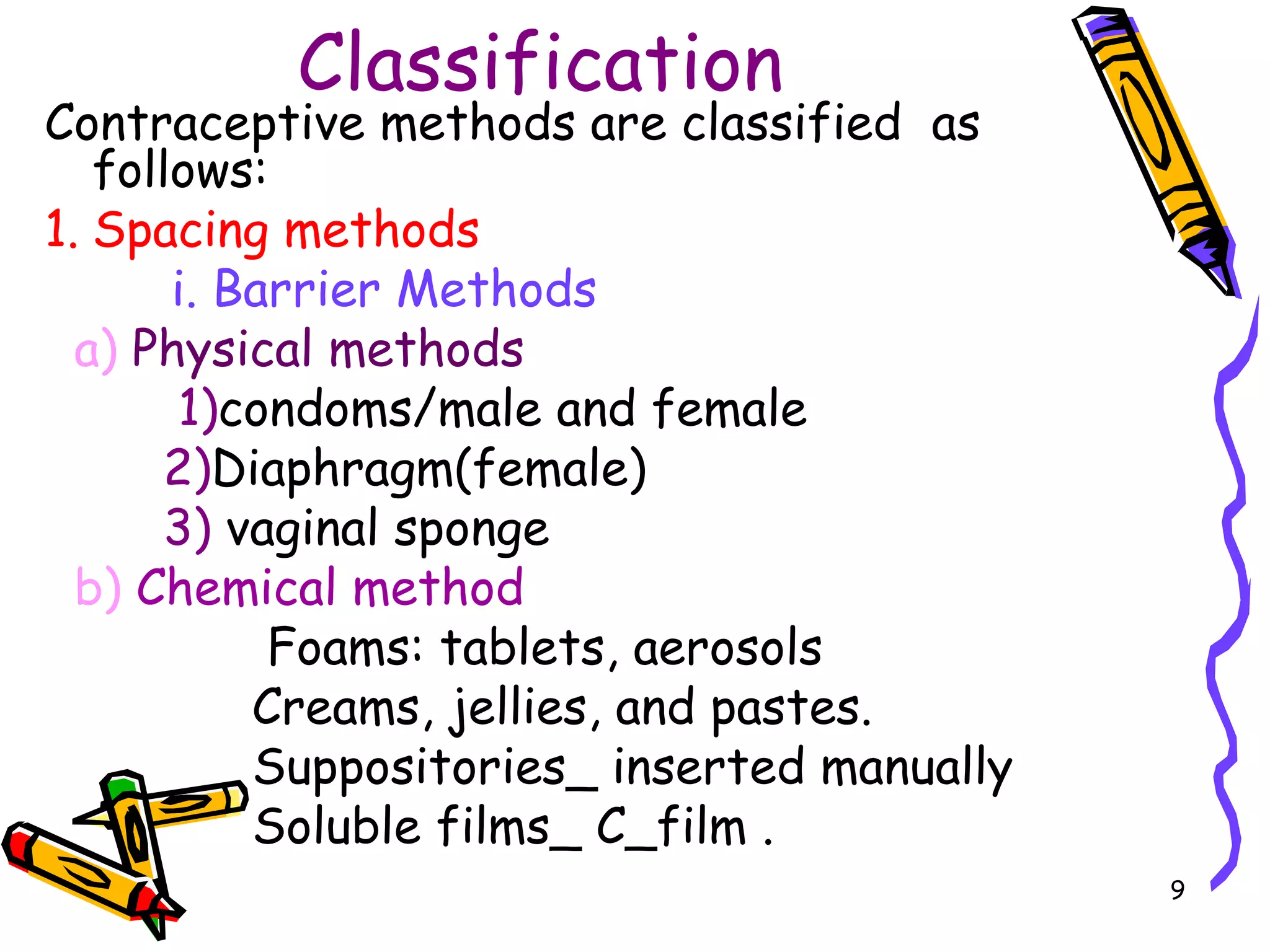
Contraceptive methods are classified as
follows:
1. Spacing methods
i. Barrier Methods
a) Physical methods
1)condoms/male and female
2)Diaphragm(female)
3) vaginal sponge
b) Chemical method
Foams: tablets, aerosols
Creams, jellies, and pastes.
Suppositories_ inserted manually
Soluble films_ C_film .
9
Combined methods
Combination of physical and chemical methods.
ii. Intra- utrine devices
Types of IUCDs:
Non-medicated includes :
Lippes loop
Medicated IUCDs includes:
copperT and multiload
Harmone releasing IUCDs are:
progestasert and levonorgestrel
10
iii. Hormonal Contraceptives
May be classified as follows:
A. Oral pills
1. Combined pills
2. Progestogen only pill ( POP)
3. Post- coital pill
4.Once – a- month (long – acting) pill
5. Male pill
B. Depot(slow release) formulations
1. Injectables
2. Subcutaneous implants
3. Vaginal rings
11
iv. Post-conceptional methods
These include:
1. Menstrual regulation
consists of aspiration of the uterine contents 6
to 14 days of a missed cycle.
2. Menstrual induction
based on disturbing the normal physiology of
uterus by adding 1-5 mg of prostaglandin F2 .
3. Abortion
It is the termination of pregnancy before the
foetus become viable till 28 weeks of gestation.
12
v. Miscellaneous methods
Includes:
1. Abstinence
2. Coitus interruptus
3. Safe period (rhythm method)
4. Natural familly planning method
5. Breast feeding
6. Birth control vaccine
13
2. TERMINAL METHODS
(Sterilization)
Male sterilization or vasectomy
Female tubal ligation
14
Choose best contraceptive
for these women…
• A) 21 yrs old recently married woman presents to
your clinic after having unprotected coitus last
night. What method/s that you can use in this
woman as post-coital contraceptive method/s.
• B) A 35 yrs old healthy woman with two children
aged 3 & 5 yrs requests an emergency
contraceptive after unplanned coitus 4 days ago.
Name a method that you would offer this
woman.
15
key
A) post-coital pill containing
levonorgesterol 0.75mg 12 hrs apart
within 72 hours of unprotected
coitus.
B) Insert an IUCD. Best within 5 days
of unprotected coitus.
16
How would you confirm that
she is an ideal candidate for
IUCD?
17
An ideal candidate for
IUCD should have
• At least one child
• No history of pelvic disease
• Normal menstrual period
• Willingness to check IUCD tail
• Access to follow-up
• A monogamous relationship
18
Scenarios …
• A 30-year-old married woman having
positive history of Deep Vein
Thrombosis during last pregnancy
came for family planning advise. Her
menstrual cycle is regular and have
three children 2, 5 and 7 years of
age. Choose best contraceptive for
her.
19
• A 30-year-old married woman,
suffering from hypertension, came
for family planning advise. Her
menstrual cycle is regular and have
three children 2, 5 and 7 years of
age. Choose best contraceptive for
her
20
• A 30-year-old married woman having
positive history of Ischemic Heart
disease came for family planning
advise. Her menstrual cycle is regular
and have three children 2, 5 and 7
years of age. Choose best
contraceptive for her
21
• A 30-year-old married woman having
positive history of hyperlipidemia
came for family planning advise. Her
menstrual cycle is regular and have
three children 2, 5 and 7 years of
age. Choose best contraceptive for
her.
22
• A 36-year-old married woman, who
is healthy and have a regular
menstrual cycle, came for family
planning advise. She has three
children 2, 5 and 7 years of age.
Choose best contraceptive for her.
23
key
• For all these woman OCP is
contraindicated.
• They are all best candidates for
IUCD insertion.
24
So! remember to rule out
the contraindications for
OCP
25
Contraindications for
OCP
Absolute:
• CA Breast, CA
genitalia
• Liver disease
• Hx of
thromboembolism
• Cardiac problems
• Hyperlipidemia
• Undiagnosed abnormal
uterine bleeding
Special conditions:
• Age over 35
• Smoking
• Epilepsy
• Diabetes
• Chronic renal disease
• Migraine
• Nursing mothers first
six months
26
Question
• 30 yrs old female who is on OCP has
forgotten to take her last two pills.
what advise would you give her?
27
If you skip one or more pills, take the following
precautions:
• Missing the first pill in a new cycle. Take a tablet
as soon as you remember and the next one at the
usual time. Two tablets can be taken in one day.
Use barrier contraception for 7 days after the
missed dose.
• Missing a pill 2 days in a row. Take 2 pills as soon
as you remember and then 2 more the following
day. Also use back-up barrier contraception until
the next pill cycle.
• Missing more than 2 days. Discard the pack, use a
back-up birth control method, and begin a new
cycle on the following Sunday, even if you have
started bleeding.
28
• A 20-year-old married woman comes
for FP advise. She had a history of
irregular and heavy menstrual cycle
and an abortion 1 month ago. GPE
show marked pallor. Lab
investigations confirm Iron
deficiency anaemia. What is the best
choice of contraceptive for her?
29
• A 20-year-old married woman comes
for FP advise. She had a history of
irregular and heavy vaginal bleeding
due to Endometriosis. GPE show
marked pallor. What is the best
choice of contraceptive for her?
30
• A 25-year-old married woman comes
for FP advise. She had a history of
benign ovarian tumor and severe
dysmenorrhea. GPE show marked
pallor. What is the best choice of
contraceptive for her
31
• A 25-year-old married woman comes
for FP advise. She had a history of
benign breast lump which was excised
2 months ago. Her GP and systemic
examination was normal. What is the
best choice of contraceptive for her
32
• A 28-year-old married woman having
two children comes for FP advise.
She had a history of gestational
Diabetes during last pregnancy. Her
GP and systemic examination was
normal. What is the best choice of
contraceptive for her?
33
Key: the best
contraceptive for all
these women is OCP
provided that no
contraindication is
present!!
34
Other women in whom OCP can be
given are those
• Tuberculous
• Goitre +, hyper or hypothyroid
• Thalassemic
• HIV +,
• Suffering from STIs, PID, Ovarian Cancer, Endometrial
cancer
• Depressed
35
What if contraindication
for OCP is present?
36
• A 35-year-old married woman having
two children comes for FP advise.
She is a smoker and had a history of
gestational Diabetes during last
pregnancy. Her GP and systemic
examination was normal. What is the
best choice of contraceptive for
her?
37
Key:
• POP
• Progestin only implants OR
• Cu- T
38
Scenario
• A 23-year-old illiterate woman who
has just given birth to her first baby
wants an advice on FP. She is
medically fit and wants to
breastfeed her child. What is the
best choice of contraceptive for
her?
39
1st Choice Methods
 
These methods do not interfere with breastfeeding and
are safe to use any time after birth:
– LAM (for up to six months)
– Condoms (also the best protection against AIDS and sexually
transmitted diseases)
– Diaphragm
– Spermicides
– IUD (non-hormonal)
– Natural Family Planning (breastfeeding disrupts the signs and
symptoms of fertility, which may make charting difficult)
40
Upon inquiry she told the
doctor that she is not
willing to place anything
in her uterus.
41
2nd Choice Methods 
Methods under this category contain the hormone
progestin. In most cases, these methods do not
affect a woman's milk supply. However, to avoid
any risk, it is recommended to wait six weeks
after delivery before using a progestin-only
method, which include the following:
– Mini-pill
– Injectables (such as Depo-Provera®)
– Implants (such as Norplant®)
42
3rd Choice Methods 
These methods contain the hormone estrogen which
can reduce a woman's milk supply. Women
should be informed of this risk and advised
to delay the use of such methods until at least
six months postpartum.
However, if the breastfeeding woman chooses this
method, she can continue breastfeeding and
should be encouraged to do so for its numerous
health benefits.
Combined oral contraceptives 
Combined Injectables
43
Scenario
• A 27-year-old married woman having
two children comes for FP advise.
She is suffering from PID. Her GP
and systemic examination was normal.
Her lab investigations show lipid
disorder. What is the best choice of
contraceptive for her?
44
Key
• Barrier method by the partner or
• Safe period (Rhythm or natural
method)
45
Natural methods:
1. Calendar method
2. Cervical mucus method
3. Basal body temperature method
46
Drawbacks of calendar
method
1. Menstrual cycles are not always regular.
2. Only possible to be used by educated
couples.
3. Compulsory abstinence for nearly half of
every month.
4. Method is not applicable during post-natal
period.
5. High failure rate i.e. up to 9 per HWY.
47
Other names of natural
methods
• Billings method = ovulation method =
cervical mucus method
• Symptothermic method =
basal body temperature + cervical mucus
method + calendar method
48
Pearl’s index
Denominator i.e. total months of
exposure =
no of woman x years of exposure49
50
• Suppose 200 females on OCPs were
followed over a period of 2years to
observe the effectiveness of the
contraceptive method. During the
study period six females conceived
and left the study. Determine the
failure rate of OCPs in this study.
51
Calculation of
Contraceptive Failure
Rate
• We need to calculate the Pearl’s
Index.
– Total accidental pregnancies = 6
– Total months of exposure = 2x 12=24
– 6 x1200 / 200 x 24 = 1.5 per HWY
52
Unmet need for family
planning
• Many women who are sexually active
would prefer to avoid becoming
pregnant, and had not being using any
method of contraception(including
use by their partner).
These women are considered to have
an “unmet need “ for family planning.
53
Reason for unmet need
• Unsatisfactory services
• Lack of information
• Fear of side effects
• Opposition from the husband or
relatives.
54
How to overcome
• Maximize access to good quality
services
• Expand mass media communication
• Address facts and myths about
family planning
• Address men directly with
information about benefits and
safety
55

Family planning

  • 1.
    Objectives of theObjectivesof the lecture are:lecture are: At the end of the lecture the student should be able to :At the end of the lecture the student should be able to :  Comprehend concept of family planning  Classify various contraceptive methods  Prescribe contraceptives for clients  Counsel the women about contraceptive use according to her situation.  Calculate the failure rate of contraception (pearl’s Index). 1
  • 2.
    Family Planning Definition According toWHO in 1971 it is defined as “a way of thinking and living that is adopted voluntarily, upon the basis of knowledge, attitudes and responsible decisions by individuals and couples, in order to promote the health and welfare of the family group and thus contribute effectively to the social development of a country’’ 2
  • 3.
    Objectives of family planning Familyplanning refers to certain objectives;  To avoid unwanted births  To bring about wanted births  To regulate intervals b/t pregnancies  To control the time of birth in relation to the age of parent  To determine the number of children in the family 3
  • 4.
    Scope of familyplanning services Family planning is not mere birth control and by WHO expert committee it includes ;  the spacing and limitation of birth  advice on sterility  education for parenthood,  marriage counseling  genetic counseling  providing adoption services . 4
  • 5.
    Eligible couples An “eligiblecouple” is a newly married couple wherein the wife is in the reproductive age between 15 and 45 years. Target couples The term target couples was applied to couples who have had 2-3 living children, or even newly married couples to make them accept the idea of family planning from the earliest possible stage. 5
  • 6.
    CONTRACEPTIVE METHODS Definition : By definition,these are preventive methods to help women avoid unwanted pregnancies. They include all temporary and permanent measures to prevent pregnancy resulting from coitus. 6
  • 7.
    Ideal contraceptive • Theterm “ideal contraceptive” that is safe, effective, long lasting, inexpensive, acceptable, these may be suitable for one group and may be unsuitable for another. Now this approach is replaced and family planning programs provide a “cafeteria choice”. 7
  • 8.
  • 9.
    Classification Contraceptive methods areclassified as follows: 1. Spacing methods i. Barrier Methods a) Physical methods 1)condoms/male and female 2)Diaphragm(female) 3) vaginal sponge b) Chemical method Foams: tablets, aerosols Creams, jellies, and pastes. Suppositories_ inserted manually Soluble films_ C_film . 9
  • 10.
    Combined methods Combination ofphysical and chemical methods. ii. Intra- utrine devices Types of IUCDs: Non-medicated includes : Lippes loop Medicated IUCDs includes: copperT and multiload Harmone releasing IUCDs are: progestasert and levonorgestrel 10
  • 11.
    iii. Hormonal Contraceptives Maybe classified as follows: A. Oral pills 1. Combined pills 2. Progestogen only pill ( POP) 3. Post- coital pill 4.Once – a- month (long – acting) pill 5. Male pill B. Depot(slow release) formulations 1. Injectables 2. Subcutaneous implants 3. Vaginal rings 11
  • 12.
    iv. Post-conceptional methods Theseinclude: 1. Menstrual regulation consists of aspiration of the uterine contents 6 to 14 days of a missed cycle. 2. Menstrual induction based on disturbing the normal physiology of uterus by adding 1-5 mg of prostaglandin F2 . 3. Abortion It is the termination of pregnancy before the foetus become viable till 28 weeks of gestation. 12
  • 13.
    v. Miscellaneous methods Includes: 1.Abstinence 2. Coitus interruptus 3. Safe period (rhythm method) 4. Natural familly planning method 5. Breast feeding 6. Birth control vaccine 13
  • 14.
    2. TERMINAL METHODS (Sterilization) Malesterilization or vasectomy Female tubal ligation 14
  • 15.
    Choose best contraceptive forthese women… • A) 21 yrs old recently married woman presents to your clinic after having unprotected coitus last night. What method/s that you can use in this woman as post-coital contraceptive method/s. • B) A 35 yrs old healthy woman with two children aged 3 & 5 yrs requests an emergency contraceptive after unplanned coitus 4 days ago. Name a method that you would offer this woman. 15
  • 16.
    key A) post-coital pillcontaining levonorgesterol 0.75mg 12 hrs apart within 72 hours of unprotected coitus. B) Insert an IUCD. Best within 5 days of unprotected coitus. 16
  • 17.
    How would youconfirm that she is an ideal candidate for IUCD? 17
  • 18.
    An ideal candidatefor IUCD should have • At least one child • No history of pelvic disease • Normal menstrual period • Willingness to check IUCD tail • Access to follow-up • A monogamous relationship 18
  • 19.
    Scenarios … • A30-year-old married woman having positive history of Deep Vein Thrombosis during last pregnancy came for family planning advise. Her menstrual cycle is regular and have three children 2, 5 and 7 years of age. Choose best contraceptive for her. 19
  • 20.
    • A 30-year-oldmarried woman, suffering from hypertension, came for family planning advise. Her menstrual cycle is regular and have three children 2, 5 and 7 years of age. Choose best contraceptive for her 20
  • 21.
    • A 30-year-oldmarried woman having positive history of Ischemic Heart disease came for family planning advise. Her menstrual cycle is regular and have three children 2, 5 and 7 years of age. Choose best contraceptive for her 21
  • 22.
    • A 30-year-oldmarried woman having positive history of hyperlipidemia came for family planning advise. Her menstrual cycle is regular and have three children 2, 5 and 7 years of age. Choose best contraceptive for her. 22
  • 23.
    • A 36-year-oldmarried woman, who is healthy and have a regular menstrual cycle, came for family planning advise. She has three children 2, 5 and 7 years of age. Choose best contraceptive for her. 23
  • 24.
    key • For allthese woman OCP is contraindicated. • They are all best candidates for IUCD insertion. 24
  • 25.
    So! remember torule out the contraindications for OCP 25
  • 26.
    Contraindications for OCP Absolute: • CABreast, CA genitalia • Liver disease • Hx of thromboembolism • Cardiac problems • Hyperlipidemia • Undiagnosed abnormal uterine bleeding Special conditions: • Age over 35 • Smoking • Epilepsy • Diabetes • Chronic renal disease • Migraine • Nursing mothers first six months 26
  • 27.
    Question • 30 yrsold female who is on OCP has forgotten to take her last two pills. what advise would you give her? 27
  • 28.
    If you skipone or more pills, take the following precautions: • Missing the first pill in a new cycle. Take a tablet as soon as you remember and the next one at the usual time. Two tablets can be taken in one day. Use barrier contraception for 7 days after the missed dose. • Missing a pill 2 days in a row. Take 2 pills as soon as you remember and then 2 more the following day. Also use back-up barrier contraception until the next pill cycle. • Missing more than 2 days. Discard the pack, use a back-up birth control method, and begin a new cycle on the following Sunday, even if you have started bleeding. 28
  • 29.
    • A 20-year-oldmarried woman comes for FP advise. She had a history of irregular and heavy menstrual cycle and an abortion 1 month ago. GPE show marked pallor. Lab investigations confirm Iron deficiency anaemia. What is the best choice of contraceptive for her? 29
  • 30.
    • A 20-year-oldmarried woman comes for FP advise. She had a history of irregular and heavy vaginal bleeding due to Endometriosis. GPE show marked pallor. What is the best choice of contraceptive for her? 30
  • 31.
    • A 25-year-oldmarried woman comes for FP advise. She had a history of benign ovarian tumor and severe dysmenorrhea. GPE show marked pallor. What is the best choice of contraceptive for her 31
  • 32.
    • A 25-year-oldmarried woman comes for FP advise. She had a history of benign breast lump which was excised 2 months ago. Her GP and systemic examination was normal. What is the best choice of contraceptive for her 32
  • 33.
    • A 28-year-oldmarried woman having two children comes for FP advise. She had a history of gestational Diabetes during last pregnancy. Her GP and systemic examination was normal. What is the best choice of contraceptive for her? 33
  • 34.
    Key: the best contraceptivefor all these women is OCP provided that no contraindication is present!! 34
  • 35.
    Other women inwhom OCP can be given are those • Tuberculous • Goitre +, hyper or hypothyroid • Thalassemic • HIV +, • Suffering from STIs, PID, Ovarian Cancer, Endometrial cancer • Depressed 35
  • 36.
    What if contraindication forOCP is present? 36
  • 37.
    • A 35-year-oldmarried woman having two children comes for FP advise. She is a smoker and had a history of gestational Diabetes during last pregnancy. Her GP and systemic examination was normal. What is the best choice of contraceptive for her? 37
  • 38.
    Key: • POP • Progestinonly implants OR • Cu- T 38
  • 39.
    Scenario • A 23-year-oldilliterate woman who has just given birth to her first baby wants an advice on FP. She is medically fit and wants to breastfeed her child. What is the best choice of contraceptive for her? 39
  • 40.
    1st Choice Methods   Thesemethods do not interfere with breastfeeding and are safe to use any time after birth: – LAM (for up to six months) – Condoms (also the best protection against AIDS and sexually transmitted diseases) – Diaphragm – Spermicides – IUD (non-hormonal) – Natural Family Planning (breastfeeding disrupts the signs and symptoms of fertility, which may make charting difficult) 40
  • 41.
    Upon inquiry shetold the doctor that she is not willing to place anything in her uterus. 41
  • 42.
    2nd Choice Methods  Methodsunder this category contain the hormone progestin. In most cases, these methods do not affect a woman's milk supply. However, to avoid any risk, it is recommended to wait six weeks after delivery before using a progestin-only method, which include the following: – Mini-pill – Injectables (such as Depo-Provera®) – Implants (such as Norplant®) 42
  • 43.
    3rd Choice Methods  Thesemethods contain the hormone estrogen which can reduce a woman's milk supply. Women should be informed of this risk and advised to delay the use of such methods until at least six months postpartum. However, if the breastfeeding woman chooses this method, she can continue breastfeeding and should be encouraged to do so for its numerous health benefits. Combined oral contraceptives  Combined Injectables 43
  • 44.
    Scenario • A 27-year-oldmarried woman having two children comes for FP advise. She is suffering from PID. Her GP and systemic examination was normal. Her lab investigations show lipid disorder. What is the best choice of contraceptive for her? 44
  • 45.
    Key • Barrier methodby the partner or • Safe period (Rhythm or natural method) 45
  • 46.
    Natural methods: 1. Calendarmethod 2. Cervical mucus method 3. Basal body temperature method 46
  • 47.
    Drawbacks of calendar method 1.Menstrual cycles are not always regular. 2. Only possible to be used by educated couples. 3. Compulsory abstinence for nearly half of every month. 4. Method is not applicable during post-natal period. 5. High failure rate i.e. up to 9 per HWY. 47
  • 48.
    Other names ofnatural methods • Billings method = ovulation method = cervical mucus method • Symptothermic method = basal body temperature + cervical mucus method + calendar method 48
  • 49.
    Pearl’s index Denominator i.e.total months of exposure = no of woman x years of exposure49
  • 50.
  • 51.
    • Suppose 200females on OCPs were followed over a period of 2years to observe the effectiveness of the contraceptive method. During the study period six females conceived and left the study. Determine the failure rate of OCPs in this study. 51
  • 52.
    Calculation of Contraceptive Failure Rate •We need to calculate the Pearl’s Index. – Total accidental pregnancies = 6 – Total months of exposure = 2x 12=24 – 6 x1200 / 200 x 24 = 1.5 per HWY 52
  • 53.
    Unmet need forfamily planning • Many women who are sexually active would prefer to avoid becoming pregnant, and had not being using any method of contraception(including use by their partner). These women are considered to have an “unmet need “ for family planning. 53
  • 54.
    Reason for unmetneed • Unsatisfactory services • Lack of information • Fear of side effects • Opposition from the husband or relatives. 54
  • 55.
    How to overcome •Maximize access to good quality services • Expand mass media communication • Address facts and myths about family planning • Address men directly with information about benefits and safety 55