Reproductive health
 Total well being in all aspects of
reproduction i.e physical,
emotional, behavioral & social is
called reproductive health
 A society with people having
physically & functionally normal
reproductive organs normal
emotional& behavioral
interactions among them in all
sex related aspects is said to be
reproductively healthy society
Reproductive & child health care (RCH)
 THE MAJOR TASKS UNDER THIS PROGRAMMES ARE
 1. Creating awareness among people about various reproduction related aspects
 2. providing facilities & support for building up reproductively healthy society
Steps taken by the government Creating awareness
among people about various reproduction related
aspects
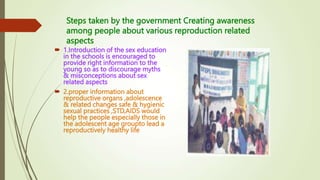
 1.Introduction of the sex education
in the schools is encouraged to
provide right information to the
young so as to discourage myths
& misconceptions about sex
related aspects
 2.proper information about
reproductive organs ,adolescence
& related changes safe & hygienic
sexual practices ,STD,AIDS would
help the people especially those in
the adolescent age groupto lead a
reproductively healthy life
introduction of sex education in schools is necessary. It would
provide right information to young individuals at the right time
about various aspects of reproductive health such as reproductive
organs, puberty, and adolescence related changes, safe sexual
practices, sexually transmitted diseases, etc.
The young individual or adolescents are more susceptible in
acquiring various sexually transmitted diseases.
Hence, providing information to them at the right time would help
them to lead a reproductively healthy life and also protect them
from the myths and misconceptions about various sex related
issues.
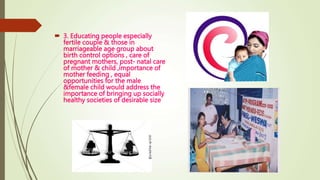
 3. Educating people especially
fertile couple & those in
marriageable age group about
birth control options , care of
pregnant mothers, post- natal care
of mother & child ,importance of
mother feeding , equal
opportunities for the male
&female child would address the
importance of bringing up socially
healthy societies of desirable size
Awareness of problems due
to uncontrolled population
growth, social evils like sex
abuse ,sex related crimes
need to be created to
enable the people to take
up necessary steps to
prevent them& there by
build up a socially
responsible& healthy
society
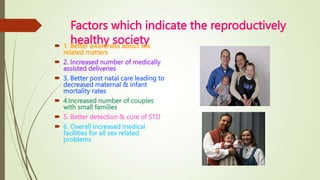
Factors which indicate the reproductively
healthy society
 1. Better awareness about sex
related matters
 2. Increased number of medically
assisted deliveries
 3. Better post natal care leading to
decreased maternal & infant
mortality rates
 4.Increased number of couples
with small families
 5. Better detection & cure of STD
 6. Overall increased medical
facilities for all sex related
problems
Population explosion
 World population was 2 billions in 1900
 It was increased to 6 billions by 2000
 Indian population was 350 millions at the time of our independence
 It crossed one billion in may 2000
 Every sixth person in the world is an Indian
Reasons for population explosion
 1. A rapid decline in death rate, maternal mortality rate, infant mortality rate
 2. Increase in number of people in reproducible age
Measures taken by the government to
check the population growth rate
 1. Motivating the people to have smaller families by using various contraceptive
methods
 2. Raising the marriagble age of the females to 18 years & males to 21 years
 3. Giving incentives to the couples with small families
IDEAL CONTRACEPTIVE
 1) User friendly
 2) Easily available
 3) Effective
 4) Reversible with no or less side effects
 5) It should not interfere with the sexual desire or sexual act of the user
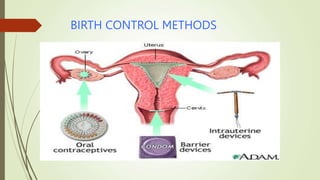
Contraceptive methods
 1) Natural methods
 2)Barrier methods
 3)IUDs
 4)Oral pills
 5) Injections & implants
 6)Surgical methods
NATURAL METHODS
There are three natural methods
 1) PERIODIC ABSTINANCE
 2) WITHDRAWL( OR ) COITUS INTERRUPTUS
 3)LACTATIONAL AMENORRHEA
Natural methods work on the principle of avoiding
chances of ovum & sperms meeting
As no medicines or devices are used in this method ,
side effects are almost nil
Chances of failure through these methods are also
high
1. Periodic abstinance
In this method couple avoid or abstain from coitus
from 10th to 17th day of the menstrual cycle when
ovulation could be expected
As chances of fertilization are high during this period,
it is called the fertile period
 Therefore by avoiding the coitus during this period
conception can be prevented
2.WITHDRAWL( OR ) COITUS
INTERRUPTUS
In this method male partner withdraws his penis from the vagina just before
ejaculation to avoid the insemination
3) LACTATIONAL AMENORRHEA
 It is the absence of the menstruation
This method is based on the fact that ovulation &
menstrual cycle do not occur during period of the
intense lactation following parturition
As long as the mother breast feeds the child fully, the
chances of conception are nil
This method is effective only for 6 months following
parturition
BARRIER METHODS
 1) CONDOMS
 2) DIAPHRAGMS,CERVICAL CAPS&VAULTS
Barrier methods
 In barrier methods ovum & sperm are prevented physically meeting with the help
of the barriers
 These methods are available for both males & females
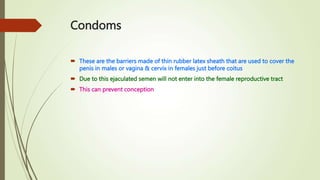
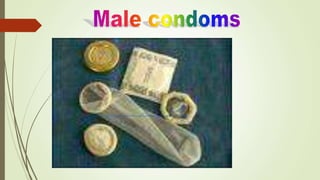
Condoms
 These are the barriers made of thin rubber latex sheath that are used to cover the
penis in males or vagina & cervix in females just before coitus
 Due to this ejaculated semen will not enter into the female reproductive tract
 This can prevent conception
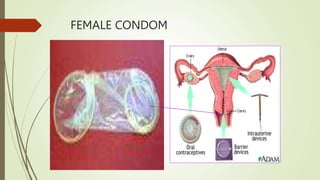
FEMALE CONDOM
Benefits of condoms
The use of condoms in recent years has increased
due to their additional benefits
1. They protect the user from contracting STDs &
AIDS
2. Both male & female condoms are disposable
3. They can be self inserted & there by gives privacy
to the user
Nirodh is the popular brand of condom for the male
.
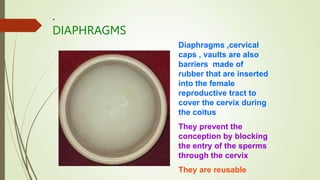
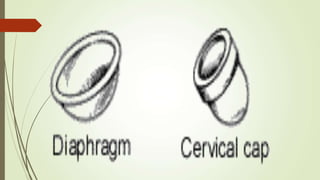
DIAPHRAGMS
Diaphragms ,cervical
caps , vaults are also
barriers made of
rubber that are inserted
into the female
reproductive tract to
cover the cervix during
the coitus
They prevent the
conception by blocking
the entry of the sperms
through the cervix
They are reusable
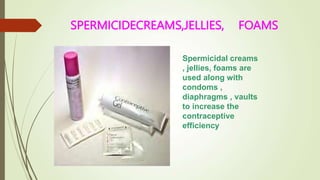
SPERMICIDECREAMS,JELLIES, FOAMS
Spermicidal creams
, jellies, foams are
used along with
condoms ,
diaphragms , vaults
to increase the
contraceptive
efficiency
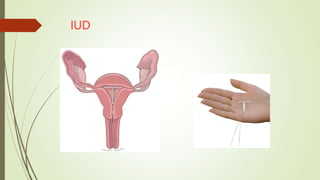
IUD
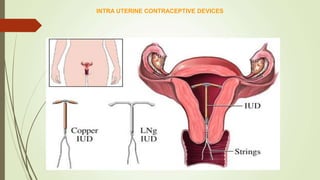
INTRA UTERINE CONTRACEPTIVE DEVICES
INTRA UTERINE CONTRACEPTIVES
 IUDs are ideal contraceptive devices for the females who want to
delay pregnancy or space children
 This is one of the most widely accepted contraceptive device in India
 These are of three types
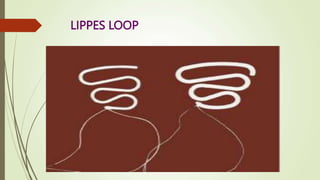
 1. Non medicated IUD(Lippes loop)
 2. Copper releasing IUD( CuT, Cu7,multiload 375)
 3.Hormone realeasing IUD (progestasert,LNG-20)
 Function of IUD
IUDs increase the phagocytosis of the
sperms within the uterus
LIPPES LOOP
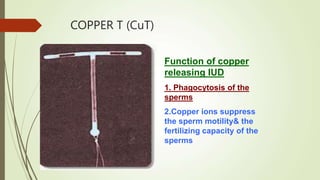
COPPER T (CuT)
Function of copper
releasing IUD
1. Phagocytosis of the
sperms
2.Copper ions suppress
the sperm motility& the
fertilizing capacity of the
sperms
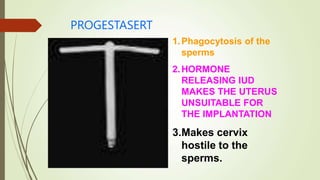
PROGESTASERT
1.Phagocytosis of the
sperms
2.HORMONE
RELEASING IUD
MAKES THE UTERUS
UNSUITABLE FOR
THE IMPLANTATION
3.Makes cervix
hostile to the
sperms.
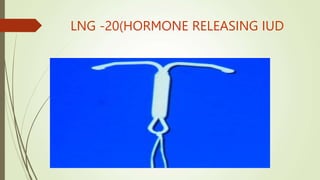
LNG -20(HORMONE RELEASING IUD
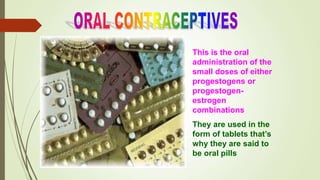
This is the oral
administration of the
small doses of either
progestogens or
progestogen-
estrogen
combinations
They are used in the
form of tablets that’s
why they are said to
be oral pills
How to use pills
 They have to be taken daily for a period of 21 days
 After a gap of 7 days ( during which menstruation occurs ) it has to be repeated in
the same pattern till the female desires to prevent conception
 Pills are very effective with less side effects
 Pills are used by the females
Pills as contraceptive methods
 1. They inhibit ovulation , implantation
 2.They alter the quality of the cervical mucus to prevent & retard the entry of the
sperms
Saheli
 It is a new oral contraceptive pill for the females contains a non steroidal
preparation
 It is a once a week pill with very few side effects & high contraceptive value
BIRTH CONTROL METHODS
Injections & implants
 Progestogens alone or in combination with estrogen can also be used by
females as injections or implants under the skin
 Their mode of action is similar to the pills & their effective periods are longer
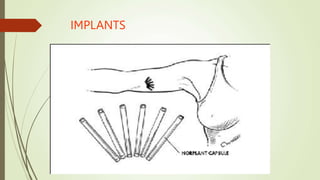
IMPLANTS
HOW TO USE IMPLANTS
The Norplant system requires just one trip to the
doctor every 5 years—
and nothing else! There's no
daily pill to remember and nothing to fuss with
before sex. The only major drawback to the
system is the insertion procedure. Because the 6
levonorgestrel-filled capsules that make up the
system must be placed under the skin, you can
expect tenderness and swelling of your upper
inner arm for a couple of days while the insertion
site heals.
EMERGENCY CONTRACEPTIVES
 Progestogens alone or Progestogen-estrogen combination or IUD within 24 hours
of coitus are very effective as emergency contraceptives to avoid possible
pregnancy due to rape or casual unprotected intercourse
SURGICAL METHODS
 TUBECTOMY
 VASECTOMY
Surgical methods
Surgical methods, also called sterilisation, are
generally advised for the male/female partner
as a terminal method to prevent any more
pregnancies.
Surgical intervention blocks gamete transport
and thereby prevent conception. Sterilisation
procedure in the male is called ‘vasectomy’
and that in the female, ‘tubectomy’.
 These techniques are highly effective but
their reversibility is very poor
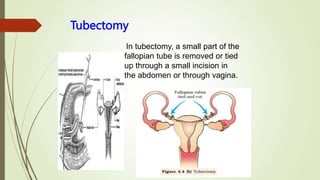
Tubectomy
In tubectomy, a small part of the
fallopian tube is removed or tied
up through a small incision in
the abdomen or through vagina.
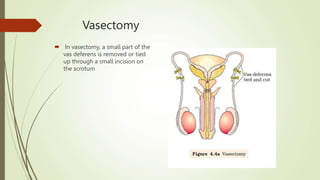
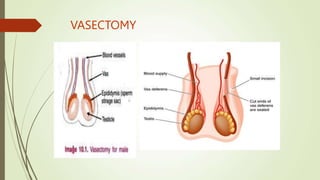
Vasectomy
 In vasectomy, a small part of the
vas deferens is removed or tied
up through a small incision on
the scrotum
VASECTOMY
It needs to be emphasised that the selection of a suitable
contraceptive method and its use should always be
undertaken in consultation with qualified medical
professionals.
One must also remember that contraceptives are not
regular requirements for the maintenance of
reproductive health.
In fact, they are practiced against a natural reproductive
event, i.e., conception/pregnancy. One is forced to use
these methods either to prevent pregnancy or to delay or
space pregnancy due to personal reasons.
Ill effects of contraceptives
Contraceptives are not regular requirements for the
maintenance of reproductive health
They are practiced against the natural reproductive event
They cause ill effects
1. Nausea
2. Abdominal pain
3. Break through bleeding
4. Irregular menstrual bleeding
5. Breast cancer
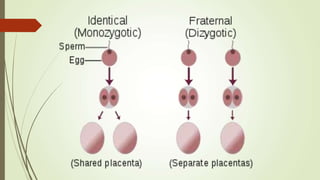
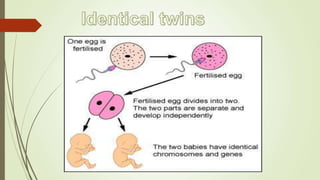
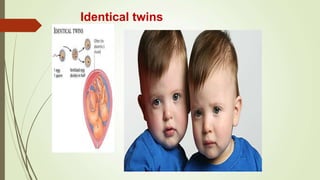
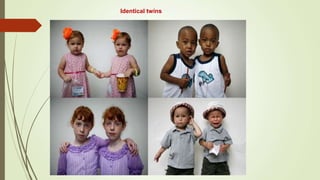
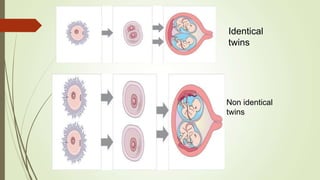
Identical twins
Identical twins
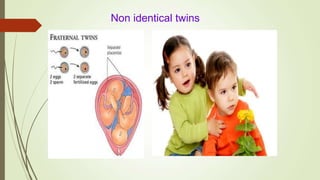
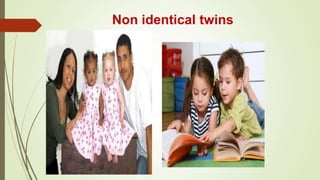
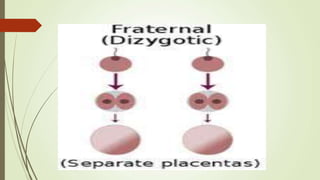
Non identical twins
Non identical twins
Identical
twins
Non identical
twins
MEDICAL TERMINATION OF PREGNANCY
Intentional or voluntary termination
of pregnancy before full term is
called MTP or induced abortion
 Nearly 45 to 50 million MTPs are performed in a year all over the world which
accounts to 1/5th of the total number of conceived pregnancies in a year.
Obviously, MTP has a significant role in decreasing the population though it is not
meant for that purpose.
CAUSES FOR MTP
 1) Casual or unprotected intercourse
 2) Failure of contraceptive device used during coitus
 3)MTP is essential in certain cases where continuation of pregnancy could be
harmful or fatal either to the mother or fetus or both
 Government of India legalised MTP in 1971 with some strict conditions to avoid its
misuse. Such restrictions are all the more important to check indiscriminate and
illegal female foeticides which are reported to be high in India
SAFER PERIOD FOR MTP
During first trimester i.e. up to
12 weeks of pregnancy MPTS
are considered safe
 second trimester abortions
are much more riskier
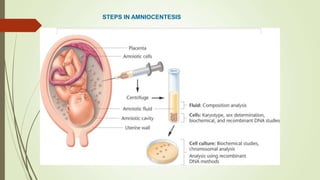
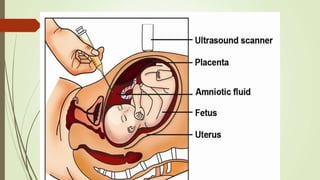
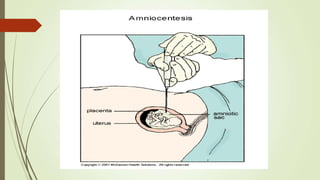
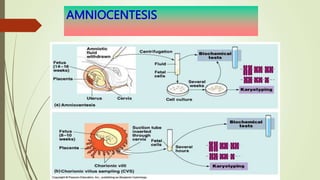
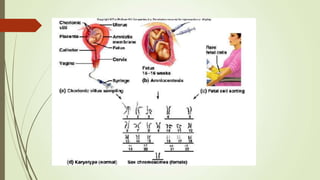
Amniocentesis
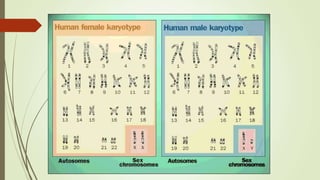
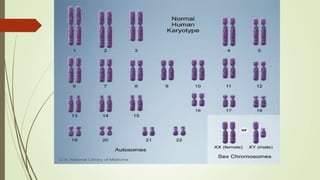
 Amniocentesis (also referred to as amniotic fluid test or AFT) is a medical procedure
used in prenatal diagnosis of chromosomal abnormalities and fetal infections, and
also used for sex determination in which a small amount of amniotic fluid, which
contains fetal tissues is sampled
STEPS IN AMNIOCENTESIS
AMNIOCENTESIS
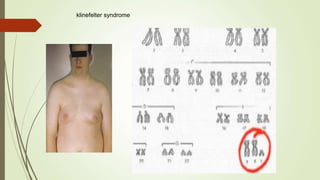
klinefelter syndrome
MISUSE OF AMNIOCENTESIS
If the fetus is found to be female ,it
is followed by MTP. This is totally
against to what is legal
SEXUALLY TRANSMITTED DISEASES
 1)GONORRHOEA
 2) SYPHILIS
 3)GENITAL HERPES
 4) CHLAMYDIASIS
 5) GENITAL WARTS
 6) TRICHOMONIASIS
 7)HEPATITES-B
 8) AIDS
MODES OF TRANSMISSION OF STD
 Sexual contact
 AIDS &Hepatitis B spread also by
 1) By sharing of injection needles
 2)Surgical instruments
 3)Transfusion of blood
 4)From infected mother to fetus
EARLY SYMPTOMS OF STD
 SYMPTOMS APPEAR IN GENITAL REGION
 1) Itching
 2) Fluid discharge
 3) Slight pain
 4) Swelling
Preventive measures of STD
 1) Avoid sex with unknown persons /multiple persons
 2) Always use condoms during coitus
 3) In case of doubt ,go to qualified doctor for early detection & get
complete treatment if diagnosed with diseases
 If STDs are not treated for long time ,they lead to
1) Pelvic inflammatory diseases
2) Abortions
3) Still births
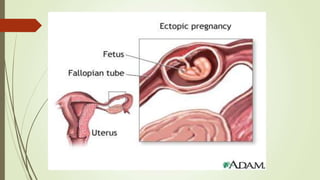
4) Ectopic pregnancies
6) Infertility
Factors which deter the persons for going
for timely detection & proper treatment
 1. Absence or less significant symptoms in the early stages of the infection
 2. Social stigma attached to the STD
ASSISTED REPRODUCTIVE TECHNOLOGIES
Assisted reproductive technologies
are used for the couple when their
infertility problems are not rectified
CAUSES FOR INFERTILITY
 1)Physical
 2)Congenital
 3)Diseases
 4)Drugs
 5)Immunological or physiological
ASSISTED REPRODUCTIVE TECHNOLOGIES
 Test tube programme
 Gamete intra fallopian transfer (GIFT)
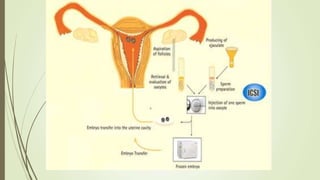
 Intra cytoplasmic sperm injections( ICSI)
 Artificial inseminations
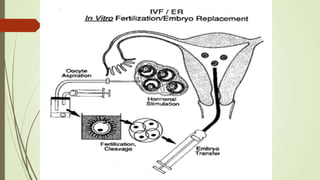
TEST TUBE BABY PROGRAMME

 It involves 2 steps
 1. in vitro fertilization
 2. Embryo transfer
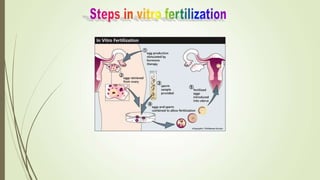
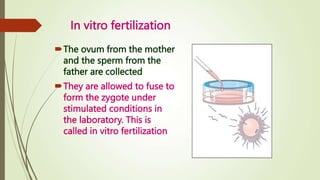
In vitro fertilization
The ovum from the mother
and the sperm from the
father are collected
They are allowed to fuse to
form the zygote under
stimulated conditions in
the laboratory. This is
called in vitro fertilization
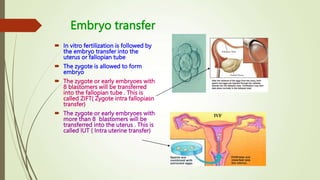
Embryo transfer
 In vitro fertilization is followed by
the embryo transfer into the
uterus or fallopian tube
 The zygote is allowed to form
embryo
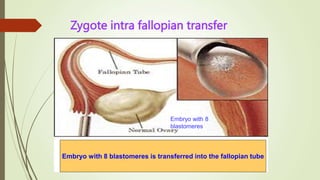
 The zygote or early embryoes with
8 blastomers will be transferred
into the fallopian tube . This is
called ZIFT( Zygote intra fallopiasn
transfer)
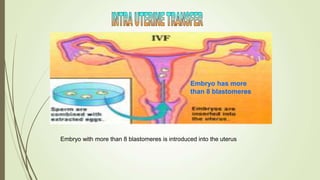
 The zygote or early embryoes with
more than 8 blastomers will be
transferred into the uterus . This is
called IUT ( Intra uterine transfer)
Zygote intra fallopian transfer
Embryo with 8
blastomeres
Embryo with 8 blastomeres is transferred into the fallopian tube
Embryo has more
than 8 blastomeres
Embryo with more than 8 blastomeres is introduced into the uterus
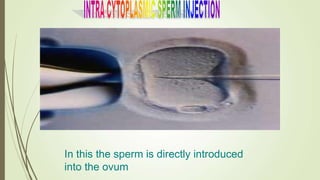
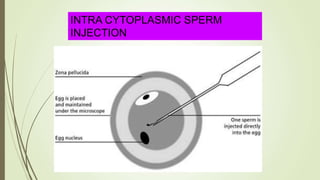
In this the sperm is directly introduced
into the ovum
INTRA CYTOPLASMIC SPERM
INJECTION
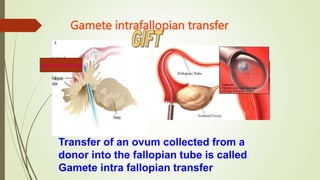
Gamete intrafallopian transfer
Injection of the egg
Transfer of an ovum collected from a
donor into the fallopian tube is called
Gamete intra fallopian transfer
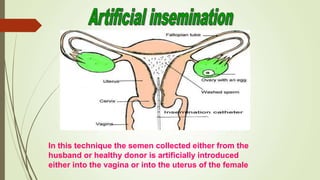
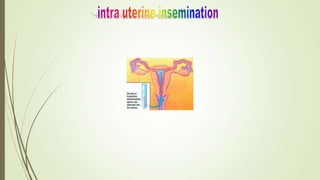
In this technique the semen collected either from the
husband or healthy donor is artificially introduced
either into the vagina or into the uterus of the female
ARTEFICIAL INSEMINATION
 This is used
 1) when male partner has the inability to inseminate the female
 2) Very low sperm count In the male ejaculate

reproductive health.ppt

  • 1.
    Reproductive health  Totalwell being in all aspects of reproduction i.e physical, emotional, behavioral & social is called reproductive health  A society with people having physically & functionally normal reproductive organs normal emotional& behavioral interactions among them in all sex related aspects is said to be reproductively healthy society
  • 2.
    Reproductive & childhealth care (RCH)  THE MAJOR TASKS UNDER THIS PROGRAMMES ARE  1. Creating awareness among people about various reproduction related aspects  2. providing facilities & support for building up reproductively healthy society
  • 3.
    Steps taken bythe government Creating awareness among people about various reproduction related aspects  1.Introduction of the sex education in the schools is encouraged to provide right information to the young so as to discourage myths & misconceptions about sex related aspects  2.proper information about reproductive organs ,adolescence & related changes safe & hygienic sexual practices ,STD,AIDS would help the people especially those in the adolescent age groupto lead a reproductively healthy life
  • 4.
    introduction of sexeducation in schools is necessary. It would provide right information to young individuals at the right time about various aspects of reproductive health such as reproductive organs, puberty, and adolescence related changes, safe sexual practices, sexually transmitted diseases, etc. The young individual or adolescents are more susceptible in acquiring various sexually transmitted diseases. Hence, providing information to them at the right time would help them to lead a reproductively healthy life and also protect them from the myths and misconceptions about various sex related issues.
  • 5.
     3. Educatingpeople especially fertile couple & those in marriageable age group about birth control options , care of pregnant mothers, post- natal care of mother & child ,importance of mother feeding , equal opportunities for the male &female child would address the importance of bringing up socially healthy societies of desirable size
  • 6.
    Awareness of problemsdue to uncontrolled population growth, social evils like sex abuse ,sex related crimes need to be created to enable the people to take up necessary steps to prevent them& there by build up a socially responsible& healthy society
  • 7.
    Factors which indicatethe reproductively healthy society  1. Better awareness about sex related matters  2. Increased number of medically assisted deliveries  3. Better post natal care leading to decreased maternal & infant mortality rates  4.Increased number of couples with small families  5. Better detection & cure of STD  6. Overall increased medical facilities for all sex related problems
  • 8.
    Population explosion  Worldpopulation was 2 billions in 1900  It was increased to 6 billions by 2000  Indian population was 350 millions at the time of our independence  It crossed one billion in may 2000  Every sixth person in the world is an Indian
  • 9.
    Reasons for populationexplosion  1. A rapid decline in death rate, maternal mortality rate, infant mortality rate  2. Increase in number of people in reproducible age
  • 10.
    Measures taken bythe government to check the population growth rate  1. Motivating the people to have smaller families by using various contraceptive methods  2. Raising the marriagble age of the females to 18 years & males to 21 years  3. Giving incentives to the couples with small families
  • 11.
    IDEAL CONTRACEPTIVE  1)User friendly  2) Easily available  3) Effective  4) Reversible with no or less side effects  5) It should not interfere with the sexual desire or sexual act of the user
  • 12.
    Contraceptive methods  1)Natural methods  2)Barrier methods  3)IUDs  4)Oral pills  5) Injections & implants  6)Surgical methods
  • 13.
    NATURAL METHODS There arethree natural methods  1) PERIODIC ABSTINANCE  2) WITHDRAWL( OR ) COITUS INTERRUPTUS  3)LACTATIONAL AMENORRHEA Natural methods work on the principle of avoiding chances of ovum & sperms meeting As no medicines or devices are used in this method , side effects are almost nil Chances of failure through these methods are also high
  • 14.
    1. Periodic abstinance Inthis method couple avoid or abstain from coitus from 10th to 17th day of the menstrual cycle when ovulation could be expected As chances of fertilization are high during this period, it is called the fertile period  Therefore by avoiding the coitus during this period conception can be prevented
  • 15.
    2.WITHDRAWL( OR )COITUS INTERRUPTUS In this method male partner withdraws his penis from the vagina just before ejaculation to avoid the insemination
  • 16.
    3) LACTATIONAL AMENORRHEA It is the absence of the menstruation This method is based on the fact that ovulation & menstrual cycle do not occur during period of the intense lactation following parturition As long as the mother breast feeds the child fully, the chances of conception are nil This method is effective only for 6 months following parturition
  • 17.
    BARRIER METHODS  1)CONDOMS  2) DIAPHRAGMS,CERVICAL CAPS&VAULTS
  • 18.
    Barrier methods  Inbarrier methods ovum & sperm are prevented physically meeting with the help of the barriers  These methods are available for both males & females
  • 19.
    Condoms  These arethe barriers made of thin rubber latex sheath that are used to cover the penis in males or vagina & cervix in females just before coitus  Due to this ejaculated semen will not enter into the female reproductive tract  This can prevent conception
  • 21.
  • 22.
    Benefits of condoms Theuse of condoms in recent years has increased due to their additional benefits 1. They protect the user from contracting STDs & AIDS 2. Both male & female condoms are disposable 3. They can be self inserted & there by gives privacy to the user Nirodh is the popular brand of condom for the male
  • 23.
    . DIAPHRAGMS Diaphragms ,cervical caps ,vaults are also barriers made of rubber that are inserted into the female reproductive tract to cover the cervix during the coitus They prevent the conception by blocking the entry of the sperms through the cervix They are reusable
  • 25.
    SPERMICIDECREAMS,JELLIES, FOAMS Spermicidal creams ,jellies, foams are used along with condoms , diaphragms , vaults to increase the contraceptive efficiency
  • 26.
  • 27.
  • 28.
    INTRA UTERINE CONTRACEPTIVES IUDs are ideal contraceptive devices for the females who want to delay pregnancy or space children  This is one of the most widely accepted contraceptive device in India  These are of three types  1. Non medicated IUD(Lippes loop)  2. Copper releasing IUD( CuT, Cu7,multiload 375)  3.Hormone realeasing IUD (progestasert,LNG-20)  Function of IUD IUDs increase the phagocytosis of the sperms within the uterus
  • 29.
  • 30.
    COPPER T (CuT) Functionof copper releasing IUD 1. Phagocytosis of the sperms 2.Copper ions suppress the sperm motility& the fertilizing capacity of the sperms
  • 31.
    PROGESTASERT 1.Phagocytosis of the sperms 2.HORMONE RELEASINGIUD MAKES THE UTERUS UNSUITABLE FOR THE IMPLANTATION 3.Makes cervix hostile to the sperms.
  • 32.
  • 33.
    This is theoral administration of the small doses of either progestogens or progestogen- estrogen combinations They are used in the form of tablets that’s why they are said to be oral pills
  • 34.
    How to usepills  They have to be taken daily for a period of 21 days  After a gap of 7 days ( during which menstruation occurs ) it has to be repeated in the same pattern till the female desires to prevent conception  Pills are very effective with less side effects  Pills are used by the females
  • 35.
    Pills as contraceptivemethods  1. They inhibit ovulation , implantation  2.They alter the quality of the cervical mucus to prevent & retard the entry of the sperms
  • 36.
    Saheli  It isa new oral contraceptive pill for the females contains a non steroidal preparation  It is a once a week pill with very few side effects & high contraceptive value
  • 37.
  • 38.
    Injections & implants Progestogens alone or in combination with estrogen can also be used by females as injections or implants under the skin  Their mode of action is similar to the pills & their effective periods are longer
  • 39.
  • 40.
    HOW TO USEIMPLANTS The Norplant system requires just one trip to the doctor every 5 years— and nothing else! There's no daily pill to remember and nothing to fuss with before sex. The only major drawback to the system is the insertion procedure. Because the 6 levonorgestrel-filled capsules that make up the system must be placed under the skin, you can expect tenderness and swelling of your upper inner arm for a couple of days while the insertion site heals.
  • 41.
    EMERGENCY CONTRACEPTIVES  Progestogensalone or Progestogen-estrogen combination or IUD within 24 hours of coitus are very effective as emergency contraceptives to avoid possible pregnancy due to rape or casual unprotected intercourse
  • 42.
  • 43.
    Surgical methods Surgical methods,also called sterilisation, are generally advised for the male/female partner as a terminal method to prevent any more pregnancies. Surgical intervention blocks gamete transport and thereby prevent conception. Sterilisation procedure in the male is called ‘vasectomy’ and that in the female, ‘tubectomy’.  These techniques are highly effective but their reversibility is very poor
  • 44.
    Tubectomy In tubectomy, asmall part of the fallopian tube is removed or tied up through a small incision in the abdomen or through vagina.
  • 45.
    Vasectomy  In vasectomy,a small part of the vas deferens is removed or tied up through a small incision on the scrotum
  • 46.
  • 47.
    It needs tobe emphasised that the selection of a suitable contraceptive method and its use should always be undertaken in consultation with qualified medical professionals. One must also remember that contraceptives are not regular requirements for the maintenance of reproductive health. In fact, they are practiced against a natural reproductive event, i.e., conception/pregnancy. One is forced to use these methods either to prevent pregnancy or to delay or space pregnancy due to personal reasons.
  • 48.
    Ill effects ofcontraceptives Contraceptives are not regular requirements for the maintenance of reproductive health They are practiced against the natural reproductive event They cause ill effects 1. Nausea 2. Abdominal pain 3. Break through bleeding 4. Irregular menstrual bleeding 5. Breast cancer
  • 51.
  • 52.
  • 53.
  • 54.
  • 55.
  • 57.
    MEDICAL TERMINATION OFPREGNANCY Intentional or voluntary termination of pregnancy before full term is called MTP or induced abortion
  • 58.
     Nearly 45to 50 million MTPs are performed in a year all over the world which accounts to 1/5th of the total number of conceived pregnancies in a year. Obviously, MTP has a significant role in decreasing the population though it is not meant for that purpose.
  • 59.
    CAUSES FOR MTP 1) Casual or unprotected intercourse  2) Failure of contraceptive device used during coitus  3)MTP is essential in certain cases where continuation of pregnancy could be harmful or fatal either to the mother or fetus or both
  • 60.
     Government ofIndia legalised MTP in 1971 with some strict conditions to avoid its misuse. Such restrictions are all the more important to check indiscriminate and illegal female foeticides which are reported to be high in India
  • 61.
    SAFER PERIOD FORMTP During first trimester i.e. up to 12 weeks of pregnancy MPTS are considered safe  second trimester abortions are much more riskier
  • 62.
    Amniocentesis  Amniocentesis (alsoreferred to as amniotic fluid test or AFT) is a medical procedure used in prenatal diagnosis of chromosomal abnormalities and fetal infections, and also used for sex determination in which a small amount of amniotic fluid, which contains fetal tissues is sampled
  • 63.
  • 66.
  • 72.
  • 73.
    MISUSE OF AMNIOCENTESIS Ifthe fetus is found to be female ,it is followed by MTP. This is totally against to what is legal
  • 74.
    SEXUALLY TRANSMITTED DISEASES 1)GONORRHOEA  2) SYPHILIS  3)GENITAL HERPES  4) CHLAMYDIASIS  5) GENITAL WARTS  6) TRICHOMONIASIS  7)HEPATITES-B  8) AIDS
  • 75.
    MODES OF TRANSMISSIONOF STD  Sexual contact  AIDS &Hepatitis B spread also by  1) By sharing of injection needles  2)Surgical instruments  3)Transfusion of blood  4)From infected mother to fetus
  • 76.
    EARLY SYMPTOMS OFSTD  SYMPTOMS APPEAR IN GENITAL REGION  1) Itching  2) Fluid discharge  3) Slight pain  4) Swelling
  • 77.
    Preventive measures ofSTD  1) Avoid sex with unknown persons /multiple persons  2) Always use condoms during coitus  3) In case of doubt ,go to qualified doctor for early detection & get complete treatment if diagnosed with diseases
  • 78.
     If STDsare not treated for long time ,they lead to 1) Pelvic inflammatory diseases 2) Abortions 3) Still births 4) Ectopic pregnancies 6) Infertility
  • 80.
    Factors which deterthe persons for going for timely detection & proper treatment  1. Absence or less significant symptoms in the early stages of the infection  2. Social stigma attached to the STD
  • 81.
    ASSISTED REPRODUCTIVE TECHNOLOGIES Assistedreproductive technologies are used for the couple when their infertility problems are not rectified
  • 82.
    CAUSES FOR INFERTILITY 1)Physical  2)Congenital  3)Diseases  4)Drugs  5)Immunological or physiological
  • 83.
    ASSISTED REPRODUCTIVE TECHNOLOGIES Test tube programme  Gamete intra fallopian transfer (GIFT)  Intra cytoplasmic sperm injections( ICSI)  Artificial inseminations
  • 84.
    TEST TUBE BABYPROGRAMME   It involves 2 steps  1. in vitro fertilization  2. Embryo transfer
  • 87.
    In vitro fertilization Theovum from the mother and the sperm from the father are collected They are allowed to fuse to form the zygote under stimulated conditions in the laboratory. This is called in vitro fertilization
  • 88.
    Embryo transfer  Invitro fertilization is followed by the embryo transfer into the uterus or fallopian tube  The zygote is allowed to form embryo  The zygote or early embryoes with 8 blastomers will be transferred into the fallopian tube . This is called ZIFT( Zygote intra fallopiasn transfer)  The zygote or early embryoes with more than 8 blastomers will be transferred into the uterus . This is called IUT ( Intra uterine transfer)
  • 89.
    Zygote intra fallopiantransfer Embryo with 8 blastomeres Embryo with 8 blastomeres is transferred into the fallopian tube
  • 90.
    Embryo has more than8 blastomeres Embryo with more than 8 blastomeres is introduced into the uterus
  • 91.
    In this thesperm is directly introduced into the ovum
  • 92.
  • 94.
    Gamete intrafallopian transfer Injectionof the egg Transfer of an ovum collected from a donor into the fallopian tube is called Gamete intra fallopian transfer
  • 95.
    In this techniquethe semen collected either from the husband or healthy donor is artificially introduced either into the vagina or into the uterus of the female
  • 97.
    ARTEFICIAL INSEMINATION  Thisis used  1) when male partner has the inability to inseminate the female  2) Very low sperm count In the male ejaculate