POPULATION CONTROL
Overall development – population control can be achieved by overall
development of women. It means women need to be empowered and
they should be developed socially, economically, and educationally so
as to decide and take appropriate measures to have small size family
which helps to reduce the population growth and achieve the
population control.
Measures to control population
Increasing the age of marriage
Spread the importance of education especially women’s education.
Sex education along with general education
Liberal laws regarding abortion
Improvement in the status of women
Implement programs for motivating and encouraging population
control.
Making arrangements for effective implementation of family
welfare programme.
PROMOTION OF SMALL FAMILY NORMS
Family size refers to the total number of person’s in a
family. In demography, family size means the total number
of children a woman has born at a point in time.
The family size depends upon number of factors like:
Duration of marriage
Education of couple
The number of live births and living children
Preference of male children
Desired family size
Customs and beliefs, etc
CONT….
Small differences in the family size will make big
differences in the birth rate.
The family size play a very important role in the health
and welfare of not only the individual, family and
community but also of the nation as a whole because it’s
affects the population growth rate.
EFFECTS OF FAMILY SIZE
Basic human needs
Income, saving and resources
Quality and quantity of food
Fragmentation of family land
Health
Education
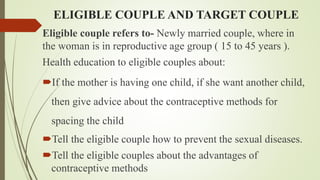
ELIGIBLE COUPLE AND TARGET COUPLE
Eligible couple refers to- Newly married couple, where in
the woman is in reproductive age group ( 15 to 45 years ).
Health education to eligible couples about:
If the mother is having one child, if she want another child,
then give advice about the contraceptive methods for
spacing the child
Tell the eligible couple how to prevent the sexual diseases.
Tell the eligible couples about the advantages of
contraceptive methods
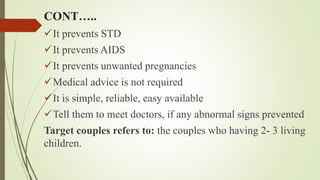
CONT…..
It prevents STD
It prevents AIDS
It prevents unwanted pregnancies
Medical advice is not required
It is simple, reliable, easy available
Tell them to meet doctors, if any abnormal signs prevented
Target couples refers to: the couples who having 2- 3 living
children.
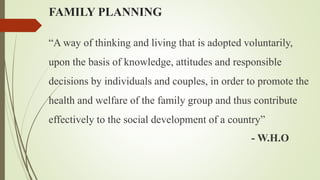
FAMILY PLANNING
“A way of thinking and living that is adopted voluntarily,
upon the basis of knowledge, attitudes and responsible
decisions by individuals and couples, in order to promote the
health and welfare of the family group and thus contribute
effectively to the social development of a country”
- W.H.O
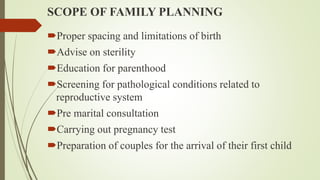
SCOPE OF FAMILY PLANNING
Proper spacing and limitations of birth
Advise on sterility
Education for parenthood
Screening for pathological conditions related to
reproductive system
Pre marital consultation
Carrying out pregnancy test
Preparation of couples for the arrival of their first child
OBJECTIVES
To avoid unwanted births
To bring about wanted births
To regulate the intervals between pregnancies
To control the time at which births occur in relation to
the ages of the parent
To determine the number of children in the family
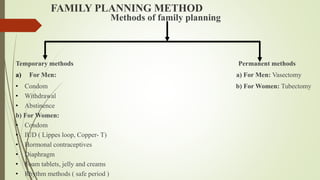
FAMILY PLANNING METHOD
Methods of family planning
Temporary methods Permanent methods
a) For Men: a) For Men: Vasectomy
• Condom b) For Women: Tubectomy
• Withdrawal
• Abstinence
b) For Women:
• Condom
• IUD ( Lippes loop, Copper- T)
• Hormonal contraceptives
• Diaphragm
• Foam tablets, jelly and creams
• Rhythm methods ( safe period )
TEMPORARY METHODS ( SPACING METHOD)
Condom (Nirodh): The condom is a thin rubber sheath used by men
during sex. It is one of the oldest and widely used methods of
contraception, consistently used, condom is a safe and effective method
of birth control.
The condom is unrolled over erect penis before each act of sexual
intercourse
The condom prevents the deposition of semen in vagina
The combination of chemical spermicide and condom is effective
method of contraception
Advantages:
Easy available through a variety of commercial outlets: offered free
of cost at all family welfare centers
Easy to use
Protects against STDs and AIDS
No side effects
Require no medical supervision
Disadvantages:
A new condom must be used each time
It may slip off or tear. If instructions are not followed carefully
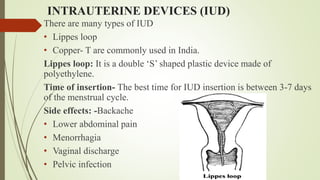
INTRAUTERINE DEVICES (IUD)
There are many types of IUD
• Lippes loop
• Copper- T are commonly used in India.
Lippes loop: It is a double ‘S’ shaped plastic device made of
polyethylene.
Time of insertion- The best time for IUD insertion is between 3-7 days
of the menstrual cycle.
Side effects: -Backache
• Lower abdominal pain
• Menorrhagia
• Vaginal discharge
• Pelvic infection
Advantages:
Inexpensive
One time method
Reversible
No hospitalization
Disadvantages:
Painful
Side effects
Expulsion
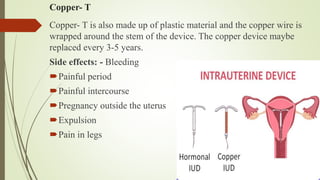
Copper- T
Copper- T is also made up of plastic material and the copper wire is
wrapped around the stem of the device. The copper device maybe
replaced every 3-5 years.
Side effects: - Bleeding
Painful period
Painful intercourse
Pregnancy outside the uterus
Expulsion
Pain in legs
Advantages: -
Small in size and therefore easier insertion
Low expulsion rate
Greater effectiveness
Safety, simplicity, reversibility
Disadvantages: -
Heavy bleeding and pain
Pelvic inflammatory diseases
Ectopic pregnancy
May come out accidently if not properly inserted.
HORMONAL CONTRACEPTIVES
• Oral pills
• Injectables (DMPA, NET- EN)
• Subdermal implants
Oral pills: It contain small amounts of an estrogen and progestin. They
are particularly suitable as a ‘spacing method’ for young couples below
the age of 30 years.
Types of pills:
 Mala- D
 Mala- N
Components of drugs:
Norethisterone – 0.30mg
Ethinyl estradiol – 0.03mg
Mode of intake:
A packet of oral pills contains 28 pills, of 21 are contraceptive pills
and the remaining 7 are iron tablets.
The first course of the pills should be started strictly on the 5th
day of the menstruation
Then daily one tablet should be taken from the packet as
indicated by the arrows on the pack till all the pills are consumed
After the pack is finished, a new packet should be started from
the very next day
Instructions issued with each packet should be closely followed
CONT….
The pill should be taken every day at night in a fixed time.
Preferably before going to bed at night
If a women forgets to take the pills on a particular day, she should
take the missed pill as soon as possible, or 2 pills the next day;
one in the morning and one in the evening
If the pills is not taken daily it increases the chances of
conception.
SIDE EFFECT
EARLY
 Mild nausea
 Dizziness
 Headache
 Intermenstrual bleeding
 Spotting
 Weight gain
 Tender breast
LATE/ RARE
 Hypertension
 Cardiovascular complication
ADVANTAGES
100% effective
No interference with sexual intercourse
Reversible method
DISADVANTAGES
Prior medical examination is necessary
Side effects
Require strong motivation and self- discipline
INJECTABLE CONTRACEPTIVES
Progestogen only injectables
DMPA- Depotmedroxy progesterone acetate (DMPA) has been in
use since 1960s. The standard use an intramuscular injection of
150mg every 3 months.
NET-EN- Norethisterone enantate has been in use as a
contraceptive since 1966. It is 200mg will be given
intramuscularly with 2 months intervals.
 Combined injectable contraceptive: Cycloferm had been found to
be highly effective with 12 months.
Subdermal implants: It consist of 6 silastic capsules containing
35mg of levonogestrel. It will be fixed below skin of upper arm. It
is need surgery for fixation. for example- Norplant.
DIAPHRAGM:
It is a soft rubber dome with a coiled spring rim.
Advantages- cheap and effective
Disadvantages- Doctor and nurse is required to determine the proper
size.
FOAM TABLETS, JELLY AND CREAMS- Foam tablets, jelly,
suppository, and creams or vaginal contraceptives pills are inserted deep
in the vagina.
Advantages- prevents pregnancy
Disadvantages- It will give burning sensation
 It must be used almost immediately before intercourse and repeated
before each sex act
 It must be introduced into those rigions of the vagina where sperm are
likely to deposited
RHYTHM METHOD/ SAFE PERIOD/ CALENDER METHOD:
The method is based on the fact that ovulation occurs from 12th to 16th
days before the onset of menstruation
The intercourse must be avoided during ovulation period
The one week after menstruation and before menstruation is safe
period
PERMANENT METHODS (TERMINAL METHODS)
For Men (Vasectomy): Vasectomy is a comparatively simple
operation, it can be performed even in primary health centers by
trained doctors under local anesthesia.
Complication- operative
Sperm granules
Spontaneous regularization
Autoimmune response
Psychological
For Women (Tubectomy):
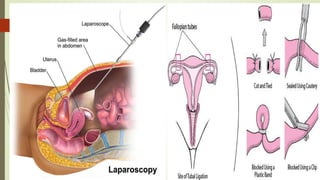
It involves cutting and trying of the fallopian tubes
Laparoscopy- the abdomen is inflated with gas (nitrous oxide) and the
instrument (laparoscope) is inserted into abdominal cavity to visualize
the tubes.
Once the tubes are accessible, fallopian rings (clips) are applied to
occlude the tubes
Minilaparotomy- it is modification of abdominal tubectomy
It is much simpler procedure requiring a smaller abdominal incision of
only 2.5- 3cm conducted under local anesthesia
The tubules will be selected, clamp 1cm and it will be removed. After
removing folded into back and tied.
This technique is considered as a revolutionary procedure for female
sterilization.
ROLE OF COMMUNITY HEALTH NURSE IN FAMILY
WELFARE SERVICES/ PROGRAMME
Understanding
Knowledge about family planning
Knowledge about the person
Communication and health education
Conducting clinics
Organizing family planning camps
Follow up
Educational functions and motivation
Referral
Maintaining the records

POPULATION CONTROL.pptx

  • 1.
    POPULATION CONTROL Overall development– population control can be achieved by overall development of women. It means women need to be empowered and they should be developed socially, economically, and educationally so as to decide and take appropriate measures to have small size family which helps to reduce the population growth and achieve the population control.
  • 2.
    Measures to controlpopulation Increasing the age of marriage Spread the importance of education especially women’s education. Sex education along with general education Liberal laws regarding abortion Improvement in the status of women Implement programs for motivating and encouraging population control. Making arrangements for effective implementation of family welfare programme.
  • 3.
    PROMOTION OF SMALLFAMILY NORMS Family size refers to the total number of person’s in a family. In demography, family size means the total number of children a woman has born at a point in time. The family size depends upon number of factors like: Duration of marriage Education of couple The number of live births and living children Preference of male children Desired family size Customs and beliefs, etc
  • 4.
    CONT…. Small differences inthe family size will make big differences in the birth rate. The family size play a very important role in the health and welfare of not only the individual, family and community but also of the nation as a whole because it’s affects the population growth rate.
  • 5.
    EFFECTS OF FAMILYSIZE Basic human needs Income, saving and resources Quality and quantity of food Fragmentation of family land Health Education
  • 6.
    ELIGIBLE COUPLE ANDTARGET COUPLE Eligible couple refers to- Newly married couple, where in the woman is in reproductive age group ( 15 to 45 years ). Health education to eligible couples about: If the mother is having one child, if she want another child, then give advice about the contraceptive methods for spacing the child Tell the eligible couple how to prevent the sexual diseases. Tell the eligible couples about the advantages of contraceptive methods
  • 7.
    CONT….. It prevents STD Itprevents AIDS It prevents unwanted pregnancies Medical advice is not required It is simple, reliable, easy available Tell them to meet doctors, if any abnormal signs prevented Target couples refers to: the couples who having 2- 3 living children.
  • 8.
    FAMILY PLANNING “A wayof thinking and living that is adopted voluntarily, upon the basis of knowledge, attitudes and responsible decisions by individuals and couples, in order to promote the health and welfare of the family group and thus contribute effectively to the social development of a country” - W.H.O
  • 9.
    SCOPE OF FAMILYPLANNING Proper spacing and limitations of birth Advise on sterility Education for parenthood Screening for pathological conditions related to reproductive system Pre marital consultation Carrying out pregnancy test Preparation of couples for the arrival of their first child
  • 10.
    OBJECTIVES To avoid unwantedbirths To bring about wanted births To regulate the intervals between pregnancies To control the time at which births occur in relation to the ages of the parent To determine the number of children in the family
  • 11.
    FAMILY PLANNING METHOD Methodsof family planning Temporary methods Permanent methods a) For Men: a) For Men: Vasectomy • Condom b) For Women: Tubectomy • Withdrawal • Abstinence b) For Women: • Condom • IUD ( Lippes loop, Copper- T) • Hormonal contraceptives • Diaphragm • Foam tablets, jelly and creams • Rhythm methods ( safe period )
  • 12.
    TEMPORARY METHODS (SPACING METHOD) Condom (Nirodh): The condom is a thin rubber sheath used by men during sex. It is one of the oldest and widely used methods of contraception, consistently used, condom is a safe and effective method of birth control. The condom is unrolled over erect penis before each act of sexual intercourse The condom prevents the deposition of semen in vagina The combination of chemical spermicide and condom is effective method of contraception
  • 13.
    Advantages: Easy available througha variety of commercial outlets: offered free of cost at all family welfare centers Easy to use Protects against STDs and AIDS No side effects Require no medical supervision Disadvantages: A new condom must be used each time It may slip off or tear. If instructions are not followed carefully
  • 14.
    INTRAUTERINE DEVICES (IUD) Thereare many types of IUD • Lippes loop • Copper- T are commonly used in India. Lippes loop: It is a double ‘S’ shaped plastic device made of polyethylene. Time of insertion- The best time for IUD insertion is between 3-7 days of the menstrual cycle. Side effects: -Backache • Lower abdominal pain • Menorrhagia • Vaginal discharge • Pelvic infection
  • 15.
    Advantages: Inexpensive One time method Reversible Nohospitalization Disadvantages: Painful Side effects Expulsion
  • 16.
    Copper- T Copper- Tis also made up of plastic material and the copper wire is wrapped around the stem of the device. The copper device maybe replaced every 3-5 years. Side effects: - Bleeding Painful period Painful intercourse Pregnancy outside the uterus Expulsion Pain in legs
  • 17.
    Advantages: - Small insize and therefore easier insertion Low expulsion rate Greater effectiveness Safety, simplicity, reversibility Disadvantages: - Heavy bleeding and pain Pelvic inflammatory diseases Ectopic pregnancy May come out accidently if not properly inserted.
  • 18.
    HORMONAL CONTRACEPTIVES • Oralpills • Injectables (DMPA, NET- EN) • Subdermal implants Oral pills: It contain small amounts of an estrogen and progestin. They are particularly suitable as a ‘spacing method’ for young couples below the age of 30 years. Types of pills:  Mala- D  Mala- N Components of drugs: Norethisterone – 0.30mg Ethinyl estradiol – 0.03mg
  • 19.
    Mode of intake: Apacket of oral pills contains 28 pills, of 21 are contraceptive pills and the remaining 7 are iron tablets. The first course of the pills should be started strictly on the 5th day of the menstruation Then daily one tablet should be taken from the packet as indicated by the arrows on the pack till all the pills are consumed After the pack is finished, a new packet should be started from the very next day Instructions issued with each packet should be closely followed
  • 20.
    CONT…. The pill shouldbe taken every day at night in a fixed time. Preferably before going to bed at night If a women forgets to take the pills on a particular day, she should take the missed pill as soon as possible, or 2 pills the next day; one in the morning and one in the evening If the pills is not taken daily it increases the chances of conception.
  • 21.
    SIDE EFFECT EARLY  Mildnausea  Dizziness  Headache  Intermenstrual bleeding  Spotting  Weight gain  Tender breast LATE/ RARE  Hypertension  Cardiovascular complication
  • 22.
    ADVANTAGES 100% effective No interferencewith sexual intercourse Reversible method DISADVANTAGES Prior medical examination is necessary Side effects Require strong motivation and self- discipline
  • 23.
    INJECTABLE CONTRACEPTIVES Progestogen onlyinjectables DMPA- Depotmedroxy progesterone acetate (DMPA) has been in use since 1960s. The standard use an intramuscular injection of 150mg every 3 months. NET-EN- Norethisterone enantate has been in use as a contraceptive since 1966. It is 200mg will be given intramuscularly with 2 months intervals.  Combined injectable contraceptive: Cycloferm had been found to be highly effective with 12 months. Subdermal implants: It consist of 6 silastic capsules containing 35mg of levonogestrel. It will be fixed below skin of upper arm. It is need surgery for fixation. for example- Norplant.
  • 24.
    DIAPHRAGM: It is asoft rubber dome with a coiled spring rim. Advantages- cheap and effective Disadvantages- Doctor and nurse is required to determine the proper size. FOAM TABLETS, JELLY AND CREAMS- Foam tablets, jelly, suppository, and creams or vaginal contraceptives pills are inserted deep in the vagina. Advantages- prevents pregnancy Disadvantages- It will give burning sensation  It must be used almost immediately before intercourse and repeated before each sex act  It must be introduced into those rigions of the vagina where sperm are likely to deposited
  • 25.
    RHYTHM METHOD/ SAFEPERIOD/ CALENDER METHOD: The method is based on the fact that ovulation occurs from 12th to 16th days before the onset of menstruation The intercourse must be avoided during ovulation period The one week after menstruation and before menstruation is safe period
  • 26.
    PERMANENT METHODS (TERMINALMETHODS) For Men (Vasectomy): Vasectomy is a comparatively simple operation, it can be performed even in primary health centers by trained doctors under local anesthesia. Complication- operative Sperm granules Spontaneous regularization Autoimmune response Psychological
  • 27.
    For Women (Tubectomy): Itinvolves cutting and trying of the fallopian tubes Laparoscopy- the abdomen is inflated with gas (nitrous oxide) and the instrument (laparoscope) is inserted into abdominal cavity to visualize the tubes. Once the tubes are accessible, fallopian rings (clips) are applied to occlude the tubes Minilaparotomy- it is modification of abdominal tubectomy It is much simpler procedure requiring a smaller abdominal incision of only 2.5- 3cm conducted under local anesthesia The tubules will be selected, clamp 1cm and it will be removed. After removing folded into back and tied. This technique is considered as a revolutionary procedure for female sterilization.
  • 29.
    ROLE OF COMMUNITYHEALTH NURSE IN FAMILY WELFARE SERVICES/ PROGRAMME Understanding Knowledge about family planning Knowledge about the person Communication and health education Conducting clinics Organizing family planning camps Follow up Educational functions and motivation Referral Maintaining the records