ELECTRIC CURCUITS
Lesson Objectives
• State Ohm’s Law
• Interpret graphs on the
relationships between current,
voltage and resistance
• Differentiate between ohmic and
non ohmic conductors
In this
lesson
we will:
Lesson Introduction
Electrical circuits are everywhere in our lives, from very complex ones that
control computers and smart phones, to the simpler circuits that allow you
to switch a lightbulb on and off.
In order to understand how circuits work, we must understand Ohm’s law,
which explains the relationships between the key concepts in a circuit.
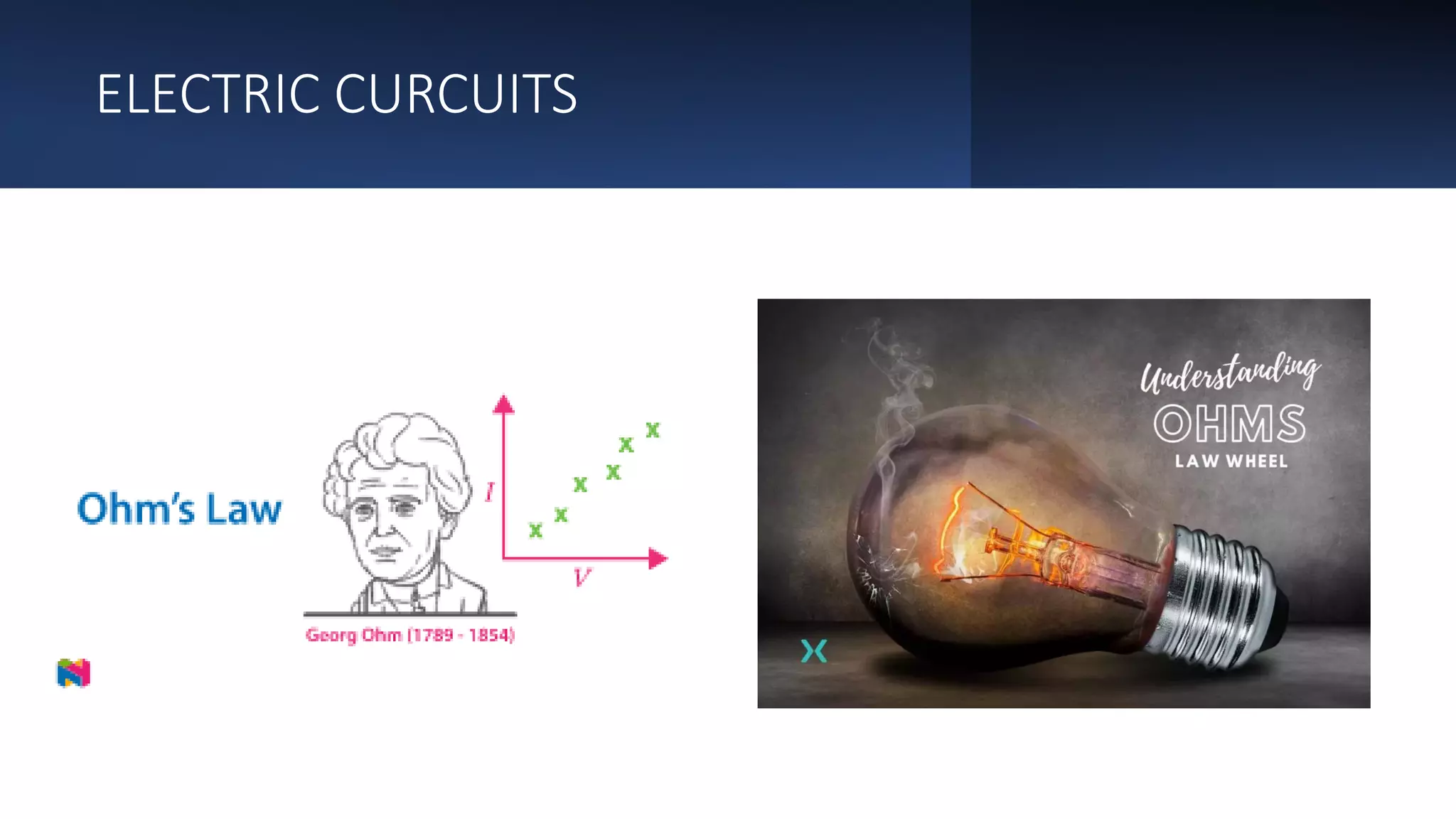
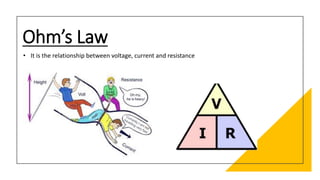
Ohm’s Law
• It is the relationship between voltage, current and resistance
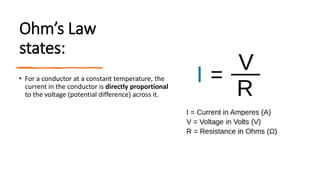
Ohm’s Law
states:
• For a conductor at a constant temperature, the
current in the conductor is directly proportional
to the voltage (potential difference) across it.
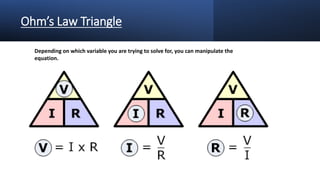
Ohm’s Law Triangle
Depending on which variable you are trying to solve for, you can manipulate the
equation.
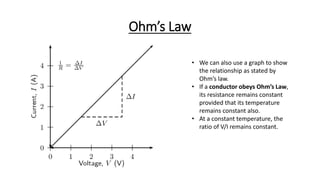
Ohm’s Law
• We can also use a graph to show
the relationship as stated by
Ohm’s law.
• If a conductor obeys Ohm’s Law,
its resistance remains constant
provided that its temperature
remains constant also.
• At a constant temperature, the
ratio of V/I remains constant.
Ohmic vs. Non-ohmic conductors
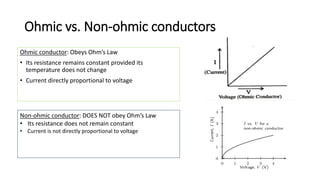
Ohmic conductor: Obeys Ohm’s Law
• Its resistance remains constant provided its
temperature does not change
• Current directly proportional to voltage
Non-ohmic conductor: DOES NOT obey Ohm’s Law
• Its resistance does not remain constant
• Current is not directly proportional to voltage
Ohmic vs. Non-ohmic conductors
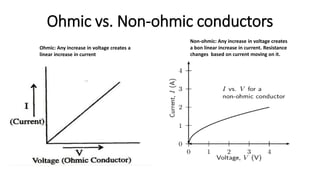
Ohmic: Any increase in voltage creates a
linear increase in current
Non-ohmic: Any increase in voltage creates
a bon linear increase in current. Resistance
changes based on current moving on it.
Questions
1. A load has a 1.2 A current flowing through it. The voltage across the
load is 6.0 V. What is the resistance of the load?
2. What happens to current (I) when the voltage (V) is increased in a
circuit?
3. What happens to current (I) when the resistance (R) is increased in
a circuit?
ELECTRIC CURCUITS [Autosaved].pdf

ELECTRIC CURCUITS [Autosaved].pdf

  • 1.
  • 2.
    Lesson Objectives • StateOhm’s Law • Interpret graphs on the relationships between current, voltage and resistance • Differentiate between ohmic and non ohmic conductors In this lesson we will:
  • 3.
    Lesson Introduction Electrical circuitsare everywhere in our lives, from very complex ones that control computers and smart phones, to the simpler circuits that allow you to switch a lightbulb on and off. In order to understand how circuits work, we must understand Ohm’s law, which explains the relationships between the key concepts in a circuit.
  • 4.
    Ohm’s Law • Itis the relationship between voltage, current and resistance
  • 5.
    Ohm’s Law states: • Fora conductor at a constant temperature, the current in the conductor is directly proportional to the voltage (potential difference) across it.
  • 6.
    Ohm’s Law Triangle Dependingon which variable you are trying to solve for, you can manipulate the equation.
  • 7.
    Ohm’s Law • Wecan also use a graph to show the relationship as stated by Ohm’s law. • If a conductor obeys Ohm’s Law, its resistance remains constant provided that its temperature remains constant also. • At a constant temperature, the ratio of V/I remains constant.
  • 8.
    Ohmic vs. Non-ohmicconductors Ohmic conductor: Obeys Ohm’s Law • Its resistance remains constant provided its temperature does not change • Current directly proportional to voltage Non-ohmic conductor: DOES NOT obey Ohm’s Law • Its resistance does not remain constant • Current is not directly proportional to voltage
  • 9.
    Ohmic vs. Non-ohmicconductors Ohmic: Any increase in voltage creates a linear increase in current Non-ohmic: Any increase in voltage creates a bon linear increase in current. Resistance changes based on current moving on it.
  • 10.
    Questions 1. A loadhas a 1.2 A current flowing through it. The voltage across the load is 6.0 V. What is the resistance of the load? 2. What happens to current (I) when the voltage (V) is increased in a circuit? 3. What happens to current (I) when the resistance (R) is increased in a circuit?