Drugs Affecting Gastrointestinal 
Motility 
Chapter 58 
Copyright © 2013 Wolters Kluwer Health | Lippincott Williams & Wilkins
Actions of Drugs Used to Affect Motor 
Activity of the GI Tract 
• Speed up or improve movement of intestinal contents 
when movement becomes slow or sluggish (constipation) 
• Increase the tone of the GI tract and stimulate motility 
throughout the system 
• Decrease movement along the GI tract when rapid 
movement decreases the time for absorption of nutrients 
(diarrhea) 
Copyright © 2013 Wolters Kluwer Health | Lippincott Williams & Wilkins
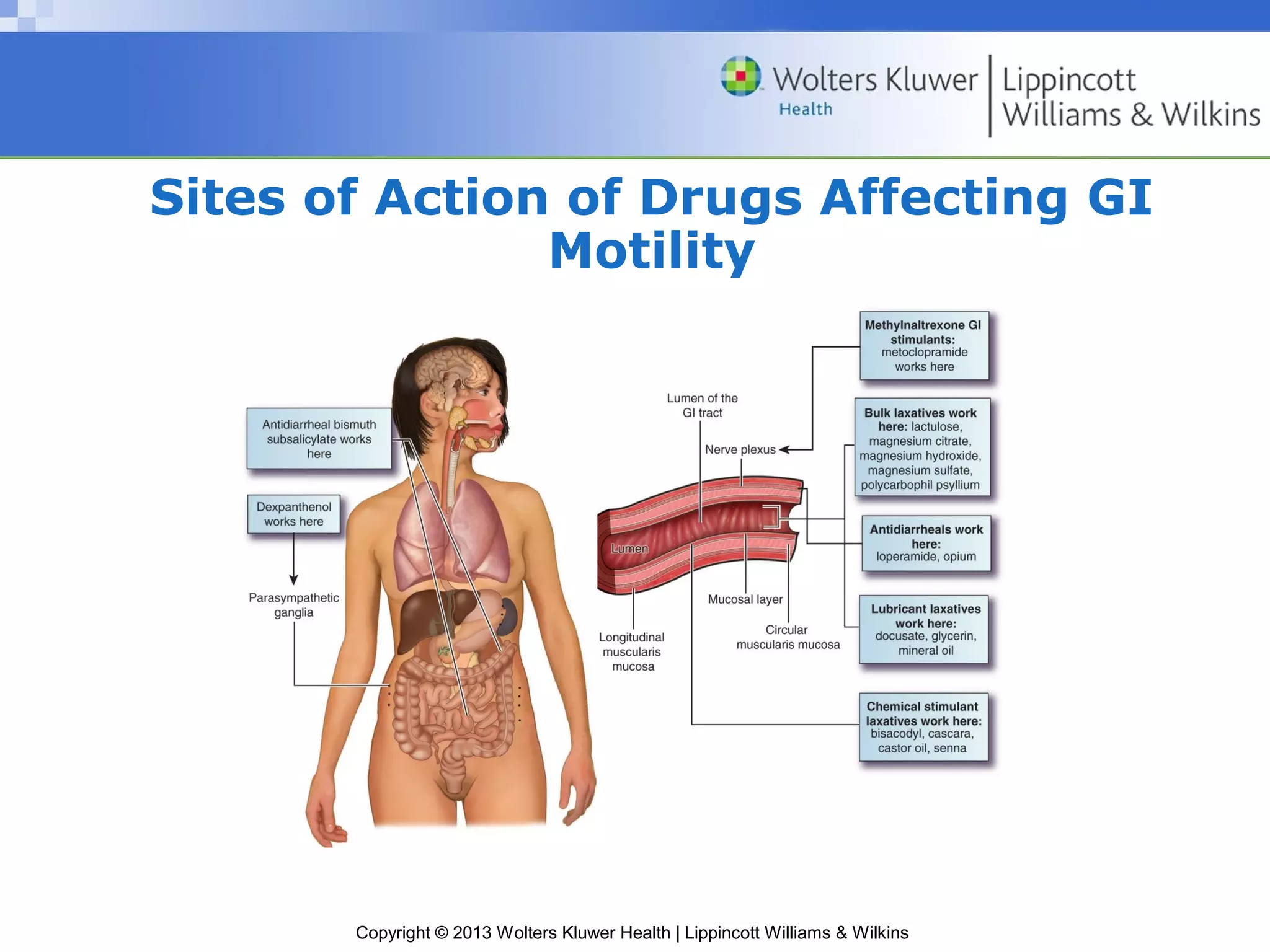
Sites of Action of Drugs Affecting GI 
Motility 
Copyright © 2013 Wolters Kluwer Health | Lippincott Williams & Wilkins
Types of Laxatives 
• Chemical Stimulants 
– Chemically irritate the lining of the GI tract 
• Bulk Stimulants 
– Cause the fecal matter to increase in bulk 
Copyright © 2013 Wolters Kluwer Health | Lippincott Williams & Wilkins 
• Lubricants 
– Help the intestinal contents move more smoothly
Types of Chemical Stimulants 
• Cascara (Generic): Reliable agent that leads to intestinal 
evacuation 
• Senna (Senokot): Reliable drug, similar to cascara (OTC) 
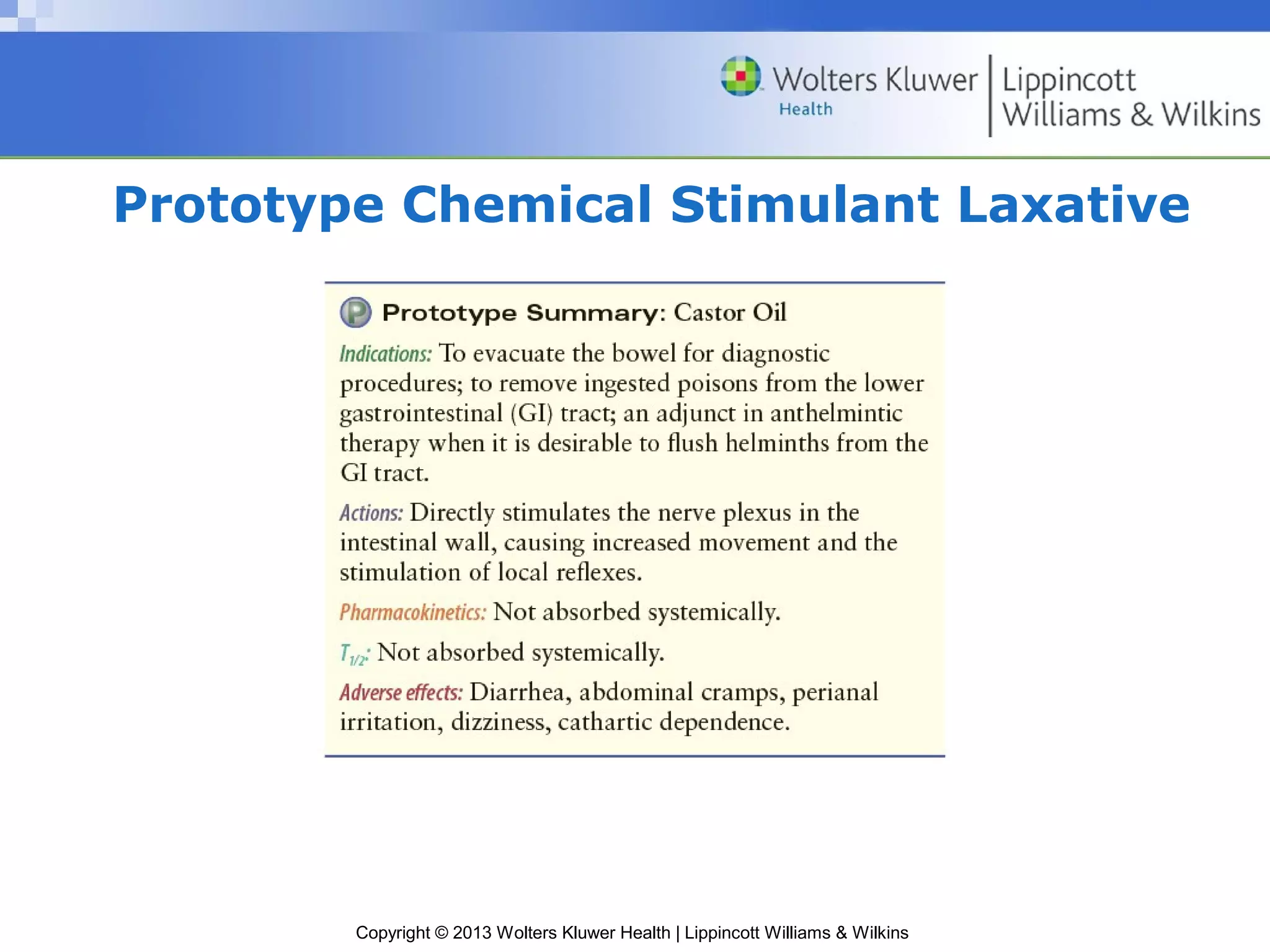
• Castor Oil (Neoloid): Old standby for thorough evacuation 
of the intestine 
• Bisacodyl (Dulcolax): Very popular OTC laxative 
Copyright © 2013 Wolters Kluwer Health | Lippincott Williams & Wilkins
Types of Bulk Stimulants 
• Magnesium Sulfate (Epsom Salts) 
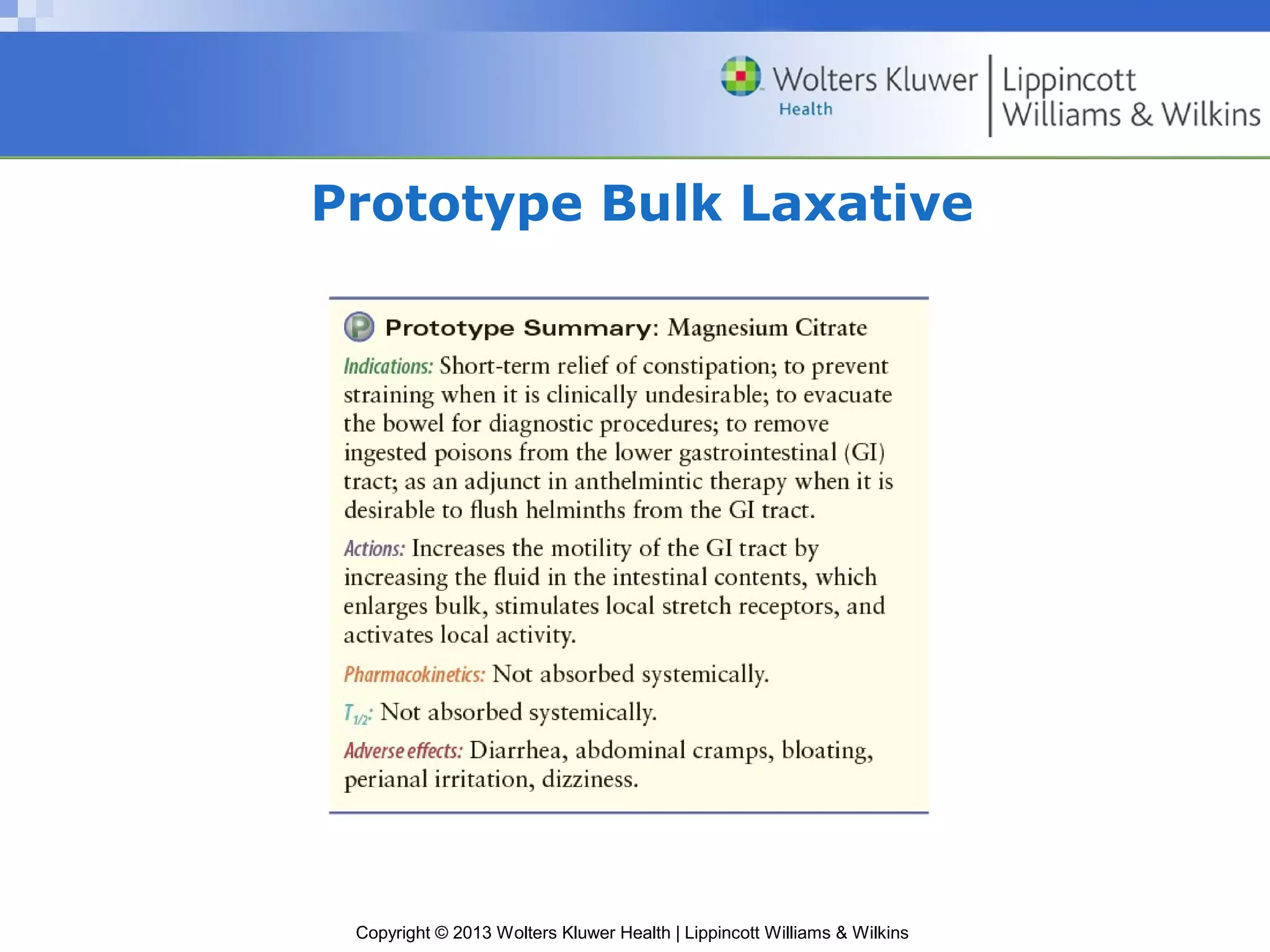
• Magnesium Citrate (Citrate of Magnesia) 
• Magnesium Hydroxide (Milk of Magnesia) 
• Lactulose (Chronulac) 
• Polycarbophil (FiberCon) 
• Psyllium (Metamucil) 
Copyright © 2013 Wolters Kluwer Health | Lippincott Williams & Wilkins
Types of Lubricating Laxatives 
• Docusate (Colace) 
– Has a detergent action on the surface of the 
intestinal bolus, making a softer stool 
• Glycerin (Sani-Supp) 
– Hyperosmolar laxative used to gently evacuate the 
rectum without systemic effects higher in the GI tract 
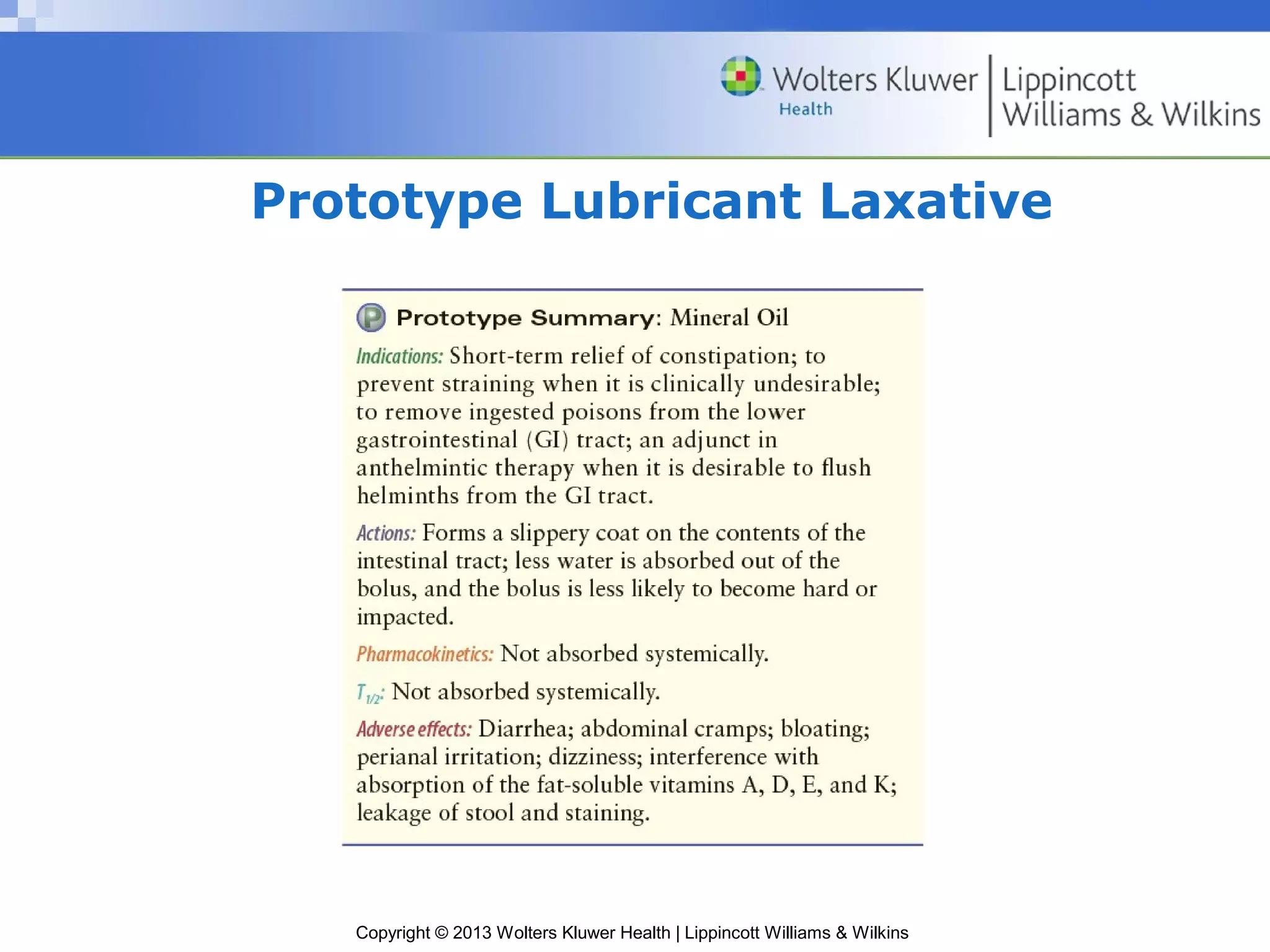
• Mineral Oil (Agoral Plain) 
– Forms a slippery coat on the contents of the 
intestinal tract 
Copyright © 2013 Wolters Kluwer Health | Lippincott Williams & Wilkins
Laxatives 
Copyright © 2013 Wolters Kluwer Health | Lippincott Williams & Wilkins 
• Actions 
– Work in three ways: 
• Direct chemical stimulation of the GI tract 
• Production of bulk or increased fluid in the lumen 
• Lubrication of the intestinal bolus to promote passage 
through the GI tract 
• Indications 
– Short-term relief of constipation 
– Prevent straining when it is clinically undesirable 
– Evacuate the bowel for diagnostic procedures 
– Removal of ingested poisons 
– Adjunct in antihelmintic therapy
Laxatives (cont.) 
• Pharmacokinetics 
– Only minimally absorbed and exert their therapeutic 
effect directly in the GI tract 
• Contraindications 
– Acute abdominal disorders 
Copyright © 2013 Wolters Kluwer Health | Lippincott Williams & Wilkins 
• Caution 
– Pregnancy or lactation
Laxatives (cont.) 
• Adverse Effects 
– GI effects - Diarrhea, abdominal cramping, and 
Copyright © 2013 Wolters Kluwer Health | Lippincott Williams & Wilkins 
nausea 
– CNS effects – Dizziness, headache, and weakness 
– CV effects – Sweating, palpitations, flushing, and 
fainting 
– Cathartic dependency 
• Drug-to-Drug Interactions 
– Some interfere with the timing or process of 
absorption
Question 
Which of the following is a very popular OTC laxative? 
A. Cascara 
B. Magnesium citrate 
C. Bisacodyl 
D. Polycarbophil 
Copyright © 2013 Wolters Kluwer Health | Lippincott Williams & Wilkins
Answer 
C. Bisacodyl 
Rationale: Bisacodyl (Dulcolax): Very popular OTC laxative. 
Copyright © 2013 Wolters Kluwer Health | Lippincott Williams & Wilkins
Types of Gastrointestinal Stimulants 
• Dexpanthenol (Ilopan) 
– Increases acetylcholine levels and stimulates the 
parasympathetic system 
• Metoclopramide (Reglan) 
– Blocks dopamine receptors and makes the GI cells 
more sensitive to acetylcholine 
– Leads to increased GI activity and rapid movement of 
food through the upper GI tract 
Copyright © 2013 Wolters Kluwer Health | Lippincott Williams & Wilkins
Gastrointestinal Stimulants 
Copyright © 2013 Wolters Kluwer Health | Lippincott Williams & Wilkins 
• Actions 
– Stimulate parasympathetic activity within the GI 
tract 
– Increase GI secretions and motility 
• Indications 
– Rapid movement of GI contents is desirable 
• Pharmacokinetics 
– Rapidly absorbed 
– Metabolized in the liver 
– Excreted in the urine
Gastrointestinal Stimulants (cont.) 
• Contraindications 
– Allergy 
– GI obstruction 
Copyright © 2013 Wolters Kluwer Health | Lippincott Williams & Wilkins 
• Caution 
– Pregnancy 
– Lactation
Gastrointestinal Stimulants (cont.) 
• Adverse Effects 
– Nausea, vomiting, diarrhea, intestinal spasms, 
cramping, decreased blood pressure and heart rate, 
weakness, and fatigue 
• Drug-to-Drug Interactions 
– Digoxin 
– Cyclosporine 
– Alcohol 
Copyright © 2013 Wolters Kluwer Health | Lippincott Williams & Wilkins
Types of Antidiarrheal Drugs 
• Bismuth Subsalicylate (Pepto-Bismol): Coats the lining of 
the GI tract and soothes irritation stimulating local 
reflexes to cause excessive GI activity and diarrhea 
• Loperamide (Imodium): Has a direct effect on the muscle 
layers of the GI tract; slows peristalsis and allows 
increased time for absorption of fluid and electrolytes 
• Opium Derivatives (Paregoric): Stimulates spasm within 
the GI tract, stops peristalsis and diarrhea 
Copyright © 2013 Wolters Kluwer Health | Lippincott Williams & Wilkins
Antidiarrheal Drugs 
Copyright © 2013 Wolters Kluwer Health | Lippincott Williams & Wilkins 
• Actions 
– Slow the motility of the GI tract through direct action 
on the lining of the GI tract 
• Indications 
– Relief of symptoms of acute or chronic diarrhea 
– Reduction of volume of discharge from ileostomies 
– Prevention and treatment of traveler’s diarrhea 
• Pharmacokinetics 
– Vary depending on agent
Antidiarrheal Drugs (cont.) 
• Contraindications 
Copyright © 2013 Wolters Kluwer Health | Lippincott Williams & Wilkins 
– Allergy 
• Caution 
– Pregnancy 
– Lactation 
– History of GI obstruction 
– History of acute abdominal conditions 
– Diarrhea due to poisonings
Antidiarrheal Drugs (cont.) 
• Adverse Effects 
– Constipation 
– Abdominal distension 
– Abdominal discomfort 
– Nausea 
– Dry mouth 
– Toxic megacolon 
– Fatigue 
– Weakness 
– Dizziness 
Copyright © 2013 Wolters Kluwer Health | Lippincott Williams & Wilkins
Antidiarrheal Drugs (cont.) 
• Drug-to-Drug Interactions 
– Depends on the drug 
Copyright © 2013 Wolters Kluwer Health | Lippincott Williams & Wilkins
Question 
Please answer the following statement as true or false. 
Pepto-Bismol can be involved in salicylate toxicity. 
Copyright © 2013 Wolters Kluwer Health | Lippincott Williams & Wilkins
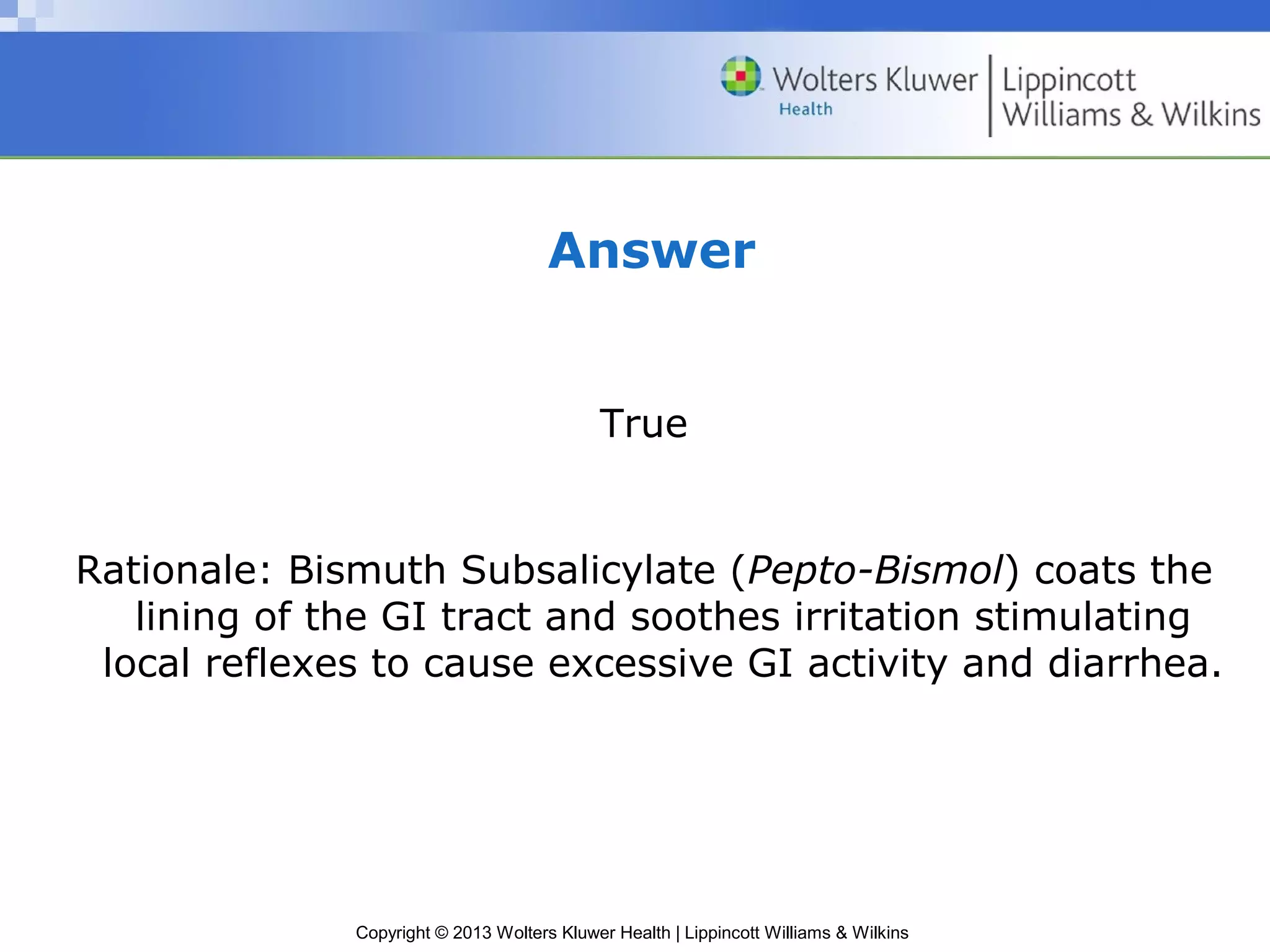
Answer 
True 
Rationale: Bismuth Subsalicylate (Pepto-Bismol) coats the 
lining of the GI tract and soothes irritation stimulating 
local reflexes to cause excessive GI activity and diarrhea. 
Copyright © 2013 Wolters Kluwer Health | Lippincott Williams & Wilkins
Use of Laxative and Antidiarrheal Agents 
Across the Lifespan 
Copyright © 2013 Wolters Kluwer Health | Lippincott Williams & Wilkins
Prototype Chemical Stimulant Laxative 
Copyright © 2013 Wolters Kluwer Health | Lippincott Williams & Wilkins
Prototype Bulk Laxative 
Copyright © 2013 Wolters Kluwer Health | Lippincott Williams & Wilkins
Prototype Lubricant Laxative 
Copyright © 2013 Wolters Kluwer Health | Lippincott Williams & Wilkins
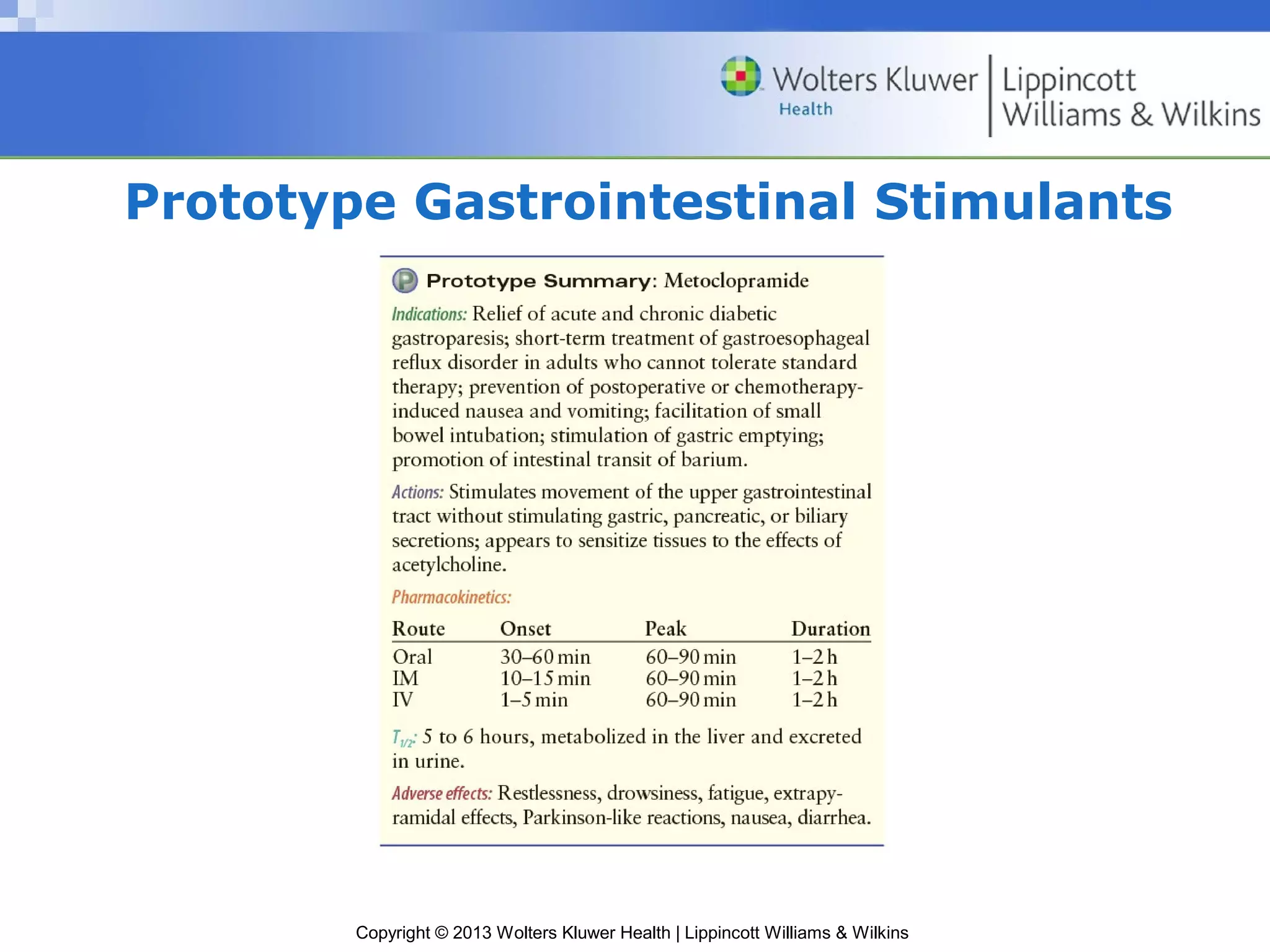
Prototype Gastrointestinal Stimulants 
Copyright © 2013 Wolters Kluwer Health | Lippincott Williams & Wilkins
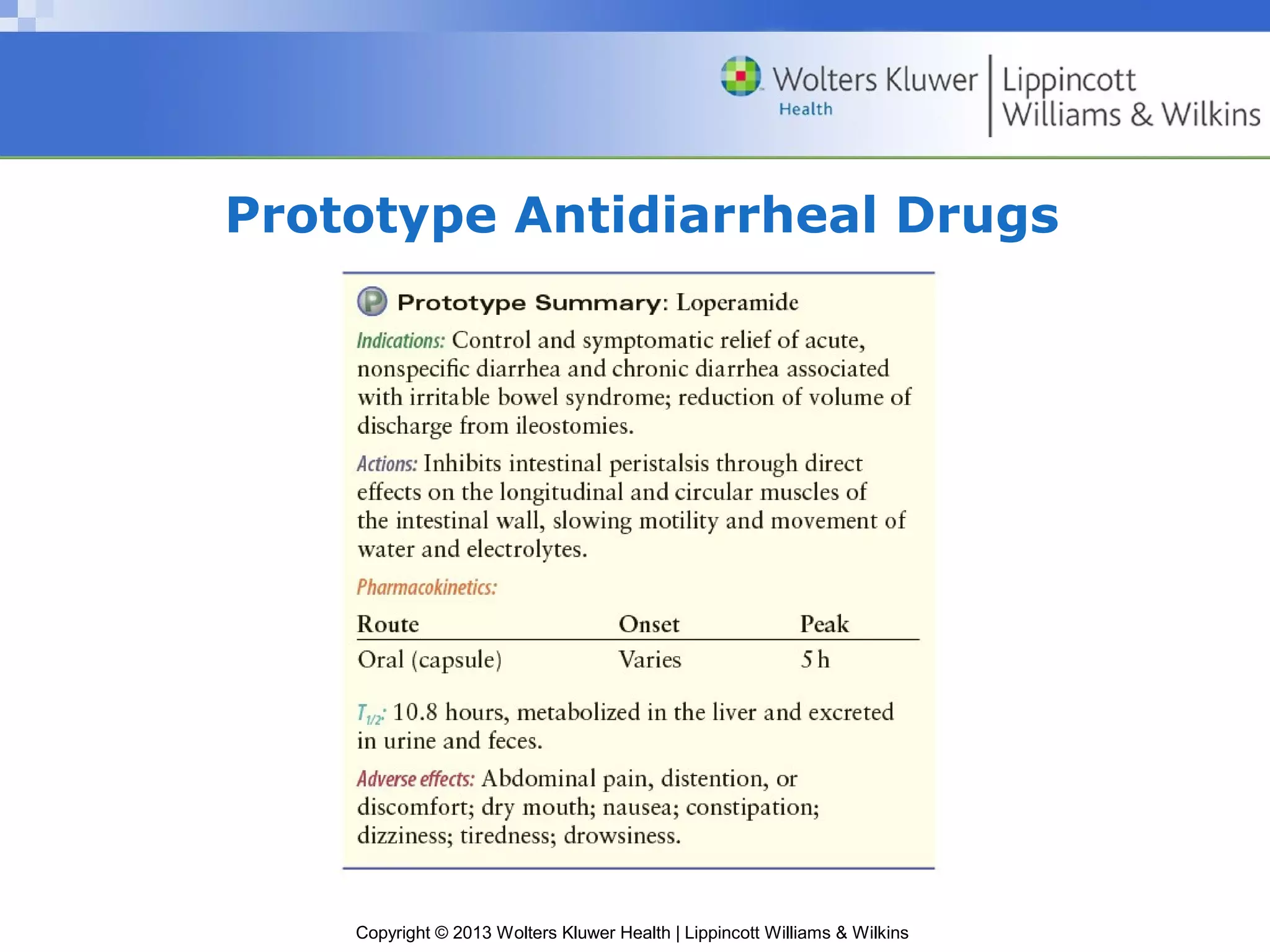
Prototype Antidiarrheal Drugs 
Copyright © 2013 Wolters Kluwer Health | Lippincott Williams & Wilkins
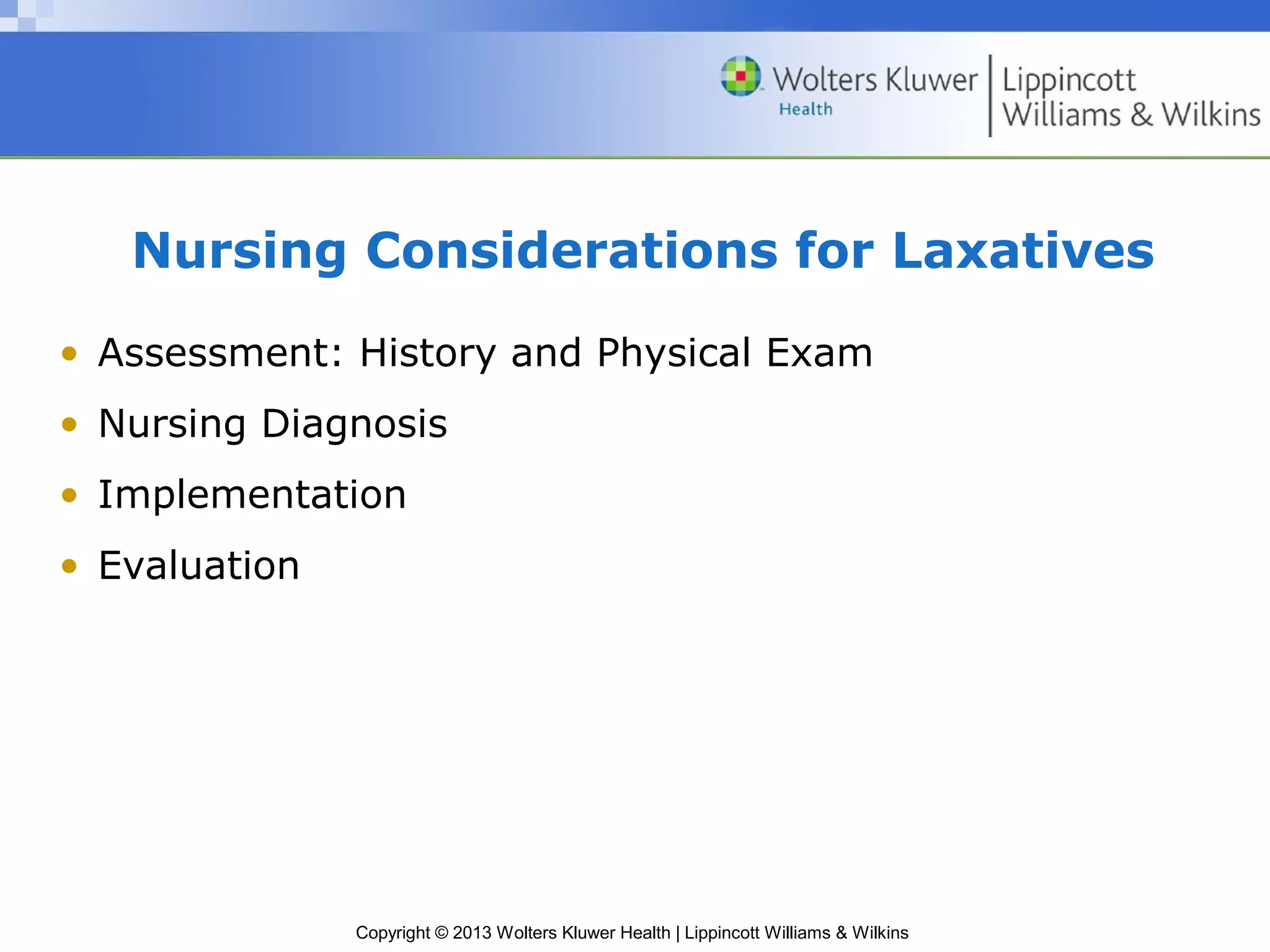
Nursing Considerations for Laxatives 
• Assessment: History and Physical Exam 
• Nursing Diagnosis 
• Implementation 
• Evaluation 
Copyright © 2013 Wolters Kluwer Health | Lippincott Williams & Wilkins
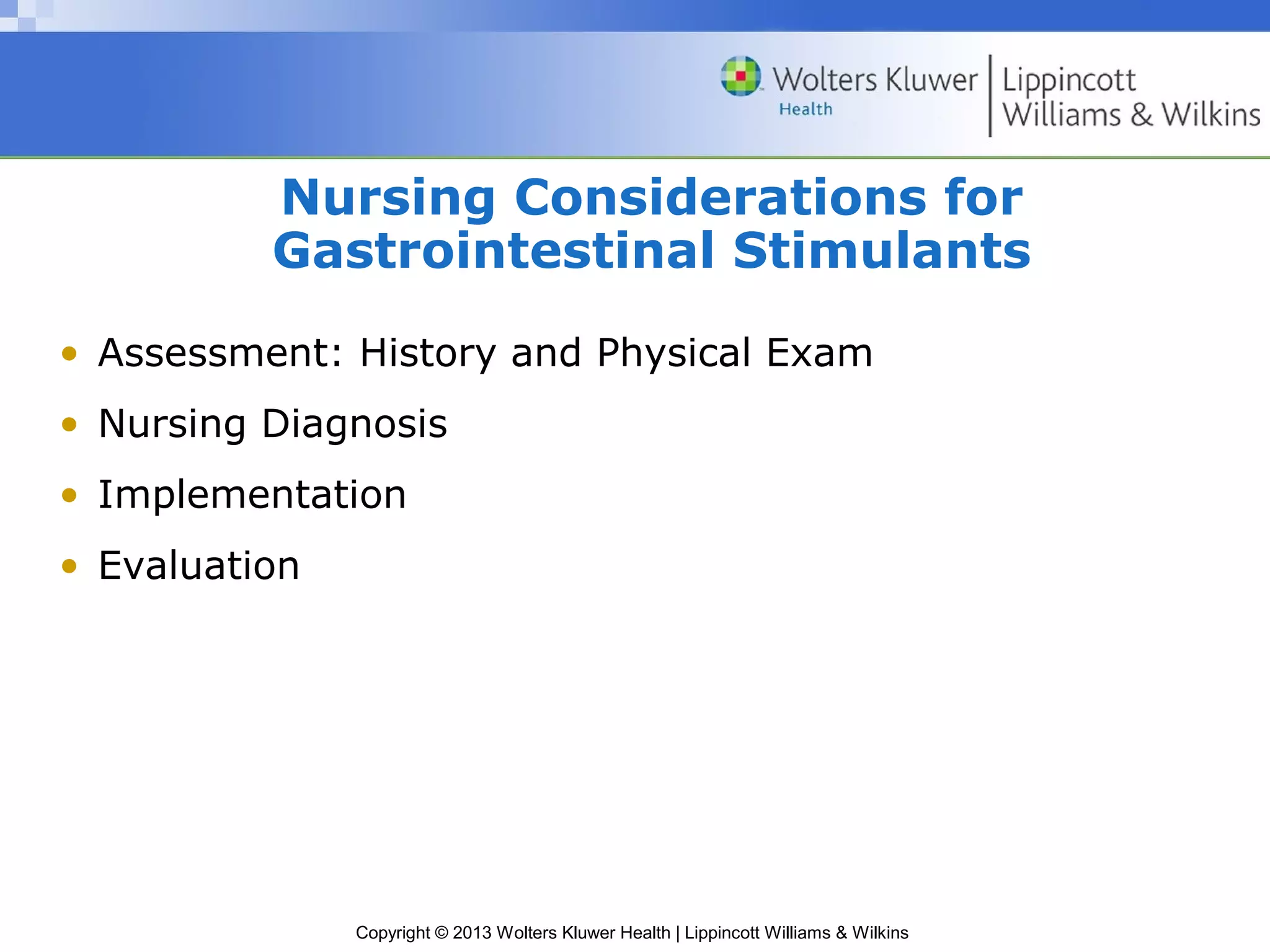
Nursing Considerations for 
Gastrointestinal Stimulants 
• Assessment: History and Physical Exam 
• Nursing Diagnosis 
• Implementation 
• Evaluation 
Copyright © 2013 Wolters Kluwer Health | Lippincott Williams & Wilkins
Nursing Considerations for Antidiarrheal 
Drugs 
• Assessment: History and Physical Exam 
• Nursing Diagnosis 
• Implementation 
• Evaluation 
Copyright © 2013 Wolters Kluwer Health | Lippincott Williams & Wilkins
Question 
Why should laxatives be taken only on a short-term basis? 
A. To prevent a fluid volume deficit 
B. To prevent cathartic dependence 
C. To obtain relief of abdominal distention 
D. To obtain relief of intestinal cramping 
Copyright © 2013 Wolters Kluwer Health | Lippincott Williams & Wilkins
Answer 
B. To prevent cathartic dependence 
Rationale: Administer laxative only as a temporary 
measure to prevent development of cathartic 
dependence. 
Copyright © 2013 Wolters Kluwer Health | Lippincott Williams & Wilkins

Ppt chapter 58

  • 1.
    Drugs Affecting Gastrointestinal Motility Chapter 58 Copyright © 2013 Wolters Kluwer Health | Lippincott Williams & Wilkins
  • 2.
    Actions of DrugsUsed to Affect Motor Activity of the GI Tract • Speed up or improve movement of intestinal contents when movement becomes slow or sluggish (constipation) • Increase the tone of the GI tract and stimulate motility throughout the system • Decrease movement along the GI tract when rapid movement decreases the time for absorption of nutrients (diarrhea) Copyright © 2013 Wolters Kluwer Health | Lippincott Williams & Wilkins
  • 3.
    Sites of Actionof Drugs Affecting GI Motility Copyright © 2013 Wolters Kluwer Health | Lippincott Williams & Wilkins
  • 4.
    Types of Laxatives • Chemical Stimulants – Chemically irritate the lining of the GI tract • Bulk Stimulants – Cause the fecal matter to increase in bulk Copyright © 2013 Wolters Kluwer Health | Lippincott Williams & Wilkins • Lubricants – Help the intestinal contents move more smoothly
  • 5.
    Types of ChemicalStimulants • Cascara (Generic): Reliable agent that leads to intestinal evacuation • Senna (Senokot): Reliable drug, similar to cascara (OTC) • Castor Oil (Neoloid): Old standby for thorough evacuation of the intestine • Bisacodyl (Dulcolax): Very popular OTC laxative Copyright © 2013 Wolters Kluwer Health | Lippincott Williams & Wilkins
  • 6.
    Types of BulkStimulants • Magnesium Sulfate (Epsom Salts) • Magnesium Citrate (Citrate of Magnesia) • Magnesium Hydroxide (Milk of Magnesia) • Lactulose (Chronulac) • Polycarbophil (FiberCon) • Psyllium (Metamucil) Copyright © 2013 Wolters Kluwer Health | Lippincott Williams & Wilkins
  • 7.
    Types of LubricatingLaxatives • Docusate (Colace) – Has a detergent action on the surface of the intestinal bolus, making a softer stool • Glycerin (Sani-Supp) – Hyperosmolar laxative used to gently evacuate the rectum without systemic effects higher in the GI tract • Mineral Oil (Agoral Plain) – Forms a slippery coat on the contents of the intestinal tract Copyright © 2013 Wolters Kluwer Health | Lippincott Williams & Wilkins
  • 8.
    Laxatives Copyright ©2013 Wolters Kluwer Health | Lippincott Williams & Wilkins • Actions – Work in three ways: • Direct chemical stimulation of the GI tract • Production of bulk or increased fluid in the lumen • Lubrication of the intestinal bolus to promote passage through the GI tract • Indications – Short-term relief of constipation – Prevent straining when it is clinically undesirable – Evacuate the bowel for diagnostic procedures – Removal of ingested poisons – Adjunct in antihelmintic therapy
  • 9.
    Laxatives (cont.) •Pharmacokinetics – Only minimally absorbed and exert their therapeutic effect directly in the GI tract • Contraindications – Acute abdominal disorders Copyright © 2013 Wolters Kluwer Health | Lippincott Williams & Wilkins • Caution – Pregnancy or lactation
  • 10.
    Laxatives (cont.) •Adverse Effects – GI effects - Diarrhea, abdominal cramping, and Copyright © 2013 Wolters Kluwer Health | Lippincott Williams & Wilkins nausea – CNS effects – Dizziness, headache, and weakness – CV effects – Sweating, palpitations, flushing, and fainting – Cathartic dependency • Drug-to-Drug Interactions – Some interfere with the timing or process of absorption
  • 11.
    Question Which ofthe following is a very popular OTC laxative? A. Cascara B. Magnesium citrate C. Bisacodyl D. Polycarbophil Copyright © 2013 Wolters Kluwer Health | Lippincott Williams & Wilkins
  • 12.
    Answer C. Bisacodyl Rationale: Bisacodyl (Dulcolax): Very popular OTC laxative. Copyright © 2013 Wolters Kluwer Health | Lippincott Williams & Wilkins
  • 13.
    Types of GastrointestinalStimulants • Dexpanthenol (Ilopan) – Increases acetylcholine levels and stimulates the parasympathetic system • Metoclopramide (Reglan) – Blocks dopamine receptors and makes the GI cells more sensitive to acetylcholine – Leads to increased GI activity and rapid movement of food through the upper GI tract Copyright © 2013 Wolters Kluwer Health | Lippincott Williams & Wilkins
  • 14.
    Gastrointestinal Stimulants Copyright© 2013 Wolters Kluwer Health | Lippincott Williams & Wilkins • Actions – Stimulate parasympathetic activity within the GI tract – Increase GI secretions and motility • Indications – Rapid movement of GI contents is desirable • Pharmacokinetics – Rapidly absorbed – Metabolized in the liver – Excreted in the urine
  • 15.
    Gastrointestinal Stimulants (cont.) • Contraindications – Allergy – GI obstruction Copyright © 2013 Wolters Kluwer Health | Lippincott Williams & Wilkins • Caution – Pregnancy – Lactation
  • 16.
    Gastrointestinal Stimulants (cont.) • Adverse Effects – Nausea, vomiting, diarrhea, intestinal spasms, cramping, decreased blood pressure and heart rate, weakness, and fatigue • Drug-to-Drug Interactions – Digoxin – Cyclosporine – Alcohol Copyright © 2013 Wolters Kluwer Health | Lippincott Williams & Wilkins
  • 17.
    Types of AntidiarrhealDrugs • Bismuth Subsalicylate (Pepto-Bismol): Coats the lining of the GI tract and soothes irritation stimulating local reflexes to cause excessive GI activity and diarrhea • Loperamide (Imodium): Has a direct effect on the muscle layers of the GI tract; slows peristalsis and allows increased time for absorption of fluid and electrolytes • Opium Derivatives (Paregoric): Stimulates spasm within the GI tract, stops peristalsis and diarrhea Copyright © 2013 Wolters Kluwer Health | Lippincott Williams & Wilkins
  • 18.
    Antidiarrheal Drugs Copyright© 2013 Wolters Kluwer Health | Lippincott Williams & Wilkins • Actions – Slow the motility of the GI tract through direct action on the lining of the GI tract • Indications – Relief of symptoms of acute or chronic diarrhea – Reduction of volume of discharge from ileostomies – Prevention and treatment of traveler’s diarrhea • Pharmacokinetics – Vary depending on agent
  • 19.
    Antidiarrheal Drugs (cont.) • Contraindications Copyright © 2013 Wolters Kluwer Health | Lippincott Williams & Wilkins – Allergy • Caution – Pregnancy – Lactation – History of GI obstruction – History of acute abdominal conditions – Diarrhea due to poisonings
  • 20.
    Antidiarrheal Drugs (cont.) • Adverse Effects – Constipation – Abdominal distension – Abdominal discomfort – Nausea – Dry mouth – Toxic megacolon – Fatigue – Weakness – Dizziness Copyright © 2013 Wolters Kluwer Health | Lippincott Williams & Wilkins
  • 21.
    Antidiarrheal Drugs (cont.) • Drug-to-Drug Interactions – Depends on the drug Copyright © 2013 Wolters Kluwer Health | Lippincott Williams & Wilkins
  • 22.
    Question Please answerthe following statement as true or false. Pepto-Bismol can be involved in salicylate toxicity. Copyright © 2013 Wolters Kluwer Health | Lippincott Williams & Wilkins
  • 23.
    Answer True Rationale:Bismuth Subsalicylate (Pepto-Bismol) coats the lining of the GI tract and soothes irritation stimulating local reflexes to cause excessive GI activity and diarrhea. Copyright © 2013 Wolters Kluwer Health | Lippincott Williams & Wilkins
  • 24.
    Use of Laxativeand Antidiarrheal Agents Across the Lifespan Copyright © 2013 Wolters Kluwer Health | Lippincott Williams & Wilkins
  • 25.
    Prototype Chemical StimulantLaxative Copyright © 2013 Wolters Kluwer Health | Lippincott Williams & Wilkins
  • 26.
    Prototype Bulk Laxative Copyright © 2013 Wolters Kluwer Health | Lippincott Williams & Wilkins
  • 27.
    Prototype Lubricant Laxative Copyright © 2013 Wolters Kluwer Health | Lippincott Williams & Wilkins
  • 28.
    Prototype Gastrointestinal Stimulants Copyright © 2013 Wolters Kluwer Health | Lippincott Williams & Wilkins
  • 29.
    Prototype Antidiarrheal Drugs Copyright © 2013 Wolters Kluwer Health | Lippincott Williams & Wilkins
  • 30.
    Nursing Considerations forLaxatives • Assessment: History and Physical Exam • Nursing Diagnosis • Implementation • Evaluation Copyright © 2013 Wolters Kluwer Health | Lippincott Williams & Wilkins
  • 31.
    Nursing Considerations for Gastrointestinal Stimulants • Assessment: History and Physical Exam • Nursing Diagnosis • Implementation • Evaluation Copyright © 2013 Wolters Kluwer Health | Lippincott Williams & Wilkins
  • 32.
    Nursing Considerations forAntidiarrheal Drugs • Assessment: History and Physical Exam • Nursing Diagnosis • Implementation • Evaluation Copyright © 2013 Wolters Kluwer Health | Lippincott Williams & Wilkins
  • 33.
    Question Why shouldlaxatives be taken only on a short-term basis? A. To prevent a fluid volume deficit B. To prevent cathartic dependence C. To obtain relief of abdominal distention D. To obtain relief of intestinal cramping Copyright © 2013 Wolters Kluwer Health | Lippincott Williams & Wilkins
  • 34.
    Answer B. Toprevent cathartic dependence Rationale: Administer laxative only as a temporary measure to prevent development of cathartic dependence. Copyright © 2013 Wolters Kluwer Health | Lippincott Williams & Wilkins