X-Rays & Matter
MUHAMMED ASLAM BS
BSC MIT
Introduction
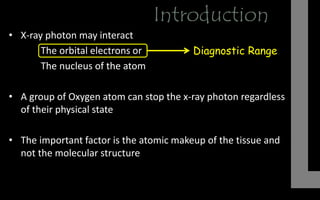
• X-ray photon may interact
The orbital electrons or
The nucleus of the atom
• A group of Oxygen atom can stop the x-ray photon regardless
of their physical state
• The important factor is the atomic makeup of the tissue and
not the molecular structure
Diagnostic Range
• X-rays are either absorbed or they are scattered
• When they are absorbed they are completely
removed from the beam & cease to exist
• When photon are scattered they are deflected into a
random course & no longer carry useful information
& so adds noise to the system. - film fog
Ways of interaction with matter
• Coherent scattering
• Photoelectric effect
• Compton scattering
• Pair production
• Photodisintegration
Compton and photoelectric are important in diagnostic x ray
Coherent Scattering
• Interactions in which
radiation undergoes a change in direction
without a change in wavelength
• Synonym
– Classical scattering
– Unmodified scattering
• Low energy x-rays of about 10 KeV interact in this manner
• No Ionization ( only type of interaction )
• No loss of energy
• Total contribution < 5%
Coherent Scattering
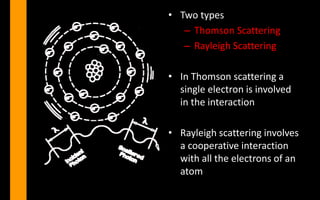
• Two types
– Thomson Scattering
– Rayleigh Scattering
• In Thomson scattering a
single electron is involved
in the interaction
• Rayleigh scattering involves
a cooperative interaction
with all the electrons of an
atom
• Basically there are three
phases: absorption of
radiation, vibration of the atom
& emission of radiation as the
atom returns to its
undisturbed state
• fog
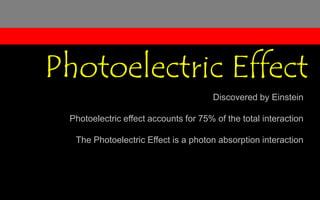
Discovered by Einstein
Photoelectric effect accounts for 75% of the total interaction
The Photoelectric Effect is a photon absorption interaction
Photoelectric Effect
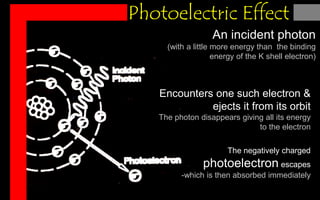
An incident photon
(with a little more energy than the binding
energy of the K shell electron)
Encounters one such electron &
ejects it from its orbit
The photon disappears giving all its energy
to the electron
The negatively charged
photoelectron escapes
-which is then absorbed immediately
Now the atom acquires a
Positive Charge
as it is left with a electron void in the K shell
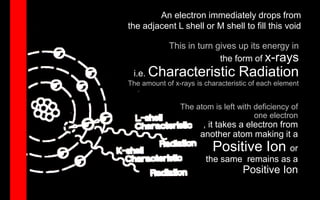
An electron immediately drops from
the adjacent L shell or M shell to fill this void
This in turn gives up its energy in
the form of x-rays
i.e. Characteristic Radiation
The amount of x-rays is characteristic of each element
The atom is left with deficiency of
one electron
, it takes a electron from
another atom making it a
Positive Ion or
the same remains as a
Positive Ion
In short the photoelectric effect
yields 3 end products:
1. Characteristic radiation
2. A Negative ion
3. A positive ion
Effective Atomic Numbers
Human Tissue
Muscle
Fat
Bone
Lung
Other Material
Calcium
Air
Concrete
Lead
Effective Atomic #
7.4
6.3
13.8
7.4
4.04
7.6
17
82
Probability of photoelectric reaction
• The incident photon must have sufficient energy
to overcome the binding energy of the electron
• A photoelectric reaction is most likely to occur
when the photon energy & electron binding
energy are nearly the same
Photoelectric effect ~ 1/(energy)3
• The tighter an electron is bound to its orbit the
more likely it is involved in a photoelectric reaction
Electrons are more tightly bound to elements with high atomic
no. than in elements with low atomic no.
Photoelectric effect ~ (atomic no.)3
Radiological Application
• Calcium which has the highest atomic no. of any
element found in the body emits around 4keV
characteristic radiation
• This is very little energy & is absorbed within a few
mm. of its site of origin
The contrast agents
iodine(33.2keV) & barium(37.4keV)
are the only elements encountered in diagnostic radiology
that emit characteristic radiation energetic
enough to leave the pt.& fog the x - ray film
• Photoelectric effect produces radiographic images of
excellent quality as ,it does not produce scatter
radiation & enhances natural tissue contrast
• Contrast is greatest when the difference in
absorption between adjacent tissues is large like
bone & soft tissues
• From the point of view of patient exposure
photoelectric effect is undesirable as all the energy
of the incident photon is absorbed by the pt.
This can be minimized by using high energy kVp techniques.
Compton Scattering
It accounts for 20% of the total interaction
This interaction not only changes the direction but reduced its
energy and ionizes the atom as well
Synonym
Compton Effect
Compton ScatteringCompton Scattering
Angle of
Scattering
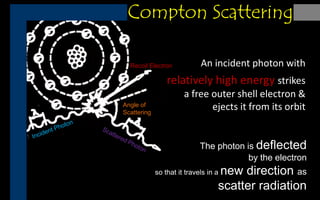
Recoil Electron An incident photon with
relatively high energy strikes
a free outer shell electron &
ejects it from its orbit
The photon is deflected
by the electron
so that it travels in a new direction as
scatter radiation
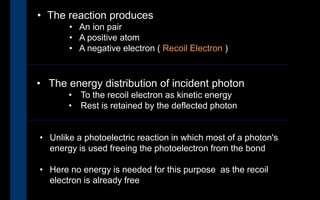
• The reaction produces
• An ion pair
• A positive atom
• A negative electron ( Recoil Electron )
• The energy distribution of incident photon
• To the recoil electron as kinetic energy
• Rest is retained by the deflected photon
• Unlike a photoelectric reaction in which most of a photon's
energy is used freeing the photoelectron from the bond
• Here no energy is needed for this purpose as the recoil
electron is already free
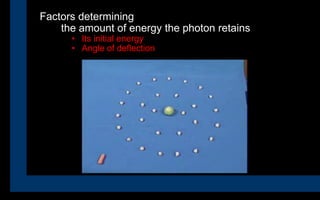
Factors determining
the amount of energy the photon retains
• Its initial energy
• Angle of deflection
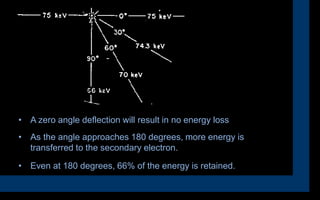
• A zero angle deflection will result in no energy loss
• As the angle approaches 180 degrees, more energy is
transferred to the secondary electron.
• Even at 180 degrees, 66% of the energy is retained.
• Photons scattered at narrow angles have an excellent
chance of reaching an x-ray tube & producing fog
• So scatter radiation arising from the pt. during
fluoroscopy creates a safety hazard to the fluoroscopist &
other personnel in the room
• The probability of Compton Effect is about the
same for soft tissue or bone.
• Photons scattered back towards the incident x-ray
beam are called Backscatter Radiation.
Pair Production
Pair production
• If the incident x-ray has sufficient energy, it may escape
the electron cloud and come close enough to the nucleus
to come under the influence of the strong electrostatic
field of the nucleus.
• The photon disappears
• Its energy is converted to matter in the form of two particles,
• an electron &
• a positron (a particle with the same mass of an electron but
with a positive charge)
Pair Production
• As pair production does not occur with photon energies less than 1.02
MeV it is not of importance in diagnostic radiology ,where we rarely use
energies above 150 kev
Photodisintegration
Photodisintegration
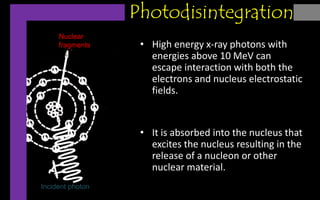
• High energy x-ray photons with
energies above 10 MeV can
escape interaction with both the
electrons and nucleus electrostatic
fields.
• It is absorbed into the nucleus that
excites the nucleus resulting in the
release of a nucleon or other
nuclear material.
Photodisintegration
Nuclear
fragments
Incident photon
• The photon must have
sufficient energy to
overcome nuclear
binding energies of the
order 7-15 mev
• As photodisintegration does not occur with
photon energies less than 7mev ,it is not of
importance in diagnostic radiology ,where we
rarely use energies above 150 kev
Relative frequency of basic interactions
D
At a glance
Intercation with matter

Intercation with matter

  • 1.
    X-Rays & Matter MUHAMMEDASLAM BS BSC MIT
  • 2.
    Introduction • X-ray photonmay interact The orbital electrons or The nucleus of the atom • A group of Oxygen atom can stop the x-ray photon regardless of their physical state • The important factor is the atomic makeup of the tissue and not the molecular structure Diagnostic Range
  • 3.
    • X-rays areeither absorbed or they are scattered • When they are absorbed they are completely removed from the beam & cease to exist • When photon are scattered they are deflected into a random course & no longer carry useful information & so adds noise to the system. - film fog
  • 4.
    Ways of interactionwith matter • Coherent scattering • Photoelectric effect • Compton scattering • Pair production • Photodisintegration Compton and photoelectric are important in diagnostic x ray
  • 5.
  • 6.
    • Interactions inwhich radiation undergoes a change in direction without a change in wavelength • Synonym – Classical scattering – Unmodified scattering • Low energy x-rays of about 10 KeV interact in this manner • No Ionization ( only type of interaction ) • No loss of energy • Total contribution < 5% Coherent Scattering
  • 7.
    • Two types –Thomson Scattering – Rayleigh Scattering • In Thomson scattering a single electron is involved in the interaction • Rayleigh scattering involves a cooperative interaction with all the electrons of an atom
  • 8.
    • Basically thereare three phases: absorption of radiation, vibration of the atom & emission of radiation as the atom returns to its undisturbed state • fog
  • 9.
    Discovered by Einstein Photoelectriceffect accounts for 75% of the total interaction The Photoelectric Effect is a photon absorption interaction Photoelectric Effect
  • 10.
    Photoelectric Effect An incidentphoton (with a little more energy than the binding energy of the K shell electron) Encounters one such electron & ejects it from its orbit The photon disappears giving all its energy to the electron The negatively charged photoelectron escapes -which is then absorbed immediately
  • 11.
    Now the atomacquires a Positive Charge as it is left with a electron void in the K shell
  • 12.
    An electron immediatelydrops from the adjacent L shell or M shell to fill this void This in turn gives up its energy in the form of x-rays i.e. Characteristic Radiation The amount of x-rays is characteristic of each element The atom is left with deficiency of one electron , it takes a electron from another atom making it a Positive Ion or the same remains as a Positive Ion
  • 14.
    In short thephotoelectric effect yields 3 end products: 1. Characteristic radiation 2. A Negative ion 3. A positive ion
  • 15.
    Effective Atomic Numbers HumanTissue Muscle Fat Bone Lung Other Material Calcium Air Concrete Lead Effective Atomic # 7.4 6.3 13.8 7.4 4.04 7.6 17 82
  • 16.
    Probability of photoelectricreaction • The incident photon must have sufficient energy to overcome the binding energy of the electron • A photoelectric reaction is most likely to occur when the photon energy & electron binding energy are nearly the same Photoelectric effect ~ 1/(energy)3 • The tighter an electron is bound to its orbit the more likely it is involved in a photoelectric reaction Electrons are more tightly bound to elements with high atomic no. than in elements with low atomic no. Photoelectric effect ~ (atomic no.)3
  • 17.
    Radiological Application • Calciumwhich has the highest atomic no. of any element found in the body emits around 4keV characteristic radiation • This is very little energy & is absorbed within a few mm. of its site of origin
  • 18.
    The contrast agents iodine(33.2keV)& barium(37.4keV) are the only elements encountered in diagnostic radiology that emit characteristic radiation energetic enough to leave the pt.& fog the x - ray film
  • 19.
    • Photoelectric effectproduces radiographic images of excellent quality as ,it does not produce scatter radiation & enhances natural tissue contrast • Contrast is greatest when the difference in absorption between adjacent tissues is large like bone & soft tissues • From the point of view of patient exposure photoelectric effect is undesirable as all the energy of the incident photon is absorbed by the pt. This can be minimized by using high energy kVp techniques.
  • 20.
    Compton Scattering It accountsfor 20% of the total interaction This interaction not only changes the direction but reduced its energy and ionizes the atom as well Synonym Compton Effect
  • 21.
    Compton ScatteringCompton Scattering Angleof Scattering Recoil Electron An incident photon with relatively high energy strikes a free outer shell electron & ejects it from its orbit The photon is deflected by the electron so that it travels in a new direction as scatter radiation
  • 22.
    • The reactionproduces • An ion pair • A positive atom • A negative electron ( Recoil Electron ) • The energy distribution of incident photon • To the recoil electron as kinetic energy • Rest is retained by the deflected photon • Unlike a photoelectric reaction in which most of a photon's energy is used freeing the photoelectron from the bond • Here no energy is needed for this purpose as the recoil electron is already free
  • 23.
    Factors determining the amountof energy the photon retains • Its initial energy • Angle of deflection
  • 24.
    • A zeroangle deflection will result in no energy loss • As the angle approaches 180 degrees, more energy is transferred to the secondary electron. • Even at 180 degrees, 66% of the energy is retained.
  • 25.
    • Photons scatteredat narrow angles have an excellent chance of reaching an x-ray tube & producing fog • So scatter radiation arising from the pt. during fluoroscopy creates a safety hazard to the fluoroscopist & other personnel in the room • The probability of Compton Effect is about the same for soft tissue or bone. • Photons scattered back towards the incident x-ray beam are called Backscatter Radiation.
  • 26.
  • 27.
    Pair production • Ifthe incident x-ray has sufficient energy, it may escape the electron cloud and come close enough to the nucleus to come under the influence of the strong electrostatic field of the nucleus. • The photon disappears • Its energy is converted to matter in the form of two particles, • an electron & • a positron (a particle with the same mass of an electron but with a positive charge) Pair Production
  • 28.
    • As pairproduction does not occur with photon energies less than 1.02 MeV it is not of importance in diagnostic radiology ,where we rarely use energies above 150 kev
  • 29.
  • 30.
    Photodisintegration • High energyx-ray photons with energies above 10 MeV can escape interaction with both the electrons and nucleus electrostatic fields. • It is absorbed into the nucleus that excites the nucleus resulting in the release of a nucleon or other nuclear material. Photodisintegration Nuclear fragments Incident photon
  • 31.
    • The photonmust have sufficient energy to overcome nuclear binding energies of the order 7-15 mev • As photodisintegration does not occur with photon energies less than 7mev ,it is not of importance in diagnostic radiology ,where we rarely use energies above 150 kev
  • 32.
    Relative frequency ofbasic interactions
  • 33.