
Uploaded byLucinda Wittkower
Learning Through Play, The Old School Way
The document describes a case study where the author created a board game called "Perry Library Land" based on Candy Land to teach students about information ethics. In fall 2013, 31 students played the game for extra credit and provided positive feedback, finding it engaging and interactive. In spring 2014, 101 students were required to play and also found it fun and an effective way to learn and interact. By observing gameplay and student feedback, the author found students actively discussed scenarios and learned about topics like copyright, citation, and academic honesty. The document also discusses how games are nothing new to education and can be short activities to keep students engaged according to other studies.
More Related Content


Similar to Learning Through Play, The Old School Way


Learning Through Play, The Old School Way
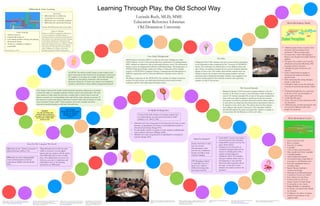
- 1. Learning Through Play,the Old School Way Lucinda Rush, MLIS, MME Education Reference Librarian Old Dominion University How Do We Compete? We Don’t! True or False: Restaurants can sing “Happy Birthday” to customers because the author is unknown. Scenario: You copy and paste a few sentences from a website to your paper. The website doesn’t list an author or date. What should you do? The Pilot The Second Episode Battles, J., Glenn, V. & Shedd, L. (2011). Rethinking the library game: Creating an alternate reality with social media. Journal of Web Libarianship, 5(2), 114-131. http://10.1080/19322909.2011.569922 Walsh, A. & Inala, P. (2010). Active learning techniques for librarians: Practical examples. Oxford: Chandos Publishing. Bonwell, C.C. & Eison, J.A. (1991). Active learning: Creating excitement in the classroom. ASHE-ERIC Higher Education Report No. 1. Washington, D.C.: The George Washington University School of Education and Human Development. Detlor, B., Booker, L., Serenko, A., Julien, H. (2012). Student perceptions of information literacy instruction: The importance of active learning. Education for Information, 29(2), p. 147-161. http://10.3233/EFI-2012-0924 Duck, P.M. & Koeske, R. (2005). Marketing the Millennials: What they expect from their library experience. ACRL Twelfth National Conference proceedings, April 7-10, 2005, 112-120. Kapp, K.M. (2012). The gamification of learning and instruction: Game-based methods and strategies for training and education. San Francisco, CA: Pfeiffer. Markey, K., Swanson, F., Jenkins, A., Jennings, B., Rosenberg, V., Yao, X., & Frost, R. (2009). Will undergraduate students play games to learn how to conduct library research? The Journal of Academic Librarianship, 35(3), 303-313. Oblinger, D. (2006). Games and learning. Educause Quarterly, 3, 5-7. Smith, F. (2007). Games for teaching information literacy skills. Library Philosophy and Practice. http://digitalcommons.unl.edu/libphilprac/117 Millennials & Active Learning Active Learning • Student-centered • Experiential, hands-on • Can include problem solving, role-playing, dicussion & debate • Teacher is a facilitator, student is responsible (Bonwell & Eison, 1991) Fast Facts • Millennials like to collaborate • Competition is motivating • Millennials want immediate feedback • Millennials like experiential learning (Prensky, 2010; Walsh & Inala, 2010; Sweeney, 2005) Active vs. Passive Detlor et. al, (2012) compared the effectiveness of active and passive teaching methods in information literacy instruction and determined that students who experienced an active learning environment retained more information and achieved learning outcomes at a higher level than those who experienced a passive environment. The amount of time spent on activity did not make a difference, as along as some active learning was present students retained more. Case Study: Background Old Dominion University (ODU) is a mid-size university, enrolling just under 25,000 students. As part of the general education requirements for undergraduates, ODU students are required to take an information literacy course. The information literacy courses are designed and offered by individual colleges. The department of STEM & Professional Studies within the College of Education offers multiple sections of STEM 251G (Computer Literacy: Communication & Information) to fulfill the requirement, and the Education Reference Librarian assists with the classes. The library component of the STEM 251G class includes two library instruction sessions for each section, one addressing information retrieval and resource evaluation and the other addressing information ethics. During the Fall of 2013 students were given extra credit for attendance at the information ethics workshop for the 9 sections of STEM251G classes. The workshop was offered twice, on two different times and days. Thirty-one students attended the two sessions. Students played in groups of four or five. The author observed that students were very willing to discuss the scenarios with their group members and were passionate about sharing their thoughts. Students were engaged in the content, asking questions about specific scenarios and expressing surprise at some of the answers. During the Spring of 2014, instructors required students in the five sections of the course to come to the information ethics workshop. A total of 101 students attended. The format of the game remained the same with some slight tweaking to specific questions and scenarios. Assessment was done by informal observation and by asking students to write down one thing that they learned about information ethics to be turned in at the end of class. The author observed that students were willing to talk openly to their peers. The immediate feedback provided throughout the game encouraged the students to engage in conversations with the librarian as well as each other. In Fall 2013 the author created a game to help students learn about information ethics based on the board game Candy Land. The logistics of the game were simple. It provided immediate feedback, was fast-paced, competitive and encouraged discussion. Elements of humor and sarcasm were included in scenarios and answers to keep students engaged and amused. Perry Library Land used the Candy Land board game and pieces. Questions or scenarios covered the topics of copyright, academic honesty, citation and social media. The rules were similar to Candy Land, but each time a student drew a card he had to read and discuss a scenario on a corresponding color card with his team, then give an answer. If the answer was correct, the player could move forward. Cards with two blocks of color were considered “bonus cards.” These questions were more in-depth and when answered correctly, the player could move forward twice. What Did Students Think? • I liked the game format, it made it more interactive and encouraged social interaction. I like my group mates. • It is more fun to learn while playing. I liked it, even though some might think it’s childish. • The game was a creative way to get the information presented effectively, while keeping everyone’s attention. • I thought the game format was very effective. • Game worked better in regards to interaction but made me feel like a preschool kid. • More interesting than sitting through a lecture or slide show. • I thought it made it more fun and made everyone be involved and interact. I liked it. • I definitely thought this was a good way to do this. It was a good reminder of what is right and wrong. • I really liked the game. • It was a fun way to learn and interact with our classmates. • I liked the game. It made learning fun and you can also collaborate with other people in your group. What Did Students Learn? • How to cite class notes • Reuse of papers • Necessity of citation • Copyright • A lot on ethics and information • Many people don’t know copyright • Copyright legalities • About intellectual property • You should bring a rough draft of your paper to the Writing Center • Can’t put copyrighted music to YouTube videos • Barack Obama’s birthday is common knowledge • Drawings are intellectual property • I found out I’m not very ethical • Perry Library has four floors • I cannot freely use all of the images found in Google Images • It is possible to cite a tattoo • Happy Birthday is copyrighted • It is hard to be ethical when friends are involved • It’s illegal to use videos or images without the permission of the original author It’s Really Nothing New • Educators have been using games in the classroom for years, as many elements of gamification are based on well-established research in educational psychology (Kapp, 2012). • In early grades, teachers use games to teach numbers, multiplication, colors, patterns and more (Oblinger, 2006). • Militaries have been using elements of gamification in training for centuries (Kapp, 2012). Games don’t have to take up a lot of time. Incorporating a short activity into a traditional lecture can help to keep students engaged. • Smith (2007) created a two-minute crossword puzzle about Boolean. • Smith (2007) created a Tic Tac Toe game about citation. • Librarians at the University of Auckland redesigned their info lit courses to include games with a student centered approach (Zdrakovic, 2010). For example, they gave students sticky notes at the beginning of class and had them write down questions about the topic. At the end of class, students were asked to answer the questions. TIP: Requiring students to physically move is a great way to address different learning styles and regain attention Time For Games?! Millennials are the “ultimate consumers” (Duck & Koeske, 2005, p. 113) Millennials are used to playing highly visual, technical games created by corporations (Battles, Glen & Shedd, 2011). Many librarians do not have the time, skills or resources to create digital games that can compete with the games that Millennials play in their everyday lives. Non-digital games are more cost-effective, are easier to implement and still address most of the learning preferences of Millennials. “Games hold much promise for teaching students how to conduct library research and develop info lit skills” (Markey, et al., 2009, p. 304).