Class 9 Dem. Pol.
WORKING OF DEMOCRATIC INSTITUTIONS
POWERS
&FUNCTIONS OF
THE PRIME
MINISTER
2abdul shumz kv kanjikode
3abdul shumz kv kanjikode
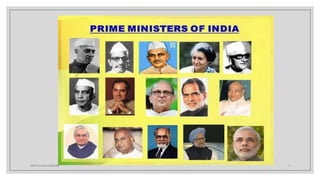
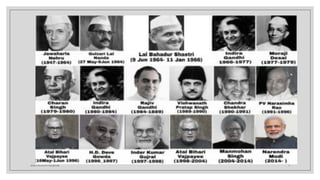
PRIME MINISTER
◦ Head of the Council of Ministers
◦ Most important person in taking decisions
◦ Can freely choose ministers
◦ Indirectly elected
◦ Appointed by the President
4abdul shumz kv kanjikode
POWERS & FUNCTIONS
❖ Leader of a big team
❖ Enjoys a wide range of powers.
❖ Head of the Government.
❖ Distributes work to all ministers
❖ Official spokesman of the Govt.
❖ Chairs the Cabinet meetings
❖ Co ordinates various departments
❖ Taking all final decisions
❖ Supervises the functioning of all ministries.
❖ Can dismiss any minister.
He is the Leader of
the majoriy party/
front.
He is the real head
of the govt.
When he quits the
entire Ministry Quits.
5abdul shumz kv kanjikode
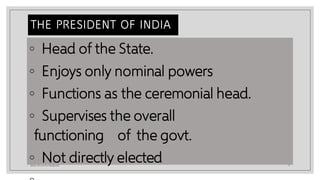
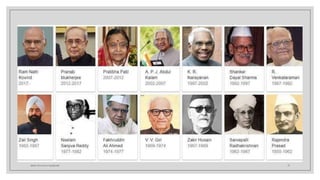
THE PRESIDENT OF INDIA
◦ Head of the State.
◦ Enjoys only nominal powers
◦ Functions as the ceremonial head.
◦ Supervises the overall
functioning of the govt.
◦ Not directly elected 6abdul shumz kv kanjikode
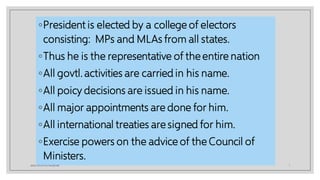
◦President is elected by a college of electors
consisting: MPs and MLAs from all states.
◦Thus he is the representative of the entire nation
◦All govtl. activities are carried in his name.
◦All poicy decisions are issued in his name.
◦All major appointments are done for him.
◦All international treaties are signed for him.
◦Exercise powers on the advice of the Council of
Ministers.
7abdul shumz kv kanjikode
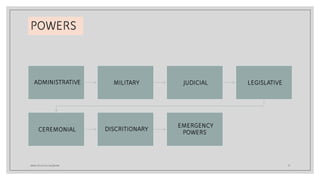
POWERS
ADMINISTRATIVE MILITARY JUDICIAL LEGISLATIVE
CEREMONIAL DISCRITIONARY
EMERGENCY
POWERS
8abdul shumz kv kanjikode
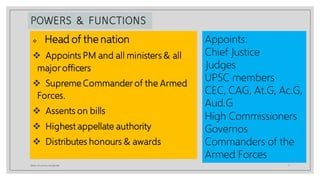
POWERS & FUNCTIONS
❖ Head of the nation
❖ Appoints PM and all ministers & all
major officers
❖ Supreme Commander of the Armed
Forces.
❖ Assents on bills
❖ Highest appellate authority
❖ Distributes honours & awards
Appoints:
Chief Justice
Judges
UPSC members
CEC, CAG, At.G, Ac.G,
Aud.G
High Commissioners
Governos
Commanders of the
Armed Forces
9abdul shumz kv kanjikode
10abdul shumz kv kanjikode
Click to add text
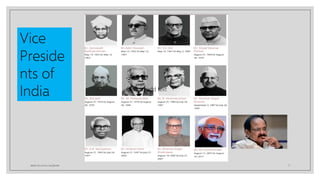
Vice
Preside
nts of
India
11abdul shumz kv kanjikode
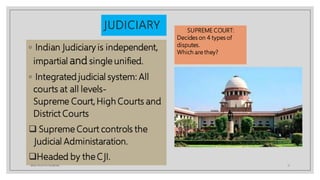
JUDICIARY
◦ Indian Judiciary is independent,
impartial and single unified.
◦ Integrated judicial system: All
courts at all levels-
Supreme Court, High Courts and
District Courts
❑ Supreme Court controls the
Judicial Administaration.
❑Headed by the CJI.
SUPREME COURT:
Decides on 4 types of
disputes.
Which are they?
12abdul shumz kv kanjikode
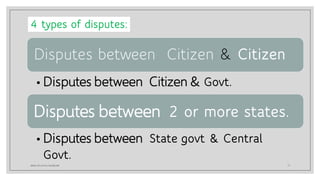
4 types of disputes:
Disputes between Citizen & Citizen
• Disputes between Citizen & Govt.
Disputes between 2 or more states.
• Disputes between State govt & Central
Govt.
13abdul shumz kv kanjikode
Supreme Court:
➢ Highest Court of Appeal
➢ Not under the Legislature or Executive
➢ Judges donot act on the direction of the Govt.
➢ Judges are appointed by the President
on the advice of the Prime Minister.
➢ Once appointed, difficult to remove.
➢ Can be removed by only by IMPEACHMENT .
➢ Impeachment motion should be
seperately passedby both houses with 2/3
majority.
14abdul shumz kv kanjikode
FUNCTIONS:
❖Power to interpret the Constitution.
❖Can declare a law invalid, if against the constitution.
❖Guardian of the Constitution
❖Ensures that the Basic Principles are not changed.
❖Guardian of Fundemental Rights.
❖Protects public interest, if hurt by the action of the
Govt.
❖Accepts Public Interest Litigation.
❖Supervises the Govt. From misusing its power.
❖Checks malpractices from the side of the public
officials.
Supreme Court
15abdul shumz kv kanjikode
THANK YOU
abdul shumz
kv kanjikode
16abdul shumz kv kanjikode