abdul shumz kv kanjikode
1
 What problems did Birsa set out to solve?
 Who were the outsiders?
 How did they enslave the people of this area ?
 What was happening to the forest people under
the British?
 How did it change their lives?
lets answer all these questions…………
abdul shumz kv kanjikode
2
HOW DID THE TRIBAL GROUPS LIVE?
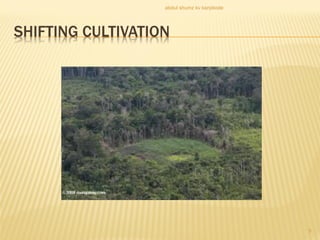
 Lived in clans, in groups & practiced Jhum
cultivation:
This type of cultivation is usually found in
forests and hilly areas
 Some were hunter‟s and gatherer‟s-
They hunted deer, pig & other animals and
gathered for their survival
 Some were herderer‟s.
 Many tribal's lived by herding and grazing
animals. They are known as nomads.
abdul shumz kv kanjikode
3
PROBLEM OF BRITISH WITH SHIFTING
CULTIVATION?
 They wanted shifting cultivators to settle down and
become peasants
 As people engaged in shifting cultivation who were
moving around, lot of problems in calculating tax.
 Water was scarce in those areas where settled
cultivation practiced.
 Jhum cultivators were forced to take up settled
cultivation, suffered, because the yield from their
fields were less or not good.
abdul shumz kv kanjikode
4
SHIFTING CULTIVATION
abdul shumz kv kanjikode
5
HOW DID COLONIAL RULE AFFECT TRIBAL
LIVES?
Tribal chiefs enjoyed many
administrative and influencing rights.
But during the colonial period there
was a loss of power; they had to obey
British law and the government
restricted the rights of the tribal
chiefs.
abdul shumz kv kanjikode
6
WHAT HAPPENED TO THE SHIFTING
CULTIVATORS?
 British wanted the tribal's to settle down.
 Government wanted tax therefore they wanted
tribal's to settle down as it is easier to calculate
tax.
 Settled cultivation was not successful were
water is scarce and soil is dry.
 Facing widespread protests, the British had to
ultimately allow them the right to carry on
shifting cultivation in some parts of the forests.
abdul shumz kv kanjikode
7
FORESTS LAW AND THEIR IMPACT
 The British extended their over all forests and
declared that forests were state property.
 Some forests were classified as reserve forests
which was used to produce timber which the
British wanted
 The colonial officials allowed some land for
jhum cultivation that they would provide labor
for the forests department for looking after
forests.
abdul shumz kv kanjikode
8
impacts:-
 Many tribal groups reacted against the
colonial forest laws .
 They disobeyed the new rules, continued
with the practices that were declared
illegal .
 Such was the revolt of Songram Sangam
of 1906 in Assam.
abdul shumz kv kanjikode
9
 many people were depending on money-
lenders, traders etc for purchasing raw
goods and loans.
 These traders made huge profits but only
a meager amount reached the producers.
 The condition of people who went to
towns for work was also not better.
 They were paid low wages, and prevented
them from returning home.
abdul shumz kv kanjikode
10
 Throughout the 19th and 20th centuries
tribal's rebelled against the forest laws.
 the kolas rebelled in 1831-32
 Santhal rose in revolt in 1855
 The bastar rebellion in central India broke
out in 1910 .
 Warli revolt in Maharashtra on 1940.
abdul shumz kv kanjikode
11
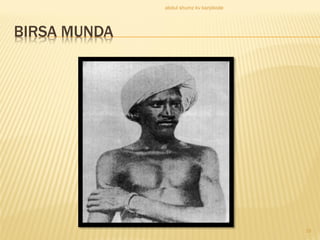
BIRSA MUNDA-AN IMMORTAL LEGACY
 In 1895 Birsa urged his followers to recover the
past glory, a golden age were the tribal's held
their heads high
 He talked of a golden past were Mundas led a
good life, constructed embankments, tapped
natural springs, planted trees and orchards,
practised cultivation to earn their living.
 As the movement spread the British officials
decided to act. They arrested Birsa in 1895,
convicted him on charges of rioting and jailed
him for 2 years.
abdul shumz kv kanjikode
12
 When Birsa was released in 1897 he began to
gather support against the British by using
traditional methods
 They attacked police stations and churches, and
raided the property of moneylenders and
zamindars.
 They raised the white flag as a symbol of Birsa raj.
 In 1900 Birsa Munda died of cholera and the
movement faded out.
abdul shumz kv kanjikode
13
 Birsa- a person with miracular powers
 Worshipped as god- able to save from slavery
and to save from rule of Dikus [outsiders].
 He wanted to reform the tribal societies- to stop
drinking- to have clean villages- to stop
superstitions- to recover own land from the
encroachers-
 To establish „Satyug‟- age of truth.
 To help to lead a good life, honest life, no
killing- doing some work.
 To establish „ Munda Raj‟.
abdul shumz kv kanjikode
14
BIRSA MUNDA
abdul shumz kv kanjikode
15
SIGNIFICANCE OF THE MOVEMENT OF BIRSA
MUNDA
 It showed that the tribals could protest
against injustice and express their
dissatisfaction over the colonial rule
 It introduced laws so that the govt. could
not take away the land of the tribals
 His efforts to destroy „Ravanas‟-
 Raising of white flag[ a symbol of Birsa raj.
abdul shumz kv kanjikode
16
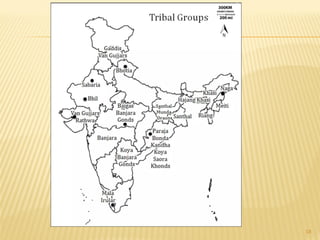
 TRIBAL GROUPS:
 Mundas, Santhals, Oraons [ Bihar]
 Khonds – Odisha
 Gujjars- Punjab
 Labadis- Andhra
 Gaddis, Kulu, Bakarwals,
abdul shumz kv kanjikode
17
abdul shumz kv kanjikode
18
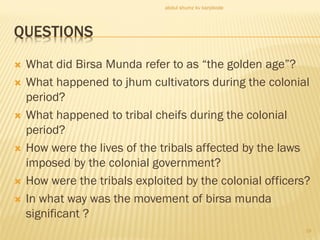
QUESTIONS
 What did Birsa Munda refer to as “the golden age”?
 What happened to jhum cultivators during the colonial
period?
 What happened to tribal cheifs during the colonial
period?
 How were the lives of the tribals affected by the laws
imposed by the colonial government?
 How were the tribals exploited by the colonial officers?
 In what way was the movement of birsa munda
significant ?
abdul shumz kv kanjikode
19
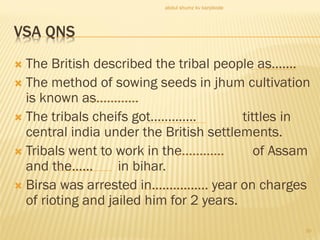
VSA QNS
 The British described the tribal people as…….
 The method of sowing seeds in jhum cultivation
is known as…………
 The tribals cheifs got…………. tittles in
central india under the British settlements.
 Tribals went to work in the………… of Assam
and the…… in bihar.
 Birsa was arrested in……………. year on charges
of rioting and jailed him for 2 years.
abdul shumz kv kanjikode
20
pl. mail u r suggestions to :
abdul.shumz@gmail.com
abdul shumz kv kanjikode 21