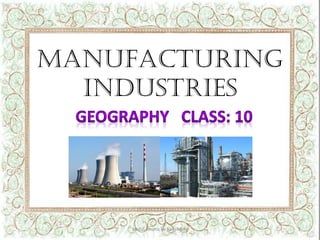
MANUFACTURING
INDUSTRIES
abdul shumz kv kanjikode 1
WHAT IS MANUFACTURING?
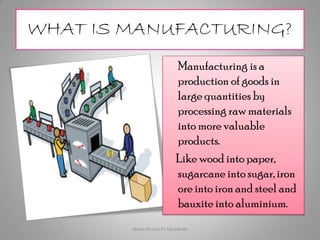
Manufacturing is a
production of goods in
large quantities by
processing raw materials
into more valuable
products.
Like wood into paper,
sugarcane into sugar, iron
ore into iron and steel and
bauxite into aluminium.
abdul shumz kv kanjikode 2
abdul shumz kv kanjikode 3
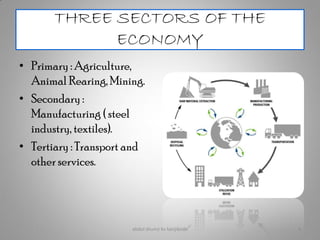
THREE SECTORS OF THE
ECONOMY
• Primary : Agriculture,
Animal Rearing, Mining.
• Secondary :
Manufacturing ( steel
industry, textiles).
• Tertiary : Transport and
other services.
abdul shumz kv kanjikode 4
IMPORTANCE OF
MANUFACTURING
• Modernises agriculture.
• Provides jobs.
• Eradicates poverty.
• Expands trade and commerce.
• Contributes to national income.
• Adds value to raw materials.
• Promotes economic development.
• Helps in the development of transports and
communication and
• Reduces regional disparity.
abdul shumz kv kanjikode 5
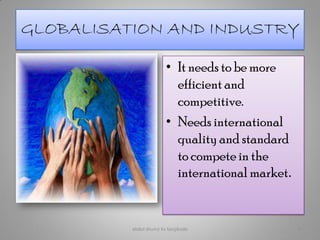
GLOBALISATION AND INDUSTRY
• It needs to be more
efficient and
competitive.
• Needs international
quality and standard
to compete in the
internationalmarket.
abdul shumz kv kanjikode 6
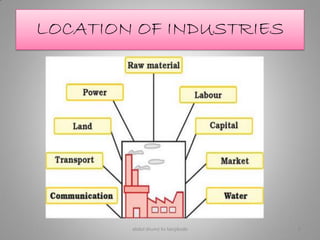
Factors influencing
location of industries.
• Availability of land & raw materials
• Capital
• Labour
• Power *marketing * communication
• Transportation * markets
• Services: bank, insurance, consultation
• Policy of the govt.
abdul shumz kv kanjikode 7
LOCATION OF INDUSTRIES
abdul shumz kv kanjikode 8
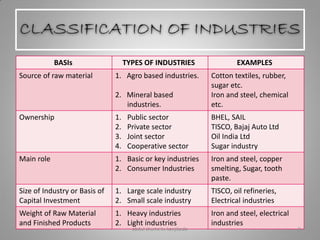
CLASSIFICATION OF INDUSTRIES
BASIs TYPES OF INDUSTRIES EXAMPLES
Source of raw material 1. Agro based industries.
2. Mineral based
industries.
Cotton textiles, rubber,
sugar etc.
Iron and steel, chemical
etc.
Ownership 1. Public sector
2. Private sector
3. Joint sector
4. Cooperative sector
BHEL, SAIL
TISCO, Bajaj Auto Ltd
Oil India Ltd
Sugar industry
Main role 1. Basic or key industries
2. Consumer Industries
Iron and steel, copper
smelting, Sugar, tooth
paste.
Size of Industry or Basis of
Capital Investment
1. Large scale industry
2. Small scale industry
TISCO, oil refineries,
Electrical industries
Weight of Raw Material
and Finished Products
1. Heavy industries
2. Light industries
Iron and steel, electrical
industries
abdul shumz kv kanjikode 9
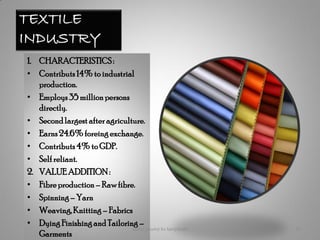
TEXTILE
INDUSTRY
1. CHARACTERISTICS:
• Contributs14% to industrial
production.
• Employs35 millionpersons
directly.
• Secondlargestafteragriculture.
• Earns24.6%foreingexchange.
• Contributs4% to GDP.
• Selfreliant.
2. VALUEADDITION:
• Fibreproduction– Rawfibre.
• Spinning– Yarn
• Weaving,Knitting – Fabrics
• DyingFinishingandTailoring –
Garments
abdul shumz kv kanjikode 10
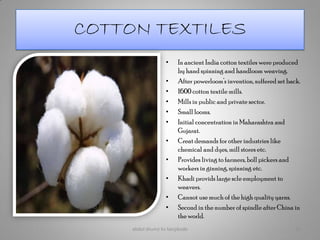
COTTON TEXTILES
• In ancient India cotton textiles were produced
by hand spinning and handloom weaving.
• After powerloom’s invention, suffered set back.
• 1600 cotton textile mills.
• Mills in public and private sector.
• Small looms.
• Initial concentration in Maharashtra and
Gujarat.
• Creat demands for other industries like
chemical and dyes, mill stores etc.
• Provides living to farmers, boll pickers and
workers in ginning, spinning etc.
• Khadi provids large scle employment to
weavers.
• Cannot use much of the high quality yarns.
• Second in the number of spindle after China in
the world.
abdul shumz kv kanjikode 11
PROBLEMS OF COTTON TEXTILE
INDUSTRY
• Weaving , knitting and processing cannot use all the
quality yarns.
• Yarn is exported.
• Fabric is imported for garment/ apparel
manufacturers.
• Erratic power spully.
• Upgradation of machine needed.
• Low output of labour force.
• Stiff competition.
abdul shumz kv kanjikode 12
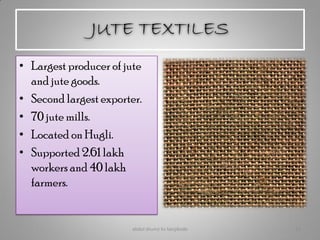
JUTE TEXTILES
• Largest producer of jute
and jute goods.
• Second largest exporter.
• 70 jute mills.
• Located on Hugli.
• Supported 2.61 lakh
workers and 40 lakh
farmers.
abdul shumz kv kanjikode 13
Factors for Localisation of Jute
industry
• Nearness to jute produsing areas.
• Cheap water and other transport facility.
• Abundant water supply.
• Cheap labour from West Bengal, Bihar,
Orissa, Uttar Pradesh and other facilities of
Kolkata.
abdul shumz kv kanjikode 14
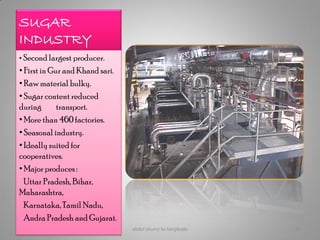
SUGAR
INDUSTRY
• Second largest producer.
• First in Gur and Khand sari.
• Raw material bulky.
• Sugar content reduced
during transport.
• More than 460 factories.
• Seasonal industry.
• Ideally suited for
cooperatives.
• Major produces :
Uttar Pradesh, Bihar,
Maharashtra,
Karnataka, Tamil Nadu,
Andra Pradesh and Gujarat.
abdul shumz kv kanjikode 15
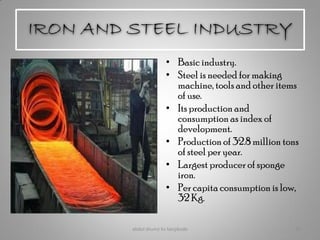
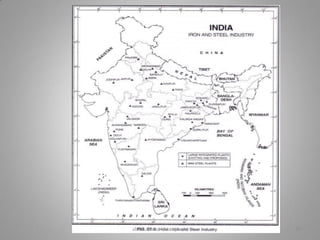
IRON AND STEEL INDUSTRY
• Basic industry.
• Steel is needed for making
machine, tools and other items
of use.
• Its production and
consumption as index of
development.
• Production of 32.8 million tons
of steel per year.
• Largest producer of sponge
iron.
• Per capita consumption is low,
32 Kg.
abdul shumz kv kanjikode 16
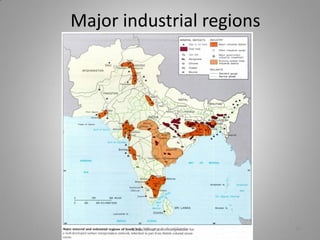
Major industrial regions
abdul shumz kv kanjikode 17
abdul shumz kv kanjikode 18
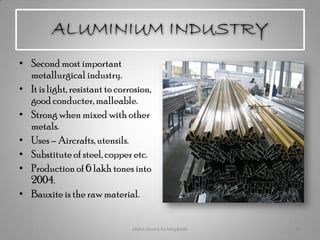
ALUMINIUM INDUSTRY
• Second most important
metallurgical industry.
• It is light, resistant to corrosion,
good conducter, malleable.
• Strong when mixed with other
metals.
• Uses – Aircrafts,utensils.
• Substitute of steel, copper etc.
• Production of 6 lakh tones into
2004.
• Bauxite is the raw material.
abdul shumz kv kanjikode 19
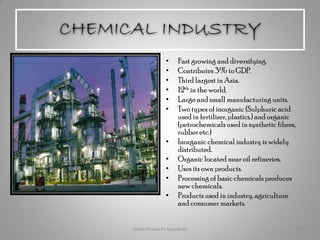
CHEMICAL INDUSTRY
• Fast growing and diversifying.
• Contributes 3% to GDP.
• Third largest in Asia.
• 12th in the world.
• Large and small manufacturing units.
• Two types of inorganic (Sulphuric acid
used in fertilizer, plastics.) and organic
(petrochemicals used in synthetic fibres,
rubber etc.)
• Inorganic chemical industry is widely
distributed.
• Organic located near oil refineries.
• Uses its own products.
• Processing of basic chemicals produces
new chemicals.
• Products used in industry, agriculture
and consumer markets.
abdul shumz kv kanjikode 20
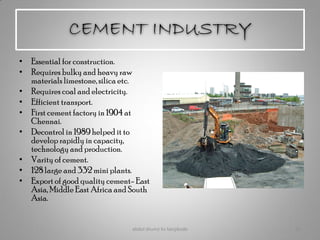
CEMENT INDUSTRY
• Essential for construction.
• Requires bulky and heavy raw
materials limestone, silica etc.
• Requires coal and electricity.
• Efficient transport.
• First cement factory in 1904 at
Chennai.
• Decontrol in 1989 helped it to
develop rapidly in capacity,
technology and production.
• Varity of cement.
• 128 large and 332 mini plants.
• Export of good quality cement- East
Asia, Middle East Africa and South
Asia.
abdul shumz kv kanjikode 21
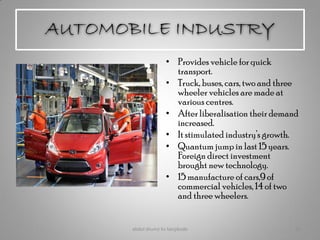
AUTOMOBILE INDUSTRY
• Provides vehicle for quick
transport.
• Truck, buses, cars, two and three
wheeler vehicles are made at
various centres.
• After liberalisation their demand
increased.
• It stimulated industry’s growth.
• Quantum jump in last 15 years.
Foreign direct investment
brought new technology.
• 15 manufacture of cars,9 of
commercial vehicles, 14 of two
and three wheelers.
abdul shumz kv kanjikode 22
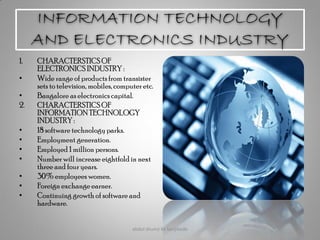
INFORMATION TECHNOLOGY
AND ELECTRONICS INDUSTRY
1. CHARACTERSTICSOF
ELECTRONICS INDUSTRY :
• Wide range of products from transister
sets to television, mobiles, computeretc.
• Bangalore as electronics capital.
2. CHARACTERSTICSOF
INFORMATIONTECHNOLOGY
INDUSTRY :
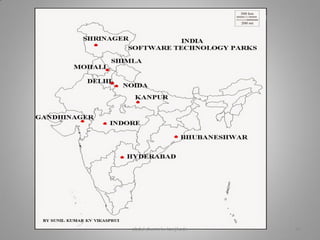
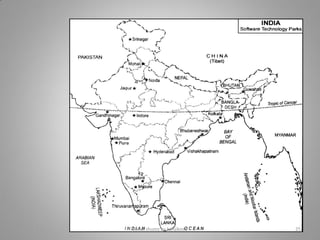
• 18 software technology parks.
• Employment generation.
• Employed 1 million persons.
• Number will increase eightfold in next
three and four years.
• 30% employees women.
• Foreign exchange earner.
• Continuing growth of software and
hardware.
abdul shumz kv kanjikode 23
abdul shumz kv kanjikode 24
abdul shumz kv kanjikode 25
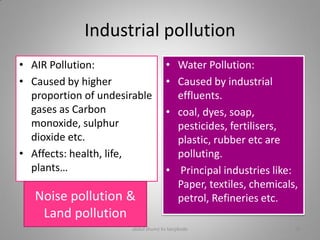
Industrial pollution
• AIR Pollution:
• Caused by higher
proportion of undesirable
gases as Carbon
monoxide, sulphur
dioxide etc.
• Affects: health, life,
plants…
• Water Pollution:
• Caused by industrial
effluents.
• coal, dyes, soap,
pesticides, fertilisers,
plastic, rubber etc are
polluting.
• Principal industries like:
Paper, textiles, chemicals,
petrol, Refineries etc.Noise pollution &
Land pollution
abdul shumz kv kanjikode 26
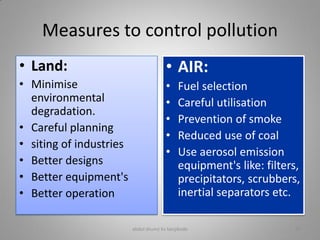
Measures to control pollution
• Land:
• Minimise
environmental
degradation.
• Careful planning
• siting of industries
• Better designs
• Better equipment's
• Better operation
• AIR:
• Fuel selection
• Careful utilisation
• Prevention of smoke
• Reduced use of coal
• Use aerosol emission
equipment's like: filters,
precipitators, scrubbers,
inertial separators etc.
abdul shumz kv kanjikode 27
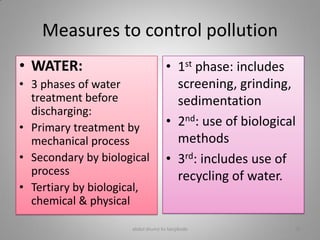
Measures to control pollution
• WATER:
• 3 phases of water
treatment before
discharging:
• Primary treatment by
mechanical process
• Secondary by biological
process
• Tertiary by biological,
chemical & physical
• 1st phase: includes
screening, grinding,
sedimentation
• 2nd: use of biological
methods
• 3rd: includes use of
recycling of water.
abdul shumz kv kanjikode 28
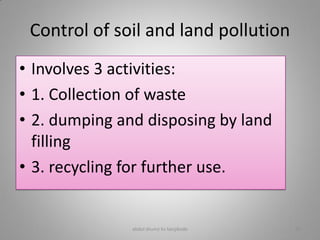
Control of soil and land pollution
• Involves 3 activities:
• 1. Collection of waste
• 2. dumping and disposing by land
filling
• 3. recycling for further use.
abdul shumz kv kanjikode 29
abdul shumz kv kanjikode 30
abdul shumz
Kv kanjikode

Manufacturing Industries CLASS 10 GEPGRAPHY

  • 1.
  • 2.
    WHAT IS MANUFACTURING? Manufacturingis a production of goods in large quantities by processing raw materials into more valuable products. Like wood into paper, sugarcane into sugar, iron ore into iron and steel and bauxite into aluminium. abdul shumz kv kanjikode 2
  • 3.
    abdul shumz kvkanjikode 3
  • 4.
    THREE SECTORS OFTHE ECONOMY • Primary : Agriculture, Animal Rearing, Mining. • Secondary : Manufacturing ( steel industry, textiles). • Tertiary : Transport and other services. abdul shumz kv kanjikode 4
  • 5.
    IMPORTANCE OF MANUFACTURING • Modernisesagriculture. • Provides jobs. • Eradicates poverty. • Expands trade and commerce. • Contributes to national income. • Adds value to raw materials. • Promotes economic development. • Helps in the development of transports and communication and • Reduces regional disparity. abdul shumz kv kanjikode 5
  • 6.
    GLOBALISATION AND INDUSTRY •It needs to be more efficient and competitive. • Needs international quality and standard to compete in the internationalmarket. abdul shumz kv kanjikode 6
  • 7.
    Factors influencing location ofindustries. • Availability of land & raw materials • Capital • Labour • Power *marketing * communication • Transportation * markets • Services: bank, insurance, consultation • Policy of the govt. abdul shumz kv kanjikode 7
  • 8.
    LOCATION OF INDUSTRIES abdulshumz kv kanjikode 8
  • 9.
    CLASSIFICATION OF INDUSTRIES BASIsTYPES OF INDUSTRIES EXAMPLES Source of raw material 1. Agro based industries. 2. Mineral based industries. Cotton textiles, rubber, sugar etc. Iron and steel, chemical etc. Ownership 1. Public sector 2. Private sector 3. Joint sector 4. Cooperative sector BHEL, SAIL TISCO, Bajaj Auto Ltd Oil India Ltd Sugar industry Main role 1. Basic or key industries 2. Consumer Industries Iron and steel, copper smelting, Sugar, tooth paste. Size of Industry or Basis of Capital Investment 1. Large scale industry 2. Small scale industry TISCO, oil refineries, Electrical industries Weight of Raw Material and Finished Products 1. Heavy industries 2. Light industries Iron and steel, electrical industries abdul shumz kv kanjikode 9
  • 10.
    TEXTILE INDUSTRY 1. CHARACTERISTICS: • Contributs14%to industrial production. • Employs35 millionpersons directly. • Secondlargestafteragriculture. • Earns24.6%foreingexchange. • Contributs4% to GDP. • Selfreliant. 2. VALUEADDITION: • Fibreproduction– Rawfibre. • Spinning– Yarn • Weaving,Knitting – Fabrics • DyingFinishingandTailoring – Garments abdul shumz kv kanjikode 10
  • 11.
    COTTON TEXTILES • Inancient India cotton textiles were produced by hand spinning and handloom weaving. • After powerloom’s invention, suffered set back. • 1600 cotton textile mills. • Mills in public and private sector. • Small looms. • Initial concentration in Maharashtra and Gujarat. • Creat demands for other industries like chemical and dyes, mill stores etc. • Provides living to farmers, boll pickers and workers in ginning, spinning etc. • Khadi provids large scle employment to weavers. • Cannot use much of the high quality yarns. • Second in the number of spindle after China in the world. abdul shumz kv kanjikode 11
  • 12.
    PROBLEMS OF COTTONTEXTILE INDUSTRY • Weaving , knitting and processing cannot use all the quality yarns. • Yarn is exported. • Fabric is imported for garment/ apparel manufacturers. • Erratic power spully. • Upgradation of machine needed. • Low output of labour force. • Stiff competition. abdul shumz kv kanjikode 12
  • 13.
    JUTE TEXTILES • Largestproducer of jute and jute goods. • Second largest exporter. • 70 jute mills. • Located on Hugli. • Supported 2.61 lakh workers and 40 lakh farmers. abdul shumz kv kanjikode 13
  • 14.
    Factors for Localisationof Jute industry • Nearness to jute produsing areas. • Cheap water and other transport facility. • Abundant water supply. • Cheap labour from West Bengal, Bihar, Orissa, Uttar Pradesh and other facilities of Kolkata. abdul shumz kv kanjikode 14
  • 15.
    SUGAR INDUSTRY • Second largestproducer. • First in Gur and Khand sari. • Raw material bulky. • Sugar content reduced during transport. • More than 460 factories. • Seasonal industry. • Ideally suited for cooperatives. • Major produces : Uttar Pradesh, Bihar, Maharashtra, Karnataka, Tamil Nadu, Andra Pradesh and Gujarat. abdul shumz kv kanjikode 15
  • 16.
    IRON AND STEELINDUSTRY • Basic industry. • Steel is needed for making machine, tools and other items of use. • Its production and consumption as index of development. • Production of 32.8 million tons of steel per year. • Largest producer of sponge iron. • Per capita consumption is low, 32 Kg. abdul shumz kv kanjikode 16
  • 17.
    Major industrial regions abdulshumz kv kanjikode 17
  • 18.
    abdul shumz kvkanjikode 18
  • 19.
    ALUMINIUM INDUSTRY • Secondmost important metallurgical industry. • It is light, resistant to corrosion, good conducter, malleable. • Strong when mixed with other metals. • Uses – Aircrafts,utensils. • Substitute of steel, copper etc. • Production of 6 lakh tones into 2004. • Bauxite is the raw material. abdul shumz kv kanjikode 19
  • 20.
    CHEMICAL INDUSTRY • Fastgrowing and diversifying. • Contributes 3% to GDP. • Third largest in Asia. • 12th in the world. • Large and small manufacturing units. • Two types of inorganic (Sulphuric acid used in fertilizer, plastics.) and organic (petrochemicals used in synthetic fibres, rubber etc.) • Inorganic chemical industry is widely distributed. • Organic located near oil refineries. • Uses its own products. • Processing of basic chemicals produces new chemicals. • Products used in industry, agriculture and consumer markets. abdul shumz kv kanjikode 20
  • 21.
    CEMENT INDUSTRY • Essentialfor construction. • Requires bulky and heavy raw materials limestone, silica etc. • Requires coal and electricity. • Efficient transport. • First cement factory in 1904 at Chennai. • Decontrol in 1989 helped it to develop rapidly in capacity, technology and production. • Varity of cement. • 128 large and 332 mini plants. • Export of good quality cement- East Asia, Middle East Africa and South Asia. abdul shumz kv kanjikode 21
  • 22.
    AUTOMOBILE INDUSTRY • Providesvehicle for quick transport. • Truck, buses, cars, two and three wheeler vehicles are made at various centres. • After liberalisation their demand increased. • It stimulated industry’s growth. • Quantum jump in last 15 years. Foreign direct investment brought new technology. • 15 manufacture of cars,9 of commercial vehicles, 14 of two and three wheelers. abdul shumz kv kanjikode 22
  • 23.
    INFORMATION TECHNOLOGY AND ELECTRONICSINDUSTRY 1. CHARACTERSTICSOF ELECTRONICS INDUSTRY : • Wide range of products from transister sets to television, mobiles, computeretc. • Bangalore as electronics capital. 2. CHARACTERSTICSOF INFORMATIONTECHNOLOGY INDUSTRY : • 18 software technology parks. • Employment generation. • Employed 1 million persons. • Number will increase eightfold in next three and four years. • 30% employees women. • Foreign exchange earner. • Continuing growth of software and hardware. abdul shumz kv kanjikode 23
  • 24.
    abdul shumz kvkanjikode 24
  • 25.
    abdul shumz kvkanjikode 25
  • 26.
    Industrial pollution • AIRPollution: • Caused by higher proportion of undesirable gases as Carbon monoxide, sulphur dioxide etc. • Affects: health, life, plants… • Water Pollution: • Caused by industrial effluents. • coal, dyes, soap, pesticides, fertilisers, plastic, rubber etc are polluting. • Principal industries like: Paper, textiles, chemicals, petrol, Refineries etc.Noise pollution & Land pollution abdul shumz kv kanjikode 26
  • 27.
    Measures to controlpollution • Land: • Minimise environmental degradation. • Careful planning • siting of industries • Better designs • Better equipment's • Better operation • AIR: • Fuel selection • Careful utilisation • Prevention of smoke • Reduced use of coal • Use aerosol emission equipment's like: filters, precipitators, scrubbers, inertial separators etc. abdul shumz kv kanjikode 27
  • 28.
    Measures to controlpollution • WATER: • 3 phases of water treatment before discharging: • Primary treatment by mechanical process • Secondary by biological process • Tertiary by biological, chemical & physical • 1st phase: includes screening, grinding, sedimentation • 2nd: use of biological methods • 3rd: includes use of recycling of water. abdul shumz kv kanjikode 28
  • 29.
    Control of soiland land pollution • Involves 3 activities: • 1. Collection of waste • 2. dumping and disposing by land filling • 3. recycling for further use. abdul shumz kv kanjikode 29
  • 30.
    abdul shumz kvkanjikode 30 abdul shumz Kv kanjikode