CHAPTER - 5
WORKING OF INSTITUTION
Email for more PPTs at a very reasonable price.
Email: parmarshivam105@gmail.com By Shivam Parmar (PPT Designer)
INTRODUCTION
• The Prime Minister, the Cabinet, the civil servants
and the Supreme Court are all political
institutions. These institutions perform functions
assigned to them.
• Working with institutions is not easy. Institution
involves rules and regulation. This can bind the
hands of leaders. Institutions involve meetings,
committees and routines. This often leads to
delays and complications. But some of the delays
and complications introduced by institutions are
useful. They provide an opportunity for a wider
set of people can be consulted in any decision.
HOW IS A
MAJOR
POLICY
DECISION
TAKEN?
A Government Order
• On August 13, 1990, the
Government of India
issued an Order. It was
called an Office
Memorandum.
• The Joint Secretary, an
officer in the department
of Personnel and Training
in the Ministry of
Personnel, Public
Grievances and Pensions,
signed the Order.
The Decision Makers
1. President is the head of the state
and is the highest formal authority
in the country.
2. Prime Minister is the head of the
government and actually exercises
all governmental powers. He takes
most of the decisions in the
Cabinet meetings.
3. Parliament consists of two Houses,
Lok Sabha and Rajya Sabha. The
Prime Minister must have the
support of a majority of Lok Sabha
members.
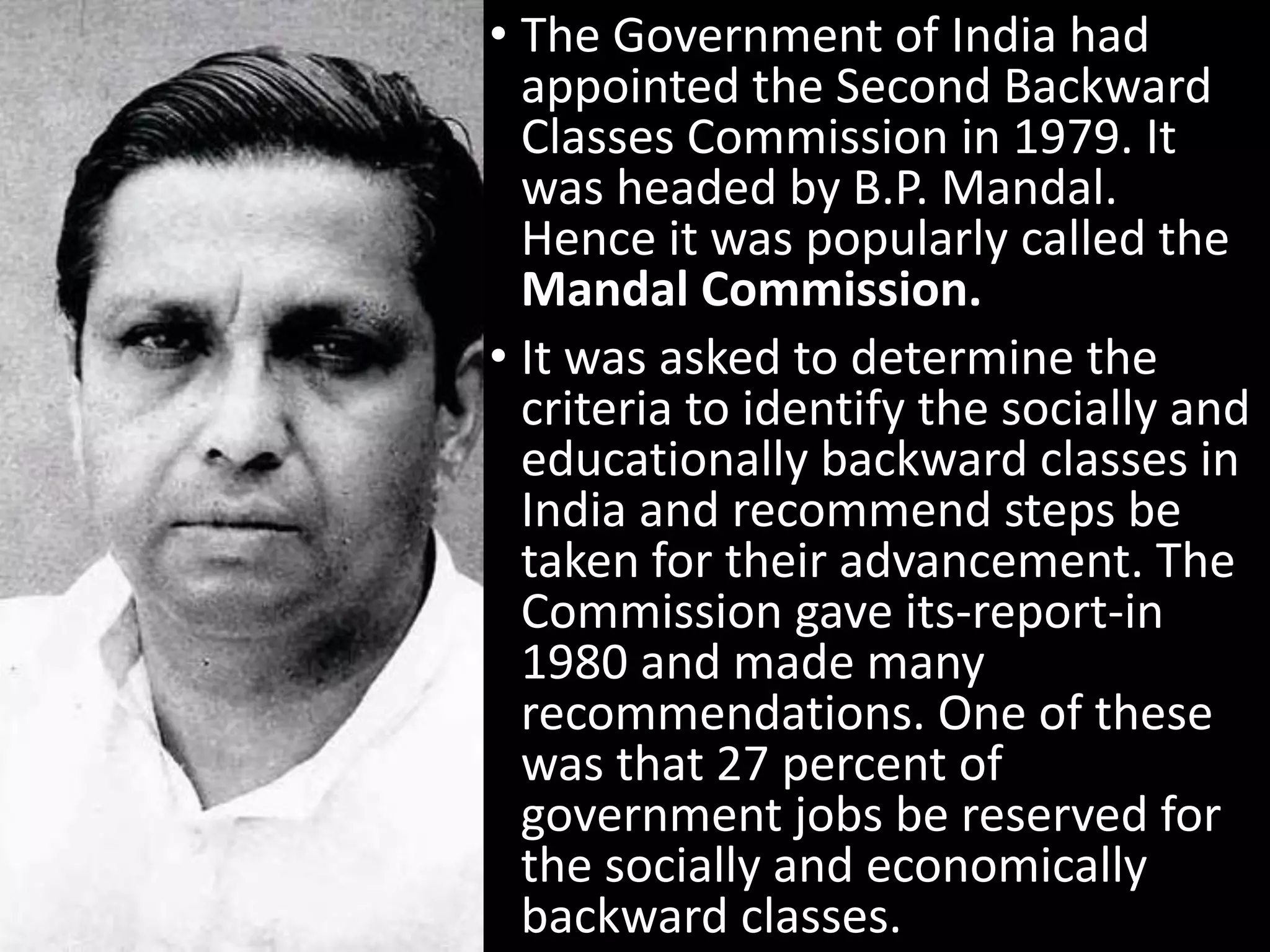
• The Government of India had
appointed the Second Backward
Classes Commission in 1979. It
was headed by B.P. Mandal.
Hence it was popularly called the
Mandal Commission.
• It was asked to determine the
criteria to identify the socially and
educationally backward classes in
India and recommend steps be
taken for their advancement. The
Commission gave its-report-in
1980 and made many
recommendations. One of these
was that 27 percent of
government jobs be reserved for
the socially and economically
backward classes.
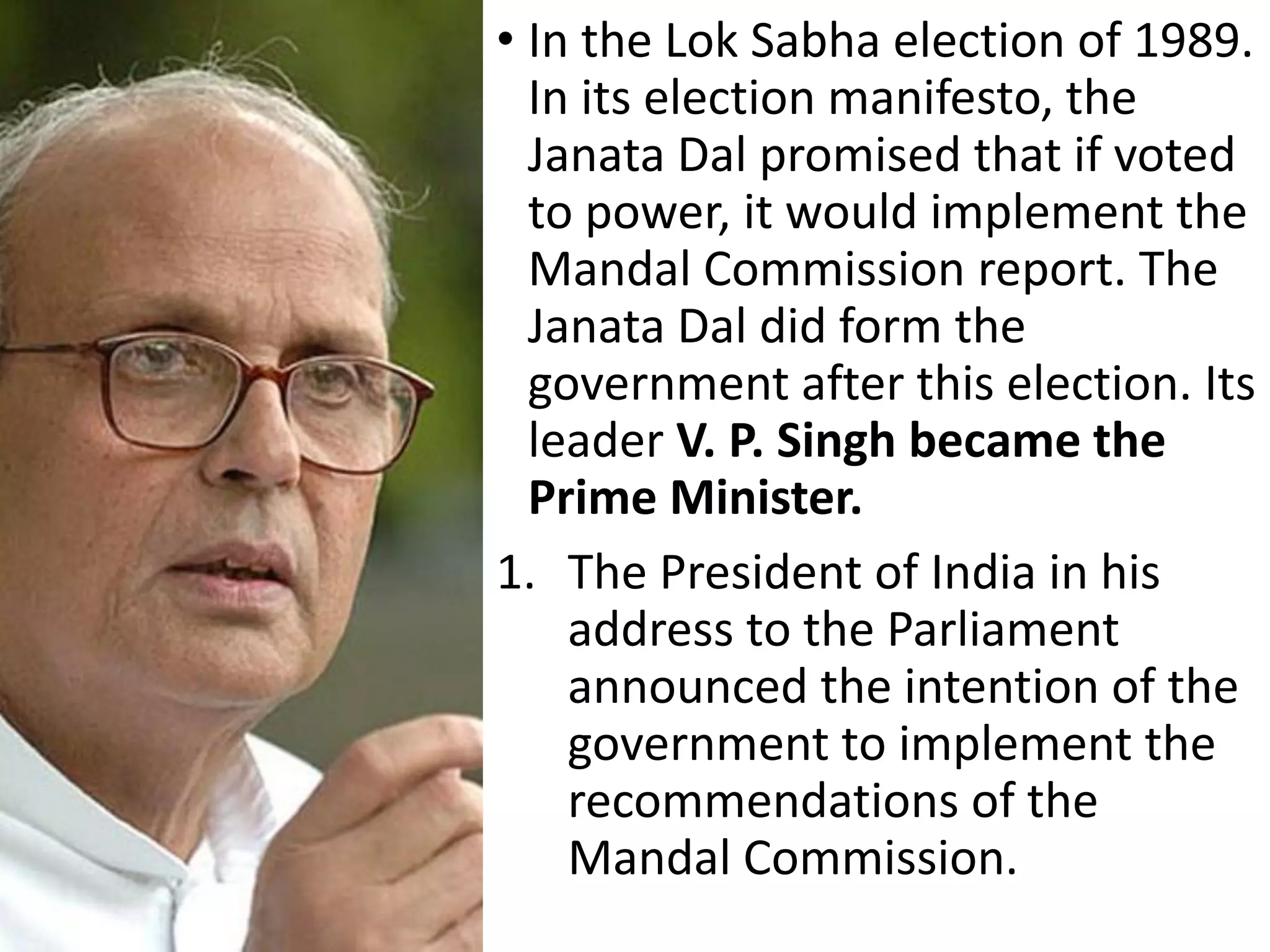
• In the Lok Sabha election of 1989.
In its election manifesto, the
Janata Dal promised that if voted
to power, it would implement the
Mandal Commission report. The
Janata Dal did form the
government after this election. Its
leader V. P. Singh became the
Prime Minister.
1. The President of India in his
address to the Parliament
announced the intention of the
government to implement the
recommendations of the
Mandal Commission.
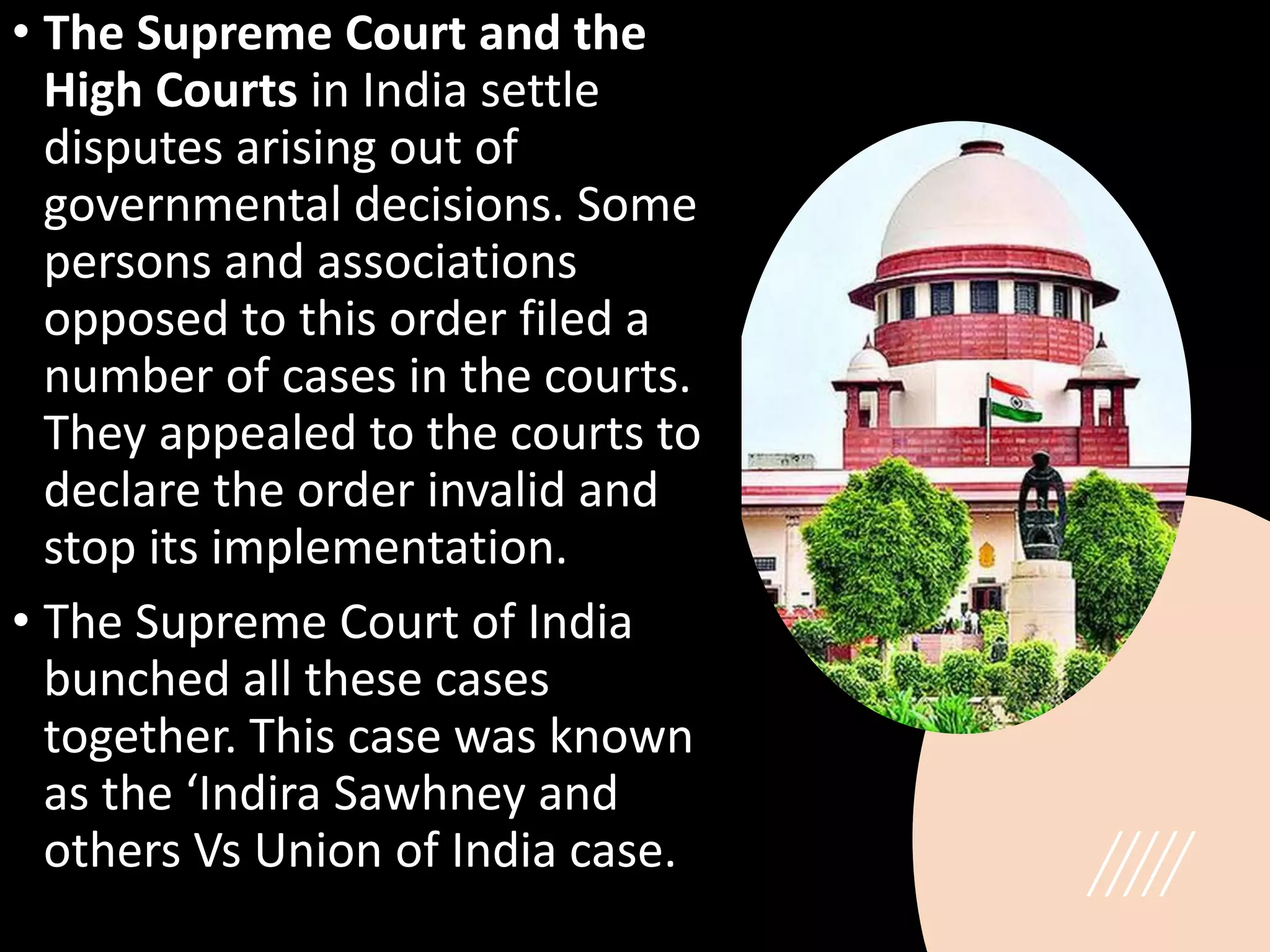
• The Supreme Court and the
High Courts in India settle
disputes arising out of
governmental decisions. Some
persons and associations
opposed to this order filed a
number of cases in the courts.
They appealed to the courts to
declare the order invalid and
stop its implementation.
• The Supreme Court of India
bunched all these cases
together. This case was known
as the ‘Indira Sawhney and
others Vs Union of India case.
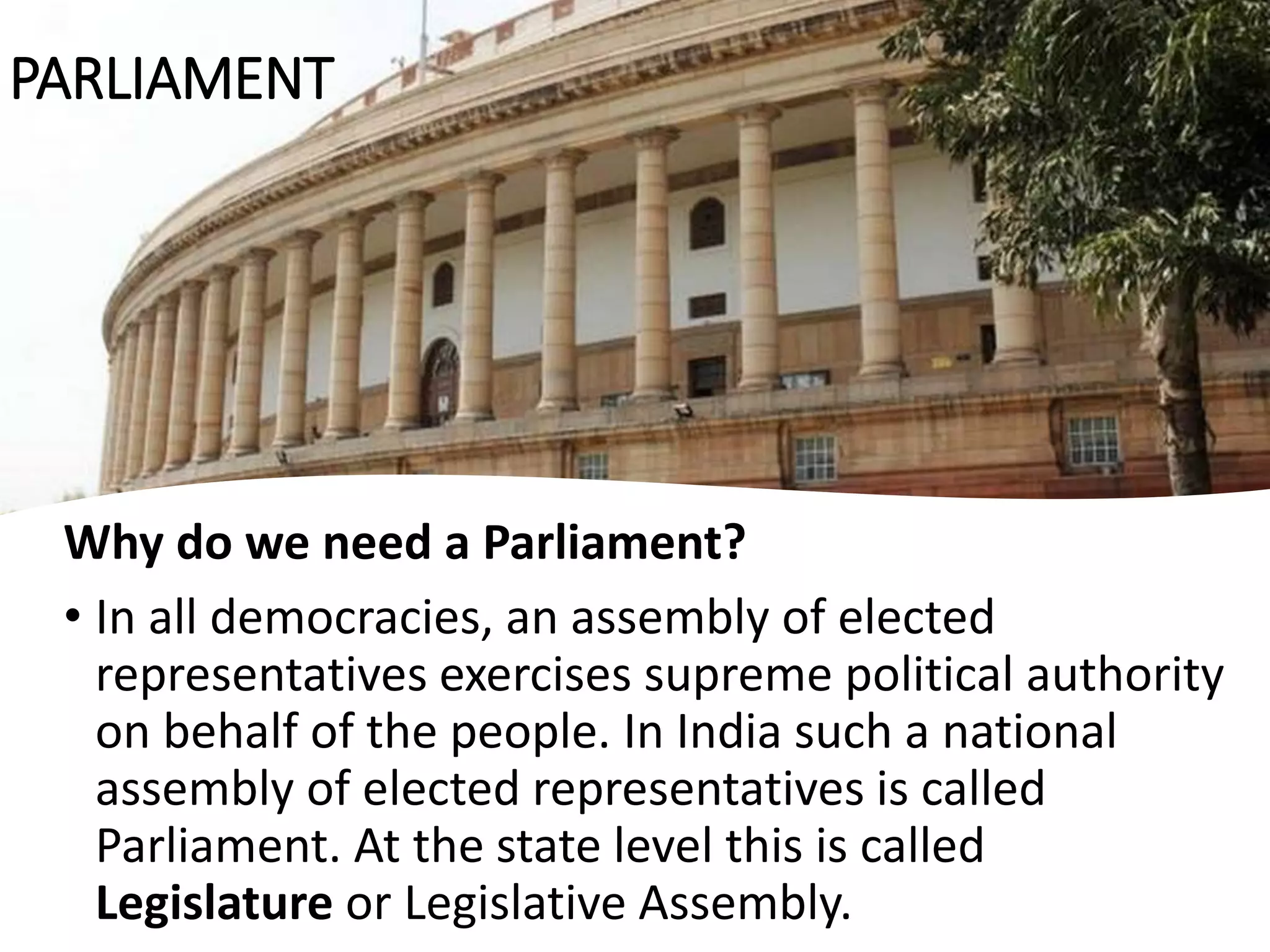
Why do we need a Parliament?
• In all democracies, an assembly of elected
representatives exercises supreme political authority
on behalf of the people. In India such a national
assembly of elected representatives is called
Parliament. At the state level this is called
Legislature or Legislative Assembly.
PARLIAMENT
It exercises political authority on
behalf of the people in many ways :
• 1. Parliament is the final authority for making
laws in any country. This task of law making
or legislation is so crucial that these
assemblies are called legislatures.
Parliaments all over the world can make new
laws, change existing laws, or abolish existing
laws and make new ones in their place.
TWO HOUSES OF PARLIAMENT
• Most large countries divide the role and powers
of the Parliament in two parts. They are called
Chambers or Houses.
• One House is usually directly elected by the
people and exercises the real power on behalf
of the people.
• The second House is usually elected indirectly
and performs some special functions. The most
common work for the second House is to look
after the interests of various states, regions or
federal units.
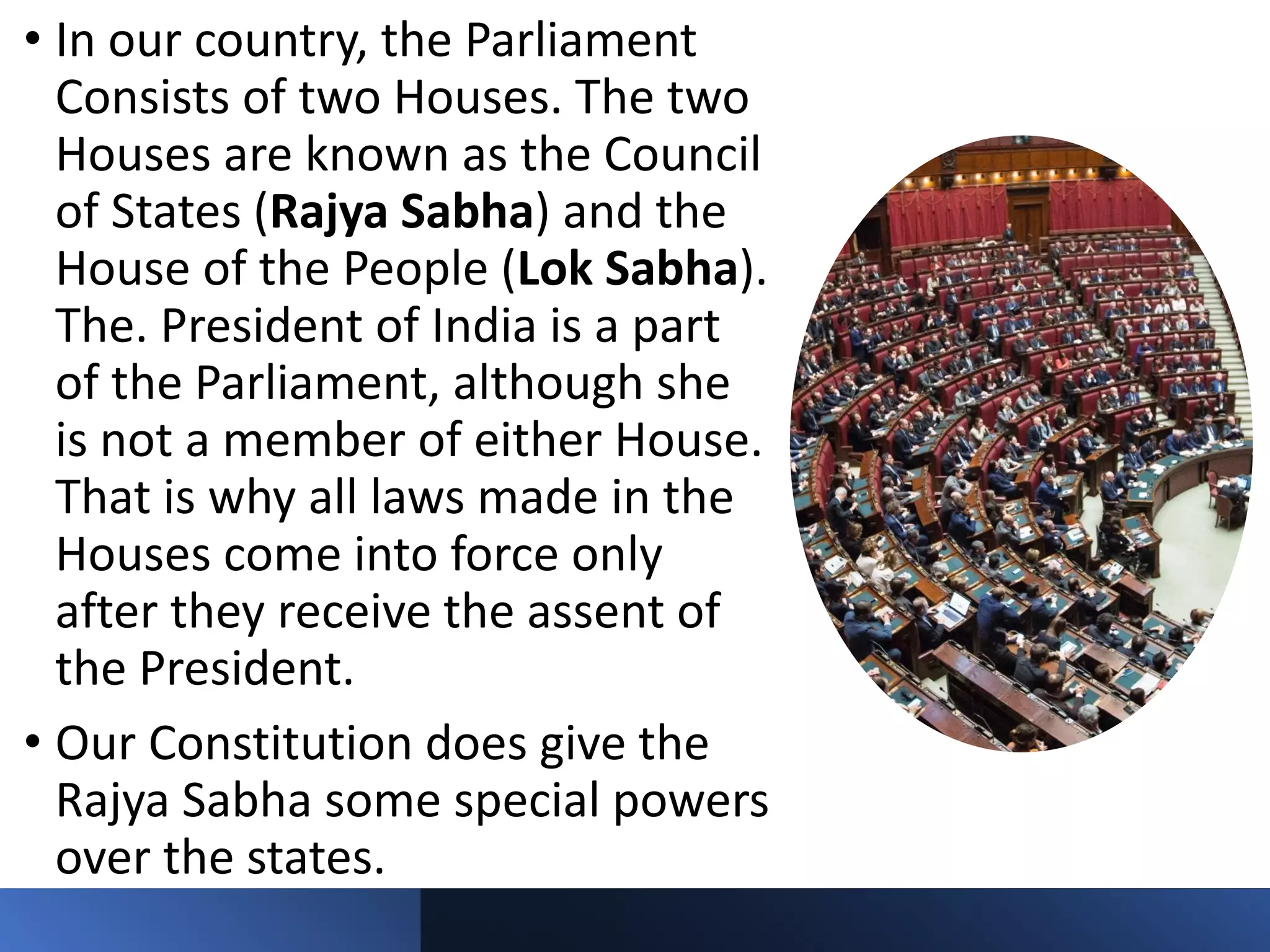
• In our country, the Parliament
Consists of two Houses. The two
Houses are known as the Council
of States (Rajya Sabha) and the
House of the People (Lok Sabha).
The. President of India is a part
of the Parliament, although she
is not a member of either House.
That is why all laws made in the
Houses come into force only
after they receive the assent of
the President.
• Our Constitution does give the
Rajya Sabha some special powers
over the states.
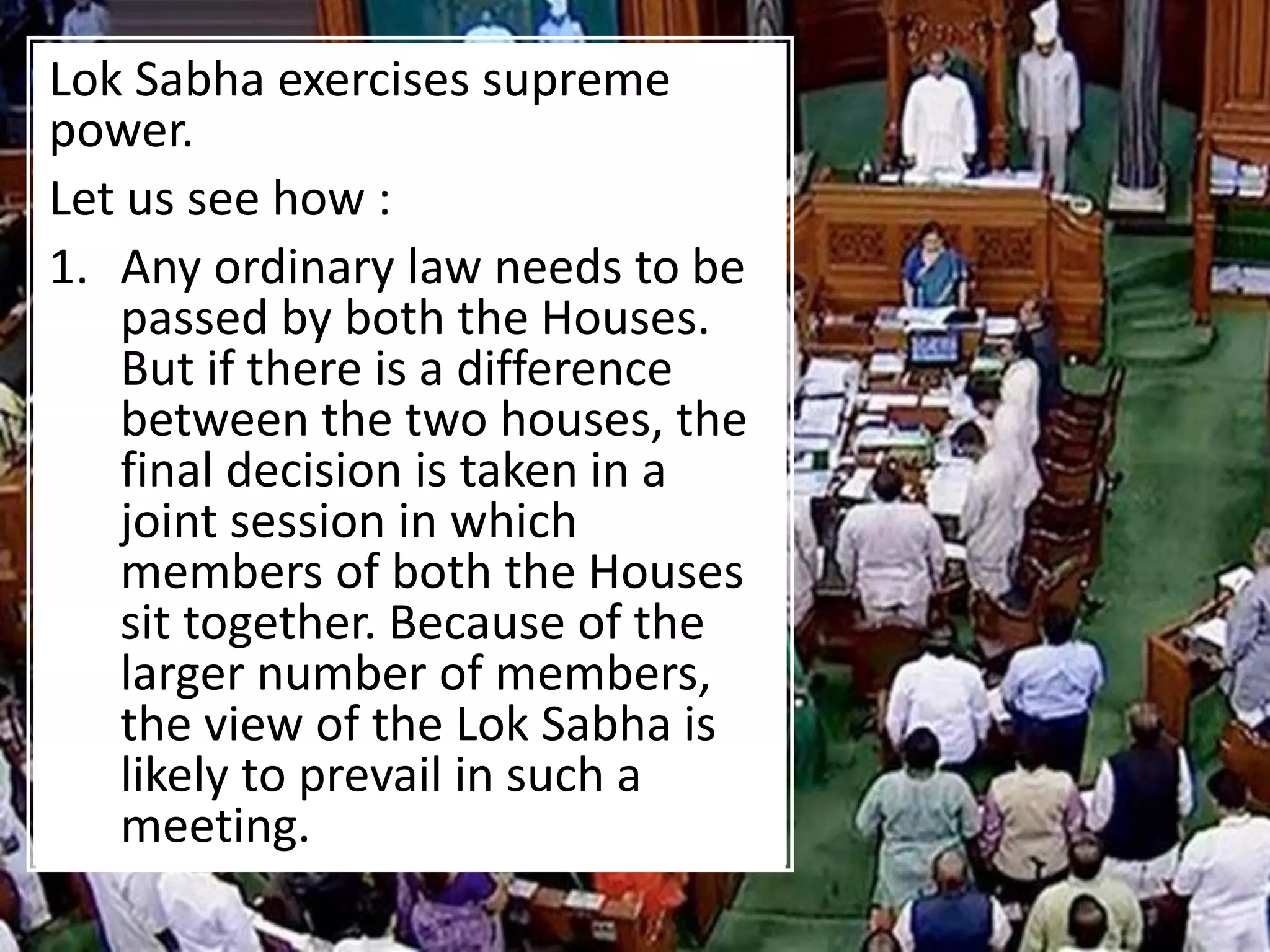
Lok Sabha exercises supreme
power.
Let us see how :
1. Any ordinary law needs to be
passed by both the Houses.
But if there is a difference
between the two houses, the
final decision is taken in a
joint session in which
members of both the Houses
sit together. Because of the
larger number of members,
the view of the Lok Sabha is
likely to prevail in such a
meeting.
POLITICAL EXECUTIVE
• At different levels of any
government we find functionaries
who take day-to-day decisions but
do not exercise supreme power on
behalf of the people. All those
functionaries are collectively known
as the executive. They are called
executive because they are in
charge of the ‘execution’ of the
policies of the government.
The minister have the final say on
these matters ?
• The reason is very simple. In a
democracy the will of the people is
supreme. The minister is elected by the
people and thus empowered to exercise
the will of the people on their behalf.
PRIME MINISTER
AND COUNCIL OF
MINISTERS
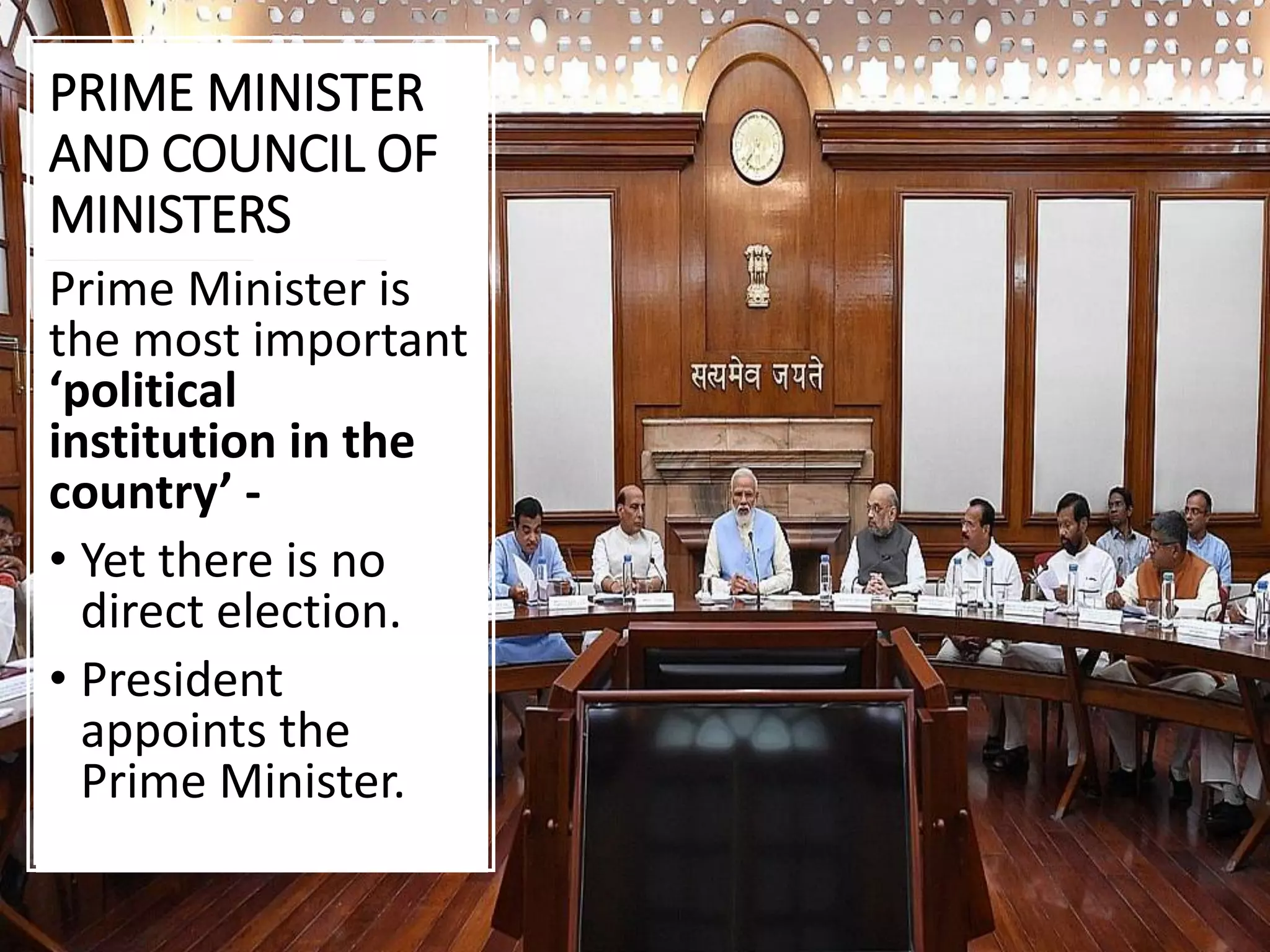
Prime Minister is
the most important
‘political
institution in the
country’ -
• Yet there is no
direct election.
• President
appoints the
Prime Minister.
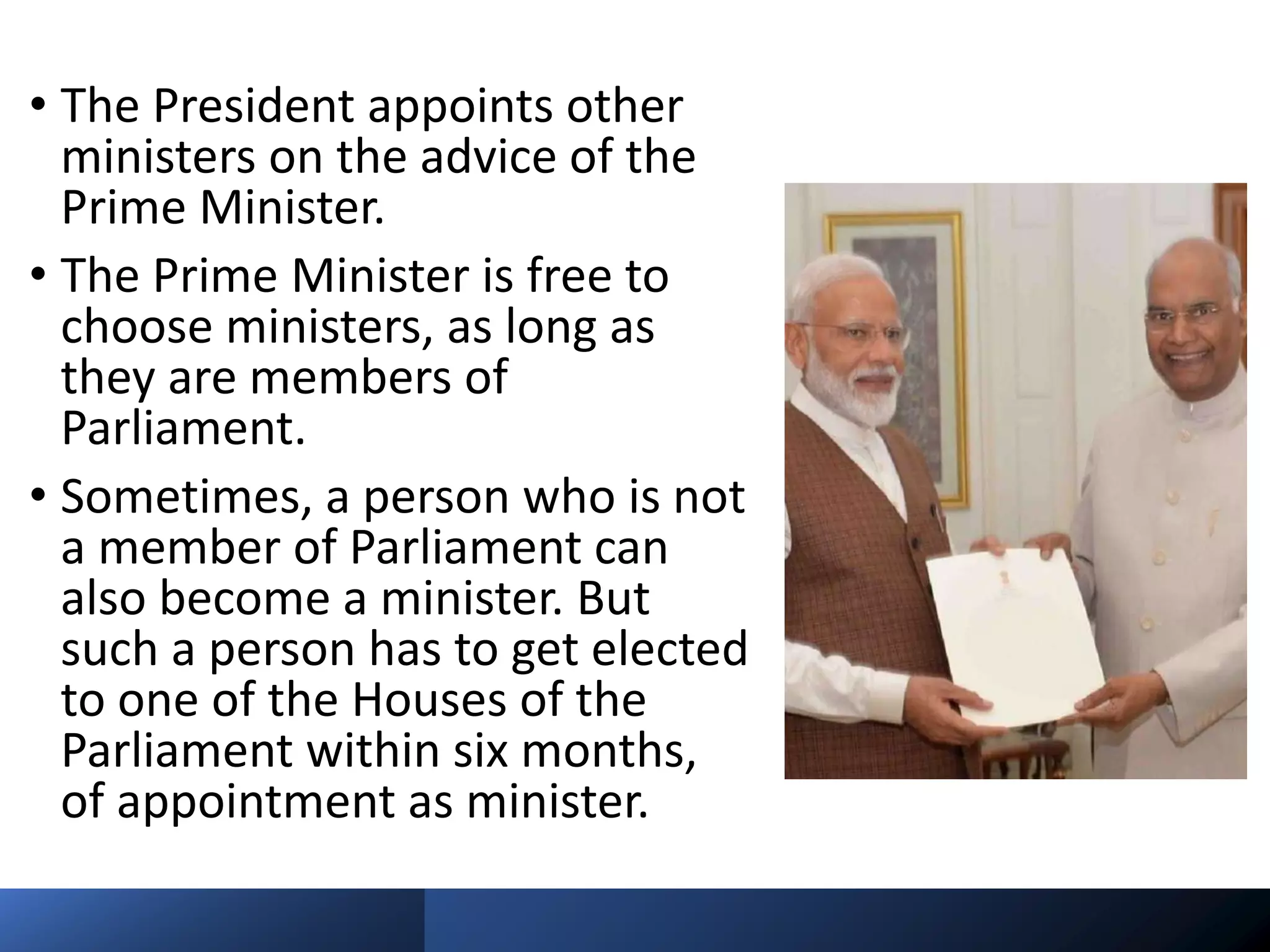
• The President appoints other
ministers on the advice of the
Prime Minister.
• The Prime Minister is free to
choose ministers, as long as
they are members of
Parliament.
• Sometimes, a person who is not
a member of Parliament can
also become a minister. But
such a person has to get elected
to one of the Houses of the
Parliament within six months,
of appointment as minister.
Powers of the Prime Minister
Has wide ranging powers -
1. Chairs Cabinet meetings.
2. Coordinates the work of different “Departments”.
3. Decisions are final in case disagreements arise
between Departments.
4. Exercises general supervision of different
ministries.
5. Ministers work under his leadership.
6. Distributes and redistributes work to the ministers.
7. Prime Minister has the power to dismiss ministers.
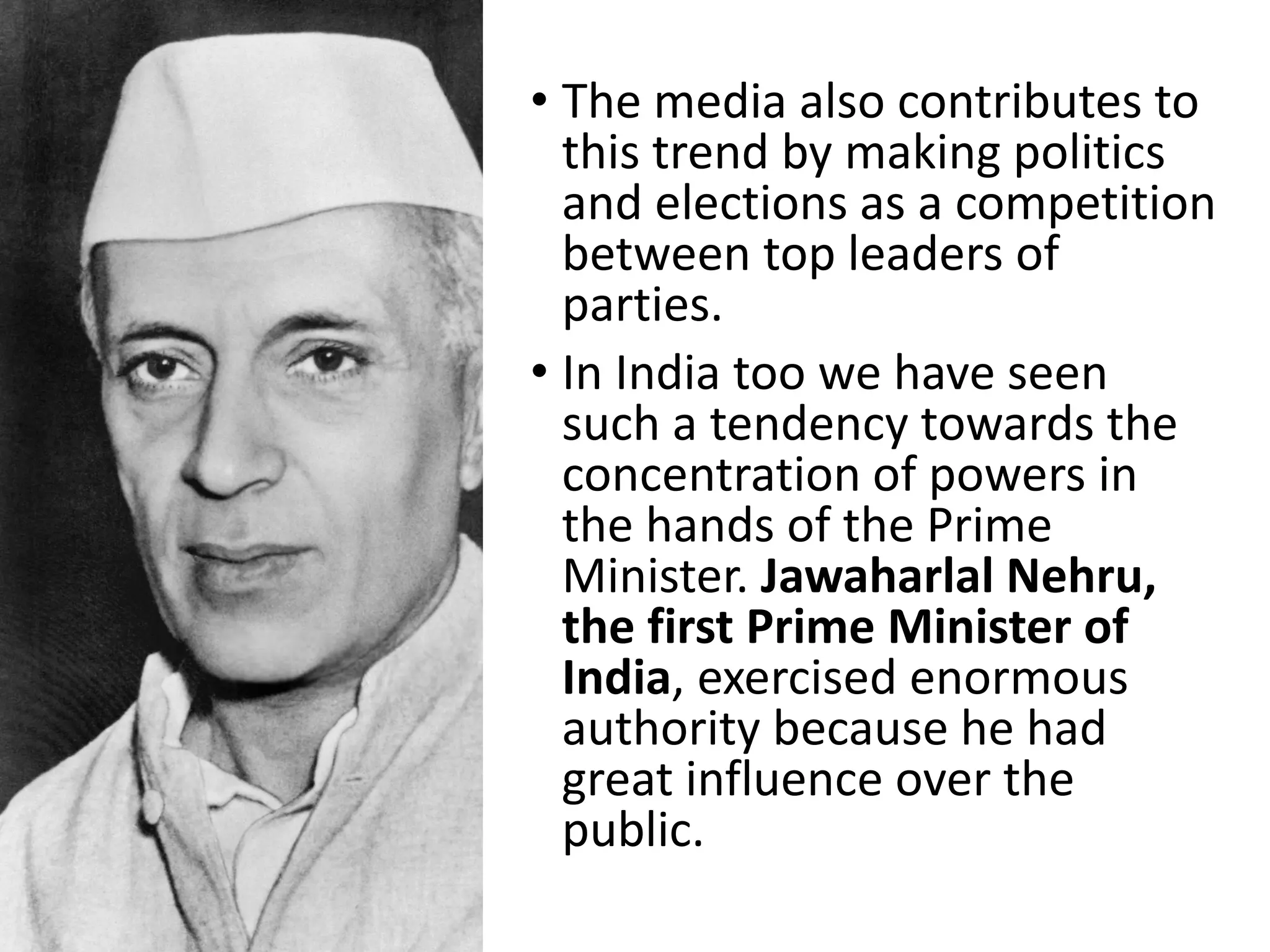
• The media also contributes to
this trend by making politics
and elections as a competition
between top leaders of
parties.
• In India too we have seen
such a tendency towards the
concentration of powers in
the hands of the Prime
Minister. Jawaharlal Nehru,
the first Prime Minister of
India, exercised enormous
authority because he had
great influence over the
public.
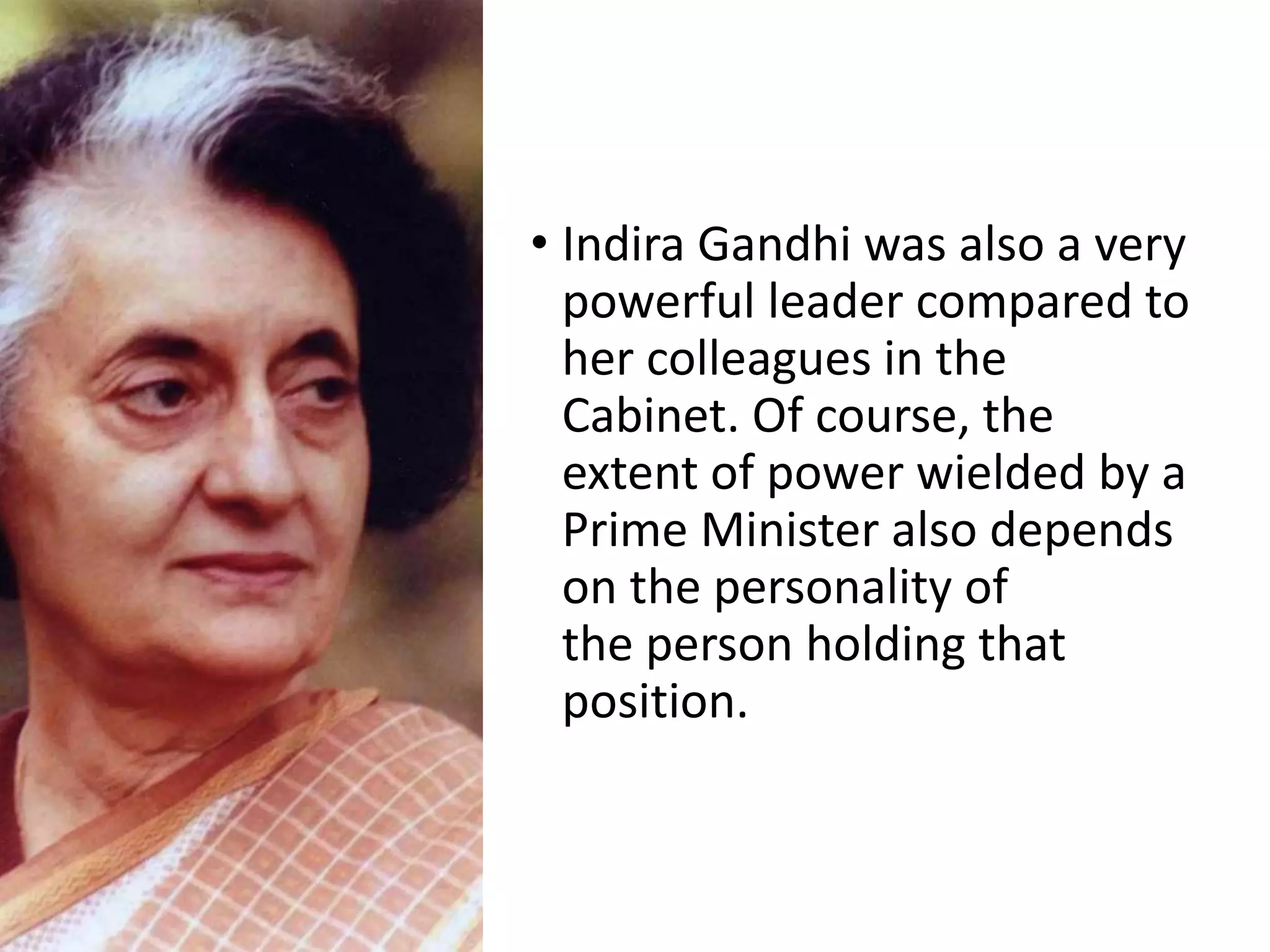
• Indira Gandhi was also a very
powerful leader compared to
her colleagues in the
Cabinet. Of course, the
extent of power wielded by a
Prime Minister also depends
on the personality of
the person holding that
position.
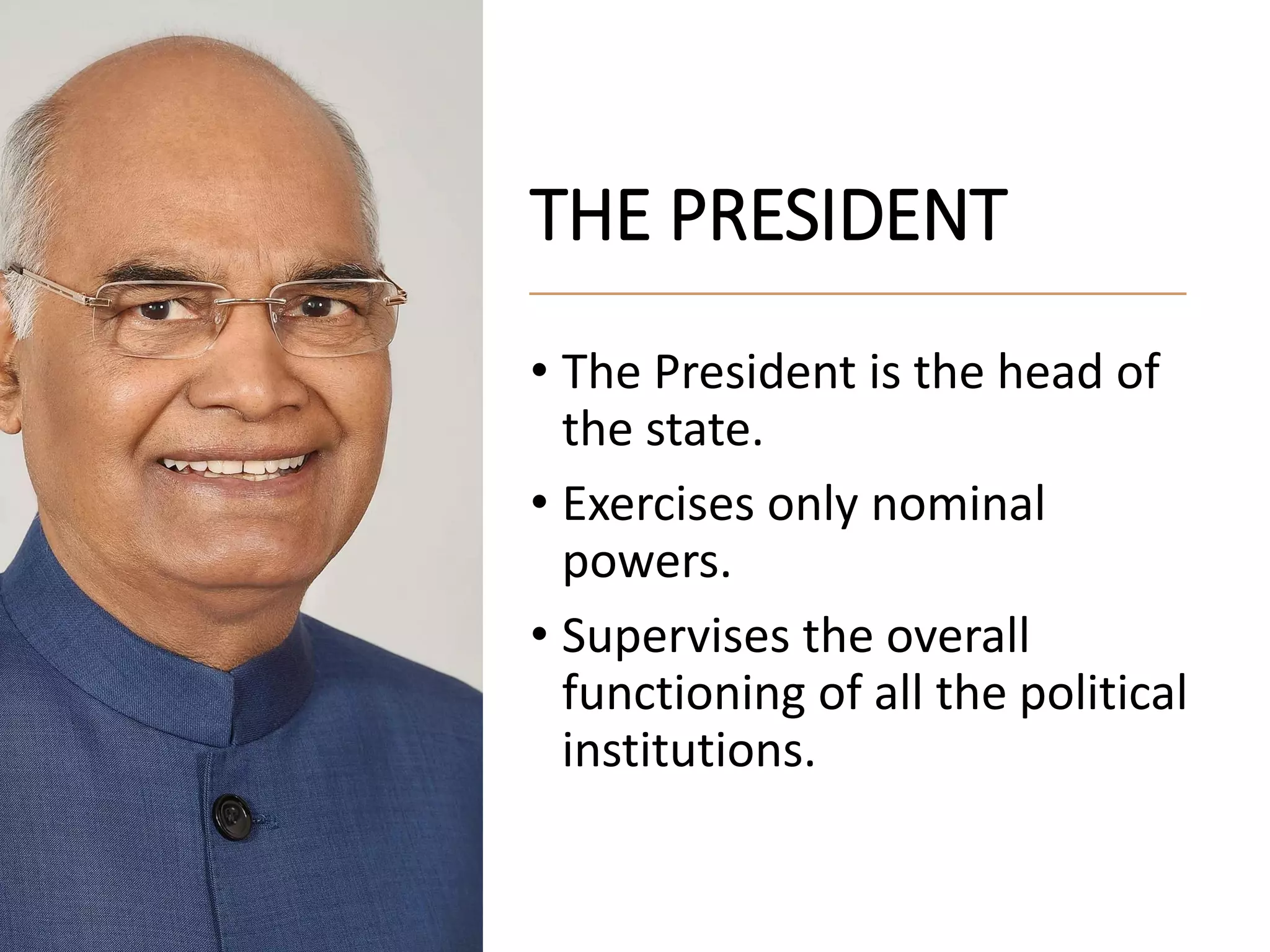
THE PRESIDENT
• The President is the head of
the state.
• Exercises only nominal
powers.
• Supervises the overall
functioning of all the political
institutions.
Power of the President
1. All governmental activities take place in the
name of the President.
2. All laws and major policy decisions of the
government are issued in her name.
3. All major appointments are made in the name
of the President.
4. All international treaties and agreements are
made in the name, of the President.
5. Is the supreme commander of the defence
forces of India.
THE JUDICIARY
• An independent and
powerful judiciary is
considered essential for
democracies.
• All the courts at different
levels in a country put
together are called the
judiciary.
• Consists of a Supreme Court
for the entire nation. High
Courts, District Courts and
the courts at local level.
I have expertise in making educational
and other PPTs. Email me for more
PPTs at a very reasonable price that
perfectly fits in your budget.
Email: parmarshivam105@gmail.com
THANK YOU
• This PPT is for educational
purposes only. If you find
any infringement of your
copyrighted content, email
me directly and I will
remove it.
• If anyone is found using
this PPT for commercial
purposes, he/she will be
solely responsible for the
consequences.

Chapter - 5, Working of Institutions, Democratic Politics/Civics, Social Science, Class 9

  • 1.
    CHAPTER - 5 WORKINGOF INSTITUTION Email for more PPTs at a very reasonable price. Email: parmarshivam105@gmail.com By Shivam Parmar (PPT Designer)
  • 2.
    INTRODUCTION • The PrimeMinister, the Cabinet, the civil servants and the Supreme Court are all political institutions. These institutions perform functions assigned to them. • Working with institutions is not easy. Institution involves rules and regulation. This can bind the hands of leaders. Institutions involve meetings, committees and routines. This often leads to delays and complications. But some of the delays and complications introduced by institutions are useful. They provide an opportunity for a wider set of people can be consulted in any decision.
  • 3.
    HOW IS A MAJOR POLICY DECISION TAKEN? AGovernment Order • On August 13, 1990, the Government of India issued an Order. It was called an Office Memorandum. • The Joint Secretary, an officer in the department of Personnel and Training in the Ministry of Personnel, Public Grievances and Pensions, signed the Order.
  • 4.
    The Decision Makers 1.President is the head of the state and is the highest formal authority in the country. 2. Prime Minister is the head of the government and actually exercises all governmental powers. He takes most of the decisions in the Cabinet meetings. 3. Parliament consists of two Houses, Lok Sabha and Rajya Sabha. The Prime Minister must have the support of a majority of Lok Sabha members.
  • 5.
    • The Governmentof India had appointed the Second Backward Classes Commission in 1979. It was headed by B.P. Mandal. Hence it was popularly called the Mandal Commission. • It was asked to determine the criteria to identify the socially and educationally backward classes in India and recommend steps be taken for their advancement. The Commission gave its-report-in 1980 and made many recommendations. One of these was that 27 percent of government jobs be reserved for the socially and economically backward classes.
  • 6.
    • In theLok Sabha election of 1989. In its election manifesto, the Janata Dal promised that if voted to power, it would implement the Mandal Commission report. The Janata Dal did form the government after this election. Its leader V. P. Singh became the Prime Minister. 1. The President of India in his address to the Parliament announced the intention of the government to implement the recommendations of the Mandal Commission.
  • 7.
    • The SupremeCourt and the High Courts in India settle disputes arising out of governmental decisions. Some persons and associations opposed to this order filed a number of cases in the courts. They appealed to the courts to declare the order invalid and stop its implementation. • The Supreme Court of India bunched all these cases together. This case was known as the ‘Indira Sawhney and others Vs Union of India case.
  • 8.
    Why do weneed a Parliament? • In all democracies, an assembly of elected representatives exercises supreme political authority on behalf of the people. In India such a national assembly of elected representatives is called Parliament. At the state level this is called Legislature or Legislative Assembly. PARLIAMENT
  • 9.
    It exercises politicalauthority on behalf of the people in many ways : • 1. Parliament is the final authority for making laws in any country. This task of law making or legislation is so crucial that these assemblies are called legislatures. Parliaments all over the world can make new laws, change existing laws, or abolish existing laws and make new ones in their place.
  • 10.
    TWO HOUSES OFPARLIAMENT • Most large countries divide the role and powers of the Parliament in two parts. They are called Chambers or Houses. • One House is usually directly elected by the people and exercises the real power on behalf of the people. • The second House is usually elected indirectly and performs some special functions. The most common work for the second House is to look after the interests of various states, regions or federal units.
  • 11.
    • In ourcountry, the Parliament Consists of two Houses. The two Houses are known as the Council of States (Rajya Sabha) and the House of the People (Lok Sabha). The. President of India is a part of the Parliament, although she is not a member of either House. That is why all laws made in the Houses come into force only after they receive the assent of the President. • Our Constitution does give the Rajya Sabha some special powers over the states.
  • 12.
    Lok Sabha exercisessupreme power. Let us see how : 1. Any ordinary law needs to be passed by both the Houses. But if there is a difference between the two houses, the final decision is taken in a joint session in which members of both the Houses sit together. Because of the larger number of members, the view of the Lok Sabha is likely to prevail in such a meeting.
  • 13.
    POLITICAL EXECUTIVE • Atdifferent levels of any government we find functionaries who take day-to-day decisions but do not exercise supreme power on behalf of the people. All those functionaries are collectively known as the executive. They are called executive because they are in charge of the ‘execution’ of the policies of the government.
  • 14.
    The minister havethe final say on these matters ? • The reason is very simple. In a democracy the will of the people is supreme. The minister is elected by the people and thus empowered to exercise the will of the people on their behalf.
  • 15.
    PRIME MINISTER AND COUNCILOF MINISTERS Prime Minister is the most important ‘political institution in the country’ - • Yet there is no direct election. • President appoints the Prime Minister.
  • 16.
    • The Presidentappoints other ministers on the advice of the Prime Minister. • The Prime Minister is free to choose ministers, as long as they are members of Parliament. • Sometimes, a person who is not a member of Parliament can also become a minister. But such a person has to get elected to one of the Houses of the Parliament within six months, of appointment as minister.
  • 17.
    Powers of thePrime Minister Has wide ranging powers - 1. Chairs Cabinet meetings. 2. Coordinates the work of different “Departments”. 3. Decisions are final in case disagreements arise between Departments. 4. Exercises general supervision of different ministries. 5. Ministers work under his leadership. 6. Distributes and redistributes work to the ministers. 7. Prime Minister has the power to dismiss ministers.
  • 18.
    • The mediaalso contributes to this trend by making politics and elections as a competition between top leaders of parties. • In India too we have seen such a tendency towards the concentration of powers in the hands of the Prime Minister. Jawaharlal Nehru, the first Prime Minister of India, exercised enormous authority because he had great influence over the public.
  • 19.
    • Indira Gandhiwas also a very powerful leader compared to her colleagues in the Cabinet. Of course, the extent of power wielded by a Prime Minister also depends on the personality of the person holding that position.
  • 20.
    THE PRESIDENT • ThePresident is the head of the state. • Exercises only nominal powers. • Supervises the overall functioning of all the political institutions.
  • 21.
    Power of thePresident 1. All governmental activities take place in the name of the President. 2. All laws and major policy decisions of the government are issued in her name. 3. All major appointments are made in the name of the President. 4. All international treaties and agreements are made in the name, of the President. 5. Is the supreme commander of the defence forces of India.
  • 22.
    THE JUDICIARY • Anindependent and powerful judiciary is considered essential for democracies. • All the courts at different levels in a country put together are called the judiciary. • Consists of a Supreme Court for the entire nation. High Courts, District Courts and the courts at local level.
  • 23.
    I have expertisein making educational and other PPTs. Email me for more PPTs at a very reasonable price that perfectly fits in your budget. Email: parmarshivam105@gmail.com THANK YOU
  • 24.
    • This PPTis for educational purposes only. If you find any infringement of your copyrighted content, email me directly and I will remove it. • If anyone is found using this PPT for commercial purposes, he/she will be solely responsible for the consequences.