Final Case Study
Jessica Lumsden, OTAS
OTA 140
Jefferson College of Health Sciences
 Occupational Profile
 JJ is a married 76 year-old female
 15 year gun shop owner
 Lives independently with husband, drives self, attends support groups 5x/wk.
 Interests include going to peer support groups and reading
 History
 Suffers from depression, anxiety, bipolar disorder, as well as chronic pain caused by
sciatica- severe to moderate- “never goes away”
 Currently taking Selective Serotonin Reuptake Inhibitors (SSRIs) an antidepressant &
Geodon, an antipsychotic
 Hospitalized 3 times since her 60’s due to the severity of her mental illnesses
 Has appointments 1x/3wks with doctor regarding chronic pain and 1x/wk with psychologist
Areas of Dysfunction
 Motor and Praxis Skills- bending, maintaining balance
 Emotional Regulation Skills- controlling and responding to feelings, displaying
appropriate emotions, utilizing relaxation
strategies, persistence
 Cognitive Skills- multitasking, creating different activities
 Communication and Social Skills- Initiating and answering questions,
acknowledging others & their feelings.
Impact on Areas of Occupation
 ADLs & IADLs- functional mobility, caring for others, communication
management, financial management, meal preparation and cleanup, shopping
 Rest & Sleep- Sleep, Sleep participation
 Leisure- Leisure exploration, Leisure participation
 Social Participation- Community, Family, Peer, Friend
Problem : Depression
Long Term Goal : Client will develop the
ability to recognize, accept
and cope with feelings of
depression within 12 weeks.
Short Term Goals:
1. Client will be able to describe at least
five effective coping strategies for
dealing with stressful situations in 4
weeks.
2. Client will learn to identify negative
thoughts & how to replace them with
more positive, adaptive thoughts within 6
weeks.
Problem : Chronic Pain
Long Term Goal: Client will minimize impact
of chronic pain on life domains
within 12 weeks.
Short Term Goals:
1. Client will learn progressive
relaxation and distraction
techniques to manage pain
within 4 weeks.
2. Client will increase physical
strength and stamina during occupational
activities within 6 weeks.
Treatment Goals
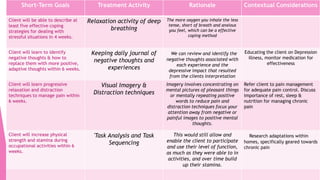
Short-Term Goals Treatment Activity Rationale Contextual Considerations
Client will be able to describe at
least five effective coping
strategies for dealing with
stressful situations in 4 weeks.
Relaxation activity of deep
breathing
The more oxygen you inhale the less
tense, short of breath and anxious
you feel, which can be a effective
coping method
Client will learn to identify
negative thoughts & how to
replace them with more positive,
adaptive thoughts within 6 weeks.
Keeping daily journal of
negative thoughts and
experiences
We can review and identify the
negative thoughts associated with
each experience and the
depressive impact that resulted
from the clients interpretation
Educating the client on Depression
illness, monitor medication for
effectiveness
Client will learn progressive
relaxation and distraction
techniques to manage pain within
6 weeks.
Visual Imagery &
Distraction techniques
Imagery involves concentrating on
mental pictures of pleasant things
or mentally repeating positive
words to reduce pain and
distraction techniques focus your
attention away from negative or
painful images to positive mental
thoughts.
Refer client to pain management
for adequate pain control. Discuss
importance of rest, sleep &
nutrition for managing chronic
pain
Client will increase physical
strength and stamina during
occupational activities within 6
weeks.
'Task Analysis and Task
Sequencing
This would still allow and
enable the client to participate
and use their level of function,
as much as they were able to in
activities, and over time build
up their stamina.
Research adaptations within
homes, specifically geared towards
chronic pain
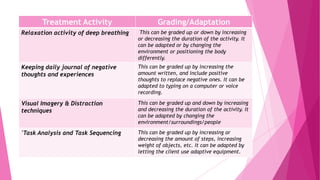
Treatment Activity Grading/Adaptation
Relaxation activity of deep breathing This can be graded up or down by increasing
or decreasing the duration of the activity. It
can be adapted or by changing the
environment or positioning the body
differently.
Keeping daily journal of negative
thoughts and experiences
This can be graded up by increasing the
amount written, and include positive
thoughts to replace negative ones. It can be
adapted to typing on a computer or voice
recording.
Visual Imagery & Distraction
techniques
This can be graded up and down by increasing
and decreasing the duration of the activity. It
can be adapted by changing the
environment/surroundings/people
'Task Analysis and Task Sequencing This can be graded up by increasing or
decreasing the amount of steps, increasing
weight of objects, etc. It can be adapted by
letting the client use adaptive equipment.
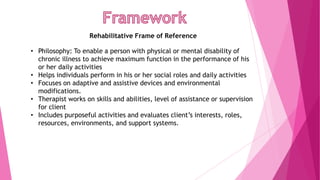
Rehabilitative Frame of Reference
• Philosophy: To enable a person with physical or mental disability of
chronic illness to achieve maximum function in the performance of his
or her daily activities
• Helps individuals perform in his or her social roles and daily activities
• Focuses on adaptive and assistive devices and environmental
modifications.
• Therapist works on skills and abilities, level of assistance or supervision
for client
• Includes purposeful activities and evaluates client’s interests, roles,
resources, environments, and support systems.
References
 American Occupational Therapy Association. (2008). Occupational therapy
practice framework: Domain and process (2nd ed). American Journal of
Occupational Therapy, 62, 628-659.
 Hofmann, A. (2010,01 19). Living life to its fullest: Managing chronic pain with
occupational therapy. Retreived from http://www.aota.org/ Consumers
/Professionals/WhatIsOT/PA/Articles/Chronic-Pain.aspx

Powerpoint final case study presentation

  • 1.
    Final Case Study JessicaLumsden, OTAS OTA 140 Jefferson College of Health Sciences
  • 2.
     Occupational Profile JJ is a married 76 year-old female  15 year gun shop owner  Lives independently with husband, drives self, attends support groups 5x/wk.  Interests include going to peer support groups and reading  History  Suffers from depression, anxiety, bipolar disorder, as well as chronic pain caused by sciatica- severe to moderate- “never goes away”  Currently taking Selective Serotonin Reuptake Inhibitors (SSRIs) an antidepressant & Geodon, an antipsychotic  Hospitalized 3 times since her 60’s due to the severity of her mental illnesses  Has appointments 1x/3wks with doctor regarding chronic pain and 1x/wk with psychologist
  • 3.
    Areas of Dysfunction Motor and Praxis Skills- bending, maintaining balance  Emotional Regulation Skills- controlling and responding to feelings, displaying appropriate emotions, utilizing relaxation strategies, persistence  Cognitive Skills- multitasking, creating different activities  Communication and Social Skills- Initiating and answering questions, acknowledging others & their feelings. Impact on Areas of Occupation  ADLs & IADLs- functional mobility, caring for others, communication management, financial management, meal preparation and cleanup, shopping  Rest & Sleep- Sleep, Sleep participation  Leisure- Leisure exploration, Leisure participation  Social Participation- Community, Family, Peer, Friend
  • 4.
    Problem : Depression LongTerm Goal : Client will develop the ability to recognize, accept and cope with feelings of depression within 12 weeks. Short Term Goals: 1. Client will be able to describe at least five effective coping strategies for dealing with stressful situations in 4 weeks. 2. Client will learn to identify negative thoughts & how to replace them with more positive, adaptive thoughts within 6 weeks. Problem : Chronic Pain Long Term Goal: Client will minimize impact of chronic pain on life domains within 12 weeks. Short Term Goals: 1. Client will learn progressive relaxation and distraction techniques to manage pain within 4 weeks. 2. Client will increase physical strength and stamina during occupational activities within 6 weeks. Treatment Goals
  • 5.
    Short-Term Goals TreatmentActivity Rationale Contextual Considerations Client will be able to describe at least five effective coping strategies for dealing with stressful situations in 4 weeks. Relaxation activity of deep breathing The more oxygen you inhale the less tense, short of breath and anxious you feel, which can be a effective coping method Client will learn to identify negative thoughts & how to replace them with more positive, adaptive thoughts within 6 weeks. Keeping daily journal of negative thoughts and experiences We can review and identify the negative thoughts associated with each experience and the depressive impact that resulted from the clients interpretation Educating the client on Depression illness, monitor medication for effectiveness Client will learn progressive relaxation and distraction techniques to manage pain within 6 weeks. Visual Imagery & Distraction techniques Imagery involves concentrating on mental pictures of pleasant things or mentally repeating positive words to reduce pain and distraction techniques focus your attention away from negative or painful images to positive mental thoughts. Refer client to pain management for adequate pain control. Discuss importance of rest, sleep & nutrition for managing chronic pain Client will increase physical strength and stamina during occupational activities within 6 weeks. 'Task Analysis and Task Sequencing This would still allow and enable the client to participate and use their level of function, as much as they were able to in activities, and over time build up their stamina. Research adaptations within homes, specifically geared towards chronic pain
  • 6.
    Treatment Activity Grading/Adaptation Relaxationactivity of deep breathing This can be graded up or down by increasing or decreasing the duration of the activity. It can be adapted or by changing the environment or positioning the body differently. Keeping daily journal of negative thoughts and experiences This can be graded up by increasing the amount written, and include positive thoughts to replace negative ones. It can be adapted to typing on a computer or voice recording. Visual Imagery & Distraction techniques This can be graded up and down by increasing and decreasing the duration of the activity. It can be adapted by changing the environment/surroundings/people 'Task Analysis and Task Sequencing This can be graded up by increasing or decreasing the amount of steps, increasing weight of objects, etc. It can be adapted by letting the client use adaptive equipment.
  • 7.
    Rehabilitative Frame ofReference • Philosophy: To enable a person with physical or mental disability of chronic illness to achieve maximum function in the performance of his or her daily activities • Helps individuals perform in his or her social roles and daily activities • Focuses on adaptive and assistive devices and environmental modifications. • Therapist works on skills and abilities, level of assistance or supervision for client • Includes purposeful activities and evaluates client’s interests, roles, resources, environments, and support systems.
  • 8.
    References  American OccupationalTherapy Association. (2008). Occupational therapy practice framework: Domain and process (2nd ed). American Journal of Occupational Therapy, 62, 628-659.  Hofmann, A. (2010,01 19). Living life to its fullest: Managing chronic pain with occupational therapy. Retreived from http://www.aota.org/ Consumers /Professionals/WhatIsOT/PA/Articles/Chronic-Pain.aspx