Pain Management PsychologyJOHNSEY  THOMAS Consultant Clinical Psychologist
Pain Management Psychology
DefiningPainAn unpleasant sensory and emotional experience associated with actual or potential tissue damage, or described in terms of such damage.”International Association for the Study of Pain 1979
Mind-Body- Soul HealingAlmost everything deals with mind-body issues, but it would be rational to say that a principal focus is self change and ways that Psychology can help with this…
Mind-Body- Soul HealingPsychology can help with this, especially with regard to enabling greater happiness and better health. It helps to believe", Mind over matter" and "all in the mind" look at the role of  thinking processes in self-healing.
Key ConceptsMost people think of pain as resulting from physical injury or disease, but psychological factors play a huge role in pain perception. Pain is intimately tied to brain functions that govern behavior and decision making, including expectation, attention and learning.
Psychology plays a major role in Pain Management
My doctor recommended I should see a psychologist for Pain Management.
Why would I see a psychologist? This pain is not in my head and I am not crazy!
No it unlikely to be in your head - the pain is most likely very real. However there are many psychological techniques which have been shown to assist people in coping with chronic pain.
Pain Psychologists are part of the treatment team for patients suffering from chronic pain (including cancer pain) as well as other chronic conditions.
Recent research suggests that pain is mismanaged in up to 50% of cases. For example, irrational fears about addiction, underreporting of pain, inadequate communication between patient and doctor, lack of knowledge, etc.
	Pain is disturbing my Life-Sleep-Work
Sleep as a Medicine 	Sleep is an essential part of our lives. It’s an opportunity for your body to repair itself, both physically (e.g., repairing muscles) and psychologically (working through anxiety).
I can sit at ease And relax
Guided imagery involves having the person with pain imagine (using all or as many as possible of their senses, not just the visual) something that contributes to relaxation, healing, or the lowering of pain and suffering.
This could be going to a relaxing place such as the beach or imagining what your pain looks (sounds, smells, tastes, feels) like and changing the image!
	I have cut down my routine activity drastically
When pain persists over time, a person may avoid doing regular activities for fear of further injury or increased pain. This can include work, social activities, or hobbies.
As the individual withdraws and becomes less active, their muscles may become weaker, they may begin to gain or lose weight, and their overall physical conditioning may decline. This can contribute to the belief that one is disabled.
	Do I need to live 	and suffer 	lifelong with pain?
	They say, I don’t have 	any problem pain, but I know; 	what I am going through
I getting easily 	frustrated and irritated
	Sometimes I feel Pain is demanding
† It feels like I've been drained of all energy 	and that to do just about anything  will 	take more effort than I can summon.Not at all 		Very seldom 		Sometimes 		Most of the time 		All of the time
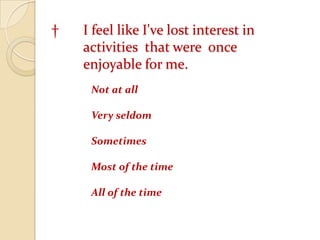
	† 	I feel like I've lost interest in 			activities  that were  once 				enjoyable for me.Not at all 	Very seldom	Sometimes	Most of the time	All of the time
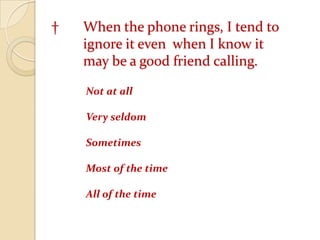
	† 	When the phone rings, I tend to 		ignore it even  when I know it 			may be a good friend calling. Not at all 	Very seldom 	Sometimes 	Most of the time 	All of the time
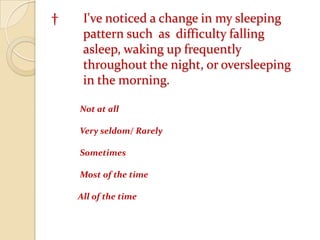
	† 	I've noticed a change in my sleeping 		pattern such  as  difficulty falling 			asleep, waking up frequently 			throughout the night, or oversleeping 		in the morning. 	 Not at all Very seldom/ Rarely Sometimes Most of the time 	All of the time
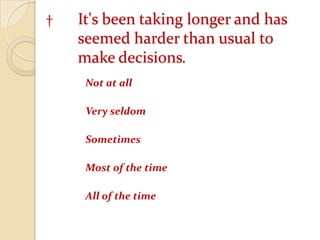
	† 	It's been taking longer and has 		seemed harder than usual to 		make decisions. Not at all 	Very seldom 	Sometimes 	Most of the time 	All of the time
 † 	It seems as though everything 	is going wrong no matter how 	hard I'm trying. 	Not at all 	Very seldom 	Sometimes 	Most of the time 	All of the time
† 	I've been turning down invitations to 	get together with friends because trying 	to socialize feels like it will take more 	energy than I have or because I think my 	"down“ mood will just depress everyone 	else. 	Not at all 	Very seldom 	Sometimes 	Most of the time
†	 I've been getting headaches, stomach-	aches, backaches, or pains in my joints 	or muscles that can’t be traced to a 	physical illness or injury. 	Not at all 	Very seldom	 Sometimes 	Most of the time 	All of the time
† 	I've been feeling restless 	and/or irritable. 		Not at all	 Very seldom	 Sometimes 	Most of the time 	All of the time
	Psychology in Managing Pain
… is tailored to the individual needsRelaxation Therapy
      Cognitive Behavior Therapy
	Cognitive Restructuring
	Stress and Anger Management
	Sleep Hygiene
	Activity PacingRelaxation Therapy- is that blissful state of being at peace with oneself and with the world.It creates measurable changes in the body, such as a reduction in oxygen consumption, heart and respiratory rate, blood pressure, blood cortisol levels, and muscle tension, and an increase in the production in the brain of serotonin which leads to feelings of calmness and well-being.
	Cognitive behavior Therapy- CBT 	for pain management has three basic components.treatment rationale that helps patients understand that cognitions and behavior can affect the pain experience and emphasizes the role that patients can play in controlling their own pain.
2. Coping skills- Progressive relaxation and cue-controlled brief relaxation exercises are used to decrease muscle tension, reduce emotional distress, and divert attention from pain.
Activity pacing and pleasant activity scheduling are used to help patients increase the level and range of their activities.
Training in distraction techniques such as pleasant imagery, counting methods, and use of a focal point helps patients learn to divert attention away from severe pain episodes.
Cognitive restructuring is used to help patients identify and challenge overly negative pain-related thoughts and to replace these thoughts with more adaptive, coping thoughts.
The third component of CBT involves the application and maintenance of learned coping skills.
Problem solving methods are taught that enable  to analyze and develop plans for dealing with pain flares and other challenging situations.
Self-monitoring and behavioral contracting methods also are used to prompt and reinforce frequent coping skills practice.
	If sleep is disrupted for an extended 	period of time it can lead to the 	following effects:† 	Increased emotional distress and irritability † 	Increased clumsiness and poor coordination

Pain management psychology

  • 1.
    Pain Management PsychologyJOHNSEY THOMAS Consultant Clinical Psychologist
  • 2.
  • 7.
    DefiningPainAn unpleasant sensoryand emotional experience associated with actual or potential tissue damage, or described in terms of such damage.”International Association for the Study of Pain 1979
  • 8.
    Mind-Body- Soul HealingAlmosteverything deals with mind-body issues, but it would be rational to say that a principal focus is self change and ways that Psychology can help with this…
  • 9.
    Mind-Body- Soul HealingPsychologycan help with this, especially with regard to enabling greater happiness and better health. It helps to believe", Mind over matter" and "all in the mind" look at the role of thinking processes in self-healing.
  • 10.
    Key ConceptsMost peoplethink of pain as resulting from physical injury or disease, but psychological factors play a huge role in pain perception. Pain is intimately tied to brain functions that govern behavior and decision making, including expectation, attention and learning.
  • 11.
    Psychology plays amajor role in Pain Management
  • 12.
    My doctor recommendedI should see a psychologist for Pain Management.
  • 13.
    Why would Isee a psychologist? This pain is not in my head and I am not crazy!
  • 14.
    No it unlikelyto be in your head - the pain is most likely very real. However there are many psychological techniques which have been shown to assist people in coping with chronic pain.
  • 15.
    Pain Psychologists arepart of the treatment team for patients suffering from chronic pain (including cancer pain) as well as other chronic conditions.
  • 16.
    Recent research suggeststhat pain is mismanaged in up to 50% of cases. For example, irrational fears about addiction, underreporting of pain, inadequate communication between patient and doctor, lack of knowledge, etc.
  • 17.
    Pain is disturbingmy Life-Sleep-Work
  • 18.
    Sleep as aMedicine Sleep is an essential part of our lives. It’s an opportunity for your body to repair itself, both physically (e.g., repairing muscles) and psychologically (working through anxiety).
  • 19.
    I can sitat ease And relax
  • 20.
    Guided imagery involveshaving the person with pain imagine (using all or as many as possible of their senses, not just the visual) something that contributes to relaxation, healing, or the lowering of pain and suffering.
  • 21.
    This could begoing to a relaxing place such as the beach or imagining what your pain looks (sounds, smells, tastes, feels) like and changing the image!
  • 22.
    I have cutdown my routine activity drastically
  • 23.
    When pain persistsover time, a person may avoid doing regular activities for fear of further injury or increased pain. This can include work, social activities, or hobbies.
  • 24.
    As the individualwithdraws and becomes less active, their muscles may become weaker, they may begin to gain or lose weight, and their overall physical conditioning may decline. This can contribute to the belief that one is disabled.
  • 25.
    Do I needto live and suffer lifelong with pain?
  • 26.
    They say, Idon’t have any problem pain, but I know; what I am going through
  • 27.
    I getting easily frustrated and irritated
  • 28.
    Sometimes I feelPain is demanding
  • 29.
    † It feelslike I've been drained of all energy and that to do just about anything will take more effort than I can summon.Not at all  Very seldom  Sometimes  Most of the time  All of the time
  • 30.
    † I feellike I've lost interest in activities that were once enjoyable for me.Not at all Very seldom Sometimes Most of the time All of the time
  • 31.
    † When thephone rings, I tend to ignore it even when I know it may be a good friend calling. Not at all  Very seldom  Sometimes  Most of the time  All of the time
  • 32.
    † I've noticeda change in my sleeping pattern such as difficulty falling asleep, waking up frequently throughout the night, or oversleeping in the morning.  Not at all Very seldom/ Rarely Sometimes Most of the time  All of the time
  • 33.
    † It's beentaking longer and has seemed harder than usual to make decisions. Not at all  Very seldom  Sometimes  Most of the time  All of the time
  • 34.
    † Itseems as though everything is going wrong no matter how hard I'm trying.  Not at all  Very seldom  Sometimes  Most of the time  All of the time
  • 35.
    † I've beenturning down invitations to get together with friends because trying to socialize feels like it will take more energy than I have or because I think my "down“ mood will just depress everyone else.  Not at all  Very seldom  Sometimes  Most of the time
  • 36.
    † I've beengetting headaches, stomach- aches, backaches, or pains in my joints or muscles that can’t be traced to a physical illness or injury.  Not at all  Very seldom  Sometimes  Most of the time  All of the time
  • 37.
    † I've beenfeeling restless and/or irritable.  Not at all  Very seldom  Sometimes  Most of the time  All of the time
  • 38.
  • 39.
    … is tailoredto the individual needsRelaxation Therapy
  • 40.
    Cognitive Behavior Therapy
  • 41.
  • 42.
  • 43.
  • 44.
    Activity PacingRelaxation Therapy-is that blissful state of being at peace with oneself and with the world.It creates measurable changes in the body, such as a reduction in oxygen consumption, heart and respiratory rate, blood pressure, blood cortisol levels, and muscle tension, and an increase in the production in the brain of serotonin which leads to feelings of calmness and well-being.
  • 45.
    Cognitive behavior Therapy-CBT for pain management has three basic components.treatment rationale that helps patients understand that cognitions and behavior can affect the pain experience and emphasizes the role that patients can play in controlling their own pain.
  • 46.
    2. Coping skills-Progressive relaxation and cue-controlled brief relaxation exercises are used to decrease muscle tension, reduce emotional distress, and divert attention from pain.
  • 47.
    Activity pacing andpleasant activity scheduling are used to help patients increase the level and range of their activities.
  • 48.
    Training in distractiontechniques such as pleasant imagery, counting methods, and use of a focal point helps patients learn to divert attention away from severe pain episodes.
  • 49.
    Cognitive restructuring isused to help patients identify and challenge overly negative pain-related thoughts and to replace these thoughts with more adaptive, coping thoughts.
  • 50.
    The third componentof CBT involves the application and maintenance of learned coping skills.
  • 51.
    Problem solving methodsare taught that enable to analyze and develop plans for dealing with pain flares and other challenging situations.
  • 52.
    Self-monitoring and behavioralcontracting methods also are used to prompt and reinforce frequent coping skills practice.
  • 53.
    If sleep isdisrupted for an extended period of time it can lead to the following effects:† Increased emotional distress and irritability † Increased clumsiness and poor coordination