NCP ON Depression:
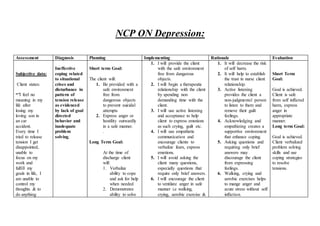
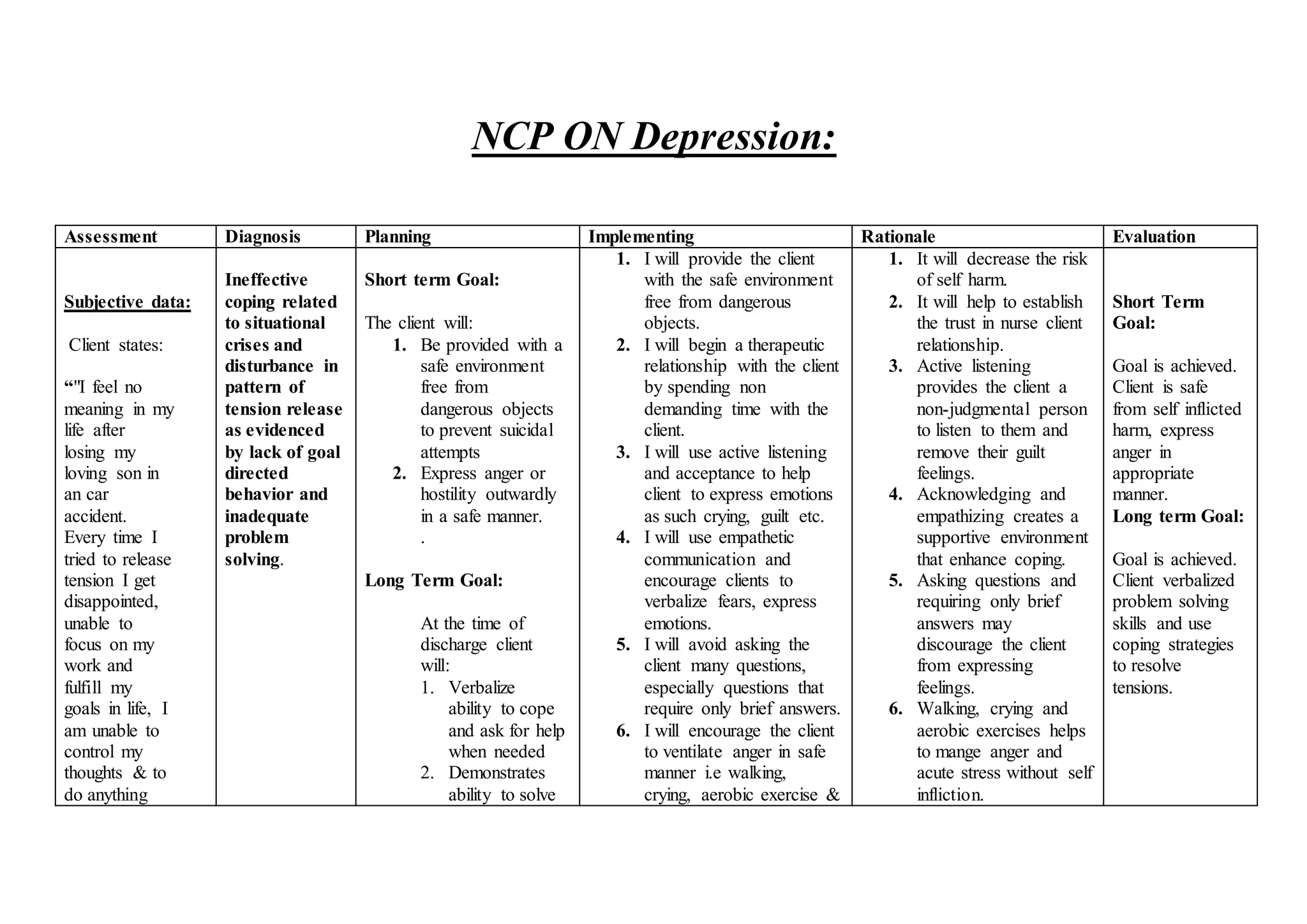
Assessment Diagnosis Planning Implementing Rationale Evaluation
Subjective data:
Client states:
“"I feel no
meaning in my
life after
losing my
loving son in
an car
accident.
Every time I
tried to release
tension I get
disappointed,
unable to
focus on my
work and
fulfill my
goals in life, I
am unable to
control my
thoughts & to
do anything
Ineffective
coping related
to situational
crises and
disturbance in
pattern of
tension release
as evidenced
by lack of goal
directed
behavior and
inadequate
problem
solving.
Short term Goal:
The client will:
1. Be provided with a
safe environment
free from
dangerous objects
to prevent suicidal
attempts
2. Express anger or
hostility outwardly
in a safe manner.
.
Long Term Goal:
At the time of
discharge client
will:
1. Verbalize
ability to cope
and ask for help
when needed
2. Demonstrates
ability to solve
1. I will provide the client
with the safe environment
free from dangerous
objects.
2. I will begin a therapeutic
relationship with the client
by spending non
demanding time with the
client.
3. I will use active listening
and acceptance to help
client to express emotions
as such crying, guilt etc.
4. I will use empathetic
communication and
encourage clients to
verbalize fears, express
emotions.
5. I will avoid asking the
client many questions,
especially questions that
require only brief answers.
6. I will encourage the client
to ventilate anger in safe
manner i.e walking,
crying, aerobic exercise &
1. It will decrease the risk
of self harm.
2. It will help to establish
the trust in nurse client
relationship.
3. Active listening
provides the client a
non-judgmental person
to listen to them and
remove their guilt
feelings.
4. Acknowledging and
empathizing creates a
supportive environment
that enhance coping.
5. Asking questions and
requiring only brief
answers may
discourage the client
from expressing
feelings.
6. Walking, crying and
aerobic exercises helps
to mange anger and
acute stress without self
infliction.
Short Term
Goal:
Goal is achieved.
Client is safe
from self inflicted
harm, express
anger in
appropriate
manner.
Long term Goal:
Goal is achieved.
Client verbalized
problem solving
skills and use
coping strategies
to resolve
tensions.
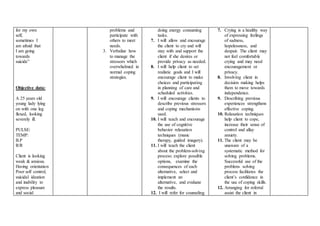
for my own
self,
sometimes I
am afraid that
I am going
towards
suicide”
Objective data:
A 25 years old
young lady lying
on with one leg
flexed, looking
severely ill.
PULSE:
TEMP:
B.P
R/R
Client is looking
weak & anxious.
Having orientation
Poor self control,
suicidal ideation
and inability to
express pleasure
and social
problems and
participate with
others to meet
needs.
3. Verbalize how
to manage the
stressors which
overwhelmed in
normal coping
strategies.
doing energy consuming
tasks.
7. I will allow and encourage
the client to cry and will
stay with and support the
client if she desires or
provide privacy as needed.
8. I will help client to set
realistic goals and I will
encourage client to make
choices and participating
in planning of care and
scheduled activities.
9. I will encourage clients to
describe previous stressors
and coping mechanisms
used.
10. I will teach and encourage
the use of cognitive
behavior relaxation
techniques (music
therapy, guided imagery).
11. I will teach the client
about the problem-solving
process: explore possible
options, examine the
consequences of each
alternative, select and
implement an
alternative, and evaluate
the results.
12. I will refer for counseling
7. Crying is a healthy way
of expressing feelings
of sadness,
hopelessness, and
despair. The client may
not feel comfortable
crying and may need
encouragement or
privacy.
8. Involving client in
decision making helps
them to move towards
independence.
9. Describing previous
experiences strengthens
effective coping.
10. Relaxation techniques
help client to cope,
increase their sense of
control and allay
anxiety.
11. The client may be
unaware of a
systematic method for
solving problems.
Successful use of the
problem- solving
process facilitates the
client’s confidence in
the use of coping skills.
12. Arranging for referral
assist the client in
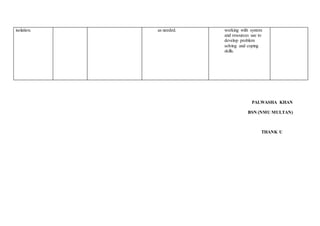
isolation. as needed. working with system
and resources use to
develop problem
solving and coping
skills.
PALWASHA KHAN
BSN (NMU MULTAN)
THANK U

Depression

  • 1.
    NCP ON Depression: AssessmentDiagnosis Planning Implementing Rationale Evaluation Subjective data: Client states: “"I feel no meaning in my life after losing my loving son in an car accident. Every time I tried to release tension I get disappointed, unable to focus on my work and fulfill my goals in life, I am unable to control my thoughts & to do anything Ineffective coping related to situational crises and disturbance in pattern of tension release as evidenced by lack of goal directed behavior and inadequate problem solving. Short term Goal: The client will: 1. Be provided with a safe environment free from dangerous objects to prevent suicidal attempts 2. Express anger or hostility outwardly in a safe manner. . Long Term Goal: At the time of discharge client will: 1. Verbalize ability to cope and ask for help when needed 2. Demonstrates ability to solve 1. I will provide the client with the safe environment free from dangerous objects. 2. I will begin a therapeutic relationship with the client by spending non demanding time with the client. 3. I will use active listening and acceptance to help client to express emotions as such crying, guilt etc. 4. I will use empathetic communication and encourage clients to verbalize fears, express emotions. 5. I will avoid asking the client many questions, especially questions that require only brief answers. 6. I will encourage the client to ventilate anger in safe manner i.e walking, crying, aerobic exercise & 1. It will decrease the risk of self harm. 2. It will help to establish the trust in nurse client relationship. 3. Active listening provides the client a non-judgmental person to listen to them and remove their guilt feelings. 4. Acknowledging and empathizing creates a supportive environment that enhance coping. 5. Asking questions and requiring only brief answers may discourage the client from expressing feelings. 6. Walking, crying and aerobic exercises helps to mange anger and acute stress without self infliction. Short Term Goal: Goal is achieved. Client is safe from self inflicted harm, express anger in appropriate manner. Long term Goal: Goal is achieved. Client verbalized problem solving skills and use coping strategies to resolve tensions.
  • 2.
    for my own self, sometimesI am afraid that I am going towards suicide” Objective data: A 25 years old young lady lying on with one leg flexed, looking severely ill. PULSE: TEMP: B.P R/R Client is looking weak & anxious. Having orientation Poor self control, suicidal ideation and inability to express pleasure and social problems and participate with others to meet needs. 3. Verbalize how to manage the stressors which overwhelmed in normal coping strategies. doing energy consuming tasks. 7. I will allow and encourage the client to cry and will stay with and support the client if she desires or provide privacy as needed. 8. I will help client to set realistic goals and I will encourage client to make choices and participating in planning of care and scheduled activities. 9. I will encourage clients to describe previous stressors and coping mechanisms used. 10. I will teach and encourage the use of cognitive behavior relaxation techniques (music therapy, guided imagery). 11. I will teach the client about the problem-solving process: explore possible options, examine the consequences of each alternative, select and implement an alternative, and evaluate the results. 12. I will refer for counseling 7. Crying is a healthy way of expressing feelings of sadness, hopelessness, and despair. The client may not feel comfortable crying and may need encouragement or privacy. 8. Involving client in decision making helps them to move towards independence. 9. Describing previous experiences strengthens effective coping. 10. Relaxation techniques help client to cope, increase their sense of control and allay anxiety. 11. The client may be unaware of a systematic method for solving problems. Successful use of the problem- solving process facilitates the client’s confidence in the use of coping skills. 12. Arranging for referral assist the client in
  • 3.
    isolation. as needed.working with system and resources use to develop problem solving and coping skills. PALWASHA KHAN BSN (NMU MULTAN) THANK U