The Ohio State University Comprehensive Cancer Center – Arthur G. James Cancer Hospital and Richard J. Solove Research Institute
OT Case Study
Rachel Walton OTR/L
April 6, 2016
 The role of occupational therapy in oncology is “to
facilitate and enable an individual patient to achieve
maximum functional performance, both physically and
psychologically, in everyday living skills regardless of his or
her life expectancy” (p. 75).
2
OT Roles in Cancer Rehabilitation
• ADL/IADL training
• Cancer-Related Fatigue
• Caner-Related Cognitive
Dysfunction
• Chemo-Induced Peripheral
Neuropathy
• Cancer-Related Pain
 National Comprehensive Cancer Network (NCCN):
 “Cancer-related fatigue is a distressing, persistent
subjective sense of tiredness or exhaustion related to
cancer or cancer treatment that is not proportional
to recent activity and interferes with usual
functioning.”
3
Cancer-Related Fatigue
Cancer-Related Cognitive Dysfunction
 Cancer-related cognitive dysfunction or CRCD,
describes memory or thinking problems that occur as a
side effect from chemotherapy treatments. It can
affect a person’s ability to carry out daily tasks
 70 year old female
 Medical History
 Diagnosed with breast cancer in 2006
 Underwent right mastectomy and right axillary
sentinel lymph node biopsy
 Received post-op systemic chemotherapy
 Patient developed lymphedema in her right arm in
2012
 History of mild cerebral palsy affecting her right arm
and seizure disorder
 Social History:
 Living in an assisted living apartment
 Involved in church
 Supportive family in a different state
4
Case Study: Jillian
5
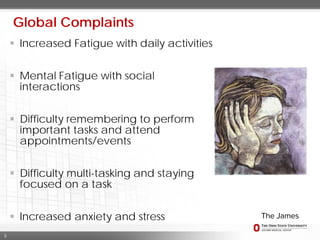
 Increased Fatigue with daily activities
 Mental Fatigue with social
interactions
 Difficulty remembering to perform
important tasks and attend
appointments/events
 Difficulty multi-tasking and staying
focused on a task
 Increased anxiety and stress
Global Complaints
 Activities of Daily Living (ADL) and Instrumental Activities of Daily
Living (IADL)
 Difficulty with upper body dressing and morning routine due
to increased fatigue and limited use of RUE
 Increased fatigue after cleaning apartment
 Increased fatigue with cooking due to only using LUE
 Forgetting to pay bills on time
 Difficulty with carrying out grocery shopping
 Leisure
 Forgetting to attend volunteering events at church and
increased fatigue with attending Sunday morning church
service
 Increased mental fatigue with social gatherings at assisted
living apartment
6
Impact of Jillian's Functional Ability
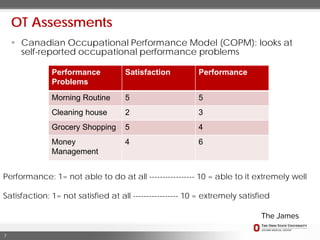
 Canadian Occupational Performance Model (COPM): looks at
self-reported occupational performance problems
7
OT Assessments
Performance
Problems
Satisfaction Performance
Morning Routine 5 5
Cleaning house 2 3
Grocery Shopping 5 4
Money
Management
4 6
Performance: 1= not able to do at all ----------------- 10 = able to it extremely well
Satisfaction: 1= not satisfied at all ----------------- 10 = extremely satisfied
 Multidimensional Assessment of Fatigue Scale: 40.1 (50 =
severe fatigue)
 Highest self-rated fatigue scores were with household chores,
bathing/dressing, shopping/errands
 FACT-COG (2008): assesses perceived cognitive dysfunction
quality of life measure
 Perceived Cognitive Impairments
 Perceived Cognitive Abilities
 Comments from Others
 Impact on Quality of Life
8
OT Assessments
9
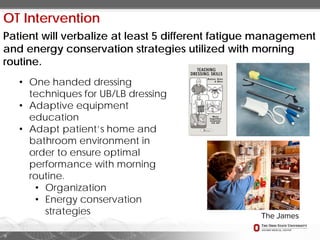
OT Intervention
Patient will verbalize at least 5 different fatigue management
and energy conservation strategies utilized with morning
routine.
• One handed dressing
techniques for UB/LB dressing
• Adaptive equipment
education
• Adapt patient’s home and
bathroom environment in
order to ensure optimal
performance with morning
routine.
• Organization
• Energy conservation
strategies
10
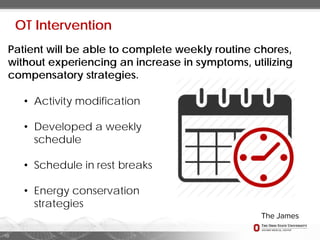
OT Intervention
Patient will be able to complete weekly routine chores,
without experiencing an increase in symptoms, utilizing
compensatory strategies.
• Activity modification
• Developed a weekly
schedule
• Schedule in rest breaks
• Energy conservation
strategies
11
Activity Modification Examples
12
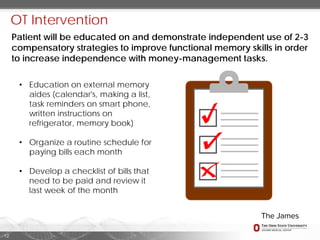
• Education on external memory
aides (calendar's, making a list,
task reminders on smart phone,
written instructions on
refrigerator, memory book)
• Organize a routine schedule for
paying bills each month
• Develop a checklist of bills that
need to be paid and review it
last week of the month
Patient will be educated on and demonstrate independent use of 2-3
compensatory strategies to improve functional memory skills in order
to increase independence with money-management tasks.
OT Intervention
13
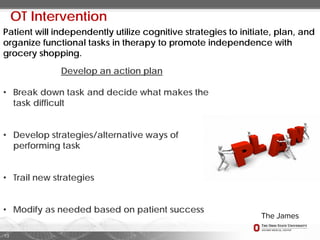
Develop an action plan
• Break down task and decide what makes the
task difficult
• Develop strategies/alternative ways of
performing task
• Trail new strategies
• Modify as needed based on patient success
Patient will independently utilize cognitive strategies to initiate, plan, and
organize functional tasks in therapy to promote independence with
grocery shopping.
OT Intervention
14
Develop An Action Plan
• Break down task and decide what makes the task difficult
• Scheduling transportation
• collecting all needed items
• making sure your within budget
• getting back to bus on time
• Develop strategies/alternative ways of performing task
• Write bus schedule in calendar/memory book/post on refrigerator
• Choose the same time to catch bus each week
• Make a grocery list, start at one end of store and work your way
down
• Decide budget before leaving, plan meals for the week
• Set phone alarm 15 minutes before bus arrives, as well as when bus
arrives
• Trail new strategies
• Modify as needed based on patient success
Problem solving steps repeated for maintaining budget.
15
OT Problem Solving Worksheet Example
16
Conclusion
Global Fatigue Score went from 40 to 27.
Patient demonstrated a 8 point increase on FACT-Cog – demonstrating
minimal detectable change
Patient reported feelings of being more equipped to take on the challenges
of fatigue and cognitive dysfunction.
COPM Initial Assessment Re-Assessment
Performance
Problems
Satisfaction Performance Satisfaction Performance
Morning Routine 5 5 7 7
Cleaning house 2 3 5 5
Grocery Shopping 5 4 7 6
Money
Management
4 6 7 7
17
Questions
Thank You
18
For more information on OT’s role in
cancer rehabilitation please contact:
Rachel Walton OTR/L
Stephanie Spielman Oncology
Rehabilitation
rachel.walton@osumc.edu

OT Case Study

  • 1.
    The Ohio StateUniversity Comprehensive Cancer Center – Arthur G. James Cancer Hospital and Richard J. Solove Research Institute OT Case Study Rachel Walton OTR/L April 6, 2016
  • 2.
     The roleof occupational therapy in oncology is “to facilitate and enable an individual patient to achieve maximum functional performance, both physically and psychologically, in everyday living skills regardless of his or her life expectancy” (p. 75). 2 OT Roles in Cancer Rehabilitation • ADL/IADL training • Cancer-Related Fatigue • Caner-Related Cognitive Dysfunction • Chemo-Induced Peripheral Neuropathy • Cancer-Related Pain
  • 3.
     National ComprehensiveCancer Network (NCCN):  “Cancer-related fatigue is a distressing, persistent subjective sense of tiredness or exhaustion related to cancer or cancer treatment that is not proportional to recent activity and interferes with usual functioning.” 3 Cancer-Related Fatigue Cancer-Related Cognitive Dysfunction  Cancer-related cognitive dysfunction or CRCD, describes memory or thinking problems that occur as a side effect from chemotherapy treatments. It can affect a person’s ability to carry out daily tasks
  • 4.
     70 yearold female  Medical History  Diagnosed with breast cancer in 2006  Underwent right mastectomy and right axillary sentinel lymph node biopsy  Received post-op systemic chemotherapy  Patient developed lymphedema in her right arm in 2012  History of mild cerebral palsy affecting her right arm and seizure disorder  Social History:  Living in an assisted living apartment  Involved in church  Supportive family in a different state 4 Case Study: Jillian
  • 5.
    5  Increased Fatiguewith daily activities  Mental Fatigue with social interactions  Difficulty remembering to perform important tasks and attend appointments/events  Difficulty multi-tasking and staying focused on a task  Increased anxiety and stress Global Complaints
  • 6.
     Activities ofDaily Living (ADL) and Instrumental Activities of Daily Living (IADL)  Difficulty with upper body dressing and morning routine due to increased fatigue and limited use of RUE  Increased fatigue after cleaning apartment  Increased fatigue with cooking due to only using LUE  Forgetting to pay bills on time  Difficulty with carrying out grocery shopping  Leisure  Forgetting to attend volunteering events at church and increased fatigue with attending Sunday morning church service  Increased mental fatigue with social gatherings at assisted living apartment 6 Impact of Jillian's Functional Ability
  • 7.
     Canadian OccupationalPerformance Model (COPM): looks at self-reported occupational performance problems 7 OT Assessments Performance Problems Satisfaction Performance Morning Routine 5 5 Cleaning house 2 3 Grocery Shopping 5 4 Money Management 4 6 Performance: 1= not able to do at all ----------------- 10 = able to it extremely well Satisfaction: 1= not satisfied at all ----------------- 10 = extremely satisfied
  • 8.
     Multidimensional Assessmentof Fatigue Scale: 40.1 (50 = severe fatigue)  Highest self-rated fatigue scores were with household chores, bathing/dressing, shopping/errands  FACT-COG (2008): assesses perceived cognitive dysfunction quality of life measure  Perceived Cognitive Impairments  Perceived Cognitive Abilities  Comments from Others  Impact on Quality of Life 8 OT Assessments
  • 9.
    9 OT Intervention Patient willverbalize at least 5 different fatigue management and energy conservation strategies utilized with morning routine. • One handed dressing techniques for UB/LB dressing • Adaptive equipment education • Adapt patient’s home and bathroom environment in order to ensure optimal performance with morning routine. • Organization • Energy conservation strategies
  • 10.
    10 OT Intervention Patient willbe able to complete weekly routine chores, without experiencing an increase in symptoms, utilizing compensatory strategies. • Activity modification • Developed a weekly schedule • Schedule in rest breaks • Energy conservation strategies
  • 11.
  • 12.
    12 • Education onexternal memory aides (calendar's, making a list, task reminders on smart phone, written instructions on refrigerator, memory book) • Organize a routine schedule for paying bills each month • Develop a checklist of bills that need to be paid and review it last week of the month Patient will be educated on and demonstrate independent use of 2-3 compensatory strategies to improve functional memory skills in order to increase independence with money-management tasks. OT Intervention
  • 13.
    13 Develop an actionplan • Break down task and decide what makes the task difficult • Develop strategies/alternative ways of performing task • Trail new strategies • Modify as needed based on patient success Patient will independently utilize cognitive strategies to initiate, plan, and organize functional tasks in therapy to promote independence with grocery shopping. OT Intervention
  • 14.
    14 Develop An ActionPlan • Break down task and decide what makes the task difficult • Scheduling transportation • collecting all needed items • making sure your within budget • getting back to bus on time • Develop strategies/alternative ways of performing task • Write bus schedule in calendar/memory book/post on refrigerator • Choose the same time to catch bus each week • Make a grocery list, start at one end of store and work your way down • Decide budget before leaving, plan meals for the week • Set phone alarm 15 minutes before bus arrives, as well as when bus arrives • Trail new strategies • Modify as needed based on patient success Problem solving steps repeated for maintaining budget.
  • 15.
    15 OT Problem SolvingWorksheet Example
  • 16.
    16 Conclusion Global Fatigue Scorewent from 40 to 27. Patient demonstrated a 8 point increase on FACT-Cog – demonstrating minimal detectable change Patient reported feelings of being more equipped to take on the challenges of fatigue and cognitive dysfunction. COPM Initial Assessment Re-Assessment Performance Problems Satisfaction Performance Satisfaction Performance Morning Routine 5 5 7 7 Cleaning house 2 3 5 5 Grocery Shopping 5 4 7 6 Money Management 4 6 7 7
  • 17.
  • 18.
    Thank You 18 For moreinformation on OT’s role in cancer rehabilitation please contact: Rachel Walton OTR/L Stephanie Spielman Oncology Rehabilitation rachel.walton@osumc.edu