Brief Interventions
& Motivational
Enhancement Therapy
for Alcohol problems
© Bob Patton 2003
Dr Bob Patton
Visiting Lecturer in Addiction
National Addiction Centre
With thanks to Dr Catherine Gilvary
Learning Objectives
To understand what is meant by a brief
intervention
To recognise the Stages of Change and how they
relate to brief interventions
To be able to describe the FRAMES approach to
Motivational Interviewing
To be able to translate examples of BI in the
alcohol field to the wider substance misuse
arena
What is the Rationale for
Screening and Brief
Intervention?
• SBI is effective for both early intervention and secondary
prevention of hazardous and harmful alcohol use but also more
severe abuse and dependence.
• Recent UK alcohol policy suggests that alcohol problems are
not detected early enough at present in the NHS and that vital
opportunities to intervene in the patient’s best interests are
being lost.
• Evidence that brief interventions lead to reduced consumption,
harm and consequently reduced use of health-care resources
and cost-effectiveness.
What is Brief Alcohol
Intervention?
“… the giving of information, advice and encouragement to the
patient to consider the positives and negatives of their drinking
behaviour, plus support and help to the patient if they do decide
they want to cut down on their drinking.”
“Brief interventions are usually ‘opportunistic’ – that is, they are
administered to patients who have not attended a consultation to
discuss their drinking”
(from the Alcohol Harm Reduction Strategy for England, p.37)
Features of Brief Interventions
• A family of interventions ranging from a few minutes simple, but structured, advice to
20 minutes counselling with repeat consultations.
• Two basic levels of brief intervention:
– (i) simple structured advice ~ 1-2 minutes to deliver.
– (ii) brief counselling (extended brief intervention) ~ 10-20 minutes.
• Brief interventions can be delivered by different practitioners in community settings,
e.g. GPs, practice nurses, health visitors, dieticians and other primary health care
professionals in the normal course of their work.
• They can also be delivered by more specialist workers (CPNs, lifestyle counsellors,
alcohol health workers).
• Normally aimed at a goal of low-risk drinking (i.e., under medically recommended
levels).
• But patients who prefer to become abstinent should not be discouraged.
Advantages of Locating SBI
in Primary Health Care
• 78% of population visit GP at least once a year.
• Stigma avoided.
• Intervention possible at “teachable moments”.
• Intervention in context of ongoing relationship with
patient and family.
• Advice from GPs, practice nurses and other primary
health care staff likely to be respected.
Don’t forget the ED!
It’s busy. Up to 40% presentations related to alcohol
consumption, rising to 70% on Saturday nights.
It’s a teachable moment – highlighting the relationship
between alcohol and attendance.
It’s an ideal location to access a wide cross-section of
the population.
ED accounts for 27% of the NHS alcohol bill
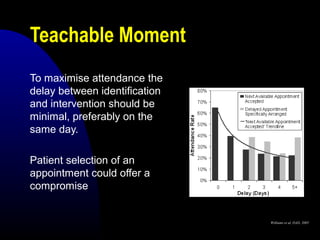
Teachable Moment
To maximise attendance the
delay between identification
and intervention should be
minimal, preferably on the
same day.
Patient selection of an
appointment could offer a
compromise
Williams et al, DAD, 2005
Who are the Targets for Brief
Interventions?
• Hazardous drinkers, including regular excessive
• drinkers & “binge drinkers” (behavioural rather
than physiological dependence evident).
• Harmful drinkers, including regular excessive
drinkers & “binge drinkers”.
• NOT people who are alcohol dependent.
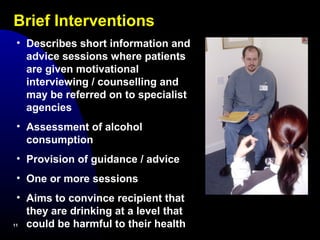
Brief Interventions
1111
• Describes short information and
advice sessions where patients
are given motivational
interviewing / counselling and
may be referred on to specialist
agencies
• Assessment of alcohol
consumption
• Provision of guidance / advice
• One or more sessions
• Aims to convince recipient that
they are drinking at a level that
could be harmful to their health
Brief Interventions
• Time-limited, structured.
• Self-help.
• Prevention strategy.
• Negotiated reduction in alcohol use rather than
abstinence.
• Not teaching specific skills.
• Not changing social environment.
Identification & Brief Advice
Detection with an appropriate screening tool is
followed by the delivery of an intervention.
This could be an information booklet, a few
minutes of focused dialogue or a longer in-
depth assessment and either a motivational
intervention or onward referral to specialist
services.
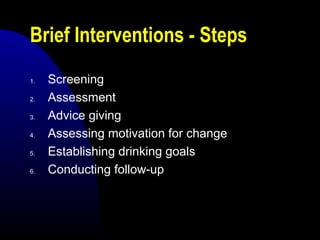
Brief Interventions - Steps
1. Screening
2. Assessment
3. Advice giving
4. Assessing motivation for change
5. Establishing drinking goals
6. Conducting follow-up
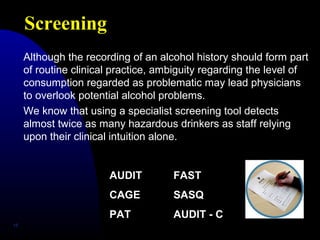
Screening
15
Although the recording of an alcohol history should form part
of routine clinical practice, ambiguity regarding the level of
consumption regarded as problematic may lead physicians
to overlook potential alcohol problems.
We know that using a specialist screening tool detects
almost twice as many hazardous drinkers as staff relying
upon their clinical intuition alone.
AUDIT FAST
CAGE SASQ
PAT AUDIT - C
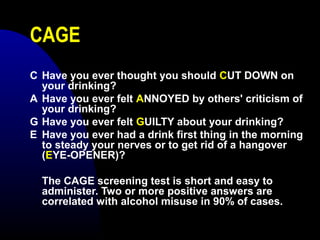
CAGE
C Have you ever thought you should CUT DOWN on
your drinking?
A Have you ever felt ANNOYED by others' criticism of
your drinking?
G Have you ever felt GUILTY about your drinking?
E Have you ever had a drink first thing in the morning
to steady your nerves or to get rid of a hangover
(EYE-OPENER)?
The CAGE screening test is short and easy to
administer. Two or more positive answers are
correlated with alcohol misuse in 90% of cases.
1717
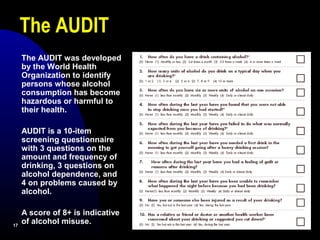
The AUDIT was developed
by the World Health
Organization to identify
persons whose alcohol
consumption has become
hazardous or harmful to
their health.
AUDIT is a 10-item
screening questionnaire
with 3 questions on the
amount and frequency of
drinking, 3 questions on
alcohol dependence, and
4 on problems caused by
alcohol.
A score of 8+ is indicative
of alcohol misuse.
The AUDIT
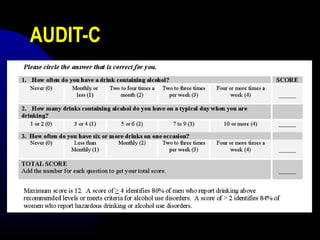
AUDIT-C
© SIPS
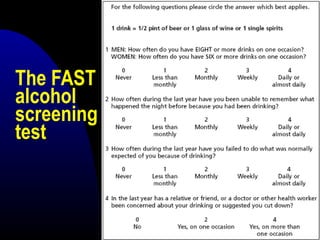
The FAST
alcohol
screening
test
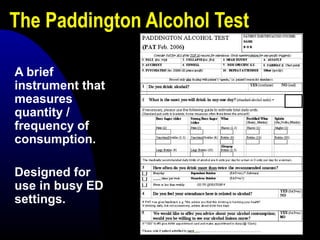
The Paddington Alcohol Test
A brief
instrument that
measures
quantity /
frequency of
consumption.
Designed for
use in busy ED
settings.
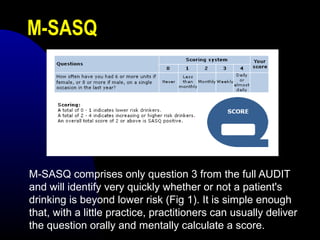
M-SASQ
M-SASQ comprises only question 3 from the full AUDIT
and will identify very quickly whether or not a patient's
drinking is beyond lower risk (Fig 1). It is simple enough
that, with a little practice, practitioners can usually deliver
the question orally and mentally calculate a score.
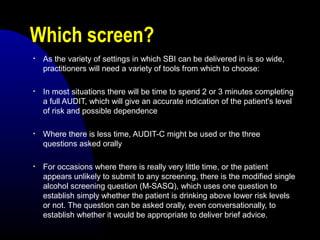
Which screen?
• As the variety of settings in which SBI can be delivered in is so wide,
practitioners will need a variety of tools from which to choose:
• In most situations there will be time to spend 2 or 3 minutes completing
a full AUDIT, which will give an accurate indication of the patient's level
of risk and possible dependence
• Where there is less time, AUDIT-C might be used or the three
questions asked orally
• For occasions where there is really very little time, or the patient
appears unlikely to submit to any screening, there is the modified single
alcohol screening question (M-SASQ), which uses one question to
establish simply whether the patient is drinking above lower risk levels
or not. The question can be asked orally, even conversationally, to
establish whether it would be appropriate to deliver brief advice.
Enhancing Motivation for
Change: FRAMES
Feedback (personalized, non-judgmental)
Responsibility (respect for autonomy)
Advice (clear and timely)
Menu of options (what works for you?)
Empathy (reflective listening)
Self-efficacy (offer optimism and hope)
Brief Interventions: Assessment
• Perform with anyone who drinks above
established cut-offs.
• Assess potential alcohol-related problems.
• Assess for symptoms of dependence.
• Refer to specialist practitioner if evidence of
alcohol dependence.
Brief Interventions: Advice
Giving
• Express concerns about the alcohol use pattern.
• Provide personalised feedback about how
alcohol affects people.
• Advise about need to change the drinking
behaviour.
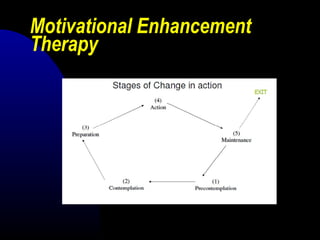
Stages of change
26
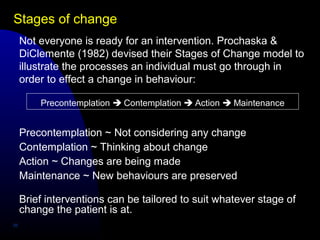
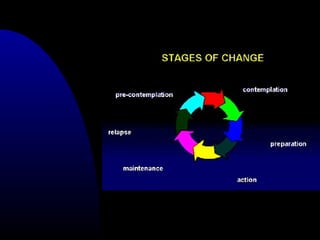
Not everyone is ready for an intervention. Prochaska &
DiClemente (1982) devised their Stages of Change model to
illustrate the processes an individual must go through in
order to effect a change in behaviour:
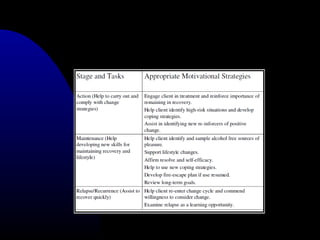
Precontemplation  Contemplation  Action  Maintenance
Precontemplation ~ Not considering any change
Contemplation ~ Thinking about change
Action ~ Changes are being made
Maintenance ~ New behaviours are preserved
Brief interventions can be tailored to suit whatever stage of
change the patient is at.
Brief Interventions: Establishing
Drinking Goals
• Negotiate specific drinking amounts.
• Establish specific dates.
• Develop a written contract.
• Offer resources, materials, information,
workbook, exercises, drinking diary.
Brief interventions: Conducting a
Follow-Up
• Review drinking goals.
• Assess ongoing problems.
• Support ongoing efforts to change.
• Assess new problems that might emerge.
Evidence of Effectiveness
Over 56 controlled trials of effectiveness, most in primary care.
At least 13 meta-analyses and/or systematic reviews, including 5
specifically focused on primary care - and reaching favourable conclusions.
In the best meta-analysis so far (Moyer et al., 2002), small to medium
aggregate effect sizes in favour of brief interventions emerged across
different follow-up points.
At follow-up of 3-6 months or more, the effect for brief interventions
compared to control conditions was significantly larger when individuals
showing more severe alcohol problems were excluded from the analysis.
Moyer, A., Finney, J., Swearingen, C., Vergun, P. (2002). Brief interventions for
Alcohol problems: A meta-analytic review of controlled investigations in treatment
Seeking and non-treatment seeking populations. Addiction, 97, 279-292.
Evidence of effectiveness cont…
• Estimates of number needed to treat (NNT) range from
2 to 12.
• Compares favourably with smoking cessation advice
(NNT = 20).
• Some recent evidence of a reduction in mortality
following screening and brief intervention.
• Also evidence of reductions in number of alcohol-related
problems.
• Effects of intervention still present after 4 years in one
US study and after 10 16 years in a Swedish study,
though an Australian study did not find an effect after 10
years.
An example of brief advice
• This is taken from the SIPS training
programme and is an illustration of
how a health worker can help a client
work out how much they are drinking,
how risky that is, and what can be
done.
Using the Brief Advice Tool
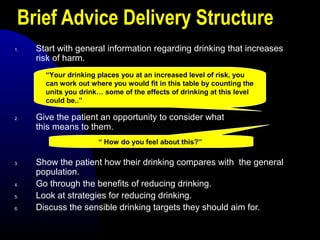
Brief Advice Delivery Structure
1. Start with general information regarding drinking that increases
risk of harm.
2. Give the patient an opportunity to consider what
this means to them.
3. Show the patient how their drinking compares with the general
population.
4. Go through the benefits of reducing drinking.
5. Look at strategies for reducing drinking.
6. Discuss the sensible drinking targets they should aim for.
“Your drinking places you at an increased level of risk, you
can work out where you would fit in this table by counting the
units you drink… some of the effects of drinking at this level
could be..”
“ How do you feel about this?”
Training video – Brief Advice
Brief Interventions
Methodological limitations exist:
• Most but not all interventions consisted of a single 15-
20 minute session.
• Medical doctors were the primary interventionists in
most trials.
• Small sample sizes.
• Low follow-up rates.
• Lack of “blinding” of the control participants.
REDUCE project – 2001/2003
AIM: Examine the effect of referral to an AHW
on levels of alcohol consumption.
DESIGN: Single blind pragmatic RCT
METHOD: Patients screened in the ED.
Hazardous drinkers allocated to experimental or
control conditions. Follow-up at six and twelve
months.
Experimental & Control treatments
All participants were given a copy of the HEA
booklet ‘Think about drink’.
Participants in the Experimental Treatment (ET)
were made an appointment with the AHW.
Control Treatment (CT) participants did not
receive this appointment.
Study Measures
Alcohol consumption
Screening using the PAT occurred at baseline for all
participants. At follow-up we employed the Form 90
AQ, Steady Pattern Grid and the PAT.
Psychiatric Morbidity & Quality of Life
An indication of psychiatric caseness was assessed
at six months using the GHQ-12. At twelve months
we used the EQ-5D to gauge quality of life.
ED attendance
Data extracted from routine hospital records
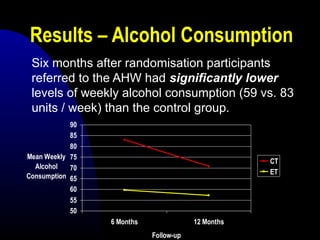
Results – Alcohol Consumption
Six months after randomisation participants
referred to the AHW had significantly lower
levels of weekly alcohol consumption (59 vs. 83
units / week) than the control group.
50
55
60
65
70
75
80
85
90
6 Months 12 Months
Follow-up
Mean Weekly
Alcohol
Consumption
CT
ET
Results – Other Measures
ET participants were also less likely to re-
attend the A&E in the one year following
their initial presentation than CT (1.2 visits
vs. 1.7, p<0.05, NNT=2)
However we detected no significant
differences between the groups on GHQ-
12 or EQ-5D.
Cost / Benefit
Screening and referral to the AHW has a cost, but
this should be offset against the savings gained by
reducing attendance:
For every 1000 patients screened, costs are
approximately £2500 (including the cost of the
AHW for those referred), and savings of £4000.
Net: £1500 savings
Limitations of the study
This was a pragmatic trial – we were unable to
collect comprehensive data at baseline, and so
were unable to measure the change in our primary
and secondary outcome measures
All study participants received as self-help booklet;
a “no treatment” control group was considered
unethical
Low numbers of our ET group actually attended
the AHW session
Conclusions from REDUCE
IBA in an ED is feasible and results in lower levels
of alcohol consumption over the following 12
months.
Reduced alcohol consumption is associated with
lower levels of reattendance in the department.
Reduced reattendance in the ED offsets the costs
of screening and providing brief intervention.
In summary – Alcohol IBA
• Ensure adequate confidentiality for the intended discussion
• Be non judgmental - avoid making judgemental comments about a
patient's drinking revelations
• Recommended clinical approach is to be encouraging, empathetic,
authoritative and aim to facilitate the patient's decision making
• If dealing with an angry question or response from a patient be
assertive but calm, drawing the patient's attention back to the
relationship between the screening test and their health
• M-SASQ, which uses one question to establish whether the patient is
drinking above lower risk levels or not, can be used for occasions
where there is really very little time, or the patient appears unlikely to
submit to any screening
• Addressing potential alcohol dependency is beyond the scope of the
Brief Advice session, offer referral to a specialist service
Motivational
Enhancement
Therapy
(Motivational Interviewing)
Motivational Enhancement
Therapy
• Aimed at problem and dependent drinkers.
• Aimed at increasing motivation to change drinking behaviours.
• Based on Motivational Enhancement Therapy (MET) principles.
Patient participation in treatment dependent on:
• Modifying unrealistic treatment expectations.
• Resolving client ambivalence about drinking.
• Enhancing client self-efficacy.
What is MET?
• Client-centered and directive counselling style that elicits
behaviour change by helping clients explore and resolve
ambivalence to change.
• Designed to produce rapid, internally motivated change.
• Evokes from clients their own motivation for change and
helps client to consolidate a personal decision and plan
for change. It uses motivational strategies to mobilize
the client’s own change resources.
• Can be delivered as a primary intervention or as a pre-
treatment intervention to increase motivation for
treatment and is useful in both out-and in-patient
settings.
MET features
• Little emphasis place on acceptance of a diagnostic
label.
• Personal choice regarding future substance use is
stressed.
• Resistance behaviour is not viewed as an obstacle or
denial, instead ambivalence is seen as a normal part of
change.
• Evoke from the client perceptions of problems and the
need for change. Do not impose truth on client.
• Emphasizes ability to change (Self-efficacy) rather than
helplessness over substances.
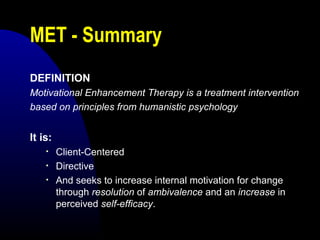
MET - Summary
DEFINITION
Motivational Enhancement Therapy is a treatment intervention
based on principles from humanistic psychology
It is:
• Client-Centered
• Directive
• And seeks to increase internal motivation for change
through resolution of ambivalence and an increase in
perceived self-efficacy.
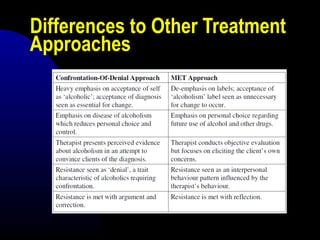
Differences to Other Treatment
Approaches
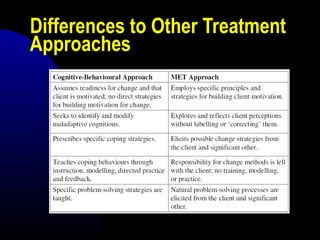
Differences to Other Treatment
Approaches
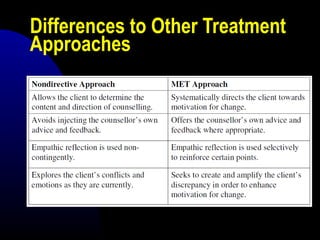
Differences to Other Treatment
Approaches
Rogerian* Constructs on which
MET is based
Empathy - is the ability to put oneself in another’s
situation and accurately convey an understanding of their
emotional experience without making a judgment about it.
Empathy is different from sympathy which connotes “feeling
sorry” for another person. In comparing the two, empathy is
a more egalitarian sharing of a feeling state. It
encompasses a wide range of affect where sympathy is
generally a reaction to another’s sadness or loss.
Warmth - Someone who is warm uses the self to convey
acceptance and positive regard through their own positive
affect and body language.
Rogerian* Constructs on which
MET is based
Genuineness - is the ability to be oneself and feel
comfortable in the context of a professional relationship with
a client. It does not imply a high degree of self-disclosure,
but a genuine presence in the relationship. It may involve an
ability to use the skill of immediacy.
Immediacy - means that the counsellor conveys
thoughts, feelings and reactions “in the moment”. An
example is the counsellor’s sharing of their own feelings of
sadness in response to a client story of a loss. It is different
from empathy in that empathy will convey an accurate
understanding of the client’s feeling of sadness.
Joining the Patient
Another tenet of client-centered counselling is to “meet the client
where they are at.”
Some patients may not be interested in addressing substance
abuse in the first sessions. The counsellor can engage the patient
by talking with them about their interests. For example, a client
referred to substance abuse treatment by his/her GP does not see
her substance use as problematic but is pre-occupied with issues
of getting her 13 year old son to attend school more regularly.
In this scenario the counsellor works with the patient on parenting
issues and uses this area of patient concern to further explore
substance abuse issues.
Directive
Motivational Enhancement Therapy is not impartial. The
goal is to move the client in the direction of making a
positive change.
This is one of the major differences between MET and
Rogerian Counselling, which assumes that clients will
ultimately move towards self-actualization. Rogers
advocated no particular direction in the treatment.
Principles of MET
1. Express Empathy
2. Roll with Resistance
3. Develop Discrepancy
4. Support Self-efficacy
5. Avoid Argumentation
Principle 1: Express Empathy
• Client centred, empathetic style is a fundamental defining element of MET.
• Reflective listening/accurate empathy is a key skill:
– Communicates acceptance of clients as they are.
– Communicates respect for the client.
– Builds a working therapeutic alliance.
– Supports client’s self esteem.
– All of the above promote further behaviour change.
• Client’s freedom of choice and self-direction are respected:
– It is only the client who can decide to change and can carry out that choice.
– More listening than telling.
– Persuasion is gentle and subtle – assume change is up to the client.
Principle 2: Roll with Resistance
• Handling of client ‘resistance’ is a crucial and defining characteristic
of MET
• MET does not meet resistance head-on (eg. Break through denial),
but ‘rolls with the momentum’, with a goal of shifting client
perceptions in the process
• Resistance is a red flag to a therapist – change behaviours or
strategies – Indicator of therapist behaviour rather than client’s
traits.
• Ambivalence is viewed as normal, not pathological and is explored
openly – meet resistance with reflection.
Principle 3: Develop Discrepancy
Motivation for change occurs when people perceive a discrepancy between
where they are, and where they want to be
MET seeks to enhance and focus clients’ attention on discrepancies regarding
substance use: Flight to health
Discrepancies disrupt emotional equilibrium and result in cognitive dissonance –
person may change to reduce perceived discrepancy and regain equilibrium
With pre-contemplators, one would first need to raise awareness of adverse
personal consequences of drinking so that discrepancies can develop
Counsellor must help client find and voice discrepancies and need for change.
Principle 4: Support Self-efficacy
A person who is persuaded they have a problem will not change unless
they believe that change is possible (hope/confidence)
Self-efficacy is the belief that one can perform a particular behaviour or
accomplish a particular task
In MET, client must be persuaded that it is possible to change
substance use and thereby reduce related problems
Unless self-efficacy is present, a discrepancy crisis is likely to resolve
into defensive coping to reduce discomfort, without changing behaviour
Principle 5: Avoid Argument
If handled badly, ambivalence and discrepancy can result in defensive coping
strategies that reduce client’s discomfort, but do not alter substance use.
Unrealistic attacks’ on substance use evoke defensiveness and opposition and
suggest that the therapist does not understand.
MET explicitly avoids argument, which tends to evoke resistance.
No attempt made to have client accept/admit a diagnostic label.
Does not seek to prove or convince by force of argument.
MET uses other strategies to assist the client to begin devaluing perceived
positive benefits of drugs and allows the client (not the therapist) to voice
arguments for change.
Client Counsellor Relationship
The quality of the therapeutic relationship accounts for up
to 30% of client improvement in outcome studies (Hubble,
Duncan & Miller, 2004).
The emphasis on client-counsellor relationship may be
related to the positive outcomes achieved by MET in a
wide-range of settings and with broad range of behavioural
health problems.
Motivational Enhancement
Therapy and Stages of Change
Motivational Enhancement Therapy has been paired
successfully with other treatment approaches like
cognitive-behavioral therapies and twelve-step models.
When paired with another treatment MET can be used to
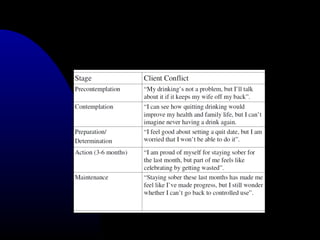
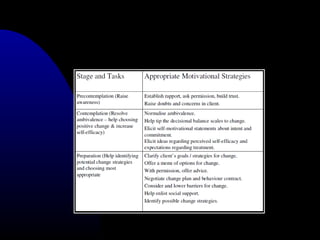
help clients progress from Pre-contemplation to the
resolution of ambivalence in the Contemplation stage.
Once the client has made a decision to change other
approaches such as twelve-step or CBT can be used in the
Action stage to help the client develop and carry out a
change plan.
Motivational Enhancement
Therapy: Stages
• Each stage has unique problems and tasks.
• Individuals moving through a particular stage must
successfully resolve the key task of that stage.
• People do NOT go through the stages in a linear way
(one trial learning is very rare in both animals and
humans).
• Cyclical experience stages is more representative.
• Issue of continuum vs distinct stages remains.
• Evidence shows significant differences between
individuals at different stages.
Motivational Enhancement
Therapy
Motivational Enhancement
Therapy
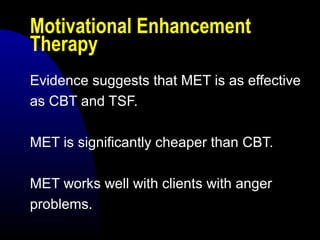
Evidence suggests that MET is as effective
as CBT and TSF.
MET is significantly cheaper than CBT.
MET works well with clients with anger
problems.
Efficacy of MET
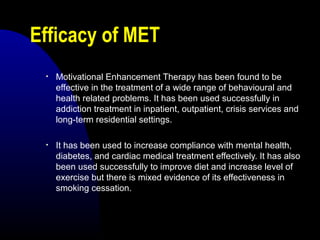
• Motivational Enhancement Therapy has been found to be
effective in the treatment of a wide range of behavioural and
health related problems. It has been used successfully in
addiction treatment in inpatient, outpatient, crisis services and
long-term residential settings.
• It has been used to increase compliance with mental health,
diabetes, and cardiac medical treatment effectively. It has also
been used successfully to improve diet and increase level of
exercise but there is mixed evidence of its effectiveness in
smoking cessation.
Meta-analysis of Outcome
Research in Substance Abuse
Treatment
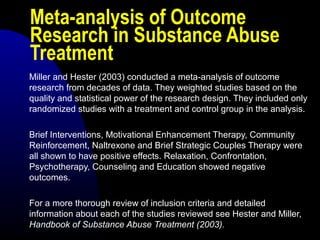
Miller and Hester (2003) conducted a meta-analysis of outcome
research from decades of data. They weighted studies based on the
quality and statistical power of the research design. They included only
randomized studies with a treatment and control group in the analysis.
Brief Interventions, Motivational Enhancement Therapy, Community
Reinforcement, Naltrexone and Brief Strategic Couples Therapy were
all shown to have positive effects. Relaxation, Confrontation,
Psychotherapy, Counseling and Education showed negative
outcomes.
For a more thorough review of inclusion criteria and detailed
information about each of the studies reviewed see Hester and Miller,
Handbook of Substance Abuse Treatment (2003).
Summary
• Motivational Enhancement Therapy is a model of treatment
based on humanistic psychology. It is directive and intends to
help clients resolve ambivalence in the direction of making a
positive change.
• “Spirit” is important and the counsellor’s stance should be
warm, empathetic, egalitarian, and should respect the client’s
right to self-determination.
• The model includes distinct techniques or strategies for opening
the interview, decreasing “sustain-talk” and encouraging
“change-talk.”
• The goal is to help the client resolve ambivalence about change
and make a commitment to a plan of action.
Summary
• Screening and brief intervention (SBI) for hazardous and
harmful drinkers in Primary Health Care is effective in reducing
alcohol-related harm.
• SBI is highly cost-effective in terms of reducing future burden on
the NHS
• Patients who have a positive screen should be offered simple
structured advice.
• If resources permit, brief counselling would benefit harmful
drinkers and more ‘interested’ patients.
• Patients with significant alcohol dependence should be referred
for more intensive intervention.
Further Reading
Miller, W. R., & Rollnick, S. (1991). Motivational interviewing: Preparing people
to change addictive behavior. New York: Guilford Press
Bien, T. H., Miller, W. R., & Tonigan, J. S. (1993). Brief interventions for alcohol
problems: A review. Addiction, 88, 315-336. doi: 10.1111/j.1360-
0443.1993.tb00820.x
Dunn C, Deroo L & Rivara FP (2001) The use of brief interventions adapted
from motivational interviewing across behavioral domains: a systematic
review. Addiction 96(12):1770-2
Thank you!

Brief interventions and motivational enhancement therapy for alcohol problems

  • 1.
    Brief Interventions & Motivational EnhancementTherapy for Alcohol problems © Bob Patton 2003 Dr Bob Patton Visiting Lecturer in Addiction National Addiction Centre With thanks to Dr Catherine Gilvary
  • 3.
    Learning Objectives To understandwhat is meant by a brief intervention To recognise the Stages of Change and how they relate to brief interventions To be able to describe the FRAMES approach to Motivational Interviewing To be able to translate examples of BI in the alcohol field to the wider substance misuse arena
  • 4.
    What is theRationale for Screening and Brief Intervention? • SBI is effective for both early intervention and secondary prevention of hazardous and harmful alcohol use but also more severe abuse and dependence. • Recent UK alcohol policy suggests that alcohol problems are not detected early enough at present in the NHS and that vital opportunities to intervene in the patient’s best interests are being lost. • Evidence that brief interventions lead to reduced consumption, harm and consequently reduced use of health-care resources and cost-effectiveness.
  • 5.
    What is BriefAlcohol Intervention? “… the giving of information, advice and encouragement to the patient to consider the positives and negatives of their drinking behaviour, plus support and help to the patient if they do decide they want to cut down on their drinking.” “Brief interventions are usually ‘opportunistic’ – that is, they are administered to patients who have not attended a consultation to discuss their drinking” (from the Alcohol Harm Reduction Strategy for England, p.37)
  • 6.
    Features of BriefInterventions • A family of interventions ranging from a few minutes simple, but structured, advice to 20 minutes counselling with repeat consultations. • Two basic levels of brief intervention: – (i) simple structured advice ~ 1-2 minutes to deliver. – (ii) brief counselling (extended brief intervention) ~ 10-20 minutes. • Brief interventions can be delivered by different practitioners in community settings, e.g. GPs, practice nurses, health visitors, dieticians and other primary health care professionals in the normal course of their work. • They can also be delivered by more specialist workers (CPNs, lifestyle counsellors, alcohol health workers). • Normally aimed at a goal of low-risk drinking (i.e., under medically recommended levels). • But patients who prefer to become abstinent should not be discouraged.
  • 7.
    Advantages of LocatingSBI in Primary Health Care • 78% of population visit GP at least once a year. • Stigma avoided. • Intervention possible at “teachable moments”. • Intervention in context of ongoing relationship with patient and family. • Advice from GPs, practice nurses and other primary health care staff likely to be respected.
  • 8.
    Don’t forget theED! It’s busy. Up to 40% presentations related to alcohol consumption, rising to 70% on Saturday nights. It’s a teachable moment – highlighting the relationship between alcohol and attendance. It’s an ideal location to access a wide cross-section of the population. ED accounts for 27% of the NHS alcohol bill
  • 9.
    Teachable Moment To maximiseattendance the delay between identification and intervention should be minimal, preferably on the same day. Patient selection of an appointment could offer a compromise Williams et al, DAD, 2005
  • 10.
    Who are theTargets for Brief Interventions? • Hazardous drinkers, including regular excessive • drinkers & “binge drinkers” (behavioural rather than physiological dependence evident). • Harmful drinkers, including regular excessive drinkers & “binge drinkers”. • NOT people who are alcohol dependent.
  • 11.
    Brief Interventions 1111 • Describesshort information and advice sessions where patients are given motivational interviewing / counselling and may be referred on to specialist agencies • Assessment of alcohol consumption • Provision of guidance / advice • One or more sessions • Aims to convince recipient that they are drinking at a level that could be harmful to their health
  • 12.
    Brief Interventions • Time-limited,structured. • Self-help. • Prevention strategy. • Negotiated reduction in alcohol use rather than abstinence. • Not teaching specific skills. • Not changing social environment.
  • 13.
    Identification & BriefAdvice Detection with an appropriate screening tool is followed by the delivery of an intervention. This could be an information booklet, a few minutes of focused dialogue or a longer in- depth assessment and either a motivational intervention or onward referral to specialist services.
  • 14.
    Brief Interventions -Steps 1. Screening 2. Assessment 3. Advice giving 4. Assessing motivation for change 5. Establishing drinking goals 6. Conducting follow-up
  • 15.
    Screening 15 Although the recordingof an alcohol history should form part of routine clinical practice, ambiguity regarding the level of consumption regarded as problematic may lead physicians to overlook potential alcohol problems. We know that using a specialist screening tool detects almost twice as many hazardous drinkers as staff relying upon their clinical intuition alone. AUDIT FAST CAGE SASQ PAT AUDIT - C
  • 16.
    CAGE C Have youever thought you should CUT DOWN on your drinking? A Have you ever felt ANNOYED by others' criticism of your drinking? G Have you ever felt GUILTY about your drinking? E Have you ever had a drink first thing in the morning to steady your nerves or to get rid of a hangover (EYE-OPENER)? The CAGE screening test is short and easy to administer. Two or more positive answers are correlated with alcohol misuse in 90% of cases.
  • 17.
    1717 The AUDIT wasdeveloped by the World Health Organization to identify persons whose alcohol consumption has become hazardous or harmful to their health. AUDIT is a 10-item screening questionnaire with 3 questions on the amount and frequency of drinking, 3 questions on alcohol dependence, and 4 on problems caused by alcohol. A score of 8+ is indicative of alcohol misuse. The AUDIT
  • 18.
  • 19.
  • 20.
    The Paddington AlcoholTest A brief instrument that measures quantity / frequency of consumption. Designed for use in busy ED settings.
  • 21.
    M-SASQ M-SASQ comprises onlyquestion 3 from the full AUDIT and will identify very quickly whether or not a patient's drinking is beyond lower risk (Fig 1). It is simple enough that, with a little practice, practitioners can usually deliver the question orally and mentally calculate a score.
  • 22.
    Which screen? • Asthe variety of settings in which SBI can be delivered in is so wide, practitioners will need a variety of tools from which to choose: • In most situations there will be time to spend 2 or 3 minutes completing a full AUDIT, which will give an accurate indication of the patient's level of risk and possible dependence • Where there is less time, AUDIT-C might be used or the three questions asked orally • For occasions where there is really very little time, or the patient appears unlikely to submit to any screening, there is the modified single alcohol screening question (M-SASQ), which uses one question to establish simply whether the patient is drinking above lower risk levels or not. The question can be asked orally, even conversationally, to establish whether it would be appropriate to deliver brief advice.
  • 23.
    Enhancing Motivation for Change:FRAMES Feedback (personalized, non-judgmental) Responsibility (respect for autonomy) Advice (clear and timely) Menu of options (what works for you?) Empathy (reflective listening) Self-efficacy (offer optimism and hope)
  • 24.
    Brief Interventions: Assessment •Perform with anyone who drinks above established cut-offs. • Assess potential alcohol-related problems. • Assess for symptoms of dependence. • Refer to specialist practitioner if evidence of alcohol dependence.
  • 25.
    Brief Interventions: Advice Giving •Express concerns about the alcohol use pattern. • Provide personalised feedback about how alcohol affects people. • Advise about need to change the drinking behaviour.
  • 26.
    Stages of change 26 Noteveryone is ready for an intervention. Prochaska & DiClemente (1982) devised their Stages of Change model to illustrate the processes an individual must go through in order to effect a change in behaviour: Precontemplation  Contemplation  Action  Maintenance Precontemplation ~ Not considering any change Contemplation ~ Thinking about change Action ~ Changes are being made Maintenance ~ New behaviours are preserved Brief interventions can be tailored to suit whatever stage of change the patient is at.
  • 28.
    Brief Interventions: Establishing DrinkingGoals • Negotiate specific drinking amounts. • Establish specific dates. • Develop a written contract. • Offer resources, materials, information, workbook, exercises, drinking diary.
  • 29.
    Brief interventions: Conductinga Follow-Up • Review drinking goals. • Assess ongoing problems. • Support ongoing efforts to change. • Assess new problems that might emerge.
  • 30.
    Evidence of Effectiveness Over56 controlled trials of effectiveness, most in primary care. At least 13 meta-analyses and/or systematic reviews, including 5 specifically focused on primary care - and reaching favourable conclusions. In the best meta-analysis so far (Moyer et al., 2002), small to medium aggregate effect sizes in favour of brief interventions emerged across different follow-up points. At follow-up of 3-6 months or more, the effect for brief interventions compared to control conditions was significantly larger when individuals showing more severe alcohol problems were excluded from the analysis. Moyer, A., Finney, J., Swearingen, C., Vergun, P. (2002). Brief interventions for Alcohol problems: A meta-analytic review of controlled investigations in treatment Seeking and non-treatment seeking populations. Addiction, 97, 279-292.
  • 31.
    Evidence of effectivenesscont… • Estimates of number needed to treat (NNT) range from 2 to 12. • Compares favourably with smoking cessation advice (NNT = 20). • Some recent evidence of a reduction in mortality following screening and brief intervention. • Also evidence of reductions in number of alcohol-related problems. • Effects of intervention still present after 4 years in one US study and after 10 16 years in a Swedish study, though an Australian study did not find an effect after 10 years.
  • 32.
    An example ofbrief advice • This is taken from the SIPS training programme and is an illustration of how a health worker can help a client work out how much they are drinking, how risky that is, and what can be done.
  • 33.
    Using the BriefAdvice Tool
  • 34.
    Using the BriefAdvice Tool
  • 35.
    Brief Advice DeliveryStructure 1. Start with general information regarding drinking that increases risk of harm. 2. Give the patient an opportunity to consider what this means to them. 3. Show the patient how their drinking compares with the general population. 4. Go through the benefits of reducing drinking. 5. Look at strategies for reducing drinking. 6. Discuss the sensible drinking targets they should aim for. “Your drinking places you at an increased level of risk, you can work out where you would fit in this table by counting the units you drink… some of the effects of drinking at this level could be..” “ How do you feel about this?”
  • 36.
    Training video –Brief Advice
  • 37.
    Brief Interventions Methodological limitationsexist: • Most but not all interventions consisted of a single 15- 20 minute session. • Medical doctors were the primary interventionists in most trials. • Small sample sizes. • Low follow-up rates. • Lack of “blinding” of the control participants.
  • 38.
    REDUCE project –2001/2003 AIM: Examine the effect of referral to an AHW on levels of alcohol consumption. DESIGN: Single blind pragmatic RCT METHOD: Patients screened in the ED. Hazardous drinkers allocated to experimental or control conditions. Follow-up at six and twelve months.
  • 39.
    Experimental & Controltreatments All participants were given a copy of the HEA booklet ‘Think about drink’. Participants in the Experimental Treatment (ET) were made an appointment with the AHW. Control Treatment (CT) participants did not receive this appointment.
  • 40.
    Study Measures Alcohol consumption Screeningusing the PAT occurred at baseline for all participants. At follow-up we employed the Form 90 AQ, Steady Pattern Grid and the PAT. Psychiatric Morbidity & Quality of Life An indication of psychiatric caseness was assessed at six months using the GHQ-12. At twelve months we used the EQ-5D to gauge quality of life. ED attendance Data extracted from routine hospital records
  • 41.
    Results – AlcoholConsumption Six months after randomisation participants referred to the AHW had significantly lower levels of weekly alcohol consumption (59 vs. 83 units / week) than the control group. 50 55 60 65 70 75 80 85 90 6 Months 12 Months Follow-up Mean Weekly Alcohol Consumption CT ET
  • 42.
    Results – OtherMeasures ET participants were also less likely to re- attend the A&E in the one year following their initial presentation than CT (1.2 visits vs. 1.7, p<0.05, NNT=2) However we detected no significant differences between the groups on GHQ- 12 or EQ-5D.
  • 43.
    Cost / Benefit Screeningand referral to the AHW has a cost, but this should be offset against the savings gained by reducing attendance: For every 1000 patients screened, costs are approximately £2500 (including the cost of the AHW for those referred), and savings of £4000. Net: £1500 savings
  • 44.
    Limitations of thestudy This was a pragmatic trial – we were unable to collect comprehensive data at baseline, and so were unable to measure the change in our primary and secondary outcome measures All study participants received as self-help booklet; a “no treatment” control group was considered unethical Low numbers of our ET group actually attended the AHW session
  • 45.
    Conclusions from REDUCE IBAin an ED is feasible and results in lower levels of alcohol consumption over the following 12 months. Reduced alcohol consumption is associated with lower levels of reattendance in the department. Reduced reattendance in the ED offsets the costs of screening and providing brief intervention.
  • 46.
    In summary –Alcohol IBA • Ensure adequate confidentiality for the intended discussion • Be non judgmental - avoid making judgemental comments about a patient's drinking revelations • Recommended clinical approach is to be encouraging, empathetic, authoritative and aim to facilitate the patient's decision making • If dealing with an angry question or response from a patient be assertive but calm, drawing the patient's attention back to the relationship between the screening test and their health • M-SASQ, which uses one question to establish whether the patient is drinking above lower risk levels or not, can be used for occasions where there is really very little time, or the patient appears unlikely to submit to any screening • Addressing potential alcohol dependency is beyond the scope of the Brief Advice session, offer referral to a specialist service
  • 48.
  • 49.
    Motivational Enhancement Therapy • Aimedat problem and dependent drinkers. • Aimed at increasing motivation to change drinking behaviours. • Based on Motivational Enhancement Therapy (MET) principles. Patient participation in treatment dependent on: • Modifying unrealistic treatment expectations. • Resolving client ambivalence about drinking. • Enhancing client self-efficacy.
  • 50.
    What is MET? •Client-centered and directive counselling style that elicits behaviour change by helping clients explore and resolve ambivalence to change. • Designed to produce rapid, internally motivated change. • Evokes from clients their own motivation for change and helps client to consolidate a personal decision and plan for change. It uses motivational strategies to mobilize the client’s own change resources. • Can be delivered as a primary intervention or as a pre- treatment intervention to increase motivation for treatment and is useful in both out-and in-patient settings.
  • 51.
    MET features • Littleemphasis place on acceptance of a diagnostic label. • Personal choice regarding future substance use is stressed. • Resistance behaviour is not viewed as an obstacle or denial, instead ambivalence is seen as a normal part of change. • Evoke from the client perceptions of problems and the need for change. Do not impose truth on client. • Emphasizes ability to change (Self-efficacy) rather than helplessness over substances.
  • 52.
    MET - Summary DEFINITION MotivationalEnhancement Therapy is a treatment intervention based on principles from humanistic psychology It is: • Client-Centered • Directive • And seeks to increase internal motivation for change through resolution of ambivalence and an increase in perceived self-efficacy.
  • 53.
    Differences to OtherTreatment Approaches
  • 54.
    Differences to OtherTreatment Approaches
  • 55.
    Differences to OtherTreatment Approaches
  • 56.
    Rogerian* Constructs onwhich MET is based Empathy - is the ability to put oneself in another’s situation and accurately convey an understanding of their emotional experience without making a judgment about it. Empathy is different from sympathy which connotes “feeling sorry” for another person. In comparing the two, empathy is a more egalitarian sharing of a feeling state. It encompasses a wide range of affect where sympathy is generally a reaction to another’s sadness or loss. Warmth - Someone who is warm uses the self to convey acceptance and positive regard through their own positive affect and body language.
  • 57.
    Rogerian* Constructs onwhich MET is based Genuineness - is the ability to be oneself and feel comfortable in the context of a professional relationship with a client. It does not imply a high degree of self-disclosure, but a genuine presence in the relationship. It may involve an ability to use the skill of immediacy. Immediacy - means that the counsellor conveys thoughts, feelings and reactions “in the moment”. An example is the counsellor’s sharing of their own feelings of sadness in response to a client story of a loss. It is different from empathy in that empathy will convey an accurate understanding of the client’s feeling of sadness.
  • 58.
    Joining the Patient Anothertenet of client-centered counselling is to “meet the client where they are at.” Some patients may not be interested in addressing substance abuse in the first sessions. The counsellor can engage the patient by talking with them about their interests. For example, a client referred to substance abuse treatment by his/her GP does not see her substance use as problematic but is pre-occupied with issues of getting her 13 year old son to attend school more regularly. In this scenario the counsellor works with the patient on parenting issues and uses this area of patient concern to further explore substance abuse issues.
  • 59.
    Directive Motivational Enhancement Therapyis not impartial. The goal is to move the client in the direction of making a positive change. This is one of the major differences between MET and Rogerian Counselling, which assumes that clients will ultimately move towards self-actualization. Rogers advocated no particular direction in the treatment.
  • 60.
    Principles of MET 1.Express Empathy 2. Roll with Resistance 3. Develop Discrepancy 4. Support Self-efficacy 5. Avoid Argumentation
  • 61.
    Principle 1: ExpressEmpathy • Client centred, empathetic style is a fundamental defining element of MET. • Reflective listening/accurate empathy is a key skill: – Communicates acceptance of clients as they are. – Communicates respect for the client. – Builds a working therapeutic alliance. – Supports client’s self esteem. – All of the above promote further behaviour change. • Client’s freedom of choice and self-direction are respected: – It is only the client who can decide to change and can carry out that choice. – More listening than telling. – Persuasion is gentle and subtle – assume change is up to the client.
  • 62.
    Principle 2: Rollwith Resistance • Handling of client ‘resistance’ is a crucial and defining characteristic of MET • MET does not meet resistance head-on (eg. Break through denial), but ‘rolls with the momentum’, with a goal of shifting client perceptions in the process • Resistance is a red flag to a therapist – change behaviours or strategies – Indicator of therapist behaviour rather than client’s traits. • Ambivalence is viewed as normal, not pathological and is explored openly – meet resistance with reflection.
  • 63.
    Principle 3: DevelopDiscrepancy Motivation for change occurs when people perceive a discrepancy between where they are, and where they want to be MET seeks to enhance and focus clients’ attention on discrepancies regarding substance use: Flight to health Discrepancies disrupt emotional equilibrium and result in cognitive dissonance – person may change to reduce perceived discrepancy and regain equilibrium With pre-contemplators, one would first need to raise awareness of adverse personal consequences of drinking so that discrepancies can develop Counsellor must help client find and voice discrepancies and need for change.
  • 64.
    Principle 4: SupportSelf-efficacy A person who is persuaded they have a problem will not change unless they believe that change is possible (hope/confidence) Self-efficacy is the belief that one can perform a particular behaviour or accomplish a particular task In MET, client must be persuaded that it is possible to change substance use and thereby reduce related problems Unless self-efficacy is present, a discrepancy crisis is likely to resolve into defensive coping to reduce discomfort, without changing behaviour
  • 65.
    Principle 5: AvoidArgument If handled badly, ambivalence and discrepancy can result in defensive coping strategies that reduce client’s discomfort, but do not alter substance use. Unrealistic attacks’ on substance use evoke defensiveness and opposition and suggest that the therapist does not understand. MET explicitly avoids argument, which tends to evoke resistance. No attempt made to have client accept/admit a diagnostic label. Does not seek to prove or convince by force of argument. MET uses other strategies to assist the client to begin devaluing perceived positive benefits of drugs and allows the client (not the therapist) to voice arguments for change.
  • 66.
    Client Counsellor Relationship Thequality of the therapeutic relationship accounts for up to 30% of client improvement in outcome studies (Hubble, Duncan & Miller, 2004). The emphasis on client-counsellor relationship may be related to the positive outcomes achieved by MET in a wide-range of settings and with broad range of behavioural health problems.
  • 67.
    Motivational Enhancement Therapy andStages of Change Motivational Enhancement Therapy has been paired successfully with other treatment approaches like cognitive-behavioral therapies and twelve-step models. When paired with another treatment MET can be used to help clients progress from Pre-contemplation to the resolution of ambivalence in the Contemplation stage. Once the client has made a decision to change other approaches such as twelve-step or CBT can be used in the Action stage to help the client develop and carry out a change plan.
  • 68.
    Motivational Enhancement Therapy: Stages •Each stage has unique problems and tasks. • Individuals moving through a particular stage must successfully resolve the key task of that stage. • People do NOT go through the stages in a linear way (one trial learning is very rare in both animals and humans). • Cyclical experience stages is more representative. • Issue of continuum vs distinct stages remains. • Evidence shows significant differences between individuals at different stages.
  • 69.
  • 73.
    Motivational Enhancement Therapy Evidence suggeststhat MET is as effective as CBT and TSF. MET is significantly cheaper than CBT. MET works well with clients with anger problems.
  • 74.
    Efficacy of MET •Motivational Enhancement Therapy has been found to be effective in the treatment of a wide range of behavioural and health related problems. It has been used successfully in addiction treatment in inpatient, outpatient, crisis services and long-term residential settings. • It has been used to increase compliance with mental health, diabetes, and cardiac medical treatment effectively. It has also been used successfully to improve diet and increase level of exercise but there is mixed evidence of its effectiveness in smoking cessation.
  • 75.
    Meta-analysis of Outcome Researchin Substance Abuse Treatment Miller and Hester (2003) conducted a meta-analysis of outcome research from decades of data. They weighted studies based on the quality and statistical power of the research design. They included only randomized studies with a treatment and control group in the analysis. Brief Interventions, Motivational Enhancement Therapy, Community Reinforcement, Naltrexone and Brief Strategic Couples Therapy were all shown to have positive effects. Relaxation, Confrontation, Psychotherapy, Counseling and Education showed negative outcomes. For a more thorough review of inclusion criteria and detailed information about each of the studies reviewed see Hester and Miller, Handbook of Substance Abuse Treatment (2003).
  • 76.
    Summary • Motivational EnhancementTherapy is a model of treatment based on humanistic psychology. It is directive and intends to help clients resolve ambivalence in the direction of making a positive change. • “Spirit” is important and the counsellor’s stance should be warm, empathetic, egalitarian, and should respect the client’s right to self-determination. • The model includes distinct techniques or strategies for opening the interview, decreasing “sustain-talk” and encouraging “change-talk.” • The goal is to help the client resolve ambivalence about change and make a commitment to a plan of action.
  • 77.
    Summary • Screening andbrief intervention (SBI) for hazardous and harmful drinkers in Primary Health Care is effective in reducing alcohol-related harm. • SBI is highly cost-effective in terms of reducing future burden on the NHS • Patients who have a positive screen should be offered simple structured advice. • If resources permit, brief counselling would benefit harmful drinkers and more ‘interested’ patients. • Patients with significant alcohol dependence should be referred for more intensive intervention.
  • 78.
    Further Reading Miller, W.R., & Rollnick, S. (1991). Motivational interviewing: Preparing people to change addictive behavior. New York: Guilford Press Bien, T. H., Miller, W. R., & Tonigan, J. S. (1993). Brief interventions for alcohol problems: A review. Addiction, 88, 315-336. doi: 10.1111/j.1360- 0443.1993.tb00820.x Dunn C, Deroo L & Rivara FP (2001) The use of brief interventions adapted from motivational interviewing across behavioral domains: a systematic review. Addiction 96(12):1770-2
  • 79.

Editor's Notes

  • #9 Figures from Drummond et al (in submission)
  • #16 Thus, sensitivity measures the number of people who truly have the disease who test positive.Specificity measures the number of people who do not have the disease who test negative.
  • #27 Prochaska, J.O., &amp; DiClemente, C.C. (1982). Transtheoretical therapy toward a more integrative model of change. Psychotherapy: Theory, Research and Practice, 19(3), 276-287. Precontemplation – raise awareness of health issues, give info if requested Contemplation – Suggest how changes may be for the better, challenge concerns Action – Reinforce decisions and give information and support Maintenance – Positive feedback on progress. Offer more support.
  • #34 (Hand out the 5 minute tool) When you are doing the 5 minute advice this is the tool you will use. We would like you to go through each section with the patient. The patient can then take this away as a reminder of the session. So I will go through each part of the tool: The Standard Drinks Table shows the alcoholic unit for popular drinks. The table below shows consumption risk categories and associated common effects of drinking above the recommended level. In the column on the right hand side is some brief information on alcohol. We then ask the patient “How do you Feel?” Which gives them an opportunity to consider the information you have given them and discuss what it means to them. Overleaf (side two): The graph shows the alcohol consumption for the general population. Often people who are increased/high risk drinkers are out with others who are doing the same. This graph shows that the general population are low risk as they actually drink at the recommended levels. Next we have some of the benefits of cutting down and in the bottom left hand corner are some strategies patients can use to reduce their consumption. The last section shows the recommended drinking limits for men and women.
  • #36 Read through from slide
  • #37 Show BA video here….
  • #42 In terms of the DoH guidelines there was also a significant difference – 68% Haz vs. 77% haz In a recent survey the ONS found the in general the GHQ-12 score 4+ represented 20% of the normal population.
  • #44 Note: Increased use of alcohol services will result in increased costs to society. Also, as patients begin to recover from alcohol related problems they may in turn make increased use of services, again resulting in increased cost.