PERINATAL MENTAL HEALTH 
SERVICE 
Jess Bacchus: Frames of Reference
CLIENT GROUP 
Entry Criteria 
Referral Process 
Number of Clients 
Multi Disciplinary Team (MDT)
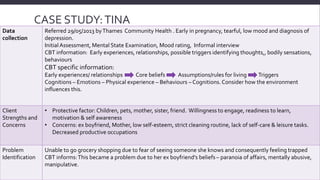
CASE STUDY: TINA 
DOB 01/06/1982 – 31YRS Data 
collection 
Referred 29/05/2013 by Thames Community Health . Early in pregnancy, tearful, low mood and diagnosis of 
depression. 
Initial Assessment, Mental State Examination, Mood rating, Informal interview 
CBT information: Early experiences, relationships, possible triggers identifying thoughts,, bodily sensations, 
behaviours 
CBT specific information: 
Early experiences/ relationships Core beliefs Assumptions/rules for living Triggers 
Cognitions – Emotions – Physical experience – Behaviours – Cognitions. Consider how the environment 
influences this. 
Client 
Strengths and 
Concerns 
• Protective factor: Children, pets, mother, sister, friend. Willingness to engage, readiness to learn, 
motivation & self awareness 
• Concerns: ex boyfriend, Mother, low self-esteem, strict cleaning routine, lack of self-care & leisure tasks. 
Decreased productive occupations 
Problem 
Identification 
Unable to go grocery shopping due to fear of seeing someone she knows and consequently feeling trapped 
CBT informs: This became a problem due to her ex boyfriend’s beliefs – paranoia of affairs, mentally abusive, 
manipulative.
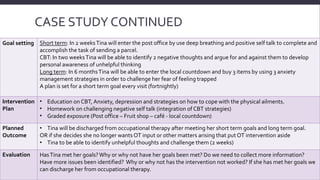
CASE STUDY CONTINUED 
Goal setting Short term: In 2 weeks Tina will enter the post office by use deep breathing and positive self talk to complete and 
accomplish the task of sending a parcel. 
CBT: In two weeks Tina will be able to identify 2 negative thoughts and argue for and against them to develop 
personal awareness of unhelpful thinking 
Long term: In 6 months Tina will be able to enter the local countdown and buy 3 items by using 3 anxiety 
management strategies in order to challenge her fear of feeling trapped 
A plan is set for a short term goal every visit (fortnightly) 
Intervention 
Plan 
• Education on CBT, Anxiety, depression and strategies on how to cope with the physical ailments. 
• Homework on challenging negative self talk (integration of CBT strategies) 
• Graded exposure (Post office – Fruit shop – café - local countdown) 
Planned 
Outcome 
• Tina will be discharged from occupational therapy after meeting her short term goals and long term goal. 
OR if she decides she no longer wants OT input or other matters arising that put OT intervention aside 
• Tina to be able to identify unhelpful thoughts and challenge them (2 weeks) 
Evaluation Has Tina met her goals? Why or why not have her goals been met? Do we need to collect more information? 
Have more issues been identified? Why or why not has the intervention not worked? If she has met her goals we 
can discharge her from occupational therapy.
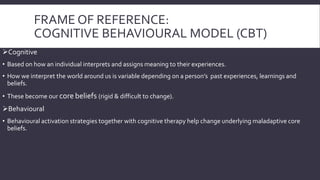
FRAME OF REFERENCE: 
COGNITIVE BEHAVIOURAL MODEL (CBT) 
Cognitive 
• Based on how an individual interprets and assigns meaning to their experiences. 
• How we interpret the world around us is variable depending on a person’s past experiences, learnings and 
beliefs. 
• These become our core beliefs (rigid & difficult to change). 
Behavioural 
• Behavioural activation strategies together with cognitive therapy help change underlying maladaptive core 
beliefs.
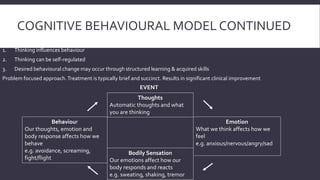
COGNITIVE BEHAVIOURAL MODEL CONTINUED 
1. Thinking influences behaviour 
2. Thinking can be self-regulated 
3. Desired behavioural change may occur through structured learning & acquired skills 
Problem focused approach. Treatment is typically brief and succinct. Results in significant clinical improvement 
Thoughts 
Automatic thoughts and what 
you are thinking 
Bodily Sensation 
Our emotions affect how our 
body responds and reacts 
e.g. sweating, shaking, tremor 
Emotion 
What we think affects how we 
feel 
e.g. anxious/nervous/angry/sad 
Behaviour 
Our thoughts, emotion and 
body response affects how we 
behave 
e.g. avoidance, screaming, 
fight/flight 
EVENT
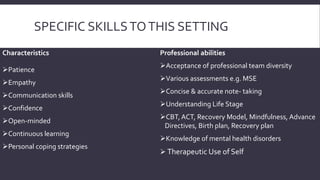
SPECIFIC SKILLS TO THIS SETTING 
Characteristics 
Patience 
Empathy 
Communication skills 
Confidence 
Open-minded 
Continuous learning 
Personal coping strategies 
Professional abilities 
Acceptance of professional team diversity 
Various assessments e.g. MSE 
Concise & accurate note- taking 
Understanding Life Stage 
CBT, ACT, Recovery Model, Mindfulness, Advance 
Directives, Birth plan, Recovery plan 
Knowledge of mental health disorders 
 Therapeutic Use of Self
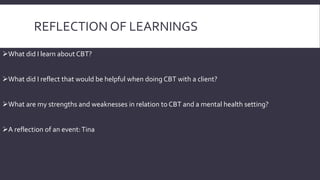
REFLECTION OF LEARNINGS 
What did I learn about CBT? 
What did I reflect that would be helpful when doing CBT with a client? 
What are my strengths and weaknesses in relation to CBT and a mental health setting? 
A reflection of an event: Tina
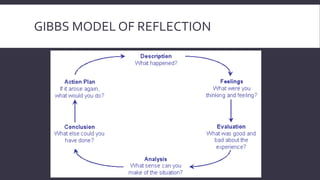
GIBBS MODEL OF REFLECTION
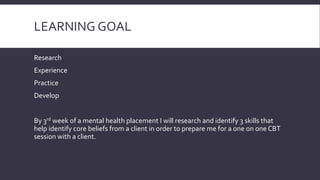
LEARNING GOAL 
Research 
Experience 
Practice 
Develop 
By 3rd week of a mental health placement I will research and identify 3 skills that 
help identify core beliefs from a client in order to prepare me for a one on one CBT 
session with a client.

Perinatal Mental Health

  • 1.
    PERINATAL MENTAL HEALTH SERVICE Jess Bacchus: Frames of Reference
  • 2.
    CLIENT GROUP EntryCriteria Referral Process Number of Clients Multi Disciplinary Team (MDT)
  • 3.
    CASE STUDY: TINA DOB 01/06/1982 – 31YRS Data collection Referred 29/05/2013 by Thames Community Health . Early in pregnancy, tearful, low mood and diagnosis of depression. Initial Assessment, Mental State Examination, Mood rating, Informal interview CBT information: Early experiences, relationships, possible triggers identifying thoughts,, bodily sensations, behaviours CBT specific information: Early experiences/ relationships Core beliefs Assumptions/rules for living Triggers Cognitions – Emotions – Physical experience – Behaviours – Cognitions. Consider how the environment influences this. Client Strengths and Concerns • Protective factor: Children, pets, mother, sister, friend. Willingness to engage, readiness to learn, motivation & self awareness • Concerns: ex boyfriend, Mother, low self-esteem, strict cleaning routine, lack of self-care & leisure tasks. Decreased productive occupations Problem Identification Unable to go grocery shopping due to fear of seeing someone she knows and consequently feeling trapped CBT informs: This became a problem due to her ex boyfriend’s beliefs – paranoia of affairs, mentally abusive, manipulative.
  • 4.
    CASE STUDY CONTINUED Goal setting Short term: In 2 weeks Tina will enter the post office by use deep breathing and positive self talk to complete and accomplish the task of sending a parcel. CBT: In two weeks Tina will be able to identify 2 negative thoughts and argue for and against them to develop personal awareness of unhelpful thinking Long term: In 6 months Tina will be able to enter the local countdown and buy 3 items by using 3 anxiety management strategies in order to challenge her fear of feeling trapped A plan is set for a short term goal every visit (fortnightly) Intervention Plan • Education on CBT, Anxiety, depression and strategies on how to cope with the physical ailments. • Homework on challenging negative self talk (integration of CBT strategies) • Graded exposure (Post office – Fruit shop – café - local countdown) Planned Outcome • Tina will be discharged from occupational therapy after meeting her short term goals and long term goal. OR if she decides she no longer wants OT input or other matters arising that put OT intervention aside • Tina to be able to identify unhelpful thoughts and challenge them (2 weeks) Evaluation Has Tina met her goals? Why or why not have her goals been met? Do we need to collect more information? Have more issues been identified? Why or why not has the intervention not worked? If she has met her goals we can discharge her from occupational therapy.
  • 5.
    FRAME OF REFERENCE: COGNITIVE BEHAVIOURAL MODEL (CBT) Cognitive • Based on how an individual interprets and assigns meaning to their experiences. • How we interpret the world around us is variable depending on a person’s past experiences, learnings and beliefs. • These become our core beliefs (rigid & difficult to change). Behavioural • Behavioural activation strategies together with cognitive therapy help change underlying maladaptive core beliefs.
  • 6.
    COGNITIVE BEHAVIOURAL MODELCONTINUED 1. Thinking influences behaviour 2. Thinking can be self-regulated 3. Desired behavioural change may occur through structured learning & acquired skills Problem focused approach. Treatment is typically brief and succinct. Results in significant clinical improvement Thoughts Automatic thoughts and what you are thinking Bodily Sensation Our emotions affect how our body responds and reacts e.g. sweating, shaking, tremor Emotion What we think affects how we feel e.g. anxious/nervous/angry/sad Behaviour Our thoughts, emotion and body response affects how we behave e.g. avoidance, screaming, fight/flight EVENT
  • 7.
    SPECIFIC SKILLS TOTHIS SETTING Characteristics Patience Empathy Communication skills Confidence Open-minded Continuous learning Personal coping strategies Professional abilities Acceptance of professional team diversity Various assessments e.g. MSE Concise & accurate note- taking Understanding Life Stage CBT, ACT, Recovery Model, Mindfulness, Advance Directives, Birth plan, Recovery plan Knowledge of mental health disorders  Therapeutic Use of Self
  • 8.
    REFLECTION OF LEARNINGS What did I learn about CBT? What did I reflect that would be helpful when doing CBT with a client? What are my strengths and weaknesses in relation to CBT and a mental health setting? A reflection of an event: Tina
  • 9.
    GIBBS MODEL OFREFLECTION
  • 10.
    LEARNING GOAL Research Experience Practice Develop By 3rd week of a mental health placement I will research and identify 3 skills that help identify core beliefs from a client in order to prepare me for a one on one CBT session with a client.