1
Chapter Seven
Basic Elements of Planning and Decision
Making
2
Decision Making and the
Planning Process
Decision making
◦ Is the cornerstone of planning.
◦ Is the catalyst that drives the planning process.
◦ Underlies every aspect of setting goals and
formulating plans.
Planning
◦ All organizations plan, but not in the same
fashion.
◦ All planning occurs within an environmental
context.
◦ All goals require plans to guide in their
achievement.
◦ All goals are tied higher goals and plans
3
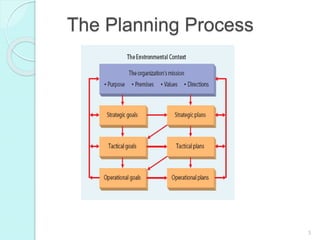
The Planning Process
4
Organizational Goals
Goals are critical to organizational effectiveness and
serve a number of purposes.
Purposes of goals:
◦ Provide guidance.
◦ Promote good planning.
◦ Serve as sources of motivation.
◦ Mechanism for evaluation and control.
5
Kinds of Goals
By Level
◦ Mission statement
◦ Strategic goals
◦ Tactical goals
◦ Operational goals
By Area
◦ Different functional areas of the organization.
By Time Frame
◦ Long-term, intermediate-term, or short-term time
frames and explicit time frames or open-ended.
Copyright © Houghton Mifflin
Company. All rights
reserved. 7 - 6
Kinds of Goals( Level)
Mission: a statement of an organization’s
fundamental purpose.
Strategic goal: a goal set by and for top
management of the organization.
Tactical goal: set by and for middle managers
of the organization.
Operational goal: set by and for lower
managers of the organization.
Copyright © Houghton Mifflin Company.
All rights reserved.
7 -
7
Other Goals
Area: organizations also set goals
for different areas.
Time frame: organizations also set
goals across different time frames.
8
Responsibilities of Setting
Goals
Who Sets Goals?
◦ All managers: managerial responsibility for
goal setting should correspond to the
manager’s level in the organization.
Managing Multiple Goals
◦ When setting goals organizations sometimes
experience conflicts or contradictions among
goals.
◦ Conflicts are addressed through the use of the
Optimizing concept:
Optimizing: balancing and reconciling possible conflicts
among goals.
Copyright © Houghton Mifflin
Company. All rights
reserved. 7 - 9
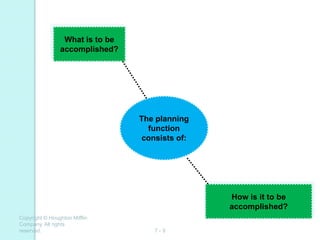
The planning
function
consists of:
What is to be
accomplished?
How is it to be
accomplished?
Copyright © Houghton Mifflin
Company. All rights
reserved. 7 - 10
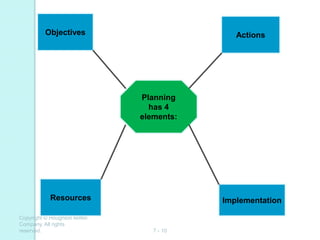
Planning
has 4
elements:
Objectives Actions
Resources Implementation
Copyright © Houghton Mifflin
Company. All rights
reserved. 7 - 11
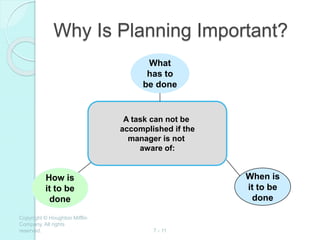
Why Is Planning Important?
A task can not be
accomplished if the
manager is not
aware of:
How is
it to be
done
What
has to
be done
When is
it to be
done
12
Kinds of Organizational Plans
Strategic Plans
◦ A general plan set by and for top management
that outlines resource allocation, priorities, and
action steps to achieve strategic goals.
Tactical Plans
◦ A plan aimed at achieving the tactical goals set
by and for middle management.
Operational Plans
◦ Short-term focus plans that are set by and for
lower-level managers.
13
Time Frames for Planning
The Time Dimension of Planning
◦ Planning must provide sufficient time to fulfill the
managerial commitments involved.
Long-range Plans
◦ Cover present and future strategic issues extending
beyond five years in the future.
Intermediate Plans
◦ Cover from 1 to 5 years and parallel tactical plans.
◦ Are the principal focus of organizational planning
efforts.
Short-range Plans
◦ Are action plans and reaction (contingency) plans that
have a time frame of one year or less.
14
Responsibilities for Planning
Planning Staff
◦ Gather information, coordinate planning activities,
and take a broader view than individual managers.
Planning Task Force
◦ Created when the organization wants a special
circumstance addressed.
Board of Directors
◦ Establishes corporate mission and strategy.
◦ May engage in strategic planning.
Chief Executive Officer
◦ May serve as president or board chair; has a major
role in planning and implementing the strategy.
15
Responsibilities for Planning
Executive Committee
◦ Composed of top executives.
◦ Meets regularly with the CEO to
review strategic plans.
 Line Management
 Have formal authority and
responsibility for management of
the organization.
 Help to formulate strategy by
providing information.
 Responsible for executing the
plans of top management.
Copyright © Houghton Mifflin Company.
All rights reserved.
7 -
16
Contingency Planning
The determination of
alternative courses of
action to be taken if
an intended plan of
action is
unexpectedly
disrupted or rendered
inappropriate.
Copyright © Houghton Mifflin Company.
All rights reserved.
7 -
17
Crisis Management
The set of procedures
the organization uses
in the event of a
disaster or other
unexpected calamity.
A related concept is
the set of procedures
the organization uses
in the event of a
disaster or other
unexpected calamity.
Copyright © Houghton Mifflin
Company. All rights
reserved. 7 - 18
Tactical Planning
The development and executing of
tactical plans:
◦ Tactical plans are used to accomplish
specific parts of a strategic plan. Each
strategic plan is generally implemented
through several tactical plans. Effective
tactical planning involves both
development and execution.
Operational Planning
Single use plans
Programs
Project
Standing Plans
Policies
Standard operating Procedure
19
Operational Planning
Single use plans
Developed to carry out a course of
action that is not likely to be repeated in
the future.
Programs
A single use plan for a large set of
activities.
Project
A s ingle-use plan of less scope and
complexity than a program.
20
Operational Planning
Standing Plan
Developed for activities that recur regularly over
a period of time.
Policies
A standing plan that specifies the organization’s
general response to a designated problem of
situation.
Standard operating Procedure
A standard plan that outlines the steps to be
followed in particular circumstances.
21
22
Managing Goal-Setting and
Planning Processes
Barriers to Goal Setting and Planning
◦ As part of managing the goal-setting and
planning process, managers must
understand the barriers that can disrupt
them.
◦ Managers must also know how to
overcome them.
Copyright © Houghton Mifflin
Company. All rights
reserved. 7 - 23
Barriers to Goal Setting and
Planning
Major Barriers
◦ Inappropriate goals.
◦ Improper reward
system.
◦ Dynamic and
complex
environment.
◦ Reluctance to
establish goals.
◦ Resistance to
change.
◦ Constraints.
Overcoming Barriers
◦ Understanding the
purposes of goals
and planning.
◦ Communication and
participation.
◦ Consistency, revision,
and updating.
◦ Effective reward
system.

Management Chapter-7

  • 1.
    1 Chapter Seven Basic Elementsof Planning and Decision Making
  • 2.
    2 Decision Making andthe Planning Process Decision making ◦ Is the cornerstone of planning. ◦ Is the catalyst that drives the planning process. ◦ Underlies every aspect of setting goals and formulating plans. Planning ◦ All organizations plan, but not in the same fashion. ◦ All planning occurs within an environmental context. ◦ All goals require plans to guide in their achievement. ◦ All goals are tied higher goals and plans
  • 3.
  • 4.
    4 Organizational Goals Goals arecritical to organizational effectiveness and serve a number of purposes. Purposes of goals: ◦ Provide guidance. ◦ Promote good planning. ◦ Serve as sources of motivation. ◦ Mechanism for evaluation and control.
  • 5.
    5 Kinds of Goals ByLevel ◦ Mission statement ◦ Strategic goals ◦ Tactical goals ◦ Operational goals By Area ◦ Different functional areas of the organization. By Time Frame ◦ Long-term, intermediate-term, or short-term time frames and explicit time frames or open-ended.
  • 6.
    Copyright © HoughtonMifflin Company. All rights reserved. 7 - 6 Kinds of Goals( Level) Mission: a statement of an organization’s fundamental purpose. Strategic goal: a goal set by and for top management of the organization. Tactical goal: set by and for middle managers of the organization. Operational goal: set by and for lower managers of the organization.
  • 7.
    Copyright © HoughtonMifflin Company. All rights reserved. 7 - 7 Other Goals Area: organizations also set goals for different areas. Time frame: organizations also set goals across different time frames.
  • 8.
    8 Responsibilities of Setting Goals WhoSets Goals? ◦ All managers: managerial responsibility for goal setting should correspond to the manager’s level in the organization. Managing Multiple Goals ◦ When setting goals organizations sometimes experience conflicts or contradictions among goals. ◦ Conflicts are addressed through the use of the Optimizing concept: Optimizing: balancing and reconciling possible conflicts among goals.
  • 9.
    Copyright © HoughtonMifflin Company. All rights reserved. 7 - 9 The planning function consists of: What is to be accomplished? How is it to be accomplished?
  • 10.
    Copyright © HoughtonMifflin Company. All rights reserved. 7 - 10 Planning has 4 elements: Objectives Actions Resources Implementation
  • 11.
    Copyright © HoughtonMifflin Company. All rights reserved. 7 - 11 Why Is Planning Important? A task can not be accomplished if the manager is not aware of: How is it to be done What has to be done When is it to be done
  • 12.
    12 Kinds of OrganizationalPlans Strategic Plans ◦ A general plan set by and for top management that outlines resource allocation, priorities, and action steps to achieve strategic goals. Tactical Plans ◦ A plan aimed at achieving the tactical goals set by and for middle management. Operational Plans ◦ Short-term focus plans that are set by and for lower-level managers.
  • 13.
    13 Time Frames forPlanning The Time Dimension of Planning ◦ Planning must provide sufficient time to fulfill the managerial commitments involved. Long-range Plans ◦ Cover present and future strategic issues extending beyond five years in the future. Intermediate Plans ◦ Cover from 1 to 5 years and parallel tactical plans. ◦ Are the principal focus of organizational planning efforts. Short-range Plans ◦ Are action plans and reaction (contingency) plans that have a time frame of one year or less.
  • 14.
    14 Responsibilities for Planning PlanningStaff ◦ Gather information, coordinate planning activities, and take a broader view than individual managers. Planning Task Force ◦ Created when the organization wants a special circumstance addressed. Board of Directors ◦ Establishes corporate mission and strategy. ◦ May engage in strategic planning. Chief Executive Officer ◦ May serve as president or board chair; has a major role in planning and implementing the strategy.
  • 15.
    15 Responsibilities for Planning ExecutiveCommittee ◦ Composed of top executives. ◦ Meets regularly with the CEO to review strategic plans.  Line Management  Have formal authority and responsibility for management of the organization.  Help to formulate strategy by providing information.  Responsible for executing the plans of top management.
  • 16.
    Copyright © HoughtonMifflin Company. All rights reserved. 7 - 16 Contingency Planning The determination of alternative courses of action to be taken if an intended plan of action is unexpectedly disrupted or rendered inappropriate.
  • 17.
    Copyright © HoughtonMifflin Company. All rights reserved. 7 - 17 Crisis Management The set of procedures the organization uses in the event of a disaster or other unexpected calamity. A related concept is the set of procedures the organization uses in the event of a disaster or other unexpected calamity.
  • 18.
    Copyright © HoughtonMifflin Company. All rights reserved. 7 - 18 Tactical Planning The development and executing of tactical plans: ◦ Tactical plans are used to accomplish specific parts of a strategic plan. Each strategic plan is generally implemented through several tactical plans. Effective tactical planning involves both development and execution.
  • 19.
    Operational Planning Single useplans Programs Project Standing Plans Policies Standard operating Procedure 19
  • 20.
    Operational Planning Single useplans Developed to carry out a course of action that is not likely to be repeated in the future. Programs A single use plan for a large set of activities. Project A s ingle-use plan of less scope and complexity than a program. 20
  • 21.
    Operational Planning Standing Plan Developedfor activities that recur regularly over a period of time. Policies A standing plan that specifies the organization’s general response to a designated problem of situation. Standard operating Procedure A standard plan that outlines the steps to be followed in particular circumstances. 21
  • 22.
    22 Managing Goal-Setting and PlanningProcesses Barriers to Goal Setting and Planning ◦ As part of managing the goal-setting and planning process, managers must understand the barriers that can disrupt them. ◦ Managers must also know how to overcome them.
  • 23.
    Copyright © HoughtonMifflin Company. All rights reserved. 7 - 23 Barriers to Goal Setting and Planning Major Barriers ◦ Inappropriate goals. ◦ Improper reward system. ◦ Dynamic and complex environment. ◦ Reluctance to establish goals. ◦ Resistance to change. ◦ Constraints. Overcoming Barriers ◦ Understanding the purposes of goals and planning. ◦ Communication and participation. ◦ Consistency, revision, and updating. ◦ Effective reward system.