(eBook PDF) Operations Strategy 6th Edition
download
https://ebookluna.com/product/ebook-pdf-operations-strategy-6th-
edition/
Download more ebook from https://ebookluna.com
OPERATIONS
STRATEGY
NIGEL SLACK
MICHAEL LEWIS
SIXTH EDITION
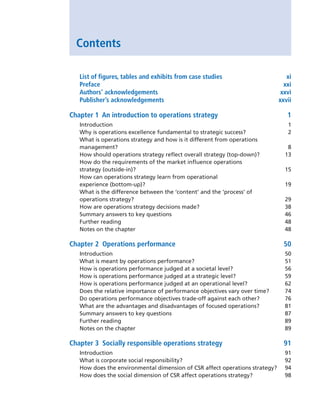
Contents
List of figures, tables and exhibits from case studies xi
Preface xxi
Authors’ acknowledgements xxvi
Publisher’s acknowledgements xxvii
Chapter 1 An introduction to operations strategy 1
Introduction 1
Why is operations excellence fundamental to strategic success? 2
What is operations strategy and how is it different from operations
management? 8
How should operations strategy reflect overall strategy (top-down)? 13
How do the requirements of the market influence operations
strategy (outside-in)? 15
How can operations strategy learn from operational
experience (bottom-up)? 19
What is the difference between the ‘content’ and the ‘process’ of
operations strategy? 29
How are operations strategy decisions made? 38
Summary answers to key questions 46
Further reading 48
Notes on the chapter 48
Chapter 2 Operations performance 50
Introduction 50
What is meant by operations performance? 51
How is operations performance judged at a societal level? 56
How is operations performance judged at a strategic level? 59
How is operations performance judged at an operational level? 62
Does the relative importance of performance objectives vary over time? 74
Do operations performance objectives trade-off against each other? 76
What are the advantages and disadvantages of focused operations? 81
Summary answers to key questions 87
Further reading 89
Notes on the chapter 89
Chapter 3 Socially responsible operations strategy 91
Introduction 91
What is corporate social responsibility? 92
How does the environmental dimension of CSR affect operations strategy? 94
How does the social dimension of CSR affect operations strategy? 98
viii Contents
How does the economic dimension of CSR affect operations strategy? 102
How does the stakeholder dimension of CSR affect operations strategy? 104
How does the voluntary dimension of CSR affect operations strategy? 109
How can operations managers analyse CSR issues? 112
Summary answers to key questions 115
Selected further reading 117
Notes on the chapter 117
Chapter 4 Capacity strategy 119
Introduction 119
What is capacity strategy? 120
How much capacity should an operation have? 121
How many separate sites should an operation have? 131
What issues are important when changing capacity levels? 133
What tasks should be allocated to sites? 141
Where should capacity be located? 142
Summary answers to key questions 149
Further reading 151
Notes on the chapter 151
Chapter 5 Purchasing and supply strategy 152
Introduction 152
What is purchasing and supply strategy? 153
What should we do and what should we buy? 163
What is the role of contracts and/or relationships? 168
How do we manage supply dynamics? 177
How do we manage supply networks over time? 183
How do we manage supply chain risks? 188
Summary answers to key questions 190
Further reading 192
Notes on the chapter 192
Chapter 6 Process technology strategy 193
Introduction 193
What is process technology strategy and why is it
getting more important? 194
How can process technology be characterised? 202
How do market volume and variety influence process technology? 206
How can process technology be evaluated strategically? 217
Summary answers to key questions 230
Further reading 233
Notes on the chapter 233
Chapter 7 Improvement strategy 235
Introduction 235
What are the different approaches to improvement? 235
ix
Contents
How do the needs of the market direct the ongoing development of
operations processes? 248
How can the ongoing management and control of operations be
harnessed to develop their capabilities? 260
What can operations do to deploy their capabilities into the market? 271
Summary answers to key questions 273
Further reading 275
Notes on the chapter 275
Chapter 8 Product and service development and organisation 277
Introduction 277
What is the relationship between innovation, design and creativity? 277
Why is the way in which companies develop their products and services
so important? 281
What process do companies use to develop products and services? 287
How should the effectiveness of the product and service development
process be judged in terms of fulfilling market requirements? 295
What operations resource-based decisions define a company’s product
and service development strategy? 299
Summary answers to key questions 308
Further reading 309
Notes on the chapter 310
Chapter 9 The process of operations strategy – formulation and
implementation 311
Introduction 311
What is the ‘formulation’ of operations strategy? 312
What is involved in maintaining alignment over time? 316
What analysis is needed for formulation? 324
What is operations strategy implementation? 332
Who can be responsible for implementation? 335
Summary answers to key questions 342
Further reading 343
Notes on the chapter 344
Chapter 10 The process of operations strategy – monitoring
and control 345
Introduction 345
What are the differences between operational and strategic
monitoring and control? 346
How is progress towards strategic objectives tracked? 350
How can the monitoring and control process attempt to control risks? 355
How does learning contribute to strategic control? 363
Summary answers to key questions 371
Further reading 373
Notes on the chapter 373
x Contents
Topics covered in case studies 375
List of case studies 377
Aarens Electronic 379
Aztec Component Supplies 383
Carglass®
: building and sustaining a customer-centric organisation 385
Clever Consulting 399
Delta Synthetic Fibres (DSF) 401
Developing ‘Savory Rosti-crisps’ at Dreddo Dan’s 407
Disneyland Resort Paris 411
Dresding Medical 418
Hagen Style 420
Hartford Building Society: to measure, or not to measure? 422
Holmart and Wersa: the food waste partnership 428
McDonald’s: half a century of growth 433
Ontario Facilities Equity Management (OFEM) 439
Slagelse Industrial Services (SIS) 443
The Thought Space partnership 446
Turnround at the Preston Plant 449
Zara’s operating model 453
Zentrill 458
Index 460
Figures
Figure 1.1 This chapter looks at the fundamentals of operations strategy 1
Figure 1.2 All operations transform input resources into products
and services 3
Figure 1.3 The hierarchy of operations describes networks at different
levels of analysis. Three are illustrated here: the supply
network, the operation, and the process 5
Figure 1.4 The Four Vs analysis for the changing emphasis of retail
banking services from branch-based to online 8
Figure 1.5 The four perspectives on operations strategy: top-down,
bottom-up, market requirements (outside-in), and
operations resources (inside-out) 13
Figure 1.6 Correspondence and coherence are the two requirements
of the top-down perspective of operations strategy 14
Figure 1.7 The outside-in element of operations strategy translates
the requirements of the market into a set of operations
performance objectives 18
Figure 1.8 The bottom-up element of operations strategy is to learn
from day-to-day experiences and convert the knowledge
gained into strategic capabilities 20
Figure 1.9 The inside-out element of operations strategy develops the
capabilities of the operation’s resources and processes 21
Figure 1.10 The four features of the VRIO framework 26
Figure 1.11 Top-down, outside-in, bottom-up, and inside-out
perspectives of the Heftexx operations strategy 29
Figure 1.12 The content of operations strategy involves the strategic
reconciliation of market requirements with operations resources 30
Figure 1.13 Decomposing the ratio profit / total assets to derive the four
strategic decision areas of operations strategy 34
Figure 1.14 The process of operations strategy reconciles the top-down
and bottom-up perspectives 37
Figure 1.15 The stages of the process of operations strategy 37
Figure 1.16 Operations strategy matrix for Pret A Manager 41
List of figures, tables and exhibits
from case studies
xii List of figures, tables and exhibits from case studies
Figure 1.17 (a) The decision matrix, (b) The decision tree for the
simplified strategy choice decision 43
Figure 1.18 Operations strategy map for an airline fuel supply company 44
Figure 2.1 This chapter looks at operations strategic performance 50
Figure 2.2 Hayes and Wheelwright’s four-stage model of
operations contribution sees operations as moving from
implementation of strategy, through to supporting
strategy, and finally driving strategy 54
Figure 2.3 Three levels of operations performance 56
Figure 2.4 Significant times for the delivery of two products/services 64
Figure 2.5 Different product groups require different performance
objectives 70
Figure 2.6 Polar diagrams for newspaper collection (NC) and general
recycling (GR) services and a proposed police performance
method 71
Figure 2.7 Qualifiers, order-winners and delights expressed in terms
of their competitive benefit with achieved performance.
Note: there is an erosion of delights and order-winners
over time. 72
Figure 2.8 What is the operation doing today to develop the
capabilities which will provide the ‘Delights’ of the future? 74
Figure 2.9 The effects of the product/service life cycle on operations
performance objectives 75
Figure 2.10 The efficient frontier 80
Figure 2.11 Burning bridges behind you increases commitment but
reduces flexibility 85
Figure 3.1 Socially responsible operations strategy 91
Figure 3.2 The five ‘dimensions’ of CSR and examples of phrases used
in defining CSR 93
Figure 3.3 Waste product recycling at Marmite 94
Figure 3.4 Broad strategic objectives for a parcel delivery operation
applied to stakeholder groups 104
Figure 3.5 Building-up to full community acceptance (social licence
to operate) 107
Figure 3.6 Examples of corporate philanthropy 111
Figure 3.7 The Carroll pyramid (Based on the work of Carroll, A.B.
(1991) The pyramid of social responsibility: Towards
the moral management of organizational stakeholders,
Business Horizons, July/August) 111
xiii
List of figures, tables and exhibits from case studies
Figure 3.8 To what extent do social and financial performance trade-off? 114
Figure 3.9 CSR as risk management 114
Figure 4.1 This chapter looks at capacity strategy 119
Figure 4.2 Issues covered in capacity strategy 121
Figure 4.3 The interplay between capacity, demand, competition,
utilisation, costs and revenues can be complex, as in the
airfreight example 123
Figure 4.4 Cost, volume, profit illustration 126
Figure 4.5 Unit cost curves 128
Figure 4.6 Expanding physical capacity in advance of effective
capacity can bring greater returns in the longer term 131
Figure 4.7 (a) Capacity leading and capacity lagging strategies, and
(b) Smoothing with inventory means using the excess
capacity of one period to produce inventory which can be
used to supply the under-capacity period 135
Figure 4.8 (a) Capacity plans for meeting demand using either 800-
or 400-unit capacity plants, and (b) Smaller scale capacity
increments allow the capacity plan to be adjusted to
accommodate changes in demand 137
Figure 4.9 Decision tree for simple capacity expansion example
showing investment (in brackets) and additional profit
over a two-year period 139
Figure 4.10 Rarely does each stage of a supply chain have perfectly
balanced capacity because of different optimum capacity
increments 140
Figure 4.11 Utilisation or focus? Long- and short-term
considerations differ 142
Figure 5.1 This chapter looks at purchasing and supply strategy 152
Figure 5.2 Supply networks are the interconnections of relationships
between operations 154
Figure 5.3 (a) Dyadic relationships in a simple supply network and
example (b) Triadic relationship and example 155
Figure 5.4 The value net (based on Brandenburger and Nalebuff) 158
Figure 5.5 Wimbledon’s tennis balls travel over 80,000 kilometres in
their supply network 161
Figure 5.6 Types of supply arrangement 163
Figure 5.7 The operations scope decision should include both
strategic and operational analysis 167
xiv List of figures, tables and exhibits from case studies
Figure 5.8 Supply arrangements are a balance between contracting
and relationship 169
Figure 5.9 Elements of partnership relationships 171
Figure 5.10 Fluctuations of production levels along supply chain in
response to small change in end-customer demand 178
Figure 5.11 Potential perception mismatches in supply chains 181
Figure 5.12 Typical supply chain dynamics 182
Figure 5.13 Single-, multi-, cross- and omni-channel retail models 184
Figure 5.14 Matching the operations resources in the supply chain
with market requirements 187
Figure 6.1 This chapter looks at process technology strategy 193
Figure 6.2 The generic form of technology road maps (TRM) 198
Figure 6.3 Simplified example of a technology road map for the
development of products/services, technologies, and
processes for a facilities management service 199
Figure 6.4 Some factors that govern the speed and extent of the
adoption of new process technologies 201
Figure 6.5 New and emerging technologies positioned relative to five
‘primary capabilities’: thinking/reasoning, seeing/sensing,
communicating/connecting, moving physical objects,
processing materials 203
Figure 6.6 The three dimensions of process technology are often
closely linked 213
Figure 6.7 The product–process matrix and the technology dimensions 214
Figure 6.8 Market pressures are requiring operations to be both
flexible and low cost 215
Figure 6.9 New developments in process technology can change the
cost-flexibility trade-off 216
Figure 6.10 Broad categories of evaluation criteria for evaluating
technologies 217
Figure 6.11 Cash inflows, outflows and requirements up to the finish
of the project (€000s) 219
Figure 6.12 Assessing the ‘acceptability’ of a process technology 220
Figure 6.13 Performance of laboratory analysis and data-based systems 226
Figure 6.14 Including all four perspectives in evaluation for a proposed
advanced predictive maintenance system 231
Figure 7.1 This chapter looks at improvement strategy 236
Figure 7.2 Three potential ways of achieving organisational ambidexterity 241
xv
List of figures, tables and exhibits from case studies
Figure 7.3 Some ‘pre-packaged’ improvement approaches positioned
in terms of their emphasis on what changes to make or how
to make the changes, and whether they emphasise rapid or
gradual change 246
Figure 7.4 The ‘direct’, ‘develop’, ‘deploy’ strategic improvement cycle 248
Figure 7.5 Directing improvement is a cycle of comparing targets with
performance 249
Figure 7.6 Performance targets can involve different levels
of aggregation 250
Figure 7.7 Different standards of comparison give a different message 253
Figure 7.8 The importance–performance matrix 256
Figure 7.9 The importance–performance matrix for TAG’s ‘overnight
temperature controlled’ service 258
Figure 7.10 The sandcone model of improvement; cost reduction relies
on a cumulative foundation of improvement in the other
performance objectives 259
Figure 7.11 Log-log experience curve for a voucher processing centre 260
Figure 7.12 Knowledge management systems exploit the ability of
e-technologiestocollectknowledgeandconnectindividuals
and knowledge in order to encourage collaboration 265
Figure 7.13 The Nonaka and Takeuchi knowledge model 268
Figure 7.14 Process control may be one of the most operational of
tasks, but it can bring strategic benefits 270
Figure 7.15 Deploying operations capabilities to create market
potential means ensuring that the operations function is
expected to contribute to market positioning 271
Figure 8.1 This chapter looks at product and service development and
organisation 278
Figure 8.2 The relationship between creativity, innovation, and design 279
Figure 8.3 The S-shaped curve of innovation 279
Figure 8.4 The Henderson–Clark Model 281
Figure 8.5 The link between product/service development and process
development can be closer in service industries 284
Figure 8.6 Operations strategy analysis for product and service
development 288
Figure 8.7 A typical ‘stage model’ of the product and service
development process 289
Figure 8.8 (a) The idealised development funnel, and (b) The
development funnel for one company 293
xvi List of figures, tables and exhibits from case studies
Figure 8.9 (a)Sequentialarrangementofthestagesinthedevelopment
activity (b) Simultaneous arrangement of the stages in the
development activity 294
Figure 8.10 Slow and/or delayed development times, which can be the
result of quality or flexibility failures, will increase costs
and can reduce revenue 300
Figure 8.11 The ‘vicious cycle’ of under-resourcing
development capacity 301
Figure 8.12 Organisation structures for design processes 307
Figure 9.1 This chapter looks at the process of operations strategy –
formulation and implementation 311
Figure 9.2 The stages in the process of operations strategy, with the
formulation and implementation stages highlighted 313
Figure 9.3 In operations strategy ‘fit’ is the alignment between market
and operations capability 313
Figure 9.4 Align operations resources with market requirements, or
align market positioning with operations resources capabilities 315
Figure 9.5 Alignment over time at CAG Recycling Service 319
Figure 9.6 The relationship between the concepts of the ‘business
model’ and the ‘operating model’ 330
Figure 9.7 ‘Fit’ is concerned with ensuring comprehensiveness,
correspondence, coherence and criticality 330
Figure 9.8 Implementing an operations strategy that involves moving
from A to B means understanding current and intended
market requirements and operations resource capabilities
so that the extent and nature of the change can be assessed 333
Figure 9.9 A typology of the ‘central operations’ function 337
Figure 9.10 Information relationships for the four types of central
operations functions 339
Figure 10.1 This chapter looks at the process of operations strategy –
monitoring and control 345
Figure 10.2 The monitoring and control stages of the process of
operations strategy 346
Figure 10.3 Monitoring and control is less clear at a strategic level 347
Figure 10.4 The type of intervention that is appropriate can depend on
the nature of activities being controlled 348
Figure 10.5 Process objectives for centralisation of risk assessment
departments implementation 352
Figure 10.6 Measures used in the balanced scorecard 354
xvii
List of figures, tables and exhibits from case studies
Figure 10.7 Excessively tight ‘fit’ can increase the risks of misalignment
between market requirements and operations resource
capability 356
Figure 10.8 Implementing a strategy that moves an operation from A
to B may mean deviating from the ‘line of fit’ and therefore
exposing the operation to risk 357
Figure 10.9 Pure risk has only negative consequences (A to C).
Speculative risk can have both positive (A to B) and
negative (A to D, or A to E) consequences 358
Figure 10.10 Strategic risk management involves prevention, mitigation,
and recovery strategies 359
Figure 10.11 The reduction in performance during and after the
implementation of a new technology reflects
‘adjustment costs’ 361
Figure 10.12 Single-loop learning and the potential limitations of
single-loop learning 365
Figure 10.13 Double-loop learning questions the appropriateness of
operations 365
Figure 10.14 Learning potential depends on both resource and process
‘distance’ 369
Figure 10.15 The power– interest grid 370
Tables
Table 1.1 Examples of operations management and operations
strategy questions 12
Table 1.2 Competitive factors for three operations grouped under
their generic performance objectives 31
Table 1.3 Some decisions in each decision area for a hotel chain and
an automobile manufacturer 35
Table 2.1 Examples of ‘hard’ and ‘soft’ dimensions of specification quality 63
Table 2.2 The range and response dimensions of the four types of
total operations flexibility 66
Table 2.3 Internal and external benefits of excelling at each
performance objective 69
Table 2.4 Firms can use various criteria to ‘focus’ their operations 84
Table 3.1 Some environmental considerations of operations strategy
decisions 97
Table 3.2 Some social considerations of operations strategy decisions 101
Table 3.3 Typical stakeholders’ performance objectives 108
xviii List of figures, tables and exhibits from case studies
Table 4.1 Three levels of capacity decision 122
Table 4.2 Analysis of existing operation and two options 132
Table 4.3 The advantages and disadvantages of pure leading, pure
lagging and smoothing-with-inventories strategies of
capacity timing 136
Table 5.1 How in-house and outsourced supply may affect an
operation’s performance objectives 164
Table 5.2 A summary of some problems that can arise from
asymmetric information 170
Table 5.3 Understanding the qualitative dynamics of supply chains 181
Table 5.4 Coordinating mechanisms for reducing supply chain
dynamic instability 186
Table 5.5 Indicative purchasing and supply related risks 190
Table 6.1 Some process technologies classified by their primary inputs 203
Table 6.2 Evaluating the acceptability of process technology
investment on market criteria 222
Table 6.3 The four dimensions of ‘strategic’ operations resources 224
Table 7.1 Some features of continuous/exploitation improvement
and breakthrough/exploration improvement 238
Table 7.2 The degree of process change can be characterised by
changes in the arrangement and nature of process activities 239
Table 7.3 Some typical partial measures of performance 252
Table 7.4 Characteristics of Bohn’s eight stages of process knowledge 262
Table 8.1 The degree of product/service change can affect both its
external appearance and its internal methodology/technology 283
Table 9.1 Internal and external ‘defensive’ static mechanisms of
sustainability 322
Table 9.2 Some possible operations-related factors in a SWOT analysis 325
Table 10.1 Type I and type II errors for the control of an operations
strategy implementation 363
Exhibits from case studies
Carglass®
: building and sustaining a customer-centric organisation 385
Exhibit 1 Presentation of the Belron® Group (Figures 2009) 386
Exhibit 2 From opportunity to job: The Waterfall concept (Figures 2009) 389
Exhibit 3 The Carglass® Circle of Success 391
xix
List of figures, tables and exhibits from case studies
Exhibit 4 Carglass®’s leadership effectiveness 392
Exhibit 5a Carglass®’s overall employee satisfaction scores 393
Exhibit 5b Detailed employee satisfaction scores 393
Exhibit 6a Carglass®’s overall customer satisfaction scores 394
Exhibit 6b Detailed customer satisfaction scores (Figures 2009) 395
Exhibit 7 Carglass® financial information 396
Delta Synthetic Fibres (DSF) 401
Exhibit 1 Current market volumes by product and region, 2004
(millions of kg) 406
Exhibit 2 Forecasts for Britlene and Britlon ranges 406
Exhibit 3 Estimated Britlon capital costs 406
Holmart and Wersa: the food waste partnership 428
Exhibit 1 The Biogas process 429
Ontario Facilities Equity Management (OFEM) 439
Exhibit 1 Revenue projections for the three investment opportunities 442
Discovering Diverse Content Through
Random Scribd Documents
plainly the watch on her deck, and hear the officer swear at the
helmsman, saying:
"Keep her off, you damned sheep-herder, or you will cut that mud-
scow in two." Then he shouted over to me: "It is the captain of an
Irish locomotive you ought to be, you thick-headed pirate, trying to
run us down! What's the name of your ship, anyway?"
"Hardship loaded with Poverty," I replied with sarcasm.
As we passed each other the voice of the angry officer grew fainter
and fainter, then was lost in the stilly night under Southern skies.
I was amused at the expression of the officer on board of the
Yankee clipper, when he spoke of me as the captain of an Irish
locomotive. There could be no greater insult to a self-respecting
sailorman than this phrase. It means that you would do much better
carrying a hod or wheeling a wheelbarrow than handling a ship. I
had sailed in those down-east ships and knew their language. They
never intend to give one inch on land or sea. Hard luck indeed for
the sailor who does not know how to fight, or who shows a yellow
streak!
While thus meditating on the cruelties of the old oak ships and
thinking what wonderful tales they could tell, my thoughts were
suddenly interrupted by a consciousness of fear. Something warm
was moving about my feet. On looking down I beheld Toby rubbing
his black fur against my feet and legs....
On getting my position of ship at noon today, I noticed the crew
tiptoeing around as if they were afraid of disturbing some sleeping
baby. I spoke to Riley, asking what all the hush was about.
"Oh, be the Lord, sir, it is getting turrible on this auld graveyard of a
ship. Begorra, we are shure av it now. Auld Charlie seen him
prancing up and down the poop deck wid a poipe in his mouth. 'Tis
turrible days we be having. The cook said that he proved it himself
beyond a question of a doubt that the old bye himself is back on
her."
"Well, Riley, I am going to make the Old Man show down tonight. It
is put up or shut up for him." Laughing a little at my own fancies, I
went aft to the Captain's room, and sat down to watch, to continue
to investigate this mystery that was so upsetting the morals of the
crew as to endanger their efficiency.
I left the door to the dining-room half open so that the light hung
from the center of the ceiling threw its sickly rays into the room. I
could hear the man at the wheel make an occasional move with his
feet. Then all would be still again. One bell rang,—half-past twelve.
Suddenly the door slammed with a terrible bang. I knew that there
was no draught in the Captain's room to close it in this manner, and
I must confess that I was considerably startled. Then I was
conscious of some one moving a small stool that stood across from
me, over towards the safe at the foot of the bed. I put out my hands
to catch the visitor, and not finding anything but air, I reached out
and pulled the door open.
To my amazement, the stool had been moved to the safe. I was so
unnerved by this that my one thought was to get away, and I went
into the dining-room, and unconsciously lit my pipe. When my
thoughts sorted themselves it became clear to me that I had been
singled out by Destiny to have the privilege of meeting a great and
new and unseen Force. If this were so great as to be able to move
furniture at will, why, thought I, could it not be harnessed to our
material uses? Why could it not be developed to get sails and
discharge cargoes? Surely, it would revolutionize the forces of the air
and earth, as we know them now.
While these thoughts were taking shape in my mind, I was brought
up with a start by hearing three loud and distinct raps on the door of
the Captain's room.
I shook the ashes out of the old corn cob pipe, and entered the
room, closing the door behind me. This time I beheld still greater
marvels. At the head of the Captain's bed appeared a small light,
giving forth no rays, but moving around in the direction of the safe
at the foot of the bunk. There it stopped about a minute, then
moved over to the desk and gradually disappeared.
"Ah," said I, "you are getting too much for me. Move some more
furniture or that safe around this room so that I may alight upon a
plan to harness your great power to hand down to future ages."
At that I must have gone to sleep, for I was conscious of nothing
more until I heard the cook coming aft with coffee. He was anxious
to hear my experience during the middle watch. I told him that there
had been no occurrence that was not natural, but that I might have
news for him soon.
"Steward," said I, "tomorrow is Christmas Day. I want you to prepare
a good dinner for all hands."
"Oh, yes," he replied, "I have had plum pudding boiling since
yesterday. I am going to open a few cans of canned turkey. That,
with the cove oyster soup and canned carrots will make a good
dinner. I have had a little hard luck with my cake. I forgot to put
baking powder in it. But I think that they can get away with it, as
there is an abundance of raisins in it."
Christmas morning at half-past twelve found me waiting in the
Captain's room listening to rappings on the desk. At times these
were loud and then again very weak. I opened the door and turned
up the light in the dining-room so that there might be more
brightness in the Captain's room. I wanted to see and hear whatever
vibrations might be caused from the rappings. As I drew near the
writing desk the rapping was centered on the middle drawer. Then it
would move to a smaller drawer on the right-hand side and tap very
hard. With a shout of joy I sprang to the light at the head of the
bed, and lit it.
"At last," I cried, "at last!"
I was satisfied that there were rats in these drawers, and in order
that they should not get away I armed myself with a club. I started
to pull out the smaller drawer very carefully so that the rodent
should not make his escape. To my astonishment I found it locked. I
held my ear close to it, but could not hear a sound. Then I
proceeded to open the middle drawer with the same caution, but
found it open, and nothing in it but a small bunch of keys. My
curiosity being aroused, I decided to look for the key on this ring
that would open the smaller drawer. After many trials I found one
that would fit the lock and on opening it I found, neither the animal,
which in spite of my senses' evidence I half expected to see there,
nor any other expected alternative, but, most surprising of all, a pair
of tiny baby-shoes with a lock of yellow hair, tied with pink ribbon, in
each of them.
Back of the shoes was a jewel box, and in it a wedding-ring. Also,
wrapped up in paper, was a will made by our late Captain two days
before his death. This stated that he had an equity in an apartment
house in San Francisco, which he wanted his boys to have. Evidently
he had acquired this equity during his last visit to San Francisco. It
also stated that there should be no delay in forwarding this will to
the above address in West Berkeley, California, U. S. A.
With the discovery of the Captain's treasures, this essence of his
personality so revealed, I was carried out of my skepticism for the
moment, into feeling his presence beside me, waiting for my word as
a friend awaits the voice of a friend. Half unconsciously I spoke
aloud: "You have shown me, and I shall obey. You have only to call
upon me. Do not be anxious for your ship. I will tell your boys."
"A lonely, lonely Christmas," echoed back vaguely, whether from
Beyond or from the storehouse of my imagination, I do not know.
As I replaced his things and started for the deck, the cook's words
echoed and re-echoed in my memory, "Does it end here?"
On deck Old Charlie was steering. Looking over the rail at the log, I
found that she was cutting the distance to Suva at the rate of nine
knots an hour. The breeze was warm, the turquoise sky studded with
diamond stars; the three especially bright ones known as the Sailors'
Yard were shining in all their splendor.
Away to the south the Southern Cross twinkled and glittered, and
was so majestic in its position, that it seemed to command
obedience from all other celestial bodies.
CHAPTER XIV
Christmas Day—Our Unwilling Guest the Dolphin
While gazing into the Infinite, analyzing the experience through
which I had just passed, and wondering where lay the Land of
Shadows, my dreaming was suddenly changed to material things by
hearing a terrible fight in the fore part of the ship. Jumping up on
the deck-load, and running forward, I could hear Riley shout:
"Club him, you old hen-catcher, you, before he goes through the
hawsepipe. That's the way, that's the way. Shure, bad luck to you,
you have missed him. Stand back there, stand back there, let me
have at him. There he goes again under the lumber. Get me the bar,
Pete. Look out, me byes. Shure and be Hivins out he comes again.
Strike him between the eyes, Pete. Give me the bar, Pete. Shure'n
you couldn't shtrike the sheep barn you was raised in."
"What's all this row about?" I asked.
"Ah, shure, sir, it's me auld friend Neptune would be after sendin' us
a Christmas present. He is as fine a bonita as iver greased a mouth,
but it's the divil's own toime we have had sub-duin' him."
"Bring him up on the deck-load and let us look him over."
"Riley," said I, when they had the great fish stretched out before us,
"that is a dolphin, and no bonita,—notice the wedge-shaped head,
and broad tail. No doubt he was cornered by a school of sword fish,
and this fastest fish that swims the ocean had to make a leap for life
by jumping aboard our ship. Bring the lantern here, and you will see
him change to all colors of the rainbow while he is dying, another
proof that he is a dolphin, that is, if he is not already dead."
"Be Hivins, and it's far from dead he is, look at the gills moving."
Surely enough, we watched and the beautiful colors came, brilliant
blue and green and shaded red, and again I wondered, and it
seemed to me that in the passing of the human life there might be
just such a color change, invisible to those who are left behind.
Dismissing these thoughts once and for all from my mind, I entered
into the long discussion incident to the settlement of claims on the
dead dolphin, as to who had discovered him, etc., etc. Broken-Nosed
Pete was sure that he had seen him first, very much to the disgust
of Riley, who, however, could not deny that his one eye was usually
cocked to windward.
I then turned to the men and told them that they need no longer be
afraid of the ghost in the Captain's cabin.
Riley spoke up: "And, shure, sir, you wasn't thinking that it was
meself that was scared?"
"Why do you carry the belaying-pin aft to the wheel with you, if you
are not scared?" said Pete.
"Go wan, you broken-nosed heathen, it's the likes of me that knows
the likes av you. You degraded auld beachcomber, haven't I slept in
ivery graveyard from Heath Head in Ireland to Sline Head in Galway?
Divil a thing did I see only Mulligan's goat."
Riley was about to launch away with Mulligan's goat when I
interrupted, reassuring them and telling them that there was no
need of carrying belaying-pins to kill the ghost, for it had departed
for shores unknown.
"Good luck to it," said Riley, highly pleased, "and more power to it.
And shure it is sinsible it is to lave on this howly Christmas morning.
I remimber one time on an auld side-wheeler running between
Dublin and London, it was twelve o'clock—"
Riley's story was cut short by the man at the wheel ringing eight
bells, four o'clock. Pete went off to clean the fish, and the others to
their watch below, while I turned in, leaving Riley alone with his
side-wheeler.
The sentiment of Christmas amongst sailors on the sea makes it a
day of strict observances. No work is done outside the working of
ship, which is steering or keeping lookout. There is no mat-making,
model-making nor patching old clothes in their watch below. They
dress in their best clothes, and for those that shave a great deal of
time is spent in this operation. No stray bristle has a chance to
escape the religious hand of a sailor on a day like this.
It is also a day of letter-writing, with good intentions of forwarding
them at the first port, but somehow in the general confusion when
in port, they are lost in a whirlpool of excitement. Considering a sign
between the ship and the post office reading "Bass' Ale," "Black and
White" or "Guinness's Stout," imagine any poor sailor doing his duty
to the folks at home! For the moment those glaring and fascinating
signs are home to him.
But today is too full of sentiment for him to think of alluring public
houses and pretty barmaids. It is given up to religious thoughts with
a firm resolution to sin no more.
The spirit of the day had even taken hold of the Socialist cook. In
serving dinner I noticed that he had on a clean apron and a white
jacket, a great concession for him. I was much attracted by his
brogans, which were much too large, and had a fine coating of stove
polish to enhance their charm.
"Why have you set a place for the Captain, Steward?" said I.
"Oh, just out of respect for him. You know he wasn't such a bad
man after all. Beside, it will make the table look more like a real
Christmas dinner. You can just suppose that your invited guest has
been delayed, and you can go on with your dinner."
I was beginning to like our cook more and more. It seemed that
beneath the hard crust of materialism, there was something very like
love and loyalty.
The German noodle soup, the canned turkey, and the plum pudding
to top off with was a very befitting dinner at sea. Of course, one
must not indulge too freely in plum pudding, especially when its
specific gravity exceeds that of heavy metals. This hypothesis was
proven to me later in the day.
CHAPTER XV
Crimp and Sailor—The Cook's Marxian Effort
The cook was pleased with my investigation of the Captain's room.
"Don't you know," said he, "I was impressed with the unusual
sounds there? I was beginning to relinquish my hold on the Material,
and to give way more to the unknown and unseen things of life. But
you can see that we are all creatures of imagination. There are no
limitations to it, especially with those who are superstitious. Now I
can plainly understand how such sounds could be produced by rats,
just as you say."
He took his stand in the pantry, and continued, from this point of
vantage. "It is a shame," he shouted, "that there is so much
superstition in the world. If there were not so much, the capitalist
would not have the opportunity to exploit his ill-gotten goods on the
highways and byways of our economic system."
Stirring something in a glass, no doubt extract of lemon, he tipped it
to his lips and swallowed it with a grunt of satisfaction.
"With such ignorance in the world," he said, "how are we to combat
this scourge of humanity? Let me say here," shaking his fist at me,
"the only solution is education without discrimination. With this
useful weapon we can equalize the scales of justice. Without it we
continue to be slaves to the old and new masters. Take, for instance,
the ignorance and superstition of our crew forward. While they are
hunting for ghosts the parasites are picking their pockets. What can
society expect of them? No wonder they are a prey to apparitions at
sea and crimps ashore. Once we were homeward bound from New
Zealand to Frisco. The crew, as usual, consisted of many
nationalities. She carried twenty-four seamen forward. I frequently
talked to these men evenings about joining the Socialist Labor Party,
much to the disgust of the Captain. Well, they all agreed that when
they should reach San Francisco they would join the organization. I
believe that they really intended to, but you know the sailorman
ashore scents the rum barrel, and becomes an easy prey to the
crimp and boarding-house runner. Two days after our arrival in that
wicked city we were paid off by the U. S. Government. I waited until
the last man had his money. 'Men,' said I, 'come with me to our hall
and join the one organization that is going to redeem the world.'
"The crimp runners were pretty well represented, as they usually are
when a ship pays off. They tried every possible means to entice the
men away, telling them that they would not have to pay for room or
board, and that furthermore they could pick their own ship when
they felt like going to sea again. The latter is considered a great
concession to a sailor. But the crimps do not stop there. They have
old sailors who are kept with them for years, who make it their
business to know as many as possible of the men who follow the
sea. We had an Irishman in the crew, and this lost the day for me.
Just as we started for the hall, out of the crowd strolled a seasoned
veteran of the sea. With a shout of joy he fell upon one of our crew,
crying:
"'If me eyes don't deceive me, I see Jamey Dugan. Dead or alive, I
shake hands with you.'
"Whether Dugan knew the greasy beachcomber or not, I knew that
the bunko steering talk would get him. It was very flowery.
"'Why, certainly, you remember me. In Valparaiso. You were in the
good old ship so-and-so.'
"I could see that there was no time to lose if I expected to reach the
hall with all of them. I mounted a fire-hydrant near by, and pleaded
with them, telling them that this crook who had hold of them was
nothing but a hireling of the crimp, and tomorrow, all of their money
being spent, they would most likely be shipped off to sea in any old
tub whose master offered the most money to the boarding-house
keeper.
"My pleading was in vain. They kept edging away as if I were a wild
beast of the jungle. The influence of the gangster was getting
stronger. Again I beseeched and implored these men of the sea to
come with me. They only started to move away. It was with a
sickened heart that I stepped down from the hydrant. I had no
chance with this barnacle of the sea, for they were already starting
in his wake for Ryan's saloon across the street."
The cook, lamenting his loss, started to stir up another lemon-de-
luxe. Taking advantage of the opportunity, I stole up on deck to
relieve the second mate for dinner. He must have thought that I had
foundered on the noodle soup and plum-pudding.
The cook and I may not altogether have agreed on the social things
of life, but I was with him heart and soul in his fight for better and
cleaner conditions for sailors ashore. I, too, know the crimps, and
had suffered more than once from their dastardly methods of
making money.
They were always on the lookout for anything that resembled a
sailor when a ship was ready to sail, and a short-handed captain
would offer one of them fifty or a hundred dollars a head blood-
money. With that would go from one to two months' advance in
wages to the unfortunate victim, which eventually fell into the
crimp's hands also. He would not stop even at murder if necessary
to fill the required quota.
What if he did ship a dead man or two? They were not supposed to
awake for at least twenty-four hours after they were brought
aboard. By that time they were under way, and the curses of the
captain were lost in sheeting home the upper topsails.
The mate, on the other hand, took a lively interest in restoring the
sleeper to life. After he had spent some time clubbing him, and
trying every method known to the hard-boiled mates of former
times, he would find a belaying-pin, and beat the drugged man on
the soles of his shoes. This was the final test. If he did not respond
to it, the officer would report to the captain that one of the crew
who had just come aboard was dead. Cursing and swearing, the
captain would say: "How do you know that he is dead?"
"Well, Captain, I have awakened a great many of them in my time,
and there isn't a kick in this fellow."
"Did you try the mirror?"
Holding the mirror at his mouth, to see whether by chance there
might be precipitation was the last act. It would never occur to them
to feel for the pulse, probably because their hands were too heavily
calloused to permit of it. Furthermore, it would never do to lower the
mate's dignity in the presence of the crew by so gracious an act.
"No, sir, I have not tried the mirror yet. I am thinking that you have
booked a losing."
"Booked Hell," the captain would shout, "Here, take this drink of
brandy and pour it into him, then hold the mirror over his mouth. If
that doesn't work, throw him overboard."
Those who were shanghaied were not usually sailors. One would
find tailors, sheep-herders, waiters and riff-raff of the slums, who
had fallen prey to the greed of the boarding-house keeper.
When one did respond to the mate's treatment, he would awake to a
living Hell, until the next port was reached, which would take three,
four or even five months.
CHAPTER XVI
The Montana Cowboy—A Horse-Marine Adventure
There are instances where the Captain and mates of the old time
sailing ships have had cause to regret their methods of procuring
sailors from the crimps.
When a drugged and shanghaied sailor comes on board the mate
looks him over for dangerous weapons.
If he has a sheath knife the mate breaks the point off. If a gun, he
takes it aft to the Captain. When the drug-crazed man comes to he
is easy to handle. If he should show fight, a crack over the head
with a belaying-pin will send him down and out. When the stars
disappear and he comes back to earth again, he is very responsive,
and willing to scrub decks or anything else that is desired of him.
A Montana cowboy, seeing the sights in a Pacific port, fell a prey to
the crimps. Blood money was high. One hundred and fifty dollars
was not to be laughed at, when it could be had so easily. The
cowboy was given the usual dose of knock-out drops, then thrown
into a boat, and rowed off to the ship, which was lying at anchor.
When the boat came alongside the ship, the crimp shouted: "Ahoy,
Mr. Mate, I have a good sailor for you."
The mate never expected shanghaied men to walk up the gangway.
He knew what to expect, and usually gave them the allotted time,
about twenty-four hours, to sleep the drug off.
"Are you sure he is a good sailor?" said the mate.
"Oh, yes," replied the crimp, "he is an old-time sailor, we have
known him for years. He has been sailing to this port in some of the
best ships afloat."
The mate called some members of the crew to get the tackle over
the side and yank him aboard. The cowboy was heavy, and he did
not yank aboard as easily as some of the other drugged men, very
much to the astonishment of the old-time sailors.
They know by the weight on the tackle fall how to guess what the
vocation ashore has been of this latest addition to their number. If
the drugged man is a light-weight, he is proclaimed a tailor, if
medium weight he is a sheep-herder, and so on.
But they could not find a suitable vocation for this cowboy who was
so damned heavy. After long, long pulls, and strong, strong pulls, he
landed on deck as limp as a rag. The mate rolled him over with his
foot, and seeing that he had no weapons of any kind ordered him
thrown on the hatch to sleep it off.
The crimp had relieved him of the cowboy hat, but not the riding
shoes, very much to the disgust of the mate, who remarked:
"I have sailed in many ships and with all kinds of sailors, but I will
go to Hell if I ever saw a sailor with as long heels on his boots as
this fellow has."
Nevertheless he impressed the mate as being a sailor. He had the
desert and mountain ruggedness and complexion, and not the
sallow dyspeptic look of the tailor, which mates and crew despise so.
When the anchor was up, and they were standing out to sea, the
mate undertook to awake the cowboy with a force pump.
After the salt water had been played on him about five minutes, he
awoke, and realized that he was on board of a ship. He inquired of
the mate how he got aboard, and where he was going. The mate
answered him very sharply, saying:
"You get up, damn quick, and loose the main-upper-topgallant-sail if
you want to get along well and happy in this ship."
He might have been talking the dead languages for all the cowboy
knew about upper-topgallant-sails. He rubbed his eyes, and pulling
himself together realized that this was not a dream after all, but a
stern reality. After looking over the ship and feeling the roll, he eyed
the mate with suspicion, saying: "See here, stranger, haven't you
made a mistake? Tell me how I came aboard this here ship."
The mate thought the new sailor was having a joke at his expense.
Stepping up to him he said, "Damn you, don't you dare to joke with
me, or I will break every bone in your body."
"Let me tell you, stranger," said the cowboy, "I want you to turn this
here thing around 'cause I must be a hitting the trail."
This was too much for any good mate to stand, especially when the
members of the crew were highly pleased with the new sailor's
remark. The mate pulled off his pea-jacket, and tightening his belt,
remarked:
"I guess I will teach you how to respect your superiors while you are
on board this ship."
The cowboy, seeing that the mate meant business, pulled off his wet
coat and vest, also the black silk handkerchief that was tied in a very
fashionable knot around his neck and remarked, "Stranger, you be
mighty keerful how many bones you break in my body."
Here the mate made a lunge for him, which the boy ducked, and
with an upper-cut he sent the mate to the deck in a heap. The mate
got up and started for a belaying pin. The crafty range rider was
upon him in a second with a left hook to the jaw. The mate went
down, and stayed down for some time. Then the second mate, third
mate and captain came to the rescue of their first mate. The mates
were knocked down as fast as they could get up. The Captain called
the crew saying, "Arrest this man and put him in irons for mutiny on
the high seas."
This the crew refused to do, because the way this new sailor could
use his hands was not at all to their liking, and they were not
anxious to take on any rough stuff so early on the voyage.
The Captain, flushed with rage, ran to the cabin shouting:
"I will get my gun and kill this mutineer." The mates picked
themselves up and the two went after guns. The cowboy, turning to
the sailors, said:
"Here, you critters, get behind a sage bush or something,—get out
of range and get out damned quick, for there is going to be Hell shot
out of this here ship in about a minute." Reaching down in his riding
boots he pulled out two forty-fives and backed over to the starboard
bulwarks to await the signal from the cabin.
He did not have to wait long. The Captain came roaring up the
companion-way, thinking that the new sailor at the sight of the gun
would run and get under cover. But not so with this one, far from it.
There he stood, a plain and visible target for the Captain's and
mate's guns. While the Captain was running along the lee alleyway
of the bridge-deck, the cowboy called to him, saying:
"Can you kill from the hip, Mister? If you can't you'd better get close
and shoot straight."
The Captain was too angry to utter a sound. It was bad enough to
knock his three mates down and out, without heaping insult upon
insult by asking if he could shoot straight. The blow he had got on
the jaw from this untamed sailor he considered enough to justify him
in killing on sight anyway, for it would be days before he could bring
his jaws together on anything harder than pea soup or bread
pudding.
With these maddening thoughts twitching his nautical brow, he
swung from the bridge-deck onto the main deck. There in front of
him stood the new mariner leaning against the bulwarks with his
hands behind his back. The Captain's gun was swinging at arm's
length in the right hand, but not pointed toward the cowboy.
This code of ethics pleased the cowboy, for he remarked to the
Captain: "Remember you draw first, and if you have any message
for the folks at home now is the time to send it."
Hearing the mates coming, the Captain took courage, and raised his
gun as if to shoot, when a shot rang out and his right arm fell limply
to his side. With a spring of a wild animal the cowboy changed for a
new position. He jumped onto the main hatch, where he could
command a view of the ship fore and aft. No sooner had he changed
to his new position, than the mates appeared on the main deck and
ordered him in the King's name to surrender or take the
consequences.
"I don't know anything about your kings," remarked the cowboy,
"but I do know I'm going back to my ole horse and I'm going mighty
quick. Let me tell you, strangers, I want you to turn this here ship
back. I'll give you five minutes to make up your minds."
The Captain broke the silence by ordering the ship back to port,
saying, to save his dignity, that he could never go to sea wounded as
he was, and was also anxious to bring this sailor to the bar of justice
for mutiny and attempted murder on the high seas.
"Before you obey the orders of your boss here," said the cowboy,
addressing the crew, "I want your guns. You know it is dangerous
for children like you to be handling something you don't know much
about."
Evidently the Captain was in great pain, for he commanded the
mates to give up their weapons, which they did very reluctantly after
the ship had tacked and stood in for port again. To make matters
worse, the cowboy walked the weather side of the bridge-deck, and
practically commanded the ship until she dropped anchor.
Then the police boat came off and took captain, mates and cowboy
ashore to the hall of justice, where the new sailor put a kink in the
crimp, sending him for five years to the penitentiary for drugging
and shanghaing him. He also caused the Captain and first mate to
exchange their comfortable quarters aboard ship for uneasy cells in
jail; six months for the mate and a year for the Captain....
The old Hell Ships have passed away into the murky horizon, to be
seen no more, and with them have gone the old sailors, some to the
Land of Shadow, others to pass their remaining years working
ashore, and many to that most coveted place on earth, Snug Harbor.
A new age has dawned upon the mariner of today. He sails on ocean
greyhounds, where there are no yards to square, no topsails, no
tiller ropes to steer with. He doesn't have to sail four years before
the mast to learn how to become a sailor. Steam, the simplified, has
made it pleasant and easy for him. He no longer requires the tin
plate and hook pot, nor has he any place for the donkey's breakfast.
(The latter used to be supplied by the crimp and consisted of a
handful of straw tucked into a cheap bed tick; that was the sailor's
bed in the old days.)
Today he is supplied with everything necessary for his comfort, even
to five hundred cubic feet of air space, and food as good as he was
likely to get ashore.
The cracker or hardtack hash was an art years ago, and required the
skill of a French chef. It is even possible that the French chef would
not have scorned what the old sailor discarded in making this
sumptuous repast. The first process of this delicious dish was to
economize for days to save enough hardtack. Secondly, it was
necessary for it to soak at least forty-eight hours. By that time you
were sure that all living creatures had forsaken their pleasant abode
for a breath of fresh air or a swim around the hook pot.
When you were satisfied that the hardtack was malleable, you would
mix in what salt horse you could spare without stinting yourself too
much, and anything else that happened to be around. Then came
the supreme task, getting a concession from the cook to bake it. It
required much study as to how to approach the "Doctor," for this
was his title in important functions. Should he be so generous with
you as to grant an interview for this noble concession, you were to
be complimented, and considered in line for promotion to the black
pan. It is only a brother in death that could share the remnants from
the Captain's table. Hence the black pan.
The sailor of today no longer need covet the crumbs from the
captain's table, he is fed à la carte and waited on by uniformed
waiters; even his salary is more than captains received twenty to
thirty years ago in sailing ships.
CHAPTER XVII
The Fragrant Smell of the Alluring Palms
Away to the westward the sun was sinking into the deep, with small
fleecy clouds guarding the last bright quivering rays as if giving a
signal to make ready for the lovely night. So Christmas had come
and departed with the setting of the sun.
I was thinking of him who had also departed so suddenly to the land
of eternal rays, and wondered if the great Nazarene should not have
said, "Peace to those who have passed away, and good will to those
whom they have left behind."
For the next ten days the wind held steady, and one could see from
the restlessness of the crew, particularly Dago Joe, that we were
nearing land. I had sent a man aloft to see if he could pick up
Wallingallala Light. I was sure that if our chronometer was right we
should pick it up about two o'clock in the morning. I decided to sail
through Namuka Passage, thereby cutting off the distance to Suva
about three hundred and fifty miles. Otherwise it would be
necessary to sail to the southward of the Archipelago, and the
danger of the latter course was the southeast trades, which usually
die out twenty degrees south of the Equator.
As Suva lay 18° 22', I was sure I could hold the wind through the
Passage, if I could keep away from the uncharted coral reefs which
are so dangerous to navigation among those islands. At half-past
three in the morning Broken-Nosed Pete sang out from the foretop,
"A light on the port bow." I took the binoculars and ran up the
mizzen-rigging. There was the long-looked-for light.
I changed the course after getting bearings on the light, and headed
her for Namuka Passage. After entering the Passage it was
necessary to change our course from time to time, and this had to
be done by log and chart, in order to avoid the projecting reefs
which jutted out from the island. Many of these reefs extend from
three to five miles from each island. The navigator never loses his
position of ship, and great care must be taken in making allowances
for currents.
About six o'clock we were well into the Passage and abreast of
Boscowen Island, better known as Cap Island. Away to the
southwest lay Vite Vuva, which was the island we were bound for.
The wind was freshening, and when passing an island great gusts of
wind would swoop on us, which made it necessary to take in our
staysails.
The fragrant smell of the alluring palms was beginning to fascinate
the crew, with the exception of Riley, who wore a rather troubled
look. When I asked him if he was sick he replied in the negative,
"Sick would you have me? Shur'n the divil a bit is it sick I am. Auld
Charlie has been telling me it's cannibals there are on these islands,
but shure I don't belave a wurd that old wharf rat says."
"Well, Riley," said I, "Charlie may be right. No doubt somewhere in
these islands there may lurk a few sturdy savages who wouldn't
hesitate a moment to recommend that a man like you be cooked
and served table d'hôte at one of their moonlight festivals. They
much prefer the white meat to the dark, and you will admit there are
some choice pieces in you."
"There are, me bye, but I'll be keeping meself intact and the divil a
man-eater will iver lay a tooth in me, if Michael Dennis Riley knows
anything."
"Stay close to the ship," said I, "and don't wander too far afield and
I doubt if there is much danger, as long as you keep sober and have
your eye peeled to windward."
"Be Hiven, sor, and that is what I will be doing. As for keeping sober,
shure and that is aisy for me. It is only on rare occasions that I ever
take a drop of the crayture. Begorra, and it's the pledge I'll be taking
while I'm amongst these heathen."
The speed we were making did not encourage me in the least. We
were logging eleven knots, and if she kept this up we would be off
Suva Harbor about two-thirty in the morning; then it would be
necessary to lie off Suva till the pilot came aboard some time during
the forenoon. The chart showed it was about seven miles from the
entrance of the channel between the coral reefs to the harbor. As
there were no tug-boats here, I figured that by the time the pilot
rowed off to where I should be in the offing, it would indeed be late
in the morning. But I was much worried at having to spend a night
dodging these dangerous reefs which were not even marked by a
bell-buoy.
Towards evening, while passing between two islands, the wind fell
very light. The channel was narrow, and it looked for a time as if we
were in danger of drifting onto the south reef of Vite Vuva Island.
What little breeze there was carried to our ears the enchanting
voices of the natives singing their island songs. The cook was
coaxing Toby to indulge in age-old brisket, but without success, and
turning to me he said, "What a pity it is that our world isn't full of
song and laughter like that of these happy natives. Their day of toil
is over, and with it comes the song of happiness. There are no
landlords here to dispossess you, no licensed thugs hired by crooked
corporations to club you while you are working for the interest of the
downtrodden. I tell you that some day the world will be just such a
place to live in as these isles, no worries, no troubles and damned
little work."
CHAPTER XVIII
Suva Harbor—The Reef and the Lighthouses
As we nosed by the reef, and got the island on our beam, the wind
came to our rescue, and with staysails set I laid a course for Suva
Harbor. At one o'clock we picked up Suva lights, the two lighthouses
which marked the entrance to the harbor. One light is about on sea
level, the other has an altitude of some two hundred feet, being
back and up the hill and in direct line with the first. When these two
lights bear due north you have the channel course into Suva Harbor.
When I had these lights in range I decided to run in and take a
chance, rather than stay out and wait for the pilot. Another reason
why I was anxious to get in was that the barometer was falling and
it looked like rain. This being the hurricane season, I was not at all
pleased with the mackerel skies of the early morning. The channel is
very narrow between the reefs, and great care must be taken in
steering one's course.
After jibing her over and pointing her into the channel, I had Broken-
Nosed Pete take the wheel, with instructions that if he got off the
course his neck would be twisted at right angles to his nose. Pete
was a good helmsman, and could be trusted in close quarters like
those we were about to sail through.
Until we passed into the harbor my interest in the schooner
"Wampa" could be had for a song. With waves breaking on either
side of us as we were passing through, and expecting every moment
to strike the reef, moments seemed like centuries, and not to me
alone. The only sound that came from the crew was from Riley, and
he did not intend it for my ears.
Welcome to our website – the ideal destination for book lovers and
knowledge seekers. With a mission to inspire endlessly, we offer a
vast collection of books, ranging from classic literary works to
specialized publications, self-development books, and children's
literature. Each book is a new journey of discovery, expanding
knowledge and enriching the soul of the reade
Our website is not just a platform for buying books, but a bridge
connecting readers to the timeless values of culture and wisdom. With
an elegant, user-friendly interface and an intelligent search system,
we are committed to providing a quick and convenient shopping
experience. Additionally, our special promotions and home delivery
services ensure that you save time and fully enjoy the joy of reading.
Let us accompany you on the journey of exploring knowledge and
personal growth!
ebookluna.com

(eBook PDF) Operations Strategy 6th Edition

  • 1.
    (eBook PDF) OperationsStrategy 6th Edition download https://ebookluna.com/product/ebook-pdf-operations-strategy-6th- edition/ Download more ebook from https://ebookluna.com
  • 2.
  • 3.
    Contents List of figures,tables and exhibits from case studies xi Preface xxi Authors’ acknowledgements xxvi Publisher’s acknowledgements xxvii Chapter 1 An introduction to operations strategy 1 Introduction 1 Why is operations excellence fundamental to strategic success? 2 What is operations strategy and how is it different from operations management? 8 How should operations strategy reflect overall strategy (top-down)? 13 How do the requirements of the market influence operations strategy (outside-in)? 15 How can operations strategy learn from operational experience (bottom-up)? 19 What is the difference between the ‘content’ and the ‘process’ of operations strategy? 29 How are operations strategy decisions made? 38 Summary answers to key questions 46 Further reading 48 Notes on the chapter 48 Chapter 2 Operations performance 50 Introduction 50 What is meant by operations performance? 51 How is operations performance judged at a societal level? 56 How is operations performance judged at a strategic level? 59 How is operations performance judged at an operational level? 62 Does the relative importance of performance objectives vary over time? 74 Do operations performance objectives trade-off against each other? 76 What are the advantages and disadvantages of focused operations? 81 Summary answers to key questions 87 Further reading 89 Notes on the chapter 89 Chapter 3 Socially responsible operations strategy 91 Introduction 91 What is corporate social responsibility? 92 How does the environmental dimension of CSR affect operations strategy? 94 How does the social dimension of CSR affect operations strategy? 98
  • 4.
    viii Contents How doesthe economic dimension of CSR affect operations strategy? 102 How does the stakeholder dimension of CSR affect operations strategy? 104 How does the voluntary dimension of CSR affect operations strategy? 109 How can operations managers analyse CSR issues? 112 Summary answers to key questions 115 Selected further reading 117 Notes on the chapter 117 Chapter 4 Capacity strategy 119 Introduction 119 What is capacity strategy? 120 How much capacity should an operation have? 121 How many separate sites should an operation have? 131 What issues are important when changing capacity levels? 133 What tasks should be allocated to sites? 141 Where should capacity be located? 142 Summary answers to key questions 149 Further reading 151 Notes on the chapter 151 Chapter 5 Purchasing and supply strategy 152 Introduction 152 What is purchasing and supply strategy? 153 What should we do and what should we buy? 163 What is the role of contracts and/or relationships? 168 How do we manage supply dynamics? 177 How do we manage supply networks over time? 183 How do we manage supply chain risks? 188 Summary answers to key questions 190 Further reading 192 Notes on the chapter 192 Chapter 6 Process technology strategy 193 Introduction 193 What is process technology strategy and why is it getting more important? 194 How can process technology be characterised? 202 How do market volume and variety influence process technology? 206 How can process technology be evaluated strategically? 217 Summary answers to key questions 230 Further reading 233 Notes on the chapter 233 Chapter 7 Improvement strategy 235 Introduction 235 What are the different approaches to improvement? 235
  • 5.
    ix Contents How do theneeds of the market direct the ongoing development of operations processes? 248 How can the ongoing management and control of operations be harnessed to develop their capabilities? 260 What can operations do to deploy their capabilities into the market? 271 Summary answers to key questions 273 Further reading 275 Notes on the chapter 275 Chapter 8 Product and service development and organisation 277 Introduction 277 What is the relationship between innovation, design and creativity? 277 Why is the way in which companies develop their products and services so important? 281 What process do companies use to develop products and services? 287 How should the effectiveness of the product and service development process be judged in terms of fulfilling market requirements? 295 What operations resource-based decisions define a company’s product and service development strategy? 299 Summary answers to key questions 308 Further reading 309 Notes on the chapter 310 Chapter 9 The process of operations strategy – formulation and implementation 311 Introduction 311 What is the ‘formulation’ of operations strategy? 312 What is involved in maintaining alignment over time? 316 What analysis is needed for formulation? 324 What is operations strategy implementation? 332 Who can be responsible for implementation? 335 Summary answers to key questions 342 Further reading 343 Notes on the chapter 344 Chapter 10 The process of operations strategy – monitoring and control 345 Introduction 345 What are the differences between operational and strategic monitoring and control? 346 How is progress towards strategic objectives tracked? 350 How can the monitoring and control process attempt to control risks? 355 How does learning contribute to strategic control? 363 Summary answers to key questions 371 Further reading 373 Notes on the chapter 373
  • 6.
    x Contents Topics coveredin case studies 375 List of case studies 377 Aarens Electronic 379 Aztec Component Supplies 383 Carglass® : building and sustaining a customer-centric organisation 385 Clever Consulting 399 Delta Synthetic Fibres (DSF) 401 Developing ‘Savory Rosti-crisps’ at Dreddo Dan’s 407 Disneyland Resort Paris 411 Dresding Medical 418 Hagen Style 420 Hartford Building Society: to measure, or not to measure? 422 Holmart and Wersa: the food waste partnership 428 McDonald’s: half a century of growth 433 Ontario Facilities Equity Management (OFEM) 439 Slagelse Industrial Services (SIS) 443 The Thought Space partnership 446 Turnround at the Preston Plant 449 Zara’s operating model 453 Zentrill 458 Index 460
  • 7.
    Figures Figure 1.1 Thischapter looks at the fundamentals of operations strategy 1 Figure 1.2 All operations transform input resources into products and services 3 Figure 1.3 The hierarchy of operations describes networks at different levels of analysis. Three are illustrated here: the supply network, the operation, and the process 5 Figure 1.4 The Four Vs analysis for the changing emphasis of retail banking services from branch-based to online 8 Figure 1.5 The four perspectives on operations strategy: top-down, bottom-up, market requirements (outside-in), and operations resources (inside-out) 13 Figure 1.6 Correspondence and coherence are the two requirements of the top-down perspective of operations strategy 14 Figure 1.7 The outside-in element of operations strategy translates the requirements of the market into a set of operations performance objectives 18 Figure 1.8 The bottom-up element of operations strategy is to learn from day-to-day experiences and convert the knowledge gained into strategic capabilities 20 Figure 1.9 The inside-out element of operations strategy develops the capabilities of the operation’s resources and processes 21 Figure 1.10 The four features of the VRIO framework 26 Figure 1.11 Top-down, outside-in, bottom-up, and inside-out perspectives of the Heftexx operations strategy 29 Figure 1.12 The content of operations strategy involves the strategic reconciliation of market requirements with operations resources 30 Figure 1.13 Decomposing the ratio profit / total assets to derive the four strategic decision areas of operations strategy 34 Figure 1.14 The process of operations strategy reconciles the top-down and bottom-up perspectives 37 Figure 1.15 The stages of the process of operations strategy 37 Figure 1.16 Operations strategy matrix for Pret A Manager 41 List of figures, tables and exhibits from case studies
  • 8.
    xii List offigures, tables and exhibits from case studies Figure 1.17 (a) The decision matrix, (b) The decision tree for the simplified strategy choice decision 43 Figure 1.18 Operations strategy map for an airline fuel supply company 44 Figure 2.1 This chapter looks at operations strategic performance 50 Figure 2.2 Hayes and Wheelwright’s four-stage model of operations contribution sees operations as moving from implementation of strategy, through to supporting strategy, and finally driving strategy 54 Figure 2.3 Three levels of operations performance 56 Figure 2.4 Significant times for the delivery of two products/services 64 Figure 2.5 Different product groups require different performance objectives 70 Figure 2.6 Polar diagrams for newspaper collection (NC) and general recycling (GR) services and a proposed police performance method 71 Figure 2.7 Qualifiers, order-winners and delights expressed in terms of their competitive benefit with achieved performance. Note: there is an erosion of delights and order-winners over time. 72 Figure 2.8 What is the operation doing today to develop the capabilities which will provide the ‘Delights’ of the future? 74 Figure 2.9 The effects of the product/service life cycle on operations performance objectives 75 Figure 2.10 The efficient frontier 80 Figure 2.11 Burning bridges behind you increases commitment but reduces flexibility 85 Figure 3.1 Socially responsible operations strategy 91 Figure 3.2 The five ‘dimensions’ of CSR and examples of phrases used in defining CSR 93 Figure 3.3 Waste product recycling at Marmite 94 Figure 3.4 Broad strategic objectives for a parcel delivery operation applied to stakeholder groups 104 Figure 3.5 Building-up to full community acceptance (social licence to operate) 107 Figure 3.6 Examples of corporate philanthropy 111 Figure 3.7 The Carroll pyramid (Based on the work of Carroll, A.B. (1991) The pyramid of social responsibility: Towards the moral management of organizational stakeholders, Business Horizons, July/August) 111
  • 9.
    xiii List of figures,tables and exhibits from case studies Figure 3.8 To what extent do social and financial performance trade-off? 114 Figure 3.9 CSR as risk management 114 Figure 4.1 This chapter looks at capacity strategy 119 Figure 4.2 Issues covered in capacity strategy 121 Figure 4.3 The interplay between capacity, demand, competition, utilisation, costs and revenues can be complex, as in the airfreight example 123 Figure 4.4 Cost, volume, profit illustration 126 Figure 4.5 Unit cost curves 128 Figure 4.6 Expanding physical capacity in advance of effective capacity can bring greater returns in the longer term 131 Figure 4.7 (a) Capacity leading and capacity lagging strategies, and (b) Smoothing with inventory means using the excess capacity of one period to produce inventory which can be used to supply the under-capacity period 135 Figure 4.8 (a) Capacity plans for meeting demand using either 800- or 400-unit capacity plants, and (b) Smaller scale capacity increments allow the capacity plan to be adjusted to accommodate changes in demand 137 Figure 4.9 Decision tree for simple capacity expansion example showing investment (in brackets) and additional profit over a two-year period 139 Figure 4.10 Rarely does each stage of a supply chain have perfectly balanced capacity because of different optimum capacity increments 140 Figure 4.11 Utilisation or focus? Long- and short-term considerations differ 142 Figure 5.1 This chapter looks at purchasing and supply strategy 152 Figure 5.2 Supply networks are the interconnections of relationships between operations 154 Figure 5.3 (a) Dyadic relationships in a simple supply network and example (b) Triadic relationship and example 155 Figure 5.4 The value net (based on Brandenburger and Nalebuff) 158 Figure 5.5 Wimbledon’s tennis balls travel over 80,000 kilometres in their supply network 161 Figure 5.6 Types of supply arrangement 163 Figure 5.7 The operations scope decision should include both strategic and operational analysis 167
  • 10.
    xiv List offigures, tables and exhibits from case studies Figure 5.8 Supply arrangements are a balance between contracting and relationship 169 Figure 5.9 Elements of partnership relationships 171 Figure 5.10 Fluctuations of production levels along supply chain in response to small change in end-customer demand 178 Figure 5.11 Potential perception mismatches in supply chains 181 Figure 5.12 Typical supply chain dynamics 182 Figure 5.13 Single-, multi-, cross- and omni-channel retail models 184 Figure 5.14 Matching the operations resources in the supply chain with market requirements 187 Figure 6.1 This chapter looks at process technology strategy 193 Figure 6.2 The generic form of technology road maps (TRM) 198 Figure 6.3 Simplified example of a technology road map for the development of products/services, technologies, and processes for a facilities management service 199 Figure 6.4 Some factors that govern the speed and extent of the adoption of new process technologies 201 Figure 6.5 New and emerging technologies positioned relative to five ‘primary capabilities’: thinking/reasoning, seeing/sensing, communicating/connecting, moving physical objects, processing materials 203 Figure 6.6 The three dimensions of process technology are often closely linked 213 Figure 6.7 The product–process matrix and the technology dimensions 214 Figure 6.8 Market pressures are requiring operations to be both flexible and low cost 215 Figure 6.9 New developments in process technology can change the cost-flexibility trade-off 216 Figure 6.10 Broad categories of evaluation criteria for evaluating technologies 217 Figure 6.11 Cash inflows, outflows and requirements up to the finish of the project (€000s) 219 Figure 6.12 Assessing the ‘acceptability’ of a process technology 220 Figure 6.13 Performance of laboratory analysis and data-based systems 226 Figure 6.14 Including all four perspectives in evaluation for a proposed advanced predictive maintenance system 231 Figure 7.1 This chapter looks at improvement strategy 236 Figure 7.2 Three potential ways of achieving organisational ambidexterity 241
  • 11.
    xv List of figures,tables and exhibits from case studies Figure 7.3 Some ‘pre-packaged’ improvement approaches positioned in terms of their emphasis on what changes to make or how to make the changes, and whether they emphasise rapid or gradual change 246 Figure 7.4 The ‘direct’, ‘develop’, ‘deploy’ strategic improvement cycle 248 Figure 7.5 Directing improvement is a cycle of comparing targets with performance 249 Figure 7.6 Performance targets can involve different levels of aggregation 250 Figure 7.7 Different standards of comparison give a different message 253 Figure 7.8 The importance–performance matrix 256 Figure 7.9 The importance–performance matrix for TAG’s ‘overnight temperature controlled’ service 258 Figure 7.10 The sandcone model of improvement; cost reduction relies on a cumulative foundation of improvement in the other performance objectives 259 Figure 7.11 Log-log experience curve for a voucher processing centre 260 Figure 7.12 Knowledge management systems exploit the ability of e-technologiestocollectknowledgeandconnectindividuals and knowledge in order to encourage collaboration 265 Figure 7.13 The Nonaka and Takeuchi knowledge model 268 Figure 7.14 Process control may be one of the most operational of tasks, but it can bring strategic benefits 270 Figure 7.15 Deploying operations capabilities to create market potential means ensuring that the operations function is expected to contribute to market positioning 271 Figure 8.1 This chapter looks at product and service development and organisation 278 Figure 8.2 The relationship between creativity, innovation, and design 279 Figure 8.3 The S-shaped curve of innovation 279 Figure 8.4 The Henderson–Clark Model 281 Figure 8.5 The link between product/service development and process development can be closer in service industries 284 Figure 8.6 Operations strategy analysis for product and service development 288 Figure 8.7 A typical ‘stage model’ of the product and service development process 289 Figure 8.8 (a) The idealised development funnel, and (b) The development funnel for one company 293
  • 12.
    xvi List offigures, tables and exhibits from case studies Figure 8.9 (a)Sequentialarrangementofthestagesinthedevelopment activity (b) Simultaneous arrangement of the stages in the development activity 294 Figure 8.10 Slow and/or delayed development times, which can be the result of quality or flexibility failures, will increase costs and can reduce revenue 300 Figure 8.11 The ‘vicious cycle’ of under-resourcing development capacity 301 Figure 8.12 Organisation structures for design processes 307 Figure 9.1 This chapter looks at the process of operations strategy – formulation and implementation 311 Figure 9.2 The stages in the process of operations strategy, with the formulation and implementation stages highlighted 313 Figure 9.3 In operations strategy ‘fit’ is the alignment between market and operations capability 313 Figure 9.4 Align operations resources with market requirements, or align market positioning with operations resources capabilities 315 Figure 9.5 Alignment over time at CAG Recycling Service 319 Figure 9.6 The relationship between the concepts of the ‘business model’ and the ‘operating model’ 330 Figure 9.7 ‘Fit’ is concerned with ensuring comprehensiveness, correspondence, coherence and criticality 330 Figure 9.8 Implementing an operations strategy that involves moving from A to B means understanding current and intended market requirements and operations resource capabilities so that the extent and nature of the change can be assessed 333 Figure 9.9 A typology of the ‘central operations’ function 337 Figure 9.10 Information relationships for the four types of central operations functions 339 Figure 10.1 This chapter looks at the process of operations strategy – monitoring and control 345 Figure 10.2 The monitoring and control stages of the process of operations strategy 346 Figure 10.3 Monitoring and control is less clear at a strategic level 347 Figure 10.4 The type of intervention that is appropriate can depend on the nature of activities being controlled 348 Figure 10.5 Process objectives for centralisation of risk assessment departments implementation 352 Figure 10.6 Measures used in the balanced scorecard 354
  • 13.
    xvii List of figures,tables and exhibits from case studies Figure 10.7 Excessively tight ‘fit’ can increase the risks of misalignment between market requirements and operations resource capability 356 Figure 10.8 Implementing a strategy that moves an operation from A to B may mean deviating from the ‘line of fit’ and therefore exposing the operation to risk 357 Figure 10.9 Pure risk has only negative consequences (A to C). Speculative risk can have both positive (A to B) and negative (A to D, or A to E) consequences 358 Figure 10.10 Strategic risk management involves prevention, mitigation, and recovery strategies 359 Figure 10.11 The reduction in performance during and after the implementation of a new technology reflects ‘adjustment costs’ 361 Figure 10.12 Single-loop learning and the potential limitations of single-loop learning 365 Figure 10.13 Double-loop learning questions the appropriateness of operations 365 Figure 10.14 Learning potential depends on both resource and process ‘distance’ 369 Figure 10.15 The power– interest grid 370 Tables Table 1.1 Examples of operations management and operations strategy questions 12 Table 1.2 Competitive factors for three operations grouped under their generic performance objectives 31 Table 1.3 Some decisions in each decision area for a hotel chain and an automobile manufacturer 35 Table 2.1 Examples of ‘hard’ and ‘soft’ dimensions of specification quality 63 Table 2.2 The range and response dimensions of the four types of total operations flexibility 66 Table 2.3 Internal and external benefits of excelling at each performance objective 69 Table 2.4 Firms can use various criteria to ‘focus’ their operations 84 Table 3.1 Some environmental considerations of operations strategy decisions 97 Table 3.2 Some social considerations of operations strategy decisions 101 Table 3.3 Typical stakeholders’ performance objectives 108
  • 14.
    xviii List offigures, tables and exhibits from case studies Table 4.1 Three levels of capacity decision 122 Table 4.2 Analysis of existing operation and two options 132 Table 4.3 The advantages and disadvantages of pure leading, pure lagging and smoothing-with-inventories strategies of capacity timing 136 Table 5.1 How in-house and outsourced supply may affect an operation’s performance objectives 164 Table 5.2 A summary of some problems that can arise from asymmetric information 170 Table 5.3 Understanding the qualitative dynamics of supply chains 181 Table 5.4 Coordinating mechanisms for reducing supply chain dynamic instability 186 Table 5.5 Indicative purchasing and supply related risks 190 Table 6.1 Some process technologies classified by their primary inputs 203 Table 6.2 Evaluating the acceptability of process technology investment on market criteria 222 Table 6.3 The four dimensions of ‘strategic’ operations resources 224 Table 7.1 Some features of continuous/exploitation improvement and breakthrough/exploration improvement 238 Table 7.2 The degree of process change can be characterised by changes in the arrangement and nature of process activities 239 Table 7.3 Some typical partial measures of performance 252 Table 7.4 Characteristics of Bohn’s eight stages of process knowledge 262 Table 8.1 The degree of product/service change can affect both its external appearance and its internal methodology/technology 283 Table 9.1 Internal and external ‘defensive’ static mechanisms of sustainability 322 Table 9.2 Some possible operations-related factors in a SWOT analysis 325 Table 10.1 Type I and type II errors for the control of an operations strategy implementation 363 Exhibits from case studies Carglass® : building and sustaining a customer-centric organisation 385 Exhibit 1 Presentation of the Belron® Group (Figures 2009) 386 Exhibit 2 From opportunity to job: The Waterfall concept (Figures 2009) 389 Exhibit 3 The Carglass® Circle of Success 391
  • 15.
    xix List of figures,tables and exhibits from case studies Exhibit 4 Carglass®’s leadership effectiveness 392 Exhibit 5a Carglass®’s overall employee satisfaction scores 393 Exhibit 5b Detailed employee satisfaction scores 393 Exhibit 6a Carglass®’s overall customer satisfaction scores 394 Exhibit 6b Detailed customer satisfaction scores (Figures 2009) 395 Exhibit 7 Carglass® financial information 396 Delta Synthetic Fibres (DSF) 401 Exhibit 1 Current market volumes by product and region, 2004 (millions of kg) 406 Exhibit 2 Forecasts for Britlene and Britlon ranges 406 Exhibit 3 Estimated Britlon capital costs 406 Holmart and Wersa: the food waste partnership 428 Exhibit 1 The Biogas process 429 Ontario Facilities Equity Management (OFEM) 439 Exhibit 1 Revenue projections for the three investment opportunities 442
  • 17.
    Discovering Diverse ContentThrough Random Scribd Documents
  • 18.
    plainly the watchon her deck, and hear the officer swear at the helmsman, saying: "Keep her off, you damned sheep-herder, or you will cut that mud- scow in two." Then he shouted over to me: "It is the captain of an Irish locomotive you ought to be, you thick-headed pirate, trying to run us down! What's the name of your ship, anyway?" "Hardship loaded with Poverty," I replied with sarcasm. As we passed each other the voice of the angry officer grew fainter and fainter, then was lost in the stilly night under Southern skies. I was amused at the expression of the officer on board of the Yankee clipper, when he spoke of me as the captain of an Irish locomotive. There could be no greater insult to a self-respecting sailorman than this phrase. It means that you would do much better carrying a hod or wheeling a wheelbarrow than handling a ship. I had sailed in those down-east ships and knew their language. They never intend to give one inch on land or sea. Hard luck indeed for the sailor who does not know how to fight, or who shows a yellow streak! While thus meditating on the cruelties of the old oak ships and thinking what wonderful tales they could tell, my thoughts were suddenly interrupted by a consciousness of fear. Something warm was moving about my feet. On looking down I beheld Toby rubbing his black fur against my feet and legs.... On getting my position of ship at noon today, I noticed the crew tiptoeing around as if they were afraid of disturbing some sleeping baby. I spoke to Riley, asking what all the hush was about. "Oh, be the Lord, sir, it is getting turrible on this auld graveyard of a ship. Begorra, we are shure av it now. Auld Charlie seen him prancing up and down the poop deck wid a poipe in his mouth. 'Tis turrible days we be having. The cook said that he proved it himself
  • 19.
    beyond a questionof a doubt that the old bye himself is back on her." "Well, Riley, I am going to make the Old Man show down tonight. It is put up or shut up for him." Laughing a little at my own fancies, I went aft to the Captain's room, and sat down to watch, to continue to investigate this mystery that was so upsetting the morals of the crew as to endanger their efficiency. I left the door to the dining-room half open so that the light hung from the center of the ceiling threw its sickly rays into the room. I could hear the man at the wheel make an occasional move with his feet. Then all would be still again. One bell rang,—half-past twelve. Suddenly the door slammed with a terrible bang. I knew that there was no draught in the Captain's room to close it in this manner, and I must confess that I was considerably startled. Then I was conscious of some one moving a small stool that stood across from me, over towards the safe at the foot of the bed. I put out my hands to catch the visitor, and not finding anything but air, I reached out and pulled the door open. To my amazement, the stool had been moved to the safe. I was so unnerved by this that my one thought was to get away, and I went into the dining-room, and unconsciously lit my pipe. When my thoughts sorted themselves it became clear to me that I had been singled out by Destiny to have the privilege of meeting a great and new and unseen Force. If this were so great as to be able to move furniture at will, why, thought I, could it not be harnessed to our material uses? Why could it not be developed to get sails and discharge cargoes? Surely, it would revolutionize the forces of the air and earth, as we know them now. While these thoughts were taking shape in my mind, I was brought up with a start by hearing three loud and distinct raps on the door of the Captain's room.
  • 20.
    I shook theashes out of the old corn cob pipe, and entered the room, closing the door behind me. This time I beheld still greater marvels. At the head of the Captain's bed appeared a small light, giving forth no rays, but moving around in the direction of the safe at the foot of the bunk. There it stopped about a minute, then moved over to the desk and gradually disappeared. "Ah," said I, "you are getting too much for me. Move some more furniture or that safe around this room so that I may alight upon a plan to harness your great power to hand down to future ages." At that I must have gone to sleep, for I was conscious of nothing more until I heard the cook coming aft with coffee. He was anxious to hear my experience during the middle watch. I told him that there had been no occurrence that was not natural, but that I might have news for him soon. "Steward," said I, "tomorrow is Christmas Day. I want you to prepare a good dinner for all hands." "Oh, yes," he replied, "I have had plum pudding boiling since yesterday. I am going to open a few cans of canned turkey. That, with the cove oyster soup and canned carrots will make a good dinner. I have had a little hard luck with my cake. I forgot to put baking powder in it. But I think that they can get away with it, as there is an abundance of raisins in it." Christmas morning at half-past twelve found me waiting in the Captain's room listening to rappings on the desk. At times these were loud and then again very weak. I opened the door and turned up the light in the dining-room so that there might be more brightness in the Captain's room. I wanted to see and hear whatever vibrations might be caused from the rappings. As I drew near the writing desk the rapping was centered on the middle drawer. Then it would move to a smaller drawer on the right-hand side and tap very hard. With a shout of joy I sprang to the light at the head of the bed, and lit it.
  • 21.
    "At last," Icried, "at last!" I was satisfied that there were rats in these drawers, and in order that they should not get away I armed myself with a club. I started to pull out the smaller drawer very carefully so that the rodent should not make his escape. To my astonishment I found it locked. I held my ear close to it, but could not hear a sound. Then I proceeded to open the middle drawer with the same caution, but found it open, and nothing in it but a small bunch of keys. My curiosity being aroused, I decided to look for the key on this ring that would open the smaller drawer. After many trials I found one that would fit the lock and on opening it I found, neither the animal, which in spite of my senses' evidence I half expected to see there, nor any other expected alternative, but, most surprising of all, a pair of tiny baby-shoes with a lock of yellow hair, tied with pink ribbon, in each of them. Back of the shoes was a jewel box, and in it a wedding-ring. Also, wrapped up in paper, was a will made by our late Captain two days before his death. This stated that he had an equity in an apartment house in San Francisco, which he wanted his boys to have. Evidently he had acquired this equity during his last visit to San Francisco. It also stated that there should be no delay in forwarding this will to the above address in West Berkeley, California, U. S. A. With the discovery of the Captain's treasures, this essence of his personality so revealed, I was carried out of my skepticism for the moment, into feeling his presence beside me, waiting for my word as a friend awaits the voice of a friend. Half unconsciously I spoke aloud: "You have shown me, and I shall obey. You have only to call upon me. Do not be anxious for your ship. I will tell your boys." "A lonely, lonely Christmas," echoed back vaguely, whether from Beyond or from the storehouse of my imagination, I do not know. As I replaced his things and started for the deck, the cook's words echoed and re-echoed in my memory, "Does it end here?"
  • 22.
    On deck OldCharlie was steering. Looking over the rail at the log, I found that she was cutting the distance to Suva at the rate of nine knots an hour. The breeze was warm, the turquoise sky studded with diamond stars; the three especially bright ones known as the Sailors' Yard were shining in all their splendor. Away to the south the Southern Cross twinkled and glittered, and was so majestic in its position, that it seemed to command obedience from all other celestial bodies.
  • 23.
    CHAPTER XIV Christmas Day—OurUnwilling Guest the Dolphin While gazing into the Infinite, analyzing the experience through which I had just passed, and wondering where lay the Land of Shadows, my dreaming was suddenly changed to material things by hearing a terrible fight in the fore part of the ship. Jumping up on the deck-load, and running forward, I could hear Riley shout: "Club him, you old hen-catcher, you, before he goes through the hawsepipe. That's the way, that's the way. Shure, bad luck to you, you have missed him. Stand back there, stand back there, let me have at him. There he goes again under the lumber. Get me the bar, Pete. Look out, me byes. Shure and be Hivins out he comes again. Strike him between the eyes, Pete. Give me the bar, Pete. Shure'n you couldn't shtrike the sheep barn you was raised in." "What's all this row about?" I asked. "Ah, shure, sir, it's me auld friend Neptune would be after sendin' us a Christmas present. He is as fine a bonita as iver greased a mouth, but it's the divil's own toime we have had sub-duin' him." "Bring him up on the deck-load and let us look him over." "Riley," said I, when they had the great fish stretched out before us, "that is a dolphin, and no bonita,—notice the wedge-shaped head, and broad tail. No doubt he was cornered by a school of sword fish, and this fastest fish that swims the ocean had to make a leap for life by jumping aboard our ship. Bring the lantern here, and you will see him change to all colors of the rainbow while he is dying, another proof that he is a dolphin, that is, if he is not already dead."
  • 24.
    "Be Hivins, andit's far from dead he is, look at the gills moving." Surely enough, we watched and the beautiful colors came, brilliant blue and green and shaded red, and again I wondered, and it seemed to me that in the passing of the human life there might be just such a color change, invisible to those who are left behind. Dismissing these thoughts once and for all from my mind, I entered into the long discussion incident to the settlement of claims on the dead dolphin, as to who had discovered him, etc., etc. Broken-Nosed Pete was sure that he had seen him first, very much to the disgust of Riley, who, however, could not deny that his one eye was usually cocked to windward. I then turned to the men and told them that they need no longer be afraid of the ghost in the Captain's cabin. Riley spoke up: "And, shure, sir, you wasn't thinking that it was meself that was scared?" "Why do you carry the belaying-pin aft to the wheel with you, if you are not scared?" said Pete. "Go wan, you broken-nosed heathen, it's the likes of me that knows the likes av you. You degraded auld beachcomber, haven't I slept in ivery graveyard from Heath Head in Ireland to Sline Head in Galway? Divil a thing did I see only Mulligan's goat." Riley was about to launch away with Mulligan's goat when I interrupted, reassuring them and telling them that there was no need of carrying belaying-pins to kill the ghost, for it had departed for shores unknown. "Good luck to it," said Riley, highly pleased, "and more power to it. And shure it is sinsible it is to lave on this howly Christmas morning. I remimber one time on an auld side-wheeler running between Dublin and London, it was twelve o'clock—" Riley's story was cut short by the man at the wheel ringing eight bells, four o'clock. Pete went off to clean the fish, and the others to
  • 25.
    their watch below,while I turned in, leaving Riley alone with his side-wheeler. The sentiment of Christmas amongst sailors on the sea makes it a day of strict observances. No work is done outside the working of ship, which is steering or keeping lookout. There is no mat-making, model-making nor patching old clothes in their watch below. They dress in their best clothes, and for those that shave a great deal of time is spent in this operation. No stray bristle has a chance to escape the religious hand of a sailor on a day like this. It is also a day of letter-writing, with good intentions of forwarding them at the first port, but somehow in the general confusion when in port, they are lost in a whirlpool of excitement. Considering a sign between the ship and the post office reading "Bass' Ale," "Black and White" or "Guinness's Stout," imagine any poor sailor doing his duty to the folks at home! For the moment those glaring and fascinating signs are home to him. But today is too full of sentiment for him to think of alluring public houses and pretty barmaids. It is given up to religious thoughts with a firm resolution to sin no more. The spirit of the day had even taken hold of the Socialist cook. In serving dinner I noticed that he had on a clean apron and a white jacket, a great concession for him. I was much attracted by his brogans, which were much too large, and had a fine coating of stove polish to enhance their charm. "Why have you set a place for the Captain, Steward?" said I. "Oh, just out of respect for him. You know he wasn't such a bad man after all. Beside, it will make the table look more like a real Christmas dinner. You can just suppose that your invited guest has been delayed, and you can go on with your dinner." I was beginning to like our cook more and more. It seemed that beneath the hard crust of materialism, there was something very like
  • 26.
    love and loyalty. TheGerman noodle soup, the canned turkey, and the plum pudding to top off with was a very befitting dinner at sea. Of course, one must not indulge too freely in plum pudding, especially when its specific gravity exceeds that of heavy metals. This hypothesis was proven to me later in the day.
  • 27.
    CHAPTER XV Crimp andSailor—The Cook's Marxian Effort The cook was pleased with my investigation of the Captain's room. "Don't you know," said he, "I was impressed with the unusual sounds there? I was beginning to relinquish my hold on the Material, and to give way more to the unknown and unseen things of life. But you can see that we are all creatures of imagination. There are no limitations to it, especially with those who are superstitious. Now I can plainly understand how such sounds could be produced by rats, just as you say." He took his stand in the pantry, and continued, from this point of vantage. "It is a shame," he shouted, "that there is so much superstition in the world. If there were not so much, the capitalist would not have the opportunity to exploit his ill-gotten goods on the highways and byways of our economic system." Stirring something in a glass, no doubt extract of lemon, he tipped it to his lips and swallowed it with a grunt of satisfaction. "With such ignorance in the world," he said, "how are we to combat this scourge of humanity? Let me say here," shaking his fist at me, "the only solution is education without discrimination. With this useful weapon we can equalize the scales of justice. Without it we continue to be slaves to the old and new masters. Take, for instance, the ignorance and superstition of our crew forward. While they are hunting for ghosts the parasites are picking their pockets. What can society expect of them? No wonder they are a prey to apparitions at sea and crimps ashore. Once we were homeward bound from New Zealand to Frisco. The crew, as usual, consisted of many nationalities. She carried twenty-four seamen forward. I frequently
  • 28.
    talked to thesemen evenings about joining the Socialist Labor Party, much to the disgust of the Captain. Well, they all agreed that when they should reach San Francisco they would join the organization. I believe that they really intended to, but you know the sailorman ashore scents the rum barrel, and becomes an easy prey to the crimp and boarding-house runner. Two days after our arrival in that wicked city we were paid off by the U. S. Government. I waited until the last man had his money. 'Men,' said I, 'come with me to our hall and join the one organization that is going to redeem the world.' "The crimp runners were pretty well represented, as they usually are when a ship pays off. They tried every possible means to entice the men away, telling them that they would not have to pay for room or board, and that furthermore they could pick their own ship when they felt like going to sea again. The latter is considered a great concession to a sailor. But the crimps do not stop there. They have old sailors who are kept with them for years, who make it their business to know as many as possible of the men who follow the sea. We had an Irishman in the crew, and this lost the day for me. Just as we started for the hall, out of the crowd strolled a seasoned veteran of the sea. With a shout of joy he fell upon one of our crew, crying: "'If me eyes don't deceive me, I see Jamey Dugan. Dead or alive, I shake hands with you.' "Whether Dugan knew the greasy beachcomber or not, I knew that the bunko steering talk would get him. It was very flowery. "'Why, certainly, you remember me. In Valparaiso. You were in the good old ship so-and-so.' "I could see that there was no time to lose if I expected to reach the hall with all of them. I mounted a fire-hydrant near by, and pleaded with them, telling them that this crook who had hold of them was nothing but a hireling of the crimp, and tomorrow, all of their money being spent, they would most likely be shipped off to sea in any old
  • 29.
    tub whose masteroffered the most money to the boarding-house keeper. "My pleading was in vain. They kept edging away as if I were a wild beast of the jungle. The influence of the gangster was getting stronger. Again I beseeched and implored these men of the sea to come with me. They only started to move away. It was with a sickened heart that I stepped down from the hydrant. I had no chance with this barnacle of the sea, for they were already starting in his wake for Ryan's saloon across the street." The cook, lamenting his loss, started to stir up another lemon-de- luxe. Taking advantage of the opportunity, I stole up on deck to relieve the second mate for dinner. He must have thought that I had foundered on the noodle soup and plum-pudding. The cook and I may not altogether have agreed on the social things of life, but I was with him heart and soul in his fight for better and cleaner conditions for sailors ashore. I, too, know the crimps, and had suffered more than once from their dastardly methods of making money. They were always on the lookout for anything that resembled a sailor when a ship was ready to sail, and a short-handed captain would offer one of them fifty or a hundred dollars a head blood- money. With that would go from one to two months' advance in wages to the unfortunate victim, which eventually fell into the crimp's hands also. He would not stop even at murder if necessary to fill the required quota. What if he did ship a dead man or two? They were not supposed to awake for at least twenty-four hours after they were brought aboard. By that time they were under way, and the curses of the captain were lost in sheeting home the upper topsails. The mate, on the other hand, took a lively interest in restoring the sleeper to life. After he had spent some time clubbing him, and trying every method known to the hard-boiled mates of former
  • 30.
    times, he wouldfind a belaying-pin, and beat the drugged man on the soles of his shoes. This was the final test. If he did not respond to it, the officer would report to the captain that one of the crew who had just come aboard was dead. Cursing and swearing, the captain would say: "How do you know that he is dead?" "Well, Captain, I have awakened a great many of them in my time, and there isn't a kick in this fellow." "Did you try the mirror?" Holding the mirror at his mouth, to see whether by chance there might be precipitation was the last act. It would never occur to them to feel for the pulse, probably because their hands were too heavily calloused to permit of it. Furthermore, it would never do to lower the mate's dignity in the presence of the crew by so gracious an act. "No, sir, I have not tried the mirror yet. I am thinking that you have booked a losing." "Booked Hell," the captain would shout, "Here, take this drink of brandy and pour it into him, then hold the mirror over his mouth. If that doesn't work, throw him overboard." Those who were shanghaied were not usually sailors. One would find tailors, sheep-herders, waiters and riff-raff of the slums, who had fallen prey to the greed of the boarding-house keeper. When one did respond to the mate's treatment, he would awake to a living Hell, until the next port was reached, which would take three, four or even five months.
  • 31.
    CHAPTER XVI The MontanaCowboy—A Horse-Marine Adventure There are instances where the Captain and mates of the old time sailing ships have had cause to regret their methods of procuring sailors from the crimps. When a drugged and shanghaied sailor comes on board the mate looks him over for dangerous weapons. If he has a sheath knife the mate breaks the point off. If a gun, he takes it aft to the Captain. When the drug-crazed man comes to he is easy to handle. If he should show fight, a crack over the head with a belaying-pin will send him down and out. When the stars disappear and he comes back to earth again, he is very responsive, and willing to scrub decks or anything else that is desired of him. A Montana cowboy, seeing the sights in a Pacific port, fell a prey to the crimps. Blood money was high. One hundred and fifty dollars was not to be laughed at, when it could be had so easily. The cowboy was given the usual dose of knock-out drops, then thrown into a boat, and rowed off to the ship, which was lying at anchor. When the boat came alongside the ship, the crimp shouted: "Ahoy, Mr. Mate, I have a good sailor for you." The mate never expected shanghaied men to walk up the gangway. He knew what to expect, and usually gave them the allotted time, about twenty-four hours, to sleep the drug off. "Are you sure he is a good sailor?" said the mate. "Oh, yes," replied the crimp, "he is an old-time sailor, we have known him for years. He has been sailing to this port in some of the
  • 32.
    best ships afloat." Themate called some members of the crew to get the tackle over the side and yank him aboard. The cowboy was heavy, and he did not yank aboard as easily as some of the other drugged men, very much to the astonishment of the old-time sailors. They know by the weight on the tackle fall how to guess what the vocation ashore has been of this latest addition to their number. If the drugged man is a light-weight, he is proclaimed a tailor, if medium weight he is a sheep-herder, and so on. But they could not find a suitable vocation for this cowboy who was so damned heavy. After long, long pulls, and strong, strong pulls, he landed on deck as limp as a rag. The mate rolled him over with his foot, and seeing that he had no weapons of any kind ordered him thrown on the hatch to sleep it off. The crimp had relieved him of the cowboy hat, but not the riding shoes, very much to the disgust of the mate, who remarked: "I have sailed in many ships and with all kinds of sailors, but I will go to Hell if I ever saw a sailor with as long heels on his boots as this fellow has." Nevertheless he impressed the mate as being a sailor. He had the desert and mountain ruggedness and complexion, and not the sallow dyspeptic look of the tailor, which mates and crew despise so. When the anchor was up, and they were standing out to sea, the mate undertook to awake the cowboy with a force pump. After the salt water had been played on him about five minutes, he awoke, and realized that he was on board of a ship. He inquired of the mate how he got aboard, and where he was going. The mate answered him very sharply, saying: "You get up, damn quick, and loose the main-upper-topgallant-sail if you want to get along well and happy in this ship."
  • 33.
    He might havebeen talking the dead languages for all the cowboy knew about upper-topgallant-sails. He rubbed his eyes, and pulling himself together realized that this was not a dream after all, but a stern reality. After looking over the ship and feeling the roll, he eyed the mate with suspicion, saying: "See here, stranger, haven't you made a mistake? Tell me how I came aboard this here ship." The mate thought the new sailor was having a joke at his expense. Stepping up to him he said, "Damn you, don't you dare to joke with me, or I will break every bone in your body." "Let me tell you, stranger," said the cowboy, "I want you to turn this here thing around 'cause I must be a hitting the trail." This was too much for any good mate to stand, especially when the members of the crew were highly pleased with the new sailor's remark. The mate pulled off his pea-jacket, and tightening his belt, remarked: "I guess I will teach you how to respect your superiors while you are on board this ship." The cowboy, seeing that the mate meant business, pulled off his wet coat and vest, also the black silk handkerchief that was tied in a very fashionable knot around his neck and remarked, "Stranger, you be mighty keerful how many bones you break in my body." Here the mate made a lunge for him, which the boy ducked, and with an upper-cut he sent the mate to the deck in a heap. The mate got up and started for a belaying pin. The crafty range rider was upon him in a second with a left hook to the jaw. The mate went down, and stayed down for some time. Then the second mate, third mate and captain came to the rescue of their first mate. The mates were knocked down as fast as they could get up. The Captain called the crew saying, "Arrest this man and put him in irons for mutiny on the high seas."
  • 34.
    This the crewrefused to do, because the way this new sailor could use his hands was not at all to their liking, and they were not anxious to take on any rough stuff so early on the voyage. The Captain, flushed with rage, ran to the cabin shouting: "I will get my gun and kill this mutineer." The mates picked themselves up and the two went after guns. The cowboy, turning to the sailors, said: "Here, you critters, get behind a sage bush or something,—get out of range and get out damned quick, for there is going to be Hell shot out of this here ship in about a minute." Reaching down in his riding boots he pulled out two forty-fives and backed over to the starboard bulwarks to await the signal from the cabin. He did not have to wait long. The Captain came roaring up the companion-way, thinking that the new sailor at the sight of the gun would run and get under cover. But not so with this one, far from it. There he stood, a plain and visible target for the Captain's and mate's guns. While the Captain was running along the lee alleyway of the bridge-deck, the cowboy called to him, saying: "Can you kill from the hip, Mister? If you can't you'd better get close and shoot straight." The Captain was too angry to utter a sound. It was bad enough to knock his three mates down and out, without heaping insult upon insult by asking if he could shoot straight. The blow he had got on the jaw from this untamed sailor he considered enough to justify him in killing on sight anyway, for it would be days before he could bring his jaws together on anything harder than pea soup or bread pudding. With these maddening thoughts twitching his nautical brow, he swung from the bridge-deck onto the main deck. There in front of him stood the new mariner leaning against the bulwarks with his
  • 35.
    hands behind hisback. The Captain's gun was swinging at arm's length in the right hand, but not pointed toward the cowboy. This code of ethics pleased the cowboy, for he remarked to the Captain: "Remember you draw first, and if you have any message for the folks at home now is the time to send it." Hearing the mates coming, the Captain took courage, and raised his gun as if to shoot, when a shot rang out and his right arm fell limply to his side. With a spring of a wild animal the cowboy changed for a new position. He jumped onto the main hatch, where he could command a view of the ship fore and aft. No sooner had he changed to his new position, than the mates appeared on the main deck and ordered him in the King's name to surrender or take the consequences. "I don't know anything about your kings," remarked the cowboy, "but I do know I'm going back to my ole horse and I'm going mighty quick. Let me tell you, strangers, I want you to turn this here ship back. I'll give you five minutes to make up your minds." The Captain broke the silence by ordering the ship back to port, saying, to save his dignity, that he could never go to sea wounded as he was, and was also anxious to bring this sailor to the bar of justice for mutiny and attempted murder on the high seas. "Before you obey the orders of your boss here," said the cowboy, addressing the crew, "I want your guns. You know it is dangerous for children like you to be handling something you don't know much about." Evidently the Captain was in great pain, for he commanded the mates to give up their weapons, which they did very reluctantly after the ship had tacked and stood in for port again. To make matters worse, the cowboy walked the weather side of the bridge-deck, and practically commanded the ship until she dropped anchor.
  • 36.
    Then the policeboat came off and took captain, mates and cowboy ashore to the hall of justice, where the new sailor put a kink in the crimp, sending him for five years to the penitentiary for drugging and shanghaing him. He also caused the Captain and first mate to exchange their comfortable quarters aboard ship for uneasy cells in jail; six months for the mate and a year for the Captain.... The old Hell Ships have passed away into the murky horizon, to be seen no more, and with them have gone the old sailors, some to the Land of Shadow, others to pass their remaining years working ashore, and many to that most coveted place on earth, Snug Harbor. A new age has dawned upon the mariner of today. He sails on ocean greyhounds, where there are no yards to square, no topsails, no tiller ropes to steer with. He doesn't have to sail four years before the mast to learn how to become a sailor. Steam, the simplified, has made it pleasant and easy for him. He no longer requires the tin plate and hook pot, nor has he any place for the donkey's breakfast. (The latter used to be supplied by the crimp and consisted of a handful of straw tucked into a cheap bed tick; that was the sailor's bed in the old days.) Today he is supplied with everything necessary for his comfort, even to five hundred cubic feet of air space, and food as good as he was likely to get ashore. The cracker or hardtack hash was an art years ago, and required the skill of a French chef. It is even possible that the French chef would not have scorned what the old sailor discarded in making this sumptuous repast. The first process of this delicious dish was to economize for days to save enough hardtack. Secondly, it was necessary for it to soak at least forty-eight hours. By that time you were sure that all living creatures had forsaken their pleasant abode for a breath of fresh air or a swim around the hook pot.
  • 37.
    When you weresatisfied that the hardtack was malleable, you would mix in what salt horse you could spare without stinting yourself too much, and anything else that happened to be around. Then came the supreme task, getting a concession from the cook to bake it. It required much study as to how to approach the "Doctor," for this was his title in important functions. Should he be so generous with you as to grant an interview for this noble concession, you were to be complimented, and considered in line for promotion to the black pan. It is only a brother in death that could share the remnants from the Captain's table. Hence the black pan. The sailor of today no longer need covet the crumbs from the captain's table, he is fed à la carte and waited on by uniformed waiters; even his salary is more than captains received twenty to thirty years ago in sailing ships.
  • 38.
    CHAPTER XVII The FragrantSmell of the Alluring Palms Away to the westward the sun was sinking into the deep, with small fleecy clouds guarding the last bright quivering rays as if giving a signal to make ready for the lovely night. So Christmas had come and departed with the setting of the sun. I was thinking of him who had also departed so suddenly to the land of eternal rays, and wondered if the great Nazarene should not have said, "Peace to those who have passed away, and good will to those whom they have left behind." For the next ten days the wind held steady, and one could see from the restlessness of the crew, particularly Dago Joe, that we were nearing land. I had sent a man aloft to see if he could pick up Wallingallala Light. I was sure that if our chronometer was right we should pick it up about two o'clock in the morning. I decided to sail through Namuka Passage, thereby cutting off the distance to Suva about three hundred and fifty miles. Otherwise it would be necessary to sail to the southward of the Archipelago, and the danger of the latter course was the southeast trades, which usually die out twenty degrees south of the Equator. As Suva lay 18° 22', I was sure I could hold the wind through the Passage, if I could keep away from the uncharted coral reefs which are so dangerous to navigation among those islands. At half-past three in the morning Broken-Nosed Pete sang out from the foretop, "A light on the port bow." I took the binoculars and ran up the mizzen-rigging. There was the long-looked-for light.
  • 39.
    I changed thecourse after getting bearings on the light, and headed her for Namuka Passage. After entering the Passage it was necessary to change our course from time to time, and this had to be done by log and chart, in order to avoid the projecting reefs which jutted out from the island. Many of these reefs extend from three to five miles from each island. The navigator never loses his position of ship, and great care must be taken in making allowances for currents. About six o'clock we were well into the Passage and abreast of Boscowen Island, better known as Cap Island. Away to the southwest lay Vite Vuva, which was the island we were bound for. The wind was freshening, and when passing an island great gusts of wind would swoop on us, which made it necessary to take in our staysails. The fragrant smell of the alluring palms was beginning to fascinate the crew, with the exception of Riley, who wore a rather troubled look. When I asked him if he was sick he replied in the negative, "Sick would you have me? Shur'n the divil a bit is it sick I am. Auld Charlie has been telling me it's cannibals there are on these islands, but shure I don't belave a wurd that old wharf rat says." "Well, Riley," said I, "Charlie may be right. No doubt somewhere in these islands there may lurk a few sturdy savages who wouldn't hesitate a moment to recommend that a man like you be cooked and served table d'hôte at one of their moonlight festivals. They much prefer the white meat to the dark, and you will admit there are some choice pieces in you." "There are, me bye, but I'll be keeping meself intact and the divil a man-eater will iver lay a tooth in me, if Michael Dennis Riley knows anything." "Stay close to the ship," said I, "and don't wander too far afield and I doubt if there is much danger, as long as you keep sober and have your eye peeled to windward."
  • 40.
    "Be Hiven, sor,and that is what I will be doing. As for keeping sober, shure and that is aisy for me. It is only on rare occasions that I ever take a drop of the crayture. Begorra, and it's the pledge I'll be taking while I'm amongst these heathen." The speed we were making did not encourage me in the least. We were logging eleven knots, and if she kept this up we would be off Suva Harbor about two-thirty in the morning; then it would be necessary to lie off Suva till the pilot came aboard some time during the forenoon. The chart showed it was about seven miles from the entrance of the channel between the coral reefs to the harbor. As there were no tug-boats here, I figured that by the time the pilot rowed off to where I should be in the offing, it would indeed be late in the morning. But I was much worried at having to spend a night dodging these dangerous reefs which were not even marked by a bell-buoy. Towards evening, while passing between two islands, the wind fell very light. The channel was narrow, and it looked for a time as if we were in danger of drifting onto the south reef of Vite Vuva Island. What little breeze there was carried to our ears the enchanting voices of the natives singing their island songs. The cook was coaxing Toby to indulge in age-old brisket, but without success, and turning to me he said, "What a pity it is that our world isn't full of song and laughter like that of these happy natives. Their day of toil is over, and with it comes the song of happiness. There are no landlords here to dispossess you, no licensed thugs hired by crooked corporations to club you while you are working for the interest of the downtrodden. I tell you that some day the world will be just such a place to live in as these isles, no worries, no troubles and damned little work."
  • 41.
    CHAPTER XVIII Suva Harbor—TheReef and the Lighthouses As we nosed by the reef, and got the island on our beam, the wind came to our rescue, and with staysails set I laid a course for Suva Harbor. At one o'clock we picked up Suva lights, the two lighthouses which marked the entrance to the harbor. One light is about on sea level, the other has an altitude of some two hundred feet, being back and up the hill and in direct line with the first. When these two lights bear due north you have the channel course into Suva Harbor. When I had these lights in range I decided to run in and take a chance, rather than stay out and wait for the pilot. Another reason why I was anxious to get in was that the barometer was falling and it looked like rain. This being the hurricane season, I was not at all pleased with the mackerel skies of the early morning. The channel is very narrow between the reefs, and great care must be taken in steering one's course. After jibing her over and pointing her into the channel, I had Broken- Nosed Pete take the wheel, with instructions that if he got off the course his neck would be twisted at right angles to his nose. Pete was a good helmsman, and could be trusted in close quarters like those we were about to sail through. Until we passed into the harbor my interest in the schooner "Wampa" could be had for a song. With waves breaking on either side of us as we were passing through, and expecting every moment to strike the reef, moments seemed like centuries, and not to me alone. The only sound that came from the crew was from Riley, and he did not intend it for my ears.
  • 42.
    Welcome to ourwebsite – the ideal destination for book lovers and knowledge seekers. With a mission to inspire endlessly, we offer a vast collection of books, ranging from classic literary works to specialized publications, self-development books, and children's literature. Each book is a new journey of discovery, expanding knowledge and enriching the soul of the reade Our website is not just a platform for buying books, but a bridge connecting readers to the timeless values of culture and wisdom. With an elegant, user-friendly interface and an intelligent search system, we are committed to providing a quick and convenient shopping experience. Additionally, our special promotions and home delivery services ensure that you save time and fully enjoy the joy of reading. Let us accompany you on the journey of exploring knowledge and personal growth! ebookluna.com