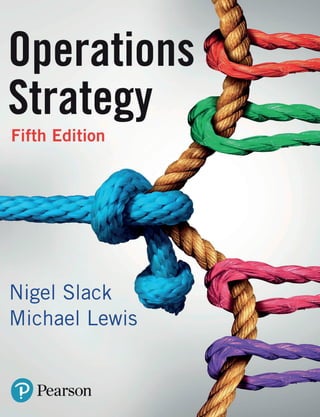
(eBook PDF) Operations Strategy 5th by Nigel
Slack install download
https://ebookluna.com/product/ebook-pdf-operations-strategy-5th-
by-nigel-slack/
Download more ebook from https://ebookluna.com
Instant digital products (PDF, ePub, MOBI) ready for you
Download now and discover formats that fit your needs...
(eBook PDF) Operations Management 9th Edition by Prof
Nigel Slack
https://ebookluna.com/product/ebook-pdf-operations-management-9th-
edition-by-prof-nigel-slack/
ebookluna.com
Operations Strategy 5th Edition (eBook PDF)
https://ebookluna.com/product/operations-strategy-5th-edition-ebook-
pdf/
ebookluna.com
(eBook PDF) Operations Strategy 6th Edition
https://ebookluna.com/product/ebook-pdf-operations-strategy-6th-
edition/
ebookluna.com
(eBook PDF) Service Management: Operations, Strategy,
Information Technology 9th Edition
https://ebookluna.com/product/ebook-pdf-service-management-operations-
strategy-information-technology-9th-edition/
ebookluna.com
(eBook PDF) The Middleboro Casebook: Healthcare Strategy
and Operations, Second Edition
https://ebookluna.com/product/ebook-pdf-the-middleboro-casebook-
healthcare-strategy-and-operations-second-edition/
ebookluna.com
(eBook PDF) Marketing Strategy and Management 5th by M.
Baker
https://ebookluna.com/product/ebook-pdf-marketing-strategy-and-
management-5th-by-m-baker/
ebookluna.com
(eBook PDF) Operations Strategy: Design, Implementation
and Delivery 1st ed. 2018 Edition
https://ebookluna.com/product/ebook-pdf-operations-strategy-design-
implementation-and-delivery-1st-ed-2018-edition/
ebookluna.com
Service Management: Operations, Strategy, Information
Technology 10th Edition Sanjeev K. Bordoloi - eBook PDF
https://ebookluna.com/download/service-management-operations-strategy-
information-technology-ebook-pdf/
ebookluna.com
(eBook PDF) Games of Strategy (Fifth Edition) 5th Edition
by Avinash K. Dixit
https://ebookluna.com/product/ebook-pdf-games-of-strategy-fifth-
edition-5th-edition-by-avinash-k-dixit/
ebookluna.com
M01 Operations Strategy 62492.indd 1 11/04/2017 18:59
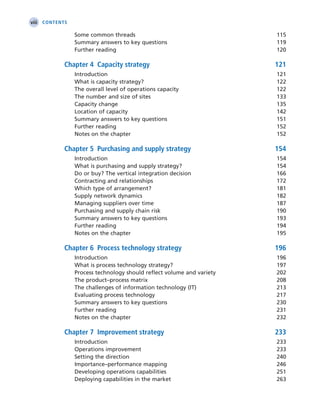
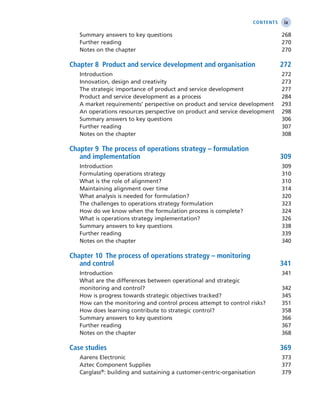
Contents
List of figures, tables and exhibits from case studies xi
Preface xix
Acknowledgements xxiii
Publisher’s acknowledgements xxiv
Chapter 1 Operations strategy – developing resources and
processes for strategic impact 1
Introduction 1
Why is operations excellence fundamental to strategic success? 2
What is strategy? 7
What is operations strategy and how is it different from operations
management? 9
What is the ‘content’ of operations strategy? 25
The operations strategy matrix 32
What is the ‘process’ of operations strategy? 33
How is operations strategy developing? 36
Summary answers to key questions 41
Further reading 43
Notes on the chapter 43
Chapter 2 Operations performance	 45
Introduction 45
Operations performance can make or break any organisation 46
Judging operations performance at a societal level? 48
Judging operations performance at a strategic level 53
Judging operations performance at an operational level? 56
The relative importance of performance objectives changes over time 68
Trade-offs – are they inevitable? 72
Targeting and operations focus 80
Summary answers to key questions 87
Further reading 89
Notes on the chapter 89
Chapter 3 Substitutes for strategy	 91
Introduction 91
Fads, fashion and the ‘new’ approaches to operations 92
Total quality management (TQM) 93
Lean operations 99
Business process reengineering (BPR) 105
Six Sigma 109
A01 Operations Strategy 62492.indd 7 03/03/2017 15:31
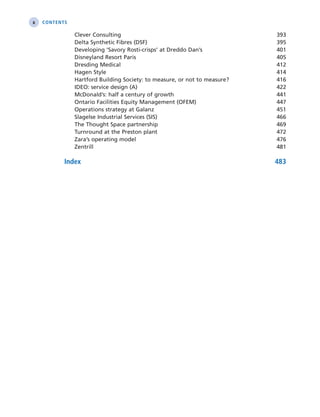
viii Contents
Some common threads 115
Summary answers to key questions 119
Further reading 120
Chapter 4 Capacity strategy	 121
Introduction 121
What is capacity strategy? 122
The overall level of operations capacity 122
The number and size of sites 133
Capacity change 135
Location of capacity 142
Summary answers to key questions 151
Further reading 152
Notes on the chapter 152
Chapter 5 Purchasing and supply strategy 154
Introduction 154
What is purchasing and supply strategy? 154
Do or buy? The vertical integration decision 166
Contracting and relationships 172
Which type of arrangement? 181
Supply network dynamics 182
Managing suppliers over time 187
Purchasing and supply chain risk 190
Summary answers to key questions 193
Further reading 194
Notes on the chapter 195
Chapter 6 Process technology strategy	 196
Introduction 196
What is process technology strategy? 197
Process technology should reflect volume and variety 202
The product–process matrix 208
The challenges of information technology (IT) 213
Evaluating process technology 217
Summary answers to key questions 230
Further reading 231
Notes on the chapter 232
Chapter 7 Improvement strategy	 233
Introduction 233
Operations improvement 233
Setting the direction 240
Importance–performance mapping 246
Developing operations capabilities 251
Deploying capabilities in the market 263
A01 Operations Strategy 62492.indd 8 03/03/2017 15:31
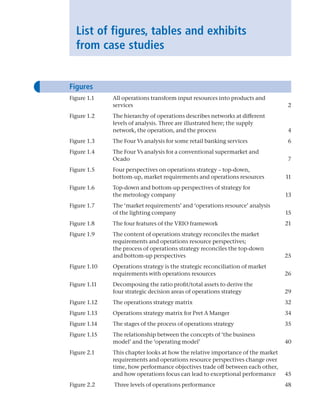
ix
Contents
Summary answers to key questions 268
Further reading 270
Notes on the chapter 270
Chapter 8 Product and service development and organisation	 272
Introduction 272
Innovation, design and creativity 273
The strategic importance of product and service development 277
Product and service development as a process 284
A market requirements’ perspective on product and service development 293
An operations resources perspective on product and service development 298
Summary answers to key questions 306
Further reading 307
Notes on the chapter 308
Chapter 9 The process of operations strategy – formulation
and implementation	 309
Introduction 309
Formulating operations strategy 310
What is the role of alignment? 310
Maintaining alignment over time 314
What analysis is needed for formulation? 320
The challenges to operations strategy formulation 323
How do we know when the formulation process is complete? 324
What is operations strategy implementation? 326
Summary answers to key questions 338
Further reading 339
Notes on the chapter 340
Chapter 10 The process of operations strategy – monitoring
and control	 341
Introduction 341
What are the differences between operational and strategic
monitoring and control? 342
How is progress towards strategic objectives tracked? 345
How can the monitoring and control process attempt to control risks? 351
How does learning contribute to strategic control? 358
Summary answers to key questions 366
Further reading 367
Notes on the chapter 368
Case studies	 369
Aarens Electronic 373
Aztec Component Supplies 377
Carglass®: building and sustaining a customer-centric-organisation 379
A01 Operations Strategy 62492.indd 9 03/03/2017 15:31
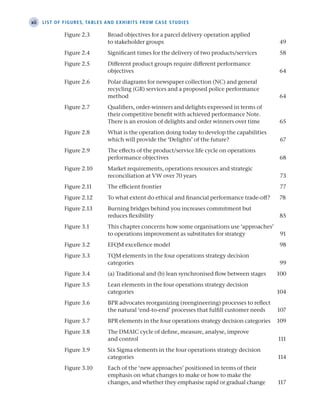
x Contents
Clever Consulting 393
Delta Synthetic Fibres (DSF) 395
Developing ‘Savory Rosti-crisps’ at Dreddo Dan’s 401
Disneyland Resort Paris 405
Dresding Medical 412
Hagen Style 414
Hartford Building Society: to measure, or not to measure? 416
IDEO: service design (A) 422
McDonald’s: half a century of growth 441
Ontario Facilities Equity Management (OFEM) 447
Operations strategy at Galanz 451
Slagelse Industrial Services (SIS) 466
The Thought Space partnership 469
Turnround at the Preston plant 472
Zara’s operating model 476
Zentrill 481
Index 483
A01 Operations Strategy 62492.indd 10 03/03/2017 15:31
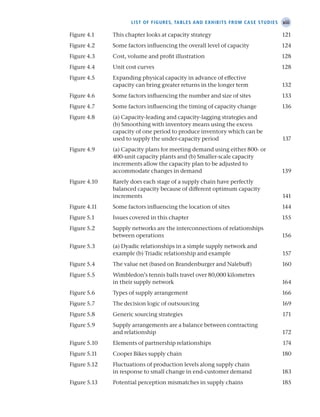
List of figures, tables and exhibits
from case studies
Figures
Figure 1.1	
All operations transform input resources into products and
services	 2
Figure 1.2	
The hierarchy of operations describes networks at different
levels of analysis. Three are illustrated here; the supply
network, the operation, and the process	 4
Figure 1.3	
The Four Vs analysis for some retail banking services 6
Figure 1.4	
The Four Vs analysis for a conventional supermarket and
Ocado7
Figure 1.5	
Four perspectives on operations strategy – top-down,
bottom-up, market requirements and operations resources 11
Figure 1.6	
Top-down and bottom-up perspectives of strategy for
the metrology company	 13
Figure 1.7	
The ‘market requirements’ and ‘operations resource’ analysis
of the lighting company 15
Figure 1.8	
The four features of the VRIO framework 21
Figure 1.9	
The content of operations strategy reconciles the market
requirements and operations resource perspectives;
the process of operations strategy reconciles the top-down
and bottom-up perspectives 25
Figure 1.10	
Operations strategy is the strategic reconciliation of market
requirements with operations resources 26
Figure 1.11	
Decomposing the ratio profit/total assets to derive the
four strategic decision areas of operations strategy 29
Figure 1.12 The operations strategy matrix 32
Figure 1.13 Operations strategy matrix for Pret A Manger 34
Figure 1.14 The stages of the process of operations strategy 35
Figure 1.15	
The relationship between the concepts of ‘the business
model’ and the ‘operating model’ 40
Figure 2.1	
This chapter looks at how the relative importance of the market
requirements and operations resource perspectives change over
time, how performance objectives trade off between each other,
and how operations focus can lead to exceptional performance 45
Figure 2.2 Three levels of operations performance 48
A01 Operations Strategy 62492.indd 11 03/03/2017 15:31
xii List of figures, tables and exhibits from case studies
Figure 2.3	
Broad objectives for a parcel delivery operation applied
to stakeholder groups 49
Figure 2.4	
Significant times for the delivery of two products/services 58
Figure 2.5 Different product groups require different performance
objectives64
Figure 2.6	
Polar diagrams for newspaper collection (NC) and general
recycling (GR) services and a proposed police performance
method64
Figure 2.7	
Qualifiers, order-winners and delights expressed in terms of
their competitive benefit with achieved performance Note.
There is an erosion of delights and order winners over time 65
Figure 2.8	
What is the operation doing today to develop the capabilities
which will provide the ‘Delights’ of the future?	 67
Figure 2.9	
The effects of the product/service life cycle on operations
performance objectives 68
Figure 2.10	
Market requirements, operations resources and strategic
reconciliation at VW over 70 years 73
Figure 2.11 The efficient frontier 77
Figure 2.12 To what extent do ethical and financial performance trade-off? 78
Figure 2.13	
Burning bridges behind you increases commitment but
reduces flexibility 85
Figure 3.1	
This chapter concerns how some organisations use ‘approaches’
to operations improvement as substitutes for strategy 91
Figure 3.2	
EFQM excellence model 98
Figure 3.3	
TQM elements in the four operations strategy decision
categories99
Figure 3.4	
(a) Traditional and (b) lean synchronised flow between stages 100
Figure 3.5	
Lean elements in the four operations strategy decision
categories104
Figure 3.6	
BPR advocates reorganizing (reengineering) processes to reflect
the natural ‘end-to-end’ processes that fulfill customer needs 107
Figure 3.7	
BPR elements in the four operations strategy decision categories 109
Figure 3.8	
The DMAIC cycle of define, measure, analyse, improve
and control 111
Figure 3.9	
Six Sigma elements in the four operations strategy decision
categories114
Figure 3.10	
Each of the ‘new approaches’ positioned in terms of their
emphasis on what changes to make or how to make the
changes, and whether they emphasise rapid or gradual change 117
A01 Operations Strategy 62492.indd 12 03/03/2017 15:31
xiii
List of figures, tables and exhibits from case studies
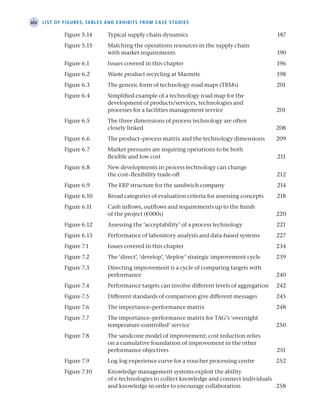
Figure 4.1	
This chapter looks at capacity strategy 121
Figure 4.2	
Some factors influencing the overall level of capacity 124
Figure 4.3 Cost, volume and profit illustration 128
Figure 4.4 Unit cost curves 128
Figure 4.5 Expanding physical capacity in advance of effective
capacity can bring greater returns in the longer term 132
Figure 4.6 Some factors influencing the number and size of sites 133
Figure 4.7 Some factors influencing the timing of capacity change 136
Figure 4.8 (a) Capacity-leading and capacity-lagging strategies and
(b) Smoothing with inventory means using the excess
capacity of one period to produce inventory which can be
used to supply the under-capacity period 137
Figure 4.9 (a) Capacity plans for meeting demand using either 800- or
400-unit capacity plants and (b) Smaller-scale capacity
increments allow the capacity plan to be adjusted to
accommodate changes in demand 139
Figure 4.10 Rarely does each stage of a supply chain have perfectly
balanced capacity because of different optimum capacity
increments141
Figure 4.11 Some factors influencing the location of sites 144
Figure 5.1 Issues covered in this chapter 155
Figure 5.2 Supply networks are the interconnections of relationships
between operations 156
Figure 5.3 (a) Dyadic relationships in a simple supply network and
example (b) Triadic relationship and example 157
Figure 5.4 The value net (based on Brandenburger and Nalebuff) 160
Figure 5.5 Wimbledon’s tennis balls travel over 80,000 kilometres
in their supply network 164
Figure 5.6 Types of supply arrangement 166
Figure 5.7 The decision logic of outsourcing 169
Figure 5.8 Generic sourcing strategies 171
Figure 5.9 Supply arrangements are a balance between contracting
and relationship 172
Figure 5.10 Elements of partnership relationships 174
Figure 5.11 Cooper Bikes supply chain 180
Figure 5.12 Fluctuations of production levels along supply chain
in response to small change in end-customer demand 183
Figure 5.13 Potential perception mismatches in supply chains 185
A01 Operations Strategy 62492.indd 13 03/03/2017 15:31
xiv List of figures, tables and exhibits from case studies
Figure 5.14 Typical supply chain dynamics 187
Figure 5.15 Matching the operations resources in the supply chain
with market requirements 190
Figure 6.1 Issues covered in this chapter 196
Figure 6.2 Waste product recycling at Marmite 198
Figure 6.3 The generic form of technology road maps (TRMs) 201
Figure 6.4 Simplified example of a technology road map for the
development of products/services, technologies and
processes for a facilities management service 201
Figure 6.5 The three dimensions of process technology are often
closely linked 208
Figure 6.6 The product–process matrix and the technology dimensions 209
Figure 6.7 Market pressures are requiring operations to be both
flexible and low cost 211
Figure 6.8 New developments in process technology can change
the cost–flexibility trade-off 212
Figure 6.9 The ERP structure for the sandwich company 214
Figure 6.10 Broad categories of evaluation criteria for assessing concepts 218
Figure 6.11 Cash inflows, outflows and requirements up to the finish
of the project (€000s) 220
Figure 6.12 Assessing the ‘acceptability’ of a process technology 221
Figure 6.13 Performance of laboratory analysis and data-based systems 227
Figure 7.1 Issues covered in this chapter 234
Figure 7.2 The ‘direct’, ‘develop’, ‘deploy’ strategic improvement cycle 239
Figure 7.3 Directing improvement is a cycle of comparing targets with
performance 240
Figure 7.4 Performance targets can involve different levels of aggregation 242
Figure 7.5 Different standards of comparison give different messages 245
Figure 7.6 The importance–performance matrix 248
Figure 7.7 The importance–performance matrix for TAG’s ‘overnight
temperature-controlled’ service 250
Figure 7.8 The sandcone model of improvement; cost reduction relies
on a cumulative foundation of improvement in the other
performance objectives 251
Figure 7.9 Log-log experience curve for a voucher processing centre 252
Figure 7.10 Knowledge management systems exploit the ability
of e-technologies to collect knowledge and connect individuals
and knowledge in order to encourage collaboration 258
A01 Operations Strategy 62492.indd 14 03/03/2017 15:31
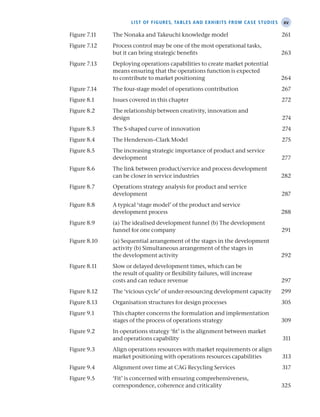
xv
List of figures, tables and exhibits from case studies
Figure 7.11 The Nonaka and Takeuchi knowledge model 261
Figure 7.12 Process control may be one of the most operational tasks,
but it can bring strategic benefits 263
Figure 7.13 Deploying operations capabilities to create market potential
means ensuring that the operations function is expected
to contribute to market positioning 264
Figure 7.14 The four-stage model of operations contribution 267
Figure 8.1 Issues covered in this chapter 272
Figure 8.2 The relationship between creativity, innovation and
design 274
Figure 8.3 The S-shaped curve of innovation 274
Figure 8.4 The Henderson–Clark Model 275
Figure 8.5 The increasing strategic importance of product and service
development 277
Figure 8.6 The link between product/service and process development
can be closer in service industries 282
Figure 8.7 Operations strategy analysis for product and service
development 287
Figure 8.8 A typical ‘stage model’ of the product and service
development process 288
Figure 8.9 (a) The idealised development funnel (b) The development
funnel for one company 291
Figure 8.10 (a) Sequential arrangement of the stages in the development
activity (b) Simultaneous arrangement of the stages in
the development activity 292
Figure 8.11 Slow or delayed development times, which can be
the result of quality or flexibility failures, will increase
costs and can reduce revenue 297
Figure 8.12 The ‘vicious cycle’ of under-resourcing development capacity 299
Figure 8.13 Organisation structures for design processes 305
Figure 9.1 This chapter concerns the formulation and implementation
stages of the process of operations strategy 309
Figure 9.2 In operations strategy ‘fit’ is the alignment between market
and operations capability 311
Figure 9.3 Align operations resources with market requirements or align
market positioning with operations resources capabilities 313
Figure 9.4 Alignment over time at CAG Recycling Services 317
Figure 9.5 ‘Fit’ is concerned with ensuring comprehensiveness,
correspondence, coherence and criticality 325
A01 Operations Strategy 62492.indd 15 03/03/2017 15:31
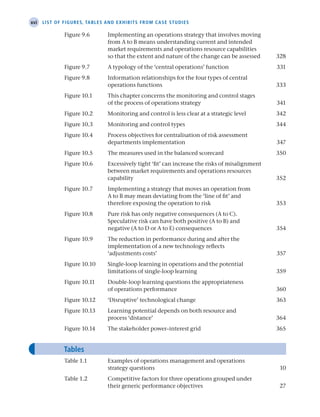
xvi List of figures, tables and exhibits from case studies
Figure 9.6 Implementing an operations strategy that involves moving
from A to B means understanding current and intended
market requirements and operations resource capabilities
so that the extent and nature of the change can be assessed 328
Figure 9.7 A typology of the ‘central operations’ function 331
Figure 9.8 Information relationships for the four types of central
operations functions 333
Figure 10.1 This chapter concerns the monitoring and control stages
of the process of operations strategy 341
Figure 10.2 Monitoring and control is less clear at a strategic level 342
Figure 10.3 Monitoring and control types 344
Figure 10.4 Process objectives for centralisation of risk assessment
departments implementation 347
Figure 10.5 The measures used in the balanced scorecard 350
Figure 10.6 Excessively tight ‘fit’ can increase the risks of misalignment
between market requirements and operations resources
capability 352
Figure 10.7 Implementing a strategy that moves an operation from
A to B may mean deviating from the ‘line of fit’ and
therefore exposing the operation to risk 353
Figure 10.8 Pure risk has only negative consequences (A to C).
Speculative risk can have both positive (A to B) and
negative (A to D or A to E) consequences 354
Figure 10.9 The reduction in performance during and after the
implementation of a new technology reflects
‘adjustments costs’ 357
Figure 10.10 Single-loop learning in operations and the potential
limitations of single-loop learning 359
Figure 10.11 Double-loop learning questions the appropriateness
of operations performance 360
Figure 10.12 ‘Disruptive’ technological change 363
Figure 10.13 Learning potential depends on both resource and
process ‘distance’ 364
Figure 10.14 The stakeholder power–interest grid 365
Tables
Table 1.1 Examples of operations management and operations
strategy questions 10
Table 1.2 Competitive factors for three operations grouped under
their generic performance objectives 27
A01 Operations Strategy 62492.indd 16 03/03/2017 15:31
xvii
List of figures, tables and exhibits from case studies
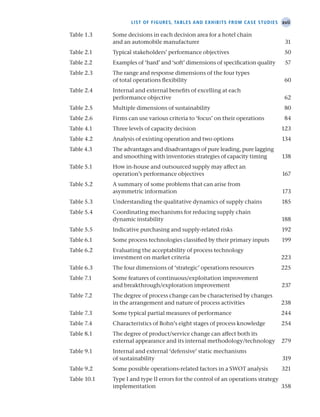
Table 1.3 Some decisions in each decision area for a hotel chain
and an automobile manufacturer 31
Table 2.1 Typical stakeholders’ performance objectives 50
Table 2.2 Examples of ‘hard’ and ‘soft’ dimensions of specification quality 57
Table 2.3 The range and response dimensions of the four types
of total operations flexibility 60
Table 2.4 Internal and external benefits of excelling at each
performance objective 62
Table 2.5 Multiple dimensions of sustainability 80
Table 2.6 Firms can use various criteria to ‘focus’ on their operations 84
Table 4.1 Three levels of capacity decision 123
Table 4.2 Analysis of existing operation and two options 134
Table 4.3 The advantages and disadvantages of pure leading, pure lagging
and smoothing with inventories strategies of capacity timing 138
Table 5.1 How in-house and outsourced supply may affect an
operation’s performance objectives 167
Table 5.2 A summary of some problems that can arise from
asymmetric information 173
Table 5.3 Understanding the qualitative dynamics of supply chains 185
Table 5.4 Coordinating mechanisms for reducing supply chain
dynamic instability 188
Table 5.5 Indicative purchasing and supply-related risks 192
Table 6.1 Some process technologies classified by their primary inputs 199
Table 6.2 Evaluating the acceptability of process technology
investment on market criteria 223
Table 6.3 The four dimensions of ‘strategic’ operations resources 225
Table 7.1 Some features of continuous/exploitation improvement
and breakthrough/exploration improvement 237
Table 7.2 The degree of process change can be characterised by changes
in the arrangement and nature of process activities 238
Table 7.3 Some typical partial measures of performance 244
Table 7.4 Characteristics of Bohn’s eight stages of process knowledge 254
Table 8.1 The degree of product/service change can affect both its
external appearance and its internal methodology/technology 279
Table 9.1 Internal and external ‘defensive’ static mechanisms
of sustainability 319
Table 9.2 Some possible operations-related factors in a SWOT analysis 321
Table 10.1 Type I and type II errors for the control of an operations strategy
implementation 358
A01 Operations Strategy 62492.indd 17 03/03/2017 15:31
xviii List of figures, tables and exhibits from case studies
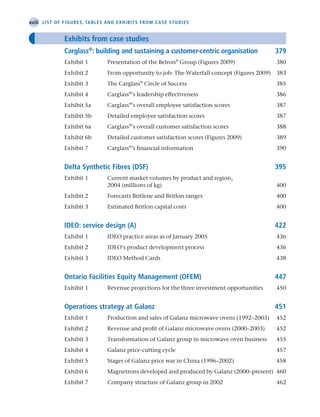
Exhibits from case studies
Carglass®
: building and sustaining a customer-centric organisation 379
Exhibit 1 Presentation of the Belron® Group (Figures 2009) 380
Exhibit 2 From opportunity to job: The Waterfall concept (Figures 2009) 383
Exhibit 3 The Carglass® Circle of Success 385
Exhibit 4 Carglass®’s leadership effectiveness 386
Exhibit 5a Carglass®’s overall employee satisfaction scores 387
Exhibit 5b Detailed employee satisfaction scores 387
Exhibit 6a Carglass®’s overall customer satisfaction scores 388
Exhibit 6b Detailed customer satisfaction scores (Figures 2009) 389
Exhibit 7 Carglass®’s financial information 390
Delta Synthetic Fibres (DSF) 395
Exhibit 1 Current market volumes by product and region,
2004 (millions of kg) 400
Exhibit 2 Forecasts Britlene and Britlon ranges 400
Exhibit 3 Estimated Britlon capital costs 400
IDEO: service design (A) 422
Exhibit 1 IDEO practice areas as of January 2005 436
Exhibit 2 IDEO’s product development process 436
Exhibit 3 IDEO Method Cards 438
Ontario Facilities Equity Management (OFEM) 447
Exhibit 1 Revenue projections for the three investment opportunities 450
Operations strategy at Galanz 451
Exhibit 1 Production and sales of Galanz microwave ovens (1992–2003) 452
Exhibit 2 Revenue and profit of Galanz microwave ovens (2000–2003) 452
Exhibit 3 Transformation of Galanz group in microwave oven business 455
Exhibit 4 Galanz price-cutting cycle 457
Exhibit 5 Stages of Galanz price war in China (1996–2002) 458
Exhibit 6 Magnetrons developed and produced by Galanz (2000–present) 460
Exhibit 7 Company structure of Galanz group in 2002 462
A01 Operations Strategy 62492.indd 18 03/03/2017 15:31
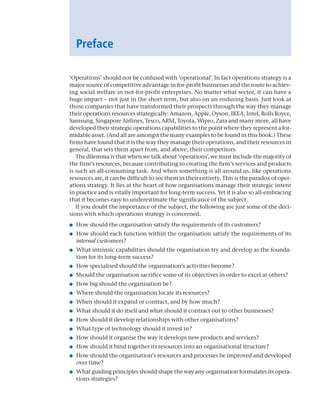
Preface
‘Operations’ should not be confused with ‘operational’. In fact operations strategy is a
major source of competitive advantage in for-profit businesses and the route to achiev-
ing social welfare in not-for-profit enterprises. No matter what sector, it can have a
huge impact – not just in the short term, but also on an enduring basis. Just look at
those companies that have transformed their prospects through the way they manage
their operations resources strategically: Amazon, Apple, Dyson, IKEA, Intel, Rolls Royce,
Samsung, Singapore Airlines, Tesco, ARM, Toyota, Wipro, Zara and many more, all have
developed their strategic operations capabilities to the point where they represent a for-
midable asset. (And all are amongst the many examples to be found in this book.) These
firms have found that it is the way they manage their operations, and their resources in
general, that sets them apart from, and above, their competitors.
The dilemma is that when we talk about ‘operations’, we must include the majority of
the firm’s resources, because contributing to creating the firm’s services and products
is such an all-consuming task. And when something is all around us, like operations
resources are, it can be difficult to see them in their entirety. This is the paradox of oper-
ations strategy. It lies at the heart of how organisations manage their strategic intent
in practice and is vitally important for long-term success. Yet it is also so all-embracing
that it becomes easy to underestimate the significance of the subject.
If you doubt the importance of the subject, the following are just some of the deci-
sions with which operations strategy is concerned.
● How should the organisation satisfy the requirements of its customers?
● How should each function within the organisation satisfy the requirements of its
internal customers?
● What intrinsic capabilities should the organisation try and develop as the founda-
tion for its long-term success?
● How specialised should the organisation’s activities become?
● Should the organisation sacrifice some of its objectives in order to excel at others?
● How big should the organisation be?
● Where should the organisation locate its resources?
● When should it expand or contract, and by how much?
● What should it do itself and what should it contract out to other businesses?
● How should it develop relationships with other organisations?
● What type of technology should it invest in?
● How should it organise the way it develops new products and services?
● How should it bind together its resources into an organisational structure?
● How should the organisation’s resources and processes be improved and developed
over time?
● What guiding principles should shape the way any organisation formulates its opera-
tions strategies?
A01 Operations Strategy 62492.indd 19 03/03/2017 15:31
xx Preface
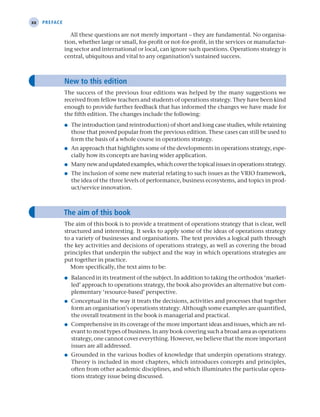
All these questions are not merely important – they are fundamental. No organisa-
tion, whether large or small, for-profit or not-for-profit, in the services or manufactur-
ing sector and international or local, can ignore such questions. Operations strategy is
central, ubiquitous and vital to any organisation’s sustained success.
New to this edition
The success of the previous four editions was helped by the many suggestions we
received from fellow teachers and students of operations strategy. They have been kind
enough to provide further feedback that has informed the changes we have made for
the fifth edition. The changes include the following:
● The introduction (and reintroduction) of short and long case studies, while retaining
those that proved popular from the previous edition. These cases can still be used to
form the basis of a whole course in operations strategy.
● An approach that highlights some of the developments in operations strategy, espe-
cially how its concepts are having wider application.
● Manynewandupdatedexamples,whichcoverthetopicalissuesinoperationsstrategy.
● The inclusion of some new material relating to such issues as the VRIO framework,
the idea of the three levels of performance, business ecosystems, and topics in prod-
uct/service innovation.
The aim of this book
The aim of this book is to provide a treatment of operations strategy that is clear, well
structured and interesting. It seeks to apply some of the ideas of operations strategy
to a variety of businesses and organisations. The text provides a logical path through
the key activities and decisions of operations strategy, as well as covering the broad
principles that underpin the subject and the way in which operations strategies are
put together in practice.
More specifically, the text aims to be:
● Balanced in its treatment of the subject. In addition to taking the orthodox ‘market-
led’ approach to operations strategy, the book also provides an alternative but com-
plementary ‘resource-based’ perspective.
● Conceptual in the way it treats the decisions, activities and processes that together
form an organisation’s operations strategy. Although some examples are quantified,
the overall treatment in the book is managerial and practical.
● Comprehensive in its coverage of the more important ideas and issues, which are rel-
evant to most types of business. In any book covering such a broad area as operations
strategy, one cannot cover everything. However, we believe that the more important
issues are all addressed.
● Grounded in the various bodies of knowledge that underpin operations strategy.
Theory is included in most chapters, which introduces concepts and principles,
often from other academic disciplines, and which illuminates the particular opera-
tions strategy issue being discussed.
A01 Operations Strategy 62492.indd 20 03/03/2017 15:31
xxi
Preface
● International in the examples it uses to describe practical operations strategy
issues.
Who should use this book?
This book is intended to provide a broad introduction to operations strategy for all
students who wish to understand the strategic importance and scope of the operations
function. For example:
● MBA students, who should find that it both links and integrates their experience and
study of operations management with their core studies in business strategy.
● Higher-level undergraduates studying business or technical subjects, although we
assume a prior knowledge of the basics of operations management.
● Postgraduate students on other specialised Master’s degrees, who should find that it
provides them with a well-grounded approach to the subject.
● Executives, who will also be able to relate the practical and pragmatic structure of the
book to the more conceptual and theoretical issues discussed within the structure.
Distinctive features
Clear structure
The book employs coherent models of the subject that run through each part of the text
and explain how the chapters fit into the overall subject. Key questions set the scene
at the beginning of each chapter and also provide a structure for the summary at the
end of each chapter.
Illustration-based
The study of operations, even at a strategic level, is essentially a practical subject and
cannot be taught in a purely theoretical manner. Because of this we have used both
abstracted examples and ‘boxed’ examples, which explain some issues faced by real
operations.
Theory
Operations strategy is a practical subject that is driven by theoretical ideas. Most chap-
ters contain one or more theories that explain the underpinning ideas that have con-
tributed to our understanding of the issues being discussed.
Case studies
The book includes a number of case studies suitable for class discussion. The cases are
long enough to provide depth and serve as illustrations, which can be used to supple-
ment class sessions.
A01 Operations Strategy 62492.indd 21 03/03/2017 15:31
xxii Preface
Selected further reading
Every chapter ends with a list of further reading, which takes the topic covered in the
chapter further or treats some important related issues.
Website
A website is available that helps students to develop a firm understanding of each issue
covered in the book and provides lecturers with pedagogical assistance. There are also
Instructor’s manual and PowerPoints available.
Chapters
Chapter 1 defines operations strategy in terms of the reconciliation between market
requirements and operations resources.
Chapter 2 looks at three interrelated issues that affect reconciliation – how operations
change over time, how operations deal with trade-offs and how trade-offs can be used
to understand ‘targeted’, or focused, operations.
Chapter 3 examines some of the popular approaches to improving operations
performance. These are total quality management (TQM), lean operations, business
process reengineering (BPR) and Six Sigma. Although they are not strategies as such,
implementing any of them is a strategic decision.
Chapter 4 examines those decisions that shape the overall capacity of the operations
resources, particularly the level of capacity and where the capacity should be located,
and deals with the dynamics of the capacity decision by examining how capacity is
changed over time.
Chapter 5 looks at supply networks – in particular, the nature of the relationships that
develop between the various operations in a network, the advantages of taking a total
network perspective and how networks behave in a dynamic sense.
Chapter 6 characterises the various types of process technology that are at the heart
of many operations; it looks at the effects of some newer types of technology on
operations capabilities and proposes some ideas that help operations to choose
between different technologies and implement them once chosen.
Chapter 7 examines the way operations resources can be developed and improved
within the organisation, especially how capabilities can be directed, developed and
deployed in a cycle of improvement.
Chapter 8 applies some of the issues covered in the previous chapters to the activities
associated with product and service development and organisation.
Chapter 9 is concerned with ‘how’ to reconcile market requirements with operations
resources over the long term. In particular it looks at the first two of the four stages of
the process of operations strategy, namely formulation and implementation.
Chapter 10 looks at the final two stages of the four stages of the process of operations
strategy, namely monitoring and control.
A01 Operations Strategy 62492.indd 22 03/03/2017 15:31
Acknowledgements
Again we have been fortunate enough to receive advice on this and earlier editions
from a number of leading academics and industrialists. In particular: Pär Åhlström of
Chalmers University, David Barnes of the Open University, Mike Bourne of ­
Cranfield
University, Raffaella Cagliano of Politecnico di Milano, Dan Chicksand of ­Birmingham
University, Ben Clegg of Aston University, Paul Coghlan of Trinity College ­
Dublin,
­
Henrique Correa of Rollins College, Pamela Danese of the University of Padova,
Roland van Dierdonck of the University of Ghent, Ian Evans of Sunderland Univer-
sity, Kasra Ferdows of Georgetown University, Janet Godsell of Warwick University,
Mike Gregory of Cambridge University, Linda Hendry of Lancaster University, Christer
Karlsson of Copenhagen Business School, Bart McCarthy of Nottingham University,
Samuel B. Larsen of IHK (Copenhagen University College of Engineering), Arunkumar
­
Madapusi of Drexel University, Andy Neely of Cambridge University, Phil Morgan of
Oxford Brooks University, Andy Neely of Cranfield University, Jan Olhager of Lund
University, Ken Platts of Cambridge University, Dan Paulin of Chalmers University,
Giovanni ­
Perrone of the University of Palermo, Zoran Perunovic of Danish Technical
University, Gerald Reiner of Université de Neuchâtel, James Rowell of the University of
Buckingham, Sofia Salgado Pinto of Universidade Católica Portuguesa, Mike ­Shulver of
­
Birmingham University, Rui Sousa of Universidade Católica Portuguesa, nigel Spinks
of Reading University, Martin Spring of Lancaster University, Ann Vereecke of the Uni-
versity of Ghent, Helen Walker of Cardiff University and Gera Welker of the University
of Groningen.
Our academic colleagues at Warwick and Bath Universities also helped us, both
by contributing ideas and by creating a lively and stimulating work environment.
At Warwick our thanks go to Nicola Burgess, Mehmet Chakkol, Emily Jamieson,
Mark Johnson, Pietro Micheli, Ross Ritchie, Rhian Silvestro and Chris Voss. At Bath
our thanks go to Chris Archer-Brown, Alistair Brandon-Jones, Paul Goodwin, Emma
Brandon-Jones, Jie Chen, Melanie Kreye and Jens Roehrich, Brian Squire and Baris
Yalabik.
We are also grateful to many friends, colleagues and company contacts. In particular,
thanks go to John Palmer of the Welsh NHS, Nigel Hayter of DS Smith, Steen Karstensen,
Henrik Larsen and Morten Bo Christiansen of AP Moller-Maersk, Kevin Doolan, Partner
at Moller PSF Group Cambridge and Gerard Chick of Optimum Procurement Group,
Peter Norris of the Royal Bank of Scotland, Hans Mayer of Nestlé, Dr Andrew Court
of QinetiQ, Tony Solomons, Chris Spencer and Maurice Dunster of Waitrose, Nathan
Travis of Gloucestershire Fire and Rescue, John Richardson of Elizabeth Shaw and
Dr Hanno Kirner of Rolls Royce Motors.
The team from Pearson Education provided their usual highly professional support.
Particular thanks to Natalia Jaszczuk, Caitlin Lisle and Archana Makhija.
Finally, and most importantly, we would like to thank our wives, Angela and Helen,
for their forbearance and unwavering support.
Nigel Slack
Michael Lewis
A01 Operations Strategy 62492.indd 23 03/03/2017 15:31
Publisher’s acknowledgements
We are grateful to the following for permission to reproduce copyright material:
Figures
Figure 5.5 from The 50,000 mile journey of Wimbledon’s tennis balls, WBS News,
02/07/2014, © Warwick Business School 2014; Figure 5.8 adapted from What Is The Right
Outsourcing Strategy For Your Process?, European Management Journal, 26 (1), pp. 24–34
(McIvor, R., 2008), Copyright 2008, with permission from Elsevier; ­
Figure 10.3 after
Management Control of Public and Not-For-Profit Activities, Accounting, ­Organizations
and Society, 6 (3), pp. 193–211 (Hofstede, G., 1981), Copyright 1981, with permission
from Elsevier.
Text
Case Study 3 from Verweire, K. and Buekens, W., 17/03/2014, Associate Professor ­Vlerick
Business School, http://www.vlerick.com/en/research-and-faculty/knowledge-items/
knowledge/carglass-building-and-sustaining-a-customer-centric-organisation; Case
Study 4 from Micheli, P. and Beer, H., Associate Professor of Organising ­
Healthcare
Research Network, Operations Management Group, Warwick Business School,
­
University of Warwick, http://www.wbs.ac.uk/; Case Study 9 from IDEO: Service
Design (A), IDEO, 1, 606-012 (Ritesh Bhavnani, Manuel Sosa), This case was written by
Ritesh Bhavnani, Research Associate and INSEAD MBA (July 2004), and Manuel Sosa,
­Assistant Professor of Technology and Operations Management at INSEAD, as basis for
class ­
discussion rather than to illustrate either effective or ineffective handling of an
administrative situation. The information in this case has been obtained from both
public sources and company interviews. Copyright © 2006 INSEAD.
A01 Operations Strategy 62492.indd 24 03/03/2017 15:31
Other documents randomly have
different content
The Project Gutenberg eBook of Critical,
Historical, and Miscellaneous Essays; Vol. 6
This ebook is for the use of anyone anywhere in the United
States and most other parts of the world at no cost and with
almost no restrictions whatsoever. You may copy it, give it away
or re-use it under the terms of the Project Gutenberg License
included with this ebook or online at www.gutenberg.org. If you
are not located in the United States, you will have to check the
laws of the country where you are located before using this
eBook.
Title: Critical, Historical, and Miscellaneous Essays; Vol. 6
Author: Baron Thomas Babington Macaulay Macaulay
Editor: Edwin Percy Whipple
Release date: November 6, 2017 [eBook #55906]
Most recently updated: October 23, 2024
Language: English
Credits: Produced by David Widger from page images
generously
provided by the Internet Archive
*** START OF THE PROJECT GUTENBERG EBOOK CRITICAL,
HISTORICAL, AND MISCELLANEOUS ESSAYS; VOL. 6 ***
CRITICAL, HISTORICAL, AND
MISCELLANEOUS ESSAYS
By Lord Macaulay
With a Memoir and Index
In Six Volumes
Vol. VI.
New York: Published by Sheldon and Company
1860
THE SIX VOLUMES
VOLUME I.
VOLUME II.
VOLUME III.
VOLUME IV.
VOLUME V.
VOLUME VI.
CONTENTS
ESSAYS
THE EARL OF CHATHAM.
FRANCIS ATTERBURY.
JOHN BUNYAN.
OLIVER GOLDSMITH.
SAMUEL JOHNSON.
WILLIAM PITT
A P P E N D I X.
THE WEST INDIES.
THE LONDON UNIVERSITY.
SOCIAL AND INDUSTRIAL CAPACITIES OP NEGROES.
THE PRESENT ADMINISTRATION.
INDEX
ESSAYS
M
THE EARL OF CHATHAM. (1)
(Edinburgh Review, October 1844.)
ore than ten years ago we commenced a sketch of the
political life of the great Lord Chatham. We then stopped at
the death of George the Second, with the intention of
speedily resuming our task. Circumstances, which it would be
tedious to explain, long prevented us from carrying this intention
into effect. Nor can we regret the delay. For the materials which
were within our reach in 1834 were scanty and unsatisfactory, when
compared with those which we at present possess. Even now,
though we have had access to some valuable sources of information
which have not yet been opened to the public, we cannot but feel
that the history of the first ten years of the reign of George the Third
is but imperfectly known to us. Nevertheless, we are inclined to think
that we are in a condition to lay before our readers a narrative
neither uninstructive nor uninteresting. We therefore return with
pleasure to our long interrupted labour.
We left Pitt in the zenith of prosperity and glory,
(1) 1.Correspondence of William Pitt, Earl of Chatham. 4
vols. 8vo. London: 1840.
2. Letters of Horace Walpole, Earl of Orford, to Horace
Mann. 4 vols. 8vo. London: 1843-4.
the idol of England, the terror of France, the admiration of the
whole civilised world. The wind, from whatever quarter it blew,
carried to England tidings of battles won, fortresses taken, provinces
added to the empire. At home, factions had sunk into a lethargy,
such as had never been known since the great religious schism of
the sixteenth century had roused the public mind from repose.
In order that the events which we have to relate may be clearly
understood, it may be desirable that we should advert to the causes
which had for a time suspended the animation of both the great
English parties.
If, rejecting all that is merely accidental, we look at the essential
characteristics of the Whig and the Tory, we may consider each of
them as the representative of a great principle, essential to the
welfare of nations. One is, in an especial manner, the guardian of
liberty, and the other, of order. One is the moving power, and the
other the steadying power of the state. One is the sail, without
which society would make no progress, the other the ballast, without
which there would be small safety in a tempest. But, during the
forty-six years which followed the accession of the House of
Hanover, these distinctive peculiarities seemed to be effaced. The
Whig conceived that he could not better serve the cause of civil and
religious freedom than by strenuously supporting the Protestant
dynasty. The Tory conceived that he could not better prove his
hatred of revolutions than by attacking a government to which a
revolution had given birth. Both came by degrees to attach more
importance to the means than to the end. Both were thrown into
unnatural situations; and both, like animals transported to an
uncongenial climate, languished and degenerated. The Tory,
removed from the sunshine of the court, was as a camel in the
snows of Lapland. The Whig, basking in the rays of royal favour, was
as a reindeer in the sands of Arabia.
Dante tells us that he saw, in Maleholge, a strange encounter
between a human form and a serpent. The enemies, after cruel
wounds inflicted, stood for a time glaring on each other. A great
cloud surrounded them, and then a wonderful metamorphosis
began. Each creature was transfigured into the likeness of its
antagonist. The serpent’s tail divided itself into two legs; the man’s
legs intertwined themselves into a tail. The body of the serpent put
forth arms; the arms of the man shrank into his body. At length the
serpent stood up a man, and spake; the man sank down a serpent,
and glided hissing away. Something like this was the transformation
which, during the reign of George the First, befell the two English
parties. Each gradually took the shape and colour of its foe, till at
length the Tory rose up erect the zealot of freedom, and the Whig
crawled and licked the dust at the feet of power.
It is true that, when these degenerate politicians discussed
questions merely speculative, and, above all, when they discussed
questions relating to the conduct of their own grandfathers, they still
seemed to differ as their grandfathers had differed. The Whig, who,
during three Parliaments, had never given one vote against the
court, and who was ready to sell his soul for the Comptroller’s staff
or for the Great Wardrobe, still professed to draw his political
doctrines from Locke and Milton, still worshipped the memory of
Pym and Hampden, and would still, on the thirtieth of January, take
his class, first to the man in the mask, and then to the man who
would do it without a mask. The Tory, on the other hand, while he
reviled the mild and temperate Walpole as a deadly enemy of liberty,
could see nothing to reprobate in the iron tyranny of Strafford and
Land. But, whatever judgment the Whig or the Tory of that age
might pronounce on transactions long past, there can be no doubt
that, as respected the practical questions then pending, the Tory was
a reformer, and indeed an intemperate and indiscreet reformer, while
the Whig; was conservative even to bigotry. We have ourselves,
seen similar effects produced in a neighbouring country by similar
causes. Who would have believed, fifteen years ago, that M. Guizot
and M. Villemain would have to defend property and social order
against the attacks of such enemies as M. Genoude and M. de La
Roche Jaquelin?
Thus the successors of the old Cavaliers had turned demagogues;
the successors of the old Roundheads had turned courtiers. Yet was
it long before their mutual animosity began to abate; for it is the
nature of parties to retain their original enmities far more firmly than
their original principles. During many years, a generation of Whigs,
whom Sidney would have spurned as slaves, continued to wage
deadly war with a generation of Tories whom Jeffreys would have
hanged for Republicans.
Through the whole reign of George the First, and through nearly
half of the reign of George the Second, a Tory was regarded as an
enemy of the reigning house, and was excluded from all the favours
of the crown. Though most of the country gentlemen were Tories,
none but Whigs were created peers and baronets. Though most of
the clergy were Tories, none but Whigs were appointed deans and
bishops. In every county, opulent and well descended Tory squires
complained that their names were left out of the commission of the
peace, while men of small estate and mean birth, who were for
toleration and excise, septennial parliaments and standing armies,
presided at quarter sessions, and became deputy lieutenants.
By degrees some approaches were made towards a reconciliation.
While Walpole was at the head of affairs, enmity to his power
induced a large and powerful body of Whigs, headed by the heir
apparent of the throne, to make an alliance with the Tories, and a
truce even with the Jacobites. After Sir Robert’s fall, the ban which
lay on the Tory party was taken off. The chief places in the
administration continued to be filled by Whigs, and, indeed, could
scarcely have been filled otherwise; for the Tory nobility and gentry,
though strong in numbers and in property, had among them scarcely
a single man distinguished by talents, either for business or for
debate. A few of them, however, were admitted to subordinate
offices; and this indulgence produced a softening effect on the
temper of the whole body. The first levee of George the Second after
Walpole’s resignation was a remarkable spectacle. Mingled with the
constant supporters of the House of Brunswick, with the Russells,
the Cavendishes, and the Pelhams, appeared a crowd of faces
utterly unknown to the pages and gentlemen ushers, lords of rural
manors, whose ale and fox-hounds were renowned in the
neighbourhood of the Mendip hills, or round the Wrekin, but who
had never crossed the threshold of the palace since the days when
Oxford, with the white staff in his hand, stood behind Queen Anne.
During the eighteen years which followed this clay, both factions
were gradually sinking deeper and deeper into repose. The apathy of
the public mind is partly to be ascribed to the unjust violence with
which the administration of Walpole had been assailed. In the body
politic, as in the natural body, morbid languor generally succeeds
morbid excitement. The people had been maddened by sophistry, by
calumny, by rhetoric, by stimulants applied to the national pride. In
the fulness of bread, they had raved as if famine had been in the
land. While enjoying such a measure of civil and religious freedom
as, till then, no great society had ever known, they had cried out for
a Timoleon or a Brutus to stab their oppressor to the heart. They
were in this frame of mind when the change of administration took
place; and they soon found that there was to be no change
whatever in the system of government. The natural consequences
followed. To frantic zeal succeeded sullen indifference. The cant of
patriotism had not merely ceased to charm the public ear, but had
become as nauseous as the cant of Puritanism after the downfall of
the Rump. The hot fit was over: the cold fit had begun: and it was
long before seditious arts, or even real grievances, could bring back
the fiery paroxysm which had run its course and reached its
termination.
Two attempts were made to disturb this tranquillity. The banished
heir of the House of Stewart headed a rebellion; the discontented
heir of the House of Brunswick headed an opposition. Both the
rebellion and the opposition came to nothing. The battle of Culloden
annihilated the Jacobite party. The death of Prince Frederic dissolved
the faction which, under his guidance, had feebly striven to annoy
his father’s government. His chief followers hastened to make their
peace with the ministry; and the political torpor became complete.
Five years after the death of Prince Frederic, the public mind was
for a time violently excited. But this excitement had nothing to do
with the old disputes between Whigs and Tories. England was at war
with France. The war had been feebly conducted. Minorca had been
torn from us. Our fleet had retired before the white flag of the
House of Bourbon. A bitter sense of humiliation, new to the proudest
and bravest of nations, superseded every other feeling. The cry of all
the counties and great towns of the realm was for a government
which would retrieve the honour of the English arms. The two most
powerful men in the country were the Duke of Newcastle and Pitt.
Alternate victories and defeats had made them sensible that neither
of them could stand alone. The interest of the state, and the interest
of their own ambition, impelled them to coalesce. By their coalition
was formed the ministry which was in power when George the Third
ascended the throne.
The more carefully the structure of this celebrated ministry is
examined, the more shall we see reason to marvel at the skill or the
luck which had combined in one harmonious whole such various
and, as it seemed, incompatible elements of force. The influence
which is derived from stainless integrity, the influence which is
derived from the vilest arts of corruption, the strength of
aristocratical connection, the strength of democratical enthusiasm,
all these things were for the first time found together. Newcastle
brought to the coalition a vast mass of power, which had descended
to him from Walpole and Pelham. The public offices, the church, the
courts of law, the army, the navy, the diplomatic service, swarmed
with his creatures. The boroughs, which long afterwards made up
the memorable schedules A and B, were represented by his
nominees. The great Whig families, which, during several
generations, had been trained in the discipline of party warfare, and
were accustomed to stand together in a firm phalanx, acknowledged
him as their captain. Pitt, on the other hand, had what Newcastle
wanted, an eloquence which stirred the passions and charmed the
imagination, a high reputation for purity, and the confidence and
ardent love of millions.
The partition which the two ministers made of the powers of
government was singularly happy. Each occupied a province for
which he was well qualified; and neither had any inclination to
intrude himself into the province of the other. Newcastle took the
treasury, the civil and ecclesiastical patronage, and the disposal of
that part of the secret service money which was then employed in
bribing members of Parliament. Pitt was Secretary of State, with the
direction of the war and of foreign affairs. Thus the filth of all the
noisome and pestilential sewers of government was poured into one
channel. Through the other passed only what was bright and
stainless. Mean and selfish politicians, pining for commissionerships,
gold sticks, and ribands, flocked to the great house at the corner of
Lincoln’s Inn Fields. There, at every levee, appeared eighteen or
twenty pair of lawn sleeves; for there was not, it was said, a single
Prelate who had not owed either his first elevation or some
subsequent translation to Newcastle. There appeared those
members of the House of Commons in whose silent votes the main
strength of the government lay. One wanted a place in the excise for
his butler. Another came about a prebend for his son. A third
whispered that he had always stood by his Grace and the Protestant
succession; that his last election had been very expensive; that
potwallopers had now no conscience; that he had been forced to
take up money on mortgage; and that he hardly knew where to turn
for five hundred pounds. The Duke pressed all their hands, passed
his arms round all their shoulders, patted all their backs, and sent
away some with wages, and some with promises. From this traffic
Pitt stood haughtily aloof. Not only was he himself incorruptible, but
he shrank from the loathsome drudgery of corrupting others. He had
not, however, been twenty years in Parliament, and ten in office,
without discovering how the government was carried on. He was
perfectly aware that bribery was practised on a large scale by his
colleagues. Hating the practice, yet despairing of putting it down,
and doubting whether, in those times, any ministry could stand
without it, he determined to be blind to it. He would see nothing,
know nothing, believe nothing. People who came to talk to him
about shares in lucrative contracts, or about the means of securing a
Cornish corporation, were soon put out of countenance by his
arrogant humility. They did him too much honour. Such matters were
beyond his capacity. It was true that his poor advice about
expeditions and treaties was listened to with indulgence by a
gracious sovereign. If the question were, who should command in
North America, or who should be ambassador at Berlin, his
colleagues would probably condescend to take his opinion. But he
had not the smallest influence with the Secretary of the Treasury,
and could not venture to ask even for a tidewaiter’s place. It may be
doubted whether he did not owe as much of his popularity to his
ostentatious purity as to his eloquence, or to his talents for the
administration of war. It was every where said with delight and
admiration that the great Commoner, without any advantages of
birth or fortune, had, in spite of the dislike of the Court and of the
aristocracy, made himself the first, man in England, and made
England the first country in the world; that his name was mentioned
with awe in every palace from Lisbon to Moscow; that his trophies
were in all the four quarters of the globe; yet that he was still plain
William Pitt, without title or riband, without pension or sinecure
place. Whenever he should retire, after saving the state, he must sell
his coach horses and his silver candlesticks. Widely as the taint of
corruption had spread, his hands were clean. They had never
received, they had never given, the price of infamy. Thus the
coalition gathered to itself support from all the high and all the low
parts of human nature, and was strong with the whole united
strength of virtue and of Mammon.
Pitt and Newcastle were co-ordinate chief ministers. The
subordinate places had been filled on the principle of including in the
government every party and shade of party, the avowed Jacobites
alone excepted, nay, every public man who, from his abilities or from
his situation, seemed likely to be either useful in office or formidable
in opposition.
The Whigs, according to what was then considered as their
prescriptive right, held by far the largest share of power. The main
support of the administration was what may be called the great
Whig connection, a connection which, during near half a century,
had generally had the chief sway in the country, and which derived
an immense authority from rank, wealth, borough interest, and firm
union. To this connection, of which Newcastle was the head,
belonged the houses of Cavendish, Lennox, Fitzroy, Bentinck,
Manners, Conway, Wentworth, and many others of high note.
There were two other powerful Whig connections, either of which
might have been a nucleus for a strong opposition. But room had
been found in the government for both. They were known as the
Grenvilles and the Bedfords.
The head of the Grenvilles was Richard Earl Temple. His talents for
administration and debate were of no high order. But his great
possessions, his turbulent and unscrupulous character, his restless
activity, and his skill in the most ignoble tactics of faction, made him
one of the most formidable enemies that a ministry could have. He
was keeper of the privy seal. His brother George was treasurer of
the navy. They were supposed to be on terms of close friendship
with Pitt, who had married their sister, and was the most uxorious of
husbands.
The Bedfords, or, as they were called by their enemies, the
Bloomsbury gang, professed to be led by John Duke of Bedford, but
in truth led him wherever they chose, and very often led him where
he never would have gone of his own accord. He had many good
qualities of head and heart, and would have been certainly a
respectable, and possibly a distinguished man, if he had been less
under the influence of his friends, or more fortunate in choosing
them. Some of them were indeed, to do them justice, men of parts.
But here, we are afraid, eulogy must end. Sandwich and Rigby were
able debaters, pleasant boon companions, dexterous intriguers,
masters of all the arts of jobbing and electioneering, and both in
public and private life, shamelessly immoral. Weymouth had a
natural eloquence, which sometimes astonished those who knew
how little he owed to study. But he was indolent and dissolute, and
had early impaired a fine estate with the dice box, and a fine
constitution with the bottle. The wealth and power of the Duke, and
the talents and audacity of some of his retainers, might have
seriously annoyed the strongest ministry. But his assistance had
been secured. He was Lord Lieutenant of Ireland; Rigby was his
secretary; and the whole party dutifully supported the measures of
the Government.
Two men had, a short time before, been thought likely to contest
with Pitt the lead of the House of Commons, William Murray and
Henry Fox. But Murray had been removed to the Lords, and was
Chief Justice of the Kings Bench. Fox was indeed still in the
Commons: but means had been found to secure, if not his strenuous
support, at least his silent acquiescence. He was a poor man; he was
a doting father. The office of Paymaster-General durum an expensive
war was, in that age, perhaps the most lucrative situation in the gift
of the government. This office was bestowed on Fox. The prospect
of making a noble fortune in a few years, and of providing amply for
his darling boy Charles, was irresistibly tempting. To hold a
subordinate place, however profitable, after having led the House of
Commons, and having been intrusted with the business of forming a
ministry, was indeed a great descent. But a punctilious sense of
personal dignity was no part of the character of Henry Fox. We have
not time to enumerate all the other men of weight who were, by
some tie or other, attached to the government. We may mention
Hardwicke, reputed the first lawyer of the age; Legge, reputed the
first financier of the age; the acute and ready Oswald; the bold and
humorous Nugent; Charles Townshend, the most brilliant and
versatile of mankind; Elliot, Barrington, North, Pratt. Indeed, as far
as we recollect, there were in the whole House of Commons only
two men of distinguished abilities who were not connected with the
government; and those two men stood so low in public estimation,
that the only service which they could have rendered to any
government would have been to oppose it. We speak of Lord George
Sackville and Bubb Dodington.
Though most of the official men, and all the members of the
cabinet, were reputed Whigs, the Tories were by no means excluded
from employment. Pitt had gratified many of them with commands
in the militia, which increased both their income and their
importance in their own counties; and they were therefore in better
humour than at any time since the death of Anne. Some of the party
still continued to grumble over their punch at the Cocoa Tree; but in
the House of Commons not a single one of the malecontents durst
lift his eyes above the buckle of Pitt’s shoe.
Thus there was absolutely no opposition. Nay, there was no sign
from which it could be guessed in what quarter opposition was likely
to arise. Several years passed during which Parliament seemed to
have abdicated its chief functions. The Journals of the House of
Commons, during four sessions, contain no trace of a division on a
party question. The supplies, though beyond precedent great, were
voted without discussion. The most animated debates of that period
were on road bills and inclosure bills.
The old King was content; and it mattered little whether he were
content or not. It would have been impossible for him to emancipate
himself from a ministry so powerful, even if he had been inclined to
do so. But he had no such inclination. He had once, indeed, been
strongly prejudiced against Pitt, and had repeatedly been ill used by
Newcastle; but the vigour and success with which the war had been
waged in Germany, and the smoothness with which all public
business was carried on, had produced a favourable change in the
royal mind.
Such was the posture of affairs when, on the twenty-fifth of
October, 1760, George the Second suddenly died, and George the
Third, then twenty-two years old, became King. The situation of
George the Third differed widely from that of his grandfather and
that of his greatgrandfather. Many years had elapsed since a
sovereign of England had been an object of affection to any part of
his people. The first two Kings of the House of Hanover had neither
those hereditary rights which have often supplied the defect of
merit, nor those personal qualities which have often supplied the
defect of title. A prince may be popular with little virtue or capacity,
if he reigns by birthright derived from a long line of illustrious
predecessors. An usurper may be popular, if his genius has saved or
aggrandised the nation which he governs. Perhaps no rulers have in
our time had a stronger hold on the affection of subjects than the
Emperor Francis, and his son-inlaw the Emperor Napoleon. But
imagine a ruler with no better title than Napoleon, and no better
understanding than Francis. Richard Cromwell was such a ruler; and,
as soon as an arm was lifted up against him, he fell without a
struggle, amidst universal derision. George the First and George the
Second were in a situation which bore some resemblance to that of
Richard Cromwell. They were saved from the fate of Richard
Cromwell by the strenuous and able exertions of the Whig party, and
by the general conviction that the nation had no choice but between
the House of Brunswick and popery. But by no class were the
Guelphs regarded with that devoted affection, of which Charles the
First, Charles the Second, and James the Second, in spite of the
greatest faults, and in the midst of the greatest misfortunes,
received innumerable proofs. Those Whigs who stood by the new
dynasty so manfully with purse and sword did so on principles
independent of, and indeed almost incompatible with, the sentiment
of devoted loyalty. The moderate Tories regarded the foreign dynasty
as a great evil, which must be endured for fear of a greater evil. In
the eyes of the high Tories, the Elector was the most hateful of
robbers and tyrants. The crown of another was on his head; the
blood of the brave and loyal was on his hands. Thus, during many
years, the Kings of England were objects of strong personal aversion
to many of their subjects, and of strong personal attachment to
none. They found, indeed, firm and cordial support against the
pretender to their throne; but this support was given, not at all for
their sake, but for the sake of a religious and political system which
would have been endangered by their fall. This support, too, they
were compelled to purchase by perpetually sacrificing their private
inclinations to the party which had set them on the throne, and
which maintained them there. At the close of the reign of George
the Second, the feeling of aversion with which the House of
Brunswick had long been regarded by half the nation had died away:
but no feeling of affection to that house had yet sprung up. There
was little, indeed, in the old King’s character to inspire esteem or
tenderness. He was not our countryman. He never set foot on our
soil till he was more than thirty years old. His speech betrayed his
foreign origin and breeding. His love for his native land, though the
most amiable part of his character, was not likely to endear him to
his British subjects. He was never so happy as when he could
exchange St. James’s for Hernhansen. Year after year, our fleets
were employed to convoy him to the Continent, and the interests of
his kingdom were as nothing to him when compared with the
interests of his Electorate. As to the rest, he had neither the qualities
which make dulness respectable, nor the qualities which make
libertinism attractive. He had been a bad son and a worse father, an
unfaithful husband and an ungraceful lover. Not one magnanimous
or humane action is recorded of him; but many instances of
meanness, and of a harshness which, but for the strong
constitutional restraints under which he was placed, might have
made the misery of his people.
He died; and at once a new world opened. The young King was a
born Englishman. All his tastes and habits, good or bad, were
English. No portion of his subjects had anything to reproach him
with. Even the remaining adherents of the House of Stuart could
scarcely impute to him the guilt of usurpation. He was not
responsible for the Revolution, for the Act of Settlement, for the
suppression of the risings of 1715 and of 1745. He was innocent of
the blood of Derwentwater and Kilmarnock, of Balmerino and
Cameron. Born fifty years after the old line had been expelled, fourth
in descent and third in succession of the Hanoverian dynasty, he
might plead some show of hereditary right. His age, his appearance,
and all that was known of his character, conciliated public favour. He
was in the bloom of youth; his person and address were pleasing.
Scandal imputed to him no vice; and flattery might, without any
glaring absurdity, ascribe to him many princely virtues.
It is not strange, therefore, that the sentiment of loyalty, a
sentiment which had lately seemed to be as much out of date as the
belief in witches or the practice of pilgrimage, should, from the day
of his accession, have begun to revive. The Tories in particular, who
had always been inclined to Kingworship, and who had long felt with
pain the want of an idol before whom they could bow themselves
down, were as joyful as the priests of Apis, when, after a long
interval, they had found a new calf to adore. It was soon clear that
George the Third was regarded by a portion of the nation with a
very different feeling from that which his two predecessors had
inspired. They had been merely First Magistrates, Doges,
Stadtholders; he was emphatically a King, the anointed of heaven,
the breath of his people’s nostrils. The years of the widowhood and
mourning of the Tory party were over. Dido had kept faith long
enough to the cold ashes of a former lord; she had at last found a
comforter, and recognised the vestigus of the old flame. The golden
days of Harley would return. The Somersets, the Lees, and the
Wyndhams would again surround the throne. The latitudinarian
Prelates, who had not been ashamed to correspond with Doddridge
and to shake hands with Winston, would he succeeded by divines of
the temper of South and Atterbury. The devotion which had been so
signally shown to the House of Stuart, which had been proof against
defeats, confiscations, and proscriptions, which perfidy, oppression,
ingratitude, could not weary out, was now transferred entire to the
House of Brunswick. If George the Third would but accept the
homage of the Cavaliers and High Churchmen, he should be to them
all that Charles the First and Charles the Second had been.
The Prince, whose accession was thus hailed by a great party long
estranged from his house, had received from nature a strong will, a
firmness of temper to which a harsher name might perhaps be
given, and an understanding not, indeed, acute or enlarged, but
such as qualified him to be a good man of business. But his
character had not yet fully developed itself. He had been brought up
in strict seclusion. The detractors of the Princess Dowager of Wales
affirmed that she had kept her children from commerce with society,
in order that she might hold an undivided empire over their minds.
She gave a very different explanation of her conduct. She would
gladly, she said, see her sons and daughters mix in the world, if they
could do so without risk to their morals. But the profligacy of the
people of quality alarmed her. The young men were all rakes; the
young women made love, instead of waiting till it was made to
them. She could not bear to expose those whom she loved best to
the contaminating influence of such society. The moral advantages
of the system of education which formed the Duke of York, the Duke
of Cumberland, and the Queen of Denmark, may perhaps be
questioned. George the Third was indeed no libertine; but he
brought to the throne a mind only half opened, and was for some
time entirely under the influence of his mother and of his Groom of
the Stole, John Stuart, Earl of Bute.
The Earl of Bute was scarcely known even by name, to the
country which he was soon to govern. He had indeed, a short time
after he came of age, been chosen to fill a vacancy, which, in the
middle of a parliament, had taken place among the Scotch
representative peers. He had disobliged the Whig ministers by giving
some silent votes with the Tories, had consequently lost his seat at
the next dissolution, and had never been reelected. Near twenty
years had elapsed since he had borne any part in politics. He had
passed some of those years at his seat, in one of the Hebrides, and
from that retirement he had emerged as one of the household of
Prince Frederick. Lord Bute, excluded from public life, had found out
many ways of amusing his leisure. He was a tolerable actor in
private theatricals, and was particularly successful in the part of
Lothario. A handsome leg, to which both painters and satirists took
care to give prominence, was among his chief qualifications for the
stage. He devised quaint dresses for masquerades. He dabbled in
geometry, mechanics, and botany. He paid some attention to
antiquities and works of art, and was considered in his own circle as
a judge of painting, architecture, and poetry. It is said that his
spelling was incorrect. But though, in our time, incorrect spelling is
justly considered as a proof of sordid ignorance, it would be unjust
to apply the same rule to people who lived a century ago. The novel
of Sir Charles Grandison was published about the time at which Lord
Bute made his appearance at Leicester House. Our readers may
perhaps remember the account which Charlotte Grandison gives of
her two lovers. One of them, a fashionable baronet who talks French
and Italian fluently, cannot write a line in his own language without
some sin against orthography: the other, who is represented as a
most respectable specimen of the young aristocracy, and something
of a virtuoso, is described as spelling pretty well for a lord. On the
whole, the Earl of Bute might fairly be called a man of cultivated
mind. He was also a man of undoubted honour. But his
understanding was narrow, and his manners cold and haughty. His
qualifications for the part of a statesman were best described by
Frederic, who often indulged in the unprincely luxury of sneering at
his dependents. “Bute,” said his Royal Highness, “you are the very
man to be envoy at some small proud German court where there is
nothing to do.” Scandal represented the Groom of the Stole as the
favoured lover of the Princess Dowager. He was undoubtedly her
confidential friend. The influence which the two united exercised
over the mind of the King was for a time unbounded. The Princess, a
woman and a foreigner, was not likely to be a judicious adviser
about affairs of state. The Earl could scarcely be said to have served
even a noviciate in politics. His notions of government had been
acquired in the society which had been in the habit of assembling
round Frederic at Kew and Leicester House, That society consisted
principally of Tories, who had been reconciled to the House of
Hanover by the civility with which the Prince had treated them, and
by the hope of obtaining high preferment when he should come to
the throne. Their political creed was a peculiar modification of
Toryism. It was the creed neither of the Tories of the seventeenth
nor of the Tories of the nineteenth century. It was the creed, not of
Filmer and Sacheverell, not of Perceval and Eldon, but of the sect of
which Bolingbroke may be considered as the chief doctor. This sect
deserves commendation for having pointed out and justly
reprobated some great abuses which sprang up during the long
domination of the Whigs. But it is far easier to point out and
reprobate abuses than to propose beneficial reforms: and the
reforms which Bolingbroke proposed would either have been utterly
inefficient, or would have produced much more mischief than they
would have removed.
The Revolution had saved the nation from one class of evils, but
had at the same time—such is the imperfection of all things human
—engendered or aggravated another class of evils which required
new remedies. Liberty and property were secure from the attacks of
prerogative. Conscience was respected. No government ventured to
infringe any of the-rights solemnly recognised by the instrument
which had called William and Mary to the throne. But it cannot be
denied that, under the new system, the public interests and the
public morals were seriously endangered by corruption and faction.
During the long struggle against the Stuarts, the chief object of the
most enlightened statesmen had been to strengthen the House of
Commons. The struggle was over; the victory was won; the House
of Commons was supreme in the state: and all the vices which had
till then been latent in the representative system were rapidly
developed by prosperity and power. Scarcely had the executive
government become really responsible to the House of Commons,
when it began to appear that the House of Commons was not really
responsible to the nation. Many of the constituent bodies were under
the absolute control of individuals; many were notoriously at the
command of the highest bidder. The debates were not published. It
was very seldom known out of doors how a gentleman had voted.
Thus, while the ministry was accountable to the Parliament, the
majority of the Parliament was accountable to nobody. In such
circumstances, nothing could be more natural than that the
members should insist on being paid for their votes, should form
themselves into combinations for the purpose of raising the price of
their votes, and should at critical conjunctures extort large wages by
threatening a strike. Thus the Whig ministers of George the First and
George the Second were com-pelled to reduce corruption to a
system, and to practise it on a gigantic scale.
If we are right as to the cause of these abuses, we can scarcely
be wrong as to the remedy. The remedy was surely not to deprive
the House of Commons of its weight in the state. Such a course
would undoubtedly have put an end to parliamentary corruption and
to parliamentary factions: for, when votes cease to be of importance,
they will cease to be bought; and, when knaves can get nothing by
combining, they will cease to combine. But to destroy corruption and
faction by introducing despotism would have been to cure bad by
worse. The proper remedy evidently was, to make the House of
Commons responsible to the nation; and this was to be effected in
two ways; first, by giving-publicity to parliamentary proceedings, and
thus placing every member on his trial before the tribunal of public
opinion; and secondly, by so reforming the constitution of the House
that no man should be able to sit in it who had not been returned by
a respectable and independent body of constituents. Bolingbroke
and Bolingbroke’s disciples recommended a very different mode of
treating the diseases of the state. Their doctrine was that a vigorous
use of the prerogative by a patriot King would at once break all
factious combinations, and supersede the pretended necessity of
bribing members of Parliament. The King had only to resolve that he
would be master, that he would not be held in thraldom by any set
of men, that he would take for ministers any persons in whom he
had confidence, without distinction of party, and that he would
restrain his servants from influencing by immoral means either the
constituent bodies or the representative body. This childish scheme
proved that those who proposed it knew nothing of the nature of the
evil with which they pretended to deal. The real cause of the
prevalence of corruption and fiction was that a House of Commons,
not accountable to the people, was more powerful than the King.
Bolingbroke’s remedy could be applied only by a King more powerful
than the House of Commons. How was the patriot Prince to govern
in defiance of the body without whose consent he could not equip a
sloop, keep a battalion under arms, send an embassy, or defray even
the charges of his own household? Was he to dissolve the
Parliament? And what was he likely to gain by appealing to Sudbury
and Old Sarum against the venality of their representatives? Was he
to send out privy seals? Was he to levy ship-money? If so, this
boasted reform must commence in all probability by civil war, and, if
consummated, must be consummated by the establishment of
absolute monarchy. Or was the patriot King to carry the House of
Commons with him in his upright designs? By what means?
Interdicting himself from the use of corrupt influence, what motive
was he to address to the Dodingtons and Winningtons? Was cupidity,
strengthened by habit, to be laid asleep by a few fine sentences
about virtue and union?
Absurd as this theory was, it had many admirers, particularly
among men of letters. It was now to be reduced to practice; and the
result was, as any man of sagacity must have foreseen, the most
piteous and ridiculous of failures.
On the very day of the young King’s accession, appeared some
signs which indicated the approach of a great change. The speech
which he made to his council was not submitted to the cabinet. It
was drawn up by Bute, and contained some expressions which might
be construed into reflections on the conduct of affairs during the late
reign. Pitt remonstrated, and begged that these expressions might
be softened down in the printed copy; but it was not till after some
hours of altercation that Bute yielded; and, even after Bute had
yielded, the King affected to hold out till the following afternoon. On
the same day on which this singular contest took place, Bute was
not only sworn of the privy council, but introduced into the cabinet.
Soon after this, Lord Holdernesse, one of the Secretaries of State,
in pursuance of a plan concerted with the court, resigned the seals.
Bute was instantly appointed to the vacant place. A general election
speedily followed, and the new Secretary entered parliament in the
only way in which he then could enter it, as one of the sixteen
representative peers of Scotland. (1)
(1) In the reign of Anne, the House of Lords had resolved
that, under the 23d article of Union, no Scotch peer could
be created a peer of Great Britain. This resolution was not
annulled till the year 1782.
Had the ministers been firmly united it can scarcely be doubted
that they would have been able to withstand the court. The
parliamentary influence of the Whig aristocracy, combined with the
genius, the virtue, and the firmness of Pitt, would have been
irresistible. But there had been in the cabinet of George the Second
latent jealousies and enmities, which now began to show
themselves. Pitt had been estranged from his old ally Legge, the
Chancellor of the Exchequer. Some of the ministers were envious of
Pitt’s popularity. Others were, not altogether without cause,
disgusted by his imperious and haughty demeanour. Others, again,
were honestly opposed to some parts of his policy. They admitted
that he had found the country in the depths of humiliation, and had
raised it to the height of glory: they admitted that he had conducted
the war with energy, ability, and splendid success; but they began to
hint that the drain on the resources of the state was unexampled,
and that the public debt was increasing with a speed at which
Montague or Godolphin would have stood aghast. Some of the
acquisitions made by our fleets and armies were, it was
acknowledged, profitable as well as honourable; but, now that
George the Second was dead, a courtier might venture to ask why
England was to become a party in a dispute between two German
powers. What was it to her whether the House of Hapsburg or the
House of Brandenburg ruled in Silesia? Why were the best English
regiments fighting on the Main? Why were the Prussian battalions
paid with English gold? The great minister seemed to think it
beneath him to calculate the price of victory. As long as the Tower
guns were fired, as the streets were illuminated, as French banners
were carried in triumph through London, it was to him matter of
indifference to what extent the public burdens were augmented.
Nay, he seemed to glory in the magnitude of those sacrifices which
the people, fascinated by his eloquence and success, had too readily
made, and would long and bitterly regret. There was no check on
waste or embezzlement. Our commissaries returned from the camp
of Prince Ferdinand to buy boroughs, to rear palaces, to rival the
magnificence of the old aristocracy of the realm. Already had we
borrowed, in four years of war, more than the most skilful and
economical government would pay in forty years of peace. But the
prospect of peace was as remote as ever. It could not be doubted
that France, smarting and prostrate, would consent to fair terms of
accommodation; but this was not what Pitt wanted. War had made
him powerful and popular; with war, all that was brightest in his life
was associated: for war his talents were peculiarly fitted. He had at
length begun to love war for its own sake, and was more disposed to
quarrel with neutrals than to make peace with enemies.
Such were the views of the Duke of Bedford and of the Earl of
Hardwicke; but no member of the government held these opinions
so strongly as George Grenville, the treasurer of the navy. George
Grenville was brother-in-law of Pitt, and had always been reckoned
one of Pitt’s personal and political friends. But it is difficult to
conceive two men of talents and integrity more utterly unlike each
other. Pitt, as his sister often said, knew nothing accurately except
Spenser’s Fairy Queen. He had never applied himself steadily to any
branch of knowledge. He was a wretched financier. He never became
familiar even with the rules of that House of which he was the
brightest ornament. He had never studied public law as a system;
and was, indeed, so ignorant of the whole subject, that George the
Second, on one occasion, complained bitterly that a man who had
never read Vattel should presume to undertake the direction of
foreign affairs. But these defects were more than redeemed by high
and rare gifts, by a strange power of inspiring great masses of men
with confidence and affection, by an eloquence which not only
delighted the ear, but stirred the blood, and brought tears into the
eyes, by originality in devising plans, by vigour in executing them.
Grenville, on the other hand, was by nature and habit a man of
details. He had been bred a lawyer; and he had brought the industry
and acuteness of the Temple into official and parliamentary life. He
was supposed to be intimately acquainted with the whole fiscal
system of the country. He had paid especial attention to the law of
Parliament, and was so learned in all things relating to the privileges
and orders of the House of Commons that those who loved him least
pronounced him the only person competent to succeed Onslow in

(eBook PDF) Operations Strategy 5th by Nigel Slack

  • 1.
    (eBook PDF) OperationsStrategy 5th by Nigel Slack install download https://ebookluna.com/product/ebook-pdf-operations-strategy-5th- by-nigel-slack/ Download more ebook from https://ebookluna.com
  • 2.
    Instant digital products(PDF, ePub, MOBI) ready for you Download now and discover formats that fit your needs... (eBook PDF) Operations Management 9th Edition by Prof Nigel Slack https://ebookluna.com/product/ebook-pdf-operations-management-9th- edition-by-prof-nigel-slack/ ebookluna.com Operations Strategy 5th Edition (eBook PDF) https://ebookluna.com/product/operations-strategy-5th-edition-ebook- pdf/ ebookluna.com (eBook PDF) Operations Strategy 6th Edition https://ebookluna.com/product/ebook-pdf-operations-strategy-6th- edition/ ebookluna.com (eBook PDF) Service Management: Operations, Strategy, Information Technology 9th Edition https://ebookluna.com/product/ebook-pdf-service-management-operations- strategy-information-technology-9th-edition/ ebookluna.com
  • 3.
    (eBook PDF) TheMiddleboro Casebook: Healthcare Strategy and Operations, Second Edition https://ebookluna.com/product/ebook-pdf-the-middleboro-casebook- healthcare-strategy-and-operations-second-edition/ ebookluna.com (eBook PDF) Marketing Strategy and Management 5th by M. Baker https://ebookluna.com/product/ebook-pdf-marketing-strategy-and- management-5th-by-m-baker/ ebookluna.com (eBook PDF) Operations Strategy: Design, Implementation and Delivery 1st ed. 2018 Edition https://ebookluna.com/product/ebook-pdf-operations-strategy-design- implementation-and-delivery-1st-ed-2018-edition/ ebookluna.com Service Management: Operations, Strategy, Information Technology 10th Edition Sanjeev K. Bordoloi - eBook PDF https://ebookluna.com/download/service-management-operations-strategy- information-technology-ebook-pdf/ ebookluna.com (eBook PDF) Games of Strategy (Fifth Edition) 5th Edition by Avinash K. Dixit https://ebookluna.com/product/ebook-pdf-games-of-strategy-fifth- edition-5th-edition-by-avinash-k-dixit/ ebookluna.com
  • 5.
    M01 Operations Strategy62492.indd 1 11/04/2017 18:59
  • 6.
    Contents List of figures,tables and exhibits from case studies xi Preface xix Acknowledgements xxiii Publisher’s acknowledgements xxiv Chapter 1 Operations strategy – developing resources and processes for strategic impact 1 Introduction 1 Why is operations excellence fundamental to strategic success? 2 What is strategy? 7 What is operations strategy and how is it different from operations management? 9 What is the ‘content’ of operations strategy? 25 The operations strategy matrix 32 What is the ‘process’ of operations strategy? 33 How is operations strategy developing? 36 Summary answers to key questions 41 Further reading 43 Notes on the chapter 43 Chapter 2 Operations performance 45 Introduction 45 Operations performance can make or break any organisation 46 Judging operations performance at a societal level? 48 Judging operations performance at a strategic level 53 Judging operations performance at an operational level? 56 The relative importance of performance objectives changes over time 68 Trade-offs – are they inevitable? 72 Targeting and operations focus 80 Summary answers to key questions 87 Further reading 89 Notes on the chapter 89 Chapter 3 Substitutes for strategy 91 Introduction 91 Fads, fashion and the ‘new’ approaches to operations 92 Total quality management (TQM) 93 Lean operations 99 Business process reengineering (BPR) 105 Six Sigma 109 A01 Operations Strategy 62492.indd 7 03/03/2017 15:31
  • 7.
    viii Contents Some commonthreads 115 Summary answers to key questions 119 Further reading 120 Chapter 4 Capacity strategy 121 Introduction 121 What is capacity strategy? 122 The overall level of operations capacity 122 The number and size of sites 133 Capacity change 135 Location of capacity 142 Summary answers to key questions 151 Further reading 152 Notes on the chapter 152 Chapter 5 Purchasing and supply strategy 154 Introduction 154 What is purchasing and supply strategy? 154 Do or buy? The vertical integration decision 166 Contracting and relationships 172 Which type of arrangement? 181 Supply network dynamics 182 Managing suppliers over time 187 Purchasing and supply chain risk 190 Summary answers to key questions 193 Further reading 194 Notes on the chapter 195 Chapter 6 Process technology strategy 196 Introduction 196 What is process technology strategy? 197 Process technology should reflect volume and variety 202 The product–process matrix 208 The challenges of information technology (IT) 213 Evaluating process technology 217 Summary answers to key questions 230 Further reading 231 Notes on the chapter 232 Chapter 7 Improvement strategy 233 Introduction 233 Operations improvement 233 Setting the direction 240 Importance–performance mapping 246 Developing operations capabilities 251 Deploying capabilities in the market 263 A01 Operations Strategy 62492.indd 8 03/03/2017 15:31
  • 8.
    ix Contents Summary answers tokey questions 268 Further reading 270 Notes on the chapter 270 Chapter 8 Product and service development and organisation 272 Introduction 272 Innovation, design and creativity 273 The strategic importance of product and service development 277 Product and service development as a process 284 A market requirements’ perspective on product and service development 293 An operations resources perspective on product and service development 298 Summary answers to key questions 306 Further reading 307 Notes on the chapter 308 Chapter 9 The process of operations strategy – formulation and implementation 309 Introduction 309 Formulating operations strategy 310 What is the role of alignment? 310 Maintaining alignment over time 314 What analysis is needed for formulation? 320 The challenges to operations strategy formulation 323 How do we know when the formulation process is complete? 324 What is operations strategy implementation? 326 Summary answers to key questions 338 Further reading 339 Notes on the chapter 340 Chapter 10 The process of operations strategy – monitoring and control 341 Introduction 341 What are the differences between operational and strategic monitoring and control? 342 How is progress towards strategic objectives tracked? 345 How can the monitoring and control process attempt to control risks? 351 How does learning contribute to strategic control? 358 Summary answers to key questions 366 Further reading 367 Notes on the chapter 368 Case studies 369 Aarens Electronic 373 Aztec Component Supplies 377 Carglass®: building and sustaining a customer-centric-organisation 379 A01 Operations Strategy 62492.indd 9 03/03/2017 15:31
  • 9.
    x Contents Clever Consulting393 Delta Synthetic Fibres (DSF) 395 Developing ‘Savory Rosti-crisps’ at Dreddo Dan’s 401 Disneyland Resort Paris 405 Dresding Medical 412 Hagen Style 414 Hartford Building Society: to measure, or not to measure? 416 IDEO: service design (A) 422 McDonald’s: half a century of growth 441 Ontario Facilities Equity Management (OFEM) 447 Operations strategy at Galanz 451 Slagelse Industrial Services (SIS) 466 The Thought Space partnership 469 Turnround at the Preston plant 472 Zara’s operating model 476 Zentrill 481 Index 483 A01 Operations Strategy 62492.indd 10 03/03/2017 15:31
  • 10.
    List of figures,tables and exhibits from case studies Figures Figure 1.1 All operations transform input resources into products and services 2 Figure 1.2 The hierarchy of operations describes networks at different levels of analysis. Three are illustrated here; the supply network, the operation, and the process 4 Figure 1.3 The Four Vs analysis for some retail banking services 6 Figure 1.4 The Four Vs analysis for a conventional supermarket and Ocado7 Figure 1.5 Four perspectives on operations strategy – top-down, bottom-up, market requirements and operations resources 11 Figure 1.6 Top-down and bottom-up perspectives of strategy for the metrology company 13 Figure 1.7 The ‘market requirements’ and ‘operations resource’ analysis of the lighting company 15 Figure 1.8 The four features of the VRIO framework 21 Figure 1.9 The content of operations strategy reconciles the market requirements and operations resource perspectives; the process of operations strategy reconciles the top-down and bottom-up perspectives 25 Figure 1.10 Operations strategy is the strategic reconciliation of market requirements with operations resources 26 Figure 1.11 Decomposing the ratio profit/total assets to derive the four strategic decision areas of operations strategy 29 Figure 1.12 The operations strategy matrix 32 Figure 1.13 Operations strategy matrix for Pret A Manger 34 Figure 1.14 The stages of the process of operations strategy 35 Figure 1.15 The relationship between the concepts of ‘the business model’ and the ‘operating model’ 40 Figure 2.1 This chapter looks at how the relative importance of the market requirements and operations resource perspectives change over time, how performance objectives trade off between each other, and how operations focus can lead to exceptional performance 45 Figure 2.2 Three levels of operations performance 48 A01 Operations Strategy 62492.indd 11 03/03/2017 15:31
  • 11.
    xii List offigures, tables and exhibits from case studies Figure 2.3 Broad objectives for a parcel delivery operation applied to stakeholder groups 49 Figure 2.4 Significant times for the delivery of two products/services 58 Figure 2.5 Different product groups require different performance objectives64 Figure 2.6 Polar diagrams for newspaper collection (NC) and general recycling (GR) services and a proposed police performance method64 Figure 2.7 Qualifiers, order-winners and delights expressed in terms of their competitive benefit with achieved performance Note. There is an erosion of delights and order winners over time 65 Figure 2.8 What is the operation doing today to develop the capabilities which will provide the ‘Delights’ of the future? 67 Figure 2.9 The effects of the product/service life cycle on operations performance objectives 68 Figure 2.10 Market requirements, operations resources and strategic reconciliation at VW over 70 years 73 Figure 2.11 The efficient frontier 77 Figure 2.12 To what extent do ethical and financial performance trade-off? 78 Figure 2.13 Burning bridges behind you increases commitment but reduces flexibility 85 Figure 3.1 This chapter concerns how some organisations use ‘approaches’ to operations improvement as substitutes for strategy 91 Figure 3.2 EFQM excellence model 98 Figure 3.3 TQM elements in the four operations strategy decision categories99 Figure 3.4 (a) Traditional and (b) lean synchronised flow between stages 100 Figure 3.5 Lean elements in the four operations strategy decision categories104 Figure 3.6 BPR advocates reorganizing (reengineering) processes to reflect the natural ‘end-to-end’ processes that fulfill customer needs 107 Figure 3.7 BPR elements in the four operations strategy decision categories 109 Figure 3.8 The DMAIC cycle of define, measure, analyse, improve and control 111 Figure 3.9 Six Sigma elements in the four operations strategy decision categories114 Figure 3.10 Each of the ‘new approaches’ positioned in terms of their emphasis on what changes to make or how to make the changes, and whether they emphasise rapid or gradual change 117 A01 Operations Strategy 62492.indd 12 03/03/2017 15:31
  • 12.
    xiii List of figures,tables and exhibits from case studies Figure 4.1 This chapter looks at capacity strategy 121 Figure 4.2 Some factors influencing the overall level of capacity 124 Figure 4.3 Cost, volume and profit illustration 128 Figure 4.4 Unit cost curves 128 Figure 4.5 Expanding physical capacity in advance of effective capacity can bring greater returns in the longer term 132 Figure 4.6 Some factors influencing the number and size of sites 133 Figure 4.7 Some factors influencing the timing of capacity change 136 Figure 4.8 (a) Capacity-leading and capacity-lagging strategies and (b) Smoothing with inventory means using the excess capacity of one period to produce inventory which can be used to supply the under-capacity period 137 Figure 4.9 (a) Capacity plans for meeting demand using either 800- or 400-unit capacity plants and (b) Smaller-scale capacity increments allow the capacity plan to be adjusted to accommodate changes in demand 139 Figure 4.10 Rarely does each stage of a supply chain have perfectly balanced capacity because of different optimum capacity increments141 Figure 4.11 Some factors influencing the location of sites 144 Figure 5.1 Issues covered in this chapter 155 Figure 5.2 Supply networks are the interconnections of relationships between operations 156 Figure 5.3 (a) Dyadic relationships in a simple supply network and example (b) Triadic relationship and example 157 Figure 5.4 The value net (based on Brandenburger and Nalebuff) 160 Figure 5.5 Wimbledon’s tennis balls travel over 80,000 kilometres in their supply network 164 Figure 5.6 Types of supply arrangement 166 Figure 5.7 The decision logic of outsourcing 169 Figure 5.8 Generic sourcing strategies 171 Figure 5.9 Supply arrangements are a balance between contracting and relationship 172 Figure 5.10 Elements of partnership relationships 174 Figure 5.11 Cooper Bikes supply chain 180 Figure 5.12 Fluctuations of production levels along supply chain in response to small change in end-customer demand 183 Figure 5.13 Potential perception mismatches in supply chains 185 A01 Operations Strategy 62492.indd 13 03/03/2017 15:31
  • 13.
    xiv List offigures, tables and exhibits from case studies Figure 5.14 Typical supply chain dynamics 187 Figure 5.15 Matching the operations resources in the supply chain with market requirements 190 Figure 6.1 Issues covered in this chapter 196 Figure 6.2 Waste product recycling at Marmite 198 Figure 6.3 The generic form of technology road maps (TRMs) 201 Figure 6.4 Simplified example of a technology road map for the development of products/services, technologies and processes for a facilities management service 201 Figure 6.5 The three dimensions of process technology are often closely linked 208 Figure 6.6 The product–process matrix and the technology dimensions 209 Figure 6.7 Market pressures are requiring operations to be both flexible and low cost 211 Figure 6.8 New developments in process technology can change the cost–flexibility trade-off 212 Figure 6.9 The ERP structure for the sandwich company 214 Figure 6.10 Broad categories of evaluation criteria for assessing concepts 218 Figure 6.11 Cash inflows, outflows and requirements up to the finish of the project (€000s) 220 Figure 6.12 Assessing the ‘acceptability’ of a process technology 221 Figure 6.13 Performance of laboratory analysis and data-based systems 227 Figure 7.1 Issues covered in this chapter 234 Figure 7.2 The ‘direct’, ‘develop’, ‘deploy’ strategic improvement cycle 239 Figure 7.3 Directing improvement is a cycle of comparing targets with performance 240 Figure 7.4 Performance targets can involve different levels of aggregation 242 Figure 7.5 Different standards of comparison give different messages 245 Figure 7.6 The importance–performance matrix 248 Figure 7.7 The importance–performance matrix for TAG’s ‘overnight temperature-controlled’ service 250 Figure 7.8 The sandcone model of improvement; cost reduction relies on a cumulative foundation of improvement in the other performance objectives 251 Figure 7.9 Log-log experience curve for a voucher processing centre 252 Figure 7.10 Knowledge management systems exploit the ability of e-technologies to collect knowledge and connect individuals and knowledge in order to encourage collaboration 258 A01 Operations Strategy 62492.indd 14 03/03/2017 15:31
  • 14.
    xv List of figures,tables and exhibits from case studies Figure 7.11 The Nonaka and Takeuchi knowledge model 261 Figure 7.12 Process control may be one of the most operational tasks, but it can bring strategic benefits 263 Figure 7.13 Deploying operations capabilities to create market potential means ensuring that the operations function is expected to contribute to market positioning 264 Figure 7.14 The four-stage model of operations contribution 267 Figure 8.1 Issues covered in this chapter 272 Figure 8.2 The relationship between creativity, innovation and design 274 Figure 8.3 The S-shaped curve of innovation 274 Figure 8.4 The Henderson–Clark Model 275 Figure 8.5 The increasing strategic importance of product and service development 277 Figure 8.6 The link between product/service and process development can be closer in service industries 282 Figure 8.7 Operations strategy analysis for product and service development 287 Figure 8.8 A typical ‘stage model’ of the product and service development process 288 Figure 8.9 (a) The idealised development funnel (b) The development funnel for one company 291 Figure 8.10 (a) Sequential arrangement of the stages in the development activity (b) Simultaneous arrangement of the stages in the development activity 292 Figure 8.11 Slow or delayed development times, which can be the result of quality or flexibility failures, will increase costs and can reduce revenue 297 Figure 8.12 The ‘vicious cycle’ of under-resourcing development capacity 299 Figure 8.13 Organisation structures for design processes 305 Figure 9.1 This chapter concerns the formulation and implementation stages of the process of operations strategy 309 Figure 9.2 In operations strategy ‘fit’ is the alignment between market and operations capability 311 Figure 9.3 Align operations resources with market requirements or align market positioning with operations resources capabilities 313 Figure 9.4 Alignment over time at CAG Recycling Services 317 Figure 9.5 ‘Fit’ is concerned with ensuring comprehensiveness, correspondence, coherence and criticality 325 A01 Operations Strategy 62492.indd 15 03/03/2017 15:31
  • 15.
    xvi List offigures, tables and exhibits from case studies Figure 9.6 Implementing an operations strategy that involves moving from A to B means understanding current and intended market requirements and operations resource capabilities so that the extent and nature of the change can be assessed 328 Figure 9.7 A typology of the ‘central operations’ function 331 Figure 9.8 Information relationships for the four types of central operations functions 333 Figure 10.1 This chapter concerns the monitoring and control stages of the process of operations strategy 341 Figure 10.2 Monitoring and control is less clear at a strategic level 342 Figure 10.3 Monitoring and control types 344 Figure 10.4 Process objectives for centralisation of risk assessment departments implementation 347 Figure 10.5 The measures used in the balanced scorecard 350 Figure 10.6 Excessively tight ‘fit’ can increase the risks of misalignment between market requirements and operations resources capability 352 Figure 10.7 Implementing a strategy that moves an operation from A to B may mean deviating from the ‘line of fit’ and therefore exposing the operation to risk 353 Figure 10.8 Pure risk has only negative consequences (A to C). Speculative risk can have both positive (A to B) and negative (A to D or A to E) consequences 354 Figure 10.9 The reduction in performance during and after the implementation of a new technology reflects ‘adjustments costs’ 357 Figure 10.10 Single-loop learning in operations and the potential limitations of single-loop learning 359 Figure 10.11 Double-loop learning questions the appropriateness of operations performance 360 Figure 10.12 ‘Disruptive’ technological change 363 Figure 10.13 Learning potential depends on both resource and process ‘distance’ 364 Figure 10.14 The stakeholder power–interest grid 365 Tables Table 1.1 Examples of operations management and operations strategy questions 10 Table 1.2 Competitive factors for three operations grouped under their generic performance objectives 27 A01 Operations Strategy 62492.indd 16 03/03/2017 15:31
  • 16.
    xvii List of figures,tables and exhibits from case studies Table 1.3 Some decisions in each decision area for a hotel chain and an automobile manufacturer 31 Table 2.1 Typical stakeholders’ performance objectives 50 Table 2.2 Examples of ‘hard’ and ‘soft’ dimensions of specification quality 57 Table 2.3 The range and response dimensions of the four types of total operations flexibility 60 Table 2.4 Internal and external benefits of excelling at each performance objective 62 Table 2.5 Multiple dimensions of sustainability 80 Table 2.6 Firms can use various criteria to ‘focus’ on their operations 84 Table 4.1 Three levels of capacity decision 123 Table 4.2 Analysis of existing operation and two options 134 Table 4.3 The advantages and disadvantages of pure leading, pure lagging and smoothing with inventories strategies of capacity timing 138 Table 5.1 How in-house and outsourced supply may affect an operation’s performance objectives 167 Table 5.2 A summary of some problems that can arise from asymmetric information 173 Table 5.3 Understanding the qualitative dynamics of supply chains 185 Table 5.4 Coordinating mechanisms for reducing supply chain dynamic instability 188 Table 5.5 Indicative purchasing and supply-related risks 192 Table 6.1 Some process technologies classified by their primary inputs 199 Table 6.2 Evaluating the acceptability of process technology investment on market criteria 223 Table 6.3 The four dimensions of ‘strategic’ operations resources 225 Table 7.1 Some features of continuous/exploitation improvement and breakthrough/exploration improvement 237 Table 7.2 The degree of process change can be characterised by changes in the arrangement and nature of process activities 238 Table 7.3 Some typical partial measures of performance 244 Table 7.4 Characteristics of Bohn’s eight stages of process knowledge 254 Table 8.1 The degree of product/service change can affect both its external appearance and its internal methodology/technology 279 Table 9.1 Internal and external ‘defensive’ static mechanisms of sustainability 319 Table 9.2 Some possible operations-related factors in a SWOT analysis 321 Table 10.1 Type I and type II errors for the control of an operations strategy implementation 358 A01 Operations Strategy 62492.indd 17 03/03/2017 15:31
  • 17.
    xviii List offigures, tables and exhibits from case studies Exhibits from case studies Carglass® : building and sustaining a customer-centric organisation 379 Exhibit 1 Presentation of the Belron® Group (Figures 2009) 380 Exhibit 2 From opportunity to job: The Waterfall concept (Figures 2009) 383 Exhibit 3 The Carglass® Circle of Success 385 Exhibit 4 Carglass®’s leadership effectiveness 386 Exhibit 5a Carglass®’s overall employee satisfaction scores 387 Exhibit 5b Detailed employee satisfaction scores 387 Exhibit 6a Carglass®’s overall customer satisfaction scores 388 Exhibit 6b Detailed customer satisfaction scores (Figures 2009) 389 Exhibit 7 Carglass®’s financial information 390 Delta Synthetic Fibres (DSF) 395 Exhibit 1 Current market volumes by product and region, 2004 (millions of kg) 400 Exhibit 2 Forecasts Britlene and Britlon ranges 400 Exhibit 3 Estimated Britlon capital costs 400 IDEO: service design (A) 422 Exhibit 1 IDEO practice areas as of January 2005 436 Exhibit 2 IDEO’s product development process 436 Exhibit 3 IDEO Method Cards 438 Ontario Facilities Equity Management (OFEM) 447 Exhibit 1 Revenue projections for the three investment opportunities 450 Operations strategy at Galanz 451 Exhibit 1 Production and sales of Galanz microwave ovens (1992–2003) 452 Exhibit 2 Revenue and profit of Galanz microwave ovens (2000–2003) 452 Exhibit 3 Transformation of Galanz group in microwave oven business 455 Exhibit 4 Galanz price-cutting cycle 457 Exhibit 5 Stages of Galanz price war in China (1996–2002) 458 Exhibit 6 Magnetrons developed and produced by Galanz (2000–present) 460 Exhibit 7 Company structure of Galanz group in 2002 462 A01 Operations Strategy 62492.indd 18 03/03/2017 15:31
  • 18.
    Preface ‘Operations’ should notbe confused with ‘operational’. In fact operations strategy is a major source of competitive advantage in for-profit businesses and the route to achiev- ing social welfare in not-for-profit enterprises. No matter what sector, it can have a huge impact – not just in the short term, but also on an enduring basis. Just look at those companies that have transformed their prospects through the way they manage their operations resources strategically: Amazon, Apple, Dyson, IKEA, Intel, Rolls Royce, Samsung, Singapore Airlines, Tesco, ARM, Toyota, Wipro, Zara and many more, all have developed their strategic operations capabilities to the point where they represent a for- midable asset. (And all are amongst the many examples to be found in this book.) These firms have found that it is the way they manage their operations, and their resources in general, that sets them apart from, and above, their competitors. The dilemma is that when we talk about ‘operations’, we must include the majority of the firm’s resources, because contributing to creating the firm’s services and products is such an all-consuming task. And when something is all around us, like operations resources are, it can be difficult to see them in their entirety. This is the paradox of oper- ations strategy. It lies at the heart of how organisations manage their strategic intent in practice and is vitally important for long-term success. Yet it is also so all-embracing that it becomes easy to underestimate the significance of the subject. If you doubt the importance of the subject, the following are just some of the deci- sions with which operations strategy is concerned. ● How should the organisation satisfy the requirements of its customers? ● How should each function within the organisation satisfy the requirements of its internal customers? ● What intrinsic capabilities should the organisation try and develop as the founda- tion for its long-term success? ● How specialised should the organisation’s activities become? ● Should the organisation sacrifice some of its objectives in order to excel at others? ● How big should the organisation be? ● Where should the organisation locate its resources? ● When should it expand or contract, and by how much? ● What should it do itself and what should it contract out to other businesses? ● How should it develop relationships with other organisations? ● What type of technology should it invest in? ● How should it organise the way it develops new products and services? ● How should it bind together its resources into an organisational structure? ● How should the organisation’s resources and processes be improved and developed over time? ● What guiding principles should shape the way any organisation formulates its opera- tions strategies? A01 Operations Strategy 62492.indd 19 03/03/2017 15:31
  • 19.
    xx Preface All thesequestions are not merely important – they are fundamental. No organisa- tion, whether large or small, for-profit or not-for-profit, in the services or manufactur- ing sector and international or local, can ignore such questions. Operations strategy is central, ubiquitous and vital to any organisation’s sustained success. New to this edition The success of the previous four editions was helped by the many suggestions we received from fellow teachers and students of operations strategy. They have been kind enough to provide further feedback that has informed the changes we have made for the fifth edition. The changes include the following: ● The introduction (and reintroduction) of short and long case studies, while retaining those that proved popular from the previous edition. These cases can still be used to form the basis of a whole course in operations strategy. ● An approach that highlights some of the developments in operations strategy, espe- cially how its concepts are having wider application. ● Manynewandupdatedexamples,whichcoverthetopicalissuesinoperationsstrategy. ● The inclusion of some new material relating to such issues as the VRIO framework, the idea of the three levels of performance, business ecosystems, and topics in prod- uct/service innovation. The aim of this book The aim of this book is to provide a treatment of operations strategy that is clear, well structured and interesting. It seeks to apply some of the ideas of operations strategy to a variety of businesses and organisations. The text provides a logical path through the key activities and decisions of operations strategy, as well as covering the broad principles that underpin the subject and the way in which operations strategies are put together in practice. More specifically, the text aims to be: ● Balanced in its treatment of the subject. In addition to taking the orthodox ‘market- led’ approach to operations strategy, the book also provides an alternative but com- plementary ‘resource-based’ perspective. ● Conceptual in the way it treats the decisions, activities and processes that together form an organisation’s operations strategy. Although some examples are quantified, the overall treatment in the book is managerial and practical. ● Comprehensive in its coverage of the more important ideas and issues, which are rel- evant to most types of business. In any book covering such a broad area as operations strategy, one cannot cover everything. However, we believe that the more important issues are all addressed. ● Grounded in the various bodies of knowledge that underpin operations strategy. Theory is included in most chapters, which introduces concepts and principles, often from other academic disciplines, and which illuminates the particular opera- tions strategy issue being discussed. A01 Operations Strategy 62492.indd 20 03/03/2017 15:31
  • 20.
    xxi Preface ● International inthe examples it uses to describe practical operations strategy issues. Who should use this book? This book is intended to provide a broad introduction to operations strategy for all students who wish to understand the strategic importance and scope of the operations function. For example: ● MBA students, who should find that it both links and integrates their experience and study of operations management with their core studies in business strategy. ● Higher-level undergraduates studying business or technical subjects, although we assume a prior knowledge of the basics of operations management. ● Postgraduate students on other specialised Master’s degrees, who should find that it provides them with a well-grounded approach to the subject. ● Executives, who will also be able to relate the practical and pragmatic structure of the book to the more conceptual and theoretical issues discussed within the structure. Distinctive features Clear structure The book employs coherent models of the subject that run through each part of the text and explain how the chapters fit into the overall subject. Key questions set the scene at the beginning of each chapter and also provide a structure for the summary at the end of each chapter. Illustration-based The study of operations, even at a strategic level, is essentially a practical subject and cannot be taught in a purely theoretical manner. Because of this we have used both abstracted examples and ‘boxed’ examples, which explain some issues faced by real operations. Theory Operations strategy is a practical subject that is driven by theoretical ideas. Most chap- ters contain one or more theories that explain the underpinning ideas that have con- tributed to our understanding of the issues being discussed. Case studies The book includes a number of case studies suitable for class discussion. The cases are long enough to provide depth and serve as illustrations, which can be used to supple- ment class sessions. A01 Operations Strategy 62492.indd 21 03/03/2017 15:31
  • 21.
    xxii Preface Selected furtherreading Every chapter ends with a list of further reading, which takes the topic covered in the chapter further or treats some important related issues. Website A website is available that helps students to develop a firm understanding of each issue covered in the book and provides lecturers with pedagogical assistance. There are also Instructor’s manual and PowerPoints available. Chapters Chapter 1 defines operations strategy in terms of the reconciliation between market requirements and operations resources. Chapter 2 looks at three interrelated issues that affect reconciliation – how operations change over time, how operations deal with trade-offs and how trade-offs can be used to understand ‘targeted’, or focused, operations. Chapter 3 examines some of the popular approaches to improving operations performance. These are total quality management (TQM), lean operations, business process reengineering (BPR) and Six Sigma. Although they are not strategies as such, implementing any of them is a strategic decision. Chapter 4 examines those decisions that shape the overall capacity of the operations resources, particularly the level of capacity and where the capacity should be located, and deals with the dynamics of the capacity decision by examining how capacity is changed over time. Chapter 5 looks at supply networks – in particular, the nature of the relationships that develop between the various operations in a network, the advantages of taking a total network perspective and how networks behave in a dynamic sense. Chapter 6 characterises the various types of process technology that are at the heart of many operations; it looks at the effects of some newer types of technology on operations capabilities and proposes some ideas that help operations to choose between different technologies and implement them once chosen. Chapter 7 examines the way operations resources can be developed and improved within the organisation, especially how capabilities can be directed, developed and deployed in a cycle of improvement. Chapter 8 applies some of the issues covered in the previous chapters to the activities associated with product and service development and organisation. Chapter 9 is concerned with ‘how’ to reconcile market requirements with operations resources over the long term. In particular it looks at the first two of the four stages of the process of operations strategy, namely formulation and implementation. Chapter 10 looks at the final two stages of the four stages of the process of operations strategy, namely monitoring and control. A01 Operations Strategy 62492.indd 22 03/03/2017 15:31
  • 22.
    Acknowledgements Again we havebeen fortunate enough to receive advice on this and earlier editions from a number of leading academics and industrialists. In particular: Pär Åhlström of Chalmers University, David Barnes of the Open University, Mike Bourne of ­ Cranfield University, Raffaella Cagliano of Politecnico di Milano, Dan Chicksand of ­Birmingham University, Ben Clegg of Aston University, Paul Coghlan of Trinity College ­ Dublin, ­ Henrique Correa of Rollins College, Pamela Danese of the University of Padova, Roland van Dierdonck of the University of Ghent, Ian Evans of Sunderland Univer- sity, Kasra Ferdows of Georgetown University, Janet Godsell of Warwick University, Mike Gregory of Cambridge University, Linda Hendry of Lancaster University, Christer Karlsson of Copenhagen Business School, Bart McCarthy of Nottingham University, Samuel B. Larsen of IHK (Copenhagen University College of Engineering), Arunkumar ­ Madapusi of Drexel University, Andy Neely of Cambridge University, Phil Morgan of Oxford Brooks University, Andy Neely of Cranfield University, Jan Olhager of Lund University, Ken Platts of Cambridge University, Dan Paulin of Chalmers University, Giovanni ­ Perrone of the University of Palermo, Zoran Perunovic of Danish Technical University, Gerald Reiner of Université de Neuchâtel, James Rowell of the University of Buckingham, Sofia Salgado Pinto of Universidade Católica Portuguesa, Mike ­Shulver of ­ Birmingham University, Rui Sousa of Universidade Católica Portuguesa, nigel Spinks of Reading University, Martin Spring of Lancaster University, Ann Vereecke of the Uni- versity of Ghent, Helen Walker of Cardiff University and Gera Welker of the University of Groningen. Our academic colleagues at Warwick and Bath Universities also helped us, both by contributing ideas and by creating a lively and stimulating work environment. At Warwick our thanks go to Nicola Burgess, Mehmet Chakkol, Emily Jamieson, Mark Johnson, Pietro Micheli, Ross Ritchie, Rhian Silvestro and Chris Voss. At Bath our thanks go to Chris Archer-Brown, Alistair Brandon-Jones, Paul Goodwin, Emma Brandon-Jones, Jie Chen, Melanie Kreye and Jens Roehrich, Brian Squire and Baris Yalabik. We are also grateful to many friends, colleagues and company contacts. In particular, thanks go to John Palmer of the Welsh NHS, Nigel Hayter of DS Smith, Steen Karstensen, Henrik Larsen and Morten Bo Christiansen of AP Moller-Maersk, Kevin Doolan, Partner at Moller PSF Group Cambridge and Gerard Chick of Optimum Procurement Group, Peter Norris of the Royal Bank of Scotland, Hans Mayer of Nestlé, Dr Andrew Court of QinetiQ, Tony Solomons, Chris Spencer and Maurice Dunster of Waitrose, Nathan Travis of Gloucestershire Fire and Rescue, John Richardson of Elizabeth Shaw and Dr Hanno Kirner of Rolls Royce Motors. The team from Pearson Education provided their usual highly professional support. Particular thanks to Natalia Jaszczuk, Caitlin Lisle and Archana Makhija. Finally, and most importantly, we would like to thank our wives, Angela and Helen, for their forbearance and unwavering support. Nigel Slack Michael Lewis A01 Operations Strategy 62492.indd 23 03/03/2017 15:31
  • 23.
    Publisher’s acknowledgements We aregrateful to the following for permission to reproduce copyright material: Figures Figure 5.5 from The 50,000 mile journey of Wimbledon’s tennis balls, WBS News, 02/07/2014, © Warwick Business School 2014; Figure 5.8 adapted from What Is The Right Outsourcing Strategy For Your Process?, European Management Journal, 26 (1), pp. 24–34 (McIvor, R., 2008), Copyright 2008, with permission from Elsevier; ­ Figure 10.3 after Management Control of Public and Not-For-Profit Activities, Accounting, ­Organizations and Society, 6 (3), pp. 193–211 (Hofstede, G., 1981), Copyright 1981, with permission from Elsevier. Text Case Study 3 from Verweire, K. and Buekens, W., 17/03/2014, Associate Professor ­Vlerick Business School, http://www.vlerick.com/en/research-and-faculty/knowledge-items/ knowledge/carglass-building-and-sustaining-a-customer-centric-organisation; Case Study 4 from Micheli, P. and Beer, H., Associate Professor of Organising ­ Healthcare Research Network, Operations Management Group, Warwick Business School, ­ University of Warwick, http://www.wbs.ac.uk/; Case Study 9 from IDEO: Service Design (A), IDEO, 1, 606-012 (Ritesh Bhavnani, Manuel Sosa), This case was written by Ritesh Bhavnani, Research Associate and INSEAD MBA (July 2004), and Manuel Sosa, ­Assistant Professor of Technology and Operations Management at INSEAD, as basis for class ­ discussion rather than to illustrate either effective or ineffective handling of an administrative situation. The information in this case has been obtained from both public sources and company interviews. Copyright © 2006 INSEAD. A01 Operations Strategy 62492.indd 24 03/03/2017 15:31
  • 24.
    Other documents randomlyhave different content
  • 28.
    The Project GutenbergeBook of Critical, Historical, and Miscellaneous Essays; Vol. 6
  • 29.
    This ebook isfor the use of anyone anywhere in the United States and most other parts of the world at no cost and with almost no restrictions whatsoever. You may copy it, give it away or re-use it under the terms of the Project Gutenberg License included with this ebook or online at www.gutenberg.org. If you are not located in the United States, you will have to check the laws of the country where you are located before using this eBook. Title: Critical, Historical, and Miscellaneous Essays; Vol. 6 Author: Baron Thomas Babington Macaulay Macaulay Editor: Edwin Percy Whipple Release date: November 6, 2017 [eBook #55906] Most recently updated: October 23, 2024 Language: English Credits: Produced by David Widger from page images generously provided by the Internet Archive *** START OF THE PROJECT GUTENBERG EBOOK CRITICAL, HISTORICAL, AND MISCELLANEOUS ESSAYS; VOL. 6 ***
  • 30.
  • 31.
    By Lord Macaulay Witha Memoir and Index In Six Volumes Vol. VI. New York: Published by Sheldon and Company 1860
  • 32.
    THE SIX VOLUMES VOLUMEI. VOLUME II. VOLUME III. VOLUME IV. VOLUME V. VOLUME VI.
  • 33.
  • 34.
    FRANCIS ATTERBURY. JOHN BUNYAN. OLIVERGOLDSMITH. SAMUEL JOHNSON. WILLIAM PITT A P P E N D I X. THE WEST INDIES. THE LONDON UNIVERSITY. SOCIAL AND INDUSTRIAL CAPACITIES OP NEGROES. THE PRESENT ADMINISTRATION. INDEX
  • 35.
  • 36.
    M THE EARL OFCHATHAM. (1) (Edinburgh Review, October 1844.) ore than ten years ago we commenced a sketch of the political life of the great Lord Chatham. We then stopped at the death of George the Second, with the intention of speedily resuming our task. Circumstances, which it would be tedious to explain, long prevented us from carrying this intention into effect. Nor can we regret the delay. For the materials which were within our reach in 1834 were scanty and unsatisfactory, when compared with those which we at present possess. Even now, though we have had access to some valuable sources of information which have not yet been opened to the public, we cannot but feel that the history of the first ten years of the reign of George the Third is but imperfectly known to us. Nevertheless, we are inclined to think that we are in a condition to lay before our readers a narrative neither uninstructive nor uninteresting. We therefore return with pleasure to our long interrupted labour. We left Pitt in the zenith of prosperity and glory, (1) 1.Correspondence of William Pitt, Earl of Chatham. 4 vols. 8vo. London: 1840. 2. Letters of Horace Walpole, Earl of Orford, to Horace Mann. 4 vols. 8vo. London: 1843-4. the idol of England, the terror of France, the admiration of the whole civilised world. The wind, from whatever quarter it blew, carried to England tidings of battles won, fortresses taken, provinces added to the empire. At home, factions had sunk into a lethargy, such as had never been known since the great religious schism of the sixteenth century had roused the public mind from repose.
  • 37.
    In order thatthe events which we have to relate may be clearly understood, it may be desirable that we should advert to the causes which had for a time suspended the animation of both the great English parties. If, rejecting all that is merely accidental, we look at the essential characteristics of the Whig and the Tory, we may consider each of them as the representative of a great principle, essential to the welfare of nations. One is, in an especial manner, the guardian of liberty, and the other, of order. One is the moving power, and the other the steadying power of the state. One is the sail, without which society would make no progress, the other the ballast, without which there would be small safety in a tempest. But, during the forty-six years which followed the accession of the House of Hanover, these distinctive peculiarities seemed to be effaced. The Whig conceived that he could not better serve the cause of civil and religious freedom than by strenuously supporting the Protestant dynasty. The Tory conceived that he could not better prove his hatred of revolutions than by attacking a government to which a revolution had given birth. Both came by degrees to attach more importance to the means than to the end. Both were thrown into unnatural situations; and both, like animals transported to an uncongenial climate, languished and degenerated. The Tory, removed from the sunshine of the court, was as a camel in the snows of Lapland. The Whig, basking in the rays of royal favour, was as a reindeer in the sands of Arabia. Dante tells us that he saw, in Maleholge, a strange encounter between a human form and a serpent. The enemies, after cruel wounds inflicted, stood for a time glaring on each other. A great cloud surrounded them, and then a wonderful metamorphosis began. Each creature was transfigured into the likeness of its antagonist. The serpent’s tail divided itself into two legs; the man’s legs intertwined themselves into a tail. The body of the serpent put forth arms; the arms of the man shrank into his body. At length the serpent stood up a man, and spake; the man sank down a serpent,
  • 38.
    and glided hissingaway. Something like this was the transformation which, during the reign of George the First, befell the two English parties. Each gradually took the shape and colour of its foe, till at length the Tory rose up erect the zealot of freedom, and the Whig crawled and licked the dust at the feet of power. It is true that, when these degenerate politicians discussed questions merely speculative, and, above all, when they discussed questions relating to the conduct of their own grandfathers, they still seemed to differ as their grandfathers had differed. The Whig, who, during three Parliaments, had never given one vote against the court, and who was ready to sell his soul for the Comptroller’s staff or for the Great Wardrobe, still professed to draw his political doctrines from Locke and Milton, still worshipped the memory of Pym and Hampden, and would still, on the thirtieth of January, take his class, first to the man in the mask, and then to the man who would do it without a mask. The Tory, on the other hand, while he reviled the mild and temperate Walpole as a deadly enemy of liberty, could see nothing to reprobate in the iron tyranny of Strafford and Land. But, whatever judgment the Whig or the Tory of that age might pronounce on transactions long past, there can be no doubt that, as respected the practical questions then pending, the Tory was a reformer, and indeed an intemperate and indiscreet reformer, while the Whig; was conservative even to bigotry. We have ourselves, seen similar effects produced in a neighbouring country by similar causes. Who would have believed, fifteen years ago, that M. Guizot and M. Villemain would have to defend property and social order against the attacks of such enemies as M. Genoude and M. de La Roche Jaquelin? Thus the successors of the old Cavaliers had turned demagogues; the successors of the old Roundheads had turned courtiers. Yet was it long before their mutual animosity began to abate; for it is the nature of parties to retain their original enmities far more firmly than their original principles. During many years, a generation of Whigs, whom Sidney would have spurned as slaves, continued to wage
  • 39.
    deadly war witha generation of Tories whom Jeffreys would have hanged for Republicans. Through the whole reign of George the First, and through nearly half of the reign of George the Second, a Tory was regarded as an enemy of the reigning house, and was excluded from all the favours of the crown. Though most of the country gentlemen were Tories, none but Whigs were created peers and baronets. Though most of the clergy were Tories, none but Whigs were appointed deans and bishops. In every county, opulent and well descended Tory squires complained that their names were left out of the commission of the peace, while men of small estate and mean birth, who were for toleration and excise, septennial parliaments and standing armies, presided at quarter sessions, and became deputy lieutenants. By degrees some approaches were made towards a reconciliation. While Walpole was at the head of affairs, enmity to his power induced a large and powerful body of Whigs, headed by the heir apparent of the throne, to make an alliance with the Tories, and a truce even with the Jacobites. After Sir Robert’s fall, the ban which lay on the Tory party was taken off. The chief places in the administration continued to be filled by Whigs, and, indeed, could scarcely have been filled otherwise; for the Tory nobility and gentry, though strong in numbers and in property, had among them scarcely a single man distinguished by talents, either for business or for debate. A few of them, however, were admitted to subordinate offices; and this indulgence produced a softening effect on the temper of the whole body. The first levee of George the Second after Walpole’s resignation was a remarkable spectacle. Mingled with the constant supporters of the House of Brunswick, with the Russells, the Cavendishes, and the Pelhams, appeared a crowd of faces utterly unknown to the pages and gentlemen ushers, lords of rural manors, whose ale and fox-hounds were renowned in the neighbourhood of the Mendip hills, or round the Wrekin, but who had never crossed the threshold of the palace since the days when Oxford, with the white staff in his hand, stood behind Queen Anne.
  • 40.
    During the eighteenyears which followed this clay, both factions were gradually sinking deeper and deeper into repose. The apathy of the public mind is partly to be ascribed to the unjust violence with which the administration of Walpole had been assailed. In the body politic, as in the natural body, morbid languor generally succeeds morbid excitement. The people had been maddened by sophistry, by calumny, by rhetoric, by stimulants applied to the national pride. In the fulness of bread, they had raved as if famine had been in the land. While enjoying such a measure of civil and religious freedom as, till then, no great society had ever known, they had cried out for a Timoleon or a Brutus to stab their oppressor to the heart. They were in this frame of mind when the change of administration took place; and they soon found that there was to be no change whatever in the system of government. The natural consequences followed. To frantic zeal succeeded sullen indifference. The cant of patriotism had not merely ceased to charm the public ear, but had become as nauseous as the cant of Puritanism after the downfall of the Rump. The hot fit was over: the cold fit had begun: and it was long before seditious arts, or even real grievances, could bring back the fiery paroxysm which had run its course and reached its termination. Two attempts were made to disturb this tranquillity. The banished heir of the House of Stewart headed a rebellion; the discontented heir of the House of Brunswick headed an opposition. Both the rebellion and the opposition came to nothing. The battle of Culloden annihilated the Jacobite party. The death of Prince Frederic dissolved the faction which, under his guidance, had feebly striven to annoy his father’s government. His chief followers hastened to make their peace with the ministry; and the political torpor became complete. Five years after the death of Prince Frederic, the public mind was for a time violently excited. But this excitement had nothing to do with the old disputes between Whigs and Tories. England was at war with France. The war had been feebly conducted. Minorca had been torn from us. Our fleet had retired before the white flag of the
  • 41.
    House of Bourbon.A bitter sense of humiliation, new to the proudest and bravest of nations, superseded every other feeling. The cry of all the counties and great towns of the realm was for a government which would retrieve the honour of the English arms. The two most powerful men in the country were the Duke of Newcastle and Pitt. Alternate victories and defeats had made them sensible that neither of them could stand alone. The interest of the state, and the interest of their own ambition, impelled them to coalesce. By their coalition was formed the ministry which was in power when George the Third ascended the throne. The more carefully the structure of this celebrated ministry is examined, the more shall we see reason to marvel at the skill or the luck which had combined in one harmonious whole such various and, as it seemed, incompatible elements of force. The influence which is derived from stainless integrity, the influence which is derived from the vilest arts of corruption, the strength of aristocratical connection, the strength of democratical enthusiasm, all these things were for the first time found together. Newcastle brought to the coalition a vast mass of power, which had descended to him from Walpole and Pelham. The public offices, the church, the courts of law, the army, the navy, the diplomatic service, swarmed with his creatures. The boroughs, which long afterwards made up the memorable schedules A and B, were represented by his nominees. The great Whig families, which, during several generations, had been trained in the discipline of party warfare, and were accustomed to stand together in a firm phalanx, acknowledged him as their captain. Pitt, on the other hand, had what Newcastle wanted, an eloquence which stirred the passions and charmed the imagination, a high reputation for purity, and the confidence and ardent love of millions. The partition which the two ministers made of the powers of government was singularly happy. Each occupied a province for which he was well qualified; and neither had any inclination to intrude himself into the province of the other. Newcastle took the
  • 42.
    treasury, the civiland ecclesiastical patronage, and the disposal of that part of the secret service money which was then employed in bribing members of Parliament. Pitt was Secretary of State, with the direction of the war and of foreign affairs. Thus the filth of all the noisome and pestilential sewers of government was poured into one channel. Through the other passed only what was bright and stainless. Mean and selfish politicians, pining for commissionerships, gold sticks, and ribands, flocked to the great house at the corner of Lincoln’s Inn Fields. There, at every levee, appeared eighteen or twenty pair of lawn sleeves; for there was not, it was said, a single Prelate who had not owed either his first elevation or some subsequent translation to Newcastle. There appeared those members of the House of Commons in whose silent votes the main strength of the government lay. One wanted a place in the excise for his butler. Another came about a prebend for his son. A third whispered that he had always stood by his Grace and the Protestant succession; that his last election had been very expensive; that potwallopers had now no conscience; that he had been forced to take up money on mortgage; and that he hardly knew where to turn for five hundred pounds. The Duke pressed all their hands, passed his arms round all their shoulders, patted all their backs, and sent away some with wages, and some with promises. From this traffic Pitt stood haughtily aloof. Not only was he himself incorruptible, but he shrank from the loathsome drudgery of corrupting others. He had not, however, been twenty years in Parliament, and ten in office, without discovering how the government was carried on. He was perfectly aware that bribery was practised on a large scale by his colleagues. Hating the practice, yet despairing of putting it down, and doubting whether, in those times, any ministry could stand without it, he determined to be blind to it. He would see nothing, know nothing, believe nothing. People who came to talk to him about shares in lucrative contracts, or about the means of securing a Cornish corporation, were soon put out of countenance by his arrogant humility. They did him too much honour. Such matters were beyond his capacity. It was true that his poor advice about expeditions and treaties was listened to with indulgence by a
  • 43.
    gracious sovereign. Ifthe question were, who should command in North America, or who should be ambassador at Berlin, his colleagues would probably condescend to take his opinion. But he had not the smallest influence with the Secretary of the Treasury, and could not venture to ask even for a tidewaiter’s place. It may be doubted whether he did not owe as much of his popularity to his ostentatious purity as to his eloquence, or to his talents for the administration of war. It was every where said with delight and admiration that the great Commoner, without any advantages of birth or fortune, had, in spite of the dislike of the Court and of the aristocracy, made himself the first, man in England, and made England the first country in the world; that his name was mentioned with awe in every palace from Lisbon to Moscow; that his trophies were in all the four quarters of the globe; yet that he was still plain William Pitt, without title or riband, without pension or sinecure place. Whenever he should retire, after saving the state, he must sell his coach horses and his silver candlesticks. Widely as the taint of corruption had spread, his hands were clean. They had never received, they had never given, the price of infamy. Thus the coalition gathered to itself support from all the high and all the low parts of human nature, and was strong with the whole united strength of virtue and of Mammon. Pitt and Newcastle were co-ordinate chief ministers. The subordinate places had been filled on the principle of including in the government every party and shade of party, the avowed Jacobites alone excepted, nay, every public man who, from his abilities or from his situation, seemed likely to be either useful in office or formidable in opposition. The Whigs, according to what was then considered as their prescriptive right, held by far the largest share of power. The main support of the administration was what may be called the great Whig connection, a connection which, during near half a century, had generally had the chief sway in the country, and which derived an immense authority from rank, wealth, borough interest, and firm
  • 44.
    union. To thisconnection, of which Newcastle was the head, belonged the houses of Cavendish, Lennox, Fitzroy, Bentinck, Manners, Conway, Wentworth, and many others of high note. There were two other powerful Whig connections, either of which might have been a nucleus for a strong opposition. But room had been found in the government for both. They were known as the Grenvilles and the Bedfords. The head of the Grenvilles was Richard Earl Temple. His talents for administration and debate were of no high order. But his great possessions, his turbulent and unscrupulous character, his restless activity, and his skill in the most ignoble tactics of faction, made him one of the most formidable enemies that a ministry could have. He was keeper of the privy seal. His brother George was treasurer of the navy. They were supposed to be on terms of close friendship with Pitt, who had married their sister, and was the most uxorious of husbands. The Bedfords, or, as they were called by their enemies, the Bloomsbury gang, professed to be led by John Duke of Bedford, but in truth led him wherever they chose, and very often led him where he never would have gone of his own accord. He had many good qualities of head and heart, and would have been certainly a respectable, and possibly a distinguished man, if he had been less under the influence of his friends, or more fortunate in choosing them. Some of them were indeed, to do them justice, men of parts. But here, we are afraid, eulogy must end. Sandwich and Rigby were able debaters, pleasant boon companions, dexterous intriguers, masters of all the arts of jobbing and electioneering, and both in public and private life, shamelessly immoral. Weymouth had a natural eloquence, which sometimes astonished those who knew how little he owed to study. But he was indolent and dissolute, and had early impaired a fine estate with the dice box, and a fine constitution with the bottle. The wealth and power of the Duke, and the talents and audacity of some of his retainers, might have seriously annoyed the strongest ministry. But his assistance had
  • 45.
    been secured. Hewas Lord Lieutenant of Ireland; Rigby was his secretary; and the whole party dutifully supported the measures of the Government. Two men had, a short time before, been thought likely to contest with Pitt the lead of the House of Commons, William Murray and Henry Fox. But Murray had been removed to the Lords, and was Chief Justice of the Kings Bench. Fox was indeed still in the Commons: but means had been found to secure, if not his strenuous support, at least his silent acquiescence. He was a poor man; he was a doting father. The office of Paymaster-General durum an expensive war was, in that age, perhaps the most lucrative situation in the gift of the government. This office was bestowed on Fox. The prospect of making a noble fortune in a few years, and of providing amply for his darling boy Charles, was irresistibly tempting. To hold a subordinate place, however profitable, after having led the House of Commons, and having been intrusted with the business of forming a ministry, was indeed a great descent. But a punctilious sense of personal dignity was no part of the character of Henry Fox. We have not time to enumerate all the other men of weight who were, by some tie or other, attached to the government. We may mention Hardwicke, reputed the first lawyer of the age; Legge, reputed the first financier of the age; the acute and ready Oswald; the bold and humorous Nugent; Charles Townshend, the most brilliant and versatile of mankind; Elliot, Barrington, North, Pratt. Indeed, as far as we recollect, there were in the whole House of Commons only two men of distinguished abilities who were not connected with the government; and those two men stood so low in public estimation, that the only service which they could have rendered to any government would have been to oppose it. We speak of Lord George Sackville and Bubb Dodington. Though most of the official men, and all the members of the cabinet, were reputed Whigs, the Tories were by no means excluded from employment. Pitt had gratified many of them with commands in the militia, which increased both their income and their
  • 46.
    importance in theirown counties; and they were therefore in better humour than at any time since the death of Anne. Some of the party still continued to grumble over their punch at the Cocoa Tree; but in the House of Commons not a single one of the malecontents durst lift his eyes above the buckle of Pitt’s shoe. Thus there was absolutely no opposition. Nay, there was no sign from which it could be guessed in what quarter opposition was likely to arise. Several years passed during which Parliament seemed to have abdicated its chief functions. The Journals of the House of Commons, during four sessions, contain no trace of a division on a party question. The supplies, though beyond precedent great, were voted without discussion. The most animated debates of that period were on road bills and inclosure bills. The old King was content; and it mattered little whether he were content or not. It would have been impossible for him to emancipate himself from a ministry so powerful, even if he had been inclined to do so. But he had no such inclination. He had once, indeed, been strongly prejudiced against Pitt, and had repeatedly been ill used by Newcastle; but the vigour and success with which the war had been waged in Germany, and the smoothness with which all public business was carried on, had produced a favourable change in the royal mind. Such was the posture of affairs when, on the twenty-fifth of October, 1760, George the Second suddenly died, and George the Third, then twenty-two years old, became King. The situation of George the Third differed widely from that of his grandfather and that of his greatgrandfather. Many years had elapsed since a sovereign of England had been an object of affection to any part of his people. The first two Kings of the House of Hanover had neither those hereditary rights which have often supplied the defect of merit, nor those personal qualities which have often supplied the defect of title. A prince may be popular with little virtue or capacity, if he reigns by birthright derived from a long line of illustrious predecessors. An usurper may be popular, if his genius has saved or
  • 47.
    aggrandised the nationwhich he governs. Perhaps no rulers have in our time had a stronger hold on the affection of subjects than the Emperor Francis, and his son-inlaw the Emperor Napoleon. But imagine a ruler with no better title than Napoleon, and no better understanding than Francis. Richard Cromwell was such a ruler; and, as soon as an arm was lifted up against him, he fell without a struggle, amidst universal derision. George the First and George the Second were in a situation which bore some resemblance to that of Richard Cromwell. They were saved from the fate of Richard Cromwell by the strenuous and able exertions of the Whig party, and by the general conviction that the nation had no choice but between the House of Brunswick and popery. But by no class were the Guelphs regarded with that devoted affection, of which Charles the First, Charles the Second, and James the Second, in spite of the greatest faults, and in the midst of the greatest misfortunes, received innumerable proofs. Those Whigs who stood by the new dynasty so manfully with purse and sword did so on principles independent of, and indeed almost incompatible with, the sentiment of devoted loyalty. The moderate Tories regarded the foreign dynasty as a great evil, which must be endured for fear of a greater evil. In the eyes of the high Tories, the Elector was the most hateful of robbers and tyrants. The crown of another was on his head; the blood of the brave and loyal was on his hands. Thus, during many years, the Kings of England were objects of strong personal aversion to many of their subjects, and of strong personal attachment to none. They found, indeed, firm and cordial support against the pretender to their throne; but this support was given, not at all for their sake, but for the sake of a religious and political system which would have been endangered by their fall. This support, too, they were compelled to purchase by perpetually sacrificing their private inclinations to the party which had set them on the throne, and which maintained them there. At the close of the reign of George the Second, the feeling of aversion with which the House of Brunswick had long been regarded by half the nation had died away: but no feeling of affection to that house had yet sprung up. There was little, indeed, in the old King’s character to inspire esteem or
  • 48.
    tenderness. He wasnot our countryman. He never set foot on our soil till he was more than thirty years old. His speech betrayed his foreign origin and breeding. His love for his native land, though the most amiable part of his character, was not likely to endear him to his British subjects. He was never so happy as when he could exchange St. James’s for Hernhansen. Year after year, our fleets were employed to convoy him to the Continent, and the interests of his kingdom were as nothing to him when compared with the interests of his Electorate. As to the rest, he had neither the qualities which make dulness respectable, nor the qualities which make libertinism attractive. He had been a bad son and a worse father, an unfaithful husband and an ungraceful lover. Not one magnanimous or humane action is recorded of him; but many instances of meanness, and of a harshness which, but for the strong constitutional restraints under which he was placed, might have made the misery of his people. He died; and at once a new world opened. The young King was a born Englishman. All his tastes and habits, good or bad, were English. No portion of his subjects had anything to reproach him with. Even the remaining adherents of the House of Stuart could scarcely impute to him the guilt of usurpation. He was not responsible for the Revolution, for the Act of Settlement, for the suppression of the risings of 1715 and of 1745. He was innocent of the blood of Derwentwater and Kilmarnock, of Balmerino and Cameron. Born fifty years after the old line had been expelled, fourth in descent and third in succession of the Hanoverian dynasty, he might plead some show of hereditary right. His age, his appearance, and all that was known of his character, conciliated public favour. He was in the bloom of youth; his person and address were pleasing. Scandal imputed to him no vice; and flattery might, without any glaring absurdity, ascribe to him many princely virtues. It is not strange, therefore, that the sentiment of loyalty, a sentiment which had lately seemed to be as much out of date as the belief in witches or the practice of pilgrimage, should, from the day
  • 49.
    of his accession,have begun to revive. The Tories in particular, who had always been inclined to Kingworship, and who had long felt with pain the want of an idol before whom they could bow themselves down, were as joyful as the priests of Apis, when, after a long interval, they had found a new calf to adore. It was soon clear that George the Third was regarded by a portion of the nation with a very different feeling from that which his two predecessors had inspired. They had been merely First Magistrates, Doges, Stadtholders; he was emphatically a King, the anointed of heaven, the breath of his people’s nostrils. The years of the widowhood and mourning of the Tory party were over. Dido had kept faith long enough to the cold ashes of a former lord; she had at last found a comforter, and recognised the vestigus of the old flame. The golden days of Harley would return. The Somersets, the Lees, and the Wyndhams would again surround the throne. The latitudinarian Prelates, who had not been ashamed to correspond with Doddridge and to shake hands with Winston, would he succeeded by divines of the temper of South and Atterbury. The devotion which had been so signally shown to the House of Stuart, which had been proof against defeats, confiscations, and proscriptions, which perfidy, oppression, ingratitude, could not weary out, was now transferred entire to the House of Brunswick. If George the Third would but accept the homage of the Cavaliers and High Churchmen, he should be to them all that Charles the First and Charles the Second had been. The Prince, whose accession was thus hailed by a great party long estranged from his house, had received from nature a strong will, a firmness of temper to which a harsher name might perhaps be given, and an understanding not, indeed, acute or enlarged, but such as qualified him to be a good man of business. But his character had not yet fully developed itself. He had been brought up in strict seclusion. The detractors of the Princess Dowager of Wales affirmed that she had kept her children from commerce with society, in order that she might hold an undivided empire over their minds. She gave a very different explanation of her conduct. She would gladly, she said, see her sons and daughters mix in the world, if they
  • 50.
    could do sowithout risk to their morals. But the profligacy of the people of quality alarmed her. The young men were all rakes; the young women made love, instead of waiting till it was made to them. She could not bear to expose those whom she loved best to the contaminating influence of such society. The moral advantages of the system of education which formed the Duke of York, the Duke of Cumberland, and the Queen of Denmark, may perhaps be questioned. George the Third was indeed no libertine; but he brought to the throne a mind only half opened, and was for some time entirely under the influence of his mother and of his Groom of the Stole, John Stuart, Earl of Bute. The Earl of Bute was scarcely known even by name, to the country which he was soon to govern. He had indeed, a short time after he came of age, been chosen to fill a vacancy, which, in the middle of a parliament, had taken place among the Scotch representative peers. He had disobliged the Whig ministers by giving some silent votes with the Tories, had consequently lost his seat at the next dissolution, and had never been reelected. Near twenty years had elapsed since he had borne any part in politics. He had passed some of those years at his seat, in one of the Hebrides, and from that retirement he had emerged as one of the household of Prince Frederick. Lord Bute, excluded from public life, had found out many ways of amusing his leisure. He was a tolerable actor in private theatricals, and was particularly successful in the part of Lothario. A handsome leg, to which both painters and satirists took care to give prominence, was among his chief qualifications for the stage. He devised quaint dresses for masquerades. He dabbled in geometry, mechanics, and botany. He paid some attention to antiquities and works of art, and was considered in his own circle as a judge of painting, architecture, and poetry. It is said that his spelling was incorrect. But though, in our time, incorrect spelling is justly considered as a proof of sordid ignorance, it would be unjust to apply the same rule to people who lived a century ago. The novel of Sir Charles Grandison was published about the time at which Lord Bute made his appearance at Leicester House. Our readers may
  • 51.
    perhaps remember theaccount which Charlotte Grandison gives of her two lovers. One of them, a fashionable baronet who talks French and Italian fluently, cannot write a line in his own language without some sin against orthography: the other, who is represented as a most respectable specimen of the young aristocracy, and something of a virtuoso, is described as spelling pretty well for a lord. On the whole, the Earl of Bute might fairly be called a man of cultivated mind. He was also a man of undoubted honour. But his understanding was narrow, and his manners cold and haughty. His qualifications for the part of a statesman were best described by Frederic, who often indulged in the unprincely luxury of sneering at his dependents. “Bute,” said his Royal Highness, “you are the very man to be envoy at some small proud German court where there is nothing to do.” Scandal represented the Groom of the Stole as the favoured lover of the Princess Dowager. He was undoubtedly her confidential friend. The influence which the two united exercised over the mind of the King was for a time unbounded. The Princess, a woman and a foreigner, was not likely to be a judicious adviser about affairs of state. The Earl could scarcely be said to have served even a noviciate in politics. His notions of government had been acquired in the society which had been in the habit of assembling round Frederic at Kew and Leicester House, That society consisted principally of Tories, who had been reconciled to the House of Hanover by the civility with which the Prince had treated them, and by the hope of obtaining high preferment when he should come to the throne. Their political creed was a peculiar modification of Toryism. It was the creed neither of the Tories of the seventeenth nor of the Tories of the nineteenth century. It was the creed, not of Filmer and Sacheverell, not of Perceval and Eldon, but of the sect of which Bolingbroke may be considered as the chief doctor. This sect deserves commendation for having pointed out and justly reprobated some great abuses which sprang up during the long domination of the Whigs. But it is far easier to point out and reprobate abuses than to propose beneficial reforms: and the reforms which Bolingbroke proposed would either have been utterly
  • 52.
    inefficient, or wouldhave produced much more mischief than they would have removed. The Revolution had saved the nation from one class of evils, but had at the same time—such is the imperfection of all things human —engendered or aggravated another class of evils which required new remedies. Liberty and property were secure from the attacks of prerogative. Conscience was respected. No government ventured to infringe any of the-rights solemnly recognised by the instrument which had called William and Mary to the throne. But it cannot be denied that, under the new system, the public interests and the public morals were seriously endangered by corruption and faction. During the long struggle against the Stuarts, the chief object of the most enlightened statesmen had been to strengthen the House of Commons. The struggle was over; the victory was won; the House of Commons was supreme in the state: and all the vices which had till then been latent in the representative system were rapidly developed by prosperity and power. Scarcely had the executive government become really responsible to the House of Commons, when it began to appear that the House of Commons was not really responsible to the nation. Many of the constituent bodies were under the absolute control of individuals; many were notoriously at the command of the highest bidder. The debates were not published. It was very seldom known out of doors how a gentleman had voted. Thus, while the ministry was accountable to the Parliament, the majority of the Parliament was accountable to nobody. In such circumstances, nothing could be more natural than that the members should insist on being paid for their votes, should form themselves into combinations for the purpose of raising the price of their votes, and should at critical conjunctures extort large wages by threatening a strike. Thus the Whig ministers of George the First and George the Second were com-pelled to reduce corruption to a system, and to practise it on a gigantic scale. If we are right as to the cause of these abuses, we can scarcely be wrong as to the remedy. The remedy was surely not to deprive
  • 53.
    the House ofCommons of its weight in the state. Such a course would undoubtedly have put an end to parliamentary corruption and to parliamentary factions: for, when votes cease to be of importance, they will cease to be bought; and, when knaves can get nothing by combining, they will cease to combine. But to destroy corruption and faction by introducing despotism would have been to cure bad by worse. The proper remedy evidently was, to make the House of Commons responsible to the nation; and this was to be effected in two ways; first, by giving-publicity to parliamentary proceedings, and thus placing every member on his trial before the tribunal of public opinion; and secondly, by so reforming the constitution of the House that no man should be able to sit in it who had not been returned by a respectable and independent body of constituents. Bolingbroke and Bolingbroke’s disciples recommended a very different mode of treating the diseases of the state. Their doctrine was that a vigorous use of the prerogative by a patriot King would at once break all factious combinations, and supersede the pretended necessity of bribing members of Parliament. The King had only to resolve that he would be master, that he would not be held in thraldom by any set of men, that he would take for ministers any persons in whom he had confidence, without distinction of party, and that he would restrain his servants from influencing by immoral means either the constituent bodies or the representative body. This childish scheme proved that those who proposed it knew nothing of the nature of the evil with which they pretended to deal. The real cause of the prevalence of corruption and fiction was that a House of Commons, not accountable to the people, was more powerful than the King. Bolingbroke’s remedy could be applied only by a King more powerful than the House of Commons. How was the patriot Prince to govern in defiance of the body without whose consent he could not equip a sloop, keep a battalion under arms, send an embassy, or defray even the charges of his own household? Was he to dissolve the Parliament? And what was he likely to gain by appealing to Sudbury and Old Sarum against the venality of their representatives? Was he to send out privy seals? Was he to levy ship-money? If so, this boasted reform must commence in all probability by civil war, and, if
  • 54.
    consummated, must beconsummated by the establishment of absolute monarchy. Or was the patriot King to carry the House of Commons with him in his upright designs? By what means? Interdicting himself from the use of corrupt influence, what motive was he to address to the Dodingtons and Winningtons? Was cupidity, strengthened by habit, to be laid asleep by a few fine sentences about virtue and union? Absurd as this theory was, it had many admirers, particularly among men of letters. It was now to be reduced to practice; and the result was, as any man of sagacity must have foreseen, the most piteous and ridiculous of failures. On the very day of the young King’s accession, appeared some signs which indicated the approach of a great change. The speech which he made to his council was not submitted to the cabinet. It was drawn up by Bute, and contained some expressions which might be construed into reflections on the conduct of affairs during the late reign. Pitt remonstrated, and begged that these expressions might be softened down in the printed copy; but it was not till after some hours of altercation that Bute yielded; and, even after Bute had yielded, the King affected to hold out till the following afternoon. On the same day on which this singular contest took place, Bute was not only sworn of the privy council, but introduced into the cabinet. Soon after this, Lord Holdernesse, one of the Secretaries of State, in pursuance of a plan concerted with the court, resigned the seals. Bute was instantly appointed to the vacant place. A general election speedily followed, and the new Secretary entered parliament in the only way in which he then could enter it, as one of the sixteen representative peers of Scotland. (1) (1) In the reign of Anne, the House of Lords had resolved that, under the 23d article of Union, no Scotch peer could be created a peer of Great Britain. This resolution was not annulled till the year 1782.
  • 55.
    Had the ministersbeen firmly united it can scarcely be doubted that they would have been able to withstand the court. The parliamentary influence of the Whig aristocracy, combined with the genius, the virtue, and the firmness of Pitt, would have been irresistible. But there had been in the cabinet of George the Second latent jealousies and enmities, which now began to show themselves. Pitt had been estranged from his old ally Legge, the Chancellor of the Exchequer. Some of the ministers were envious of Pitt’s popularity. Others were, not altogether without cause, disgusted by his imperious and haughty demeanour. Others, again, were honestly opposed to some parts of his policy. They admitted that he had found the country in the depths of humiliation, and had raised it to the height of glory: they admitted that he had conducted the war with energy, ability, and splendid success; but they began to hint that the drain on the resources of the state was unexampled, and that the public debt was increasing with a speed at which Montague or Godolphin would have stood aghast. Some of the acquisitions made by our fleets and armies were, it was acknowledged, profitable as well as honourable; but, now that George the Second was dead, a courtier might venture to ask why England was to become a party in a dispute between two German powers. What was it to her whether the House of Hapsburg or the House of Brandenburg ruled in Silesia? Why were the best English regiments fighting on the Main? Why were the Prussian battalions paid with English gold? The great minister seemed to think it beneath him to calculate the price of victory. As long as the Tower guns were fired, as the streets were illuminated, as French banners were carried in triumph through London, it was to him matter of indifference to what extent the public burdens were augmented. Nay, he seemed to glory in the magnitude of those sacrifices which the people, fascinated by his eloquence and success, had too readily made, and would long and bitterly regret. There was no check on waste or embezzlement. Our commissaries returned from the camp of Prince Ferdinand to buy boroughs, to rear palaces, to rival the magnificence of the old aristocracy of the realm. Already had we borrowed, in four years of war, more than the most skilful and
  • 56.
    economical government wouldpay in forty years of peace. But the prospect of peace was as remote as ever. It could not be doubted that France, smarting and prostrate, would consent to fair terms of accommodation; but this was not what Pitt wanted. War had made him powerful and popular; with war, all that was brightest in his life was associated: for war his talents were peculiarly fitted. He had at length begun to love war for its own sake, and was more disposed to quarrel with neutrals than to make peace with enemies. Such were the views of the Duke of Bedford and of the Earl of Hardwicke; but no member of the government held these opinions so strongly as George Grenville, the treasurer of the navy. George Grenville was brother-in-law of Pitt, and had always been reckoned one of Pitt’s personal and political friends. But it is difficult to conceive two men of talents and integrity more utterly unlike each other. Pitt, as his sister often said, knew nothing accurately except Spenser’s Fairy Queen. He had never applied himself steadily to any branch of knowledge. He was a wretched financier. He never became familiar even with the rules of that House of which he was the brightest ornament. He had never studied public law as a system; and was, indeed, so ignorant of the whole subject, that George the Second, on one occasion, complained bitterly that a man who had never read Vattel should presume to undertake the direction of foreign affairs. But these defects were more than redeemed by high and rare gifts, by a strange power of inspiring great masses of men with confidence and affection, by an eloquence which not only delighted the ear, but stirred the blood, and brought tears into the eyes, by originality in devising plans, by vigour in executing them. Grenville, on the other hand, was by nature and habit a man of details. He had been bred a lawyer; and he had brought the industry and acuteness of the Temple into official and parliamentary life. He was supposed to be intimately acquainted with the whole fiscal system of the country. He had paid especial attention to the law of Parliament, and was so learned in all things relating to the privileges and orders of the House of Commons that those who loved him least pronounced him the only person competent to succeed Onslow in