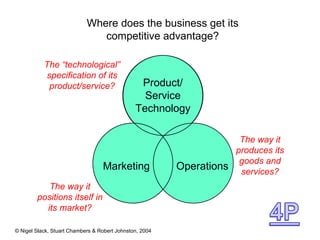
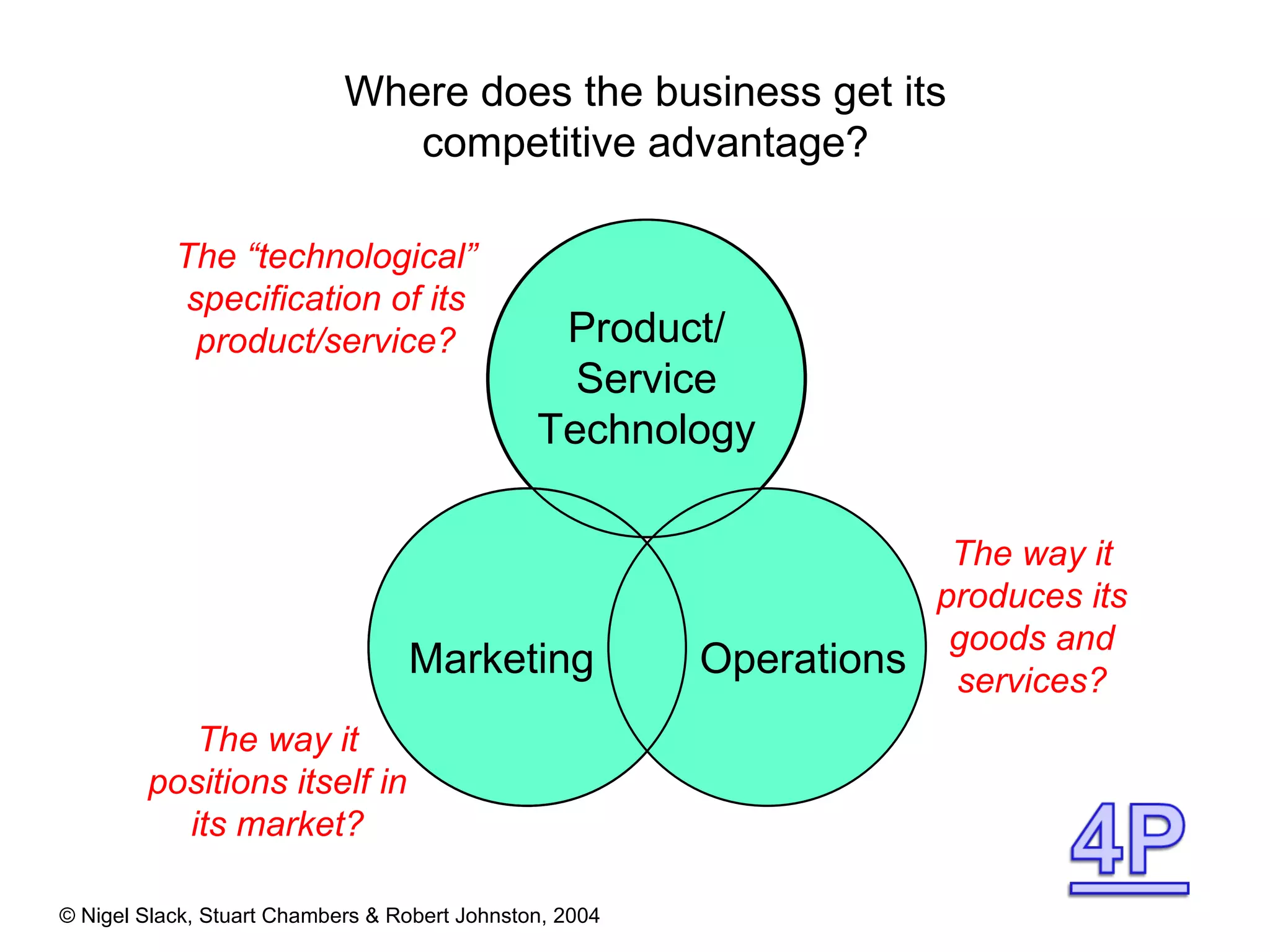
Where does the business get its competitive advantage? The way it produces its goods and services? The way it positions itself in its market? The “technological” specification of its product/service? Product/ Service Technology Marketing Operations
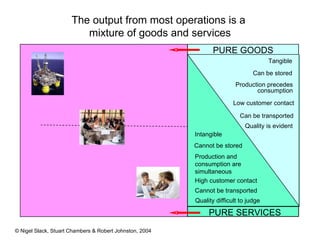
The output from most operations is a  mixture of goods and services PURE GOODS Tangible Can be stored Production precedes consumption Low customer contact Can be transported Quality is evident PURE SERVICES Quality difficult to judge Cannot be transported High customer contact Production and consumption are simultaneous Cannot be stored Intangible
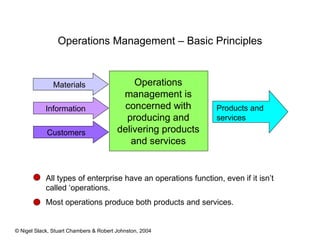
Operations Management – Basic Principles All types of enterprise have an operations function, even if it isn’t called ‘operations. Most operations produce both products and services. Materials Products and services Information Customers Operations management is concerned with producing and delivering products and services
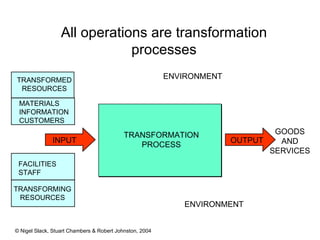
All o perations  are transformation processes ENVIRONMENT ENVIRONMENT INPUT OUTPUT GOODS AND SERVICES TRANSFORMATION PROCESS TRANSFORMED RESOURCES MATERIAL S   INF OR MATION CUSTOMERS FACILITIES STAFF TRA NS FORM ING  RESOURCES
 
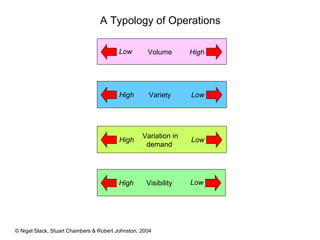
A Typology of Operations Variation in demand  High Low Visibility High Low Variety High Low High Volume Low High
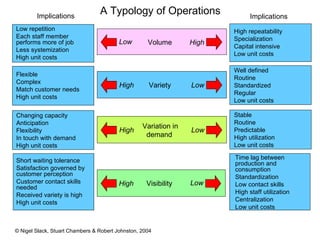
A Typology of Operations Implications Implications Changing capacity Anticipation Flexibility In touch with demand High unit costs Stable Routine Predictable High utilization Low unit costs Variation in demand  High Low Visibility High Low Short waiting tolerance Satisfaction governed by customer perception Customer contact skills needed Received variety is high High unit costs Time lag between production and consumption Standardization Low contact skills High staff utilization Centralization Low unit costs Flexible Complex Match customer needs High unit costs Well defined Routine Standardized Regular Low unit costs Variety High Low High Low repetition Each staff member performs more of job Less systemization High unit costs High repeatability Specialization Capital intensive Low unit costs Volume Low High
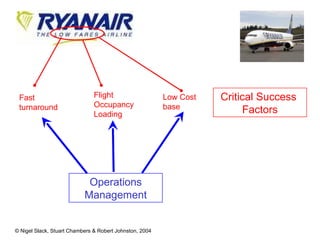
Critical Success  Factors Fast  turnaround  Flight Occupancy Loading Low Cost base Operations Management
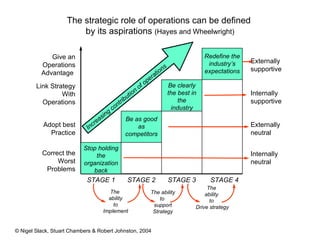
The strategic role of operations can be defined  by its aspirations  (Hayes and Wheelwright) Give an Operations Advantage  Externally supportive Internally supportive Externally neutral Internally neutral The  ability to Implement Link Strategy With Operations Adopt best Practice Correct the Worst Problems Increasing contribution of operations STAGE 1 STAGE 2 STAGE 3 STAGE 4 The  ability  to  Drive strategy Stop holding the organi z ation back Be as good as competitors Be clearly the best in the industry Redefine the industry’s expectations The ability to  support Strategy
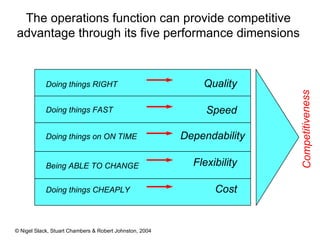
Competitiveness The operations function can provide competitive  advantage through its five performance dimensions  Speed Flexibility Cost Dependability Quality Doing things RIGHT Doing things FAST Doing things on ON TIME Being ABLE TO CHANGE Doing things CHEAPLY
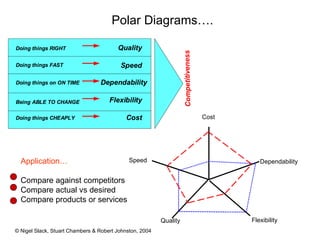
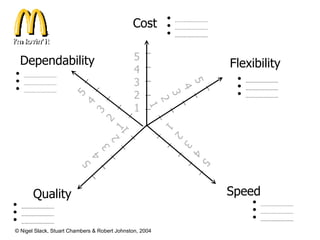
Polar Diagrams…. Application… Compare against competitors Compare actual vs desired Compare products or services Dependability Flexibility  Quality  Speed Cost
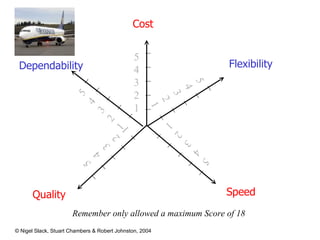
5 4 3 2 1 5 4 3 2 1 Remember only allowed a maximum Score of 18 Quality Cost Speed Flexibility Dependability 5 4 3 2 1 5 4 3 2 1 5 4 3 2 1
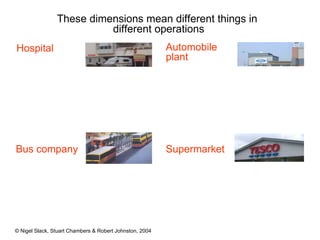
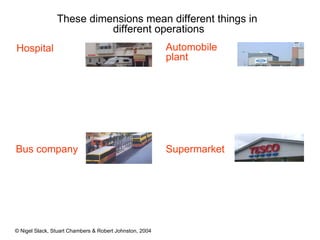
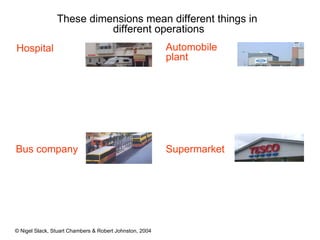
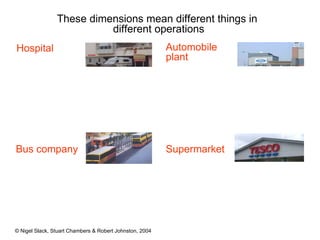
These dimensions mean different things in  different operations Hospital Bus company Automobile plant Supermarket
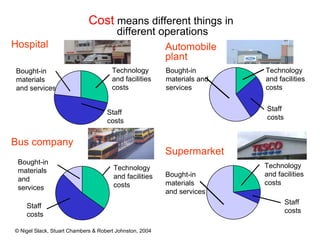
Cost  means different things in  different operations Hospital Automobile plant Supermarket Staff costs Technology and facilities costs Bought-in materials and services Technology and facilities costs Staff costs Staff costs Technology and facilities costs Bought-in materials and services Bought-in materials and services Technology and facilities costs Bus company Staff costs Bought-in materials and services
Step 2 Relative Priorities
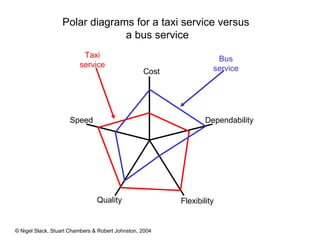
Polar diagrams for a taxi service versus  a bus service Cost Quality Flexibility Dependability Speed Taxi service Bus service
5 4 3 2 1 5 4 3 2 1 Quality Cost Speed Flexibility Dependability 5 4 3 2 1 5 4 3 2 1 5 4 3 2 1
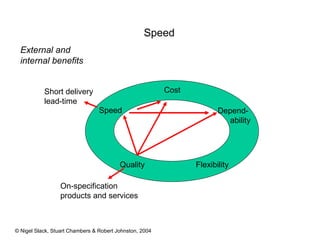
Quality Flexibility Depend-  ability Speed Cost On-specification products and services Speed External and  internal benefits Short delivery lead-time

Bpm lecture 1 students

  • 1.
    Where does thebusiness get its competitive advantage? The way it produces its goods and services? The way it positions itself in its market? The “technological” specification of its product/service? Product/ Service Technology Marketing Operations
  • 2.
    The output frommost operations is a mixture of goods and services PURE GOODS Tangible Can be stored Production precedes consumption Low customer contact Can be transported Quality is evident PURE SERVICES Quality difficult to judge Cannot be transported High customer contact Production and consumption are simultaneous Cannot be stored Intangible
  • 3.
    Operations Management –Basic Principles All types of enterprise have an operations function, even if it isn’t called ‘operations. Most operations produce both products and services. Materials Products and services Information Customers Operations management is concerned with producing and delivering products and services
  • 4.
    All o perations are transformation processes ENVIRONMENT ENVIRONMENT INPUT OUTPUT GOODS AND SERVICES TRANSFORMATION PROCESS TRANSFORMED RESOURCES MATERIAL S INF OR MATION CUSTOMERS FACILITIES STAFF TRA NS FORM ING RESOURCES
  • 5.
  • 6.
    A Typology ofOperations Variation in demand High Low Visibility High Low Variety High Low High Volume Low High
  • 7.
    A Typology ofOperations Implications Implications Changing capacity Anticipation Flexibility In touch with demand High unit costs Stable Routine Predictable High utilization Low unit costs Variation in demand High Low Visibility High Low Short waiting tolerance Satisfaction governed by customer perception Customer contact skills needed Received variety is high High unit costs Time lag between production and consumption Standardization Low contact skills High staff utilization Centralization Low unit costs Flexible Complex Match customer needs High unit costs Well defined Routine Standardized Regular Low unit costs Variety High Low High Low repetition Each staff member performs more of job Less systemization High unit costs High repeatability Specialization Capital intensive Low unit costs Volume Low High
  • 8.
    Critical Success Factors Fast turnaround Flight Occupancy Loading Low Cost base Operations Management
  • 9.
    The strategic roleof operations can be defined by its aspirations (Hayes and Wheelwright) Give an Operations Advantage Externally supportive Internally supportive Externally neutral Internally neutral The ability to Implement Link Strategy With Operations Adopt best Practice Correct the Worst Problems Increasing contribution of operations STAGE 1 STAGE 2 STAGE 3 STAGE 4 The ability to Drive strategy Stop holding the organi z ation back Be as good as competitors Be clearly the best in the industry Redefine the industry’s expectations The ability to support Strategy
  • 10.
    Competitiveness The operationsfunction can provide competitive advantage through its five performance dimensions Speed Flexibility Cost Dependability Quality Doing things RIGHT Doing things FAST Doing things on ON TIME Being ABLE TO CHANGE Doing things CHEAPLY
  • 11.
    Polar Diagrams…. Application…Compare against competitors Compare actual vs desired Compare products or services Dependability Flexibility Quality Speed Cost
  • 12.
    5 4 32 1 5 4 3 2 1 Remember only allowed a maximum Score of 18 Quality Cost Speed Flexibility Dependability 5 4 3 2 1 5 4 3 2 1 5 4 3 2 1
  • 13.
    These dimensions meandifferent things in different operations Hospital Bus company Automobile plant Supermarket
  • 14.
    These dimensions meandifferent things in different operations Hospital Bus company Automobile plant Supermarket
  • 15.
    These dimensions meandifferent things in different operations Hospital Bus company Automobile plant Supermarket
  • 16.
    These dimensions meandifferent things in different operations Hospital Bus company Automobile plant Supermarket
  • 17.
    Cost meansdifferent things in different operations Hospital Automobile plant Supermarket Staff costs Technology and facilities costs Bought-in materials and services Technology and facilities costs Staff costs Staff costs Technology and facilities costs Bought-in materials and services Bought-in materials and services Technology and facilities costs Bus company Staff costs Bought-in materials and services
  • 18.
    Step 2 RelativePriorities
  • 19.
    Polar diagrams fora taxi service versus a bus service Cost Quality Flexibility Dependability Speed Taxi service Bus service
  • 20.
    5 4 32 1 5 4 3 2 1 Quality Cost Speed Flexibility Dependability 5 4 3 2 1 5 4 3 2 1 5 4 3 2 1
  • 21.
    Quality Flexibility Depend- ability Speed Cost On-specification products and services Speed External and internal benefits Short delivery lead-time

Editor's Notes