Operations Management
Chapter-2
Competitiveness,
strategy, productivity
How effectively an organization meets the wants and
needs of customers relative to others that offer similar
goods or services.
Competitiveness
1. Identifying consumer wants and needs
2. Pricing
3. Advertising and promotion
Businesses Compete Using
Marketing
1. Product and service design
2. Cost
3. Location
4. Quality
5. Quick response
6. Flexibility
7. Inventory management
8. Supply chain management
9. Service
Businesses Compete Using
Operations
1. Too much emphasis on short-term financial performance
2. Failing to take advantage of strengths and opportunities
3. Failing to recognize competitive threats
4. Neglecting operations strategy
5. Too much emphasis in product and service design and not
enough on improvement
6. Neglecting investments in capital and human resources
7. Failing to establish good internal communications
8. Failing to consider customer wants and needs
Why Some Organizations Fail
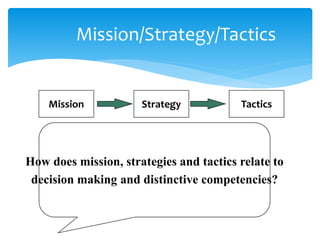
Mission/Strategy/Tactics
Strategy Tactics
Mission
How does mission, strategies and tactics relate to
decision making and distinctive competencies?
1. Strategies
Plans for achieving organizational goals
2. Mission
The reason for existence for an organization
3. Mission Statement
Answers the question “What business are we in?”
4. Goals
Provide detail and scope of mission
5. Tactics
The methods and actions taken to accomplish strategies
Strategy
Rita is a high school student. She would like to have a career
in business, have a good job, and earn enough income to live
comfortably
Mission: Live a good life
Goal: Successful career, good income
Strategy: Obtain a college education
Tactics: Select a college and a major
Operations: Register, buy books, take
courses, study, graduate, get job
Strategy Example
Distinctive Competencies
The special attributes or abilities that give an
organization a competitive edge.
 Price
 Quality
 Time
 Flexibility
 Service
 Location
Strategy and Tactics
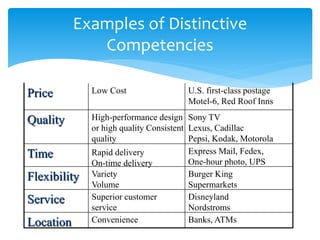
Examples of Distinctive
Competencies
Banks, ATMs
Convenience
Location
Disneyland
Nordstroms
Superior customer
service
Service
Burger King
Supermarkets
Variety
Volume
Flexibility
Express Mail, Fedex,
One-hour photo, UPS
Rapid delivery
On-time delivery
Time
Sony TV
Lexus, Cadillac
Pepsi, Kodak, Motorola
High-performance design
or high quality Consistent
quality
Quality
U.S. first-class postage
Motel-6, Red Roof Inns
Low Cost
Price
Operations strategy – The approach, consistent
with organization strategy, that is used to guide
the operations function.
Operations Strategy
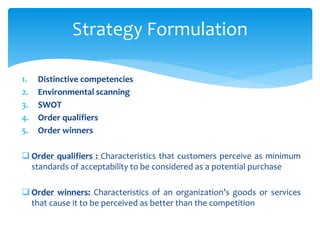
1. Distinctive competencies
2. Environmental scanning
3. SWOT
4. Order qualifiers
5. Order winners
 Order qualifiers : Characteristics that customers perceive as minimum
standards of acceptability to be considered as a potential purchase
 Order winners: Characteristics of an organization’s goods or services
that cause it to be perceived as better than the competition
Strategy Formulation
1. Economic conditions
2. Political conditions
3. Legal environment
4. Technology
5. Competition
6. Markets
Key External Factors
1. Human Resources
2. Facilities and equipment
3. Financial resources
4. Customers
5. Products and services
6. Technology
7. Suppliers
Key Internal Factors
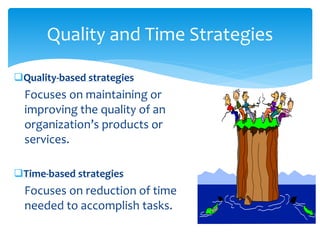
Quality-based strategies
Focuses on maintaining or
improving the quality of an
organization’s products or
services.
Time-based strategies
Focuses on reduction of time
needed to accomplish tasks.
Quality and Time Strategies
Productivity
A measure of the effective use of resources, usually
expressed as the ratio of output to input
Productivity ratios are used for
1. Planning workforce requirements
2. Scheduling equipment
3. Financial analysis
Productivity
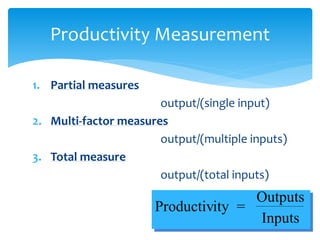
1. Partial measures
output/(single input)
2. Multi-factor measures
output/(multiple inputs)
3. Total measure
output/(total inputs)
Productivity Measurement
Productivity =
Outputs
Inputs
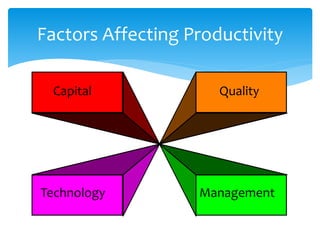
Factors Affecting Productivity
Capital Quality
Technology Management
1. Standardization
2. Quality
3. Use of Internet
4. Computer viruses
5. Searching for lost or misplaced items
6. Scrap rates
7. New workers
8. Safety
9. Shortage of IT workers
10. Layoffs
11. Labor turnover
12. Design of the workspace
13. Incentive plans that reward productivity
Other Factors Affecting Productivity
1. Develop productivity measures
2. Determine critical (bottleneck) operations
3. Develop methods for productivity improvements
4. Establish reasonable goals
5. Get management support
6. Measure and publicize improvements
7. Don’t confuse productivity with efficiency
Improving Productivity

OM-2- strategy mission vision competitiveness.pptx

  • 1.
  • 2.
    How effectively anorganization meets the wants and needs of customers relative to others that offer similar goods or services. Competitiveness
  • 3.
    1. Identifying consumerwants and needs 2. Pricing 3. Advertising and promotion Businesses Compete Using Marketing
  • 4.
    1. Product andservice design 2. Cost 3. Location 4. Quality 5. Quick response 6. Flexibility 7. Inventory management 8. Supply chain management 9. Service Businesses Compete Using Operations
  • 5.
    1. Too muchemphasis on short-term financial performance 2. Failing to take advantage of strengths and opportunities 3. Failing to recognize competitive threats 4. Neglecting operations strategy 5. Too much emphasis in product and service design and not enough on improvement 6. Neglecting investments in capital and human resources 7. Failing to establish good internal communications 8. Failing to consider customer wants and needs Why Some Organizations Fail
  • 6.
    Mission/Strategy/Tactics Strategy Tactics Mission How doesmission, strategies and tactics relate to decision making and distinctive competencies?
  • 7.
    1. Strategies Plans forachieving organizational goals 2. Mission The reason for existence for an organization 3. Mission Statement Answers the question “What business are we in?” 4. Goals Provide detail and scope of mission 5. Tactics The methods and actions taken to accomplish strategies Strategy
  • 8.
    Rita is ahigh school student. She would like to have a career in business, have a good job, and earn enough income to live comfortably Mission: Live a good life Goal: Successful career, good income Strategy: Obtain a college education Tactics: Select a college and a major Operations: Register, buy books, take courses, study, graduate, get job Strategy Example
  • 9.
    Distinctive Competencies The specialattributes or abilities that give an organization a competitive edge.  Price  Quality  Time  Flexibility  Service  Location Strategy and Tactics
  • 10.
    Examples of Distinctive Competencies Banks,ATMs Convenience Location Disneyland Nordstroms Superior customer service Service Burger King Supermarkets Variety Volume Flexibility Express Mail, Fedex, One-hour photo, UPS Rapid delivery On-time delivery Time Sony TV Lexus, Cadillac Pepsi, Kodak, Motorola High-performance design or high quality Consistent quality Quality U.S. first-class postage Motel-6, Red Roof Inns Low Cost Price
  • 11.
    Operations strategy –The approach, consistent with organization strategy, that is used to guide the operations function. Operations Strategy
  • 12.
    1. Distinctive competencies 2.Environmental scanning 3. SWOT 4. Order qualifiers 5. Order winners  Order qualifiers : Characteristics that customers perceive as minimum standards of acceptability to be considered as a potential purchase  Order winners: Characteristics of an organization’s goods or services that cause it to be perceived as better than the competition Strategy Formulation
  • 13.
    1. Economic conditions 2.Political conditions 3. Legal environment 4. Technology 5. Competition 6. Markets Key External Factors
  • 14.
    1. Human Resources 2.Facilities and equipment 3. Financial resources 4. Customers 5. Products and services 6. Technology 7. Suppliers Key Internal Factors
  • 15.
    Quality-based strategies Focuses onmaintaining or improving the quality of an organization’s products or services. Time-based strategies Focuses on reduction of time needed to accomplish tasks. Quality and Time Strategies
  • 16.
    Productivity A measure ofthe effective use of resources, usually expressed as the ratio of output to input Productivity ratios are used for 1. Planning workforce requirements 2. Scheduling equipment 3. Financial analysis Productivity
  • 17.
    1. Partial measures output/(singleinput) 2. Multi-factor measures output/(multiple inputs) 3. Total measure output/(total inputs) Productivity Measurement Productivity = Outputs Inputs
  • 18.
    Factors Affecting Productivity CapitalQuality Technology Management
  • 19.
    1. Standardization 2. Quality 3.Use of Internet 4. Computer viruses 5. Searching for lost or misplaced items 6. Scrap rates 7. New workers 8. Safety 9. Shortage of IT workers 10. Layoffs 11. Labor turnover 12. Design of the workspace 13. Incentive plans that reward productivity Other Factors Affecting Productivity
  • 20.
    1. Develop productivitymeasures 2. Determine critical (bottleneck) operations 3. Develop methods for productivity improvements 4. Establish reasonable goals 5. Get management support 6. Measure and publicize improvements 7. Don’t confuse productivity with efficiency Improving Productivity