Collier, Evans, Operations and Supply Chain Management, 3rd Edition. ©2024 Cengage Group. All Rights
Reserved. May not be scanned, copied or duplicated, or posted to a publicly accessible website, in whole or in part.
Operations and Supply Chain
Management, 3e
Chapter 1 – Operations Management
Value Chains
© 2024 Cengage Group. All Rights Reserved.
Chapter Contents
1-1 The Importance and Scope of
Operations Management (OM)
1-2 OM in the Workplace
1-3 Understanding Goods and
Services
1-4 The Concept of Value
1-5 Customer Benefit Packages
1-6 Value Chains
1-7 Value Chain Frameworks
1-8 OM: A History of Change and
Challenge
1-9 Current and Future Challenges
© 2024 Cengage Group. All Rights Reserved.
Chapter Objectives
After completing this chapter, you will be able to:
LO 1-1 Explain the concept and importance of operations management.
LO 1-2 Describe what operations managers do.
LO 1-3 Explain the differences between goods and services.
LO 1-4 Define the concept of value and explain how the value of goods and services
can be enhanced.
LO 1-5 Describe a customer benefit package.
LO 1-6 Explain the difference between value chains and supply chains and identify
three general types of processes in a business.
LO 1-7 Contrast the three different frameworks for describing value chains.
LO 1-8 Summarize the historical development of OM.
LO 1-9 State the current and future key challenges facing OM.
© 2024 Cengage Group. All Rights Reserved.
1-1 Operations Management (OM)
Operations Management (OM) is the science and art of ensuring that goods
and services are created and delivered successfully to customers.
OM includes:
• Design of goods, services, and the processes that create them
• Day-to-day management of processes
• Continual improvement of goods, services, and processes
OM depends on:
• Efficiency
• Cost of operations
• Quality of goods
© 2024 Cengage Group. All Rights Reserved.
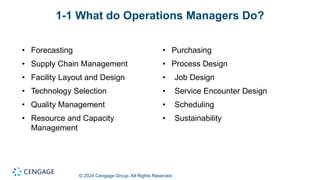
1-1 What do Operations Managers Do?
• Forecasting
• Supply Chain Management
• Facility Layout and Design
• Technology Selection
• Quality Management
• Resource and Capacity
Management
• Purchasing
• Process Design
• Job Design
• Service Encounter Design
• Scheduling
• Sustainability
© 2024 Cengage Group. All Rights Reserved.
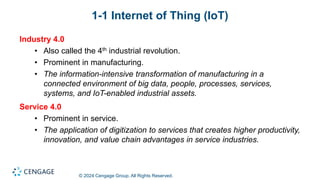
1-1 Internet of Thing (IoT)
Industry 4.0
• Also called the 4th industrial revolution.
• Prominent in manufacturing.
• The information-intensive transformation of manufacturing in a
connected environment of big data, people, processes, services,
systems, and IoT-enabled industrial assets.
Service 4.0
• Prominent in service.
• The application of digitization to services that creates higher productivity,
innovation, and value chain advantages in service industries.
© 2024 Cengage Group. All Rights Reserved.
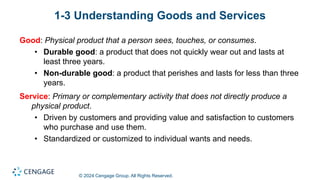
1-3 Understanding Goods and Services
Good: Physical product that a person sees, touches, or consumes.
• Durable good: a product that does not quickly wear out and lasts at
least three years.
• Non-durable good: a product that perishes and lasts for less than three
years.
Service: Primary or complementary activity that does not directly produce a
physical product.
• Driven by customers and providing value and satisfaction to customers
who purchase and use them.
• Standardized or customized to individual wants and needs.
© 2024 Cengage Group. All Rights Reserved.
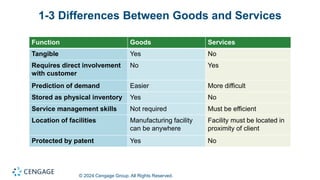
1-3 Differences Between Goods and Services
Function Goods Services
Tangible Yes No
Requires direct involvement
with customer
No Yes
Prediction of demand Easier More difficult
Stored as physical inventory Yes No
Service management skills Not required Must be efficient
Location of facilities Manufacturing facility
can be anywhere
Facility must be located in
proximity of client
Protected by patent Yes No
© 2024 Cengage Group. All Rights Reserved.
1-3 Service Management
Service management integrates marketing, human resources, and
operations functions to
• plan
• create
• deliver goods and services
• deal with associated service encounters
A service encounter is an interaction between the customer and the service
provider.
• Service encounters consist of one or more moments of truth.
Moments of truth are any episodes, transactions, or experiences in which a
customer comes into contact with any aspect of the delivery system, however
remote, and has an opportunity to form an impression.
© 2024 Cengage Group. All Rights Reserved.
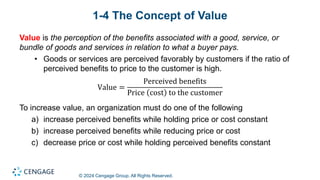
1-4 The Concept of Value
Value is the perception of the benefits associated with a good, service, or
bundle of goods and services in relation to what a buyer pays.
• Goods or services are perceived favorably by customers if the ratio of
perceived benefits to price to the customer is high.
Value =
Perceived benefits
Price cost to the customer
To increase value, an organization must do one of the following
a) increase perceived benefits while holding price or cost constant
b) increase perceived benefits while reducing price or cost
c) decrease price or cost while holding perceived benefits constant
© 2024 Cengage Group. All Rights Reserved.
1-5 Customer Benefit Packages
A customer benefit package (CBP) is a clearly defined set of tangible and
intangible features that a customer recognizes, pays for, uses, or experiences.
• A CBP consists of a primary good or service coupled with peripheral
goods and/or services, and sometimes variants.
• A primary good or service is the “core” offering that attracts
customers and responds to their basic needs.
• The peripheral goods or services are offerings that are not
essential to the primary good or service but enhance it.
• A variant is a location- or firm-specific CBP attribute that departs
from the standard CBP.
© 2024 Cengage Group. All Rights Reserved.
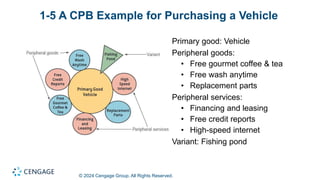
1-5 A CPB Example for Purchasing a Vehicle
Primary good: Vehicle
Peripheral goods:
• Free gourmet coffee & tea
• Free wash anytime
• Replacement parts
Peripheral services:
• Financing and leasing
• Free credit reports
• High-speed internet
Variant: Fishing pond
© 2024 Cengage Group. All Rights Reserved.
1-5 Biztainment
Biztainment is the practice of adding entertainment content to a bundle of
goods and services in order to gain a competitive advantage.
Biztainment can be applied to both manufacturing and service settings:
• Manufacturing
• Retail
• Restaurants
• Agriculture
• Lodging
• Telecommunications
© 2024 Cengage Group. All Rights Reserved.
1-6 Value Chains
A value chain is a network of facilities and processes.
A value chain describes the flow of materials, finished goods, services,
information, and financial transactions from suppliers through the
facilities and processes that create goods and services and those that
deliver them to the customer.
A supply chain is a portion of the value chain.
A supply chain focuses primarily on the physical movement of goods and
materials and supports flows of information and financial transactions
through the supply, production, and distribution processes.
© 2024 Cengage Group. All Rights Reserved.
1-6a Processes
A process is a sequence of activities intended to create a certain result, such
as a physical good, a service, or information.
A practical definition of a process (source: AT&T) is
• A process is how work creates value for customers.
Key business processes:
• Value-creation (core) processes: producing or delivering an
organization’s primary goods or services that create value for customers.
• Support processes: purchasing, managing inventory, installation, health
benefits, technology acquisition, daycare services, and research.
• General management processes focus on accounting and information
systems, human resource management, and marketing.
© 2024 Cengage Group. All Rights Reserved.
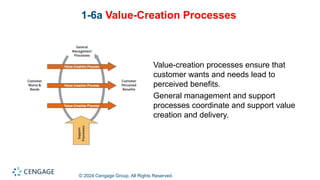
1-6a Value-Creation Processes
Value-creation processes ensure that
customer wants and needs lead to
perceived benefits.
General management and support
processes coordinate and support value
creation and delivery.
© 2024 Cengage Group. All Rights Reserved.
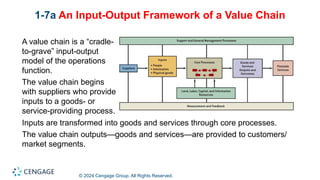
1-7a An Input-Output Framework of a Value Chain
A value chain is a “cradle-
to-grave” input-output
model of the operations
function.
The value chain begins
with suppliers who provide
inputs to a goods- or
service-providing process.
Inputs are transformed into goods and services through core processes.
The value chain outputs—goods and services—are provided to customers/
market segments.
© 2024 Cengage Group. All Rights Reserved.
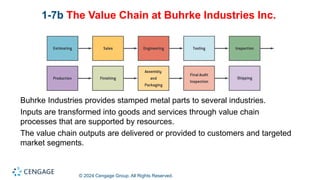
1-7b The Value Chain at Buhrke Industries Inc.
Buhrke Industries provides stamped metal parts to several industries.
Inputs are transformed into goods and services through value chain
processes that are supported by resources.
The value chain outputs are delivered or provided to customers and targeted
market segments.
© 2024 Cengage Group. All Rights Reserved.
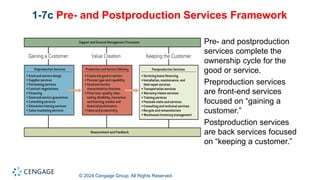
1-7c Pre- and Postproduction Services Framework
Pre- and postproduction
services complete the
ownership cycle for the
good or service.
Preproduction services
are front-end services
focused on “gaining a
customer.”
Postproduction services
are back services focused
on “keeping a customer.”
© 2024 Cengage Group. All Rights Reserved.
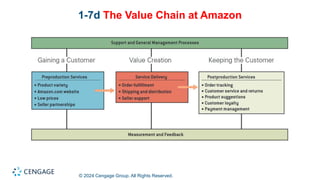
1-7d The Value Chain at Amazon
© 2024 Cengage Group. All Rights Reserved.
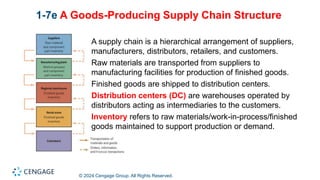
1-7e A Goods-Producing Supply Chain Structure
A supply chain is a hierarchical arrangement of suppliers,
manufacturers, distributors, retailers, and customers.
Raw materials are transported from suppliers to
manufacturing facilities for production of finished goods.
Finished goods are shipped to distribution centers.
Distribution centers (DC) are warehouses operated by
distributors acting as intermediaries to the customers.
Inventory refers to raw materials/work-in-process/finished
goods maintained to support production or demand.
© 2024 Cengage Group. All Rights Reserved.
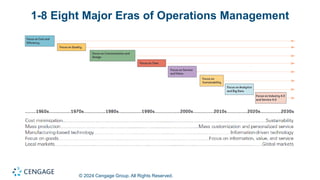
1-8 Eight Major Eras of Operations Management
© 2024 Cengage Group. All Rights Reserved.
1-8f Sustainability
Sustainability refers to an organization’s ability to address current business
needs strategically and develop a long-term strategy that embraces
opportunities, manages risks, and preserves resources.
The three main perspectives of sustainability are:
• Environmental sustainability is an organization’s commitment to
the long-term quality of the environment.
• Social sustainability is an organization’s commitment to maintaining
healthy communities and a society that improves the quality of life.
• Economic sustainability is an organization’s commitment to
addressing current business needs and economic vitality.
© 2024 Cengage Group. All Rights Reserved.
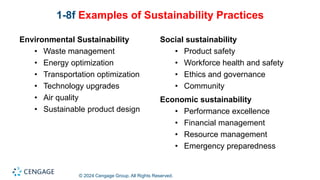
1-8f Examples of Sustainability Practices
Environmental Sustainability
• Waste management
• Energy optimization
• Transportation optimization
• Technology upgrades
• Air quality
• Sustainable product design
Social sustainability
• Product safety
• Workforce health and safety
• Ethics and governance
• Community
Economic sustainability
• Performance excellence
• Financial management
• Resource management
• Emergency preparedness
© 2024 Cengage Group. All Rights Reserved.
1-8g Analytics
Companies leverage data to create competitive advantage using a discipline
called business analytics.
Business analytics is the process of transforming data into actions through
analysis and insights in the context of decision-making and problem-solving.
Supplements at the end of the book provide introductions to the following
analytics topics:
A. Probability and statistics
B. Decision Analysis
C. Break-Even Analysis
D. Linear Optimization
E. The Transportation and
Assignment Models
F. Queueing Models
G. Simulation
© 2024 Cengage Group. All Rights Reserved.
1-8g Big Data
Big data refers to massive amounts of business data from a wide variety of
sources, much of which is available in real-time.
• Big data helps retailers make optimum inventory decisions.
• Big data, such as weather and traffic data, helps supply chains to
improve routing and delivery decisions.
• Big data helps improve manufacturing, process flow, quality, and
preventive maintenance.
• Big data analytics supports service businesses such as targeted
advertising, virtual banking, remote medical diagnosis by artificial
intelligence, self-driving vehicles, etc.
© 2024 Cengage Group. All Rights Reserved.
1-9 Current and Future Challenges in OM
Customers demand goods with new and improved features.
Technology continues to evolve at a rapid pace.
Today’s workforce requires new skills, more diversity, and better management.
Firms must contend with globalization in a “borderless marketplace”.
Sustainability is a fourth major performance area in addition to the traditional
cost, quality, and time.
Optimizing supply chains presents new challenges in terms of determining
where to best source raw materials, components, and finished goods.
Exploiting Industry 4.0/Service 4.0 will lead to applications that are
customized to customers.
© 2024 Cengage Group. All Rights Reserved.
Check Your Knowledge 1.1
The value of goods and services can be determined by dividing
a. actual benefits by perceived benefits.
b. perceived benefits by price (cost) to customer.
c. cost to the seller by actual benefits.
d. cost to the customer by cost to the seller.
Which of the following statements about value-creation (core) processes is true?
a. They are "behind-the-scenes" processes that support primary processes.
b. They include the processes of inventory management and research and
development.
c. They include the processes of human resource management and marketing.
d. They are focused on delivering an organization's primary goods or services
that create value for customers.
© 2024 Cengage Group. All Rights Reserved.
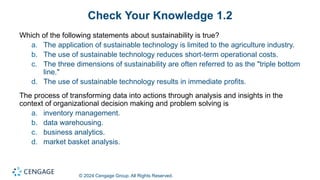
Check Your Knowledge 1.2
Which of the following statements about sustainability is true?
a. The application of sustainable technology is limited to the agriculture industry.
b. The use of sustainable technology reduces short-term operational costs.
c. The three dimensions of sustainability are often referred to as the "triple bottom
line."
d. The use of sustainable technology results in immediate profits.
The process of transforming data into actions through analysis and insights in the
context of organizational decision making and problem solving is
a. inventory management.
b. data warehousing.
c. business analytics.
d. market basket analysis.

Collier OSCM 3e PPT CH01.pptx

  • 1.
    Collier, Evans, Operationsand Supply Chain Management, 3rd Edition. ©2024 Cengage Group. All Rights Reserved. May not be scanned, copied or duplicated, or posted to a publicly accessible website, in whole or in part. Operations and Supply Chain Management, 3e Chapter 1 – Operations Management Value Chains
  • 2.
    © 2024 CengageGroup. All Rights Reserved. Chapter Contents 1-1 The Importance and Scope of Operations Management (OM) 1-2 OM in the Workplace 1-3 Understanding Goods and Services 1-4 The Concept of Value 1-5 Customer Benefit Packages 1-6 Value Chains 1-7 Value Chain Frameworks 1-8 OM: A History of Change and Challenge 1-9 Current and Future Challenges
  • 3.
    © 2024 CengageGroup. All Rights Reserved. Chapter Objectives After completing this chapter, you will be able to: LO 1-1 Explain the concept and importance of operations management. LO 1-2 Describe what operations managers do. LO 1-3 Explain the differences between goods and services. LO 1-4 Define the concept of value and explain how the value of goods and services can be enhanced. LO 1-5 Describe a customer benefit package. LO 1-6 Explain the difference between value chains and supply chains and identify three general types of processes in a business. LO 1-7 Contrast the three different frameworks for describing value chains. LO 1-8 Summarize the historical development of OM. LO 1-9 State the current and future key challenges facing OM.
  • 4.
    © 2024 CengageGroup. All Rights Reserved. 1-1 Operations Management (OM) Operations Management (OM) is the science and art of ensuring that goods and services are created and delivered successfully to customers. OM includes: • Design of goods, services, and the processes that create them • Day-to-day management of processes • Continual improvement of goods, services, and processes OM depends on: • Efficiency • Cost of operations • Quality of goods
  • 5.
    © 2024 CengageGroup. All Rights Reserved. 1-1 What do Operations Managers Do? • Forecasting • Supply Chain Management • Facility Layout and Design • Technology Selection • Quality Management • Resource and Capacity Management • Purchasing • Process Design • Job Design • Service Encounter Design • Scheduling • Sustainability
  • 6.
    © 2024 CengageGroup. All Rights Reserved. 1-1 Internet of Thing (IoT) Industry 4.0 • Also called the 4th industrial revolution. • Prominent in manufacturing. • The information-intensive transformation of manufacturing in a connected environment of big data, people, processes, services, systems, and IoT-enabled industrial assets. Service 4.0 • Prominent in service. • The application of digitization to services that creates higher productivity, innovation, and value chain advantages in service industries.
  • 7.
    © 2024 CengageGroup. All Rights Reserved. 1-3 Understanding Goods and Services Good: Physical product that a person sees, touches, or consumes. • Durable good: a product that does not quickly wear out and lasts at least three years. • Non-durable good: a product that perishes and lasts for less than three years. Service: Primary or complementary activity that does not directly produce a physical product. • Driven by customers and providing value and satisfaction to customers who purchase and use them. • Standardized or customized to individual wants and needs.
  • 8.
    © 2024 CengageGroup. All Rights Reserved. 1-3 Differences Between Goods and Services Function Goods Services Tangible Yes No Requires direct involvement with customer No Yes Prediction of demand Easier More difficult Stored as physical inventory Yes No Service management skills Not required Must be efficient Location of facilities Manufacturing facility can be anywhere Facility must be located in proximity of client Protected by patent Yes No
  • 9.
    © 2024 CengageGroup. All Rights Reserved. 1-3 Service Management Service management integrates marketing, human resources, and operations functions to • plan • create • deliver goods and services • deal with associated service encounters A service encounter is an interaction between the customer and the service provider. • Service encounters consist of one or more moments of truth. Moments of truth are any episodes, transactions, or experiences in which a customer comes into contact with any aspect of the delivery system, however remote, and has an opportunity to form an impression.
  • 10.
    © 2024 CengageGroup. All Rights Reserved. 1-4 The Concept of Value Value is the perception of the benefits associated with a good, service, or bundle of goods and services in relation to what a buyer pays. • Goods or services are perceived favorably by customers if the ratio of perceived benefits to price to the customer is high. Value = Perceived benefits Price cost to the customer To increase value, an organization must do one of the following a) increase perceived benefits while holding price or cost constant b) increase perceived benefits while reducing price or cost c) decrease price or cost while holding perceived benefits constant
  • 11.
    © 2024 CengageGroup. All Rights Reserved. 1-5 Customer Benefit Packages A customer benefit package (CBP) is a clearly defined set of tangible and intangible features that a customer recognizes, pays for, uses, or experiences. • A CBP consists of a primary good or service coupled with peripheral goods and/or services, and sometimes variants. • A primary good or service is the “core” offering that attracts customers and responds to their basic needs. • The peripheral goods or services are offerings that are not essential to the primary good or service but enhance it. • A variant is a location- or firm-specific CBP attribute that departs from the standard CBP.
  • 12.
    © 2024 CengageGroup. All Rights Reserved. 1-5 A CPB Example for Purchasing a Vehicle Primary good: Vehicle Peripheral goods: • Free gourmet coffee & tea • Free wash anytime • Replacement parts Peripheral services: • Financing and leasing • Free credit reports • High-speed internet Variant: Fishing pond
  • 13.
    © 2024 CengageGroup. All Rights Reserved. 1-5 Biztainment Biztainment is the practice of adding entertainment content to a bundle of goods and services in order to gain a competitive advantage. Biztainment can be applied to both manufacturing and service settings: • Manufacturing • Retail • Restaurants • Agriculture • Lodging • Telecommunications
  • 14.
    © 2024 CengageGroup. All Rights Reserved. 1-6 Value Chains A value chain is a network of facilities and processes. A value chain describes the flow of materials, finished goods, services, information, and financial transactions from suppliers through the facilities and processes that create goods and services and those that deliver them to the customer. A supply chain is a portion of the value chain. A supply chain focuses primarily on the physical movement of goods and materials and supports flows of information and financial transactions through the supply, production, and distribution processes.
  • 15.
    © 2024 CengageGroup. All Rights Reserved. 1-6a Processes A process is a sequence of activities intended to create a certain result, such as a physical good, a service, or information. A practical definition of a process (source: AT&T) is • A process is how work creates value for customers. Key business processes: • Value-creation (core) processes: producing or delivering an organization’s primary goods or services that create value for customers. • Support processes: purchasing, managing inventory, installation, health benefits, technology acquisition, daycare services, and research. • General management processes focus on accounting and information systems, human resource management, and marketing.
  • 16.
    © 2024 CengageGroup. All Rights Reserved. 1-6a Value-Creation Processes Value-creation processes ensure that customer wants and needs lead to perceived benefits. General management and support processes coordinate and support value creation and delivery.
  • 17.
    © 2024 CengageGroup. All Rights Reserved. 1-7a An Input-Output Framework of a Value Chain A value chain is a “cradle- to-grave” input-output model of the operations function. The value chain begins with suppliers who provide inputs to a goods- or service-providing process. Inputs are transformed into goods and services through core processes. The value chain outputs—goods and services—are provided to customers/ market segments.
  • 18.
    © 2024 CengageGroup. All Rights Reserved. 1-7b The Value Chain at Buhrke Industries Inc. Buhrke Industries provides stamped metal parts to several industries. Inputs are transformed into goods and services through value chain processes that are supported by resources. The value chain outputs are delivered or provided to customers and targeted market segments.
  • 19.
    © 2024 CengageGroup. All Rights Reserved. 1-7c Pre- and Postproduction Services Framework Pre- and postproduction services complete the ownership cycle for the good or service. Preproduction services are front-end services focused on “gaining a customer.” Postproduction services are back services focused on “keeping a customer.”
  • 20.
    © 2024 CengageGroup. All Rights Reserved. 1-7d The Value Chain at Amazon
  • 21.
    © 2024 CengageGroup. All Rights Reserved. 1-7e A Goods-Producing Supply Chain Structure A supply chain is a hierarchical arrangement of suppliers, manufacturers, distributors, retailers, and customers. Raw materials are transported from suppliers to manufacturing facilities for production of finished goods. Finished goods are shipped to distribution centers. Distribution centers (DC) are warehouses operated by distributors acting as intermediaries to the customers. Inventory refers to raw materials/work-in-process/finished goods maintained to support production or demand.
  • 22.
    © 2024 CengageGroup. All Rights Reserved. 1-8 Eight Major Eras of Operations Management
  • 23.
    © 2024 CengageGroup. All Rights Reserved. 1-8f Sustainability Sustainability refers to an organization’s ability to address current business needs strategically and develop a long-term strategy that embraces opportunities, manages risks, and preserves resources. The three main perspectives of sustainability are: • Environmental sustainability is an organization’s commitment to the long-term quality of the environment. • Social sustainability is an organization’s commitment to maintaining healthy communities and a society that improves the quality of life. • Economic sustainability is an organization’s commitment to addressing current business needs and economic vitality.
  • 24.
    © 2024 CengageGroup. All Rights Reserved. 1-8f Examples of Sustainability Practices Environmental Sustainability • Waste management • Energy optimization • Transportation optimization • Technology upgrades • Air quality • Sustainable product design Social sustainability • Product safety • Workforce health and safety • Ethics and governance • Community Economic sustainability • Performance excellence • Financial management • Resource management • Emergency preparedness
  • 25.
    © 2024 CengageGroup. All Rights Reserved. 1-8g Analytics Companies leverage data to create competitive advantage using a discipline called business analytics. Business analytics is the process of transforming data into actions through analysis and insights in the context of decision-making and problem-solving. Supplements at the end of the book provide introductions to the following analytics topics: A. Probability and statistics B. Decision Analysis C. Break-Even Analysis D. Linear Optimization E. The Transportation and Assignment Models F. Queueing Models G. Simulation
  • 26.
    © 2024 CengageGroup. All Rights Reserved. 1-8g Big Data Big data refers to massive amounts of business data from a wide variety of sources, much of which is available in real-time. • Big data helps retailers make optimum inventory decisions. • Big data, such as weather and traffic data, helps supply chains to improve routing and delivery decisions. • Big data helps improve manufacturing, process flow, quality, and preventive maintenance. • Big data analytics supports service businesses such as targeted advertising, virtual banking, remote medical diagnosis by artificial intelligence, self-driving vehicles, etc.
  • 27.
    © 2024 CengageGroup. All Rights Reserved. 1-9 Current and Future Challenges in OM Customers demand goods with new and improved features. Technology continues to evolve at a rapid pace. Today’s workforce requires new skills, more diversity, and better management. Firms must contend with globalization in a “borderless marketplace”. Sustainability is a fourth major performance area in addition to the traditional cost, quality, and time. Optimizing supply chains presents new challenges in terms of determining where to best source raw materials, components, and finished goods. Exploiting Industry 4.0/Service 4.0 will lead to applications that are customized to customers.
  • 28.
    © 2024 CengageGroup. All Rights Reserved. Check Your Knowledge 1.1 The value of goods and services can be determined by dividing a. actual benefits by perceived benefits. b. perceived benefits by price (cost) to customer. c. cost to the seller by actual benefits. d. cost to the customer by cost to the seller. Which of the following statements about value-creation (core) processes is true? a. They are "behind-the-scenes" processes that support primary processes. b. They include the processes of inventory management and research and development. c. They include the processes of human resource management and marketing. d. They are focused on delivering an organization's primary goods or services that create value for customers.
  • 29.
    © 2024 CengageGroup. All Rights Reserved. Check Your Knowledge 1.2 Which of the following statements about sustainability is true? a. The application of sustainable technology is limited to the agriculture industry. b. The use of sustainable technology reduces short-term operational costs. c. The three dimensions of sustainability are often referred to as the "triple bottom line." d. The use of sustainable technology results in immediate profits. The process of transforming data into actions through analysis and insights in the context of organizational decision making and problem solving is a. inventory management. b. data warehousing. c. business analytics. d. market basket analysis.