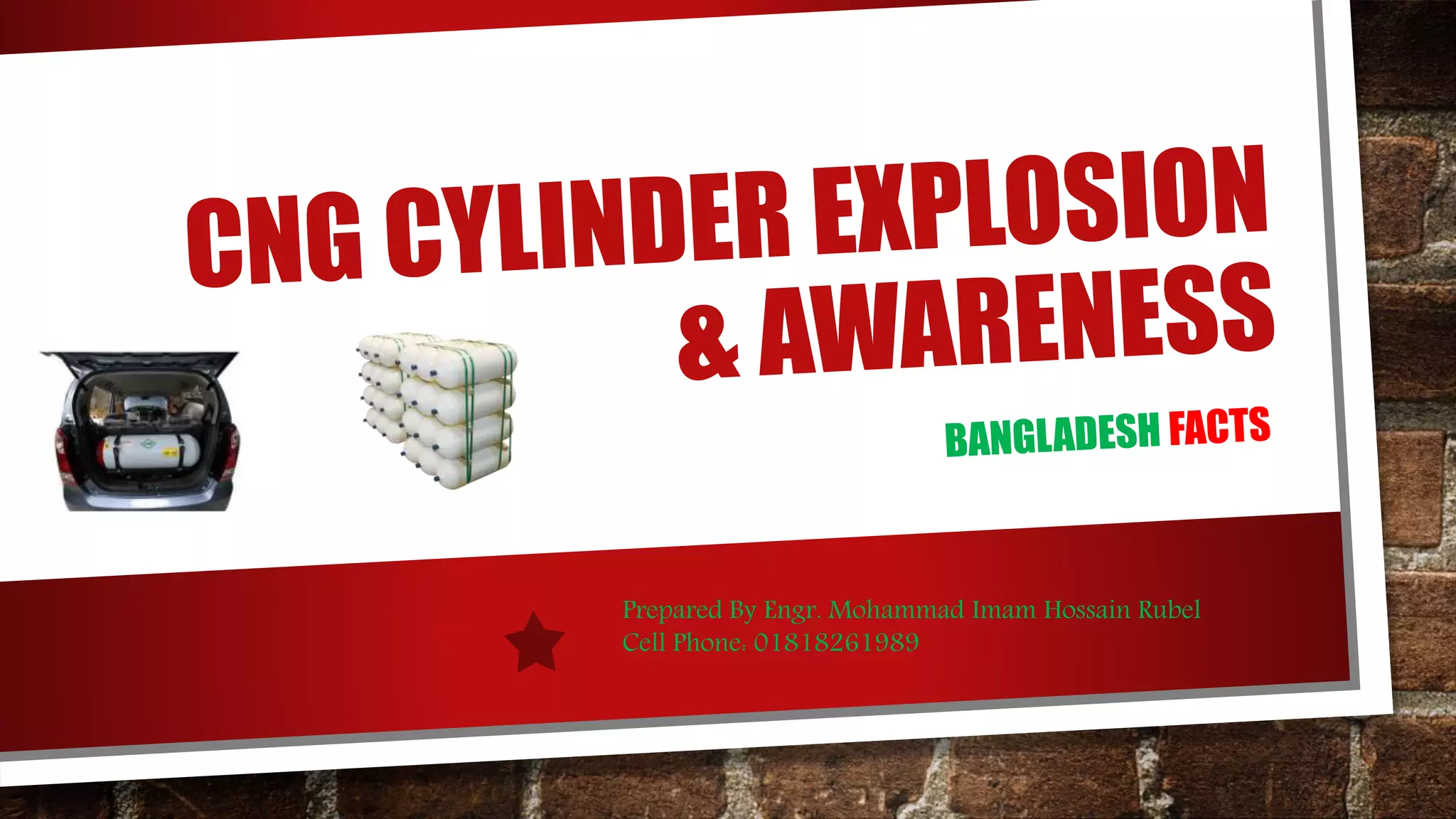
Prepared By Engr. Mohammad Imam Hossain Rubel
Cell Phone: 01818261989
A gas cylinder is a pressure vessel or storage and containment of gases at above atmospheric pressure. High-
pressure gas cylinders are also called bottles. Inside the cylinder the stored contents may be in a state of
compressed gas, vapor over liquid, supercritical fluid, or dissolved in a substrate material, depending on the
physical characteristics of the contents. A typical gas cylinder design is elongated, standing upright on a
flattened bottom end, with the valve and fitting at the top for connecting to the receiving apparatus. Filling
pressure of CNG in the vehicle cylinder is limited to 200 bar. This high pressure reduces the volume of the
natural gas to less than 1% of its volume at standard atmospheric pressure.
CNG or Compressed Natural Gas is a fossil fuel substitute for petrol, diesel, or LPG
Periodically Cylinder retesting is mandatory by law. A government
notification issued on March 1, 2005 under The Explosive Act, 1884
introduced CNG Rules 2005. Under this rules it is mandatory to retest the
cylinder periodically after every five years.
Source: The Daily Star, August 31, 2008
 Expired CNG Cylinder Using.
 Different Gas Cylinder Using for CNG (using oxygen cylinders,
acetylene gas cylinders, rejected cylinders and counterfeit
cylinders to save money)
 Overpressure CNG Filling ( Govt. Standard 200 bars )
 Periodically not retesting /Checking as per rule ( After 5 Years date
of manufacturing and then as per retest certificate)
 Substandard cylinders are often made from metal electric poles,
cylinders of fire extinguishers, oxygen cylinders, and some other
kind of unauthorized materials.
TYPES OF CNG CYLINDER
CNG TUBES TRAILERS USE FOUR MAJOR TYPES OF CNG TUBES. THE TYPES INCLUDE
CNG-1, CNG-2, CNG-3, AND CNG-4. THE QUALITY AND NUMBER OF FILAMENTS VARY ACROSS THE FOUR TYPES.
THE HIGHER THE NUMBER OF CNG TUBE, THE LIGHTER THE QUALITY, THE MORE THE FILAMENT, AND THE HARDER THE MANUFACTURING
PROCESS. BELOW IS A DESCRIPTION OF THE MATERIALS USED TO MAKE EACH OF THESE MODELS OF CNG TUBES. (ISO 11439 CLEARLY DEFINES 4
CATEGORIES OF CYLINDERS )
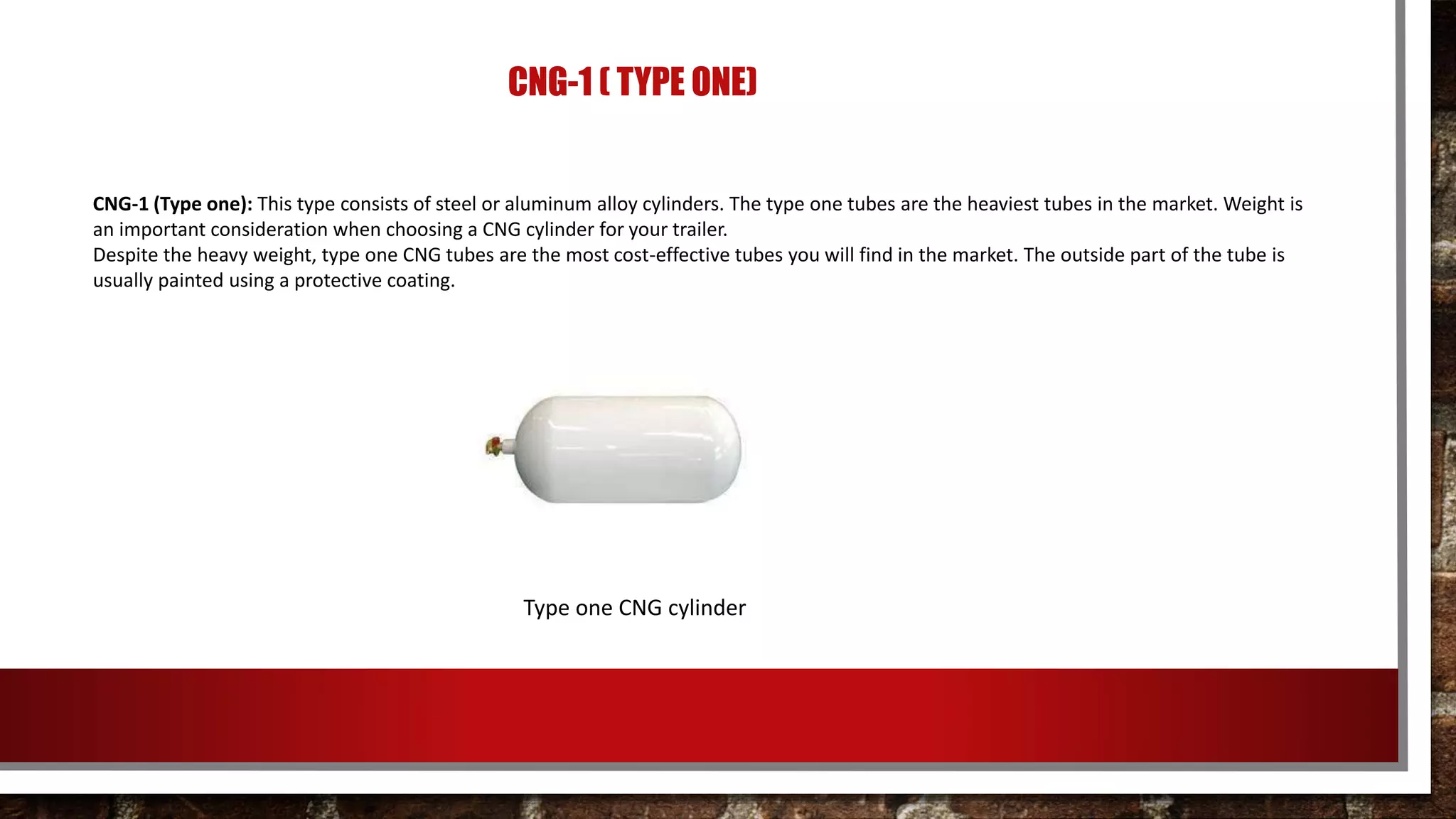
CNG-1 ( TYPE ONE)
CNG-1 (Type one): This type consists of steel or aluminum alloy cylinders. The type one tubes are the heaviest tubes in the market. Weight is
an important consideration when choosing a CNG cylinder for your trailer.
Despite the heavy weight, type one CNG tubes are the most cost-effective tubes you will find in the market. The outside part of the tube is
usually painted using a protective coating.
Type one CNG cylinder
CNG-2 (TYPE TWO)
THE MODEL HAS FILAMENT WOUND COMPOSITE GAS CYLINDERS. THE INNER PART IS MADE OF STEEL OR ALUMINUM WHILE THE BODY THE
TUBE WITHOUT THE HEADS IS WRAPPED USING LONG FIBERS IMPREGNATED WITH A RESIN.
A COMPOSITE MATERIAL WRAPPER IS IN MOST CASES TO WRAP THE METAL LINER ON THE MIDDLE SECTION OF THE CYLINDER. THE
COMPOSITE MATERIAL WRAPPER CONSISTS OF WOVEN CARBON FIBER OR WOVEN CARBON FIBER OR BOTH.
TYPE TWO CYLINDERS USE LESS METAL AND LIGHTER COMPOSITE MATERIALS. HENCE, THEY ARE LIGHTER THAN THE TYPE ONE CYLINDERS.
CNG-2 TUBES ARE MORE EXPENSIVE THAN CNG-1 TUBES.
Type two CNG cylinder
CNG-3 (TYPE THREE)
THIS TYPE ALSO HAS FILAMENT WOUND COMPOSITE GAS CYLINDERS. SIMILAR TO THE TYPE TWO CYLINDERS, THE INNER PART OF THE TUBE IS
MADE OF STEEL OR ALUMINUM.
THE TUBE BODY INCLUDING THE HEADS IS WRAPPED BUT LONG FIBERS IMPREGNATED WITH RESIN. A CNG-3 TANK IS SOMETIMES REFERRED TO AS
A FULLY WRAPPED OR FULL WRAPPED TANK.
THE LONG FIBERS USED TO FULLY WRAP THE BODY AND HEAD OF THE TYPE THREE TUBE MAY BE WOVEN CARBON FIBER OR WOVEN GLASS FIBER.
TYPE THREE CNG TUBES ARE LIGHTER THAN THE TYPE ONE AND TYPE TWO TUBES.
HENCE, THEY ARE MORE EXPENSIVE THAN TYPE ONE AND TWO TUBES. CGN-3 AND THE CNG-4 TUBES DESCRIBED BELOW ARE THE BEST CHOICES IF
YOU ARE LOOKING FOR LIGHT CNG CYLINDERS.
Type 3 CNG tubes
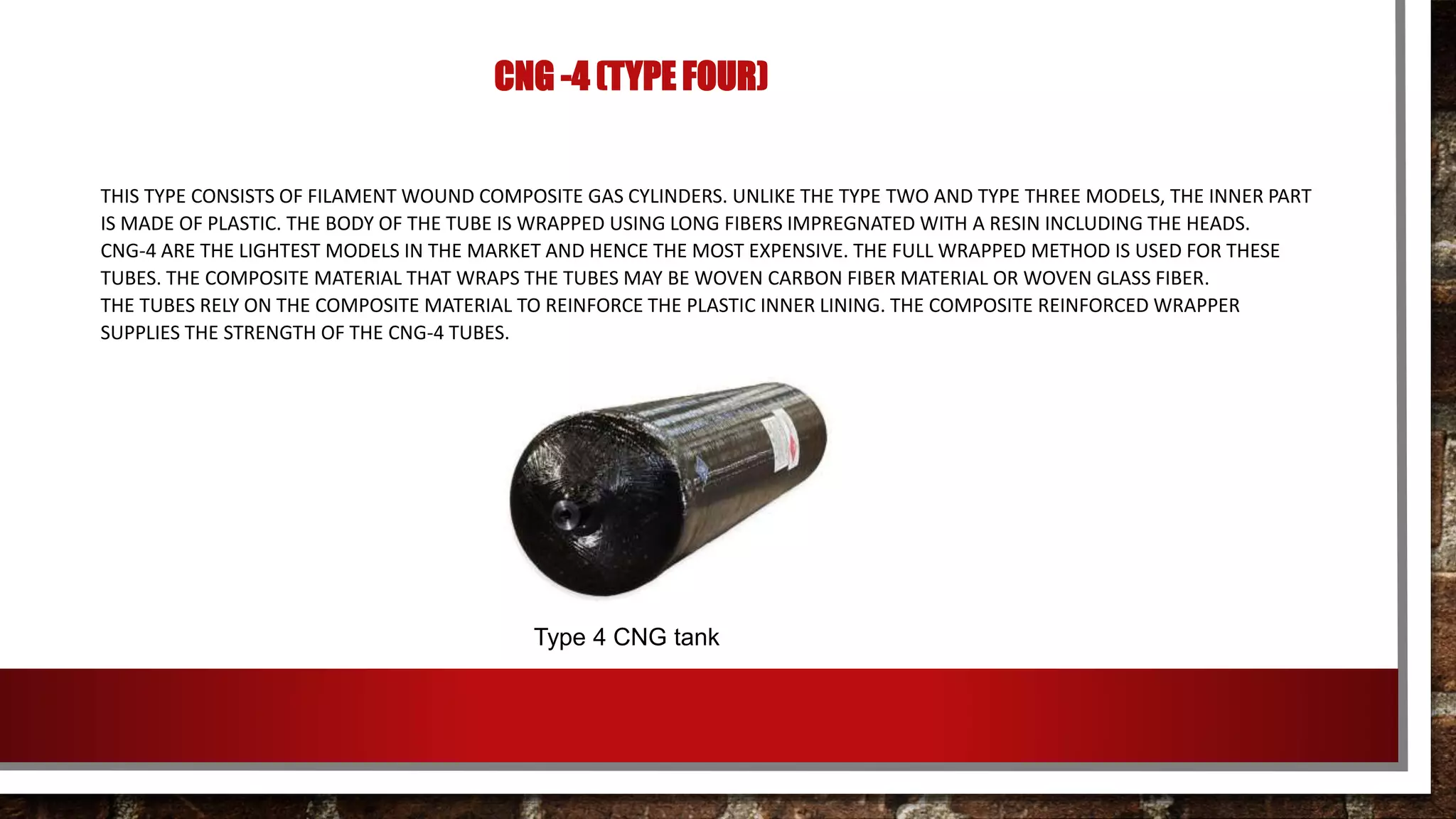
CNG -4 (TYPE FOUR)
THIS TYPE CONSISTS OF FILAMENT WOUND COMPOSITE GAS CYLINDERS. UNLIKE THE TYPE TWO AND TYPE THREE MODELS, THE INNER PART
IS MADE OF PLASTIC. THE BODY OF THE TUBE IS WRAPPED USING LONG FIBERS IMPREGNATED WITH A RESIN INCLUDING THE HEADS.
CNG-4 ARE THE LIGHTEST MODELS IN THE MARKET AND HENCE THE MOST EXPENSIVE. THE FULL WRAPPED METHOD IS USED FOR THESE
TUBES. THE COMPOSITE MATERIAL THAT WRAPS THE TUBES MAY BE WOVEN CARBON FIBER MATERIAL OR WOVEN GLASS FIBER.
THE TUBES RELY ON THE COMPOSITE MATERIAL TO REINFORCE THE PLASTIC INNER LINING. THE COMPOSITE REINFORCED WRAPPER
SUPPLIES THE STRENGTH OF THE CNG-4 TUBES.
Type 4 CNG tank
THE MANUFACTURING PROCESS OF THE CNG-1 (TYPE ONE)
1. STEEL TUBE INSPECTION
2. HOT SHELL NOSING
3. BOTTLE NECK CUTTING
4. ROUGH MACHINING
5. QUENCHING, HEAT TREATMENT, AND TEMPERING
6. OUTSIDE POLISHING
7. HYDROSTATIC TESTING
8. STEAM DRYING
9. INNER SHOT PEENING
10. INNER TUBE INSPECTION
11. NON-DESTRUCTIVE AND AIR TIGHT TESTING
12. PAINT SPRAYING AND ASSEMBLY
DATA OF CNG DRIVEN VEHICLES AND CNG CASCADE
Source: RPGCL Monthly MIS Report, March, 2018
Note: Off the record the number of Converted vehicles will be higher
and approximately 7, 00,000 numbers Cylinder are using for CNG
purpose.
SL. NO ITEMS QUANTITY
01 Total CNG Driven Vehicle 5,03,749
Total CNG Converted Vehicle 2,70,124
CNG Three wheeler 1,93,242
Imported CNG Converted Vehicles 40,383
02 Total CNG Refueling Station/Cascade 540 Units (10,800 ANC)
03 Industrial Used (PRS) 5,000 ANC
DURATION OF CNG DRIVEN VEHICLE
Source: RPGCL Monthly MIS Report, March, 2018
Financial
Year
Total Converted
vehicle
Total CNG driven
vehicle
Duration of Cyl. Using
(Year)
1983-2000 1379 1379 20+
2000-2001 839 839 19+
2001-2002 4516 4516 18+
2002-2003 188 10571 17+
2003-2004 8575 9308 16+
2004-2005 10135 10525 15+
2005-2006 26023 38313 14+
2006-2007 25974 38454 13+
2007-2008 22718 24082 12+
2008-2009 24516 26141 11+
2009-2010 28676 29574 10+
2010-2011 13343 13476 9+
2011-2012 5792 5881 8+
2012-2013 4382 4389 7+
2013-2014 6487 6487 6+
2014-2015 37368 35115 5+
2015-2016 32289 34542 4+
2016-2017 10916 2,04,158 3+
2017-2018 4054 4054 2+
2018-2019 2500 (E) 2500 (E) 1+
CNG CYLINDER RETESTING FACILITY
Source: RPGCL Monthly MIS Report, March, 2018
SL
NO
COMPANY NAME LOCATION
1 NAVANA CNG LIMITED DHAKA, CHATTOGRAM
2 SOUTHERN AUTOMOBILES LIMITED DHAKA, CTG, SYLHET
3 INTRACO CNG LIMTED DHAKA, CHATTOGRAM
4 SANJI AUTOMOBILES LIMITED DHAKA, CHATTOGRAM
5 ANUDIP MOTORS LIMITED DHAKA
6 RPGCL DHAKA
7 TMSS BOGURA
8 Others 10+ Dhaka & Out of Dhaka
There are about 22 Cylinder Retesting Centre available in all over
Bangladesh
AWARENESS OF CNG CYLINDER USES
A) USE ONLY THE APPROVED BRANDS, IMPORTED, SEAMLESS BRAND NEW CNG CYLINDERS MANUFACTURED AS PER NZS 5454-1989
STANDARD AND SATISFY THEMSELVES ABOUT THEIR GENUINENESS AND FITNESS BEFORE PURCHASING/ INSTALLING IT FROM
THE AUTHORIZED/ LICENSED CNG STATIONS.
B) LPG, OXYGEN, NITROGEN, ACETYLENE CYLINDERS ARE NOT MEANT FOR CNG USE. NEVER USE THESE CYLINDERS AS THEY CANNOT
WITHSTAND CNG PRESSURE OF 200 BARS AND THEREFORE WILL EXPLODE CAUSING LOSS OF LIFE AND PROPERTY.
C) NEVER INSTALL CNG KIT/ CYLINDER IN THE VEHICLE FROM ANY UN-AUTHORIZED ROAD-SIDE CONVERSION WORKSHOP/ OUTLET.
D) NEVER INSTALL A CYLINDER WHICH HAS BEEN FABRICATED BY JOINING TWO HALVES BY MEANS OF MALE AND FEMALE THREADS OR
WELDED AS ONLY SEAMLESS VEHICLE CYLINDERS ARE USED FOR CNG.
E) NEVER INSTALL A USED CYLINDER WHICH HAS BEEN BURNT/ DAMAGED DURING RIOTS OR OTHER TERRORIST ACTIVITIES. SUCH CYLINDER
IS WEAKENED AND MAY LEAD TO SERIOUS ACCIDENTS RESULTING IN LOSS OF PRECIOUS LIVES.
ALL VEHICLE OWNERS ARE, THEREFORE, INFORMED FOR THEIR OWN SAFETY AND INTEREST THAT THEY SHOULD:
AWARENESS OF CNG CYLINDER USES
F) NEVER ASK FOR REFUELING BEYOND THE ALLOWABLE MAXIMUM PRESSURE OF 200 BARS UNDER ANY CIRCUMSTANCES. IN CASE ANY CNG
STATION IS FOUND DISPENSING CNG AT EXCESS PRESSURE, IT MAY BE REPORTED TO RPGCL FOR STRICT ACTION AGAINST THE STATION TO
ENSURE PUBLIC SAFETY.
G) COOPERATE WITH THE CNG STATION REFUELING STAFF FOR INSPECTION OF THE VEHICLE CYLINDER AT THE TIME OF REFUELING FOR YOUR
OWN AS WELL AS PUBLIC SAFETY.
H) GET CNG CYLINDER TEST CERTIFICATE FROM THE CNG LICENSEE AFTER CONVERSION OF VEHICLE TO CNG.
I) GET VEHICLE’S CNG SYSTEM INSPECTED AT LEAST ONCE IN A YEAR FROM A TRAINED PERSONNEL AVAILABLE AT CNG STATIONS FOR
EXAMINATION OF THE CYLINDER, PIPING, CNG KIT, ALL COMPONENTS, LEAKAGE TESTING AS WELL AS PERFORMANCE OF THE CNG SYSTEM
TO ENSURE ITS SAFE OPERATION;
J) DO NOT SMOKE AND STAY INSIDE VEHICLES DURING REFUELING IN THE VEHICLE.
K) ENSURE THAT THE CNG CYLINDER INSTALLED IN THE VEHICLE IS WITHIN THE PERIODIC TEST LIFE, WHICH IS 5 YEARS.
FILLING AMOUNT OF CNG CHANGES
If ambient temperature goes up or down, pressure also correspondingly goes up or down.
CNG is typically stored at 3,600 psi at 70ºF. During fast filling, CNG heats up as it compresses into the tanks.
Example: On a 70ºF day you fill your NGV to full at fast fill station.
You fill to 3,600 psi at an elevated temperature (say 100ºF) in the tanks.
As the CNG cools back down to ambient of 70º the pressure of gas decreases.
Your end result is less gas - instead of filling at 3,600 psi you may only have filled to 3,400 psi.
You are more likely to get a more full fill on colder days than on warmer days.
CYLINDER COLOR CODING
CNG Cylinder Explosion & Awareness

CNG Cylinder Explosion & Awareness

  • 1.
    Prepared By Engr.Mohammad Imam Hossain Rubel Cell Phone: 01818261989
  • 2.
    A gas cylinderis a pressure vessel or storage and containment of gases at above atmospheric pressure. High- pressure gas cylinders are also called bottles. Inside the cylinder the stored contents may be in a state of compressed gas, vapor over liquid, supercritical fluid, or dissolved in a substrate material, depending on the physical characteristics of the contents. A typical gas cylinder design is elongated, standing upright on a flattened bottom end, with the valve and fitting at the top for connecting to the receiving apparatus. Filling pressure of CNG in the vehicle cylinder is limited to 200 bar. This high pressure reduces the volume of the natural gas to less than 1% of its volume at standard atmospheric pressure. CNG or Compressed Natural Gas is a fossil fuel substitute for petrol, diesel, or LPG
  • 3.
    Periodically Cylinder retestingis mandatory by law. A government notification issued on March 1, 2005 under The Explosive Act, 1884 introduced CNG Rules 2005. Under this rules it is mandatory to retest the cylinder periodically after every five years. Source: The Daily Star, August 31, 2008
  • 4.
     Expired CNGCylinder Using.  Different Gas Cylinder Using for CNG (using oxygen cylinders, acetylene gas cylinders, rejected cylinders and counterfeit cylinders to save money)  Overpressure CNG Filling ( Govt. Standard 200 bars )  Periodically not retesting /Checking as per rule ( After 5 Years date of manufacturing and then as per retest certificate)  Substandard cylinders are often made from metal electric poles, cylinders of fire extinguishers, oxygen cylinders, and some other kind of unauthorized materials.
  • 5.
    TYPES OF CNGCYLINDER CNG TUBES TRAILERS USE FOUR MAJOR TYPES OF CNG TUBES. THE TYPES INCLUDE CNG-1, CNG-2, CNG-3, AND CNG-4. THE QUALITY AND NUMBER OF FILAMENTS VARY ACROSS THE FOUR TYPES. THE HIGHER THE NUMBER OF CNG TUBE, THE LIGHTER THE QUALITY, THE MORE THE FILAMENT, AND THE HARDER THE MANUFACTURING PROCESS. BELOW IS A DESCRIPTION OF THE MATERIALS USED TO MAKE EACH OF THESE MODELS OF CNG TUBES. (ISO 11439 CLEARLY DEFINES 4 CATEGORIES OF CYLINDERS )
  • 6.
    CNG-1 ( TYPEONE) CNG-1 (Type one): This type consists of steel or aluminum alloy cylinders. The type one tubes are the heaviest tubes in the market. Weight is an important consideration when choosing a CNG cylinder for your trailer. Despite the heavy weight, type one CNG tubes are the most cost-effective tubes you will find in the market. The outside part of the tube is usually painted using a protective coating. Type one CNG cylinder
  • 7.
    CNG-2 (TYPE TWO) THEMODEL HAS FILAMENT WOUND COMPOSITE GAS CYLINDERS. THE INNER PART IS MADE OF STEEL OR ALUMINUM WHILE THE BODY THE TUBE WITHOUT THE HEADS IS WRAPPED USING LONG FIBERS IMPREGNATED WITH A RESIN. A COMPOSITE MATERIAL WRAPPER IS IN MOST CASES TO WRAP THE METAL LINER ON THE MIDDLE SECTION OF THE CYLINDER. THE COMPOSITE MATERIAL WRAPPER CONSISTS OF WOVEN CARBON FIBER OR WOVEN CARBON FIBER OR BOTH. TYPE TWO CYLINDERS USE LESS METAL AND LIGHTER COMPOSITE MATERIALS. HENCE, THEY ARE LIGHTER THAN THE TYPE ONE CYLINDERS. CNG-2 TUBES ARE MORE EXPENSIVE THAN CNG-1 TUBES. Type two CNG cylinder
  • 8.
    CNG-3 (TYPE THREE) THISTYPE ALSO HAS FILAMENT WOUND COMPOSITE GAS CYLINDERS. SIMILAR TO THE TYPE TWO CYLINDERS, THE INNER PART OF THE TUBE IS MADE OF STEEL OR ALUMINUM. THE TUBE BODY INCLUDING THE HEADS IS WRAPPED BUT LONG FIBERS IMPREGNATED WITH RESIN. A CNG-3 TANK IS SOMETIMES REFERRED TO AS A FULLY WRAPPED OR FULL WRAPPED TANK. THE LONG FIBERS USED TO FULLY WRAP THE BODY AND HEAD OF THE TYPE THREE TUBE MAY BE WOVEN CARBON FIBER OR WOVEN GLASS FIBER. TYPE THREE CNG TUBES ARE LIGHTER THAN THE TYPE ONE AND TYPE TWO TUBES. HENCE, THEY ARE MORE EXPENSIVE THAN TYPE ONE AND TWO TUBES. CGN-3 AND THE CNG-4 TUBES DESCRIBED BELOW ARE THE BEST CHOICES IF YOU ARE LOOKING FOR LIGHT CNG CYLINDERS. Type 3 CNG tubes
  • 9.
    CNG -4 (TYPEFOUR) THIS TYPE CONSISTS OF FILAMENT WOUND COMPOSITE GAS CYLINDERS. UNLIKE THE TYPE TWO AND TYPE THREE MODELS, THE INNER PART IS MADE OF PLASTIC. THE BODY OF THE TUBE IS WRAPPED USING LONG FIBERS IMPREGNATED WITH A RESIN INCLUDING THE HEADS. CNG-4 ARE THE LIGHTEST MODELS IN THE MARKET AND HENCE THE MOST EXPENSIVE. THE FULL WRAPPED METHOD IS USED FOR THESE TUBES. THE COMPOSITE MATERIAL THAT WRAPS THE TUBES MAY BE WOVEN CARBON FIBER MATERIAL OR WOVEN GLASS FIBER. THE TUBES RELY ON THE COMPOSITE MATERIAL TO REINFORCE THE PLASTIC INNER LINING. THE COMPOSITE REINFORCED WRAPPER SUPPLIES THE STRENGTH OF THE CNG-4 TUBES. Type 4 CNG tank
  • 10.
    THE MANUFACTURING PROCESSOF THE CNG-1 (TYPE ONE) 1. STEEL TUBE INSPECTION 2. HOT SHELL NOSING 3. BOTTLE NECK CUTTING 4. ROUGH MACHINING 5. QUENCHING, HEAT TREATMENT, AND TEMPERING 6. OUTSIDE POLISHING 7. HYDROSTATIC TESTING 8. STEAM DRYING 9. INNER SHOT PEENING 10. INNER TUBE INSPECTION 11. NON-DESTRUCTIVE AND AIR TIGHT TESTING 12. PAINT SPRAYING AND ASSEMBLY
  • 12.
    DATA OF CNGDRIVEN VEHICLES AND CNG CASCADE Source: RPGCL Monthly MIS Report, March, 2018 Note: Off the record the number of Converted vehicles will be higher and approximately 7, 00,000 numbers Cylinder are using for CNG purpose. SL. NO ITEMS QUANTITY 01 Total CNG Driven Vehicle 5,03,749 Total CNG Converted Vehicle 2,70,124 CNG Three wheeler 1,93,242 Imported CNG Converted Vehicles 40,383 02 Total CNG Refueling Station/Cascade 540 Units (10,800 ANC) 03 Industrial Used (PRS) 5,000 ANC
  • 13.
    DURATION OF CNGDRIVEN VEHICLE Source: RPGCL Monthly MIS Report, March, 2018 Financial Year Total Converted vehicle Total CNG driven vehicle Duration of Cyl. Using (Year) 1983-2000 1379 1379 20+ 2000-2001 839 839 19+ 2001-2002 4516 4516 18+ 2002-2003 188 10571 17+ 2003-2004 8575 9308 16+ 2004-2005 10135 10525 15+ 2005-2006 26023 38313 14+ 2006-2007 25974 38454 13+ 2007-2008 22718 24082 12+ 2008-2009 24516 26141 11+ 2009-2010 28676 29574 10+ 2010-2011 13343 13476 9+ 2011-2012 5792 5881 8+ 2012-2013 4382 4389 7+ 2013-2014 6487 6487 6+ 2014-2015 37368 35115 5+ 2015-2016 32289 34542 4+ 2016-2017 10916 2,04,158 3+ 2017-2018 4054 4054 2+ 2018-2019 2500 (E) 2500 (E) 1+
  • 14.
    CNG CYLINDER RETESTINGFACILITY Source: RPGCL Monthly MIS Report, March, 2018 SL NO COMPANY NAME LOCATION 1 NAVANA CNG LIMITED DHAKA, CHATTOGRAM 2 SOUTHERN AUTOMOBILES LIMITED DHAKA, CTG, SYLHET 3 INTRACO CNG LIMTED DHAKA, CHATTOGRAM 4 SANJI AUTOMOBILES LIMITED DHAKA, CHATTOGRAM 5 ANUDIP MOTORS LIMITED DHAKA 6 RPGCL DHAKA 7 TMSS BOGURA 8 Others 10+ Dhaka & Out of Dhaka There are about 22 Cylinder Retesting Centre available in all over Bangladesh
  • 16.
    AWARENESS OF CNGCYLINDER USES A) USE ONLY THE APPROVED BRANDS, IMPORTED, SEAMLESS BRAND NEW CNG CYLINDERS MANUFACTURED AS PER NZS 5454-1989 STANDARD AND SATISFY THEMSELVES ABOUT THEIR GENUINENESS AND FITNESS BEFORE PURCHASING/ INSTALLING IT FROM THE AUTHORIZED/ LICENSED CNG STATIONS. B) LPG, OXYGEN, NITROGEN, ACETYLENE CYLINDERS ARE NOT MEANT FOR CNG USE. NEVER USE THESE CYLINDERS AS THEY CANNOT WITHSTAND CNG PRESSURE OF 200 BARS AND THEREFORE WILL EXPLODE CAUSING LOSS OF LIFE AND PROPERTY. C) NEVER INSTALL CNG KIT/ CYLINDER IN THE VEHICLE FROM ANY UN-AUTHORIZED ROAD-SIDE CONVERSION WORKSHOP/ OUTLET. D) NEVER INSTALL A CYLINDER WHICH HAS BEEN FABRICATED BY JOINING TWO HALVES BY MEANS OF MALE AND FEMALE THREADS OR WELDED AS ONLY SEAMLESS VEHICLE CYLINDERS ARE USED FOR CNG. E) NEVER INSTALL A USED CYLINDER WHICH HAS BEEN BURNT/ DAMAGED DURING RIOTS OR OTHER TERRORIST ACTIVITIES. SUCH CYLINDER IS WEAKENED AND MAY LEAD TO SERIOUS ACCIDENTS RESULTING IN LOSS OF PRECIOUS LIVES. ALL VEHICLE OWNERS ARE, THEREFORE, INFORMED FOR THEIR OWN SAFETY AND INTEREST THAT THEY SHOULD:
  • 17.
    AWARENESS OF CNGCYLINDER USES F) NEVER ASK FOR REFUELING BEYOND THE ALLOWABLE MAXIMUM PRESSURE OF 200 BARS UNDER ANY CIRCUMSTANCES. IN CASE ANY CNG STATION IS FOUND DISPENSING CNG AT EXCESS PRESSURE, IT MAY BE REPORTED TO RPGCL FOR STRICT ACTION AGAINST THE STATION TO ENSURE PUBLIC SAFETY. G) COOPERATE WITH THE CNG STATION REFUELING STAFF FOR INSPECTION OF THE VEHICLE CYLINDER AT THE TIME OF REFUELING FOR YOUR OWN AS WELL AS PUBLIC SAFETY. H) GET CNG CYLINDER TEST CERTIFICATE FROM THE CNG LICENSEE AFTER CONVERSION OF VEHICLE TO CNG. I) GET VEHICLE’S CNG SYSTEM INSPECTED AT LEAST ONCE IN A YEAR FROM A TRAINED PERSONNEL AVAILABLE AT CNG STATIONS FOR EXAMINATION OF THE CYLINDER, PIPING, CNG KIT, ALL COMPONENTS, LEAKAGE TESTING AS WELL AS PERFORMANCE OF THE CNG SYSTEM TO ENSURE ITS SAFE OPERATION; J) DO NOT SMOKE AND STAY INSIDE VEHICLES DURING REFUELING IN THE VEHICLE. K) ENSURE THAT THE CNG CYLINDER INSTALLED IN THE VEHICLE IS WITHIN THE PERIODIC TEST LIFE, WHICH IS 5 YEARS.
  • 18.
    FILLING AMOUNT OFCNG CHANGES If ambient temperature goes up or down, pressure also correspondingly goes up or down. CNG is typically stored at 3,600 psi at 70ºF. During fast filling, CNG heats up as it compresses into the tanks. Example: On a 70ºF day you fill your NGV to full at fast fill station. You fill to 3,600 psi at an elevated temperature (say 100ºF) in the tanks. As the CNG cools back down to ambient of 70º the pressure of gas decreases. Your end result is less gas - instead of filling at 3,600 psi you may only have filled to 3,400 psi. You are more likely to get a more full fill on colder days than on warmer days.
  • 19.