Today in Science
You will Need:
1)Pencil, Colored Pencils, Highlighters or
Markers
2)Power Notes – Atomic Structure– 2
page 3 sides-Bookshelf- Please Staple
Topic:
Power Notes- Atomic
Structure


Do we understand
everything????
Democritus 400 BC                      • 1st idea of “atoms”
              Greece - stated that
              all matter is made up
                                       • Believed all matter is made
              of atoms.  He also
              stated that atoms are      up of tiny particles separated
              eternal and invisible
              and so small that
              they can’t be divided,
                                         by space
              and they entirely fill
              up the space they’re
                                       • Called particles “atomos”
              in
                                         which means indivisible.

Lavoisier 1789                         • Founder of modern
                                         chemistry
          France - provided the
          formula for the
          conservation of matter
                                       • 1st carefully controlled
          in chemical reactions,
          and also distinguished         experiments providing
          between an element
          and a compound                 evidence to the Law of
                                         Conservation of Mass
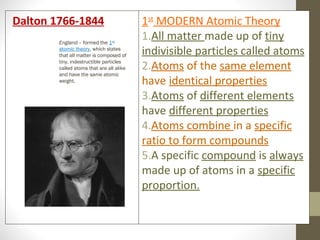
Dalton 1766-1844                          1st MODERN Atomic Theory
        England - formed the 1st
                                          1.All matter made up of tiny
        atomic theory, which states
        that all matter is composed of    indivisible particles called atoms
        tiny, indestructible particles
        called atoms that are all alike   2.Atoms of the same element
        and have the same atomic
        weight.                           have identical properties
                                          3.Atoms of different elements
                                          have different properties
                                          4.Atoms combine in a specific
                                          ratio to form compounds
                                          5.A specific compound is always
                                          made up of atoms in a specific
                                          proportion.
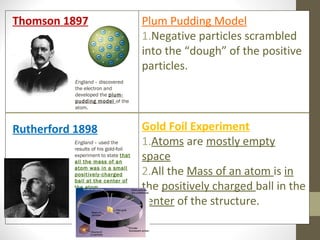
Thomson 1897                         Plum Pudding Model
                                     1.Negative particles scrambled
                                     into the “dough” of the positive
                                     particles.
           England - discovered
           the electron and
           developed the plum-
           pudding model of the
           atom.


Rutherford 1898                      Gold Foil Experiment
          England - used the
          results of his gold-foil
                                     1.Atoms are mostly empty
          experiment to state that
          all the mass of an
                                     space
          atom was in a small
          positively-charged         2.All the Mass of an atom is in
          ball at the center of
          the atom.                  the positively charged ball in the
                                     center of the structure.
Rutherford Continued


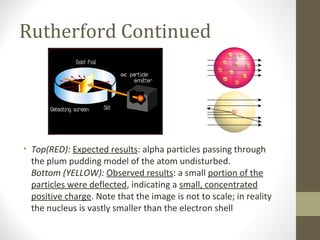
• Top(RED): Expected results: alpha particles passing through
  the plum pudding model of the atom undisturbed.
  Bottom (YELLOW): Observed results: a small portion of the
  particles were deflected, indicating a small, concentrated
  positive charge. Note that the image is not to scale; in reality
  the nucleus is vastly smaller than the electron shell
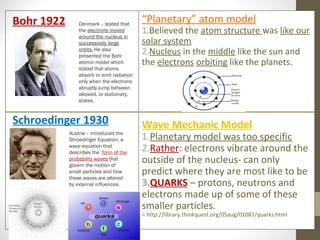
Bohr 1922       Denmark - stated that
                                           “Planetary” atom model
                the electrons moved        1.Believed the atom structure was like our
                around the nucleus in
                successively large         solar system
                orbits. He also
                presented the Bohr
                                           2.Nucleus in the middle like the sun and
                atomic model which         the electrons orbiting like the planets.
                stated that atoms
                absorb or emit radiation
                only when the electrons
                abruptly jump between
                allowed, or stationary,
                states. 


Schroedinger 1930                          Wave Mechanic Model
            Austria - introduced the
            Shroedinger Equation, a        1.Planetary model was too specific
            wave equation that
            describes the  form of the
                                           2.Rather: electrons vibrate around the
            probability waves that
            govern the motion of
                                           outside of the nucleus- can only
            small particles and how
            these waves are altered
                                           predict where they are most like to be
            by external influences.        3.QUARKS – protons, neutrons and
                                           electrons made up of some of these
                                           smaller particles.
                                           4.http://library.thinkquest.org/05aug/01087/quarks.html
Basic Atomic Structure               Today scientist agree on the
                                     three basic subatomic particles
                                     that make up all atoms.
Bohr Model for Lithium
(not to scale)                                               Electron = 3


                                                   P= 3 +
                                                   N = 3 0


Where is most of the mass in the     NUCLEUS
Atom?

Where is most of the volume in the   Outside the Nucleus; Electron
Atom?
                                     Cloud
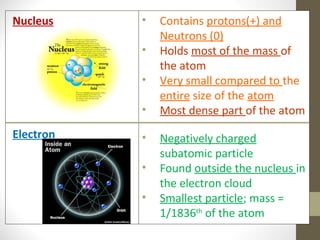
Nucleus    •   Contains protons(+) and
               Neutrons (0)
           •   Holds most of the mass of
               the atom
           •   Very small compared to the
               entire size of the atom
           •   Most dense part of the atom
Electron   •   Negatively charged
               subatomic particle
           •   Found outside the nucleus in
               the electron cloud
           •   Smallest particle; mass =
               1/1836th of the atom
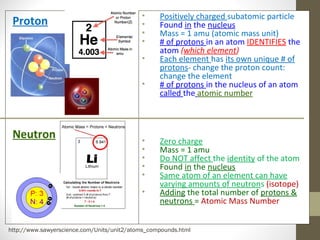
•     Positively charged subatomic particle
 Proton                                     •     Found in the nucleus
                                            •     Mass = 1 amu (atomic mass unit)
                                            •     # of protons in an atom IDENTIFIES the
                                                  atom (which element)
                                            •     Each element has its own unique # of
                                                  protons- change the proton count:
                                                  change the element
                                            •     # of protons in the nucleus of an atom
                                                  called the atomic number


 Neutron                                    •     Zero charge
                                            •     Mass = 1 amu
                                            •     Do NOT affect the identity of the atom
                                            •     Found in the nucleus
                                            •     Same atom of an element can have
                                                  varying amounts of neutrons (isotope)
                                            •     Adding the total number of protons &
                                                  neutrons = Atomic Mass Number


http://www.sawyerscience.com/Units/unit2/atoms_compounds.html
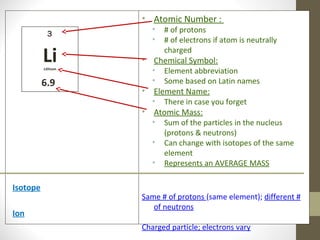
• Atomic Number :
                        •   # of protons
           3
                        •   # of electrons if atom is neutrally

          Li        •
                            charged
                       Chemical Symbol:
          Lithium
                      • Element abbreviation
          6.9         • Some based on Latin names
                    • Element Name:
                      • There in case you forget
                    • Atomic Mass:
                      • Sum of the particles in the nucleus
                         (protons & neutrons)
                      • Can change with isotopes of the same
                         element
                      • Represents an AVERAGE MASS

Isotope
                    Same # of protons (same element); different #
                       of neutrons
Ion
                    Charged particle; electrons vary
Homework
 1)Complete Power Notes– Due Monday
  at the end of the period.

Power Notes - Atomic Structure 2013

  • 1.
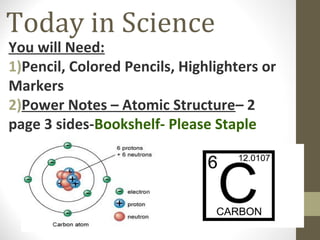
    Today in Science Youwill Need: 1)Pencil, Colored Pencils, Highlighters or Markers 2)Power Notes – Atomic Structure– 2 page 3 sides-Bookshelf- Please Staple
  • 2.
    Topic: Power Notes- Atomic Structure Dowe understand everything????
  • 3.
    Democritus 400 BC • 1st idea of “atoms” Greece - stated that all matter is made up • Believed all matter is made of atoms.  He also stated that atoms are up of tiny particles separated eternal and invisible and so small that they can’t be divided, by space and they entirely fill up the space they’re • Called particles “atomos” in which means indivisible. Lavoisier 1789 • Founder of modern chemistry France - provided the formula for the conservation of matter • 1st carefully controlled in chemical reactions, and also distinguished experiments providing between an element and a compound evidence to the Law of Conservation of Mass
  • 4.
    Dalton 1766-1844 1st MODERN Atomic Theory England - formed the 1st 1.All matter made up of tiny atomic theory, which states that all matter is composed of indivisible particles called atoms tiny, indestructible particles called atoms that are all alike 2.Atoms of the same element and have the same atomic weight.  have identical properties 3.Atoms of different elements have different properties 4.Atoms combine in a specific ratio to form compounds 5.A specific compound is always made up of atoms in a specific proportion.
  • 5.
    Thomson 1897 Plum Pudding Model 1.Negative particles scrambled into the “dough” of the positive particles. England - discovered the electron and developed the plum- pudding model of the atom. Rutherford 1898 Gold Foil Experiment England - used the results of his gold-foil 1.Atoms are mostly empty experiment to state that all the mass of an space atom was in a small positively-charged 2.All the Mass of an atom is in ball at the center of the atom.  the positively charged ball in the center of the structure.
  • 6.
    Rutherford Continued • Top(RED):Expected results: alpha particles passing through the plum pudding model of the atom undisturbed. Bottom (YELLOW): Observed results: a small portion of the particles were deflected, indicating a small, concentrated positive charge. Note that the image is not to scale; in reality the nucleus is vastly smaller than the electron shell
  • 7.
    Bohr 1922 Denmark - stated that “Planetary” atom model the electrons moved 1.Believed the atom structure was like our around the nucleus in successively large solar system orbits. He also presented the Bohr 2.Nucleus in the middle like the sun and atomic model which the electrons orbiting like the planets. stated that atoms absorb or emit radiation only when the electrons abruptly jump between allowed, or stationary, states.  Schroedinger 1930 Wave Mechanic Model Austria - introduced the Shroedinger Equation, a 1.Planetary model was too specific wave equation that describes the  form of the 2.Rather: electrons vibrate around the probability waves that govern the motion of outside of the nucleus- can only small particles and how these waves are altered predict where they are most like to be by external influences. 3.QUARKS – protons, neutrons and electrons made up of some of these smaller particles. 4.http://library.thinkquest.org/05aug/01087/quarks.html
  • 8.
    Basic Atomic Structure Today scientist agree on the three basic subatomic particles that make up all atoms. Bohr Model for Lithium (not to scale) Electron = 3 P= 3 + N = 3 0 Where is most of the mass in the NUCLEUS Atom? Where is most of the volume in the Outside the Nucleus; Electron Atom? Cloud
  • 9.
    Nucleus • Contains protons(+) and Neutrons (0) • Holds most of the mass of the atom • Very small compared to the entire size of the atom • Most dense part of the atom Electron • Negatively charged subatomic particle • Found outside the nucleus in the electron cloud • Smallest particle; mass = 1/1836th of the atom
  • 10.
    Positively charged subatomic particle Proton • Found in the nucleus • Mass = 1 amu (atomic mass unit) • # of protons in an atom IDENTIFIES the atom (which element) • Each element has its own unique # of protons- change the proton count: change the element • # of protons in the nucleus of an atom called the atomic number Neutron • Zero charge • Mass = 1 amu • Do NOT affect the identity of the atom • Found in the nucleus • Same atom of an element can have varying amounts of neutrons (isotope) • Adding the total number of protons & neutrons = Atomic Mass Number http://www.sawyerscience.com/Units/unit2/atoms_compounds.html
  • 11.
    • Atomic Number: • # of protons 3 • # of electrons if atom is neutrally Li • charged Chemical Symbol: Lithium • Element abbreviation 6.9 • Some based on Latin names • Element Name: • There in case you forget • Atomic Mass: • Sum of the particles in the nucleus (protons & neutrons) • Can change with isotopes of the same element • Represents an AVERAGE MASS Isotope Same # of protons (same element); different # of neutrons Ion Charged particle; electrons vary
  • 12.
    Homework 1)Complete PowerNotes– Due Monday at the end of the period.